Menu
Search
Explore journals
Get published
About BioMed Central
Login to your account
Main menu
Home
About
Articles
Submission Guidelines
Research article
Open Access
Open Peer Review
This article has Open Peer Review reports available.
How does Open Peer Review work?
Reginald D Tucker-Seeley1, 2Email author,
Yi Li3, 4,
Glorian Sorensen1, 2 and
SV Subramanian2
BMC Public Health201111:313
DOI: 10.1186/1471-2458-11-313
© Tucker-Seeley et al; licensee BioMed Central Ltd. 2011
Lifecourse socioeconomic circumstances and multimorbidity
among olde...
http://bmcpublichealth.biomedcentral.com/articles/10.1186/147
1-2458-1...
1 of 25 10/18/2016 12:28 AM
Received: 6 December 2010
Accepted: 14 May 2011
Published: 14 May 2011
Open Peer Review reports
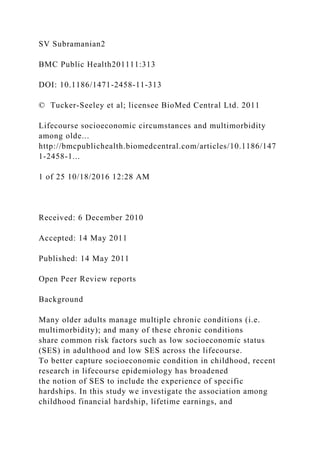
Background
Many older adults manage multiple chronic conditions (i.e.
multimorbidity); and many of these chronic conditions
share common risk factors such as low socioeconomic status
(SES) in adulthood and low SES across the lifecourse.
To better capture socioeconomic condition in childhood, recent
research in lifecourse epidemiology has broadened
the notion of SES to include the experience of specific
hardships. In this study we investigate the association among
childhood financial hardship, lifetime earnings, and
multimorbidity.
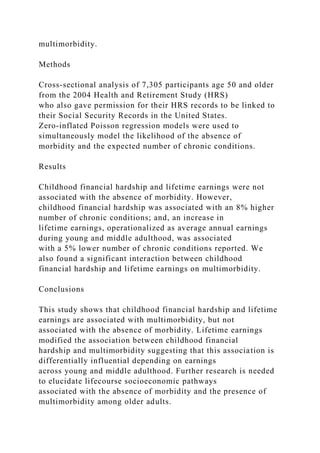
Methods
Cross-sectional analysis of 7,305 participants age 50 and older
from the 2004 Health and Retirement Study (HRS)
who also gave permission for their HRS records to be linked to
their Social Security Records in the United States.
Zero-inflated Poisson regression models were used to
simultaneously model the likelihood of the absence of
morbidity and the expected number of chronic conditions.
Results
Childhood financial hardship and lifetime earnings were not
associated with the absence of morbidity. However,
childhood financial hardship was associated with an 8% higher
number of chronic conditions; and, an increase in
lifetime earnings, operationalized as average annual earnings
during young and middle adulthood, was associated
with a 5% lower number of chronic conditions reported. We
also found a significant interaction between childhood
financial hardship and lifetime earnings on multimorbidity.
Conclusions
This study shows that childhood financial hardship and lifetime
earnings are associated with multimorbidity, but not
associated with the absence of morbidity. Lifetime earnings
modified the association between childhood financial
hardship and multimorbidity suggesting that this association is
differentially influential depending on earnings
across young and middle adulthood. Further research is needed
to elucidate lifecourse socioeconomic pathways
associated with the absence of morbidity and the presence of
multimorbidity among older adults.
Chronic conditions generally cluster and individuals with one
chronic condition are likely to have other conditions
as well. As such, many older adults now manage two or more
chronic conditions at the same time (i.e.
multimorbidity)[1, 2]; and evidence suggests that the presence
of multimorbidity is expected to continue to rise [3,
4, 5]. The influence of childhood material conditions and
lifetime earnings on multimorbidity has yet to be
investigated. Considering the impending shift in the US
population demographic as the baby-boomers reach age 65,
Lifecourse socioeconomic circumstances and multimorbidity
among olde...
http://bmcpublichealth.biomedcentral.com/articles/10.1186/147
1-2458-1...
2 of 25 10/18/2016 12:28 AM
which will yield an elderly population characterized by
declining death rates, increasing life expectancy, and
increasing health care costs,[6, 7] an understanding of the
correlates of multimorbidity in older adults is a crucial
issue for population health research [8, 9].
Lifecourse financial/economic conditions
A substantial literature exists documenting the positive
association between childhood SES and adult health[10];
specifically, low childhood socioeconomic status (e.g. parental
occupation, parental educational attainment) has
been linked to heart disease,[11] stroke [12], diabetes [13], and
some cancers [14] among adults. A few lifecourse
epidemiology studies have broadened the notion of childhood
socioeconomic status (SES) to include specific
financial hardships present in the socioeconomic environment
during childhood [15, 16, 17]. For example,
Lundberg (1997) found that respondents growing up in a family
that experienced economic difficulties had an
increased risk for circulatory illness in adulthood, even after
controlling for demographic and socioeconomic
characteristics and baseline health [17]. Additionally, Moody-
Ayers, et al (2007) showed an independent effect of
childhood financial hardship on functional limitations among
older adults over and above the influence of adult
SES and demographic characteristics [18].
Financial hardships in childhood can greatly influence
subsequent access to financial/economic resources,[19, 20]
which in turn affects the trajectory of health outcomes
throughout the lifecourse [21]. As such, SES over the
lifecourse has been shown to be more strongly associated with
adult disease outcomes than an assessment of SES
for a particular point in time [22, 23]. In particular, cumulative
disadvantage or low lifecourse SES has been shown
to be positively associated with morbidity and mortality [24, 25,
26, 27]. However, the relationship among
childhood financial hardship, earnings across adulthood, and
multimorbidity remains to be investigated; in
particular, to our knowledge no study has been conducted to
determine the association of these factors among older
adults.
The aims for the present study were threefold. The first aim was
to determine the association between childhood
financial hardship and multimorbidity adjusting for
demographic and socioeconomic characteristics. The second
aim was to determine the association between lifetime earnings
and multimorbidity; and the third aim was to
determine if lifetime earnings act as an effect modifier in the
association between childhood financial hardship and
adult multimorbidity.
Data source
The Health and Retirement Study (HRS) is a national
longitudinal study of the economic, health, marital, family
status, and public/private support systems of older Americans
funded by the National Institute on Aging and the
Social Security Administration and conducted by the Institute
for Social Research Survey Research Center at the
University of Michigan [28]. The HRS uses a national
multistage area probability sample of households in the U.S.,
with oversamples of Blacks, Hispanics, and residents from the
state of Florida. Details of the HRS data collection
methods are described elsewhere [29]. We used respondents
from the 2004 wave of the HRS who signed consent
forms for their social security earnings records to be linked to
their HRS records (N = 7,792). To determine lifetime
earnings of the respondents, we linked the 2004 HRS public use
dataset to the 2004 Permissions: Summary
Earnings Information Restricted data set provided by the HRS.
The 2004 Permissions data set includes earnings
data for HRS respondents from 1951 to 2003. Subjects were
dropped from analyses if they were under age 50 (N =
369), if they were missing data on the childhood financial
hardship variable (N = 37), and if they were missing data
on the multimorbidity variable (N = 61) or the socioeconomic
variables (N = 20). The final sample used for
analysis was N = 7,305. The Institutional Review Board (IRB)
at the University of Michigan approved the Health
Lifecourse socioeconomic circumstances and multimorbidity
among olde...
http://bmcpublichealth.biomedcentral.com/articles/10.1186/147
1-2458-1...
3 of 25 10/18/2016 12:28 AM
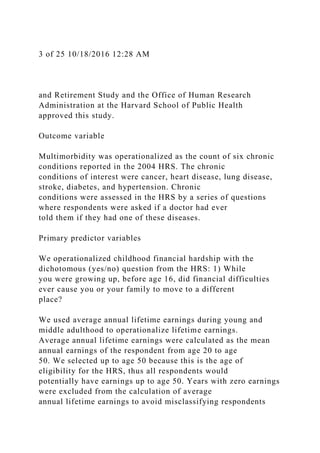
and Retirement Study and the Office of Human Research
Administration at the Harvard School of Public Health
approved this study.
Outcome variable
Multimorbidity was operationalized as the count of six chronic
conditions reported in the 2004 HRS. The chronic
conditions of interest were cancer, heart disease, lung disease,
stroke, diabetes, and hypertension. Chronic
conditions were assessed in the HRS by a series of questions
where respondents were asked if a doctor had ever
told them if they had one of these diseases.
Primary predictor variables
We operationalized childhood financial hardship with the
dichotomous (yes/no) question from the HRS: 1) While
you were growing up, before age 16, did financial difficulties
ever cause you or your family to move to a different
place?
We used average annual lifetime earnings during young and
middle adulthood to operationalize lifetime earnings.
Average annual lifetime earnings were calculated as the mean
annual earnings of the respondent from age 20 to age
50. We selected up to age 50 because this is the age of
eligibility for the HRS, thus all respondents would
potentially have earnings up to age 50. Years with zero earnings
were excluded from the calculation of average
annual lifetime earnings to avoid misclassifying respondents
who may temporarily leave the labor market (e.g.
respondents with child-rearing responsibilities) [30]. Earnings
were inflation-adjusted to 2003 US dollars using the
consumer price index for urban consumers (CPI-U 1951-2003)
[31]. For ease of interpretation, we divided average
annual earnings by $10,000 so that changes in the outcome
would be associated with a $10,000 change in average
annual earnings.
Covariates
Educational attainment was used as an indicator of adult SES
[32]. It was grouped into three categories: less than
high school, high school diploma/GED, and some college or
more.
Demographic characteristics such as gender, race (white/non-
white), ethnicity (Hispanic/non-Hispanic), and age
were assessed by self-report in the HRS. Tertiles were created
for the age variable: 50-59, 60-69, and 70 and older
for univariate and bivariate analysis.
Statistical analysis
In order to test the association among childhood financial
hardship, average annual lifetime earnings, and
multimorbidity, bivariate and multivariable tests were
performed. Bivariate analyses using Wilcoxon-
Mann-Whitney tests were conducted to determine differences in
multimorbidity between demographic categories
and Kruskall-Wallis tests were conducted to determine
differences in multimorbidity across SES categories.
Additionally, unadjusted rate ratios were estimated with robust
standard errors to quantify differences across
demographic and SES categories in multimorbidity.
To take into consideration the count nature of the outcome
variable and the substantial number of respondents
reporting no chronic conditions (Y = 0), zero-inflated Poisson
(ZIP) regression was used [33] (30% of respondents
in this sample reported no chronic conditions). The ZIP model
assumes that the respondents potentially come from
two different distributions: one distribution that is indeed likely
to have a zero count (no disease), and another
distribution that follows the Poisson distribution (count of the
six chronic conditions measured in this study) [34].
Lifecourse socioeconomic circumstances and multimorbidity
among olde...
http://bmcpublichealth.biomedcentral.com/articles/10.1186/147
1-2458-1...
4 of 25 10/18/2016 12:28 AM
The ZIP model is a two-part model represented as: 1) P (y i |x i
) = p i + (1 - p i ) exp(-μ i ) when y i = 0 and; 2)
when y i ≥1 [35]. The first part represents a logistic model that
estimates the change in
the log-odds of reporting no chronic conditions (absence of
morbidity) for each one-unit change in the independent
variable, and the second part represents a Poisson model that
estimates the percentage change in the number of
chronic conditions for a one-unit change in the independent
variable. The justification for this approach is that the
factors associated with having one or more chronic conditions
might be differentially associated with the absence of
morbidity (reporting no chronic conditions).
SAS 9.2© was used for model building. Following bivariate
analysis, we developed unadjusted models to evaluate
the association between childhood financial hardship and
multimorbidity in 2004 (Model 1). Next, we adjusted for
demographic (Model 2) and socioeconomic characteristics
(Model 3). We then developed unadjusted models to
evaluate the association between lifetime earnings and
multimorbidity in 2004 (Model 4). Next, we adjusted this
model for demographic (Model 5) and socioeconomic
characteristics (Model 6). We then entered average annual
lifetime earnings into Model 3 to evaluate the influence of
lifetime earnings on the childhood financial hardship
adjusted model (Model 7). To determine if the association
between childhood financial hardship and multimorbidity
was modified by lifetime earnings, we entered an interaction
term (lifetime earnings × childhood financial hardship)
into the model (Model 8) [36].
Table 1 lists the descriptive statistics. The average age for the
full sample was 65 years old. Nineteen percent of the
sample reported childhood financial hardship. The mean number
of chronic conditions was 1.24, with 30% (N =
2,193) reporting no chronic conditions. The mean number of
chronic conditions for those reporting childhood
financial hardship was 1.35 and the mean number of chronic
conditions for those reporting no childhood financial
hardship was 1.20. The median average annual lifetime earnings
up to age 50 (CPI-U adjusted) was $19,410 with
an inter-quartile range of $20,235 (see Table 1).
Table 1
Frequency distributions for childhood financial hardship (CFH)
and chronic conditions and bivariate
associations between demographic and socioeconomic
characteristics and multimorbidity
Childhood
Financial
Hardship
Number of Chronic
Conditions (Multimorbidity)
N %
CFH =
0
CFH =
1
0 1 2 3
4 or
more
P-VALUE
Total 7,305 5,946 1,359 2,193 2,524 1,580 730 278
Gender p < .001
Lifecourse socioeconomic circumstances and multimorbidity
among olde...
http://bmcpublichealth.biomedcentral.com/articles/10.1186/147
1-2458-1...
5 of 25 10/18/2016 12:28 AM
Childhood
Financial
Hardship
Number of Chronic
Conditions (Multimorbidity)
N %
CFH =
0
CFH =
1
0 1 2 3
4 or
more
P-VALUE
Female 3,916 53.61 3,244 672 1,238 1,382 769 374 153
Male 3,389 46.39 2,702 687 955 1,142 811 356 125
Race p < .001
White 5,907 80.87 4,827 1,080 1,861 2,053 1,241 550 202
Non-white 1,397 19.13 1,118 279 331 471 339 180 76
Hispanic Ethnicity p = .12
Hispanic 740 10.13 570 170 233 260 162 67 18
Non-Hispanic 6,565 89.87 5,376 1,189 1,960 2,264 1,418 663
260
Age
50-59 2,004 27.43 1,615 389 921 669 283 104 27 p < .001
60-69 3,218 44.05 2,661 557 866 1,169 707 338 138
≥ 70 2,083 28.51 1,670 413 406 686 590 288 113
Education p < .001
Less than High School 1,705 23.34 1,285 420 367 537 435 238
128
Lifecourse socioeconomic circumstances and multimorbidity
among olde...
http://bmcpublichealth.biomedcentral.com/articles/10.1186/147
1-2458-1...
6 of 25 10/18/2016 12:28 AM
Childhood
Financial
Hardship
Number of Chronic
Conditions (Multimorbidity)
N %
CFH =
0
CFH =
1
0 1 2 3
4 or
more
P-VALUE
High School/GED 2,410 32.99 2,007 403 700 850 537 245 78
Some College or more 3,190 43.67 2,654 536 1,126 1,137 608
247 72
Median
AVGEARN_LIFETIME†
$19,410 $19,488 $19,138
Inter-quartile Range
AVGEARN_LIFETIME
$20,235
† AVGEARN_LIFETIME = Average annual lifetime earnings
(age 20-50) which are adjusted using the
CPI-U to account for inflation
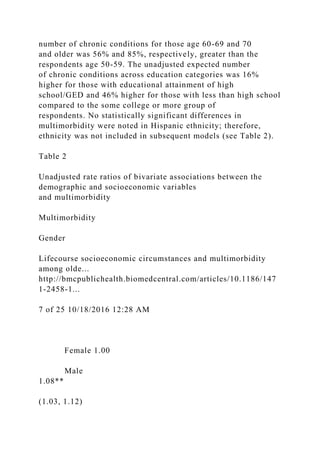
Bivariate analysis suggests differences in multimorbidity across
all demographic and socioeconomic categories
except Hispanic ethnicity (see Table 1). Unadjusted rate ratios
showed that men reported slightly higher
multimorbidity than women. In particular, the expected number
of chronic conditions in men was 8% higher than in
women. For non-white respondents, the unadjusted expected
number of chronic conditions was 21% higher
compared to white respondents. The unadjusted expected
number of chronic conditions for those age 60-69 and 70
and older was 56% and 85%, respectively, greater than the
respondents age 50-59. The unadjusted expected number
of chronic conditions across education categories was 16%
higher for those with educational attainment of high
school/GED and 46% higher for those with less than high school
compared to the some college or more group of
respondents. No statistically significant differences in
multimorbidity were noted in Hispanic ethnicity; therefore,
ethnicity was not included in subsequent models (see Table 2).
Table 2
Unadjusted rate ratios of bivariate associations between the
demographic and socioeconomic variables
and multimorbidity
Multimorbidity
Gender
Lifecourse socioeconomic circumstances and multimorbidity
among olde...
http://bmcpublichealth.biomedcentral.com/articles/10.1186/147
1-2458-1...
7 of 25 10/18/2016 12:28 AM
Female 1.00
Male
1.08**
(1.03, 1.12)
Race
White 1.00
Non-white
1.21***
(1.15, 1.26)
Hispanic Ethnicity
Hispanic
.94
(.87, 1.00)
Non-Hispanic 1.00
Age
50-59 1.00
60-69
1.56***
(1.47, 1.65)
≥ 70
1.85***
(1.74, 1.96)
Education
Less than High School 1.46***
Lifecourse socioeconomic circumstances and multimorbidity
among olde...
http://bmcpublichealth.biomedcentral.com/articles/10.1186/147
1-2458-1...
8 of 25 10/18/2016 12:28 AM
(1.39, 1.53)
High School/GED
1.16***
(1.11, 1.22)
Some College or more 1.00
p < .05; ** p < .01; *** p < .001
Multivariable analysis: childhood financial hardship and
multimorbidity
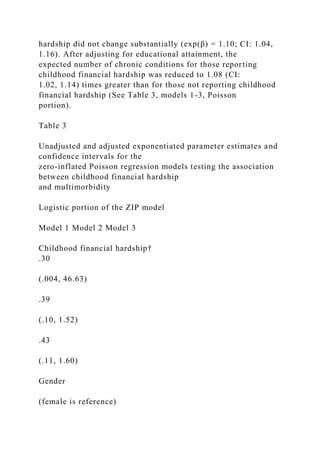
The logistic portion of the unadjusted and adjusted ZIP
regression models showed that childhood financial hardship
was not significantly associated with the absence of morbidity
(see Table 3, models 1-3, logistic portion). The
Poisson portion of the unadjusted ZIP model showed that the
expected number of chronic conditions for those
reporting childhood financial hardship was 1.11 (CI: 1.04, 1.19)
times that of those not reporting childhood
financial hardship. After adjusting for gender, age, and race, the
difference in expected number of chronic
conditions between those reporting childhood financial hardship
and those not reporting childhood financial
hardship did not change substantially (exp(β) = 1.10; CI: 1.04,
1.16). After adjusting for educational attainment, the
expected number of chronic conditions for those reporting
childhood financial hardship was reduced to 1.08 (CI:
1.02, 1.14) times greater than for those not reporting childhood
financial hardship (See Table 3, models 1-3, Poisson
portion).
Table 3
Unadjusted and adjusted exponentiated parameter estimates and
confidence intervals for the
zero-inflated Poisson regression models testing the association
between childhood financial hardship
and multimorbidity
Logistic portion of the ZIP model
Model 1 Model 2 Model 3
Childhood financial hardship†
.30
(.004, 46.63)
.39
(.10, 1.52)
.43
(.11, 1.60)
Gender
(female is reference)
.92
(.46, 1.87)
1.00
(.49, 2.04)
Age .77*** .78***
Lifecourse socioeconomic circumstances and multimorbidity
among olde...
http://bmcpublichealth.biomedcentral.com/articles/10.1186/147
1-2458-1...
9 of 25 10/18/2016 12:28 AM
Logistic portion of the ZIP model
Model 1 Model 2 Model 3
(.69, .82) (.68, .82)
Race
(white is reference)
4.03
(.74, 22.01)
.28
(.05, 1.22)
Educational Attainment
(less than high school)
High School/GED
1.79
(.74, 4.34)
Some College or more
.79
(.29, 2.16)
Poisson Portion of the ZIP model
Model 1 Model 2 Model 3
Childhood financial hardship†
1.11**
(1.04, 1.19)
1.10***
(1.04, 1.16)
1.08**
(1.02, 1.14)
Gender
(female is reference)
.36
(.10, 1.39)
.41
(.11, 1.50)
Age
1.02***
(1.02, 1.03)
1.02***
(1.02, 1.03)
Race .73 1.14
Lifecourse socioeconomic circumstances and multimorbidity
among olde...
http://bmcpublichealth.biomedcentral.com/articles/10.1186/147
1-2458-1...
10 of 25 10/18/2016 12:28 AM
Logistic portion of the ZIP model
Model 1 Model 2 Model 3
(white is reference group) (.37, 1.45) (.56, 2.32)
Educational Attainment
(less than high school)
High School/GED
.21*
(.05, .93)
Some College or more
1.52
(.63, 3.67)
p < .05; ** p < .01; *** p < .001; † Childhood financial
hardship was measured by a question, "While
you were growing up, before age 16, did financial difficulties
ever cause you or your family to move to
a different place?"
Multivariable analysis: lifetime earnings and multimorbidity
The logistic portion of the ZIP models showed that lifetime
earnings and the absence of morbidity were only
associated in the unadjusted model (exp(β) = .55; CI: .28, .91;
see Table 4, models 4-6, logistic portion). The
Poisson portion of the unadjusted ZIP model showed a 7%
decrease in the expected number of chronic conditions
for each $10,000 increase in average annual lifetime earnings
(see Table 4, model 4). After adjusting for gender,
age, and race the percent decrease was unchanged at 7%.
However, after adjusting for educational attainment the
percent decrease in the expected number of chronic conditions
was reduced to 5% for each $10,000 increase in
average annual earnings (see Table 4, model 6, Poisson
portion).
Table 4
Unadjusted and adjusted exponentiated parameter estimates and
confidence intervals for the
zero-inflated Poisson regression models testing the association
between lifetime earnings and
multimorbidity
Logistic portion of the ZIP model
Model 4 Model 5 Model 6
Lifecourse socioeconomic circumstances and multimorbidity
among olde...
http://bmcpublichealth.biomedcentral.com/articles/10.1186/147
1-2458-1...
11 of 25 10/18/2016 12:28 AM
Logistic portion of the ZIP model
Model 4 Model 5 Model 6
Lifetime Earnings§
.55*
(.28, .91)
1.08
(.81, 1.42)
1.10
(.80, 1.51)
Gender
1.15
(.50, 2.64)
1.16
(.50, 2.71)
Age
.77***
(.67, .83)
.76***
(.66, .82)
Race
(white is reference)
.35
(.08, 1.45)
.32
(.08, 1.37)
Educational Attainment
(less than high school is reference)
High School/GED
2.03
(.73, 5.69)
Some College or more
.84
(.27, 2.55)
Poisson Portion of the ZIP model
Model 4 Model 5 Model 6
lifetime earnings§
.93***
(.91, .95)
.93***
(.91, .95)
.95***
(.93, .98)
Lifecourse socioeconomic circumstances and multimorbidity
among olde...
http://bmcpublichealth.biomedcentral.com/articles/10.1186/147
1-2458-1...
12 of 25 10/18/2016 12:28 AM
Logistic portion of the ZIP model
Model 4 Model 5 Model 6
Gender
1.14***
(1.08, 1.20)
1.11***
(1.05, 1.17)
Age
1.02***
(1.02, 1.03)
1.02***
(1.02, 1.03)
Race
(white is reference)
1.22
(.54, 2.78)
1.23
(.53, 2.83)
Educational Attainment
(less than high school is reference)
High School/GED
.26
(.06, 1.06)
Some College or more
1.76
(.63, 4.89)
p < .05; ** p < .01; *** p < .001; § Lifetime earnings was
operationalized as average annual income
from 1951 up to age 50 of the respondent CPI-U adjusted
Multivariable analysis: childhood financial hardship and
lifetime earnings mutually adjusted
and interaction term added
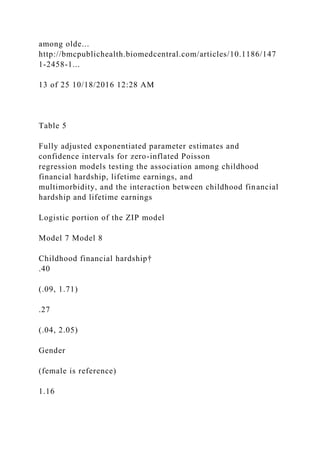
Including childhood financial hardship and lifetime earnings
into the ZIP model (see Table 5, model 7) showed a
slight change in the childhood financial hardship rate ratio from
the fully adjusted model (see Table 3, model 3) of
1.08 to 1.07, but the rate ratio for lifetime earnings from the
fully adjusted model (see Table 4, model 6) was
unchanged (see Table 5, model 7). The childhood financial
hardship × average annual lifetime earnings interaction
term was statistically significant (exp(β) = .95; CI = .91, .99);
and with the inclusion of this interaction term the rate
ratio for childhood financial hardship increased (exp(β) = 1.19;
CI: 1.07, 1.32) and the rate ratio for lifetime
earnings changed by 2% (exp(β) = .97; CI = .94, .99; see Table
5, model 8).
Lifecourse socioeconomic circumstances and multimorbidity
among olde...
http://bmcpublichealth.biomedcentral.com/articles/10.1186/147
1-2458-1...
13 of 25 10/18/2016 12:28 AM
Table 5
Fully adjusted exponentiated parameter estimates and
confidence intervals for zero-inflated Poisson
regression models testing the association among childhood
financial hardship, lifetime earnings, and
multimorbidity, and the interaction between childhood financial
hardship and lifetime earnings
Logistic portion of the ZIP model
Model 7 Model 8
Childhood financial hardship†
.40
(.09, 1.71)
.27
(.04, 2.05)
Gender
(female is reference)
1.16
(.50, 2.70)
1.05
(.47, 2.33)
Age
.76***
(.67, .82)
.75***
(.66, .81)
Race
(white is reference)
.34
(.10, 1.23)
.34
(.10, 1.15)
Educational Attainment (less than high school reference)
High School/GED
1.91
(.71, 5.11)
1.49
(.61, 3.67)
Some College or more
.67
(.24, 1.89)
.62
(.22, 1.70)
Lifetime Earnings§
1.03
(.73, 1.42)
1.06
(.77, 1.44)
Lifecourse socioeconomic circumstances and multimorbidity
among olde...
http://bmcpublichealth.biomedcentral.com/articles/10.1186/147
1-2458-1...
14 of 25 10/18/2016 12:28 AM
Logistic portion of the ZIP model
Model 7 Model 8
Childhood financial hardship X Lifetime earnings
1.35
(.35, 3.36)
Poisson Portion of the ZIP model
Model 7 Model 8
Childhood financial hardship†
1.07*
(1.01, 1.13)
1.19***
(1.07, 1.32)
Gender
(female is reference)
.41
(.10, 1.74)
.25
(.03, 1.83)
Age
1.02***
(1.02, 1.03)
1.02***
(1.02, 1.03)
Race
(white is reference group)
1.23
(.53, 2.82)
1.12
(.51, 2.46)
Educational Attainment (less than high school is reference)
High School/GED
.27*
(.08, .95)
.27*
(.08, .89)
Some College or more
1.66
(.62, 4.41)
1.49
(.61, 3.67)
Lifecourse socioeconomic circumstances and multimorbidity
among olde...
http://bmcpublichealth.biomedcentral.com/articles/10.1186/147
1-2458-1...
15 of 25 10/18/2016 12:28 AM
Logistic portion of the ZIP model
Model 7 Model 8
Lifetime Earnings§
.95***
(.93, .97)
.97*
(.94, .99)
Childhood financial hardship X Lifetime earnings
.95*
(.91, .99)
* p < .05; ** p < .01; *** p < .001; † Childhood financial
hardship was measured by a question, "While
you were growing up, before age 16, did financial difficulties
ever cause you or your family to move to
a different place?" § Lifetime Earnings was operationalized as
average annual income from 1951 up to
age 50 of the respondent CPI-U adjusted
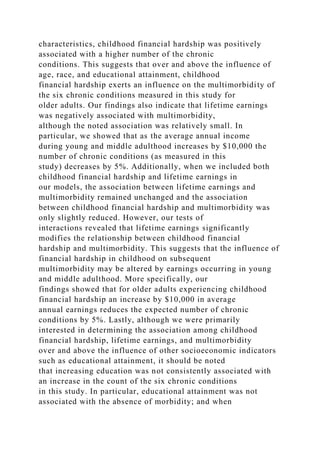
This study investigated the association among childhood
financial hardship, lifetime earnings, and multimorbidity
in a sample of older adults. Our findings revealed that after
controlling for socioeconomic and demographic
characteristics, childhood financial hardship was positively
associated with a higher number of the chronic
conditions. This suggests that over and above the influence of
age, race, and educational attainment, childhood
financial hardship exerts an influence on the multimorbidity of
the six chronic conditions measured in this study for
older adults. Our findings also indicate that lifetime earnings
was negatively associated with multimorbidity,
although the noted association was relatively small. In
particular, we showed that as the average annual income
during young and middle adulthood increases by $10,000 the
number of chronic conditions (as measured in this
study) decreases by 5%. Additionally, when we included both
childhood financial hardship and lifetime earnings in
our models, the association between lifetime earnings and
multimorbidity remained unchanged and the association
between childhood financial hardship and multimorbidity was
only slightly reduced. However, our tests of
interactions revealed that lifetime earnings significantly
modifies the relationship between childhood financial
hardship and multimorbidity. This suggests that the influence of
financial hardship in childhood on subsequent
multimorbidity may be altered by earnings occurring in young
and middle adulthood. More specifically, our
findings showed that for older adults experiencing childhood
financial hardship an increase by $10,000 in average
annual earnings reduces the expected number of chronic
conditions by 5%. Lastly, although we were primarily
interested in determining the association among childhood
financial hardship, lifetime earnings, and multimorbidity
over and above the influence of other socioeconomic indicators
such as educational attainment, it should be noted
that increasing education was not consistently associated with
an increase in the count of the six chronic conditions
in this study. In particular, educational attainment was not
associated with the absence of morbidity; and when
compared to the less than high school group, only the high
school/GED category showed a protective association
with multimorbidity.
We evaluated our hypotheses using ZIP regression; and, the
benefit of a ZIP modeling approach is the simultaneous
estimation of factors associated with multimorbidity and the
absence of morbidity. In fully adjusted models,
Lifecourse socioeconomic circumstances and multimorbidity
among olde...
http://bmcpublichealth.biomedcentral.com/articles/10.1186/147
1-2458-1...
16 of 25 10/18/2016 12:28 AM
childhood financial hardship was not associated with the
absence of morbidity and lifetime earnings was only
associated with the absence of morbidity in unadjusted models.
Consistent with the literature, the logistic portion of
our ZIP models showed that age was strongly negatively
associated with the absence of morbidity [37]. Lastly, the
widest confidence intervals were noted in the logistic portion of
the childhood financial hardship ZIP models. This
may indicate poor model fit and suggests that the potential
socioeconomic and demographic factors associated with
determining the number of diseases (of those measured in this
study) might be substantively different from the
factors associated with determining the absence of morbidity.
The lack of an association between the several indicators of
socioeconomic circumstances in this study (i.e.
childhood financial hardship, lifetime earnings, and educational
attainment) and demographic characteristics (i.e.
race and gender) and the absence of morbidity was unexpected.
Research has shown a negative association between
socioeconomic status and morbidity[38, 39] and
multimorbidity[40, 41]; and studies on successful aging (where
one component is the absence or low risk of morbidity[42])
have shown that childhood and mid-life socioeconomic
circumstances[43], and the stability of financial resources[44]
were positively associated with the absence of
morbidity in older adults. However, the evidence on the
association between socioeconomic factors and successful
aging is equivocal[45, 46, 47]. It has also been suggested that
age effects on self-reported morbidity may
overshadow socioeconomic effects[48]. Not surprising, our
results show an independent association between the
absence of morbidity and age, even when childhood financial
hardship and lifetime earnings are included in the
model. Demographic characteristics[48] and psychosocial and
behavioral factors[49] across the lifecourse may
prove more important than socioeconomic factors in
determining the absence of morbidity; however, the influence
of lifecourse socioeconomic factors on the absence of morbidity
requires further exploration to fully elucidate their
role in successful aging in general and the absence of morbidity
in particular among older adults.
Childhood socioeconomic condition and adult health
Financial and economic circumstances occurring in childhood
and throughout the lifecourse have been shown to
affect adult health outcomes [50]. Research shows that
antecedents to the socioeconomic gradient in adult health
can be seen in the socioeconomic environment in childhood
[51]. As such, the childhood environment can, 'cast
long shadows forward' on future health outcomes [52]; that is,
the financial and economic circumstances occurring
and accumulating throughout the lifecourse can determine and
influence the health trajectory of the individual [53,
54].
Additionally, it has been suggested that many chronic diseases
share common risk factors [55]. In particular, current
low socioeconomic status and disadvantage accumulated across
the lifecourse have been shown to be significant
pathways to many chronic conditions [25, 56]; and, socio-
environmental factors experienced at various stages
throughout the lifecourse can differentially impact disease
etiology [57]. So, even though chronic diseases have
long latency periods, research has consistently shown that for
many chronic conditions adult and childhood
socioeconomic factors can have a considerable impact on health
outcomes [58, 59]. Our results are consistent with
these findings. In particular, our results show that an expanded
notion of SES that includes hardships during
childhood and earnings throughout adulthood may also uncover
possible associations between socioeconomic
conditions and adult health. Our findings also show that a
possible modifier of the relationship between childhood
financial conditions and the number of adult chronic conditions
that deserves further attention is earnings during
young and middle adulthood.
There are limitations to the present study. First, respondents in
the HRS were asked to recall childhood financial
hardship experiences; as a result, the measures of childhood
financial hardship may be subject to recall bias.
Second, our sample only included those individuals who
provided permission for their social security records to be
Lifecourse socioeconomic circumstances and multimorbidity
among olde...
http://bmcpublichealth.biomedcentral.com/articles/10.1186/147
1-2458-1...
17 of 25 10/18/2016 12:28 AM
linked to their HRS records potentially introducing sample
selection bias. However, it has been shown that the HRS
respondents who grant permission for their social security were
not very much different from those who did not
[60]. In addition, the social security data linked to the HRS is
capped at the taxable maximum for a given year and
only includes earnings subject to Social Security deduction.
Next, the literature remains inconsistent in defining
multimorbidity [61, 62]; for example, some studies define
multimorbidity as the count of two or more chronic
conditions,[40] others use a combination of specific diseases,
and still others use a simple count of chronic
conditions reported or obtained from medical records [63, 64].
As a result, little guidance is provided in selecting a
measure for multimorbidity and the specific diseases such a
measure should contain. However, the chronic diseases
selected for the present study are consistent with those of other
studies of multimorbidity among older adults [21,
65]. Lastly, our study is cross-sectional so causal inferences
cannot be definitively made regarding the associations
noted.
Multimorbidity has considerable implications for health-related
research, health care, and many government
systems (e.g. Medicare, Medicaid, and Veterans
Administration). Due to the single disease focus in research and
health care[66, 67], we know relatively little about the
correlates of multimorbidity [68, 69]. Yet, health care models
on the delivery of clinical services for the elderly with multiple
chronic conditions have recently been introduced
highlighting the impact the growing problem of multimorbidity
has on health care delivery [70, 71]. However, we
know little about the factors that are associated with the various
combinations of morbidity experienced by older
adults, and such knowledge could potentially improve care and
delay mortality for many managing multiple chronic
conditions [72]. Additional research focused on the specific
socioeconomic factors associated with multimorbidity
across the lifecourse can also be used to inform the
development of appropriate interventions that target
socioeconomic groups at greatest risk for multimorbidity before
they enter the health care system. In particular,
interventions that target specific socioeconomic pathways might
prove useful in helping reduce the burden of
multimorbidity; more specifically, interventions that focus on
material resources such as reducing hardships during
childhood and increasing earnings throughout young and middle
adulthood may have a substantial impact on
prevention efforts[73] with those at risk for various
combinations of chronic disease multimorbidity.
Acknowledgements
None
Competing interests
The authors declare that they have no competing interests.
Authors' contributions
RDT-S, YL, GS, and SVS conceived of the study; RDT-S and
YL developed the analysis plan and performed the
statistical analysis; RDT-S, YL, GS, and SVS interpreted the
results; RDT-S wrote the first draft of the manuscript.
RDT-S, YL, GS, and SVS edited the manuscript. All authors
read and approved the final manuscript.
Lifecourse socioeconomic circumstances and multimorbidity
among olde...
http://bmcpublichealth.biomedcentral.com/articles/10.1186/147
1-2458-1...
18 of 25 10/18/2016 12:28 AM
(1)
Center for Community Based Research, Dana-Farber Cancer
Institute
(2)
Department of Society, Human Development, and Health,
Harvard School of Public Health
(3)
Department of Biostatistics and Computational Biology, Dana-
Farber Cancer Institute
(4)
Department of Biostatistics, Harvard School of Public Health
Guralnik JM, LaCroix AZ, Everett DF, Kovar MG: Aging in the
eighties: The prevalence of comorbidity and
its association with disability. Advance data from vital and
health statistics. 1989, National Center for Health
Statistics. Hyattsville, MD, No. 170
1.
Wolff JL, Starfield B, Anderson G: Prevalence, expenditures,
and complications of multiple chronic
conditions in the elderly. Arch Intern Med. 2002, 162: 2269-
2276. 10.1001/archinte.162.20.2269.
2.
Knottnerus JA, Metsemakers J, Hoppener P, Limonard C:
Chronic illness in the community and the concept
of 'social prevalence'. Fam Pract. 1992, 9: 15-21.
10.1093/fampra/9.1.15.
3.
van den Akker M, Buntinx F, Metsemakers JF, Roos S,
Knottnerus JA: Multimorbidity in general practice:
prevalence, incidence, and determinants of co-occurring chronic
and recurrent diseases. J Clin Epidemiol.
1998, 51: 367-375. 10.1016/S0895-4356(97)00306-5.
4.
van den Akker M, Buntinx F, Metsemakers JF, Knottnerus JA:
Marginal impact of psychosocial factors on
multimorbidity: results of an explorative nested case-control
study. Soc Sci Med. 2000, 50: 1679-1693.
10.1016/S0277-9536(99)00408-6.
5.
Martini EM, Garrett N, Lindquist T, Isham GJ: The boomers are
coming: a total cost of care model of the
impact of population aging on health care costs in the United
States by Major Practice Category. Health Serv
Res. 2007, 42: 201-218. 10.1111/j.1475-6773.2006.00607.x.
6.
Rice DP, Fineman N: Economic implications of increased
longevity in the United States. Annu Rev Public
Health. 2004, 25: 457-473.
10.1146/annurev.publhealth.25.101802.123054.
7.
Eyre H, Kahn R, Robertson RM, Clark NG, Doyle C, Hong Y,
Gansler T, Glynn T, Smith RA, Taubert K, Thun
MJ, American Cancer Society, American Diabetes Association,
American Heart Association: Preventing
cancer, cardiovascular disease, and diabetes: a common agenda
for the American Cancer Society, the
American Diabetes Association, and the American Heart
Association. Circulation. 2004, 109: 3244-3255.
10.1161/01.CIR.0000133321.00456.00.
8.
Gijsen R, Hoeymans N, Schellevis FG, Ruwaard D, Satariano
WA, van den Bos GAM: Causes and
consequences of comorbidity: A review. J Clin Epidemiol.
2001, 54: 661-674.
10.1016/S0895-4356(00)00363-2.
9.
Wadsworth MEJ, Kuh DJL: Childhood influences on adult
health: a review of recent work from the British
1946 national birth cohort study, the MRC National Survey of
Health and Development. Paediatric and
Perinatal Epidemiology. 1997, 11: 2-20. 10.1046/j.1365-
3016.1997.d01-7.x.
10.
Kaplan GA, Salonen JT: Socioeconomic conditions in childhood
and ischaemic heart disease during middle
age. BMJ. 1990, 301: 1121-1123. 10.1136/bmj.301.6761.1121.
11.
Lawlor DA, Ronalds G, Macintyre S, Clark H, Leon DA: Family
socioeconomic position at birth and future
cardiovascular disease risk: findings from the Aberdeen
Children of the 1950s cohort study. Am J Public
Health. 2006, 96: 1271-1277. 10.2105/AJPH.2005.066290.
12.
Maty SC, Lynch JW, Raghunathan TE, Kaplan GA: Childhood
socioeconomic position, gender, adult body
mass index, and incidence of type 2 diabetes mellitus over 34
years in the Alameda County Study. Am J
Public Health. 2008, 98: 1486-1494.
10.2105/AJPH.2007.123653.
13.
Lifecourse socioeconomic circumstances and multimorbidity
among olde...
http://bmcpublichealth.biomedcentral.com/articles/10.1186/147
1-2458-1...
19 of 25 10/18/2016 12:28 AM
Smith GD, Hart C, Blane D, Hole D: Adverse socioeconomic
conditions in childhood and cause specific
adult mortality: prospective observational study. BMJ. 1998,
316: 1631-1635.
14.
Bennett GG, Wolin KY, James SA: Lifecourse socioeconomic
position and weight change among blacks: The
Pitt County study. Obesity (Silver Spring). 2007, 15: 172-181.
10.1038/oby.2007.522.
15.
Lundberg O: The impact of childhood living conditions on
illness and mortality in adulthood. Soc Sci Med.
1993, 36: 1047-1052. 10.1016/0277-9536(93)90122-K.
16.
Lundberg O: Childhood conditions, sense of coherence, social
class and adult ill health: exploring their
theoretical and empirical relations. Soc Sci Med. 1997, 44: 821-
831. 10.1016/S0277-9536(96)00184-0.
17.
Moody-Ayers S, Lindquist K, Sen S, Covinsky KE: Childhood
social and economic well-being and health in
older age. Am J Epidemiol. 2007, 166: 1059-1067.
10.1093/aje/kwm185.
18.
Hatch SL: Conceptualizing and identifying cumulative adversity
and protective resources: implications for
understanding health inequalities. J Gerontol B Psychol Sci Soc
Sci. 2005, 60 (Spec No 2): 130-134.
19.
Hungerford TL: The persistence of hardship over the lifecourse.
Research on Aging. 2007, 29: 491-511.
10.1177/0164027507305736.
20.
Kahn JR, Fazio EM: Economic status over the life course and
racial disparities in health. J Gerontol B
Psychol Sci Soc Sci. 2005, 60 (Spec No 2): 76-84.
21.
Davey Smith G: Socioeconomic differentials. A life course
approach to chronic disease epidemiology. Edited
by: Kuh D, Ben-Shlomo Y. 2001, Oxford: Oxford Medical
Publications
22.
Smith GD, Hart C, Blane D, Gillis C, Hawthorne V: Lifetime
socioeconomic position and mortality:
prospective observational study. BMJ. 1997, 314: 547-552.
23.
Davey Smith G, Ben-Shlomo Y, Lynch J: Life course
approaches to inequalities in coronary heart disease
risk. Stress and the heart: Psychosocial pathways to coronary
heart disease. Edited by: Stansfeld SA, Marmot
MG. 2002, London: BMJ Books
24.
Gold R, Michael YL, Whitlock EP, Hubbell FA, Mason ED,
Rodriguez BL, Safford MM, Sarto GE:
Race/ethnicity, socioeconomic status, and lifetime morbidity
burden in the women's health initiative: a cross-
sectional analysis. J Womens Health (Larchmt). 2006, 15: 1161-
1173. 10.1089/jwh.2006.15.1161.
25.
Melchior M, Lert F, Martin M, Ville I: Socioeconomic position
in childhood and in adulthood and functional
limitations in midlife: Data from a nationally-representative
survey of French men and women. Soc Sci Med.
2006, 63: 2813-2824. 10.1016/j.socscimed.2006.07.029.
26.
Singh-Manoux A, Ferrie JE, Chandola T, Marmot M:
Socioeconomic trajectories across the life course and
health outcomes in midlife: evidence for the accumulation
hypothesis?. Int J Epidemiol. 2004, 33:
1072-1079. 10.1093/ije/dyh224.
27.
University of Michigan: Health and Retirement Study
(HRS2004) public use dataset. Produced and
distributed by the University of Michigan with funding from the
National Institute on Aging (grant number
NIA U01AG009749). 2004, Ann Arbor, MI
28.
National Institute on Aging: Growing Old in America: The
Health and Retirement Study. 2007, National
Institutes of Health. Washington, DC
29.
Cristia JP: The empirical relationship between lifetime earnings
and mortality. 2007, Congressional Budget
Office. Washington, D.C, Working Paper Series. 2007-11
30.
U.S. Department of Labor: Consumer Price Index. Bureau of
Labor Statistics31.
Galobardes B, Lynch J, Smith GD: Measuring socioeconomic
position in health research. Br Med Bull. 2007,
81-82: 21-37. 10.1093/bmb/ldm001.
32.
Cameron AC, Trivedi PK: Regression Analysis of Count Data.
1998, New York: Cambridge University Press33.
Tin A: Modeling zero-inflated count data with underdispersion
and overdispersion. SAS Global Forum
Proceedings. 2008, Paper 372-2008
34.
Lambert D: Zero-inflated Poisson regression, with an
applicationto defects in manufacturing. Technometrics.
1992, 34: 1-14. 10.2307/1269547.
35.
Knol MJ, van der Tweel I, Grobbee DE, Numans ME, Geerlings
MI: Estimating interaction on an additive
scale between continuous determinants in a logistic regression
model. Int J Epidemiol. 2007, 36: 1111-1118.
36.
Lifecourse socioeconomic circumstances and multimorbidity
among olde...
http://bmcpublichealth.biomedcentral.com/articles/10.1186/147
1-2458-1...
20 of 25 10/18/2016 12:28 AM
10.1093/ije/dym157.
Crimmins EM: Trends in the health of the elderly. Annu Rev
Public Health. 2004, 25: 79-98.
10.1146/annurev.publhealth.25.102802.124401.
37.
House JS, Lepkowski JM, Kinney AM, Mero RP, Kessler RC,
Herzog AR: The social stratification of aging
and health. J Health Soc Behav. 1994, 35: 213-234.
10.2307/2137277.
38.
Huisman M, Kunst AE, Mackenbach JP: Socioeconomic
inequalities in morbidity among the elderly; a
European overview. Soc Sci Med. 2003, 57: 861-873.
10.1016/S0277-9536(02)00454-9.
39.
Marengoni A, Winblad B, Karp A, Fratiglioni L: Prevalence of
chronic diseases and multimorbidity among
the elderly population in Sweden. Am J Public Health. 2008, 98:
4-6. 10.2105/AJPH.2008.145540.
40.
Nagel G, Peter R, Braig S, Hermann S, Rohrmann S, Linseisen
J: The impact of education on risk factors and
the occurrence of multimorbidity in the EPIC-Heidelberg
cohort. BMC Public Health. 2008, 8:
384-10.1186/1471-2458-8-384. 384
41.
Rowe JW, Kahn RL: Successful aging. Gerontologist. 1997, 37:
433-440.42.
Britton A, Shipley M, Singh-Manoux A, Marmot MG:
Successful aging: the contribution of early-life and
midlife risk factors. J Am Geriatr Soc. 2008, 56: 1098-1105.
10.1111/j.1532-5415.2008.01740.x.
43.
Burke GL, Arnold AM, Bild DE, Cushman M, Fried LP,
Newman A, Nunn C, Robbins J: Factors associated
with healthy aging: the cardiovascular health study. J Am
Geriatr Soc. 2001, 49: 254-262.
10.1046/j.1532-5415.2001.4930254.x.
44.
Reed DM, Foley DJ, White LR, Heimovitz H, Burchfiel CM,
Masaki K: Predictors of healthy aging in men
with high life expectancies. Am J Public Health. 1998, 88:
1463-1468. 10.2105/AJPH.88.10.1463.
45.
Depp CA, Jeste DV: Definitions and predictors of successful
aging: a comprehensive review of larger
quantitative studies. Am J Geriatr Psychiatry. 2006, 14: 6-20.
10.1097/01.JGP.0000192501.03069.bc.
46.
Roos NP, Havens B: Predictors of successful aging: a twelve-
year study of Manitoba elderly. Am J Public
Health. 1991, 81: 63-68. 10.2105/AJPH.81.1.63.
47.
Asthana S, Gibson A, Moon G, Brigham P, Dicker J: The
demographic and social class basis of inequality in
self reported morbidity: an exploration using the Health Survey
for England. J Epidemiol Community Health.
2004, 58: 303-307. 10.1136/jech.2002.003475.
48.
Peel NM, McClure RJ, Bartlett HP: Behavioral determinants of
healthy aging. Am J Prev Med. 2005, 28:
298-304. 10.1016/j.amepre.2004.12.002.
49.
Galobardes B, Davey Smith G, Jeffreys M, McCarron P:
Childhood socioeconomic circumstances predict
specific causes of death in adulthood: the Glasgow student
cohort study. J Epidemiol Community Health.
2006, 60: 527-529. 10.1136/jech.2005.044727.
50.
Case A, Lubotsky D, Paxson C: Economic Status and Health in
Childhood: The Origins of the Gradient.
American Economic Review. 2002, 92: 1308-1334.
10.1257/000282802762024520.
51.
Graham H, Power C: Childhood disadvantage and adult health: a
lifecourse framework. 2004, Health
Development Agency. London
52.
Lawlor DA, Ebrahim S, vey Smith G: Adverse socioeconomic
position across the lifecourse increases
coronary heart disease risk cumulatively: findings from the
British women's heart and health study. J
Epidemiol Community Health. 2005, 59: 785-793.
10.1136/jech.2004.029991.
53.
Lynch JW, Kaplan GA, Shema SJ: Cumulative impact of
sustained economic hardship on physical, cognitive,
psychological, and social functioning. N Engl J Med. 1997, 337:
1889-1895.
10.1056/NEJM199712253372606.
54.
Cassel J: The contribution of the social environment to host
resistance: the fourth Wade Hamptom Frost
lecture. Am J Epidemiol. 1976, 104: 107-123.
55.
Power C, Hertzman C: Social and biological pathways linking
early life and adult disease. Br Med Bull.
1997, 53: 210-221.
56.
Lynch J, Davey Smith G: A lifecourse approach to chronic
disease epidemiology. Annu Rev Public Health.
2005, 36: 1-35.
57.
Galobardes B, Smith GD, Lynch JW: Systematic review of the
influence of childhood socioeconomic58.
Lifecourse socioeconomic circumstances and multimorbidity
among olde...
http://bmcpublichealth.biomedcentral.com/articles/10.1186/147
1-2458-1...
21 of 25 10/18/2016 12:28 AM
circumstances on risk for cardiovascular disease in adulthood.
Ann Epidemiol. 2006, 16: 91-104.
10.1016/j.annepidem.2005.06.053.
Pollitt RA, Rose KM, Kaufman JS: Evaluating the evidence for
models of life course socioeconomic factors
and cardiovascular outcomes: a systematic review. BMC public
health. 2005, 5: 7-10.1186/1471-2458-5-7.
59.
Haider S, Salon G: Nonrandom selection in the HRS Social
Security Earnings Sample. 2000, Paper 00-01.
RAND Labor and Population Program
60.
Valderas JM, Starfield B, Sibbald B, Salisbury C, Roland M:
Defining comorbidity: Implications for
understanding health and health services. Annals of Family
Medicine. 2009, 7: 357-363. 10.1370/afm.983.
61.
van den Akker M, Buntinx F, Knottnerus JA: Comorbidity or
multimorbidity: what's in a name? A review of
the literature. European Journal of General Practice. 1996, 2:
65-70. 10.3109/13814789609162146.
62.
de Groot V, Beckerman H, Lankhorst GJ, Bouter LM: How to
measure comorbidity. a critical review of
available methods. J Clin Epidemiol. 2003, 56: 221-229.
10.1016/S0895-4356(02)00585-1.
63.
Schoenberg NE, Kim H, Edwards W, Fleming ST: Burden of
common multiple-morbidity constellations on
out-of-pocket medical expenditures among older adults.
Gerontologist. 2007, 47: 423-437. 10.1093/geront
/47.4.423.
64.
Fillenbaum GG, Pieper CF, Cohen HJ, Cornoni-Huntley JC,
Guralnik JM: Comorbidity of five chronic
health conditions in elderly community residents: determinants
and impact on mortality. J Gerontol A Biol
Sci Med Sci. 2000, 55: M84-M89.
65.
Tinetti ME, Bogardus ST, Agostini JV: Potential pitfalls of
disease-specific guidelines for patients with
multiple conditions. N Engl J Med. 2004, 351: 2870-2874.
10.1056/NEJMsb042458.
66.
Starfield B: Threads and yarns: Weaving the tapestry of
comorbidity. Annals of Family Medicine. 2006, 4:
101-103. 10.1370/afm.524.
67.
van den Akker M, Vos R, Knottnerus JA: In an exploratory
prospective study on multimorbidity general and
disease-related susceptibility could be distinguished. J Clin
Epidemiol. 2006, 59: 934-939.
10.1016/j.jclinepi.2006.02.009.
68.
Fortin M, Bravo G, Hudon C, Lapointe L, Dubois MF, Almirall
J: Psychological distress and multimorbidity
in primary care. Annals of Family Medicine. 2006, 4: 417-422.
10.1370/afm.528.
69.
Thiem U, Theile G, Junius-Walker U, Holt S, Thurmann P,
Hinrichs T, Platen P, Diederichs C, Berger K,
Hodek JM, Greiner W, Berkemeyer S, Pientka L, Trampisch HJ:
Prerequisites for a new health care model for
elderly people with multimorbidity: The PRISCUS research
consortium. Z Gerontol Geriatr. 2010,
70.
Boyd C, Leff B, Weiss C, Wolff J, Clark R, Richards T:
Clarifying multimorbidity to improve targeting and
delivery of clinical services for Medicaid populations.
[http://www.chcs.org/publications3960
/publications_show.htm?doc_id=1261201]
71.
Fortin M, Soubhi H, Hudon C, Bayliss EA, van den Akker M:
Multimorbidity's many challenges. BMJ. 2007,
334: 1016-1017. 10.1136/bmj.39201.463819.2C.
72.
Williams DR, Costa MV, Odunlami AO, Mohammed SA:
Moving upstream: How interventions that address
the social determinants of health can improve health and reduce
disparities. Journal of Public Health
Management Practice. 2008, 14 (Suppl): S8-S17.
73.
Pre-publication history
The pre-publication history for this paper can be accessed
here:http://www.biomedcentral.com
/1471-2458/11/313/prepub
1.
© Tucker-Seeley et al; licensee BioMed Central Ltd. 2011
This article is published under license to BioMed Central Ltd.
This is an Open Access article distributed under the
Lifecourse socioeconomic circumstances and multimorbidity
among olde...
http://bmcpublichealth.biomedcentral.com/articles/10.1186/147
1-2458-1...
22 of 25 10/18/2016 12:28 AM
terms of the Creative Commons Attribution License
(http://creativecommons.org/licenses/by/2.0), which permits
unrestricted use, distribution, and reproduction in any medium,
provided the original work is properly cited.
Download PDF
Export citations
Citations & References
Papers, Zotero, Reference Manager, RefWorks (.RIS)
EndNote (.ENW)
Mendeley, JabRef (.BIB)
Article citation
Papers, Zotero, Reference Manager, RefWorks (.RIS)
EndNote (.ENW)
Mendeley, JabRef (.BIB)
References
Papers, Zotero, Reference Manager, RefWorks (.RIS)
EndNote (.ENW)
Mendeley, JabRef (.BIB)
Table of Contents
Abstract
Background
Methods
Results
Discussion
Limitations
Conclusions
Declarations
References
Comments
Metrics
Article accesses: 4182
Citations: 14 more information
Altmetric score: 2
Share this article
Lifecourse socioeconomic circumstances and multimorbidity
among olde...
http://bmcpublichealth.biomedcentral.com/articles/10.1186/147
1-2458-1...
23 of 25 10/18/2016 12:28 AM
Other Actions
Order reprint
Follow
Follow us on Twitter
BMC Public Health
ISSN: 1471-2458
Contact us
Editorial email: [email protected]
Support email: [email protected]
Explore journals
Get published
Lifecourse socioeconomic circumstances and multimorbidity
among olde...
http://bmcpublichealth.biomedcentral.com/articles/10.1186/147
1-2458-1...
24 of 25 10/18/2016 12:28 AM
About BioMed Central
By continuing to use this website, you agree to our Terms and
Conditions, Privacy statement and Cookies policy.
© 2016 BioMed Central Ltd unless otherwise stated. Part of
Springer Nature.
Lifecourse socioeconomic circumstances and multimorbidity
among olde...
http://bmcpublichealth.biomedcentral.com/articles/10.1186/147
1-2458-1...
25 of 25 10/18/2016 12:28 AM
MKTG 5001 – Peer Evaluation for Elevator Pitch
The evaluation of the elevator pitches will be done via
peermarking. You will each be responsible for marking three
pitches of other students. You must take this role seriously
since your classmate’s mark on their pitch will be largely
determined by these peer evaluations. Your job is to assess both
the content and the presentation using the criteria below. For
each of three evaluations you will answer each question and
write at least 50 words of comments (be specific and
constructive in your comments).
You will also be asked to invest you imaginary money
(Garbarino Gelt; GG). Imagine you are an investor (like Warren
Buffet) with $1,000,000 to invest. You are scheduled to hear
three short pitches. From this, you will decide how to invest
your funds. You may distribute the money anyway you wish;
for example, evenly among the pitches, more to some than
others, or allocate the entire sum to one of them depending on
your assessment. Since investors are primarily interested in
making return on their money, you should invest in the pitch or
pitches that you think have the best potential to succeed. Please
make sure that the sum of the total allocation is equal to
1,000,000 GG, you should make the allocation after watching
all the videos assigned to you. I recommend watching the
videos and entering your responses and comments, then saving
but not submitting them right away. Do this for all three
videos, until you are comfortable with your answers and
comments (and investment decisions) then submit all three.
The elevator pitches will be judged on the following criteria:
Group Name of Elevator Pitch 1: _______________
Content
Ex.
V.Good
Good
Fair
PoorClear what problem the product solves
Clear understanding of what the product is
Target market identification
Revenue model clear and valid
Competitors reasonably identified
Competitive advantage is clear and compelling
Delivery
Ex.
V. Good
Good
Fair
Poor
Clarity of verbal delivery
Confident and appropriately energetic delivery
Good and even pacing
Logic of pitch structure: logically flow through materials
Stimulating and catching investor interest
Time used wisely
Time limited observed
Amount of Garbarino Gelt assigned
Mark assigned
The Elevator Pitch
An elevator pitch is a very short summary of your product plan.
You will film your own elevator pitch based on the product your
team has done their plan on for the term. Each person will make
their own pitch video but you will be working from the
materials you have produced jointly with your group for the
term project. Your elevator pitch will be posted our blackboard
page and will be evaluated by three other students from the
class.
For this elevator pitch, your goals is to get your listener to want
to invest their “Garbarino Gelt” (see peer review mark for
elevator pitch for more details) in your product. The pitch
should cover the following aspects:
1) What problem does your product solve?
a. Describe what your product will do in one or two sentences.
Not just what it is (e.g., “this machine scans your pheromones
and those of all the people within ten feet of you) but what it
does (e.g. “a device that helps you scientifically find your
perfect match”)
2) What is your solution to that problem?
a. What is your product
3) Who is your target market?
a. Who will you be selling this to (hint: the answer is not
“everyone’)
b. How big is your market
4) What is your revenue model?
a. How will you make money from this idea
5) Who are your main competition?
a. The answer is not ‘we don’t have any’; who serves the same
need now?
6) What is your competitive advantage?
a. What makes your way of serving the need superior and how
will you hang on to this advantage.
The pitch should excite and inform the listener, make them want
to invest in your idea. The effectiveness at doing this will be a
function of both your content and your delivery. There is lots of
examples online (just search you tube) so you get a get a better
sense of what they look like.
The pitch should be no more than 2-3 minutes long. If it is over
3 minutes long you will be marked down. You will need to
practice it a number of times before it is smooth and clear and
tight enough to get all the key points across. It will likely take
you a few hours to decide what to say (based on your term
project) and at least ten run-throughs before you are ready to
say it on camera.
Once you have it on video, you will post it on the class
Blackboard to be peer evaluated by three of your classmates.
Their evaluation, in consultation with class instructor, will
determine your mark for this assessment. They will also decide
if they want to invest their Garbarino Gelt in your project.
Those who receive the most investment gelt will get their name
(and their project’s name) on Wall of Fame on Blackboard.
Your video pitch should be posted in the ‘assessment’ tab on
Blackboard under the ‘Elevator Pitch Video’ item with under
your name and your product’s name (under ‘submission title’).
C H A P T E R 16
Sociological Aspects of Later
Adulthood
On July 14, 2002, David Pearsall had his 70th birthday, and it
was a day to remem-
ber. It was not only his birthday but also his last day of work at
Quality Printers. That
evening, the owners of Quality Printers gave a retirement party
for Dave. He received
a gold watch, and the owners and many of his fellow printers
gave testimonial
speeches about how much Dave had contributed to the morale
and productivity of
the company. Dave was deeply honored, and tears occasionally
came to his eyes.
Dave felt strange waking up the next morning. He was used to
getting up early to
go to work. Work had become the center of his life. He even
socialized with his fellow
printers. Now he had nothing planned and nothing to do. He lay
in bed thinking
about what the future would hold for him. Dave had generally
muddled through
life. His father had helped him obtain a position as a printer,
and Dave seldom
S
T
E
V
E
P
E
T
T
E
W
A
Y
/U
P
I/
La
n
d
o
v
671
Copyright 2012 Cengage Learning. All Rights Reserved. May
not be copied, scanned, or duplicated, in whole or in part. Due
to electronic rights, some third party content may be suppressed
from the eBook and/or eChapter(s).
Editorial review has deemed that any suppressed content does
not materially affect the overall learning experience. Cengage
Learning reserves the right to remove additional content at any
time if subsequent rights restrictions require it.
gave much attention to planning for the future. For example,
while he thought it would
be nice to retire, he had given little consideration to it.
Dave got up, looked in a mirror, and noticed his thinning gray
hair, the wrinkles
on his face and hands, and the tire around his waist. In
concluding that the best part
of his life had passed by, he again wondered anxiously what the
future would hold for
him, and he contemplated what he should do with all of his
time. He had no idea.
For the next few weeks, he followed his wife, Jeanette, around
the house. Dave
began giving Jeanette suggestions on how she could be more
efficient and productive
around the house. After a few weeks of such advice, Jeanette
angrily told Dave to “get
off her back.” He visited the print shop where he used to work
but soon realized
everyone was too busy to spend time talking with him. He also
stopped socializing
with the printers, since they tended to talk about work. He felt
useless. As the months
went by, he spent most of his time sitting home and watching
TV. Occasionally, he
went to a neighborhood bar, where he drank to excess.
Dave and his wife had never given much attention to long-range
financial plan-
ning. They both had worked for many years and tended to spend
their paychecks
shortly after they received them. When they bought their house
in 1997, they gave
little thought to how they would make their mortgage payments
after retiring. Dave
had hoped the Social Security system would take care of his
bills.
Dave and Jeanette were in for a shock when they retired. The
monthly Social
Security checks were much less than they had anticipated. They
stopped going out
to eat, to movies, and to ball games. A few months after Dave
retired, they realized
they could no longer make the mortgage payments. They put the
house up for sale and
sold it four and a half months later, at a price lower than what
the house was worth.
Both were sad about leaving their home, but financially they
had no other choice.
They moved into a two-bedroom apartment. Both became even
more inactive, as they
no longer had yard work and now had fewer home maintenance
tasks. One neighbor
frequently played a stereo late into the night, and the Pearsalls
had trouble sleeping.
In February 2004, Jeanette had a major heart attack. She was in
the hospital for
nearly two weeks and then was placed in a nursing home. Dave
missed the companion-
ship of his wife and became deeply depressed. He wished she
could come home, but her
medical needs wouldn’t allow that, so he visited her every day.
Dave had never learned
to cook, and because he was depressed, his diet consisted
mainly of cheese sandwiches
and TV dinners. In November 2004, Jeanette suffered another
heart attack and died.
Dave now became even more depressed. He no longer shaved or
bathed. He no
longer cleaned his apartment, and neighbors began to complain
about the odor.
Dave gave up the will to live. He seldom heard from his son,
Donald, who was living
in a distant city. Dave sought to drown his unhappiness in
whiskey. One night in
January 2011, he passed out in his apartment with a lighted
cigarette in his hand,
which set his couch on fire. Dave died of smoke inhalation.
Dave’s later years raise some questions for our society. Have
we abandoned
elders to a meaningless existence? Is it a mistake for older
people to count on Social
Security to meet their financial needs when they retire? How
can our society provide a
more meaningful role for older people?
672 Understanding Human Behavior and the Social Environment
Copyright 2012 Cengage Learning. All Rights Reserved. May
not be copied, scanned, or duplicated, in whole or in part. Due
to electronic rights, some third party content may be suppressed
from the eBook and/or eChapter(s).
Editorial review has deemed that any suppressed content does
not materially affect the overall learning experience. Cengage
Learning reserves the right to remove additional content at any
time if subsequent rights restrictions require it.
A Perspective
This chapter will focus on the social problems encountered by
older people. The plight
of older people has now become recognized as a major problem
in the United States.
Older people face a number of personal problems: high rates of
physical illness and
emotional difficulties, poverty, malnutrition, lack of access to
transportation, low status,
lack of a meaningful role in our society, elder abuse, and
inadequate housing. To a
large extent, older people are a minority group. Similar to other
minority groups, older
people are victims of job discrimination and are subjected to
prejudice that is based
on erroneous stereotypes.
Learning Objectives
This chapter will:
A. Summarizethespecificproblemsfacedbyolderpeopleand
the causes of these problems.
B. Describe the current services to meet these problems and
identify gaps in these services.
C. Discuss the emergence of older people as a significant po-
litical force in our society.
D. Present a proposal to provide older people with a
meaningful, productive
social role in our society.
Older People:
A Population-at-Risk
Human societies have different customs for dealing
with incapacitated older people. In the past, some
societies abandoned their enfeebled old. The Crow,
Creek, and Hopi tribes, for example, built special
huts away from the tribe where the old went to die.
The Eskimos left incapacitated older people in snow
banks, or sent them off in a kayak. The Siriono of
the Bolivian forest simply left them behind when
they moved on in search of food (Moss & Moss,
1975). Even today, the Ik of Uganda leave older
people and the disabled to starve to death (Korn-
blum & Julian, 2009). Generally, the primary reason
such societies have been forced to abandon older
people is scarce resources.
Although we might consider such customs to be
barbaric and shocking, have we not also abandoned
older people? We urge them to retire when many are
still productive. All too often, when a person is urged
to retire, his or her status, power, and self-esteem are
lost. Also, in a physical sense, we seldom have a
place for large numbers of older people. Community
facilities—parks, subways, libraries—are oriented to
serving children and young people. Most housing is
designed and priced for the young couple with one or
two children and an annual income over $50,000. If
older people are not able to care for themselves and
if their families are unable or unwilling to care for
them, we store them away from society in nursing
homes. About one out of 10 older people is living
in poverty (U.S. Census Bureau, 2010). (The poverty
rate for older adults is lower than that of the total
population.)
Older people are subjected to various forms of
discrimination—for example, job discrimination.
Older workers are erroneously believed to be less
productive. Unemployed workers in their 50s and
60s have greater difficulty finding new jobs and
remain unemployed much longer than younger un-
employed workers. Older people are given no
meaningful role in our society, which is youth-
oriented and deplores growing old (Santrock, 2009).
EP 2.1.7a,
2.1.7b
Sociological Aspects of Later Adulthood 673
Copyright 2012 Cengage Learning. All Rights Reserved. May
not be copied, scanned, or duplicated, in whole or in part. Due
to electronic rights, some third party content may be suppressed
from the eBook and/or eChapter(s).
Editorial review has deemed that any suppressed content does
not materially affect the overall learning experience. Cengage
Learning reserves the right to remove additional content at any
time if subsequent rights restrictions require it.
Our society glorifies physical attractiveness and
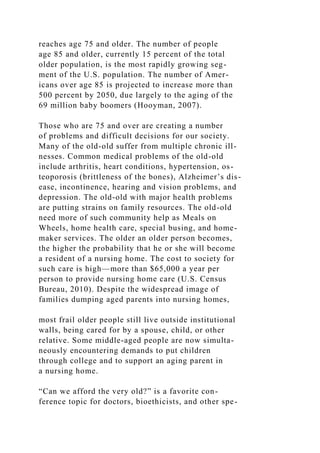
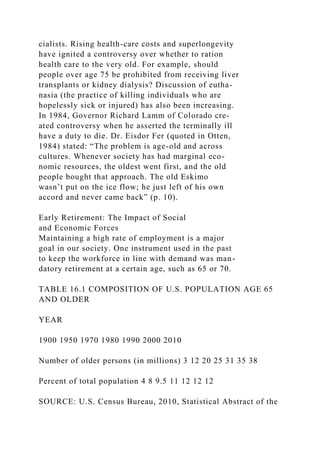
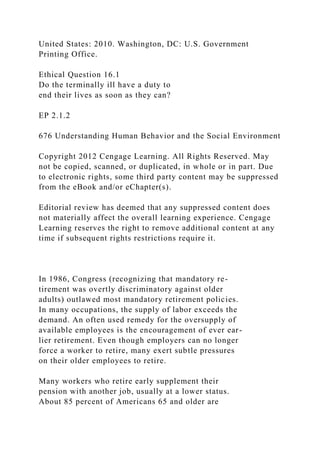
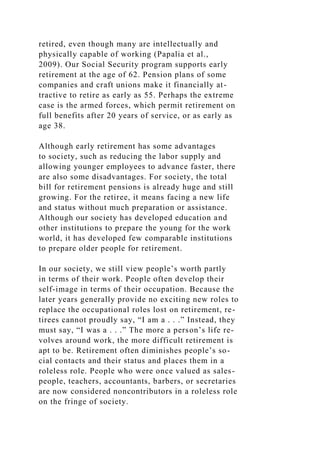
thereby shortchanges older people. Older people are
viewed as out of touch with what’s happening, and
their knowledge is seldom valued or sought. Intellec-
tual ability is sometimes thought to decline with age,
even though research shows that intellectual capacity,
barring organic problems, remains essentially
unchanged until very late in life (Santrock, 2009).
Older people are erroneously thought to be senile,
resistant to change, inflexible, incompetent workers,
and a burden on the young. Given opportunities,
older individuals usually prove such prejudicial con-
cepts to be wrong. They generally react to prejudice
against them in the same way that racial and ethnic
minorities react—by displaying self-hatred and by
being self-conscious, sensitive, and defensive about
their social and cultural status (Santrock, 2009). As
we have mentioned previously, individuals who fre-
quently receive negative responses from others even-
tually tend to come to view themselves negatively.
Problems Faced by Older People
Individuals are dramatically affected by their inter-
actions with other micro, mezzo, and macro systems.
The following section will address a range of prob-
lems suffered by older people within the macro-
system context. This involves two dimensions. The
first concerns problems older people as individual
micro systems suffer within the macro environment.
These include poverty, malnutrition, health difficul-
ties, elder abuse, and lack of transportation. The
other dimension of problems affecting older people
focuses on the macro systems providing them with
support and services. Often, cost is of chief concern.
For example, the general population might experi-
ence rapidly rising taxes to cover a range of services
for older people, including medical care. Examining
both perspectives can enhance your understanding
of human behavior in preparation for assessment
and practice.
A point to remember is that unlike other minori-
ties, older people have problems that we all encoun-
ter eventually (assuming we do not die prematurely).
By the time most of today’s college students reach
middle age (presumably their peak earning years), a
larger proportion of the adult population will be re-
tired, because older people are the fastest-growing
segment of our population. Those who are retired
depend heavily on Social Security, Medicare, and
other government programs to assist in meeting their
financial and medical needs. If we do not face and
solve the financial problems of older people now, we
will be in dire straits in the future.
Emphasis on Youth: The Impact of Social
and Economic Forces
Our society fears aging more than most other socie-
ties do. Our emphasis on youth is illustrated by our
Older people may face many problems, such as severe financial
constraints, physical disabilities,
and perceptual limitations.
A
P
P
h
o
to
/B
e
th
A
.
K
e
is
e
r
674 Understanding Human Behavior and the Social Environment
Copyright 2012 Cengage Learning. All Rights Reserved. May
not be copied, scanned, or duplicated, in whole or in part. Due
to electronic rights, some third party content may be suppressed
from the eBook and/or eChapter(s).
Editorial review has deemed that any suppressed content does
not materially affect the overall learning experience. Cengage
Learning reserves the right to remove additional content at any
time if subsequent rights restrictions require it.
dread of getting gray hair and wrinkles or becoming
bald and by our being pleased when someone
guesses our age to be younger than it actually is.
We place a high value on youthful energy and ac-
tion. We like to think we are doers. But why is there
such an emphasis on youth in our society?
Industrialization resulted in a demand for la-
borers who are energetic, agile, and strong. Rapid
advances in technology and science have made ob-
solete past knowledge and certain specialized work
skills. Pioneer living and the gradual expansion of
our nation to the west required brute strength, en-
ergy, and stamina. Competition has always been em-
phasized and has been reinforced by a social
interpretation of Darwin’s theory of evolution,
which highlighted survival of the fittest, though Dar-
win meant those that “fit” their environment, not
those that were young and healthy. The cultural tra-
dition of overvaluing youth in our society has resulted
in our devaluation of older people. Spotlight 16.1
discusses the status of older people in China and
Japan and lists factors associated with high status
for older people.
The Increasing Older Population
There are now more than 10 times as many people
age 65 and older as there were in 1900. Table 16.1
shows that the percentage of older people has been
steadily increasing. As of 2010, there were about
38 million Americans age 65 and over. (U.S. Census
Bureau, 2010).
By 2030, the number is projected to be 72 million—
a 90 percent increase in 20 years, compared to a
30 percent growth in total population during the
same period (Hooyman, 2007).
Several reasons can be given for the phenomenal
growth of the older population. The improved care
of expectant mothers and newborn infants has re-
duced the infant mortality rate. New drugs, better
sanitation, and other medical advances have in-
creased the life expectancy of Americans from
49 years in 1900 to 78 years in 2010 (U.S. Census
Bureau, 2010).
Another reason for the increasing proportion of
older people is that the birth rate is declining—fewer
babies are being born, while more adults are reach-
ing later adulthood. After World War II, a baby
boom lasted from 1946 to 1964. Children born dur-
ing these years flooded schools in the 1950s and
1960s. Then they moved into the labor market.
Very soon, this generation will begin to reach retire-
ment. After 1964, there was a baby bust, a sharp
decline in birth rates. The average number of chil-
dren per woman went down from a high of 3.8 in
1957 to the current rate of about 2.0 (Mooney,
Knox, & Schacht, 2011).
The increased life expectancy, along with the
baby boom followed by the baby bust, will
SPOTLIGHT ON DIVERSITY 16.1
High Status for Older People in China, Japan,
and Other Countries
For many generations, older people in Japan and China have
experienced higher status than older people in the United
States. In both of these countries, older people are integrated
into their families much more than in the United States. In
Japan, more than 75 percent of older people live with their
children, whereas in the United States most older people live
separately from their children (Santrock, 2009). Older people
in Japan are accorded respect in a variety of ways. For exam-
ple, the best seats in a home are apt to be reserved for older
people, cooking tends to cater to the tastes of older people,
and individuals bow to older people.
However, Americans’ images of older people in Japan and
China are somewhat idealized. Japan is becoming more ur-
banized and Westernized. As a consequence, the proportion
of older people living with their children is decreasing, and
older people there are now often employed in lower-status
jobs (Santrock, 2008).
Five factors have been identified as predicting high status
for older people in a culture (Santrock, 2009):
1. Older persons are recognized as having valuable
knowledge.
2. Older persons control key family and community
resources.
3. The culture is more collectivistic than individualistic.
4. The extended family is a common family arrangement
in the culture, and older persons are integrated into the
extended family.
5. Older persons are permitted and encouraged to engage
in useful and valued functions as long as possible.
Sociological Aspects of Later Adulthood 675
Copyright 2012 Cengage Learning. All Rights Reserved. May
not be copied, scanned, or duplicated, in whole or in part. Due
to electronic rights, some third party content may be suppressed
from the eBook and/or eChapter(s).
Editorial review has deemed that any suppressed content does
not materially affect the overall learning experience. Cengage
Learning reserves the right to remove additional content at any
time if subsequent rights restrictions require it.
significantly increase the median age of Americans
in future years. The median age is indeed increasing
dramatically. The long-term implications are that
the United States will undergo a number of cultural,
social, and economic changes.
The Fastest—Growing Age Group: Old-Old
As our society is having more success in treating and
preventing heart disease, cancer, strokes, and other
killers, more and more older people are living into
their 80s and beyond. People 85 and over constitute
the fastest-growing age group in the United States
(Mooney et al., 2011). Older Americans are living
longer, due in part to betler medical care, sanitation,
and nutrition. The proportion of the old-old in our
society is projected to increase substantially in the
next few decades as the baby boomer generation
reaches age 75 and older. The number of people
age 85 and older, currently 15 percent of the total
older population, is the most rapidly growing seg-
ment of the U.S. population. The number of Amer-
icans over age 85 is projected to increase more than
500 percent by 2050, due largely to the aging of the
69 million baby boomers (Hooyman, 2007).
Those who are 75 and over are creating a number
of problems and difficult decisions for our society.
Many of the old-old suffer from multiple chronic ill-
nesses. Common medical problems of the old-old
include arthritis, heart conditions, hypertension, os-
teoporosis (brittleness of the bones), Alzheimer’s dis-
ease, incontinence, hearing and vision problems, and
depression. The old-old with major health problems
are putting strains on family resources. The old-old
need more of such community help as Meals on
Wheels, home health care, special busing, and home-
maker services. The older an older person becomes,
the higher the probability that he or she will become
a resident of a nursing home. The cost to society for
such care is high—more than $65,000 a year per
person to provide nursing home care (U.S. Census
Bureau, 2010). Despite the widespread image of
families dumping aged parents into nursing homes,
most frail older people still live outside institutional
walls, being cared for by a spouse, child, or other
relative. Some middle-aged people are now simulta-
neously encountering demands to put children
through college and to support an aging parent in
a nursing home.
“Can we afford the very old?” is a favorite con-
ference topic for doctors, bioethicists, and other spe-
cialists. Rising health-care costs and superlongevity
have ignited a controversy over whether to ration
health care to the very old. For example, should
people over age 75 be prohibited from receiving liver
transplants or kidney dialysis? Discussion of eutha-
nasia (the practice of killing individuals who are
hopelessly sick or injured) has also been increasing.
In 1984, Governor Richard Lamm of Colorado cre-
ated controversy when he asserted the terminally ill
have a duty to die. Dr. Eisdor Fer (quoted in Otten,
1984) stated: “The problem is age-old and across
cultures. Whenever society has had marginal eco-
nomic resources, the oldest went first, and the old
people bought that approach. The old Eskimo
wasn’t put on the ice flow; he just left of his own
accord and never came back” (p. 10).
Early Retirement: The Impact of Social
and Economic Forces
Maintaining a high rate of employment is a major
goal in our society. One instrument used in the past
to keep the workforce in line with demand was man-
datory retirement at a certain age, such as 65 or 70.
TABLE 16.1 COMPOSITION OF U.S. POPULATION AGE 65
AND OLDER
YEAR
1900 1950 1970 1980 1990 2000 2010
Number of older persons (in millions) 3 12 20 25 31 35 38
Percent of total population 4 8 9.5 11 12 12 12
SOURCE: U.S. Census Bureau, 2010, Statistical Abstract of the
United States: 2010. Washington, DC: U.S. Government
Printing Office.
Ethical Question 16.1
Do the terminally ill have a duty to
end their lives as soon as they can?
EP 2.1.2
676 Understanding Human Behavior and the Social Environment
Copyright 2012 Cengage Learning. All Rights Reserved. May
not be copied, scanned, or duplicated, in whole or in part. Due
to electronic rights, some third party content may be suppressed
from the eBook and/or eChapter(s).
Editorial review has deemed that any suppressed content does
not materially affect the overall learning experience. Cengage
Learning reserves the right to remove additional content at any
time if subsequent rights restrictions require it.
In 1986, Congress (recognizing that mandatory re-
tirement was overtly discriminatory against older
adults) outlawed most mandatory retirement policies.
In many occupations, the supply of labor exceeds the
demand. An often used remedy for the oversupply of
available employees is the encouragement of ever ear-
lier retirement. Even though employers can no longer
force a worker to retire, many exert subtle pressures
on their older employees to retire.
Many workers who retire early supplement their
pension with another job, usually at a lower status.
About 85 percent of Americans 65 and older are
retired, even though many are intellectually and
physically capable of working (Papalia et al.,
2009). Our Social Security program supports early
retirement at the age of 62. Pension plans of some
companies and craft unions make it financially at-
tractive to retire as early as 55. Perhaps the extreme
case is the armed forces, which permit retirement on
full benefits after 20 years of service, or as early as
age 38.
Although early retirement has some advantages
to society, such as reducing the labor supply and
allowing younger employees to advance faster, there
are also some disadvantages. For society, the total
bill for retirement pensions is already huge and still
growing. For the retiree, it means facing a new life
and status without much preparation or assistance.
Although our society has developed education and
other institutions to prepare the young for the work
world, it has developed few comparable institutions
to prepare older people for retirement.
In our society, we still view people’s worth partly
in terms of their work. People often develop their
self-image in terms of their occupation. Because the
later years generally provide no exciting new roles to
replace the occupational roles lost on retirement, re-
tirees cannot proudly say, “I am a . . .” Instead, they
must say, “I was a . . .” The more a person’s life re-
volves around work, the more difficult retirement is
apt to be. Retirement often diminishes people’s so-
cial contacts and their status and places them in a
roleless role. People who were once valued as sales-
people, teachers, accountants, barbers, or secretaries
are now considered noncontributors in a roleless role
on the fringe of society.
Several myths about the older worker have been
widely believed by employers and the general public.
Older workers are thought to be less healthy, clum-
sier, more prone to absenteeism, more accident-
prone, more forgetful, and slower in task performance
(Papalia et al., 2009). Research has shown these be-
liefs to be erroneous. Older workers have lower turn-
over rates, produce at a steadier rate, make fewer
mistakes, have lower absenteeism rates, have a more
positive attitude toward their work, and exceed youn-
ger employees in health and low on-the-job injury
rates. However, when older workers do become ill,
they usually take a somewhat longer time to recover
(Papalia et al., 2009).
A key question about early retirement is the age
at which people want to retire. Gerontologists have
studied this question. Younger workers generally
state they prefer to retire before age 65. Older work-
ers indicate they desire to retire later than the con-
ventional age of 65 (Newman & Newman, 2009).
The explanation for this difference appears to be
partly economic. Because Social Security benefits
and pension plans are usually insufficient to provide
the same standard of living as when a person was
working, older people see an economic need to con-
tinue working beyond age 65. An additional expla-
nation is sociopsychological. With retirement often
being a roleless role in our society, older workers
may gradually identify more and more with their
work and prefer it over retirement.
Adjustment to retirement varies for different peo-
ple. Retirees who are not worried about money and
who are healthy are happier in retirement than those
who miss their income and do not feel well enough
to enjoy their leisure time. Many recent retirees rel-
ish the first long stretches of leisure time they have
had since childhood. After a while, however, they
may begin to feel restless, bored, and useless. The
most satisfied retirees tend to be physically fit people
who are using their skills in part-time volunteer or
paid work (Papalia et al., 2009).
Workers who are pressured to retire before they
want to may feel anger and resentment, and may feel
out of step with younger workers. Also, workers
who defer retirement as long as possible because
they enjoy their work may feel that no more work
is an immense loss when they are pressured to retire.
On the other hand, some people’s morale and life
satisfaction remain stable through both working
and retirement years.
Older adults who adjust best to retirement have
adequate income, are healthy, are active, are better
educated, have an extended social network that in-
cludes both family and friends, and usually were sat-
isfied with their lives prior to retiring. Those having
the most difficulty adjusting to retirement are those
Sociological Aspects of Later Adulthood 677
Copyright 2012 Cengage Learning. All Rights Reserved. May
not be copied, scanned, or duplicated, in whole or in part. Due
to electronic rights, some third party content may be suppressed
from the eBook and/or eChapter(s).
Editorial review has deemed that any suppressed content does
not materially affect the overall learning experience. Cengage
Learning reserves the right to remove additional content at any
time if subsequent rights restrictions require it.
with poor health, inadequate income, and who must
adjust to other stresses (such as the death of a
spouse) (Santrock, 2009, p. 573).
The two most common problems associated with
retirement are adjusting to a reduced income and
missing one’s former job. Those who have the
most difficulty in adjusting tend to be rigid or to
overly identify with their work by viewing their job
as their primary source of satisfaction and self-
image. Those who are happiest are able to replace
job prestige and financial status with values stress-
ing self-development, personal relationships, and
leisure activities.
Financial Problems of Older People
One out of 10 older people lives in poverty. Fair
numbers lack adequate food, essential clothes and
drugs, and perhaps a telephone in the house to
make emergency calls. Only small minorities of older
people have substantial savings or investments.
Poverty among older people varies dramatically
by race, sex, marital status, ethnicity, and age.
Women, the old-old, people of color, and those
who are widowed or single are most likely to be
poor (Mooney et al., 2009).
Older women are more likely to be poor than
older men. Nearly half of older Hispanic women,
and four out of 10 older African American women,
are living in poverty (Mooney et al., 2009). Women
of color were more likely to have been working in
low-paying jobs with no retirement plan.
The financial problems of older people are com-
pounded by other factors. One is the high cost of
health care, as previously discussed. A second factor
is inflation. Inflation is especially devastating to
those on fixed incomes. Most private pension bene-
fits do not increase after a worker retires. For exam-
ple, if living costs rise annually at 3.5 percent, after
20 years, a person on a fixed pension would be able
to buy only half as many goods and services as he or
she could at retirement (“Will Inflation Tarnish
Your Golden Years?” 1979). Fortunately, in 1974,
Congress enacted an automatic escalator clause in
Social Security benefits, providing a 3 percent in-
crease in payments when the consumer price index
increases a like amount. However, Social Security
benefits were never intended to make a person finan-
cially independent, and it is nearly impossible to live
comfortably on monthly Social Security checks.
The most important source of income for the vast
majority of older people is Social Security benefits,
primarily the Old-Age Survivors, Disability, and
Health Insurance (OASDHI) program. This pro-
gram is described later in this chapter. About
95 percent of older adults receive Social Security;
for 18 percent of them, Social Security is their only
income (Hooyman, 2007). About 14 percent of
Americans age 65 and older are in the paid labor
Retirees who have previously enjoyed social and economic
success and are in good physical health
are more likely to enjoy retirement.
A
ri
e
l
S
ke
ll
e
y/
G
e
tt
y
Im
a
g
e
s
678 Understanding Human Behavior and the Social Environment
Copyright 2012 Cengage Learning. All Rights Reserved. May
not be copied, scanned, or duplicated, in whole or in part. Due
to electronic rights, some third party content may be suppressed
from the eBook and/or eChapter(s).
Editorial review has deemed that any suppressed content does
not materially affect the overall learning experience. Cengage
Learning reserves the right to remove additional content at any
time if subsequent rights restrictions require it.
force. This figure is substantially lower than in 1950,
but represents an increase since 1993 (Hooyman,
2007).
Sullivan and his associates (Sullivan, Thompson,
Wright, Gross, & Spady, 1980) emphasize the im-
portance of financial security for the elderly:
Financial security affects one’s entire life-style. It
determines one’s diet, ability to seek good health
care, to visit relatives and friends, to maintain a
suitable wardrobe, and to find or maintain ade-
quate housing. One’s financial resources, or lack
of them, play a great part in finding recreation
(going to movies, plays, playing bridge or bingo,
etc.) and maintaining morale, feelings of indepen-
dence, and a sense of self-esteem. In other words, if
an older person has the financial resources to re-
main socially independent (having her own house-
hold and access to transportation and medical
services), to continue contact with friends and rel-
atives, and to maintain her preferred forms of rec-
reation, she is going to feel a great deal better
about herself and others than if she is deprived of
her former style of life. (pp. 357–358)
The Social Security System
The Social Security system was not designed to be
the main source of income for older people. It was
originally intended as a form of insurance that
would supplement other assets when the retirement,
disability, or death of a wage-earning spouse oc-
curred. Yet many older people do not have invest-
ments, pensions, or savings to support them in
retirement, and therefore Social Security has become
their major source of income.
The Social Security system was instituted in the
United States in 1935. Money is paid into the system
from Social Security taxes on employers and em-
ployees. In 1935, life expectancy was only somewhat
over 60 years. Life expectancy, however, has in-
creased to 78 in 2010. Social Security taxes have
sharply increased in recent years, but the proportion
of older people is increasing even faster. Some pro-
jections have the Social Security fund being depleted
around 2030 (Santrock, 2009).
The dependency ratio is the number of societal
members who are under 18 or over 64 compared
with the number who are between 18 and 64. This
ratio is increasing. Currently, there are 63 “depen-
dents” for every 100 persons between 18 and 64.
By 2050, the estimated ratio will be 80 to 100
(Mooney, Knox, & Schacht, 2007, p. 427). Accord-
ing to Mooney et al.:
This dramatic increase, and the general movement
toward global aging, may lead to a shortage of
workers and military personnel, foundering pension
plans, and declining consumer markets. It may also
lead to increased taxes as governments struggle to
finance elder care programs and services, heighten-
ing intergenerational tensions as societal members
compete for scarce resources. (p. 427)
Some problems now exist with the system. First,
as mentioned, the benefits are too small to provide
the major source of income for older people. Even
with payments from Social Security included, an es-
timated 80 percent of retirees are now living on less
than half of their preretirement income. And the
monthly payments from Social Security are gener-
ally below the poverty line (Kornblum & Julian,
2009). Second, it is unlikely that the monthly bene-
fits will be raised much. Our society faces some hard
choices about keeping the Social Security system sol-
vent in future years. Benefits might be lowered, but
this would further impoverish the recipients. Social
Security taxes might be raised, but there is little pub-
lic support for this. The amount of salary that is
subject to Social Security taxes has been rising sig-
nificantly each year since 1970.
The future of the Social Security system is un-
clear. It is likely to continue to exist, but reduced
benefits are possible. Young people are well ad-
vised to plan for retirement through savings and
investments that will supplement Social Security
payments.
Death
Preoccupation with dying, particularly with the cir-
cumstances surrounding it, is an ongoing concern of
older people. For one reason, they see their friends
and relatives dying. For another, they realize they’ve
lived more years than they have left.
Ethical Question 16.2
Should Social Security benefits be
expanded, reduced, or kept at the
same level?
EP 2.1.2
Sociological Aspects of Later Adulthood 679
Copyright 2012 Cengage Learning. All Rights Reserved. May
not be copied, scanned, or duplicated, in whole or in part. Due
to electronic rights, some third party content may be suppressed
from the eBook and/or eChapter(s).
Editorial review has deemed that any suppressed content does
not materially affect the overall learning experience. Cengage
Learning reserves the right to remove additional content at any
time if subsequent rights restrictions require it.
The older person’s concern about dying is most
often focused on the disability, the pain, or the
long period of suffering that may precede death.
People generally would like a death with dignity.
They would prefer to die in their own homes, with
little suffering, with mental faculties intact, and with
family and friends nearby. Older people are also
concerned about the cost of their final illness, the
difficulties they may cause others by the manner of
their death, and whether their resources will permit a
dignified funeral.
In modern America, many people die in nursing
homes or hospitals surrounded by medical staff
(Papalia et al., 2009). Such deaths often occur with-
out dignity. Fortunately, the hospice movement has
been developing in recent years in an attempt to fos-
ter death with dignity. A hospice is a program that is
designed to allow the terminally ill to die with dig-
nity—to live their final weeks in a way they want.
Hospices originated in the Middle Ages among
European religious groups that welcomed travelers
who were sick, tired, or hungry (Sullivan et al., 1980).
Hospices serve patients in a variety of settings—
in hospitals, in nursing homes, in assisted-living fa-
cilities, and in the dying person’s home. Hospices
provide both medical and social services, and make
extensive efforts to allow the terminally ill to spend
their remaining days as they choose. Hospices some-
times have educational and entertainment programs,
and visitors are welcome. Pain relievers are exten-
sively used, so that the patient is able to live out
his or her final days in relative comfort.
Hospices view the disease, not the patient, as ter-
minal. Their emphasis is on helping people use the
time that is left, rather than on trying to keep people
alive as long as possible. Many hospice programs
are set up to assist people in living their remaining
days at home. In addition to medical and visiting
nurse services, hospices have volunteers to help the
patient and family members with such services as
counseling, transportation, filling out insurance
forms and other paperwork, and respite care (that
is, staying with the patient to provide temporary re-
lief for family members).
The Ethical Dilemma box raises a number of is-
sues, including refusal of treatment, termination of
treatment, and physician-assisted suicide.
Elder Abuse
A shocking way for older people to spend their final
years is as victims of elder abuse—neglect, physical
abuse, or psychological abuse of dependent older
persons. The perpetrator may be the son or daughter
of the older victim, a spouse, a caregiver, or some
other person. Although elder abuse can occur in
nursing homes and in other institutions, it is most
often suffered by frail older people living with their
spouses or their children. Because of problems in
defining elder abuse, as well as the fact that the
abuse is grossly underreported, the number abused
may involve as many as 6 percent of the older pop-
ulation (Santrock, 2009, p. 579).
Adult children may abuse their parents for a va-
riety of reasons. They may be responding to the
stress of their own personal problems or to the stress
of the time, energy, and finances needed to care for
another person. They may be paying back their par-
ent for having been abusive to them when they were
younger. They may be upset with their older parent’s
emotional reactions, physical impairments, lifestyle,
or personal habits. They may be intentionally abus-
ing the parent to force him or her to move out of
their home. When the older person is living with
the abuser, finding alternative living arrangements
is often necessary.
The typical victim is an older person in poor
health who lives with someone. Papalia and her as-
sociates (2009) note that the abuser is more likely to
be a spouse than a child, partly because substantially
more older people live with spouses than with their
children. The risk of elder abuse is substantially in-
creased when the caregiver is depressed (Papalia,
et al., 2009, p. 611).
The varied forms of mistreatment of older people
are typically grouped into the following seven
categories:
• Physical abuse: the infliction of physical pain or
injury, including bruising, punching, or restraining
• Psychological abuse: the infliction of mental an-
guish, such as intimidating, humiliating, and
threatening harm
• Financial abuse: the illegal or improper exploita-
tion of the victim’s assets or property
• Neglect: the deliberate failure or refusal to fulfill a
caretaking obligation, such as denial of food or
health care, or abandoning the victim
• Sexual abuse: nonconsensual sexual contact with
an older person
• Self-neglect: behaviors of a frail, depressed, or
mentally incompetent older person that threaten
her or his own safety or health, such as failure to
680 Understanding Human Behavior and the Social Environment
Copyright 2012 Cengage Learning. All Rights Reserved. May
not be copied, scanned, or duplicated, in whole or in part. Due
to electronic rights, some third party content may be suppressed
from the eBook and/or eChapter(s).
Editorial review has deemed that any suppressed content does
not materially affect the overall learning experience. Cengage
Learning reserves the right to remove additional content at any
time if subsequent rights restrictions require it.
ETHICAL DILEMMA
A Right to Die?
The technology of life-support equipment
can keep people alive almost indefinitely.
Respirators, artificial nutrition, intravenous
hydration, and so-called miracle drugs not
only sustain life but also trap many of the
terminally ill in a degrading mental and
physical condition. Such technology has
raised a variety of ethical questions. Do people who are ter-
minally ill and in severe pain have a right to die by refusing
treatment? Increasingly, through “living wills,” patients are
able to express their wishes and refuse treatment. However,
does someone in a long-term coma who has not signed a liv-
ing will have a right to die? How should our society decide
when to continue and when to stop life-support efforts?
Courts and state legislatures are presently working through
the legal complexities governing death and euthanasia.
Should assisted death or assisted suicide be legalized? As
of 2001, only the Netherlands permitted physicians to give
qualifying terminally ill patients a lethal dose of drugs. There
is considerable controversy about assisted suicide in the
United States. Hemlock Society founder Derek Humphry
has written a do-it-yourself suicide manual. (The Hemlock So-
ciety promotes active voluntary euthanasia.) Michigan doctor
Jack Kevorkian made national news by building a machine to
help terminally ill people end their lives and by assisting a
number of them to do so.
In the Netherlands, an informal, de facto arrangement
made with prosecutors more than 25 years ago allows physi-
cians there to help patients die, as long as certain safeguards
are followed. The patient, for example, has to be terminally
ill, in considerable pain, and mentally competent, and must
repeatedly express a wish to die.
Oregon voters passed that state’s Death with Dignity Act
in 1994. It allows doctors to prescribe lethal drugs at the re-
quest of terminally ill patients who have less than six months
to live. Doctors may only prescribe a lethal dose, not admin-
ister it.
People in favor of assisted suicide argue that unnecessary
long-term suffering is without merit and should not have to be
endured. They argue that people have a right to a death with
dignity, which means a death without excessive emotional and
physical pain and without excessive mental, physical, and
spiritual degradation. They see assisted suicide as affirming
the principle of autonomy—upholding the individual’s right
to make decisions about his or her dying process. Allowing
the option of suicide for the terminally ill is perceived as the
ultimate right of self-determination.
Opponents assert that suicide is, at best, unethical and, at
worst, a mortal sin for which the deceased cannot receive for-
giveness. They view assisted suicide as assisted murder. They
assert that modern health care can provide almost everyone a
peaceful, pain-free, comfortable, and dignified end to life.
Opponents believe that most terminally ill persons consider
suicide not because they fear death but because they fear
dying—
pain, abandonment, and loss of control (all of which a hospice
is
designed to alleviate). Moreover, assisted-suicide legislation
could easily result in a number of unintended consequences.
The terminally ill might believe they have a duty to die in order
to avoid being a financial and emotional burden to their families
and to society. A health-care system intent upon cutting costs
could give subtle, even unintended, encouragement to a patient
to die. Relatives of a terminally ill person receiving expensive
medical care may put pressure on the person to choose
physician-assisted suicide to avoid eroding the family’s
finances.
There is concern that if competent people are allowed to seek
death, then pressure will grow to use the treatment-by-death op-
tion with adults in comas or with others who are mentally
incom-
petent (such as the mentally ill and those who have a severe
cognitive disability). Finally, many people worry that if the
“right to die” becomes recognized as a basic right in our
society,
then it can easily become a “duty to die” for older people, the
sick, the poor, and others devalued by society.
Some authorities have sought to make a distinction be-
tween active euthanasia (assisting in suicide) and passive eu-
thanasia (withholding or withdrawing treatment). In many
states, it is legal for physicians and courts to honor a patient’s
wishes to not receive life-sustaining treatment.
A case of passive euthanasia involved a Missouri woman,
Nancy Cruzan. On January 11, 1983, when she was 25, her
car overturned. Her brain lost oxygen for 14 minutes follow-
ing the accident, and for the next several years she was in a
“persistent vegetative state,” with no hope of recovery. A
month after the accident, her parents, Joyce and Joe Cruzan,
gave permission for a feeding tube to be inserted. In the
months that followed, however, the parents gradually became
convinced there was no point in keeping Nancy alive indefi-
nitely in such a hopeless condition.
In 1986, they were shocked when a Missouri state judge
informed them that they could be charged with murder for
removing the feeding tube. The Cruzans appealed the decision
all the way to the U.S. Supreme Court, requesting the Court
to overturn a Missouri law that specifically prohibits with-
drawal of food and water from hopelessly ill patients. In
July 1990, the Supreme Court refused the Cruzans’ request
that their daughter’s tube be removed but ruled that states
could sanction the removal if there is “clear and convincing
evidence” that the patient would have wished it. Cruzan’s
family subsequently found other witnesses to testify that
Nancy would not have wanted to be kept alive in such a con-
dition. A Missouri judge decided that the testimony met the
Supreme Court’s test. The tube was disconnected in Decem-
ber 1990, and Nancy Cruzan died several days later.
At the present time, 10,000 Americans are in similar vege-
tative conditions, unable to communicate. Many of these
(continued)
EP 2.1.2
Sociological Aspects of Later Adulthood 681
Copyright 2012 Cengage Learning. All Rights Reserved. May
not be copied, scanned, or duplicated, in whole or in part. Due
to electronic rights, some third party content may be suppressed
from the eBook and/or eChapter(s).
Editorial review has deemed that any suppressed content does
not materially affect the overall learning experience. Cengage
Learning reserves the right to remove additional content at any
time if subsequent rights restrictions require it.
eat or drink adequately or to take prescribed
medications
• Violating personal rights: violation of an older
person’s rights, including the right to privacy and
to make her or his personal and health decisions
(Papalia et al., 2009, p. 611)
Every state is mandated by the federal government
to provide adult protective services similar to those
provided for children. An Adult Protective Services
program serves adults—primarily older people and
adults with physical or mental disabilities—who are
being neglected or abused. (This program is described
in more detail later in this chapter.)
Housing
More than 95 percent of older people do not live in
nursing homes or any other kind of institution. More
than 70 percent of older men are married and live with
their wives. Because women tend to outlive their
spouses, more than 40 percent of women over age 65
live alone. Nearly 80 percent of older married couples
maintain their own households—in apartments, mo-
bile homes, condominiums, or their own houses. In
addition, nearly half of single older people (widows,
widowers, divorced, never married) live in their own
homes (Papalia et al., 2009). When older people do
not maintain their own households, they most often
live in the homes of relatives, primarily children.
Older people who live in rural areas generally
have a higher status than those living in urban areas.
People living on farms can retire gradually. People
whose income is in land, rather than a job, can re-
tain importance and esteem to an advanced age.
However, almost three-fourths of Americans live
in urban areas, and older people often live in poor-
quality housing. At least 30 percent of older people
live in substandard, deteriorating, or dilapidated
housing (Mooney et al., 2009). Many older people
in urban areas are trapped in decaying, low-value
houses needing considerable maintenance and often
surrounded by racial and ethnic groups different
from their own. Many urban older people live in
the urban inner cities in hotels or apartments with
inadequate living conditions. Their neighborhoods
may be decaying and crime-ridden, where they are
easy prey for thieves and muggers.
Fortunately, many mobile home parks, retire-
ment villages, and apartment complexes geared to
the needs of older people have been built through-
out the country. Many such communities for older
people provide a social center, security protection,
sometimes a daily hot meal, and perhaps help with
maintenance. The fastest-growing housing option
ETHICAL DILEMMA (continued)
individuals have virtually no chance to recover. Right-to-die
questions will undoubtedly continue to be raised in many of
these cases.
In June 1997, the U.S. Supreme Court ruled that termi-
nally ill people do not have a constitutional right to doctor-
assisted suicide.
In January 2006, the U.S. Supreme Court ruled that the
Bush administration’s attempts to stop Oregon doctors from
prescribing lethal doses were improper. The immediate legal
impact of the Court’s ruling is clear. Oregon doctors may
continue to prescribe lethal doses without fear of federal
penalty.
At the time of this writing, physician-assisted suicide was
legal in three states in the United States: Oregon, Washington,
and Montana. It is also legal in some other countries, includ-
ing Belgium, Luxembourg, the Netherlands, and Switzerland.
In the three states in the United States, there are barriers to the
use of this type of suicide. For example, Pamela J. Miller
(2000, p. 264) describes the processes in the state of Oregon:
To quality to receive a prescription for medication to end
life, the person must be terminally ill with six months or
less to live, and a second physician’s opinion on diagnosis
and prognosis is required. After the first oral request to start
the process, a 15-day waiting period begins. A mental health
consultation is not required, although either physician can
request an evaluation by a psychiatrist or psychologist, and
notification of family or friends is not required. A written
request combined with another oral request is obtained,
and a 48-hour waiting period begins. The prescription, gen-
erally barbiturates and antinausea medication, is then given
to the terminally ill person and taken by mouth.
Do you believe that the terminally ill have a right to die by
refusing treatment? Do you believe that assisted suicide
should be legalized? If you had a terminally ill close relative
who was in intense pain and asked you to assist her or him in
acquiring a lethal dose of drugs, how would you respond?
Would you be willing to help? Or would you refuse?
682 Understanding Human Behavior and the Social Environment
Copyright 2012 Cengage Learning. All Rights Reserved. May
not be copied, scanned, or duplicated, in whole or in part. Due
to electronic rights, some third party content may be suppressed
from the eBook and/or eChapter(s).
Editorial review has deemed that any suppressed content does
not materially affect the overall learning experience. Cengage
Learning reserves the right to remove additional content at any
time if subsequent rights restrictions require it.
for older people is assisted-living facilities. Such fa-
cilities offer private living units, with the safety of
around-the-clock staff.
Transportation
Many older people do not drive. Some cannot afford
the cost of a car, whereas others have physical lim-
itations that prevent them from driving and main-
taining a car. The lack of convenient, inexpensive
transportation is a problem faced by most older
people.
Crime Victimization
Having reduced energy, strength, and agility, older
people are vulnerable to being victimized by crime,
particularly robbery, aggravated assault, burglary,
larceny, vandalism, and fraud. Many older people
live in constant fear of being victimized, although
reported victimization rates for older people are
lower than rates for younger people. The actual vic-
timization rates for older people may be consider-
ably higher than official crime statistics indicate,
because many older people feel uneasy about be-
coming involved with the legal and criminal justice
systems. Therefore, they may not report some of the
crimes they are victims of. Some are afraid of retali-
ation from the offenders if they report the crimes,
and others dislike the legal processes they have to
go through if they press charges. Some older people
are hesitant to leave their homes for fear they will be
mugged or for fear their homes will be burglarized
while they are away.
Malnutrition
Older people are the most uniformly undernourished
segment of our population (Papalia et al., 2009).
Chronic malnutrition of older people exists because
of transportation difficulties in getting to grocery
stores; lack of knowledge about proper nutrition;
lack of money to purchase a well-balanced diet;
poor teeth and lack of good dentures, which greatly
limit the diet; lack of incentives to prepare an appe-
tizing meal when one is living alone; and inadequate
cooking and storage facilities.
Health Problems and Cost of Care
As noted earlier, the proportion of older people in our
society is increasing dramatically, and the old-old
(age 85 and over) is the most rapidly growing age
group. Today, there is a crisis in health care for older
people. There are a variety of reasons for this.
As described in Chapter 14, older people are
much more apt to have long-term illnesses. In the
1960s, the Medicare and Medicaid programs were
created to pay for much of their medical costs.
Due to the high costs of these programs, the Reagan-
Bush administrations in the 1980s said the govern-
ment could no longer pay the full costs of that care,
and as a result, there were cuts in eligibility for pay-
ment and limits set for what the government will
pay for a variety of medical procedures.
A national debate is raging over how to reduce
the funds the federal government spends on Medi-
care and Medicaid, including after the passage of
President Obama’s health-care plan in 2010. (Medi-
care and Medicaid are described later in this
chapter.) One faction asserts that limits have to be
set on the annual amount spent on these programs in
order to keep the programs solvent. Another faction
claims that these programs are providing essential
medical care to older people and to the poor, and
that setting additional limits on funds will result in
more serious untreated illnesses and a higher risk of
death for these two at-risk populations.
Physicians are primarily trained in treating the
young, and generally they are less interested in serving
older people. As a result, when older people become
ill, they often do not receive quality medical care.
Medical conditions of older people are often mis-
diagnosed, as physicians receive little specialized
training in the unique medical conditions of older
people. Many of those who are seriously ill do not
get medical attention. One of the reasons physicians
are not interested in treating older people is the
problem of reimbursement. The Medicare program
sets reimbursement limits on a variety of procedures;
as a result, most physicians prefer to work with
younger patients, where the fee-for-service system
is much more profitable.
In addition, older people who live in the commu-
nity often have transportation difficulties in getting
medical care. Those living in nursing homes some-
times receive inadequate care, because some health
professionals assume that such patients haven’t
much time to live and, as a result, providers may
be less interested in providing high-quality medical
care. Medical care for older people is becoming a
national embarrassment because of the low quality
of care that is often provided.
Sociological Aspects of Later Adulthood 683
Copyright 2012 Cengage Learning. All Rights Reserved. May
not be copied, scanned, or duplicated, in whole or in part. Due
to electronic rights, some third party content may be suppressed
from the eBook and/or eChapter(s).
Editorial review has deemed that any suppressed content does
not materially affect the overall learning experience. Cengage
Learning reserves the right to remove additional content at any
time if subsequent rights restrictions require it.
Current Services: Macro-System
Responses
Present services and programs for older people are
primarily maintenance in nature, as they are
mainly designed to meet basic physical needs.
Nonetheless, there are a number of programs, often
federally funded, that provide services needed by
older people. Before we briefly review many of
these programs, we will look at the Older Ameri-
cans Act of 1965, which set forth objectives for
such programs.
Older Americans Act of 1965
The Older Americans Act of 1965 created an oper-
ating agency (Administration on Aging) within the
Department of Health, Education, and Welfare
(now the Department of Health and Human Ser-
vices). This law and its amendments are the basis
for federal aid to states and local communities to
meet the needs of older people. The objectives of
the act are to secure for older people:
• An adequate income
• Best possible physical and mental health
• Suitable housing
• Restorative services for those who require institu-
tionalized care
• Opportunity for employment
• Retirement in health, honor, and dignity
• Pursuit of meaningful activity
• Efficient community services
• Immediate benefit from research knowledge to
sustain and improve health and happiness
• Freedom, independence, and the free exercise of
individual initiative in planning and managing
their own lives (U.S. Department of Health, Edu-
cation, and Welfare, 1970)
Although these objectives are commendable, they
have not been realized for many older people. How-
ever, some progress has been made. Many states have
offices on aging, and some municipalities and coun-
ties have established community councils on aging.
Numerous universities have established centers for
gerontology, which focus on research on older people
and training of students for working with older people
in such disciplines as nursing, psychology, medicine,
sociology, social work, and architecture. (Gerontol-
ogy is the scientific study of the aging process from
physiological, pathological, psychological, sociologi-
cal, and economic points of view.) Government re-
search grants are being given to encourage the study
of older people and their problems. Publishers are
now producing books and pamphlets to inform the
public about older people, and a few high schools
are beginning to offer courses to help teenagers under-
stand older people and their circumstances.
Numerous programs, often federally funded and
administered at state or local levels, provide funds
and services needed by older people. Some of these
programs are briefly described in the following
sections.
Old Age, Survivors, Disability, and Health
Insurance (OASDHI)
The OASDHI social insurance program1 was cre-
ated by the 1935 Social Security Act. OASDHI is
usually referred to as Social Security by the general
public. It is an income insurance program designed
to partially replace income lost when a worker re-
tires or becomes disabled. Cash benefits are also
paid to survivors of insured workers.
Payments to beneficiaries are based on previous
earnings. Rich as well as poor are eligible if insured.
Benefits can be provided to fully insured workers as
early as age 62—although those who seek benefits
before the full retirement age receive smaller bene-
fits. The full retirement age is gradually increasing
for those who are born after 1937, as shown on the
following chart:
Year of Birth Full Retirement Age
1937 (or earlier) 65
1938 65 and 2 months
1939 65 and 4 months
1940 65 and 6 months
1941 65 and 8 months
1942 65 and 10 months
1943–1954 66
1955 66 and 2 months
1956 66 and 4 months
1957 66 and 6 months
1958 66 and 8 months
1959 66 and 10 months
1960 (or later) 67
1Social insurance programs are financed by a tax on employees,
employers, or both. In contrast, public assistance benefits are
paid from general government revenues (such as those raised by
income taxes). In our society, receiving social insurance
benefits
is generally considered a right, whereas receiving public assis-
tance is often stigmatized as charity.
684 Understanding Human Behavior and the Social Environment
Copyright 2012 Cengage Learning. All Rights Reserved. May
not be copied, scanned, or duplicated, in whole or in part. Due
to electronic rights, some third party content may be suppressed
from the eBook and/or eChapter(s).
Editorial review has deemed that any suppressed content does
not materially affect the overall learning experience. Cengage
Learning reserves the right to remove additional content at any
time if subsequent rights restrictions require it.
Dependent husbands and wives over 62 and depen-
dent children under 18 are also eligible for benefits.
(There is no age limit on disabled children who be-
come disabled before 18.)
Participation in this insurance program is compul-
sory for most employees, including the self-employed.
The program is generally financed by a payroll tax
(FICA, Federal Insurance Contributions Act) assessed
equally to employer and employee; the self-employed
are required to pay both parts. The rate has gone up
gradually. Eligibility for benefits is based on the num-
ber of years in which Social Security taxes have been
paid and the amount earned while working.
Supplemental Security Income (SSI)
Under the SSI program, the federal government
makes monthly payments to people in financial
need who are 65 years of age or older or to persons
of any age who are legally blind or disabled. In or-
der to qualify for payments, applicants must have no
(or very little) regular cash income, own little prop-
erty, and have little cash or few assets (such as jew-
elry, stocks, bonds, or other valuables) that could be
turned into cash.
The SSI program became effective on January 1,
1974. The word supplemental in the program’s name
is used because, in most cases, payments supplement
whatever other income may be available to the
claimant. Because OASDHI monthly payments are
often low, SSI sometimes supplements even that in-
come source.
SSI provides a guaranteed minimum income (an
income floor) for older people, the legally blind, and
the disabled. Administration of SSI has been as-
signed to the Social Security Administration. Fi-
nancing of the program is through federal tax
dollars, primarily from income taxes.
Medicare
In 1965, Congress enacted the Medicare program
(Title XVIII of the Social Security Act). Medicare
helps older people pay the high cost of health care.
It has two parts: hospital insurance (Part A) and
supplementary medical insurance (Part B). Everyone
65 or older who is entitled to monthly benefits under
the Old Age, Survivors, and Disability Insurance
program gets Part A automatically, without paying
a monthly premium. Nearly everyone in the United
States 65 or older is eligible for Part B; Part B is
voluntary, and beneficiaries are charged a monthly
premium. Disabled people under age 65 who have
been getting Social Security benefits for 24 consecu-
tive months are also eligible for both Part A and
Part B, effective in the 25th month of disability.
Part A helps pay for time-limited care in a hospital,
in a skilled nursing facility, and for home health visits
(such as visiting nurses). Coverage is limited to 150 days
in a hospital and to 100 days in a skilled nursing facility.
If patients are able to be out of a hospital or nursing
facility for 60 consecutive days following confinement,
they are again eligible for coverage. Covered services in
a hospital or skilled nursing facility include the cost of
meals and a semi-private room, regular nursing services,
drugs, supplies, and appliances. Part A also covers
home health care on a part-time or intermittent basis
if beneficiaries meet the following conditions: they are
homebound, in need of skilled nursing care or physical
or speech therapy, and services are ordered and regu-
larly reviewed by a physician. Finally, Part A covers
up to 210 days of hospice care for a terminally ill
Medicare beneficiary.
Part B helps pay for physicians’ services, outpa-
tient hospital services in an emergency room, outpa-
tient physical and speech therapy, and a number of
other medical and health services prescribed by a
doctor, such as diagnostic services, X-ray or other
radiation treatments, and some ambulance services.
Each Medicare beneficiary has the choice of se-
lecting, from an alphabet soup of health plans,
which plan he or she will be in. The variety of plans
includes preferred provider organizations, provider
service organizations, point-of-service plans, private
fee-for-service plans, and medical savings accounts.
(Details can be obtained from your local Social Se-
curity Administration office.)
Prescription Drug Assistance for Seniors
The cost of prescription drugs is a major concern for
older people who live on fixed incomes. Individuals
without a health insurance plan that covers prescrip-
tion drugs and individuals with incomes just high
enough to put them over the threshold for Medicaid
eligibility must often pay high costs for medications
out of their own pocket. Some older people make
hard choices between paying for medications and
essentials such as food or fuel.
In December 2003, President George W. Bush
signed into law the Medicare Prescription Drug Im-
provement and Modernization Act of 2003. The
program is designed to assist older people, especially
low-income older people, to purchase prescription
drugs at lower costs. (Details of the plan are
Sociological Aspects of Later Adulthood 685
Copyright 2012 Cengage Learning. All Rights Reserved. May
not be copied, scanned, or duplicated, in whole or in part. Due
to electronic rights, some third party content may be suppressed
from the eBook and/or eChapter(s).
Editorial review has deemed that any suppressed content does
not materially affect the overall learning experience. Cengage
Learning reserves the right to remove additional content at any
time if subsequent rights restrictions require it.
complex; information can be obtained from your lo-
cal Social Security Administration office.)
Medicaid
Medicaid was established in 1965 by Title XIX of
the Social Security Act. Medicaid primarily provides
medical care for recipients of public assistance. It
enables states to pay hospitals, nursing homes, med-
ical societies, and insurance agencies for services
provided to recipients of public assistance. Many
of these recipients are indigent elderly, some of
whom are in nursing homes. The federal government
shares the expenses with the states on a 55–45 basis
for recipients of public assistance. Medical expenses
covered under Medicaid include diagnosis and ther-
apy performed by surgeons, physicians, and dentists;
nursing services in the home or elsewhere; and med-
ical supplies, drugs, and laboratory fees.
Medicaid benefits vary from state to state. The
original legislation encouraged states to include cov-
erage of all self-supporting persons whose marginal
income made them unable to pay for medical care.
However, this inclusion is not mandatory, and most
states provide insurance coverage primarily to reci-
pients of public assistance.
Obama’s Health-Care Reform
For many years the United States, unlike most other
developed countries, did not have a universal health-
care system. In 2009, President Obama proposed, and
Congress passed in 2010, the Health Care Reform
bill. Health Care Reform has numerous provisions.
The provisions that most impact older persons will
briefly be summarized (Barry, 2010):
• Once reform is fully implemented, over 95 percent
of Americans will have health insurance coverage,
including 32 million who were currently uninsured
in 2010.
• Health insurance companies will no longer be al-
lowed to deny people coverage because of preexist-
ing conditions—or to drop coverage when people
become sick.
• Individuals and small businesses who can’t afford
to purchase insurance on their own will be able to
pool together and choose from a variety of compet-
ing plans with lower premiums.
• Health care will be more affordable for families
and small businesses thanks to new tax credits, sub-
sidies, and other assistance—paid for largely by
taxing insurance companies, drug companies, and
the very wealthiest Americans.
• Seniors on Medicare will pay less for their prescrip-
tion drugs because the legislation closes the “donut
hole” gap in existing coverage. (There was a gap,
prior to Health Care Reform, in the Prescription
Drug Assistance for Seniors. This gap, called the
donut hole, is the difference of the initial coverage
limit and the catastrophic coverage threshold.)
• Medicaid will be expanded to offer health insur-
ance coverage to an additional 16 million low-
income people.
Food Stamps
The Food Stamp Program is designed to combat
hunger. Food stamps are available to public assis-
tance recipients and to other low-income families,
including older people, who qualify. These stamps
are then used to purchase groceries. The program
is also called Supplemental Nutritional Assistance
Program (SNAP).
Adult Protective Services
Adult protective services are offered in practically all
communities, usually by human services departments.
Although these services are offered widely, the public is
largely unaware of them. About one in every 20 older
people probably needs some form of protective ser-
vices, and this proportion is expected to increase as
the proportion of people over age 75 increases (Papalia
et al., 2009). Protective services are for adults who
are being neglected or abused or for adults whose
physical or mental capacities have substantially deteri-
orated. The aim of adult protective services is to help
older people, and adults with disabilities, meet their
needs in their own home if possible. Alternative
placements include foster care, group home care, and
special housing units(such asapartmentsfor olderpeo-
ple). Services provided include homemaker services,
counseling, rehabilitation, medical services, visiting
nursing services, Meals on Wheels, and transportation.
Highlight 16.1 illustrates some of the help that an
Adult Protective Services agency might offer.
Additional Programs
Additional programs for older people include the
following:
• Meals on Wheels provides hot and cold meals to
housebound recipients who are incapable of
686 Understanding Human Behavior and the Social Environment
Copyright 2012 Cengage Learning. All Rights Reserved. May
not be copied, scanned, or duplicated, in whole or in part. Due
to electronic rights, some third party content may be suppressed
from the eBook and/or eChapter(s).
Editorial review has deemed that any suppressed content does
not materially affect the overall learning experience. Cengage
Learning reserves the right to remove additional content at any
time if subsequent rights restrictions require it.
obtaining or preparing their own meals, but who
can feed themselves.
• Senior-citizen centers, golden-age clubs, and simi-
lar groups provide leisuretime and recreational ac-
tivities for older people.
• Special bus rates reduce bus transportation costs
for older people.
• Property tax relief is available to older people in
many states.
• Housing projects for older people are built by local
sponsors with financing assistance from the De-
partment of Housing and Urban Development.
• Reduced rates at movie theaters and other places
of entertainment are often offered voluntarily by
individual owners.
• Home health services provide visiting nurse ser-
vices, physical therapy, drugs, laboratory services,
and sickroom equipment.
HIGHLIGHT 16.1
Adult Protective Services
The Dodge City Human Services Department received a com-
plaint from a neighbor of Jack and Rosella McArron that the
McArrons were living in health-threatening conditions and
that Mr. McArron was frequently abusing his wife.
Vincent Rudd, an Adult Protective Services worker, inves-
tigated the complaint. When he arrived at the door, Jack
McArron appeared in shabby, dirty clothes with a can of beer
in his hand and refused entry to Mr. Rudd. Mr. Rudd heard
someone moaning in the background, so he went to the nearest
service station and called the police department. Together, Mr.
Rudd and a police officer returned to the McArrons. The offi-
cer informed Mr. McArron that a protective services complaint
had been made and that an investigation must be made. Mr.
McArron grudgingly let the officer and Mr. Rudd in.
The inside of the house appeared not to have been cleaned
for years. Newspapers and dirty clothes were heaped together
in piles on the floor. The dining room table was covered with
dust, cigarette butts, beer cans, whiskey bottles, and dirty
dishes. The plumbing was not working. Cockroaches were
seen. The house had a wood-burning stove that was covered
with dirt and a burned crust. At the very least, the place ap-
peared to be a firetrap. There was a stench that was largely
due to urine.
Mr. McArron appeared to be intoxicated. Mrs. McArron
was found moaning in the bedroom. Mr. McArron stated that
she had arthritis and had slipped on the stairs. He further stated
that her demands and her behavior were driving him to drink.
Her hair was greasy and appeared not to have been washed for
months. She was wearing a torn nightgown that smelled of
urine.
She was very thin, wrinkled, and had a variety of cuts and
bruises.
Her mutterings were difficult to understand, but she seemed to
be
saying that her husband had been battering her for months.
Rosella McArron was taken to a hospital, where she spent
two and a half weeks. (She was found to be 66 years old, and
her husband, 69.) At first she wouldn’t eat, so she was fed intra-
venously. After several days, she became more alert. Daily
baths
improved her appearance. It became clear that she had been fre-
quently abused by her husband for more than a decade. She was
also found to have severe arthritis and diabetes. In the hospital,
she stated that she did not want to return to live with her
husband
because of the beatings. She was placed in a foster home.
The McArrons’ neighbors were interviewed. They reported
that Jack McArron had had a drinking problem for years and
that the neighbors seldom saw him sober. The neighbors were
afraid of what he might do when intoxicated. He frequently
beat his wife and was loud and obnoxious, and the neighbors
were fearful he might kill someone while driving under the in-
fluence. Mr. McArron was taken to a 30-day drug treatment
center. Records showed he had been admitted to this center
on seven previous occasions. This time, a physician found evi-
dence that Mr. McArron was suffering from brain deteriora-
tion due to chronic alcoholism. He seemed to be paranoid as
he talked about his neighbors being gangsters. He stated that
they were stealing his possessions. As the days went by, he
started blaming the police and protective services for kidnap-
ping his wife and talked about getting her back. He stated,
“I’m goin’ lookin’ for her with my shotgun, and I’ll blast any-
one who gets in my way.” With his increasingly paranoid state-
ments, the staff was reluctant to let Mr. McArron return to his
home, as it was felt that if he became intoxicated he could be
dangerous. His mental capacities were deteriorating, and he
was found to have a severe case of cirrhosis of the liver. As a
result, procedures were followed to have a court declare him
incompetent, to appoint a younger cousin as guardian, and to
place Mr. McArron in a nursing home.
After Mrs. McArron had been in the foster home for sev-
eral weeks, she said that she wanted to return to live with her
husband. She was informed that her husband was in a nursing
home. She visited him on several occasions and became in-
creasingly depressed about his deteriorating condition. She
began talking about wanting to die. About a year and a half
later, she did die—of a massive heart attack. Her husband’s
condition in the nursing home continued to deteriorate.
Vincent Rudd often thought about this case. It seemed
that the intervention that resulted in Jack and Rosella’s being
separated from each other was in some way a factor in facilitat-
ing both their mental and emotional deterioration. Breaking a
husband–wife bond had unexpected adverse consequences. But
what were the alternatives? They seemed to be killing each
other by living together. Mr. Rudd realized that intervention
in social work is a matter of judgment; all anyone can do is
give it his or her best shot.
Sociological Aspects of Later Adulthood 687
Copyright 2012 Cengage Learning. All Rights Reserved. May
not be copied, scanned, or duplicated, in whole or in part. Due
to electronic rights, some third party content may be suppressed
from the eBook and/or eChapter(s).
Editorial review has deemed that any suppressed content does
not materially affect the overall learning experience. Cengage
Learning reserves the right to remove additional content at any
time if subsequent rights restrictions require it.
• Nutrition programs provide meals for older people
at group eating sites. (These meals, generally pro-
vided four or five times a week, are usually lun-
cheon meals.)
• Homemaker services perform household tasks that
older people are no longer able to do for themselves.
• Day-care centers for older people provide activi-
ties that are determined by the needs of the group.
• Telephone reassurance is provided by volunteers,
often older persons, who telephone older people
who live alone. (Such calls are a meaningful
form of social contact for both parties, and they
also ascertain whether any serious problems have
arisen that require emergency attention.)
• Lifeline assistance is available for people who are
prone to fall and have difficulty getting back on
their feet. The lifeline is a device that is worn
around the neck or wrist. The fallen person presses
a button, which alerts the Lifeline Response
Center. The Response Center then sends help,
which may be a neighbor, family member, or an
ambulance.
• Nursing homes provide residential care and skilled
nursing care when independence is no longer prac-
tical for older people who cannot take care of
themselves or whose families can no longer take
care of them.
• Congregate housing facilities are private or gov-
ernment-subsidized apartment complexes, hotels
remodeled to meet the needs of independent older
adults, or mobile home parks designed for older
adults. They provide meals, housekeeping, trans-
portation, social and recreational activities, and
sometimes health care.
• Group homes provide housing for some older resi-
dents. A group home is usually a house owned or
rented by a social agency. Employees are hired to
shop, cook, do heavy cleaning, drive, and give
counseling. Residents take care of many of their
own personal needs and take some responsibility
for day-to-day tasks.
• Assisted-living facilities allow older people to live
semi-independently. People living in such a facility
have their own rooms or apartments. Residents
receive personal care (bathing, dressing, and
grooming), meals, housekeeping, transportation,
and social and recreational activities.
• Foster-care homes are usually single-family resi-
dences whose owners take in an unrelated older
adult and are reimbursed for providing housing,
meals, housekeeping, and personal care.
• Continued-care retirement communities are long-
term housing facilities designed to provide a full
range of accommodations and services for affluent
older people as their needs change. A resident may
start out living in an independent apartment; then
move into a congregate housing unit with such
services as cleaning, laundry, and meals; then
move to an assisted-living facility; and finally
move into an adjoining nursing home.
• Nursing home ombudsman programs investigate
and act on concerns expressed by residents in
nursing homes.
Nursing Homes
Nursing homes were created as an alternative to ex-
pensive hospital care and are substantially supported
by the federal government through Medicaid and
Medicare. About 1.8 million older people now live
in extended-care facilities, making nursing homes a
billion-dollar industry. There are more patient beds
in nursing homes than in hospitals (U.S. Census Bu-
reau, 2010).
Nursing homes are classified according to the
kind of care they provide. At one end of the scale,
there are residential homes that provide primarily
room and board, with some nonmedical care (such
as help in dressing). At the other end of the scale are
nursing-care centers that provide skilled nursing and
medical attention 24 hours a day. The more skilled
and extensive the medical care given, the more ex-
pensive the home. The costs per resident average
more than $5,000 a month (U.S. Census Bureau,
2010). About 4.5 percent of adults 65 years of age
and older reside in a nursing home at any point in
time (Papalia et al., 2009, p. 601).
There have been many media reports of the atro-
cious care that some nursing homes have provided
to their residents. Patients have been found lying in
their own feces or urine. Food may be so unappetiz-
ing that some residents refuse to eat it. Some homes
have serious safety hazards. Boredom and apathy
are common among staff as well as residents. A
study in 2001 found that a third of the nursing
homes in the United States had been cited by state
inspectors as being abusive to residents in 1999 and
2000 (“Some Golden Years,” 2001).
Numerous nursing homes fail to meet food sani-
tation standards and have problems administering
drugs and providing personal hygiene for residents
(Kornblum & Julian, 2009).
688 Understanding Human Behavior and the Social Environment
Copyright 2012 Cengage Learning. All Rights Reserved. May
not be copied, scanned, or duplicated, in whole or in part. Due
to electronic rights, some third party content may be suppressed
from the eBook and/or eChapter(s).
Editorial review has deemed that any suppressed content does
not materially affect the overall learning experience. Cengage
Learning reserves the right to remove additional content at any
time if subsequent rights restrictions require it.
There is evidence of patients being abused in
nursing homes (Kornblum & Julian, 2009). Signs
of nursing home abuse include:
• Physical injuries, including broken bones, internal
bleeding, bedsores, medication overdose, head in-
jury, malnutrition, bruises, and joint dislocation
• Signs of neglect, including malnourishment, poor
hygiene, soiled bedding, dehydration, and hazard-
ous or unsanitary living conditions
• Emotional or behavioral changes, such as with-
drawal, agitation, anxiety or fear, frequent crying,
and strained relationships with nursing staff
At present, people of all ages tend to be preju-
diced against nursing homes, even those that are
well run. The average senior citizen looks at a nurs-
ing home as a human junkyard. And there is some
truth to the notion that most nursing homes are
places where older people wait to die.
The cost of care for impoverished nursing home
residents is largely paid by the Medicaid program.
Because the federal government has set limits on
what will be reimbursed under Medicaid, certain
problems may arise. There may be an effort to
keep salary and wage levels as low as possible and
the number of staff to a minimum. A nursing home
may postpone repairs and improvements. Food is
apt to be inexpensive, such as macaroni and cheese,
which his high in fat and carbohydrates. Congress
has mandated that every nursing home patient on
Medicaid is entitled to a monthly spending allow-
ance. However, the homes have control over these
funds, and some homes keep the money.
Complaints about the physical facilities of nurs-
ing homes include not enough floor space or too
many people in a room. The call light by the bed
may be difficult to reach, or the toilets and showers
may not be conveniently located. And the building
may be in a state of decay.
Although the quality of nursing home care ranges
from excellent to awful, nursing homes are needed,
particularly for those requiring round-the-clock
health care for an extended time. If nursing homes
were abolished, other institutions such as hospitals
would have to serve this need. Life in nursing homes
Support from family and friends is important to people living in
nursing homes. Here a daughter tucks
her mother’s favorite afghan around her.
Ethical Question 16.3
If you were mentally competent but
physically incapacitated, would
you agree to being placed in a
nursing home?
EP 2.1.2
R
ic
h
a
rd
H
u
tc
h
in
g
s/
P
h
o
to
E
d
it
Sociological Aspects of Later Adulthood 689
Copyright 2012 Cengage Learning. All Rights Reserved. May
not be copied, scanned, or duplicated, in whole or in part. Due
to electronic rights, some third party content may be suppressed
from the eBook and/or eChapter(s).
Editorial review has deemed that any suppressed content does
not materially affect the overall learning experience. Cengage
Learning reserves the right to remove additional content at any
time if subsequent rights restrictions require it.
need not be bad. When homes are properly adminis-
tered, residents can expand their life experiences.
The ideal nursing home should be lively (with rec-
reational, social, and educational programming),
safe, hygienic, and attractive. It should offer stimu-
lating activities and opportunities to socialize with
people of both sexes and all ages. It should offer
privacy so that (among other reasons) residents can
be sexually active. It should offer a wide range of
therapeutic, social, recreational, and rehabilitative
services. The best care tends to be provided by larger
nonprofit facilities that have a high ratio of nurses to
nurse’s aides (Pillemer & Moore, 1989).
Social Work with Older People
Social work education is taking a leading role in
identifying the problems of older people and is de-
veloping gerontological specializations within the
curricula. Social workers are a significant part of
the staff of most agencies serving older people.
Some states, for example, are now requiring that
each nursing home employ a social worker. Follow-
ing are some of the services needed by older adults in
which social workers have expertise:
• Brokering services. Most communities have a wide
range of services available, but few people are
knowledgeable about the array of services or the
eligibility requirements. Older people are in spe-
cial need of this brokering service, because some
have difficulty with transportation and communi-
cation and others may be reluctant to ask for the
assistance to which they are entitled.
• Case management or care management services.
Social workers are trained to assess the social ser-
vice needs of a client and the client’s family. When
appropriate, the social worker case-manages by
arranging, coordinating, monitoring, evaluating,
and advocating for a package of multiple services
to meet the often complex needs of an older client.
Common functions of most case management
programs for older people include case finding,
prescreening, intake, assessment, goal setting,
care planning, capacity building, care plan imple-
mentation, reassessment, and termination.
• Advocacy. Because of shortcomings in services for
older adults in our society, social workers at times
need to advocate for needed services.
• Individual and family counseling. Counseling inter-
ventions focus on examination of the older client’s
needs and strengths, the family’s needs and
strengths, and the resources available to meet the
identified needs.
• Grief counseling. Older people are apt to need
counseling for role loss (such as retirement or
loss of self-sufficiency), loss of a significant other
(such as a spouse, a child, or an adult sibling), and
loss due to chronic health or mental health
conditions.
• Adult day-care services. Social workers provide in-
dividual and family counseling, outreach and bro-
ker services, supportive services, group work
services, and care-planning services for older peo-
ple being served by adult day-care services.
• Crisis intervention services. Social workers provid-
ing crisis intervention seek to stabilize the crisis
situation and connect the older person and the
family to needed supportive services.
• Adult foster-care services. Foster care and group
homes are designed to help the older person re-
main in the community. Social workers providing
foster care match foster families with older people
and monitor the quality of life for those living in
foster-care settings.
• Adult protective services. Social workers in adult
protective services assess whether older adults are
at risk for personal harm or injury owing to the
actions (or inactions) of others. At-risk circum-
stances include physical abuse, material (financial)
abuse, psychological abuse, and neglect (in which
caregivers withhold medications or nourishment,
or fail to provide basic care). If abuse or neglect
is determined, then Adult Protective Service work-
ers develop, implement, and monitor a plan to
stop the maltreatment.
• Self-help and therapeutic groups. In some settings,
social workers facilitate the formation of self-help
groups and therapeutic groups for older people or
for family members (some of whom may be care-
givers). Self-help and therapeutic groups are useful
for such issues as adjusting to retirement, coping
with illnesses such as Alzheimer’s disease, dealing
with alcohol or other drug abuse, coping with a
terminal illness, and coping with depression and
other emotional difficulties.
• Respite care. Social workers are involved with the
recruitment and training of respite-care workers,
as well as in identifying families in need of these
services. When an older person requires 24-hour
at-home care, respite services allow caregivers
(such as the spouse or other family members)
time away from caregiving responsibilities, which
690 Understanding Human Behavior and the Social Environment
Copyright 2012 Cengage Learning. All Rights Reserved. May
not be copied, scanned, or duplicated, in whole or in part. Due
to electronic rights, some third party content may be suppressed
from the eBook and/or eChapter(s).
Editorial review has deemed that any suppressed content does
not materially affect the overall learning experience. Cengage
Learning reserves the right to remove additional content at any
time if subsequent rights restrictions require it.
alleviates some of the stress involved in providing
24-hour-a-day care.
• Transportation and housing assistance. Social wor-
kers operate as brokers for finding appropriate
housing in the community and for arranging safe
transportation services.
• Social services in hospitals and nursing homes. So-
cial workers in these settings provide assessment
of social needs; health education for the older
person and the family; direct services (such as
counseling) to the older person, the family, and
significant others; advocacy; discharge planning;
community liaison; participation in program plan-
ning; consultation on developing a therapeutic en-
vironment in the facility; and participation in
developing care plans that maximize the older per-
son’s potential for independence.
Because the older population is the most rapidly
growing age group in our society, it is anticipated
that services for older people will significantly expand
in the next few decades. This expansion will generate a
number of new employment opportunities for social
workers.
Older People: A Powerful
Political Force
Most programs for older people are
designed to maintain them at their cur-
rent level of functioning rather than to
enhance their social, physical, and psy-
chological well-being. Despite all the
maintenance programs available for
older people, key problems remain to be solved. A
high proportion of older people do not have meaning-
ful lives, respected status, or adequate income, trans-
portation, living arrangements, diet, or health care.
How can we defend urging people to retire when they
are still productive? How can we defend the living
conditions within some of our nursing homes? How
can we defend our restrictive attitudes toward sexual-
ity among older people? How can we defend provid-
ing services to older people that are limited to
maintenance and subsistence? Moss and Moss
(1975) comment, “Just as we are learning that black
can be beautiful, so we must learn that gray can be
beautiful too. In so learning, we may brighten the
prospects of our old age” (p. 79).
Older people are victims of ageism. In the past,
prejudice has been most effectively combated when
those being discriminated against joined together for
political action. It seems apparent that if major
changes in the elderly’s role in society are to take place,
they will have to be made through political action.
Older people are, in fact, increasingly involved in
political activism and, in some cases, even radical
militancy. A prominent organization is the AARP
(formerly the American Association of Retired Per-
sons). This group lobbies for the interests of old peo-
ple at local, state, and federal levels of government.
An action-oriented group that has caught the
public’s attention is the Gray Panthers. This organi-
zation argues that a fundamental flaw in our society
is the emphasis on materialism and on the consump-
tion of goods and services, rather than on improving
the quality of life for all citizens (including older
adults). The Gray Panthers seek to end ageism and
to advance the goals of human freedom, human dig-
nity, and self-development. This organization uses
social action techniques, including getting older peo-
ple to vote as a bloc for their concerns. Founder
Maggie Kuhn (quoted in Butler, 1975) stated, “We
are not mellow, sweet old people. We have got to
effect change, and we have nothing to lose” (p. 341).
Another reason older people are a powerful polit-
ical group is that they are more likely to vote than
the young (Kornblum & Julian, 2009). And older
people will be more politically active in the future
because the composition of the older population is
changing. The average educational level of this pop-
ulation has been steadily increasing (U.S. Census
Bureau, 2010). The coming generation of older peo-
ple will be better educated, better informed, and
more politically conscious.
Significant steps toward securing a better life for
older adults have been made in the last 40 years:
increased Social Security payments, enactment of
the Medicare and Medicaid programs, the emer-
gence of hospices, and the expansion of a variety
of other programs. With older people becoming a
powerful political bloc, we are apt to see a number
of changes in future years to improve the status of
older people in our society.
Changing a Macro System:
Finding a Social Role
for Older People
As we have discussed, older adults face a variety of
problems. They have a roleless role in our society
EP 2.1.8a
Sociological Aspects of Later Adulthood 691
Copyright 2012 Cengage Learning. All Rights Reserved. May
not be copied, scanned, or duplicated, in whole or in part. Due
to electronic rights, some third party content may be suppressed
from the eBook and/or eChapter(s).
Editorial review has deemed that any suppressed content does
not materially affect the overall learning experience. Cengage
Learning reserves the right to remove additional content at any
time if subsequent rights restrictions require it.
and are the victims of ageism. How can these prob-
lems be combated?
In a nutshell, it would seem essential to find a
meaningful, productive role for older people. At
present, early retirement programs and stereotypic
expectations of older adults often result in their be-
ing unproductive, inactive, dependent, and unful-
filled. To develop a meaningful role for older
people in our society, productive older adults should
be encouraged to continue to work, and the expecta-
tions of older people should be changed.
Older adults who want to work and are still per-
forming well should be encouraged to continue
working past age 65 or 70. Also, older people who
want to work half-time or part-time should be en-
couraged to do so. For example, two older persons
working half-time could fill a full-time position.
New roles might also be created for retired older
people to be consultants in the areas where they pos-
sess special knowledge and expertise. For those who
do retire, there should be educational and training
programs to help them develop their interests and
hobbies into new sources of income.
Working longer would have a number of payoffs
for older people and for society. Older people would
continue to be productive, contributing citizens.
They would have meaningful roles. They would con-
tinue to be physically and mentally active. They
would have higher self-esteem. They would begin
to break down the stereotypes of older people being
unproductive and a financial burden on society.
They would be paying into the Social Security sys-
tem rather than drawing from it.
In our materialistic society, perhaps the only way
for older people to have meaningful roles is to be
productive, either as paid workers or as volunteers.
Older people face the choice (as do younger people)
between having adequate financial resources through
productive work or inadequate financial resources as
a result of not working.
Objections to such a system may be raised by
those who maintain that some older people are no
longer productive. This may be true, but some youn-
ger people are also unproductive. What is needed to
make the proposed system work is jobs with realis-
tic, objective, and behaviorally measurable levels of
performance. Those at any age who do not meet the
performance levels should be informed about their
deficiencies and be given training to meet the defi-
ciencies. If the performance levels still are not met,
discharge should be used as a last resort. For example,
if a tenured faculty member is deficient in levels of
performance—as measured by student course evalua-
tions, peer faculty evaluations of teaching, record of
public service, record of service to the department and
to the campus, and record of publications—he or she
should be informed of the deficiencies. Training and
other resources to meet the deficiencies should be
offered. If the performance levels do not improve to
acceptable standards, dismissal proceedings would
be initiated. Some colleges and universities are now
moving in this direction.
In the productivity system being suggested, older
people would have an important part to play. They
would be expected to continue to be productive
within their capacities. By being productive, they
would serve as examples to counter negative stereo-
types of older people.
Another objection we have heard to this new sys-
tem is that older adults have worked most of their
lives and deserve to retire and live in leisure with a
comfortable standard of living. It would be nice if
older people really had this option. However, that
is not realistic. Most older people do not have the
financial resources after retiring to maintain a high
standard of living. Most older retirees experience
sharply reduced incomes and standards of living.
The choice in our society is really between working
and thereby maintaining a comfortable standard of
living, or retiring and having a lower standard of
living.
We are already seeing older adults heading in a
more productive direction. Numerous organizations
have been formed to promote the productivity of
older people. Three examples are the Retired Senior
Volunteer Program, the Service Corps of Retired
Executives, and the Foster Grandparent Program.
The Retired Senior Volunteer Program (RSVP)
offers people over age 60 the opportunity of doing
volunteer service to meet community needs. RSVP
agencies place volunteers in hospitals, schools, li-
braries, day-care centers, courts, nursing homes,
and a variety of other places.
The Service CorpsofRetired Executives (SCORE)
offers retired businesspeople an opportunity to help
owners of small businesses and managers of commu-
nity organizations who are having management prob-
lems. Volunteers receive no pay but are reimbursed
for out-of-pocket expenses.
The Foster Grandparent Program employs low-
income older people to provide personal care to chil-
dren who live in institutions. Such children include
692 Understanding Human Behavior and the Social Environment
Copyright 2012 Cengage Learning. All Rights Reserved. May
not be copied, scanned, or duplicated, in whole or in part. Due
to electronic rights, some third party content may be suppressed
from the eBook and/or eChapter(s).
Editorial review has deemed that any suppressed content does
not materially affect the overall learning experience. Cengage
Learning reserves the right to remove additional content at any
time if subsequent rights restrictions require it.
those with developmental disabilities and those who
have emotional or behavioral difficulties. Foster
grandparents are given special assignments in child
care, speech therapy, physical therapy, or as tea-
chers’ aides. This program has been shown to be of
considerable benefit to both the children and the fos-
ter grandparents (Atchley, 1988). The children
served become more outgoing and have improved
relationships with peers and staff. They have in-
creased self-confidence, improved language skills,
and decreased fear and insecurity. The foster grand-
parents have an additional (small) source of income,
increased feelings of vigor and youthfulness, an in-
creased sense of personal worth, a feeling of being
productive, and a renewed sense of personal growth
and development. For society, foster grandparents
provide a vast pool of relatively inexpensive labor
that can be used to do needed work in the
community.
The success of these programs illustrates that
older people can be productive in both paid and vol-
unteer positions. Atchley (1988) makes the following
recommendations for using older volunteers:
First, agencies must be flexible in matching the vol-
unteer’s background to assigned tasks. If the
agency takes a broad perspective, useful work can
be found for almost anyone. Second, volunteers
must be trained. All too often agency personnel
place unprepared volunteers in an unfamiliar
setting. Then the volunteer’s difficulty confirms
the myth that you cannot expect good work from
volunteers. Third, a variety of placement options
should be offered to the volunteer. Some volunteers
prefer to do familiar things; others want to do any-
thing but familiar things. Fourth, training of vo-
lunteers should not make them feel that they are
being tested. This point is particularly sensitive
among working-class volunteers. Fifth, volunteers
should get personal attention from the placement
agency. There should be people (perhaps volun-
teers) who follow up on absences and who are will-
ing to listen to the compliments, complaints, or
experiences of the volunteers. Public recognition
from the community is an important reward for
voluntary service. Finally, transportation to and
from the placement should be provided. (p. 216)
HIGHLIGHT 16.2
John Glenn, One of the Many Productive Older People
John Glenn was born July 18, 1921, in Cambridge, Ohio. He
entered the Naval Aviation Cadet program in March 1942
and later graduated from this program. He was commissioned
in the Marine Corps in 1943. During World War II, he flew
59 combat missions; during the Korean War, he flew 63 mis-
sions. In the last nine days of fighting in Korea, Glenn
downed three MIGs. He was awarded the Distinguished Fly-
ing Cross six times.
In 1959, Glenn was selected as a Project Mercury astronaut.
A few years later, he became the first American to orbit the
earth, and as a result, he became a national hero. He retired
from the Marine Corps in 1965 and became a business
executive.
In November 1974, he was elected to the United States Senate,
where he served with distinction until he retired in 1999.
John Glenn was not yet done. He offered himself as a hu-
man guinea pig by volunteering to go on a nine-day space
shuttle mission so that scientists could study the effects of
space travel on an older person. Candidates for space travel
of any age have to pass stringent physical and mental tests.
Glenn was in such superb physical condition that he passed
the examinations with flying colors. He then spent nearly
500 hours in training.
Discovery blasted off from the Kennedy Space Center
at Cape Canaveral on October 29, 1998, with John Glenn
on board. At age 77, he became a space pioneer—and na-
tional hero—for the second time. When Discovery returned
to earth nine days later, Glenn, though weak and wobbly,
walked out of the shuttle on his own two feet. Within four
days, he had fully recovered his balance and was
completely back to normal. Among other accomplish-
ments, this flight challenged common negative stereotypes
about aging.
Ethical Question 16.4
If you were physically and mentally
healthy and in your 70s, would you
continue to be employed?
EP 2.1.2
Sociological Aspects of Later Adulthood 693
Copyright 2012 Cengage Learning. All Rights Reserved. May
not be copied, scanned, or duplicated, in whole or in part. Due
to electronic rights, some third party content may be suppressed
from the eBook and/or eChapter(s).
Editorial review has deemed that any suppressed content does
not materially affect the overall learning experience. Cengage
Learning reserves the right to remove additional content at any
time if subsequent rights restrictions require it.
Is there any evidence to support the hypothesis
that productive activity, either paid or unpaid, is a
key to aging well? Glass, Seeman, Herzog, Kahn, &
Berkman (1995) compared nearly 1,200 men and
women (ages 70 to 79) who showed high physical
and cognitive functioning (“successful agers”) with
162 medium- and low-functioning adults in the
same age group (“usual agers”). Nearly all success-
ful agers and more than nine out of 10 usual agers
engaged in some form of productive activity. A key
finding was that successful agers were far more pro-
ductive than the usual agers. On average, the suc-
cessful agers were more than three times as likely to
engage in paid work, did almost four times as much
volunteer work, did one-third more housework, and
did twice as much yard work as the usual agers.
The research supports the idea that engaging in
productive activity is correlated with successful
aging.
Many role models of productive older people are
now emerging. These role models are challenging
the formerly pervasive picture of old age as a
time of inevitable physical and mental decline.
Many 70-year-olds are now acting, thinking, and
feeling like 50-year-olds did a decade or two ago.
One of these older role models is John Glenn (see
Highlight 16.2).
Chapter Summary
The following summarizes this chapter’s content in
terms of the learning objectives presented at the be-
ginning of the chapter.
A. Summarize the specific problems faced by
older people and the causes of these
problems.
People 65 and older now make up more than one-
tenth of the U.S. population and are the fastest-
growing age group in our society. Older people
tend to encounter a number of problems in our soci-
ety: low status, lack of a meaningful role, an empha-
sis on youth, health problems, inadequate income,
inadequate housing, transportation problems, elder
abuse, malnutrition, crime victimization, emotional
problems (particularly depression), and concern
with circumstances surrounding dying. Most older
people depend on the Social Security system as their
major source of income, but monthly payments are
inadequate.
B. Describe the current services to meet these
problems and identify gaps in these services.
Programs for older adults include Old Age, Survivors,
Disability, and Health Insurance; Supplemental Secu-
rity Income; Medicare; Prescription Drug Assistance
for Seniors; Medicaid; food stamps; Adult Protective
Services; Meals on Wheels; senior citizen centers; day-
care centers; nursing homes; assisted-living facilities;
group homes; and many additional programs.
There are a number of gaps in services. Some
older persons reside in substandard nursing homes,
some have serious unmet health needs, and some are
living in poverty.
C. Discuss the emergence of older people as a
significant political force in our society.
Older people are often politically active, and many
have organized to work toward improving their status.
As a result, many new programs have been created in
recent years, and the rate of poverty among this age
group has been decreasing in recent decades.
D. Present a proposal to provide older people
with a meaningful, productive social role in
our society.
In order to provide older people with a productive,
meaningful role in our society, they should be en-
couraged to work (either in paid work or as volun-
teers) as long as they are productive and have an
interest in working to maintain their standard of liv-
ing. Older people benefit substantially from continu-
ing to be productive, and society benefits also from
their productivity.
COMPETENCY NOTES
The following identifies where Educational Policy
(EP) competencies and practice behaviors are dis-
cussed in the chapter.
EP 2.1.7a Utilize conceptual frameworks to
guide the process of assessment, intervention,
and evaluation.
EP 2.1.7b Critique and apply knowledge to un-
derstand person and environment.
(All of this chapter): The content of this chapter is
focused on acquiring both of these practice behav-
iors in working with older persons.
694 Understanding Human Behavior and the Social Environment
Copyright 2012 Cengage Learning. All Rights Reserved. May
not be copied, scanned, or duplicated, in whole or in part. Due
to electronic rights, some third party content may be suppressed
from the eBook and/or eChapter(s).
Editorial review has deemed that any suppressed content does
not materially affect the overall learning experience. Cengage
Learning reserves the right to remove additional content at any
time if subsequent rights restrictions require it.

Skip to main contentMenuSearchExplore journalsGet .docx

  • 1.
    Skip to maincontent Menu Search Explore journals Get published About BioMed Central Login to your account Main menu Home About Articles Submission Guidelines Research article Open Access Open Peer Review This article has Open Peer Review reports available. How does Open Peer Review work? Reginald D Tucker-Seeley1, 2Email author, Yi Li3, 4, Glorian Sorensen1, 2 and
  • 2.
    SV Subramanian2 BMC PublicHealth201111:313 DOI: 10.1186/1471-2458-11-313 © Tucker-Seeley et al; licensee BioMed Central Ltd. 2011 Lifecourse socioeconomic circumstances and multimorbidity among olde... http://bmcpublichealth.biomedcentral.com/articles/10.1186/147 1-2458-1... 1 of 25 10/18/2016 12:28 AM Received: 6 December 2010 Accepted: 14 May 2011 Published: 14 May 2011 Open Peer Review reports Background Many older adults manage multiple chronic conditions (i.e. multimorbidity); and many of these chronic conditions share common risk factors such as low socioeconomic status (SES) in adulthood and low SES across the lifecourse. To better capture socioeconomic condition in childhood, recent research in lifecourse epidemiology has broadened the notion of SES to include the experience of specific hardships. In this study we investigate the association among childhood financial hardship, lifetime earnings, and
  • 3.
    multimorbidity. Methods Cross-sectional analysis of7,305 participants age 50 and older from the 2004 Health and Retirement Study (HRS) who also gave permission for their HRS records to be linked to their Social Security Records in the United States. Zero-inflated Poisson regression models were used to simultaneously model the likelihood of the absence of morbidity and the expected number of chronic conditions. Results Childhood financial hardship and lifetime earnings were not associated with the absence of morbidity. However, childhood financial hardship was associated with an 8% higher number of chronic conditions; and, an increase in lifetime earnings, operationalized as average annual earnings during young and middle adulthood, was associated with a 5% lower number of chronic conditions reported. We also found a significant interaction between childhood financial hardship and lifetime earnings on multimorbidity. Conclusions This study shows that childhood financial hardship and lifetime earnings are associated with multimorbidity, but not associated with the absence of morbidity. Lifetime earnings modified the association between childhood financial hardship and multimorbidity suggesting that this association is differentially influential depending on earnings across young and middle adulthood. Further research is needed to elucidate lifecourse socioeconomic pathways associated with the absence of morbidity and the presence of multimorbidity among older adults.
  • 4.
    Chronic conditions generallycluster and individuals with one chronic condition are likely to have other conditions as well. As such, many older adults now manage two or more chronic conditions at the same time (i.e. multimorbidity)[1, 2]; and evidence suggests that the presence of multimorbidity is expected to continue to rise [3, 4, 5]. The influence of childhood material conditions and lifetime earnings on multimorbidity has yet to be investigated. Considering the impending shift in the US population demographic as the baby-boomers reach age 65, Lifecourse socioeconomic circumstances and multimorbidity among olde... http://bmcpublichealth.biomedcentral.com/articles/10.1186/147 1-2458-1... 2 of 25 10/18/2016 12:28 AM which will yield an elderly population characterized by declining death rates, increasing life expectancy, and increasing health care costs,[6, 7] an understanding of the correlates of multimorbidity in older adults is a crucial issue for population health research [8, 9]. Lifecourse financial/economic conditions A substantial literature exists documenting the positive association between childhood SES and adult health[10]; specifically, low childhood socioeconomic status (e.g. parental occupation, parental educational attainment) has been linked to heart disease,[11] stroke [12], diabetes [13], and some cancers [14] among adults. A few lifecourse epidemiology studies have broadened the notion of childhood
  • 5.
    socioeconomic status (SES)to include specific financial hardships present in the socioeconomic environment during childhood [15, 16, 17]. For example, Lundberg (1997) found that respondents growing up in a family that experienced economic difficulties had an increased risk for circulatory illness in adulthood, even after controlling for demographic and socioeconomic characteristics and baseline health [17]. Additionally, Moody- Ayers, et al (2007) showed an independent effect of childhood financial hardship on functional limitations among older adults over and above the influence of adult SES and demographic characteristics [18]. Financial hardships in childhood can greatly influence subsequent access to financial/economic resources,[19, 20] which in turn affects the trajectory of health outcomes throughout the lifecourse [21]. As such, SES over the lifecourse has been shown to be more strongly associated with adult disease outcomes than an assessment of SES for a particular point in time [22, 23]. In particular, cumulative disadvantage or low lifecourse SES has been shown to be positively associated with morbidity and mortality [24, 25, 26, 27]. However, the relationship among childhood financial hardship, earnings across adulthood, and multimorbidity remains to be investigated; in particular, to our knowledge no study has been conducted to determine the association of these factors among older adults. The aims for the present study were threefold. The first aim was to determine the association between childhood financial hardship and multimorbidity adjusting for demographic and socioeconomic characteristics. The second aim was to determine the association between lifetime earnings and multimorbidity; and the third aim was to determine if lifetime earnings act as an effect modifier in the
  • 6.
    association between childhoodfinancial hardship and adult multimorbidity. Data source The Health and Retirement Study (HRS) is a national longitudinal study of the economic, health, marital, family status, and public/private support systems of older Americans funded by the National Institute on Aging and the Social Security Administration and conducted by the Institute for Social Research Survey Research Center at the University of Michigan [28]. The HRS uses a national multistage area probability sample of households in the U.S., with oversamples of Blacks, Hispanics, and residents from the state of Florida. Details of the HRS data collection methods are described elsewhere [29]. We used respondents from the 2004 wave of the HRS who signed consent forms for their social security earnings records to be linked to their HRS records (N = 7,792). To determine lifetime earnings of the respondents, we linked the 2004 HRS public use dataset to the 2004 Permissions: Summary Earnings Information Restricted data set provided by the HRS. The 2004 Permissions data set includes earnings data for HRS respondents from 1951 to 2003. Subjects were dropped from analyses if they were under age 50 (N = 369), if they were missing data on the childhood financial hardship variable (N = 37), and if they were missing data on the multimorbidity variable (N = 61) or the socioeconomic variables (N = 20). The final sample used for analysis was N = 7,305. The Institutional Review Board (IRB) at the University of Michigan approved the Health Lifecourse socioeconomic circumstances and multimorbidity among olde... http://bmcpublichealth.biomedcentral.com/articles/10.1186/147 1-2458-1...
  • 7.
    3 of 2510/18/2016 12:28 AM and Retirement Study and the Office of Human Research Administration at the Harvard School of Public Health approved this study. Outcome variable Multimorbidity was operationalized as the count of six chronic conditions reported in the 2004 HRS. The chronic conditions of interest were cancer, heart disease, lung disease, stroke, diabetes, and hypertension. Chronic conditions were assessed in the HRS by a series of questions where respondents were asked if a doctor had ever told them if they had one of these diseases. Primary predictor variables We operationalized childhood financial hardship with the dichotomous (yes/no) question from the HRS: 1) While you were growing up, before age 16, did financial difficulties ever cause you or your family to move to a different place? We used average annual lifetime earnings during young and middle adulthood to operationalize lifetime earnings. Average annual lifetime earnings were calculated as the mean annual earnings of the respondent from age 20 to age 50. We selected up to age 50 because this is the age of eligibility for the HRS, thus all respondents would potentially have earnings up to age 50. Years with zero earnings were excluded from the calculation of average annual lifetime earnings to avoid misclassifying respondents
  • 8.
    who may temporarilyleave the labor market (e.g. respondents with child-rearing responsibilities) [30]. Earnings were inflation-adjusted to 2003 US dollars using the consumer price index for urban consumers (CPI-U 1951-2003) [31]. For ease of interpretation, we divided average annual earnings by $10,000 so that changes in the outcome would be associated with a $10,000 change in average annual earnings. Covariates Educational attainment was used as an indicator of adult SES [32]. It was grouped into three categories: less than high school, high school diploma/GED, and some college or more. Demographic characteristics such as gender, race (white/non- white), ethnicity (Hispanic/non-Hispanic), and age were assessed by self-report in the HRS. Tertiles were created for the age variable: 50-59, 60-69, and 70 and older for univariate and bivariate analysis. Statistical analysis In order to test the association among childhood financial hardship, average annual lifetime earnings, and multimorbidity, bivariate and multivariable tests were performed. Bivariate analyses using Wilcoxon- Mann-Whitney tests were conducted to determine differences in multimorbidity between demographic categories and Kruskall-Wallis tests were conducted to determine differences in multimorbidity across SES categories. Additionally, unadjusted rate ratios were estimated with robust standard errors to quantify differences across demographic and SES categories in multimorbidity.
  • 9.
    To take intoconsideration the count nature of the outcome variable and the substantial number of respondents reporting no chronic conditions (Y = 0), zero-inflated Poisson (ZIP) regression was used [33] (30% of respondents in this sample reported no chronic conditions). The ZIP model assumes that the respondents potentially come from two different distributions: one distribution that is indeed likely to have a zero count (no disease), and another distribution that follows the Poisson distribution (count of the six chronic conditions measured in this study) [34]. Lifecourse socioeconomic circumstances and multimorbidity among olde... http://bmcpublichealth.biomedcentral.com/articles/10.1186/147 1-2458-1... 4 of 25 10/18/2016 12:28 AM The ZIP model is a two-part model represented as: 1) P (y i |x i ) = p i + (1 - p i ) exp(-μ i ) when y i = 0 and; 2) when y i ≥1 [35]. The first part represents a logistic model that estimates the change in the log-odds of reporting no chronic conditions (absence of morbidity) for each one-unit change in the independent variable, and the second part represents a Poisson model that estimates the percentage change in the number of chronic conditions for a one-unit change in the independent variable. The justification for this approach is that the factors associated with having one or more chronic conditions might be differentially associated with the absence of morbidity (reporting no chronic conditions).
  • 10.
    SAS 9.2© wasused for model building. Following bivariate analysis, we developed unadjusted models to evaluate the association between childhood financial hardship and multimorbidity in 2004 (Model 1). Next, we adjusted for demographic (Model 2) and socioeconomic characteristics (Model 3). We then developed unadjusted models to evaluate the association between lifetime earnings and multimorbidity in 2004 (Model 4). Next, we adjusted this model for demographic (Model 5) and socioeconomic characteristics (Model 6). We then entered average annual lifetime earnings into Model 3 to evaluate the influence of lifetime earnings on the childhood financial hardship adjusted model (Model 7). To determine if the association between childhood financial hardship and multimorbidity was modified by lifetime earnings, we entered an interaction term (lifetime earnings × childhood financial hardship) into the model (Model 8) [36]. Table 1 lists the descriptive statistics. The average age for the full sample was 65 years old. Nineteen percent of the sample reported childhood financial hardship. The mean number of chronic conditions was 1.24, with 30% (N = 2,193) reporting no chronic conditions. The mean number of chronic conditions for those reporting childhood financial hardship was 1.35 and the mean number of chronic conditions for those reporting no childhood financial hardship was 1.20. The median average annual lifetime earnings up to age 50 (CPI-U adjusted) was $19,410 with an inter-quartile range of $20,235 (see Table 1). Table 1 Frequency distributions for childhood financial hardship (CFH) and chronic conditions and bivariate associations between demographic and socioeconomic characteristics and multimorbidity
  • 11.
    Childhood Financial Hardship Number of Chronic Conditions(Multimorbidity) N % CFH = 0 CFH = 1 0 1 2 3 4 or more P-VALUE Total 7,305 5,946 1,359 2,193 2,524 1,580 730 278 Gender p < .001 Lifecourse socioeconomic circumstances and multimorbidity among olde... http://bmcpublichealth.biomedcentral.com/articles/10.1186/147 1-2458-1... 5 of 25 10/18/2016 12:28 AM Childhood
  • 12.
    Financial Hardship Number of Chronic Conditions(Multimorbidity) N % CFH = 0 CFH = 1 0 1 2 3 4 or more P-VALUE Female 3,916 53.61 3,244 672 1,238 1,382 769 374 153 Male 3,389 46.39 2,702 687 955 1,142 811 356 125 Race p < .001 White 5,907 80.87 4,827 1,080 1,861 2,053 1,241 550 202 Non-white 1,397 19.13 1,118 279 331 471 339 180 76 Hispanic Ethnicity p = .12 Hispanic 740 10.13 570 170 233 260 162 67 18 Non-Hispanic 6,565 89.87 5,376 1,189 1,960 2,264 1,418 663 260
  • 13.
    Age 50-59 2,004 27.431,615 389 921 669 283 104 27 p < .001 60-69 3,218 44.05 2,661 557 866 1,169 707 338 138 ≥ 70 2,083 28.51 1,670 413 406 686 590 288 113 Education p < .001 Less than High School 1,705 23.34 1,285 420 367 537 435 238 128 Lifecourse socioeconomic circumstances and multimorbidity among olde... http://bmcpublichealth.biomedcentral.com/articles/10.1186/147 1-2458-1... 6 of 25 10/18/2016 12:28 AM Childhood Financial Hardship Number of Chronic Conditions (Multimorbidity) N % CFH = 0 CFH =
  • 14.
    1 0 1 23 4 or more P-VALUE High School/GED 2,410 32.99 2,007 403 700 850 537 245 78 Some College or more 3,190 43.67 2,654 536 1,126 1,137 608 247 72 Median AVGEARN_LIFETIME† $19,410 $19,488 $19,138 Inter-quartile Range AVGEARN_LIFETIME $20,235 † AVGEARN_LIFETIME = Average annual lifetime earnings (age 20-50) which are adjusted using the CPI-U to account for inflation Bivariate analysis suggests differences in multimorbidity across all demographic and socioeconomic categories except Hispanic ethnicity (see Table 1). Unadjusted rate ratios showed that men reported slightly higher multimorbidity than women. In particular, the expected number of chronic conditions in men was 8% higher than in women. For non-white respondents, the unadjusted expected number of chronic conditions was 21% higher compared to white respondents. The unadjusted expected
  • 15.
    number of chronicconditions for those age 60-69 and 70 and older was 56% and 85%, respectively, greater than the respondents age 50-59. The unadjusted expected number of chronic conditions across education categories was 16% higher for those with educational attainment of high school/GED and 46% higher for those with less than high school compared to the some college or more group of respondents. No statistically significant differences in multimorbidity were noted in Hispanic ethnicity; therefore, ethnicity was not included in subsequent models (see Table 2). Table 2 Unadjusted rate ratios of bivariate associations between the demographic and socioeconomic variables and multimorbidity Multimorbidity Gender Lifecourse socioeconomic circumstances and multimorbidity among olde... http://bmcpublichealth.biomedcentral.com/articles/10.1186/147 1-2458-1... 7 of 25 10/18/2016 12:28 AM Female 1.00 Male 1.08** (1.03, 1.12)
  • 16.
    Race White 1.00 Non-white 1.21*** (1.15, 1.26) HispanicEthnicity Hispanic .94 (.87, 1.00) Non-Hispanic 1.00 Age 50-59 1.00 60-69 1.56*** (1.47, 1.65) ≥ 70 1.85*** (1.74, 1.96) Education Less than High School 1.46***
  • 17.
    Lifecourse socioeconomic circumstancesand multimorbidity among olde... http://bmcpublichealth.biomedcentral.com/articles/10.1186/147 1-2458-1... 8 of 25 10/18/2016 12:28 AM (1.39, 1.53) High School/GED 1.16*** (1.11, 1.22) Some College or more 1.00 p < .05; ** p < .01; *** p < .001 Multivariable analysis: childhood financial hardship and multimorbidity The logistic portion of the unadjusted and adjusted ZIP regression models showed that childhood financial hardship was not significantly associated with the absence of morbidity (see Table 3, models 1-3, logistic portion). The Poisson portion of the unadjusted ZIP model showed that the expected number of chronic conditions for those reporting childhood financial hardship was 1.11 (CI: 1.04, 1.19) times that of those not reporting childhood financial hardship. After adjusting for gender, age, and race, the difference in expected number of chronic conditions between those reporting childhood financial hardship and those not reporting childhood financial
  • 18.
    hardship did notchange substantially (exp(β) = 1.10; CI: 1.04, 1.16). After adjusting for educational attainment, the expected number of chronic conditions for those reporting childhood financial hardship was reduced to 1.08 (CI: 1.02, 1.14) times greater than for those not reporting childhood financial hardship (See Table 3, models 1-3, Poisson portion). Table 3 Unadjusted and adjusted exponentiated parameter estimates and confidence intervals for the zero-inflated Poisson regression models testing the association between childhood financial hardship and multimorbidity Logistic portion of the ZIP model Model 1 Model 2 Model 3 Childhood financial hardship† .30 (.004, 46.63) .39 (.10, 1.52) .43 (.11, 1.60) Gender (female is reference)
  • 19.
    .92 (.46, 1.87) 1.00 (.49, 2.04) Age.77*** .78*** Lifecourse socioeconomic circumstances and multimorbidity among olde... http://bmcpublichealth.biomedcentral.com/articles/10.1186/147 1-2458-1... 9 of 25 10/18/2016 12:28 AM Logistic portion of the ZIP model Model 1 Model 2 Model 3 (.69, .82) (.68, .82) Race (white is reference) 4.03 (.74, 22.01) .28
  • 20.
    (.05, 1.22) Educational Attainment (lessthan high school) High School/GED 1.79 (.74, 4.34) Some College or more .79 (.29, 2.16) Poisson Portion of the ZIP model Model 1 Model 2 Model 3 Childhood financial hardship† 1.11** (1.04, 1.19) 1.10*** (1.04, 1.16) 1.08** (1.02, 1.14) Gender (female is reference)
  • 21.
    .36 (.10, 1.39) .41 (.11, 1.50) Age 1.02*** (1.02,1.03) 1.02*** (1.02, 1.03) Race .73 1.14 Lifecourse socioeconomic circumstances and multimorbidity among olde... http://bmcpublichealth.biomedcentral.com/articles/10.1186/147 1-2458-1... 10 of 25 10/18/2016 12:28 AM Logistic portion of the ZIP model Model 1 Model 2 Model 3 (white is reference group) (.37, 1.45) (.56, 2.32) Educational Attainment
  • 22.
    (less than highschool) High School/GED .21* (.05, .93) Some College or more 1.52 (.63, 3.67) p < .05; ** p < .01; *** p < .001; † Childhood financial hardship was measured by a question, "While you were growing up, before age 16, did financial difficulties ever cause you or your family to move to a different place?" Multivariable analysis: lifetime earnings and multimorbidity The logistic portion of the ZIP models showed that lifetime earnings and the absence of morbidity were only associated in the unadjusted model (exp(β) = .55; CI: .28, .91; see Table 4, models 4-6, logistic portion). The Poisson portion of the unadjusted ZIP model showed a 7% decrease in the expected number of chronic conditions for each $10,000 increase in average annual lifetime earnings (see Table 4, model 4). After adjusting for gender, age, and race the percent decrease was unchanged at 7%. However, after adjusting for educational attainment the percent decrease in the expected number of chronic conditions was reduced to 5% for each $10,000 increase in average annual earnings (see Table 4, model 6, Poisson portion).
  • 23.
    Table 4 Unadjusted andadjusted exponentiated parameter estimates and confidence intervals for the zero-inflated Poisson regression models testing the association between lifetime earnings and multimorbidity Logistic portion of the ZIP model Model 4 Model 5 Model 6 Lifecourse socioeconomic circumstances and multimorbidity among olde... http://bmcpublichealth.biomedcentral.com/articles/10.1186/147 1-2458-1... 11 of 25 10/18/2016 12:28 AM Logistic portion of the ZIP model Model 4 Model 5 Model 6 Lifetime Earnings§ .55* (.28, .91) 1.08 (.81, 1.42) 1.10
  • 24.
    (.80, 1.51) Gender 1.15 (.50, 2.64) 1.16 (.50,2.71) Age .77*** (.67, .83) .76*** (.66, .82) Race (white is reference) .35 (.08, 1.45) .32 (.08, 1.37) Educational Attainment (less than high school is reference)
  • 25.
    High School/GED 2.03 (.73, 5.69) SomeCollege or more .84 (.27, 2.55) Poisson Portion of the ZIP model Model 4 Model 5 Model 6 lifetime earnings§ .93*** (.91, .95) .93*** (.91, .95) .95*** (.93, .98) Lifecourse socioeconomic circumstances and multimorbidity among olde... http://bmcpublichealth.biomedcentral.com/articles/10.1186/147 1-2458-1... 12 of 25 10/18/2016 12:28 AM
  • 26.
    Logistic portion ofthe ZIP model Model 4 Model 5 Model 6 Gender 1.14*** (1.08, 1.20) 1.11*** (1.05, 1.17) Age 1.02*** (1.02, 1.03) 1.02*** (1.02, 1.03) Race (white is reference) 1.22 (.54, 2.78) 1.23 (.53, 2.83) Educational Attainment
  • 27.
    (less than highschool is reference) High School/GED .26 (.06, 1.06) Some College or more 1.76 (.63, 4.89) p < .05; ** p < .01; *** p < .001; § Lifetime earnings was operationalized as average annual income from 1951 up to age 50 of the respondent CPI-U adjusted Multivariable analysis: childhood financial hardship and lifetime earnings mutually adjusted and interaction term added Including childhood financial hardship and lifetime earnings into the ZIP model (see Table 5, model 7) showed a slight change in the childhood financial hardship rate ratio from the fully adjusted model (see Table 3, model 3) of 1.08 to 1.07, but the rate ratio for lifetime earnings from the fully adjusted model (see Table 4, model 6) was unchanged (see Table 5, model 7). The childhood financial hardship × average annual lifetime earnings interaction term was statistically significant (exp(β) = .95; CI = .91, .99); and with the inclusion of this interaction term the rate ratio for childhood financial hardship increased (exp(β) = 1.19; CI: 1.07, 1.32) and the rate ratio for lifetime earnings changed by 2% (exp(β) = .97; CI = .94, .99; see Table 5, model 8). Lifecourse socioeconomic circumstances and multimorbidity
  • 28.
    among olde... http://bmcpublichealth.biomedcentral.com/articles/10.1186/147 1-2458-1... 13 of25 10/18/2016 12:28 AM Table 5 Fully adjusted exponentiated parameter estimates and confidence intervals for zero-inflated Poisson regression models testing the association among childhood financial hardship, lifetime earnings, and multimorbidity, and the interaction between childhood financial hardship and lifetime earnings Logistic portion of the ZIP model Model 7 Model 8 Childhood financial hardship† .40 (.09, 1.71) .27 (.04, 2.05) Gender (female is reference) 1.16
  • 29.
    (.50, 2.70) 1.05 (.47, 2.33) Age .76*** (.67,.82) .75*** (.66, .81) Race (white is reference) .34 (.10, 1.23) .34 (.10, 1.15) Educational Attainment (less than high school reference) High School/GED 1.91 (.71, 5.11) 1.49
  • 30.
    (.61, 3.67) Some Collegeor more .67 (.24, 1.89) .62 (.22, 1.70) Lifetime Earnings§ 1.03 (.73, 1.42) 1.06 (.77, 1.44) Lifecourse socioeconomic circumstances and multimorbidity among olde... http://bmcpublichealth.biomedcentral.com/articles/10.1186/147 1-2458-1... 14 of 25 10/18/2016 12:28 AM Logistic portion of the ZIP model Model 7 Model 8 Childhood financial hardship X Lifetime earnings 1.35
  • 31.
    (.35, 3.36) Poisson Portionof the ZIP model Model 7 Model 8 Childhood financial hardship† 1.07* (1.01, 1.13) 1.19*** (1.07, 1.32) Gender (female is reference) .41 (.10, 1.74) .25 (.03, 1.83) Age 1.02*** (1.02, 1.03) 1.02*** (1.02, 1.03)
  • 32.
    Race (white is referencegroup) 1.23 (.53, 2.82) 1.12 (.51, 2.46) Educational Attainment (less than high school is reference) High School/GED .27* (.08, .95) .27* (.08, .89) Some College or more 1.66 (.62, 4.41) 1.49 (.61, 3.67) Lifecourse socioeconomic circumstances and multimorbidity among olde... http://bmcpublichealth.biomedcentral.com/articles/10.1186/147 1-2458-1...
  • 33.
    15 of 2510/18/2016 12:28 AM Logistic portion of the ZIP model Model 7 Model 8 Lifetime Earnings§ .95*** (.93, .97) .97* (.94, .99) Childhood financial hardship X Lifetime earnings .95* (.91, .99) * p < .05; ** p < .01; *** p < .001; † Childhood financial hardship was measured by a question, "While you were growing up, before age 16, did financial difficulties ever cause you or your family to move to a different place?" § Lifetime Earnings was operationalized as average annual income from 1951 up to age 50 of the respondent CPI-U adjusted This study investigated the association among childhood financial hardship, lifetime earnings, and multimorbidity in a sample of older adults. Our findings revealed that after controlling for socioeconomic and demographic
  • 34.
    characteristics, childhood financialhardship was positively associated with a higher number of the chronic conditions. This suggests that over and above the influence of age, race, and educational attainment, childhood financial hardship exerts an influence on the multimorbidity of the six chronic conditions measured in this study for older adults. Our findings also indicate that lifetime earnings was negatively associated with multimorbidity, although the noted association was relatively small. In particular, we showed that as the average annual income during young and middle adulthood increases by $10,000 the number of chronic conditions (as measured in this study) decreases by 5%. Additionally, when we included both childhood financial hardship and lifetime earnings in our models, the association between lifetime earnings and multimorbidity remained unchanged and the association between childhood financial hardship and multimorbidity was only slightly reduced. However, our tests of interactions revealed that lifetime earnings significantly modifies the relationship between childhood financial hardship and multimorbidity. This suggests that the influence of financial hardship in childhood on subsequent multimorbidity may be altered by earnings occurring in young and middle adulthood. More specifically, our findings showed that for older adults experiencing childhood financial hardship an increase by $10,000 in average annual earnings reduces the expected number of chronic conditions by 5%. Lastly, although we were primarily interested in determining the association among childhood financial hardship, lifetime earnings, and multimorbidity over and above the influence of other socioeconomic indicators such as educational attainment, it should be noted that increasing education was not consistently associated with an increase in the count of the six chronic conditions in this study. In particular, educational attainment was not associated with the absence of morbidity; and when
  • 35.
    compared to theless than high school group, only the high school/GED category showed a protective association with multimorbidity. We evaluated our hypotheses using ZIP regression; and, the benefit of a ZIP modeling approach is the simultaneous estimation of factors associated with multimorbidity and the absence of morbidity. In fully adjusted models, Lifecourse socioeconomic circumstances and multimorbidity among olde... http://bmcpublichealth.biomedcentral.com/articles/10.1186/147 1-2458-1... 16 of 25 10/18/2016 12:28 AM childhood financial hardship was not associated with the absence of morbidity and lifetime earnings was only associated with the absence of morbidity in unadjusted models. Consistent with the literature, the logistic portion of our ZIP models showed that age was strongly negatively associated with the absence of morbidity [37]. Lastly, the widest confidence intervals were noted in the logistic portion of the childhood financial hardship ZIP models. This may indicate poor model fit and suggests that the potential socioeconomic and demographic factors associated with determining the number of diseases (of those measured in this study) might be substantively different from the factors associated with determining the absence of morbidity. The lack of an association between the several indicators of socioeconomic circumstances in this study (i.e. childhood financial hardship, lifetime earnings, and educational attainment) and demographic characteristics (i.e.
  • 36.
    race and gender)and the absence of morbidity was unexpected. Research has shown a negative association between socioeconomic status and morbidity[38, 39] and multimorbidity[40, 41]; and studies on successful aging (where one component is the absence or low risk of morbidity[42]) have shown that childhood and mid-life socioeconomic circumstances[43], and the stability of financial resources[44] were positively associated with the absence of morbidity in older adults. However, the evidence on the association between socioeconomic factors and successful aging is equivocal[45, 46, 47]. It has also been suggested that age effects on self-reported morbidity may overshadow socioeconomic effects[48]. Not surprising, our results show an independent association between the absence of morbidity and age, even when childhood financial hardship and lifetime earnings are included in the model. Demographic characteristics[48] and psychosocial and behavioral factors[49] across the lifecourse may prove more important than socioeconomic factors in determining the absence of morbidity; however, the influence of lifecourse socioeconomic factors on the absence of morbidity requires further exploration to fully elucidate their role in successful aging in general and the absence of morbidity in particular among older adults. Childhood socioeconomic condition and adult health Financial and economic circumstances occurring in childhood and throughout the lifecourse have been shown to affect adult health outcomes [50]. Research shows that antecedents to the socioeconomic gradient in adult health can be seen in the socioeconomic environment in childhood [51]. As such, the childhood environment can, 'cast long shadows forward' on future health outcomes [52]; that is, the financial and economic circumstances occurring and accumulating throughout the lifecourse can determine and
  • 37.
    influence the healthtrajectory of the individual [53, 54]. Additionally, it has been suggested that many chronic diseases share common risk factors [55]. In particular, current low socioeconomic status and disadvantage accumulated across the lifecourse have been shown to be significant pathways to many chronic conditions [25, 56]; and, socio- environmental factors experienced at various stages throughout the lifecourse can differentially impact disease etiology [57]. So, even though chronic diseases have long latency periods, research has consistently shown that for many chronic conditions adult and childhood socioeconomic factors can have a considerable impact on health outcomes [58, 59]. Our results are consistent with these findings. In particular, our results show that an expanded notion of SES that includes hardships during childhood and earnings throughout adulthood may also uncover possible associations between socioeconomic conditions and adult health. Our findings also show that a possible modifier of the relationship between childhood financial conditions and the number of adult chronic conditions that deserves further attention is earnings during young and middle adulthood. There are limitations to the present study. First, respondents in the HRS were asked to recall childhood financial hardship experiences; as a result, the measures of childhood financial hardship may be subject to recall bias. Second, our sample only included those individuals who provided permission for their social security records to be Lifecourse socioeconomic circumstances and multimorbidity among olde... http://bmcpublichealth.biomedcentral.com/articles/10.1186/147 1-2458-1...
  • 38.
    17 of 2510/18/2016 12:28 AM linked to their HRS records potentially introducing sample selection bias. However, it has been shown that the HRS respondents who grant permission for their social security were not very much different from those who did not [60]. In addition, the social security data linked to the HRS is capped at the taxable maximum for a given year and only includes earnings subject to Social Security deduction. Next, the literature remains inconsistent in defining multimorbidity [61, 62]; for example, some studies define multimorbidity as the count of two or more chronic conditions,[40] others use a combination of specific diseases, and still others use a simple count of chronic conditions reported or obtained from medical records [63, 64]. As a result, little guidance is provided in selecting a measure for multimorbidity and the specific diseases such a measure should contain. However, the chronic diseases selected for the present study are consistent with those of other studies of multimorbidity among older adults [21, 65]. Lastly, our study is cross-sectional so causal inferences cannot be definitively made regarding the associations noted. Multimorbidity has considerable implications for health-related research, health care, and many government systems (e.g. Medicare, Medicaid, and Veterans Administration). Due to the single disease focus in research and health care[66, 67], we know relatively little about the correlates of multimorbidity [68, 69]. Yet, health care models on the delivery of clinical services for the elderly with multiple chronic conditions have recently been introduced highlighting the impact the growing problem of multimorbidity
  • 39.
    has on healthcare delivery [70, 71]. However, we know little about the factors that are associated with the various combinations of morbidity experienced by older adults, and such knowledge could potentially improve care and delay mortality for many managing multiple chronic conditions [72]. Additional research focused on the specific socioeconomic factors associated with multimorbidity across the lifecourse can also be used to inform the development of appropriate interventions that target socioeconomic groups at greatest risk for multimorbidity before they enter the health care system. In particular, interventions that target specific socioeconomic pathways might prove useful in helping reduce the burden of multimorbidity; more specifically, interventions that focus on material resources such as reducing hardships during childhood and increasing earnings throughout young and middle adulthood may have a substantial impact on prevention efforts[73] with those at risk for various combinations of chronic disease multimorbidity. Acknowledgements None Competing interests The authors declare that they have no competing interests. Authors' contributions RDT-S, YL, GS, and SVS conceived of the study; RDT-S and YL developed the analysis plan and performed the statistical analysis; RDT-S, YL, GS, and SVS interpreted the results; RDT-S wrote the first draft of the manuscript. RDT-S, YL, GS, and SVS edited the manuscript. All authors read and approved the final manuscript.
  • 40.
    Lifecourse socioeconomic circumstancesand multimorbidity among olde... http://bmcpublichealth.biomedcentral.com/articles/10.1186/147 1-2458-1... 18 of 25 10/18/2016 12:28 AM (1) Center for Community Based Research, Dana-Farber Cancer Institute (2) Department of Society, Human Development, and Health, Harvard School of Public Health (3) Department of Biostatistics and Computational Biology, Dana- Farber Cancer Institute (4) Department of Biostatistics, Harvard School of Public Health Guralnik JM, LaCroix AZ, Everett DF, Kovar MG: Aging in the eighties: The prevalence of comorbidity and its association with disability. Advance data from vital and health statistics. 1989, National Center for Health Statistics. Hyattsville, MD, No. 170 1. Wolff JL, Starfield B, Anderson G: Prevalence, expenditures, and complications of multiple chronic conditions in the elderly. Arch Intern Med. 2002, 162: 2269- 2276. 10.1001/archinte.162.20.2269. 2.
  • 41.
    Knottnerus JA, MetsemakersJ, Hoppener P, Limonard C: Chronic illness in the community and the concept of 'social prevalence'. Fam Pract. 1992, 9: 15-21. 10.1093/fampra/9.1.15. 3. van den Akker M, Buntinx F, Metsemakers JF, Roos S, Knottnerus JA: Multimorbidity in general practice: prevalence, incidence, and determinants of co-occurring chronic and recurrent diseases. J Clin Epidemiol. 1998, 51: 367-375. 10.1016/S0895-4356(97)00306-5. 4. van den Akker M, Buntinx F, Metsemakers JF, Knottnerus JA: Marginal impact of psychosocial factors on multimorbidity: results of an explorative nested case-control study. Soc Sci Med. 2000, 50: 1679-1693. 10.1016/S0277-9536(99)00408-6. 5. Martini EM, Garrett N, Lindquist T, Isham GJ: The boomers are coming: a total cost of care model of the impact of population aging on health care costs in the United States by Major Practice Category. Health Serv Res. 2007, 42: 201-218. 10.1111/j.1475-6773.2006.00607.x. 6. Rice DP, Fineman N: Economic implications of increased longevity in the United States. Annu Rev Public Health. 2004, 25: 457-473. 10.1146/annurev.publhealth.25.101802.123054.
  • 42.
    7. Eyre H, KahnR, Robertson RM, Clark NG, Doyle C, Hong Y, Gansler T, Glynn T, Smith RA, Taubert K, Thun MJ, American Cancer Society, American Diabetes Association, American Heart Association: Preventing cancer, cardiovascular disease, and diabetes: a common agenda for the American Cancer Society, the American Diabetes Association, and the American Heart Association. Circulation. 2004, 109: 3244-3255. 10.1161/01.CIR.0000133321.00456.00. 8. Gijsen R, Hoeymans N, Schellevis FG, Ruwaard D, Satariano WA, van den Bos GAM: Causes and consequences of comorbidity: A review. J Clin Epidemiol. 2001, 54: 661-674. 10.1016/S0895-4356(00)00363-2. 9. Wadsworth MEJ, Kuh DJL: Childhood influences on adult health: a review of recent work from the British 1946 national birth cohort study, the MRC National Survey of Health and Development. Paediatric and Perinatal Epidemiology. 1997, 11: 2-20. 10.1046/j.1365- 3016.1997.d01-7.x. 10. Kaplan GA, Salonen JT: Socioeconomic conditions in childhood and ischaemic heart disease during middle age. BMJ. 1990, 301: 1121-1123. 10.1136/bmj.301.6761.1121.
  • 43.
    11. Lawlor DA, RonaldsG, Macintyre S, Clark H, Leon DA: Family socioeconomic position at birth and future cardiovascular disease risk: findings from the Aberdeen Children of the 1950s cohort study. Am J Public Health. 2006, 96: 1271-1277. 10.2105/AJPH.2005.066290. 12. Maty SC, Lynch JW, Raghunathan TE, Kaplan GA: Childhood socioeconomic position, gender, adult body mass index, and incidence of type 2 diabetes mellitus over 34 years in the Alameda County Study. Am J Public Health. 2008, 98: 1486-1494. 10.2105/AJPH.2007.123653. 13. Lifecourse socioeconomic circumstances and multimorbidity among olde... http://bmcpublichealth.biomedcentral.com/articles/10.1186/147 1-2458-1... 19 of 25 10/18/2016 12:28 AM Smith GD, Hart C, Blane D, Hole D: Adverse socioeconomic conditions in childhood and cause specific adult mortality: prospective observational study. BMJ. 1998, 316: 1631-1635. 14. Bennett GG, Wolin KY, James SA: Lifecourse socioeconomic
  • 44.
    position and weightchange among blacks: The Pitt County study. Obesity (Silver Spring). 2007, 15: 172-181. 10.1038/oby.2007.522. 15. Lundberg O: The impact of childhood living conditions on illness and mortality in adulthood. Soc Sci Med. 1993, 36: 1047-1052. 10.1016/0277-9536(93)90122-K. 16. Lundberg O: Childhood conditions, sense of coherence, social class and adult ill health: exploring their theoretical and empirical relations. Soc Sci Med. 1997, 44: 821- 831. 10.1016/S0277-9536(96)00184-0. 17. Moody-Ayers S, Lindquist K, Sen S, Covinsky KE: Childhood social and economic well-being and health in older age. Am J Epidemiol. 2007, 166: 1059-1067. 10.1093/aje/kwm185. 18. Hatch SL: Conceptualizing and identifying cumulative adversity and protective resources: implications for understanding health inequalities. J Gerontol B Psychol Sci Soc Sci. 2005, 60 (Spec No 2): 130-134. 19. Hungerford TL: The persistence of hardship over the lifecourse. Research on Aging. 2007, 29: 491-511. 10.1177/0164027507305736.
  • 45.
    20. Kahn JR, FazioEM: Economic status over the life course and racial disparities in health. J Gerontol B Psychol Sci Soc Sci. 2005, 60 (Spec No 2): 76-84. 21. Davey Smith G: Socioeconomic differentials. A life course approach to chronic disease epidemiology. Edited by: Kuh D, Ben-Shlomo Y. 2001, Oxford: Oxford Medical Publications 22. Smith GD, Hart C, Blane D, Gillis C, Hawthorne V: Lifetime socioeconomic position and mortality: prospective observational study. BMJ. 1997, 314: 547-552. 23. Davey Smith G, Ben-Shlomo Y, Lynch J: Life course approaches to inequalities in coronary heart disease risk. Stress and the heart: Psychosocial pathways to coronary heart disease. Edited by: Stansfeld SA, Marmot MG. 2002, London: BMJ Books 24. Gold R, Michael YL, Whitlock EP, Hubbell FA, Mason ED, Rodriguez BL, Safford MM, Sarto GE: Race/ethnicity, socioeconomic status, and lifetime morbidity burden in the women's health initiative: a cross- sectional analysis. J Womens Health (Larchmt). 2006, 15: 1161- 1173. 10.1089/jwh.2006.15.1161.
  • 46.
    25. Melchior M, LertF, Martin M, Ville I: Socioeconomic position in childhood and in adulthood and functional limitations in midlife: Data from a nationally-representative survey of French men and women. Soc Sci Med. 2006, 63: 2813-2824. 10.1016/j.socscimed.2006.07.029. 26. Singh-Manoux A, Ferrie JE, Chandola T, Marmot M: Socioeconomic trajectories across the life course and health outcomes in midlife: evidence for the accumulation hypothesis?. Int J Epidemiol. 2004, 33: 1072-1079. 10.1093/ije/dyh224. 27. University of Michigan: Health and Retirement Study (HRS2004) public use dataset. Produced and distributed by the University of Michigan with funding from the National Institute on Aging (grant number NIA U01AG009749). 2004, Ann Arbor, MI 28. National Institute on Aging: Growing Old in America: The Health and Retirement Study. 2007, National Institutes of Health. Washington, DC 29. Cristia JP: The empirical relationship between lifetime earnings and mortality. 2007, Congressional Budget Office. Washington, D.C, Working Paper Series. 2007-11
  • 47.
    30. U.S. Department ofLabor: Consumer Price Index. Bureau of Labor Statistics31. Galobardes B, Lynch J, Smith GD: Measuring socioeconomic position in health research. Br Med Bull. 2007, 81-82: 21-37. 10.1093/bmb/ldm001. 32. Cameron AC, Trivedi PK: Regression Analysis of Count Data. 1998, New York: Cambridge University Press33. Tin A: Modeling zero-inflated count data with underdispersion and overdispersion. SAS Global Forum Proceedings. 2008, Paper 372-2008 34. Lambert D: Zero-inflated Poisson regression, with an applicationto defects in manufacturing. Technometrics. 1992, 34: 1-14. 10.2307/1269547. 35. Knol MJ, van der Tweel I, Grobbee DE, Numans ME, Geerlings MI: Estimating interaction on an additive scale between continuous determinants in a logistic regression model. Int J Epidemiol. 2007, 36: 1111-1118. 36. Lifecourse socioeconomic circumstances and multimorbidity among olde... http://bmcpublichealth.biomedcentral.com/articles/10.1186/147 1-2458-1...
  • 48.
    20 of 2510/18/2016 12:28 AM 10.1093/ije/dym157. Crimmins EM: Trends in the health of the elderly. Annu Rev Public Health. 2004, 25: 79-98. 10.1146/annurev.publhealth.25.102802.124401. 37. House JS, Lepkowski JM, Kinney AM, Mero RP, Kessler RC, Herzog AR: The social stratification of aging and health. J Health Soc Behav. 1994, 35: 213-234. 10.2307/2137277. 38. Huisman M, Kunst AE, Mackenbach JP: Socioeconomic inequalities in morbidity among the elderly; a European overview. Soc Sci Med. 2003, 57: 861-873. 10.1016/S0277-9536(02)00454-9. 39. Marengoni A, Winblad B, Karp A, Fratiglioni L: Prevalence of chronic diseases and multimorbidity among the elderly population in Sweden. Am J Public Health. 2008, 98: 4-6. 10.2105/AJPH.2008.145540. 40. Nagel G, Peter R, Braig S, Hermann S, Rohrmann S, Linseisen J: The impact of education on risk factors and the occurrence of multimorbidity in the EPIC-Heidelberg
  • 49.
    cohort. BMC PublicHealth. 2008, 8: 384-10.1186/1471-2458-8-384. 384 41. Rowe JW, Kahn RL: Successful aging. Gerontologist. 1997, 37: 433-440.42. Britton A, Shipley M, Singh-Manoux A, Marmot MG: Successful aging: the contribution of early-life and midlife risk factors. J Am Geriatr Soc. 2008, 56: 1098-1105. 10.1111/j.1532-5415.2008.01740.x. 43. Burke GL, Arnold AM, Bild DE, Cushman M, Fried LP, Newman A, Nunn C, Robbins J: Factors associated with healthy aging: the cardiovascular health study. J Am Geriatr Soc. 2001, 49: 254-262. 10.1046/j.1532-5415.2001.4930254.x. 44. Reed DM, Foley DJ, White LR, Heimovitz H, Burchfiel CM, Masaki K: Predictors of healthy aging in men with high life expectancies. Am J Public Health. 1998, 88: 1463-1468. 10.2105/AJPH.88.10.1463. 45. Depp CA, Jeste DV: Definitions and predictors of successful aging: a comprehensive review of larger quantitative studies. Am J Geriatr Psychiatry. 2006, 14: 6-20. 10.1097/01.JGP.0000192501.03069.bc. 46.
  • 50.
    Roos NP, HavensB: Predictors of successful aging: a twelve- year study of Manitoba elderly. Am J Public Health. 1991, 81: 63-68. 10.2105/AJPH.81.1.63. 47. Asthana S, Gibson A, Moon G, Brigham P, Dicker J: The demographic and social class basis of inequality in self reported morbidity: an exploration using the Health Survey for England. J Epidemiol Community Health. 2004, 58: 303-307. 10.1136/jech.2002.003475. 48. Peel NM, McClure RJ, Bartlett HP: Behavioral determinants of healthy aging. Am J Prev Med. 2005, 28: 298-304. 10.1016/j.amepre.2004.12.002. 49. Galobardes B, Davey Smith G, Jeffreys M, McCarron P: Childhood socioeconomic circumstances predict specific causes of death in adulthood: the Glasgow student cohort study. J Epidemiol Community Health. 2006, 60: 527-529. 10.1136/jech.2005.044727. 50. Case A, Lubotsky D, Paxson C: Economic Status and Health in Childhood: The Origins of the Gradient. American Economic Review. 2002, 92: 1308-1334. 10.1257/000282802762024520. 51. Graham H, Power C: Childhood disadvantage and adult health: a
  • 51.
    lifecourse framework. 2004,Health Development Agency. London 52. Lawlor DA, Ebrahim S, vey Smith G: Adverse socioeconomic position across the lifecourse increases coronary heart disease risk cumulatively: findings from the British women's heart and health study. J Epidemiol Community Health. 2005, 59: 785-793. 10.1136/jech.2004.029991. 53. Lynch JW, Kaplan GA, Shema SJ: Cumulative impact of sustained economic hardship on physical, cognitive, psychological, and social functioning. N Engl J Med. 1997, 337: 1889-1895. 10.1056/NEJM199712253372606. 54. Cassel J: The contribution of the social environment to host resistance: the fourth Wade Hamptom Frost lecture. Am J Epidemiol. 1976, 104: 107-123. 55. Power C, Hertzman C: Social and biological pathways linking early life and adult disease. Br Med Bull. 1997, 53: 210-221. 56. Lynch J, Davey Smith G: A lifecourse approach to chronic disease epidemiology. Annu Rev Public Health.
  • 52.
    2005, 36: 1-35. 57. GalobardesB, Smith GD, Lynch JW: Systematic review of the influence of childhood socioeconomic58. Lifecourse socioeconomic circumstances and multimorbidity among olde... http://bmcpublichealth.biomedcentral.com/articles/10.1186/147 1-2458-1... 21 of 25 10/18/2016 12:28 AM circumstances on risk for cardiovascular disease in adulthood. Ann Epidemiol. 2006, 16: 91-104. 10.1016/j.annepidem.2005.06.053. Pollitt RA, Rose KM, Kaufman JS: Evaluating the evidence for models of life course socioeconomic factors and cardiovascular outcomes: a systematic review. BMC public health. 2005, 5: 7-10.1186/1471-2458-5-7. 59. Haider S, Salon G: Nonrandom selection in the HRS Social Security Earnings Sample. 2000, Paper 00-01. RAND Labor and Population Program 60. Valderas JM, Starfield B, Sibbald B, Salisbury C, Roland M: Defining comorbidity: Implications for understanding health and health services. Annals of Family Medicine. 2009, 7: 357-363. 10.1370/afm.983.
  • 53.
    61. van den AkkerM, Buntinx F, Knottnerus JA: Comorbidity or multimorbidity: what's in a name? A review of the literature. European Journal of General Practice. 1996, 2: 65-70. 10.3109/13814789609162146. 62. de Groot V, Beckerman H, Lankhorst GJ, Bouter LM: How to measure comorbidity. a critical review of available methods. J Clin Epidemiol. 2003, 56: 221-229. 10.1016/S0895-4356(02)00585-1. 63. Schoenberg NE, Kim H, Edwards W, Fleming ST: Burden of common multiple-morbidity constellations on out-of-pocket medical expenditures among older adults. Gerontologist. 2007, 47: 423-437. 10.1093/geront /47.4.423. 64. Fillenbaum GG, Pieper CF, Cohen HJ, Cornoni-Huntley JC, Guralnik JM: Comorbidity of five chronic health conditions in elderly community residents: determinants and impact on mortality. J Gerontol A Biol Sci Med Sci. 2000, 55: M84-M89. 65. Tinetti ME, Bogardus ST, Agostini JV: Potential pitfalls of disease-specific guidelines for patients with multiple conditions. N Engl J Med. 2004, 351: 2870-2874.
  • 54.
    10.1056/NEJMsb042458. 66. Starfield B: Threadsand yarns: Weaving the tapestry of comorbidity. Annals of Family Medicine. 2006, 4: 101-103. 10.1370/afm.524. 67. van den Akker M, Vos R, Knottnerus JA: In an exploratory prospective study on multimorbidity general and disease-related susceptibility could be distinguished. J Clin Epidemiol. 2006, 59: 934-939. 10.1016/j.jclinepi.2006.02.009. 68. Fortin M, Bravo G, Hudon C, Lapointe L, Dubois MF, Almirall J: Psychological distress and multimorbidity in primary care. Annals of Family Medicine. 2006, 4: 417-422. 10.1370/afm.528. 69. Thiem U, Theile G, Junius-Walker U, Holt S, Thurmann P, Hinrichs T, Platen P, Diederichs C, Berger K, Hodek JM, Greiner W, Berkemeyer S, Pientka L, Trampisch HJ: Prerequisites for a new health care model for elderly people with multimorbidity: The PRISCUS research consortium. Z Gerontol Geriatr. 2010, 70. Boyd C, Leff B, Weiss C, Wolff J, Clark R, Richards T: Clarifying multimorbidity to improve targeting and
  • 55.
    delivery of clinicalservices for Medicaid populations. [http://www.chcs.org/publications3960 /publications_show.htm?doc_id=1261201] 71. Fortin M, Soubhi H, Hudon C, Bayliss EA, van den Akker M: Multimorbidity's many challenges. BMJ. 2007, 334: 1016-1017. 10.1136/bmj.39201.463819.2C. 72. Williams DR, Costa MV, Odunlami AO, Mohammed SA: Moving upstream: How interventions that address the social determinants of health can improve health and reduce disparities. Journal of Public Health Management Practice. 2008, 14 (Suppl): S8-S17. 73. Pre-publication history The pre-publication history for this paper can be accessed here:http://www.biomedcentral.com /1471-2458/11/313/prepub 1. © Tucker-Seeley et al; licensee BioMed Central Ltd. 2011 This article is published under license to BioMed Central Ltd. This is an Open Access article distributed under the Lifecourse socioeconomic circumstances and multimorbidity among olde... http://bmcpublichealth.biomedcentral.com/articles/10.1186/147
  • 56.
    1-2458-1... 22 of 2510/18/2016 12:28 AM terms of the Creative Commons Attribution License (http://creativecommons.org/licenses/by/2.0), which permits unrestricted use, distribution, and reproduction in any medium, provided the original work is properly cited. Download PDF Export citations Citations & References Papers, Zotero, Reference Manager, RefWorks (.RIS) EndNote (.ENW) Mendeley, JabRef (.BIB) Article citation Papers, Zotero, Reference Manager, RefWorks (.RIS) EndNote (.ENW) Mendeley, JabRef (.BIB) References Papers, Zotero, Reference Manager, RefWorks (.RIS) EndNote (.ENW) Mendeley, JabRef (.BIB) Table of Contents Abstract
  • 57.
    Background Methods Results Discussion Limitations Conclusions Declarations References Comments Metrics Article accesses: 4182 Citations:14 more information Altmetric score: 2 Share this article Lifecourse socioeconomic circumstances and multimorbidity among olde... http://bmcpublichealth.biomedcentral.com/articles/10.1186/147 1-2458-1... 23 of 25 10/18/2016 12:28 AM Other Actions Order reprint Follow Follow us on Twitter
  • 58.
    BMC Public Health ISSN:1471-2458 Contact us Editorial email: [email protected] Support email: [email protected] Explore journals Get published Lifecourse socioeconomic circumstances and multimorbidity among olde... http://bmcpublichealth.biomedcentral.com/articles/10.1186/147 1-2458-1... 24 of 25 10/18/2016 12:28 AM About BioMed Central By continuing to use this website, you agree to our Terms and Conditions, Privacy statement and Cookies policy. © 2016 BioMed Central Ltd unless otherwise stated. Part of Springer Nature. Lifecourse socioeconomic circumstances and multimorbidity among olde... http://bmcpublichealth.biomedcentral.com/articles/10.1186/147 1-2458-1... 25 of 25 10/18/2016 12:28 AM
  • 59.
    MKTG 5001 –Peer Evaluation for Elevator Pitch The evaluation of the elevator pitches will be done via peermarking. You will each be responsible for marking three pitches of other students. You must take this role seriously since your classmate’s mark on their pitch will be largely determined by these peer evaluations. Your job is to assess both the content and the presentation using the criteria below. For each of three evaluations you will answer each question and write at least 50 words of comments (be specific and constructive in your comments). You will also be asked to invest you imaginary money (Garbarino Gelt; GG). Imagine you are an investor (like Warren Buffet) with $1,000,000 to invest. You are scheduled to hear three short pitches. From this, you will decide how to invest your funds. You may distribute the money anyway you wish; for example, evenly among the pitches, more to some than others, or allocate the entire sum to one of them depending on your assessment. Since investors are primarily interested in making return on their money, you should invest in the pitch or pitches that you think have the best potential to succeed. Please make sure that the sum of the total allocation is equal to 1,000,000 GG, you should make the allocation after watching all the videos assigned to you. I recommend watching the videos and entering your responses and comments, then saving but not submitting them right away. Do this for all three videos, until you are comfortable with your answers and comments (and investment decisions) then submit all three. The elevator pitches will be judged on the following criteria: Group Name of Elevator Pitch 1: _______________ Content Ex. V.Good Good
  • 60.
    Fair PoorClear what problemthe product solves Clear understanding of what the product is Target market identification Revenue model clear and valid Competitors reasonably identified Competitive advantage is clear and compelling Delivery Ex. V. Good Good Fair Poor Clarity of verbal delivery
  • 61.
    Confident and appropriatelyenergetic delivery Good and even pacing Logic of pitch structure: logically flow through materials Stimulating and catching investor interest Time used wisely Time limited observed
  • 62.
    Amount of GarbarinoGelt assigned Mark assigned The Elevator Pitch An elevator pitch is a very short summary of your product plan. You will film your own elevator pitch based on the product your team has done their plan on for the term. Each person will make their own pitch video but you will be working from the materials you have produced jointly with your group for the term project. Your elevator pitch will be posted our blackboard page and will be evaluated by three other students from the class. For this elevator pitch, your goals is to get your listener to want to invest their “Garbarino Gelt” (see peer review mark for elevator pitch for more details) in your product. The pitch should cover the following aspects: 1) What problem does your product solve? a. Describe what your product will do in one or two sentences. Not just what it is (e.g., “this machine scans your pheromones and those of all the people within ten feet of you) but what it does (e.g. “a device that helps you scientifically find your perfect match”) 2) What is your solution to that problem? a. What is your product 3) Who is your target market? a. Who will you be selling this to (hint: the answer is not “everyone’) b. How big is your market
  • 63.
    4) What isyour revenue model? a. How will you make money from this idea 5) Who are your main competition? a. The answer is not ‘we don’t have any’; who serves the same need now? 6) What is your competitive advantage? a. What makes your way of serving the need superior and how will you hang on to this advantage. The pitch should excite and inform the listener, make them want to invest in your idea. The effectiveness at doing this will be a function of both your content and your delivery. There is lots of examples online (just search you tube) so you get a get a better sense of what they look like. The pitch should be no more than 2-3 minutes long. If it is over 3 minutes long you will be marked down. You will need to practice it a number of times before it is smooth and clear and tight enough to get all the key points across. It will likely take you a few hours to decide what to say (based on your term project) and at least ten run-throughs before you are ready to say it on camera. Once you have it on video, you will post it on the class Blackboard to be peer evaluated by three of your classmates. Their evaluation, in consultation with class instructor, will determine your mark for this assessment. They will also decide if they want to invest their Garbarino Gelt in your project. Those who receive the most investment gelt will get their name (and their project’s name) on Wall of Fame on Blackboard. Your video pitch should be posted in the ‘assessment’ tab on Blackboard under the ‘Elevator Pitch Video’ item with under your name and your product’s name (under ‘submission title’).
  • 64.
    C H AP T E R 16 Sociological Aspects of Later Adulthood On July 14, 2002, David Pearsall had his 70th birthday, and it was a day to remem- ber. It was not only his birthday but also his last day of work at Quality Printers. That evening, the owners of Quality Printers gave a retirement party for Dave. He received a gold watch, and the owners and many of his fellow printers gave testimonial speeches about how much Dave had contributed to the morale and productivity of the company. Dave was deeply honored, and tears occasionally came to his eyes. Dave felt strange waking up the next morning. He was used to getting up early to go to work. Work had become the center of his life. He even socialized with his fellow printers. Now he had nothing planned and nothing to do. He lay in bed thinking about what the future would hold for him. Dave had generally muddled through life. His father had helped him obtain a position as a printer, and Dave seldom S T E V E P E
  • 65.
    T T E W A Y /U P I/ La n d o v 671 Copyright 2012 CengageLearning. All Rights Reserved. May not be copied, scanned, or duplicated, in whole or in part. Due to electronic rights, some third party content may be suppressed from the eBook and/or eChapter(s). Editorial review has deemed that any suppressed content does not materially affect the overall learning experience. Cengage Learning reserves the right to remove additional content at any time if subsequent rights restrictions require it. gave much attention to planning for the future. For example, while he thought it would be nice to retire, he had given little consideration to it. Dave got up, looked in a mirror, and noticed his thinning gray hair, the wrinkles on his face and hands, and the tire around his waist. In concluding that the best part
  • 66.
    of his lifehad passed by, he again wondered anxiously what the future would hold for him, and he contemplated what he should do with all of his time. He had no idea. For the next few weeks, he followed his wife, Jeanette, around the house. Dave began giving Jeanette suggestions on how she could be more efficient and productive around the house. After a few weeks of such advice, Jeanette angrily told Dave to “get off her back.” He visited the print shop where he used to work but soon realized everyone was too busy to spend time talking with him. He also stopped socializing with the printers, since they tended to talk about work. He felt useless. As the months went by, he spent most of his time sitting home and watching TV. Occasionally, he went to a neighborhood bar, where he drank to excess. Dave and his wife had never given much attention to long-range financial plan- ning. They both had worked for many years and tended to spend their paychecks shortly after they received them. When they bought their house in 1997, they gave little thought to how they would make their mortgage payments after retiring. Dave had hoped the Social Security system would take care of his bills. Dave and Jeanette were in for a shock when they retired. The monthly Social Security checks were much less than they had anticipated. They stopped going out
  • 67.
    to eat, tomovies, and to ball games. A few months after Dave retired, they realized they could no longer make the mortgage payments. They put the house up for sale and sold it four and a half months later, at a price lower than what the house was worth. Both were sad about leaving their home, but financially they had no other choice. They moved into a two-bedroom apartment. Both became even more inactive, as they no longer had yard work and now had fewer home maintenance tasks. One neighbor frequently played a stereo late into the night, and the Pearsalls had trouble sleeping. In February 2004, Jeanette had a major heart attack. She was in the hospital for nearly two weeks and then was placed in a nursing home. Dave missed the companion- ship of his wife and became deeply depressed. He wished she could come home, but her medical needs wouldn’t allow that, so he visited her every day. Dave had never learned to cook, and because he was depressed, his diet consisted mainly of cheese sandwiches and TV dinners. In November 2004, Jeanette suffered another heart attack and died. Dave now became even more depressed. He no longer shaved or bathed. He no longer cleaned his apartment, and neighbors began to complain about the odor. Dave gave up the will to live. He seldom heard from his son, Donald, who was living in a distant city. Dave sought to drown his unhappiness in whiskey. One night in
  • 68.
    January 2011, hepassed out in his apartment with a lighted cigarette in his hand, which set his couch on fire. Dave died of smoke inhalation. Dave’s later years raise some questions for our society. Have we abandoned elders to a meaningless existence? Is it a mistake for older people to count on Social Security to meet their financial needs when they retire? How can our society provide a more meaningful role for older people? 672 Understanding Human Behavior and the Social Environment Copyright 2012 Cengage Learning. All Rights Reserved. May not be copied, scanned, or duplicated, in whole or in part. Due to electronic rights, some third party content may be suppressed from the eBook and/or eChapter(s). Editorial review has deemed that any suppressed content does not materially affect the overall learning experience. Cengage Learning reserves the right to remove additional content at any time if subsequent rights restrictions require it. A Perspective This chapter will focus on the social problems encountered by older people. The plight of older people has now become recognized as a major problem in the United States. Older people face a number of personal problems: high rates of physical illness and emotional difficulties, poverty, malnutrition, lack of access to transportation, low status, lack of a meaningful role in our society, elder abuse, and
  • 69.
    inadequate housing. Toa large extent, older people are a minority group. Similar to other minority groups, older people are victims of job discrimination and are subjected to prejudice that is based on erroneous stereotypes. Learning Objectives This chapter will: A. Summarizethespecificproblemsfacedbyolderpeopleand the causes of these problems. B. Describe the current services to meet these problems and identify gaps in these services. C. Discuss the emergence of older people as a significant po- litical force in our society. D. Present a proposal to provide older people with a meaningful, productive social role in our society. Older People: A Population-at-Risk Human societies have different customs for dealing with incapacitated older people. In the past, some societies abandoned their enfeebled old. The Crow, Creek, and Hopi tribes, for example, built special huts away from the tribe where the old went to die. The Eskimos left incapacitated older people in snow banks, or sent them off in a kayak. The Siriono of the Bolivian forest simply left them behind when they moved on in search of food (Moss & Moss, 1975). Even today, the Ik of Uganda leave older people and the disabled to starve to death (Korn-
  • 70.
    blum & Julian,2009). Generally, the primary reason such societies have been forced to abandon older people is scarce resources. Although we might consider such customs to be barbaric and shocking, have we not also abandoned older people? We urge them to retire when many are still productive. All too often, when a person is urged to retire, his or her status, power, and self-esteem are lost. Also, in a physical sense, we seldom have a place for large numbers of older people. Community facilities—parks, subways, libraries—are oriented to serving children and young people. Most housing is designed and priced for the young couple with one or two children and an annual income over $50,000. If older people are not able to care for themselves and if their families are unable or unwilling to care for them, we store them away from society in nursing homes. About one out of 10 older people is living in poverty (U.S. Census Bureau, 2010). (The poverty rate for older adults is lower than that of the total population.) Older people are subjected to various forms of discrimination—for example, job discrimination. Older workers are erroneously believed to be less productive. Unemployed workers in their 50s and 60s have greater difficulty finding new jobs and remain unemployed much longer than younger un- employed workers. Older people are given no meaningful role in our society, which is youth- oriented and deplores growing old (Santrock, 2009). EP 2.1.7a, 2.1.7b
  • 71.
    Sociological Aspects ofLater Adulthood 673 Copyright 2012 Cengage Learning. All Rights Reserved. May not be copied, scanned, or duplicated, in whole or in part. Due to electronic rights, some third party content may be suppressed from the eBook and/or eChapter(s). Editorial review has deemed that any suppressed content does not materially affect the overall learning experience. Cengage Learning reserves the right to remove additional content at any time if subsequent rights restrictions require it. Our society glorifies physical attractiveness and thereby shortchanges older people. Older people are viewed as out of touch with what’s happening, and their knowledge is seldom valued or sought. Intellec- tual ability is sometimes thought to decline with age, even though research shows that intellectual capacity, barring organic problems, remains essentially unchanged until very late in life (Santrock, 2009). Older people are erroneously thought to be senile, resistant to change, inflexible, incompetent workers, and a burden on the young. Given opportunities, older individuals usually prove such prejudicial con- cepts to be wrong. They generally react to prejudice against them in the same way that racial and ethnic minorities react—by displaying self-hatred and by being self-conscious, sensitive, and defensive about their social and cultural status (Santrock, 2009). As we have mentioned previously, individuals who fre- quently receive negative responses from others even- tually tend to come to view themselves negatively.
  • 72.
    Problems Faced byOlder People Individuals are dramatically affected by their inter- actions with other micro, mezzo, and macro systems. The following section will address a range of prob- lems suffered by older people within the macro- system context. This involves two dimensions. The first concerns problems older people as individual micro systems suffer within the macro environment. These include poverty, malnutrition, health difficul- ties, elder abuse, and lack of transportation. The other dimension of problems affecting older people focuses on the macro systems providing them with support and services. Often, cost is of chief concern. For example, the general population might experi- ence rapidly rising taxes to cover a range of services for older people, including medical care. Examining both perspectives can enhance your understanding of human behavior in preparation for assessment and practice. A point to remember is that unlike other minori- ties, older people have problems that we all encoun- ter eventually (assuming we do not die prematurely). By the time most of today’s college students reach middle age (presumably their peak earning years), a larger proportion of the adult population will be re- tired, because older people are the fastest-growing segment of our population. Those who are retired depend heavily on Social Security, Medicare, and other government programs to assist in meeting their financial and medical needs. If we do not face and solve the financial problems of older people now, we will be in dire straits in the future.
  • 73.
    Emphasis on Youth:The Impact of Social and Economic Forces Our society fears aging more than most other socie- ties do. Our emphasis on youth is illustrated by our Older people may face many problems, such as severe financial constraints, physical disabilities, and perceptual limitations. A P P h o to /B e th A . K e is e r 674 Understanding Human Behavior and the Social Environment Copyright 2012 Cengage Learning. All Rights Reserved. May not be copied, scanned, or duplicated, in whole or in part. Due to electronic rights, some third party content may be suppressed from the eBook and/or eChapter(s). Editorial review has deemed that any suppressed content does not materially affect the overall learning experience. Cengage
  • 74.
    Learning reserves theright to remove additional content at any time if subsequent rights restrictions require it. dread of getting gray hair and wrinkles or becoming bald and by our being pleased when someone guesses our age to be younger than it actually is. We place a high value on youthful energy and ac- tion. We like to think we are doers. But why is there such an emphasis on youth in our society? Industrialization resulted in a demand for la- borers who are energetic, agile, and strong. Rapid advances in technology and science have made ob- solete past knowledge and certain specialized work skills. Pioneer living and the gradual expansion of our nation to the west required brute strength, en- ergy, and stamina. Competition has always been em- phasized and has been reinforced by a social interpretation of Darwin’s theory of evolution, which highlighted survival of the fittest, though Dar- win meant those that “fit” their environment, not those that were young and healthy. The cultural tra- dition of overvaluing youth in our society has resulted in our devaluation of older people. Spotlight 16.1 discusses the status of older people in China and Japan and lists factors associated with high status for older people. The Increasing Older Population There are now more than 10 times as many people age 65 and older as there were in 1900. Table 16.1 shows that the percentage of older people has been steadily increasing. As of 2010, there were about
  • 75.
    38 million Americansage 65 and over. (U.S. Census Bureau, 2010). By 2030, the number is projected to be 72 million— a 90 percent increase in 20 years, compared to a 30 percent growth in total population during the same period (Hooyman, 2007). Several reasons can be given for the phenomenal growth of the older population. The improved care of expectant mothers and newborn infants has re- duced the infant mortality rate. New drugs, better sanitation, and other medical advances have in- creased the life expectancy of Americans from 49 years in 1900 to 78 years in 2010 (U.S. Census Bureau, 2010). Another reason for the increasing proportion of older people is that the birth rate is declining—fewer babies are being born, while more adults are reach- ing later adulthood. After World War II, a baby boom lasted from 1946 to 1964. Children born dur- ing these years flooded schools in the 1950s and 1960s. Then they moved into the labor market. Very soon, this generation will begin to reach retire- ment. After 1964, there was a baby bust, a sharp decline in birth rates. The average number of chil- dren per woman went down from a high of 3.8 in 1957 to the current rate of about 2.0 (Mooney, Knox, & Schacht, 2011). The increased life expectancy, along with the baby boom followed by the baby bust, will SPOTLIGHT ON DIVERSITY 16.1
  • 76.
    High Status forOlder People in China, Japan, and Other Countries For many generations, older people in Japan and China have experienced higher status than older people in the United States. In both of these countries, older people are integrated into their families much more than in the United States. In Japan, more than 75 percent of older people live with their children, whereas in the United States most older people live separately from their children (Santrock, 2009). Older people in Japan are accorded respect in a variety of ways. For exam- ple, the best seats in a home are apt to be reserved for older people, cooking tends to cater to the tastes of older people, and individuals bow to older people. However, Americans’ images of older people in Japan and China are somewhat idealized. Japan is becoming more ur- banized and Westernized. As a consequence, the proportion of older people living with their children is decreasing, and older people there are now often employed in lower-status jobs (Santrock, 2008). Five factors have been identified as predicting high status for older people in a culture (Santrock, 2009): 1. Older persons are recognized as having valuable knowledge. 2. Older persons control key family and community resources. 3. The culture is more collectivistic than individualistic. 4. The extended family is a common family arrangement in the culture, and older persons are integrated into the
  • 77.
    extended family. 5. Olderpersons are permitted and encouraged to engage in useful and valued functions as long as possible. Sociological Aspects of Later Adulthood 675 Copyright 2012 Cengage Learning. All Rights Reserved. May not be copied, scanned, or duplicated, in whole or in part. Due to electronic rights, some third party content may be suppressed from the eBook and/or eChapter(s). Editorial review has deemed that any suppressed content does not materially affect the overall learning experience. Cengage Learning reserves the right to remove additional content at any time if subsequent rights restrictions require it. significantly increase the median age of Americans in future years. The median age is indeed increasing dramatically. The long-term implications are that the United States will undergo a number of cultural, social, and economic changes. The Fastest—Growing Age Group: Old-Old As our society is having more success in treating and preventing heart disease, cancer, strokes, and other killers, more and more older people are living into their 80s and beyond. People 85 and over constitute the fastest-growing age group in the United States (Mooney et al., 2011). Older Americans are living longer, due in part to betler medical care, sanitation, and nutrition. The proportion of the old-old in our society is projected to increase substantially in the next few decades as the baby boomer generation
  • 78.
    reaches age 75and older. The number of people age 85 and older, currently 15 percent of the total older population, is the most rapidly growing seg- ment of the U.S. population. The number of Amer- icans over age 85 is projected to increase more than 500 percent by 2050, due largely to the aging of the 69 million baby boomers (Hooyman, 2007). Those who are 75 and over are creating a number of problems and difficult decisions for our society. Many of the old-old suffer from multiple chronic ill- nesses. Common medical problems of the old-old include arthritis, heart conditions, hypertension, os- teoporosis (brittleness of the bones), Alzheimer’s dis- ease, incontinence, hearing and vision problems, and depression. The old-old with major health problems are putting strains on family resources. The old-old need more of such community help as Meals on Wheels, home health care, special busing, and home- maker services. The older an older person becomes, the higher the probability that he or she will become a resident of a nursing home. The cost to society for such care is high—more than $65,000 a year per person to provide nursing home care (U.S. Census Bureau, 2010). Despite the widespread image of families dumping aged parents into nursing homes, most frail older people still live outside institutional walls, being cared for by a spouse, child, or other relative. Some middle-aged people are now simulta- neously encountering demands to put children through college and to support an aging parent in a nursing home. “Can we afford the very old?” is a favorite con- ference topic for doctors, bioethicists, and other spe-
  • 79.
    cialists. Rising health-carecosts and superlongevity have ignited a controversy over whether to ration health care to the very old. For example, should people over age 75 be prohibited from receiving liver transplants or kidney dialysis? Discussion of eutha- nasia (the practice of killing individuals who are hopelessly sick or injured) has also been increasing. In 1984, Governor Richard Lamm of Colorado cre- ated controversy when he asserted the terminally ill have a duty to die. Dr. Eisdor Fer (quoted in Otten, 1984) stated: “The problem is age-old and across cultures. Whenever society has had marginal eco- nomic resources, the oldest went first, and the old people bought that approach. The old Eskimo wasn’t put on the ice flow; he just left of his own accord and never came back” (p. 10). Early Retirement: The Impact of Social and Economic Forces Maintaining a high rate of employment is a major goal in our society. One instrument used in the past to keep the workforce in line with demand was man- datory retirement at a certain age, such as 65 or 70. TABLE 16.1 COMPOSITION OF U.S. POPULATION AGE 65 AND OLDER YEAR 1900 1950 1970 1980 1990 2000 2010 Number of older persons (in millions) 3 12 20 25 31 35 38 Percent of total population 4 8 9.5 11 12 12 12 SOURCE: U.S. Census Bureau, 2010, Statistical Abstract of the
  • 80.
    United States: 2010.Washington, DC: U.S. Government Printing Office. Ethical Question 16.1 Do the terminally ill have a duty to end their lives as soon as they can? EP 2.1.2 676 Understanding Human Behavior and the Social Environment Copyright 2012 Cengage Learning. All Rights Reserved. May not be copied, scanned, or duplicated, in whole or in part. Due to electronic rights, some third party content may be suppressed from the eBook and/or eChapter(s). Editorial review has deemed that any suppressed content does not materially affect the overall learning experience. Cengage Learning reserves the right to remove additional content at any time if subsequent rights restrictions require it. In 1986, Congress (recognizing that mandatory re- tirement was overtly discriminatory against older adults) outlawed most mandatory retirement policies. In many occupations, the supply of labor exceeds the demand. An often used remedy for the oversupply of available employees is the encouragement of ever ear- lier retirement. Even though employers can no longer force a worker to retire, many exert subtle pressures on their older employees to retire. Many workers who retire early supplement their pension with another job, usually at a lower status. About 85 percent of Americans 65 and older are
  • 81.
    retired, even thoughmany are intellectually and physically capable of working (Papalia et al., 2009). Our Social Security program supports early retirement at the age of 62. Pension plans of some companies and craft unions make it financially at- tractive to retire as early as 55. Perhaps the extreme case is the armed forces, which permit retirement on full benefits after 20 years of service, or as early as age 38. Although early retirement has some advantages to society, such as reducing the labor supply and allowing younger employees to advance faster, there are also some disadvantages. For society, the total bill for retirement pensions is already huge and still growing. For the retiree, it means facing a new life and status without much preparation or assistance. Although our society has developed education and other institutions to prepare the young for the work world, it has developed few comparable institutions to prepare older people for retirement. In our society, we still view people’s worth partly in terms of their work. People often develop their self-image in terms of their occupation. Because the later years generally provide no exciting new roles to replace the occupational roles lost on retirement, re- tirees cannot proudly say, “I am a . . .” Instead, they must say, “I was a . . .” The more a person’s life re- volves around work, the more difficult retirement is apt to be. Retirement often diminishes people’s so- cial contacts and their status and places them in a roleless role. People who were once valued as sales- people, teachers, accountants, barbers, or secretaries are now considered noncontributors in a roleless role on the fringe of society.
  • 82.
    Several myths aboutthe older worker have been widely believed by employers and the general public. Older workers are thought to be less healthy, clum- sier, more prone to absenteeism, more accident- prone, more forgetful, and slower in task performance (Papalia et al., 2009). Research has shown these be- liefs to be erroneous. Older workers have lower turn- over rates, produce at a steadier rate, make fewer mistakes, have lower absenteeism rates, have a more positive attitude toward their work, and exceed youn- ger employees in health and low on-the-job injury rates. However, when older workers do become ill, they usually take a somewhat longer time to recover (Papalia et al., 2009). A key question about early retirement is the age at which people want to retire. Gerontologists have studied this question. Younger workers generally state they prefer to retire before age 65. Older work- ers indicate they desire to retire later than the con- ventional age of 65 (Newman & Newman, 2009). The explanation for this difference appears to be partly economic. Because Social Security benefits and pension plans are usually insufficient to provide the same standard of living as when a person was working, older people see an economic need to con- tinue working beyond age 65. An additional expla- nation is sociopsychological. With retirement often being a roleless role in our society, older workers may gradually identify more and more with their work and prefer it over retirement. Adjustment to retirement varies for different peo- ple. Retirees who are not worried about money and
  • 83.
    who are healthyare happier in retirement than those who miss their income and do not feel well enough to enjoy their leisure time. Many recent retirees rel- ish the first long stretches of leisure time they have had since childhood. After a while, however, they may begin to feel restless, bored, and useless. The most satisfied retirees tend to be physically fit people who are using their skills in part-time volunteer or paid work (Papalia et al., 2009). Workers who are pressured to retire before they want to may feel anger and resentment, and may feel out of step with younger workers. Also, workers who defer retirement as long as possible because they enjoy their work may feel that no more work is an immense loss when they are pressured to retire. On the other hand, some people’s morale and life satisfaction remain stable through both working and retirement years. Older adults who adjust best to retirement have adequate income, are healthy, are active, are better educated, have an extended social network that in- cludes both family and friends, and usually were sat- isfied with their lives prior to retiring. Those having the most difficulty adjusting to retirement are those Sociological Aspects of Later Adulthood 677 Copyright 2012 Cengage Learning. All Rights Reserved. May not be copied, scanned, or duplicated, in whole or in part. Due to electronic rights, some third party content may be suppressed from the eBook and/or eChapter(s). Editorial review has deemed that any suppressed content does not materially affect the overall learning experience. Cengage
  • 84.
    Learning reserves theright to remove additional content at any time if subsequent rights restrictions require it. with poor health, inadequate income, and who must adjust to other stresses (such as the death of a spouse) (Santrock, 2009, p. 573). The two most common problems associated with retirement are adjusting to a reduced income and missing one’s former job. Those who have the most difficulty in adjusting tend to be rigid or to overly identify with their work by viewing their job as their primary source of satisfaction and self- image. Those who are happiest are able to replace job prestige and financial status with values stress- ing self-development, personal relationships, and leisure activities. Financial Problems of Older People One out of 10 older people lives in poverty. Fair numbers lack adequate food, essential clothes and drugs, and perhaps a telephone in the house to make emergency calls. Only small minorities of older people have substantial savings or investments. Poverty among older people varies dramatically by race, sex, marital status, ethnicity, and age. Women, the old-old, people of color, and those who are widowed or single are most likely to be poor (Mooney et al., 2009). Older women are more likely to be poor than older men. Nearly half of older Hispanic women, and four out of 10 older African American women,
  • 85.
    are living inpoverty (Mooney et al., 2009). Women of color were more likely to have been working in low-paying jobs with no retirement plan. The financial problems of older people are com- pounded by other factors. One is the high cost of health care, as previously discussed. A second factor is inflation. Inflation is especially devastating to those on fixed incomes. Most private pension bene- fits do not increase after a worker retires. For exam- ple, if living costs rise annually at 3.5 percent, after 20 years, a person on a fixed pension would be able to buy only half as many goods and services as he or she could at retirement (“Will Inflation Tarnish Your Golden Years?” 1979). Fortunately, in 1974, Congress enacted an automatic escalator clause in Social Security benefits, providing a 3 percent in- crease in payments when the consumer price index increases a like amount. However, Social Security benefits were never intended to make a person finan- cially independent, and it is nearly impossible to live comfortably on monthly Social Security checks. The most important source of income for the vast majority of older people is Social Security benefits, primarily the Old-Age Survivors, Disability, and Health Insurance (OASDHI) program. This pro- gram is described later in this chapter. About 95 percent of older adults receive Social Security; for 18 percent of them, Social Security is their only income (Hooyman, 2007). About 14 percent of Americans age 65 and older are in the paid labor Retirees who have previously enjoyed social and economic success and are in good physical health
  • 86.
    are more likelyto enjoy retirement. A ri e l S ke ll e y/ G e tt y Im a g e s 678 Understanding Human Behavior and the Social Environment Copyright 2012 Cengage Learning. All Rights Reserved. May not be copied, scanned, or duplicated, in whole or in part. Due to electronic rights, some third party content may be suppressed from the eBook and/or eChapter(s). Editorial review has deemed that any suppressed content does not materially affect the overall learning experience. Cengage Learning reserves the right to remove additional content at any time if subsequent rights restrictions require it. force. This figure is substantially lower than in 1950,
  • 87.
    but represents anincrease since 1993 (Hooyman, 2007). Sullivan and his associates (Sullivan, Thompson, Wright, Gross, & Spady, 1980) emphasize the im- portance of financial security for the elderly: Financial security affects one’s entire life-style. It determines one’s diet, ability to seek good health care, to visit relatives and friends, to maintain a suitable wardrobe, and to find or maintain ade- quate housing. One’s financial resources, or lack of them, play a great part in finding recreation (going to movies, plays, playing bridge or bingo, etc.) and maintaining morale, feelings of indepen- dence, and a sense of self-esteem. In other words, if an older person has the financial resources to re- main socially independent (having her own house- hold and access to transportation and medical services), to continue contact with friends and rel- atives, and to maintain her preferred forms of rec- reation, she is going to feel a great deal better about herself and others than if she is deprived of her former style of life. (pp. 357–358) The Social Security System The Social Security system was not designed to be the main source of income for older people. It was originally intended as a form of insurance that would supplement other assets when the retirement, disability, or death of a wage-earning spouse oc- curred. Yet many older people do not have invest- ments, pensions, or savings to support them in retirement, and therefore Social Security has become their major source of income.
  • 88.
    The Social Securitysystem was instituted in the United States in 1935. Money is paid into the system from Social Security taxes on employers and em- ployees. In 1935, life expectancy was only somewhat over 60 years. Life expectancy, however, has in- creased to 78 in 2010. Social Security taxes have sharply increased in recent years, but the proportion of older people is increasing even faster. Some pro- jections have the Social Security fund being depleted around 2030 (Santrock, 2009). The dependency ratio is the number of societal members who are under 18 or over 64 compared with the number who are between 18 and 64. This ratio is increasing. Currently, there are 63 “depen- dents” for every 100 persons between 18 and 64. By 2050, the estimated ratio will be 80 to 100 (Mooney, Knox, & Schacht, 2007, p. 427). Accord- ing to Mooney et al.: This dramatic increase, and the general movement toward global aging, may lead to a shortage of workers and military personnel, foundering pension plans, and declining consumer markets. It may also lead to increased taxes as governments struggle to finance elder care programs and services, heighten- ing intergenerational tensions as societal members compete for scarce resources. (p. 427) Some problems now exist with the system. First, as mentioned, the benefits are too small to provide the major source of income for older people. Even with payments from Social Security included, an es- timated 80 percent of retirees are now living on less than half of their preretirement income. And the
  • 89.
    monthly payments fromSocial Security are gener- ally below the poverty line (Kornblum & Julian, 2009). Second, it is unlikely that the monthly bene- fits will be raised much. Our society faces some hard choices about keeping the Social Security system sol- vent in future years. Benefits might be lowered, but this would further impoverish the recipients. Social Security taxes might be raised, but there is little pub- lic support for this. The amount of salary that is subject to Social Security taxes has been rising sig- nificantly each year since 1970. The future of the Social Security system is un- clear. It is likely to continue to exist, but reduced benefits are possible. Young people are well ad- vised to plan for retirement through savings and investments that will supplement Social Security payments. Death Preoccupation with dying, particularly with the cir- cumstances surrounding it, is an ongoing concern of older people. For one reason, they see their friends and relatives dying. For another, they realize they’ve lived more years than they have left. Ethical Question 16.2 Should Social Security benefits be expanded, reduced, or kept at the same level? EP 2.1.2 Sociological Aspects of Later Adulthood 679 Copyright 2012 Cengage Learning. All Rights Reserved. May
  • 90.
    not be copied,scanned, or duplicated, in whole or in part. Due to electronic rights, some third party content may be suppressed from the eBook and/or eChapter(s). Editorial review has deemed that any suppressed content does not materially affect the overall learning experience. Cengage Learning reserves the right to remove additional content at any time if subsequent rights restrictions require it. The older person’s concern about dying is most often focused on the disability, the pain, or the long period of suffering that may precede death. People generally would like a death with dignity. They would prefer to die in their own homes, with little suffering, with mental faculties intact, and with family and friends nearby. Older people are also concerned about the cost of their final illness, the difficulties they may cause others by the manner of their death, and whether their resources will permit a dignified funeral. In modern America, many people die in nursing homes or hospitals surrounded by medical staff (Papalia et al., 2009). Such deaths often occur with- out dignity. Fortunately, the hospice movement has been developing in recent years in an attempt to fos- ter death with dignity. A hospice is a program that is designed to allow the terminally ill to die with dig- nity—to live their final weeks in a way they want. Hospices originated in the Middle Ages among European religious groups that welcomed travelers who were sick, tired, or hungry (Sullivan et al., 1980). Hospices serve patients in a variety of settings—
  • 91.
    in hospitals, innursing homes, in assisted-living fa- cilities, and in the dying person’s home. Hospices provide both medical and social services, and make extensive efforts to allow the terminally ill to spend their remaining days as they choose. Hospices some- times have educational and entertainment programs, and visitors are welcome. Pain relievers are exten- sively used, so that the patient is able to live out his or her final days in relative comfort. Hospices view the disease, not the patient, as ter- minal. Their emphasis is on helping people use the time that is left, rather than on trying to keep people alive as long as possible. Many hospice programs are set up to assist people in living their remaining days at home. In addition to medical and visiting nurse services, hospices have volunteers to help the patient and family members with such services as counseling, transportation, filling out insurance forms and other paperwork, and respite care (that is, staying with the patient to provide temporary re- lief for family members). The Ethical Dilemma box raises a number of is- sues, including refusal of treatment, termination of treatment, and physician-assisted suicide. Elder Abuse A shocking way for older people to spend their final years is as victims of elder abuse—neglect, physical abuse, or psychological abuse of dependent older persons. The perpetrator may be the son or daughter of the older victim, a spouse, a caregiver, or some other person. Although elder abuse can occur in nursing homes and in other institutions, it is most
  • 92.
    often suffered byfrail older people living with their spouses or their children. Because of problems in defining elder abuse, as well as the fact that the abuse is grossly underreported, the number abused may involve as many as 6 percent of the older pop- ulation (Santrock, 2009, p. 579). Adult children may abuse their parents for a va- riety of reasons. They may be responding to the stress of their own personal problems or to the stress of the time, energy, and finances needed to care for another person. They may be paying back their par- ent for having been abusive to them when they were younger. They may be upset with their older parent’s emotional reactions, physical impairments, lifestyle, or personal habits. They may be intentionally abus- ing the parent to force him or her to move out of their home. When the older person is living with the abuser, finding alternative living arrangements is often necessary. The typical victim is an older person in poor health who lives with someone. Papalia and her as- sociates (2009) note that the abuser is more likely to be a spouse than a child, partly because substantially more older people live with spouses than with their children. The risk of elder abuse is substantially in- creased when the caregiver is depressed (Papalia, et al., 2009, p. 611). The varied forms of mistreatment of older people are typically grouped into the following seven categories: • Physical abuse: the infliction of physical pain or injury, including bruising, punching, or restraining
  • 93.
    • Psychological abuse:the infliction of mental an- guish, such as intimidating, humiliating, and threatening harm • Financial abuse: the illegal or improper exploita- tion of the victim’s assets or property • Neglect: the deliberate failure or refusal to fulfill a caretaking obligation, such as denial of food or health care, or abandoning the victim • Sexual abuse: nonconsensual sexual contact with an older person • Self-neglect: behaviors of a frail, depressed, or mentally incompetent older person that threaten her or his own safety or health, such as failure to 680 Understanding Human Behavior and the Social Environment Copyright 2012 Cengage Learning. All Rights Reserved. May not be copied, scanned, or duplicated, in whole or in part. Due to electronic rights, some third party content may be suppressed from the eBook and/or eChapter(s). Editorial review has deemed that any suppressed content does not materially affect the overall learning experience. Cengage Learning reserves the right to remove additional content at any time if subsequent rights restrictions require it. ETHICAL DILEMMA A Right to Die?
  • 94.
    The technology oflife-support equipment can keep people alive almost indefinitely. Respirators, artificial nutrition, intravenous hydration, and so-called miracle drugs not only sustain life but also trap many of the terminally ill in a degrading mental and physical condition. Such technology has raised a variety of ethical questions. Do people who are ter- minally ill and in severe pain have a right to die by refusing treatment? Increasingly, through “living wills,” patients are able to express their wishes and refuse treatment. However, does someone in a long-term coma who has not signed a liv- ing will have a right to die? How should our society decide when to continue and when to stop life-support efforts? Courts and state legislatures are presently working through the legal complexities governing death and euthanasia. Should assisted death or assisted suicide be legalized? As of 2001, only the Netherlands permitted physicians to give qualifying terminally ill patients a lethal dose of drugs. There is considerable controversy about assisted suicide in the United States. Hemlock Society founder Derek Humphry has written a do-it-yourself suicide manual. (The Hemlock So- ciety promotes active voluntary euthanasia.) Michigan doctor Jack Kevorkian made national news by building a machine to help terminally ill people end their lives and by assisting a number of them to do so. In the Netherlands, an informal, de facto arrangement made with prosecutors more than 25 years ago allows physi- cians there to help patients die, as long as certain safeguards are followed. The patient, for example, has to be terminally ill, in considerable pain, and mentally competent, and must repeatedly express a wish to die.
  • 95.
    Oregon voters passedthat state’s Death with Dignity Act in 1994. It allows doctors to prescribe lethal drugs at the re- quest of terminally ill patients who have less than six months to live. Doctors may only prescribe a lethal dose, not admin- ister it. People in favor of assisted suicide argue that unnecessary long-term suffering is without merit and should not have to be endured. They argue that people have a right to a death with dignity, which means a death without excessive emotional and physical pain and without excessive mental, physical, and spiritual degradation. They see assisted suicide as affirming the principle of autonomy—upholding the individual’s right to make decisions about his or her dying process. Allowing the option of suicide for the terminally ill is perceived as the ultimate right of self-determination. Opponents assert that suicide is, at best, unethical and, at worst, a mortal sin for which the deceased cannot receive for- giveness. They view assisted suicide as assisted murder. They assert that modern health care can provide almost everyone a peaceful, pain-free, comfortable, and dignified end to life. Opponents believe that most terminally ill persons consider suicide not because they fear death but because they fear dying— pain, abandonment, and loss of control (all of which a hospice is designed to alleviate). Moreover, assisted-suicide legislation could easily result in a number of unintended consequences. The terminally ill might believe they have a duty to die in order to avoid being a financial and emotional burden to their families and to society. A health-care system intent upon cutting costs could give subtle, even unintended, encouragement to a patient to die. Relatives of a terminally ill person receiving expensive
  • 96.
    medical care mayput pressure on the person to choose physician-assisted suicide to avoid eroding the family’s finances. There is concern that if competent people are allowed to seek death, then pressure will grow to use the treatment-by-death op- tion with adults in comas or with others who are mentally incom- petent (such as the mentally ill and those who have a severe cognitive disability). Finally, many people worry that if the “right to die” becomes recognized as a basic right in our society, then it can easily become a “duty to die” for older people, the sick, the poor, and others devalued by society. Some authorities have sought to make a distinction be- tween active euthanasia (assisting in suicide) and passive eu- thanasia (withholding or withdrawing treatment). In many states, it is legal for physicians and courts to honor a patient’s wishes to not receive life-sustaining treatment. A case of passive euthanasia involved a Missouri woman, Nancy Cruzan. On January 11, 1983, when she was 25, her car overturned. Her brain lost oxygen for 14 minutes follow- ing the accident, and for the next several years she was in a “persistent vegetative state,” with no hope of recovery. A month after the accident, her parents, Joyce and Joe Cruzan, gave permission for a feeding tube to be inserted. In the months that followed, however, the parents gradually became convinced there was no point in keeping Nancy alive indefi- nitely in such a hopeless condition. In 1986, they were shocked when a Missouri state judge informed them that they could be charged with murder for removing the feeding tube. The Cruzans appealed the decision all the way to the U.S. Supreme Court, requesting the Court to overturn a Missouri law that specifically prohibits with-
  • 97.
    drawal of foodand water from hopelessly ill patients. In July 1990, the Supreme Court refused the Cruzans’ request that their daughter’s tube be removed but ruled that states could sanction the removal if there is “clear and convincing evidence” that the patient would have wished it. Cruzan’s family subsequently found other witnesses to testify that Nancy would not have wanted to be kept alive in such a con- dition. A Missouri judge decided that the testimony met the Supreme Court’s test. The tube was disconnected in Decem- ber 1990, and Nancy Cruzan died several days later. At the present time, 10,000 Americans are in similar vege- tative conditions, unable to communicate. Many of these (continued) EP 2.1.2 Sociological Aspects of Later Adulthood 681 Copyright 2012 Cengage Learning. All Rights Reserved. May not be copied, scanned, or duplicated, in whole or in part. Due to electronic rights, some third party content may be suppressed from the eBook and/or eChapter(s). Editorial review has deemed that any suppressed content does not materially affect the overall learning experience. Cengage Learning reserves the right to remove additional content at any time if subsequent rights restrictions require it. eat or drink adequately or to take prescribed medications • Violating personal rights: violation of an older
  • 98.
    person’s rights, includingthe right to privacy and to make her or his personal and health decisions (Papalia et al., 2009, p. 611) Every state is mandated by the federal government to provide adult protective services similar to those provided for children. An Adult Protective Services program serves adults—primarily older people and adults with physical or mental disabilities—who are being neglected or abused. (This program is described in more detail later in this chapter.) Housing More than 95 percent of older people do not live in nursing homes or any other kind of institution. More than 70 percent of older men are married and live with their wives. Because women tend to outlive their spouses, more than 40 percent of women over age 65 live alone. Nearly 80 percent of older married couples maintain their own households—in apartments, mo- bile homes, condominiums, or their own houses. In addition, nearly half of single older people (widows, widowers, divorced, never married) live in their own homes (Papalia et al., 2009). When older people do not maintain their own households, they most often live in the homes of relatives, primarily children. Older people who live in rural areas generally have a higher status than those living in urban areas. People living on farms can retire gradually. People whose income is in land, rather than a job, can re- tain importance and esteem to an advanced age. However, almost three-fourths of Americans live in urban areas, and older people often live in poor-
  • 99.
    quality housing. Atleast 30 percent of older people live in substandard, deteriorating, or dilapidated housing (Mooney et al., 2009). Many older people in urban areas are trapped in decaying, low-value houses needing considerable maintenance and often surrounded by racial and ethnic groups different from their own. Many urban older people live in the urban inner cities in hotels or apartments with inadequate living conditions. Their neighborhoods may be decaying and crime-ridden, where they are easy prey for thieves and muggers. Fortunately, many mobile home parks, retire- ment villages, and apartment complexes geared to the needs of older people have been built through- out the country. Many such communities for older people provide a social center, security protection, sometimes a daily hot meal, and perhaps help with maintenance. The fastest-growing housing option ETHICAL DILEMMA (continued) individuals have virtually no chance to recover. Right-to-die questions will undoubtedly continue to be raised in many of these cases. In June 1997, the U.S. Supreme Court ruled that termi- nally ill people do not have a constitutional right to doctor- assisted suicide. In January 2006, the U.S. Supreme Court ruled that the Bush administration’s attempts to stop Oregon doctors from prescribing lethal doses were improper. The immediate legal impact of the Court’s ruling is clear. Oregon doctors may continue to prescribe lethal doses without fear of federal penalty.
  • 100.
    At the timeof this writing, physician-assisted suicide was legal in three states in the United States: Oregon, Washington, and Montana. It is also legal in some other countries, includ- ing Belgium, Luxembourg, the Netherlands, and Switzerland. In the three states in the United States, there are barriers to the use of this type of suicide. For example, Pamela J. Miller (2000, p. 264) describes the processes in the state of Oregon: To quality to receive a prescription for medication to end life, the person must be terminally ill with six months or less to live, and a second physician’s opinion on diagnosis and prognosis is required. After the first oral request to start the process, a 15-day waiting period begins. A mental health consultation is not required, although either physician can request an evaluation by a psychiatrist or psychologist, and notification of family or friends is not required. A written request combined with another oral request is obtained, and a 48-hour waiting period begins. The prescription, gen- erally barbiturates and antinausea medication, is then given to the terminally ill person and taken by mouth. Do you believe that the terminally ill have a right to die by refusing treatment? Do you believe that assisted suicide should be legalized? If you had a terminally ill close relative who was in intense pain and asked you to assist her or him in acquiring a lethal dose of drugs, how would you respond? Would you be willing to help? Or would you refuse? 682 Understanding Human Behavior and the Social Environment Copyright 2012 Cengage Learning. All Rights Reserved. May not be copied, scanned, or duplicated, in whole or in part. Due to electronic rights, some third party content may be suppressed from the eBook and/or eChapter(s).
  • 101.
    Editorial review hasdeemed that any suppressed content does not materially affect the overall learning experience. Cengage Learning reserves the right to remove additional content at any time if subsequent rights restrictions require it. for older people is assisted-living facilities. Such fa- cilities offer private living units, with the safety of around-the-clock staff. Transportation Many older people do not drive. Some cannot afford the cost of a car, whereas others have physical lim- itations that prevent them from driving and main- taining a car. The lack of convenient, inexpensive transportation is a problem faced by most older people. Crime Victimization Having reduced energy, strength, and agility, older people are vulnerable to being victimized by crime, particularly robbery, aggravated assault, burglary, larceny, vandalism, and fraud. Many older people live in constant fear of being victimized, although reported victimization rates for older people are lower than rates for younger people. The actual vic- timization rates for older people may be consider- ably higher than official crime statistics indicate, because many older people feel uneasy about be- coming involved with the legal and criminal justice systems. Therefore, they may not report some of the crimes they are victims of. Some are afraid of retali- ation from the offenders if they report the crimes, and others dislike the legal processes they have to go through if they press charges. Some older people
  • 102.
    are hesitant toleave their homes for fear they will be mugged or for fear their homes will be burglarized while they are away. Malnutrition Older people are the most uniformly undernourished segment of our population (Papalia et al., 2009). Chronic malnutrition of older people exists because of transportation difficulties in getting to grocery stores; lack of knowledge about proper nutrition; lack of money to purchase a well-balanced diet; poor teeth and lack of good dentures, which greatly limit the diet; lack of incentives to prepare an appe- tizing meal when one is living alone; and inadequate cooking and storage facilities. Health Problems and Cost of Care As noted earlier, the proportion of older people in our society is increasing dramatically, and the old-old (age 85 and over) is the most rapidly growing age group. Today, there is a crisis in health care for older people. There are a variety of reasons for this. As described in Chapter 14, older people are much more apt to have long-term illnesses. In the 1960s, the Medicare and Medicaid programs were created to pay for much of their medical costs. Due to the high costs of these programs, the Reagan- Bush administrations in the 1980s said the govern- ment could no longer pay the full costs of that care, and as a result, there were cuts in eligibility for pay- ment and limits set for what the government will pay for a variety of medical procedures. A national debate is raging over how to reduce
  • 103.
    the funds thefederal government spends on Medi- care and Medicaid, including after the passage of President Obama’s health-care plan in 2010. (Medi- care and Medicaid are described later in this chapter.) One faction asserts that limits have to be set on the annual amount spent on these programs in order to keep the programs solvent. Another faction claims that these programs are providing essential medical care to older people and to the poor, and that setting additional limits on funds will result in more serious untreated illnesses and a higher risk of death for these two at-risk populations. Physicians are primarily trained in treating the young, and generally they are less interested in serving older people. As a result, when older people become ill, they often do not receive quality medical care. Medical conditions of older people are often mis- diagnosed, as physicians receive little specialized training in the unique medical conditions of older people. Many of those who are seriously ill do not get medical attention. One of the reasons physicians are not interested in treating older people is the problem of reimbursement. The Medicare program sets reimbursement limits on a variety of procedures; as a result, most physicians prefer to work with younger patients, where the fee-for-service system is much more profitable. In addition, older people who live in the commu- nity often have transportation difficulties in getting medical care. Those living in nursing homes some- times receive inadequate care, because some health professionals assume that such patients haven’t much time to live and, as a result, providers may
  • 104.
    be less interestedin providing high-quality medical care. Medical care for older people is becoming a national embarrassment because of the low quality of care that is often provided. Sociological Aspects of Later Adulthood 683 Copyright 2012 Cengage Learning. All Rights Reserved. May not be copied, scanned, or duplicated, in whole or in part. Due to electronic rights, some third party content may be suppressed from the eBook and/or eChapter(s). Editorial review has deemed that any suppressed content does not materially affect the overall learning experience. Cengage Learning reserves the right to remove additional content at any time if subsequent rights restrictions require it. Current Services: Macro-System Responses Present services and programs for older people are primarily maintenance in nature, as they are mainly designed to meet basic physical needs. Nonetheless, there are a number of programs, often federally funded, that provide services needed by older people. Before we briefly review many of these programs, we will look at the Older Ameri- cans Act of 1965, which set forth objectives for such programs. Older Americans Act of 1965 The Older Americans Act of 1965 created an oper- ating agency (Administration on Aging) within the Department of Health, Education, and Welfare (now the Department of Health and Human Ser-
  • 105.
    vices). This lawand its amendments are the basis for federal aid to states and local communities to meet the needs of older people. The objectives of the act are to secure for older people: • An adequate income • Best possible physical and mental health • Suitable housing • Restorative services for those who require institu- tionalized care • Opportunity for employment • Retirement in health, honor, and dignity • Pursuit of meaningful activity • Efficient community services • Immediate benefit from research knowledge to sustain and improve health and happiness • Freedom, independence, and the free exercise of individual initiative in planning and managing their own lives (U.S. Department of Health, Edu- cation, and Welfare, 1970) Although these objectives are commendable, they have not been realized for many older people. How- ever, some progress has been made. Many states have offices on aging, and some municipalities and coun- ties have established community councils on aging. Numerous universities have established centers for gerontology, which focus on research on older people and training of students for working with older people in such disciplines as nursing, psychology, medicine, sociology, social work, and architecture. (Gerontol- ogy is the scientific study of the aging process from physiological, pathological, psychological, sociologi-
  • 106.
    cal, and economicpoints of view.) Government re- search grants are being given to encourage the study of older people and their problems. Publishers are now producing books and pamphlets to inform the public about older people, and a few high schools are beginning to offer courses to help teenagers under- stand older people and their circumstances. Numerous programs, often federally funded and administered at state or local levels, provide funds and services needed by older people. Some of these programs are briefly described in the following sections. Old Age, Survivors, Disability, and Health Insurance (OASDHI) The OASDHI social insurance program1 was cre- ated by the 1935 Social Security Act. OASDHI is usually referred to as Social Security by the general public. It is an income insurance program designed to partially replace income lost when a worker re- tires or becomes disabled. Cash benefits are also paid to survivors of insured workers. Payments to beneficiaries are based on previous earnings. Rich as well as poor are eligible if insured. Benefits can be provided to fully insured workers as early as age 62—although those who seek benefits before the full retirement age receive smaller bene- fits. The full retirement age is gradually increasing for those who are born after 1937, as shown on the following chart: Year of Birth Full Retirement Age
  • 107.
    1937 (or earlier)65 1938 65 and 2 months 1939 65 and 4 months 1940 65 and 6 months 1941 65 and 8 months 1942 65 and 10 months 1943–1954 66 1955 66 and 2 months 1956 66 and 4 months 1957 66 and 6 months 1958 66 and 8 months 1959 66 and 10 months 1960 (or later) 67 1Social insurance programs are financed by a tax on employees, employers, or both. In contrast, public assistance benefits are paid from general government revenues (such as those raised by income taxes). In our society, receiving social insurance benefits is generally considered a right, whereas receiving public assis- tance is often stigmatized as charity. 684 Understanding Human Behavior and the Social Environment Copyright 2012 Cengage Learning. All Rights Reserved. May not be copied, scanned, or duplicated, in whole or in part. Due to electronic rights, some third party content may be suppressed from the eBook and/or eChapter(s). Editorial review has deemed that any suppressed content does not materially affect the overall learning experience. Cengage Learning reserves the right to remove additional content at any time if subsequent rights restrictions require it.
  • 108.
    Dependent husbands andwives over 62 and depen- dent children under 18 are also eligible for benefits. (There is no age limit on disabled children who be- come disabled before 18.) Participation in this insurance program is compul- sory for most employees, including the self-employed. The program is generally financed by a payroll tax (FICA, Federal Insurance Contributions Act) assessed equally to employer and employee; the self-employed are required to pay both parts. The rate has gone up gradually. Eligibility for benefits is based on the num- ber of years in which Social Security taxes have been paid and the amount earned while working. Supplemental Security Income (SSI) Under the SSI program, the federal government makes monthly payments to people in financial need who are 65 years of age or older or to persons of any age who are legally blind or disabled. In or- der to qualify for payments, applicants must have no (or very little) regular cash income, own little prop- erty, and have little cash or few assets (such as jew- elry, stocks, bonds, or other valuables) that could be turned into cash. The SSI program became effective on January 1, 1974. The word supplemental in the program’s name is used because, in most cases, payments supplement whatever other income may be available to the claimant. Because OASDHI monthly payments are often low, SSI sometimes supplements even that in- come source. SSI provides a guaranteed minimum income (an income floor) for older people, the legally blind, and
  • 109.
    the disabled. Administrationof SSI has been as- signed to the Social Security Administration. Fi- nancing of the program is through federal tax dollars, primarily from income taxes. Medicare In 1965, Congress enacted the Medicare program (Title XVIII of the Social Security Act). Medicare helps older people pay the high cost of health care. It has two parts: hospital insurance (Part A) and supplementary medical insurance (Part B). Everyone 65 or older who is entitled to monthly benefits under the Old Age, Survivors, and Disability Insurance program gets Part A automatically, without paying a monthly premium. Nearly everyone in the United States 65 or older is eligible for Part B; Part B is voluntary, and beneficiaries are charged a monthly premium. Disabled people under age 65 who have been getting Social Security benefits for 24 consecu- tive months are also eligible for both Part A and Part B, effective in the 25th month of disability. Part A helps pay for time-limited care in a hospital, in a skilled nursing facility, and for home health visits (such as visiting nurses). Coverage is limited to 150 days in a hospital and to 100 days in a skilled nursing facility. If patients are able to be out of a hospital or nursing facility for 60 consecutive days following confinement, they are again eligible for coverage. Covered services in a hospital or skilled nursing facility include the cost of meals and a semi-private room, regular nursing services, drugs, supplies, and appliances. Part A also covers home health care on a part-time or intermittent basis if beneficiaries meet the following conditions: they are homebound, in need of skilled nursing care or physical
  • 110.
    or speech therapy,and services are ordered and regu- larly reviewed by a physician. Finally, Part A covers up to 210 days of hospice care for a terminally ill Medicare beneficiary. Part B helps pay for physicians’ services, outpa- tient hospital services in an emergency room, outpa- tient physical and speech therapy, and a number of other medical and health services prescribed by a doctor, such as diagnostic services, X-ray or other radiation treatments, and some ambulance services. Each Medicare beneficiary has the choice of se- lecting, from an alphabet soup of health plans, which plan he or she will be in. The variety of plans includes preferred provider organizations, provider service organizations, point-of-service plans, private fee-for-service plans, and medical savings accounts. (Details can be obtained from your local Social Se- curity Administration office.) Prescription Drug Assistance for Seniors The cost of prescription drugs is a major concern for older people who live on fixed incomes. Individuals without a health insurance plan that covers prescrip- tion drugs and individuals with incomes just high enough to put them over the threshold for Medicaid eligibility must often pay high costs for medications out of their own pocket. Some older people make hard choices between paying for medications and essentials such as food or fuel. In December 2003, President George W. Bush signed into law the Medicare Prescription Drug Im- provement and Modernization Act of 2003. The program is designed to assist older people, especially
  • 111.
    low-income older people,to purchase prescription drugs at lower costs. (Details of the plan are Sociological Aspects of Later Adulthood 685 Copyright 2012 Cengage Learning. All Rights Reserved. May not be copied, scanned, or duplicated, in whole or in part. Due to electronic rights, some third party content may be suppressed from the eBook and/or eChapter(s). Editorial review has deemed that any suppressed content does not materially affect the overall learning experience. Cengage Learning reserves the right to remove additional content at any time if subsequent rights restrictions require it. complex; information can be obtained from your lo- cal Social Security Administration office.) Medicaid Medicaid was established in 1965 by Title XIX of the Social Security Act. Medicaid primarily provides medical care for recipients of public assistance. It enables states to pay hospitals, nursing homes, med- ical societies, and insurance agencies for services provided to recipients of public assistance. Many of these recipients are indigent elderly, some of whom are in nursing homes. The federal government shares the expenses with the states on a 55–45 basis for recipients of public assistance. Medical expenses covered under Medicaid include diagnosis and ther- apy performed by surgeons, physicians, and dentists; nursing services in the home or elsewhere; and med- ical supplies, drugs, and laboratory fees.
  • 112.
    Medicaid benefits varyfrom state to state. The original legislation encouraged states to include cov- erage of all self-supporting persons whose marginal income made them unable to pay for medical care. However, this inclusion is not mandatory, and most states provide insurance coverage primarily to reci- pients of public assistance. Obama’s Health-Care Reform For many years the United States, unlike most other developed countries, did not have a universal health- care system. In 2009, President Obama proposed, and Congress passed in 2010, the Health Care Reform bill. Health Care Reform has numerous provisions. The provisions that most impact older persons will briefly be summarized (Barry, 2010): • Once reform is fully implemented, over 95 percent of Americans will have health insurance coverage, including 32 million who were currently uninsured in 2010. • Health insurance companies will no longer be al- lowed to deny people coverage because of preexist- ing conditions—or to drop coverage when people become sick. • Individuals and small businesses who can’t afford to purchase insurance on their own will be able to pool together and choose from a variety of compet- ing plans with lower premiums. • Health care will be more affordable for families and small businesses thanks to new tax credits, sub- sidies, and other assistance—paid for largely by
  • 113.
    taxing insurance companies,drug companies, and the very wealthiest Americans. • Seniors on Medicare will pay less for their prescrip- tion drugs because the legislation closes the “donut hole” gap in existing coverage. (There was a gap, prior to Health Care Reform, in the Prescription Drug Assistance for Seniors. This gap, called the donut hole, is the difference of the initial coverage limit and the catastrophic coverage threshold.) • Medicaid will be expanded to offer health insur- ance coverage to an additional 16 million low- income people. Food Stamps The Food Stamp Program is designed to combat hunger. Food stamps are available to public assis- tance recipients and to other low-income families, including older people, who qualify. These stamps are then used to purchase groceries. The program is also called Supplemental Nutritional Assistance Program (SNAP). Adult Protective Services Adult protective services are offered in practically all communities, usually by human services departments. Although these services are offered widely, the public is largely unaware of them. About one in every 20 older people probably needs some form of protective ser- vices, and this proportion is expected to increase as the proportion of people over age 75 increases (Papalia et al., 2009). Protective services are for adults who are being neglected or abused or for adults whose physical or mental capacities have substantially deteri- orated. The aim of adult protective services is to help
  • 114.
    older people, andadults with disabilities, meet their needs in their own home if possible. Alternative placements include foster care, group home care, and special housing units(such asapartmentsfor olderpeo- ple). Services provided include homemaker services, counseling, rehabilitation, medical services, visiting nursing services, Meals on Wheels, and transportation. Highlight 16.1 illustrates some of the help that an Adult Protective Services agency might offer. Additional Programs Additional programs for older people include the following: • Meals on Wheels provides hot and cold meals to housebound recipients who are incapable of 686 Understanding Human Behavior and the Social Environment Copyright 2012 Cengage Learning. All Rights Reserved. May not be copied, scanned, or duplicated, in whole or in part. Due to electronic rights, some third party content may be suppressed from the eBook and/or eChapter(s). Editorial review has deemed that any suppressed content does not materially affect the overall learning experience. Cengage Learning reserves the right to remove additional content at any time if subsequent rights restrictions require it. obtaining or preparing their own meals, but who can feed themselves. • Senior-citizen centers, golden-age clubs, and simi- lar groups provide leisuretime and recreational ac-
  • 115.
    tivities for olderpeople. • Special bus rates reduce bus transportation costs for older people. • Property tax relief is available to older people in many states. • Housing projects for older people are built by local sponsors with financing assistance from the De- partment of Housing and Urban Development. • Reduced rates at movie theaters and other places of entertainment are often offered voluntarily by individual owners. • Home health services provide visiting nurse ser- vices, physical therapy, drugs, laboratory services, and sickroom equipment. HIGHLIGHT 16.1 Adult Protective Services The Dodge City Human Services Department received a com- plaint from a neighbor of Jack and Rosella McArron that the McArrons were living in health-threatening conditions and that Mr. McArron was frequently abusing his wife. Vincent Rudd, an Adult Protective Services worker, inves- tigated the complaint. When he arrived at the door, Jack McArron appeared in shabby, dirty clothes with a can of beer in his hand and refused entry to Mr. Rudd. Mr. Rudd heard someone moaning in the background, so he went to the nearest service station and called the police department. Together, Mr. Rudd and a police officer returned to the McArrons. The offi-
  • 116.
    cer informed Mr.McArron that a protective services complaint had been made and that an investigation must be made. Mr. McArron grudgingly let the officer and Mr. Rudd in. The inside of the house appeared not to have been cleaned for years. Newspapers and dirty clothes were heaped together in piles on the floor. The dining room table was covered with dust, cigarette butts, beer cans, whiskey bottles, and dirty dishes. The plumbing was not working. Cockroaches were seen. The house had a wood-burning stove that was covered with dirt and a burned crust. At the very least, the place ap- peared to be a firetrap. There was a stench that was largely due to urine. Mr. McArron appeared to be intoxicated. Mrs. McArron was found moaning in the bedroom. Mr. McArron stated that she had arthritis and had slipped on the stairs. He further stated that her demands and her behavior were driving him to drink. Her hair was greasy and appeared not to have been washed for months. She was wearing a torn nightgown that smelled of urine. She was very thin, wrinkled, and had a variety of cuts and bruises. Her mutterings were difficult to understand, but she seemed to be saying that her husband had been battering her for months. Rosella McArron was taken to a hospital, where she spent two and a half weeks. (She was found to be 66 years old, and her husband, 69.) At first she wouldn’t eat, so she was fed intra- venously. After several days, she became more alert. Daily baths improved her appearance. It became clear that she had been fre- quently abused by her husband for more than a decade. She was also found to have severe arthritis and diabetes. In the hospital, she stated that she did not want to return to live with her
  • 117.
    husband because of thebeatings. She was placed in a foster home. The McArrons’ neighbors were interviewed. They reported that Jack McArron had had a drinking problem for years and that the neighbors seldom saw him sober. The neighbors were afraid of what he might do when intoxicated. He frequently beat his wife and was loud and obnoxious, and the neighbors were fearful he might kill someone while driving under the in- fluence. Mr. McArron was taken to a 30-day drug treatment center. Records showed he had been admitted to this center on seven previous occasions. This time, a physician found evi- dence that Mr. McArron was suffering from brain deteriora- tion due to chronic alcoholism. He seemed to be paranoid as he talked about his neighbors being gangsters. He stated that they were stealing his possessions. As the days went by, he started blaming the police and protective services for kidnap- ping his wife and talked about getting her back. He stated, “I’m goin’ lookin’ for her with my shotgun, and I’ll blast any- one who gets in my way.” With his increasingly paranoid state- ments, the staff was reluctant to let Mr. McArron return to his home, as it was felt that if he became intoxicated he could be dangerous. His mental capacities were deteriorating, and he was found to have a severe case of cirrhosis of the liver. As a result, procedures were followed to have a court declare him incompetent, to appoint a younger cousin as guardian, and to place Mr. McArron in a nursing home. After Mrs. McArron had been in the foster home for sev- eral weeks, she said that she wanted to return to live with her husband. She was informed that her husband was in a nursing home. She visited him on several occasions and became in- creasingly depressed about his deteriorating condition. She began talking about wanting to die. About a year and a half later, she did die—of a massive heart attack. Her husband’s condition in the nursing home continued to deteriorate.
  • 118.
    Vincent Rudd oftenthought about this case. It seemed that the intervention that resulted in Jack and Rosella’s being separated from each other was in some way a factor in facilitat- ing both their mental and emotional deterioration. Breaking a husband–wife bond had unexpected adverse consequences. But what were the alternatives? They seemed to be killing each other by living together. Mr. Rudd realized that intervention in social work is a matter of judgment; all anyone can do is give it his or her best shot. Sociological Aspects of Later Adulthood 687 Copyright 2012 Cengage Learning. All Rights Reserved. May not be copied, scanned, or duplicated, in whole or in part. Due to electronic rights, some third party content may be suppressed from the eBook and/or eChapter(s). Editorial review has deemed that any suppressed content does not materially affect the overall learning experience. Cengage Learning reserves the right to remove additional content at any time if subsequent rights restrictions require it. • Nutrition programs provide meals for older people at group eating sites. (These meals, generally pro- vided four or five times a week, are usually lun- cheon meals.) • Homemaker services perform household tasks that older people are no longer able to do for themselves. • Day-care centers for older people provide activi- ties that are determined by the needs of the group.
  • 119.
    • Telephone reassuranceis provided by volunteers, often older persons, who telephone older people who live alone. (Such calls are a meaningful form of social contact for both parties, and they also ascertain whether any serious problems have arisen that require emergency attention.) • Lifeline assistance is available for people who are prone to fall and have difficulty getting back on their feet. The lifeline is a device that is worn around the neck or wrist. The fallen person presses a button, which alerts the Lifeline Response Center. The Response Center then sends help, which may be a neighbor, family member, or an ambulance. • Nursing homes provide residential care and skilled nursing care when independence is no longer prac- tical for older people who cannot take care of themselves or whose families can no longer take care of them. • Congregate housing facilities are private or gov- ernment-subsidized apartment complexes, hotels remodeled to meet the needs of independent older adults, or mobile home parks designed for older adults. They provide meals, housekeeping, trans- portation, social and recreational activities, and sometimes health care. • Group homes provide housing for some older resi- dents. A group home is usually a house owned or rented by a social agency. Employees are hired to shop, cook, do heavy cleaning, drive, and give counseling. Residents take care of many of their own personal needs and take some responsibility
  • 120.
    for day-to-day tasks. •Assisted-living facilities allow older people to live semi-independently. People living in such a facility have their own rooms or apartments. Residents receive personal care (bathing, dressing, and grooming), meals, housekeeping, transportation, and social and recreational activities. • Foster-care homes are usually single-family resi- dences whose owners take in an unrelated older adult and are reimbursed for providing housing, meals, housekeeping, and personal care. • Continued-care retirement communities are long- term housing facilities designed to provide a full range of accommodations and services for affluent older people as their needs change. A resident may start out living in an independent apartment; then move into a congregate housing unit with such services as cleaning, laundry, and meals; then move to an assisted-living facility; and finally move into an adjoining nursing home. • Nursing home ombudsman programs investigate and act on concerns expressed by residents in nursing homes. Nursing Homes Nursing homes were created as an alternative to ex- pensive hospital care and are substantially supported by the federal government through Medicaid and Medicare. About 1.8 million older people now live in extended-care facilities, making nursing homes a billion-dollar industry. There are more patient beds in nursing homes than in hospitals (U.S. Census Bu-
  • 121.
    reau, 2010). Nursing homesare classified according to the kind of care they provide. At one end of the scale, there are residential homes that provide primarily room and board, with some nonmedical care (such as help in dressing). At the other end of the scale are nursing-care centers that provide skilled nursing and medical attention 24 hours a day. The more skilled and extensive the medical care given, the more ex- pensive the home. The costs per resident average more than $5,000 a month (U.S. Census Bureau, 2010). About 4.5 percent of adults 65 years of age and older reside in a nursing home at any point in time (Papalia et al., 2009, p. 601). There have been many media reports of the atro- cious care that some nursing homes have provided to their residents. Patients have been found lying in their own feces or urine. Food may be so unappetiz- ing that some residents refuse to eat it. Some homes have serious safety hazards. Boredom and apathy are common among staff as well as residents. A study in 2001 found that a third of the nursing homes in the United States had been cited by state inspectors as being abusive to residents in 1999 and 2000 (“Some Golden Years,” 2001). Numerous nursing homes fail to meet food sani- tation standards and have problems administering drugs and providing personal hygiene for residents (Kornblum & Julian, 2009). 688 Understanding Human Behavior and the Social Environment Copyright 2012 Cengage Learning. All Rights Reserved. May
  • 122.
    not be copied,scanned, or duplicated, in whole or in part. Due to electronic rights, some third party content may be suppressed from the eBook and/or eChapter(s). Editorial review has deemed that any suppressed content does not materially affect the overall learning experience. Cengage Learning reserves the right to remove additional content at any time if subsequent rights restrictions require it. There is evidence of patients being abused in nursing homes (Kornblum & Julian, 2009). Signs of nursing home abuse include: • Physical injuries, including broken bones, internal bleeding, bedsores, medication overdose, head in- jury, malnutrition, bruises, and joint dislocation • Signs of neglect, including malnourishment, poor hygiene, soiled bedding, dehydration, and hazard- ous or unsanitary living conditions • Emotional or behavioral changes, such as with- drawal, agitation, anxiety or fear, frequent crying, and strained relationships with nursing staff At present, people of all ages tend to be preju- diced against nursing homes, even those that are well run. The average senior citizen looks at a nurs- ing home as a human junkyard. And there is some truth to the notion that most nursing homes are places where older people wait to die. The cost of care for impoverished nursing home
  • 123.
    residents is largelypaid by the Medicaid program. Because the federal government has set limits on what will be reimbursed under Medicaid, certain problems may arise. There may be an effort to keep salary and wage levels as low as possible and the number of staff to a minimum. A nursing home may postpone repairs and improvements. Food is apt to be inexpensive, such as macaroni and cheese, which his high in fat and carbohydrates. Congress has mandated that every nursing home patient on Medicaid is entitled to a monthly spending allow- ance. However, the homes have control over these funds, and some homes keep the money. Complaints about the physical facilities of nurs- ing homes include not enough floor space or too many people in a room. The call light by the bed may be difficult to reach, or the toilets and showers may not be conveniently located. And the building may be in a state of decay. Although the quality of nursing home care ranges from excellent to awful, nursing homes are needed, particularly for those requiring round-the-clock health care for an extended time. If nursing homes were abolished, other institutions such as hospitals would have to serve this need. Life in nursing homes Support from family and friends is important to people living in nursing homes. Here a daughter tucks her mother’s favorite afghan around her. Ethical Question 16.3 If you were mentally competent but physically incapacitated, would you agree to being placed in a
  • 124.
    nursing home? EP 2.1.2 R ic h a rd H u tc h in g s/ P h o to E d it SociologicalAspects of Later Adulthood 689 Copyright 2012 Cengage Learning. All Rights Reserved. May not be copied, scanned, or duplicated, in whole or in part. Due to electronic rights, some third party content may be suppressed from the eBook and/or eChapter(s). Editorial review has deemed that any suppressed content does not materially affect the overall learning experience. Cengage Learning reserves the right to remove additional content at any time if subsequent rights restrictions require it.
  • 125.
    need not bebad. When homes are properly adminis- tered, residents can expand their life experiences. The ideal nursing home should be lively (with rec- reational, social, and educational programming), safe, hygienic, and attractive. It should offer stimu- lating activities and opportunities to socialize with people of both sexes and all ages. It should offer privacy so that (among other reasons) residents can be sexually active. It should offer a wide range of therapeutic, social, recreational, and rehabilitative services. The best care tends to be provided by larger nonprofit facilities that have a high ratio of nurses to nurse’s aides (Pillemer & Moore, 1989). Social Work with Older People Social work education is taking a leading role in identifying the problems of older people and is de- veloping gerontological specializations within the curricula. Social workers are a significant part of the staff of most agencies serving older people. Some states, for example, are now requiring that each nursing home employ a social worker. Follow- ing are some of the services needed by older adults in which social workers have expertise: • Brokering services. Most communities have a wide range of services available, but few people are knowledgeable about the array of services or the eligibility requirements. Older people are in spe- cial need of this brokering service, because some have difficulty with transportation and communi- cation and others may be reluctant to ask for the
  • 126.
    assistance to whichthey are entitled. • Case management or care management services. Social workers are trained to assess the social ser- vice needs of a client and the client’s family. When appropriate, the social worker case-manages by arranging, coordinating, monitoring, evaluating, and advocating for a package of multiple services to meet the often complex needs of an older client. Common functions of most case management programs for older people include case finding, prescreening, intake, assessment, goal setting, care planning, capacity building, care plan imple- mentation, reassessment, and termination. • Advocacy. Because of shortcomings in services for older adults in our society, social workers at times need to advocate for needed services. • Individual and family counseling. Counseling inter- ventions focus on examination of the older client’s needs and strengths, the family’s needs and strengths, and the resources available to meet the identified needs. • Grief counseling. Older people are apt to need counseling for role loss (such as retirement or loss of self-sufficiency), loss of a significant other (such as a spouse, a child, or an adult sibling), and loss due to chronic health or mental health conditions. • Adult day-care services. Social workers provide in- dividual and family counseling, outreach and bro- ker services, supportive services, group work
  • 127.
    services, and care-planningservices for older peo- ple being served by adult day-care services. • Crisis intervention services. Social workers provid- ing crisis intervention seek to stabilize the crisis situation and connect the older person and the family to needed supportive services. • Adult foster-care services. Foster care and group homes are designed to help the older person re- main in the community. Social workers providing foster care match foster families with older people and monitor the quality of life for those living in foster-care settings. • Adult protective services. Social workers in adult protective services assess whether older adults are at risk for personal harm or injury owing to the actions (or inactions) of others. At-risk circum- stances include physical abuse, material (financial) abuse, psychological abuse, and neglect (in which caregivers withhold medications or nourishment, or fail to provide basic care). If abuse or neglect is determined, then Adult Protective Service work- ers develop, implement, and monitor a plan to stop the maltreatment. • Self-help and therapeutic groups. In some settings, social workers facilitate the formation of self-help groups and therapeutic groups for older people or for family members (some of whom may be care- givers). Self-help and therapeutic groups are useful for such issues as adjusting to retirement, coping with illnesses such as Alzheimer’s disease, dealing with alcohol or other drug abuse, coping with a terminal illness, and coping with depression and
  • 128.
    other emotional difficulties. •Respite care. Social workers are involved with the recruitment and training of respite-care workers, as well as in identifying families in need of these services. When an older person requires 24-hour at-home care, respite services allow caregivers (such as the spouse or other family members) time away from caregiving responsibilities, which 690 Understanding Human Behavior and the Social Environment Copyright 2012 Cengage Learning. All Rights Reserved. May not be copied, scanned, or duplicated, in whole or in part. Due to electronic rights, some third party content may be suppressed from the eBook and/or eChapter(s). Editorial review has deemed that any suppressed content does not materially affect the overall learning experience. Cengage Learning reserves the right to remove additional content at any time if subsequent rights restrictions require it. alleviates some of the stress involved in providing 24-hour-a-day care. • Transportation and housing assistance. Social wor- kers operate as brokers for finding appropriate housing in the community and for arranging safe transportation services. • Social services in hospitals and nursing homes. So- cial workers in these settings provide assessment of social needs; health education for the older person and the family; direct services (such as
  • 129.
    counseling) to theolder person, the family, and significant others; advocacy; discharge planning; community liaison; participation in program plan- ning; consultation on developing a therapeutic en- vironment in the facility; and participation in developing care plans that maximize the older per- son’s potential for independence. Because the older population is the most rapidly growing age group in our society, it is anticipated that services for older people will significantly expand in the next few decades. This expansion will generate a number of new employment opportunities for social workers. Older People: A Powerful Political Force Most programs for older people are designed to maintain them at their cur- rent level of functioning rather than to enhance their social, physical, and psy- chological well-being. Despite all the maintenance programs available for older people, key problems remain to be solved. A high proportion of older people do not have meaning- ful lives, respected status, or adequate income, trans- portation, living arrangements, diet, or health care. How can we defend urging people to retire when they are still productive? How can we defend the living conditions within some of our nursing homes? How can we defend our restrictive attitudes toward sexual- ity among older people? How can we defend provid- ing services to older people that are limited to maintenance and subsistence? Moss and Moss
  • 130.
    (1975) comment, “Justas we are learning that black can be beautiful, so we must learn that gray can be beautiful too. In so learning, we may brighten the prospects of our old age” (p. 79). Older people are victims of ageism. In the past, prejudice has been most effectively combated when those being discriminated against joined together for political action. It seems apparent that if major changes in the elderly’s role in society are to take place, they will have to be made through political action. Older people are, in fact, increasingly involved in political activism and, in some cases, even radical militancy. A prominent organization is the AARP (formerly the American Association of Retired Per- sons). This group lobbies for the interests of old peo- ple at local, state, and federal levels of government. An action-oriented group that has caught the public’s attention is the Gray Panthers. This organi- zation argues that a fundamental flaw in our society is the emphasis on materialism and on the consump- tion of goods and services, rather than on improving the quality of life for all citizens (including older adults). The Gray Panthers seek to end ageism and to advance the goals of human freedom, human dig- nity, and self-development. This organization uses social action techniques, including getting older peo- ple to vote as a bloc for their concerns. Founder Maggie Kuhn (quoted in Butler, 1975) stated, “We are not mellow, sweet old people. We have got to effect change, and we have nothing to lose” (p. 341). Another reason older people are a powerful polit-
  • 131.
    ical group isthat they are more likely to vote than the young (Kornblum & Julian, 2009). And older people will be more politically active in the future because the composition of the older population is changing. The average educational level of this pop- ulation has been steadily increasing (U.S. Census Bureau, 2010). The coming generation of older peo- ple will be better educated, better informed, and more politically conscious. Significant steps toward securing a better life for older adults have been made in the last 40 years: increased Social Security payments, enactment of the Medicare and Medicaid programs, the emer- gence of hospices, and the expansion of a variety of other programs. With older people becoming a powerful political bloc, we are apt to see a number of changes in future years to improve the status of older people in our society. Changing a Macro System: Finding a Social Role for Older People As we have discussed, older adults face a variety of problems. They have a roleless role in our society EP 2.1.8a Sociological Aspects of Later Adulthood 691 Copyright 2012 Cengage Learning. All Rights Reserved. May not be copied, scanned, or duplicated, in whole or in part. Due to electronic rights, some third party content may be suppressed from the eBook and/or eChapter(s). Editorial review has deemed that any suppressed content does
  • 132.
    not materially affectthe overall learning experience. Cengage Learning reserves the right to remove additional content at any time if subsequent rights restrictions require it. and are the victims of ageism. How can these prob- lems be combated? In a nutshell, it would seem essential to find a meaningful, productive role for older people. At present, early retirement programs and stereotypic expectations of older adults often result in their be- ing unproductive, inactive, dependent, and unful- filled. To develop a meaningful role for older people in our society, productive older adults should be encouraged to continue to work, and the expecta- tions of older people should be changed. Older adults who want to work and are still per- forming well should be encouraged to continue working past age 65 or 70. Also, older people who want to work half-time or part-time should be en- couraged to do so. For example, two older persons working half-time could fill a full-time position. New roles might also be created for retired older people to be consultants in the areas where they pos- sess special knowledge and expertise. For those who do retire, there should be educational and training programs to help them develop their interests and hobbies into new sources of income. Working longer would have a number of payoffs for older people and for society. Older people would continue to be productive, contributing citizens. They would have meaningful roles. They would con-
  • 133.
    tinue to bephysically and mentally active. They would have higher self-esteem. They would begin to break down the stereotypes of older people being unproductive and a financial burden on society. They would be paying into the Social Security sys- tem rather than drawing from it. In our materialistic society, perhaps the only way for older people to have meaningful roles is to be productive, either as paid workers or as volunteers. Older people face the choice (as do younger people) between having adequate financial resources through productive work or inadequate financial resources as a result of not working. Objections to such a system may be raised by those who maintain that some older people are no longer productive. This may be true, but some youn- ger people are also unproductive. What is needed to make the proposed system work is jobs with realis- tic, objective, and behaviorally measurable levels of performance. Those at any age who do not meet the performance levels should be informed about their deficiencies and be given training to meet the defi- ciencies. If the performance levels still are not met, discharge should be used as a last resort. For example, if a tenured faculty member is deficient in levels of performance—as measured by student course evalua- tions, peer faculty evaluations of teaching, record of public service, record of service to the department and to the campus, and record of publications—he or she should be informed of the deficiencies. Training and other resources to meet the deficiencies should be offered. If the performance levels do not improve to acceptable standards, dismissal proceedings would
  • 134.
    be initiated. Somecolleges and universities are now moving in this direction. In the productivity system being suggested, older people would have an important part to play. They would be expected to continue to be productive within their capacities. By being productive, they would serve as examples to counter negative stereo- types of older people. Another objection we have heard to this new sys- tem is that older adults have worked most of their lives and deserve to retire and live in leisure with a comfortable standard of living. It would be nice if older people really had this option. However, that is not realistic. Most older people do not have the financial resources after retiring to maintain a high standard of living. Most older retirees experience sharply reduced incomes and standards of living. The choice in our society is really between working and thereby maintaining a comfortable standard of living, or retiring and having a lower standard of living. We are already seeing older adults heading in a more productive direction. Numerous organizations have been formed to promote the productivity of older people. Three examples are the Retired Senior Volunteer Program, the Service Corps of Retired Executives, and the Foster Grandparent Program. The Retired Senior Volunteer Program (RSVP) offers people over age 60 the opportunity of doing volunteer service to meet community needs. RSVP agencies place volunteers in hospitals, schools, li- braries, day-care centers, courts, nursing homes,
  • 135.
    and a varietyof other places. The Service CorpsofRetired Executives (SCORE) offers retired businesspeople an opportunity to help owners of small businesses and managers of commu- nity organizations who are having management prob- lems. Volunteers receive no pay but are reimbursed for out-of-pocket expenses. The Foster Grandparent Program employs low- income older people to provide personal care to chil- dren who live in institutions. Such children include 692 Understanding Human Behavior and the Social Environment Copyright 2012 Cengage Learning. All Rights Reserved. May not be copied, scanned, or duplicated, in whole or in part. Due to electronic rights, some third party content may be suppressed from the eBook and/or eChapter(s). Editorial review has deemed that any suppressed content does not materially affect the overall learning experience. Cengage Learning reserves the right to remove additional content at any time if subsequent rights restrictions require it. those with developmental disabilities and those who have emotional or behavioral difficulties. Foster grandparents are given special assignments in child care, speech therapy, physical therapy, or as tea- chers’ aides. This program has been shown to be of considerable benefit to both the children and the fos- ter grandparents (Atchley, 1988). The children served become more outgoing and have improved relationships with peers and staff. They have in-
  • 136.
    creased self-confidence, improvedlanguage skills, and decreased fear and insecurity. The foster grand- parents have an additional (small) source of income, increased feelings of vigor and youthfulness, an in- creased sense of personal worth, a feeling of being productive, and a renewed sense of personal growth and development. For society, foster grandparents provide a vast pool of relatively inexpensive labor that can be used to do needed work in the community. The success of these programs illustrates that older people can be productive in both paid and vol- unteer positions. Atchley (1988) makes the following recommendations for using older volunteers: First, agencies must be flexible in matching the vol- unteer’s background to assigned tasks. If the agency takes a broad perspective, useful work can be found for almost anyone. Second, volunteers must be trained. All too often agency personnel place unprepared volunteers in an unfamiliar setting. Then the volunteer’s difficulty confirms the myth that you cannot expect good work from volunteers. Third, a variety of placement options should be offered to the volunteer. Some volunteers prefer to do familiar things; others want to do any- thing but familiar things. Fourth, training of vo- lunteers should not make them feel that they are being tested. This point is particularly sensitive among working-class volunteers. Fifth, volunteers should get personal attention from the placement agency. There should be people (perhaps volun- teers) who follow up on absences and who are will- ing to listen to the compliments, complaints, or
  • 137.
    experiences of thevolunteers. Public recognition from the community is an important reward for voluntary service. Finally, transportation to and from the placement should be provided. (p. 216) HIGHLIGHT 16.2 John Glenn, One of the Many Productive Older People John Glenn was born July 18, 1921, in Cambridge, Ohio. He entered the Naval Aviation Cadet program in March 1942 and later graduated from this program. He was commissioned in the Marine Corps in 1943. During World War II, he flew 59 combat missions; during the Korean War, he flew 63 mis- sions. In the last nine days of fighting in Korea, Glenn downed three MIGs. He was awarded the Distinguished Fly- ing Cross six times. In 1959, Glenn was selected as a Project Mercury astronaut. A few years later, he became the first American to orbit the earth, and as a result, he became a national hero. He retired from the Marine Corps in 1965 and became a business executive. In November 1974, he was elected to the United States Senate, where he served with distinction until he retired in 1999. John Glenn was not yet done. He offered himself as a hu- man guinea pig by volunteering to go on a nine-day space shuttle mission so that scientists could study the effects of space travel on an older person. Candidates for space travel of any age have to pass stringent physical and mental tests. Glenn was in such superb physical condition that he passed the examinations with flying colors. He then spent nearly 500 hours in training.
  • 138.
    Discovery blasted offfrom the Kennedy Space Center at Cape Canaveral on October 29, 1998, with John Glenn on board. At age 77, he became a space pioneer—and na- tional hero—for the second time. When Discovery returned to earth nine days later, Glenn, though weak and wobbly, walked out of the shuttle on his own two feet. Within four days, he had fully recovered his balance and was completely back to normal. Among other accomplish- ments, this flight challenged common negative stereotypes about aging. Ethical Question 16.4 If you were physically and mentally healthy and in your 70s, would you continue to be employed? EP 2.1.2 Sociological Aspects of Later Adulthood 693 Copyright 2012 Cengage Learning. All Rights Reserved. May not be copied, scanned, or duplicated, in whole or in part. Due to electronic rights, some third party content may be suppressed from the eBook and/or eChapter(s). Editorial review has deemed that any suppressed content does not materially affect the overall learning experience. Cengage Learning reserves the right to remove additional content at any time if subsequent rights restrictions require it. Is there any evidence to support the hypothesis that productive activity, either paid or unpaid, is a key to aging well? Glass, Seeman, Herzog, Kahn, & Berkman (1995) compared nearly 1,200 men and
  • 139.
    women (ages 70to 79) who showed high physical and cognitive functioning (“successful agers”) with 162 medium- and low-functioning adults in the same age group (“usual agers”). Nearly all success- ful agers and more than nine out of 10 usual agers engaged in some form of productive activity. A key finding was that successful agers were far more pro- ductive than the usual agers. On average, the suc- cessful agers were more than three times as likely to engage in paid work, did almost four times as much volunteer work, did one-third more housework, and did twice as much yard work as the usual agers. The research supports the idea that engaging in productive activity is correlated with successful aging. Many role models of productive older people are now emerging. These role models are challenging the formerly pervasive picture of old age as a time of inevitable physical and mental decline. Many 70-year-olds are now acting, thinking, and feeling like 50-year-olds did a decade or two ago. One of these older role models is John Glenn (see Highlight 16.2). Chapter Summary The following summarizes this chapter’s content in terms of the learning objectives presented at the be- ginning of the chapter. A. Summarize the specific problems faced by older people and the causes of these problems. People 65 and older now make up more than one- tenth of the U.S. population and are the fastest-
  • 140.
    growing age groupin our society. Older people tend to encounter a number of problems in our soci- ety: low status, lack of a meaningful role, an empha- sis on youth, health problems, inadequate income, inadequate housing, transportation problems, elder abuse, malnutrition, crime victimization, emotional problems (particularly depression), and concern with circumstances surrounding dying. Most older people depend on the Social Security system as their major source of income, but monthly payments are inadequate. B. Describe the current services to meet these problems and identify gaps in these services. Programs for older adults include Old Age, Survivors, Disability, and Health Insurance; Supplemental Secu- rity Income; Medicare; Prescription Drug Assistance for Seniors; Medicaid; food stamps; Adult Protective Services; Meals on Wheels; senior citizen centers; day- care centers; nursing homes; assisted-living facilities; group homes; and many additional programs. There are a number of gaps in services. Some older persons reside in substandard nursing homes, some have serious unmet health needs, and some are living in poverty. C. Discuss the emergence of older people as a significant political force in our society. Older people are often politically active, and many have organized to work toward improving their status. As a result, many new programs have been created in recent years, and the rate of poverty among this age group has been decreasing in recent decades.
  • 141.
    D. Present aproposal to provide older people with a meaningful, productive social role in our society. In order to provide older people with a productive, meaningful role in our society, they should be en- couraged to work (either in paid work or as volun- teers) as long as they are productive and have an interest in working to maintain their standard of liv- ing. Older people benefit substantially from continu- ing to be productive, and society benefits also from their productivity. COMPETENCY NOTES The following identifies where Educational Policy (EP) competencies and practice behaviors are dis- cussed in the chapter. EP 2.1.7a Utilize conceptual frameworks to guide the process of assessment, intervention, and evaluation. EP 2.1.7b Critique and apply knowledge to un- derstand person and environment. (All of this chapter): The content of this chapter is focused on acquiring both of these practice behav- iors in working with older persons. 694 Understanding Human Behavior and the Social Environment Copyright 2012 Cengage Learning. All Rights Reserved. May not be copied, scanned, or duplicated, in whole or in part. Due to electronic rights, some third party content may be suppressed from the eBook and/or eChapter(s).
  • 142.
    Editorial review hasdeemed that any suppressed content does not materially affect the overall learning experience. Cengage Learning reserves the right to remove additional content at any time if subsequent rights restrictions require it.