Skim milk microfiltration: Impact on cheese composition, yield, and aging M. Neocleous, D. M. Barbano, and M. A. Rudan. Northeast Dairy Foods Research Center,  1 Cornell University, Ithaca, NY
Introduction Skim milk microfiltration can be used to remove milk serum proteins from milk prior to cheese making.  The milk serum protein products will be superior to whey protein products and may have higher value.
This approach gives the same increase in concentration of milk casein and fat prior to cheese making as earlier approaches with UF.  However, unlike UF, there is no attempt to retain whey proteins in the cheese to increase  cheese yield. Introduction
While retention of whey proteins in cheese using UF increased cheese yield, it had negative impacts on cheese functionality (e.g., Mozzarella) and cheese flavor development during aging (e.g., Cheddar).  Thus, UF has not been very successful for these two varieties of cheese.  Introduction
Concentrating milk prior to cheese making with microfiltration (MF) should produce a cheese that has the same composition as cheese made without MF. Therefore, the cheese should have similar functionality and flavor development to control cheese. Hypothesis
To determine the influence of skim milk microfiltration on the composition and make procedure at 1.3, 1.6, and 2X concentration factors for aged Cheddar cheese.  To determine if fat and protein recovery in the cheese and cheese yield efficiency are influence by microfiltration. To determine if proteolysis and cheese aging are influenced by microfiltration.  Objectives
Experimental Design Trial 1 :  4 x 4 Randomized Block  (n = 16) 1.0, 1.3, 1.6 and 2X concentration factor complete except for final aging data Trial 2 : Paired comparison of 1.0 and 2X to try to adjust make procedure of 2X to achieve similar aging to the control. (planned for winter 1999/2000)
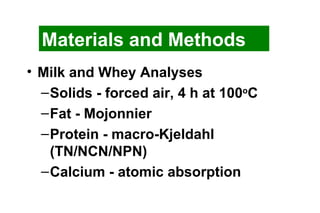
Full-fat, milled-curd Cheddar cheese was made.  Approximately, 220 kg of milk were used per vat of cheese.  Mass/balance accounting was done for fat (Mojonnier) and protein (Kjeldahl). Materials and Methods
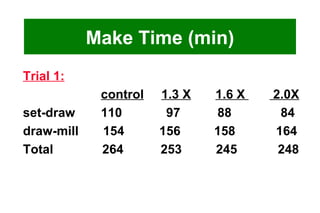
Make Time (min) Trial 1:     control   1.3 X   1.6 X  2.0X set-draw   110   97   88  84 draw-mill  154  156   158   164 Total  264   253   245   248
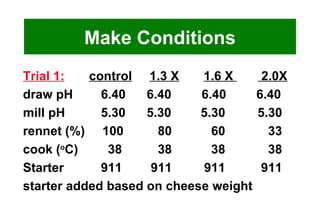
Make Conditions Trial 1:   control   1.3 X   1.6 X  2.0X draw pH  6.40  6.40   6.40   6.40 mill pH   5.30  5.30   5.30   5.30 rennet (%)  100   80   60   33 cook ( o C)   38   38   38   38 Starter   911   911   911   911 starter added based on cheese weight
Milk and Whey Analyses Solids - forced air, 4 h at 100 o C Fat - Mojonnier Protein - macro-Kjeldahl (TN/NCN/NPN)  Calcium - atomic absorption Materials and Methods
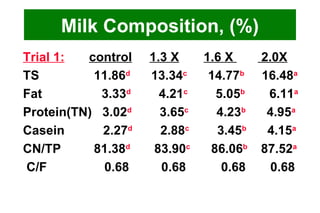
Milk Composition, (%) Trial 1:   control   1.3 X   1.6 X  2.0X TS   11.86 d   13.34 c   14.77 b   16.48 a Fat  3.33 d   4.21 c   5.05 b   6.11 a Protein(TN)  3.02 d   3.65 c   4.23 b   4.95 a Casein  2.27 d   2.88 c   3.45 b   4.15 a CN/TP   81.38 d   83.90 c   86.06 b   87.52 a C/F   0.68   0.68  0.68  0.68
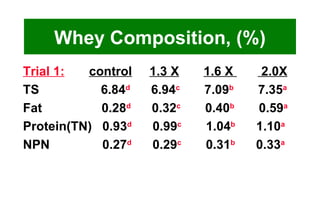
Whey Composition, (%) Trial 1:   control   1.3 X   1.6 X  2.0X TS   6.84 d   6.94 c   7.09 b   7.35 a Fat  0.28 d   0.32 c   0.40 b   0.59 a Protein(TN)  0.93 d   0.99 c   1.04 b   1.10 a NPN  0.27 d   0.29 c   0.31 b   0.33 a
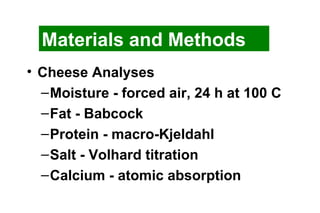
Cheese Analyses Moisture - forced air, 24 h at 100 C Fat - Babcock Protein - macro-Kjeldahl Salt - Volhard titration  Calcium - atomic absorption  Materials and Methods
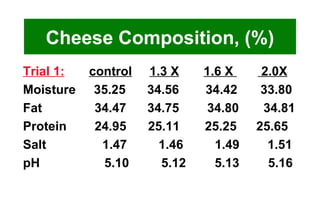
Cheese Composition, (%) Trial 1:   control   1.3 X   1.6 X  2.0X Moisture   35.25   34.56   34.42   33.80 Fat  34.47  34.75  34.80  34.81 Protein  24.95   25.11   25.25   25.65 Salt  1.47  1.46  1.49  1.51 pH   5.10   5.12   5.13   5.16
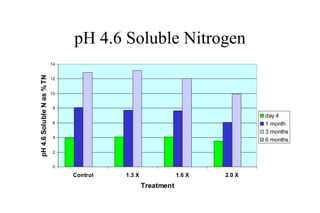
pH 4.6 Soluble Nitrogen
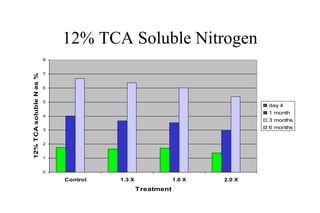
12% TCA Soluble Nitrogen
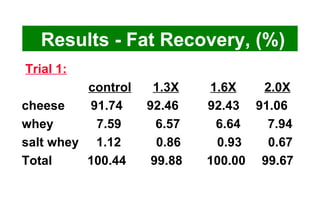
Trial 1: control   1.3X   1.6X   2.0X   cheese   91.74   92.46   92.43   91.06   whey   7.59   6.57   6.64   7.94 salt whey  1.12  0.86   0.93   0.67 Total 100.44  99.88   100.00   99.67 Results - Fat Recovery, (%)
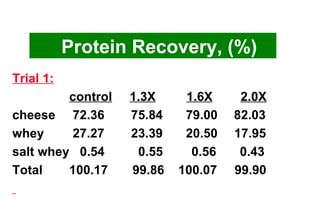
Trial 1: control   1.3X   1.6X   2.0X   cheese   72.36   75.84   79.00   82.03   whey  27.27   23.39   20.50   17.95   salt whey  0.54   0.55   0.56   0.43   Total 100.17  99.86  100.07  99.90 Protein Recovery, (%)
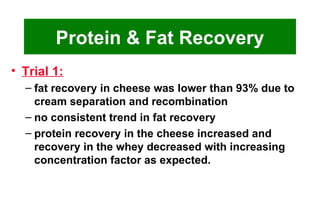
Protein & Fat Recovery Trial 1: fat recovery in cheese was lower than 93% due to cream separation and recombination no consistent trend in fat recovery protein recovery in the cheese increased and recovery in the whey decreased with increasing concentration factor as expected.
Cheese Yield Evaluation Actual Yield Moisture & Salt  Adjusted Yield (37 &  1.7%) Modified VanSlyke Formula 1   [(0.93 * % fat) + (% casein - 0.1)] *1.09 Yield =  ---------------------------------------------------   1 - (% cheese moisture/100)
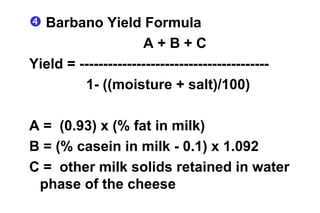
Barbano Yield Formula A + B + C Yield = ---------------------------------------- 1- ((moisture + salt)/100) A =  (0.93) x (% fat in milk) B = (% casein in milk - 0.1) x 1.092 C =  other milk solids retained in water phase of the cheese
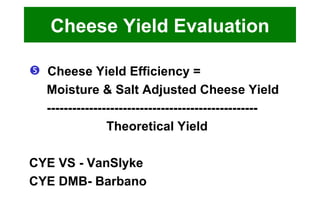
Cheese Yield Efficiency =  Moisture & Salt Adjusted Cheese Yield -------------------------------------------------- Theoretical Yield  CYE VS - VanSlyke CYE DMB- Barbano Cheese Yield Evaluation
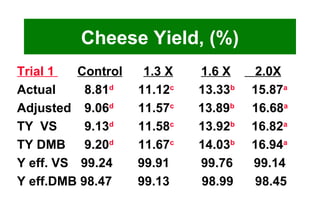
Cheese Yield, (%) Trial 1    Control   1.3 X   1.6 X   2.0X Actual   8.81 d   11.12 c   13.33 b   15.87 a Adjusted   9.06 d   11.57 c   13.89 b   16.68 a TY  VS   9.13 d   11.58 c   13.92 b   16.82 a TY DMB   9.20 d   11.67 c   14.03 b   16.94 a Y eff. VS   99.24   99.91  99.76  99.14 Y eff.DMB 98.47   99.13   98.99   98.45
Acknowledgments Maureen Chapman Laura Landolf Joanna Lynch Pat Wood

Skim milk microfiltration: Impact on cheese composition, yield, and aging

  • 1.
    Skim milk microfiltration:Impact on cheese composition, yield, and aging M. Neocleous, D. M. Barbano, and M. A. Rudan. Northeast Dairy Foods Research Center, 1 Cornell University, Ithaca, NY
  • 2.
    Introduction Skim milkmicrofiltration can be used to remove milk serum proteins from milk prior to cheese making. The milk serum protein products will be superior to whey protein products and may have higher value.
  • 3.
    This approach givesthe same increase in concentration of milk casein and fat prior to cheese making as earlier approaches with UF. However, unlike UF, there is no attempt to retain whey proteins in the cheese to increase cheese yield. Introduction
  • 4.
    While retention ofwhey proteins in cheese using UF increased cheese yield, it had negative impacts on cheese functionality (e.g., Mozzarella) and cheese flavor development during aging (e.g., Cheddar). Thus, UF has not been very successful for these two varieties of cheese. Introduction
  • 5.
    Concentrating milk priorto cheese making with microfiltration (MF) should produce a cheese that has the same composition as cheese made without MF. Therefore, the cheese should have similar functionality and flavor development to control cheese. Hypothesis
  • 6.
    To determine theinfluence of skim milk microfiltration on the composition and make procedure at 1.3, 1.6, and 2X concentration factors for aged Cheddar cheese. To determine if fat and protein recovery in the cheese and cheese yield efficiency are influence by microfiltration. To determine if proteolysis and cheese aging are influenced by microfiltration. Objectives
  • 7.
    Experimental Design Trial1 : 4 x 4 Randomized Block (n = 16) 1.0, 1.3, 1.6 and 2X concentration factor complete except for final aging data Trial 2 : Paired comparison of 1.0 and 2X to try to adjust make procedure of 2X to achieve similar aging to the control. (planned for winter 1999/2000)
  • 8.
    Full-fat, milled-curd Cheddarcheese was made. Approximately, 220 kg of milk were used per vat of cheese. Mass/balance accounting was done for fat (Mojonnier) and protein (Kjeldahl). Materials and Methods
  • 9.
    Make Time (min)Trial 1: control 1.3 X 1.6 X 2.0X set-draw 110 97 88 84 draw-mill 154 156 158 164 Total 264 253 245 248
  • 10.
    Make Conditions Trial1: control 1.3 X 1.6 X 2.0X draw pH 6.40 6.40 6.40 6.40 mill pH 5.30 5.30 5.30 5.30 rennet (%) 100 80 60 33 cook ( o C) 38 38 38 38 Starter 911 911 911 911 starter added based on cheese weight
  • 11.
    Milk and WheyAnalyses Solids - forced air, 4 h at 100 o C Fat - Mojonnier Protein - macro-Kjeldahl (TN/NCN/NPN) Calcium - atomic absorption Materials and Methods
  • 12.
    Milk Composition, (%)Trial 1: control 1.3 X 1.6 X 2.0X TS 11.86 d 13.34 c 14.77 b 16.48 a Fat 3.33 d 4.21 c 5.05 b 6.11 a Protein(TN) 3.02 d 3.65 c 4.23 b 4.95 a Casein 2.27 d 2.88 c 3.45 b 4.15 a CN/TP 81.38 d 83.90 c 86.06 b 87.52 a C/F 0.68 0.68 0.68 0.68
  • 13.
    Whey Composition, (%)Trial 1: control 1.3 X 1.6 X 2.0X TS 6.84 d 6.94 c 7.09 b 7.35 a Fat 0.28 d 0.32 c 0.40 b 0.59 a Protein(TN) 0.93 d 0.99 c 1.04 b 1.10 a NPN 0.27 d 0.29 c 0.31 b 0.33 a
  • 14.
    Cheese Analyses Moisture- forced air, 24 h at 100 C Fat - Babcock Protein - macro-Kjeldahl Salt - Volhard titration Calcium - atomic absorption Materials and Methods
  • 15.
    Cheese Composition, (%)Trial 1: control 1.3 X 1.6 X 2.0X Moisture 35.25 34.56 34.42 33.80 Fat 34.47 34.75 34.80 34.81 Protein 24.95 25.11 25.25 25.65 Salt 1.47 1.46 1.49 1.51 pH 5.10 5.12 5.13 5.16
  • 16.
  • 17.
  • 18.
    Trial 1: control 1.3X 1.6X 2.0X cheese 91.74 92.46 92.43 91.06 whey 7.59 6.57 6.64 7.94 salt whey 1.12 0.86 0.93 0.67 Total 100.44 99.88 100.00 99.67 Results - Fat Recovery, (%)
  • 19.
    Trial 1: control 1.3X 1.6X 2.0X cheese 72.36 75.84 79.00 82.03 whey 27.27 23.39 20.50 17.95 salt whey 0.54 0.55 0.56 0.43 Total 100.17 99.86 100.07 99.90 Protein Recovery, (%)
  • 20.
    Protein & FatRecovery Trial 1: fat recovery in cheese was lower than 93% due to cream separation and recombination no consistent trend in fat recovery protein recovery in the cheese increased and recovery in the whey decreased with increasing concentration factor as expected.
  • 21.
    Cheese Yield EvaluationActual Yield Moisture & Salt Adjusted Yield (37 & 1.7%) Modified VanSlyke Formula 1 [(0.93 * % fat) + (% casein - 0.1)] *1.09 Yield = --------------------------------------------------- 1 - (% cheese moisture/100)
  • 22.
    Barbano Yield FormulaA + B + C Yield = ---------------------------------------- 1- ((moisture + salt)/100) A = (0.93) x (% fat in milk) B = (% casein in milk - 0.1) x 1.092 C = other milk solids retained in water phase of the cheese
  • 23.
    Cheese Yield Efficiency= Moisture & Salt Adjusted Cheese Yield -------------------------------------------------- Theoretical Yield CYE VS - VanSlyke CYE DMB- Barbano Cheese Yield Evaluation
  • 24.
    Cheese Yield, (%)Trial 1 Control 1.3 X 1.6 X 2.0X Actual 8.81 d 11.12 c 13.33 b 15.87 a Adjusted 9.06 d 11.57 c 13.89 b 16.68 a TY VS 9.13 d 11.58 c 13.92 b 16.82 a TY DMB 9.20 d 11.67 c 14.03 b 16.94 a Y eff. VS 99.24 99.91 99.76 99.14 Y eff.DMB 98.47 99.13 98.99 98.45
  • 25.
    Acknowledgments Maureen ChapmanLaura Landolf Joanna Lynch Pat Wood