© 2011 The McGraw-Hill Companies, Inc. All rights reserved.
Skeletal System
21-1
© 2011 The McGraw-Hill Companies, Inc. All rights reserved.
21-2
Introduction
• Bones provide the
body with structure
and support
• 206 bones with joints
and connective tissue
• Divisions
– Axial – 80 bones
• Skull
• Vertebral column
• Rib cage
– Appendicular – 126
bones
• Arms and legs
• Pectoral girdle
• Pelvic girdle
© 2011 The McGraw-Hill Companies, Inc. All rights reserved.
21-3
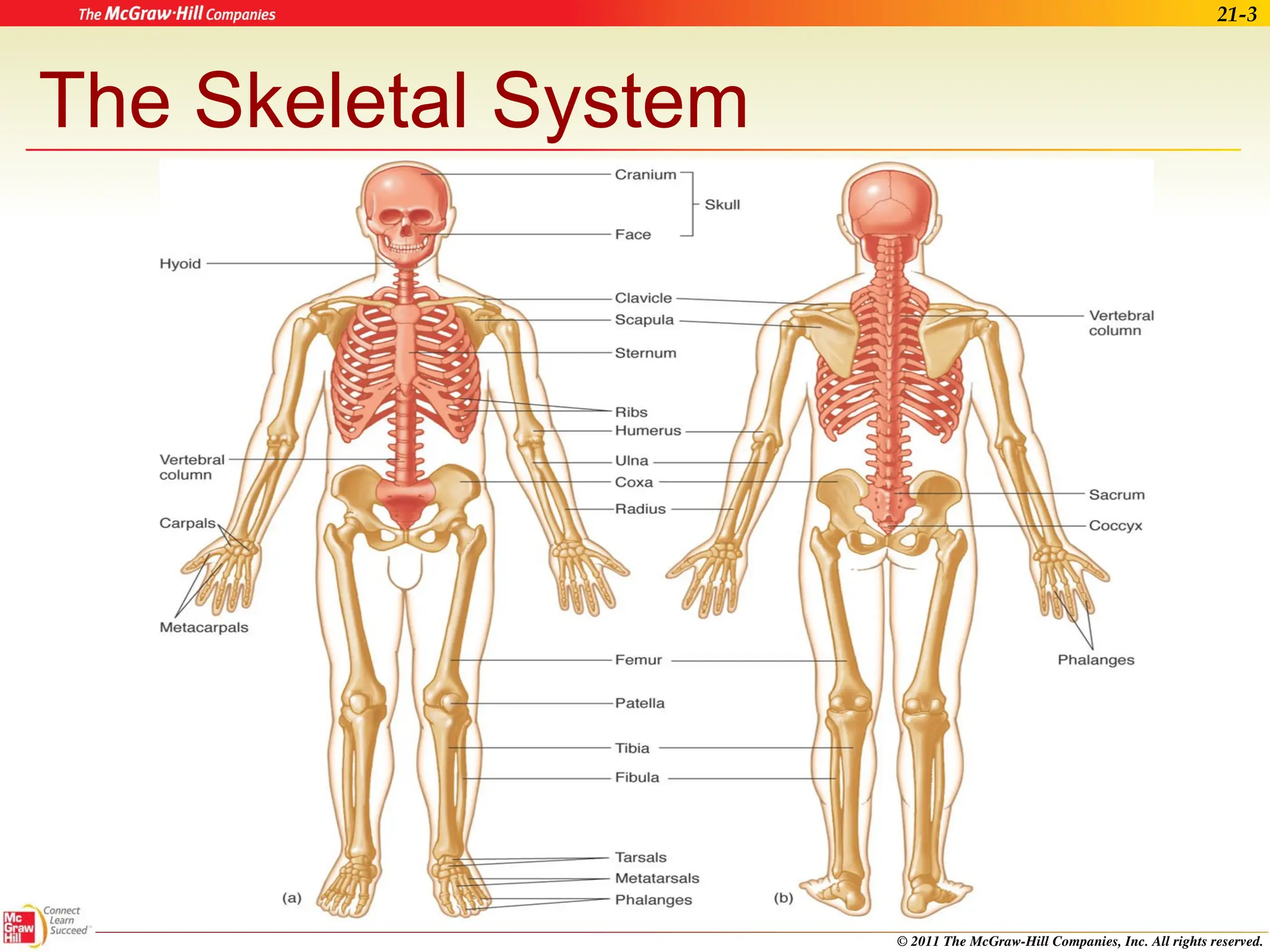
The Skeletal System
© 2011 The McGraw-Hill Companies, Inc. All rights reserved.
21-4
Bone Structure
• Bones contain various
kinds of tissues,
including
– Osseous tissue
– Blood vessels
– Nerves
• Osseous tissue can
appear compact or
spongy
Compact Bone
Spongy
Bone
© 2011 The McGraw-Hill Companies, Inc. All rights reserved.
21-5
Bone Structure (cont.)
• Compact bone looks
solid
– Structures can be
observed with a
microscope
• All bones are made
up of both compact
and spongy bone
© 2011 The McGraw-Hill Companies, Inc. All rights reserved.
21-6
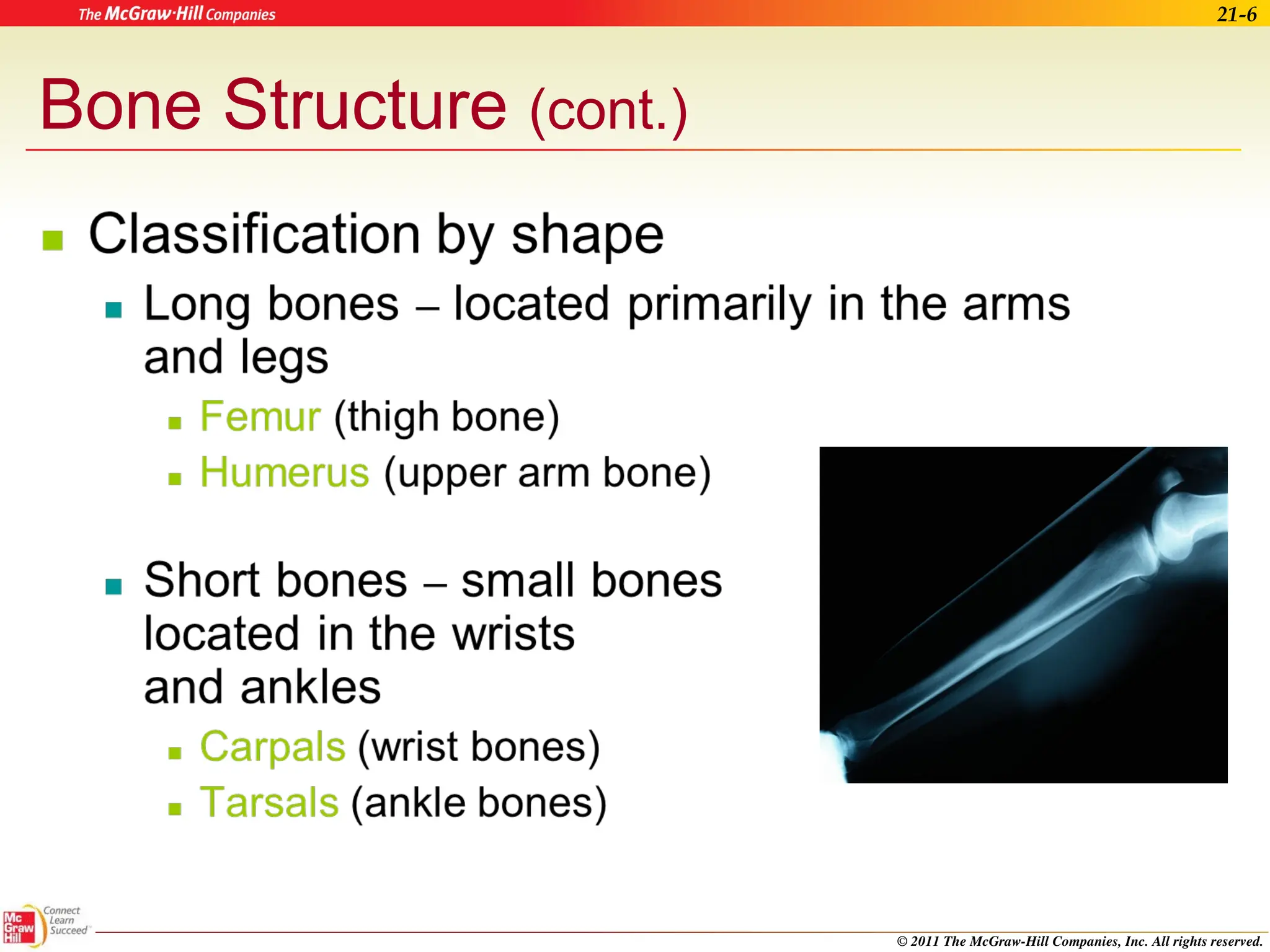
Bone Structure (cont.)
© 2011 The McGraw-Hill Companies, Inc. All rights reserved.
21-7
Bone Structure (cont.)
• Flat bones – located in the skull and rib
cage
– Ribs
– Frontal bone
• Irregular bones
– Vertebrae
– Bones of the pelvic girdle
© 2011 The McGraw-Hill Companies, Inc. All rights reserved.
21-8
Functions of Bones
• Give shape to body parts
• Support and protect soft structures
– Examples – brain, lungs, heart
• Allow body movement, because skeletal
muscles attach to them
– Allow for voluntary movement
© 2011 The McGraw-Hill Companies, Inc. All rights reserved.
21-9
Functions of Bones (cont.)
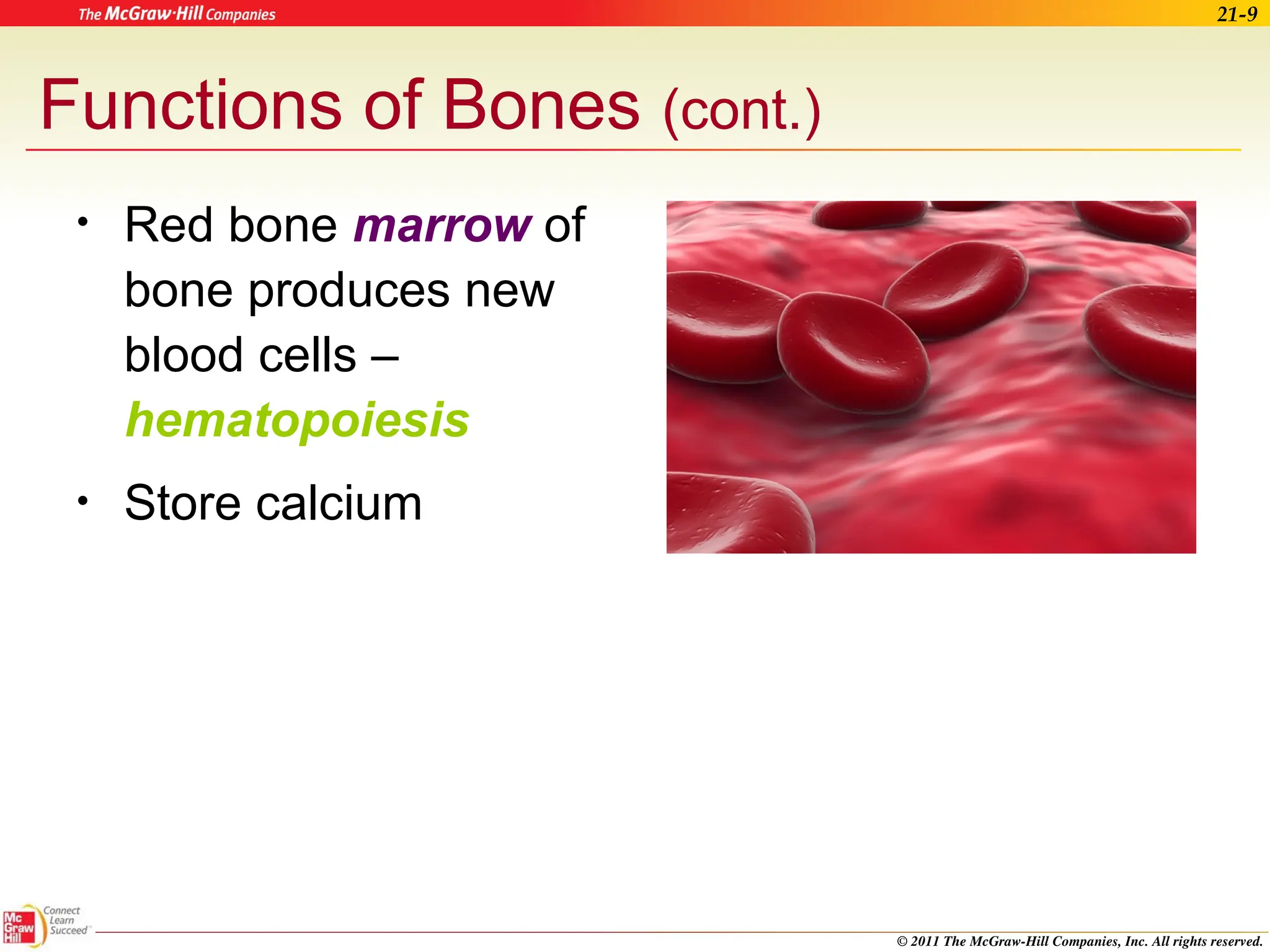
• Red bone marrow of
bone produces new
blood cells –
hematopoiesis
• Store calcium
© 2011 The McGraw-Hill Companies, Inc. All rights reserved.
21-10
Apply Your Knowledge
ANSWER: Every cell in the body needs calcium, so the
body must have a large supply readily available.
Why is it important for the bones to store calcium?
Correct!
© 2011 The McGraw-Hill Companies, Inc. All rights reserved.
21-11
Bone Growth
• Ossification – process
of bone growth
• Intramembranous
ossification
– Bones begin as tough,
fibrous membrane
– Bone-forming cells called
osteoblasts turn the
membrane to bone
(located in skull)
© 2011 The McGraw-Hill Companies, Inc. All rights reserved.
21-12
Bone Growth (cont.)
• Endochondral ossification
– Bones begin as cartilage
models
– Primary ossification center
• Bone formed in the diaphysis
– Secondary ossification center
• Epiphyses turn to bone
• Bones with some cartilage between an epiphysis and the
diaphysis will continue to grow
– Medullary cavity and spaces in cancellous bone
form
• Cells that form holes in bone are called osteoclasts
© 2011 The McGraw-Hill Companies, Inc. All rights reserved.
21-13
The Spinal Column
• 7 cervical vertebrae
• 12 thoracic vertebrae
• 5 lumbar vertebrae
• Sacrum
• Coccyx
© 2011 The McGraw-Hill Companies, Inc. All rights reserved.
21-14
The Spinal Column (cont.)
• Cervical vertebrae
– Smallest and lightest
– Located in the neck
region
– First one is atlas
– Second one is axis
• Thoracic vertebrae
– Join the 12 pairs of
ribs
• Lumbar vertebrae
– Have very sturdy
structures
© 2011 The McGraw-Hill Companies, Inc. All rights reserved.
21-15
The Spinal Column (cont.)
• Sacrum
– A triangular-shaped bone that consists of five
fused vertebrae
• Coccyx
– A small, triangular-shaped bone made up of 3
to 5 fused vertebrae
– Considered unnecessary
– More commonly called the tailbone
© 2011 The McGraw-Hill Companies, Inc. All rights reserved.
21-16
The Rib Cage
• Sternum
– Breastplate
– Forms the front
middle portion of
the rib cage
– Joins with the
clavicles and
most ribs
– Xiphoid process
• Cartilaginous tip
© 2011 The McGraw-Hill Companies, Inc. All rights reserved.
21-17
The Rib Cage (cont.)
• 12 pairs of ribs
– All are attached
posteriorly to
thoracic vertebrae
– True
• First seven pairs of
ribs
• Attach to sternum
by costal cartilage
– False
• Rib pairs 8, 9, and
10
• Attach to the costal
cartilage of rib pair
7
– Floating
• Rib pairs 11 and 12
• Do not attach
anteriorly to any
structure
© 2011 The McGraw-Hill Companies, Inc. All rights reserved.
21-18
Joints
• Junctions between bones
• Classification based on
structure
–Fibrous joints
• Connected together with
short fibers
• Between cranial bones and
facial bones
• Sutures – fibrous joints in the
skull
© 2011 The McGraw-Hill Companies, Inc. All rights reserved.
21-19
Joints
– Cartilaginous
joints
• Connected
together with
a disc of
cartilage
• Between
vertebrae
© 2011 The McGraw-Hill Companies, Inc. All rights reserved.
21-20
Joints
–Synovial joints
• Covered with hyaline cartilage
• Held together by a fibrous joint
capsule lined with synovial
membrane
– Secretes synovial fluid so bones
move easily against each other
• Freely movable
• Bones are also held together through
tough, cord-like structures called ligaments
© 2011 The McGraw-Hill Companies, Inc. All rights reserved.
21-21
Common Diseases and Disorders
• Arthritis – general term meaning
joint inflammation
– Osteoarthritis – degenerative joint
disease, primarily of weight-bearing
joints
– Rheumatoid arthritis – chronic
systemic inflammatory disease of
smaller joints and surrounding tissues
© 2011 The McGraw-Hill Companies, Inc. All rights reserved.
21-22
Common Diseases and Disorders (cont.)
• Bursitis – inflammation of a bursa (fluid-
filled sac that cushions tendons)
• Carpal tunnel syndrome – overuse of
wrist; the median nerve in the wrist
becomes compressed
• Ewing’s family of tumors (EFT) – a group
of tumors that affect different tissue types;
primarily bone
• Gout – a type of arthritis; deposits of uric
acid crystals in the joints
© 2011 The McGraw-Hill Companies, Inc. All rights reserved.
21-23
Common Diseases and Disorders (cont.)
• Kyphosis – abnormal curvature of the
spine (humpback)
• Lordosis – exaggerated inward curvature
of the lumbar spine (swayback)
• Osteogenesis imperfecta – brittle-bone
disease
• Osteoporosis – a condition in which
bones thin (become porous) over time
© 2011 The McGraw-Hill Companies, Inc. All rights reserved.
21-24
Common Diseases and Disorders
(cont.)
• Osteosarcoma – a type of bone cancer that
originates from osteoblasts, the cells that make
bony tissue
• Paget’s disease – causes bones to
enlarge and become deformed
and weak
• Scoliosis – an abnormal
S-shaped curvature of
the spine
© 2011 The McGraw-Hill Companies, Inc. All rights reserved.
21-25
Apply Your Knowledge
Osteosarcoma is a type of bone cancer that
originates from osteoblasts, the cells that make bony
tissue.
The doctor has told your patient that he has an
osteosarcoma. What do you know about this
disorder?
Nice Work!
© 2011 The McGraw-Hill Companies, Inc. All rights reserved.
21-26
Rigid, the skeleton
of habit alone
upholds the human
frame.
~ Virginia Woolf

Skeletal System.ppt Skeletal System in Our Body

  • 1.
    © 2011 TheMcGraw-Hill Companies, Inc. All rights reserved. Skeletal System 21-1
  • 2.
    © 2011 TheMcGraw-Hill Companies, Inc. All rights reserved. 21-2 Introduction • Bones provide the body with structure and support • 206 bones with joints and connective tissue • Divisions – Axial – 80 bones • Skull • Vertebral column • Rib cage – Appendicular – 126 bones • Arms and legs • Pectoral girdle • Pelvic girdle
  • 3.
    © 2011 TheMcGraw-Hill Companies, Inc. All rights reserved. 21-3 The Skeletal System
  • 4.
    © 2011 TheMcGraw-Hill Companies, Inc. All rights reserved. 21-4 Bone Structure • Bones contain various kinds of tissues, including – Osseous tissue – Blood vessels – Nerves • Osseous tissue can appear compact or spongy Compact Bone Spongy Bone
  • 5.
    © 2011 TheMcGraw-Hill Companies, Inc. All rights reserved. 21-5 Bone Structure (cont.) • Compact bone looks solid – Structures can be observed with a microscope • All bones are made up of both compact and spongy bone
  • 6.
    © 2011 TheMcGraw-Hill Companies, Inc. All rights reserved. 21-6 Bone Structure (cont.)
  • 7.
    © 2011 TheMcGraw-Hill Companies, Inc. All rights reserved. 21-7 Bone Structure (cont.) • Flat bones – located in the skull and rib cage – Ribs – Frontal bone • Irregular bones – Vertebrae – Bones of the pelvic girdle
  • 8.
    © 2011 TheMcGraw-Hill Companies, Inc. All rights reserved. 21-8 Functions of Bones • Give shape to body parts • Support and protect soft structures – Examples – brain, lungs, heart • Allow body movement, because skeletal muscles attach to them – Allow for voluntary movement
  • 9.
    © 2011 TheMcGraw-Hill Companies, Inc. All rights reserved. 21-9 Functions of Bones (cont.) • Red bone marrow of bone produces new blood cells – hematopoiesis • Store calcium
  • 10.
    © 2011 TheMcGraw-Hill Companies, Inc. All rights reserved. 21-10 Apply Your Knowledge ANSWER: Every cell in the body needs calcium, so the body must have a large supply readily available. Why is it important for the bones to store calcium? Correct!
  • 11.
    © 2011 TheMcGraw-Hill Companies, Inc. All rights reserved. 21-11 Bone Growth • Ossification – process of bone growth • Intramembranous ossification – Bones begin as tough, fibrous membrane – Bone-forming cells called osteoblasts turn the membrane to bone (located in skull)
  • 12.
    © 2011 TheMcGraw-Hill Companies, Inc. All rights reserved. 21-12 Bone Growth (cont.) • Endochondral ossification – Bones begin as cartilage models – Primary ossification center • Bone formed in the diaphysis – Secondary ossification center • Epiphyses turn to bone • Bones with some cartilage between an epiphysis and the diaphysis will continue to grow – Medullary cavity and spaces in cancellous bone form • Cells that form holes in bone are called osteoclasts
  • 13.
    © 2011 TheMcGraw-Hill Companies, Inc. All rights reserved. 21-13 The Spinal Column • 7 cervical vertebrae • 12 thoracic vertebrae • 5 lumbar vertebrae • Sacrum • Coccyx
  • 14.
    © 2011 TheMcGraw-Hill Companies, Inc. All rights reserved. 21-14 The Spinal Column (cont.) • Cervical vertebrae – Smallest and lightest – Located in the neck region – First one is atlas – Second one is axis • Thoracic vertebrae – Join the 12 pairs of ribs • Lumbar vertebrae – Have very sturdy structures
  • 15.
    © 2011 TheMcGraw-Hill Companies, Inc. All rights reserved. 21-15 The Spinal Column (cont.) • Sacrum – A triangular-shaped bone that consists of five fused vertebrae • Coccyx – A small, triangular-shaped bone made up of 3 to 5 fused vertebrae – Considered unnecessary – More commonly called the tailbone
  • 16.
    © 2011 TheMcGraw-Hill Companies, Inc. All rights reserved. 21-16 The Rib Cage • Sternum – Breastplate – Forms the front middle portion of the rib cage – Joins with the clavicles and most ribs – Xiphoid process • Cartilaginous tip
  • 17.
    © 2011 TheMcGraw-Hill Companies, Inc. All rights reserved. 21-17 The Rib Cage (cont.) • 12 pairs of ribs – All are attached posteriorly to thoracic vertebrae – True • First seven pairs of ribs • Attach to sternum by costal cartilage – False • Rib pairs 8, 9, and 10 • Attach to the costal cartilage of rib pair 7 – Floating • Rib pairs 11 and 12 • Do not attach anteriorly to any structure
  • 18.
    © 2011 TheMcGraw-Hill Companies, Inc. All rights reserved. 21-18 Joints • Junctions between bones • Classification based on structure –Fibrous joints • Connected together with short fibers • Between cranial bones and facial bones • Sutures – fibrous joints in the skull
  • 19.
    © 2011 TheMcGraw-Hill Companies, Inc. All rights reserved. 21-19 Joints – Cartilaginous joints • Connected together with a disc of cartilage • Between vertebrae
  • 20.
    © 2011 TheMcGraw-Hill Companies, Inc. All rights reserved. 21-20 Joints –Synovial joints • Covered with hyaline cartilage • Held together by a fibrous joint capsule lined with synovial membrane – Secretes synovial fluid so bones move easily against each other • Freely movable • Bones are also held together through tough, cord-like structures called ligaments
  • 21.
    © 2011 TheMcGraw-Hill Companies, Inc. All rights reserved. 21-21 Common Diseases and Disorders • Arthritis – general term meaning joint inflammation – Osteoarthritis – degenerative joint disease, primarily of weight-bearing joints – Rheumatoid arthritis – chronic systemic inflammatory disease of smaller joints and surrounding tissues
  • 22.
    © 2011 TheMcGraw-Hill Companies, Inc. All rights reserved. 21-22 Common Diseases and Disorders (cont.) • Bursitis – inflammation of a bursa (fluid- filled sac that cushions tendons) • Carpal tunnel syndrome – overuse of wrist; the median nerve in the wrist becomes compressed • Ewing’s family of tumors (EFT) – a group of tumors that affect different tissue types; primarily bone • Gout – a type of arthritis; deposits of uric acid crystals in the joints
  • 23.
    © 2011 TheMcGraw-Hill Companies, Inc. All rights reserved. 21-23 Common Diseases and Disorders (cont.) • Kyphosis – abnormal curvature of the spine (humpback) • Lordosis – exaggerated inward curvature of the lumbar spine (swayback) • Osteogenesis imperfecta – brittle-bone disease • Osteoporosis – a condition in which bones thin (become porous) over time
  • 24.
    © 2011 TheMcGraw-Hill Companies, Inc. All rights reserved. 21-24 Common Diseases and Disorders (cont.) • Osteosarcoma – a type of bone cancer that originates from osteoblasts, the cells that make bony tissue • Paget’s disease – causes bones to enlarge and become deformed and weak • Scoliosis – an abnormal S-shaped curvature of the spine
  • 25.
    © 2011 TheMcGraw-Hill Companies, Inc. All rights reserved. 21-25 Apply Your Knowledge Osteosarcoma is a type of bone cancer that originates from osteoblasts, the cells that make bony tissue. The doctor has told your patient that he has an osteosarcoma. What do you know about this disorder? Nice Work!
  • 26.
    © 2011 TheMcGraw-Hill Companies, Inc. All rights reserved. 21-26 Rigid, the skeleton of habit alone upholds the human frame. ~ Virginia Woolf