SUN KNOWLEDGE
DME BILLING PROCESS
 Medicare
Medicare is the federal health insurance program for people who are 65 or older, certain younger people with
disabilities, and people with End-Stage Renal Disease (permanent kidney failure requiring dialysis or a transplant,
sometimes called ESRD)
 Medicaid
Medicaid is an “entitlement program” created by the federal government, but administered by the state, to
provide payment for medical services for low-income citizens. People qualify for Medicaid by meeting federal
income and asset standards and by fitting into a specified eligibility.
 Workers’ Compensation
Workers' compensation is insurance that provides cash benefits and/or medical care for workers who are injured
or become ill as a direct result of their job. Employers pay for this insurance, and shall not require the employee
to contribute to the cost of compensation
 Commercial
Commercial plans are health insurance programs that are administered privately. This includes group, family and
individual coverage. The insurance may be employer-sponsored or privately purchased. Commercial health
insurance may be provided on a fee-for-service basis or through a managed care plan.
PAYERS
2Sun Knowledge © 2013-14 Private & Confidential
 Part A
Part A is the hospital insurance plan. It covers nursing care and hospital stays, although not doctors' fees. Part A
also covers some home health services, skilled nursing care after a hospital stay and hospice care..
 Part B
Part B covers services and supplies that are medically necessary to treat health conditions. This can include
outpatient care, preventive services, ambulance services, and durable medical equipment.
 Part C
Medicare Part C is not a separate benefit. Part C is the part of Medicare policy that allows private health
insurance companies to provide Medicare benefits. These Medicare private health plans, such as HMOs and
PPOs, are known as Medicare Advantage plans.
 Part D
Medicare Part D, also called the Medicare prescription drug benefit, is a United States federal-government
program to subsidize the costs of prescription drugs and prescription drug insuranc e premiums for Medicare
beneficiaries in the United States.
MEDICARE
3Sun Knowledge © 2013-14 Private & Confidential
Medical coding is the first step in the medical billing process and involves using ICD 9, CPT and HCPCS codes.
When a patient has any medical exam or procedure, the medical office will work with the patient and the
patient's insurance company for claims. The biller will submit and follow up on any claims in order to receive
payment for services rendered by the health care provider.
 Medical Coding
• Place of Service Based Coding – Inpatient, Outpatient Coding
• Provider Specialty Based Coding– E/M, Cardiology, Psychiatry, etc.
 Billing
• Provider EDI enrollment
• Patient Demographics entry
• Charge entry
• Claim submission – Electronic and Paper
• Payment entry
• Denial management
• Payment reconciliation
CODING & BILLING : OVERVIEW
4Sun Knowledge © 2013-14 Private & Confidential
 Coding – HCPCs and ICD 9
Medical Coding is the process of converting diagnosis codes to ICD-9 codes and procedure codes to CPT codes. It
also involves HCPC (pronounced Hick-pick) codes that identified supplies and drugs for correct billing. DME
coding is done based on HCPCs and for various equipment there are qualifying diagnosis. Claims for equipment
billed with non qualifying diagnosis will get denied. The correct coding combination of HCPC, ICD 9 and modifiers
is therefore of utmost importance.
 Prior Authorization
Further to checking eligibility of the patient, authorization is the process of raising a request with the payer for
prior approval for a service to be rendered. For DME authorization request is raised along with medical records.
The records are reviewed for medical necessity based on which the auth may be approved or denied.
Authorization is valid for a period of time which may vary from equipment to equipment.
 Billing
Once the coding combination is determined and authorization is obtained, the DME is delivered to the patient.
From this point starts the billing process. This process results in the generation of the claim which will be
submitted to the payer for reimbursement.
DME CODING & BILLING : OVERVIEW
5Sun Knowledge © 2013-14 Private & Confidential
 Rental Vs Purchase
CPAP Machine – Rental (E0601)
CPAP supplies (mask, water chamber etc.) – Purchase (A7030 & A7046)
 Coverage
Full electric bed (E0266)
 Modifiers
RR, NW
 Limitations
BiPAP machine – 1 every 5 years (E0470)
 Authorization
Mattress, CPM machine (E2071 & E0935)
 Prescription
All DME – must include: item ordered, corresponding Dx, length of need and physician’s signature
 Supporting tests etc.
CPAP, CPM machine etc.
DME BILLING : EXAMPLES
6Sun Knowledge © 2013-14 Private & Confidential
The billing cycle for DME involves the following activities:
 Order entry based on the Rx received from the physician
• Patient demographics & insurance entry
• Provider information entry
• Product code entry
• Rx &Dx entry (with appropriate timeframe)
 Eligibility verification and auth requirement enquiry
 Collection of documents required by payer for auth approval
 Determination that payer criteria is met before delivery of DME (if criteria is not met the patient needs to
be contacted and informed of the financial responsibility)
 Generation of delivery ticket (based on which delivery is made to the patient)
 Creation of claim after receipt of confirmation of delivery
 Submission of EDI / paper claim to payers
 Cash posting
 Rejection & Denial Management
 A/R follow-up
DME BILLING CYCLE : OVERVIEW
7Sun Knowledge © 2013-14 Private & Confidential
 Order entry based on the Rx received from the physician
• Patient demographics & insurance entry
• Provider information entry
• Product code entry
• Rx &Dx entry (with appropriate timeframe)
ORDER ENTRY
8Sun Knowledge © 2013-14 Private & Confidential
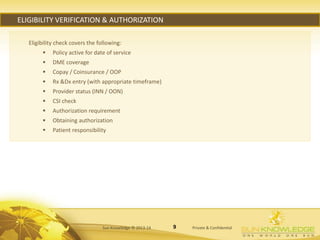
Eligibility check covers the following:
 Policy active for date of service
 DME coverage
 Copay / Coinsurance / OOP
 Rx &Dx entry (with appropriate timeframe)
 Provider status (INN / OON)
 CSI check
 Authorization requirement
 Obtaining authorization
 Patient responsibility
ELIGIBILITY VERIFICATION & AUTHORIZATION
9Sun Knowledge © 2013-14 Private & Confidential
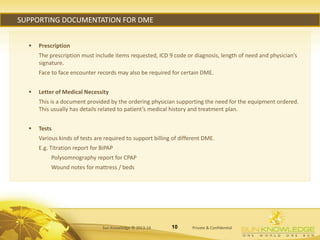
 Prescription
The prescription must include items requested, ICD 9 code or diagnosis, length of need and physician’s
signature.
Face to face encounter records may also be required for certain DME.
 Letter of Medical Necessity
This is a document provided by the ordering physician supporting the need for the equipment ordered.
This usually has details related to patient’s medical history and treatment plan.
 Tests
Various kinds of tests are required to support billing of different DME.
E.g. Titration report for BiPAP
Polysomnography report for CPAP
Wound notes for mattress / beds
SUPPORTING DOCUMENTATION FOR DME
10Sun Knowledge © 2013-14 Private & Confidential
 Duration
CPAP – once every 5 years
Hospital bed – once every 5 years
CPAP mask – once every 3 months
CPAP machine filters – 2 every month
 Annual limit
Certain commercial plans may have an annual maximum for DME. E.g. $2500 per year towards DME &
supplies
 Qualifying Diagnosis code (ICD 9 code)
Appropriate diagnosis for correct billing to avoid denials and resulting resubmissions and appeals
COVERGE AND OTHER LIMITATIONS FOR DME
11Sun Knowledge © 2013-14 Private & Confidential
 Generation of delivery ticket
Once the preliminary activities have been completed, a ticket is generated for the warehouse staff once
the delivery has been scheduled as per the patient’s convenience. The “delivery ticket” and has the
following information:
 Patient’s name and delivery address
 Equipment to be delivered and quantity
 Special instructions(if any)
 Patient’s financial responsibility (if any)
 Delivery
At the time of delivery, setting up may be required (for some equipment). Some equipment are also
delivered via mail (UPS).
 Return of signed delivery ticket
On receipt of the equipment the patient signs the ticket and this is considered as proof of delivery. The
ticket is then returned as supporting document for the purpose of billing.
DELIVERY
12Sun Knowledge © 2013-14 Private & Confidential
 Confirmation of delivery
The DME providers billers will check to ensure that all procedures have been carried out as per payer
guidelines. This includes Rx, Dx, LMN, Test reports etc.
Provider status and patient information is also checked again at this stage
 Claim generation
A claim is generated for the DME supplied which will be submitted to the payer for reimbursement.
 Submission of claim to Payer
Claims may be submitted electronically (EDI) or as paper claims. This is dependent on the payer.
For EDI submissions the DME provider has to be set up with the payer’s system .
CONFIRMATION & CLAIM GENERATION
13Sun Knowledge © 2013-14 Private & Confidential
 Receipt of EOB
Once the claim has been processed by the payer an EOB (explanation of benefits) will be generated. This
document is shared with both member and provider by the payer. The document includes the following:
• Patient & Provider information
• Billed codes
• Processing status (paid, denied or requesting additional information)
• Paid amount, date of payment and method of payment for paid claims
• Denial reason for denied claims
 Cash Posting
Cash posting is a process by which the payments received from insurance companies, patients and other
entities, towards settlement of claims, applied to the respective claims / patient accounts or other
accounts in the billing system. Cash team receives the cash files (Check copy and EOB) and applies the
payments in the billing software against the appropriate patient account.
EOB & CASH POSTING
14Sun Knowledge © 2013-14 Private & Confidential
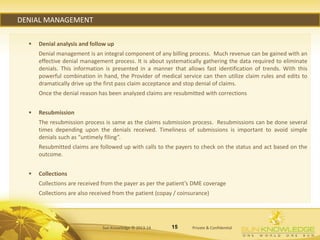
 Denial analysis and follow up
Denial management is an integral component of any billing process. Much revenue can be gained with an
effective denial management process. It is about systematically gathering the data required to eliminate
denials. This information is presented in a manner that allows fast identification of trends. With this
powerful combination in hand, the Provider of medical service can then utilize claim rules and edits to
dramatically drive up the first pass claim acceptance and stop denial of claims.
Once the denial reason has been analyzed claims are resubmitted with corrections
 Resubmission
The resubmission process is same as the claims submission process. Resubmissions can be done several
times depending upon the denials received. Timeliness of submissions is important to avoid simple
denials such as “untimely filing”.
Resubmitted claims are followed up with calls to the payers to check on the status and act based on the
outcome.
 Collections
Collections are received from the payer as per the patient’s DME coverage
Collections are also received from the patient (copay / coinsurance)
DENIAL MANAGEMENT
15Sun Knowledge © 2013-14 Private & Confidential
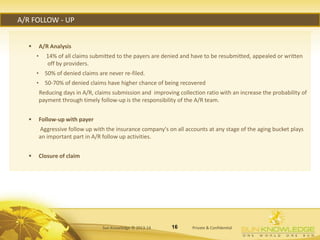
 A/R Analysis
• 14% of all claims submitted to the payers are denied and have to be resubmitted, appealed or written
off by providers.
• 50% of denied claims are never re-filed.
• 50-70% of denied claims have higher chance of being recovered
Reducing days in A/R, claims submission and improving collection ratio with an increase the probability of
payment through timely follow-up is the responsibility of the A/R team.
 Follow-up with payer
Aggressive follow up with the insurance company's on all accounts at any stage of the aging bucket plays
an important part in A/R follow up activities.
 Closure of claim
A/R FOLLOW - UP
16Sun Knowledge © 2013-14 Private & Confidential

SK_DME Billing Process

  • 1.
  • 2.
     Medicare Medicare isthe federal health insurance program for people who are 65 or older, certain younger people with disabilities, and people with End-Stage Renal Disease (permanent kidney failure requiring dialysis or a transplant, sometimes called ESRD)  Medicaid Medicaid is an “entitlement program” created by the federal government, but administered by the state, to provide payment for medical services for low-income citizens. People qualify for Medicaid by meeting federal income and asset standards and by fitting into a specified eligibility.  Workers’ Compensation Workers' compensation is insurance that provides cash benefits and/or medical care for workers who are injured or become ill as a direct result of their job. Employers pay for this insurance, and shall not require the employee to contribute to the cost of compensation  Commercial Commercial plans are health insurance programs that are administered privately. This includes group, family and individual coverage. The insurance may be employer-sponsored or privately purchased. Commercial health insurance may be provided on a fee-for-service basis or through a managed care plan. PAYERS 2Sun Knowledge © 2013-14 Private & Confidential
  • 3.
     Part A PartA is the hospital insurance plan. It covers nursing care and hospital stays, although not doctors' fees. Part A also covers some home health services, skilled nursing care after a hospital stay and hospice care..  Part B Part B covers services and supplies that are medically necessary to treat health conditions. This can include outpatient care, preventive services, ambulance services, and durable medical equipment.  Part C Medicare Part C is not a separate benefit. Part C is the part of Medicare policy that allows private health insurance companies to provide Medicare benefits. These Medicare private health plans, such as HMOs and PPOs, are known as Medicare Advantage plans.  Part D Medicare Part D, also called the Medicare prescription drug benefit, is a United States federal-government program to subsidize the costs of prescription drugs and prescription drug insuranc e premiums for Medicare beneficiaries in the United States. MEDICARE 3Sun Knowledge © 2013-14 Private & Confidential
  • 4.
    Medical coding isthe first step in the medical billing process and involves using ICD 9, CPT and HCPCS codes. When a patient has any medical exam or procedure, the medical office will work with the patient and the patient's insurance company for claims. The biller will submit and follow up on any claims in order to receive payment for services rendered by the health care provider.  Medical Coding • Place of Service Based Coding – Inpatient, Outpatient Coding • Provider Specialty Based Coding– E/M, Cardiology, Psychiatry, etc.  Billing • Provider EDI enrollment • Patient Demographics entry • Charge entry • Claim submission – Electronic and Paper • Payment entry • Denial management • Payment reconciliation CODING & BILLING : OVERVIEW 4Sun Knowledge © 2013-14 Private & Confidential
  • 5.
     Coding –HCPCs and ICD 9 Medical Coding is the process of converting diagnosis codes to ICD-9 codes and procedure codes to CPT codes. It also involves HCPC (pronounced Hick-pick) codes that identified supplies and drugs for correct billing. DME coding is done based on HCPCs and for various equipment there are qualifying diagnosis. Claims for equipment billed with non qualifying diagnosis will get denied. The correct coding combination of HCPC, ICD 9 and modifiers is therefore of utmost importance.  Prior Authorization Further to checking eligibility of the patient, authorization is the process of raising a request with the payer for prior approval for a service to be rendered. For DME authorization request is raised along with medical records. The records are reviewed for medical necessity based on which the auth may be approved or denied. Authorization is valid for a period of time which may vary from equipment to equipment.  Billing Once the coding combination is determined and authorization is obtained, the DME is delivered to the patient. From this point starts the billing process. This process results in the generation of the claim which will be submitted to the payer for reimbursement. DME CODING & BILLING : OVERVIEW 5Sun Knowledge © 2013-14 Private & Confidential
  • 6.
     Rental VsPurchase CPAP Machine – Rental (E0601) CPAP supplies (mask, water chamber etc.) – Purchase (A7030 & A7046)  Coverage Full electric bed (E0266)  Modifiers RR, NW  Limitations BiPAP machine – 1 every 5 years (E0470)  Authorization Mattress, CPM machine (E2071 & E0935)  Prescription All DME – must include: item ordered, corresponding Dx, length of need and physician’s signature  Supporting tests etc. CPAP, CPM machine etc. DME BILLING : EXAMPLES 6Sun Knowledge © 2013-14 Private & Confidential
  • 7.
    The billing cyclefor DME involves the following activities:  Order entry based on the Rx received from the physician • Patient demographics & insurance entry • Provider information entry • Product code entry • Rx &Dx entry (with appropriate timeframe)  Eligibility verification and auth requirement enquiry  Collection of documents required by payer for auth approval  Determination that payer criteria is met before delivery of DME (if criteria is not met the patient needs to be contacted and informed of the financial responsibility)  Generation of delivery ticket (based on which delivery is made to the patient)  Creation of claim after receipt of confirmation of delivery  Submission of EDI / paper claim to payers  Cash posting  Rejection & Denial Management  A/R follow-up DME BILLING CYCLE : OVERVIEW 7Sun Knowledge © 2013-14 Private & Confidential
  • 8.
     Order entrybased on the Rx received from the physician • Patient demographics & insurance entry • Provider information entry • Product code entry • Rx &Dx entry (with appropriate timeframe) ORDER ENTRY 8Sun Knowledge © 2013-14 Private & Confidential
  • 9.
    Eligibility check coversthe following:  Policy active for date of service  DME coverage  Copay / Coinsurance / OOP  Rx &Dx entry (with appropriate timeframe)  Provider status (INN / OON)  CSI check  Authorization requirement  Obtaining authorization  Patient responsibility ELIGIBILITY VERIFICATION & AUTHORIZATION 9Sun Knowledge © 2013-14 Private & Confidential
  • 10.
     Prescription The prescriptionmust include items requested, ICD 9 code or diagnosis, length of need and physician’s signature. Face to face encounter records may also be required for certain DME.  Letter of Medical Necessity This is a document provided by the ordering physician supporting the need for the equipment ordered. This usually has details related to patient’s medical history and treatment plan.  Tests Various kinds of tests are required to support billing of different DME. E.g. Titration report for BiPAP Polysomnography report for CPAP Wound notes for mattress / beds SUPPORTING DOCUMENTATION FOR DME 10Sun Knowledge © 2013-14 Private & Confidential
  • 11.
     Duration CPAP –once every 5 years Hospital bed – once every 5 years CPAP mask – once every 3 months CPAP machine filters – 2 every month  Annual limit Certain commercial plans may have an annual maximum for DME. E.g. $2500 per year towards DME & supplies  Qualifying Diagnosis code (ICD 9 code) Appropriate diagnosis for correct billing to avoid denials and resulting resubmissions and appeals COVERGE AND OTHER LIMITATIONS FOR DME 11Sun Knowledge © 2013-14 Private & Confidential
  • 12.
     Generation ofdelivery ticket Once the preliminary activities have been completed, a ticket is generated for the warehouse staff once the delivery has been scheduled as per the patient’s convenience. The “delivery ticket” and has the following information:  Patient’s name and delivery address  Equipment to be delivered and quantity  Special instructions(if any)  Patient’s financial responsibility (if any)  Delivery At the time of delivery, setting up may be required (for some equipment). Some equipment are also delivered via mail (UPS).  Return of signed delivery ticket On receipt of the equipment the patient signs the ticket and this is considered as proof of delivery. The ticket is then returned as supporting document for the purpose of billing. DELIVERY 12Sun Knowledge © 2013-14 Private & Confidential
  • 13.
     Confirmation ofdelivery The DME providers billers will check to ensure that all procedures have been carried out as per payer guidelines. This includes Rx, Dx, LMN, Test reports etc. Provider status and patient information is also checked again at this stage  Claim generation A claim is generated for the DME supplied which will be submitted to the payer for reimbursement.  Submission of claim to Payer Claims may be submitted electronically (EDI) or as paper claims. This is dependent on the payer. For EDI submissions the DME provider has to be set up with the payer’s system . CONFIRMATION & CLAIM GENERATION 13Sun Knowledge © 2013-14 Private & Confidential
  • 14.
     Receipt ofEOB Once the claim has been processed by the payer an EOB (explanation of benefits) will be generated. This document is shared with both member and provider by the payer. The document includes the following: • Patient & Provider information • Billed codes • Processing status (paid, denied or requesting additional information) • Paid amount, date of payment and method of payment for paid claims • Denial reason for denied claims  Cash Posting Cash posting is a process by which the payments received from insurance companies, patients and other entities, towards settlement of claims, applied to the respective claims / patient accounts or other accounts in the billing system. Cash team receives the cash files (Check copy and EOB) and applies the payments in the billing software against the appropriate patient account. EOB & CASH POSTING 14Sun Knowledge © 2013-14 Private & Confidential
  • 15.
     Denial analysisand follow up Denial management is an integral component of any billing process. Much revenue can be gained with an effective denial management process. It is about systematically gathering the data required to eliminate denials. This information is presented in a manner that allows fast identification of trends. With this powerful combination in hand, the Provider of medical service can then utilize claim rules and edits to dramatically drive up the first pass claim acceptance and stop denial of claims. Once the denial reason has been analyzed claims are resubmitted with corrections  Resubmission The resubmission process is same as the claims submission process. Resubmissions can be done several times depending upon the denials received. Timeliness of submissions is important to avoid simple denials such as “untimely filing”. Resubmitted claims are followed up with calls to the payers to check on the status and act based on the outcome.  Collections Collections are received from the payer as per the patient’s DME coverage Collections are also received from the patient (copay / coinsurance) DENIAL MANAGEMENT 15Sun Knowledge © 2013-14 Private & Confidential
  • 16.
     A/R Analysis •14% of all claims submitted to the payers are denied and have to be resubmitted, appealed or written off by providers. • 50% of denied claims are never re-filed. • 50-70% of denied claims have higher chance of being recovered Reducing days in A/R, claims submission and improving collection ratio with an increase the probability of payment through timely follow-up is the responsibility of the A/R team.  Follow-up with payer Aggressive follow up with the insurance company's on all accounts at any stage of the aging bucket plays an important part in A/R follow up activities.  Closure of claim A/R FOLLOW - UP 16Sun Knowledge © 2013-14 Private & Confidential