HACCP
Anurag Kumar
B.Sc. Food Microbiology Safety and Quality Control
3rd Year
INDEX
 Introduction
 Hazards
 Biological
 Chemical
 Physical
 HACCP Principle
 Benefits And Barrier
 Reference
INTRODUCTION
 Hazard Analysis and Critical Control Point
(HACCP) is a process control system designed to
identify and prevent microbial and other hazards in
food production.
 The HACCP system is a scientific, rational and
systematic approach for identification, assessment
and control of hazards during production, processing,
manufacturing, preparation and use of food to ensure
that food is safe when consumed (i.e. it does not
present a risk to health).
HACCP
 Hazard Analysis and Critical Control Point
Hazard – food contamination
Analysis – finding out the source
Critical – the level of danger
Control – the remedial action
Point – the stage for corrective action
HAZARDS
 A biological, chemical or physical agent in, or
condition of, food with the potential to cause an
adverse health effect.
 There are three recognised categories of hazards.
1. Biological hazards.
2. Chemical hazards.
3. Physical hazards.
BIOLOGICAL HAZARDS
 Bacteria
 It is estimated that 30% of the food borne diseases in
US are because of bacteria.
Example-
Salmonella, Escherichia coli, Staphylococcus aureus,
Clostridium botulinum, Bacillus cereus.
 Viruses
Hepatitis A, Rotavirus.
CHEMICAL HAZARDS
 Chemical contamination can happen at any stage in food production
and processing.
 Some chemicals can be helpful and are purposefully used with some
foods, such as pesticides on fruits and vegetables. These chemicals
are not hazardous if properly used or controlled.
 Chemical hazards can be separated into three categories:
1. Incidental chemical contaminants- Chemicals can become part of
a food without being intentionally-added. For example, certain
juices containing a high level of nitrate.
2. Naturally-occurring chemicals- These chemicals are derived from
a variety of plants, animals or micro-organisms. For example,
Allergens, Mold toxins.
3. Intentionally-added chemicals- Some chemicals are intentionally
added to food at some point during production and processing. For
example, Preservatives, Nutritional additives, Color additives
PHYSICAL HAZARDS
 Physical hazards include any potentially harmful extraneous matter not
normally found in food. When a consumer mistakenly eats the foreign
material or object, it is likely to cause choking, injury or other adverse
health effects.
 Physical hazards present in foods are classified as glass, plastics and
metals.
1. Glass: Bottles, jars, light fixtures, thermometers, gauge covers
2. Plastic: Bottles, jars, equipment and packaging material
3. Metal: Machinery, agricultural fields, buckshot, wire, staples,
building materials, employee personal effects like jewellery
(bracelets, bangles, rings, earrings), pen and its cap.
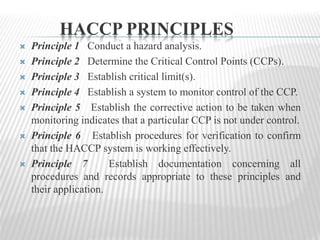
HACCP PRINCIPLES
 Principle 1 Conduct a hazard analysis.
 Principle 2 Determine the Critical Control Points (CCPs).
 Principle 3 Establish critical limit(s).
 Principle 4 Establish a system to monitor control of the CCP.
 Principle 5 Establish the corrective action to be taken when
monitoring indicates that a particular CCP is not under control.
 Principle 6 Establish procedures for verification to confirm
that the HACCP system is working effectively.
 Principle 7 Establish documentation concerning all
procedures and records appropriate to these principles and
their application.
BENEFITS OF HACCP
 There are clear benefits of implementing HACCP for all sectors:
government, food industry and consumers alike.
1. Benefits to consumers
 Reduced risk of food borne disease;
 Increased awareness of basic hygiene;
 Increased confidence in the food supply; and
 Improved quality of life (health and socio-economic).
2. Benefits to industry
 Increased consumer and/or government confidence;
 Reduced legal and insurance costs;
 Increased market access;
 Reduction in production costs (reduced recall/wastage of food);
 Improved product consistency;
 Improved staff-management commitment to food safety; and
 Decreased business risk.
3. Benefits to governments
 Improved public health;
 More efficient and targeted food control;
 Reduced public health costs;
 Trade facilitation; and
 Increased confidence of the community in the food supply.
BARRIERS OF HACCP
 The barriers may include:
 Lack of government commitment;
 Lack of customer and business demand;
 Absence of legal requirements;
 Financial constraints;
 Human resource constraints;
 Lack of expertise and/or technical support;
 Inadequate infrastructure and facilities; and
 Inadequate communications.
REFERENCE
 HACCP Introducing the Hazard Analysis and
Critical Control Points System (1997) Food Safety
Series, Food Safety Unit, World Health Organisation.
 Inteaz Ali (2004). Food Quality Assurance:
Principles and Practice. CRC Press LLC, Florida,
USA.
 Schmidt, R.H. and Rodrick, G.E. (2003). Food
Safety Handbook. Wiley Inter Science, A John Wiley
and Sons Publication, New Jersey, Canada.
HACCP

HACCP

  • 1.
    HACCP Anurag Kumar B.Sc. FoodMicrobiology Safety and Quality Control 3rd Year
  • 2.
    INDEX  Introduction  Hazards Biological  Chemical  Physical  HACCP Principle  Benefits And Barrier  Reference
  • 3.
    INTRODUCTION  Hazard Analysisand Critical Control Point  Hazard Analysis and Critical Control Point (HACCP) is a process control system designed to identify and prevent microbial and other hazards in food production.  The HACCP system is a scientific, rational and systematic approach for identification, assessment and control of hazards during production, processing, manufacturing, preparation and use of food to ensure that food is safe when consumed (i.e. it does not present a risk to health).
  • 4.
    HACCP  Hazard Analysisand Critical Control Point Hazard – food contamination Analysis – finding out the source Critical – the level of danger Control – the remedial action Point – the stage for corrective action
  • 5.
    HAZARDS  A biological,chemical or physical agent in, or condition of, food with the potential to cause an adverse health effect.  There are three recognised categories of hazards. 1. Biological hazards. 2. Chemical hazards. 3. Physical hazards.
  • 6.
    BIOLOGICAL HAZARDS  Bacteria It is estimated that 30% of the food borne diseases in US are because of bacteria. Example- Salmonella, Escherichia coli, Staphylococcus aureus, Clostridium botulinum, Bacillus cereus.  Viruses Hepatitis A, Rotavirus.
  • 7.
    CHEMICAL HAZARDS  Chemicalcontamination can happen at any stage in food production and processing.  Some chemicals can be helpful and are purposefully used with some foods, such as pesticides on fruits and vegetables. These chemicals are not hazardous if properly used or controlled.  Chemical hazards can be separated into three categories: 1. Incidental chemical contaminants- Chemicals can become part of a food without being intentionally-added. For example, certain juices containing a high level of nitrate. 2. Naturally-occurring chemicals- These chemicals are derived from a variety of plants, animals or micro-organisms. For example, Allergens, Mold toxins. 3. Intentionally-added chemicals- Some chemicals are intentionally added to food at some point during production and processing. For example, Preservatives, Nutritional additives, Color additives
  • 8.
    PHYSICAL HAZARDS  Physicalhazards include any potentially harmful extraneous matter not normally found in food. When a consumer mistakenly eats the foreign material or object, it is likely to cause choking, injury or other adverse health effects.  Physical hazards present in foods are classified as glass, plastics and metals. 1. Glass: Bottles, jars, light fixtures, thermometers, gauge covers 2. Plastic: Bottles, jars, equipment and packaging material 3. Metal: Machinery, agricultural fields, buckshot, wire, staples, building materials, employee personal effects like jewellery (bracelets, bangles, rings, earrings), pen and its cap.
  • 9.
    HACCP PRINCIPLES  Principle1 Conduct a hazard analysis.  Principle 2 Determine the Critical Control Points (CCPs).  Principle 3 Establish critical limit(s).  Principle 4 Establish a system to monitor control of the CCP.  Principle 5 Establish the corrective action to be taken when monitoring indicates that a particular CCP is not under control.  Principle 6 Establish procedures for verification to confirm that the HACCP system is working effectively.  Principle 7 Establish documentation concerning all procedures and records appropriate to these principles and their application.
  • 10.
    BENEFITS OF HACCP There are clear benefits of implementing HACCP for all sectors: government, food industry and consumers alike. 1. Benefits to consumers  Reduced risk of food borne disease;  Increased awareness of basic hygiene;  Increased confidence in the food supply; and  Improved quality of life (health and socio-economic). 2. Benefits to industry  Increased consumer and/or government confidence;  Reduced legal and insurance costs;  Increased market access;
  • 11.
     Reduction inproduction costs (reduced recall/wastage of food);  Improved product consistency;  Improved staff-management commitment to food safety; and  Decreased business risk. 3. Benefits to governments  Improved public health;  More efficient and targeted food control;  Reduced public health costs;  Trade facilitation; and  Increased confidence of the community in the food supply.
  • 12.
    BARRIERS OF HACCP The barriers may include:  Lack of government commitment;  Lack of customer and business demand;  Absence of legal requirements;  Financial constraints;  Human resource constraints;  Lack of expertise and/or technical support;  Inadequate infrastructure and facilities; and  Inadequate communications.
  • 13.
    REFERENCE  HACCP Introducingthe Hazard Analysis and Critical Control Points System (1997) Food Safety Series, Food Safety Unit, World Health Organisation.  Inteaz Ali (2004). Food Quality Assurance: Principles and Practice. CRC Press LLC, Florida, USA.  Schmidt, R.H. and Rodrick, G.E. (2003). Food Safety Handbook. Wiley Inter Science, A John Wiley and Sons Publication, New Jersey, Canada.