Placebo-Controlled Phase III Trial of Immunologic Therapy with Sipuleucel-T (APC8015) in Patients with Metastatic, Asymptomatic Hormone Refractory Prostate CancerEric J. Small, Paul F. Schellhammer, Celestia S. Higano, Charles H. Redfern, John J. Nemunaitis, Frank H. Valone, Suleman S. Verjee, Lori A. Jones, Robert M. HershbergBy Anna Begelfer-OstrovskiBPHE5310P-000M: Clinical Trials Overview, Spring 2011
Starts in the prostate glandWraps around the urethra (the tube that carries urine out of the body.) Third common cause of death from cancer in man of all ages.First most common cause of death from cancer in man over 75 of age. Rarely found in man younger than 40. Highest risk: Man over 60. Prostate cancer:
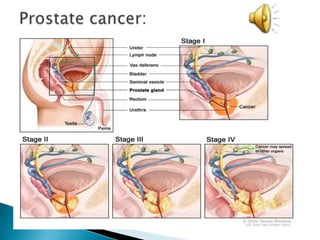
Prostate cancer:
patient specific therapeutic cancer vaccine for prostate cancer.Manufactured by a company named Dendreon. Was approved by the FDA on April 29, 2010 to treat asymptomatic or minimally symptomatic metastatic Hormone refractory prostate cancer.  Sipuleucel-T:
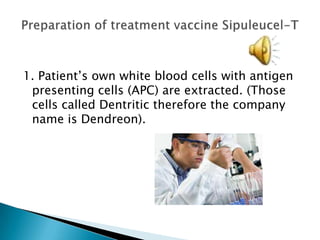
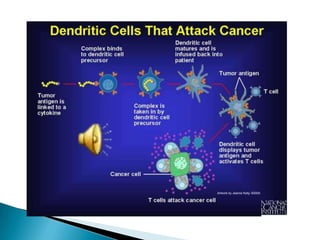
 1. Patient’s own white blood cells with antigen presenting cells (APC) are extracted. (Those cells called Dentritic therefore the company name is Dendreon). Preparation of treatment vaccine Sipuleucel-T
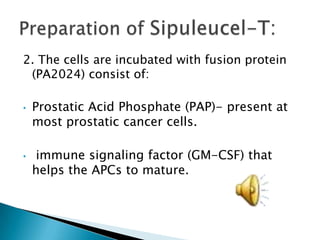
2. The cells are incubated with fusion protein (PA2024) consist of:Prostatic Acid Phosphate (PAP)- present at most prostatic cancer cells.
 immune signaling factor (GM-CSF) that helps the APCs to mature.Preparation of Sipuleucel-T:
ClinicalTrials.gov Identifier:NCT01133704Purpose:   stimulate T-cell immunity against prostatic acid phosphatase.evaluate the safety and efficacy of sipuleucel-T in a placebo-controlled study.Clinical trial overview:
PAP- not found in non prostate tissue.Patients who developed a natural immune response to PAP had a longer disease progression: 34 weeks vs 13 weeks Background to trial design:
1. Overall Time to Disease ProgressionTime frame: 36 monthsAsymptomatic patients compare to placebo. 2. Overall SurvivalSubjects were followed for 3 years from the time of randomization or until death.Primary Outcome Measures:
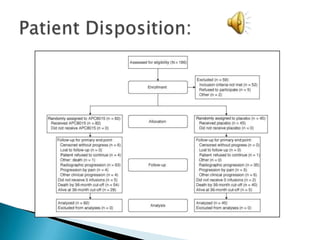
127 patients with asymptomatic metastatic hormone refractory prostate cancer.2:1 ratio to receive three infusions of sipuleucel-T (n = 82) or placebo (n = 45) every 2 weeks.PATIENTS AND METHODS:
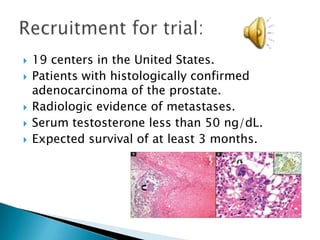
19 centers in the United States.Patients with histologically confirmed adenocarcinomaof the prostate.Radiologic evidence of metastases.Serum testosterone less than 50 ng/dL.Expected survival of at least 3 months.Recruitment for trial:
Prior radiation must be completed at least one month before  trial treatment.Radiation is prohibited within 1 year of treatment.Patients with prior immunotherapy were not eligible to participate.Patients with cancer-related bone pain or with visceral metastasis were not permitted.Recruitment for trial continuous:
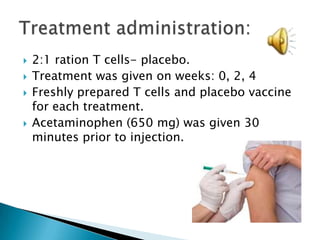
2:1 ration T cells- placebo.Treatment was given on weeks: 0, 2, 4Freshly prepared T cells and placebo vaccine for each treatment.Acetaminophen (650 mg) was given 30 minutes prior to injection.Treatment administration:
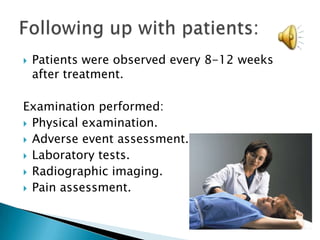
Patients were observed every 8-12 weeks after treatment.Examination performed:Physical examination.Adverse event assessment.Laboratory tests.Radiographic imaging.Pain assessment.Following up with patients:
progressive disease on serial radiographic imaging tests.new cancer-related pain associated with a radiographic anatomic correlation.progression such as spinal cord compression, nerve root compression, or pathologic fracture. Trial End Points:
Increase greater than 50% in measurable disease.Clear worsening of nonmeasurable disease.Appearance of at least two new lesions on a bone scan.Development of cancer-related pain that correlated with a site of metastasis.Development of other clinical events consistent with progression.Progressive disease defined:
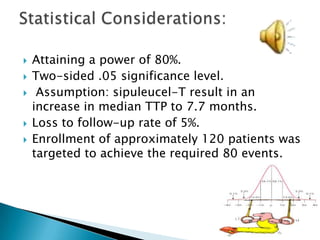
Attaining a power of 80%.Two-sided .05 significance level. Assumption: sipuleucel-T result in an increase in median TTP to 7.7 months.Loss to follow-up rate of 5%.Enrollment of approximately 120 patients was targeted to achieve the required 80 events.Statistical Considerations:
Patient Disposition:
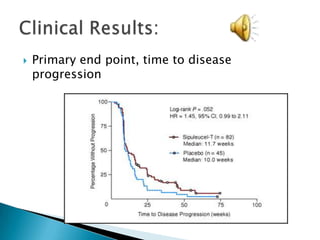
Clinical Results: Primary end point, time to disease progression
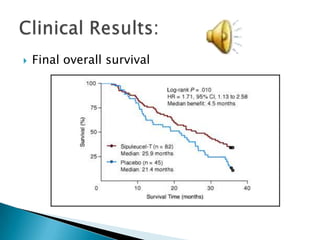
Final overall survivalClinical Results:
Immune Monitoring:The PA2024 T-cell stimulation index is a measure of specific T-cell responsiveness against the target antigen.Toxicity:significantly more common in sipuleucel-T treated patients.*No patient discontinued the trial because of toxicity. Other measurments:
Of the 127 patients, 115 patients had progressive disease at the time of data analysis.The median for time to disease progression (TTP) for sipuleucel-T was 11.7 weeks vs 10.0 weeks for placebo.Median survival was 25.9 months for sipuleucel-T and 21.4 months for placebo.Final results:
The improvement in the primary end point TTP did not achieve statistical significance.Study suggests that sipuleucel-T may provide a survival advantage to asymptomatic HRPC patients.Need for further supportive studies.Conclusion
 At 36 months, the estimated survival rate in the sipuleucel-T group was 34 weeks compared with 11 weeks in the placebo group.The real numbers were 25.9 vs 21.4.provide a survival advantage to asymptomatic HRPC patients. no patients were removed from the trial for toxicity.no treatment-related deaths.Need for supportive studies?

Sipuleucel T Presentation Anna Begelfer Ostrovski

  • 1.
    Placebo-Controlled Phase IIITrial of Immunologic Therapy with Sipuleucel-T (APC8015) in Patients with Metastatic, Asymptomatic Hormone Refractory Prostate CancerEric J. Small, Paul F. Schellhammer, Celestia S. Higano, Charles H. Redfern, John J. Nemunaitis, Frank H. Valone, Suleman S. Verjee, Lori A. Jones, Robert M. HershbergBy Anna Begelfer-OstrovskiBPHE5310P-000M: Clinical Trials Overview, Spring 2011
  • 2.
    Starts in theprostate glandWraps around the urethra (the tube that carries urine out of the body.) Third common cause of death from cancer in man of all ages.First most common cause of death from cancer in man over 75 of age. Rarely found in man younger than 40. Highest risk: Man over 60. Prostate cancer:
  • 3.
  • 4.
    patient specific therapeuticcancer vaccine for prostate cancer.Manufactured by a company named Dendreon. Was approved by the FDA on April 29, 2010 to treat asymptomatic or minimally symptomatic metastatic Hormone refractory prostate cancer. Sipuleucel-T:
  • 5.
     1. Patient’s ownwhite blood cells with antigen presenting cells (APC) are extracted. (Those cells called Dentritic therefore the company name is Dendreon). Preparation of treatment vaccine Sipuleucel-T
  • 6.
    2. The cellsare incubated with fusion protein (PA2024) consist of:Prostatic Acid Phosphate (PAP)- present at most prostatic cancer cells.
  • 7.
    immune signalingfactor (GM-CSF) that helps the APCs to mature.Preparation of Sipuleucel-T:
  • 9.
    ClinicalTrials.gov Identifier:NCT01133704Purpose: stimulate T-cell immunity against prostatic acid phosphatase.evaluate the safety and efficacy of sipuleucel-T in a placebo-controlled study.Clinical trial overview:
  • 10.
    PAP- not foundin non prostate tissue.Patients who developed a natural immune response to PAP had a longer disease progression: 34 weeks vs 13 weeks Background to trial design:
  • 11.
    1. Overall Timeto Disease ProgressionTime frame: 36 monthsAsymptomatic patients compare to placebo. 2. Overall SurvivalSubjects were followed for 3 years from the time of randomization or until death.Primary Outcome Measures:
  • 12.
    127 patients withasymptomatic metastatic hormone refractory prostate cancer.2:1 ratio to receive three infusions of sipuleucel-T (n = 82) or placebo (n = 45) every 2 weeks.PATIENTS AND METHODS:
  • 13.
    19 centers inthe United States.Patients with histologically confirmed adenocarcinomaof the prostate.Radiologic evidence of metastases.Serum testosterone less than 50 ng/dL.Expected survival of at least 3 months.Recruitment for trial:
  • 14.
    Prior radiation mustbe completed at least one month before  trial treatment.Radiation is prohibited within 1 year of treatment.Patients with prior immunotherapy were not eligible to participate.Patients with cancer-related bone pain or with visceral metastasis were not permitted.Recruitment for trial continuous:
  • 15.
    2:1 ration Tcells- placebo.Treatment was given on weeks: 0, 2, 4Freshly prepared T cells and placebo vaccine for each treatment.Acetaminophen (650 mg) was given 30 minutes prior to injection.Treatment administration:
  • 16.
    Patients were observedevery 8-12 weeks after treatment.Examination performed:Physical examination.Adverse event assessment.Laboratory tests.Radiographic imaging.Pain assessment.Following up with patients:
  • 17.
    progressive disease onserial radiographic imaging tests.new cancer-related pain associated with a radiographic anatomic correlation.progression such as spinal cord compression, nerve root compression, or pathologic fracture. Trial End Points:
  • 18.
    Increase greater than50% in measurable disease.Clear worsening of nonmeasurable disease.Appearance of at least two new lesions on a bone scan.Development of cancer-related pain that correlated with a site of metastasis.Development of other clinical events consistent with progression.Progressive disease defined:
  • 19.
    Attaining a powerof 80%.Two-sided .05 significance level. Assumption: sipuleucel-T result in an increase in median TTP to 7.7 months.Loss to follow-up rate of 5%.Enrollment of approximately 120 patients was targeted to achieve the required 80 events.Statistical Considerations:
  • 20.
  • 21.
    Clinical Results: Primaryend point, time to disease progression
  • 22.
  • 23.
    Immune Monitoring:The PA2024T-cell stimulation index is a measure of specific T-cell responsiveness against the target antigen.Toxicity:significantly more common in sipuleucel-T treated patients.*No patient discontinued the trial because of toxicity. Other measurments:
  • 24.
    Of the 127patients, 115 patients had progressive disease at the time of data analysis.The median for time to disease progression (TTP) for sipuleucel-T was 11.7 weeks vs 10.0 weeks for placebo.Median survival was 25.9 months for sipuleucel-T and 21.4 months for placebo.Final results:
  • 25.
    The improvement inthe primary end point TTP did not achieve statistical significance.Study suggests that sipuleucel-T may provide a survival advantage to asymptomatic HRPC patients.Need for further supportive studies.Conclusion
  • 26.
     At 36 months,the estimated survival rate in the sipuleucel-T group was 34 weeks compared with 11 weeks in the placebo group.The real numbers were 25.9 vs 21.4.provide a survival advantage to asymptomatic HRPC patients. no patients were removed from the trial for toxicity.no treatment-related deaths.Need for supportive studies?