





Single Page Applications (SPA)
Jeremy Likness
Principal Architect
@JeremyLikness
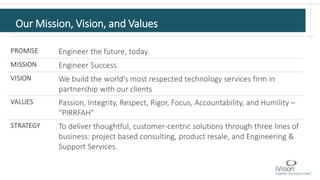
Our Mission, Vision, and Values
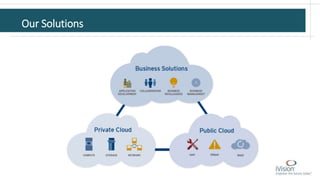
Our Solutions
INDUSTRIES WE WORK WITH
OUR AWARDS
TODAY’S AGENDA
1. Why? Drivers behind adoption of SPA applications
2. What? Features that Make up a Single Page App
3. How? Frameworks make building apps easier
4. Q&A You have questions, we have answers
WHY?
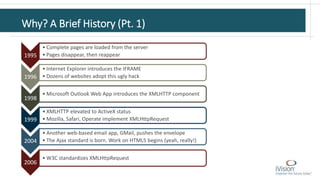
Why? A Brief History (Pt. 1)
1995
• Complete pages are loaded from the server
• Pages disappear, then reappear
1996
• Internet Explorer introduces the IFRAME
• Dozens of websites adopt this ugly hack
1998
• Microsoft Outlook Web App introduces the XMLHTTP component
1999
• XMLHTTP elevated to ActiveX status
• Mozilla, Safari, Operate implement XMLHttpRequest
2004
• Another web-based email app, GMail, pushes the envelope
• The Ajax standard is born. Work on HTML5 begins (yeah, really!)
2006
• W3C standardizes XMLHttpRequest
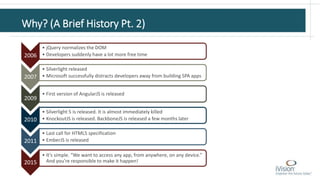
Why? (A Brief History Pt. 2)
2006
• jQuery normalizes the DOM
• Developers suddenly have a lot more free time
2007
• Silverlight released
• Microsoft successfully distracts developers away from building SPA apps
2009
• First version of AngularJS is released
2010
• Silverlight 5 is released. It is almost immediately killed
• KnockoutJS is released. BackboneJS is released a few months later
2011
• Last call for HTML5 specification
• EmberJS is released
2015
• It’s simple. “We want to access any app, from anywhere, on any device.”
And you’re responsible to make it happen!
DEMO: Before SPA
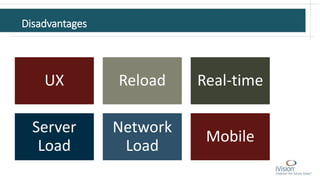
Disadvantages
UX Reload Real-time
Server
Load
Network
Load
Mobile
The Experience
UX
• Lacks responsiveness (click and wait)
• Page abandonment
• Amazon: 100ms slower = 1% lost revenue
• Google: 500ms slower = 20% decreased traffic
• Lots of manual effort, limited “one-click” experience
• Real-time notifications and updates are difficult
Reloading and Round-Trips
Reload
• Server logic is often convoluted when trying to pull data from
various areas to aggregate in order to render
• Must remember state and re-render state each time (as
opposed to state being preserved in the client)
• Flicker/page freeze is disruptive
Support for Real-time
Real-time
• Only practical method without SPA is to POST on a timer
• Notifications require rebuilding the entire page
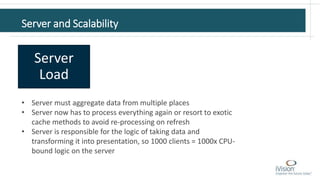
Server and Scalability
Server
Load
• Server must aggregate data from multiple places
• Server now has to process everything again or resort to exotic
cache methods to avoid re-processing on refresh
• Server is responsible for the logic of taking data and
transforming it into presentation, so 1000 clients = 1000x CPU-
bound logic on the server
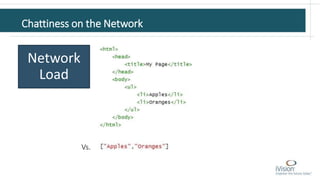
Chattiness on the Network
Network
Load
Vs.
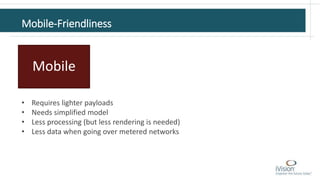
Mobile-Friendliness
Mobile
• Requires lighter payloads
• Needs simplified model
• Less processing (but less rendering is needed)
• Less data when going over metered networks
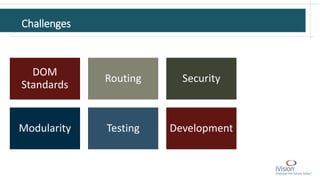
Challenges
DOM
Standards
Routing Security
Modularity Testing Development
WHAT?
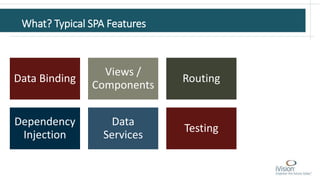
What? Typical SPA Features
Data Binding
Views /
Components
Routing
Dependency
Injection
Data
Services
Testing
Data-Binding Support
Data-
Binding
• Separate presentation logic from actual presentation
• For example: “button click” vs. “my action” that can then be
bound to a button, hyperlink, or other action
• Validation
• Data transformation
• Leads to testability and scale
• “Designer/developer workflow”
Don’t Repeat Yourself!
Views /
Components
• Support for rendering to a part of the page
• Reusable data transformations (i.e. filters, value converters)
• Reusable components (i.e. grids, type-ahead, dialog boxes, etc.)
• HTML5 standards (Web Components)
• Responsive
• Master/detail side-by-side on desktop
• Master/detail separate pages on mobile
It’s Still the Browser!
Routing
• Navigation: I can browse to an area of the application
• Bookmarks: I can save the hyperlink to a useful piece of
information or workflow that I am a part of
• State: I can persist my state between areas of the application
• Journal: I can use the back and forward buttons on my browser
the way I’m used to
Managing Large Code Bases
Dependency
Injection
• Loosely couple JavaScript objects
• Separation of concerns enables parallel development
• Inversion of control enables testability and promotes reusability
• Service location makes it easier to develop components with
dependencies
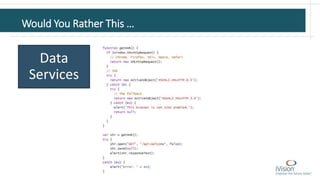
Would You Rather This …
Data
Services
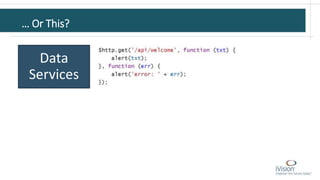
… Or This?
Data
Services
Given SPA When Test Then OK!
Testing
• Many frameworks come with their own test suites
• Some have specific support for testing and mocking interfaces
• All should expose a straightforward means to test
• Best frameworks don’t require a dependency on a visible
browser
HOW?
http://jquery.com/
• “Normalize the DOM”
• Most popular JavaScript library in use
• One of the longest maintained frameworks
• Many SPA frameworks can layer on top of this
• DEMO: http://todomvc.com/examples/jquery/#/all
• Source: https://github.com/tastejs/todomvc/blob/gh-
pages/examples/jquery/js/app.js
http://www.typescriptlang.org/
• Fooled you, this isn’t a SPA framework
• Works well with many existing SPA frameworks
• Helps “tame” JavaScript
• Very useful for projects with scale (lots of code and/or many developers)
• Page: https://github.com/tastejs/todomvc/blob/gh-
pages/examples/typescript-angular/index.html
• Source: https://github.com/tastejs/todomvc/tree/gh-
pages/examples/typescript-angular/js
http://knockoutjs.com/
• Introduced in early MVC templates by Microsoft
• Declarative bindings
• Automatic refresh of UI
• Relationships and computed models
• Templates
• Page: https://github.com/tastejs/todomvc/blob/gh-
pages/examples/knockoutjs/index.html
• Source: https://github.com/tastejs/todomvc/blob/gh-
pages/examples/knockoutjs/js/app.js
http://backbonejs.org/
• Model-driven
• Idea of “entities” and “collections”
• Views
• Convention-based REST interface
• Page: https://github.com/tastejs/todomvc/blob/gh-
pages/examples/backbone/index.html
• Source: https://github.com/tastejs/todomvc/tree/gh-
pages/examples/backbone/js
http://emberjs.com/
• Focused on productivity
• Handlebar templates
• Common idioms / convention based
• Page: https://github.com/tastejs/todomvc/blob/gh-
pages/examples/emberjs/index.html
• Source: https://github.com/tastejs/todomvc/tree/gh-
pages/examples/emberjs/js
https://angularjs.org/
• Teach HTML New Tricks
• Extensible
• Dependency injection out of the box
• My favorite framework to use, especially on large projects
• Page: https://github.com/tastejs/todomvc/blob/gh-
pages/examples/angularjs/index.html
• Source: https://github.com/tastejs/todomvc/tree/gh-
pages/examples/angularjs/js
http://www.telerik.com/kendo-ui
• Web and Mobile
• HTML5 and JavaScript focused
• Layered on top of jQuery
• Adapters for AngularJS and BackboneJS “out of the box”
• Page: http://kendotodo.apphb.com/Home/Batch
Angular 2.0
• Embraces ECMAScript 6
• Built on TypeScript
• Example: https://github.com/Microsoft/ngconf2015demo
• Page:
https://github.com/Microsoft/ngconf2015demo/blob/master/todo.html
• Source:
https://github.com/Microsoft/ngconf2015demo/blob/master/todo.ts
http://aurelia.io/
• Convention-based
• Built for ECMAScript 6 from the ground up
• Former member of AngularJS 2.0 team
• Examples: http://aurelia.io/get-started.html
DEMO: Todo SPA
Questions?
• Demo Code: https://github.com/JeremyLikness/SPAAppsExplained
• A Different Angle: What is AngularJS?
http://csharperimage.jeremylikness.com/2014/10/a-different-
angle-what-is-angularjs.html
• Let’s Build an AngularJS App!
http://csharperimage.jeremylikness.com/2014/10/lets-build-
angularjs-app.html
• iVision Application Development:
http://ivision.com/our-services/technology-services/application-
development/
Jeremy Likness, Principal Architect @JeremyLikness

Single Page Applications: Your Browser is the OS!

  • 1.
    Single Page Applications(SPA) Jeremy Likness Principal Architect @JeremyLikness
  • 2.
  • 3.
  • 4.
  • 5.
  • 6.
    TODAY’S AGENDA 1. Why?Drivers behind adoption of SPA applications 2. What? Features that Make up a Single Page App 3. How? Frameworks make building apps easier 4. Q&A You have questions, we have answers
  • 7.
  • 8.
    Why? A BriefHistory (Pt. 1) 1995 • Complete pages are loaded from the server • Pages disappear, then reappear 1996 • Internet Explorer introduces the IFRAME • Dozens of websites adopt this ugly hack 1998 • Microsoft Outlook Web App introduces the XMLHTTP component 1999 • XMLHTTP elevated to ActiveX status • Mozilla, Safari, Operate implement XMLHttpRequest 2004 • Another web-based email app, GMail, pushes the envelope • The Ajax standard is born. Work on HTML5 begins (yeah, really!) 2006 • W3C standardizes XMLHttpRequest
  • 9.
    Why? (A BriefHistory Pt. 2) 2006 • jQuery normalizes the DOM • Developers suddenly have a lot more free time 2007 • Silverlight released • Microsoft successfully distracts developers away from building SPA apps 2009 • First version of AngularJS is released 2010 • Silverlight 5 is released. It is almost immediately killed • KnockoutJS is released. BackboneJS is released a few months later 2011 • Last call for HTML5 specification • EmberJS is released 2015 • It’s simple. “We want to access any app, from anywhere, on any device.” And you’re responsible to make it happen!
  • 10.
  • 11.
  • 12.
    The Experience UX • Lacksresponsiveness (click and wait) • Page abandonment • Amazon: 100ms slower = 1% lost revenue • Google: 500ms slower = 20% decreased traffic • Lots of manual effort, limited “one-click” experience • Real-time notifications and updates are difficult
  • 13.
    Reloading and Round-Trips Reload •Server logic is often convoluted when trying to pull data from various areas to aggregate in order to render • Must remember state and re-render state each time (as opposed to state being preserved in the client) • Flicker/page freeze is disruptive
  • 14.
    Support for Real-time Real-time •Only practical method without SPA is to POST on a timer • Notifications require rebuilding the entire page
  • 15.
    Server and Scalability Server Load •Server must aggregate data from multiple places • Server now has to process everything again or resort to exotic cache methods to avoid re-processing on refresh • Server is responsible for the logic of taking data and transforming it into presentation, so 1000 clients = 1000x CPU- bound logic on the server
  • 16.
    Chattiness on theNetwork Network Load Vs.
  • 17.
    Mobile-Friendliness Mobile • Requires lighterpayloads • Needs simplified model • Less processing (but less rendering is needed) • Less data when going over metered networks
  • 18.
  • 19.
  • 20.
    What? Typical SPAFeatures Data Binding Views / Components Routing Dependency Injection Data Services Testing
  • 21.
    Data-Binding Support Data- Binding • Separatepresentation logic from actual presentation • For example: “button click” vs. “my action” that can then be bound to a button, hyperlink, or other action • Validation • Data transformation • Leads to testability and scale • “Designer/developer workflow”
  • 22.
    Don’t Repeat Yourself! Views/ Components • Support for rendering to a part of the page • Reusable data transformations (i.e. filters, value converters) • Reusable components (i.e. grids, type-ahead, dialog boxes, etc.) • HTML5 standards (Web Components) • Responsive • Master/detail side-by-side on desktop • Master/detail separate pages on mobile
  • 23.
    It’s Still theBrowser! Routing • Navigation: I can browse to an area of the application • Bookmarks: I can save the hyperlink to a useful piece of information or workflow that I am a part of • State: I can persist my state between areas of the application • Journal: I can use the back and forward buttons on my browser the way I’m used to
  • 24.
    Managing Large CodeBases Dependency Injection • Loosely couple JavaScript objects • Separation of concerns enables parallel development • Inversion of control enables testability and promotes reusability • Service location makes it easier to develop components with dependencies
  • 25.
    Would You RatherThis … Data Services
  • 26.
  • 27.
    Given SPA WhenTest Then OK! Testing • Many frameworks come with their own test suites • Some have specific support for testing and mocking interfaces • All should expose a straightforward means to test • Best frameworks don’t require a dependency on a visible browser
  • 28.
  • 29.
    http://jquery.com/ • “Normalize theDOM” • Most popular JavaScript library in use • One of the longest maintained frameworks • Many SPA frameworks can layer on top of this • DEMO: http://todomvc.com/examples/jquery/#/all • Source: https://github.com/tastejs/todomvc/blob/gh- pages/examples/jquery/js/app.js
  • 30.
    http://www.typescriptlang.org/ • Fooled you,this isn’t a SPA framework • Works well with many existing SPA frameworks • Helps “tame” JavaScript • Very useful for projects with scale (lots of code and/or many developers) • Page: https://github.com/tastejs/todomvc/blob/gh- pages/examples/typescript-angular/index.html • Source: https://github.com/tastejs/todomvc/tree/gh- pages/examples/typescript-angular/js
  • 31.
    http://knockoutjs.com/ • Introduced inearly MVC templates by Microsoft • Declarative bindings • Automatic refresh of UI • Relationships and computed models • Templates • Page: https://github.com/tastejs/todomvc/blob/gh- pages/examples/knockoutjs/index.html • Source: https://github.com/tastejs/todomvc/blob/gh- pages/examples/knockoutjs/js/app.js
  • 32.
    http://backbonejs.org/ • Model-driven • Ideaof “entities” and “collections” • Views • Convention-based REST interface • Page: https://github.com/tastejs/todomvc/blob/gh- pages/examples/backbone/index.html • Source: https://github.com/tastejs/todomvc/tree/gh- pages/examples/backbone/js
  • 33.
    http://emberjs.com/ • Focused onproductivity • Handlebar templates • Common idioms / convention based • Page: https://github.com/tastejs/todomvc/blob/gh- pages/examples/emberjs/index.html • Source: https://github.com/tastejs/todomvc/tree/gh- pages/examples/emberjs/js
  • 34.
    https://angularjs.org/ • Teach HTMLNew Tricks • Extensible • Dependency injection out of the box • My favorite framework to use, especially on large projects • Page: https://github.com/tastejs/todomvc/blob/gh- pages/examples/angularjs/index.html • Source: https://github.com/tastejs/todomvc/tree/gh- pages/examples/angularjs/js
  • 35.
    http://www.telerik.com/kendo-ui • Web andMobile • HTML5 and JavaScript focused • Layered on top of jQuery • Adapters for AngularJS and BackboneJS “out of the box” • Page: http://kendotodo.apphb.com/Home/Batch
  • 36.
    Angular 2.0 • EmbracesECMAScript 6 • Built on TypeScript • Example: https://github.com/Microsoft/ngconf2015demo • Page: https://github.com/Microsoft/ngconf2015demo/blob/master/todo.html • Source: https://github.com/Microsoft/ngconf2015demo/blob/master/todo.ts
  • 37.
    http://aurelia.io/ • Convention-based • Builtfor ECMAScript 6 from the ground up • Former member of AngularJS 2.0 team • Examples: http://aurelia.io/get-started.html
  • 38.
  • 39.
    Questions? • Demo Code:https://github.com/JeremyLikness/SPAAppsExplained • A Different Angle: What is AngularJS? http://csharperimage.jeremylikness.com/2014/10/a-different- angle-what-is-angularjs.html • Let’s Build an AngularJS App! http://csharperimage.jeremylikness.com/2014/10/lets-build- angularjs-app.html • iVision Application Development: http://ivision.com/our-services/technology-services/application- development/ Jeremy Likness, Principal Architect @JeremyLikness

Editor's Notes

  • #13 Kohavi and Longobtham 2007 – Amazon.com Linden 2006 – Google.com Rest are google
  • #22 Kohavi and Longobtham 2007 – Amazon.com Linden 2006 – Google.com Rest are google