SIMPLIFICATION TECHNIQUES AND TRICKS
The topic Simplification is asked in each and every exam. In bank
exams, Simplification covers almost 30-40% of the Quant section.
Simplification also covers the percentage chapter. There might be 2-3
questions that have asked to simplify but they are related to
percentages. Simplification topic is asked to check the ability of
students to find their ability to deal with the numbers. So, it’s
important to have knowledge about simplification. Let’s try to
understand about simplification-
Simplification means to play with the questions by doing complex
calculations.
Some of the tricks and tactics you must know to score good by saving your
valuable time-
 Learn BODMAS.
 Use the concept of digital sum.
 Memorize tables up to 30.
 Memorize cubes and squares of numbers up to 35.
 Learn tricks to find squares and cubes of numbers greater than
35.
 Learn tricks to find cube roots and square roots
of large number.
 Learn the concept of percentages (conversion of fractions to
percentage & percentage to fractions)
 Memorize the reciprocals.
RULES OF SIMPLIFICATION
V → Vinculum
B → Remove Brackets - in the order ( ) , { }, [ ]
O → Of
D → Division
M → Multiplication
A → Addition
S → Subtraction
 B Brackets first
 O Orders (i.e. Powers and Square Roots, etc.)
 DM Division and Multiplication (left-to-right)
 AS Addition and Subtraction (left-to-right)
Let’s discuss an example based on BODMAS -
Example: 152 × 23
+ (228 ÷ 19)2
=?
Sol:
⇒ 15✕(12)2
[brackets are solved first and table of 19 and 15 must be on tips]
⇒ 120+144 [must know the squares]
⇒ 264
IMPORTANT PARTS OF SIMPLIFICATION
 Digital Sum
 Number System
 Reciprocals
 HCF & LCM
 Percentages
 Square & Cube
 Approximation
 Fractions & Decimals
 Surds & Indices
DIGITAL SUM
Digital sum is the sum obtained after adding all the digits of any given number
successively.
 Example: 568 = 5+6+8 = 19, 1 + 9 = 10.
Note: if any number multiplied by 9, then the digital sum is always 9.
 Example: 6 ✕ 9 = 54, 5+4 = 9
Trick: In order to save time if we find digit 9 or multiples of 9, then 9 or its
multiple can be neglected.
 Example: 293 = 2 + 9 + 3 = 2 + 3 = 5 [ ‘9’ is omitted ]
‘9’ is omitted to reduce the calculation.
If we don’t omit ‘9’, then also the digital sum remains same.
Example: 293 = 2 + 9 + 3 = 14, 1 + 4 = 5 [answer remains same]
Let’s discuss one more example-
EXAMPLE: 326 ✕ 890 =?
a. 291140
b. 290100
c. 290140
d. 293990
Sol: We can find out the answer by option method without doing multiplication.
This is only possible with the help of Digital sum.
Now, Digital sum, 326 ✕ 890 = (3 + 2 +6) ✕ ( 8 +9 + 0 )
⇒ 11 ✕ 17
⇒ (1+1) ✕ (1+7)
⇒ 2 ✕ 8 = 16
⇒ digital sum (16) = 7
Now find out the digital sum of the given options-
1. DS (291140) = 8
2. DS (290100) = 3
3. DS (290140) = 7
4. DS (293990) = 5
Option C has the same digital sum as ‘7’ as we have already found out. Thus the
correct option is C.
NUMBER SYSTEM
 Classification
 Divisibility Test
 Division& Remainder Rules
 Sum Rules
Classification
Types Description
Natural
Numbers:
all counting numbers ( 1,2,3,4,5....∞)
Whole
Numbers:
natural number + zero( 0,1,2,3,4,5...∞)
Integers:
All whole numbers including Negative number + Positive
number(∞......-4,-3,-2,-1,0,1,2,3,4,5....∞)
Even &
Odd
Numbers :
All whole number divisible by 2 is Even (0,2,4,6,8,10,12.....∞) and
which does not divide by 2 are Odd (1,3,5,7,9,11,13,15,17,19....∞)
Prime
Numbers:
It can be positive or negative except 1, if the number is not
divisible by any number except the number
itself.(2,3,5,7,11,13,17,19,23,29,31,37,41,43,47,53,59,61....∞)
Composite
Numbers:
Natural numbers which are not prime
Co-Prime:
Two natural number a and b are said to be co-prime if their HCF
is 1.
Divisibility
Numbers IF A Number Examples
Divisible
by 2
End with
0,2,4,6,8 are
divisible by 2
254,326,3546,4718 all are divisible by 2
Divisible
by 3
Sum of its
digits is
divisible by 3
375,4251,78123 all are divisible by
3. [549=5+4+9][5+4+9=18]18 is divisible by
3 hence 549 is divisible by 3.
Divisible
by 4
Last two digit
divisible by 4
5642 here last 2 digits are 42 which is divisible by 4
hence 5642 is also divisible by 4.
Divisible
by 5
Ends with 0
or 5
225 or 330 here last digit digit is 0 or 5 that mean
both the numbers are divisible by 5.
Divisible
by 6
Divides by
Both 2 & 3
4536 here last digit is 6 so it divisible by 2 & sum of
its digit (like 4+5+3+6=18) is 18 which is divisible by
3.Hence 4536 is divisible by 6.
Divisible
by 8
Last 3 digit
divide by 8
746848 here last 3 digit 848 is divisible by 8 hence
746848 is also divisible by 8.
Divisible
by 10
End with 0
220,450,1450,8450 all numbers has a last digit zero
it means all are divisible by 10.
Divisible
by 11
[Sum of its
digit in
odd places-
Sum of its
digits
in even
places]= 0 or
multiple of 11
Consider the number 39798847
(Sum of its digits at odd places)-(Sum of its digits
at even places)(7+8+9+9)-(4+8+7+3)
(23-12)
23-12=11, which is divisible by 11. So 39798847 is
divisible by 11.
Division & Remainder Rules
Suppose we divide 45 by 6
hence ,represent it as:
dividend = ( divisor✘dividend ) + remainder
or
divisior= [(dividend)-(remainder] / quotient
could be write it as
x = kq + r where (x = dividend,k = divisor,q = quotient,r = remainder)
Example:
On dividing a certain number by 342, we get 47 as remainder. If the same
number is divided by 18, what will be the remainder ?
Number = 342k + 47
( 18 ✘19k ) + ( 18 ✘2 ) + 11
18 ✘( 19k + 2 ) +11.
Remainder = 11
Sum Rules
(1+2+3+.........+n) = 1
/2 n(n+1)
(12
+22
+32
+.........+n2
) = 1
/6 n (n+1) (2n+1)
(13
+23
+33
+.........+n3
) = 1
/4 n2
(n+1)2
Arithmetic Progression (A.P.)
a, a + d, a + 2d, a + 3d, ....are said to be in A.P. in which first term = a and
common difference = d.
Let the nth term be tn and last term = l, then
a) nth term = a + ( n - 1 ) d
b) Sum of n terms = n
/2 [2a + (n-1)d]
c) Sum of n terms = n
/2 (a+l) where l is the last term
RECIPROCALS
Up to 5, the reciprocals are easy to remember. But after 5 are
explained as below-
 1/7 = 0.142857
 2/7 = 0.285714
 3/7 = 0.42857
 5/7 = 0.714285
 6/7 = 0.857142
 1/8 = 0.125
 2/8 = ¼ = 0.25
 3/8 = 3 × 1/8 = 0.375
 4/8 = ½ = 0.5
 5/8 = 4/8 + 1/8 = 0.5 + 0.125 = 0.625
 6/8 = ¾ = 0.75
 7/8 = 6/8 + 1/8 = 0.75 + 1.25 = 0.875
 1/9 = 0.1111…
 2/9 = 0.2222…
 3/9 = 0.3333…
 1/11 = 0.090909…
 2/11 = 0.181818…
 3/11 = 0.272727…
 10/11 = 0.909090…
 1/12 = ½ × 1/6 = ½ × 0.166666 = 0.083333…
 1/13 = 0.076923
 1/14 = 0.071428
 1/15 = 1/3 × 1/5 = 0.33333 × 0.2
 1/15 = 0.0666…
 1/16 = ½ × 1/8 = ½ × 0.125 = 0.0625
 1/17 = 0.058823
 1/18 = ½ × 1/9 = ½ × 0.111111 = 0.0555…
 1/19 = 0.052631
 1/20 = 0.05
MULTIPLICATION TRICKS - FIND SOLUTION WITHIN 20
SECONDS
 Today I am going to share quick multiplication tricks that will help you find the
solution within 20 seconds. Must read - 10 Coolest Maths tricks
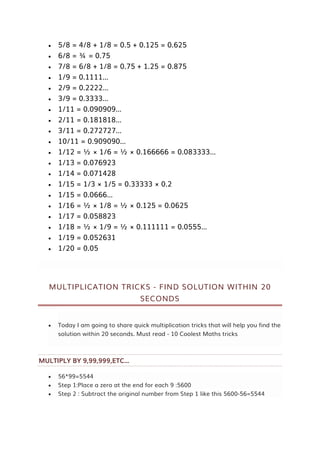
MULTIPLY BY 9,99,999,ETC...
 56*99=5544
 Step 1:Place a zero at the end for each 9 :5600
 Step 2 : Subtract the original number from Step 1 like this 5600-56=5544

MULTIPLY BY 125
 68*125=8500
 Step 1 :Place three zeros at the end of the number :68000
 Step 2: Divide the number from Step 1 by 8:68000/8=8500
 64*125 is the same as :
 32*250 is the same as
 16*500 is the same as
 8*1000
 64*125
 Step 1. Each time you just need to pick 125 multiply it by 8 will get 1000
 Step 2. Pick 64 and divide it by 8 will get 8
 Step 3. Multiply the results with each other 8* 1000
 Hence Solution is 8000
 [Hint: Just remember 125*8=1000]
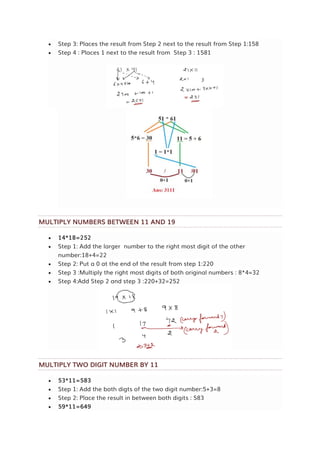
MULTIPLY TWO DIGITS NUMBERS ENDING IN 1
 51*31=1581
 Step 1: Multiply the left most digits : 5*3=15
 Step 2: Add the left most digits:5+3=8
 Step 3: Places the result from Step 2 next to the result from Step 1:158
 Step 4 : Places 1 next to the result from Step 3 : 1581
MULTIPLY NUMBERS BETWEEN 11 AND 19
 14*18=252
 Step 1: Add the larger number to the right most digit of the other
number:18+4=22
 Step 2: Put a 0 at the end of the result from step 1:220
 Step 3 :Multiply the right most digits of both original numbers : 8*4=32
 Step 4:Add Step 2 and step 3 :220+32=252
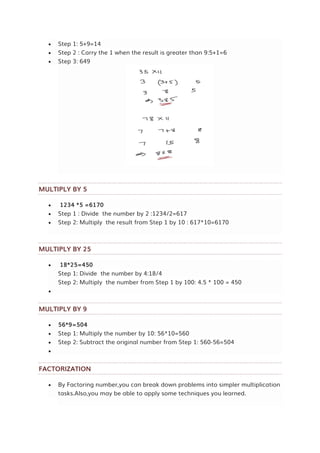
MULTIPLY TWO DIGIT NUMBER BY 11
 53*11=583
 Step 1: Add the both digts of the two digit number:5+3=8
 Step 2: Place the result in between both digits : 583
 59*11=649
 Step 1: 5+9=14
 Step 2 : Carry the 1 when the result is greater than 9:5+1=6
 Step 3: 649
MULTIPLY BY 5
 1234 *5 =6170
 Step 1 : Divide the number by 2 :1234/2=617
 Step 2: Multiply the result from Step 1 by 10 : 617*10=6170
MULTIPLY BY 25
 18*25=450
Step 1: Divide the number by 4:18/4
Step 2: Multiply the number from Step 1 by 100: 4.5 * 100 = 450

MULTIPLY BY 9
 56*9=504
 Step 1: Multiply the number by 10: 56*10=560
 Step 2: Subtract the original number from Step 1: 560-56=504

FACTORIZATION
 By Factoring number,you can break down problems into simpler multiplication
tasks.Also,you may be able to apply some techniques you learned.
 21*33
 step 1 : 21*11*3
 Step 2: 231*3
 Step 3 :693
 67*81
 Step 1: 67*9*9
 Step 2:603*9=5427
 28*125=3500
 Step 1: 28*125
 Step 2: 28*25*5
 Step 3:28*(100/4)*5
 Step 4:28/4*100*5
 Step 5:7*500=3500
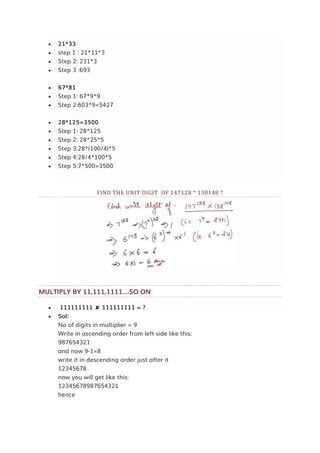
FIND THE UNIT DIGIT OF 147128 * 138148 ?
MULTIPLY BY 11,111,1111....SO ON
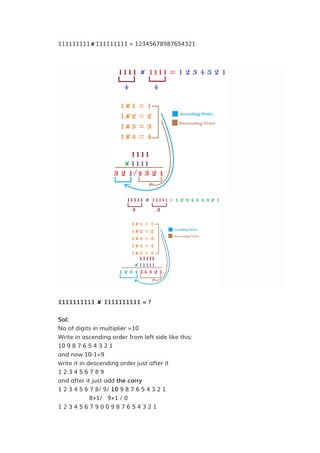
 111111111 ✘ 111111111 = ?
 Sol:
No of digits in multiplier = 9
Write in ascending order from left side like this:
987654321
and now 9-1=8
write it in descending order just after it
12345678
now you will get like this:
12345678987654321
hence
111111111✘111111111 = 12345678987654321
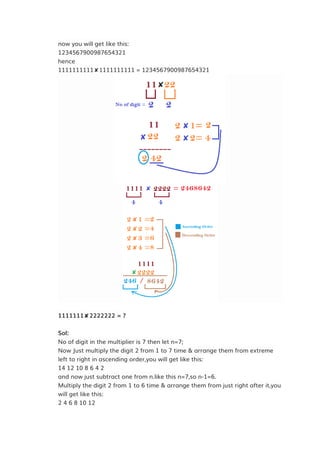
1111111111 ✘ 1111111111 = ?
Sol:
No of digits in multiplier =10
Write in ascending order from left side like this:
10 9 8 7 6 5 4 3 2 1
and now 10-1=9
write it in descending order just after it
1 2 3 4 5 6 7 8 9
and after it just add the carry
1 2 3 4 5 6 7 8/ 9/ 10 9 8 7 6 5 4 3 2 1
8+1/ 9+1 / 0
1 2 3 4 5 6 7 9 0 0 9 8 7 6 5 4 3 2 1
now you will get like this:
1234567900987654321
hence
1111111111✘1111111111 = 1234567900987654321
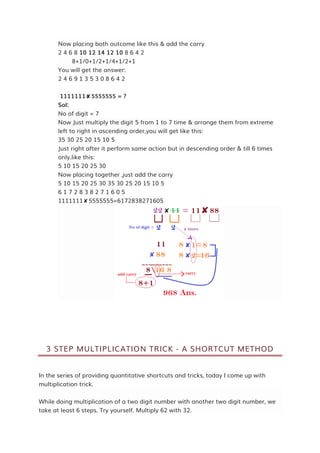
1111111✘2222222 = ?
Sol:
No of digit in the multiplier is 7 then let n=7;
Now Just multiply the digit 2 from 1 to 7 time & arrange them from extreme
left to right in ascending order,you will get like this:
14 12 10 8 6 4 2
and now just subtract one from n.like this n=7,so n-1=6.
Multiply the digit 2 from 1 to 6 time & arrange them from just right after it,you
will get like this:
2 4 6 8 10 12
Now placing both outcome like this & add the carry
2 4 6 8 10 12 14 12 10 8 6 4 2
8+1/0+1/2+1/4+1/2+1
You will get the answer:
2 4 6 9 1 3 5 3 0 8 6 4 2
1111111✘5555555 = ?
Sol:
No of digit = 7
Now Just multiply the digit 5 from 1 to 7 time & arrange them from extreme
left to right in ascending order,you will get like this:
35 30 25 20 15 10 5
Just right after it perform same action but in descending order & till 6 times
only.like this:
5 10 15 20 25 30
Now placing together ,just add the carry
5 10 15 20 25 30 35 30 25 20 15 10 5
6 1 7 2 8 3 8 2 7 1 6 0 5
1111111✘5555555=6172838271605
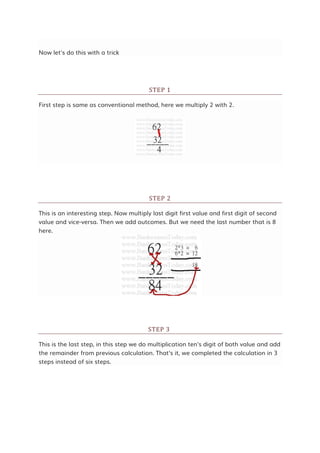
3 STEP MULTIPLICATION TRICK - A SHORTCUT METHOD
In the series of providing quantitative shortcuts and tricks, today I come up with
multiplication trick.
While doing multiplication of a two digit number with another two digit number, we
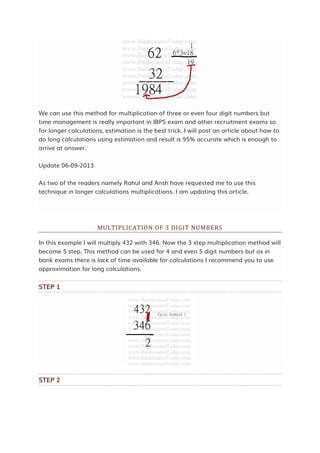
take at least 6 steps. Try yourself. Multiply 62 with 32.
Now let's do this with a trick
STEP 1
First step is same as conventional method, here we multiply 2 with 2.
STEP 2
This is an interesting step. Now multiply last digit first value and first digit of second
value and vice-versa. Then we add outcomes. But we need the last number that is 8
here.
STEP 3
This is the last step, in this step we do multiplication ten's digit of both value and add
the remainder from previous calculation. That's it, we completed the calculation in 3
steps instead of six steps.
We can use this method for multiplication of three or even four digit numbers but
time management is really important in IBPS exam and other recruitment exams so
for longer calculations, estimation is the best trick. I will post an article about how to
do long calculations using estimation and result is 95% accurate which is enough to
arrive at answer.
Update 06-09-2013
As two of the readers namely Rahul and Ansh have requested me to use this
technique in longer calculations multiplications. I am updating this article.
MULTIPLICATION OF 3 DIGIT NUMBERS
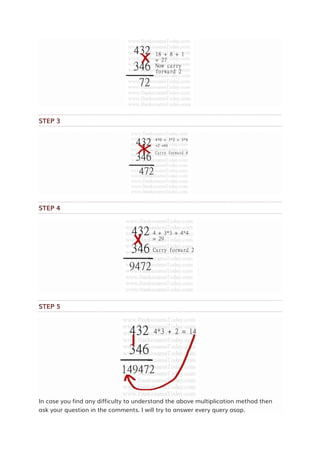
In this example I will multiply 432 with 346. Now the 3 step multiplication method will
become 5 step. This method can be used for 4 and even 5 digit numbers but as in
bank exams there is lack of time available for calculations I recommend you to use
approximation for long calculations.
STEP 1
STEP 2
STEP 3
STEP 4
STEP 5
In case you find any difficulty to understand the above multiplication method then
ask your question in the comments. I will try to answer every query asap.
TRICKS TO SOLVE SIMPLIFICATION - ADDITION AND
SUBTRACTION
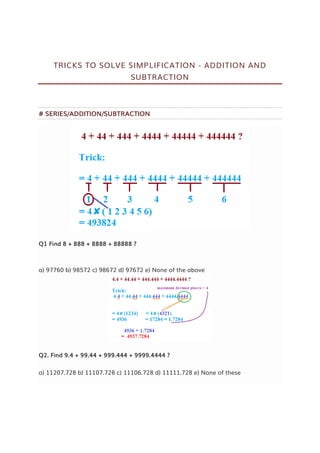
# SERIES/ADDITION/SUBTRACTION
Q1 Find 8 + 888 + 8888 + 88888 ?
a) 97760 b) 98572 c) 98672 d) 97672 e) None of the above
Q2. Find 9.4 + 99.44 + 999.444 + 9999.4444 ?
a) 11207.728 b) 11107.728 c) 11106.728 d) 11111.728 e) None of these
Q3. ( 2.3 + 3.3 ) [ ( 2.3)2
- 2.3✘3.3 + (3.3)2
] = ?
a) 48.104 b) 47.104 c) 47.204 d) 48.204 e) None of these
Q4. (3-2) [(3)4
+((3)3
✘2)+(3)2
✘(2)2
+(3✘23
)+24
] = ?
a) 311 b) 211 c) 201 c) 221 d) 301 e) None of these
Q5. (125.824+124.654)2
+ (125.824-124.54)2
/ ((125.824)2
+(124.54)2
)
a) 1.166 b) 1 b) 2 c) 625 d) 250.478 e) None of these
Q6. Evaluate 1 + 1
/1*3 + 1
/1*3*9 + 1
/1*3*9*27 + 1
/1*3*9*27*81 up to three places of decimals
?
a)1.367 b) 1.370 c) 1.361 d) 1.267 e) None of these
Q7. 2 ÷ [2+ 2÷{2+2 ÷ 4)}]= x / 19. Find x.
a) 3 b) 4 c) 5 d) 6 e) None of these
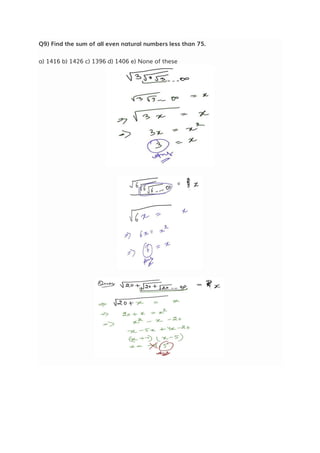
a) 0.67 b) 0.77 c) 0.87 d) 0.97 e) None of these
Q9) Find the sum of all even natural numbers less than 75.
a) 1416 b) 1426 c) 1396 d) 1406 e) None of these
SOLUTION:
(1)
Sol : Option (c)
8*(12345) - 88 = 98672
(2)
Sol: Option (b)
9✘(1234) = 11106
4✘(4321) = 17284
=1.7284
=11106+1.7284=11107.7284
(3)
Sol: Option (a)
(a3
+ b3
)=(a+b) (a2
-ab+b2
)
a = 2.3, b = 3.3;
(a)3
= 12.167, (b)3
= 35.937 (a3
+b3
)=48.104
(4)
Sol: option (b)
(a5
-b5
)=(a-b) [a4
+a3
b+a2
b2
+ab3
+b4
] = ?
a = 3, b = 2; (3)5=243, (2)5 =32;
(a5
-b5
) = 243-32= 211
(5)
Sol: Option (b)
(a+b)2
+ (a-b)2
=2((a)2
+(b)2
) Hence Answer is 2
(6)
Sol: Option (a)
1+0.33+0.0370 ... hence (a) is the answer no further addition is required.
(7)
Sol: option (e)
Using VODMAS method
Step 1. [ 2+ 2/4 ] = 5/2.
Step 2. ( 2 + 2 ÷5/2) = 2÷ 2✘2/5 =14/5
Step 3. [2+2÷14/5]=2+2*5/14=19/7
Step 4. L.H.S = 2÷19/7=14/19 = x/19 Hence x=19
(8)
Sol: Option (c)
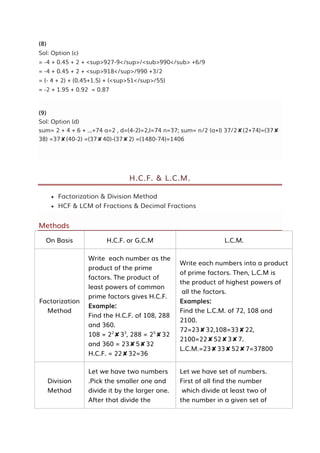
= -4 + 0.45 + 2 + <sup>927-9</sup>/<sub>990</sub> +6/9
= -4 + 0.45 + 2 + <sup>918</sup>/990 +3/2
= (- 4 + 2) + (0.45+1.5) + (<sup>51</sup>/55)
= -2 + 1.95 + 0.92 = 0.87
(9)
Sol: Option (d)
sum= 2 + 4 + 6 + ...+74 a=2 , d=(4-2)=2,l=74 n=37; sum= n/2 (a+l) 37/2✘(2+74)=(37✘
38) =37✘(40-2) =(37✘40)-(37✘2) =(1480-74)=1406
H.C.F. & L.C.M.
 Factorization & Division Method
 HCF & LCM of Fractions & Decimal Fractions
Methods
On Basis H.C.F. or G.C.M L.C.M.
Factorization
Method
Write each number as the
product of the prime
factors. The product of
least powers of common
prime factors gives H.C.F.
Example:
Find the H.C.F. of 108, 288
and 360.
108 = 22
✘33
, 288 = 25
✘32
and 360 = 23✘5✘32
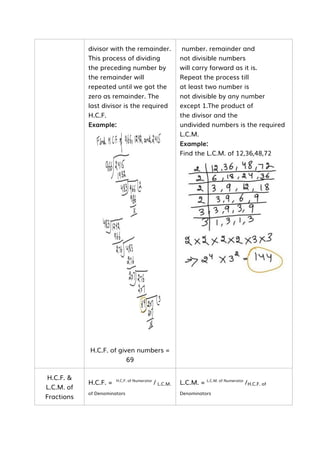
H.C.F. = 22✘32=36
Write each numbers into a product
of prime factors. Then, L.C.M is
the product of highest powers of
all the factors.
Examples:
Find the L.C.M. of 72, 108 and
2100.
72=23✘32,108=33✘22,
2100=22✘52✘3✘7.
L.C.M.=23✘33✘52✘7=37800
Division
Method
Let we have two numbers
.Pick the smaller one and
divide it by the larger one.
After that divide the
Let we have set of numbers.
First of all find the number
which divide at least two of
the number in a given set of
divisor with the remainder.
This process of dividing
the preceding number by
the remainder will
repeated until we got the
zero as remainder. The
last divisor is the required
H.C.F.
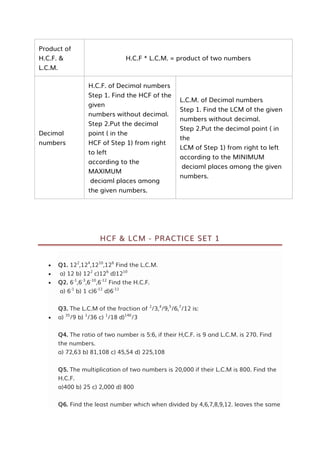
Example:
H.C.F. of given numbers =
69
number. remainder and
not divisible numbers
will carry forward as it is.
Repeat the process till
at least two number is
not divisible by any number
except 1.The product of
the divisor and the
undivided numbers is the required
L.C.M.
Example:
Find the L.C.M. of 12,36,48,72
H.C.F. &
L.C.M. of
Fractions
H.C.F. = H.C.F. of Numerator
/ L.C.M.
of Denominators
L.C.M. = L.C.M. of Numerator
/H.C.F. of
Denominators
Product of
H.C.F. &
L.C.M.
H.C.F * L.C.M. = product of two numbers
Decimal
numbers
H.C.F. of Decimal numbers
Step 1. Find the HCF of the
given
numbers without decimal.
Step 2.Put the decimal
point ( in the
HCF of Step 1) from right
to left
according to the
MAXIMUM
deciaml places among
the given numbers.
L.C.M. of Decimal numbers
Step 1. Find the LCM of the given
numbers without decimal.
Step 2.Put the decimal point ( in
the
LCM of Step 1) from right to left
according to the MINIMUM
deciaml places among the given
numbers.
HCF & LCM - PRACTICE SET 1
 Q1. 122
,124
,1210
,126
Find the L.C.M.
 a) 12 b) 122
c)126
d)1210
 Q2. 6-1
,6-3
,6-10
,6-12
Find the H.C.F.
a) 6-1
b) 1 c)6-12
d)6-11
Q3. The L.C.M of the fraction of 2
/3,4
/9,5
/6,7
/12 is:
 a) 35
/9 b) 1
/36 c) 1
/18 d)140
/3
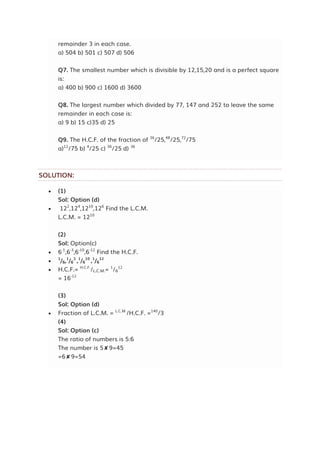
Q4. The ratio of two number is 5:6, if their H,C.F. is 9 and L.C.M. is 270. Find
the numbers.
a) 72,63 b) 81,108 c) 45,54 d) 225,108
Q5. The multiplication of two numbers is 20,000 if their L.C.M is 800. Find the
H.C.F.
a)400 b) 25 c) 2,000 d) 800
Q6. Find the least number which when divided by 4,6,7,8,9,12. leaves the same
remainder 3 in each case.
a) 504 b) 501 c) 507 d) 506
Q7. The smallest number which is divisible by 12,15,20 and is a perfect square
is:
a) 400 b) 900 c) 1600 d) 3600
Q8. The largest number which divided by 77, 147 and 252 to leave the same
remainder in each case is:
a) 9 b) 15 c)35 d) 25
Q9. The H.C.F. of the fraction of 36
/25,48
/25,72
/75
a)12
/75 b) 4
/25 c) 36
/25 d) 36
SOLUTION:
 (1)
Sol: Option (d)
 122
,124
,1210
,126
Find the L.C.M.
L.C.M. = 1210
(2)
Sol: Option(c)
 6-1
,6-3
,6-10
,6-12
Find the H.C.F.

1
/6,1
/6
3
,1
/6
10
,1
/6
12
 H.C.F.= H.C.F.
/L.C.M.= 1
/6
12
= 16-12
(3)
Sol: Option (d)
 Fraction of L.C.M. = L.C.M.
/H.C.F. =140
/3
(4)
Sol: Option (c)
The ratio of numbers is 5:6
The number is 5✘9=45
=6✘9=54
(5)
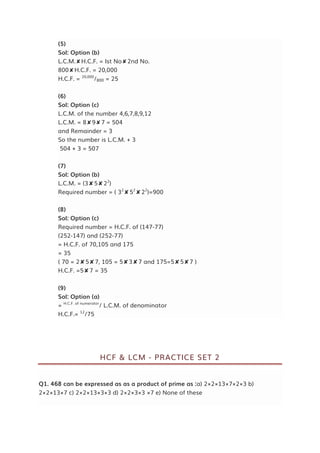
Sol: Option (b)
L.C.M.✘H.C.F. = Ist No✘2nd No.
800✘H.C.F. = 20,000
H.C.F. = 20,000
/800 = 25
(6)
Sol: Option (c)
L.C.M. of the number 4,6,7,8,9,12
L.C.M. = 8✘9✘7 = 504
and Remainder = 3
So the number is L.C.M. + 3
504 + 3 = 507
(7)
Sol: Option (b)
L.C.M. = (3✘5✘22
)
Required number = ( 32
✘52
✘22
)=900
(8)
Sol: Option (c)
Required number = H.C.F. of (147-77)
(252-147) and (252-77)
= H.C.F. of 70,105 and 175
= 35
( 70 = 2✘5✘7, 105 = 5✘3✘7 and 175=5✘5✘7 )
H.C.F. =5✘7 = 35
(9)
Sol: Option (a)
= H.C.F. of numerator
/ L.C.M. of denominator
H.C.F.= 12
/75
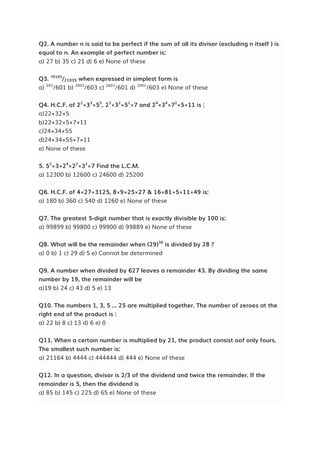
HCF & LCM - PRACTICE SET 2
Q1. 468 can be expressed as as a product of prime as :a) 2×2×13×7×2×3 b)
2×2×13×7 c) 2×2×13×3×3 d) 2×2×3×3 ×7 e) None of these
Q2. A number n is said to be perfect if the sum of all its divisor (excluding n itself ) is
equal to n. An example of perfect number is:
a) 27 b) 35 c) 21 d) 6 e) None of these
Q3. 70105
/21035 when expressed in simplest form is
a) 203
/601 b) 2003
/603 c) 2003
/601 d) 2001
/603 e) None of these
Q4. H.C.F. of 22
×33
×55
, 23
×32
×52
×7 and 24
×34
×72
×5×11 is :
a)22×32×5
b)22×32×5×7×11
c)24×34×55
d)24×34×55×7×11
e) None of these
5. 52
×3×24
×22
×32
×7 Find the L.C.M.
a) 12300 b) 12600 c) 24600 d) 25200
Q6. H.C.F. of 4×27×3125, 8×9×25×27 & 16×81×5×11×49 is:
a) 180 b) 360 c) 540 d) 1260 e) None of these
Q7. The greatest 5-digit number that is exactly divisible by 100 is:
a) 99899 b) 99800 c) 99900 d) 99889 e) None of these
Q8. What will be the remainder when (29)36
is divided by 28 ?
a) 0 b) 1 c) 29 d) 5 e) Cannot be determined
Q9. A number when divided by 627 leaves a remainder 43. By dividing the same
number by 19, the remainder will be
a)19 b) 24 c) 43 d) 5 e) 13
Q10. The numbers 1, 3, 5 ... 25 are multiplied together. The number of zeroes at the
right end of the product is :
a) 22 b) 8 c) 13 d) 6 e) 0
Q11. When a certain number is multiplied by 21, the product consist oof only fours.
The smallest such number is:
a) 21164 b) 4444 c) 444444 d) 444 e) None of these
Q12. In a question, divisor is 2/3 of the dividend and twice the remainder. If the
remainder is 5, then the dividend is
a) 85 b) 145 c) 225 d) 65 e) None of these
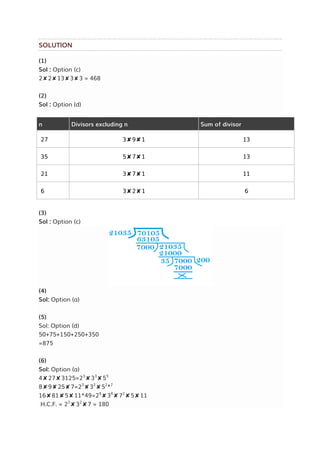
SOLUTION
(1)
Sol : Option (c)
2✘2✘13✘3✘3 = 468
(2)
Sol : Option (d)
n Divisors excluding n Sum of divisor
27 3✘9✘1 13
35 5✘7✘1 13
21 3✘7✘1 11
6 3✘2✘1 6
(3)
Sol : Option (c)
(4)
Sol: Option (a)
(5)
Sol: Option (d)
50+75+150+250+350
=875
(6)
Sol: Option (a)
4✘27✘3125=23
✘33
✘55
8✘9✘25✘7=23
✘32
✘52✘7
16✘81✘5✘11*49=24
✘34
✘72
✘5✘11
H.C.F. = 22
✘32
✘7 = 180
(7)
Sol: Option (c)
(8)
Sol: Option (b)
(9)
Sol: Option (d)
(10)
Sol: Option (e)
(11)
Sol: Option (a)
(12)
Sol: Option (e)
EXAMPLE:12.5% OF 800
Sol: 1/8 ✕ 800 [12.5% = 1/8, Learn the ratio- equivalence table]
⇒100
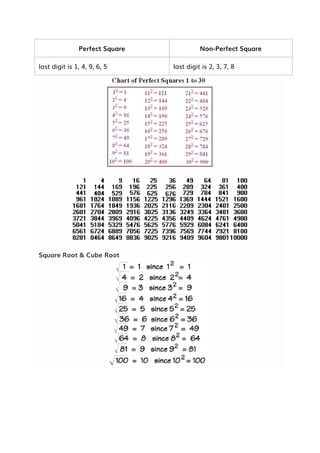
SQUARE & CUBE
 Square & Cube
 Square Root & Cube Root
 Factorization Method
Perfect Square Non-Perfect Square
last digit is 1, 4, 9, 6, 5 last digit is 2, 3, 7, 8
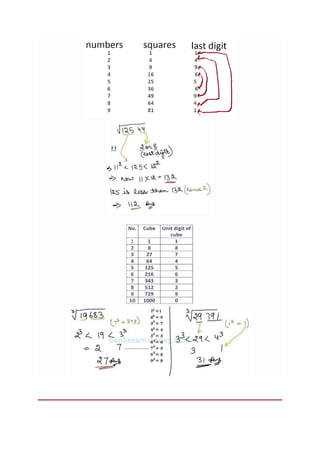
Square Root & Cube Root
FIND SQUARE OF ANY NUMBER WITHIN 10 SECONDS
Today i am going to share an interesting vedic maths trick. At first you will find it
difficult but with practice, you will be able to find square of any number within 10
seconds.
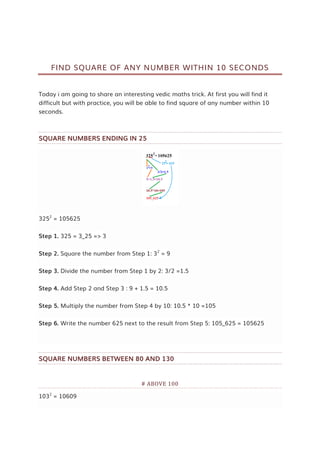
SQUARE NUMBERS ENDING IN 25
3252
= 105625
Step 1. 325 = 3_25 => 3
Step 2. Square the number from Step 1: 32
= 9
Step 3. Divide the number from Step 1 by 2: 3/2 =1.5
Step 4. Add Step 2 and Step 3 : 9 + 1.5 = 10.5
Step 5. Multiply the number from Step 4 by 10: 10.5 * 10 =105
Step 6. Write the number 625 next to the result from Step 5: 105_625 = 105625
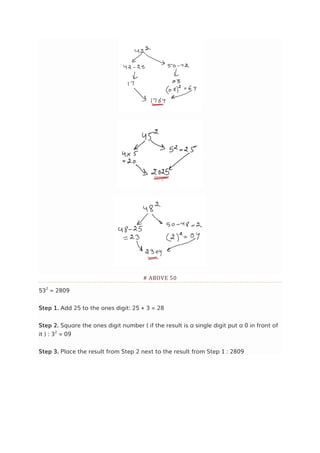
SQUARE NUMBERS BETWEEN 80 AND 130
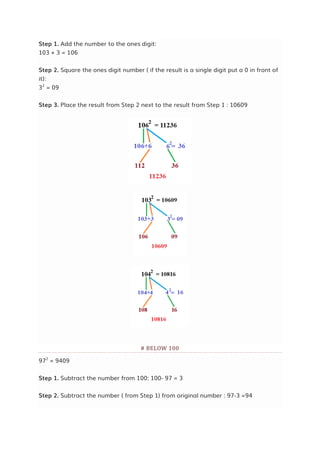
# ABOVE 100
1032
= 10609
Step 1. Add the number to the ones digit:
103 + 3 = 106
Step 2. Square the ones digit number ( if the result is a single digit put a 0 in front of
it):
32
= 09
Step 3. Place the result from Step 2 next to the result from Step 1 : 10609
# BELOW 100
972
= 9409
Step 1. Subtract the number from 100: 100- 97 = 3
Step 2. Subtract the number ( from Step 1) from original number : 97-3 =94
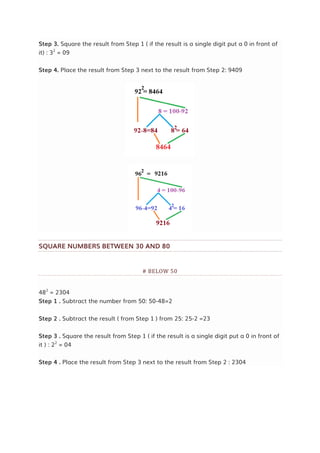
Step 3. Square the result from Step 1 ( if the result is a single digit put a 0 in front of
it) : 32
= 09
Step 4. Place the result from Step 3 next to the result from Step 2: 9409
SQUARE NUMBERS BETWEEN 30 AND 80
# BELOW 50
482
= 2304
Step 1 . Subtract the number from 50: 50-48=2
Step 2 . Subtract the result ( from Step 1 ) from 25: 25-2 =23
Step 3 . Square the result from Step 1 ( if the result is a single digit put a 0 in front of
it ) : 22
= 04
Step 4 . Place the result from Step 3 next to the result from Step 2 : 2304
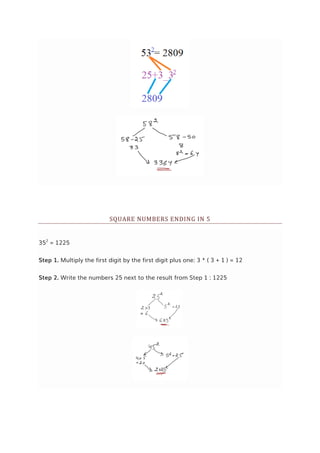
# ABOVE 50
532
= 2809
Step 1. Add 25 to the ones digit: 25 + 3 = 28
Step 2. Square the ones digit number ( if the result is a single digit put a 0 in front of
it ) : 32
= 09
Step 3. Place the result from Step 2 next to the result from Step 1 : 2809
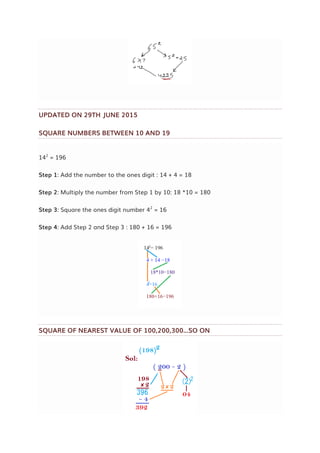
SQUARE NUMBERS ENDING IN 5
352
= 1225
Step 1. Multiply the first digit by the first digit plus one: 3 * ( 3 + 1 ) = 12
Step 2. Write the numbers 25 next to the result from Step 1 : 1225
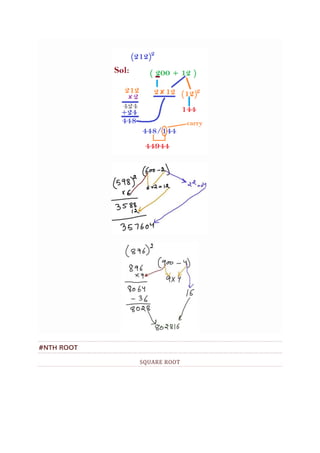
UPDATED ON 29TH JUNE 2015
SQUARE NUMBERS BETWEEN 10 AND 19
142
= 196
Step 1: Add the number to the ones digit : 14 + 4 = 18
Step 2: Multiply the number from Step 1 by 10: 18 *10 = 180
Step 3: Square the ones digit number 42
= 16
Step 4: Add Step 2 and Step 3 : 180 + 16 = 196
SQUARE OF NEAREST VALUE OF 100,200,300...SO ON
#NTH ROOT
SQUARE ROOT
SQUARING TECHNIQUE - FIND SQUARE OF ANY NUMBER
UNDER 10 SECONDS
Simple technique to find square of a two digit or three digit number under 10
seconds.
Here we are going to use simple algebric formula that it
[a+b]² = a² + 2ab + b²
By applying this formula, let's do some examples:-
Find 43²
⇒[43]²
⇒[4|3]²
⇒[4² | 2 × 4 × 3 | 3²]
⇒[16 | 24 | 9 ]
1849
More shortcut techniques
Find 114²
⇒[11| 4]²
⇒ [11² | 2 × 11 × 4 | 4²]
⇒ [121 | 88 | 16]
⇒[121| 88 + 1 | 6]
⇒ [ 121 | 89 | 6 ]
⇒ [129 | 9 | 6 ]
12996
Find 253²
⇒[25|3]²
⇒[25² | 2 × 25 × 3 | 3²]
⇒[625 | 150 | 9]
64009
TECHNIQUE
In case of two digit number deduct last digit and add it to another number and then
add square of same.
In this technique we simplify the squaring method by making one unit's digit zero. It
is far easy to multiply 50*24 than 54*24. So I used this technique. Try practice more
to become expert in this technique.
LET'S TAKE SOME EXAMPLES
Find square of 53.
=(53*53)
= (53+3) * (53-3) + (3*3)
=(56*50) + 9
= (560*5) + 9
= 2800 + 9 = 2809
Let's take another example
Find square of 69
= (69*69)
= (69+1) * (69-1) + (1*1)
= (70*68) + 1
= (680*7) + 1
= 4761
Let's take one more example
Find square of 45
= (45*45)
= (45-5)*(45+5) + (5*5)
= (40*50) + 25
= 2000+25
= 2025
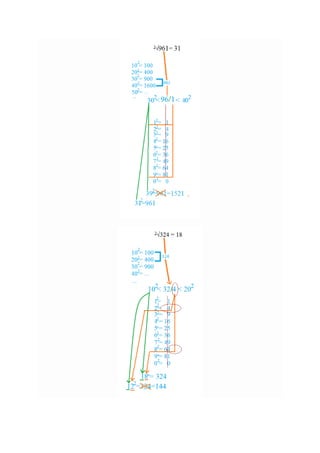
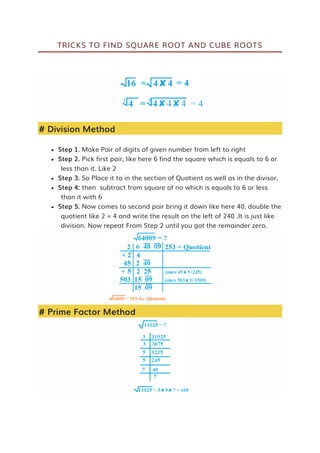
TRICKS TO FIND SQUARE ROOT AND CUBE ROOTS
# Division Method
 Step 1. Make Pair of digits of given number from left to right
 Step 2. Pick first pair, like here 6 find the square which is equals to 6 or
less than it. Like 2
 Step 3. So Place it to in the section of Quotient as well as in the divisor.
 Step 4: then subtract from square of no which is equals to 6 or less
than it with 6
 Step 5. Now comes to second pair bring it down like here 40, double the
quotient like 2 = 4 and write the result on the left of 240 .It is just like
division. Now repeat From Step 2 until you got the remainder zero.
# Prime Factor Method
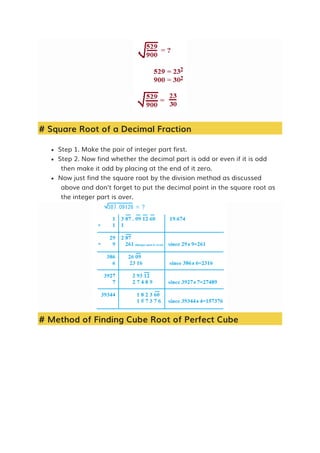
# Square Root of a Decimal Fraction
 Step 1. Make the pair of integer part first.
 Step 2. Now find whether the decimal part is odd or even if it is odd
then make it odd by placing at the end of it zero.
 Now just find the square root by the division method as discussed
above and don't forget to put the decimal point in the square root as
the integer part is over.
# Method of Finding Cube Root of Perfect Cube
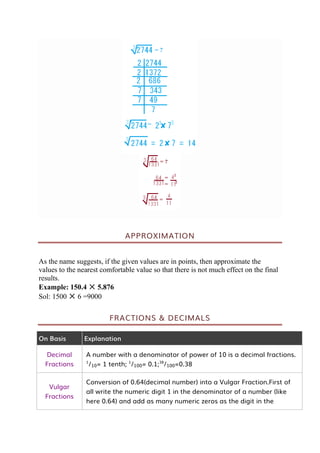
APPROXIMATION
As the name suggests, if the given values are in points, then approximate the
values to the nearest comfortable value so that there is not much effect on the final
results.
Example: 150.4 ✕ 5.876
Sol: 1500 ✕ 6 =9000
FRACTIONS & DECIMALS
On Basis Explanation
Decimal
Fractions
A number with a denominator of power of 10 is a decimal fractions.
1
/10= 1 tenth; 1
/100= 0.1;38
/100=0.38
Vulgar
Fractions
Conversion of 0.64(decimal number) into a Vulgar Fraction.First of
all write the numeric digit 1 in the denominator of a number (like
here 0.64) and add as many numeric zeros as the digit in the
number after decimal point.After that removes the decimal point
from the given number.At last step just reduce the fraction to its
lowest terms. So, 0.64 = 64
/100=16
/25;25.025 = 25025
/1000 = 1001
/4
Operations
Addition & Subtraction
To perform the addition and subtraction of a decimal fraction could
be done through placing them right under each other that the
decimal points lie in one column.
3.424+3.28+.4036+6.2+.8+4
3. 424
3. 28
. 4036
6. 2
. 8
+4______
18. 1076
Multiplication of a Decimal Fraction
To find the multiplication of decimal fraction , first of all you need to
remove the decimal point from the given numbers and then perform
the multiplication after that assign the decimal point as many
places after the number as the sum of the number of the decimal
places in the given number.
Step 1. 0.06*0.3*0.40
Step 2. 6*3*40=720
Step 3. 0.00720
Multiplication of a decimal fraction by power of 10
A multiplication of a decimal fraction by a power of 10 can be
perform through shifting the decimal point towards right as many
places as is the power of 10.
like 45.6288*100=45628.8, 0.00452*100=0.452
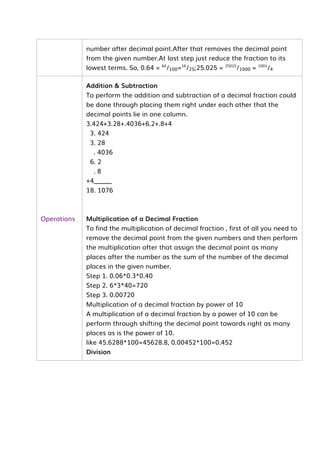
Division
Comparison
of Fractions
To compare the set of fractions numbers,first of all you need to
convert each fraction number or value into a equal decimal value
and then it will be became easy for you to assign them ( the
numbers or value) in a particular way( ascending or descending
order).
3
/5,4
/7,8
/9 and 9
/11 Arranging in Ascending Order
3
/5= 0.6, 4
/7 = 0.571, 8
/9 = 0.88, 9
/11 = 0.818.
Now, 0.88 > 0.818 > 0.6 > 0.571
8
/9>9
/11>3
/5>4
/7
Recurring
Decimal
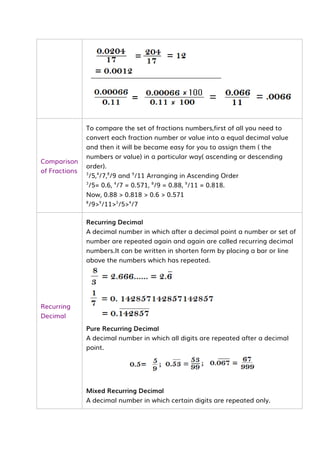
Recurring Decimal
A decimal number in which after a decimal point a number or set of
number are repeated again and again are called recurring decimal
numbers.It can be written in shorten form by placing a bar or line
above the numbers which has repeated.
Pure Recurring Decimal
A decimal number in which all digits are repeated after a decimal
point.
Mixed Recurring Decimal
A decimal number in which certain digits are repeated only.
FRACTION - TECHNIQUES WITH PRACTICE QUESTIONS
# Types
 Proper
 Improper
 Mixed Fraction
I. Proper Fraction: [when numerator < denominator ]
Eg. 4
/5 , 6
/8 , 9
/7
II. Improper Fraction : [when numerator > denominator ]
Eg. 4
/2 , 5
/3 , 6
/2
III. Mixed Fraction :
 Mixed with Proper Fraction
 Mixed with Improper fraction
a) Mixed with Proper Fraction: When a proper fraction is mixed with a whole
number known as mixed with proper fraction.
Eg. 52
/3 , 63
/4 , 71
/4
b) Mixed with Improper Fraction: When a proper fraction is mixed with a
whole number known as mixed with Improper fraction.
Eg. 23
/2 , 44
/1 , 66
/1
# Rules
I. 4 + 3
/8 = 4 3
/8
II. 4+8
/3= 4 + 22
/3
= 62
/3
III. 4-3
/8=3+(1-3
/8)=3+5
/8=35
/8
Q1. Arrange the fractions a=3
/5 , b=4
/7 , c=8
/9 and d=9
/11 in their descending
order.
a) a,b,c,d
b)c,d,a,c
b) a,d,c,a,b
d) c,d,a,b
e) None of these
Q2.[ 0.00625 of 23/5 ], when expressed as a vulgar, fraction, equals:
a)23/80 b) 23/8000 c) 23/800 d) 125/23 e) None of these
a)5/6 b) 5/9 c) 15/18 d) 3/18 e) None of these
Q4.If 47.2506 = 4A +7/B+2C +5/D+6E, then the value of 5A + 3B + 6C + D +
3E is:
a) 153.6003 b)53.6003 c) 53.603 d) None of these e) 213.0003
Q5.4/15 of 5/7 of a number is greater than 4/9 of 2/5 of the same number by
8.What is half of that number?
a)215 b) 315 c) 305 d) 325 e)None of these
Q6. Find the value of 1
/2 x 3 + 1
/3 x 4 + 1
/4 x 5 + 1
/5 x 6 +............+ 1
/9 x 10
a)4
/10 b) 2
/10 c) 2
/5 d) 4
/5 e) None of these
Solution
(1)
Sol: Option d
Clearly 3
/5=0.6, 4
/7 = 0.571 , 8
/9 = 0.88, 9
/11= 0.818
Now, 0.88 > 0.818 > 0.6 > 0.571
(2)
Sol: Option c
[0.000625 of 23
/5]=[625
/100000 * 23
/5]=23
/800
(3)
Sol: Option (a)
(4)
Sol: Option (a)
4A +7
/B + 2C +5
/D +6E = 47.2506
4A +7
/B + 2
/C +5
/D +6E = 40+7+0.2+0.05+0.0006
Comparing the terms on both sides, we get
4A=40, 7
/B =7, 2C = 0.2, 5
/D=0.05, 6E=0.0006
or
a=10, B=1, C=0.1, D = 100, E = 0.0001
5A+3B+6C+D+3E
=(5810)+(3*1)+(6*0.1)+100+(3*0.0001)
=50+3+0.6+100+0.0003=153.6003
(5)
Sol: Option B
Let the number be x. Then,
4
/15 of 5
/7 of x - 4
/9 of 2
/5 of x = 8
4
/21x-8
/45x=8
[4
/21-8
/45]x=8
[60-56
/315]x=8
4
/315x=8
x=[8*315
/4]=630
1
/2 x = 315
(6)
Sol: Option C
Given expression [1
/2-1
/3]+[1
/3-1
/4]+[1
/4-1
/5]+[1
/5-1
/6]+.....................+[1
/9-1
/10]
=[1
/2-1
/10]
=4/10
=2/5
SURDS & INDICES
 Some Rules of Indices
 Some Rules of Surds

Simplification-Techniques-and-Tricks.pdf

  • 1.
    SIMPLIFICATION TECHNIQUES ANDTRICKS The topic Simplification is asked in each and every exam. In bank exams, Simplification covers almost 30-40% of the Quant section. Simplification also covers the percentage chapter. There might be 2-3 questions that have asked to simplify but they are related to percentages. Simplification topic is asked to check the ability of students to find their ability to deal with the numbers. So, it’s important to have knowledge about simplification. Let’s try to understand about simplification- Simplification means to play with the questions by doing complex calculations. Some of the tricks and tactics you must know to score good by saving your valuable time-  Learn BODMAS.  Use the concept of digital sum.  Memorize tables up to 30.  Memorize cubes and squares of numbers up to 35.  Learn tricks to find squares and cubes of numbers greater than 35.  Learn tricks to find cube roots and square roots of large number.  Learn the concept of percentages (conversion of fractions to percentage & percentage to fractions)  Memorize the reciprocals. RULES OF SIMPLIFICATION V → Vinculum B → Remove Brackets - in the order ( ) , { }, [ ] O → Of D → Division
  • 2.
    M → Multiplication A→ Addition S → Subtraction  B Brackets first  O Orders (i.e. Powers and Square Roots, etc.)  DM Division and Multiplication (left-to-right)  AS Addition and Subtraction (left-to-right) Let’s discuss an example based on BODMAS - Example: 152 × 23 + (228 ÷ 19)2 =? Sol: ⇒ 15✕(12)2 [brackets are solved first and table of 19 and 15 must be on tips] ⇒ 120+144 [must know the squares] ⇒ 264 IMPORTANT PARTS OF SIMPLIFICATION  Digital Sum  Number System  Reciprocals  HCF & LCM  Percentages  Square & Cube  Approximation  Fractions & Decimals  Surds & Indices DIGITAL SUM Digital sum is the sum obtained after adding all the digits of any given number successively.  Example: 568 = 5+6+8 = 19, 1 + 9 = 10. Note: if any number multiplied by 9, then the digital sum is always 9.
  • 3.
     Example: 6✕ 9 = 54, 5+4 = 9 Trick: In order to save time if we find digit 9 or multiples of 9, then 9 or its multiple can be neglected.  Example: 293 = 2 + 9 + 3 = 2 + 3 = 5 [ ‘9’ is omitted ] ‘9’ is omitted to reduce the calculation. If we don’t omit ‘9’, then also the digital sum remains same. Example: 293 = 2 + 9 + 3 = 14, 1 + 4 = 5 [answer remains same] Let’s discuss one more example- EXAMPLE: 326 ✕ 890 =? a. 291140 b. 290100 c. 290140 d. 293990 Sol: We can find out the answer by option method without doing multiplication. This is only possible with the help of Digital sum. Now, Digital sum, 326 ✕ 890 = (3 + 2 +6) ✕ ( 8 +9 + 0 ) ⇒ 11 ✕ 17 ⇒ (1+1) ✕ (1+7) ⇒ 2 ✕ 8 = 16 ⇒ digital sum (16) = 7 Now find out the digital sum of the given options- 1. DS (291140) = 8 2. DS (290100) = 3 3. DS (290140) = 7 4. DS (293990) = 5 Option C has the same digital sum as ‘7’ as we have already found out. Thus the correct option is C. NUMBER SYSTEM  Classification  Divisibility Test  Division& Remainder Rules
  • 4.
     Sum Rules Classification TypesDescription Natural Numbers: all counting numbers ( 1,2,3,4,5....∞) Whole Numbers: natural number + zero( 0,1,2,3,4,5...∞) Integers: All whole numbers including Negative number + Positive number(∞......-4,-3,-2,-1,0,1,2,3,4,5....∞) Even & Odd Numbers : All whole number divisible by 2 is Even (0,2,4,6,8,10,12.....∞) and which does not divide by 2 are Odd (1,3,5,7,9,11,13,15,17,19....∞) Prime Numbers: It can be positive or negative except 1, if the number is not divisible by any number except the number itself.(2,3,5,7,11,13,17,19,23,29,31,37,41,43,47,53,59,61....∞) Composite Numbers: Natural numbers which are not prime Co-Prime: Two natural number a and b are said to be co-prime if their HCF is 1. Divisibility Numbers IF A Number Examples Divisible by 2 End with 0,2,4,6,8 are divisible by 2 254,326,3546,4718 all are divisible by 2 Divisible by 3 Sum of its digits is divisible by 3 375,4251,78123 all are divisible by 3. [549=5+4+9][5+4+9=18]18 is divisible by 3 hence 549 is divisible by 3.
  • 5.
    Divisible by 4 Last twodigit divisible by 4 5642 here last 2 digits are 42 which is divisible by 4 hence 5642 is also divisible by 4. Divisible by 5 Ends with 0 or 5 225 or 330 here last digit digit is 0 or 5 that mean both the numbers are divisible by 5. Divisible by 6 Divides by Both 2 & 3 4536 here last digit is 6 so it divisible by 2 & sum of its digit (like 4+5+3+6=18) is 18 which is divisible by 3.Hence 4536 is divisible by 6. Divisible by 8 Last 3 digit divide by 8 746848 here last 3 digit 848 is divisible by 8 hence 746848 is also divisible by 8. Divisible by 10 End with 0 220,450,1450,8450 all numbers has a last digit zero it means all are divisible by 10. Divisible by 11 [Sum of its digit in odd places- Sum of its digits in even places]= 0 or multiple of 11 Consider the number 39798847 (Sum of its digits at odd places)-(Sum of its digits at even places)(7+8+9+9)-(4+8+7+3) (23-12) 23-12=11, which is divisible by 11. So 39798847 is divisible by 11. Division & Remainder Rules Suppose we divide 45 by 6 hence ,represent it as: dividend = ( divisor✘dividend ) + remainder or divisior= [(dividend)-(remainder] / quotient could be write it as
  • 6.
    x = kq+ r where (x = dividend,k = divisor,q = quotient,r = remainder) Example: On dividing a certain number by 342, we get 47 as remainder. If the same number is divided by 18, what will be the remainder ? Number = 342k + 47 ( 18 ✘19k ) + ( 18 ✘2 ) + 11 18 ✘( 19k + 2 ) +11. Remainder = 11 Sum Rules (1+2+3+.........+n) = 1 /2 n(n+1) (12 +22 +32 +.........+n2 ) = 1 /6 n (n+1) (2n+1) (13 +23 +33 +.........+n3 ) = 1 /4 n2 (n+1)2 Arithmetic Progression (A.P.) a, a + d, a + 2d, a + 3d, ....are said to be in A.P. in which first term = a and common difference = d. Let the nth term be tn and last term = l, then a) nth term = a + ( n - 1 ) d b) Sum of n terms = n /2 [2a + (n-1)d] c) Sum of n terms = n /2 (a+l) where l is the last term RECIPROCALS Up to 5, the reciprocals are easy to remember. But after 5 are explained as below-  1/7 = 0.142857  2/7 = 0.285714  3/7 = 0.42857  5/7 = 0.714285  6/7 = 0.857142  1/8 = 0.125  2/8 = ¼ = 0.25  3/8 = 3 × 1/8 = 0.375  4/8 = ½ = 0.5
  • 7.
     5/8 =4/8 + 1/8 = 0.5 + 0.125 = 0.625  6/8 = ¾ = 0.75  7/8 = 6/8 + 1/8 = 0.75 + 1.25 = 0.875  1/9 = 0.1111…  2/9 = 0.2222…  3/9 = 0.3333…  1/11 = 0.090909…  2/11 = 0.181818…  3/11 = 0.272727…  10/11 = 0.909090…  1/12 = ½ × 1/6 = ½ × 0.166666 = 0.083333…  1/13 = 0.076923  1/14 = 0.071428  1/15 = 1/3 × 1/5 = 0.33333 × 0.2  1/15 = 0.0666…  1/16 = ½ × 1/8 = ½ × 0.125 = 0.0625  1/17 = 0.058823  1/18 = ½ × 1/9 = ½ × 0.111111 = 0.0555…  1/19 = 0.052631  1/20 = 0.05 MULTIPLICATION TRICKS - FIND SOLUTION WITHIN 20 SECONDS  Today I am going to share quick multiplication tricks that will help you find the solution within 20 seconds. Must read - 10 Coolest Maths tricks MULTIPLY BY 9,99,999,ETC...  56*99=5544  Step 1:Place a zero at the end for each 9 :5600  Step 2 : Subtract the original number from Step 1 like this 5600-56=5544
  • 8.
     MULTIPLY BY 125 68*125=8500  Step 1 :Place three zeros at the end of the number :68000  Step 2: Divide the number from Step 1 by 8:68000/8=8500  64*125 is the same as :  32*250 is the same as  16*500 is the same as  8*1000  64*125  Step 1. Each time you just need to pick 125 multiply it by 8 will get 1000  Step 2. Pick 64 and divide it by 8 will get 8  Step 3. Multiply the results with each other 8* 1000  Hence Solution is 8000  [Hint: Just remember 125*8=1000] MULTIPLY TWO DIGITS NUMBERS ENDING IN 1  51*31=1581  Step 1: Multiply the left most digits : 5*3=15  Step 2: Add the left most digits:5+3=8
  • 9.
     Step 3:Places the result from Step 2 next to the result from Step 1:158  Step 4 : Places 1 next to the result from Step 3 : 1581 MULTIPLY NUMBERS BETWEEN 11 AND 19  14*18=252  Step 1: Add the larger number to the right most digit of the other number:18+4=22  Step 2: Put a 0 at the end of the result from step 1:220  Step 3 :Multiply the right most digits of both original numbers : 8*4=32  Step 4:Add Step 2 and step 3 :220+32=252 MULTIPLY TWO DIGIT NUMBER BY 11  53*11=583  Step 1: Add the both digts of the two digit number:5+3=8  Step 2: Place the result in between both digits : 583  59*11=649
  • 10.
     Step 1:5+9=14  Step 2 : Carry the 1 when the result is greater than 9:5+1=6  Step 3: 649 MULTIPLY BY 5  1234 *5 =6170  Step 1 : Divide the number by 2 :1234/2=617  Step 2: Multiply the result from Step 1 by 10 : 617*10=6170 MULTIPLY BY 25  18*25=450 Step 1: Divide the number by 4:18/4 Step 2: Multiply the number from Step 1 by 100: 4.5 * 100 = 450  MULTIPLY BY 9  56*9=504  Step 1: Multiply the number by 10: 56*10=560  Step 2: Subtract the original number from Step 1: 560-56=504  FACTORIZATION  By Factoring number,you can break down problems into simpler multiplication tasks.Also,you may be able to apply some techniques you learned.
  • 11.
     21*33  step1 : 21*11*3  Step 2: 231*3  Step 3 :693  67*81  Step 1: 67*9*9  Step 2:603*9=5427  28*125=3500  Step 1: 28*125  Step 2: 28*25*5  Step 3:28*(100/4)*5  Step 4:28/4*100*5  Step 5:7*500=3500 FIND THE UNIT DIGIT OF 147128 * 138148 ? MULTIPLY BY 11,111,1111....SO ON  111111111 ✘ 111111111 = ?  Sol: No of digits in multiplier = 9 Write in ascending order from left side like this: 987654321 and now 9-1=8 write it in descending order just after it 12345678 now you will get like this: 12345678987654321 hence
  • 12.
    111111111✘111111111 = 12345678987654321 1111111111✘ 1111111111 = ? Sol: No of digits in multiplier =10 Write in ascending order from left side like this: 10 9 8 7 6 5 4 3 2 1 and now 10-1=9 write it in descending order just after it 1 2 3 4 5 6 7 8 9 and after it just add the carry 1 2 3 4 5 6 7 8/ 9/ 10 9 8 7 6 5 4 3 2 1 8+1/ 9+1 / 0 1 2 3 4 5 6 7 9 0 0 9 8 7 6 5 4 3 2 1
  • 13.
    now you willget like this: 1234567900987654321 hence 1111111111✘1111111111 = 1234567900987654321 1111111✘2222222 = ? Sol: No of digit in the multiplier is 7 then let n=7; Now Just multiply the digit 2 from 1 to 7 time & arrange them from extreme left to right in ascending order,you will get like this: 14 12 10 8 6 4 2 and now just subtract one from n.like this n=7,so n-1=6. Multiply the digit 2 from 1 to 6 time & arrange them from just right after it,you will get like this: 2 4 6 8 10 12
  • 14.
    Now placing bothoutcome like this & add the carry 2 4 6 8 10 12 14 12 10 8 6 4 2 8+1/0+1/2+1/4+1/2+1 You will get the answer: 2 4 6 9 1 3 5 3 0 8 6 4 2 1111111✘5555555 = ? Sol: No of digit = 7 Now Just multiply the digit 5 from 1 to 7 time & arrange them from extreme left to right in ascending order,you will get like this: 35 30 25 20 15 10 5 Just right after it perform same action but in descending order & till 6 times only.like this: 5 10 15 20 25 30 Now placing together ,just add the carry 5 10 15 20 25 30 35 30 25 20 15 10 5 6 1 7 2 8 3 8 2 7 1 6 0 5 1111111✘5555555=6172838271605 3 STEP MULTIPLICATION TRICK - A SHORTCUT METHOD In the series of providing quantitative shortcuts and tricks, today I come up with multiplication trick. While doing multiplication of a two digit number with another two digit number, we take at least 6 steps. Try yourself. Multiply 62 with 32.
  • 15.
    Now let's dothis with a trick STEP 1 First step is same as conventional method, here we multiply 2 with 2. STEP 2 This is an interesting step. Now multiply last digit first value and first digit of second value and vice-versa. Then we add outcomes. But we need the last number that is 8 here. STEP 3 This is the last step, in this step we do multiplication ten's digit of both value and add the remainder from previous calculation. That's it, we completed the calculation in 3 steps instead of six steps.
  • 16.
    We can usethis method for multiplication of three or even four digit numbers but time management is really important in IBPS exam and other recruitment exams so for longer calculations, estimation is the best trick. I will post an article about how to do long calculations using estimation and result is 95% accurate which is enough to arrive at answer. Update 06-09-2013 As two of the readers namely Rahul and Ansh have requested me to use this technique in longer calculations multiplications. I am updating this article. MULTIPLICATION OF 3 DIGIT NUMBERS In this example I will multiply 432 with 346. Now the 3 step multiplication method will become 5 step. This method can be used for 4 and even 5 digit numbers but as in bank exams there is lack of time available for calculations I recommend you to use approximation for long calculations. STEP 1 STEP 2
  • 17.
    STEP 3 STEP 4 STEP5 In case you find any difficulty to understand the above multiplication method then ask your question in the comments. I will try to answer every query asap.
  • 18.
    TRICKS TO SOLVESIMPLIFICATION - ADDITION AND SUBTRACTION # SERIES/ADDITION/SUBTRACTION Q1 Find 8 + 888 + 8888 + 88888 ? a) 97760 b) 98572 c) 98672 d) 97672 e) None of the above Q2. Find 9.4 + 99.44 + 999.444 + 9999.4444 ? a) 11207.728 b) 11107.728 c) 11106.728 d) 11111.728 e) None of these
  • 19.
    Q3. ( 2.3+ 3.3 ) [ ( 2.3)2 - 2.3✘3.3 + (3.3)2 ] = ? a) 48.104 b) 47.104 c) 47.204 d) 48.204 e) None of these Q4. (3-2) [(3)4 +((3)3 ✘2)+(3)2 ✘(2)2 +(3✘23 )+24 ] = ? a) 311 b) 211 c) 201 c) 221 d) 301 e) None of these Q5. (125.824+124.654)2 + (125.824-124.54)2 / ((125.824)2 +(124.54)2 ) a) 1.166 b) 1 b) 2 c) 625 d) 250.478 e) None of these
  • 20.
    Q6. Evaluate 1+ 1 /1*3 + 1 /1*3*9 + 1 /1*3*9*27 + 1 /1*3*9*27*81 up to three places of decimals ? a)1.367 b) 1.370 c) 1.361 d) 1.267 e) None of these Q7. 2 ÷ [2+ 2÷{2+2 ÷ 4)}]= x / 19. Find x. a) 3 b) 4 c) 5 d) 6 e) None of these a) 0.67 b) 0.77 c) 0.87 d) 0.97 e) None of these
  • 21.
    Q9) Find thesum of all even natural numbers less than 75. a) 1416 b) 1426 c) 1396 d) 1406 e) None of these
  • 22.
    SOLUTION: (1) Sol : Option(c) 8*(12345) - 88 = 98672 (2) Sol: Option (b) 9✘(1234) = 11106 4✘(4321) = 17284 =1.7284 =11106+1.7284=11107.7284 (3) Sol: Option (a) (a3 + b3 )=(a+b) (a2 -ab+b2 ) a = 2.3, b = 3.3; (a)3 = 12.167, (b)3 = 35.937 (a3 +b3 )=48.104 (4) Sol: option (b) (a5 -b5 )=(a-b) [a4 +a3 b+a2 b2 +ab3 +b4 ] = ? a = 3, b = 2; (3)5=243, (2)5 =32; (a5 -b5 ) = 243-32= 211
  • 23.
    (5) Sol: Option (b) (a+b)2 +(a-b)2 =2((a)2 +(b)2 ) Hence Answer is 2 (6) Sol: Option (a) 1+0.33+0.0370 ... hence (a) is the answer no further addition is required. (7) Sol: option (e) Using VODMAS method Step 1. [ 2+ 2/4 ] = 5/2. Step 2. ( 2 + 2 ÷5/2) = 2÷ 2✘2/5 =14/5 Step 3. [2+2÷14/5]=2+2*5/14=19/7 Step 4. L.H.S = 2÷19/7=14/19 = x/19 Hence x=19
  • 24.
    (8) Sol: Option (c) =-4 + 0.45 + 2 + <sup>927-9</sup>/<sub>990</sub> +6/9 = -4 + 0.45 + 2 + <sup>918</sup>/990 +3/2 = (- 4 + 2) + (0.45+1.5) + (<sup>51</sup>/55) = -2 + 1.95 + 0.92 = 0.87 (9) Sol: Option (d) sum= 2 + 4 + 6 + ...+74 a=2 , d=(4-2)=2,l=74 n=37; sum= n/2 (a+l) 37/2✘(2+74)=(37✘ 38) =37✘(40-2) =(37✘40)-(37✘2) =(1480-74)=1406 H.C.F. & L.C.M.  Factorization & Division Method  HCF & LCM of Fractions & Decimal Fractions Methods On Basis H.C.F. or G.C.M L.C.M. Factorization Method Write each number as the product of the prime factors. The product of least powers of common prime factors gives H.C.F. Example: Find the H.C.F. of 108, 288 and 360. 108 = 22 ✘33 , 288 = 25 ✘32 and 360 = 23✘5✘32 H.C.F. = 22✘32=36 Write each numbers into a product of prime factors. Then, L.C.M is the product of highest powers of all the factors. Examples: Find the L.C.M. of 72, 108 and 2100. 72=23✘32,108=33✘22, 2100=22✘52✘3✘7. L.C.M.=23✘33✘52✘7=37800 Division Method Let we have two numbers .Pick the smaller one and divide it by the larger one. After that divide the Let we have set of numbers. First of all find the number which divide at least two of the number in a given set of
  • 25.
    divisor with theremainder. This process of dividing the preceding number by the remainder will repeated until we got the zero as remainder. The last divisor is the required H.C.F. Example: H.C.F. of given numbers = 69 number. remainder and not divisible numbers will carry forward as it is. Repeat the process till at least two number is not divisible by any number except 1.The product of the divisor and the undivided numbers is the required L.C.M. Example: Find the L.C.M. of 12,36,48,72 H.C.F. & L.C.M. of Fractions H.C.F. = H.C.F. of Numerator / L.C.M. of Denominators L.C.M. = L.C.M. of Numerator /H.C.F. of Denominators
  • 26.
    Product of H.C.F. & L.C.M. H.C.F* L.C.M. = product of two numbers Decimal numbers H.C.F. of Decimal numbers Step 1. Find the HCF of the given numbers without decimal. Step 2.Put the decimal point ( in the HCF of Step 1) from right to left according to the MAXIMUM deciaml places among the given numbers. L.C.M. of Decimal numbers Step 1. Find the LCM of the given numbers without decimal. Step 2.Put the decimal point ( in the LCM of Step 1) from right to left according to the MINIMUM deciaml places among the given numbers. HCF & LCM - PRACTICE SET 1  Q1. 122 ,124 ,1210 ,126 Find the L.C.M.  a) 12 b) 122 c)126 d)1210  Q2. 6-1 ,6-3 ,6-10 ,6-12 Find the H.C.F. a) 6-1 b) 1 c)6-12 d)6-11 Q3. The L.C.M of the fraction of 2 /3,4 /9,5 /6,7 /12 is:  a) 35 /9 b) 1 /36 c) 1 /18 d)140 /3 Q4. The ratio of two number is 5:6, if their H,C.F. is 9 and L.C.M. is 270. Find the numbers. a) 72,63 b) 81,108 c) 45,54 d) 225,108 Q5. The multiplication of two numbers is 20,000 if their L.C.M is 800. Find the H.C.F. a)400 b) 25 c) 2,000 d) 800 Q6. Find the least number which when divided by 4,6,7,8,9,12. leaves the same
  • 27.
    remainder 3 ineach case. a) 504 b) 501 c) 507 d) 506 Q7. The smallest number which is divisible by 12,15,20 and is a perfect square is: a) 400 b) 900 c) 1600 d) 3600 Q8. The largest number which divided by 77, 147 and 252 to leave the same remainder in each case is: a) 9 b) 15 c)35 d) 25 Q9. The H.C.F. of the fraction of 36 /25,48 /25,72 /75 a)12 /75 b) 4 /25 c) 36 /25 d) 36 SOLUTION:  (1) Sol: Option (d)  122 ,124 ,1210 ,126 Find the L.C.M. L.C.M. = 1210 (2) Sol: Option(c)  6-1 ,6-3 ,6-10 ,6-12 Find the H.C.F.  1 /6,1 /6 3 ,1 /6 10 ,1 /6 12  H.C.F.= H.C.F. /L.C.M.= 1 /6 12 = 16-12 (3) Sol: Option (d)  Fraction of L.C.M. = L.C.M. /H.C.F. =140 /3 (4) Sol: Option (c) The ratio of numbers is 5:6 The number is 5✘9=45 =6✘9=54
  • 28.
    (5) Sol: Option (b) L.C.M.✘H.C.F.= Ist No✘2nd No. 800✘H.C.F. = 20,000 H.C.F. = 20,000 /800 = 25 (6) Sol: Option (c) L.C.M. of the number 4,6,7,8,9,12 L.C.M. = 8✘9✘7 = 504 and Remainder = 3 So the number is L.C.M. + 3 504 + 3 = 507 (7) Sol: Option (b) L.C.M. = (3✘5✘22 ) Required number = ( 32 ✘52 ✘22 )=900 (8) Sol: Option (c) Required number = H.C.F. of (147-77) (252-147) and (252-77) = H.C.F. of 70,105 and 175 = 35 ( 70 = 2✘5✘7, 105 = 5✘3✘7 and 175=5✘5✘7 ) H.C.F. =5✘7 = 35 (9) Sol: Option (a) = H.C.F. of numerator / L.C.M. of denominator H.C.F.= 12 /75 HCF & LCM - PRACTICE SET 2 Q1. 468 can be expressed as as a product of prime as :a) 2×2×13×7×2×3 b) 2×2×13×7 c) 2×2×13×3×3 d) 2×2×3×3 ×7 e) None of these
  • 29.
    Q2. A numbern is said to be perfect if the sum of all its divisor (excluding n itself ) is equal to n. An example of perfect number is: a) 27 b) 35 c) 21 d) 6 e) None of these Q3. 70105 /21035 when expressed in simplest form is a) 203 /601 b) 2003 /603 c) 2003 /601 d) 2001 /603 e) None of these Q4. H.C.F. of 22 ×33 ×55 , 23 ×32 ×52 ×7 and 24 ×34 ×72 ×5×11 is : a)22×32×5 b)22×32×5×7×11 c)24×34×55 d)24×34×55×7×11 e) None of these 5. 52 ×3×24 ×22 ×32 ×7 Find the L.C.M. a) 12300 b) 12600 c) 24600 d) 25200 Q6. H.C.F. of 4×27×3125, 8×9×25×27 & 16×81×5×11×49 is: a) 180 b) 360 c) 540 d) 1260 e) None of these Q7. The greatest 5-digit number that is exactly divisible by 100 is: a) 99899 b) 99800 c) 99900 d) 99889 e) None of these Q8. What will be the remainder when (29)36 is divided by 28 ? a) 0 b) 1 c) 29 d) 5 e) Cannot be determined Q9. A number when divided by 627 leaves a remainder 43. By dividing the same number by 19, the remainder will be a)19 b) 24 c) 43 d) 5 e) 13 Q10. The numbers 1, 3, 5 ... 25 are multiplied together. The number of zeroes at the right end of the product is : a) 22 b) 8 c) 13 d) 6 e) 0 Q11. When a certain number is multiplied by 21, the product consist oof only fours. The smallest such number is: a) 21164 b) 4444 c) 444444 d) 444 e) None of these Q12. In a question, divisor is 2/3 of the dividend and twice the remainder. If the remainder is 5, then the dividend is a) 85 b) 145 c) 225 d) 65 e) None of these
  • 30.
    SOLUTION (1) Sol : Option(c) 2✘2✘13✘3✘3 = 468 (2) Sol : Option (d) n Divisors excluding n Sum of divisor 27 3✘9✘1 13 35 5✘7✘1 13 21 3✘7✘1 11 6 3✘2✘1 6 (3) Sol : Option (c) (4) Sol: Option (a) (5) Sol: Option (d) 50+75+150+250+350 =875 (6) Sol: Option (a) 4✘27✘3125=23 ✘33 ✘55 8✘9✘25✘7=23 ✘32 ✘52✘7 16✘81✘5✘11*49=24 ✘34 ✘72 ✘5✘11 H.C.F. = 22 ✘32 ✘7 = 180
  • 31.
    (7) Sol: Option (c) (8) Sol:Option (b) (9) Sol: Option (d) (10) Sol: Option (e) (11) Sol: Option (a) (12) Sol: Option (e) EXAMPLE:12.5% OF 800 Sol: 1/8 ✕ 800 [12.5% = 1/8, Learn the ratio- equivalence table] ⇒100 SQUARE & CUBE  Square & Cube  Square Root & Cube Root  Factorization Method
  • 32.
    Perfect Square Non-PerfectSquare last digit is 1, 4, 9, 6, 5 last digit is 2, 3, 7, 8 Square Root & Cube Root
  • 34.
    FIND SQUARE OFANY NUMBER WITHIN 10 SECONDS Today i am going to share an interesting vedic maths trick. At first you will find it difficult but with practice, you will be able to find square of any number within 10 seconds. SQUARE NUMBERS ENDING IN 25 3252 = 105625 Step 1. 325 = 3_25 => 3 Step 2. Square the number from Step 1: 32 = 9 Step 3. Divide the number from Step 1 by 2: 3/2 =1.5 Step 4. Add Step 2 and Step 3 : 9 + 1.5 = 10.5 Step 5. Multiply the number from Step 4 by 10: 10.5 * 10 =105 Step 6. Write the number 625 next to the result from Step 5: 105_625 = 105625 SQUARE NUMBERS BETWEEN 80 AND 130 # ABOVE 100 1032 = 10609
  • 35.
    Step 1. Addthe number to the ones digit: 103 + 3 = 106 Step 2. Square the ones digit number ( if the result is a single digit put a 0 in front of it): 32 = 09 Step 3. Place the result from Step 2 next to the result from Step 1 : 10609 # BELOW 100 972 = 9409 Step 1. Subtract the number from 100: 100- 97 = 3 Step 2. Subtract the number ( from Step 1) from original number : 97-3 =94
  • 36.
    Step 3. Squarethe result from Step 1 ( if the result is a single digit put a 0 in front of it) : 32 = 09 Step 4. Place the result from Step 3 next to the result from Step 2: 9409 SQUARE NUMBERS BETWEEN 30 AND 80 # BELOW 50 482 = 2304 Step 1 . Subtract the number from 50: 50-48=2 Step 2 . Subtract the result ( from Step 1 ) from 25: 25-2 =23 Step 3 . Square the result from Step 1 ( if the result is a single digit put a 0 in front of it ) : 22 = 04 Step 4 . Place the result from Step 3 next to the result from Step 2 : 2304
  • 37.
    # ABOVE 50 532 =2809 Step 1. Add 25 to the ones digit: 25 + 3 = 28 Step 2. Square the ones digit number ( if the result is a single digit put a 0 in front of it ) : 32 = 09 Step 3. Place the result from Step 2 next to the result from Step 1 : 2809
  • 38.
    SQUARE NUMBERS ENDINGIN 5 352 = 1225 Step 1. Multiply the first digit by the first digit plus one: 3 * ( 3 + 1 ) = 12 Step 2. Write the numbers 25 next to the result from Step 1 : 1225
  • 39.
    UPDATED ON 29THJUNE 2015 SQUARE NUMBERS BETWEEN 10 AND 19 142 = 196 Step 1: Add the number to the ones digit : 14 + 4 = 18 Step 2: Multiply the number from Step 1 by 10: 18 *10 = 180 Step 3: Square the ones digit number 42 = 16 Step 4: Add Step 2 and Step 3 : 180 + 16 = 196 SQUARE OF NEAREST VALUE OF 100,200,300...SO ON
  • 40.
  • 42.
    SQUARING TECHNIQUE -FIND SQUARE OF ANY NUMBER UNDER 10 SECONDS Simple technique to find square of a two digit or three digit number under 10 seconds. Here we are going to use simple algebric formula that it [a+b]² = a² + 2ab + b² By applying this formula, let's do some examples:- Find 43² ⇒[43]² ⇒[4|3]² ⇒[4² | 2 × 4 × 3 | 3²] ⇒[16 | 24 | 9 ] 1849 More shortcut techniques Find 114² ⇒[11| 4]² ⇒ [11² | 2 × 11 × 4 | 4²] ⇒ [121 | 88 | 16] ⇒[121| 88 + 1 | 6] ⇒ [ 121 | 89 | 6 ] ⇒ [129 | 9 | 6 ] 12996 Find 253²
  • 43.
    ⇒[25|3]² ⇒[25² | 2× 25 × 3 | 3²] ⇒[625 | 150 | 9] 64009 TECHNIQUE In case of two digit number deduct last digit and add it to another number and then add square of same. In this technique we simplify the squaring method by making one unit's digit zero. It is far easy to multiply 50*24 than 54*24. So I used this technique. Try practice more to become expert in this technique. LET'S TAKE SOME EXAMPLES Find square of 53. =(53*53) = (53+3) * (53-3) + (3*3) =(56*50) + 9 = (560*5) + 9 = 2800 + 9 = 2809 Let's take another example Find square of 69 = (69*69) = (69+1) * (69-1) + (1*1) = (70*68) + 1 = (680*7) + 1 = 4761 Let's take one more example Find square of 45 = (45*45) = (45-5)*(45+5) + (5*5) = (40*50) + 25 = 2000+25 = 2025
  • 45.
    TRICKS TO FINDSQUARE ROOT AND CUBE ROOTS # Division Method  Step 1. Make Pair of digits of given number from left to right  Step 2. Pick first pair, like here 6 find the square which is equals to 6 or less than it. Like 2  Step 3. So Place it to in the section of Quotient as well as in the divisor.  Step 4: then subtract from square of no which is equals to 6 or less than it with 6  Step 5. Now comes to second pair bring it down like here 40, double the quotient like 2 = 4 and write the result on the left of 240 .It is just like division. Now repeat From Step 2 until you got the remainder zero. # Prime Factor Method
  • 46.
    # Square Rootof a Decimal Fraction  Step 1. Make the pair of integer part first.  Step 2. Now find whether the decimal part is odd or even if it is odd then make it odd by placing at the end of it zero.  Now just find the square root by the division method as discussed above and don't forget to put the decimal point in the square root as the integer part is over. # Method of Finding Cube Root of Perfect Cube
  • 47.
    APPROXIMATION As the namesuggests, if the given values are in points, then approximate the values to the nearest comfortable value so that there is not much effect on the final results. Example: 150.4 ✕ 5.876 Sol: 1500 ✕ 6 =9000 FRACTIONS & DECIMALS On Basis Explanation Decimal Fractions A number with a denominator of power of 10 is a decimal fractions. 1 /10= 1 tenth; 1 /100= 0.1;38 /100=0.38 Vulgar Fractions Conversion of 0.64(decimal number) into a Vulgar Fraction.First of all write the numeric digit 1 in the denominator of a number (like here 0.64) and add as many numeric zeros as the digit in the
  • 48.
    number after decimalpoint.After that removes the decimal point from the given number.At last step just reduce the fraction to its lowest terms. So, 0.64 = 64 /100=16 /25;25.025 = 25025 /1000 = 1001 /4 Operations Addition & Subtraction To perform the addition and subtraction of a decimal fraction could be done through placing them right under each other that the decimal points lie in one column. 3.424+3.28+.4036+6.2+.8+4 3. 424 3. 28 . 4036 6. 2 . 8 +4______ 18. 1076 Multiplication of a Decimal Fraction To find the multiplication of decimal fraction , first of all you need to remove the decimal point from the given numbers and then perform the multiplication after that assign the decimal point as many places after the number as the sum of the number of the decimal places in the given number. Step 1. 0.06*0.3*0.40 Step 2. 6*3*40=720 Step 3. 0.00720 Multiplication of a decimal fraction by power of 10 A multiplication of a decimal fraction by a power of 10 can be perform through shifting the decimal point towards right as many places as is the power of 10. like 45.6288*100=45628.8, 0.00452*100=0.452 Division
  • 49.
    Comparison of Fractions To comparethe set of fractions numbers,first of all you need to convert each fraction number or value into a equal decimal value and then it will be became easy for you to assign them ( the numbers or value) in a particular way( ascending or descending order). 3 /5,4 /7,8 /9 and 9 /11 Arranging in Ascending Order 3 /5= 0.6, 4 /7 = 0.571, 8 /9 = 0.88, 9 /11 = 0.818. Now, 0.88 > 0.818 > 0.6 > 0.571 8 /9>9 /11>3 /5>4 /7 Recurring Decimal Recurring Decimal A decimal number in which after a decimal point a number or set of number are repeated again and again are called recurring decimal numbers.It can be written in shorten form by placing a bar or line above the numbers which has repeated. Pure Recurring Decimal A decimal number in which all digits are repeated after a decimal point. Mixed Recurring Decimal A decimal number in which certain digits are repeated only.
  • 50.
    FRACTION - TECHNIQUESWITH PRACTICE QUESTIONS # Types  Proper  Improper  Mixed Fraction I. Proper Fraction: [when numerator < denominator ] Eg. 4 /5 , 6 /8 , 9 /7 II. Improper Fraction : [when numerator > denominator ] Eg. 4 /2 , 5 /3 , 6 /2 III. Mixed Fraction :  Mixed with Proper Fraction  Mixed with Improper fraction
  • 51.
    a) Mixed withProper Fraction: When a proper fraction is mixed with a whole number known as mixed with proper fraction. Eg. 52 /3 , 63 /4 , 71 /4 b) Mixed with Improper Fraction: When a proper fraction is mixed with a whole number known as mixed with Improper fraction. Eg. 23 /2 , 44 /1 , 66 /1 # Rules I. 4 + 3 /8 = 4 3 /8 II. 4+8 /3= 4 + 22 /3 = 62 /3 III. 4-3 /8=3+(1-3 /8)=3+5 /8=35 /8 Q1. Arrange the fractions a=3 /5 , b=4 /7 , c=8 /9 and d=9 /11 in their descending order. a) a,b,c,d b)c,d,a,c b) a,d,c,a,b d) c,d,a,b e) None of these Q2.[ 0.00625 of 23/5 ], when expressed as a vulgar, fraction, equals: a)23/80 b) 23/8000 c) 23/800 d) 125/23 e) None of these a)5/6 b) 5/9 c) 15/18 d) 3/18 e) None of these Q4.If 47.2506 = 4A +7/B+2C +5/D+6E, then the value of 5A + 3B + 6C + D + 3E is: a) 153.6003 b)53.6003 c) 53.603 d) None of these e) 213.0003
  • 52.
    Q5.4/15 of 5/7of a number is greater than 4/9 of 2/5 of the same number by 8.What is half of that number? a)215 b) 315 c) 305 d) 325 e)None of these Q6. Find the value of 1 /2 x 3 + 1 /3 x 4 + 1 /4 x 5 + 1 /5 x 6 +............+ 1 /9 x 10 a)4 /10 b) 2 /10 c) 2 /5 d) 4 /5 e) None of these Solution (1) Sol: Option d Clearly 3 /5=0.6, 4 /7 = 0.571 , 8 /9 = 0.88, 9 /11= 0.818 Now, 0.88 > 0.818 > 0.6 > 0.571 (2) Sol: Option c [0.000625 of 23 /5]=[625 /100000 * 23 /5]=23 /800 (3) Sol: Option (a) (4) Sol: Option (a) 4A +7 /B + 2C +5 /D +6E = 47.2506 4A +7 /B + 2 /C +5 /D +6E = 40+7+0.2+0.05+0.0006 Comparing the terms on both sides, we get 4A=40, 7 /B =7, 2C = 0.2, 5 /D=0.05, 6E=0.0006 or a=10, B=1, C=0.1, D = 100, E = 0.0001 5A+3B+6C+D+3E =(5810)+(3*1)+(6*0.1)+100+(3*0.0001) =50+3+0.6+100+0.0003=153.6003
  • 53.
    (5) Sol: Option B Letthe number be x. Then, 4 /15 of 5 /7 of x - 4 /9 of 2 /5 of x = 8 4 /21x-8 /45x=8 [4 /21-8 /45]x=8 [60-56 /315]x=8 4 /315x=8 x=[8*315 /4]=630 1 /2 x = 315 (6) Sol: Option C Given expression [1 /2-1 /3]+[1 /3-1 /4]+[1 /4-1 /5]+[1 /5-1 /6]+.....................+[1 /9-1 /10] =[1 /2-1 /10] =4/10 =2/5 SURDS & INDICES  Some Rules of Indices  Some Rules of Surds