Decision Tree
1
Root Node
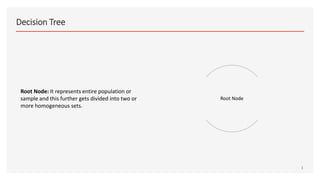
Root Node: It represents entire population or
sample and this further gets divided into two or
more homogeneous sets.
Decision Tree
2
Root Node
Decision Node Decision Node
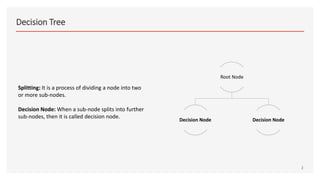
Splitting: It is a process of dividing a node into two
or more sub-nodes.
Decision Node: When a sub-node splits into further
sub-nodes, then it is called decision node.
Decision Tree
3
Root Node
Decision Node
Decision Node
Terminal Node
Terminal Node
Terminal Node
Decision Node
Terminal Node
Terminal Node
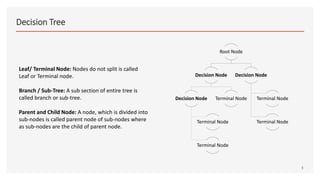
Leaf/ Terminal Node: Nodes do not split is called
Leaf or Terminal node.
Branch / Sub-Tree: A sub section of entire tree is
called branch or sub-tree.
Parent and Child Node: A node, which is divided into
sub-nodes is called parent node of sub-nodes where
as sub-nodes are the child of parent node.
Decision Tree
4
Root Node
Decision Node
Decision Node
Terminal Node
Terminal Node
Terminal Node
Decision Node
Terminal Node
Terminal Node
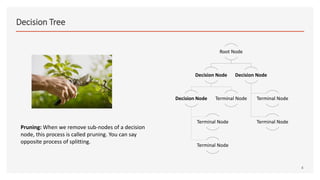
Pruning: When we remove sub-nodes of a decision
node, this process is called pruning. You can say
opposite process of splitting.
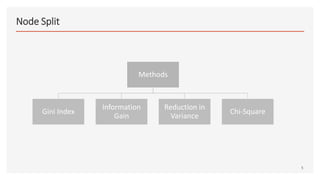
Node Split
5
Methods
Gini Index
Information
Gain
Reduction in
Variance
Chi-Square
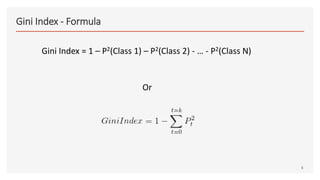
Gini Index - Formula
6
Gini Index = 1 – P2(Class 1) – P2(Class 2) - … - P2(Class N)
Or
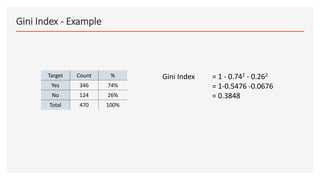
Gini Index - Example
Target Count %
Yes 346 74%
No 124 26%
Total 470 100%
Gini Index = 1 - 0.742 - 0.262
= 1-0.5476 -0.0676
= 0.3848
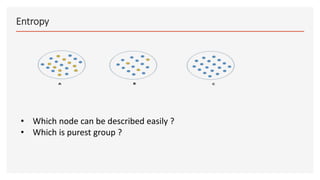
Entropy
• Which node can be described easily ?
• Which is purest group ?
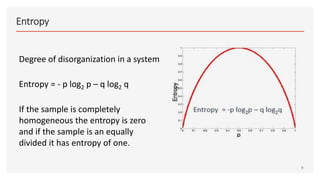
Entropy
9
Entropy = - p log2 p – q log2 q
If the sample is completely
homogeneous the entropy is zero
and if the sample is an equally
divided it has entropy of one.
Degree of disorganization in a system
Entropy - Example
10
Play Golf
Yes No
Outlook
Sunny 3 2 5
Overcast 4 0 4
Rainy 2 3 5
9 5 14
Entropy (Play Golf, Outlook) = 5/14 * [ - 3/5 log 3/5 – 2/5 log 2/5] + 4/14 [ - 4/4 log 4/4] + 5/14 [- 2/5 log 2/5 – 3/5 log
3/5]
= 0.46 * 0.971 + 0.28 * 0.0 + 0.56 * 0.971
= 0.693
Entropy (Play Golf) = Entropy (9/14, 5/14)
= - 9/14 log 9/14 – 5/14 log 5/14
= 0.95
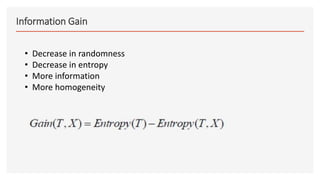
Information Gain
• Decrease in randomness
• Decrease in entropy
• More information
• More homogeneity
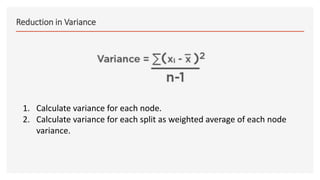
Reduction in Variance
1. Calculate variance for each node.
2. Calculate variance for each split as weighted average of each node
variance.
Chi-Square
• It works with categorical target
variable “Success” or “Failure”.
• It can perform two or more splits.
• Higher the value of Chi-Square
higher the statistical significance
of differences between sub-node
and Parent node.
• Chi-Square of each node is
calculated using formula, Chi-
square = ((Actual – Expected)^2 /
Expected)^1/2
• It generates tree called CHAID
(Chi-square Automatic Interaction
Detector)
Chi-Square
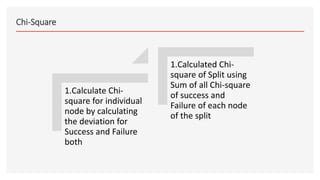
1.Calculate Chi-
square for individual
node by calculating
the deviation for
Success and Failure
both
1.Calculated Chi-
square of Split using
Sum of all Chi-square
of success and
Failure of each node
of the split

Simple Decision Tree

  • 1.
    Decision Tree 1 Root Node RootNode: It represents entire population or sample and this further gets divided into two or more homogeneous sets.
  • 2.
    Decision Tree 2 Root Node DecisionNode Decision Node Splitting: It is a process of dividing a node into two or more sub-nodes. Decision Node: When a sub-node splits into further sub-nodes, then it is called decision node.
  • 3.
    Decision Tree 3 Root Node DecisionNode Decision Node Terminal Node Terminal Node Terminal Node Decision Node Terminal Node Terminal Node Leaf/ Terminal Node: Nodes do not split is called Leaf or Terminal node. Branch / Sub-Tree: A sub section of entire tree is called branch or sub-tree. Parent and Child Node: A node, which is divided into sub-nodes is called parent node of sub-nodes where as sub-nodes are the child of parent node.
  • 4.
    Decision Tree 4 Root Node DecisionNode Decision Node Terminal Node Terminal Node Terminal Node Decision Node Terminal Node Terminal Node Pruning: When we remove sub-nodes of a decision node, this process is called pruning. You can say opposite process of splitting.
  • 5.
  • 6.
    Gini Index -Formula 6 Gini Index = 1 – P2(Class 1) – P2(Class 2) - … - P2(Class N) Or
  • 7.
    Gini Index -Example Target Count % Yes 346 74% No 124 26% Total 470 100% Gini Index = 1 - 0.742 - 0.262 = 1-0.5476 -0.0676 = 0.3848
  • 8.
    Entropy • Which nodecan be described easily ? • Which is purest group ?
  • 9.
    Entropy 9 Entropy = -p log2 p – q log2 q If the sample is completely homogeneous the entropy is zero and if the sample is an equally divided it has entropy of one. Degree of disorganization in a system
  • 10.
    Entropy - Example 10 PlayGolf Yes No Outlook Sunny 3 2 5 Overcast 4 0 4 Rainy 2 3 5 9 5 14 Entropy (Play Golf, Outlook) = 5/14 * [ - 3/5 log 3/5 – 2/5 log 2/5] + 4/14 [ - 4/4 log 4/4] + 5/14 [- 2/5 log 2/5 – 3/5 log 3/5] = 0.46 * 0.971 + 0.28 * 0.0 + 0.56 * 0.971 = 0.693 Entropy (Play Golf) = Entropy (9/14, 5/14) = - 9/14 log 9/14 – 5/14 log 5/14 = 0.95
  • 11.
    Information Gain • Decreasein randomness • Decrease in entropy • More information • More homogeneity
  • 12.
    Reduction in Variance 1.Calculate variance for each node. 2. Calculate variance for each split as weighted average of each node variance.
  • 13.
    Chi-Square • It workswith categorical target variable “Success” or “Failure”. • It can perform two or more splits. • Higher the value of Chi-Square higher the statistical significance of differences between sub-node and Parent node. • Chi-Square of each node is calculated using formula, Chi- square = ((Actual – Expected)^2 / Expected)^1/2 • It generates tree called CHAID (Chi-square Automatic Interaction Detector)
  • 14.
    Chi-Square 1.Calculate Chi- square forindividual node by calculating the deviation for Success and Failure both 1.Calculated Chi- square of Split using Sum of all Chi-square of success and Failure of each node of the split