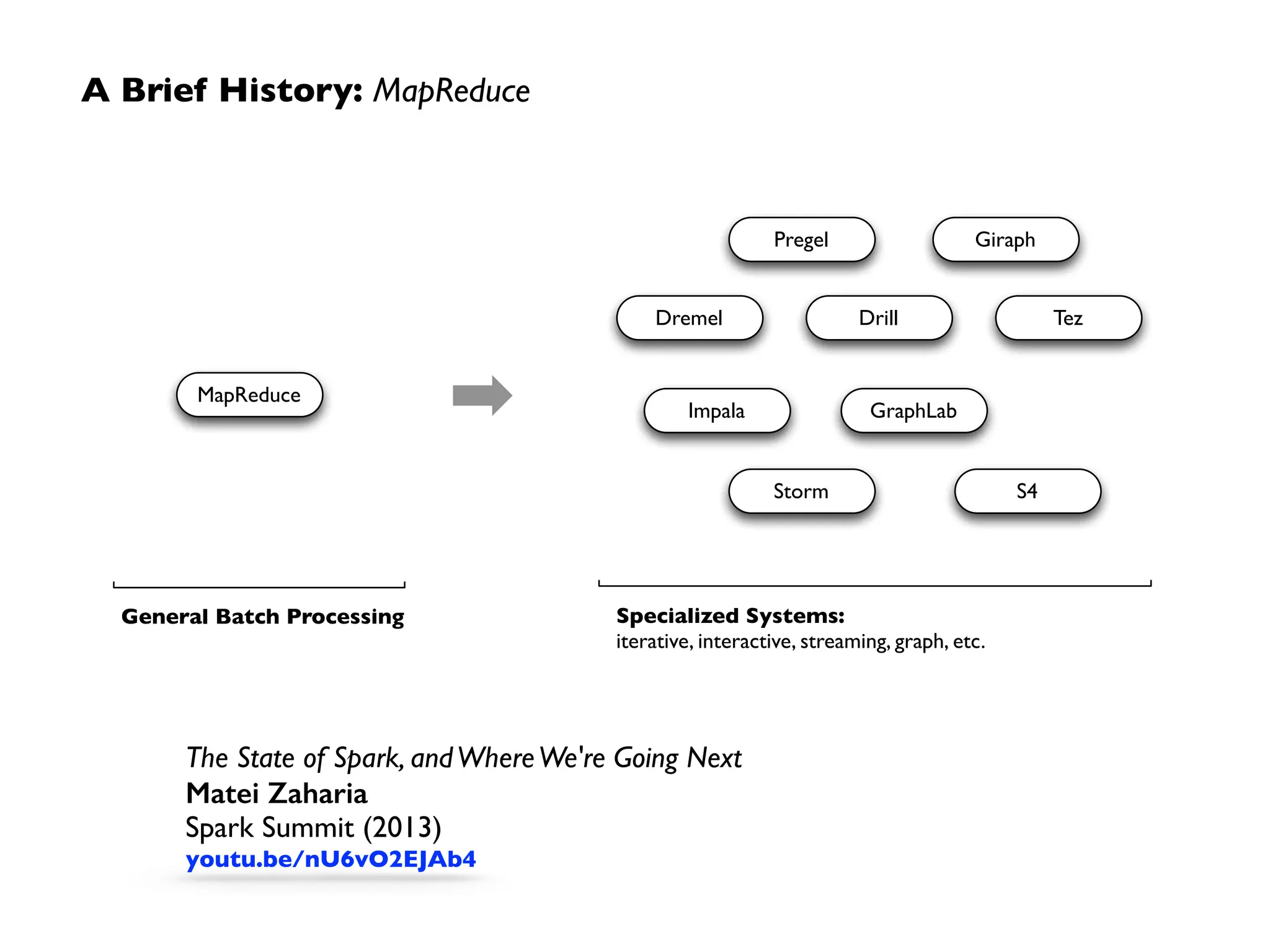
A Brief History:MapReduce
MapReduce
General Batch Processing
Pregel Giraph
Dremel Drill Tez
Impala GraphLab
Storm S4
Specialized Systems:
iterative, interactive, streaming, graph, etc.
The State of Spark, andWhereWe're Going Next
Matei Zaharia
Spark Summit (2013)
youtu.be/nU6vO2EJAb4
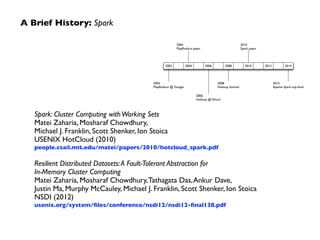
2.
2002
2002
MapReduce @ Google
2004
MapReducepaper
2006
Hadoop @Yahoo!
2004 2006 2008 2010 2012 2014
2014
Apache Spark top-level
2010
Spark paper
2008
Hadoop Summit
A Brief History: Spark
Spark: Cluster Computing withWorking Sets
Matei Zaharia, Mosharaf Chowdhury,
Michael J. Franklin, Scott Shenker, Ion Stoica
USENIX HotCloud (2010)
people.csail.mit.edu/matei/papers/2010/hotcloud_spark.pdf
!
Resilient Distributed Datasets:A Fault-Tolerant Abstraction for
In-Memory Cluster Computing
Matei Zaharia, Mosharaf Chowdhury,Tathagata Das,Ankur Dave,
Justin Ma, Murphy McCauley, Michael J. Franklin, Scott Shenker, Ion Stoica
NSDI (2012)
usenix.org/system/files/conference/nsdi12/nsdi12-final138.pdf
3.
A Brief History:Spark
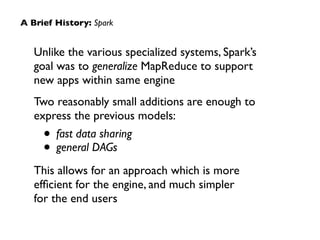
Unlike the various specialized systems, Spark’s
goal was to generalize MapReduce to support
new apps within same engine
Two reasonably small additions are enough to
express the previous models:
• fast data sharing
• general DAGs
This allows for an approach which is more
efficient for the engine, and much simpler
for the end users
4.
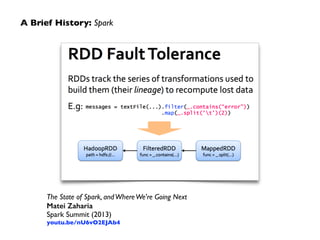
A Brief History:Spark
The State of Spark, andWhereWe're Going Next
Matei Zaharia
Spark Summit (2013)
youtu.be/nU6vO2EJAb4
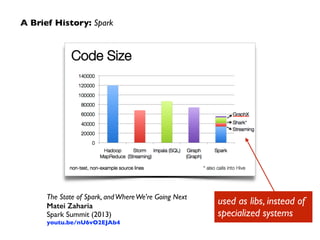
used as libs, instead of
specialized systems
5.
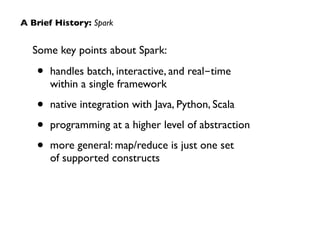
Some key pointsabout Spark:
• handles batch, interactive, and real-time
within a single framework
• native integration with Java, Python, Scala
• programming at a higher level of abstraction
• more general: map/reduce is just one set
of supported constructs
A Brief History: Spark
6.
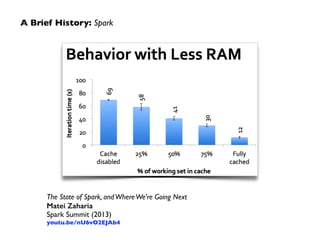
The State ofSpark, andWhereWe're Going Next
Matei Zaharia
Spark Summit (2013)
youtu.be/nU6vO2EJAb4
A Brief History: Spark
7.
The State ofSpark, andWhereWe're Going Next
Matei Zaharia
Spark Summit (2013)
youtu.be/nU6vO2EJAb4
A Brief History: Spark
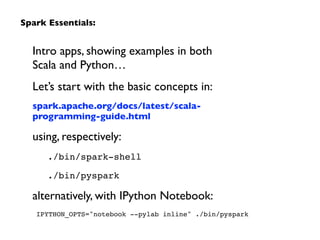
Intro apps, showingexamples in both
Scala and Python…
Let’s start with the basic concepts in:
spark.apache.org/docs/latest/scala-
programming-guide.html
using, respectively:
./bin/spark-shell!
./bin/pyspark!
alternatively, with IPython Notebook:
IPYTHON_OPTS="notebook --pylab inline" ./bin/pyspark
Spark Essentials:
11.
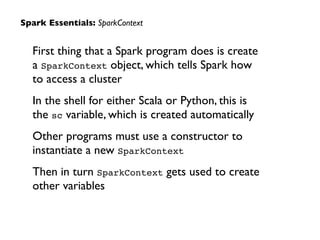
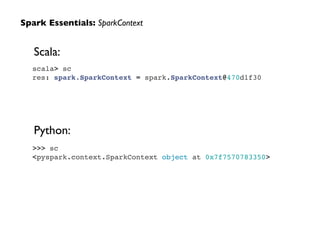
First thing thata Spark program does is create
a SparkContext object, which tells Spark how
to access a cluster
In the shell for either Scala or Python, this is
the sc variable, which is created automatically
Other programs must use a constructor to
instantiate a new SparkContext
Then in turn SparkContext gets used to create
other variables
Spark Essentials: SparkContext
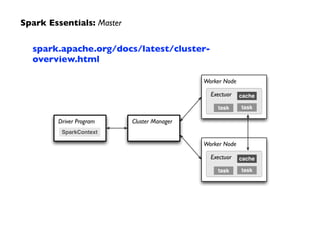
The master parameterfor a SparkContext
determines which cluster to use
Spark Essentials: Master
master description
local
run Spark locally with one worker thread
(no parallelism)
local[K]
run Spark locally with K worker threads
(ideally set to # cores)
spark://HOST:PORT
connect to a Spark standalone cluster;
PORT depends on config (7077 by default)
mesos://HOST:PORT
connect to a Mesos cluster;
PORT depends on config (5050 by default)
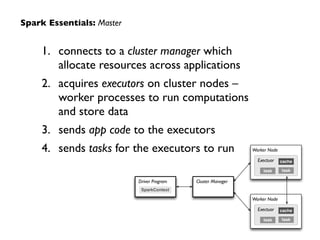
1. connects toa cluster manager which
allocate resources across applications
2. acquires executors on cluster nodes –
worker processes to run computations
and store data
3. sends app code to the executors
4. sends tasks for the executors to run
Spark Essentials: Master
Cluster Manager
Driver Program
SparkContext
Worker Node
Exectuor cache
task
task
Worker Node
Exectuor cache
task
task
16.
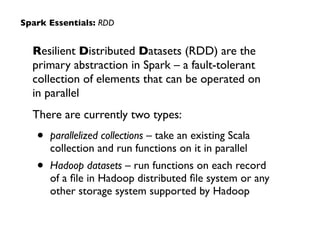
Resilient Distributed Datasets(RDD) are the
primary abstraction in Spark – a fault-tolerant
collection of elements that can be operated on
in parallel
There are currently two types:
• parallelized collections – take an existing Scala
collection and run functions on it in parallel
• Hadoop datasets – run functions on each record
of a file in Hadoop distributed file system or any
other storage system supported by Hadoop
Spark Essentials: RDD
17.
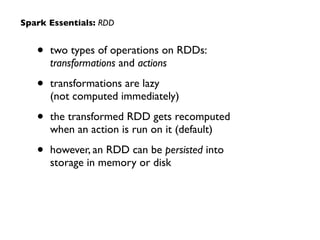
• two typesof operations on RDDs:
transformations and actions
• transformations are lazy
(not computed immediately)
• the transformed RDD gets recomputed
when an action is run on it (default)
• however, an RDD can be persisted into
storage in memory or disk
Spark Essentials: RDD
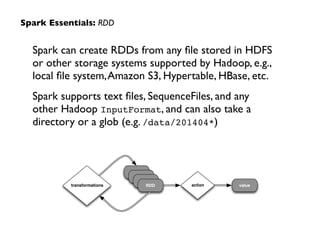
Spark can createRDDs from any file stored in HDFS
or other storage systems supported by Hadoop, e.g.,
local file system,Amazon S3, Hypertable, HBase, etc.
Spark supports text files, SequenceFiles, and any
other Hadoop InputFormat, and can also take a
directory or a glob (e.g. /data/201404*)
Spark Essentials: RDD
action value
RDD
RDD
RDD
transformations RDD
20.
scala> val distFile= sc.textFile("README.md")!
distFile: spark.RDD[String] = spark.HadoopRDD@1d4cee08
Spark Essentials: RDD
>>> distFile = sc.textFile("README.md")!
14/04/19 23:42:40 INFO storage.MemoryStore: ensureFreeSpace(36827) called
with curMem=0, maxMem=318111744!
14/04/19 23:42:40 INFO storage.MemoryStore: Block broadcast_0 stored as
values to memory (estimated size 36.0 KB, free 303.3 MB)!
>>> distFile!
MappedRDD[2] at textFile at NativeMethodAccessorImpl.java:-2
Scala:
Python:
21.
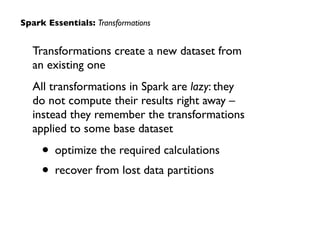
Transformations create anew dataset from
an existing one
All transformations in Spark are lazy: they
do not compute their results right away –
instead they remember the transformations
applied to some base dataset
• optimize the required calculations
• recover from lost data partitions
Spark Essentials: Transformations
22.
Spark Essentials: Transformations
transformationdescription
map(func)
return a new distributed dataset formed by passing
each element of the source through a function func
filter(func)
return a new dataset formed by selecting those
elements of the source on which func returns true
flatMap(func)
similar to map, but each input item can be mapped
to 0 or more output items (so func should return a
Seq rather than a single item)
sample(withReplacement,
fraction, seed)
sample a fraction fraction of the data, with or without
replacement, using a given random number generator
seed
union(otherDataset)
return a new dataset that contains the union of the
elements in the source dataset and the argument
distinct([numTasks]))
return a new dataset that contains the distinct elements
of the source dataset
23.
Spark Essentials: Transformations
transformationdescription
groupByKey([numTasks])
when called on a dataset of (K, V) pairs, returns a
dataset of (K, Seq[V]) pairs
reduceByKey(func,
[numTasks])
when called on a dataset of (K, V) pairs, returns
a dataset of (K, V) pairs where the values for each
key are aggregated using the given reduce function
sortByKey([ascending],
[numTasks])
when called on a dataset of (K, V) pairs where K
implements Ordered, returns a dataset of (K, V)
pairs sorted by keys in ascending or descending order,
as specified in the boolean ascending argument
join(otherDataset,
[numTasks])
when called on datasets of type (K, V) and (K, W),
returns a dataset of (K, (V, W)) pairs with all pairs
of elements for each key
cogroup(otherDataset,
[numTasks])
when called on datasets of type (K, V) and (K, W),
returns a dataset of (K, Seq[V], Seq[W]) tuples –
also called groupWith
cartesian(otherDataset)
when called on datasets of types T and U, returns a
dataset of (T, U) pairs (all pairs of elements)
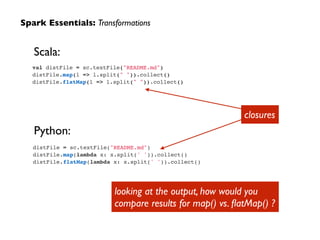
24.
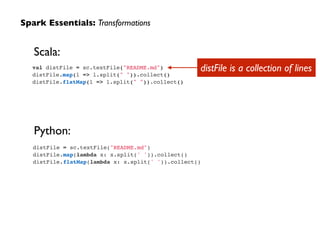
val distFile =sc.textFile("README.md")!
distFile.map(l => l.split(" ")).collect()!
distFile.flatMap(l => l.split(" ")).collect()
Spark Essentials: Transformations
distFile = sc.textFile("README.md")!
distFile.map(lambda x: x.split(' ')).collect()!
distFile.flatMap(lambda x: x.split(' ')).collect()
Scala:
Python:
distFile is a collection of lines
Spark Essentials: Transformations
Scala:
Python:
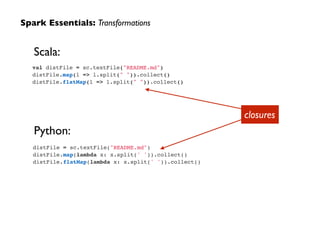
closures
lookingat the output, how would you
compare results for map() vs. flatMap() ?
val distFile = sc.textFile("README.md")!
distFile.map(l => l.split(" ")).collect()!
distFile.flatMap(l => l.split(" ")).collect()
distFile = sc.textFile("README.md")!
distFile.map(lambda x: x.split(' ')).collect()!
distFile.flatMap(lambda x: x.split(' ')).collect()
27.
Spark Essentials: Transformations
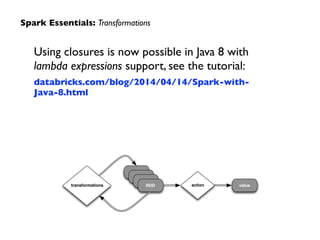
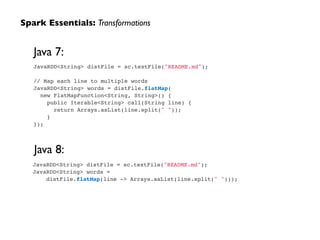
Usingclosures is now possible in Java 8 with
lambda expressions support, see the tutorial:
databricks.com/blog/2014/04/14/Spark-with-
Java-8.html
action value
RDD
RDD
RDD
transformations RDD
28.
Spark Essentials: Transformations
JavaRDD<String>distFile = sc.textFile("README.md");!
!
// Map each line to multiple words!
JavaRDD<String> words = distFile.flatMap(!
new FlatMapFunction<String, String>() {!
public Iterable<String> call(String line) {!
return Arrays.asList(line.split(" "));!
}!
});
Java 7:
JavaRDD<String> distFile = sc.textFile("README.md");!
JavaRDD<String> words =!
distFile.flatMap(line -> Arrays.asList(line.split(" ")));
Java 8:
29.
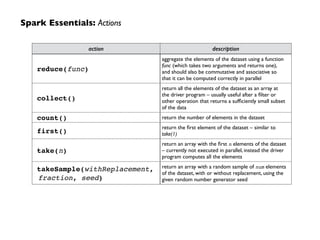
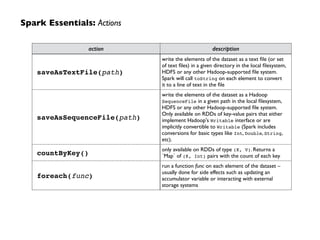
Spark Essentials: Actions
actiondescription
reduce(func)
aggregate the elements of the dataset using a function
func (which takes two arguments and returns one),
and should also be commutative and associative so
that it can be computed correctly in parallel
collect()
return all the elements of the dataset as an array at
the driver program – usually useful after a filter or
other operation that returns a sufficiently small subset
of the data
count() return the number of elements in the dataset
first()
return the first element of the dataset – similar to
take(1)
take(n)
return an array with the first n elements of the dataset
– currently not executed in parallel, instead the driver
program computes all the elements
takeSample(withReplacement,
fraction, seed)
return an array with a random sample of num elements
of the dataset, with or without replacement, using the
given random number generator seed
30.
Spark Essentials: Actions
actiondescription
saveAsTextFile(path)
write the elements of the dataset as a text file (or set
of text files) in a given directory in the local filesystem,
HDFS or any other Hadoop-supported file system.
Spark will call toString on each element to convert
it to a line of text in the file
saveAsSequenceFile(path)
write the elements of the dataset as a Hadoop
SequenceFile in a given path in the local filesystem,
HDFS or any other Hadoop-supported file system.
Only available on RDDs of key-value pairs that either
implement Hadoop's Writable interface or are
implicitly convertible to Writable (Spark includes
conversions for basic types like Int, Double, String,
etc).
countByKey()
only available on RDDs of type (K, V). Returns a
`Map` of (K, Int) pairs with the count of each key
foreach(func)
run a function func on each element of the dataset –
usually done for side effects such as updating an
accumulator variable or interacting with external
storage systems
31.
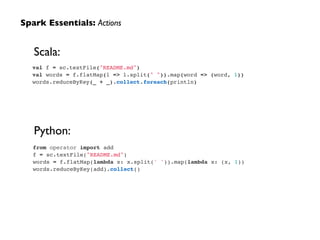
val f =sc.textFile("README.md")!
val words = f.flatMap(l => l.split(" ")).map(word => (word, 1))!
words.reduceByKey(_ + _).collect.foreach(println)
Spark Essentials: Actions
from operator import add!
f = sc.textFile("README.md")!
words = f.flatMap(lambda x: x.split(' ')).map(lambda x: (x, 1))!
words.reduceByKey(add).collect()
Scala:
Python:
32.
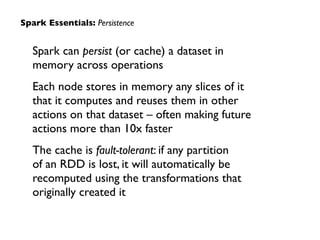
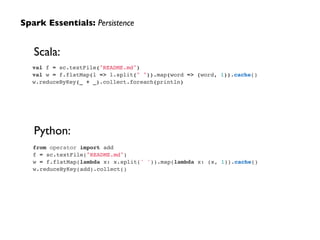
Spark can persist(or cache) a dataset in
memory across operations
Each node stores in memory any slices of it
that it computes and reuses them in other
actions on that dataset – often making future
actions more than 10x faster
The cache is fault-tolerant: if any partition
of an RDD is lost, it will automatically be
recomputed using the transformations that
originally created it
Spark Essentials: Persistence
33.
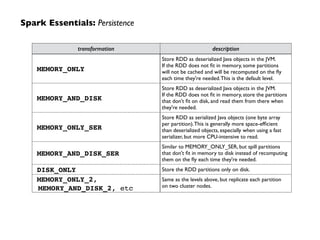
Spark Essentials: Persistence
transformationdescription
MEMORY_ONLY
Store RDD as deserialized Java objects in the JVM.
If the RDD does not fit in memory, some partitions
will not be cached and will be recomputed on the fly
each time they're needed.This is the default level.
MEMORY_AND_DISK
Store RDD as deserialized Java objects in the JVM.
If the RDD does not fit in memory, store the partitions
that don't fit on disk, and read them from there when
they're needed.
MEMORY_ONLY_SER
Store RDD as serialized Java objects (one byte array
per partition).This is generally more space-efficient
than deserialized objects, especially when using a fast
serializer, but more CPU-intensive to read.
MEMORY_AND_DISK_SER
Similar to MEMORY_ONLY_SER, but spill partitions
that don't fit in memory to disk instead of recomputing
them on the fly each time they're needed.
DISK_ONLY Store the RDD partitions only on disk.
MEMORY_ONLY_2,
MEMORY_AND_DISK_2, etc
Same as the levels above, but replicate each partition
on two cluster nodes.
34.
val f =sc.textFile("README.md")!
val w = f.flatMap(l => l.split(" ")).map(word => (word, 1)).cache()!
w.reduceByKey(_ + _).collect.foreach(println)
Spark Essentials: Persistence
from operator import add!
f = sc.textFile("README.md")!
w = f.flatMap(lambda x: x.split(' ')).map(lambda x: (x, 1)).cache()!
w.reduceByKey(add).collect()
Scala:
Python:
35.
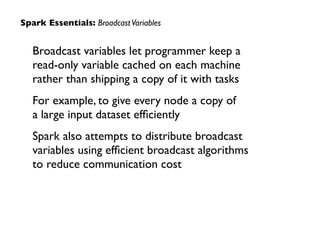
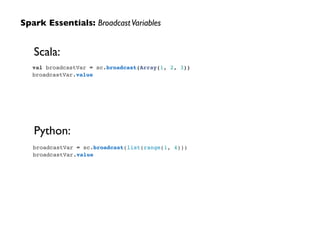
Broadcast variables letprogrammer keep a
read-only variable cached on each machine
rather than shipping a copy of it with tasks
For example, to give every node a copy of
a large input dataset efficiently
Spark also attempts to distribute broadcast
variables using efficient broadcast algorithms
to reduce communication cost
Spark Essentials: BroadcastVariables
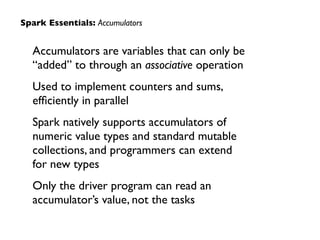
Accumulators are variablesthat can only be
“added” to through an associative operation
Used to implement counters and sums,
efficiently in parallel
Spark natively supports accumulators of
numeric value types and standard mutable
collections, and programmers can extend
for new types
Only the driver program can read an
accumulator’s value, not the tasks
Spark Essentials: Accumulators
val pair =(a, b)!
!
pair._1 // => a!
pair._2 // => b
Spark Essentials: (K,V) pairs
pair = (a, b)!
!
pair[0] # => a!
pair[1] # => b
Scala:
Python:
Tuple2 pair = new Tuple2(a, b);!
!
pair._1 // => a!
pair._2 // => b
Java:
41.
Spark Essentials: APIDetails
For more details about the Scala/Java API:
spark.apache.org/docs/latest/api/scala/
index.html#org.apache.spark.package
!
For more details about the Python API:
spark.apache.org/docs/latest/api/python/
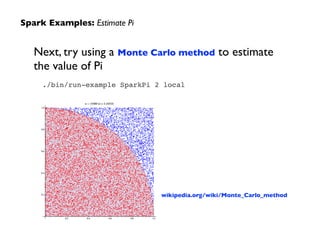
Spark Examples: EstimatePi
Next, try using a Monte Carlo method to estimate
the value of Pi
./bin/run-example SparkPi 2 local
wikipedia.org/wiki/Monte_Carlo_method
44.
import scala.math.random
import org.apache.spark._
!
/**Computes an approximation to pi */
object SparkPi {
def main(args: Array[String]) {
val conf = new SparkConf().setAppName("Spark Pi")
val spark = new SparkContext(conf)
!
val slices = if (args.length > 0) args(0).toInt else 2
val n = 100000 * slices
!
val count = spark.parallelize(1 to n, slices).map { i =>
val x = random * 2 - 1
val y = random * 2 - 1
if (x*x + y*y < 1) 1 else 0
}.reduce(_ + _)
!
println("Pi is roughly " + 4.0 * count / n)
spark.stop()
}
}
Spark Examples: Estimate Pi
45.
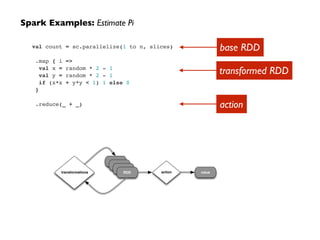
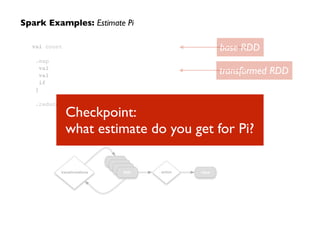
val count =sc.parallelize(1 to n, slices)!
!
.map { i =>!
val x = random * 2 - 1!
val y = random * 2 - 1!
if (x*x + y*y < 1) 1 else 0!
}!
!
.reduce(_ + _)
Spark Examples: Estimate Pi
base RDD
transformed RDD
action
action value
RDD
RDD
RDD
transformations RDD
Spark Examples: K-Means
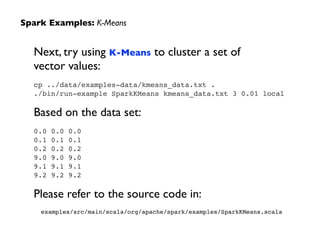
Next,try using K-Means to cluster a set of
vector values:
cp ../data/examples-data/kmeans_data.txt .!
./bin/run-example SparkKMeans kmeans_data.txt 3 0.01 local!
!
Based on the data set:
0.0 0.0 0.0!
0.1 0.1 0.1!
0.2 0.2 0.2!
9.0 9.0 9.0!
9.1 9.1 9.1!
9.2 9.2 9.2!
!
Please refer to the source code in:
examples/src/main/scala/org/apache/spark/examples/SparkKMeans.scala
48.
Spark Examples: PageRank
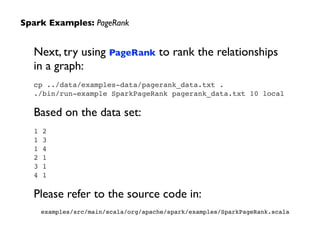
Next,try using PageRank to rank the relationships
in a graph:
cp ../data/examples-data/pagerank_data.txt .!
./bin/run-example SparkPageRank pagerank_data.txt 10 local!
!
Based on the data set:
1 2!
1 3!
1 4!
2 1!
3 1!
4 1!
!
Please refer to the source code in:
examples/src/main/scala/org/apache/spark/examples/SparkPageRank.scala
Depending on thevenue:
• if not catered, we’re off to find food!
• we’ll lock the room to secure valuables
Let’s take an hour or so…
Networking is some of the best part
of these workshops!
Lunch:

![The master parameter for a SparkContext
determines which cluster to use
Spark Essentials: Master
master description
local
run Spark locally with one worker thread
(no parallelism)
local[K]
run Spark locally with K worker threads
(ideally set to # cores)
spark://HOST:PORT
connect to a Spark standalone cluster;
PORT depends on config (7077 by default)
mesos://HOST:PORT
connect to a Mesos cluster;
PORT depends on config (5050 by default)](https://image.slidesharecdn.com/spark2-250331095828-152337f8/85/Simple-Apache-Spark-Introduction-Part-2-13-320.jpg)
![scala> val data = Array(1, 2, 3, 4, 5)!
data: Array[Int] = Array(1, 2, 3, 4, 5)!
!
scala> val distData = sc.parallelize(data)!
distData: spark.RDD[Int] = spark.ParallelCollection@10d13e3e
Spark Essentials: RDD
>>> data = [1, 2, 3, 4, 5]!
>>> data!
[1, 2, 3, 4, 5]!
!
>>> distData = sc.parallelize(data)!
>>> distData!
ParallelCollectionRDD[0] at parallelize at PythonRDD.scala:229
Scala:
Python:](https://image.slidesharecdn.com/spark2-250331095828-152337f8/85/Simple-Apache-Spark-Introduction-Part-2-18-320.jpg)
![scala> val distFile = sc.textFile("README.md")!
distFile: spark.RDD[String] = spark.HadoopRDD@1d4cee08
Spark Essentials: RDD
>>> distFile = sc.textFile("README.md")!
14/04/19 23:42:40 INFO storage.MemoryStore: ensureFreeSpace(36827) called
with curMem=0, maxMem=318111744!
14/04/19 23:42:40 INFO storage.MemoryStore: Block broadcast_0 stored as
values to memory (estimated size 36.0 KB, free 303.3 MB)!
>>> distFile!
MappedRDD[2] at textFile at NativeMethodAccessorImpl.java:-2
Scala:
Python:](https://image.slidesharecdn.com/spark2-250331095828-152337f8/85/Simple-Apache-Spark-Introduction-Part-2-20-320.jpg)
![Spark Essentials: Transformations
transformation description
map(func)
return a new distributed dataset formed by passing
each element of the source through a function func
filter(func)
return a new dataset formed by selecting those
elements of the source on which func returns true
flatMap(func)
similar to map, but each input item can be mapped
to 0 or more output items (so func should return a
Seq rather than a single item)
sample(withReplacement,
fraction, seed)
sample a fraction fraction of the data, with or without
replacement, using a given random number generator
seed
union(otherDataset)
return a new dataset that contains the union of the
elements in the source dataset and the argument
distinct([numTasks]))
return a new dataset that contains the distinct elements
of the source dataset](https://image.slidesharecdn.com/spark2-250331095828-152337f8/85/Simple-Apache-Spark-Introduction-Part-2-22-320.jpg)
![Spark Essentials: Transformations
transformation description
groupByKey([numTasks])
when called on a dataset of (K, V) pairs, returns a
dataset of (K, Seq[V]) pairs
reduceByKey(func,
[numTasks])
when called on a dataset of (K, V) pairs, returns
a dataset of (K, V) pairs where the values for each
key are aggregated using the given reduce function
sortByKey([ascending],
[numTasks])
when called on a dataset of (K, V) pairs where K
implements Ordered, returns a dataset of (K, V)
pairs sorted by keys in ascending or descending order,
as specified in the boolean ascending argument
join(otherDataset,
[numTasks])
when called on datasets of type (K, V) and (K, W),
returns a dataset of (K, (V, W)) pairs with all pairs
of elements for each key
cogroup(otherDataset,
[numTasks])
when called on datasets of type (K, V) and (K, W),
returns a dataset of (K, Seq[V], Seq[W]) tuples –
also called groupWith
cartesian(otherDataset)
when called on datasets of types T and U, returns a
dataset of (T, U) pairs (all pairs of elements)](https://image.slidesharecdn.com/spark2-250331095828-152337f8/85/Simple-Apache-Spark-Introduction-Part-2-23-320.jpg)
![val accum = sc.accumulator(0)!
sc.parallelize(Array(1, 2, 3, 4)).foreach(x => accum += x)!
!
accum.value
Spark Essentials: Accumulators
accum = sc.accumulator(0)!
rdd = sc.parallelize([1, 2, 3, 4])!
def f(x):!
global accum!
accum += x!
!
rdd.foreach(f)!
!
accum.value
Scala:
Python:](https://image.slidesharecdn.com/spark2-250331095828-152337f8/85/Simple-Apache-Spark-Introduction-Part-2-38-320.jpg)
![val accum = sc.accumulator(0)!
sc.parallelize(Array(1, 2, 3, 4)).foreach(x => accum += x)!
!
accum.value
Spark Essentials: Accumulators
accum = sc.accumulator(0)!
rdd = sc.parallelize([1, 2, 3, 4])!
def f(x):!
global accum!
accum += x!
!
rdd.foreach(f)!
!
accum.value
Scala:
Python:
driver-side](https://image.slidesharecdn.com/spark2-250331095828-152337f8/85/Simple-Apache-Spark-Introduction-Part-2-39-320.jpg)
![val pair = (a, b)!
!
pair._1 // => a!
pair._2 // => b
Spark Essentials: (K,V) pairs
pair = (a, b)!
!
pair[0] # => a!
pair[1] # => b
Scala:
Python:
Tuple2 pair = new Tuple2(a, b);!
!
pair._1 // => a!
pair._2 // => b
Java:](https://image.slidesharecdn.com/spark2-250331095828-152337f8/85/Simple-Apache-Spark-Introduction-Part-2-40-320.jpg)
![import scala.math.random
import org.apache.spark._
!
/** Computes an approximation to pi */
object SparkPi {
def main(args: Array[String]) {
val conf = new SparkConf().setAppName("Spark Pi")
val spark = new SparkContext(conf)
!
val slices = if (args.length > 0) args(0).toInt else 2
val n = 100000 * slices
!
val count = spark.parallelize(1 to n, slices).map { i =>
val x = random * 2 - 1
val y = random * 2 - 1
if (x*x + y*y < 1) 1 else 0
}.reduce(_ + _)
!
println("Pi is roughly " + 4.0 * count / n)
spark.stop()
}
}
Spark Examples: Estimate Pi](https://image.slidesharecdn.com/spark2-250331095828-152337f8/85/Simple-Apache-Spark-Introduction-Part-2-44-320.jpg)


![[@NaukriEngineering] Apache Spark](https://cdn.slidesharecdn.com/ss_thumbnails/apachesparkppt-170105054406-thumbnail.jpg?width=640&height=640&fit=bounds)


