How the Safer Births Programme
made a difference
Mr Simon Cunningham
Acknowledgments to Denise Horne & Cath Murray


Developing Better Maternity
    Care Conference

The King’s Fund, March 2012
Overview

• Background of the project & organisation

• Key issues & change of approach

• Timeline

• Outcomes & changes in practice

• Key lessons

• Future
Background

• The place MCHT Crewe and its surrounding areas
  (Population of 300,000)

• Foundation trust in 2008

• 60 hour / week labour ward cover since early 2010

• Three levels of consultant involvement

• Four heads of midwifery & three GDM / ADD’s
The safer births initiative


• Decrease CTG
  misinterpretation

• Decrease low cord gases

• Decrease PPH rates

• Better use of the maternity
  information system
The safer births initiative 2.0

• Better teamworking


• Better communication


• Adoption of national tools for
  patient safety
Manchester patient safety framework


• MaPSaF

• Maturity, culture & perception

• Teamworking domain scored B (reactionary)

• Ideas for service improvement

• Congruence with governance issues
Teamworking

• What defines your team?

• How easy is it to
  communicate ideas ?

• Roles & goals

• Loafing versus labouring

• Topdown for direction.
  Ground up for solutions
Initiatives


• Communication tools

• Buddy CTG system

• Birthrate acuity & NPSA intrapartum tools

• Communication of change

• Postpartum haemorrhage
SBAR


• Situation Background Assessment Recommendation

• Flattens the hierarchy

• Streamlines & standardises

• Promotes continuity

• Reduces frustration !!!
SBAR


• CHAPS used by a
  cluster partner

• Ownership by staff

• Mandatory training

• Distributed throughout
  care pathway
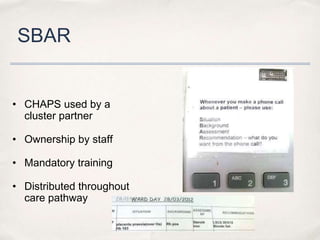
SBAR


• CHAPS used by a
  cluster partner

• Ownership by staff

• Mandatory training

• Distributed throughout
  care pathway
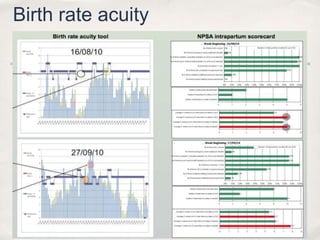
Birth rate acuity
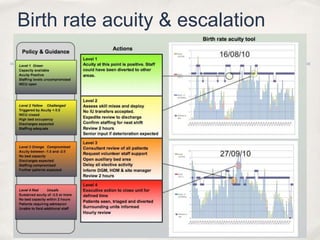
Birth rate acuity & escalation
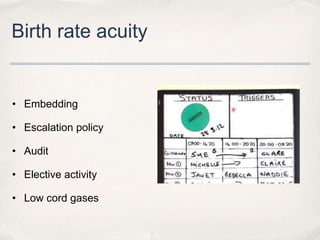
Birth rate acuity


• Embedding

• Escalation policy

• Audit

• Elective activity

• Low cord gases
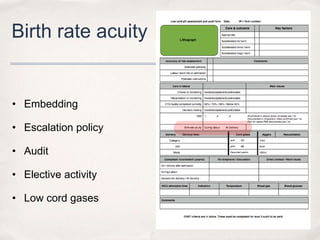
Birth rate acuity


• Embedding

• Escalation policy

• Audit

• Elective activity

• Low cord gases
Buddy system


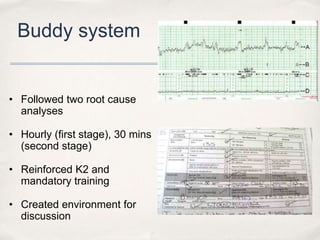
• Followed two root cause
  analyses

• Hourly (first stage), 30 mins
  (second stage)

• Reinforced K2 and
  mandatory training

• Created environment for
  discussion
Buddy system

     It’s that Buddy time again!
        A fresh pair of eyes…
      On the hour, every hour
Buddy system

                                • Habit
• Ad hoc
                        • Guidance revised by LWC
• Not clearly
  understood
                               • Drove it
• Not reinforced

• Directed to problem          • All EFM
  traces
                             • Rolling audit
Labour ward co-ordinators
consultancy day
  10.00                  Welcome and introductions
                         Overview and update on SBIN project

  •   10.15              Agreeing purpose and expectations

  • A day in the life of a Labour Ward Co-ordinator
                         Triumphs and tribulations
                         LWC as leader

  •   11.30              Break

  •   11.50              What’s my style?
                         How do I like to do things, how do I work
      with others?

  •   13.00              Lunch


  • Introducing change and making it stick
                         Working with real issues identifying:
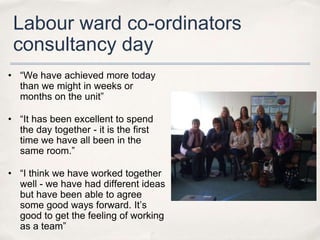
Labour ward co-ordinators
 consultancy day
• “We have achieved more today
  than we might in weeks or
  months on the unit”

• “It has been excellent to spend
  the day together - it is the first
  time we have all been in the
  same room.”

• “I think we have worked together
  well - we have had different ideas
  but have been able to agree
  some good ways forward. It’s
  good to get the feeling of working
  as a team”
Outcomes

• MaPSAF: B/C into C/D.

• Reactive into bureaucratic into proactive

• Triage & induction areas made

• SBAR across the board

• Escalation policy works…

• Buddy system embedded

• Dissemination of guidance/practice
What went well


• Culture versus strategy

• Cluster days

• Consultancy days

• Core days

• MDT
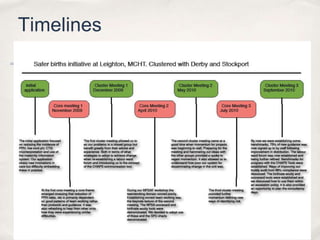
Timelines
Momentum
Momentum
Next time we’d


• Involve more people sooner

• Board support

• Mentor sites

• Postpartum haemorrhage
How has ……?


• Look behind the headlines

• Creating a movement

• Pseudoteams

• Sell, buy, own

• Network

• MDT works
Moving on
• Shared decision making project
  with AQUA

• Normality

• Antenatal care pathways

• Screening & fetal med

• Postnatal care & parentcraft

• Complex social care

• Bereavement & Post-traumatic
  stress
• “You don’t reduce
  caesarean section rates
  with policies and
  guidelines you do it by
  changing the people”


• Professor James
  Walker, first core
  meeting at The King’s
  Fund, October 2009.

Simon Cunningham: How the Safer Births Programme has made a difference to quality and safety

  • 1.
    How the SaferBirths Programme made a difference Mr Simon Cunningham Acknowledgments to Denise Horne & Cath Murray Developing Better Maternity Care Conference The King’s Fund, March 2012
  • 2.
    Overview • Background ofthe project & organisation • Key issues & change of approach • Timeline • Outcomes & changes in practice • Key lessons • Future
  • 3.
    Background • The placeMCHT Crewe and its surrounding areas (Population of 300,000) • Foundation trust in 2008 • 60 hour / week labour ward cover since early 2010 • Three levels of consultant involvement • Four heads of midwifery & three GDM / ADD’s
  • 4.
    The safer birthsinitiative • Decrease CTG misinterpretation • Decrease low cord gases • Decrease PPH rates • Better use of the maternity information system
  • 5.
    The safer birthsinitiative 2.0 • Better teamworking • Better communication • Adoption of national tools for patient safety
  • 6.
    Manchester patient safetyframework • MaPSaF • Maturity, culture & perception • Teamworking domain scored B (reactionary) • Ideas for service improvement • Congruence with governance issues
  • 7.
    Teamworking • What definesyour team? • How easy is it to communicate ideas ? • Roles & goals • Loafing versus labouring • Topdown for direction. Ground up for solutions
  • 8.
    Initiatives • Communication tools •Buddy CTG system • Birthrate acuity & NPSA intrapartum tools • Communication of change • Postpartum haemorrhage
  • 9.
    SBAR • Situation BackgroundAssessment Recommendation • Flattens the hierarchy • Streamlines & standardises • Promotes continuity • Reduces frustration !!!
  • 10.
    SBAR • CHAPS usedby a cluster partner • Ownership by staff • Mandatory training • Distributed throughout care pathway
  • 11.
    SBAR • CHAPS usedby a cluster partner • Ownership by staff • Mandatory training • Distributed throughout care pathway
  • 12.
  • 13.
    Birth rate acuity& escalation
  • 14.
    Birth rate acuity •Embedding • Escalation policy • Audit • Elective activity • Low cord gases
  • 15.
    Birth rate acuity •Embedding • Escalation policy • Audit • Elective activity • Low cord gases
  • 16.
    Buddy system • Followedtwo root cause analyses • Hourly (first stage), 30 mins (second stage) • Reinforced K2 and mandatory training • Created environment for discussion
  • 17.
    Buddy system It’s that Buddy time again! A fresh pair of eyes… On the hour, every hour
  • 18.
    Buddy system • Habit • Ad hoc • Guidance revised by LWC • Not clearly understood • Drove it • Not reinforced • Directed to problem • All EFM traces • Rolling audit
  • 19.
    Labour ward co-ordinators consultancyday 10.00 Welcome and introductions Overview and update on SBIN project • 10.15 Agreeing purpose and expectations • A day in the life of a Labour Ward Co-ordinator Triumphs and tribulations LWC as leader • 11.30 Break • 11.50 What’s my style? How do I like to do things, how do I work with others? • 13.00 Lunch • Introducing change and making it stick Working with real issues identifying:
  • 20.
    Labour ward co-ordinators consultancy day • “We have achieved more today than we might in weeks or months on the unit” • “It has been excellent to spend the day together - it is the first time we have all been in the same room.” • “I think we have worked together well - we have had different ideas but have been able to agree some good ways forward. It’s good to get the feeling of working as a team”
  • 21.
    Outcomes • MaPSAF: B/Cinto C/D. • Reactive into bureaucratic into proactive • Triage & induction areas made • SBAR across the board • Escalation policy works… • Buddy system embedded • Dissemination of guidance/practice
  • 22.
    What went well •Culture versus strategy • Cluster days • Consultancy days • Core days • MDT
  • 23.
  • 24.
  • 25.
  • 26.
    Next time we’d •Involve more people sooner • Board support • Mentor sites • Postpartum haemorrhage
  • 27.
    How has ……? •Look behind the headlines • Creating a movement • Pseudoteams • Sell, buy, own • Network • MDT works
  • 28.
    Moving on • Shareddecision making project with AQUA • Normality • Antenatal care pathways • Screening & fetal med • Postnatal care & parentcraft • Complex social care • Bereavement & Post-traumatic stress
  • 29.
    • “You don’treduce caesarean section rates with policies and guidelines you do it by changing the people” • Professor James Walker, first core meeting at The King’s Fund, October 2009.