Staffordshire health and
        wellbeing board
Opportunities, challenges and the way ahead

             Matthew Ellis
  Cabinet Member – Adults & Wellbeing
               (HWbB Chair)
Staffordshire partnerships –
                  before HWB
• CONTEXT June 2009 – one council – restructure
• Integrated health and social care partnership trust
• Staffordshire sector committed in principle to integrated
  commissioning and health and wellbeing
• Cabinet member for public health/community safety
• Joint DPH appointment – located in county council
• Joint health and wellbeing strategy
• Joint commissioning unit
• Strategic plan with health and wellbeing outcomes
Establishing the health and wellbeing
          board – the early days
• Commitment and interest from many partners in the HWB – But!

• Managing expectations of wider partners difficult – dealing with
  who isn’t on the board, rather than who is – distracting and time
  consuming – INWARD FOCUS

• Learning from past LAA partnerships – a need for more strategic,
  outcome focused partnership – not ‘usual suspects’

• Stakeholder events

• Engagement and relationships of clinical commissioning groups
  – county led on GP events – ‘understanding new partnerships,
  each other’s worlds, trust and new opportunities – limited
  knowledge of social care
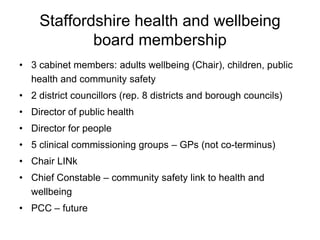
Staffordshire health and wellbeing
            board membership
• 3 cabinet members: adults wellbeing (Chair), children, public
  health and community safety
• 2 district councillors (rep. 8 districts and borough councils)
• Director of public health
• Director for people
• 5 clinical commissioning groups – GPs (not co-terminus)
• Chair LINk
• Chief Constable – community safety link to health and
  wellbeing
• PCC – future
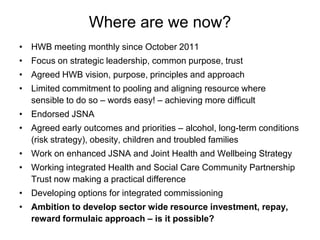
Where are we now?
• HWB meeting monthly since October 2011
• Focus on strategic leadership, common purpose, trust
• Agreed HWB vision, purpose, principles and approach
• Limited commitment to pooling and aligning resource where
  sensible to do so – words easy! – achieving more difficult
• Endorsed JSNA
• Agreed early outcomes and priorities – alcohol, long-term conditions
  (risk strategy), obesity, children and troubled families
• Work on enhanced JSNA and Joint Health and Wellbeing Strategy
• Working integrated Health and Social Care Community Partnership
  Trust now making a practical difference
• Developing options for integrated commissioning
• Ambition to develop sector wide resource investment, repay,
  reward formulaic approach – is it possible?
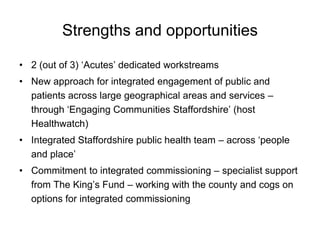
Strengths and opportunities

• 2 (out of 3) ‘Acutes’ dedicated workstreams
• New approach for integrated engagement of public and
  patients across large geographical areas and services –
  through ‘Engaging Communities Staffordshire’ (host
  Healthwatch)
• Integrated Staffordshire public health team – across ‘people
  and place’
• Commitment to integrated commissioning – specialist support
  from The King’s Fund – working with the county and cogs on
  options for integrated commissioning
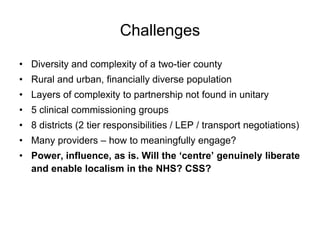
Challenges
• Diversity and complexity of a two-tier county
• Rural and urban, financially diverse population
• Layers of complexity to partnership not found in unitary
• 5 clinical commissioning groups
• 8 districts (2 tier responsibilities / LEP / transport negotiations)
• Many providers – how to meaningfully engage?
• Power, influence, as is. Will the ‘centre’ genuinely liberate
  and enable localism in the NHS? CSS?
Challenges cont…

• Trust, ceding power, politics/tough decisions/GPs prepared?
• NHS long-term strategic infrastructure planning
• Doing the right thing and managing unpopular messages with
  the community – eg, the strategic shift to prevention and
  greater focus on community means fewer hospitals
• Early days – CCGs keen and willing – but all at very different
  levels of development
• Double funding change
• Strategic provider engagement with HWB
Where are we going? The journey ahead?

• Relationships and partnership with developing CCGs remains
  key
• Reviewing commissioning plans
• Enhanced JSNA & JHWS
• Ongoing work with The King’s Fund, county council and
  CCGs on integrated commissioning – options in October
• More investment in prevention
• Social media
• Public engagement

Matthew Ellis: Staffordshire health and wellbeing board

  • 1.
    Staffordshire health and wellbeing board Opportunities, challenges and the way ahead Matthew Ellis Cabinet Member – Adults & Wellbeing (HWbB Chair)
  • 2.
    Staffordshire partnerships – before HWB • CONTEXT June 2009 – one council – restructure • Integrated health and social care partnership trust • Staffordshire sector committed in principle to integrated commissioning and health and wellbeing • Cabinet member for public health/community safety • Joint DPH appointment – located in county council • Joint health and wellbeing strategy • Joint commissioning unit • Strategic plan with health and wellbeing outcomes
  • 3.
    Establishing the healthand wellbeing board – the early days • Commitment and interest from many partners in the HWB – But! • Managing expectations of wider partners difficult – dealing with who isn’t on the board, rather than who is – distracting and time consuming – INWARD FOCUS • Learning from past LAA partnerships – a need for more strategic, outcome focused partnership – not ‘usual suspects’ • Stakeholder events • Engagement and relationships of clinical commissioning groups – county led on GP events – ‘understanding new partnerships, each other’s worlds, trust and new opportunities – limited knowledge of social care
  • 4.
    Staffordshire health andwellbeing board membership • 3 cabinet members: adults wellbeing (Chair), children, public health and community safety • 2 district councillors (rep. 8 districts and borough councils) • Director of public health • Director for people • 5 clinical commissioning groups – GPs (not co-terminus) • Chair LINk • Chief Constable – community safety link to health and wellbeing • PCC – future
  • 5.
    Where are wenow? • HWB meeting monthly since October 2011 • Focus on strategic leadership, common purpose, trust • Agreed HWB vision, purpose, principles and approach • Limited commitment to pooling and aligning resource where sensible to do so – words easy! – achieving more difficult • Endorsed JSNA • Agreed early outcomes and priorities – alcohol, long-term conditions (risk strategy), obesity, children and troubled families • Work on enhanced JSNA and Joint Health and Wellbeing Strategy • Working integrated Health and Social Care Community Partnership Trust now making a practical difference • Developing options for integrated commissioning • Ambition to develop sector wide resource investment, repay, reward formulaic approach – is it possible?
  • 6.
    Strengths and opportunities •2 (out of 3) ‘Acutes’ dedicated workstreams • New approach for integrated engagement of public and patients across large geographical areas and services – through ‘Engaging Communities Staffordshire’ (host Healthwatch) • Integrated Staffordshire public health team – across ‘people and place’ • Commitment to integrated commissioning – specialist support from The King’s Fund – working with the county and cogs on options for integrated commissioning
  • 7.
    Challenges • Diversity andcomplexity of a two-tier county • Rural and urban, financially diverse population • Layers of complexity to partnership not found in unitary • 5 clinical commissioning groups • 8 districts (2 tier responsibilities / LEP / transport negotiations) • Many providers – how to meaningfully engage? • Power, influence, as is. Will the ‘centre’ genuinely liberate and enable localism in the NHS? CSS?
  • 8.
    Challenges cont… • Trust,ceding power, politics/tough decisions/GPs prepared? • NHS long-term strategic infrastructure planning • Doing the right thing and managing unpopular messages with the community – eg, the strategic shift to prevention and greater focus on community means fewer hospitals • Early days – CCGs keen and willing – but all at very different levels of development • Double funding change • Strategic provider engagement with HWB
  • 9.
    Where are wegoing? The journey ahead? • Relationships and partnership with developing CCGs remains key • Reviewing commissioning plans • Enhanced JSNA & JHWS • Ongoing work with The King’s Fund, county council and CCGs on integrated commissioning – options in October • More investment in prevention • Social media • Public engagement