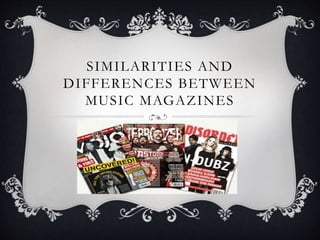
SIMILARITIES AND 
DIFFERENCES BETWEEN 
MUSIC MAGAZINES
AESTHETICA 
Aesthetica was founded in 2002. Cherie Federico and Dale 
Donley founded Aesthetica, when they were students at York 
St John: A College of the University of Leeds Aesthetica is at 
the forefront of art, culture and design. Published six times per 
year, it is distributed across the UK and internationally. 
Audience: 144,000 (Print: 60,000 / Web, E-news, Blog: 59,000 
/ Social Media: 25,000). It has an international distribution of 
168,000. 
The magazine and online content stylishly combine editorial with compelling critical debate, 
pushing the boundaries while exploring the best in contemporary visual culture. Aesthetica is 
widely available in the UK. It is also internationally distributed and is available in the following 
countries: UK, USA, Ireland, Canada, Brazil, France, Germany, The Netherlands, Belgium, Spain, 
Portugal, Italy, Sweden, Belgium, Denmark, Norway, Turkey, Japan, Australia and New Zealand.
AESTHETICA 
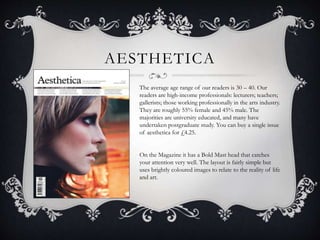
The average age range of our readers is 30 – 40. Our 
readers are high-income professionals: lecturers; teachers; 
gallerists; those working professionally in the arts industry. 
They are roughly 55% female and 45% male. The 
majorities are university educated, and many have 
undertaken postgraduate study. You can buy a single issue 
of aesthetica for £4.25. 
On the Magazine it has a Bold Mast head that catches 
your attention very well. The layout is fairly simple but 
uses brightly coloured images to relate to the reality of life 
and art.
VIBE 
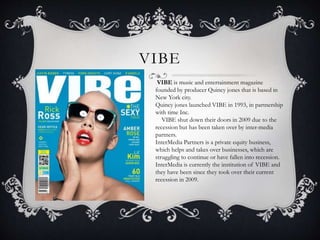
VIBE is music and entertainment magazine 
founded by producer Quincy jones that is based in 
New York city. 
Quincy jones launched VIBE in 1993, in partnership 
with time Inc. 
VIBE shut down their doors in 2009 due to the 
recession but has been taken over by inter-media 
partners. 
InterMedia Partners is a private equity business, 
which helps and takes over businesses, which are 
struggling to continue or have fallen into recession. 
InterMedia is currently the institution of VIBE and 
they have been since they took over their current 
recession in 2009.
VIBE 
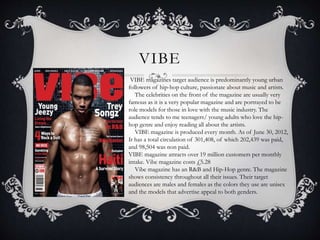
VIBE magazines target audience is predominantly young urban 
followers of hip-hop culture, passionate about music and artists. 
The celebrities on the front of the magazine are usually very 
famous as it is a very popular magazine and are portrayed to be 
role models for those in love with the music industry. The 
audience tends to me teenagers/ young adults who love the hip-hop 
genre and enjoy reading all about the artists. 
VIBE magazine is produced every month. As of June 30, 2012, 
It has a total circulation of 301,408, of which 202,439 was paid, 
and 98,504 was non paid. 
VIBE magazine attracts over 19 million customers per monthly 
intake. Vibe magazine costs £5.28 
Vibe magazine has an R&B and Hip-Hop genre. The magazine 
shows consistency throughout all their issues. Their target 
audiences are males and females as the colors they use are unisex 
and the models that advertise appeal to both genders.
Q 
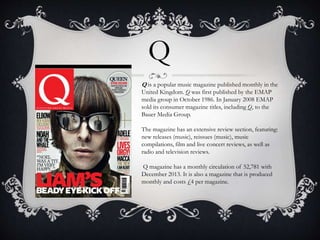
Q is a popular music magazine published monthly in the 
United Kingdom. Q was first published by the EMAP 
media group in October 1986. In January 2008 EMAP 
sold its consumer magazine titles, including Q, to the 
Bauer Media Group. 
The magazine has an extensive review section, featuring: 
new releases (music), reissues (music), music 
compilations, film and live concert reviews, as well as 
radio and television reviews. 
Q magazine has a monthly circulation of 52,781 with 
December 2013. It is also a magazine that is produced 
monthly and costs £4 per magazine.
Q 
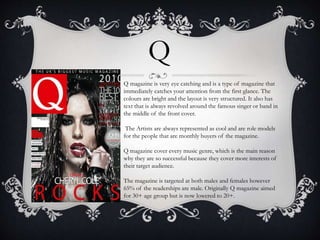
Q magazine is very eye catching and is a type of magazine that 
immediately catches your attention from the first glance. The 
colours are bright and the layout is very structured. It also has 
text that is always revolved around the famous singer or band in 
the middle of the front cover. 
The Artists are always represented as cool and are role models 
for the people that are monthly buyers of the magazine. 
Q magazine cover every music genre, which is the main reason 
why they are so successful because they cover more interests of 
their target audience. 
The magazine is targeted at both males and females however 
65% of the readerships are male. Originally Q magazine aimed 
for 30+ age group but is now lowered to 20+.
ROLLING STONES 
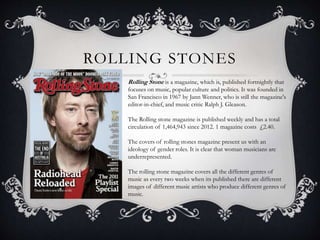
Rolling Stone is a magazine, which is, published fortnightly that 
focuses on music, popular culture and politics. It was founded in 
San Francisco in 1967 by Jann Wenner, who is still the magazine's 
editor-in-chief, and music critic Ralph J. Gleason. 
The Rolling stone magazine is published weekly and has a total 
circulation of 1,464,943 since 2012. 1 magazine costs £2.40. 
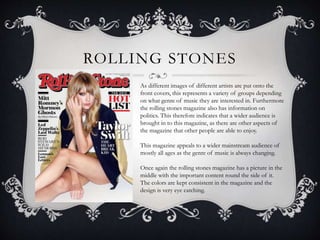
The covers of rolling stones magazine present us with an 
ideology of gender roles. It is clear that woman musicians are 
underrepresented. 
The rolling stone magazine covers all the different genres of 
music as every two weeks when its published there are different 
images of different music artists who produce different genres of 
music.
ROLLING STONES 
As different images of different artists are put onto the 
front covers, this represents a variety of groups depending 
on what genre of music they are interested in. Furthermore 
the rolling stones magazine also has information on 
politics. This therefore indicates that a wider audience is 
brought in to this magazine, as there are other aspects of 
the magazine that other people are able to enjoy. 
This magazine appeals to a wider mainstream audience of 
mostly all ages as the genre of music is always changing. 
Once again the rolling stones magazine has a picture in the 
middle with the important content round the side of it. 
The colors are kept consistent in the magazine and the 
design is very eye catching.
TOP OF THE POPS 
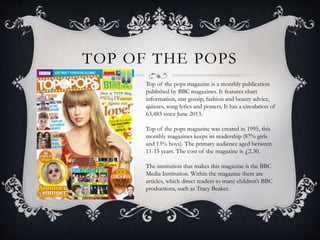
Top of the pops magazine is a monthly publication 
published by BBC magazines. It features chart 
information, star gossip, fashion and beauty advice, 
quizzes, song lyrics and posters. It has a circulation of 
63,483 since June 2013. 
Top of the pops magazine was created in 1995, this 
monthly magazines keeps its readership (87% girls 
and 13% boys). The primary audience aged between 
11-15 years. The cost of the magazine is £2.30. 
The institution that makes this magazine is the BBC 
Media Institution. Within the magazine there are 
articles, which direct readers to many children’s BBC 
productions, such as Tracy Beaker.
TOP OF THE POPS 
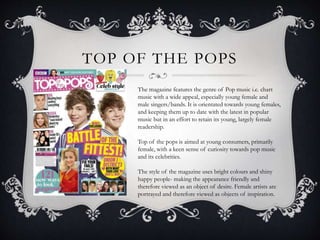
The magazine features the genre of Pop music i.e. chart 
music with a wide appeal, especially young female and 
male singers/bands. It is orientated towards young females, 
and keeping them up to date with the latest in popular 
music but in an effort to retain its young, largely female 
readership. 
Top of the pops is aimed at young consumers, primarily 
female, with a keen sense of curiosity towards pop music 
and its celebrities. 
The style of the magazine uses bright colours and shiny 
happy people- making the appearance friendly and 
therefore viewed as an object of desire. Female artists are 
portrayed and therefore viewed as objects of inspiration.
NME 
NME is a weekly music journalism magazine that started 
publication in March 1952. Theodore Ingham founded NME. 
It is currently published by IPC media, the UK’s leading 
publisher of consumer magazines and websites. Over 26 
million adults read and IPC media magazine and over 350 
million copies are sold each year. 
NME is widely available in most shops including many smaller 
corner shops for a reasonable price of only £2.40. NME 
magazine has a rough circulation of 19,491 since December 
2013. The magazine is issued weekly. 
The content is entirely devoted to music with music/band 
news and articles, album reviews, gig information and gig 
guides.
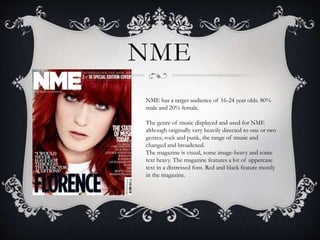
NME 
NME has a target audience of 16-24 year olds. 80% 
male and 20% female. 
The genre of music displayed and used for NME 
although originally very heavily directed to one or two 
genres; rock and punk, the range of music and 
changed and broadened. 
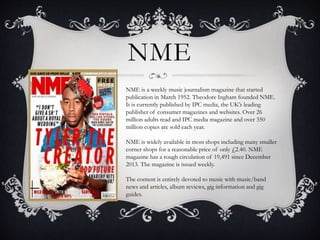
The magazine is visual, some image-heavy and some 
text heavy. The magazine features a lot of uppercase 
text in a distressed font. Red and black feature mostly 
in the magazine.

Similarities and differences between music magazines

  • 1.
    SIMILARITIES AND DIFFERENCESBETWEEN MUSIC MAGAZINES
  • 2.
    AESTHETICA Aesthetica wasfounded in 2002. Cherie Federico and Dale Donley founded Aesthetica, when they were students at York St John: A College of the University of Leeds Aesthetica is at the forefront of art, culture and design. Published six times per year, it is distributed across the UK and internationally. Audience: 144,000 (Print: 60,000 / Web, E-news, Blog: 59,000 / Social Media: 25,000). It has an international distribution of 168,000. The magazine and online content stylishly combine editorial with compelling critical debate, pushing the boundaries while exploring the best in contemporary visual culture. Aesthetica is widely available in the UK. It is also internationally distributed and is available in the following countries: UK, USA, Ireland, Canada, Brazil, France, Germany, The Netherlands, Belgium, Spain, Portugal, Italy, Sweden, Belgium, Denmark, Norway, Turkey, Japan, Australia and New Zealand.
  • 3.
    AESTHETICA The averageage range of our readers is 30 – 40. Our readers are high-income professionals: lecturers; teachers; gallerists; those working professionally in the arts industry. They are roughly 55% female and 45% male. The majorities are university educated, and many have undertaken postgraduate study. You can buy a single issue of aesthetica for £4.25. On the Magazine it has a Bold Mast head that catches your attention very well. The layout is fairly simple but uses brightly coloured images to relate to the reality of life and art.
  • 4.
    VIBE VIBE ismusic and entertainment magazine founded by producer Quincy jones that is based in New York city. Quincy jones launched VIBE in 1993, in partnership with time Inc. VIBE shut down their doors in 2009 due to the recession but has been taken over by inter-media partners. InterMedia Partners is a private equity business, which helps and takes over businesses, which are struggling to continue or have fallen into recession. InterMedia is currently the institution of VIBE and they have been since they took over their current recession in 2009.
  • 5.
    VIBE VIBE magazinestarget audience is predominantly young urban followers of hip-hop culture, passionate about music and artists. The celebrities on the front of the magazine are usually very famous as it is a very popular magazine and are portrayed to be role models for those in love with the music industry. The audience tends to me teenagers/ young adults who love the hip-hop genre and enjoy reading all about the artists. VIBE magazine is produced every month. As of June 30, 2012, It has a total circulation of 301,408, of which 202,439 was paid, and 98,504 was non paid. VIBE magazine attracts over 19 million customers per monthly intake. Vibe magazine costs £5.28 Vibe magazine has an R&B and Hip-Hop genre. The magazine shows consistency throughout all their issues. Their target audiences are males and females as the colors they use are unisex and the models that advertise appeal to both genders.
  • 6.
    Q Q isa popular music magazine published monthly in the United Kingdom. Q was first published by the EMAP media group in October 1986. In January 2008 EMAP sold its consumer magazine titles, including Q, to the Bauer Media Group. The magazine has an extensive review section, featuring: new releases (music), reissues (music), music compilations, film and live concert reviews, as well as radio and television reviews. Q magazine has a monthly circulation of 52,781 with December 2013. It is also a magazine that is produced monthly and costs £4 per magazine.
  • 7.
    Q Q magazineis very eye catching and is a type of magazine that immediately catches your attention from the first glance. The colours are bright and the layout is very structured. It also has text that is always revolved around the famous singer or band in the middle of the front cover. The Artists are always represented as cool and are role models for the people that are monthly buyers of the magazine. Q magazine cover every music genre, which is the main reason why they are so successful because they cover more interests of their target audience. The magazine is targeted at both males and females however 65% of the readerships are male. Originally Q magazine aimed for 30+ age group but is now lowered to 20+.
  • 8.
    ROLLING STONES RollingStone is a magazine, which is, published fortnightly that focuses on music, popular culture and politics. It was founded in San Francisco in 1967 by Jann Wenner, who is still the magazine's editor-in-chief, and music critic Ralph J. Gleason. The Rolling stone magazine is published weekly and has a total circulation of 1,464,943 since 2012. 1 magazine costs £2.40. The covers of rolling stones magazine present us with an ideology of gender roles. It is clear that woman musicians are underrepresented. The rolling stone magazine covers all the different genres of music as every two weeks when its published there are different images of different music artists who produce different genres of music.
  • 9.
    ROLLING STONES Asdifferent images of different artists are put onto the front covers, this represents a variety of groups depending on what genre of music they are interested in. Furthermore the rolling stones magazine also has information on politics. This therefore indicates that a wider audience is brought in to this magazine, as there are other aspects of the magazine that other people are able to enjoy. This magazine appeals to a wider mainstream audience of mostly all ages as the genre of music is always changing. Once again the rolling stones magazine has a picture in the middle with the important content round the side of it. The colors are kept consistent in the magazine and the design is very eye catching.
  • 10.
    TOP OF THEPOPS Top of the pops magazine is a monthly publication published by BBC magazines. It features chart information, star gossip, fashion and beauty advice, quizzes, song lyrics and posters. It has a circulation of 63,483 since June 2013. Top of the pops magazine was created in 1995, this monthly magazines keeps its readership (87% girls and 13% boys). The primary audience aged between 11-15 years. The cost of the magazine is £2.30. The institution that makes this magazine is the BBC Media Institution. Within the magazine there are articles, which direct readers to many children’s BBC productions, such as Tracy Beaker.
  • 11.
    TOP OF THEPOPS The magazine features the genre of Pop music i.e. chart music with a wide appeal, especially young female and male singers/bands. It is orientated towards young females, and keeping them up to date with the latest in popular music but in an effort to retain its young, largely female readership. Top of the pops is aimed at young consumers, primarily female, with a keen sense of curiosity towards pop music and its celebrities. The style of the magazine uses bright colours and shiny happy people- making the appearance friendly and therefore viewed as an object of desire. Female artists are portrayed and therefore viewed as objects of inspiration.
  • 12.
    NME NME isa weekly music journalism magazine that started publication in March 1952. Theodore Ingham founded NME. It is currently published by IPC media, the UK’s leading publisher of consumer magazines and websites. Over 26 million adults read and IPC media magazine and over 350 million copies are sold each year. NME is widely available in most shops including many smaller corner shops for a reasonable price of only £2.40. NME magazine has a rough circulation of 19,491 since December 2013. The magazine is issued weekly. The content is entirely devoted to music with music/band news and articles, album reviews, gig information and gig guides.
  • 13.
    NME NME hasa target audience of 16-24 year olds. 80% male and 20% female. The genre of music displayed and used for NME although originally very heavily directed to one or two genres; rock and punk, the range of music and changed and broadened. The magazine is visual, some image-heavy and some text heavy. The magazine features a lot of uppercase text in a distressed font. Red and black feature mostly in the magazine.