12/5/2016
© Project SOUND
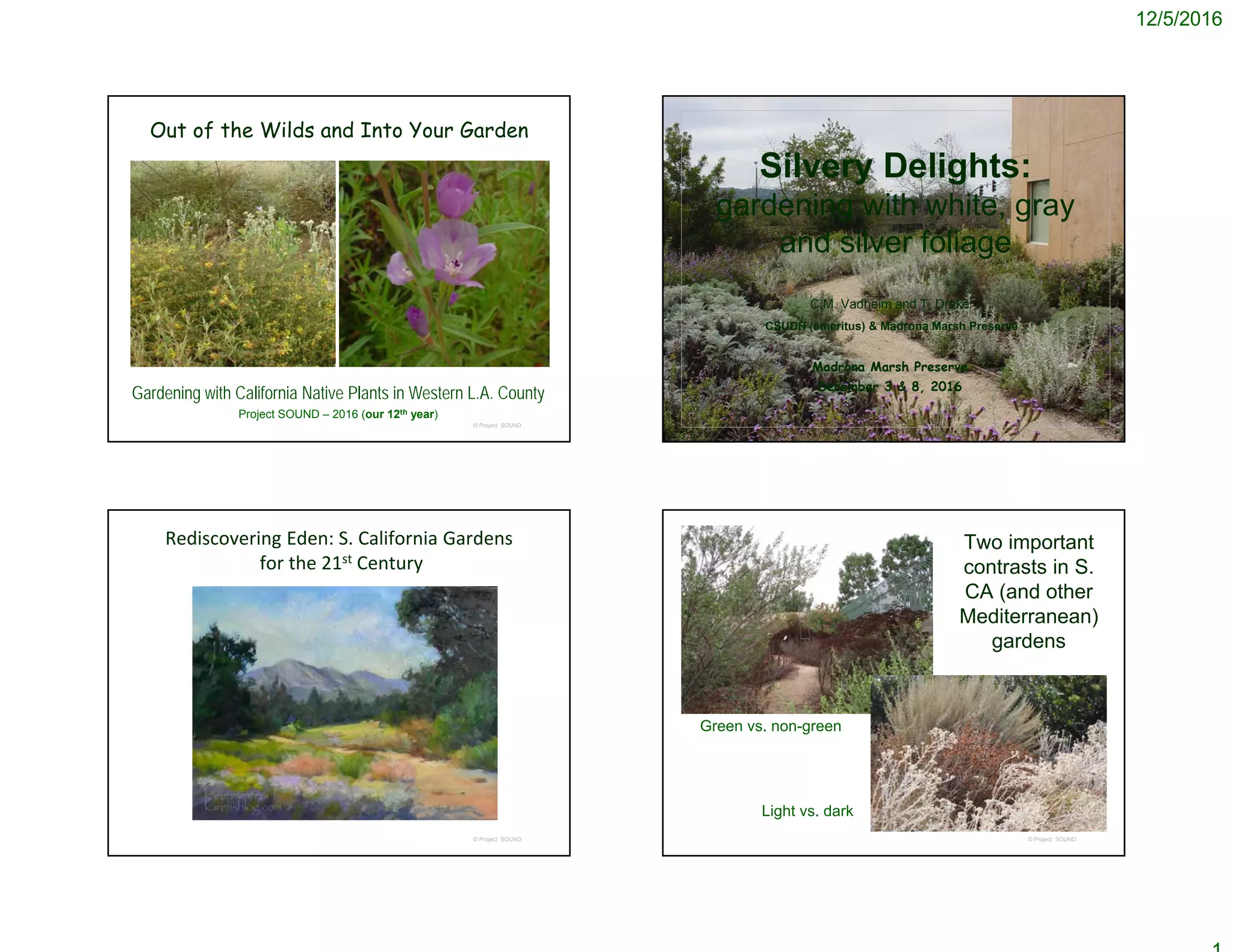
Out of the Wilds and Into Your Garden
Gardening with California Native Plants in Western L.A. County
Project SOUND – 2016 (our 12th year)
© Project SOUND
Silvery Delights:
gardening with white, gray
and silver foliage
C.M. Vadheim and T. Drake
CSUDH (emeritus) & Madrona Marsh Preserve
Madrona Marsh Preserve
December 3 & 8, 2016
Rediscovering Eden: S. California Gardens
for the 21st Century
© Project SOUND
Two important
contrasts in S.
CA (and other
Mediterranean)
gardens
© Project SOUND
Green vs. non-green
Light vs. dark
12/5/2016
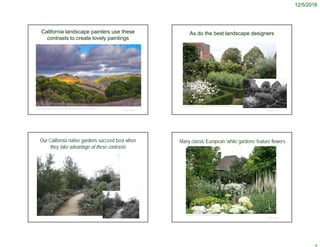
California landscape painters use these
contrasts to create lovely paintings
© Project SOUND
http://oceanquigley.blogspot.com/2010/09/new-series-of-california-landscape.html
As do the best landscape designers
© Project SOUND
https://sissinghurstcastle.wordpress.com/2013/11/18/when-a-wheel-barrow-wont-do/
Our California native gardens succeed best when
they take advantage of these contrasts
© Project SOUND
Many classic European ‘white gardens’ feature flowers
© Project SOUND
https://www.pinterest.com/explore/white-gardens/
12/5/2016
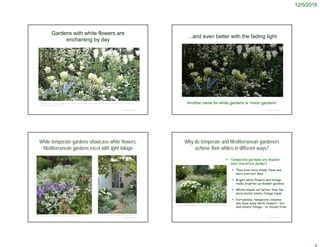
Gardens with white flowers are
enchanting by day
© Project SOUND
http://wefollowpics.com/moon-garden-all-white-flowers-and-gray-foliage-white-forget-me-nots-tulips-daisies-and-money-plants-combined-with-
hostas-and-silvery-astelia-foliage/
…and even better with the fading light
© Project SOUND
Another name for white gardens is ‘moon gardens’
While temperate gardens showcase white flowers,
Mediterranean gardens excel with light foliage
© Project SOUND
https://www.pinterest.com/pin/482307441324344276/
http://youreasygarden.com/simple-ways-to-use-white-in-the-garden/
Why do temperate and Mediterranean gardeners
achieve their whites in different ways?
 Temperate gardens are shadier
(and therefore darker)
 They have more shade trees and
more overcast days
 Bright white flowers and foliage
really brighten up shadier gardens
 White stands out better than the
more muted silvery foliage types
 Fortunately, temperate climates
also have many white flowers – but
less silvery foliage - to choose from
© Project SOUND
http://blog.theenduringgardener.com/holiday-at-sissinghurst/p1010369_2/
12/5/2016
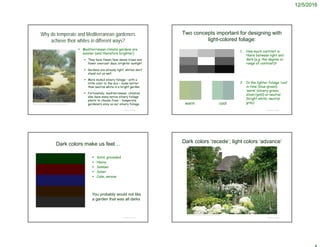
Why do temperate and Mediterranean gardeners
achieve their whites in different ways?
 Mediterranean climate gardens are
sunnier (and therefore brighter)
 They have fewer/less dense trees and
fewer overcast days, brighter sunlight
 Gardens are already light; whites don’t
stand out as well
 More muted silvery foliage – with a
little color to the mix – looks better
than neutral white in a bright garden
 Fortunately, mediterranean climates
also have many native silvery foliage
plants to choose from – temperate
gardeners envy us our silvery foliage
© Project SOUND
https://www.pinterest.com/pin/522206519262061613/
Two concepts important for designing with
light-colored foliage:
1. How much contrast is
there between light and
dark (e.g. the degree or
range of contrast)?
2. Is the lighter foliage ‘cool’
in tone (blue-green),
‘warm’ (silvery-green;
silver/gold) or neutral
(bright white; neutral
gray)
© Project SOUND
warm cool
Dark colors make us feel…
 Solid, grounded
 Heavy
 Somber
 Sober
 Calm, serene
© Project SOUND
You probably would not like
a garden that was all darks
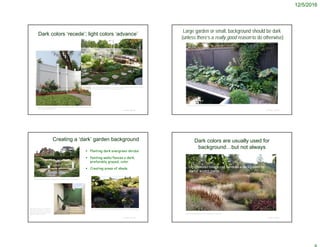
Dark colors ‘recede’; light colors ‘advance’
© Project SOUND
https://www.pinterest.com/explore/white-gardens/
12/5/2016
Dark colors ‘recede’; light colors ‘advance’
© Project SOUND
http://www.freshdesignpedia.com/interior-design-ideas/ready-for-the-summer-
furnishing-ideas-for-indoors-and-outdoors.html
http://www.homedepot.com/p/Veranda-Windham-6-ft-H-x-6-ft-W-White-Vinyl-Fence-
Panel-73002103/202297437
Large garden or small, background should be dark
(unless there’s a really good reason to do otherwise)
© Project SOUND
http://www.gardenista.com/posts/trend-alert-black-fences/
Creating a ‘dark’ garden background
 Planting dark evergreen shrubs
 Painting walls/fences a dark,
preferably grayed, color
 Creating areas of shade
© Project SOUND
http://indulgy.com/post/WYfDcpGxQ1/the-white-garden-sissinghurst
http://www.bobvila.com/slidesho
w/awesome-accents-17-ways-to-
make-any-space-pop-with-color-
46922#.WEIU5mcU-Uk
http://www.readingeagle.com/life/article/garden-of-the-week-linda-yeager
Dark colors are usually used for
background…but not always
© Project SOUND
https://www.pinterest.com/pin/182466222379148078/
Light colored foliage can serve as a background for
darker accent plants
12/5/2016
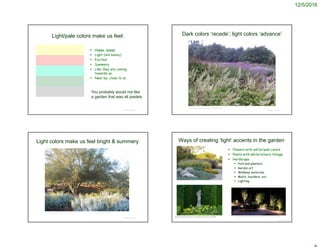
Light/pale colors make us feel:
 Happy, peppy
 Light (not heavy)
 Excited
 Summery
 Like they are coming
towards us
 Near by; close to us
© Project SOUND
You probably would not like
a garden that was all pastels
Dark colors ‘recede’; light colors ‘advance’
© Project SOUND
https://www.pinterest.com/pin/259449628502874271/
Light colors make us feel bright & summery
© Project SOUND
Ways of creating ‘light’ accents in the garden
 Flowers with white/pale colors
 Plants with white/silvery foliage
 Hardscape
 Pots and planters
 Garden art
 Walkway materials
 Mulch, boulders, etc.
 Lighting
© Project SOUND
http://pittsburghoutdoorlighting.com/tag/pittsburgh-landscape-lighting/
12/5/2016
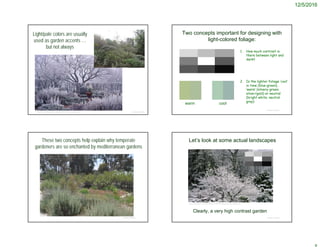
Light/pale colors are usually
used as garden accents …
but not always
© Project SOUNDhttp://www.bulldogtools.co.uk/blog/2013/12/winter-garden-tools/
Two concepts important for designing with
light-colored foliage:
1. How much contrast is
there between light and
dark?
2. Is the lighter foliage ‘cool’
in tone (blue-green),
‘warm’ (silvery-green;
silver/gold) or neutral
(bright white; neutral
gray)
© Project SOUND
warm cool
These two concepts help explain why temperate
gardeners are so enchanted by mediterranean gardens
© Project SOUND
Let’s look at some actual landscapes
© Project SOUND
http://i.telegraph.co.uk/multimedia/archive/02407/Harlowcarr2_2407849b.jpg
Clearly, a very high contrast garden
12/5/2016
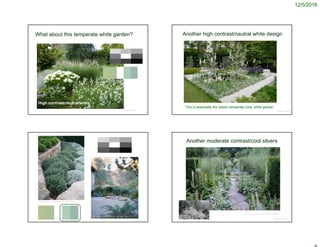
What about this temperate white garden?
© Project SOUND
High contrast/neutral white
Another high contrast/neutral white design
© Project SOUND
This is essentially the classic temperate zone ‘white garden’
© Project SOUND
https://www.pinterest.com/pin/251146116692235608/
https://www.pinterest.com/pin/479703797795311305/
Another moderate contrast/cool silvers
© Project SOUND
https://www.pinterest.com/pin/163748136425865989/
12/5/2016
© Project SOUND
Bright white is neutral
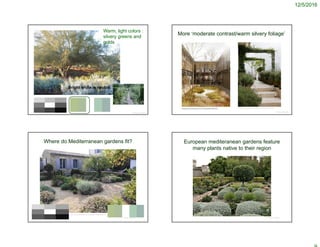
Warm, light colors :
silvery greens and
golds
More ‘moderate contrast/warm silvery foliage’
© Project SOUND
https://www.pinterest.com/pin/163748136427787424/
Where do Mediterranean gardens fit?
© Project SOUND
https://www.pinterest.com/pin/534661786995634673/
European mediteranean gardens feature
many plants native to their region
© Project SOUND
12/5/2016
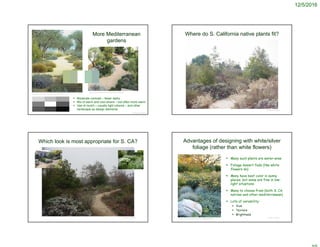
More Mediterranean
gardens
© Project SOUND
https://www.pinterest.com/pin/522206519262061613/
https://www.pinterest.com/pin/38632509282381226/
 Moderate contrast – fewer darks
 Mix of warm and cool silvers – but often more warm
 Use of mulch – usually light colored – and other
hardscape as design elements
Where do S. California native plants fit?
© Project SOUND
Which look is most appropriate for S. CA?
© Project SOUND
Advantages of designing with white/silver
foliage (rather than white flowers)
 Many such plants are water-wise
 Foliage doesn’t fade (like white
flowers do)
 Many have best color in sunny
places; but some are fine in low-
light situations
 Many to choose from (both S. CA
natives and other mediterranean)
 Lots of variability:
 Size
 Texture
 Brightness
© Project SOUND
https://www.pinterest.com/pin/83035186858621967/
12/5/2016
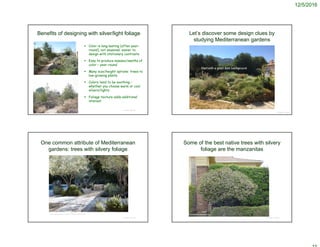
Benefits of designing with silver/light foliage
 Color is long-lasting (often year-
round), not seasonal; easier to
design with stationary contrasts
 Easy to produce masses/swaths of
color – year-round
 Many size/height options: trees to
low-growing plants
 Colors tend to be soothing –
whether you choose warm or cool
silvers/lights
 Foliage texture adds additional
interest
© Project SOUND
Let’s discover some design clues by
studying Mediterranean gardens
© Project SOUND
Start with a good dark background
One common attribute of Mediterranean
gardens: trees with silvery foliage
© Project SOUND
https://www.pinterest.com/pin/212865519863542396/
Some of the best native trees with silvery
foliage are the manzanitas
© Project SOUND
12/5/2016
Several manzanitas have silvery leaves
 Bigberry manzanita
(Arctostaphylos glauca)
 ‘Lester Rountree’ manzanita
 ‘John Dourley’ manzanita
 Whiteleaf Manzanita
(A. viscida ssp. viscida)
 Diablo Blush Manzanita
(A. auriculata)
 Ghostly Manzanita (A. silvicola)
 Ian Bush Manzanita
(A. densiflora x A. pungens)
 Laguna Manzanita
(A. glandulosa adamsii).
© Project SOUND
© Project SOUND
*Bishop manzanita – Arctostaphylos obispoensis
©1993 David Graber
© Project SOUND
*Bishop manzanita – Arctostaphylos obispoensis
©1993 David Graber
©2011 Chris Winchell
http://ucjeps.berkeley.edu/eflora/eflora_display.php?tid=13958
 Foothills of coastal mountains, Monterrey
and San Luis Obispo Counties
 Arctostaphylos obispoensis Eastwood [family
ERICACEAE], Leafl. W. Bot., 2: 8. 1937
© Project SOUND
Bishop manzanita: silvery foliage
 Size:
 5-10+ ft tall
 5-10 ft wide
 Growth form:
 Woody shrub/small tree
 Dense, mounded form
 Attractive, dark red bark
 Foliage:
 Typical simple, rounded to
lanceshaped manzanita leaves
– somewhat leathery
 Color: blue-green to gray-
green – pretty color due to
leaf hairs
http://www.worldbotanical.com/arctostaphylos.htm
©2006 Steve Matson
12/5/2016
© Project SOUND
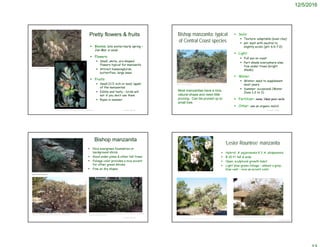
Pretty flowers & fruits
 Blooms: late winter/early spring –
Jan-Mar is usual
 Flowers:
 Small, white, urn-shaped
flowers typical for manzanita
 Attract hummingbirds,
butterflies, large bees
 Fruits:
 Small (1/2 inch or less) ‘apple’
of the manzanitas
 Edible and tasty – birds will
eat if you don’t use them
 Ripen in summer
©2016 Susan McDougall
Gerald and Buff Corsi © California Academy of Sciences © Project SOUND
Bishop manzanita: typical
of Central Coast species
 Soils:
 Texture: adaptable (even clay)
 pH: best with neutral to
slightly acidic (pH: 6.0-7.0)
 Light:
 Full sun on coast
 Part-shade everywhere else;
fine under trees (bright
shade)
 Water:
 Winter: need to supplement
most years
 Summer: occasional (Water
Zone 1-2 to 2)
 Fertilizer: none; likes poor soils
 Other: use an organic mulch
©2011 Chris Winchell
Most manzanitas have a nice,
natural shape and need little
pruning. Can be pruned up to
small tree.
© Project SOUND
Bishop manzanita
 Nice evergreen foundation or
background shrub
 Good under pines & other tall trees
 Foliage color provides a nice accent
for other green shrubs
 Fine on dry slopes
http://www.laspilitas.com/nature-of-california/plants/63--arctostaphylos-obispoensis-
san-luis-obispo-manzanitahttps://en.wikipedia.org/wiki/Arctostaphylos_obispoensis
© Project SOUND
‘Lester Rountree’ manzanita
 Hybrid: A. pajaroensis X ? A. obispoensis
 8-10 ft tall & wide
 Open, sculptural growth habit
 Light blue-green foliage – almost a gray-
blue cast – nice as accent color
http://www.cactusjungle.com/blog/category/california-native-plants/page/2/
http://farm1.static.flickr.com/84/268090756_f6a54c9577.jpg
https://www.flickr.com/photos/mechanoid_dolly/4943065895
12/5/2016
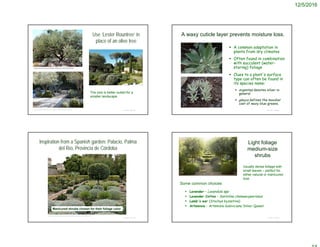
Use ‘Lester Rountree’ in
place of an olive tree
© Project SOUNDhttps://www.pinterest.com/explore/mediterranean-garden/
The size is better suited for a
smaller landscape
© Project SOUND
A waxy cuticle layer prevents moisture loss.
 A common adaptation in
plants from dry climates
 Often found in combination
with succulent (water-
storing) foliage
 Clues to a plant's surface
type can often be found in
its species name:
 argentea denotes silver in
general
 glauca defines the moodier
cast of waxy blue-greens.
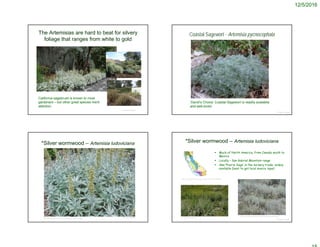
Inspiration from a Spanish garden: Palacio, Palma
del Río, Provincia de Córdoba
© Project SOUND
http://www.mediterraneangardensociety.org/carmona-22.html#1
Manicured shrubs chosen for their foliage color
Light foliage
medium-size
shrubs
 Lavender – Lavandula spp
 Lavender Cotton – Santolina chamaecyparissus
 Lamb's ear (Stachys byzantina)
 Artemisia – Artemisia ludoviciana ‘Silver Queen’
© Project SOUND
Some common choices
Usually dense foliage with
small leaves – perfect for
either natural or manicured
look
12/5/2016
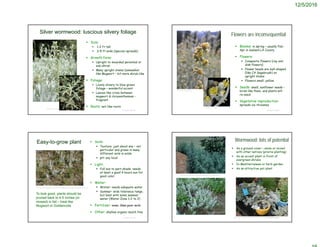
The Artemisias are hard to beat for silvery
foliage that ranges from white to gold
© Project SOUND
http://prairie476.rssing.com/chan-7188697/all_p5.html
California sagebrush is known to most
gardeners – but other great species merit
attention
© Project SOUND
Coastal Sagewort - Artemisia pycnocephala
© 2005 George W. Hartwell
‘David’s Choice’ Coastal Sagewort is readily available
and well-loved
© Project SOUND
*Silver wormwood – Artemisia ludoviciana
http://redrockcanyonopenspace.org/education/biology/sage/
© Project SOUND
*Silver wormwood – Artemisia ludoviciana
©2012 Jean Pawek
http://ucjeps.berkeley.edu/cgi-bin/draw_tiny2.pl?e4e3fcf507
 Much of North America, from Canada south to
Mexico
 Locally – San Gabriel Mountain range
 Aka ‘Prairie Sage’ in the nursery trade; widely
available (best to get local source type)
http://www.crossconservation.org/encyclopedia/prairie-sage
12/5/2016
© Project SOUND
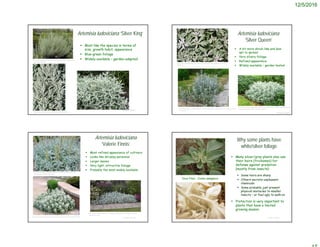
Silver wormwood: luscious silvery foliage
 Size:
 1-2 ft tall
 3-5 ft wide (species spreads)
 Growth form:
 Upright to mounded perennial or
sub-shrub
 Many upright stems (somewhat
like Mugwort – bit more shrub-like
 Foliage:
 Lovely silvery to blue-green
foliage – wonderful accent
 Leaves like cross between
mugwort & chrysanthemum -
fragrant
 Roots: net-like roots
© 2005, Ben Legler
© Project SOUND
Flowers are inconsequential
 Blooms: in spring – usually Feb-
Apr in lowland LA County
 Flowers:
 Composite flowers (ray and
disk flowers)
 Flower heads are bell-shaped
(like CA Sagebrush) on
upright stems
 Flowers small, yellow
 Seeds: small, sunflower seeds –
birds like them, and plants will
re-seed
 Vegetative reproduction:
spreads via rhizomes
2010, Ron Bockelman
© 2009, G. D. Carr
© Project SOUND
Easy-to-grow plant  Soils:
 Texture: just about any – not
particular and grows in many
different soils in wilds.
 pH: any local
 Light:
 Full sun to part-shade; needs
at least a good 4 hours sun for
good color.
 Water:
 Winter: needs adequate water
 Summer: wide tolerance range,
but best with some summer
water (Water Zone 1-2 to 2)
 Fertilizer: none; likes poor soils
 Other: shallow organic mulch fine
http://khkeeler.blogspot.com/2013/02/sages-garden-sage-and-sagebrush.html
To look good, plants should be
pruned back to 4-5 inches (or
mowed) in fall – treat like
Mugwort or Goldenrods
© Project SOUND
Wormwood: lots of potential
 As a ground cover – alone or mixed
with other natives (prairie planting)
 As an accent plant in front of
evergreen shrubs
 In Mediterranean or herb garden
 As an attractive pot plant
http://www.wildflower.org/plants/result.php?id_plant=ARLU
© 2010, Ron Bockelman
https://commons.wikimedia.org/wiki/Category:Artemisia_ludoviciana
12/5/2016
Artemisia ludoviciana ‘Silver King’
 Most like the species in terms of
size, growth habit, appearance
 Blue-green foliage
 Widely available – garden adapted
© Project SOUND
http://www.paintedflowerfarm.com/pages/plants/natives/artem
isia,silver-king.htm
https://www.pinterest.com/pin/434386326528208910/
Artemisia ludoviciana
‘Silver Queen’
 A bit more shrub-like and less
apt to spread
 Very silvery foliage
 Refined appearance
 Widely available – garden tested
© Project SOUND
http://www.zelen.cz/detail_galerie_rostlin/Artemisia_ludoviciana_Silver_Queen_pelyne
k_Ludvikuv
https://www.groeneparadijs.com/producten/tuinplanten/vaste-planten/artemisia-
ludoviciana-silver-queen-westerse-bijvoet
https://www.plantes-shopping.fr/articles/artemisia-ludoviciana-silver-queen-
1882.html
Artemisia ludoviciana
‘Valerie Finnis’
 Most refined appearance of cultivars
 Looks like shrubby perennial
 Larger leaves
 Very light, attractive foliage
 Probably the most widely available
© Project SOUND
http://www.ivydenegardens.co.uk/Mixed%20Border%20Herbaceous/artv
aleriefinnis.html
http://www.gardeningimpulse.ie/shop/artemisia-ludoviciana-valerie-finnis/
http://forums2.gardenweb.com/discussions/1600791/artemesia-
ludoviciana-valerie-finnis-photo
© Project SOUND
Why some plants have
white/silver foliage
 Many silver/gray plants also use
their hairs (trichomes) for
defense against predation
(mostly from insects)
 Some hairs are sharp
 Others secrete unpleasant
chemicals
 Some probably just present
physical obstacles to smaller
insects – or feel ugly to walk on
 Protection is very important to
plants that have a limited
growing season.
Dove Plant - Croton setagerus
12/5/2016
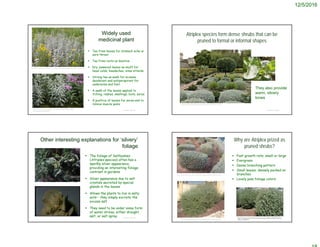
Widely used
medicinal plant
 Tea from leaves for stomach ache or
sore throat
 Tea from roots as laxative
 Dry, powered leaves as snuff for
head colds, headaches, sinus attacks
 Strong tea as wash for eczema,
deodorant and antiperspirant for
underarms and feet
 A wash of the leaves applied to
itching, rashes, swellings, boils, sores
 A poultice of leaves for sores and to
relieve muscle pains
© Project SOUND
http://www.cannonvalleynursery.com/output/moreinfo/Artemisia_ludoviciana.asp
http://www.crocus.co.uk/plants/_/artemisia-ludoviciana-valerie-
finnis/classid.2000006631/
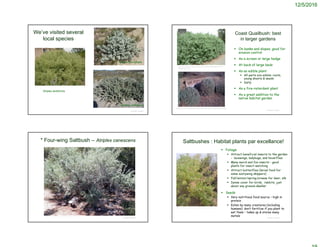
Atriplex species form dense shrubs that can be
pruned to formal or informal shapes
© Project SOUND
http://www.mediterraneangardensociety.org/carmona-22.html
They also provide
warm, silvery
tones
© Project SOUND
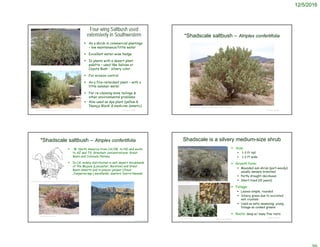
Other interesting explanations for ‘silvery’
foliage
 The foliage of Saltbushes
(Atriplex species) often has a
sparkly silver appearance,
providing an interesting foliage
contrast in gardens
 Silver appearance due to salt
crystals secreted by special
glands in the leaves
 Allows the plants to live in salty
soils – they simply excrete the
excess salt
 They need to be under some form
of water stress, either drought,
salt, or salt spray
Why are Atriplex prized as
pruned shrubs?
 Fast growth rate; small or large
 Evergreen
 Dense branching pattern
 Small leaves; densely packed on
branches
 Lovely pale foliage colors
© Project SOUND
http://www.jardinbotanico.uma.es/bbdd/index.php/jb-alm-02/
http://www.riomoros.com/2012/03/la-osagra-atriplex-halimus.html
12/5/2016
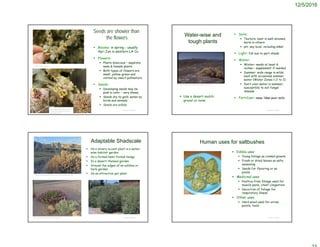
We’ve visited several
local species
© Project SOUND
Atriplex lentiformis
Atriplex leucophylla
Atrip[lex californica
© Project SOUND
Coast Quailbush: best
in larger gardens
 On banks and slopes; good for
erosion control
 As a screen or large hedge
 At back of large beds
 As an edible plant:
 All parts are edible: roots,
young shoots & seeds
 Salty
 As a fire-retardant plant
 As a great addition to the
native habitat garden
http://www.sanjose.watersavingplants.com/eplant.php?plantnum=2
4532&return=s_aQ
http://www.cnps.org/cnps/grownative/tips/native_garden_planning-part2.php
© Project SOUND
* Four-wing Saltbush – Atriplex canescens
http://www.perennialfavoritesnursery.com/native_a-f.html
© Project SOUND
Saltbushes : Habitat plants par excellance!
 Foliage
 Attract beneficial insects to the garden
- lacewings, ladybugs, and hoverflies
 Many weird and fun insects – good
plants for insect-watching
 Attract butterflies (larval food for
some sootywing skippers)
 Fall/winter/spring browse for deer, elk
 Dense cover for birds, rabbits, just
about any ground-dweller
 Seeds
 Very nutritious food source – high in
protein
 Eaten by many creatures (including
humans): don’t fertilize if you plant to
eat them – takes up & stores many
metals
http://www.fs.fed.us/database/feis/plants/shrub/atrlen/plant.jpg
12/5/2016
© Project SOUND
Four-wing Saltbush used
extensively in Southwestern
 As a shrub in commercial plantings
– low maintenance/little water
 Excellent water-wise hedge
 In plants with a desert plant
palette – used like Salvias or
Coyote Bush - silvery color
 For erosion control
 As a fire-retardant plant – with a
little summer water
 For re-claiming mine tailings &
other environmental problems
 Also used as dye plant (yellow &
‘Navajo Black’ & medicine (emetic)
http://biology.burke.washington.edu/herbarium/imagecollection.php?Genus=Atriplex&Species=canescens
http://www.delange.org/FourwingSaltbush/FourwingSaltbush.htm © Project SOUND
*Shadscale saltbush – Atriplex confertifolia
Gary A. Monroe, hosted by the USDA-NRCS PLANTS Database
 W. North America from CA/OR to ND and south
to AZ and TX. Greatest concentrations: Great
Basin and Colorado Plateau
 In CA, widely distributed in salt-desert shrublands
of the Mojave (Lancaster; Barstow) and Great
Basin deserts and in pinyon-juniper (Pinus-
Juniperus spp.) woodlands, eastern Sierra Nevada
© Project SOUND
*Shadscale saltbush – Atriplex confertifolia
©2009 James M. Andre
http://www.efloras.org/florataxon.aspx?flora_id=1&taxon_id=242415596
https://plantsofthesouthwest.com/collections/trees-shrubs
© Project SOUND
Shadscale is a silvery medium-size shrub
 Size:
 1-3 ft tall
 1-3 ft wide
 Growth form:
 Mounded sub-shrub (part-woody);
usually densely branched
 Partly drought-deciduous
 Short-lived (10 years)
 Foliage:
 Leaves simple, rounded
 Silvery green due to excreted
salt crystals
 Used as salty seasoning; young
foliage as cooked greens
 Roots: deep w/ many fine roots
©2012 Jean Pawek
©2012 Neal Kramer
©2015 Steve Matson
12/5/2016
© Project SOUND
Seeds are showier than
the flowers
 Blooms: in spring - usually
Apr-Jun in western LA Co.
 Flowers:
 Plants dioecious – separate
male & female plants
 Both types of flowers are
small, yellow-green and
visited by insect pollinators
 Seeds:
 Developing seeds may be
pink in color – very showy
 Seeds dry to gold; eaten by
birds and animals
 Seeds are edible
©2015 Steve Matson
http://www.americansouthwest
.net/plants/wildflowers/atriplex-
confertifolia.html
© Project SOUND
Water-wise and
tough plants
 Soils:
 Texture: best in well-drained;
berm in others
 pH: any local, including alkali
 Light: full sun to part-shade
 Water:
 Winter: needs at least 6
inches – supplement if needed
 Summer: wide range in wilds;
best with occasional summer
water (Water Zones 1-2 to 2)
 Don’t over-water in summer;
susceptible to soil fungal
disease
 Fertilizer: none; likes poor soils
Charles Webber © California Academy of Sciences
 Use a desert mulch:
gravel or none
© Project SOUND
Adaptable Shadscale
 As a silvery accent plant in a water-
wise habitat garden
 As a formal/semi-formal hedge
 In a desert-themed garden
 Around the edges of an edibles or
herb garden
 As an attractive pot plant
http://chelseanursery.com/?page_id=358
https://plantsofthesouthwest.com/collections/trees-shrubs
Human uses for saltbushes
 Edible uses
 Young foliage as cooked greens
 Fresh or dried leaves as salty
seasoning
 Seeds for flavoring or as
pinole
 Medicinal uses
 Poultice from foliage used for
muscle pains, chest congestion
 Decoction of foliage for
respiratory illness
 Other uses
 Hard wood used for arrow
points, tools
© Project SOUND
12/5/2016
© Project SOUND
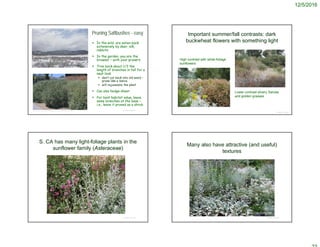
Pruning Saltbushes - easy
 In the wild, are eaten back
extensively by deer, elk,
rabbits
 In the garden, you are the
browser – with your pruners
 Trim back about 1/3 the
length of branches in fall for a
neat look
 don’t cut back into old wood –
prune like a Salvia
 will rejuvenate the plant
 Can also hedge-shear
 For best habitat value, leave
some branches at the base –
i.e., leave it pruned as a shrub
http://commons.wikimedia.org/wiki/File:Atriplex_canescens_inflor.jpg
http://allergy.peds.arizona.edu/southwest/grass_weeds/wingscale.htm
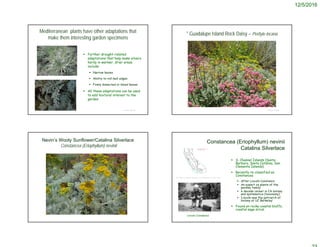
Important summer/fall contrasts: dark
buckwheat flowers with something light
© Project SOUND
High contrast with white-foliage
sunflowers
Lower contrast silvery Salvias
and golden grasses
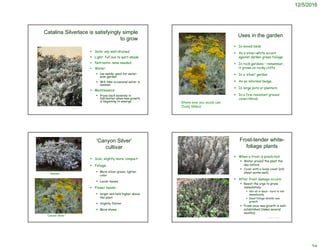
S. CA has many light-foliage plants in the
sunflower family (Asteraceae)
© Project SOUND
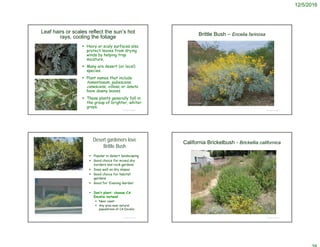
Many also have attractive (and useful)
textures
© Project SOUND
12/5/2016
© Project SOUND
Mediterranean plants have other adaptations that
make them interesting garden specimens
 Further drought-related
adaptations that help make silvers
hardy in warmer, drier areas
include:
 Narrow leaves
 Ability to roll leaf edges
 Finely dissected or lobed leaves
 All these adaptations can be used
to add textural interest to the
garden
© Project SOUND
* Guadalupe Island Rock Daisy – Perityle incana
Nevin’s Wooly Sunflower/Catalina Silverlace
Constancea (Eriophyllum) nevinii
 S. Channel Islands (Santa
Barbara, Santa Catalina, San
Clemente Islands).
 Recently re-classified as
Constancea
 After Lincoln Constance
 An expert on plants of the
parsley family
 6 decade career in CA botany
and systematics (taxonomy)
 ‘Lincoln was the patriarch of
botany at UC Berkeley’
 Found on rocky coastal bluffs,
coastal sage scrub
http://ucjeps.berkeley.edu/cgi-bin/get_JM_treatment.pl?Eriophyllum+nevinii
http://www.cnps.org/publications/fremontia/Fremontia_Vol29-No2.pdf
Lincoln Constance
Constancea (Eriophyllum) nevinii
Catalina Silverlace
12/5/2016
Catalina Silverlace is satisfyingly simple
to grow
 Soils: any well-drained
 Light: full sun to part-shade
 Nutrients: none needed
 Water:
 low needs; good for water-
wise garden
 Will take occasional water in
summer
 Maintenance:
 Prune back severely in
fall/winter when new growth
is beginning to emerge
Uses in the garden
 In mixed beds
 As a silver-white accent
against darker green foliage
 In rock gardens – remember,
it grows on rocky cliffs
 In a ‘silver’ garden
 As an informal hedge
 In large pots or planters
 In a fire-resistant ground
cover/shrub
Where ever you would use
‘Dusty Millers’
‘Canyon Silver’
cultivar
 Size: slightly more compact
 Foliage:
 More silver-green; lighter
color
 Lacier leaves
 Flower heads:
 larger and held higher above
the plant
 Slightly flatter
 More showy
‘Canyon Silver’
Species
Frost-tender white-
foliage plants
 When a frost is predicted:
 Water around the plant the
day before
 Cover with a loose cover (old
sheet works well)
 After frost damage occurs:
 Resist the urge to prune
immediately:
 Not all is dead – hard to tell
immediately
 Dead foliage shields new
growth
 Prune once new growth is well-
established (takes several
months)
© Project SOUND
12/5/2016
© Project SOUND
Leaf hairs or scales reflect the sun’s hot
rays, cooling the foliage
 Hairy or scaly surfaces also
protect leaves from drying
winds by helping trap
moisture.
 Many are desert (or local)
species.
 Plant names that include
tomentosum, pubescens,
canescens, villosa, or lanata
have downy leaves
 These plants generally fall in
the group of brighter, whiter
grays.
© Project SOUND
Brittle Bush – Encelia farinosa
© 2008 Scott Millard
© Project SOUND
Desert gardeners love
Brittle Bush
 Popular in desert landscaping
 Good choice for mixed dry
borders and rock gardens
 Does well on dry slopes
 Good choice for habitat
gardens
 Good for ‘Evening Garden’
 Don’t plant: choose CA
Encelia instead
 Near coast
 Any area near natural
populations of CA Encelia
http://ag.arizona.edu/pima/gardening/aridplants/Encelia_farinosa.html
http://www.elnativogrowers.com/Photographs_page/encfar.htm
California Brickelbush - Brickellia californica
© Project SOUND
12/5/2016
© Project SOUND
*Wooly brickellbush – Brickellia incana
©2010 Lee Dittmann
 Mojave and Sonoran Deserts of CA, AZ, NV; locally
Riverside and San Bernardino Co.
 First collected from Providence Mtns (JG Cooper)
1860-61 – named by A. Gray [1868]
 MK Brandegee collected - Daggett, Nipton in 1914-15
© Project SOUND
*Wooly brickellbush – Brickellia incana
©2008 Aaron Schusteff
http://ucjeps.berkeley.edu/cgi-bin/get_cpn.pl?BRIN
http://www.birdandhike.com/Veg/Species/Shrubs/Bricke_inc/_Bri_inc.htm
© Project SOUND
Wooly brickellbush: silvery desert shrub
 Size:
 1-4 ft tall
 2-4 ft wide
 Growth form:
 Mostly evergreen sub-shrub
 Upright to mounded form
 Foliage usually dense
 Attractive with just a little water
 Foliage:
 Silvery to white color due dense
hairs (trichomes)
 Leaves simple, oval
©2010 Lee Dittmann
© Project SOUND
Flowers: typical
Brickellbush
 Blooms: Anytime from spring
to fall, depending on rains,
temperatures
 Flowers:
 On white-hairy stems
 Distinctive silvery bracts
around the flower heads
 Disk & ray flowers small,
yellow-gold
 Seeds:
 Fluffy seeds are actually more
showy than the flowers
 Seed-eating birds will eat
©2010 Lee Dittmann
12/5/2016
© Project SOUND
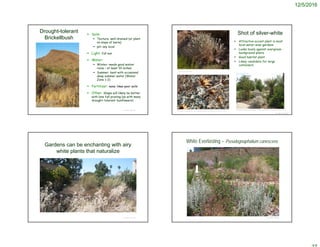
Drought-tolerant
Brickellbush
 Soils:
 Texture: well-drained (or plant
on slope of berm)
 pH: any local
 Light: full sun
 Water:
 Winter: needs good winter
rains – at least 10 inches
 Summer: best with occasional
deep summer water (Water
Zone 1-2)
 Fertilizer: none; likes poor soils
 Other: Shape will likely be better
with late fall pruning (as with many
drought-tolerant Sunflowers)
© Project SOUND
Shot of silver-white
 Attractive accent plant in most
local water-wise gardens
 Looks lovely against evergreen
background plants
 Good habitat plant
 Likely candidate for large
containers
©2010 Lee Dittmann
http://www.birdandhike.com/Veg/Species/Shrubs/Bricke_inc/_Bri_inc.htm
https://dryheatblog.wordpress.com/2015/07/08/its-111-degrees-garden-visit/
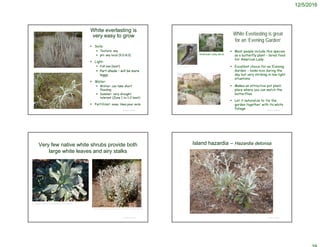
Gardens can be enchanting with airy
white plants that naturalize
© Project SOUND © Project SOUND
White Everlasting – Pseudognaphalium canescens
12/5/2016
© Project SOUND
White everlasting is
very easy to grow
 Soils:
 Texture: any
 pH: any local (5.0-8.0)
 Light:
 Full sun (best)
 Part-shade – will be more
leggy
 Water:
 Winter: can take short
flooding
 Summer: very drought
tolerant (Zone 1 to 1-2 best)
 Fertilizer: none; likes poor soils
© Project SOUND
White Everlasting is great
for an ‘Evening Garden’
 Most people include this species
as a butterfly plant – larval food
for American Lady
 Excellent choice for an ‘Evening
Garden’ – looks nice during the
day but very striking in low-light
situations
 Makes an attractive pot plant;
place where you can watch the
butterflies
 Let it naturalize to ‘tie the
garden together’ with its white
foliage
American Lady larva
http://www.theodorepayne.org/plants/
plants_for_butterflies.htm
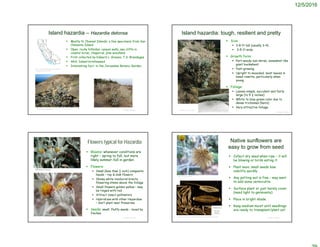
Very few native white shrubs provide both
large white leaves and airy stalks
© Project SOUND
http://www.laspilitas.com/nature-of-california/plants/243--hazardia-detonsa
J.S. Peterson, hosted by the USDA-NRCS PLANTS Database
© Project SOUND
Island hazardia – Hazardia detonsa
12/5/2016
 Mostly N. Channel Islands; a few specimens from San
Clemente Island
 Open, rocky hillsides, canyon walls, sea cliffs in
coastal scrub, chaparral, pine woodland
 First collected by Edward L. Greene, T.S. Brandegee
 AKA: Island bristleweed
 Interesting fact: in the Jerusalem Botanic Garden
© Project SOUND
Island hazardia – Hazardia detonsa
http://ucjeps.berkeley.edu/eflora/eflora
_display.php?tid=3184
©2013 James Gonsman
© Project SOUND
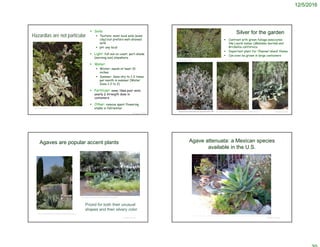
Island hazardia: tough, resilient and pretty
 Size:
 3-8 ft tall (usually 3-4)
 3-5 ft wide
 Growth form:
 Part-woody sub-shrub; somewhat like
giant buckwheat
 Fast-growing
 Upright to mounded; most leaves in
basal rosette, particularly when
young
 Foliage:
 Leaves simple, succulent and fairly
large (to 5 ½ inches)
 White to blue-green color due to
dense trichomes (hairs)
 Very attractive foliage
©2009 Gary A. Monroe ©2014 Zoya Akulova
© Project SOUND
Flowers typical for Hazardia
 Blooms: whenever conditions are
right – spring to fall, but more
likely summer-fall in garden
 Flowers:
 Small (less than ½ inch) composite
heads – ray & disk flowers
 Showy white involucral bracts,
flowering stems above the foliage
 Small flowers golden yellow – may
be tinged with red
 Attract insect pollinators
 Hybridizes with other Hazardias
– don’t plant near Preserves
 Seeds: small, fluffy seeds – loved by
finches
Native sunflowers are
easy to grow from seed
 Collect dry seed when ripe – it will
be blowing or birds eating it.
 Plant soon; small seeds lose
viability quickly
 Any potting soil is fine – may want
to add some vermiculite
 Surface plant or just barely cover
(need light to germinate)
 Place in bright shade
 Keep medium moist until seedlings
are ready to transplant/plant out
© Project SOUND
©2009 Zoya Akulova
http://www.hazmac.biz/080728/080728HazardiaDetonsa.html
12/5/2016
© Project SOUND
Hazardias are not particular
 Soils:
 Texture: most local soils (even
clay) but prefers well-drained
soils
 pH: any local
 Light: full sun on coast; part-shade
(morning sun) elsewhere.
 Water:
 Winter: needs at least 10
inches
 Summer: Semi-dry to 1-2 times
per month in summer (Water
Zone 1-2 to 2)
 Fertilizer: none; likes poor soils;
yearly ½ strength dose in
containers
 Other: remove spent flowering
stalks in fall/winter©2014 Steve Matson
© Project SOUND
Silver for the garden
 Contrast with green foliage associates
like Laurel sumac (Malosma laurina) and
Brickellia californica
 Important plant for ‘Channel island’ theme
 Can even be grown in large containers
©2015 Robert Sikora
http://farm6.static.flickr.com/5285/5314495162_f70a9bcbd9.jpg
Agaves are popular accent plants
© Project SOUND
https://www.pinterest.com/explore/mediterranean-garden/
http://www.bevbeverly.com/agave-garden-design.shtml
Prized for both their unusual
shapes and their silvery color
© Project SOUND
Agave attenuata: a Mexican species
available in the U.S.
http://www.geographylists.com/sandiegoplants.html http://www.cactusjungle.com/blog/2008/09/30/berkeley-succulent-garden-3/
12/5/2016
© Project SOUND
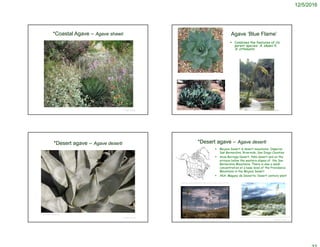
*Coastal Agave – Agave shawii
© 2005 Vince Scheidt
© Project SOUND
Agave ‘Blue Flame’
 Combines the features of its
parent species: A. shawii X
A. attenuata
http://www.smgrowers.com/products/plants/plantdisplay.asp?plant_id=2871
http://www.huntington.org/BotanicalDiv/ISI2005/isi/2005-06.html
© Project SOUND
*Desert agave – Agave deserti
©2005 Dee E. Warenycia
 Mojave Desert & desert mountains; Imperial,
San Bernardino, Riverside, San Diego Counties
 Anza Borrego Desert, Palm desert and on the
arroyos below the western slopes of the San
Bernardino Mountains. There is also a small
concentration at a base level of the Providence
Mountains in the Mojave Desert
 AKA: Maguey de Desierto; Desert century plant
© Project SOUND
*Desert agave – Agave deserti
Glenn and Martha Vargas © California Academy of Sciences
http://www.efloras.org/florataxon.aspx?flora_id=1&taxon_id=242101305
http://online.sfsu.edu/bholzman/courses/Fall00Projects/3Agavedeserti.html
12/5/2016
Native sub-species
available  ssp. deserti - south-central CA, Baja
 Offsets prolifically; sometimes large
colonies.
 Pale silvery (or greenish-silver) leaves
 Typical rosette 2' high and wide; some
larger & hardier forms from San
Jacinto Mountains
 Easy to grow
 ssp. simplex – AZ, mountains of Mojave
Desert, CA
 Usually solitary or produces few
offsets
 frequently have very strong horizontal
banding on the leaves, a striking
feature.
 slow grower and appreciates dry,
gritty soil and heat. it ought to do well
in the Pacific Northwest also.
© Project SOUND
©2007 Charles E. Jones © Project SOUND
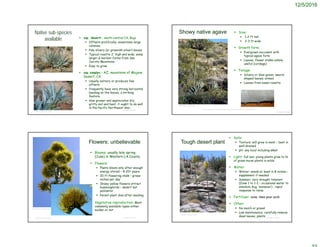
Showy native agave  Size:
 1-2 ft tall
 2-3 ft wide
 Growth form:
 Evergreen succulent with
typical agave form
 Leaves, flower stalks edible,
useful (cordage)
 Foliage:
 Silvery or blue-green, sword-
shaped leaves; armed
 Leaves from basal rosette
©2005 Richard Zmasek
http://swbiodiversity.org/seinet/collections/individual/index.php?occid=3195373
© Project SOUND
Flowers: unbelievable
 Blooms: usually late spring
(June) in Western LA County
 Flowers:
 Plants bloom only after enough
energy stored – 8-20+ years
 20 ft flowering stalk – grows
inches per day
 Showy yellow flowers attract
hummingbirds – desert bat
pollinator
 Parent plant dies after seeding
 Vegetative reproduction: Most
commonly available types either
sucker or not
©2005 Richard Zmasek
©2005 Dee E. Warenycia
© Project SOUND
Tough desert plant
 Soils:
 Texture: will grow in most – best in
well-drained
 pH: any local including alkali
 Light: full sun; young plants grow to N.
of grass nurse plants in wilds
 Water:
 Winter: needs at least 6-8 inches –
supplement if needed
 Summer: very drought tolerant
(Zone 1 to 1-2 – occasional water to
simulate Aug. ‘monsoon’) ; rapid
response to rains;
 Fertilizer: none; likes poor soils
 Other:
 No mulch or gravel
 Low maintenance; carefully remove
dead leaves, plants
©2006 J. Zylstra, SBNF
12/5/2016
© Project SOUND
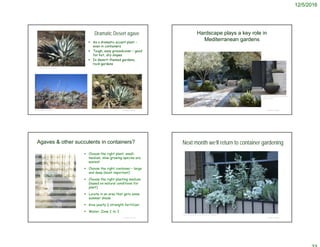
Dramatic Desert agave
 As a dramatic accent plant –
even in containers
 Tough, easy groundcover – good
for hot, dry slopes
 In desert-themed gardens,
rock gardens
©2009 Thomas Stoughton
©2014 William Flaxington
http://www.desertnorthwest.com/articles/domestic_agaves.html
Hardscape plays a key role in
Mediterranean gardens
© Project SOUND
https://www.pinterest.com/pin/534732
155736778905/
Agaves & other succulents in containers?
 Choose the right plant: small-
medium, slow-growing species are
easiest
 Choose the right container – large
and deep (most important)
 Choose the right planting medium
(based on natural conditions for
plant)
 Locate in an area that gets some
summer shade
 Give yearly ½ strength fertilizer
 Water: Zone 2 to 3
© Project SOUND
Next month we’ll return to container gardening
© Project SOUND
https://www.pinterest.com/pin/227361481166598111/
12/5/2016
© Project SOUND
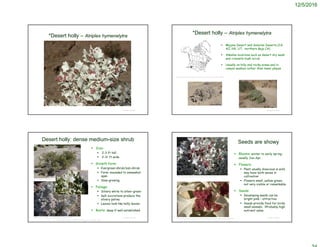
*Desert holly – Atriplex hymenelytra
 Mojave Desert and Sonoran Deserts (CA,
AZ, NV, UT, northern Baja CA)
 Alkaline locations such as desert dry wash
and creosote bush scrub
 Usually on hilly and rocky areas and in
canyon washes rather than lower playas
© Project SOUND
*Desert holly – Atriplex hymenelytra
©2010 Neal Kramer
http://www.efloras.org/florataxon.aspx?flora_id=1&taxon_id=242415594
© Project SOUND
Desert holly: dense medium-size shrub
 Size:
 2-3 ft tall
 2-3+ ft wide
 Growth form:
 Evergreen shrub/sub-shrub
 Form: mounded to somewhat
open
 Slow-growing
 Foliage:
 Silvery white to silver-green
 Salt excretions produce the
silvery patina
 Leaves look like holly leaves
 Roots: deep if well-established
http://www.werc.usgs.gov/outreach.aspx?RecordID=164
https://commons.wikimedia.org/wiki/File:Atriplex_hymenelytra_form.jpg
http://macskamoksha.com/2016/03/ecosystems-risk-4-death-valley
© Project SOUND
Seeds are showy
 Blooms: winter to early spring:
usually Jan-Apr.
 Flowers:
 Plant usually dioecious in wild;
may have both sexes in
cultivation
 Flowers small, yellow-green,
not very visible or remarkable
 Seeds:
 Developing seeds can be
bright pink – attractive
 Seeds provide food for birds,
small animals. ?Probably high
nutrient value.
http://www.werc.usgs.gov/outreach.aspx?RecordID=164
http://www.abdnha.org/pages/03flora/family/amaranthaceae/atriplex_hymenelytra.htm
12/5/2016
© Project SOUND
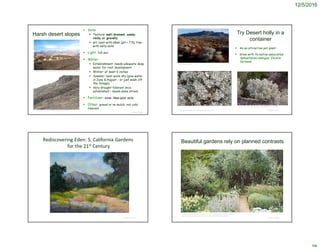
Harsh desert slopes
 Soils:
 Texture: well-drained; sandy,
rocky or gravelly
 pH: best with alkali (pH > 7.5); fine
with salty soils
 Light: full sun
 Water:
 Establishment: needs adequate deep
water for root development
 Winter: at least 6 inches
 Summer: best quite dry (give water
in June & August - or just wash off
the foliage).
 Very drought tolerant once
established – needs some stress
 Fertilizer: none; likes poor soils
 Other: gravel or no mulch; not cold
tolerant
Margaret Williams, hosted by the USDA-NRCS PLANTS Database
http://www.calflora.net/recentfieldtrips/deathvalley12C.html © Project SOUND
Try Desert holly in a
container
 As an attractive pot plant
 Grow with its native associates:
Sphaeralcea ambigua, Encelia
farinosa
©2012 Jean Pawek
http://www.desertusa.com/flowers/Desert-Holly.html
https://www.flickr.com/photos/21529332@N08/8109508685
Rediscovering Eden: S. California Gardens
for the 21st Century
© Project SOUND
Beautiful gardens rely on planned contrasts
© Project SOUND
https://sissinghurstcastle.wordpress.com/2014/10/23/researching-the-white-
garden/the-same-statue-and-pear-tree-later-in-the-20th-century/#main
12/5/2016
Dark colors ‘recede’; light colors ‘advance’
© Project SOUND
https://www.pinterest.com/pin/259449628502874271/
© Project SOUND
Classic English ‘White
Gardens’ suggest ways to
use white in the garden
 White flowers, foliage, even
white barked trees can be
used as an accent, against
darker green foliage
 Plants with white flowers/
foliage can be used to ‘unify’
plants with varying flower
colors
 White/silver plants can be
combined in a garden area
that features white plants –
the ‘white garden’ or
‘evening garden’.
http://www.friendsschoolplantsale.com/page/2/
http://www.flickr.com/photos/robroy/977716219/
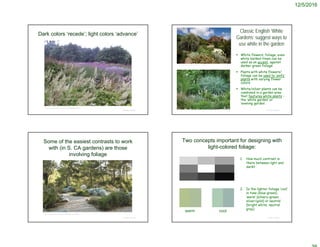
Some of the easiest contrasts to work
with (in S. CA gardens) are those
involving foliage
© Project SOUND
https://www.pinterest.com/pin/152559506104712395/
Two concepts important for designing with
light-colored foliage:
1. How much contrast is
there between light and
dark?
2. Is the lighter foliage ‘cool’
in tone (blue-green),
‘warm’ (silvery-green;
silver/gold) or neutral
(bright white; neutral
gray)
© Project SOUND
warm cool
12/5/2016
Secrets of
Mediterranean gardens
© Project SOUND
https://www.pinterest.com/pin/522206519262061613/
https://www.pinterest.com/pin/38632509282381226/
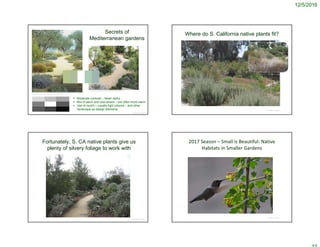
 Moderate contrast – fewer darks
 Mix of warm and cool silvers – but often more warm
 Use of mulch – usually light colored – and other
hardscape as design elements
Where do S. California native plants fit?
© Project SOUND
Fortunately, S. CA native plants give us
plenty of silvery foliage to work with
© Project SOUND
2017 Season – Small is Beautiful: Native 
Habitats in Smaller Gardens
© Project SOUND

Silver foliage 2016-notes

  • 1.
    12/5/2016 © Project SOUND Outof the Wilds and Into Your Garden Gardening with California Native Plants in Western L.A. County Project SOUND – 2016 (our 12th year) © Project SOUND Silvery Delights: gardening with white, gray and silver foliage C.M. Vadheim and T. Drake CSUDH (emeritus) & Madrona Marsh Preserve Madrona Marsh Preserve December 3 & 8, 2016 Rediscovering Eden: S. California Gardens for the 21st Century © Project SOUND Two important contrasts in S. CA (and other Mediterranean) gardens © Project SOUND Green vs. non-green Light vs. dark
  • 2.
    12/5/2016 California landscape paintersuse these contrasts to create lovely paintings © Project SOUND http://oceanquigley.blogspot.com/2010/09/new-series-of-california-landscape.html As do the best landscape designers © Project SOUND https://sissinghurstcastle.wordpress.com/2013/11/18/when-a-wheel-barrow-wont-do/ Our California native gardens succeed best when they take advantage of these contrasts © Project SOUND Many classic European ‘white gardens’ feature flowers © Project SOUND https://www.pinterest.com/explore/white-gardens/
  • 3.
    12/5/2016 Gardens with whiteflowers are enchanting by day © Project SOUND http://wefollowpics.com/moon-garden-all-white-flowers-and-gray-foliage-white-forget-me-nots-tulips-daisies-and-money-plants-combined-with- hostas-and-silvery-astelia-foliage/ …and even better with the fading light © Project SOUND Another name for white gardens is ‘moon gardens’ While temperate gardens showcase white flowers, Mediterranean gardens excel with light foliage © Project SOUND https://www.pinterest.com/pin/482307441324344276/ http://youreasygarden.com/simple-ways-to-use-white-in-the-garden/ Why do temperate and Mediterranean gardeners achieve their whites in different ways?  Temperate gardens are shadier (and therefore darker)  They have more shade trees and more overcast days  Bright white flowers and foliage really brighten up shadier gardens  White stands out better than the more muted silvery foliage types  Fortunately, temperate climates also have many white flowers – but less silvery foliage - to choose from © Project SOUND http://blog.theenduringgardener.com/holiday-at-sissinghurst/p1010369_2/
  • 4.
    12/5/2016 Why do temperateand Mediterranean gardeners achieve their whites in different ways?  Mediterranean climate gardens are sunnier (and therefore brighter)  They have fewer/less dense trees and fewer overcast days, brighter sunlight  Gardens are already light; whites don’t stand out as well  More muted silvery foliage – with a little color to the mix – looks better than neutral white in a bright garden  Fortunately, mediterranean climates also have many native silvery foliage plants to choose from – temperate gardeners envy us our silvery foliage © Project SOUND https://www.pinterest.com/pin/522206519262061613/ Two concepts important for designing with light-colored foliage: 1. How much contrast is there between light and dark (e.g. the degree or range of contrast)? 2. Is the lighter foliage ‘cool’ in tone (blue-green), ‘warm’ (silvery-green; silver/gold) or neutral (bright white; neutral gray) © Project SOUND warm cool Dark colors make us feel…  Solid, grounded  Heavy  Somber  Sober  Calm, serene © Project SOUND You probably would not like a garden that was all darks Dark colors ‘recede’; light colors ‘advance’ © Project SOUND https://www.pinterest.com/explore/white-gardens/
  • 5.
    12/5/2016 Dark colors ‘recede’;light colors ‘advance’ © Project SOUND http://www.freshdesignpedia.com/interior-design-ideas/ready-for-the-summer- furnishing-ideas-for-indoors-and-outdoors.html http://www.homedepot.com/p/Veranda-Windham-6-ft-H-x-6-ft-W-White-Vinyl-Fence- Panel-73002103/202297437 Large garden or small, background should be dark (unless there’s a really good reason to do otherwise) © Project SOUND http://www.gardenista.com/posts/trend-alert-black-fences/ Creating a ‘dark’ garden background  Planting dark evergreen shrubs  Painting walls/fences a dark, preferably grayed, color  Creating areas of shade © Project SOUND http://indulgy.com/post/WYfDcpGxQ1/the-white-garden-sissinghurst http://www.bobvila.com/slidesho w/awesome-accents-17-ways-to- make-any-space-pop-with-color- 46922#.WEIU5mcU-Uk http://www.readingeagle.com/life/article/garden-of-the-week-linda-yeager Dark colors are usually used for background…but not always © Project SOUND https://www.pinterest.com/pin/182466222379148078/ Light colored foliage can serve as a background for darker accent plants
  • 6.
    12/5/2016 Light/pale colors makeus feel:  Happy, peppy  Light (not heavy)  Excited  Summery  Like they are coming towards us  Near by; close to us © Project SOUND You probably would not like a garden that was all pastels Dark colors ‘recede’; light colors ‘advance’ © Project SOUND https://www.pinterest.com/pin/259449628502874271/ Light colors make us feel bright & summery © Project SOUND Ways of creating ‘light’ accents in the garden  Flowers with white/pale colors  Plants with white/silvery foliage  Hardscape  Pots and planters  Garden art  Walkway materials  Mulch, boulders, etc.  Lighting © Project SOUND http://pittsburghoutdoorlighting.com/tag/pittsburgh-landscape-lighting/
  • 7.
    12/5/2016 Light/pale colors areusually used as garden accents … but not always © Project SOUNDhttp://www.bulldogtools.co.uk/blog/2013/12/winter-garden-tools/ Two concepts important for designing with light-colored foliage: 1. How much contrast is there between light and dark? 2. Is the lighter foliage ‘cool’ in tone (blue-green), ‘warm’ (silvery-green; silver/gold) or neutral (bright white; neutral gray) © Project SOUND warm cool These two concepts help explain why temperate gardeners are so enchanted by mediterranean gardens © Project SOUND Let’s look at some actual landscapes © Project SOUND http://i.telegraph.co.uk/multimedia/archive/02407/Harlowcarr2_2407849b.jpg Clearly, a very high contrast garden
  • 8.
    12/5/2016 What about thistemperate white garden? © Project SOUND High contrast/neutral white Another high contrast/neutral white design © Project SOUND This is essentially the classic temperate zone ‘white garden’ © Project SOUND https://www.pinterest.com/pin/251146116692235608/ https://www.pinterest.com/pin/479703797795311305/ Another moderate contrast/cool silvers © Project SOUND https://www.pinterest.com/pin/163748136425865989/
  • 9.
    12/5/2016 © Project SOUND Brightwhite is neutral Warm, light colors : silvery greens and golds More ‘moderate contrast/warm silvery foliage’ © Project SOUND https://www.pinterest.com/pin/163748136427787424/ Where do Mediterranean gardens fit? © Project SOUND https://www.pinterest.com/pin/534661786995634673/ European mediteranean gardens feature many plants native to their region © Project SOUND
  • 10.
    12/5/2016 More Mediterranean gardens © ProjectSOUND https://www.pinterest.com/pin/522206519262061613/ https://www.pinterest.com/pin/38632509282381226/  Moderate contrast – fewer darks  Mix of warm and cool silvers – but often more warm  Use of mulch – usually light colored – and other hardscape as design elements Where do S. California native plants fit? © Project SOUND Which look is most appropriate for S. CA? © Project SOUND Advantages of designing with white/silver foliage (rather than white flowers)  Many such plants are water-wise  Foliage doesn’t fade (like white flowers do)  Many have best color in sunny places; but some are fine in low- light situations  Many to choose from (both S. CA natives and other mediterranean)  Lots of variability:  Size  Texture  Brightness © Project SOUND https://www.pinterest.com/pin/83035186858621967/
  • 11.
    12/5/2016 Benefits of designingwith silver/light foliage  Color is long-lasting (often year- round), not seasonal; easier to design with stationary contrasts  Easy to produce masses/swaths of color – year-round  Many size/height options: trees to low-growing plants  Colors tend to be soothing – whether you choose warm or cool silvers/lights  Foliage texture adds additional interest © Project SOUND Let’s discover some design clues by studying Mediterranean gardens © Project SOUND Start with a good dark background One common attribute of Mediterranean gardens: trees with silvery foliage © Project SOUND https://www.pinterest.com/pin/212865519863542396/ Some of the best native trees with silvery foliage are the manzanitas © Project SOUND
  • 12.
    12/5/2016 Several manzanitas havesilvery leaves  Bigberry manzanita (Arctostaphylos glauca)  ‘Lester Rountree’ manzanita  ‘John Dourley’ manzanita  Whiteleaf Manzanita (A. viscida ssp. viscida)  Diablo Blush Manzanita (A. auriculata)  Ghostly Manzanita (A. silvicola)  Ian Bush Manzanita (A. densiflora x A. pungens)  Laguna Manzanita (A. glandulosa adamsii). © Project SOUND © Project SOUND *Bishop manzanita – Arctostaphylos obispoensis ©1993 David Graber © Project SOUND *Bishop manzanita – Arctostaphylos obispoensis ©1993 David Graber ©2011 Chris Winchell http://ucjeps.berkeley.edu/eflora/eflora_display.php?tid=13958  Foothills of coastal mountains, Monterrey and San Luis Obispo Counties  Arctostaphylos obispoensis Eastwood [family ERICACEAE], Leafl. W. Bot., 2: 8. 1937 © Project SOUND Bishop manzanita: silvery foliage  Size:  5-10+ ft tall  5-10 ft wide  Growth form:  Woody shrub/small tree  Dense, mounded form  Attractive, dark red bark  Foliage:  Typical simple, rounded to lanceshaped manzanita leaves – somewhat leathery  Color: blue-green to gray- green – pretty color due to leaf hairs http://www.worldbotanical.com/arctostaphylos.htm ©2006 Steve Matson
  • 13.
    12/5/2016 © Project SOUND Prettyflowers & fruits  Blooms: late winter/early spring – Jan-Mar is usual  Flowers:  Small, white, urn-shaped flowers typical for manzanita  Attract hummingbirds, butterflies, large bees  Fruits:  Small (1/2 inch or less) ‘apple’ of the manzanitas  Edible and tasty – birds will eat if you don’t use them  Ripen in summer ©2016 Susan McDougall Gerald and Buff Corsi © California Academy of Sciences © Project SOUND Bishop manzanita: typical of Central Coast species  Soils:  Texture: adaptable (even clay)  pH: best with neutral to slightly acidic (pH: 6.0-7.0)  Light:  Full sun on coast  Part-shade everywhere else; fine under trees (bright shade)  Water:  Winter: need to supplement most years  Summer: occasional (Water Zone 1-2 to 2)  Fertilizer: none; likes poor soils  Other: use an organic mulch ©2011 Chris Winchell Most manzanitas have a nice, natural shape and need little pruning. Can be pruned up to small tree. © Project SOUND Bishop manzanita  Nice evergreen foundation or background shrub  Good under pines & other tall trees  Foliage color provides a nice accent for other green shrubs  Fine on dry slopes http://www.laspilitas.com/nature-of-california/plants/63--arctostaphylos-obispoensis- san-luis-obispo-manzanitahttps://en.wikipedia.org/wiki/Arctostaphylos_obispoensis © Project SOUND ‘Lester Rountree’ manzanita  Hybrid: A. pajaroensis X ? A. obispoensis  8-10 ft tall & wide  Open, sculptural growth habit  Light blue-green foliage – almost a gray- blue cast – nice as accent color http://www.cactusjungle.com/blog/category/california-native-plants/page/2/ http://farm1.static.flickr.com/84/268090756_f6a54c9577.jpg https://www.flickr.com/photos/mechanoid_dolly/4943065895
  • 14.
    12/5/2016 Use ‘Lester Rountree’in place of an olive tree © Project SOUNDhttps://www.pinterest.com/explore/mediterranean-garden/ The size is better suited for a smaller landscape © Project SOUND A waxy cuticle layer prevents moisture loss.  A common adaptation in plants from dry climates  Often found in combination with succulent (water- storing) foliage  Clues to a plant's surface type can often be found in its species name:  argentea denotes silver in general  glauca defines the moodier cast of waxy blue-greens. Inspiration from a Spanish garden: Palacio, Palma del Río, Provincia de Córdoba © Project SOUND http://www.mediterraneangardensociety.org/carmona-22.html#1 Manicured shrubs chosen for their foliage color Light foliage medium-size shrubs  Lavender – Lavandula spp  Lavender Cotton – Santolina chamaecyparissus  Lamb's ear (Stachys byzantina)  Artemisia – Artemisia ludoviciana ‘Silver Queen’ © Project SOUND Some common choices Usually dense foliage with small leaves – perfect for either natural or manicured look
  • 15.
    12/5/2016 The Artemisias arehard to beat for silvery foliage that ranges from white to gold © Project SOUND http://prairie476.rssing.com/chan-7188697/all_p5.html California sagebrush is known to most gardeners – but other great species merit attention © Project SOUND Coastal Sagewort - Artemisia pycnocephala © 2005 George W. Hartwell ‘David’s Choice’ Coastal Sagewort is readily available and well-loved © Project SOUND *Silver wormwood – Artemisia ludoviciana http://redrockcanyonopenspace.org/education/biology/sage/ © Project SOUND *Silver wormwood – Artemisia ludoviciana ©2012 Jean Pawek http://ucjeps.berkeley.edu/cgi-bin/draw_tiny2.pl?e4e3fcf507  Much of North America, from Canada south to Mexico  Locally – San Gabriel Mountain range  Aka ‘Prairie Sage’ in the nursery trade; widely available (best to get local source type) http://www.crossconservation.org/encyclopedia/prairie-sage
  • 16.
    12/5/2016 © Project SOUND Silverwormwood: luscious silvery foliage  Size:  1-2 ft tall  3-5 ft wide (species spreads)  Growth form:  Upright to mounded perennial or sub-shrub  Many upright stems (somewhat like Mugwort – bit more shrub-like  Foliage:  Lovely silvery to blue-green foliage – wonderful accent  Leaves like cross between mugwort & chrysanthemum - fragrant  Roots: net-like roots © 2005, Ben Legler © Project SOUND Flowers are inconsequential  Blooms: in spring – usually Feb- Apr in lowland LA County  Flowers:  Composite flowers (ray and disk flowers)  Flower heads are bell-shaped (like CA Sagebrush) on upright stems  Flowers small, yellow  Seeds: small, sunflower seeds – birds like them, and plants will re-seed  Vegetative reproduction: spreads via rhizomes 2010, Ron Bockelman © 2009, G. D. Carr © Project SOUND Easy-to-grow plant  Soils:  Texture: just about any – not particular and grows in many different soils in wilds.  pH: any local  Light:  Full sun to part-shade; needs at least a good 4 hours sun for good color.  Water:  Winter: needs adequate water  Summer: wide tolerance range, but best with some summer water (Water Zone 1-2 to 2)  Fertilizer: none; likes poor soils  Other: shallow organic mulch fine http://khkeeler.blogspot.com/2013/02/sages-garden-sage-and-sagebrush.html To look good, plants should be pruned back to 4-5 inches (or mowed) in fall – treat like Mugwort or Goldenrods © Project SOUND Wormwood: lots of potential  As a ground cover – alone or mixed with other natives (prairie planting)  As an accent plant in front of evergreen shrubs  In Mediterranean or herb garden  As an attractive pot plant http://www.wildflower.org/plants/result.php?id_plant=ARLU © 2010, Ron Bockelman https://commons.wikimedia.org/wiki/Category:Artemisia_ludoviciana
  • 17.
    12/5/2016 Artemisia ludoviciana ‘SilverKing’  Most like the species in terms of size, growth habit, appearance  Blue-green foliage  Widely available – garden adapted © Project SOUND http://www.paintedflowerfarm.com/pages/plants/natives/artem isia,silver-king.htm https://www.pinterest.com/pin/434386326528208910/ Artemisia ludoviciana ‘Silver Queen’  A bit more shrub-like and less apt to spread  Very silvery foliage  Refined appearance  Widely available – garden tested © Project SOUND http://www.zelen.cz/detail_galerie_rostlin/Artemisia_ludoviciana_Silver_Queen_pelyne k_Ludvikuv https://www.groeneparadijs.com/producten/tuinplanten/vaste-planten/artemisia- ludoviciana-silver-queen-westerse-bijvoet https://www.plantes-shopping.fr/articles/artemisia-ludoviciana-silver-queen- 1882.html Artemisia ludoviciana ‘Valerie Finnis’  Most refined appearance of cultivars  Looks like shrubby perennial  Larger leaves  Very light, attractive foliage  Probably the most widely available © Project SOUND http://www.ivydenegardens.co.uk/Mixed%20Border%20Herbaceous/artv aleriefinnis.html http://www.gardeningimpulse.ie/shop/artemisia-ludoviciana-valerie-finnis/ http://forums2.gardenweb.com/discussions/1600791/artemesia- ludoviciana-valerie-finnis-photo © Project SOUND Why some plants have white/silver foliage  Many silver/gray plants also use their hairs (trichomes) for defense against predation (mostly from insects)  Some hairs are sharp  Others secrete unpleasant chemicals  Some probably just present physical obstacles to smaller insects – or feel ugly to walk on  Protection is very important to plants that have a limited growing season. Dove Plant - Croton setagerus
  • 18.
    12/5/2016 Widely used medicinal plant Tea from leaves for stomach ache or sore throat  Tea from roots as laxative  Dry, powered leaves as snuff for head colds, headaches, sinus attacks  Strong tea as wash for eczema, deodorant and antiperspirant for underarms and feet  A wash of the leaves applied to itching, rashes, swellings, boils, sores  A poultice of leaves for sores and to relieve muscle pains © Project SOUND http://www.cannonvalleynursery.com/output/moreinfo/Artemisia_ludoviciana.asp http://www.crocus.co.uk/plants/_/artemisia-ludoviciana-valerie- finnis/classid.2000006631/ Atriplex species form dense shrubs that can be pruned to formal or informal shapes © Project SOUND http://www.mediterraneangardensociety.org/carmona-22.html They also provide warm, silvery tones © Project SOUND Other interesting explanations for ‘silvery’ foliage  The foliage of Saltbushes (Atriplex species) often has a sparkly silver appearance, providing an interesting foliage contrast in gardens  Silver appearance due to salt crystals secreted by special glands in the leaves  Allows the plants to live in salty soils – they simply excrete the excess salt  They need to be under some form of water stress, either drought, salt, or salt spray Why are Atriplex prized as pruned shrubs?  Fast growth rate; small or large  Evergreen  Dense branching pattern  Small leaves; densely packed on branches  Lovely pale foliage colors © Project SOUND http://www.jardinbotanico.uma.es/bbdd/index.php/jb-alm-02/ http://www.riomoros.com/2012/03/la-osagra-atriplex-halimus.html
  • 19.
    12/5/2016 We’ve visited several localspecies © Project SOUND Atriplex lentiformis Atriplex leucophylla Atrip[lex californica © Project SOUND Coast Quailbush: best in larger gardens  On banks and slopes; good for erosion control  As a screen or large hedge  At back of large beds  As an edible plant:  All parts are edible: roots, young shoots & seeds  Salty  As a fire-retardant plant  As a great addition to the native habitat garden http://www.sanjose.watersavingplants.com/eplant.php?plantnum=2 4532&return=s_aQ http://www.cnps.org/cnps/grownative/tips/native_garden_planning-part2.php © Project SOUND * Four-wing Saltbush – Atriplex canescens http://www.perennialfavoritesnursery.com/native_a-f.html © Project SOUND Saltbushes : Habitat plants par excellance!  Foliage  Attract beneficial insects to the garden - lacewings, ladybugs, and hoverflies  Many weird and fun insects – good plants for insect-watching  Attract butterflies (larval food for some sootywing skippers)  Fall/winter/spring browse for deer, elk  Dense cover for birds, rabbits, just about any ground-dweller  Seeds  Very nutritious food source – high in protein  Eaten by many creatures (including humans): don’t fertilize if you plant to eat them – takes up & stores many metals http://www.fs.fed.us/database/feis/plants/shrub/atrlen/plant.jpg
  • 20.
    12/5/2016 © Project SOUND Four-wingSaltbush used extensively in Southwestern  As a shrub in commercial plantings – low maintenance/little water  Excellent water-wise hedge  In plants with a desert plant palette – used like Salvias or Coyote Bush - silvery color  For erosion control  As a fire-retardant plant – with a little summer water  For re-claiming mine tailings & other environmental problems  Also used as dye plant (yellow & ‘Navajo Black’ & medicine (emetic) http://biology.burke.washington.edu/herbarium/imagecollection.php?Genus=Atriplex&Species=canescens http://www.delange.org/FourwingSaltbush/FourwingSaltbush.htm © Project SOUND *Shadscale saltbush – Atriplex confertifolia Gary A. Monroe, hosted by the USDA-NRCS PLANTS Database  W. North America from CA/OR to ND and south to AZ and TX. Greatest concentrations: Great Basin and Colorado Plateau  In CA, widely distributed in salt-desert shrublands of the Mojave (Lancaster; Barstow) and Great Basin deserts and in pinyon-juniper (Pinus- Juniperus spp.) woodlands, eastern Sierra Nevada © Project SOUND *Shadscale saltbush – Atriplex confertifolia ©2009 James M. Andre http://www.efloras.org/florataxon.aspx?flora_id=1&taxon_id=242415596 https://plantsofthesouthwest.com/collections/trees-shrubs © Project SOUND Shadscale is a silvery medium-size shrub  Size:  1-3 ft tall  1-3 ft wide  Growth form:  Mounded sub-shrub (part-woody); usually densely branched  Partly drought-deciduous  Short-lived (10 years)  Foliage:  Leaves simple, rounded  Silvery green due to excreted salt crystals  Used as salty seasoning; young foliage as cooked greens  Roots: deep w/ many fine roots ©2012 Jean Pawek ©2012 Neal Kramer ©2015 Steve Matson
  • 21.
    12/5/2016 © Project SOUND Seedsare showier than the flowers  Blooms: in spring - usually Apr-Jun in western LA Co.  Flowers:  Plants dioecious – separate male & female plants  Both types of flowers are small, yellow-green and visited by insect pollinators  Seeds:  Developing seeds may be pink in color – very showy  Seeds dry to gold; eaten by birds and animals  Seeds are edible ©2015 Steve Matson http://www.americansouthwest .net/plants/wildflowers/atriplex- confertifolia.html © Project SOUND Water-wise and tough plants  Soils:  Texture: best in well-drained; berm in others  pH: any local, including alkali  Light: full sun to part-shade  Water:  Winter: needs at least 6 inches – supplement if needed  Summer: wide range in wilds; best with occasional summer water (Water Zones 1-2 to 2)  Don’t over-water in summer; susceptible to soil fungal disease  Fertilizer: none; likes poor soils Charles Webber © California Academy of Sciences  Use a desert mulch: gravel or none © Project SOUND Adaptable Shadscale  As a silvery accent plant in a water- wise habitat garden  As a formal/semi-formal hedge  In a desert-themed garden  Around the edges of an edibles or herb garden  As an attractive pot plant http://chelseanursery.com/?page_id=358 https://plantsofthesouthwest.com/collections/trees-shrubs Human uses for saltbushes  Edible uses  Young foliage as cooked greens  Fresh or dried leaves as salty seasoning  Seeds for flavoring or as pinole  Medicinal uses  Poultice from foliage used for muscle pains, chest congestion  Decoction of foliage for respiratory illness  Other uses  Hard wood used for arrow points, tools © Project SOUND
  • 22.
    12/5/2016 © Project SOUND PruningSaltbushes - easy  In the wild, are eaten back extensively by deer, elk, rabbits  In the garden, you are the browser – with your pruners  Trim back about 1/3 the length of branches in fall for a neat look  don’t cut back into old wood – prune like a Salvia  will rejuvenate the plant  Can also hedge-shear  For best habitat value, leave some branches at the base – i.e., leave it pruned as a shrub http://commons.wikimedia.org/wiki/File:Atriplex_canescens_inflor.jpg http://allergy.peds.arizona.edu/southwest/grass_weeds/wingscale.htm Important summer/fall contrasts: dark buckwheat flowers with something light © Project SOUND High contrast with white-foliage sunflowers Lower contrast silvery Salvias and golden grasses S. CA has many light-foliage plants in the sunflower family (Asteraceae) © Project SOUND Many also have attractive (and useful) textures © Project SOUND
  • 23.
    12/5/2016 © Project SOUND Mediterraneanplants have other adaptations that make them interesting garden specimens  Further drought-related adaptations that help make silvers hardy in warmer, drier areas include:  Narrow leaves  Ability to roll leaf edges  Finely dissected or lobed leaves  All these adaptations can be used to add textural interest to the garden © Project SOUND * Guadalupe Island Rock Daisy – Perityle incana Nevin’s Wooly Sunflower/Catalina Silverlace Constancea (Eriophyllum) nevinii  S. Channel Islands (Santa Barbara, Santa Catalina, San Clemente Islands).  Recently re-classified as Constancea  After Lincoln Constance  An expert on plants of the parsley family  6 decade career in CA botany and systematics (taxonomy)  ‘Lincoln was the patriarch of botany at UC Berkeley’  Found on rocky coastal bluffs, coastal sage scrub http://ucjeps.berkeley.edu/cgi-bin/get_JM_treatment.pl?Eriophyllum+nevinii http://www.cnps.org/publications/fremontia/Fremontia_Vol29-No2.pdf Lincoln Constance Constancea (Eriophyllum) nevinii Catalina Silverlace
  • 24.
    12/5/2016 Catalina Silverlace issatisfyingly simple to grow  Soils: any well-drained  Light: full sun to part-shade  Nutrients: none needed  Water:  low needs; good for water- wise garden  Will take occasional water in summer  Maintenance:  Prune back severely in fall/winter when new growth is beginning to emerge Uses in the garden  In mixed beds  As a silver-white accent against darker green foliage  In rock gardens – remember, it grows on rocky cliffs  In a ‘silver’ garden  As an informal hedge  In large pots or planters  In a fire-resistant ground cover/shrub Where ever you would use ‘Dusty Millers’ ‘Canyon Silver’ cultivar  Size: slightly more compact  Foliage:  More silver-green; lighter color  Lacier leaves  Flower heads:  larger and held higher above the plant  Slightly flatter  More showy ‘Canyon Silver’ Species Frost-tender white- foliage plants  When a frost is predicted:  Water around the plant the day before  Cover with a loose cover (old sheet works well)  After frost damage occurs:  Resist the urge to prune immediately:  Not all is dead – hard to tell immediately  Dead foliage shields new growth  Prune once new growth is well- established (takes several months) © Project SOUND
  • 25.
    12/5/2016 © Project SOUND Leafhairs or scales reflect the sun’s hot rays, cooling the foliage  Hairy or scaly surfaces also protect leaves from drying winds by helping trap moisture.  Many are desert (or local) species.  Plant names that include tomentosum, pubescens, canescens, villosa, or lanata have downy leaves  These plants generally fall in the group of brighter, whiter grays. © Project SOUND Brittle Bush – Encelia farinosa © 2008 Scott Millard © Project SOUND Desert gardeners love Brittle Bush  Popular in desert landscaping  Good choice for mixed dry borders and rock gardens  Does well on dry slopes  Good choice for habitat gardens  Good for ‘Evening Garden’  Don’t plant: choose CA Encelia instead  Near coast  Any area near natural populations of CA Encelia http://ag.arizona.edu/pima/gardening/aridplants/Encelia_farinosa.html http://www.elnativogrowers.com/Photographs_page/encfar.htm California Brickelbush - Brickellia californica © Project SOUND
  • 26.
    12/5/2016 © Project SOUND *Woolybrickellbush – Brickellia incana ©2010 Lee Dittmann  Mojave and Sonoran Deserts of CA, AZ, NV; locally Riverside and San Bernardino Co.  First collected from Providence Mtns (JG Cooper) 1860-61 – named by A. Gray [1868]  MK Brandegee collected - Daggett, Nipton in 1914-15 © Project SOUND *Wooly brickellbush – Brickellia incana ©2008 Aaron Schusteff http://ucjeps.berkeley.edu/cgi-bin/get_cpn.pl?BRIN http://www.birdandhike.com/Veg/Species/Shrubs/Bricke_inc/_Bri_inc.htm © Project SOUND Wooly brickellbush: silvery desert shrub  Size:  1-4 ft tall  2-4 ft wide  Growth form:  Mostly evergreen sub-shrub  Upright to mounded form  Foliage usually dense  Attractive with just a little water  Foliage:  Silvery to white color due dense hairs (trichomes)  Leaves simple, oval ©2010 Lee Dittmann © Project SOUND Flowers: typical Brickellbush  Blooms: Anytime from spring to fall, depending on rains, temperatures  Flowers:  On white-hairy stems  Distinctive silvery bracts around the flower heads  Disk & ray flowers small, yellow-gold  Seeds:  Fluffy seeds are actually more showy than the flowers  Seed-eating birds will eat ©2010 Lee Dittmann
  • 27.
    12/5/2016 © Project SOUND Drought-tolerant Brickellbush Soils:  Texture: well-drained (or plant on slope of berm)  pH: any local  Light: full sun  Water:  Winter: needs good winter rains – at least 10 inches  Summer: best with occasional deep summer water (Water Zone 1-2)  Fertilizer: none; likes poor soils  Other: Shape will likely be better with late fall pruning (as with many drought-tolerant Sunflowers) © Project SOUND Shot of silver-white  Attractive accent plant in most local water-wise gardens  Looks lovely against evergreen background plants  Good habitat plant  Likely candidate for large containers ©2010 Lee Dittmann http://www.birdandhike.com/Veg/Species/Shrubs/Bricke_inc/_Bri_inc.htm https://dryheatblog.wordpress.com/2015/07/08/its-111-degrees-garden-visit/ Gardens can be enchanting with airy white plants that naturalize © Project SOUND © Project SOUND White Everlasting – Pseudognaphalium canescens
  • 28.
    12/5/2016 © Project SOUND Whiteeverlasting is very easy to grow  Soils:  Texture: any  pH: any local (5.0-8.0)  Light:  Full sun (best)  Part-shade – will be more leggy  Water:  Winter: can take short flooding  Summer: very drought tolerant (Zone 1 to 1-2 best)  Fertilizer: none; likes poor soils © Project SOUND White Everlasting is great for an ‘Evening Garden’  Most people include this species as a butterfly plant – larval food for American Lady  Excellent choice for an ‘Evening Garden’ – looks nice during the day but very striking in low-light situations  Makes an attractive pot plant; place where you can watch the butterflies  Let it naturalize to ‘tie the garden together’ with its white foliage American Lady larva http://www.theodorepayne.org/plants/ plants_for_butterflies.htm Very few native white shrubs provide both large white leaves and airy stalks © Project SOUND http://www.laspilitas.com/nature-of-california/plants/243--hazardia-detonsa J.S. Peterson, hosted by the USDA-NRCS PLANTS Database © Project SOUND Island hazardia – Hazardia detonsa
  • 29.
    12/5/2016  Mostly N.Channel Islands; a few specimens from San Clemente Island  Open, rocky hillsides, canyon walls, sea cliffs in coastal scrub, chaparral, pine woodland  First collected by Edward L. Greene, T.S. Brandegee  AKA: Island bristleweed  Interesting fact: in the Jerusalem Botanic Garden © Project SOUND Island hazardia – Hazardia detonsa http://ucjeps.berkeley.edu/eflora/eflora _display.php?tid=3184 ©2013 James Gonsman © Project SOUND Island hazardia: tough, resilient and pretty  Size:  3-8 ft tall (usually 3-4)  3-5 ft wide  Growth form:  Part-woody sub-shrub; somewhat like giant buckwheat  Fast-growing  Upright to mounded; most leaves in basal rosette, particularly when young  Foliage:  Leaves simple, succulent and fairly large (to 5 ½ inches)  White to blue-green color due to dense trichomes (hairs)  Very attractive foliage ©2009 Gary A. Monroe ©2014 Zoya Akulova © Project SOUND Flowers typical for Hazardia  Blooms: whenever conditions are right – spring to fall, but more likely summer-fall in garden  Flowers:  Small (less than ½ inch) composite heads – ray & disk flowers  Showy white involucral bracts, flowering stems above the foliage  Small flowers golden yellow – may be tinged with red  Attract insect pollinators  Hybridizes with other Hazardias – don’t plant near Preserves  Seeds: small, fluffy seeds – loved by finches Native sunflowers are easy to grow from seed  Collect dry seed when ripe – it will be blowing or birds eating it.  Plant soon; small seeds lose viability quickly  Any potting soil is fine – may want to add some vermiculite  Surface plant or just barely cover (need light to germinate)  Place in bright shade  Keep medium moist until seedlings are ready to transplant/plant out © Project SOUND ©2009 Zoya Akulova http://www.hazmac.biz/080728/080728HazardiaDetonsa.html
  • 30.
    12/5/2016 © Project SOUND Hazardiasare not particular  Soils:  Texture: most local soils (even clay) but prefers well-drained soils  pH: any local  Light: full sun on coast; part-shade (morning sun) elsewhere.  Water:  Winter: needs at least 10 inches  Summer: Semi-dry to 1-2 times per month in summer (Water Zone 1-2 to 2)  Fertilizer: none; likes poor soils; yearly ½ strength dose in containers  Other: remove spent flowering stalks in fall/winter©2014 Steve Matson © Project SOUND Silver for the garden  Contrast with green foliage associates like Laurel sumac (Malosma laurina) and Brickellia californica  Important plant for ‘Channel island’ theme  Can even be grown in large containers ©2015 Robert Sikora http://farm6.static.flickr.com/5285/5314495162_f70a9bcbd9.jpg Agaves are popular accent plants © Project SOUND https://www.pinterest.com/explore/mediterranean-garden/ http://www.bevbeverly.com/agave-garden-design.shtml Prized for both their unusual shapes and their silvery color © Project SOUND Agave attenuata: a Mexican species available in the U.S. http://www.geographylists.com/sandiegoplants.html http://www.cactusjungle.com/blog/2008/09/30/berkeley-succulent-garden-3/
  • 31.
    12/5/2016 © Project SOUND *CoastalAgave – Agave shawii © 2005 Vince Scheidt © Project SOUND Agave ‘Blue Flame’  Combines the features of its parent species: A. shawii X A. attenuata http://www.smgrowers.com/products/plants/plantdisplay.asp?plant_id=2871 http://www.huntington.org/BotanicalDiv/ISI2005/isi/2005-06.html © Project SOUND *Desert agave – Agave deserti ©2005 Dee E. Warenycia  Mojave Desert & desert mountains; Imperial, San Bernardino, Riverside, San Diego Counties  Anza Borrego Desert, Palm desert and on the arroyos below the western slopes of the San Bernardino Mountains. There is also a small concentration at a base level of the Providence Mountains in the Mojave Desert  AKA: Maguey de Desierto; Desert century plant © Project SOUND *Desert agave – Agave deserti Glenn and Martha Vargas © California Academy of Sciences http://www.efloras.org/florataxon.aspx?flora_id=1&taxon_id=242101305 http://online.sfsu.edu/bholzman/courses/Fall00Projects/3Agavedeserti.html
  • 32.
    12/5/2016 Native sub-species available ssp. deserti - south-central CA, Baja  Offsets prolifically; sometimes large colonies.  Pale silvery (or greenish-silver) leaves  Typical rosette 2' high and wide; some larger & hardier forms from San Jacinto Mountains  Easy to grow  ssp. simplex – AZ, mountains of Mojave Desert, CA  Usually solitary or produces few offsets  frequently have very strong horizontal banding on the leaves, a striking feature.  slow grower and appreciates dry, gritty soil and heat. it ought to do well in the Pacific Northwest also. © Project SOUND ©2007 Charles E. Jones © Project SOUND Showy native agave  Size:  1-2 ft tall  2-3 ft wide  Growth form:  Evergreen succulent with typical agave form  Leaves, flower stalks edible, useful (cordage)  Foliage:  Silvery or blue-green, sword- shaped leaves; armed  Leaves from basal rosette ©2005 Richard Zmasek http://swbiodiversity.org/seinet/collections/individual/index.php?occid=3195373 © Project SOUND Flowers: unbelievable  Blooms: usually late spring (June) in Western LA County  Flowers:  Plants bloom only after enough energy stored – 8-20+ years  20 ft flowering stalk – grows inches per day  Showy yellow flowers attract hummingbirds – desert bat pollinator  Parent plant dies after seeding  Vegetative reproduction: Most commonly available types either sucker or not ©2005 Richard Zmasek ©2005 Dee E. Warenycia © Project SOUND Tough desert plant  Soils:  Texture: will grow in most – best in well-drained  pH: any local including alkali  Light: full sun; young plants grow to N. of grass nurse plants in wilds  Water:  Winter: needs at least 6-8 inches – supplement if needed  Summer: very drought tolerant (Zone 1 to 1-2 – occasional water to simulate Aug. ‘monsoon’) ; rapid response to rains;  Fertilizer: none; likes poor soils  Other:  No mulch or gravel  Low maintenance; carefully remove dead leaves, plants ©2006 J. Zylstra, SBNF
  • 33.
    12/5/2016 © Project SOUND DramaticDesert agave  As a dramatic accent plant – even in containers  Tough, easy groundcover – good for hot, dry slopes  In desert-themed gardens, rock gardens ©2009 Thomas Stoughton ©2014 William Flaxington http://www.desertnorthwest.com/articles/domestic_agaves.html Hardscape plays a key role in Mediterranean gardens © Project SOUND https://www.pinterest.com/pin/534732 155736778905/ Agaves & other succulents in containers?  Choose the right plant: small- medium, slow-growing species are easiest  Choose the right container – large and deep (most important)  Choose the right planting medium (based on natural conditions for plant)  Locate in an area that gets some summer shade  Give yearly ½ strength fertilizer  Water: Zone 2 to 3 © Project SOUND Next month we’ll return to container gardening © Project SOUND https://www.pinterest.com/pin/227361481166598111/
  • 34.
    12/5/2016 © Project SOUND *Desertholly – Atriplex hymenelytra  Mojave Desert and Sonoran Deserts (CA, AZ, NV, UT, northern Baja CA)  Alkaline locations such as desert dry wash and creosote bush scrub  Usually on hilly and rocky areas and in canyon washes rather than lower playas © Project SOUND *Desert holly – Atriplex hymenelytra ©2010 Neal Kramer http://www.efloras.org/florataxon.aspx?flora_id=1&taxon_id=242415594 © Project SOUND Desert holly: dense medium-size shrub  Size:  2-3 ft tall  2-3+ ft wide  Growth form:  Evergreen shrub/sub-shrub  Form: mounded to somewhat open  Slow-growing  Foliage:  Silvery white to silver-green  Salt excretions produce the silvery patina  Leaves look like holly leaves  Roots: deep if well-established http://www.werc.usgs.gov/outreach.aspx?RecordID=164 https://commons.wikimedia.org/wiki/File:Atriplex_hymenelytra_form.jpg http://macskamoksha.com/2016/03/ecosystems-risk-4-death-valley © Project SOUND Seeds are showy  Blooms: winter to early spring: usually Jan-Apr.  Flowers:  Plant usually dioecious in wild; may have both sexes in cultivation  Flowers small, yellow-green, not very visible or remarkable  Seeds:  Developing seeds can be bright pink – attractive  Seeds provide food for birds, small animals. ?Probably high nutrient value. http://www.werc.usgs.gov/outreach.aspx?RecordID=164 http://www.abdnha.org/pages/03flora/family/amaranthaceae/atriplex_hymenelytra.htm
  • 35.
    12/5/2016 © Project SOUND Harshdesert slopes  Soils:  Texture: well-drained; sandy, rocky or gravelly  pH: best with alkali (pH > 7.5); fine with salty soils  Light: full sun  Water:  Establishment: needs adequate deep water for root development  Winter: at least 6 inches  Summer: best quite dry (give water in June & August - or just wash off the foliage).  Very drought tolerant once established – needs some stress  Fertilizer: none; likes poor soils  Other: gravel or no mulch; not cold tolerant Margaret Williams, hosted by the USDA-NRCS PLANTS Database http://www.calflora.net/recentfieldtrips/deathvalley12C.html © Project SOUND Try Desert holly in a container  As an attractive pot plant  Grow with its native associates: Sphaeralcea ambigua, Encelia farinosa ©2012 Jean Pawek http://www.desertusa.com/flowers/Desert-Holly.html https://www.flickr.com/photos/21529332@N08/8109508685 Rediscovering Eden: S. California Gardens for the 21st Century © Project SOUND Beautiful gardens rely on planned contrasts © Project SOUND https://sissinghurstcastle.wordpress.com/2014/10/23/researching-the-white- garden/the-same-statue-and-pear-tree-later-in-the-20th-century/#main
  • 36.
    12/5/2016 Dark colors ‘recede’;light colors ‘advance’ © Project SOUND https://www.pinterest.com/pin/259449628502874271/ © Project SOUND Classic English ‘White Gardens’ suggest ways to use white in the garden  White flowers, foliage, even white barked trees can be used as an accent, against darker green foliage  Plants with white flowers/ foliage can be used to ‘unify’ plants with varying flower colors  White/silver plants can be combined in a garden area that features white plants – the ‘white garden’ or ‘evening garden’. http://www.friendsschoolplantsale.com/page/2/ http://www.flickr.com/photos/robroy/977716219/ Some of the easiest contrasts to work with (in S. CA gardens) are those involving foliage © Project SOUND https://www.pinterest.com/pin/152559506104712395/ Two concepts important for designing with light-colored foliage: 1. How much contrast is there between light and dark? 2. Is the lighter foliage ‘cool’ in tone (blue-green), ‘warm’ (silvery-green; silver/gold) or neutral (bright white; neutral gray) © Project SOUND warm cool
  • 37.
    12/5/2016 Secrets of Mediterranean gardens ©Project SOUND https://www.pinterest.com/pin/522206519262061613/ https://www.pinterest.com/pin/38632509282381226/  Moderate contrast – fewer darks  Mix of warm and cool silvers – but often more warm  Use of mulch – usually light colored – and other hardscape as design elements Where do S. California native plants fit? © Project SOUND Fortunately, S. CA native plants give us plenty of silvery foliage to work with © Project SOUND 2017 Season – Small is Beautiful: Native  Habitats in Smaller Gardens © Project SOUND