© Project SOUND
Out of the Wilds and Into Your Garden
Gardening with California Native Plants in Western L.A. County
Project SOUND – 2017 (our 13th year)
© Project SOUND
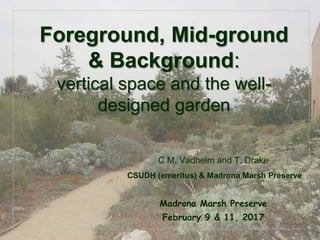
Foreground, Mid-ground
& Background:
vertical space and the well-
designed garden
C.M. Vadheim and T. Drake
CSUDH (emeritus) & Madrona Marsh Preserve
Madrona Marsh Preserve
February 9 & 11, 2017
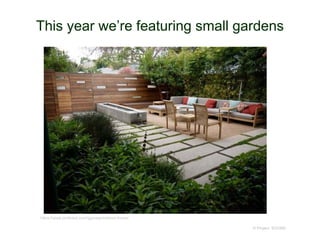
This year we’re featuring small gardens
© Project SOUND
https://www.pinterest.com/ggmaas/exterior-home/
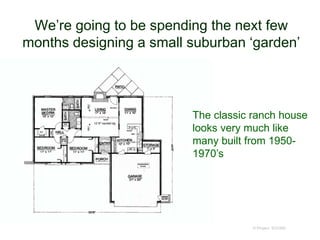
We’re going to be spending the next few
months designing a small suburban ‘garden’
© Project SOUND
The classic ranch house
looks very much like
many built from 1950-
1970’s
© Project SOUND
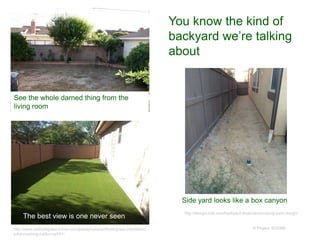
http://design-milk.com/backyard-blues-landscaping-yard-design/
You know the kind of
backyard we’re talking
about
http://www.artificialgrass-irvine.com/grassphotos/artificial-grass-installation-
johannesburg-california/651/
See the whole darned thing from the
living room
Side yard looks like a box canyon
The best view is one never seen
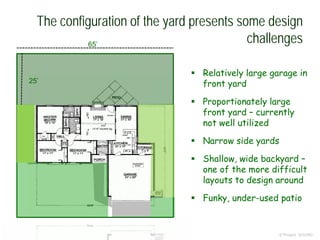
The configuration of the yard presents some design
challenges
 Relatively large garage in
front yard
 Proportionately large
front yard – currently
not well utilized
 Narrow side yards
 Shallow, wide backyard –
one of the more difficult
layouts to design around
 Funky, under-used patio
© Project SOUND
65’
25’
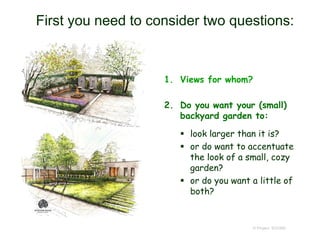
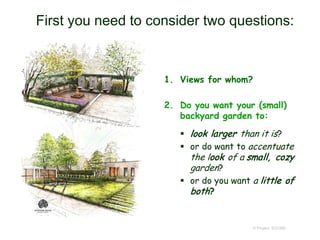
First you need to consider two questions:
1. Views for whom?
2. Do you want your (small)
backyard garden to:
 look larger than it is?
 or do want to accentuate
the look of a small, cozy
garden?
 or do you want a little of
both?
© Project SOUND
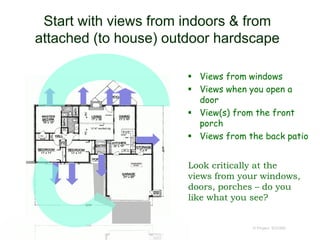
Start with views from indoors & from
attached (to house) outdoor hardscape
 Views from windows
 Views when you open a
door
 View(s) from the front
porch
 Views from the back patio
© Project SOUND
Look critically at the
views from your windows,
doors, porches – do you
like what you see?
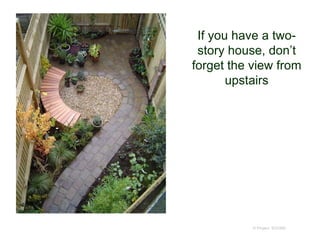
If you have a two-
story house, don’t
forget the view from
upstairs
© Project SOUND
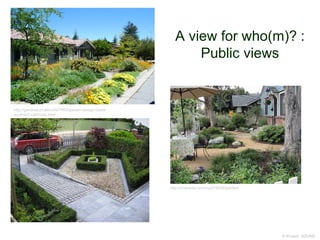
A view for who(m)? :
Public views
© Project SOUND
http://gardkebun.website/7993/garden-design-ideas-
southern-california.html
http://imanada.com/nu/215538/garden/
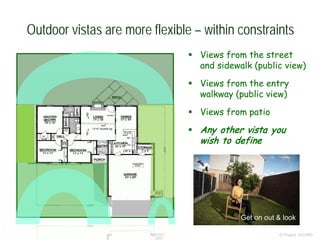
Outdoor vistas are more flexible – within constraints
 Views from the street
and sidewalk (public view)
 Views from the entry
walkway (public view)
 Views from patio
 Any other vista you
wish to define
© Project SOUND
Get on out & look
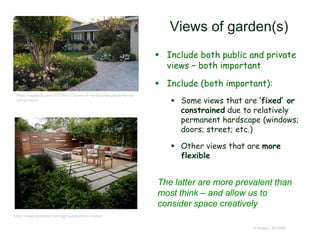
Views of garden(s)
 Include both public and private
views – both important
 Include (both important):
 Some views that are ‘fixed’ or
constrained due to relatively
permanent hardscape (windows;
doors; street; etc.)
 Other views that are more
flexible
© Project SOUND
https://ocjackie.com/2012/08/27/some-of-my-favorite-plants-for-so-
cal-gardens/
https://www.pinterest.com/ggmaas/exterior-home/
The latter are more prevalent than
most think – and allow us to
consider space creatively
First you need to consider two questions:
1. Views for whom?
2. Do you want your (small)
backyard garden to:
 look larger than it is?
 or do want to accentuate
the look of a small, cozy
garden?
 or do you want a little of
both?
© Project SOUND
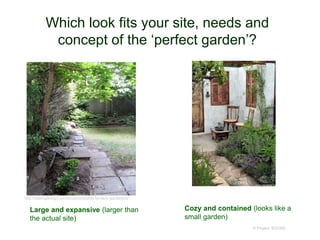
Which look fits your site, needs and
concept of the ‘perfect garden’?
© Project SOUND
Large and expansive (larger than
the actual site)
Cozy and contained (looks like a
small garden)
http://seeingdesign.com/projects/plants-for-lazy-gardeners/
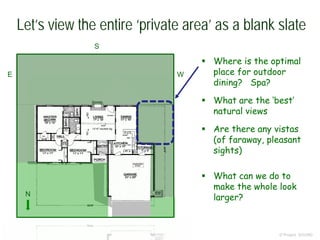
Let’s view the entire ‘private area’ as a blank slate
© Project SOUND
 Where is the optimal
place for outdoor
dining? Spa?
 What are the ‘best’
natural views
 Are there any vistas
(of faraway, pleasant
sights)
 What can we do to
make the whole look
larger?N
WE
S
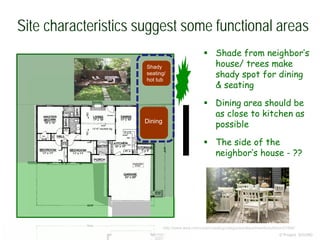
Site characteristics suggest some functional areas
© Project SOUND
 Shade from neighbor’s
house/ trees make
shady spot for dining
& seating
 Dining area should be
as close to kitchen as
possible
 The side of the
neighbor’s house - ??
Shady
seating/
hot tub
Dining
http://www.ikea.com/us/en/catalog/categories/departments/outdoor/21964/
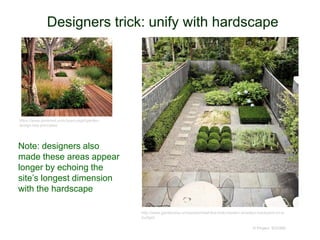
Designers trick: unify with hardscape
© Project SOUND
https://www.pinterest.com/quercusgd/garden-
design-key-principles/
http://www.gardenista.com/posts/steal-this-look-modern-brooklyn-backyard-on-a-
budget/
Note: designers also
made these areas appear
longer by echoing the
site’s longest dimension
with the hardscape
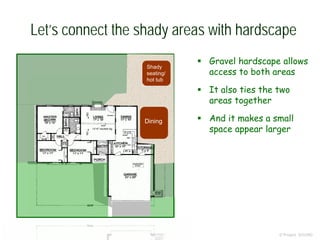
Let’s connect the shady areas with hardscape
© Project SOUND
 Gravel hardscape allows
access to both areas
 It also ties the two
areas together
 And it makes a small
space appear larger
Shady
seating/
hot tub
Dining
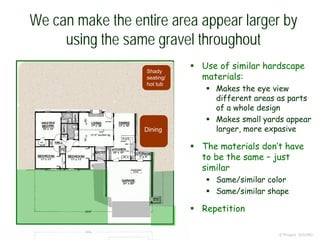
We can make the entire area appear larger by
using the same gravel throughout
© Project SOUND
 Use of similar hardscape
materials:
 Makes the eye view
different areas as parts
of a whole design
 Makes small yards appear
larger, more expasive
 The materials don’t have
to be the same – just
similar
 Same/similar color
 Same/similar shape
 Repetition
Shady
seating/
hot tub
Dining
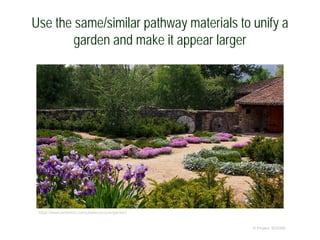
Use the same/similar pathway materials to unify a
garden and make it appear larger
© Project SOUND
https://www.pinterest.com/juliettevanzyve/garden/
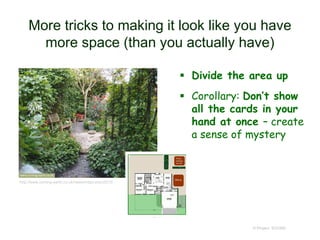
More tricks to making it look like you have
more space (than you actually have)
 Divide the area up
 Corollary: Don’t show
all the cards in your
hand at once – create
a sense of mystery
© Project SOUND
http://www.turning-earth.co.uk/news/index.php/2013/
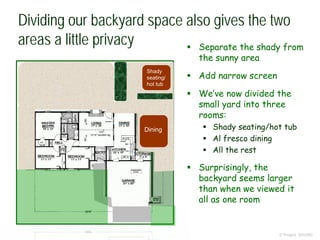
Dividing our backyard space also gives the two
areas a little privacy
© Project SOUND
 Separate the shady from
the sunny area
 Add narrow screen
 We’ve now divided the
small yard into three
rooms:
 Shady seating/hot tub
 Al fresco dining
 All the rest
 Surprisingly, the
backyard seems larger
than when we viewed it
all as one room
Shady
seating/
hot tub
Dining
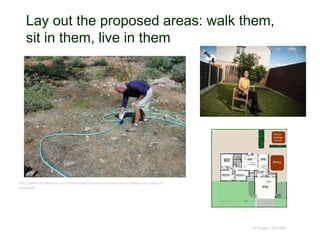
Lay out the proposed areas: walk them,
sit in them, live in them
© Project SOUND
http://www.diynetwork.com/how-to/outdoors/structures/how-to-design-an-outdoor-
waterfall
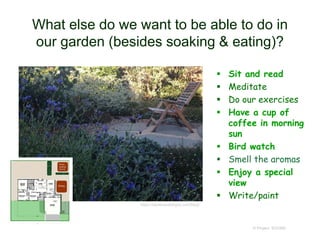
What else do we want to be able to do in
our garden (besides soaking & eating)?
 Sit and read
 Meditate
 Do our exercises
 Have a cup of
coffee in morning
sun
 Bird watch
 Smell the aromas
 Enjoy a special
view
 Write/paint
© Project SOUND
https://lapelusodesigns.com/blog/
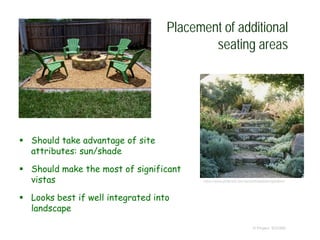
Placement of additional
seating areas
 Should take advantage of site
attributes: sun/shade
 Should make the most of significant
vistas
 Looks best if well integrated into
landscape
© Project SOUND
https://www.pinterest.com/amanthawalden/gardens/
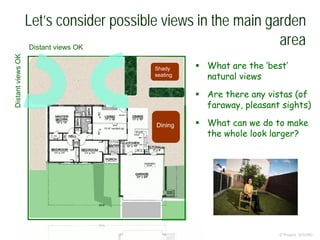
Let’s consider possible views in the main garden
area
© Project SOUND
 What are the ‘best’
natural views
 Are there any vistas (of
faraway, pleasant sights)
 What can we do to make
the whole look larger?
Shady
seating
Dining
Distant views OK
DistantviewsOK
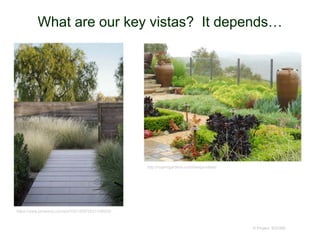
What are our key vistas? It depends…
© Project SOUND
https://www.pinterest.com/pin/105130972531729525/
http://rogersgardens.com/design-ideas/
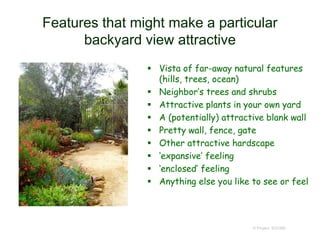
Features that might make a particular
backyard view attractive
 Vista of far-away natural features
(hills, trees, ocean)
 Neighbor’s trees and shrubs
 Attractive plants in your own yard
 A (potentially) attractive blank wall
 Pretty wall, fence, gate
 Other attractive hardscape
 ‘expansive’ feeling
 ‘enclosed’ feeling
 Anything else you like to see or feel
© Project SOUND
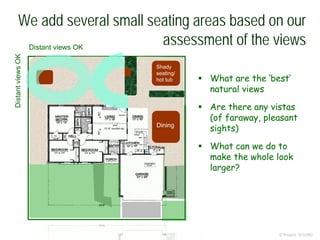
We add several small seating areas based on our
assessment of the views
© Project SOUND
 What are the ‘best’
natural views
 Are there any vistas
(of faraway, pleasant
sights)
 What can we do to
make the whole look
larger?
Shady
seating/
hot tub
Dining
Distant views OK
DistantviewsOK
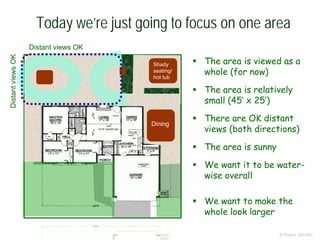
Today we’re just going to focus on one area
© Project SOUND
 The area is viewed as a
whole (for now)
 The area is relatively
small (45’ x 25’)
 There are OK distant
views (both directions)
 The area is sunny
 We want it to be water-
wise overall
 We want to make the
whole look larger
Shady
seating/
hot tub
Dining
Distant views OK
DistantviewsOK
© Project SOUND
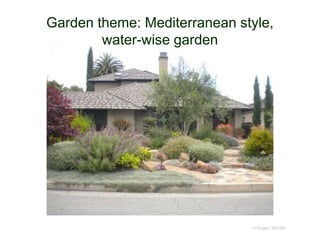
Garden theme: Mediterranean style,
water-wise garden
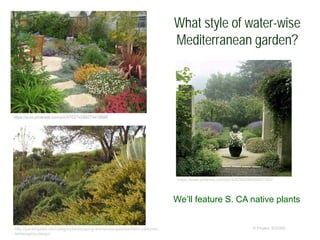
What style of water-wise
Mediterranean garden?
© Project SOUNDhttp://gardengates.info/category/landscaping-and-landscapes/southern-california-
landscaping-design/
https://www.pinterest.com/pin/426364289694847260/
We’ll feature S. CA native plants
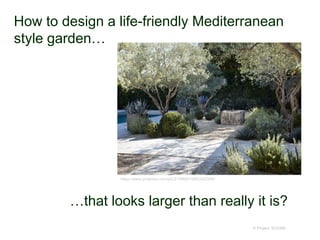
How to design a life-friendly Mediterranean
style garden…
© Project SOUND
https://www.pinterest.com/pin/212865519863542396/
…that looks larger than really it is?
© Project SOUND
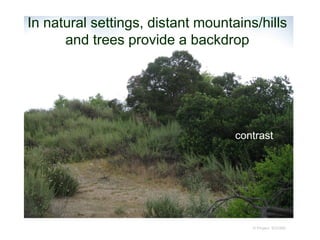
contrast
In natural settings, distant mountains/hills
and trees provide a backdrop
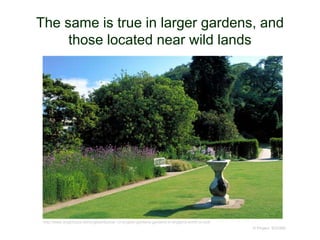
The same is true in larger gardens, and
those located near wild lands
© Project SOUND
http://www.anglotopia.net/anglophilia/top-12-english-gardens-gardens-in-england-worth-a-visit/
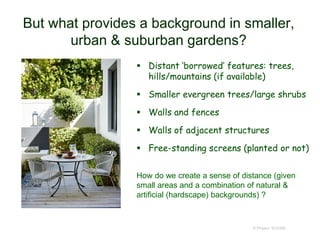
But what provides a background in smaller,
urban & suburban gardens?
 Distant ‘borrowed’ features: trees,
hills/mountains (if available)
 Smaller evergreen trees/large shrubs
 Walls and fences
 Walls of adjacent structures
 Free-standing screens (planted or not)
© Project SOUND
How do we create a sense of distance (given
small areas and a combination of natural &
artificial (hardscape) backgrounds) ?
When you take a painting class, you learn
about the importance of perspective
© Project SOUND
http://www.mariewise.com/2015/11/01/notre-dame-cathedral-the-final/
e.g., how to trick the
eye into perceiving
depth in a two-
dimensional painting
Illusion works – particularly when well done
© Project SOUND
http://www.nhm.org/site/explore-exhibits/permanent-exhibits/north-american-mammals http://www.huffingtonpost.com/ross-macphee/natural-
history-dioramas-_b_1975451.html
http://wallpaper-gallery.net/wallpapers/frozen-wallpaper-hd.html
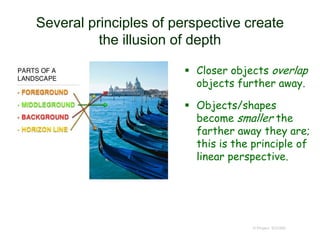
Several principles of perspective create
the illusion of depth
 Closer objects overlap
objects further away.
 Objects/shapes
become smaller the
farther away they are;
this is the principle of
linear perspective.
© Project SOUND
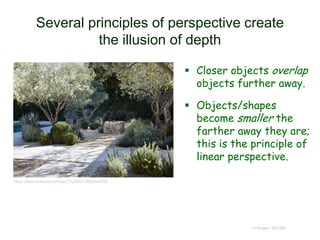
Several principles of perspective create
the illusion of depth
 Closer objects overlap
objects further away.
 Objects/shapes
become smaller the
farther away they are;
this is the principle of
linear perspective.
© Project SOUND
https://www.pinterest.com/pin/212865519863542396/
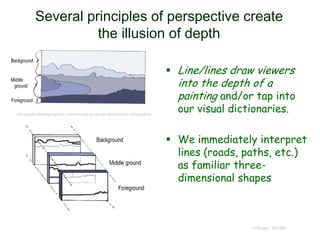
Several principles of perspective create
the illusion of depth
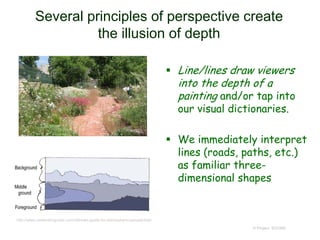
 Line/lines draw viewers
into the depth of a
painting and/or tap into
our visual dictionaries.
 We immediately interpret
lines (roads, paths, etc.)
as familiar three-
dimensional shapes
© Project SOUND
http://www.celebratingcolor.com/ultimate-guide-for-atmospheric-perspective/
Several principles of perspective create
the illusion of depth
 Line/lines draw viewers
into the depth of a
painting and/or tap into
our visual dictionaries.
 We immediately interpret
lines (roads, paths, etc.)
as familiar three-
dimensional shapes
© Project SOUND
http://www.celebratingcolor.com/ultimate-guide-for-atmospheric-perspective/
Creating the illusion of depth (painting)
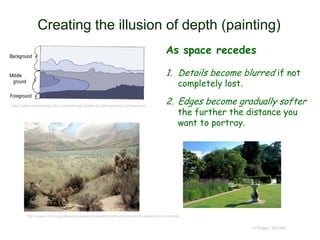
As space recedes
1. Details become blurred if not
completely lost.
2. Edges become gradually softer
the further the distance you
want to portray.
© Project SOUND
http://www.celebratingcolor.com/ultimate-guide-for-atmospheric-perspective/
http://www.nhm.org/site/explore-exhibits/permanent-exhibits/north-american-mammals
Creating the illusion of
depth (garden design)
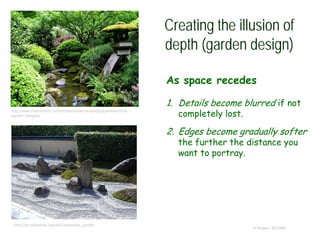
As space recedes
1. Details become blurred if not
completely lost.
2. Edges become gradually softer
the further the distance you
want to portray.
© Project SOUND
http://www.interiorholic.com/outdoors/landscaping/japanese-stroll-
garden-designs/
http://en.wikipedia.org/wiki/Japanese_garden
Creating the illusion of depth (painting)
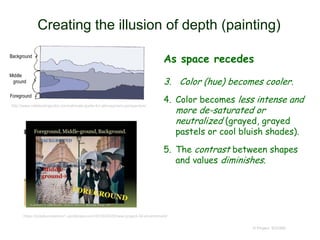
As space recedes
3. Color (hue) becomes cooler.
4. Color becomes less intense and
more de-saturated or
neutralized (grayed, grayed
pastels or cool bluish shades).
5. The contrast between shapes
and values diminishes.
© Project SOUND
http://www.celebratingcolor.com/ultimate-guide-for-atmospheric-perspective/
https://sotafoundations1.wordpress.com/2016/04/25/new-project-3d-environment/
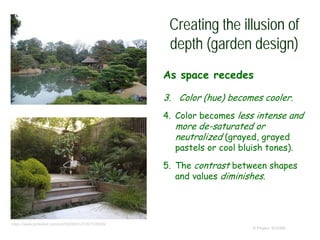
Creating the illusion of
depth (garden design)
As space recedes
3. Color (hue) becomes cooler.
4. Color becomes less intense and
more de-saturated or
neutralized (grayed, grayed
pastels or cool bluish tones).
5. The contrast between shapes
and values diminishes.
© Project SOUND
https://www.pinterest.com/pin/550565123167535855/
© Project SOUND
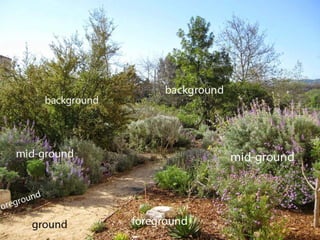
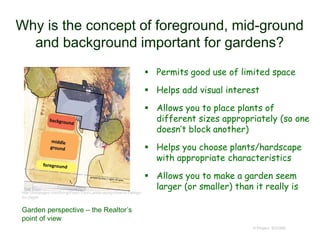
Why is the concept of foreground, mid-ground
and background important for gardens?
 Permits good use of limited space
 Helps add visual interest
 Allows you to place plants of
different sizes appropriately (so one
doesn’t block another)
 Helps you choose plants/hardscape
with appropriate characteristics
 Allows you to make a garden seem
larger (or smaller) than it really is
© Project SOUND
http://hubpages.com/living/Front-Yard-Landscaping-How-to-Design-
for-Depth
Garden perspective – the Realtor’s
point of view
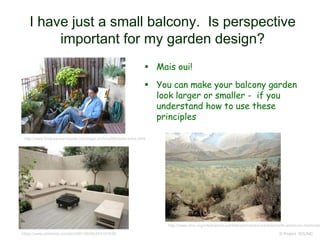
I have just a small balcony. Is perspective
important for my garden design?
 Mais oui!
 You can make your balcony garden
look larger or smaller - if you
understand how to use these
principles
© Project SOUND
http://www.findpeaceandquiet.com/page-archive/lifestyles-luhrs.html
https://www.pinterest.com/pin/393150242453181538/
http://www.nhm.org/site/explore-exhibits/permanent-exhibits/north-american-mammals
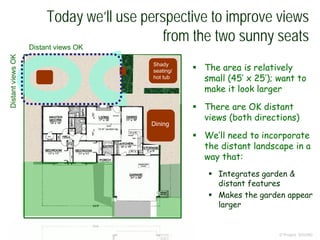
Today we’ll use perspective to improve views
from the two sunny seats
© Project SOUND
 The area is relatively
small (45’ x 25’); want to
make it look larger
 There are OK distant
views (both directions)
 We’ll need to incorporate
the distant landscape in a
way that:
 Integrates garden &
distant features
 Makes the garden appear
larger
Shady
seating/
hot tub
Dining
Distant views OK
DistantviewsOK
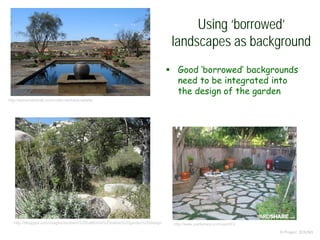
Using ‘borrowed’
landscapes as background
© Project SOUND
http://annemariehall.com/rustic-santaluz-estate/
http://blogqpot.com/images/southern%20california%20native%20garden%20design
 Good ‘borrowed’ backgrounds
need to be integrated into
the design of the garden
http://www.yardshare.com/yard/E3
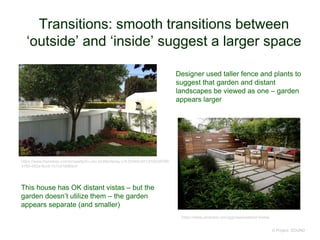
Transitions: smooth transitions between
‘outside’ and ‘inside’ suggest a larger space
© Project SOUND
https://www.pinterest.com/ggmaas/exterior-home/
https://www.homebay.com/property/9-Lilac-St-Monterey-CA-93940-5413/55539799-
4160-492e-9cc5-7c7c018969c4
This house has OK distant vistas – but the
garden doesn’t utilize them – the garden
appears separate (and smaller)
Designer used taller fence and plants to
suggest that garden and distant
landscapes be viewed as one – garden
appears larger
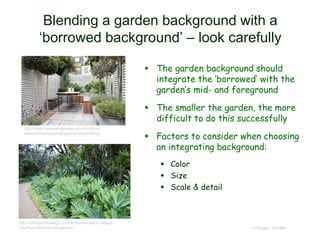
Blending a garden background with a
‘borrowed background’ – look carefully
 The garden background should
integrate the ‘borrowed’ with the
garden’s mid- and foreground
 The smaller the garden, the more
difficult to do this successfully
 Factors to consider when choosing
an integrating background:
 Color
 Size
 Scale & detail
© Project SOUND
http://www.houseandgarden.co.uk/outdoor-
spaces/features/small-garden-ideas-design
http://dlivingstondesign.com/donna-livingston-design-
southern-california-life-garden/
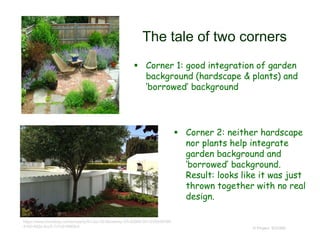
The tale of two corners
 Corner 1: good integration of garden
background (hardscape & plants) and
‘borrowed’ background
© Project SOUND
 Corner 2: neither hardscape
nor plants help integrate
garden background and
‘borrowed’ background.
Result: looks like it was just
thrown together with no real
design.
https://www.homebay.com/property/9-Lilac-St-Monterey-CA-93940-5413/55539799-
4160-492e-9cc5-7c7c018969c4
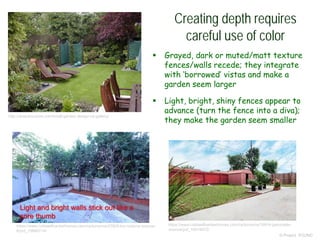
Creating depth requires
careful use of color
 Grayed, dark or muted/matt texture
fences/walls recede; they integrate
with ‘borrowed’ vistas and make a
garden seem larger
 Light, bright, shiny fences appear to
advance (turn the fence into a diva);
they make the garden seem smaller
© Project SOUND
http://wrapdcouture.com/small-garden-design-uk-gallery/
https://www.coldwellbankerhomes.com/ca/torrance/18816-patronella-
avenue/pid_16019472/
https://www.coldwellbankerhomes.com/ca/torrance/23808-los-codona-avenue-
6/pid_15860714/
Light and bright walls stick out like a
sore thumb
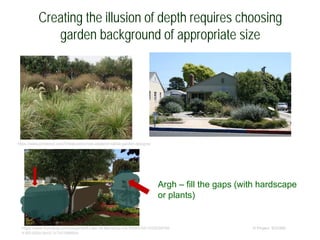
Creating the illusion of depth requires choosing
garden background of appropriate size
© Project SOUNDhttps://www.homebay.com/property/9-Lilac-St-Monterey-CA-93940-5413/55539799-
4160-492e-9cc5-7c7c018969c4
https://www.pinterest.com/Vitexlucens/new-zealand-native-garden-designs/
Argh – fill the gaps (with hardscape
or plants)
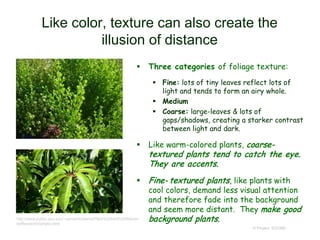
Like color, texture can also create the
illusion of distance
 Three categories of foliage texture:
 Fine: lots of tiny leaves reflect lots of
light and tends to form an airy whole.
 Medium
 Coarse: large-leaves & lots of
gaps/shadows, creating a starker contrast
between light and dark.
 Like warm-colored plants, coarse-
textured plants tend to catch the eye.
They are accents.
 Fine- textured plants, like plants with
cool colors, demand less visual attention
and therefore fade into the background
and seem more distant. They make good
background plants.
© Project SOUND
http://www.public.asu.edu/~camartin/plants/Plant%20html%20files/sc
heffleraactinophylla.html
Creating the illusion of depth requires
attention to scale & texture of background
© Project SOUND
http://www.designrulz.com/outdoor-design/garden/2012/05/10-awesome-fences-
created-from-recycled-sports-gear/
http://maxpixel.freegreatpicture.com/Bushes-Red-Leaves-Hedge-Haie-Fleurie-
Fothinia-891354
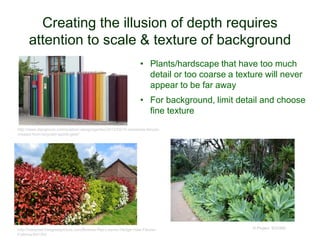
• Plants/hardscape that have too much
detail or too coarse a texture will never
appear to be far away
• For background, limit detail and choose
fine texture
Let’s apply these concepts to designing a view
from the middle seat
© Project SOUND
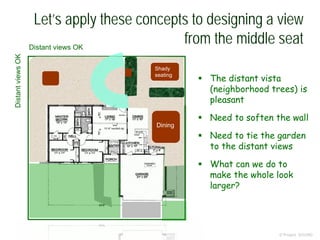
 The distant vista
(neighborhood trees) is
pleasant
 Need to soften the wall
 Need to tie the garden
to the distant views
 What can we do to
make the whole look
larger?
Shady
seating
Dining
Distant views OK
DistantviewsOK
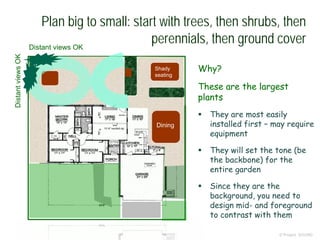
Plan big to small: start with trees, then shrubs, then
perennials, then ground cover
© Project SOUND
Why?
These are the largest
plants
 They are most easily
installed first – may require
equipment
 They will set the tone (be
the backbone) for the
entire garden
 Since they are the
background, you need to
design mid- and foreground
to contrast with them
Shady
seating
Dining
Distant views OK
DistantviewsOK
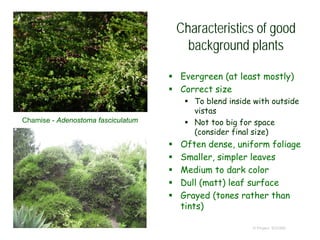
Characteristics of good
background plants
 Evergreen (at least mostly)
 Correct size
 To blend inside with outside
vistas
 Not too big for space
(consider final size)
 Often dense, uniform foliage
 Smaller, simpler leaves
 Medium to dark color
 Dull (matt) leaf surface
 Grayed (tones rather than
tints)
© Project SOUND
Chamise - Adenostoma fasciculatum
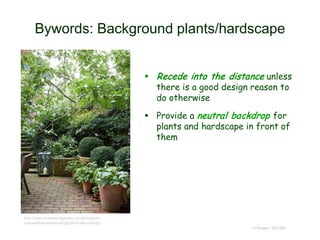
Bywords: Background plants/hardscape
 Recede into the distance unless
there is a good design reason to
do otherwise
 Provide a neutral backdrop for
plants and hardscape in front of
them
© Project SOUND
http://www.houseandgarden.co.uk/outdoor-
spaces/features/small-garden-ideas-design
© Project SOUND
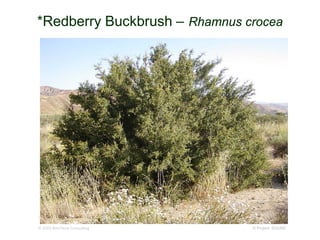
*Redberry Buckbrush – Rhamnus crocea
http://www.researchlearningcenter.org/bloom/species/Rhamnus_crocea.htm
© 2003 BonTerra Consulting
© Project SOUND
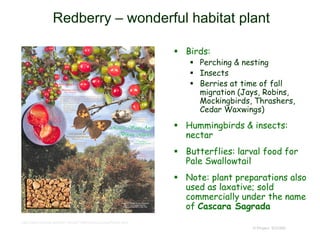
Redberry – wonderful habitat plant
 Birds:
 Perching & nesting
 Insects
 Berries at time of fall
migration (Jays, Robins,
Mockingbirds, Thrashers,
Cedar Waxwings)
 Hummingbirds & insects:
nectar
 Butterflies: larval food for
Pale Swallowtail
 Note: plant preparations also
used as laxative; sold
commercially under the name
of Cascara Sagrada
http://www.hazmac.biz/030714/030714RhamnusCroceaPoster.html
© Project SOUND
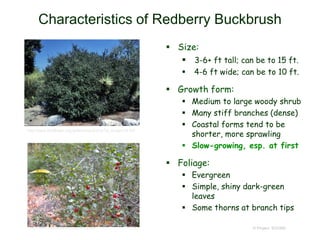
Characteristics of Redberry Buckbrush
 Size:
 3-6+ ft tall; can be to 15 ft.
 4-6 ft wide; can be to 10 ft.
 Growth form:
 Medium to large woody shrub
 Many stiff branches (dense)
 Coastal forms tend to be
shorter, more sprawling
 Slow-growing, esp. at first
 Foliage:
 Evergreen
 Simple, shiny dark-green
leaves
 Some thorns at branch tips
© 2007 Neal Kramer
http://www.timetotrack.com/jay/redb3.htm
http://www.wildflower.org/gallery/result.php?id_image=24163
© Project SOUND
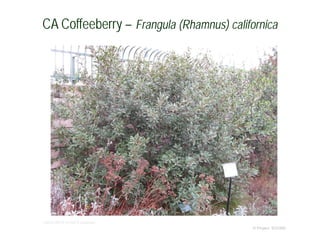
CA Coffeeberry – Frangula (Rhamnus) californica
USDA-NRCS PLANTS Database
© Project SOUND
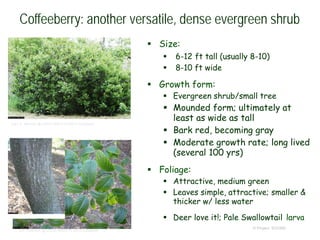
Coffeeberry: another versatile, dense evergreen shrub
Gary A. Monroe @ USDA-NRCS PLANTS Database
J.S. Peterson @ USDA-NRCS PLANTS Database
 Size:
 6-12 ft tall (usually 8-10)
 8-10 ft wide
 Growth form:
 Evergreen shrub/small tree
 Mounded form; ultimately at
least as wide as tall
 Bark red, becoming gray
 Moderate growth rate; long lived
(several 100 yrs)
 Foliage:
 Attractive, medium green
 Leaves simple, attractive; smaller &
thicker w/ less water
 Deer love it!; Pale Swallowtail larva
© Project SOUND
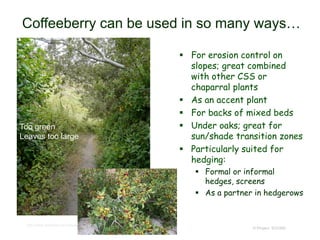
Coffeeberry can be used in so many ways…
 For erosion control on
slopes; great combined
with other CSS or
chaparral plants
 As an accent plant
 For backs of mixed beds
 Under oaks; great for
sun/shade transition zones
 Particularly suited for
hedging:
 Formal or informal
hedges, screens
 As a partner in hedgerows
http://www.laspilitas.com/nature-of-california/plants/rhamnus-californica
Too green
Leaves too large
© Project SOUND
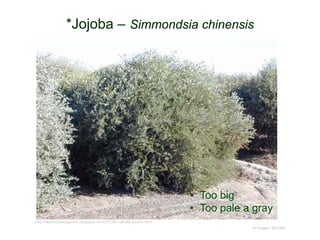
*Jojoba – Simmondsia chinensis
http://rechercheorganics.blogspot.com/2013/01/wholly-jojoba.html
• Too big
• Too pale a gray
© Project SOUND
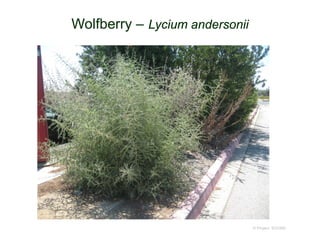
Wolfberry – Lycium andersonii
© Project SOUND
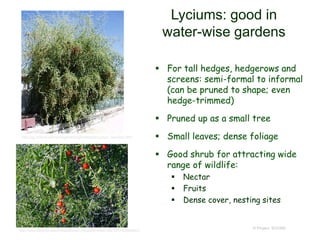
Lyciums: good in
water-wise gardens
 For tall hedges, hedgerows and
screens: semi-formal to informal
(can be pruned to shape; even
hedge-trimmed)
 Pruned up as a small tree
 Small leaves; dense foliage
 Good shrub for attracting wide
range of wildlife:
 Nectar
 Fruits
 Dense cover, nesting sites
http://ag.arizona.edu/pima/gardening/aridplants/Lycium_brevipes.html
http://www.desertmuseumdigitallibrary.org/public/detail.php?id=ASDM08603
© Project SOUND
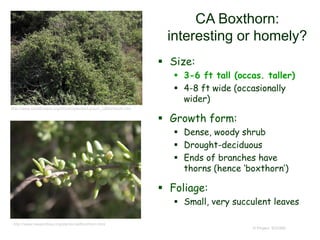
CA Boxthorn:
interesting or homely?
http://www.newportbay.org/plants/califboxthorn.html
 Size:
 3-6 ft tall (occas. taller)
 4-8 ft wide (occasionally
wider)
 Growth form:
 Dense, woody shrub
 Drought-deciduous
 Ends of branches have
thorns (hence ‘boxthorn’)
 Foliage:
 Small, very succulent leaves
http://www.smmflowers.org/bloom/species/Lycium_californicum.htm
© Project SOUND
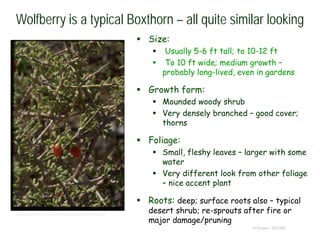
Wolfberry is a typical Boxthorn – all quite similar looking
 Size:
 Usually 5-6 ft tall; to 10-12 ft
 To 10 ft wide; medium growth –
probably long-lived, even in gardens
 Growth form:
 Mounded woody shrub
 Very densely branched – good cover;
thorns
 Foliage:
 Small, fleshy leaves – larger with some
water
 Very different look from other foliage
– nice accent plant
 Roots: deep; surface roots also – typical
desert shrub; re-sprouts after fire or
major damage/pruning
Gerald and Buff Corsi © California Academy of Sciences
© Project SOUND
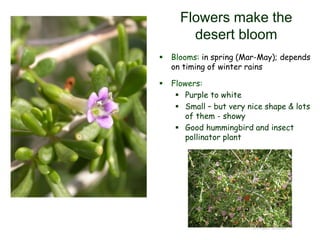
Flowers make the
desert bloom
 Blooms: in spring (Mar-May); depends
on timing of winter rains
 Flowers:
 Purple to white
 Small – but very nice shape & lots
of them - showy
 Good hummingbird and insect
pollinator plant
© Project SOUND
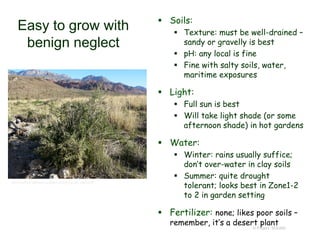
Easy to grow with
benign neglect
 Soils:
 Texture: must be well-drained –
sandy or gravelly is best
 pH: any local is fine
 Fine with salty soils, water,
maritime exposures
 Light:
 Full sun is best
 Will take light shade (or some
afternoon shade) in hot gardens
 Water:
 Winter: rains usually suffice;
don’t over-water in clay soils
 Summer: quite drought
tolerant; looks best in Zone1-2
to 2 in garden setting
 Fertilizer: none; likes poor soils –
remember, it’s a desert plant
http://commons.wikimedia.org/wiki/Category:Lycium_andersonii
© Project SOUND
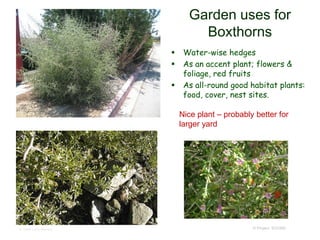
Garden uses for
Boxthorns
 Water-wise hedges
 As an accent plant; flowers &
foliage, red fruits
 As all-round good habitat plants:
food, cover, nest sites.
© 1998 Larry Blakely
Nice plant – probably better for
larger yard
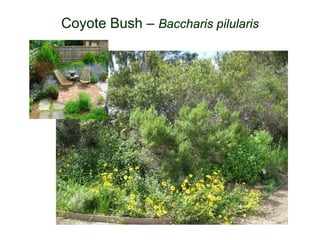
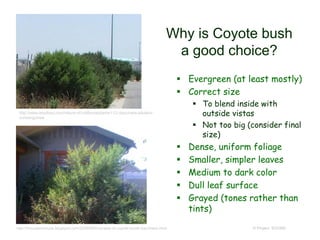
Coyote Bush – Baccharis pilularis
Why is Coyote bush
a good choice?
© Project SOUND
 Evergreen (at least mostly)
 Correct size
 To blend inside with
outside vistas
 Not too big (consider final
size)
 Dense, uniform foliage
 Smaller, simpler leaves
 Medium to dark color
 Dull leaf surface
 Grayed (tones rather than
tints)
http://www.laspilitas.com/nature-of-california/plants/112--baccharis-pilularis-
consanguinea
http://tmousecmouse.blogspot.com/2009/06/in-praise-of-coyote-brush-baccharis.html
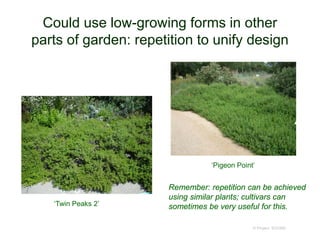
Could use low-growing forms in other
parts of garden: repetition to unify design
© Project SOUND
‘Twin Peaks 2’
‘Pigeon Point’
Remember: repetition can be achieved
using similar plants; cultivars can
sometimes be very useful for this.
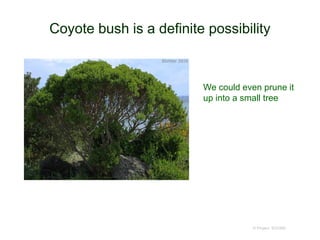
Coyote bush is a definite possibility
© Project SOUND
We could even prune it
up into a small tree
© Project SOUND
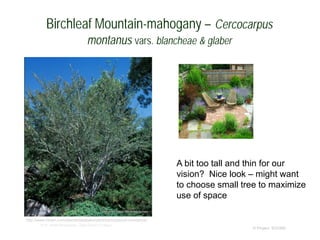
Birchleaf Mountain-mahogany – Cercocarpus
montanus vars. blancheae & glaber
© Br. Alfred Brousseau, Saint Mary's College
A bit too tall and thin for our
vision? Nice look – might want
to choose small tree to maximize
use of space
http://www.mswn.com/plants/database/plant/cercocarpus-montanus/
© Project SOUND
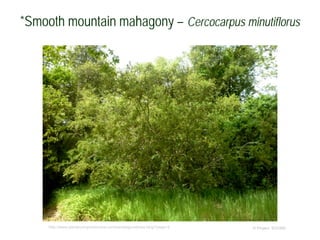
*Smooth mountain mahagony – Cercocarpus minutiflorus
http://www.plantscomprehensive.com/sandiegonatives-blog?page=2
© Project SOUND
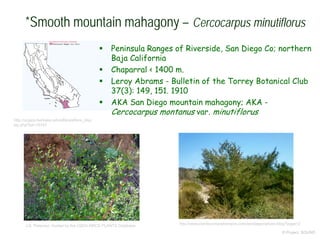
*Smooth mountain mahagony – Cercocarpus minutiflorus
J.S. Peterson, hosted by the USDA-NRCS PLANTS Database
http://ucjeps.berkeley.edu/eflora/eflora_disp
lay.php?tid=18743
 Peninsula Ranges of Riverside, San Diego Co; northern
Baja California
 Chaparral < 1400 m.
 Leroy Abrams - Bulletin of the Torrey Botanical Club
37(3): 149, 151. 1910
 AKA San Diego mountain mahagony; AKA -
Cercocarpus montanus var. minutiflorus
http://www.plantscomprehensive.com/sandiegonatives-blog?page=2
© Project SOUND
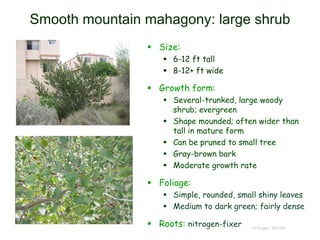
Smooth mountain mahagony: large shrub
 Size:
 6-12 ft tall
 8-12+ ft wide
 Growth form:
 Several-trunked, large woody
shrub; evergreen
 Shape mounded; often wider than
tall in mature form
 Can be pruned to small tree
 Gray-brown bark
 Moderate growth rate
 Foliage:
 Simple, rounded, small shiny leaves
 Medium to dark green; fairly dense
 Roots: nitrogen-fixer
© Project SOUND
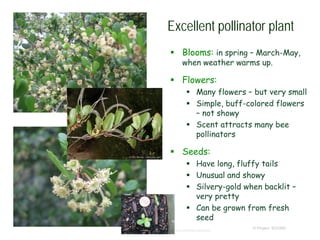
Excellent pollinator plant
 Blooms: in spring – March-May,
when weather warms up.
 Flowers:
 Many flowers – but very small
 Simple, buff-colored flowers
– not showy
 Scent attracts many bee
pollinators
 Seeds:
 Have long, fluffy tails
 Unusual and showy
 Silvery-gold when backlit –
very pretty
 Can be grown from fresh
seed
http://www.answers.com/topic/dudleya
© Project SOUND
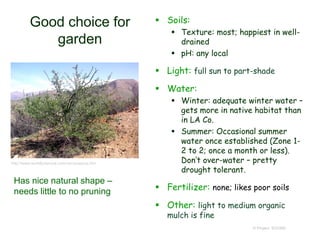
Good choice for
garden
 Soils:
 Texture: most; happiest in well-
drained
 pH: any local
 Light: full sun to part-shade
 Water:
 Winter: adequate winter water –
gets more in native habitat than
in LA Co.
 Summer: Occasional summer
water once established (Zone 1-
2 to 2; once a month or less).
Don’t over-water – pretty
drought tolerant.
 Fertilizer: none; likes poor soils
 Other: light to medium organic
mulch is fine
http://www.worldbotanical.com/cercocarpus.htm
Has nice natural shape –
needs little to no pruning
© Project SOUND
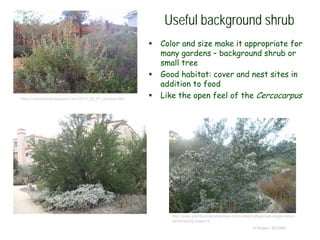
Useful background shrub
 Color and size make it appropriate for
many gardens – background shrub or
small tree
 Good habitat: cover and nest sites in
addition to food
 Like the open feel of the Cercocarpushttps://camissonia.blogspot.com/2015_02_01_archive.html
http://www.plantscomprehensive.com/category/tags/san-diego-native-
landscaping?page=3
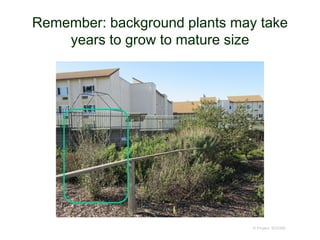
Remember: background plants may take
years to grow to mature size
© Project SOUND
© Project SOUND
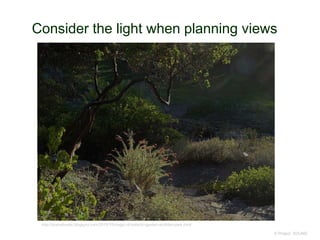
Consider the light when planning views
© Project SOUND
http://prairiebreak.blogspot.com/2016/10/magic-of-botanic-garden-at-tilden-park.html
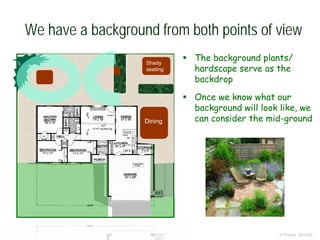
We have a background from both points of view
© Project SOUND
 The background plants/
hardscape serve as the
backdrop
 Once we know what our
background will look like, we
can consider the mid-ground
Shady
seating
Dining
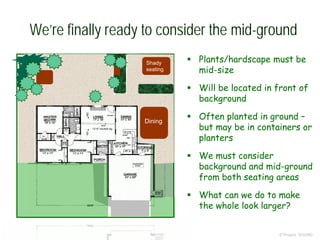
We’re finally ready to consider the mid-ground
© Project SOUND
 Plants/hardscape must be
mid-size
 Will be located in front of
background
 Often planted in ground –
but may be in containers or
planters
 We must consider
background and mid-ground
from both seating areas
 What can we do to make
the whole look larger?
Shady
seating
Dining
© Project SOUND
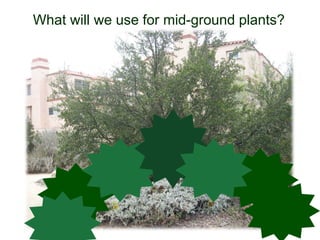
What will we use for mid-ground plants?
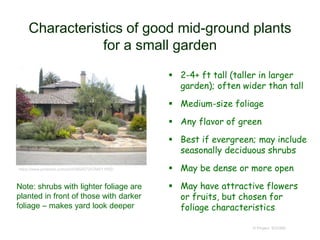
Characteristics of good mid-ground plants
for a small garden
 2-4+ ft tall (taller in larger
garden); often wider than tall
 Medium-size foliage
 Any flavor of green
 Best if evergreen; may include
seasonally deciduous shrubs
 May be dense or more open
 May have attractive flowers
or fruits, but chosen for
foliage characteristics
© Project SOUND
https://www.pinterest.com/pin/428545720766011955/
Note: shrubs with lighter foliage are
planted in front of those with darker
foliage – makes yard look deeper
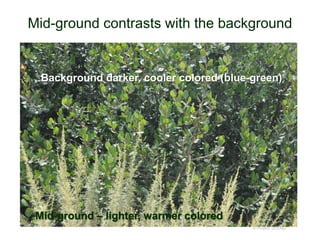
Mid-ground contrasts with the background
© Project SOUND
Background darker, cooler colored (blue-green)
Mid-ground – lighter, warmer colored
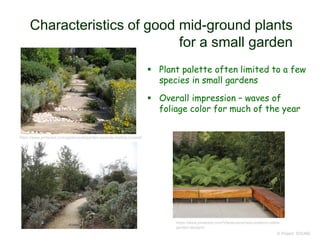
Characteristics of good mid-ground plants
for a small garden
 Plant palette often limited to a few
species in small gardens
 Overall impression – waves of
foliage color for much of the year
© Project SOUND
https://www.pinterest.com/Vitexlucens/new-zealand-native-
garden-designs/
https://www.pinterest.com/garteneule/garden-seaside-feeling-coastal/
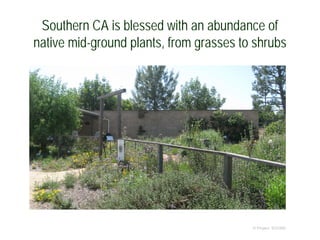
Southern CA is blessed with an abundance of
native mid-ground plants, from grasses to shrubs
© Project SOUND
Repetition: the rule of thumb in mid-ground
© Project SOUND
https://www.flickr.com/photos/ukgardenphotos/12347798964/in/photostream/
Swathes of color
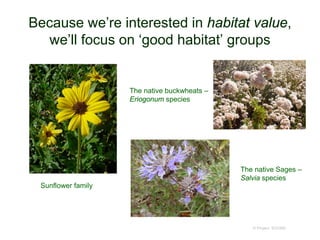
Because we’re interested in habitat value,
we’ll focus on ‘good habitat’ groups
© Project SOUND
Sunflower family
The native buckwheats –
Eriogonum species
The native Sages –
Salvia species
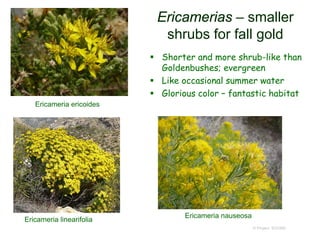
Ericamerias – smaller
shrubs for fall gold
 Shorter and more shrub-like than
Goldenbushes; evergreen
 Like occasional summer water
 Glorious color – fantastic habitat
© Project SOUND
Ericameria linearifolia
Ericameria ericoides
Ericameria nauseosa
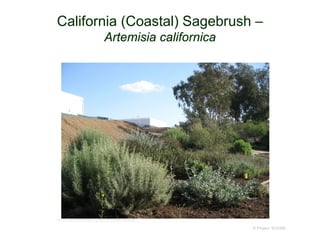
California (Coastal) Sagebrush –
Artemisia californica
© Project SOUND
http://caornamentalnativeplants.org/artemesia.jpg
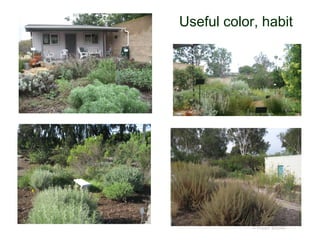
Useful color, habit
© Project SOUND
© Project SOUND
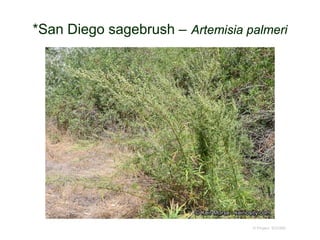
*San Diego sagebrush – Artemisia palmeri
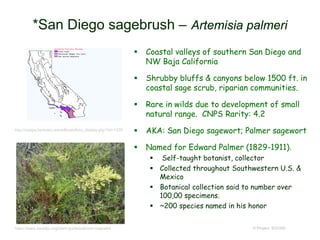
 Coastal valleys of southern San Diego and
NW Baja California
 Shrubby bluffs & canyons below 1500 ft. in
coastal sage scrub, riparian communities.
 Rare in wilds due to development of small
natural range. CNPS Rarity: 4.2
 AKA: San Diego sagewort; Palmer sagewort
 Named for Edward Palmer (1829-1911).
 Self-taught botanist, collector
 Collected throughout Southwestern U.S. &
Mexico
 Botanical collection said to number over
100,00 specimens.
 ~200 species named in his honor
© Project SOUND
*San Diego sagebrush – Artemisia palmeri
http://ucjeps.berkeley.edu/eflora/eflora_display.php?tid=1228
https://www.sanelijo.org/plant-guide/palmers-sagewort
© Project SOUND
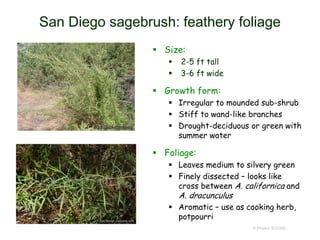
San Diego sagebrush: feathery foliage
 Size:
 2-5 ft tall
 3-6 ft wide
 Growth form:
 Irregular to mounded sub-shrub
 Stiff to wand-like branches
 Drought-deciduous or green with
summer water
 Foliage:
 Leaves medium to silvery green
 Finely dissected – looks like
cross between A. californica and
A. dracunculus
 Aromatic – use as cooking herb,
potpourri
© Project SOUND
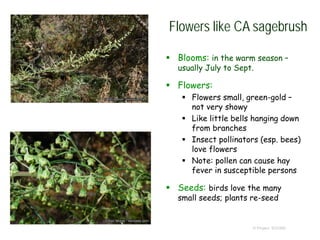
Flowers like CA sagebrush
 Blooms: in the warm season –
usually July to Sept.
 Flowers:
 Flowers small, green-gold –
not very showy
 Like little bells hanging down
from branches
 Insect pollinators (esp. bees)
love flowers
 Note: pollen can cause hay
fever in susceptible persons
 Seeds: birds love the many
small seeds; plants re-seed
© Project SOUND
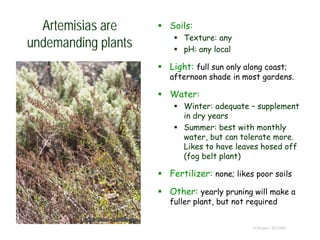
Artemisias are
undemanding plants
 Soils:
 Texture: any
 pH: any local
 Light: full sun only along coast;
afternoon shade in most gardens.
 Water:
 Winter: adequate – supplement
in dry years
 Summer: best with monthly
water, but can tolerate more.
Likes to have leaves hosed off
(fog belt plant)
 Fertilizer: none; likes poor soils
 Other: yearly pruning will make a
fuller plant, but not required
© Project SOUND
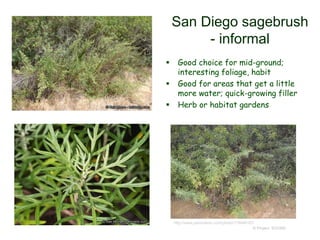
San Diego sagebrush
- informal
 Good choice for mid-ground;
interesting foliage, habit
 Good for areas that get a little
more water; quick-growing filler
 Herb or habitat gardens
http://www.panoramio.com/photo/119446163
© Project SOUND
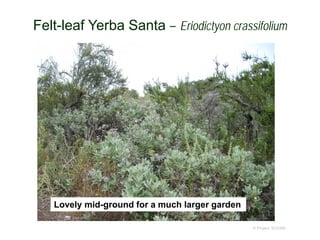
Felt-leaf Yerba Santa – Eriodictyon crassifolium
Lovely mid-ground for a much larger garden
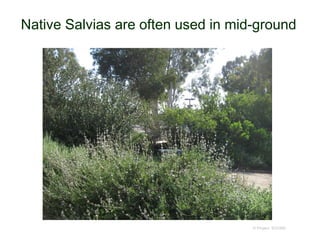
Native Salvias are often used in mid-ground
© Project SOUND
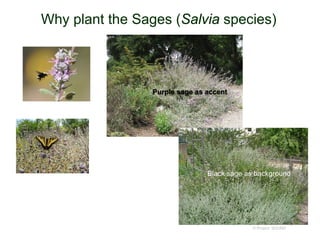
Why plant the Sages (Salvia species)
© Project SOUND
Purple sage as accent
Black sage as background
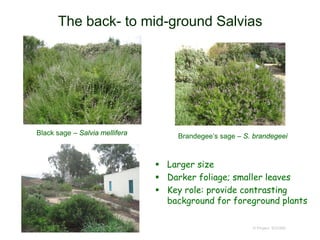
The back- to mid-ground Salvias
 Larger size
 Darker foliage; smaller leaves
 Key role: provide contrasting
background for foreground plants
© Project SOUND
Brandegee’s sage – S. brandegeeiBlack sage – Salvia mellifera
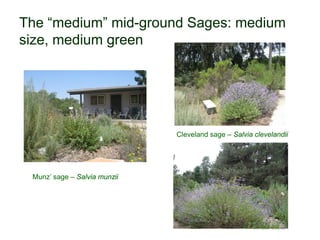
The “medium” mid-ground Sages: medium
size, medium green
© Project SOUND
Munz’ sage – Salvia munzii
Cleveland sage – Salvia clevelandii
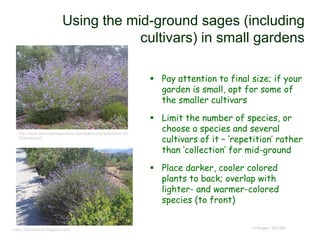
Using the mid-ground sages (including
cultivars) in small gardens
 Pay attention to final size; if your
garden is small, opt for some of
the smaller cultivars
 Limit the number of species, or
choose a species and several
cultivars of it – ‘repetition’ rather
than ‘collection’ for mid-ground
 Place darker, cooler colored
plants to back; overlap with
lighter- and warmer-colored
species (to front)
© Project SOUND
http://www.santaclaritagardens.com/eplant.php?plantnum=25
82&return=l7
https://camissonia.blogspot.com/
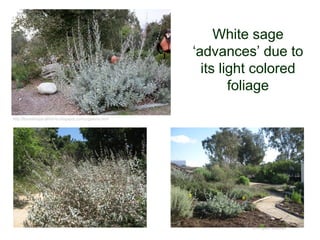
White sage
‘advances’ due to
its light colored
foliage
© Project SOUND
http://floradebajacalifornia.blogspot.com/p/galeria.html
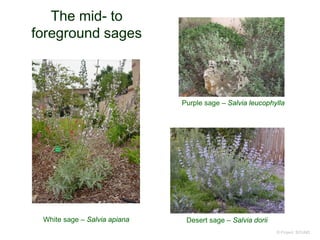
The mid- to
foreground sages
© Project SOUND
Purple sage – Salvia leucophylla
White sage – Salvia apiana Desert sage – Salvia dorii
© Project SOUND
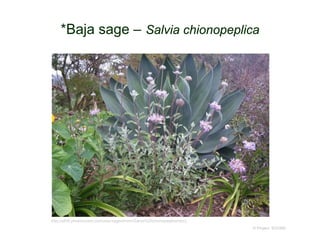
*Baja sage – Salvia chionopeplica
http://s800.photobucket.com/user/sagemtnmn/Salvia%20chionopeplica/story
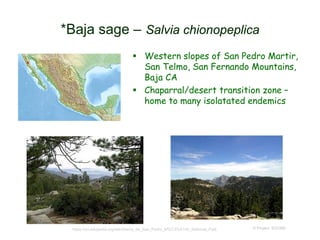
 Western slopes of San Pedro Martir,
San Telmo, San Fernando Mountains,
Baja CA
 Chaparral/desert transition zone –
home to many isolatated endemics
© Project SOUND
*Baja sage – Salvia chionopeplica
https://en.wikipedia.org/wiki/Sierra_de_San_Pedro_M%C3%A1rtir_National_Park
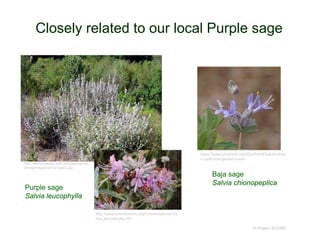
Closely related to our local Purple sage
© Project SOUND
https://www.pinterest.com/EarthAndOak/souther
n-california-garden-have/
http://wildfire.geog.csulb.edu/resac/proje
ct/veg/images/salvia/sage2.jpg
http://www.smmflowers.org/mobile/species/Sa
lvia_leucophylla.htm
Purple sage
Salvia leucophylla
Baja sage
Salvia chionopeplica
© Project SOUND
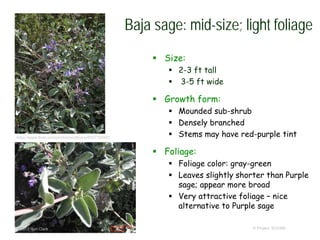
Baja sage: mid-size; light foliage
 Size:
 2-3 ft tall
 3-5 ft wide
 Growth form:
 Mounded sub-shrub
 Densely branched
 Stems may have red-purple tint
 Foliage:
 Foliage color: gray-green
 Leaves slightly shorter than Purple
sage; appear more broad
 Very attractive foliage – nice
alternative to Purple sage
©2013 Ron Clark
https://www.flickr.com/photos/scottzona/8557755982
© Project SOUND
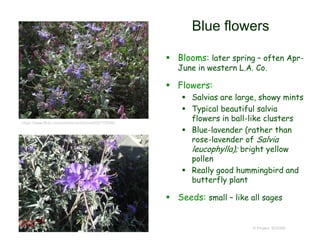
Blue flowers
 Blooms: later spring – often Apr-
June in western L.A. Co.
 Flowers:
 Salvias are large, showy mints
 Typical beautiful salvia
flowers in ball-like clusters
 Blue-lavender (rather than
rose-lavender of Salvia
leucophylla); bright yellow
pollen
 Really good hummingbird and
butterfly plant
 Seeds: small – like all sages
https://www.flickr.com/photos/scottzona/8557755904
© Project SOUND
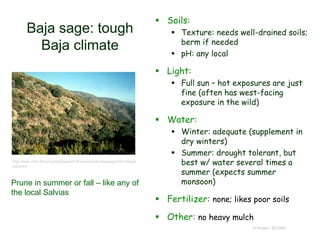
Baja sage: tough
Baja climate
 Soils:
 Texture: needs well-drained soils;
berm if needed
 pH: any local
 Light:
 Full sun – hot exposures are just
fine (often has west-facing
exposure in the wild)
 Water:
 Winter: adequate (supplement in
dry winters)
 Summer: drought tolerant, but
best w/ water several times a
summer (expects summer
monsoon)
 Fertilizer: none; likes poor soils
 Other: no heavy mulch
http://wwx.inhs.illinois.edu/research/therevid/activities/expedition/baja/
pictures/
Prune in summer or fall – like any of
the local Salvias
© Project SOUND
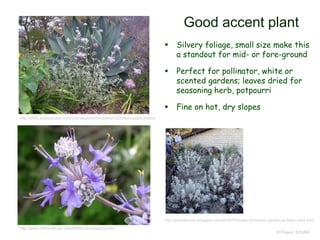
Good accent plant
 Silvery foliage, small size make this
a standout for mid- or fore-ground
 Perfect for pollinator, white or
scented gardens; leaves dried for
seasoning herb, potpourri
 Fine on hot, dry slopes
http://s800.photobucket.com/user/sagemtnmn/Salvia%20chionopeplica/story
http://www.robinssalvias.com/htms/chionopeplica.htm
http://prairiebreak.blogspot.com/2016/10/magic-of-botanic-garden-at-tilden-park.html
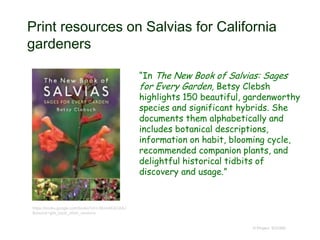
Print resources on Salvias for California
gardeners
“In The New Book of Salvias: Sages
for Every Garden, Betsy Clebsh
highlights 150 beautiful, gardenworthy
species and significant hybrids. She
documents them alphabetically and
includes botanical descriptions,
information on habit, blooming cycle,
recommended companion plants, and
delightful historical tidbits of
discovery and usage.”
© Project SOUND
https://books.google.com/books?id=L5KcnAEACAAJ
&source=gbs_book_other_versions
© Project SOUND
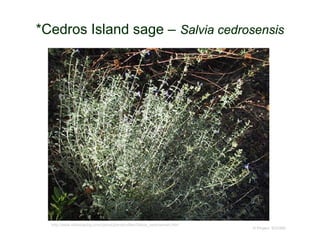
*Cedros Island sage – Salvia cedrosensis
http://www.wildscaping.com/plants/plantprofiles/Salvia_cedrosensis.htm
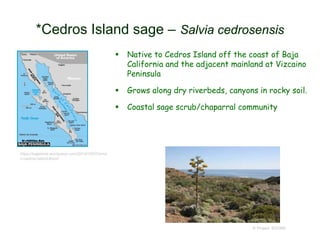
 Native to Cedros Island off the coast of Baja
California and the adjacent mainland at Vizcaino
Peninsula
 Grows along dry riverbeds, canyons in rocky soil.
 Coastal sage scrub/chaparral community
© Project SOUND
*Cedros Island sage – Salvia cedrosensis
https://bajadock.wordpress.com/2014/10/07/simo
n-cedros-island-flood/
Mail order salvias:
native and not
 Annie’s Annuals & Perennials – good
selection from around world
 Digging Dog Nursery – good selection
– mostly SW, Mexican and cultivars
 Flowers by the Sea – specializes in
Salvias
 Seed Hunt – seeds of CA natives
© Project SOUND
Salvia greggii 'Royal Bumble'
https://www.anniesannuals.com/plants/view/?id=4019
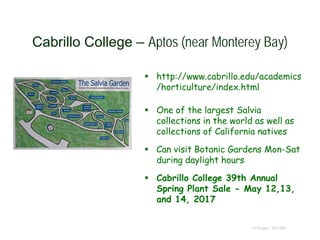
Cabrillo College – Aptos (near Monterey Bay)
 http://www.cabrillo.edu/academics
/horticulture/index.html
 One of the largest Salvia
collections in the world as well as
collections of California natives
 Can visit Botanic Gardens Mon-Sat
during daylight hours
 Cabrillo College 39th Annual
Spring Plant Sale - May 12,13,
and 14, 2017
© Project SOUND
© Project SOUND
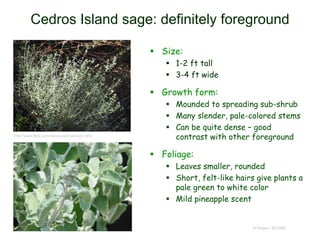
Cedros Island sage: definitely foreground
 Size:
 1-2 ft tall
 3-4 ft wide
 Growth form:
 Mounded to spreading sub-shrub
 Many slender, pale-colored stems
 Can be quite dense – good
contrast with other foreground
 Foliage:
 Leaves smaller, rounded
 Short, felt-like hairs give plants a
pale green to white color
 Mild pineapple scent
http://www.fbts.com/salvia-cedrosensis.html
© Project SOUND
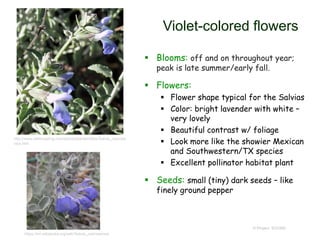
Violet-colored flowers
 Blooms: off and on throughout year;
peak is late summer/early fall.
 Flowers:
 Flower shape typical for the Salvias
 Color: bright lavender with white –
very lovely
 Beautiful contrast w/ foliage
 Look more like the showier Mexican
and Southwestern/TX species
 Excellent pollinator habitat plant
 Seeds: small (tiny) dark seeds – like
finely ground pepper
https://en.wikipedia.org/wiki/Salvia_cedrosensis
http://www.wildscaping.com/plants/plantprofiles/Salvia_cedrose
nsis.htm
© Project SOUND
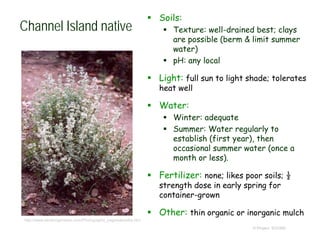
Channel Island native
 Soils:
 Texture: well-drained best; clays
are possible (berm & limit summer
water)
 pH: any local
 Light: full sun to light shade; tolerates
heat well
 Water:
 Winter: adequate
 Summer: Water regularly to
establish (first year), then
occasional summer water (once a
month or less).
 Fertilizer: none; likes poor soils; ½
strength dose in early spring for
container-grown
 Other: thin organic or inorganic mulch
http://www.elnativogrowers.com/Photographs_page/salcedbb.htm
© Project SOUND
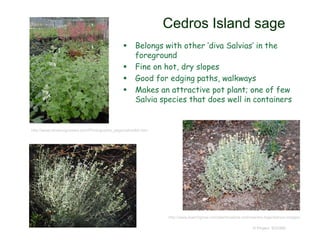
Cedros Island sage
 Belongs with other ‘diva Salvias’ in the
foreground
 Fine on hot, dry slopes
 Good for edging paths, walkways
 Makes an attractive pot plant; one of few
Salvia species that does well in containers
http://www.learn2grow.com/plants/salvia-cedrosensis-baja-blanca-images/
http://www.elnativogrowers.com/Photographs_page/salcedbb.htm
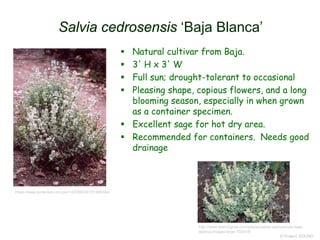
Salvia cedrosensis ‘Baja Blanca’
 Natural cultivar from Baja.
 3' H x 3' W
 Full sun; drought-tolerant to occasional
 Pleasing shape, copious flowers, and a long
blooming season, especially in when grown
as a container specimen.
 Excellent sage for hot dry area.
 Recommended for containers. Needs good
drainage
© Project SOUND
https://www.pinterest.com/pin/142356038191489384/
http://www.learn2grow.com/plants/salvia-cedrosensis-baja-
blanca-images-large-103419/
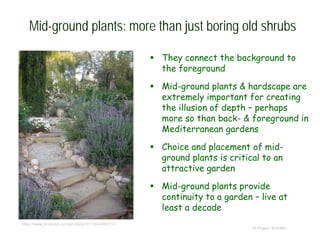
Mid-ground plants: more than just boring old shrubs
 They connect the background to
the foreground
 Mid-ground plants & hardscape are
extremely important for creating
the illusion of depth – perhaps
more so than back- & foreground in
Mediterranean gardens
 Choice and placement of mid-
ground plants is critical to an
attractive garden
 Mid-ground plants provide
continuity to a garden – live at
least a decade
© Project SOUND
https://www.pinterest.com/pin/365073113524893117/
Mid-ground plants: depth
in small gardens
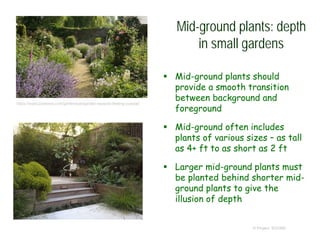
 Mid-ground plants should
provide a smooth transition
between background and
foreground
 Mid-ground often includes
plants of various sizes – as tall
as 4+ ft to as short as 2 ft
 Larger mid-ground plants must
be planted behind shorter mid-
ground plants to give the
illusion of depth
© Project SOUND
https://www.pinterest.com/garteneule/garden-seaside-feeling-coastal/
Color & texture in
mid-ground
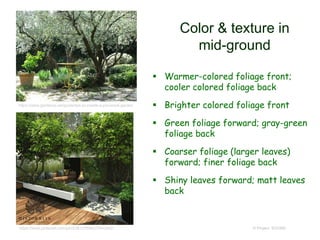
 Warmer-colored foliage front;
cooler colored foliage back
 Brighter colored foliage front
 Green foliage forward; gray-green
foliage back
 Coarser foliage (larger leaves)
forward; finer foliage back
 Shiny leaves forward; matt leaves
back
© Project SOUND
https://www.gardenia.net/guide/tips-to-create-a-provence-garden
https://www.pinterest.com/pin/238127899027642842/
Seating: should it be mid- or foreground?
© Project SOUND
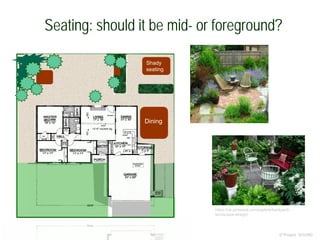
Shady
seating
Dining
https://uk.pinterest.com/explore/backyard-
landscape-design/
And now we come to the fun part…
© Project SOUND
http://www.torontogardens.com/2016/10/designing-with-see-through-plants.html/
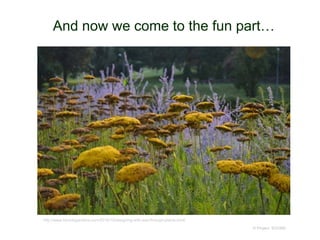
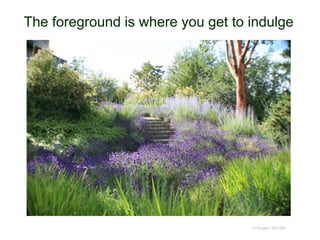
The foreground is where you get to indulge
© Project SOUND
© Project SOUND
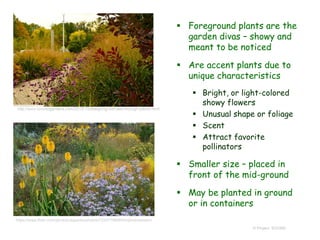
 Foreground plants are the
garden divas – showy and
meant to be noticed
 Are accent plants due to
unique characteristics
 Bright, or light-colored
showy flowers
 Unusual shape or foliage
 Scent
 Attract favorite
pollinators
 Smaller size – placed in
front of the mid-ground
 May be planted in ground
or in containers
https://www.flickr.com/photos/ukgardenphotos/12347798964/in/photostream/
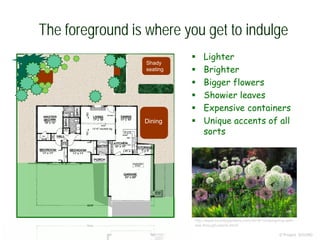
The foreground is where you get to indulge
© Project SOUND
 Lighter
 Brighter
 Bigger flowers
 Showier leaves
 Expensive containers
 Unique accents of all
sorts
Shady
seating
Dining
http://www.torontogardens.com/2016/10/designing-with-
see-through-plants.html/
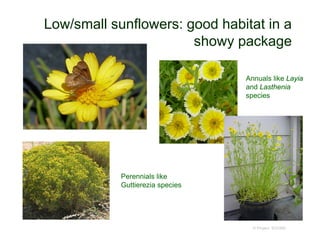
Low/small sunflowers: good habitat in a
showy package
© Project SOUND
Annuals like Layia
and Lasthenia
species
Perennials like
Guttierezia species
© Project SOUND
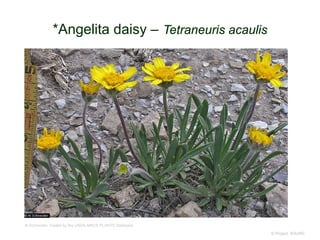
*Angelita daisy – Tetraneuris acaulis
Al Schneider, hosted by the USDA-NRCS PLANTS Database
© Project SOUND
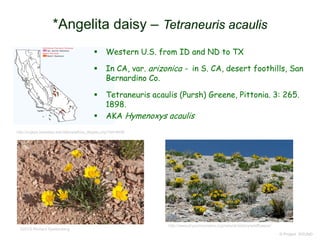
*Angelita daisy – Tetraneuris acaulis
http://ucjeps.berkeley.edu/eflora/eflora_display.php?tid=8496
©2015 Richard Spellenberg
http://www.pryormountains.org/natural-history/wildflowers/
 Western U.S. from ID and ND to TX
 In CA, var. arizonica - in S. CA, desert foothills, San
Bernardino Co.
 Tetraneuris acaulis (Pursh) Greene, Pittonia. 3: 265.
1898.
 AKA Hymenoxys acaulis
© Project SOUND
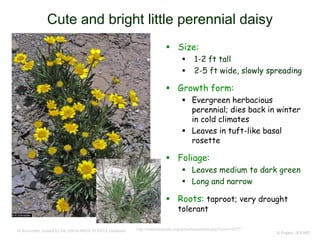
 Size:
 1-2 ft tall
 2-5 ft wide, slowly spreading
 Growth form:
 Evergreen herbacious
perennial; dies back in winter
in cold climates
 Leaves in tuft-like basal
rosette
 Foliage:
 Leaves medium to dark green
 Long and narrow
 Roots: taproot; very drought
tolerant
Al Schneider, hosted by the USDA-NRCS PLANTS Database
Cute and bright little perennial daisy
http://swbiodiversity.org/seinet/taxa/index.php?taxon=2077
© Project SOUND
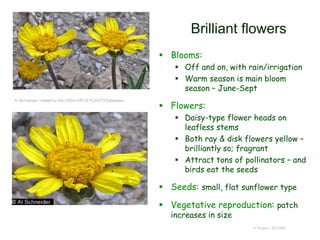
Brilliant flowers
 Blooms:
 Off and on, with rain/irrigation
 Warm season is main bloom
season – June-Sept
 Flowers:
 Daisy-type flower heads on
leafless stems
 Both ray & disk flowers yellow –
brilliantly so; fragrant
 Attract tons of pollinators – and
birds eat the seeds
 Seeds: small, flat sunflower type
 Vegetative reproduction: patch
increases in size
© Project SOUND
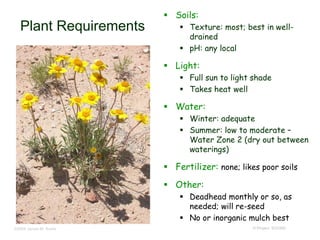
Plant Requirements
 Soils:
 Texture: most; best in well-
drained
 pH: any local
 Light:
 Full sun to light shade
 Takes heat well
 Water:
 Winter: adequate
 Summer: low to moderate –
Water Zone 2 (dry out between
waterings)
 Fertilizer: none; likes poor soils
 Other:
 Deadhead monthly or so, as
needed; will re-seed
 No or inorganic mulch best
©2004 James M. Andre
© Project SOUND
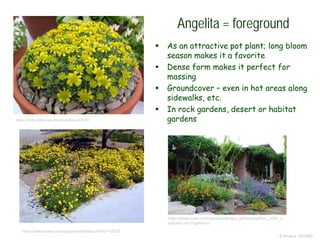
Angelita = foreground
 As an attractive pot plant; long bloom
season makes it a favorite
 Dense form makes it perfect for
massing
 Groundcover – even in hot areas along
sidewalks, etc.
 In rock gardens, desert or habitat
gardenshttps://idfg.idaho.gov/species/taxa/57900
https://www.snwa.com/apps/plant/detail.cfml?id=15070
https://www.snwa.com/apps/landscape_galleries/gallery_color_e
xplosion.cfml?gallery=2
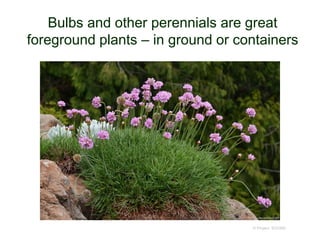
Bulbs and other perennials are great
foreground plants – in ground or containers
© Project SOUND
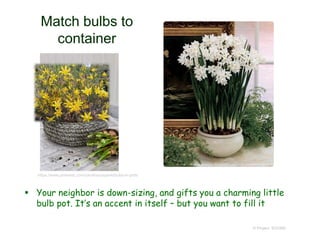
Match bulbs to
container
 Your neighbor is down-sizing, and gifts you a charming little
bulb pot. It’s an accent in itself – but you want to fill it
© Project SOUND
https://www.pinterest.com/carolinecooperk/bulbs-in-pots/
© Project SOUND
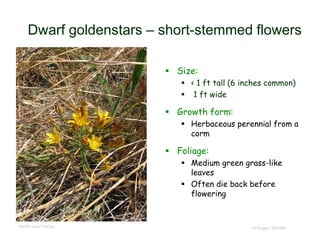
Dwarf goldenstars – short-stemmed flowers
 Size:
 < 1 ft tall (6 inches common)
 1 ft wide
 Growth form:
 Herbaceous perennial from a
corm
 Foliage:
 Medium green grass-like
leaves
 Often die back before
flowering
©2006 Dave Hacker
© Project SOUND
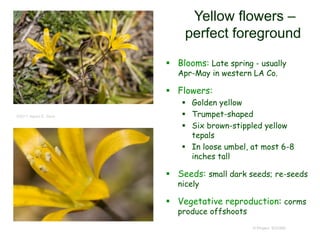
Yellow flowers –
perfect foreground
 Blooms: Late spring - usually
Apr-May in western LA Co.
 Flowers:
 Golden yellow
 Trumpet-shaped
 Six brown-stippled yellow
tepals
 In loose umbel, at most 6-8
inches tall
 Seeds: small dark seeds; re-seeds
nicely
 Vegetative reproduction: corms
produce offshoots
©2011 Aaron E. Sims
© Project SOUND
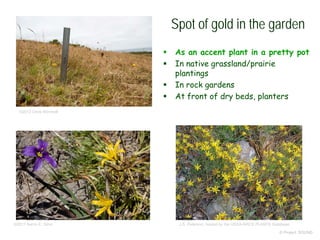
Spot of gold in the garden
 As an accent plant in a pretty pot
 In native grassland/prairie
plantings
 In rock gardens
 At front of dry beds, planters
©2012 Chris Winchell
©2011 Aaron E. Sims J.S. Peterson, hosted by the USDA-NRCS PLANTS Database
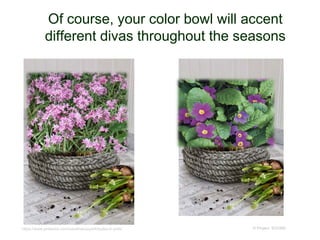
Of course, your color bowl will accent
different divas throughout the seasons
© Project SOUNDhttps://www.pinterest.com/carolinecooperk/bulbs-in-pots/
© Project SOUND
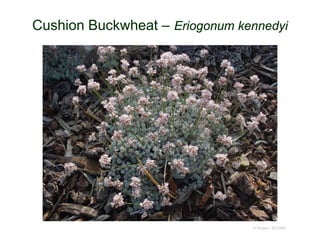
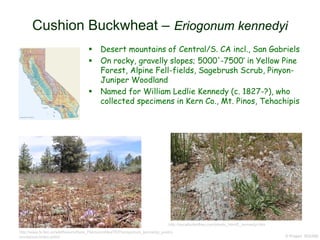
Cushion Buckwheat – Eriogonum kennedyi
 Desert mountains of Central/S. CA incl., San Gabriels
 On rocky, gravelly slopes; 5000'-7500‘ in Yellow Pine
Forest, Alpine Fell-fields, Sagebrush Scrub, Pinyon-
Juniper Woodland
 Named for William Ledlie Kennedy (c. 1827-?), who
collected specimens in Kern Co., Mt. Pinos, Tehachipis
© Project SOUND
Cushion Buckwheat – Eriogonum kennedyi
http://www.fs.fed.us/wildflowers/Rare_Plants/profiles/TEP/eriogonum_kennedyi_austro
montanum/index.shtml
http://socalbutterflies.com/plants_html/E_kennedyi.htm
© Project SOUND
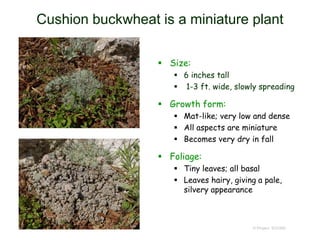
Cushion buckwheat is a miniature plant
 Size:
 6 inches tall
 1-3 ft. wide, slowly spreading
 Growth form:
 Mat-like; very low and dense
 All aspects are miniature
 Becomes very dry in fall
 Foliage:
 Tiny leaves; all basal
 Leaves hairy, giving a pale,
silvery appearance
© Project SOUND
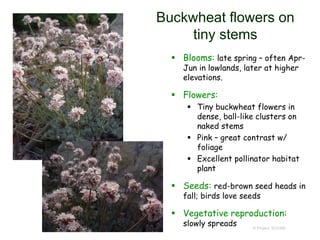
Buckwheat flowers on
tiny stems
 Blooms: late spring – often Apr-
Jun in lowlands, later at higher
elevations.
 Flowers:
 Tiny buckwheat flowers in
dense, ball-like clusters on
naked stems
 Pink – great contrast w/
foliage
 Excellent pollinator habitat
plant
 Seeds: red-brown seed heads in
fall; birds love seeds
 Vegetative reproduction:
slowly spreads
© Project SOUND
Desert mountain
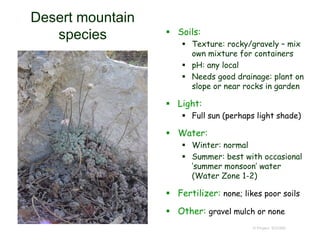
species  Soils:
 Texture: rocky/gravely – mix
own mixture for containers
 pH: any local
 Needs good drainage: plant on
slope or near rocks in garden
 Light:
 Full sun (perhaps light shade)
 Water:
 Winter: normal
 Summer: best with occasional
‘summer monsoon’ water
(Water Zone 1-2)
 Fertilizer: none; likes poor soils
 Other: gravel mulch or none
© Project SOUND
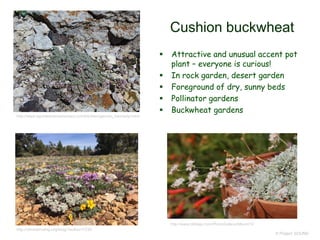
Cushion buckwheat
 Attractive and unusual accent pot
plant – everyone is curious!
 In rock garden, desert garden
 Foreground of dry, sunny beds
 Pollinator gardens
 Buckwheat gardens
http://www.laporteavenuenursery.com/html/eriogonum_kennedyi.html
http://www.bbldwp.com/PhotoGallery/Album/10
http://clminternship.org/blog/?author=7236
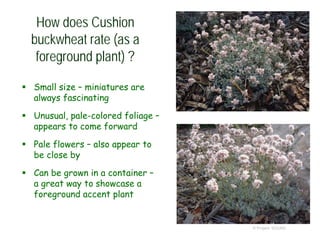
How does Cushion
buckwheat rate (as a
foreground plant) ?
© Project SOUND
 Small size – miniatures are
always fascinating
 Unusual, pale-colored foliage –
appears to come forward
 Pale flowers – also appear to
be close by
 Can be grown in a container –
a great way to showcase a
foreground accent plant
We’ve come a long way today
© Project SOUND
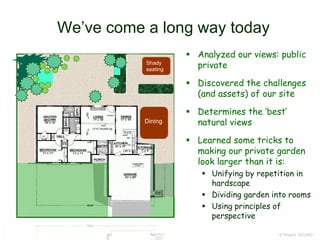
 Analyzed our views: public
private
 Discovered the challenges
(and assets) of our site
 Determines the ‘best’
natural views
 Learned some tricks to
making our private garden
look larger than it is:
 Unifying by repetition in
hardscape
 Dividing garden into rooms
 Using principles of
perspective
Shady
seating
Dining
We’ve learned to envision potential views
as consisting of several planes
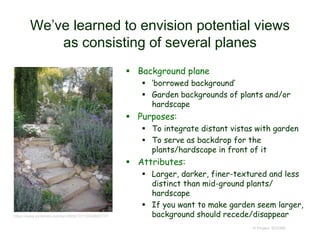
 Background plane
 ‘borrowed background’
 Garden backgrounds of plants and/or
hardscape
 Purposes:
 To integrate distant vistas with garden
 To serve as backdrop for the
plants/hardscape in front of it
 Attributes:
 Larger, darker, finer-textured and less
distinct than mid-ground plants/
hardscape
 If you want to make garden seem larger,
background should recede/disappear
© Project SOUND
https://www.pinterest.com/pin/365073113524893117/
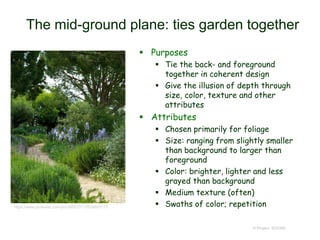
The mid-ground plane: ties garden together
 Purposes
 Tie the back- and foreground
together in coherent design
 Give the illusion of depth through
size, color, texture and other
attributes
 Attributes
 Chosen primarily for foliage
 Size: ranging from slightly smaller
than background to larger than
foreground
 Color: brighter, lighter and less
grayed than background
 Medium texture (often)
 Swaths of color; repetition
© Project SOUND
https://www.pinterest.com/pin/365073113524893117/
© Project SOUND
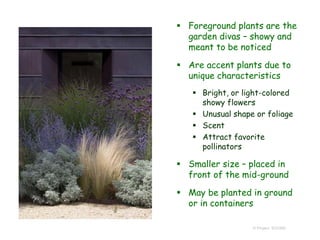
 Foreground plants are the
garden divas – showy and
meant to be noticed
 Are accent plants due to
unique characteristics
 Bright, or light-colored
showy flowers
 Unusual shape or foliage
 Scent
 Attract favorite
pollinators
 Smaller size – placed in
front of the mid-ground
 May be planted in ground
or in containers
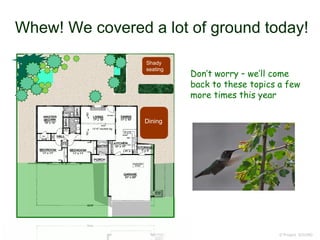
Whew! We covered a lot of ground today!
© Project SOUND
Don’t worry – we’ll come
back to these topics a few
more times this year
Shady
seating
Dining
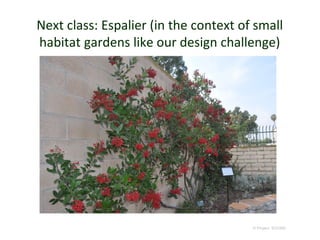
Next class: Espalier (in the context of small
habitat gardens like our design challenge)
© Project SOUND
We’ve got some fun workshops coming up
© Project SOUND

Foreground/Mid-ground/Background - 2017

  • 1.
    © Project SOUND Outof the Wilds and Into Your Garden Gardening with California Native Plants in Western L.A. County Project SOUND – 2017 (our 13th year)
  • 2.
    © Project SOUND Foreground,Mid-ground & Background: vertical space and the well- designed garden C.M. Vadheim and T. Drake CSUDH (emeritus) & Madrona Marsh Preserve Madrona Marsh Preserve February 9 & 11, 2017
  • 3.
    This year we’refeaturing small gardens © Project SOUND https://www.pinterest.com/ggmaas/exterior-home/
  • 4.
    We’re going tobe spending the next few months designing a small suburban ‘garden’ © Project SOUND The classic ranch house looks very much like many built from 1950- 1970’s
  • 5.
    © Project SOUND http://design-milk.com/backyard-blues-landscaping-yard-design/ Youknow the kind of backyard we’re talking about http://www.artificialgrass-irvine.com/grassphotos/artificial-grass-installation- johannesburg-california/651/ See the whole darned thing from the living room Side yard looks like a box canyon The best view is one never seen
  • 6.
    The configuration ofthe yard presents some design challenges  Relatively large garage in front yard  Proportionately large front yard – currently not well utilized  Narrow side yards  Shallow, wide backyard – one of the more difficult layouts to design around  Funky, under-used patio © Project SOUND 65’ 25’
  • 7.
    First you needto consider two questions: 1. Views for whom? 2. Do you want your (small) backyard garden to:  look larger than it is?  or do want to accentuate the look of a small, cozy garden?  or do you want a little of both? © Project SOUND
  • 8.
    Start with viewsfrom indoors & from attached (to house) outdoor hardscape  Views from windows  Views when you open a door  View(s) from the front porch  Views from the back patio © Project SOUND Look critically at the views from your windows, doors, porches – do you like what you see?
  • 9.
    If you havea two- story house, don’t forget the view from upstairs © Project SOUND
  • 10.
    A view forwho(m)? : Public views © Project SOUND http://gardkebun.website/7993/garden-design-ideas- southern-california.html http://imanada.com/nu/215538/garden/
  • 11.
    Outdoor vistas aremore flexible – within constraints  Views from the street and sidewalk (public view)  Views from the entry walkway (public view)  Views from patio  Any other vista you wish to define © Project SOUND Get on out & look
  • 12.
    Views of garden(s) Include both public and private views – both important  Include (both important):  Some views that are ‘fixed’ or constrained due to relatively permanent hardscape (windows; doors; street; etc.)  Other views that are more flexible © Project SOUND https://ocjackie.com/2012/08/27/some-of-my-favorite-plants-for-so- cal-gardens/ https://www.pinterest.com/ggmaas/exterior-home/ The latter are more prevalent than most think – and allow us to consider space creatively
  • 13.
    First you needto consider two questions: 1. Views for whom? 2. Do you want your (small) backyard garden to:  look larger than it is?  or do want to accentuate the look of a small, cozy garden?  or do you want a little of both? © Project SOUND
  • 14.
    Which look fitsyour site, needs and concept of the ‘perfect garden’? © Project SOUND Large and expansive (larger than the actual site) Cozy and contained (looks like a small garden) http://seeingdesign.com/projects/plants-for-lazy-gardeners/
  • 15.
    Let’s view theentire ‘private area’ as a blank slate © Project SOUND  Where is the optimal place for outdoor dining? Spa?  What are the ‘best’ natural views  Are there any vistas (of faraway, pleasant sights)  What can we do to make the whole look larger?N WE S
  • 16.
    Site characteristics suggestsome functional areas © Project SOUND  Shade from neighbor’s house/ trees make shady spot for dining & seating  Dining area should be as close to kitchen as possible  The side of the neighbor’s house - ?? Shady seating/ hot tub Dining http://www.ikea.com/us/en/catalog/categories/departments/outdoor/21964/
  • 17.
    Designers trick: unifywith hardscape © Project SOUND https://www.pinterest.com/quercusgd/garden- design-key-principles/ http://www.gardenista.com/posts/steal-this-look-modern-brooklyn-backyard-on-a- budget/ Note: designers also made these areas appear longer by echoing the site’s longest dimension with the hardscape
  • 18.
    Let’s connect theshady areas with hardscape © Project SOUND  Gravel hardscape allows access to both areas  It also ties the two areas together  And it makes a small space appear larger Shady seating/ hot tub Dining
  • 19.
    We can makethe entire area appear larger by using the same gravel throughout © Project SOUND  Use of similar hardscape materials:  Makes the eye view different areas as parts of a whole design  Makes small yards appear larger, more expasive  The materials don’t have to be the same – just similar  Same/similar color  Same/similar shape  Repetition Shady seating/ hot tub Dining
  • 20.
    Use the same/similarpathway materials to unify a garden and make it appear larger © Project SOUND https://www.pinterest.com/juliettevanzyve/garden/
  • 21.
    More tricks tomaking it look like you have more space (than you actually have)  Divide the area up  Corollary: Don’t show all the cards in your hand at once – create a sense of mystery © Project SOUND http://www.turning-earth.co.uk/news/index.php/2013/
  • 22.
    Dividing our backyardspace also gives the two areas a little privacy © Project SOUND  Separate the shady from the sunny area  Add narrow screen  We’ve now divided the small yard into three rooms:  Shady seating/hot tub  Al fresco dining  All the rest  Surprisingly, the backyard seems larger than when we viewed it all as one room Shady seating/ hot tub Dining
  • 23.
    Lay out theproposed areas: walk them, sit in them, live in them © Project SOUND http://www.diynetwork.com/how-to/outdoors/structures/how-to-design-an-outdoor- waterfall
  • 24.
    What else dowe want to be able to do in our garden (besides soaking & eating)?  Sit and read  Meditate  Do our exercises  Have a cup of coffee in morning sun  Bird watch  Smell the aromas  Enjoy a special view  Write/paint © Project SOUND https://lapelusodesigns.com/blog/
  • 25.
    Placement of additional seatingareas  Should take advantage of site attributes: sun/shade  Should make the most of significant vistas  Looks best if well integrated into landscape © Project SOUND https://www.pinterest.com/amanthawalden/gardens/
  • 26.
    Let’s consider possibleviews in the main garden area © Project SOUND  What are the ‘best’ natural views  Are there any vistas (of faraway, pleasant sights)  What can we do to make the whole look larger? Shady seating Dining Distant views OK DistantviewsOK
  • 27.
    What are ourkey vistas? It depends… © Project SOUND https://www.pinterest.com/pin/105130972531729525/ http://rogersgardens.com/design-ideas/
  • 28.
    Features that mightmake a particular backyard view attractive  Vista of far-away natural features (hills, trees, ocean)  Neighbor’s trees and shrubs  Attractive plants in your own yard  A (potentially) attractive blank wall  Pretty wall, fence, gate  Other attractive hardscape  ‘expansive’ feeling  ‘enclosed’ feeling  Anything else you like to see or feel © Project SOUND
  • 29.
    We add severalsmall seating areas based on our assessment of the views © Project SOUND  What are the ‘best’ natural views  Are there any vistas (of faraway, pleasant sights)  What can we do to make the whole look larger? Shady seating/ hot tub Dining Distant views OK DistantviewsOK
  • 30.
    Today we’re justgoing to focus on one area © Project SOUND  The area is viewed as a whole (for now)  The area is relatively small (45’ x 25’)  There are OK distant views (both directions)  The area is sunny  We want it to be water- wise overall  We want to make the whole look larger Shady seating/ hot tub Dining Distant views OK DistantviewsOK
  • 31.
    © Project SOUND Gardentheme: Mediterranean style, water-wise garden
  • 32.
    What style ofwater-wise Mediterranean garden? © Project SOUNDhttp://gardengates.info/category/landscaping-and-landscapes/southern-california- landscaping-design/ https://www.pinterest.com/pin/426364289694847260/ We’ll feature S. CA native plants
  • 33.
    How to designa life-friendly Mediterranean style garden… © Project SOUND https://www.pinterest.com/pin/212865519863542396/ …that looks larger than really it is?
  • 34.
    © Project SOUND contrast Innatural settings, distant mountains/hills and trees provide a backdrop
  • 35.
    The same istrue in larger gardens, and those located near wild lands © Project SOUND http://www.anglotopia.net/anglophilia/top-12-english-gardens-gardens-in-england-worth-a-visit/
  • 36.
    But what providesa background in smaller, urban & suburban gardens?  Distant ‘borrowed’ features: trees, hills/mountains (if available)  Smaller evergreen trees/large shrubs  Walls and fences  Walls of adjacent structures  Free-standing screens (planted or not) © Project SOUND How do we create a sense of distance (given small areas and a combination of natural & artificial (hardscape) backgrounds) ?
  • 37.
    When you takea painting class, you learn about the importance of perspective © Project SOUND http://www.mariewise.com/2015/11/01/notre-dame-cathedral-the-final/ e.g., how to trick the eye into perceiving depth in a two- dimensional painting
  • 38.
    Illusion works –particularly when well done © Project SOUND http://www.nhm.org/site/explore-exhibits/permanent-exhibits/north-american-mammals http://www.huffingtonpost.com/ross-macphee/natural- history-dioramas-_b_1975451.html http://wallpaper-gallery.net/wallpapers/frozen-wallpaper-hd.html
  • 39.
    Several principles ofperspective create the illusion of depth  Closer objects overlap objects further away.  Objects/shapes become smaller the farther away they are; this is the principle of linear perspective. © Project SOUND
  • 40.
    Several principles ofperspective create the illusion of depth  Closer objects overlap objects further away.  Objects/shapes become smaller the farther away they are; this is the principle of linear perspective. © Project SOUND https://www.pinterest.com/pin/212865519863542396/
  • 41.
    Several principles ofperspective create the illusion of depth  Line/lines draw viewers into the depth of a painting and/or tap into our visual dictionaries.  We immediately interpret lines (roads, paths, etc.) as familiar three- dimensional shapes © Project SOUND http://www.celebratingcolor.com/ultimate-guide-for-atmospheric-perspective/
  • 42.
    Several principles ofperspective create the illusion of depth  Line/lines draw viewers into the depth of a painting and/or tap into our visual dictionaries.  We immediately interpret lines (roads, paths, etc.) as familiar three- dimensional shapes © Project SOUND http://www.celebratingcolor.com/ultimate-guide-for-atmospheric-perspective/
  • 43.
    Creating the illusionof depth (painting) As space recedes 1. Details become blurred if not completely lost. 2. Edges become gradually softer the further the distance you want to portray. © Project SOUND http://www.celebratingcolor.com/ultimate-guide-for-atmospheric-perspective/ http://www.nhm.org/site/explore-exhibits/permanent-exhibits/north-american-mammals
  • 44.
    Creating the illusionof depth (garden design) As space recedes 1. Details become blurred if not completely lost. 2. Edges become gradually softer the further the distance you want to portray. © Project SOUND http://www.interiorholic.com/outdoors/landscaping/japanese-stroll- garden-designs/ http://en.wikipedia.org/wiki/Japanese_garden
  • 45.
    Creating the illusionof depth (painting) As space recedes 3. Color (hue) becomes cooler. 4. Color becomes less intense and more de-saturated or neutralized (grayed, grayed pastels or cool bluish shades). 5. The contrast between shapes and values diminishes. © Project SOUND http://www.celebratingcolor.com/ultimate-guide-for-atmospheric-perspective/ https://sotafoundations1.wordpress.com/2016/04/25/new-project-3d-environment/
  • 46.
    Creating the illusionof depth (garden design) As space recedes 3. Color (hue) becomes cooler. 4. Color becomes less intense and more de-saturated or neutralized (grayed, grayed pastels or cool bluish tones). 5. The contrast between shapes and values diminishes. © Project SOUND https://www.pinterest.com/pin/550565123167535855/
  • 47.
  • 48.
    Why is theconcept of foreground, mid-ground and background important for gardens?  Permits good use of limited space  Helps add visual interest  Allows you to place plants of different sizes appropriately (so one doesn’t block another)  Helps you choose plants/hardscape with appropriate characteristics  Allows you to make a garden seem larger (or smaller) than it really is © Project SOUND http://hubpages.com/living/Front-Yard-Landscaping-How-to-Design- for-Depth Garden perspective – the Realtor’s point of view
  • 49.
    I have justa small balcony. Is perspective important for my garden design?  Mais oui!  You can make your balcony garden look larger or smaller - if you understand how to use these principles © Project SOUND http://www.findpeaceandquiet.com/page-archive/lifestyles-luhrs.html https://www.pinterest.com/pin/393150242453181538/ http://www.nhm.org/site/explore-exhibits/permanent-exhibits/north-american-mammals
  • 50.
    Today we’ll useperspective to improve views from the two sunny seats © Project SOUND  The area is relatively small (45’ x 25’); want to make it look larger  There are OK distant views (both directions)  We’ll need to incorporate the distant landscape in a way that:  Integrates garden & distant features  Makes the garden appear larger Shady seating/ hot tub Dining Distant views OK DistantviewsOK
  • 51.
    Using ‘borrowed’ landscapes asbackground © Project SOUND http://annemariehall.com/rustic-santaluz-estate/ http://blogqpot.com/images/southern%20california%20native%20garden%20design  Good ‘borrowed’ backgrounds need to be integrated into the design of the garden http://www.yardshare.com/yard/E3
  • 52.
    Transitions: smooth transitionsbetween ‘outside’ and ‘inside’ suggest a larger space © Project SOUND https://www.pinterest.com/ggmaas/exterior-home/ https://www.homebay.com/property/9-Lilac-St-Monterey-CA-93940-5413/55539799- 4160-492e-9cc5-7c7c018969c4 This house has OK distant vistas – but the garden doesn’t utilize them – the garden appears separate (and smaller) Designer used taller fence and plants to suggest that garden and distant landscapes be viewed as one – garden appears larger
  • 53.
    Blending a gardenbackground with a ‘borrowed background’ – look carefully  The garden background should integrate the ‘borrowed’ with the garden’s mid- and foreground  The smaller the garden, the more difficult to do this successfully  Factors to consider when choosing an integrating background:  Color  Size  Scale & detail © Project SOUND http://www.houseandgarden.co.uk/outdoor- spaces/features/small-garden-ideas-design http://dlivingstondesign.com/donna-livingston-design- southern-california-life-garden/
  • 54.
    The tale oftwo corners  Corner 1: good integration of garden background (hardscape & plants) and ‘borrowed’ background © Project SOUND  Corner 2: neither hardscape nor plants help integrate garden background and ‘borrowed’ background. Result: looks like it was just thrown together with no real design. https://www.homebay.com/property/9-Lilac-St-Monterey-CA-93940-5413/55539799- 4160-492e-9cc5-7c7c018969c4
  • 55.
    Creating depth requires carefuluse of color  Grayed, dark or muted/matt texture fences/walls recede; they integrate with ‘borrowed’ vistas and make a garden seem larger  Light, bright, shiny fences appear to advance (turn the fence into a diva); they make the garden seem smaller © Project SOUND http://wrapdcouture.com/small-garden-design-uk-gallery/ https://www.coldwellbankerhomes.com/ca/torrance/18816-patronella- avenue/pid_16019472/ https://www.coldwellbankerhomes.com/ca/torrance/23808-los-codona-avenue- 6/pid_15860714/ Light and bright walls stick out like a sore thumb
  • 56.
    Creating the illusionof depth requires choosing garden background of appropriate size © Project SOUNDhttps://www.homebay.com/property/9-Lilac-St-Monterey-CA-93940-5413/55539799- 4160-492e-9cc5-7c7c018969c4 https://www.pinterest.com/Vitexlucens/new-zealand-native-garden-designs/ Argh – fill the gaps (with hardscape or plants)
  • 57.
    Like color, texturecan also create the illusion of distance  Three categories of foliage texture:  Fine: lots of tiny leaves reflect lots of light and tends to form an airy whole.  Medium  Coarse: large-leaves & lots of gaps/shadows, creating a starker contrast between light and dark.  Like warm-colored plants, coarse- textured plants tend to catch the eye. They are accents.  Fine- textured plants, like plants with cool colors, demand less visual attention and therefore fade into the background and seem more distant. They make good background plants. © Project SOUND http://www.public.asu.edu/~camartin/plants/Plant%20html%20files/sc heffleraactinophylla.html
  • 58.
    Creating the illusionof depth requires attention to scale & texture of background © Project SOUND http://www.designrulz.com/outdoor-design/garden/2012/05/10-awesome-fences- created-from-recycled-sports-gear/ http://maxpixel.freegreatpicture.com/Bushes-Red-Leaves-Hedge-Haie-Fleurie- Fothinia-891354 • Plants/hardscape that have too much detail or too coarse a texture will never appear to be far away • For background, limit detail and choose fine texture
  • 59.
    Let’s apply theseconcepts to designing a view from the middle seat © Project SOUND  The distant vista (neighborhood trees) is pleasant  Need to soften the wall  Need to tie the garden to the distant views  What can we do to make the whole look larger? Shady seating Dining Distant views OK DistantviewsOK
  • 60.
    Plan big tosmall: start with trees, then shrubs, then perennials, then ground cover © Project SOUND Why? These are the largest plants  They are most easily installed first – may require equipment  They will set the tone (be the backbone) for the entire garden  Since they are the background, you need to design mid- and foreground to contrast with them Shady seating Dining Distant views OK DistantviewsOK
  • 61.
    Characteristics of good backgroundplants  Evergreen (at least mostly)  Correct size  To blend inside with outside vistas  Not too big for space (consider final size)  Often dense, uniform foliage  Smaller, simpler leaves  Medium to dark color  Dull (matt) leaf surface  Grayed (tones rather than tints) © Project SOUND Chamise - Adenostoma fasciculatum
  • 62.
    Bywords: Background plants/hardscape Recede into the distance unless there is a good design reason to do otherwise  Provide a neutral backdrop for plants and hardscape in front of them © Project SOUND http://www.houseandgarden.co.uk/outdoor- spaces/features/small-garden-ideas-design
  • 63.
    © Project SOUND *RedberryBuckbrush – Rhamnus crocea http://www.researchlearningcenter.org/bloom/species/Rhamnus_crocea.htm © 2003 BonTerra Consulting
  • 64.
    © Project SOUND Redberry– wonderful habitat plant  Birds:  Perching & nesting  Insects  Berries at time of fall migration (Jays, Robins, Mockingbirds, Thrashers, Cedar Waxwings)  Hummingbirds & insects: nectar  Butterflies: larval food for Pale Swallowtail  Note: plant preparations also used as laxative; sold commercially under the name of Cascara Sagrada http://www.hazmac.biz/030714/030714RhamnusCroceaPoster.html
  • 65.
    © Project SOUND Characteristicsof Redberry Buckbrush  Size:  3-6+ ft tall; can be to 15 ft.  4-6 ft wide; can be to 10 ft.  Growth form:  Medium to large woody shrub  Many stiff branches (dense)  Coastal forms tend to be shorter, more sprawling  Slow-growing, esp. at first  Foliage:  Evergreen  Simple, shiny dark-green leaves  Some thorns at branch tips © 2007 Neal Kramer http://www.timetotrack.com/jay/redb3.htm http://www.wildflower.org/gallery/result.php?id_image=24163
  • 66.
    © Project SOUND CACoffeeberry – Frangula (Rhamnus) californica USDA-NRCS PLANTS Database
  • 67.
    © Project SOUND Coffeeberry:another versatile, dense evergreen shrub Gary A. Monroe @ USDA-NRCS PLANTS Database J.S. Peterson @ USDA-NRCS PLANTS Database  Size:  6-12 ft tall (usually 8-10)  8-10 ft wide  Growth form:  Evergreen shrub/small tree  Mounded form; ultimately at least as wide as tall  Bark red, becoming gray  Moderate growth rate; long lived (several 100 yrs)  Foliage:  Attractive, medium green  Leaves simple, attractive; smaller & thicker w/ less water  Deer love it!; Pale Swallowtail larva
  • 68.
    © Project SOUND Coffeeberrycan be used in so many ways…  For erosion control on slopes; great combined with other CSS or chaparral plants  As an accent plant  For backs of mixed beds  Under oaks; great for sun/shade transition zones  Particularly suited for hedging:  Formal or informal hedges, screens  As a partner in hedgerows http://www.laspilitas.com/nature-of-california/plants/rhamnus-californica Too green Leaves too large
  • 69.
    © Project SOUND *Jojoba– Simmondsia chinensis http://rechercheorganics.blogspot.com/2013/01/wholly-jojoba.html • Too big • Too pale a gray
  • 70.
    © Project SOUND Wolfberry– Lycium andersonii
  • 71.
    © Project SOUND Lyciums:good in water-wise gardens  For tall hedges, hedgerows and screens: semi-formal to informal (can be pruned to shape; even hedge-trimmed)  Pruned up as a small tree  Small leaves; dense foliage  Good shrub for attracting wide range of wildlife:  Nectar  Fruits  Dense cover, nesting sites http://ag.arizona.edu/pima/gardening/aridplants/Lycium_brevipes.html http://www.desertmuseumdigitallibrary.org/public/detail.php?id=ASDM08603
  • 72.
    © Project SOUND CABoxthorn: interesting or homely? http://www.newportbay.org/plants/califboxthorn.html  Size:  3-6 ft tall (occas. taller)  4-8 ft wide (occasionally wider)  Growth form:  Dense, woody shrub  Drought-deciduous  Ends of branches have thorns (hence ‘boxthorn’)  Foliage:  Small, very succulent leaves http://www.smmflowers.org/bloom/species/Lycium_californicum.htm
  • 73.
    © Project SOUND Wolfberryis a typical Boxthorn – all quite similar looking  Size:  Usually 5-6 ft tall; to 10-12 ft  To 10 ft wide; medium growth – probably long-lived, even in gardens  Growth form:  Mounded woody shrub  Very densely branched – good cover; thorns  Foliage:  Small, fleshy leaves – larger with some water  Very different look from other foliage – nice accent plant  Roots: deep; surface roots also – typical desert shrub; re-sprouts after fire or major damage/pruning Gerald and Buff Corsi © California Academy of Sciences
  • 74.
    © Project SOUND Flowersmake the desert bloom  Blooms: in spring (Mar-May); depends on timing of winter rains  Flowers:  Purple to white  Small – but very nice shape & lots of them - showy  Good hummingbird and insect pollinator plant
  • 75.
    © Project SOUND Easyto grow with benign neglect  Soils:  Texture: must be well-drained – sandy or gravelly is best  pH: any local is fine  Fine with salty soils, water, maritime exposures  Light:  Full sun is best  Will take light shade (or some afternoon shade) in hot gardens  Water:  Winter: rains usually suffice; don’t over-water in clay soils  Summer: quite drought tolerant; looks best in Zone1-2 to 2 in garden setting  Fertilizer: none; likes poor soils – remember, it’s a desert plant http://commons.wikimedia.org/wiki/Category:Lycium_andersonii
  • 76.
    © Project SOUND Gardenuses for Boxthorns  Water-wise hedges  As an accent plant; flowers & foliage, red fruits  As all-round good habitat plants: food, cover, nest sites. © 1998 Larry Blakely Nice plant – probably better for larger yard
  • 77.
    Coyote Bush –Baccharis pilularis
  • 78.
    Why is Coyotebush a good choice? © Project SOUND  Evergreen (at least mostly)  Correct size  To blend inside with outside vistas  Not too big (consider final size)  Dense, uniform foliage  Smaller, simpler leaves  Medium to dark color  Dull leaf surface  Grayed (tones rather than tints) http://www.laspilitas.com/nature-of-california/plants/112--baccharis-pilularis- consanguinea http://tmousecmouse.blogspot.com/2009/06/in-praise-of-coyote-brush-baccharis.html
  • 79.
    Could use low-growingforms in other parts of garden: repetition to unify design © Project SOUND ‘Twin Peaks 2’ ‘Pigeon Point’ Remember: repetition can be achieved using similar plants; cultivars can sometimes be very useful for this.
  • 80.
    Coyote bush isa definite possibility © Project SOUND We could even prune it up into a small tree
  • 81.
    © Project SOUND BirchleafMountain-mahogany – Cercocarpus montanus vars. blancheae & glaber © Br. Alfred Brousseau, Saint Mary's College A bit too tall and thin for our vision? Nice look – might want to choose small tree to maximize use of space http://www.mswn.com/plants/database/plant/cercocarpus-montanus/
  • 82.
    © Project SOUND *Smoothmountain mahagony – Cercocarpus minutiflorus http://www.plantscomprehensive.com/sandiegonatives-blog?page=2
  • 83.
    © Project SOUND *Smoothmountain mahagony – Cercocarpus minutiflorus J.S. Peterson, hosted by the USDA-NRCS PLANTS Database http://ucjeps.berkeley.edu/eflora/eflora_disp lay.php?tid=18743  Peninsula Ranges of Riverside, San Diego Co; northern Baja California  Chaparral < 1400 m.  Leroy Abrams - Bulletin of the Torrey Botanical Club 37(3): 149, 151. 1910  AKA San Diego mountain mahagony; AKA - Cercocarpus montanus var. minutiflorus http://www.plantscomprehensive.com/sandiegonatives-blog?page=2
  • 84.
    © Project SOUND Smoothmountain mahagony: large shrub  Size:  6-12 ft tall  8-12+ ft wide  Growth form:  Several-trunked, large woody shrub; evergreen  Shape mounded; often wider than tall in mature form  Can be pruned to small tree  Gray-brown bark  Moderate growth rate  Foliage:  Simple, rounded, small shiny leaves  Medium to dark green; fairly dense  Roots: nitrogen-fixer
  • 85.
    © Project SOUND Excellentpollinator plant  Blooms: in spring – March-May, when weather warms up.  Flowers:  Many flowers – but very small  Simple, buff-colored flowers – not showy  Scent attracts many bee pollinators  Seeds:  Have long, fluffy tails  Unusual and showy  Silvery-gold when backlit – very pretty  Can be grown from fresh seed http://www.answers.com/topic/dudleya
  • 86.
    © Project SOUND Goodchoice for garden  Soils:  Texture: most; happiest in well- drained  pH: any local  Light: full sun to part-shade  Water:  Winter: adequate winter water – gets more in native habitat than in LA Co.  Summer: Occasional summer water once established (Zone 1- 2 to 2; once a month or less). Don’t over-water – pretty drought tolerant.  Fertilizer: none; likes poor soils  Other: light to medium organic mulch is fine http://www.worldbotanical.com/cercocarpus.htm Has nice natural shape – needs little to no pruning
  • 87.
    © Project SOUND Usefulbackground shrub  Color and size make it appropriate for many gardens – background shrub or small tree  Good habitat: cover and nest sites in addition to food  Like the open feel of the Cercocarpushttps://camissonia.blogspot.com/2015_02_01_archive.html http://www.plantscomprehensive.com/category/tags/san-diego-native- landscaping?page=3
  • 88.
    Remember: background plantsmay take years to grow to mature size © Project SOUND
  • 89.
  • 90.
    Consider the lightwhen planning views © Project SOUND http://prairiebreak.blogspot.com/2016/10/magic-of-botanic-garden-at-tilden-park.html
  • 91.
    We have abackground from both points of view © Project SOUND  The background plants/ hardscape serve as the backdrop  Once we know what our background will look like, we can consider the mid-ground Shady seating Dining
  • 92.
    We’re finally readyto consider the mid-ground © Project SOUND  Plants/hardscape must be mid-size  Will be located in front of background  Often planted in ground – but may be in containers or planters  We must consider background and mid-ground from both seating areas  What can we do to make the whole look larger? Shady seating Dining
  • 93.
    © Project SOUND Whatwill we use for mid-ground plants?
  • 94.
    Characteristics of goodmid-ground plants for a small garden  2-4+ ft tall (taller in larger garden); often wider than tall  Medium-size foliage  Any flavor of green  Best if evergreen; may include seasonally deciduous shrubs  May be dense or more open  May have attractive flowers or fruits, but chosen for foliage characteristics © Project SOUND https://www.pinterest.com/pin/428545720766011955/ Note: shrubs with lighter foliage are planted in front of those with darker foliage – makes yard look deeper
  • 95.
    Mid-ground contrasts withthe background © Project SOUND Background darker, cooler colored (blue-green) Mid-ground – lighter, warmer colored
  • 96.
    Characteristics of goodmid-ground plants for a small garden  Plant palette often limited to a few species in small gardens  Overall impression – waves of foliage color for much of the year © Project SOUND https://www.pinterest.com/Vitexlucens/new-zealand-native- garden-designs/ https://www.pinterest.com/garteneule/garden-seaside-feeling-coastal/
  • 97.
    Southern CA isblessed with an abundance of native mid-ground plants, from grasses to shrubs © Project SOUND
  • 98.
    Repetition: the ruleof thumb in mid-ground © Project SOUND https://www.flickr.com/photos/ukgardenphotos/12347798964/in/photostream/ Swathes of color
  • 99.
    Because we’re interestedin habitat value, we’ll focus on ‘good habitat’ groups © Project SOUND Sunflower family The native buckwheats – Eriogonum species The native Sages – Salvia species
  • 100.
    Ericamerias – smaller shrubsfor fall gold  Shorter and more shrub-like than Goldenbushes; evergreen  Like occasional summer water  Glorious color – fantastic habitat © Project SOUND Ericameria linearifolia Ericameria ericoides Ericameria nauseosa
  • 101.
    California (Coastal) Sagebrush– Artemisia californica © Project SOUND http://caornamentalnativeplants.org/artemesia.jpg
  • 102.
  • 103.
    © Project SOUND *SanDiego sagebrush – Artemisia palmeri
  • 104.
     Coastal valleysof southern San Diego and NW Baja California  Shrubby bluffs & canyons below 1500 ft. in coastal sage scrub, riparian communities.  Rare in wilds due to development of small natural range. CNPS Rarity: 4.2  AKA: San Diego sagewort; Palmer sagewort  Named for Edward Palmer (1829-1911).  Self-taught botanist, collector  Collected throughout Southwestern U.S. & Mexico  Botanical collection said to number over 100,00 specimens.  ~200 species named in his honor © Project SOUND *San Diego sagebrush – Artemisia palmeri http://ucjeps.berkeley.edu/eflora/eflora_display.php?tid=1228 https://www.sanelijo.org/plant-guide/palmers-sagewort
  • 105.
    © Project SOUND SanDiego sagebrush: feathery foliage  Size:  2-5 ft tall  3-6 ft wide  Growth form:  Irregular to mounded sub-shrub  Stiff to wand-like branches  Drought-deciduous or green with summer water  Foliage:  Leaves medium to silvery green  Finely dissected – looks like cross between A. californica and A. dracunculus  Aromatic – use as cooking herb, potpourri
  • 106.
    © Project SOUND Flowerslike CA sagebrush  Blooms: in the warm season – usually July to Sept.  Flowers:  Flowers small, green-gold – not very showy  Like little bells hanging down from branches  Insect pollinators (esp. bees) love flowers  Note: pollen can cause hay fever in susceptible persons  Seeds: birds love the many small seeds; plants re-seed
  • 107.
    © Project SOUND Artemisiasare undemanding plants  Soils:  Texture: any  pH: any local  Light: full sun only along coast; afternoon shade in most gardens.  Water:  Winter: adequate – supplement in dry years  Summer: best with monthly water, but can tolerate more. Likes to have leaves hosed off (fog belt plant)  Fertilizer: none; likes poor soils  Other: yearly pruning will make a fuller plant, but not required
  • 108.
    © Project SOUND SanDiego sagebrush - informal  Good choice for mid-ground; interesting foliage, habit  Good for areas that get a little more water; quick-growing filler  Herb or habitat gardens http://www.panoramio.com/photo/119446163
  • 109.
    © Project SOUND Felt-leafYerba Santa – Eriodictyon crassifolium Lovely mid-ground for a much larger garden
  • 110.
    Native Salvias areoften used in mid-ground © Project SOUND
  • 111.
    Why plant theSages (Salvia species) © Project SOUND Purple sage as accent Black sage as background
  • 112.
    The back- tomid-ground Salvias  Larger size  Darker foliage; smaller leaves  Key role: provide contrasting background for foreground plants © Project SOUND Brandegee’s sage – S. brandegeeiBlack sage – Salvia mellifera
  • 113.
    The “medium” mid-groundSages: medium size, medium green © Project SOUND Munz’ sage – Salvia munzii Cleveland sage – Salvia clevelandii
  • 114.
    Using the mid-groundsages (including cultivars) in small gardens  Pay attention to final size; if your garden is small, opt for some of the smaller cultivars  Limit the number of species, or choose a species and several cultivars of it – ‘repetition’ rather than ‘collection’ for mid-ground  Place darker, cooler colored plants to back; overlap with lighter- and warmer-colored species (to front) © Project SOUND http://www.santaclaritagardens.com/eplant.php?plantnum=25 82&return=l7 https://camissonia.blogspot.com/
  • 115.
    White sage ‘advances’ dueto its light colored foliage © Project SOUND http://floradebajacalifornia.blogspot.com/p/galeria.html
  • 116.
    The mid- to foregroundsages © Project SOUND Purple sage – Salvia leucophylla White sage – Salvia apiana Desert sage – Salvia dorii
  • 117.
    © Project SOUND *Bajasage – Salvia chionopeplica http://s800.photobucket.com/user/sagemtnmn/Salvia%20chionopeplica/story
  • 118.
     Western slopesof San Pedro Martir, San Telmo, San Fernando Mountains, Baja CA  Chaparral/desert transition zone – home to many isolatated endemics © Project SOUND *Baja sage – Salvia chionopeplica https://en.wikipedia.org/wiki/Sierra_de_San_Pedro_M%C3%A1rtir_National_Park
  • 119.
    Closely related toour local Purple sage © Project SOUND https://www.pinterest.com/EarthAndOak/souther n-california-garden-have/ http://wildfire.geog.csulb.edu/resac/proje ct/veg/images/salvia/sage2.jpg http://www.smmflowers.org/mobile/species/Sa lvia_leucophylla.htm Purple sage Salvia leucophylla Baja sage Salvia chionopeplica
  • 120.
    © Project SOUND Bajasage: mid-size; light foliage  Size:  2-3 ft tall  3-5 ft wide  Growth form:  Mounded sub-shrub  Densely branched  Stems may have red-purple tint  Foliage:  Foliage color: gray-green  Leaves slightly shorter than Purple sage; appear more broad  Very attractive foliage – nice alternative to Purple sage ©2013 Ron Clark https://www.flickr.com/photos/scottzona/8557755982
  • 121.
    © Project SOUND Blueflowers  Blooms: later spring – often Apr- June in western L.A. Co.  Flowers:  Salvias are large, showy mints  Typical beautiful salvia flowers in ball-like clusters  Blue-lavender (rather than rose-lavender of Salvia leucophylla); bright yellow pollen  Really good hummingbird and butterfly plant  Seeds: small – like all sages https://www.flickr.com/photos/scottzona/8557755904
  • 122.
    © Project SOUND Bajasage: tough Baja climate  Soils:  Texture: needs well-drained soils; berm if needed  pH: any local  Light:  Full sun – hot exposures are just fine (often has west-facing exposure in the wild)  Water:  Winter: adequate (supplement in dry winters)  Summer: drought tolerant, but best w/ water several times a summer (expects summer monsoon)  Fertilizer: none; likes poor soils  Other: no heavy mulch http://wwx.inhs.illinois.edu/research/therevid/activities/expedition/baja/ pictures/ Prune in summer or fall – like any of the local Salvias
  • 123.
    © Project SOUND Goodaccent plant  Silvery foliage, small size make this a standout for mid- or fore-ground  Perfect for pollinator, white or scented gardens; leaves dried for seasoning herb, potpourri  Fine on hot, dry slopes http://s800.photobucket.com/user/sagemtnmn/Salvia%20chionopeplica/story http://www.robinssalvias.com/htms/chionopeplica.htm http://prairiebreak.blogspot.com/2016/10/magic-of-botanic-garden-at-tilden-park.html
  • 124.
    Print resources onSalvias for California gardeners “In The New Book of Salvias: Sages for Every Garden, Betsy Clebsh highlights 150 beautiful, gardenworthy species and significant hybrids. She documents them alphabetically and includes botanical descriptions, information on habit, blooming cycle, recommended companion plants, and delightful historical tidbits of discovery and usage.” © Project SOUND https://books.google.com/books?id=L5KcnAEACAAJ &source=gbs_book_other_versions
  • 125.
    © Project SOUND *CedrosIsland sage – Salvia cedrosensis http://www.wildscaping.com/plants/plantprofiles/Salvia_cedrosensis.htm
  • 126.
     Native toCedros Island off the coast of Baja California and the adjacent mainland at Vizcaino Peninsula  Grows along dry riverbeds, canyons in rocky soil.  Coastal sage scrub/chaparral community © Project SOUND *Cedros Island sage – Salvia cedrosensis https://bajadock.wordpress.com/2014/10/07/simo n-cedros-island-flood/
  • 127.
    Mail order salvias: nativeand not  Annie’s Annuals & Perennials – good selection from around world  Digging Dog Nursery – good selection – mostly SW, Mexican and cultivars  Flowers by the Sea – specializes in Salvias  Seed Hunt – seeds of CA natives © Project SOUND Salvia greggii 'Royal Bumble' https://www.anniesannuals.com/plants/view/?id=4019
  • 128.
    Cabrillo College –Aptos (near Monterey Bay)  http://www.cabrillo.edu/academics /horticulture/index.html  One of the largest Salvia collections in the world as well as collections of California natives  Can visit Botanic Gardens Mon-Sat during daylight hours  Cabrillo College 39th Annual Spring Plant Sale - May 12,13, and 14, 2017 © Project SOUND
  • 129.
    © Project SOUND CedrosIsland sage: definitely foreground  Size:  1-2 ft tall  3-4 ft wide  Growth form:  Mounded to spreading sub-shrub  Many slender, pale-colored stems  Can be quite dense – good contrast with other foreground  Foliage:  Leaves smaller, rounded  Short, felt-like hairs give plants a pale green to white color  Mild pineapple scent http://www.fbts.com/salvia-cedrosensis.html
  • 130.
    © Project SOUND Violet-coloredflowers  Blooms: off and on throughout year; peak is late summer/early fall.  Flowers:  Flower shape typical for the Salvias  Color: bright lavender with white – very lovely  Beautiful contrast w/ foliage  Look more like the showier Mexican and Southwestern/TX species  Excellent pollinator habitat plant  Seeds: small (tiny) dark seeds – like finely ground pepper https://en.wikipedia.org/wiki/Salvia_cedrosensis http://www.wildscaping.com/plants/plantprofiles/Salvia_cedrose nsis.htm
  • 131.
    © Project SOUND ChannelIsland native  Soils:  Texture: well-drained best; clays are possible (berm & limit summer water)  pH: any local  Light: full sun to light shade; tolerates heat well  Water:  Winter: adequate  Summer: Water regularly to establish (first year), then occasional summer water (once a month or less).  Fertilizer: none; likes poor soils; ½ strength dose in early spring for container-grown  Other: thin organic or inorganic mulch http://www.elnativogrowers.com/Photographs_page/salcedbb.htm
  • 132.
    © Project SOUND CedrosIsland sage  Belongs with other ‘diva Salvias’ in the foreground  Fine on hot, dry slopes  Good for edging paths, walkways  Makes an attractive pot plant; one of few Salvia species that does well in containers http://www.learn2grow.com/plants/salvia-cedrosensis-baja-blanca-images/ http://www.elnativogrowers.com/Photographs_page/salcedbb.htm
  • 133.
    Salvia cedrosensis ‘BajaBlanca’  Natural cultivar from Baja.  3' H x 3' W  Full sun; drought-tolerant to occasional  Pleasing shape, copious flowers, and a long blooming season, especially in when grown as a container specimen.  Excellent sage for hot dry area.  Recommended for containers. Needs good drainage © Project SOUND https://www.pinterest.com/pin/142356038191489384/ http://www.learn2grow.com/plants/salvia-cedrosensis-baja- blanca-images-large-103419/

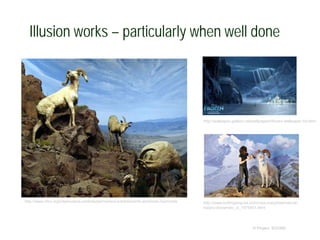
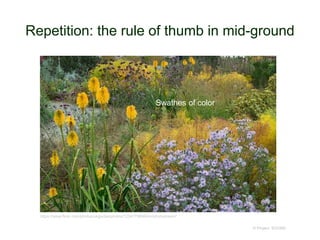
  • 134.
    Mid-ground plants: morethan just boring old shrubs  They connect the background to the foreground  Mid-ground plants & hardscape are extremely important for creating the illusion of depth – perhaps more so than back- & foreground in Mediterranean gardens  Choice and placement of mid- ground plants is critical to an attractive garden  Mid-ground plants provide continuity to a garden – live at least a decade © Project SOUND https://www.pinterest.com/pin/365073113524893117/
  • 135.
    Mid-ground plants: depth insmall gardens  Mid-ground plants should provide a smooth transition between background and foreground  Mid-ground often includes plants of various sizes – as tall as 4+ ft to as short as 2 ft  Larger mid-ground plants must be planted behind shorter mid- ground plants to give the illusion of depth © Project SOUND https://www.pinterest.com/garteneule/garden-seaside-feeling-coastal/
  • 136.
    Color & texturein mid-ground  Warmer-colored foliage front; cooler colored foliage back  Brighter colored foliage front  Green foliage forward; gray-green foliage back  Coarser foliage (larger leaves) forward; finer foliage back  Shiny leaves forward; matt leaves back © Project SOUND https://www.gardenia.net/guide/tips-to-create-a-provence-garden https://www.pinterest.com/pin/238127899027642842/
  • 137.
    Seating: should itbe mid- or foreground? © Project SOUND Shady seating Dining https://uk.pinterest.com/explore/backyard- landscape-design/
  • 138.
    And now wecome to the fun part… © Project SOUND http://www.torontogardens.com/2016/10/designing-with-see-through-plants.html/
  • 139.
    The foreground iswhere you get to indulge © Project SOUND
  • 140.
    © Project SOUND Foreground plants are the garden divas – showy and meant to be noticed  Are accent plants due to unique characteristics  Bright, or light-colored showy flowers  Unusual shape or foliage  Scent  Attract favorite pollinators  Smaller size – placed in front of the mid-ground  May be planted in ground or in containers https://www.flickr.com/photos/ukgardenphotos/12347798964/in/photostream/
  • 141.
    The foreground iswhere you get to indulge © Project SOUND  Lighter  Brighter  Bigger flowers  Showier leaves  Expensive containers  Unique accents of all sorts Shady seating Dining http://www.torontogardens.com/2016/10/designing-with- see-through-plants.html/
  • 142.
    Low/small sunflowers: goodhabitat in a showy package © Project SOUND Annuals like Layia and Lasthenia species Perennials like Guttierezia species
  • 143.
    © Project SOUND *Angelitadaisy – Tetraneuris acaulis Al Schneider, hosted by the USDA-NRCS PLANTS Database
  • 144.
    © Project SOUND *Angelitadaisy – Tetraneuris acaulis http://ucjeps.berkeley.edu/eflora/eflora_display.php?tid=8496 ©2015 Richard Spellenberg http://www.pryormountains.org/natural-history/wildflowers/  Western U.S. from ID and ND to TX  In CA, var. arizonica - in S. CA, desert foothills, San Bernardino Co.  Tetraneuris acaulis (Pursh) Greene, Pittonia. 3: 265. 1898.  AKA Hymenoxys acaulis
  • 145.
    © Project SOUND Size:  1-2 ft tall  2-5 ft wide, slowly spreading  Growth form:  Evergreen herbacious perennial; dies back in winter in cold climates  Leaves in tuft-like basal rosette  Foliage:  Leaves medium to dark green  Long and narrow  Roots: taproot; very drought tolerant Al Schneider, hosted by the USDA-NRCS PLANTS Database Cute and bright little perennial daisy http://swbiodiversity.org/seinet/taxa/index.php?taxon=2077
  • 146.
    © Project SOUND Brilliantflowers  Blooms:  Off and on, with rain/irrigation  Warm season is main bloom season – June-Sept  Flowers:  Daisy-type flower heads on leafless stems  Both ray & disk flowers yellow – brilliantly so; fragrant  Attract tons of pollinators – and birds eat the seeds  Seeds: small, flat sunflower type  Vegetative reproduction: patch increases in size
  • 147.
    © Project SOUND PlantRequirements  Soils:  Texture: most; best in well- drained  pH: any local  Light:  Full sun to light shade  Takes heat well  Water:  Winter: adequate  Summer: low to moderate – Water Zone 2 (dry out between waterings)  Fertilizer: none; likes poor soils  Other:  Deadhead monthly or so, as needed; will re-seed  No or inorganic mulch best ©2004 James M. Andre
  • 148.
    © Project SOUND Angelita= foreground  As an attractive pot plant; long bloom season makes it a favorite  Dense form makes it perfect for massing  Groundcover – even in hot areas along sidewalks, etc.  In rock gardens, desert or habitat gardenshttps://idfg.idaho.gov/species/taxa/57900 https://www.snwa.com/apps/plant/detail.cfml?id=15070 https://www.snwa.com/apps/landscape_galleries/gallery_color_e xplosion.cfml?gallery=2
  • 149.
    Bulbs and otherperennials are great foreground plants – in ground or containers © Project SOUND
  • 150.
    Match bulbs to container Your neighbor is down-sizing, and gifts you a charming little bulb pot. It’s an accent in itself – but you want to fill it © Project SOUND https://www.pinterest.com/carolinecooperk/bulbs-in-pots/
  • 151.
    © Project SOUND Dwarfgoldenstars – short-stemmed flowers  Size:  < 1 ft tall (6 inches common)  1 ft wide  Growth form:  Herbaceous perennial from a corm  Foliage:  Medium green grass-like leaves  Often die back before flowering ©2006 Dave Hacker
  • 152.
    © Project SOUND Yellowflowers – perfect foreground  Blooms: Late spring - usually Apr-May in western LA Co.  Flowers:  Golden yellow  Trumpet-shaped  Six brown-stippled yellow tepals  In loose umbel, at most 6-8 inches tall  Seeds: small dark seeds; re-seeds nicely  Vegetative reproduction: corms produce offshoots ©2011 Aaron E. Sims
  • 153.
    © Project SOUND Spotof gold in the garden  As an accent plant in a pretty pot  In native grassland/prairie plantings  In rock gardens  At front of dry beds, planters ©2012 Chris Winchell ©2011 Aaron E. Sims J.S. Peterson, hosted by the USDA-NRCS PLANTS Database
  • 154.
    Of course, yourcolor bowl will accent different divas throughout the seasons © Project SOUNDhttps://www.pinterest.com/carolinecooperk/bulbs-in-pots/
  • 155.
    © Project SOUND CushionBuckwheat – Eriogonum kennedyi
  • 156.
     Desert mountainsof Central/S. CA incl., San Gabriels  On rocky, gravelly slopes; 5000'-7500‘ in Yellow Pine Forest, Alpine Fell-fields, Sagebrush Scrub, Pinyon- Juniper Woodland  Named for William Ledlie Kennedy (c. 1827-?), who collected specimens in Kern Co., Mt. Pinos, Tehachipis © Project SOUND Cushion Buckwheat – Eriogonum kennedyi http://www.fs.fed.us/wildflowers/Rare_Plants/profiles/TEP/eriogonum_kennedyi_austro montanum/index.shtml http://socalbutterflies.com/plants_html/E_kennedyi.htm
  • 157.
    © Project SOUND Cushionbuckwheat is a miniature plant  Size:  6 inches tall  1-3 ft. wide, slowly spreading  Growth form:  Mat-like; very low and dense  All aspects are miniature  Becomes very dry in fall  Foliage:  Tiny leaves; all basal  Leaves hairy, giving a pale, silvery appearance
  • 158.
    © Project SOUND Buckwheatflowers on tiny stems  Blooms: late spring – often Apr- Jun in lowlands, later at higher elevations.  Flowers:  Tiny buckwheat flowers in dense, ball-like clusters on naked stems  Pink – great contrast w/ foliage  Excellent pollinator habitat plant  Seeds: red-brown seed heads in fall; birds love seeds  Vegetative reproduction: slowly spreads
  • 159.
    © Project SOUND Desertmountain species  Soils:  Texture: rocky/gravely – mix own mixture for containers  pH: any local  Needs good drainage: plant on slope or near rocks in garden  Light:  Full sun (perhaps light shade)  Water:  Winter: normal  Summer: best with occasional ‘summer monsoon’ water (Water Zone 1-2)  Fertilizer: none; likes poor soils  Other: gravel mulch or none
  • 160.
    © Project SOUND Cushionbuckwheat  Attractive and unusual accent pot plant – everyone is curious!  In rock garden, desert garden  Foreground of dry, sunny beds  Pollinator gardens  Buckwheat gardens http://www.laporteavenuenursery.com/html/eriogonum_kennedyi.html http://www.bbldwp.com/PhotoGallery/Album/10 http://clminternship.org/blog/?author=7236
  • 161.
    How does Cushion buckwheatrate (as a foreground plant) ? © Project SOUND  Small size – miniatures are always fascinating  Unusual, pale-colored foliage – appears to come forward  Pale flowers – also appear to be close by  Can be grown in a container – a great way to showcase a foreground accent plant
  • 162.
    We’ve come along way today © Project SOUND  Analyzed our views: public private  Discovered the challenges (and assets) of our site  Determines the ‘best’ natural views  Learned some tricks to making our private garden look larger than it is:  Unifying by repetition in hardscape  Dividing garden into rooms  Using principles of perspective Shady seating Dining
  • 163.
    We’ve learned toenvision potential views as consisting of several planes  Background plane  ‘borrowed background’  Garden backgrounds of plants and/or hardscape  Purposes:  To integrate distant vistas with garden  To serve as backdrop for the plants/hardscape in front of it  Attributes:  Larger, darker, finer-textured and less distinct than mid-ground plants/ hardscape  If you want to make garden seem larger, background should recede/disappear © Project SOUND https://www.pinterest.com/pin/365073113524893117/
  • 164.
    The mid-ground plane:ties garden together  Purposes  Tie the back- and foreground together in coherent design  Give the illusion of depth through size, color, texture and other attributes  Attributes  Chosen primarily for foliage  Size: ranging from slightly smaller than background to larger than foreground  Color: brighter, lighter and less grayed than background  Medium texture (often)  Swaths of color; repetition © Project SOUND https://www.pinterest.com/pin/365073113524893117/
  • 165.
    © Project SOUND Foreground plants are the garden divas – showy and meant to be noticed  Are accent plants due to unique characteristics  Bright, or light-colored showy flowers  Unusual shape or foliage  Scent  Attract favorite pollinators  Smaller size – placed in front of the mid-ground  May be planted in ground or in containers
  • 166.
    Whew! We covereda lot of ground today! © Project SOUND Don’t worry – we’ll come back to these topics a few more times this year Shady seating Dining
  • 167.
    Next class: Espalier(in the context of small habitat gardens like our design challenge) © Project SOUND
  • 168.
    We’ve got somefun workshops coming up © Project SOUND