Silicon in
Steels
Erika Entico
MS MSE
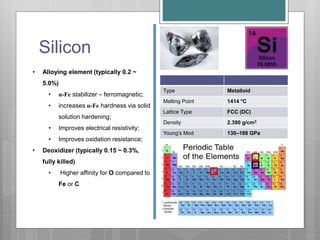
Silicon
Type Metalloid
Melting Point 1414 °C
Lattice Type FCC (DC)
Density 2.390 g/cm3
Young’s Mod 130–188 GPa
• Alloying element (typically 0.2 ~
5.0%)
• α-Fe stabilizer – ferromagnetic;
• increases α-Fe hardness via solid
solution hardening;
• Improves electrical resistivity;
• Improves oxidation resistance;
• Deoxidizer (typically 0.15 ~ 0.3%,
fully killed)
• Higher affinity for O compared to
Fe or C
Plain Carbon Steel Steel with sufficient
Si content
• Sufficient Si in steel retards the
formation of γ-Fe within a smaller
range of C content; the so-called γ-
loop;
• α and σ phase fields become
continuous;
• Above a certain amount, γ-Fe
disappears and no phase
transformation occurs from the
melting point down to room temp;
Effect on Phase
Transformation
• Increases A1 with increasing
concentration;
• Decreases the eutectoid C content
with increasing concentration;
Effect on Phase
Transformation
• Slows down austenite
transformation into pearlite, bainite,
and martensite;
Effect on Phase
Transformation
Effect on Hardness
(Ferrite) and Ductility
• Significantly enhances ferritic steel
hardness thru solid solutions as Si
content is increased;
• However, Si also promotes
precipitation of graphite;
Effect on Hardenability
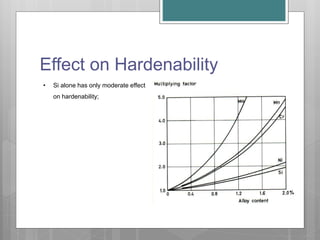
• Si alone has only moderate effect
on hardenability;
Effect on Hardenability
• Shifts the TTT curve to longer times but
has little effect on Ms;
• Makes austenitization difficult by
stabilizing the ferrite phase;
Effect on
Hardenability
• However, in combination with other
alloying elements such as Mn, Cr, and
Mo:
Effect on
Hardenability
Notable commercial Silicon
Steels
Examples Components
Electrical Steels Oriented 3.0 ~ 3.25 wt% Si
Non-oriented 0.5 ~ 3.25 wt% Si, max 0.5
wt% Al
Spring Steels 1080 (A228) (Piano wires) 0.7–1.0% C, 0.2–0.6% Mn,
0.1–0.3% Si
50CrV4 (EN 10277) 0.47–0.55% C, max. 1.10%
Mn, 0.90–1.20% Cr, 0.10–
0.20% V, max. 0.40% Si
9255 0.50–0.60% C, 0.70–0.95%
Mn, 1.80–2.20% Si
HSLA Steels 0.9 wt% max Si
References
 Oberg, E.; et al. (1996), Machinery's Handbook (25th ed.), Industrial Press Inc
 McMaster-Carr catalog (116th ed.), McMaster-Carr, p. 3662, retrieved 3
September 2010.
 Drumond, J.; et al. (2012), Effect of Silicon Content on the Microstructure and
Mechanical Properties of Dual-Phase Steels, Met. Microstruct. Anal.

Silicon in Steels

  • 1.
  • 2.
    Silicon Type Metalloid Melting Point1414 °C Lattice Type FCC (DC) Density 2.390 g/cm3 Young’s Mod 130–188 GPa • Alloying element (typically 0.2 ~ 5.0%) • α-Fe stabilizer – ferromagnetic; • increases α-Fe hardness via solid solution hardening; • Improves electrical resistivity; • Improves oxidation resistance; • Deoxidizer (typically 0.15 ~ 0.3%, fully killed) • Higher affinity for O compared to Fe or C
  • 3.
    Plain Carbon SteelSteel with sufficient Si content • Sufficient Si in steel retards the formation of γ-Fe within a smaller range of C content; the so-called γ- loop; • α and σ phase fields become continuous; • Above a certain amount, γ-Fe disappears and no phase transformation occurs from the melting point down to room temp; Effect on Phase Transformation
  • 4.
    • Increases A1with increasing concentration; • Decreases the eutectoid C content with increasing concentration; Effect on Phase Transformation
  • 5.
    • Slows downaustenite transformation into pearlite, bainite, and martensite; Effect on Phase Transformation
  • 6.
    Effect on Hardness (Ferrite)and Ductility • Significantly enhances ferritic steel hardness thru solid solutions as Si content is increased; • However, Si also promotes precipitation of graphite;
  • 7.
    Effect on Hardenability •Si alone has only moderate effect on hardenability;
  • 8.
    Effect on Hardenability •Shifts the TTT curve to longer times but has little effect on Ms; • Makes austenitization difficult by stabilizing the ferrite phase;
  • 9.
    Effect on Hardenability • However,in combination with other alloying elements such as Mn, Cr, and Mo:
  • 10.
  • 11.
    Notable commercial Silicon Steels ExamplesComponents Electrical Steels Oriented 3.0 ~ 3.25 wt% Si Non-oriented 0.5 ~ 3.25 wt% Si, max 0.5 wt% Al Spring Steels 1080 (A228) (Piano wires) 0.7–1.0% C, 0.2–0.6% Mn, 0.1–0.3% Si 50CrV4 (EN 10277) 0.47–0.55% C, max. 1.10% Mn, 0.90–1.20% Cr, 0.10– 0.20% V, max. 0.40% Si 9255 0.50–0.60% C, 0.70–0.95% Mn, 1.80–2.20% Si HSLA Steels 0.9 wt% max Si
  • 12.
    References  Oberg, E.;et al. (1996), Machinery's Handbook (25th ed.), Industrial Press Inc  McMaster-Carr catalog (116th ed.), McMaster-Carr, p. 3662, retrieved 3 September 2010.  Drumond, J.; et al. (2012), Effect of Silicon Content on the Microstructure and Mechanical Properties of Dual-Phase Steels, Met. Microstruct. Anal.