TOPIC : CLASSIFICATION OF MATERIAL AND
EFFECT OF ALLOYING ELEMENTS ON STEEL
PURPOSE : TO UNDERSTAND THE METALLURGICAL
EFFECT OF ALLOYING ELEMENTS AND ITS
IMPACTON MECHANICAL PROPERTIES
WELCOME
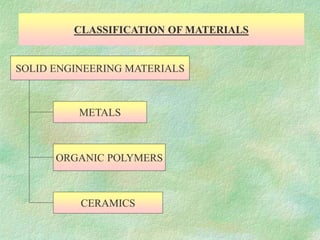
CLASSIFICATION OF MATERIALS
SOLID ENGINEERING MATERIALS
METALS
ORGANIC POLYMERS
CERAMICS
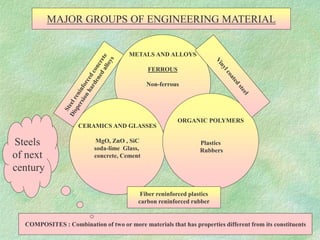
METALS AND ALLOYS
FERROUS
Non-ferrous
CERAMICS AND GLASSES
MgO, ZnO , SiC
soda-lime Glass,
concrete, Cement
ORGANIC POLYMERS
Plastics
Rubbers
Fiber reninforced plastics
carbon reninforced rubber
MAJOR GROUPS OF ENGINEERING MATERIAL
COMPOSITES : Combination of two or more materials that has properties different from its constituents
Steels
of next
century
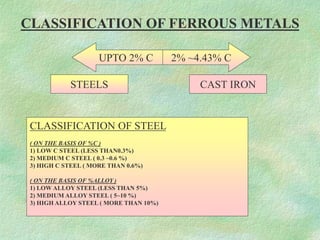
CLASSIFICATION OF FERROUS METALS
UPTO 2% C 2% ~4.43% C
STEELS CAST IRON
CLASSIFICATION OF STEEL
( ON THE BASIS OF %C )
1) LOW C STEEL (LESS THAN0.3%)
2) MEDIUM C STEEL ( 0.3 ~0.6 %)
3) HIGH C STEEL ( MORE THAN 0.6%)
( ON THE BASIS OF %ALLOY )
1) LOW ALLOY STEEL (LESS THAN 5%)
2) MEDIUM ALLOY STEEL ( 5~10 %)
3) HIGH ALLOY STEEL ( MORE THAN 10%)
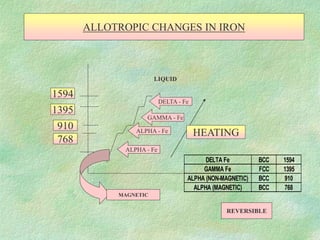
ALLOTROPIC CHANGES IN IRON
1594
1395
910
768
HEATING
LIQUID
DELTA - Fe
GAMMA - Fe
ALPHA - Fe
ALPHA - Fe
MAGNETIC
DELTA Fe BCC 1594
GAMMA Fe FCC 1395
ALPHA (NON-MAGNETIC) BCC 910
ALPHA (MAGNETIC) BCC 768
REVERSIBLE
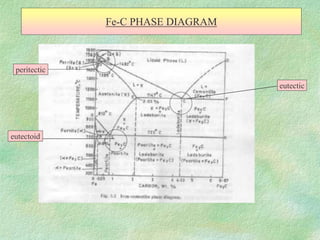
Fe-C PHASE DIAGRAM
eutectic
eutectoid
peritectic
Fe-C PHASE DIAGRAM
# IT IS ALSO CALLED Fe- Fe3C DIAGRAM.
# IT INDICATES PHASES PRESENT AND PHASE CHANGES OCCUR DURING HEATING
AND COOLING.
# %C SOLUBILITY VARIES IN DIFFERENT FORMS OF Fe
DELTA  Fe 0.1% MAX.
GAMMA  Fe 2.03% MAX.
ALPHA  Fe 0.008% AT RT MAX.
# REACTIONS OF Fe-C DIAGRAM
PERITECTIC REACTION ( L +    - Austenite)
EUTECTIC REACTION ( L   + Fe3C - Ledeburite)
EUTECTOID REACTION (   + Fe3C - Pearlite)
Fe-C PHASE DIAGRAM
What is ferrite , austenite, pearlite, cementite ????????
Fe-C PHASE DIAGRAM
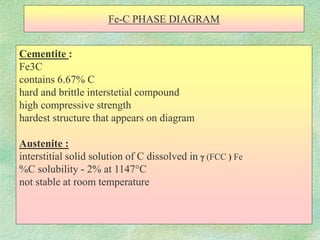
Cementite :
Fe3C
contains 6.67% C
hard and brittle interstetial compound
high compressive strength
hardest structure that appears on diagram
Austenite :
interstitial solid solution of C dissolved in  (FCC ) Fe
%C solubility - 2% at 1147°C
not stable at room temperature
Fe-C PHASE DIAGRAM
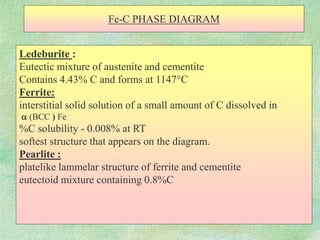
Ledeburite :
Eutectic mixture of austenite and cementite
Contains 4.43% C and forms at 1147°C
Ferrite:
interstitial solid solution of a small amount of C dissolved in
 (BCC ) Fe
%C solubility - 0.008% at RT
softest structure that appears on the diagram.
Pearlite :
platelike lammelar structure of ferrite and cementite
eutectoid mixture containing 0.8%C
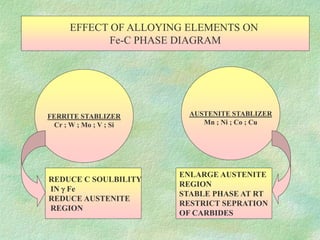
EFFECT OF ALLOYING ELEMENTS ON
Fe-C PHASE DIAGRAM
FERRITE STABLIZER
Cr ; W ; Mo ; V ; Si
AUSTENITE STABLIZER
Mn ; Ni ; Co ; Cu
ENLARGE AUSTENITE
REGION
STABLE PHASE AT RT
RESTRICT SEPRATION
OF CARBIDES
REDUCE C SOULBILITY
IN  Fe
REDUCE AUSTENITE
REGION
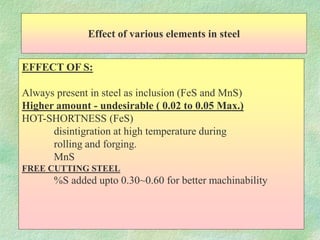
Effect of various elements in steel
EFFECT OF S:
Always present in steel as inclusion (FeS and MnS)
Higher amount - undesirable ( 0.02 to 0.05 Max.)
HOT-SHORTNESS (FeS)
disintigration at high temperature during
rolling and forging.
MnS
FREE CUTTING STEEL
%S added upto 0.30~0.60 for better machinability
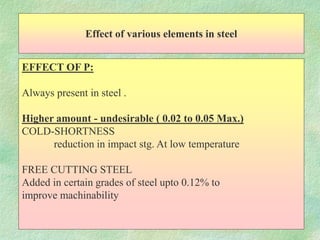
Effect of various elements in steel
EFFECT OF P:
Always present in steel .
Higher amount - undesirable ( 0.02 to 0.05 Max.)
COLD-SHORTNESS
reduction in impact stg. At low temperature
FREE CUTTING STEEL
Added in certain grades of steel upto 0.12% to
improve machinability
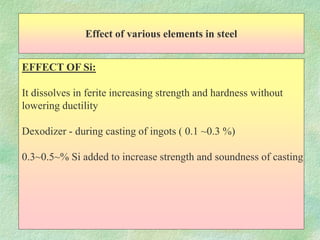
Effect of various elements in steel
EFFECT OF Si:
It dissolves in ferite increasing strength and hardness without
lowering ductility
Dexodizer - during casting of ingots ( 0.1 ~0.3 %)
0.3~0.5~% Si added to increase strength and soundness of casting
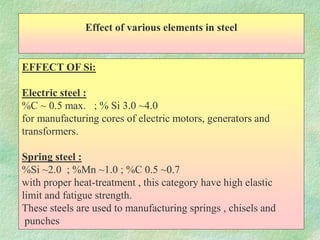
Effect of various elements in steel
EFFECT OF Si:
Electric steel :
%C ~ 0.5 max. ; % Si 3.0 ~4.0
for manufacturing cores of electric motors, generators and
transformers.
Spring steel :
%Si ~2.0 ; %Mn ~1.0 ; %C 0.5 ~0.7
with proper heat-treatment , this category have high elastic
limit and fatigue strength.
These steels are used to manufacturing springs , chisels and
punches
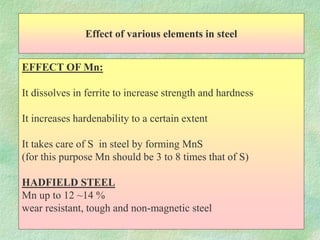
Effect of various elements in steel
EFFECT OF Mn:
It dissolves in ferrite to increase strength and hardness
It increases hardenability to a certain extent
It takes care of S in steel by forming MnS
(for this purpose Mn should be 3 to 8 times that of S)
HADFIELD STEEL
Mn up to 12 ~14 %
wear resistant, tough and non-magnetic steel
Effect of various elements in steel
EFFECT OF Ni:
It dissolves in ferrite, increasing hardness, strength and toughness
without sacrificing ductility
It increasing hardenability of steel
It increases impact resistance of steel at very low temperature
Higher amount of Ni is added to increase corrosion resistance
of high Cr steels
Effect of various elements in steel
EFFECT OF Cr:
Cr increases hardenability
It forms carbides havigg high hardness and wear resistance
Cr provodes strength, wear and oxidation resistance at elevated
temperature.
Higher amount of Ni is added to increase corrosion resistance
of high Cr steels
Effect of various elements in steel
EFFECT OF Mo:
Mo increases hardenability
It forms carbides having high hardness and wear resistance
0.15 ~0.30 % Mo is added to enhance the effect of other alloying
elements such as Mn , Ni , and chromium
It eliminates temper brittleness in steel
Effect of various elements in steel
EFFECT OF V:
V increases hardenability
It inhibits grain growth when steel is heated at high temperature.
V is a strong carbide former. Vanadium carbides posses high
hardness and wear resistance
V improves fatigue resistance
Effect of various elements in steel
EFFECT OF W:
W increases hardenability
It forms carbides having high hardness and wear resistance
It is important alloying element in tool steel
EFFECT OF Ti:
It is a strong carbide former
Ti in ss - to fix C and prevent ppt of chromium-carbide
Effect of various elements in steel
EFFECT OF Cu:
0.1 ~0.4% is added to get increased atmospheric corrosion
Effect of Al :
0.01 ~0.06 % - for fine grained steel
1 ~3 % in nitriding steel
Effect if B :
Increases hardenability ( 0.001 ~0.005%)
ALLOY STEELS
1) FREE CUTTING STEEL :-
- High machinability
- High quality surface finish
- %S - 0.3 ~0.6 % ; %P - 0.12 max.
(S present in MnS inclusions which promote formation
of short brittle chips)
- % Pb upto 0.35 % also improves machinability
(Pb exists in very small sub-microscopic globules)
Pb does not decrease ductility, toughness and other
mechanical properties
ALLOY STEELS
2) SPRING STEEL :-
(i) Medium and high C , plain C steels with higher
amount of Mn.
(ii) Medium C alloy steel with Mn and Si as main alloying
elements.
Cr, Ni, Mo , V may be added in place of Si
ALLOY STEELS
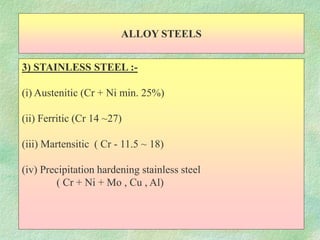
3) STAINLESS STEEL :-
(i) Austenitic (Cr + Ni min. 25%)
(ii) Ferritic (Cr 14 ~27)
(iii) Martensitic ( Cr - 11.5 ~ 18)
(iv) Precipitation hardening stainless steel
( Cr + Ni + Mo , Cu , Al)
ALLOY STEELS
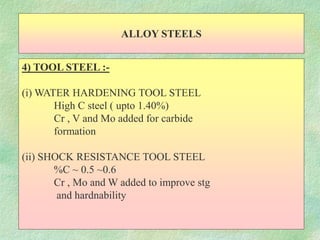
4) TOOL STEEL :-
(i) WATER HARDENING TOOL STEEL
High C steel ( upto 1.40%)
Cr , V and Mo added for carbide
formation
(ii) SHOCK RESISTANCE TOOL STEEL
%C ~ 0.5 ~0.6
Cr , Mo and W added to improve stg
and hardnability
ALLOY STEELS
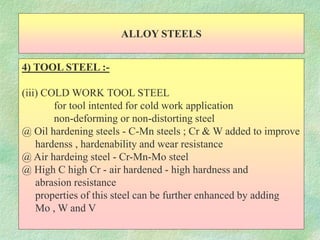
4) TOOL STEEL :-
(iii) COLD WORK TOOL STEEL
for tool intented for cold work application
non-deforming or non-distorting steel
@ Oil hardening steels - C-Mn steels ; Cr & W added to improve
hardenss , hardenability and wear resistance
@ Air hardeing steel - Cr-Mn-Mo steel
@ High C high Cr - air hardened - high hardness and
abrasion resistance
properties of this steel can be further enhanced by adding
Mo , W and V
ALLOY STEELS
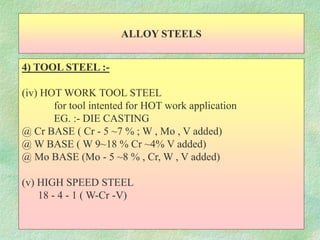
4) TOOL STEEL :-
(iv) HOT WORK TOOL STEEL
for tool intented for HOT work application
EG. :- DIE CASTING
@ Cr BASE ( Cr - 5 ~7 % ; W , Mo , V added)
@ W BASE ( W 9~18 % Cr ~4% V added)
@ Mo BASE (Mo - 5 ~8 % , Cr, W , V added)
(v) HIGH SPEED STEEL
18 - 4 - 1 ( W-Cr -V)
ALLOY STEELS
OTHERS
VALVE STEEL ( Cr + Si > 10%) + Ni + W
HEAT RESISTANT STEELS
MARAGING STEELS ( HAHS STEELS) - Ni + Co

classification of materials1.ppt

  • 1.
    TOPIC : CLASSIFICATIONOF MATERIAL AND EFFECT OF ALLOYING ELEMENTS ON STEEL PURPOSE : TO UNDERSTAND THE METALLURGICAL EFFECT OF ALLOYING ELEMENTS AND ITS IMPACTON MECHANICAL PROPERTIES WELCOME
  • 2.
    CLASSIFICATION OF MATERIALS SOLIDENGINEERING MATERIALS METALS ORGANIC POLYMERS CERAMICS
  • 3.
    METALS AND ALLOYS FERROUS Non-ferrous CERAMICSAND GLASSES MgO, ZnO , SiC soda-lime Glass, concrete, Cement ORGANIC POLYMERS Plastics Rubbers Fiber reninforced plastics carbon reninforced rubber MAJOR GROUPS OF ENGINEERING MATERIAL COMPOSITES : Combination of two or more materials that has properties different from its constituents Steels of next century
  • 4.
    CLASSIFICATION OF FERROUSMETALS UPTO 2% C 2% ~4.43% C STEELS CAST IRON CLASSIFICATION OF STEEL ( ON THE BASIS OF %C ) 1) LOW C STEEL (LESS THAN0.3%) 2) MEDIUM C STEEL ( 0.3 ~0.6 %) 3) HIGH C STEEL ( MORE THAN 0.6%) ( ON THE BASIS OF %ALLOY ) 1) LOW ALLOY STEEL (LESS THAN 5%) 2) MEDIUM ALLOY STEEL ( 5~10 %) 3) HIGH ALLOY STEEL ( MORE THAN 10%)
  • 5.
    ALLOTROPIC CHANGES INIRON 1594 1395 910 768 HEATING LIQUID DELTA - Fe GAMMA - Fe ALPHA - Fe ALPHA - Fe MAGNETIC DELTA Fe BCC 1594 GAMMA Fe FCC 1395 ALPHA (NON-MAGNETIC) BCC 910 ALPHA (MAGNETIC) BCC 768 REVERSIBLE
  • 6.
  • 7.
    Fe-C PHASE DIAGRAM #IT IS ALSO CALLED Fe- Fe3C DIAGRAM. # IT INDICATES PHASES PRESENT AND PHASE CHANGES OCCUR DURING HEATING AND COOLING. # %C SOLUBILITY VARIES IN DIFFERENT FORMS OF Fe DELTA  Fe 0.1% MAX. GAMMA  Fe 2.03% MAX. ALPHA  Fe 0.008% AT RT MAX. # REACTIONS OF Fe-C DIAGRAM PERITECTIC REACTION ( L +    - Austenite) EUTECTIC REACTION ( L   + Fe3C - Ledeburite) EUTECTOID REACTION (   + Fe3C - Pearlite)
  • 8.
    Fe-C PHASE DIAGRAM Whatis ferrite , austenite, pearlite, cementite ????????
  • 9.
    Fe-C PHASE DIAGRAM Cementite: Fe3C contains 6.67% C hard and brittle interstetial compound high compressive strength hardest structure that appears on diagram Austenite : interstitial solid solution of C dissolved in  (FCC ) Fe %C solubility - 2% at 1147°C not stable at room temperature
  • 10.
    Fe-C PHASE DIAGRAM Ledeburite: Eutectic mixture of austenite and cementite Contains 4.43% C and forms at 1147°C Ferrite: interstitial solid solution of a small amount of C dissolved in  (BCC ) Fe %C solubility - 0.008% at RT softest structure that appears on the diagram. Pearlite : platelike lammelar structure of ferrite and cementite eutectoid mixture containing 0.8%C
  • 11.
    EFFECT OF ALLOYINGELEMENTS ON Fe-C PHASE DIAGRAM FERRITE STABLIZER Cr ; W ; Mo ; V ; Si AUSTENITE STABLIZER Mn ; Ni ; Co ; Cu ENLARGE AUSTENITE REGION STABLE PHASE AT RT RESTRICT SEPRATION OF CARBIDES REDUCE C SOULBILITY IN  Fe REDUCE AUSTENITE REGION
  • 12.
    Effect of variouselements in steel EFFECT OF S: Always present in steel as inclusion (FeS and MnS) Higher amount - undesirable ( 0.02 to 0.05 Max.) HOT-SHORTNESS (FeS) disintigration at high temperature during rolling and forging. MnS FREE CUTTING STEEL %S added upto 0.30~0.60 for better machinability
  • 13.
    Effect of variouselements in steel EFFECT OF P: Always present in steel . Higher amount - undesirable ( 0.02 to 0.05 Max.) COLD-SHORTNESS reduction in impact stg. At low temperature FREE CUTTING STEEL Added in certain grades of steel upto 0.12% to improve machinability
  • 14.
    Effect of variouselements in steel EFFECT OF Si: It dissolves in ferite increasing strength and hardness without lowering ductility Dexodizer - during casting of ingots ( 0.1 ~0.3 %) 0.3~0.5~% Si added to increase strength and soundness of casting
  • 15.
    Effect of variouselements in steel EFFECT OF Si: Electric steel : %C ~ 0.5 max. ; % Si 3.0 ~4.0 for manufacturing cores of electric motors, generators and transformers. Spring steel : %Si ~2.0 ; %Mn ~1.0 ; %C 0.5 ~0.7 with proper heat-treatment , this category have high elastic limit and fatigue strength. These steels are used to manufacturing springs , chisels and punches
  • 16.
    Effect of variouselements in steel EFFECT OF Mn: It dissolves in ferrite to increase strength and hardness It increases hardenability to a certain extent It takes care of S in steel by forming MnS (for this purpose Mn should be 3 to 8 times that of S) HADFIELD STEEL Mn up to 12 ~14 % wear resistant, tough and non-magnetic steel
  • 17.
    Effect of variouselements in steel EFFECT OF Ni: It dissolves in ferrite, increasing hardness, strength and toughness without sacrificing ductility It increasing hardenability of steel It increases impact resistance of steel at very low temperature Higher amount of Ni is added to increase corrosion resistance of high Cr steels
  • 18.
    Effect of variouselements in steel EFFECT OF Cr: Cr increases hardenability It forms carbides havigg high hardness and wear resistance Cr provodes strength, wear and oxidation resistance at elevated temperature. Higher amount of Ni is added to increase corrosion resistance of high Cr steels
  • 19.
    Effect of variouselements in steel EFFECT OF Mo: Mo increases hardenability It forms carbides having high hardness and wear resistance 0.15 ~0.30 % Mo is added to enhance the effect of other alloying elements such as Mn , Ni , and chromium It eliminates temper brittleness in steel
  • 20.
    Effect of variouselements in steel EFFECT OF V: V increases hardenability It inhibits grain growth when steel is heated at high temperature. V is a strong carbide former. Vanadium carbides posses high hardness and wear resistance V improves fatigue resistance
  • 21.
    Effect of variouselements in steel EFFECT OF W: W increases hardenability It forms carbides having high hardness and wear resistance It is important alloying element in tool steel EFFECT OF Ti: It is a strong carbide former Ti in ss - to fix C and prevent ppt of chromium-carbide
  • 22.
    Effect of variouselements in steel EFFECT OF Cu: 0.1 ~0.4% is added to get increased atmospheric corrosion Effect of Al : 0.01 ~0.06 % - for fine grained steel 1 ~3 % in nitriding steel Effect if B : Increases hardenability ( 0.001 ~0.005%)
  • 23.
    ALLOY STEELS 1) FREECUTTING STEEL :- - High machinability - High quality surface finish - %S - 0.3 ~0.6 % ; %P - 0.12 max. (S present in MnS inclusions which promote formation of short brittle chips) - % Pb upto 0.35 % also improves machinability (Pb exists in very small sub-microscopic globules) Pb does not decrease ductility, toughness and other mechanical properties
  • 24.
    ALLOY STEELS 2) SPRINGSTEEL :- (i) Medium and high C , plain C steels with higher amount of Mn. (ii) Medium C alloy steel with Mn and Si as main alloying elements. Cr, Ni, Mo , V may be added in place of Si
  • 25.
    ALLOY STEELS 3) STAINLESSSTEEL :- (i) Austenitic (Cr + Ni min. 25%) (ii) Ferritic (Cr 14 ~27) (iii) Martensitic ( Cr - 11.5 ~ 18) (iv) Precipitation hardening stainless steel ( Cr + Ni + Mo , Cu , Al)
  • 26.
    ALLOY STEELS 4) TOOLSTEEL :- (i) WATER HARDENING TOOL STEEL High C steel ( upto 1.40%) Cr , V and Mo added for carbide formation (ii) SHOCK RESISTANCE TOOL STEEL %C ~ 0.5 ~0.6 Cr , Mo and W added to improve stg and hardnability
  • 27.
    ALLOY STEELS 4) TOOLSTEEL :- (iii) COLD WORK TOOL STEEL for tool intented for cold work application non-deforming or non-distorting steel @ Oil hardening steels - C-Mn steels ; Cr & W added to improve hardenss , hardenability and wear resistance @ Air hardeing steel - Cr-Mn-Mo steel @ High C high Cr - air hardened - high hardness and abrasion resistance properties of this steel can be further enhanced by adding Mo , W and V
  • 28.
    ALLOY STEELS 4) TOOLSTEEL :- (iv) HOT WORK TOOL STEEL for tool intented for HOT work application EG. :- DIE CASTING @ Cr BASE ( Cr - 5 ~7 % ; W , Mo , V added) @ W BASE ( W 9~18 % Cr ~4% V added) @ Mo BASE (Mo - 5 ~8 % , Cr, W , V added) (v) HIGH SPEED STEEL 18 - 4 - 1 ( W-Cr -V)
  • 29.
    ALLOY STEELS OTHERS VALVE STEEL( Cr + Si > 10%) + Ni + W HEAT RESISTANT STEELS MARAGING STEELS ( HAHS STEELS) - Ni + Co