Significant (Measured) Digits Measuring with Precision
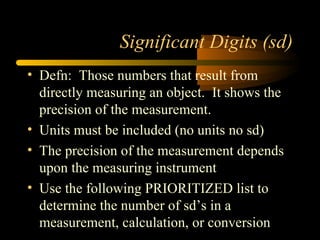
Significant Digits (sd) Defn:  Those numbers that result from directly measuring an object.  It shows the precision of the measurement. Units must be included (no units no sd) The precision of the measurement depends upon the measuring instrument Use the following PRIORITIZED list to determine the number of sd’s in a measurement, calculation, or conversion
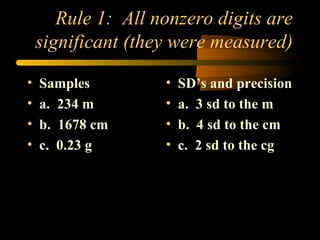
Rule 1:  All nonzero digits are significant (they were measured) Samples a.  234 m b.  1678 cm c.  0.23 g SD’s and precision a.  3 sd to the m b.  4 sd to the cm c.  2 sd to the cg
Rule 2:  All zeros between nonzero (or significant) digits are significant Samples a. 202 mm b. 1003 cm c.  0.200105 m SD’s and precision a.  3 sd to the mm b.  4 sd to the cm c.  6 sd to the   m Translation: In between 0s must be measured
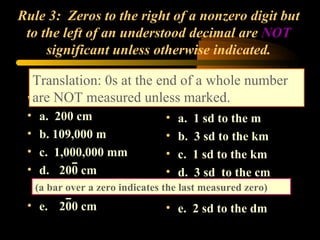
Rule 3:  Zeros to the right of a nonzero digit but to the left of an understood decimal are  NOT  significant unless otherwise indicated. a.  200 cm b. 109,000 m c.  1,000,000 mm d. 200 cm e. 200 cm a.  1 sd to the m b.  3 sd to the km c.  1 sd to the km d.  3 sd  to the cm e.  2 sd to the dm Translation: 0s at the end of a whole number are NOT measured unless marked. (a bar over a zero indicates the last measured zero)
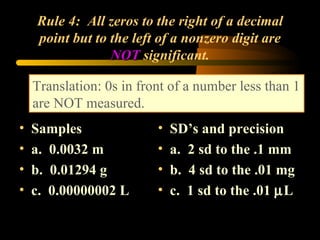
Rule 4:  All zeros to the right of a decimal point but to the left of a nonzero digit are  NOT  significant. Samples a.  0.0032 m b.  0.01294 g c.  0.00000002 L SD’s and precision  a.  2 sd to the .1 mm b.  4 sd to the .01 mg c.  1 sd to the .01   L Translation: 0s in front of a number less than 1 are NOT measured.
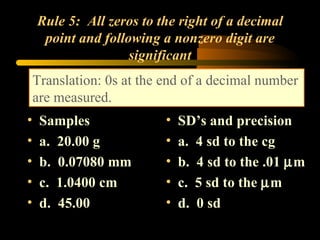
Rule 5:  All zeros to the right of a decimal point and following a nonzero digit are significant Samples a.  20.00 g b.  0.07080 mm c.  1.0400 cm d.  45.00 SD’s and precision a.  4 sd to the cg b.  4 sd to the .01   m c.  5 sd to the   m d.  0 sd Translation: 0s at the end of a decimal number are measured.
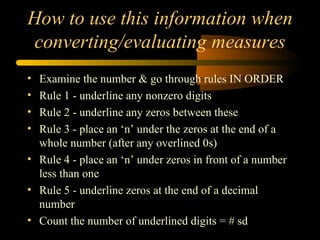
How to use this information when converting/evaluating measures Examine the number & go through rules IN ORDER Rule 1 - underline any nonzero digits Rule 2 - underline any zeros between these Rule 3 - place an ‘n’ under the zeros at the end of a whole number (after any overlined 0s) Rule 4 - place an ‘n’ under zeros in front of a number less than one Rule 5 - underline zeros at the end of a decimal number Count the number of underlined digits = # sd
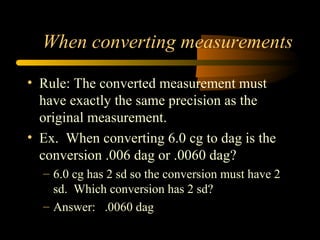
When converting measurements Rule: The converted measurement must have exactly the same precision as the original measurement. Ex.  When converting 6.0 cg to dag is the conversion .006 dag or .0060 dag? 6.0 cg has 2 sd so the conversion must have 2 sd.  Which conversion has 2 sd? Answer:  .0060 dag
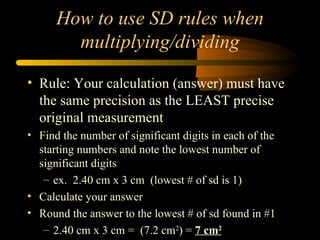
How to use SD rules when multiplying/dividing Rule: Your calculation (answer) must have the same precision as the LEAST precise original measurement Find the number of significant digits in each of the starting numbers and note the lowest number of significant digits ex.  2.40 cm x 3 cm  (lowest # of sd is 1) Calculate your answer Round the answer to the lowest # of sd found in #1 2.40 cm x 3 cm =  (7.2 cm 2 ) =  7 cm 2

Significant digits

  • 1.
    Significant (Measured) DigitsMeasuring with Precision
  • 2.
    Significant Digits (sd)Defn: Those numbers that result from directly measuring an object. It shows the precision of the measurement. Units must be included (no units no sd) The precision of the measurement depends upon the measuring instrument Use the following PRIORITIZED list to determine the number of sd’s in a measurement, calculation, or conversion
  • 3.
    Rule 1: All nonzero digits are significant (they were measured) Samples a. 234 m b. 1678 cm c. 0.23 g SD’s and precision a. 3 sd to the m b. 4 sd to the cm c. 2 sd to the cg
  • 4.
    Rule 2: All zeros between nonzero (or significant) digits are significant Samples a. 202 mm b. 1003 cm c. 0.200105 m SD’s and precision a. 3 sd to the mm b. 4 sd to the cm c. 6 sd to the  m Translation: In between 0s must be measured
  • 5.
    Rule 3: Zeros to the right of a nonzero digit but to the left of an understood decimal are NOT significant unless otherwise indicated. a. 200 cm b. 109,000 m c. 1,000,000 mm d. 200 cm e. 200 cm a. 1 sd to the m b. 3 sd to the km c. 1 sd to the km d. 3 sd to the cm e. 2 sd to the dm Translation: 0s at the end of a whole number are NOT measured unless marked. (a bar over a zero indicates the last measured zero)
  • 6.
    Rule 4: All zeros to the right of a decimal point but to the left of a nonzero digit are NOT significant. Samples a. 0.0032 m b. 0.01294 g c. 0.00000002 L SD’s and precision a. 2 sd to the .1 mm b. 4 sd to the .01 mg c. 1 sd to the .01  L Translation: 0s in front of a number less than 1 are NOT measured.
  • 7.
    Rule 5: All zeros to the right of a decimal point and following a nonzero digit are significant Samples a. 20.00 g b. 0.07080 mm c. 1.0400 cm d. 45.00 SD’s and precision a. 4 sd to the cg b. 4 sd to the .01  m c. 5 sd to the  m d. 0 sd Translation: 0s at the end of a decimal number are measured.
  • 8.
    How to usethis information when converting/evaluating measures Examine the number & go through rules IN ORDER Rule 1 - underline any nonzero digits Rule 2 - underline any zeros between these Rule 3 - place an ‘n’ under the zeros at the end of a whole number (after any overlined 0s) Rule 4 - place an ‘n’ under zeros in front of a number less than one Rule 5 - underline zeros at the end of a decimal number Count the number of underlined digits = # sd
  • 9.
    When converting measurementsRule: The converted measurement must have exactly the same precision as the original measurement. Ex. When converting 6.0 cg to dag is the conversion .006 dag or .0060 dag? 6.0 cg has 2 sd so the conversion must have 2 sd. Which conversion has 2 sd? Answer: .0060 dag
  • 10.
    How to useSD rules when multiplying/dividing Rule: Your calculation (answer) must have the same precision as the LEAST precise original measurement Find the number of significant digits in each of the starting numbers and note the lowest number of significant digits ex. 2.40 cm x 3 cm (lowest # of sd is 1) Calculate your answer Round the answer to the lowest # of sd found in #1 2.40 cm x 3 cm = (7.2 cm 2 ) = 7 cm 2