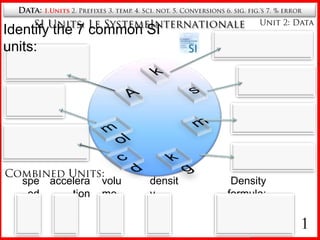
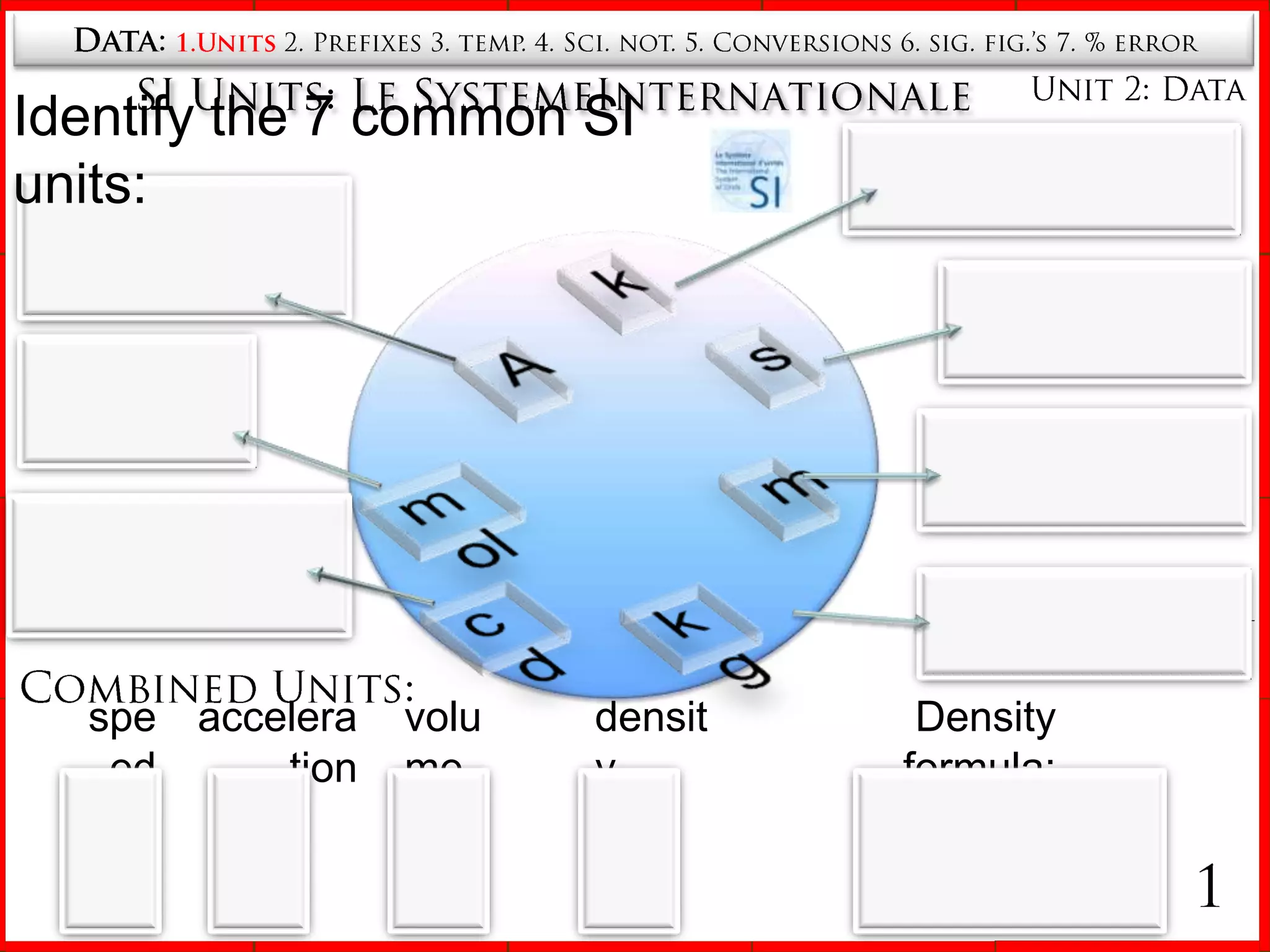
Data: 1.Units2. Prefixes 3. temp. 4. Sci. not. 5. Conversions 6. sig. fig.’s 7. % errorSI Units: Le SystemeInternationaleUnit 2: DataIdentify the 7 common SI units:KelvintemperatureAmperekcurrentsecondstimeAmolemeteramountmolmdistancecandelabrightnesscdkgkilogrammassCombined Units:speedaccelerationdensityvolumeDensity formula:1
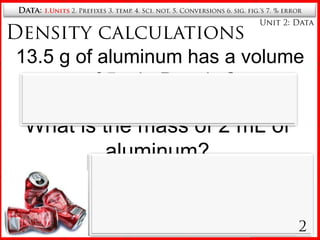
Data: 1.Units2. Prefixes 3. temp. 4. Sci. not. 5. Conversions 6. sig. fig.’s 7. % errorUnit 2: DataDensity calculations13.5 g of aluminum has a volume of 5 mL. Density?What is the mass of 2 mL of aluminum?m = vd
= (2 mL)(2.7 g/mL)
= 5.4 gdividemmultiplydv2
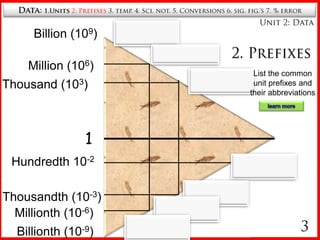
Data: 1.Units2. Prefixes 3. temp. 4. Sci. not. 5. Conversions 6. sig. fig.’s 7. % errorUnit 2: DataBillion (109)Giga (G)2. PrefixesMega (M)Million (106)List the common unit prefixes and their abbreviationskilo (k)Thousand (103)learn more1Hundredth 10-2centi (c)milli (m)Thousandth (10-3)micro (m)Millionth (10-6)3nano (n)Billionth (10-9)
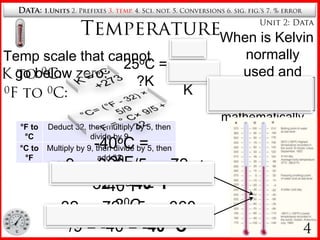
Data: 1.Units2. Prefixes 3. temp. 4. Sci. not. 5. Conversions 6. sig. fig.’s 7. % errorTemperatureUnit 2: DataWhen is Kelvin normally used and why?KelvinTemp scale that cannot go below zero:K to 0C:25oC = ?KK = oC +273= 298 KIn many formulas: it is mathematically accurate.0F to 0C:°C= (°F - 32) × 5/9°F = ° C× 9/5 + 32 -40oC = ?0Fx9 = -360, /5 = -72, + 32 = -40 0F -40oF = ?0C-32 = -72, x5 = -360, /9 = -40 = -40 0C 44
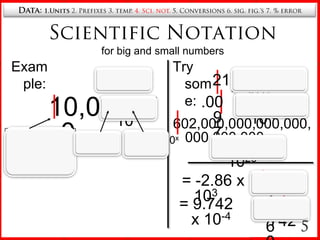
Data: 1.Units2. Prefixes 3. temp. 4. Sci. not. 5. Conversions 6. sig. fig.’s 7. % errorScientific Notationfor big and small numbersExample:Try some:= 2.12 x 102212.009710,000= 9.7x 10-3= 1 x 104602,000,000,000,000,000,000,000Draw a line to make it between 1 and 10; count to decimal point.Always 10xAlways 1-10= 6.02x 10²³-2860= -2.86 x 103= 9.742 x 10-4.00097425
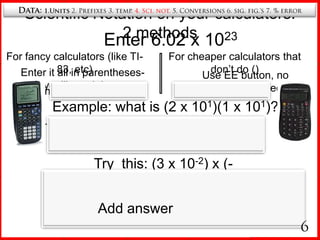
Data: 1.Units2. Prefixes 3. temp. 4. Sci. not. 5. Conversions 6. sig. fig.’s 7. % errorScientific Notation on your calculators:  2 methodsEnter 6.02 x 10²³For fancy calculators (like TI-83, etc)For cheaper calculators that don’t do ()Enter it all in parentheses- you’ll need themUse EE button, no parentheses neededEnter (6.02x10^23)Enter 6.02E23Example: what is (2 x 101)(1 x 101)?Enter (2 x 10^1)(1 x 10^1)Enter 2E1x1E1= 200 or 2E2Try  this: (3 x 10⁻²) x (-4.2 x 10⁻⁴) = ?Enter (3x10^-2)x(-4.2x10^-4)Enter  3E-2x-4.2E-4Negative, not subtractNegative, not subtractAdd answer= -1.26 x 10⁻⁵ or -0.00001266
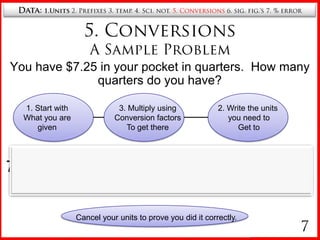
Data: 1.Units2. Prefixes 3. temp. 4. Sci. not. 5. Conversions 6. sig. fig.’s 7. % error5. ConversionsA Sample ProblemYou have $7.25 in your pocket in quarters.  How many quarters do you have?1. Start withWhat you aregiven3. Multiply usingConversion factorsTo get there2. Write the units you need toGet to4 quarters29= ___ quartersX7.25 dollarsdollarCancel your units to prove you did it correctly.7
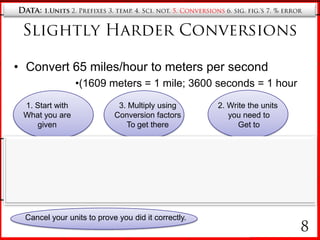
1. Units 2. Prefixes 3. Dens./temp. 4. Sci. not. 5. Conversions 6. sig. fig.’s 7. % errorData: 1.Units2. Prefixes 3. temp. 4. Sci. not. 5. Conversions 6. sig. fig.’s 7. % errorConvert 65 miles/hour to meters per second(1609 meters = 1 mile; 3600 seconds = 1 hour1. Start withWhat you aregiven3. Multiply usingConversion factorsTo get there2. Write the units you need toGet to1609 meters1 hour65 milesxxmeterssecond= 29.05hour1 mile3600 secondsCancel your units to prove you did it correctly.Slightly Harder Conversions8
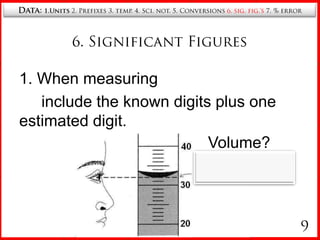
Data: 1.Units2. Prefixes 3. temp. 4. Sci. not. 5. Conversions 6. sig. fig.’s 7. % error6. Significant Figures1. When measuring     include the known digits plus one estimated digit.Volume?32.0 mL9
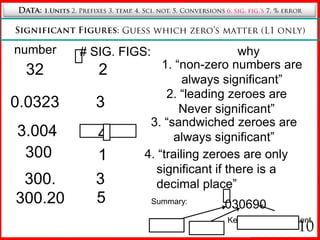
Data: 1.Units2. Prefixes 3. temp. 4. Sci. not. 5. Conversions 6. sig. fig.’s 7. % errorSignificant Figures: Guess which zero’s matter (L1 only)numberwhy# SIG. FIGS:1. “non-zero numbers are always significant”3222. “leading zeroes are Never significant”0.032333. “sandwiched zeroes are always significant”3.004430014. “trailing zeroes are only significant if there is a decimal place”300.35300.20.030690Summary:Keep if decimal presentdump10keep

2 data 2011

  • 1.
    Data: 1.Units2. Prefixes3. temp. 4. Sci. not. 5. Conversions 6. sig. fig.’s 7. % errorSI Units: Le SystemeInternationaleUnit 2: DataIdentify the 7 common SI units:KelvintemperatureAmperekcurrentsecondstimeAmolemeteramountmolmdistancecandelabrightnesscdkgkilogrammassCombined Units:speedaccelerationdensityvolumeDensity formula:1
  • 2.
    Data: 1.Units2. Prefixes3. temp. 4. Sci. not. 5. Conversions 6. sig. fig.’s 7. % errorUnit 2: DataDensity calculations13.5 g of aluminum has a volume of 5 mL. Density?What is the mass of 2 mL of aluminum?m = vd
  • 3.
  • 4.
  • 5.
    Data: 1.Units2. Prefixes3. temp. 4. Sci. not. 5. Conversions 6. sig. fig.’s 7. % errorUnit 2: DataBillion (109)Giga (G)2. PrefixesMega (M)Million (106)List the common unit prefixes and their abbreviationskilo (k)Thousand (103)learn more1Hundredth 10-2centi (c)milli (m)Thousandth (10-3)micro (m)Millionth (10-6)3nano (n)Billionth (10-9)
  • 6.
    Data: 1.Units2. Prefixes3. temp. 4. Sci. not. 5. Conversions 6. sig. fig.’s 7. % errorTemperatureUnit 2: DataWhen is Kelvin normally used and why?KelvinTemp scale that cannot go below zero:K to 0C:25oC = ?KK = oC +273= 298 KIn many formulas: it is mathematically accurate.0F to 0C:°C= (°F - 32) × 5/9°F = ° C× 9/5 + 32 -40oC = ?0Fx9 = -360, /5 = -72, + 32 = -40 0F -40oF = ?0C-32 = -72, x5 = -360, /9 = -40 = -40 0C 44
  • 7.
    Data: 1.Units2. Prefixes3. temp. 4. Sci. not. 5. Conversions 6. sig. fig.’s 7. % errorScientific Notationfor big and small numbersExample:Try some:= 2.12 x 102212.009710,000= 9.7x 10-3= 1 x 104602,000,000,000,000,000,000,000Draw a line to make it between 1 and 10; count to decimal point.Always 10xAlways 1-10= 6.02x 10²³-2860= -2.86 x 103= 9.742 x 10-4.00097425
  • 8.
    Data: 1.Units2. Prefixes3. temp. 4. Sci. not. 5. Conversions 6. sig. fig.’s 7. % errorScientific Notation on your calculators: 2 methodsEnter 6.02 x 10²³For fancy calculators (like TI-83, etc)For cheaper calculators that don’t do ()Enter it all in parentheses- you’ll need themUse EE button, no parentheses neededEnter (6.02x10^23)Enter 6.02E23Example: what is (2 x 101)(1 x 101)?Enter (2 x 10^1)(1 x 10^1)Enter 2E1x1E1= 200 or 2E2Try this: (3 x 10⁻²) x (-4.2 x 10⁻⁴) = ?Enter (3x10^-2)x(-4.2x10^-4)Enter 3E-2x-4.2E-4Negative, not subtractNegative, not subtractAdd answer= -1.26 x 10⁻⁵ or -0.00001266
  • 9.
    Data: 1.Units2. Prefixes3. temp. 4. Sci. not. 5. Conversions 6. sig. fig.’s 7. % error5. ConversionsA Sample ProblemYou have $7.25 in your pocket in quarters. How many quarters do you have?1. Start withWhat you aregiven3. Multiply usingConversion factorsTo get there2. Write the units you need toGet to4 quarters29= ___ quartersX7.25 dollarsdollarCancel your units to prove you did it correctly.7
  • 10.
    1. Units 2.Prefixes 3. Dens./temp. 4. Sci. not. 5. Conversions 6. sig. fig.’s 7. % errorData: 1.Units2. Prefixes 3. temp. 4. Sci. not. 5. Conversions 6. sig. fig.’s 7. % errorConvert 65 miles/hour to meters per second(1609 meters = 1 mile; 3600 seconds = 1 hour1. Start withWhat you aregiven3. Multiply usingConversion factorsTo get there2. Write the units you need toGet to1609 meters1 hour65 milesxxmeterssecond= 29.05hour1 mile3600 secondsCancel your units to prove you did it correctly.Slightly Harder Conversions8
  • 11.
    Data: 1.Units2. Prefixes3. temp. 4. Sci. not. 5. Conversions 6. sig. fig.’s 7. % error6. Significant Figures1. When measuring include the known digits plus one estimated digit.Volume?32.0 mL9
  • 12.
    Data: 1.Units2. Prefixes3. temp. 4. Sci. not. 5. Conversions 6. sig. fig.’s 7. % errorSignificant Figures: Guess which zero’s matter (L1 only)numberwhy# SIG. FIGS:1. “non-zero numbers are always significant”3222. “leading zeroes are Never significant”0.032333. “sandwiched zeroes are always significant”3.004430014. “trailing zeroes are only significant if there is a decimal place”300.35300.20.030690Summary:Keep if decimal presentdump10keep