SignalR-Powered X-Platform Real-Time
Apps!
SignalR-Powered X-Platform Real-Time
Apps!
Samidip Basu Microsoft MVP, MS, MCPD, CAPM
Senior Technical Trainer | Telerik Inc. |
www.telerik.com
E: Sam.Basu@Telerik.com | L: x3179 | C: 507 244
0579
T: @samidip | W: http://samidipbasu.com
Why do we need real-time?
- New email
- Twitter/Facebook updates
- Stock Ticker/Live Auctions
- Game Scores
- Real-time Notifications
- Turn-by-Turn or Shooter Games
- Collaboration
- Progress Bars
- And obviously, Chat
No dearth of examples where real-time communication in needed ..
Challenges
- Building real-time applications is difficult
- Transcends boundaries of choice in development platforms
- Part of the problem is HTTP – Request/Response protocol
HTTP = HyperText Transfer Protocol | Obviously works, but has
limitations!

- Statelessness of web applications
 Need open transport channel between server and clients for
bidirectional or full-duplex communication.
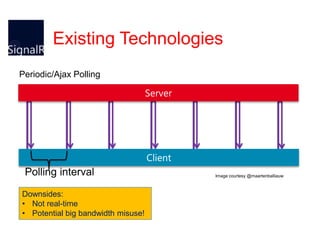
Existing Technologies
Periodic/Ajax Polling

Image courtesy @maartenballiauw

Downsides:
• Not real-time
• Potential big bandwidth misuse!
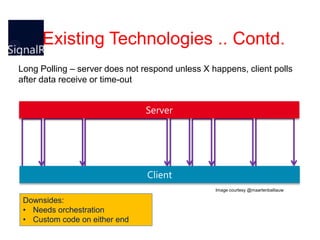
Existing Technologies .. Contd.
Long Polling – server does not respond unless X happens, client polls
after data receive or time-out

Image courtesy @maartenballiauw

Downsides:
• Needs orchestration
• Custom code on either end
Existing Technologies .. Others
- Use plugins like Silverlight/Flash – to communicate through sockets
- Forever Frame (execute script blocks from server in iFrame)
- Server sent Events (Push or Stream from server)

- Native HTML 5 Web Sockets (Magic Unicorn world) – true
bidirectional
transport channel; but support can be flaky
Bottom-line:
• Lots of options in existing technologies to build real-time applications
• Not perfect; choose what you need
Wish list:
• Wouldn’t it be nice if someone took care of the network transport layer?
• Would you not want to focus on just your application?
Enter SignalR
An async, persistent connection/signalling library for .NET over HTTP ... aids in
building real time, multi-user connected applications.
Persistent client-server connection over best transport .. Abstracts away the
transport layer.
From ASP.NET team-members (Damian Edwards & David Fowler) ..
Not officially MSFT product, but OSS Boom! 
https://github.com/SignalR/SignalR
http://jabbr.net/#/rooms/signal
http://shootr.signalr.net/

SignalR is broken up into a few packages on NuGet:
SignalR - Package for SignalR.Server and SignalR.Js
SignalR.Server - Server components needed for SignalR endpoints
SignalR.Js - Javascript client for SignalR
SignalR.Client - .NET client for SignalR
SignalR.WP7, SignalR.WinRT, SignalR.Silverlight – For the cool folks 
SignalR.WebSockets - WebSocket Transport for SignalR
What is SignalR?
- SignalR is an asynchronous persistent connection/signaling library for
ASP.NET applications
- SignalR makes it easy to build real-time multi-user connected applications
- SignalR abstracts away the network layer for bidirectional real-time
communications, thus helping you focus on building your application
- SignalR includes broad platform support & features a rich API set for aiding
client-server communications

SignalR is quite
awesome!
History & Examples
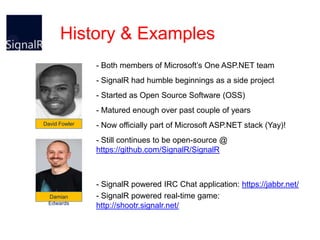
- Both members of Microsoft’s One ASP.NET team
- SignalR had humble beginnings as a side project
- Started as Open Source Software (OSS)
- Matured enough over past couple of years
David Fowler

- Now officially part of Microsoft ASP.NET stack (Yay)!
- Still continues to be open-source @
https://github.com/SignalR/SignalR

Damian
Edwards

- SignalR powered IRC Chat application: https://jabbr.net/
- SignalR powered real-time game:
http://shootr.signalr.net/
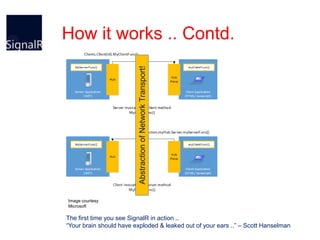
How it works
- SignalR allows bidirectional communication between client & server
over persistent connections

- SignalR provides simple APIs for Remote Procedure Calls (RPC)
between client & server
- Transport mechanisms are chosen to best fit given client & server
environments
- SignalR manages the network layer for your application, unless you
want control
Abstraction of Network Transport!

How it works .. Contd.

Image courtesy
Microsoft

The first time you see SignalR in action ..
“Your brain should have exploded & leaked out of your ears ..” – Scott Hanselman
SignalR Internals
- SignalR abstracts bidirectional communication between client & server over
persistent connections
- The choice of network transport relies on available client & server
environments. Applications may also specify transport layer.
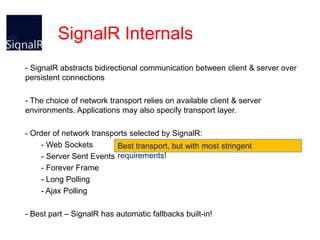
- Order of network transports selected by SignalR:
- Web Sockets
Best transport, but with most stringent
- Server Sent Events requirements!
- Forever Frame
- Long Polling
- Ajax Polling
- Best part – SignalR has automatic fallbacks built-in!
SignalR API Stack
- SignalR offers consistent interface on top of network technologies
- Developer gets to choose the level of abstraction of network layer
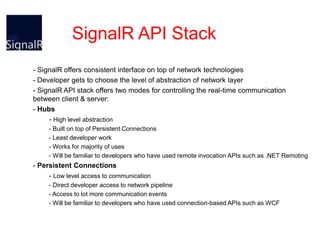
- SignalR API stack offers two modes for controlling the real-time communication
between client & server:
- Hubs
- High level abstraction
- Built on top of Persistent Connections
- Least developer work
- Works for majority of uses
- Will be familiar to developers who have used remote invocation APIs such as .NET Remoting

- Persistent Connections
- Low level access to communication
- Direct developer access to network pipeline
- Access to lot more communication events
- Will be familiar to developers who have used connection-based APIs such as WCF
More SignalR APIs
- Specifying network technology if client/server capabilities are known in
advance; saves the hand-shaking time for SignalR connectivity

- Monitor network transport/traffic by turning on logging on the server
- List of clients connected to SignalR server is maintained in-memory on server;
developers may choose to persist based on application needs
- Connection Management

- Connect/Disconnect events
- Grouping Connections
- Authorization

Needed for chatrooms


- Messages from SignalR server can be broadcast to
- All clients
- Specific clients
- Grouped clients

Offers fine-grained control over client
reach from SignalR server!

- SignalR applications can scale out to thousands of clients using Service Bus,
SQL Server or Redis
SignalR Platform Support – Server
Side
- Server OS
- Windows Server 2012
- Windows Server 2008 r2
- Windows 8
- Windows 7
- Windows Azure [Does not support Web Sockets yet]

- Server .NET Frameworks
- .NET 4.5
- .NET 4 [Does not support Web Sockets]

- Server IIS Requirements
- IIS 8 or IIS 8 Express [Only ones with Web Socket support]
- IIS 7 and 7.5.
- IIS must be running in integrated mode
- The hosting application must be running in full trust mode

- SignalR applications can be self-hosted in own process outside of IIS using OWIN
(Open Web Interface for .NET) techniques
SignalR Platform Support – Client Side
- Client Browsers
- Microsoft Internet Explorer (IE) versions 8, 9 and 10. Modern, Desktop, and Mobile versions
are supported.
- Mozilla Firefox: current version - 1, both Windows and Mac versions.
- Google Chrome: current version - 1, both Windows and Mac versions.
- Safari: current version - 1, both Mac and iOS versions.
- Opera: current version - 1, Windows only.
- Android browser

- Applications that use SignalR in browsers must use jQuery version 1.6.4 or major later
versions
- Windows Desktop & Silverlight applications
- Applications using .NET 4 are supported on Windows XP SP3 or later.
- Applications using .NET Framework 4.5 are supported on Windows Vista or later.

- Windows Store & Windows Phone applications
Live Demos & Walkthrough
- Client calls server; Server calls client; seamlessly – Whoa!
- No polling, at least in our code

- Low level – PersistentConnection
more control
- Abstraction – Hub
easier to use
like spokes on a wheel, broadcasting
- Server maintains Clients .. Broadcast to all, group or individual clients
- Built-in Retry logic if transport fails
- Supports scaling out to web farms - backplane support through
Service Bus or Redis (in memory DB) to pump messages between
multiple servers
Real-time connectivity for .NET apps
- .NET Mobile clients can be super interactive with SignalR incorporation
- What .NET client apps could add SignalR powered real-time connectivity?
- Console
- Windows Forms & WPF
- Silverlight
- Windows 8 Store Apps
- Windows Phone Apps
- Any other apps running .NET ..

One SignalR NuGet for all .NET
clients

- Think you can bypass the Web entirely?
- Imagine the possibilities for your next .NET app
- Great potential for enterprises
Extending SignalR to other platforms
- SignalR makes a lot of sense for Mobile client apps
- Windows 8 & Windows Phone .NET options are great!
- But, we do not live in a silo
- In fact iOS, Android & Windows will coexist in the mobile space
- Would the other platforms be left high & dry?
- Several options to extend SignalR to other non-MSFT platforms

- Let real-time connectivity shine ..
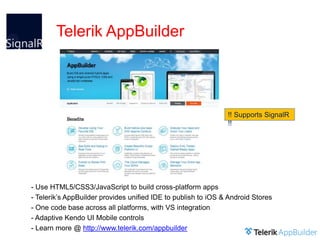
Telerik AppBuilder

!! Supports SignalR
!!

- Use HTML5/CSS3/JavaScript to build cross-platform apps
- Telerik’s AppBuilder provides unified IDE to publish to iOS & Android Stores
- One code base across all platforms, with VS integration
- Adaptive Kendo UI Mobile controls
- Learn more @ http://www.telerik.com/appbuilder
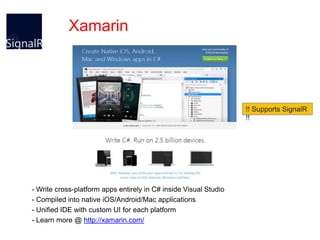
Xamarin

!! Supports SignalR
!!

- Write cross-platform apps entirely in C# inside Visual Studio
- Compiled into native iOS/Android/Mac applications
- Unified IDE with custom UI for each platform
- Learn more @ http://xamarin.com/
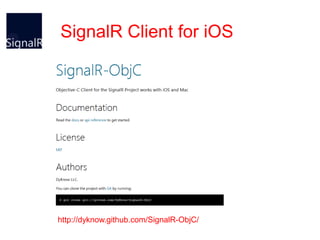
SignalR Client for iOS

http://dyknow.github.com/SignalR-ObjC/
Where does this fit?
- Other technologies have solved this problem

- Socket.IO is a client-side Jscript library that talks to node.js
- Nowjs supports namespace sync between client-server
- Primary SignalR advantages
→ Simplicity & ease of use
→ Works natively in .NET
→ Works out of browser
→ Supports Web Sockets for best transport
[ASP.NET 4.5/IIS 8 on Win8 only]
→ Works on other platforms, specially mobile
Questions?
Thank You!
@samidip

SignalR Powered X-Platform Real-Time Apps!

  • 1.
  • 2.
    SignalR-Powered X-Platform Real-Time Apps! SamidipBasu Microsoft MVP, MS, MCPD, CAPM Senior Technical Trainer | Telerik Inc. | www.telerik.com E: Sam.Basu@Telerik.com | L: x3179 | C: 507 244 0579 T: @samidip | W: http://samidipbasu.com
  • 5.
    Why do weneed real-time? - New email - Twitter/Facebook updates - Stock Ticker/Live Auctions - Game Scores - Real-time Notifications - Turn-by-Turn or Shooter Games - Collaboration - Progress Bars - And obviously, Chat No dearth of examples where real-time communication in needed ..
  • 6.
    Challenges - Building real-timeapplications is difficult - Transcends boundaries of choice in development platforms - Part of the problem is HTTP – Request/Response protocol HTTP = HyperText Transfer Protocol | Obviously works, but has limitations! - Statelessness of web applications  Need open transport channel between server and clients for bidirectional or full-duplex communication.
  • 7.
    Existing Technologies Periodic/Ajax Polling Imagecourtesy @maartenballiauw Downsides: • Not real-time • Potential big bandwidth misuse!
  • 8.
    Existing Technologies ..Contd. Long Polling – server does not respond unless X happens, client polls after data receive or time-out Image courtesy @maartenballiauw Downsides: • Needs orchestration • Custom code on either end
  • 9.
    Existing Technologies ..Others - Use plugins like Silverlight/Flash – to communicate through sockets - Forever Frame (execute script blocks from server in iFrame) - Server sent Events (Push or Stream from server) - Native HTML 5 Web Sockets (Magic Unicorn world) – true bidirectional transport channel; but support can be flaky Bottom-line: • Lots of options in existing technologies to build real-time applications • Not perfect; choose what you need Wish list: • Wouldn’t it be nice if someone took care of the network transport layer? • Would you not want to focus on just your application?
  • 10.
    Enter SignalR An async,persistent connection/signalling library for .NET over HTTP ... aids in building real time, multi-user connected applications. Persistent client-server connection over best transport .. Abstracts away the transport layer. From ASP.NET team-members (Damian Edwards & David Fowler) .. Not officially MSFT product, but OSS Boom!  https://github.com/SignalR/SignalR http://jabbr.net/#/rooms/signal http://shootr.signalr.net/ SignalR is broken up into a few packages on NuGet: SignalR - Package for SignalR.Server and SignalR.Js SignalR.Server - Server components needed for SignalR endpoints SignalR.Js - Javascript client for SignalR SignalR.Client - .NET client for SignalR SignalR.WP7, SignalR.WinRT, SignalR.Silverlight – For the cool folks  SignalR.WebSockets - WebSocket Transport for SignalR
  • 11.
    What is SignalR? -SignalR is an asynchronous persistent connection/signaling library for ASP.NET applications - SignalR makes it easy to build real-time multi-user connected applications - SignalR abstracts away the network layer for bidirectional real-time communications, thus helping you focus on building your application - SignalR includes broad platform support & features a rich API set for aiding client-server communications SignalR is quite awesome!
  • 12.
    History & Examples -Both members of Microsoft’s One ASP.NET team - SignalR had humble beginnings as a side project - Started as Open Source Software (OSS) - Matured enough over past couple of years David Fowler - Now officially part of Microsoft ASP.NET stack (Yay)! - Still continues to be open-source @ https://github.com/SignalR/SignalR Damian Edwards - SignalR powered IRC Chat application: https://jabbr.net/ - SignalR powered real-time game: http://shootr.signalr.net/
  • 13.
    How it works -SignalR allows bidirectional communication between client & server over persistent connections - SignalR provides simple APIs for Remote Procedure Calls (RPC) between client & server - Transport mechanisms are chosen to best fit given client & server environments - SignalR manages the network layer for your application, unless you want control
  • 14.
    Abstraction of NetworkTransport! How it works .. Contd. Image courtesy Microsoft The first time you see SignalR in action .. “Your brain should have exploded & leaked out of your ears ..” – Scott Hanselman
  • 15.
    SignalR Internals - SignalRabstracts bidirectional communication between client & server over persistent connections - The choice of network transport relies on available client & server environments. Applications may also specify transport layer. - Order of network transports selected by SignalR: - Web Sockets Best transport, but with most stringent - Server Sent Events requirements! - Forever Frame - Long Polling - Ajax Polling - Best part – SignalR has automatic fallbacks built-in!
  • 16.
    SignalR API Stack -SignalR offers consistent interface on top of network technologies - Developer gets to choose the level of abstraction of network layer - SignalR API stack offers two modes for controlling the real-time communication between client & server: - Hubs - High level abstraction - Built on top of Persistent Connections - Least developer work - Works for majority of uses - Will be familiar to developers who have used remote invocation APIs such as .NET Remoting - Persistent Connections - Low level access to communication - Direct developer access to network pipeline - Access to lot more communication events - Will be familiar to developers who have used connection-based APIs such as WCF
  • 17.
    More SignalR APIs -Specifying network technology if client/server capabilities are known in advance; saves the hand-shaking time for SignalR connectivity - Monitor network transport/traffic by turning on logging on the server - List of clients connected to SignalR server is maintained in-memory on server; developers may choose to persist based on application needs - Connection Management - Connect/Disconnect events - Grouping Connections - Authorization Needed for chatrooms  - Messages from SignalR server can be broadcast to - All clients - Specific clients - Grouped clients Offers fine-grained control over client reach from SignalR server! - SignalR applications can scale out to thousands of clients using Service Bus, SQL Server or Redis
  • 18.
    SignalR Platform Support– Server Side - Server OS - Windows Server 2012 - Windows Server 2008 r2 - Windows 8 - Windows 7 - Windows Azure [Does not support Web Sockets yet] - Server .NET Frameworks - .NET 4.5 - .NET 4 [Does not support Web Sockets] - Server IIS Requirements - IIS 8 or IIS 8 Express [Only ones with Web Socket support] - IIS 7 and 7.5. - IIS must be running in integrated mode - The hosting application must be running in full trust mode - SignalR applications can be self-hosted in own process outside of IIS using OWIN (Open Web Interface for .NET) techniques
  • 19.
    SignalR Platform Support– Client Side - Client Browsers - Microsoft Internet Explorer (IE) versions 8, 9 and 10. Modern, Desktop, and Mobile versions are supported. - Mozilla Firefox: current version - 1, both Windows and Mac versions. - Google Chrome: current version - 1, both Windows and Mac versions. - Safari: current version - 1, both Mac and iOS versions. - Opera: current version - 1, Windows only. - Android browser - Applications that use SignalR in browsers must use jQuery version 1.6.4 or major later versions - Windows Desktop & Silverlight applications - Applications using .NET 4 are supported on Windows XP SP3 or later. - Applications using .NET Framework 4.5 are supported on Windows Vista or later. - Windows Store & Windows Phone applications
  • 20.
    Live Demos &Walkthrough - Client calls server; Server calls client; seamlessly – Whoa! - No polling, at least in our code - Low level – PersistentConnection more control - Abstraction – Hub easier to use like spokes on a wheel, broadcasting - Server maintains Clients .. Broadcast to all, group or individual clients - Built-in Retry logic if transport fails - Supports scaling out to web farms - backplane support through Service Bus or Redis (in memory DB) to pump messages between multiple servers
  • 21.
    Real-time connectivity for.NET apps - .NET Mobile clients can be super interactive with SignalR incorporation - What .NET client apps could add SignalR powered real-time connectivity? - Console - Windows Forms & WPF - Silverlight - Windows 8 Store Apps - Windows Phone Apps - Any other apps running .NET .. One SignalR NuGet for all .NET clients - Think you can bypass the Web entirely? - Imagine the possibilities for your next .NET app - Great potential for enterprises
  • 22.
    Extending SignalR toother platforms - SignalR makes a lot of sense for Mobile client apps - Windows 8 & Windows Phone .NET options are great! - But, we do not live in a silo - In fact iOS, Android & Windows will coexist in the mobile space - Would the other platforms be left high & dry? - Several options to extend SignalR to other non-MSFT platforms - Let real-time connectivity shine ..
  • 23.
    Telerik AppBuilder !! SupportsSignalR !! - Use HTML5/CSS3/JavaScript to build cross-platform apps - Telerik’s AppBuilder provides unified IDE to publish to iOS & Android Stores - One code base across all platforms, with VS integration - Adaptive Kendo UI Mobile controls - Learn more @ http://www.telerik.com/appbuilder
  • 24.
    Xamarin !! Supports SignalR !! -Write cross-platform apps entirely in C# inside Visual Studio - Compiled into native iOS/Android/Mac applications - Unified IDE with custom UI for each platform - Learn more @ http://xamarin.com/
  • 25.
    SignalR Client foriOS http://dyknow.github.com/SignalR-ObjC/
  • 26.
    Where does thisfit? - Other technologies have solved this problem - Socket.IO is a client-side Jscript library that talks to node.js - Nowjs supports namespace sync between client-server - Primary SignalR advantages → Simplicity & ease of use → Works natively in .NET → Works out of browser → Supports Web Sockets for best transport [ASP.NET 4.5/IIS 8 on Win8 only] → Works on other platforms, specially mobile
  • 27.