Budget and resource tracking
Dr. Michael McQuestion
Dr. Cliff Kamara
Ms. Dana Silver
Sustainable Immunization Financing Program
Anglophone African Peer review workshop
Nairobi, Kenya
26 October 2015
Overview
• “To pay for something is to own it”
• Most countries are actually paying most of
their immunization program costs but are not
properly capturing and reporting those
expenditures
• The countries are closer to the country
ownership goal than they know
What the world sees
now
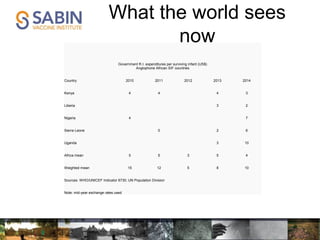
Government R.I. expenditures per surviving infant (US$)
Anglophone African SIF countries
Country 2010 2011 2012 2013 2014
Kenya 4 4 4 3
Liberia 3 2
Nigeria 4 7
Sierra Leone 0 2 6
Uganda 3 10
Africa mean 5 5 3 5 4
Weighted mean 15 12 5 8 10
Sources: WHO/UNICEF Indicator 6730; UN Population Division
Note: mid-year exchange rates used
PEFA standards
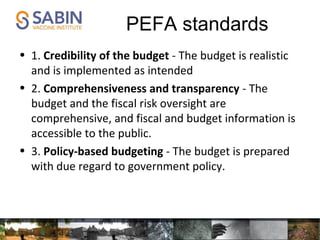
• 1. Credibility of the budget - The budget is realistic
and is implemented as intended
• 2. Comprehensiveness and transparency - The
budget and the fiscal risk oversight are
comprehensive, and fiscal and budget information is
accessible to the public.
• 3. Policy-based budgeting - The budget is prepared
with due regard to government policy.
PEFA standards
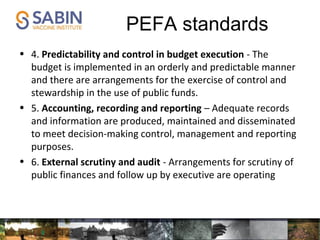
• 4. Predictability and control in budget execution - The
budget is implemented in an orderly and predictable manner
and there are arrangements for the exercise of control and
stewardship in the use of public funds.
• 5. Accounting, recording and reporting – Adequate records
and information are produced, maintained and disseminated
to meet decision-making control, management and reporting
purposes.
• 6. External scrutiny and audit - Arrangements for scrutiny of
public finances and follow up by executive are operating
Budgets
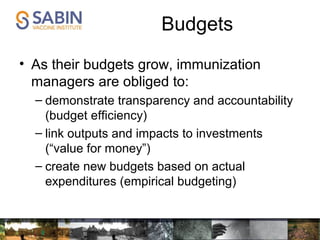
• As their budgets grow, immunization
managers are obliged to:
– demonstrate transparency and accountability
(budget efficiency)
– link outputs and impacts to investments
(“value for money”)
– create new budgets based on actual
expenditures (empirical budgeting)
Resource tracking
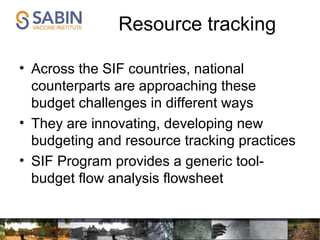
• Across the SIF countries, national
counterparts are approaching these
budget challenges in different ways
• They are innovating, developing new
budgeting and resource tracking practices
• SIF Program provides a generic tool-
budget flow analysis flowsheet
Partenaires
2010
%
2011
%
2012
%
2013
%
MONTANT MONTANT MONTANT MONTANT MONTANT MONTANT MONTANT MONTANT
PREVU LIBERE PREVU LIBERE PREVU LIBERE PREVU LIBERE
EN $ EN $ EN $ EN $ EN $ EN $ EN $ EN $
GVT 6713193 1604175 24% 7653996 1819612 24% 15 855 306 5 350 949 34% 10 610 555 4 128 764 39%
GAVI 78 397 442 25 701 000 33% 4 758 500 1 281 360 27% 73 010 784 31 625 999 43% 58 986 600 39 089 915 66%
OMS 5 382 466 17 993 274 334% 17 393 274 17 393 274 100% 14 939 380 24 745 892 166% 20 397 479 15 629 248 77%
UNICEF 8 530 647 23 848 264 280% 23 848 264 23 848 264 100% 20 109 850 21 577 095 107% 21 984 143 9 449 735 43%
USAID 3 700 300 3 700 300 100% Nd nd 0% nd 0% nd nd 0%
ROTARY 431 858 223 265 52% 223 265 223 265 100% nd nd 0% 165 750 50 000 30%
CTB 13 031 666 13 031 666 100% Nd 0 0% nd nd 0% nd nd 0%
MSH Nd Nd 0% 438 425 438 425 100% nd nd 0% nd nd 0%
Axxes Nd Nd 0% 1 339 500 1 339 500 100% nd nd 0% nd nd 0%
MCHIP Nd Nd 0% 37 385 37 385 100% 40 000 42 033 105% 45 700 37 837 83%
BM Nd Nd 0% Nd nd 0% 21 179 021 11 215 310 53% 5 446 306 5 446 306 100%
PROSANI nd nd 0% nd nd 0% 1 137 700 2 460 738 216% 2 742 460 2 716 868 99%
Total 115 650 572 86 101 944 74% 55 692 609 46 680 085 83% 146 272 041 97 018 016 66% 120 378 993 76 548 673 64 %
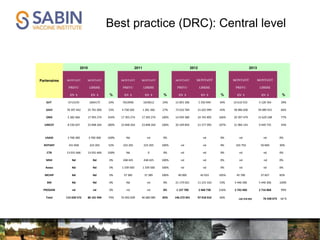
Best practice (DRC): Central level
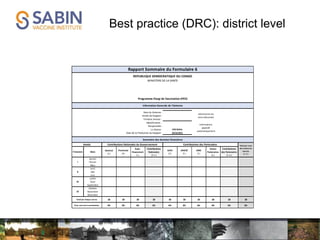
Best practice (DRC): district level
Nom du Antenne -
Année de Rapport -
Trimetre Annuel -
Identification -
Responsible -
La Devise -
Date de la Production du Rapport -
Trimestre Mois
Central
(A.)
Provincial
(B.)
Auto-
finacement
(C.)
Contributions
Nationales
(A.-C.)
GAVI
(D.)
UNICEF
(E.)
OMS
(F.)
Autres
Partenaires
(G.)
Contributions
des Partenaires
(D.-G.)
Janvier
Février
Mars
Avril
Mai
Juin
Juillet
Aout
Septembre
Octobre
Novembre
Décembre
$0 $0 $0 $0 $0 $0 $0 $0 $0 $0
0% 0% 0% 0% 0% 0% 0% 0% 0% 0%
REPUBLIQUE DEMOCRATIQUE DU CONGO
MINISTERE DE LA SANTE
Rapport Sommaire du Formulaire 6
US$ Dollar
10/16/2015
II
III
IV
Total par chaque source
Pour cent de la contribution
Sommaire des données financières
Information Generale de l'Antenne
Programme Elargi de Vaccination (PEV)
Contributions Nationales du Gouvernement Contributions des Partenaires Total par mois
des toutes les
sources
(A.-G.)
I
Année
sélectionner du
menu déroulant
informations
apparaît
automatiquement
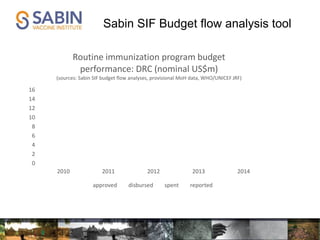
Sabin SIF Budget flow analysis tool
Budget
Processes
Description Accounting concepts Amount in US$
Local Currency
exchange rate to US$ =
1
The initial projected immunization program budget (from current
cMYP, amount of routine recurrent government projected costs,
Spreadsheet 4. Financing)
Projected government R.I. budget
2
The adjusted proposed immunization budget afterreview by the
Ministry of Health, Council of Ministers orotherbudget review
institution(s).The amount that wassubmitted forparliamentary
approval.
Immunization budget proposed by MOH
3 The final immunization budget that wasapproved by parliament. Immunization budget approved by parliament
Framework
Indicators
PEFA Indicator Key
Formula Guide
Cash Hoarding
Misclassification
BudgetCredibility
Absorptive Capacity
ReportingAccuracy
(Box 7 / Box 6 ) x 100
Phase-V:
Reporting 8
Amountof government routine EPI expenditures reported for
Indicator6730of the WHO/UNICEF Joint ReportingForm (JRF) forthe
reportingyear.
If Box 7 > Box 8, then (Box 8/ Box 7) x 100
If Box 7 < Box 8, then (Box 7/ Box 8) x 100
Phase-IV:
Expenditure 7
Amountof actual publicroutine immunization program expenditures.
Includes expenditures against in-yearsupplementarybudgets.
Total immunization expenditures as of end fiscal year
[ (Box 5 - Box 6) / Box 5 ] x 100
6
Amountof funds in Box5actuallyallocated by the Ministry of Health
to the immunization program.
Amount of disbursed budgetactuallyallocated to
immunization program
(Box 7 /(Box 3+ Box 4 ) x 100
Phase-III:
Disbursement
5
The amount of funds disbursed by Treasury to the Ministry of Health
forimmunization.
Amountdisbursed againstapproved immunization
budgetby Treasury to MOH
Phase-I:
Proposed
Budget
Public Expenditure and Financing
Accountability (PEFA)
Phase-II:
Approved
Budget
4
Additional in-yearfunds approved forimmunization. Any additional
(supplemental) increases to the budget duringthe fiscal year.
Total in-yearimmunization budget increase(s) approved
by parliament [ ((Box 3 +Box 4) - Box 5) /(Box 3+ Box 4) ] x 100
End: XXXCountry: Fiscal Year: Start: XXX
Sabin SIF Budget flow analysis tool
0
2
4
6
8
10
12
14
16
2010 2011 2012 2013 2014
Routine immunization program budget
performance: DRC (nominal US$m)
(sources: Sabin SIF budget flow analyses, provisional MoH data, WHO/UNICEF JRF)
approved disbursed spent reported
Sabin SIF Budget flow analysis tool
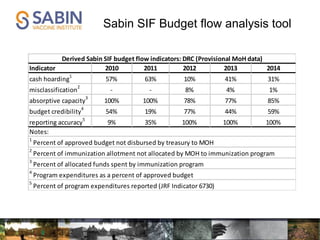
Indicator 2010 2011 2012 2013 2014
cash hoarding
1
57% 63% 10% 41% 31%
misclassification
2
- - 8% 4% 1%
absorptive capacity
3
100% 100% 78% 77% 85%
budget credibility
4
54% 19% 77% 44% 59%
reporting accuracy
5
9% 35% 100% 100% 100%
4
Program expenditures as a percent of approved budget
5
Percent of program expenditures reported (JRF Indicator 6730)
Derived Sabin SIF budget flow indicators: DRC (Provisional MoH data)
Notes:
1
Percent of approved budget not disbursed by treasury to MOH
2
Percent of immunization allotment not allocated by MOH to immunization program
3
Percent of allocated funds spent by immunization program
Sabin SIF Budget flow analysis tool
0
20
40
60
80
100
2010 2011 2012 2013 2014
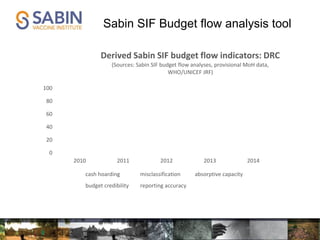
Derived Sabin SIF budget flow indicators: DRC
(Sources: Sabin SIF budget flow analyses, provisional MoH data,
WHO/UNICEF JRF)
cash hoarding misclassification absorptive capacity
budget credibility reporting accuracy
Resource tracking
examples
• In three SIF countries, immunization
managers secured the budget they sought
simply by presenting EPI expenditure data
over the previous several years as part of
their “investment case”
– Demonstrated budget credibility, sound
budget management
Resource tracking
examples
• In two SIF countries, national
immunization teams provided feedback on
immunization expenditures to provincial
officials, the public
– Immediate improvement in provincial
expenditure reporting
Resource tracking
examples
• In one SIF country, the immunization team
presented the completed SIF budget flow
analysis to parliamentarians, who then
showed it to the prime minister, who then
instructed the minister of finance to fully
disburse the immunization budget
– “information is power”
Thank you!

SIF theme ii budget and resource tracking

  • 1.
    Budget and resourcetracking Dr. Michael McQuestion Dr. Cliff Kamara Ms. Dana Silver Sustainable Immunization Financing Program Anglophone African Peer review workshop Nairobi, Kenya 26 October 2015
  • 2.
    Overview • “To payfor something is to own it” • Most countries are actually paying most of their immunization program costs but are not properly capturing and reporting those expenditures • The countries are closer to the country ownership goal than they know
  • 3.
    What the worldsees now Government R.I. expenditures per surviving infant (US$) Anglophone African SIF countries Country 2010 2011 2012 2013 2014 Kenya 4 4 4 3 Liberia 3 2 Nigeria 4 7 Sierra Leone 0 2 6 Uganda 3 10 Africa mean 5 5 3 5 4 Weighted mean 15 12 5 8 10 Sources: WHO/UNICEF Indicator 6730; UN Population Division Note: mid-year exchange rates used
  • 4.
    PEFA standards • 1.Credibility of the budget - The budget is realistic and is implemented as intended • 2. Comprehensiveness and transparency - The budget and the fiscal risk oversight are comprehensive, and fiscal and budget information is accessible to the public. • 3. Policy-based budgeting - The budget is prepared with due regard to government policy.
  • 5.
    PEFA standards • 4.Predictability and control in budget execution - The budget is implemented in an orderly and predictable manner and there are arrangements for the exercise of control and stewardship in the use of public funds. • 5. Accounting, recording and reporting – Adequate records and information are produced, maintained and disseminated to meet decision-making control, management and reporting purposes. • 6. External scrutiny and audit - Arrangements for scrutiny of public finances and follow up by executive are operating
  • 6.
    Budgets • As theirbudgets grow, immunization managers are obliged to: – demonstrate transparency and accountability (budget efficiency) – link outputs and impacts to investments (“value for money”) – create new budgets based on actual expenditures (empirical budgeting)
  • 7.
    Resource tracking • Acrossthe SIF countries, national counterparts are approaching these budget challenges in different ways • They are innovating, developing new budgeting and resource tracking practices • SIF Program provides a generic tool- budget flow analysis flowsheet
  • 8.
    Partenaires 2010 % 2011 % 2012 % 2013 % MONTANT MONTANT MONTANTMONTANT MONTANT MONTANT MONTANT MONTANT PREVU LIBERE PREVU LIBERE PREVU LIBERE PREVU LIBERE EN $ EN $ EN $ EN $ EN $ EN $ EN $ EN $ GVT 6713193 1604175 24% 7653996 1819612 24% 15 855 306 5 350 949 34% 10 610 555 4 128 764 39% GAVI 78 397 442 25 701 000 33% 4 758 500 1 281 360 27% 73 010 784 31 625 999 43% 58 986 600 39 089 915 66% OMS 5 382 466 17 993 274 334% 17 393 274 17 393 274 100% 14 939 380 24 745 892 166% 20 397 479 15 629 248 77% UNICEF 8 530 647 23 848 264 280% 23 848 264 23 848 264 100% 20 109 850 21 577 095 107% 21 984 143 9 449 735 43% USAID 3 700 300 3 700 300 100% Nd nd 0% nd 0% nd nd 0% ROTARY 431 858 223 265 52% 223 265 223 265 100% nd nd 0% 165 750 50 000 30% CTB 13 031 666 13 031 666 100% Nd 0 0% nd nd 0% nd nd 0% MSH Nd Nd 0% 438 425 438 425 100% nd nd 0% nd nd 0% Axxes Nd Nd 0% 1 339 500 1 339 500 100% nd nd 0% nd nd 0% MCHIP Nd Nd 0% 37 385 37 385 100% 40 000 42 033 105% 45 700 37 837 83% BM Nd Nd 0% Nd nd 0% 21 179 021 11 215 310 53% 5 446 306 5 446 306 100% PROSANI nd nd 0% nd nd 0% 1 137 700 2 460 738 216% 2 742 460 2 716 868 99% Total 115 650 572 86 101 944 74% 55 692 609 46 680 085 83% 146 272 041 97 018 016 66% 120 378 993 76 548 673 64 % Best practice (DRC): Central level
  • 9.
    Best practice (DRC):district level Nom du Antenne - Année de Rapport - Trimetre Annuel - Identification - Responsible - La Devise - Date de la Production du Rapport - Trimestre Mois Central (A.) Provincial (B.) Auto- finacement (C.) Contributions Nationales (A.-C.) GAVI (D.) UNICEF (E.) OMS (F.) Autres Partenaires (G.) Contributions des Partenaires (D.-G.) Janvier Février Mars Avril Mai Juin Juillet Aout Septembre Octobre Novembre Décembre $0 $0 $0 $0 $0 $0 $0 $0 $0 $0 0% 0% 0% 0% 0% 0% 0% 0% 0% 0% REPUBLIQUE DEMOCRATIQUE DU CONGO MINISTERE DE LA SANTE Rapport Sommaire du Formulaire 6 US$ Dollar 10/16/2015 II III IV Total par chaque source Pour cent de la contribution Sommaire des données financières Information Generale de l'Antenne Programme Elargi de Vaccination (PEV) Contributions Nationales du Gouvernement Contributions des Partenaires Total par mois des toutes les sources (A.-G.) I Année sélectionner du menu déroulant informations apparaît automatiquement
  • 10.
    Sabin SIF Budgetflow analysis tool Budget Processes Description Accounting concepts Amount in US$ Local Currency exchange rate to US$ = 1 The initial projected immunization program budget (from current cMYP, amount of routine recurrent government projected costs, Spreadsheet 4. Financing) Projected government R.I. budget 2 The adjusted proposed immunization budget afterreview by the Ministry of Health, Council of Ministers orotherbudget review institution(s).The amount that wassubmitted forparliamentary approval. Immunization budget proposed by MOH 3 The final immunization budget that wasapproved by parliament. Immunization budget approved by parliament Framework Indicators PEFA Indicator Key Formula Guide Cash Hoarding Misclassification BudgetCredibility Absorptive Capacity ReportingAccuracy (Box 7 / Box 6 ) x 100 Phase-V: Reporting 8 Amountof government routine EPI expenditures reported for Indicator6730of the WHO/UNICEF Joint ReportingForm (JRF) forthe reportingyear. If Box 7 > Box 8, then (Box 8/ Box 7) x 100 If Box 7 < Box 8, then (Box 7/ Box 8) x 100 Phase-IV: Expenditure 7 Amountof actual publicroutine immunization program expenditures. Includes expenditures against in-yearsupplementarybudgets. Total immunization expenditures as of end fiscal year [ (Box 5 - Box 6) / Box 5 ] x 100 6 Amountof funds in Box5actuallyallocated by the Ministry of Health to the immunization program. Amount of disbursed budgetactuallyallocated to immunization program (Box 7 /(Box 3+ Box 4 ) x 100 Phase-III: Disbursement 5 The amount of funds disbursed by Treasury to the Ministry of Health forimmunization. Amountdisbursed againstapproved immunization budgetby Treasury to MOH Phase-I: Proposed Budget Public Expenditure and Financing Accountability (PEFA) Phase-II: Approved Budget 4 Additional in-yearfunds approved forimmunization. Any additional (supplemental) increases to the budget duringthe fiscal year. Total in-yearimmunization budget increase(s) approved by parliament [ ((Box 3 +Box 4) - Box 5) /(Box 3+ Box 4) ] x 100 End: XXXCountry: Fiscal Year: Start: XXX
  • 11.
    Sabin SIF Budgetflow analysis tool 0 2 4 6 8 10 12 14 16 2010 2011 2012 2013 2014 Routine immunization program budget performance: DRC (nominal US$m) (sources: Sabin SIF budget flow analyses, provisional MoH data, WHO/UNICEF JRF) approved disbursed spent reported
  • 12.
    Sabin SIF Budgetflow analysis tool Indicator 2010 2011 2012 2013 2014 cash hoarding 1 57% 63% 10% 41% 31% misclassification 2 - - 8% 4% 1% absorptive capacity 3 100% 100% 78% 77% 85% budget credibility 4 54% 19% 77% 44% 59% reporting accuracy 5 9% 35% 100% 100% 100% 4 Program expenditures as a percent of approved budget 5 Percent of program expenditures reported (JRF Indicator 6730) Derived Sabin SIF budget flow indicators: DRC (Provisional MoH data) Notes: 1 Percent of approved budget not disbursed by treasury to MOH 2 Percent of immunization allotment not allocated by MOH to immunization program 3 Percent of allocated funds spent by immunization program
  • 13.
    Sabin SIF Budgetflow analysis tool 0 20 40 60 80 100 2010 2011 2012 2013 2014 Derived Sabin SIF budget flow indicators: DRC (Sources: Sabin SIF budget flow analyses, provisional MoH data, WHO/UNICEF JRF) cash hoarding misclassification absorptive capacity budget credibility reporting accuracy
  • 14.
    Resource tracking examples • Inthree SIF countries, immunization managers secured the budget they sought simply by presenting EPI expenditure data over the previous several years as part of their “investment case” – Demonstrated budget credibility, sound budget management
  • 15.
    Resource tracking examples • Intwo SIF countries, national immunization teams provided feedback on immunization expenditures to provincial officials, the public – Immediate improvement in provincial expenditure reporting
  • 16.
    Resource tracking examples • Inone SIF country, the immunization team presented the completed SIF budget flow analysis to parliamentarians, who then showed it to the prime minister, who then instructed the minister of finance to fully disburse the immunization budget – “information is power”
  • 17.

Editor's Notes

  • #11 The Sabin-developed tool for simple central-level resource tracking partial but quickly identifies bottlenecks based on PEFA provides strong basis for advocacy begins with cMYP, ends with JRF 6730 The EPI team does the work themselves Only about half of SIF countries this transparent