SHRM Survey Findings: Changing Employee Skills and
Education Requirements—Post-secondary
Certificates/Credentials and Demographics
In collaboration with and commissioned by Achieve


                                                    October 3, 2012
Introduction


• This is the sixth part of a series of SHRM/Achieve survey findings titled “Changing Employee
  Skills and Education Requirements.” These results look at post-secondary certificates/
  credentials and overall organizational demographics.
• The following nine industries were included in the sample. Overall results are reported
  first, followed by industry-specific results for the following industries:
       Construction, mining, oil and gas
       Federal government
       Finance
       Health
       High-tech
       Manufacturing
       Nonprofessional services
       Professional services
       State and local government


SHRM/Achieve Survey: Changing Employee Skills and Education Requirements—Post-secondary Certificates/Credentials and Demographics
                                                                                                                       ©SHRM 2012   2
Key Findings


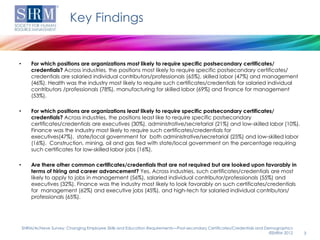
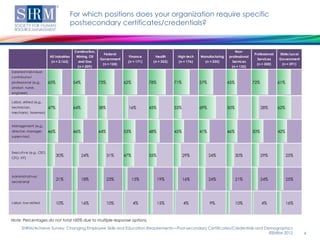
•       For which positions are organizations most likely to require specific postsecondary certificates/
        credentials? Across industries, the positions most likely to require specific postsecondary certificates/
        credentials are salaried individual contributors/professionals (65%), skilled labor (47%) and management
        (46%). Health was the industry most likely to require such certificates/credentials for salaried individual
        contributors /professionals (78%), manufacturing for skilled labor (69%) and finance for management
        (53%).

•       For which positions are organizations least likely to require specific postsecondary certificates/
        credentials? Across industries, the positions least like to require specific postsecondary
        certificates/credentials are executives (30%), administrative/secretarial (21%) and low-skilled labor (10%).
        Finance was the industry most likely to require such certificates/credentials for
        executives(47%), state/local government for both administrative/secretarial (25%) and low-skilled labor
        (16%). Construction, mining, oil and gas tied with state/local government on the percentage requiring
        such certificates for low-skilled labor jobs (16%).

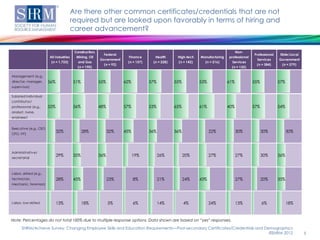
•       Are there other common certificates/credentials that are not required but are looked upon favorably in
        terms of hiring and career advancement? Yes. Across industries, such certificates/credentials are most
        likely to apply to jobs in management (56%), salaried individual contributor/professionals (55%) and
        executives (32%). Finance was the industry most likely to look favorably on such certificates/credentials
        for management (62%) and executive jobs (45%), and high-tech for salaried individual contributors/
        professionals (65%).


    SHRM/Achieve Survey: Changing Employee Skills and Education Requirements—Post-secondary Certificates/Credentials and Demographics
                                                                                                                           ©SHRM 2012   3
For which positions does your organization require specific
                                          postsecondary certificates/credentials?


                                           Construction,                                                                           Non-
                                                             Federal                                                                          Professional   State/Local
                         All Industries     Mining, Oil                  Finance       Health      High-tech   Manufacturing   professional
                                                           Government                                                                           Services     Government
                          (n = 2,163)        and Gas                     (n = 171)    (n = 352)    (n = 176)     (n = 255)       Services
                                                            (n = 124)                                                                           (n = 350)     (n = 391)
                                            (n = 209)                                                                            (n = 135)
Salaried indiv idual
contributor/
professional (e.g.,      65%              54%              73%          62%          78%          71%          57%             45%            72%            61%
analyst, nurse,
engineer)

Labor, skilled (e.g.,
technician,              47%              64%              38%           16%         45%          33%          69%             50%                  28%      62%
mechanic, foreman)


Management (e.g.,
director, manager,       46%              46%              44%          53%          48%          45%          41%             46%            50%            42%
superv isor)


Executiv e (e.g., CEO,
                               30%              24%              31%    47%          35%                29%          24%             30%            29%            25%
CFO, VP)


Administrativ e/
                               21%              18%              23%          15%          19%          16%          24%             21%            24%            25%
secretarial


Labor, low-skilled             10%              16%              10%          4%           15%          4%           9%              10%            4%             16%


Note: Percentages do not total 100% due to multiple response options.
      SHRM/Achieve Survey: Changing Employee Skills and Education Requirements—Post-secondary Certificates/Credentials and Demographics
                                                                                                                             ©SHRM 2012                                    4
Are there other common certificates/credentials that are not
                                          required but are looked upon favorably in terms of hiring and
                                          career advancement?


                                           Construction,                                                                           Non-
                                                             Federal                                                                          Professional   State/Local
                         All Industries     Mining, Oil                  Finance       Health      High-tech   Manufacturing   professional
                                                           Government                                                                           Services     Government
                          (n = 1,723)        and Gas                     (n = 157)    (n = 228)    (n = 142)     (n = 216)       Services
                                                             (n = 92)                                                                           (n = 384)     (n = 279)
                                            (n = 190)                                                                            (n = 135)

Management (e.g.,
director, manager,       56%              51%              55%          62%          57%          55%          53%             61%            55%            57%
superv isor)

Salaried indiv idual
contributor/
professional (e.g.,      55%              56%              48%          57%          53%          65%          61%             40%            57%            54%
analyst, nurse,
engineer)


Executiv e (e.g., CEO,
                               32%              28%              32%    45%          36%          36%                22%             30%            30%            30%
CFO, VP)


Administrativ e/
                               29%        35%              36%                19%          26%          20%          27%             27%            30%      36%
secretarial


Labor, skilled (e.g.,
technician,                    28%        45%                    23%          8%           21%          24%    43%                   27%            20%      35%
mechanic, foreman)


Labor, low-skilled             13%              18%              5%           6%           14%          4%           24%             13%            6%             18%


Note: Percentages do not total 100% due to multiple response options. Data shown are based on “yes” responses.
      SHRM/Achieve Survey: Changing Employee Skills and Education Requirements—Post-secondary Certificates/Credentials and Demographics
                                                                                                                             ©SHRM 2012                                    5
SHRM Survey Findings: Changing Employee Skills and
                     Education Requirements—Post-secondary
                     Certificates/Credentials


                                            Demographics


SHRM/Achieve Survey: Changing Employee Skills and Education Requirements—Post-secondary Certificates/Credentials and Demographics
                                                                                                                       ©SHRM 2012   6
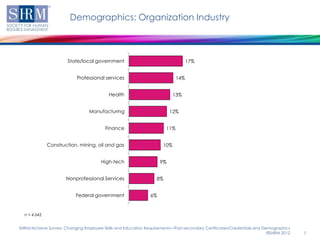
Demographics: Organization Industry


                       State/local government                                     17%


                           Professional services                            14%


                                          Health                          13%


                                 Manufacturing                          12%


                                         Finance                      11%


              Construction, mining, oil and gas                     10%


                                       High-tech                   9%


                      Nonprofessional Services                   8%


                           Federal government                 6%


  n = 4,642


SHRM/Achieve Survey: Changing Employee Skills and Education Requirements—Post-secondary Certificates/Credentials and Demographics
                                                                                                                       ©SHRM 2012   7
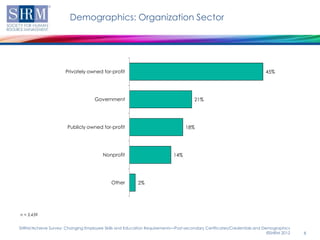
Demographics: Organization Sector


                      Privately owned for-profit                                                                     45%


                                   Government                                      21%


                       Publicly owned for-profit                               18%


                                       Nonprofit                         14%


                                           Other        2%


n = 3,439


SHRM/Achieve Survey: Changing Employee Skills and Education Requirements—Post-secondary Certificates/Credentials and Demographics
                                                                                                                       ©SHRM 2012   8
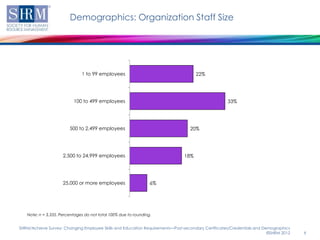
Demographics: Organization Staff Size


                              1 to 99 employees                                     22%


                          100 to 499 employees                                                     33%


                        500 to 2,499 employees                                   20%


                     2,500 to 24,999 employees                                18%


                     25,000 or more employees                    6%


   Note: n = 3,335. Percentages do not total 100% due to rounding.


SHRM/Achieve Survey: Changing Employee Skills and Education Requirements—Post-secondary Certificates/Credentials and Demographics
                                                                                                                       ©SHRM 2012   9
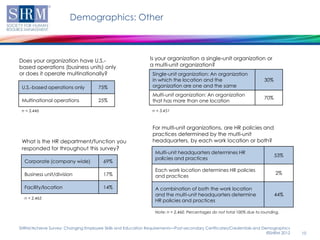
Demographics: Other


Does your organization have U.S.-                             Is your organization a single-unit organization or
based operations (business units) only                        a multi-unit organization?
or does it operate multinationally?                            Single-unit organization: An organization
                                                               in which the location and the                           30%
 U.S.-based operations only          75%                       organization are one and the same
                                                               Multi-unit organization: An organization
                                                                                                                       70%
 Multinational operations            25%                       that has more than one location
 n = 3,446                                                     n = 3,451


                                                               For multi-unit organizations, are HR policies and
                                                               practices determined by the multi-unit
 What is the HR department/function you                        headquarters, by each work location or both?
 responded for throughout this survey?
                                                                Multi-unit headquarters determines HR
                                                                                                                             53%
                                                                policies and practices
  Corporate (company wide)              69%
                                                                Each work location determines HR policies
  Business unit/division                17%                                                                                  2%
                                                                and practices

  Facility/location                     14%                     A combination of both the work location
                                                                and the multi-unit headquarters determine                    44%
  n = 2,465
                                                                HR policies and practices

                                                                Note: n = 2,460. Percentages do not total 100% due to rounding.


SHRM/Achieve Survey: Changing Employee Skills and Education Requirements—Post-secondary Certificates/Credentials and Demographics
                                                                                                                       ©SHRM 2012   10
SHRM Survey Findings: Changing Employee Skills and
                     Education Requirements—Post-secondary
                     Certificates/Credentials
                      In collaboration with and commissioned by Achieve


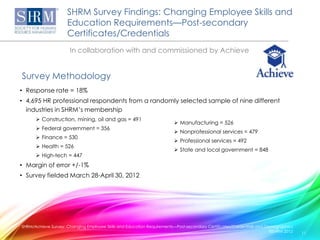
Survey Methodology
• Response rate = 18%
• 4,695 HR professional respondents from a randomly selected sample of nine different
  industries in SHRM’s membership
       Construction, mining, oil and gas = 491
                                                                         Manufacturing = 526
       Federal government = 356
                                                                         Nonprofessional services = 479
       Finance = 530
                                                                         Professional services = 492
       Health = 526
                                                                         State and local government = 848
       High-tech = 447
• Margin of error +/-1%
• Survey fielded March 28-April 30, 2012


SHRM/Achieve Survey: Changing Employee Skills and Education Requirements—Post-secondary Certificates/Credentials and Demographics
                                                                                                                       ©SHRM 2012   11
SHRM Survey Findings: Changing Employee Skills
                   and Education Requirements


    About SHRM Research
     • For more survey/poll findings, visit www.shrm.org/surveys

     • For more information about SHRM’s Customized Research Services, visit
       www.shrm.org/customizedresearch

     • Follow us on Twitter @SHRM_Research


SHRM/Achieve Survey: Changing Employee Skills and Education Requirements—Post-secondary Certificates/Credentials and Demographics
                                                                                                                       ©SHRM 2012   12

Changing Employee Skills and Education Requirements—Post-secondary Certificates/Credentials and Demographics

  • 1.
    SHRM Survey Findings:Changing Employee Skills and Education Requirements—Post-secondary Certificates/Credentials and Demographics In collaboration with and commissioned by Achieve October 3, 2012
  • 2.
    Introduction • This isthe sixth part of a series of SHRM/Achieve survey findings titled “Changing Employee Skills and Education Requirements.” These results look at post-secondary certificates/ credentials and overall organizational demographics. • The following nine industries were included in the sample. Overall results are reported first, followed by industry-specific results for the following industries:  Construction, mining, oil and gas  Federal government  Finance  Health  High-tech  Manufacturing  Nonprofessional services  Professional services  State and local government SHRM/Achieve Survey: Changing Employee Skills and Education Requirements—Post-secondary Certificates/Credentials and Demographics ©SHRM 2012 2
  • 3.
    Key Findings • For which positions are organizations most likely to require specific postsecondary certificates/ credentials? Across industries, the positions most likely to require specific postsecondary certificates/ credentials are salaried individual contributors/professionals (65%), skilled labor (47%) and management (46%). Health was the industry most likely to require such certificates/credentials for salaried individual contributors /professionals (78%), manufacturing for skilled labor (69%) and finance for management (53%). • For which positions are organizations least likely to require specific postsecondary certificates/ credentials? Across industries, the positions least like to require specific postsecondary certificates/credentials are executives (30%), administrative/secretarial (21%) and low-skilled labor (10%). Finance was the industry most likely to require such certificates/credentials for executives(47%), state/local government for both administrative/secretarial (25%) and low-skilled labor (16%). Construction, mining, oil and gas tied with state/local government on the percentage requiring such certificates for low-skilled labor jobs (16%). • Are there other common certificates/credentials that are not required but are looked upon favorably in terms of hiring and career advancement? Yes. Across industries, such certificates/credentials are most likely to apply to jobs in management (56%), salaried individual contributor/professionals (55%) and executives (32%). Finance was the industry most likely to look favorably on such certificates/credentials for management (62%) and executive jobs (45%), and high-tech for salaried individual contributors/ professionals (65%). SHRM/Achieve Survey: Changing Employee Skills and Education Requirements—Post-secondary Certificates/Credentials and Demographics ©SHRM 2012 3
  • 4.
    For which positionsdoes your organization require specific postsecondary certificates/credentials? Construction, Non- Federal Professional State/Local All Industries Mining, Oil Finance Health High-tech Manufacturing professional Government Services Government (n = 2,163) and Gas (n = 171) (n = 352) (n = 176) (n = 255) Services (n = 124) (n = 350) (n = 391) (n = 209) (n = 135) Salaried indiv idual contributor/ professional (e.g., 65% 54% 73% 62% 78% 71% 57% 45% 72% 61% analyst, nurse, engineer) Labor, skilled (e.g., technician, 47% 64% 38% 16% 45% 33% 69% 50% 28% 62% mechanic, foreman) Management (e.g., director, manager, 46% 46% 44% 53% 48% 45% 41% 46% 50% 42% superv isor) Executiv e (e.g., CEO, 30% 24% 31% 47% 35% 29% 24% 30% 29% 25% CFO, VP) Administrativ e/ 21% 18% 23% 15% 19% 16% 24% 21% 24% 25% secretarial Labor, low-skilled 10% 16% 10% 4% 15% 4% 9% 10% 4% 16% Note: Percentages do not total 100% due to multiple response options. SHRM/Achieve Survey: Changing Employee Skills and Education Requirements—Post-secondary Certificates/Credentials and Demographics ©SHRM 2012 4
  • 5.
    Are there othercommon certificates/credentials that are not required but are looked upon favorably in terms of hiring and career advancement? Construction, Non- Federal Professional State/Local All Industries Mining, Oil Finance Health High-tech Manufacturing professional Government Services Government (n = 1,723) and Gas (n = 157) (n = 228) (n = 142) (n = 216) Services (n = 92) (n = 384) (n = 279) (n = 190) (n = 135) Management (e.g., director, manager, 56% 51% 55% 62% 57% 55% 53% 61% 55% 57% superv isor) Salaried indiv idual contributor/ professional (e.g., 55% 56% 48% 57% 53% 65% 61% 40% 57% 54% analyst, nurse, engineer) Executiv e (e.g., CEO, 32% 28% 32% 45% 36% 36% 22% 30% 30% 30% CFO, VP) Administrativ e/ 29% 35% 36% 19% 26% 20% 27% 27% 30% 36% secretarial Labor, skilled (e.g., technician, 28% 45% 23% 8% 21% 24% 43% 27% 20% 35% mechanic, foreman) Labor, low-skilled 13% 18% 5% 6% 14% 4% 24% 13% 6% 18% Note: Percentages do not total 100% due to multiple response options. Data shown are based on “yes” responses. SHRM/Achieve Survey: Changing Employee Skills and Education Requirements—Post-secondary Certificates/Credentials and Demographics ©SHRM 2012 5
  • 6.
    SHRM Survey Findings:Changing Employee Skills and Education Requirements—Post-secondary Certificates/Credentials Demographics SHRM/Achieve Survey: Changing Employee Skills and Education Requirements—Post-secondary Certificates/Credentials and Demographics ©SHRM 2012 6
  • 7.
    Demographics: Organization Industry State/local government 17% Professional services 14% Health 13% Manufacturing 12% Finance 11% Construction, mining, oil and gas 10% High-tech 9% Nonprofessional Services 8% Federal government 6% n = 4,642 SHRM/Achieve Survey: Changing Employee Skills and Education Requirements—Post-secondary Certificates/Credentials and Demographics ©SHRM 2012 7
  • 8.
    Demographics: Organization Sector Privately owned for-profit 45% Government 21% Publicly owned for-profit 18% Nonprofit 14% Other 2% n = 3,439 SHRM/Achieve Survey: Changing Employee Skills and Education Requirements—Post-secondary Certificates/Credentials and Demographics ©SHRM 2012 8
  • 9.
    Demographics: Organization StaffSize 1 to 99 employees 22% 100 to 499 employees 33% 500 to 2,499 employees 20% 2,500 to 24,999 employees 18% 25,000 or more employees 6% Note: n = 3,335. Percentages do not total 100% due to rounding. SHRM/Achieve Survey: Changing Employee Skills and Education Requirements—Post-secondary Certificates/Credentials and Demographics ©SHRM 2012 9
  • 10.
    Demographics: Other Does yourorganization have U.S.- Is your organization a single-unit organization or based operations (business units) only a multi-unit organization? or does it operate multinationally? Single-unit organization: An organization in which the location and the 30% U.S.-based operations only 75% organization are one and the same Multi-unit organization: An organization 70% Multinational operations 25% that has more than one location n = 3,446 n = 3,451 For multi-unit organizations, are HR policies and practices determined by the multi-unit What is the HR department/function you headquarters, by each work location or both? responded for throughout this survey? Multi-unit headquarters determines HR 53% policies and practices Corporate (company wide) 69% Each work location determines HR policies Business unit/division 17% 2% and practices Facility/location 14% A combination of both the work location and the multi-unit headquarters determine 44% n = 2,465 HR policies and practices Note: n = 2,460. Percentages do not total 100% due to rounding. SHRM/Achieve Survey: Changing Employee Skills and Education Requirements—Post-secondary Certificates/Credentials and Demographics ©SHRM 2012 10
  • 11.
    SHRM Survey Findings:Changing Employee Skills and Education Requirements—Post-secondary Certificates/Credentials In collaboration with and commissioned by Achieve Survey Methodology • Response rate = 18% • 4,695 HR professional respondents from a randomly selected sample of nine different industries in SHRM’s membership  Construction, mining, oil and gas = 491  Manufacturing = 526  Federal government = 356  Nonprofessional services = 479  Finance = 530  Professional services = 492  Health = 526  State and local government = 848  High-tech = 447 • Margin of error +/-1% • Survey fielded March 28-April 30, 2012 SHRM/Achieve Survey: Changing Employee Skills and Education Requirements—Post-secondary Certificates/Credentials and Demographics ©SHRM 2012 11
  • 12.
    SHRM Survey Findings:Changing Employee Skills and Education Requirements About SHRM Research • For more survey/poll findings, visit www.shrm.org/surveys • For more information about SHRM’s Customized Research Services, visit www.shrm.org/customizedresearch • Follow us on Twitter @SHRM_Research SHRM/Achieve Survey: Changing Employee Skills and Education Requirements—Post-secondary Certificates/Credentials and Demographics ©SHRM 2012 12