SIMPLE CONCEPTS OF SETS
SIR ABDUL GHAFFAR
We'llcome to Problem
SOLUTION
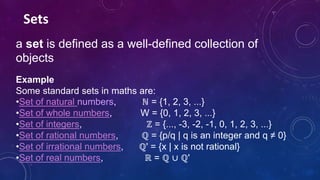
a set is defined as a well-defined collection of
objects
Example
Some standard sets in maths are:
•Set of natural numbers, ℕ = {1, 2, 3, ...}
•Set of whole numbers, W = {0, 1, 2, 3, ...}
•Set of integers, ℤ = {..., -3, -2, -1, 0, 1, 2, 3, ...}
•Set of rational numbers, ℚ = {p/q | q is an integer and q ≠ 0}
•Set of irrational numbers, ℚ' = {x | x is not rational}
•Set of real numbers, ℝ = ℚ ∪ ℚ'
Sets
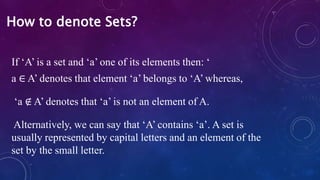
If ‘A’ is a set and ‘a’ one of its elements then: ‘
a ∈ A’ denotes that element ‘a’ belongs to ‘A’ whereas,
‘a ∉ A’ denotes that ‘a’ is not an element of A.
Alternatively, we can say that ‘A’ contains ‘a’. A set is
usually represented by capital letters and an element of the
set by the small letter.
How to denote Sets?
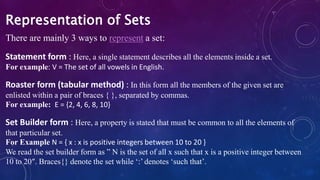
There are mainly 3 ways to represent a set:
Statement form : Here, a single statement describes all the elements inside a set.
For example: V = The set of all vowels in English.
Roaster form (tabular method) : In this form all the members of the given set are
enlisted within a pair of braces { }, separated by commas.
For example: E = {2, 4, 6, 8, 10}
Set Builder form : Here, a property is stated that must be common to all the elements of
that particular set.
For Example N = { x : x is positive integers between 10 to 20 }
We read the set builder form as ” N is the set of all x such that x is a positive integer between
10 to 20″. Braces{} denote the set while ‘:’ denotes ‘such that’.
Representation of Sets
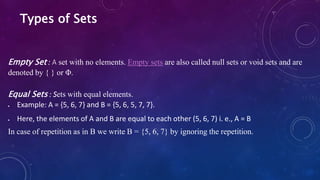
Empty Set : A set with no elements. Empty sets are also called null sets or void sets and are
denoted by { } or Φ.
Equal Sets : Sets with equal elements.
 Example: A = {5, 6, 7} and B = {5, 6, 5, 7, 7}.
 Here, the elements of A and B are equal to each other (5, 6, 7) i. e., A = B
In case of repetition as in B we write B = {5, 6, 7} by ignoring the repetition.
Types of Sets
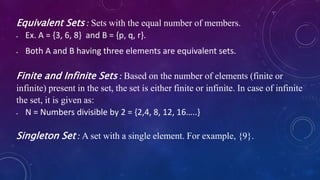
Equivalent Sets : Sets with the equal number of members.
 Ex. A = {3, 6, 8} and B = {p, q, r}.
 Both A and B having three elements are equivalent sets.
Finite and Infinite Sets : Based on the number of elements (finite or
infinite) present in the set, the set is either finite or infinite. In case of infinite
the set, it is given as:
 N = Numbers divisible by 2 = {2,4, 8, 12, 16…..}
Singleton Set : A set with a single element. For example, {9}.
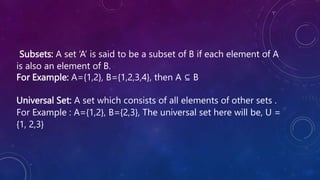
Subsets: A set ‘A’ is said to be a subset of B if each element of A
is also an element of B.
For Example: A={1,2}, B={1,2,3,4}, then A ⊆ B
Universal Set: A set which consists of all elements of other sets .
For Example : A={1,2}, B={2,3}, The universal set here will be, U =
{1, 2,3}
Thank you

Short introduction of sets.pptx

  • 1.
    SIMPLE CONCEPTS OFSETS SIR ABDUL GHAFFAR We'llcome to Problem SOLUTION
  • 2.
    a set isdefined as a well-defined collection of objects Example Some standard sets in maths are: •Set of natural numbers, ℕ = {1, 2, 3, ...} •Set of whole numbers, W = {0, 1, 2, 3, ...} •Set of integers, ℤ = {..., -3, -2, -1, 0, 1, 2, 3, ...} •Set of rational numbers, ℚ = {p/q | q is an integer and q ≠ 0} •Set of irrational numbers, ℚ' = {x | x is not rational} •Set of real numbers, ℝ = ℚ ∪ ℚ' Sets
  • 3.
    If ‘A’ isa set and ‘a’ one of its elements then: ‘ a ∈ A’ denotes that element ‘a’ belongs to ‘A’ whereas, ‘a ∉ A’ denotes that ‘a’ is not an element of A. Alternatively, we can say that ‘A’ contains ‘a’. A set is usually represented by capital letters and an element of the set by the small letter. How to denote Sets?
  • 4.
    There are mainly3 ways to represent a set: Statement form : Here, a single statement describes all the elements inside a set. For example: V = The set of all vowels in English. Roaster form (tabular method) : In this form all the members of the given set are enlisted within a pair of braces { }, separated by commas. For example: E = {2, 4, 6, 8, 10} Set Builder form : Here, a property is stated that must be common to all the elements of that particular set. For Example N = { x : x is positive integers between 10 to 20 } We read the set builder form as ” N is the set of all x such that x is a positive integer between 10 to 20″. Braces{} denote the set while ‘:’ denotes ‘such that’. Representation of Sets
  • 5.
    Empty Set :A set with no elements. Empty sets are also called null sets or void sets and are denoted by { } or Φ. Equal Sets : Sets with equal elements.  Example: A = {5, 6, 7} and B = {5, 6, 5, 7, 7}.  Here, the elements of A and B are equal to each other (5, 6, 7) i. e., A = B In case of repetition as in B we write B = {5, 6, 7} by ignoring the repetition. Types of Sets
  • 6.
    Equivalent Sets :Sets with the equal number of members.  Ex. A = {3, 6, 8} and B = {p, q, r}.  Both A and B having three elements are equivalent sets. Finite and Infinite Sets : Based on the number of elements (finite or infinite) present in the set, the set is either finite or infinite. In case of infinite the set, it is given as:  N = Numbers divisible by 2 = {2,4, 8, 12, 16…..} Singleton Set : A set with a single element. For example, {9}.
  • 7.
    Subsets: A set‘A’ is said to be a subset of B if each element of A is also an element of B. For Example: A={1,2}, B={1,2,3,4}, then A ⊆ B Universal Set: A set which consists of all elements of other sets . For Example : A={1,2}, B={2,3}, The universal set here will be, U = {1, 2,3}
  • 8.