Systemic nitrogen demand signaling
Shivalingappa Bangi
PALB- 5052
Crop Physiology
UAS, GKVK Bengaluru
Why Nitrogen is important
??????
 It is an essential macronutrient that impacts plant growth and
development.
 There is an abundant supply of nitrogen in the earth’s atmosphere—
N2 gas comprises nearly 79% of air.
 It is an important component of chlorophyll, amino acids, nucleic
acids and secondary metabolites.
 The nitrogen regulatory mechanisms are mostly characterized at
the physiological level but still remain largely unknown at the
molecular level
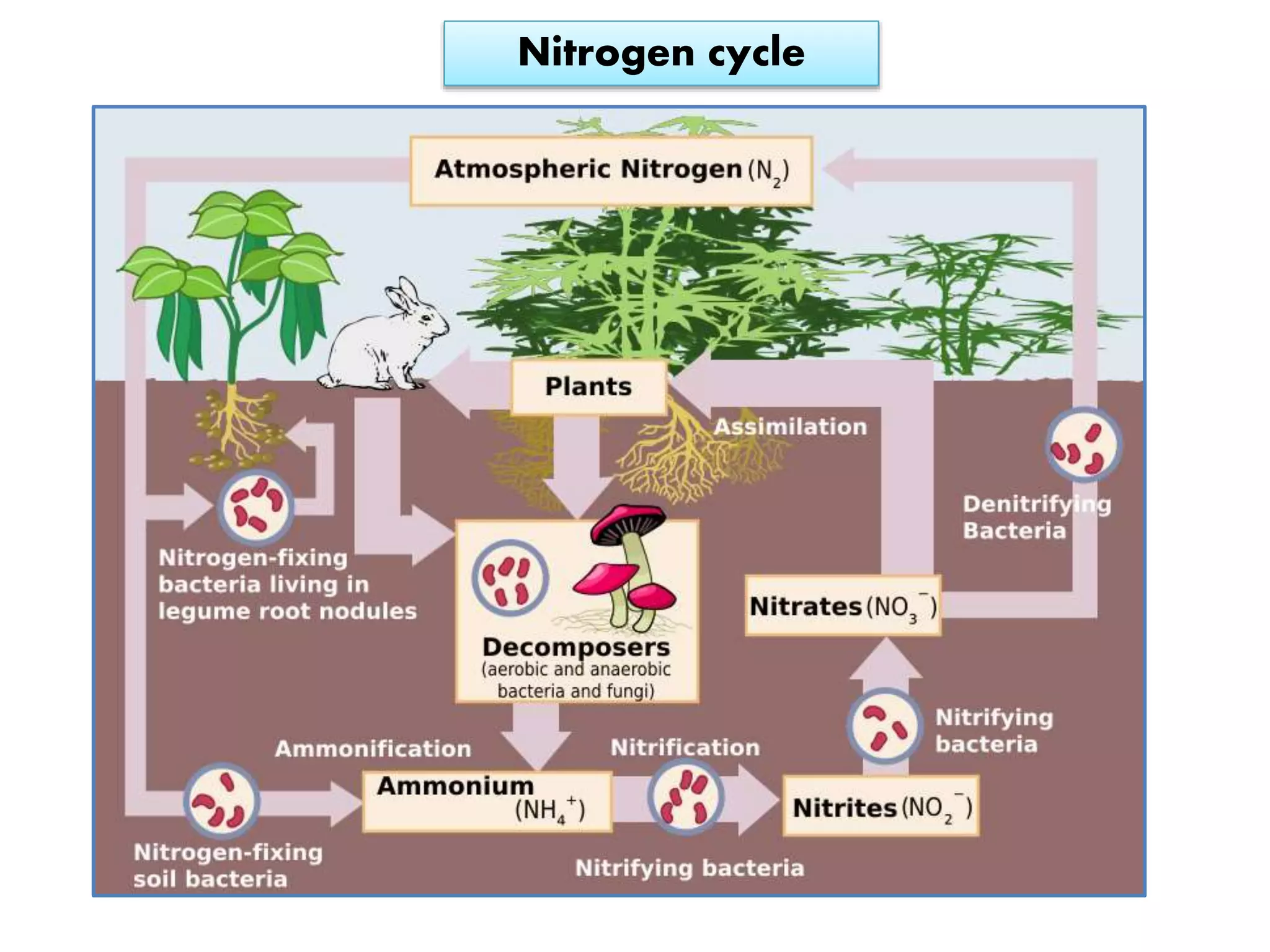
Nitrogen cycle
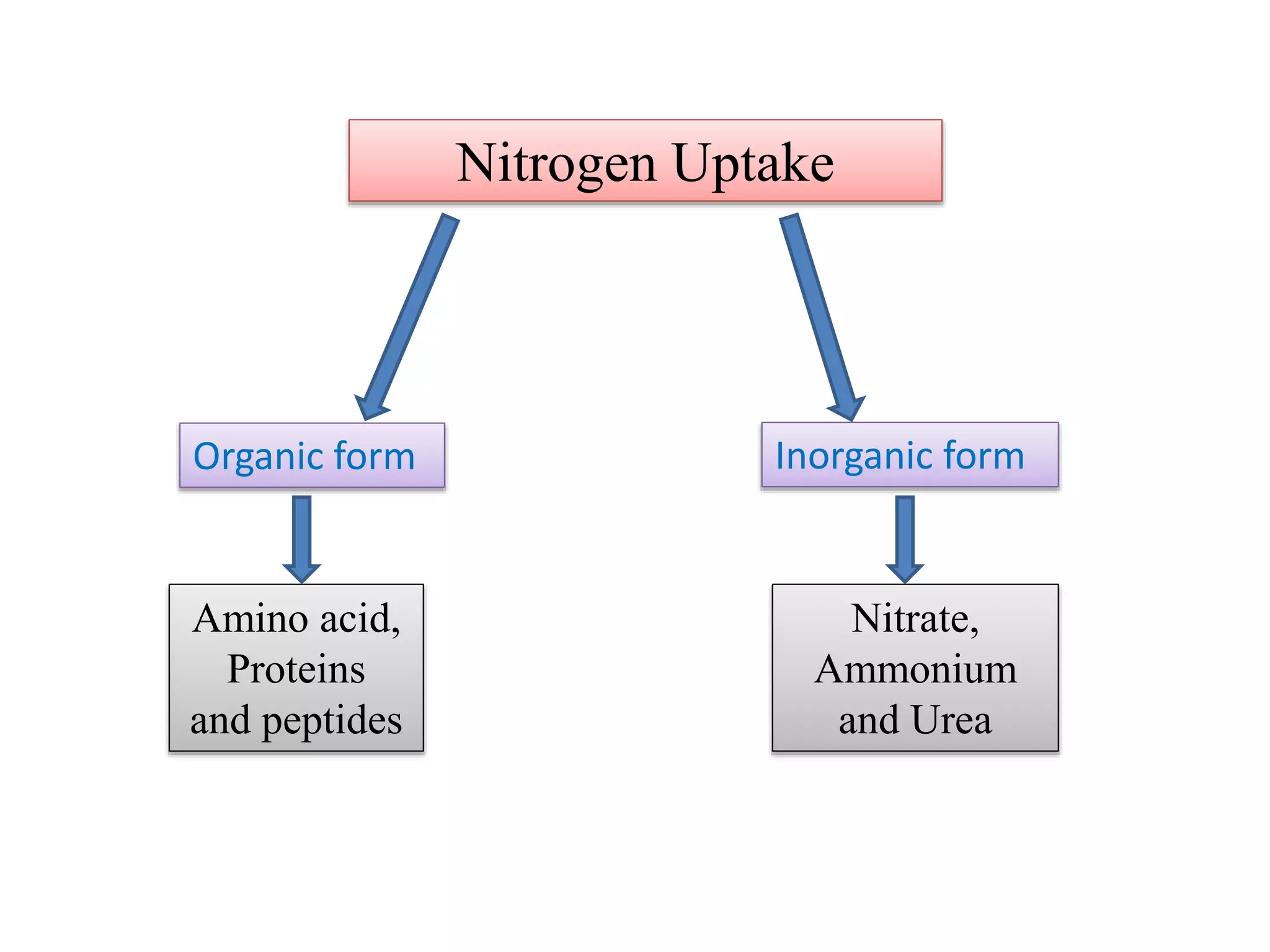
Nitrogen Uptake
Organic form Inorganic form
Nitrate,
Ammonium
and Urea
Amino acid,
Proteins
and peptides
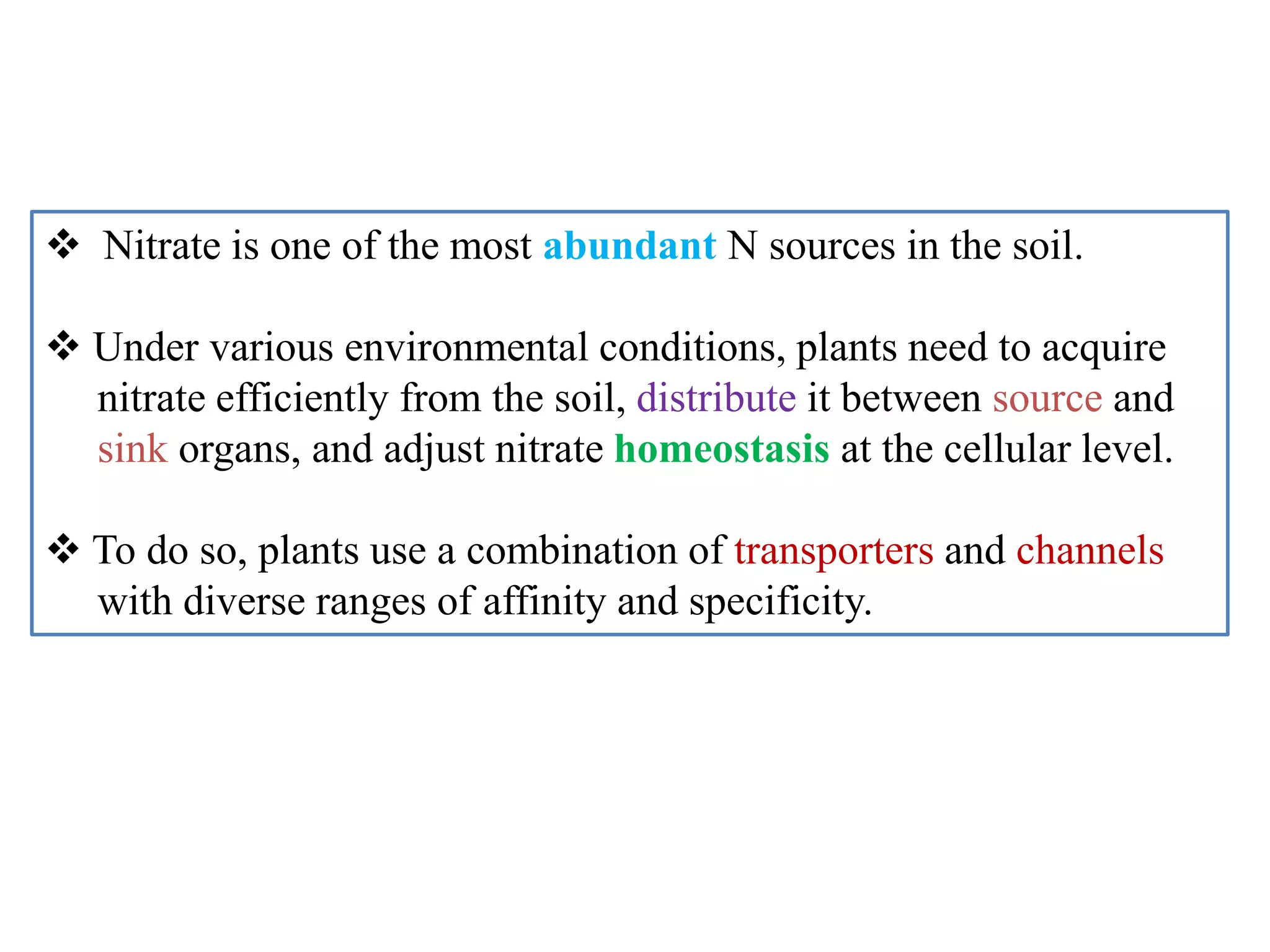
 Nitrate is one of the most abundant N sources in the soil.
 Under various environmental conditions, plants need to acquire
nitrate efficiently from the soil, distribute it between source and
sink organs, and adjust nitrate homeostasis at the cellular level.
 To do so, plants use a combination of transporters and channels
with diverse ranges of affinity and specificity.
Nitrate transporter and channels in higher plants
 NRT1 (Nitrate transporter-1) Dual-affinity (transport and signalling)
 NRT2 (Nitrate transporter-2)
 CLC family (Chloride channel)
 SLAH3 (Slow anion channel- associated 1 homolog 3)- uptake,
allocation and sensing of nitrate
CLC a
CLC b
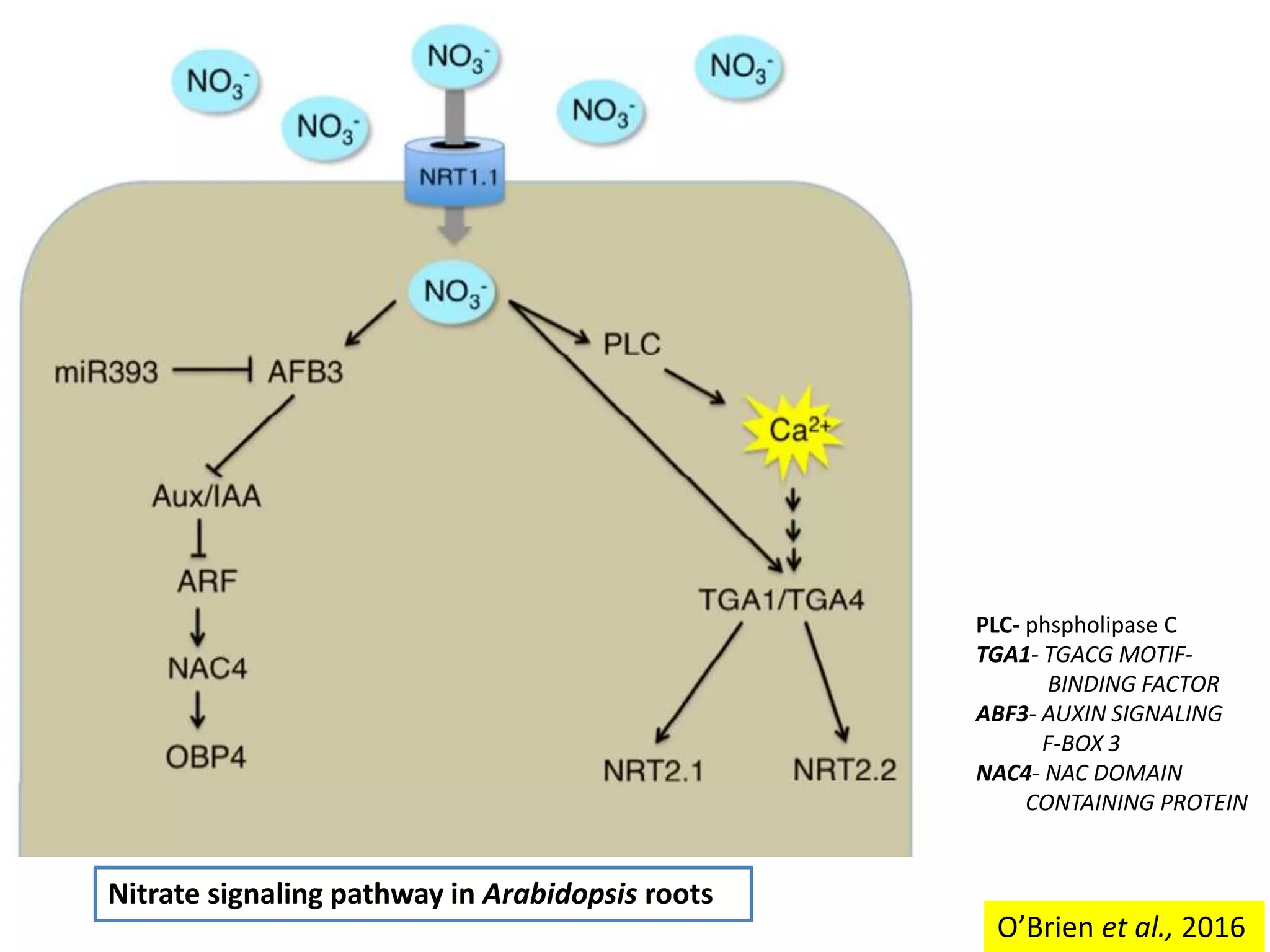
O’Brien et al., 2016
Nitrate signaling pathway in Arabidopsis roots
PLC- phspholipase C
TGA1- TGACG MOTIF-
BINDING FACTOR
ABF3- AUXIN SIGNALING
F-BOX 3
NAC4- NAC DOMAIN
CONTAINING PROTEIN
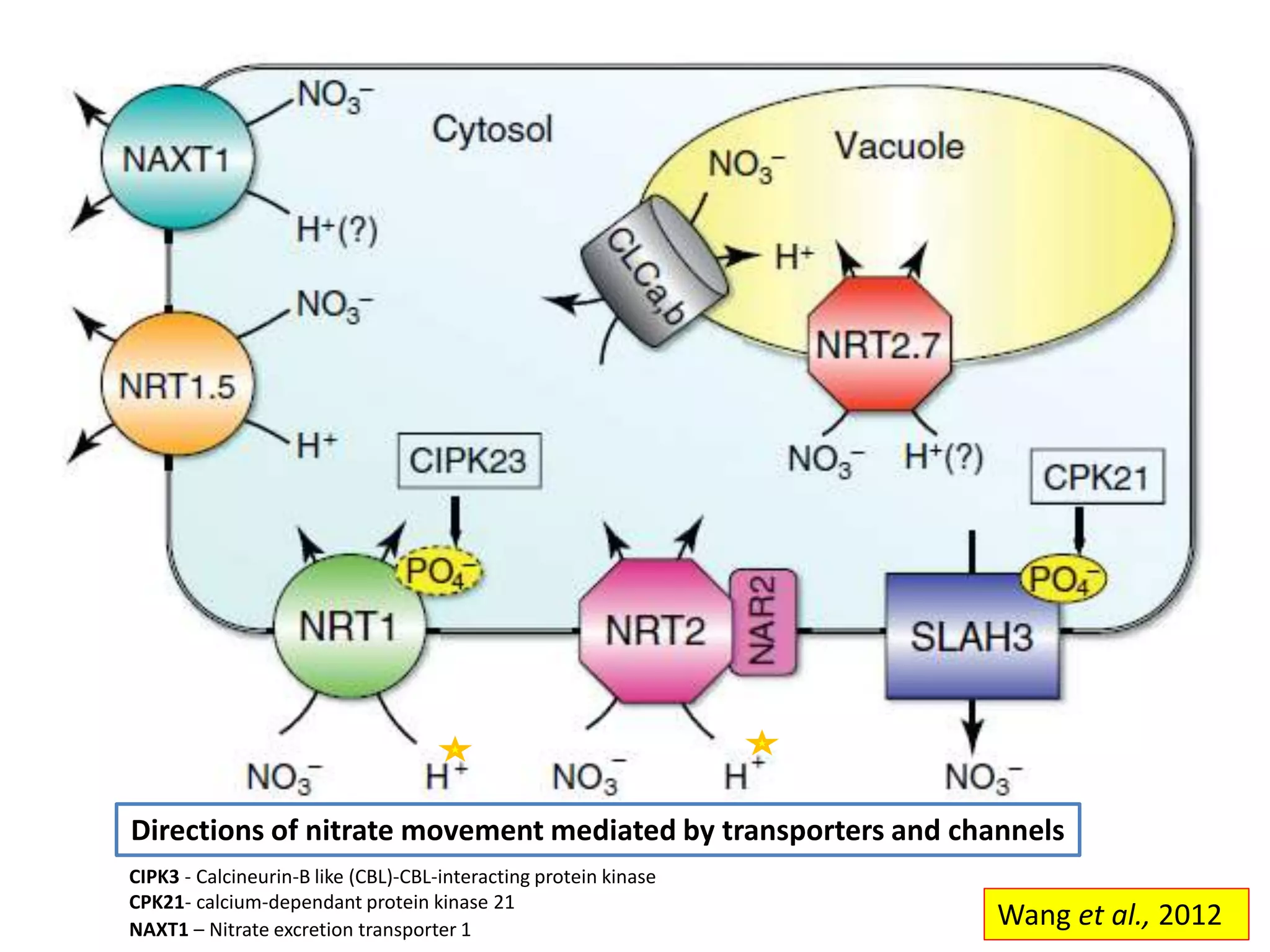
Wang et al., 2012
How Nitrate movement in root system ????
NAXT1 – Nitrate excretion transporter 1
Wang et al., 2012
Regulation of root-to-shoot nitrate transport
Co- cortex
Pe- pericycle
Xy - xylem
Ph – phloem
En - endodermis
Wang et al., 2012
Directions of nitrate movement mediated by transporters and channels
CIPK3 - Calcineurin-B like (CBL)-CBL-interacting protein kinase
CPK21- calcium-dependant protein kinase 21
NAXT1 – Nitrate excretion transporter 1
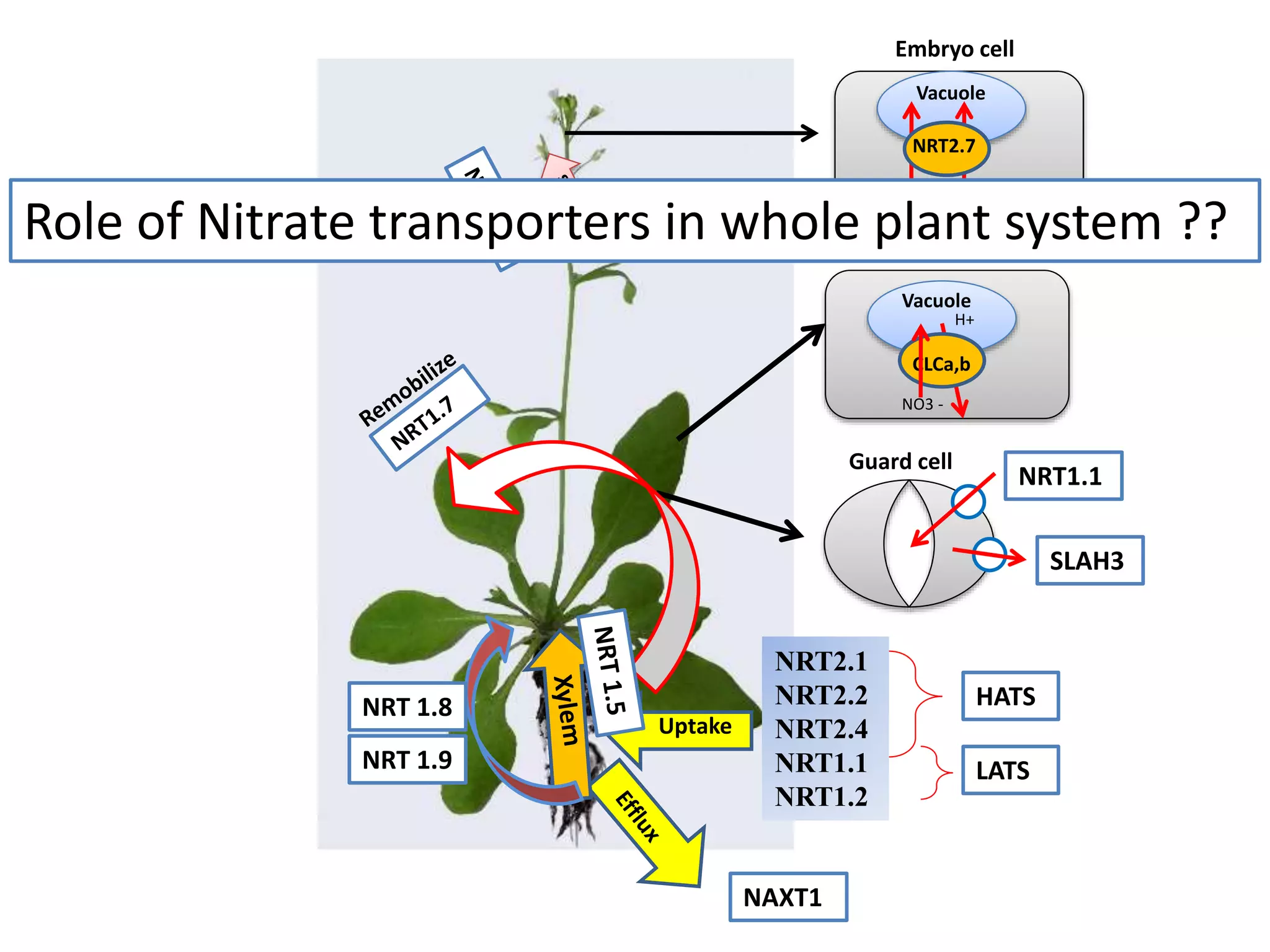
NRT2.1
NRT2.2
NRT2.4
NRT1.1
NRT1.2
HATS
LATS
Uptake
NAXT1
SLAH3
NRT1.1
Vacuole
CLCa,b
NO3 -
H+
Vacuole
NRT2.7
NO3 - H+ (?)
Embryo cell
Mesophyll cell
Guard cell
NRT 1.8
NRT 1.9
Role of Nitrate transporters in whole plant system ??
Wang et al., 2012
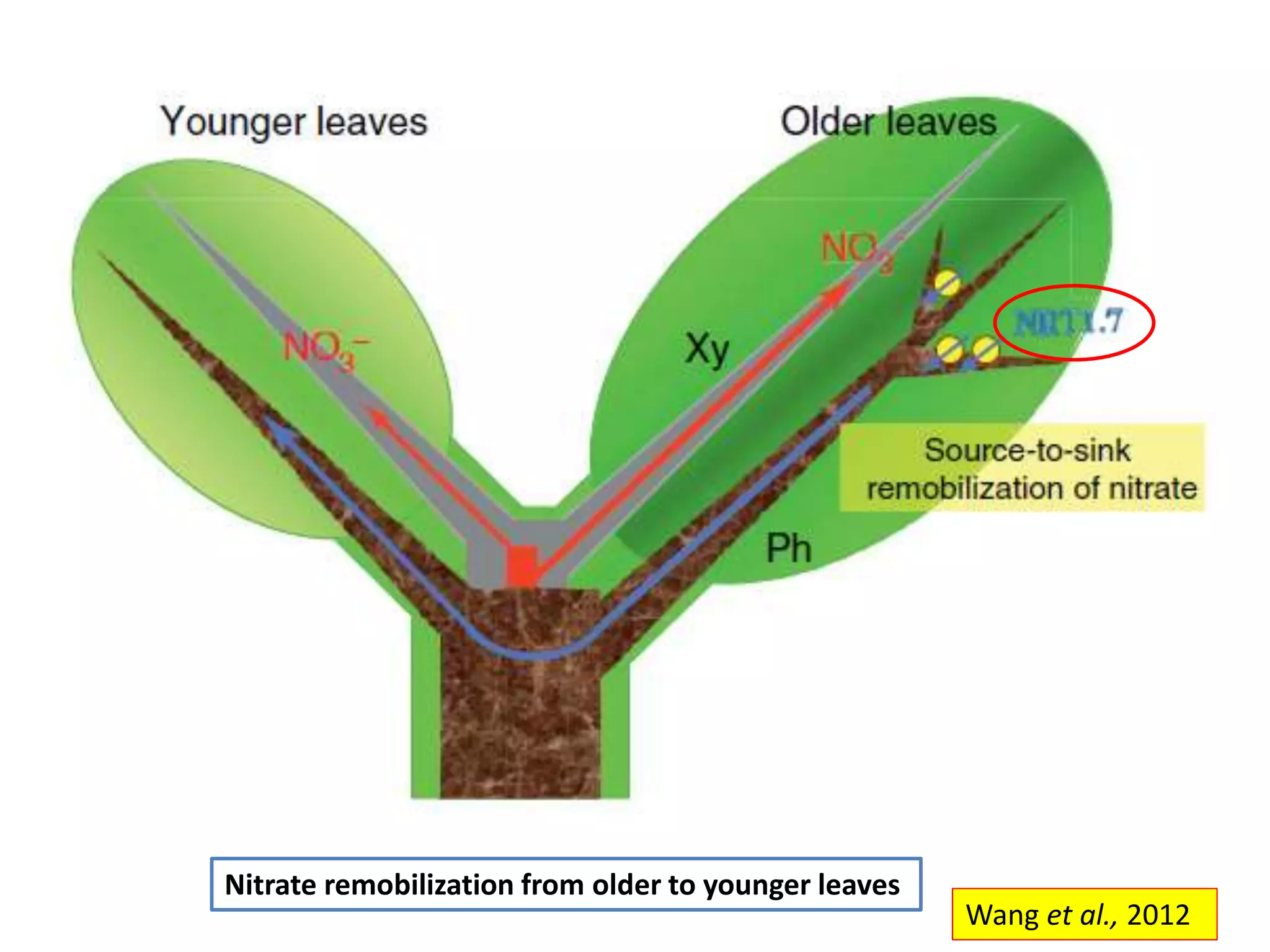
Nitrate remobilization from older to younger leaves
Wang et al., 2012
Nitrate transport to embryos
F - Funiculus
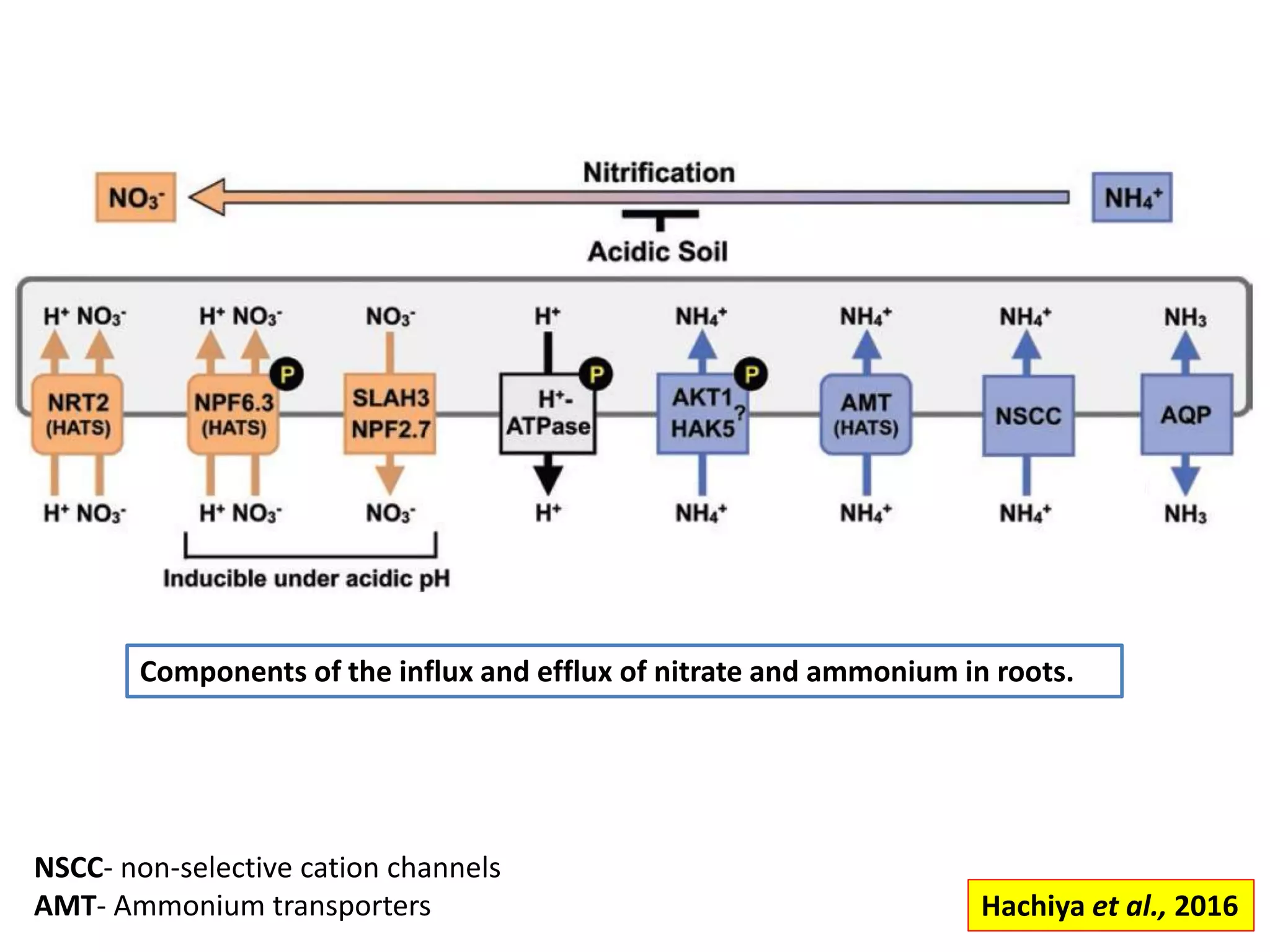
Components of the influx and efflux of nitrate and ammonium in roots.
Hachiya et al., 2016
NSCC- non-selective cation channels
AMT- Ammonium transporters
Conclusion
Further study is required to understand the function of other transporters. For
example, there are at 80 genes in the rice (Oryza sativa) NRT1 family but to
date only two of them have been functionally characterized.
In Arabidopsis also less than one third of NRT1 and NRT2 genes have been
characterized. Now a big question to plant scientists is that why higher plants
need so many nitrate transporters? and how those genes were function and how
these coordinate the external stimuli with internal growth, it requires more study.
REFERENCE
HACHIYA, T., AND SAKAKIBARA, H., 2016, Interactions between nitrate
and ammonium in their uptake, allocation, assimilation, and signaling
in plants. Journal of Experimental Botany, erw449.
O'BRIEN, J. A., VEGA, A., BOUGUYON, E., KROUK, G., GOJON, A.,
CORUZZI, G., AND GUTIÉRREZ, R. A., 2016, Nitrate transport,
sensing, and responses in plants. Molecular Plant, 9(6): 837-856.
WANG, Y. Y., HSU, P. K., AND TSAY, Y. F., 2012, Uptake, allocation and
signaling of nitrate. Trends in plant science, 17(8): 458-467.
Shiva Bangi presented the "Systemic nitrogen demand signaling"

Shiva Bangi presented the "Systemic nitrogen demand signaling"

  • 1.
    Systemic nitrogen demandsignaling Shivalingappa Bangi PALB- 5052 Crop Physiology UAS, GKVK Bengaluru
  • 2.
    Why Nitrogen isimportant ??????  It is an essential macronutrient that impacts plant growth and development.  There is an abundant supply of nitrogen in the earth’s atmosphere— N2 gas comprises nearly 79% of air.  It is an important component of chlorophyll, amino acids, nucleic acids and secondary metabolites.  The nitrogen regulatory mechanisms are mostly characterized at the physiological level but still remain largely unknown at the molecular level
  • 3.
  • 4.
    Nitrogen Uptake Organic formInorganic form Nitrate, Ammonium and Urea Amino acid, Proteins and peptides
  • 5.
     Nitrate isone of the most abundant N sources in the soil.  Under various environmental conditions, plants need to acquire nitrate efficiently from the soil, distribute it between source and sink organs, and adjust nitrate homeostasis at the cellular level.  To do so, plants use a combination of transporters and channels with diverse ranges of affinity and specificity.
  • 6.
    Nitrate transporter andchannels in higher plants  NRT1 (Nitrate transporter-1) Dual-affinity (transport and signalling)  NRT2 (Nitrate transporter-2)  CLC family (Chloride channel)  SLAH3 (Slow anion channel- associated 1 homolog 3)- uptake, allocation and sensing of nitrate CLC a CLC b
  • 8.
    O’Brien et al.,2016 Nitrate signaling pathway in Arabidopsis roots PLC- phspholipase C TGA1- TGACG MOTIF- BINDING FACTOR ABF3- AUXIN SIGNALING F-BOX 3 NAC4- NAC DOMAIN CONTAINING PROTEIN
  • 9.
    Wang et al.,2012 How Nitrate movement in root system ???? NAXT1 – Nitrate excretion transporter 1
  • 10.
    Wang et al.,2012 Regulation of root-to-shoot nitrate transport Co- cortex Pe- pericycle Xy - xylem Ph – phloem En - endodermis
  • 11.
    Wang et al.,2012 Directions of nitrate movement mediated by transporters and channels CIPK3 - Calcineurin-B like (CBL)-CBL-interacting protein kinase CPK21- calcium-dependant protein kinase 21 NAXT1 – Nitrate excretion transporter 1
  • 12.
    NRT2.1 NRT2.2 NRT2.4 NRT1.1 NRT1.2 HATS LATS Uptake NAXT1 SLAH3 NRT1.1 Vacuole CLCa,b NO3 - H+ Vacuole NRT2.7 NO3 -H+ (?) Embryo cell Mesophyll cell Guard cell NRT 1.8 NRT 1.9 Role of Nitrate transporters in whole plant system ??
  • 13.
    Wang et al.,2012 Nitrate remobilization from older to younger leaves
  • 14.
    Wang et al.,2012 Nitrate transport to embryos F - Funiculus
  • 15.
    Components of theinflux and efflux of nitrate and ammonium in roots. Hachiya et al., 2016 NSCC- non-selective cation channels AMT- Ammonium transporters
  • 16.
    Conclusion Further study isrequired to understand the function of other transporters. For example, there are at 80 genes in the rice (Oryza sativa) NRT1 family but to date only two of them have been functionally characterized. In Arabidopsis also less than one third of NRT1 and NRT2 genes have been characterized. Now a big question to plant scientists is that why higher plants need so many nitrate transporters? and how those genes were function and how these coordinate the external stimuli with internal growth, it requires more study.
  • 17.
    REFERENCE HACHIYA, T., ANDSAKAKIBARA, H., 2016, Interactions between nitrate and ammonium in their uptake, allocation, assimilation, and signaling in plants. Journal of Experimental Botany, erw449. O'BRIEN, J. A., VEGA, A., BOUGUYON, E., KROUK, G., GOJON, A., CORUZZI, G., AND GUTIÉRREZ, R. A., 2016, Nitrate transport, sensing, and responses in plants. Molecular Plant, 9(6): 837-856. WANG, Y. Y., HSU, P. K., AND TSAY, Y. F., 2012, Uptake, allocation and signaling of nitrate. Trends in plant science, 17(8): 458-467.