Summary of published Dissertation by
Robynne Sherrill, PhD

 The role of policing requires leadership and courageous
followership skills; at any time, a police leader could
become a follower and vice versa
 Similar studies have focused on law enforcement
leadership and followership independently (e.g., Havins,
2010; Harvey, 2004)
 This study explored the relationship between courageous
followership and transformational leadership behaviors,
to assess if law enforcement leaders rating themselves as
courageous followers also rated themselves as
transformational leaders
Introduction

 The relationship between followership behaviors and
leadership behaviors had not been studied to determine if
developing followership behaviors produces more
effective leaders
 Identifying the existence of a relationship between
courageous followership and transformational leadership
behaviors could improve the selection of law enforcement
leaders, better align roles within law enforcement (leaders
and followers), or identify educational venues to build
followership competency
 A model does not exist that relates the development of
followership to the development of leadership
Statement of the
Problem

 Law enforcement leaders, in supervisory positions,
in the state of Ohio, represent the unit of analysis for
this study
 Supervisory position defined as those with supervisor
titles. Those with supervisor titles, but with no direct
reports, were not excluded from the study.
 Included female and male participants.
 The target sample size for this study was 107 based on
a Power Analysis; N=148 for this study.
Methodology - Sample

 The data collection approach was distribution of 2 paper
forms: (a) 2-sided copies of The Follower Profile and, (b)
2-sided copies of the Leadership Practices Inventory (LPI)
Self-Assessment
 Considering conversations with police chiefs, paper
surveys were distributed by an agency point of contact
was selected to maintain process integrity and perceived
confidentiality
 Surveys were in individual envelopes, accompanied by an
envelope to be sealed with the survey inside and returned
to the point of contact. The point of contact then returned
sealed envelopes to the researcher.
Methodology – Data
Collection

 Two survey instruments were distributed for completion
by the sample population: (a) Dixon’s (2003) The Follower
Profile and (b) Kouzes and Posner’s (2003) Leadership
Practices Inventory Self-Assessment
 Selected as the instruments determined to best measure
how police leaders perceive their courageous followership
behaviors and transformational leadership behaviors, to
facilitate analysis of the relationship between both
(behaviors).
 Researcher observed the potential relationship between
Chaleff’s (2007) courageous followership behaviors and
Kouzes and Posner’s (2007) exemplary leadership practices.
Methodology -
Instrumentation

 Preliminary analyses were conducted to examine the
linearity of the relationships between the follower and
leadership behaviors
 In Step 1 one of the model, the follower behavior was
entered as the independent variable, and the leadership
behavior was entered as the dependent variable. In step 2
of the model, gender was entered as a predictor variable
 A significant F-change from Step 1 to Step 2 meant that
gender was a significant moderating variable between the
follower and leadership variables.
 There were five main hypotheses. Therefore, five
hierarchical regression models were utilized to examine
the relationships.
Methodology – Data
Analysis

 148 individuals participated in the study
 85.8% (n = 127) were males and 14.2% (n = 21) were
females
 Relative to job rank, the majority of respondents
(66.2%, n = 98) were sergeants; 20.3% (n = 30) were
lieutenants; and 6.8% (n = 10) were commanders
Results - Demographics

Results – Research
Question 1
 RQ1: Is there a significant
relationship between how
law enforcement leaders at
select agencies in the state of
Ohio assess their courageous
followership behavior,
courage to challenge (as scored
on The Follower Profile) and
their transformational
leadership behavior,
challenging the process (as
scored on The Leadership
Practices Inventory), and
what influence does gender
have on the relationship?
 Findings:
 Statistically significant
relationship
 Gender does not influence
this relationship
 Courage to challenge the
process was statistically the
lowest rated behavior on
The Follower Profile by
respondents (M=3.85, SD =
0.55)
 Challenging the process
requires courage

Results – Research
Question 2
 RQ2: Is there a significant
relationship between how law
enforcement leaders at select
agencies in the state of Ohio
assess their courageous
followership behavior, courage
to take moral action (as scored
on The Follower Profile) and
their transformational
leadership behavior, modeling
the way (as scored on The
Leadership Practices
Inventory), and what
influence does gender have on
the relationship?
 Findings:
 No statistically significant
relationship
 Gender does not influence
this relationship
 Modeling the way was
statistically the highest rated
behavior on the LPI, by
respondents (M=8.52, SD =
0.85)
 Variables remain
individually critical to
courageous followership and
transformational leadership

Results – Research
Question 3
 RQ3: Is there a significant
relationship between how law
enforcement leaders at select
agencies in the state of Ohio
assess their courageous
followership behavior, courage
to participate in transformation
(as scored on The Follower
Profile) and their
transformational leadership
behavior, inspiring a shared
vision (as scored on The
Leadership Practices
Inventory) , and what influence
does gender have on the
relationship?
 Findings:
 Statistically significant
relationship
 Gender does not influence this
relationship
 Courage to participate in
transformation was statistically the
highest rated behavior on The
Follower Profile, by respondents
(M=4.15, SD = 0.57)
 Inspiring a shared vision was
statistically the lowest rated
behavior on The LPI by
respondents (M=7.04, SD = 1.77)

Results – Research
Question 4
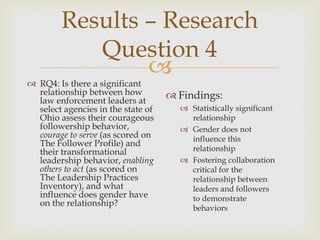
 RQ4: Is there a significant
relationship between how
law enforcement leaders at
select agencies in the state of
Ohio assess their courageous
followership behavior,
courage to serve (as scored on
The Follower Profile) and
their transformational
leadership behavior, enabling
others to act (as scored on
The Leadership Practices
Inventory), and what
influence does gender have
on the relationship?
 Findings:
 Statistically significant
relationship
 Gender does not
influence this
relationship
 Fostering collaboration
critical for the
relationship between
leaders and followers
to demonstrate
behaviors

Results – Research
Question 5
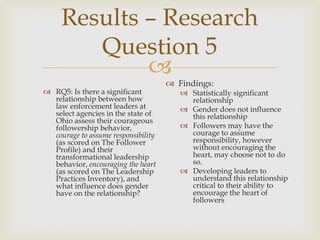
 RQ5: Is there a significant
relationship between how
law enforcement leaders at
select agencies in the state of
Ohio assess their courageous
followership behavior,
courage to assume responsibility
(as scored on The Follower
Profile) and their
transformational leadership
behavior, encouraging the heart
(as scored on The Leadership
Practices Inventory), and
what influence does gender
have on the relationship?
 Findings:
 Statistically significant
relationship
 Gender does not influence
this relationship
 Followers may have the
courage to assume
responsibility, however
without encouraging the
heart, may choose not to do
so.
 Developing leaders to
understand this relationship
critical to their ability to
encourage the heart of
followers

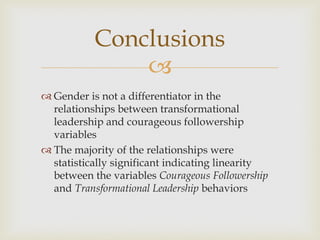
 Gender is not a differentiator in the
relationships between transformational
leadership and courageous followership
variables
 The majority of the relationships were
statistically significant indicating linearity
between the variables Courageous Followership
and Transformational Leadership behaviors
Conclusions

Sherrill Dissertation Summary

  • 1.
    Summary of publishedDissertation by Robynne Sherrill, PhD
  • 2.
      The roleof policing requires leadership and courageous followership skills; at any time, a police leader could become a follower and vice versa  Similar studies have focused on law enforcement leadership and followership independently (e.g., Havins, 2010; Harvey, 2004)  This study explored the relationship between courageous followership and transformational leadership behaviors, to assess if law enforcement leaders rating themselves as courageous followers also rated themselves as transformational leaders Introduction
  • 3.
      The relationshipbetween followership behaviors and leadership behaviors had not been studied to determine if developing followership behaviors produces more effective leaders  Identifying the existence of a relationship between courageous followership and transformational leadership behaviors could improve the selection of law enforcement leaders, better align roles within law enforcement (leaders and followers), or identify educational venues to build followership competency  A model does not exist that relates the development of followership to the development of leadership Statement of the Problem
  • 4.
      Law enforcementleaders, in supervisory positions, in the state of Ohio, represent the unit of analysis for this study  Supervisory position defined as those with supervisor titles. Those with supervisor titles, but with no direct reports, were not excluded from the study.  Included female and male participants.  The target sample size for this study was 107 based on a Power Analysis; N=148 for this study. Methodology - Sample
  • 5.
      The datacollection approach was distribution of 2 paper forms: (a) 2-sided copies of The Follower Profile and, (b) 2-sided copies of the Leadership Practices Inventory (LPI) Self-Assessment  Considering conversations with police chiefs, paper surveys were distributed by an agency point of contact was selected to maintain process integrity and perceived confidentiality  Surveys were in individual envelopes, accompanied by an envelope to be sealed with the survey inside and returned to the point of contact. The point of contact then returned sealed envelopes to the researcher. Methodology – Data Collection
  • 6.
      Two surveyinstruments were distributed for completion by the sample population: (a) Dixon’s (2003) The Follower Profile and (b) Kouzes and Posner’s (2003) Leadership Practices Inventory Self-Assessment  Selected as the instruments determined to best measure how police leaders perceive their courageous followership behaviors and transformational leadership behaviors, to facilitate analysis of the relationship between both (behaviors).  Researcher observed the potential relationship between Chaleff’s (2007) courageous followership behaviors and Kouzes and Posner’s (2007) exemplary leadership practices. Methodology - Instrumentation
  • 7.
      Preliminary analyseswere conducted to examine the linearity of the relationships between the follower and leadership behaviors  In Step 1 one of the model, the follower behavior was entered as the independent variable, and the leadership behavior was entered as the dependent variable. In step 2 of the model, gender was entered as a predictor variable  A significant F-change from Step 1 to Step 2 meant that gender was a significant moderating variable between the follower and leadership variables.  There were five main hypotheses. Therefore, five hierarchical regression models were utilized to examine the relationships. Methodology – Data Analysis
  • 8.
      148 individualsparticipated in the study  85.8% (n = 127) were males and 14.2% (n = 21) were females  Relative to job rank, the majority of respondents (66.2%, n = 98) were sergeants; 20.3% (n = 30) were lieutenants; and 6.8% (n = 10) were commanders Results - Demographics
  • 9.
     Results – Research Question1  RQ1: Is there a significant relationship between how law enforcement leaders at select agencies in the state of Ohio assess their courageous followership behavior, courage to challenge (as scored on The Follower Profile) and their transformational leadership behavior, challenging the process (as scored on The Leadership Practices Inventory), and what influence does gender have on the relationship?  Findings:  Statistically significant relationship  Gender does not influence this relationship  Courage to challenge the process was statistically the lowest rated behavior on The Follower Profile by respondents (M=3.85, SD = 0.55)  Challenging the process requires courage
  • 10.
     Results – Research Question2  RQ2: Is there a significant relationship between how law enforcement leaders at select agencies in the state of Ohio assess their courageous followership behavior, courage to take moral action (as scored on The Follower Profile) and their transformational leadership behavior, modeling the way (as scored on The Leadership Practices Inventory), and what influence does gender have on the relationship?  Findings:  No statistically significant relationship  Gender does not influence this relationship  Modeling the way was statistically the highest rated behavior on the LPI, by respondents (M=8.52, SD = 0.85)  Variables remain individually critical to courageous followership and transformational leadership
  • 11.
     Results – Research Question3  RQ3: Is there a significant relationship between how law enforcement leaders at select agencies in the state of Ohio assess their courageous followership behavior, courage to participate in transformation (as scored on The Follower Profile) and their transformational leadership behavior, inspiring a shared vision (as scored on The Leadership Practices Inventory) , and what influence does gender have on the relationship?  Findings:  Statistically significant relationship  Gender does not influence this relationship  Courage to participate in transformation was statistically the highest rated behavior on The Follower Profile, by respondents (M=4.15, SD = 0.57)  Inspiring a shared vision was statistically the lowest rated behavior on The LPI by respondents (M=7.04, SD = 1.77)
  • 12.
     Results – Research Question4  RQ4: Is there a significant relationship between how law enforcement leaders at select agencies in the state of Ohio assess their courageous followership behavior, courage to serve (as scored on The Follower Profile) and their transformational leadership behavior, enabling others to act (as scored on The Leadership Practices Inventory), and what influence does gender have on the relationship?  Findings:  Statistically significant relationship  Gender does not influence this relationship  Fostering collaboration critical for the relationship between leaders and followers to demonstrate behaviors
  • 13.
     Results – Research Question5  RQ5: Is there a significant relationship between how law enforcement leaders at select agencies in the state of Ohio assess their courageous followership behavior, courage to assume responsibility (as scored on The Follower Profile) and their transformational leadership behavior, encouraging the heart (as scored on The Leadership Practices Inventory), and what influence does gender have on the relationship?  Findings:  Statistically significant relationship  Gender does not influence this relationship  Followers may have the courage to assume responsibility, however without encouraging the heart, may choose not to do so.  Developing leaders to understand this relationship critical to their ability to encourage the heart of followers
  • 14.
      Gender isnot a differentiator in the relationships between transformational leadership and courageous followership variables  The majority of the relationships were statistically significant indicating linearity between the variables Courageous Followership and Transformational Leadership behaviors Conclusions