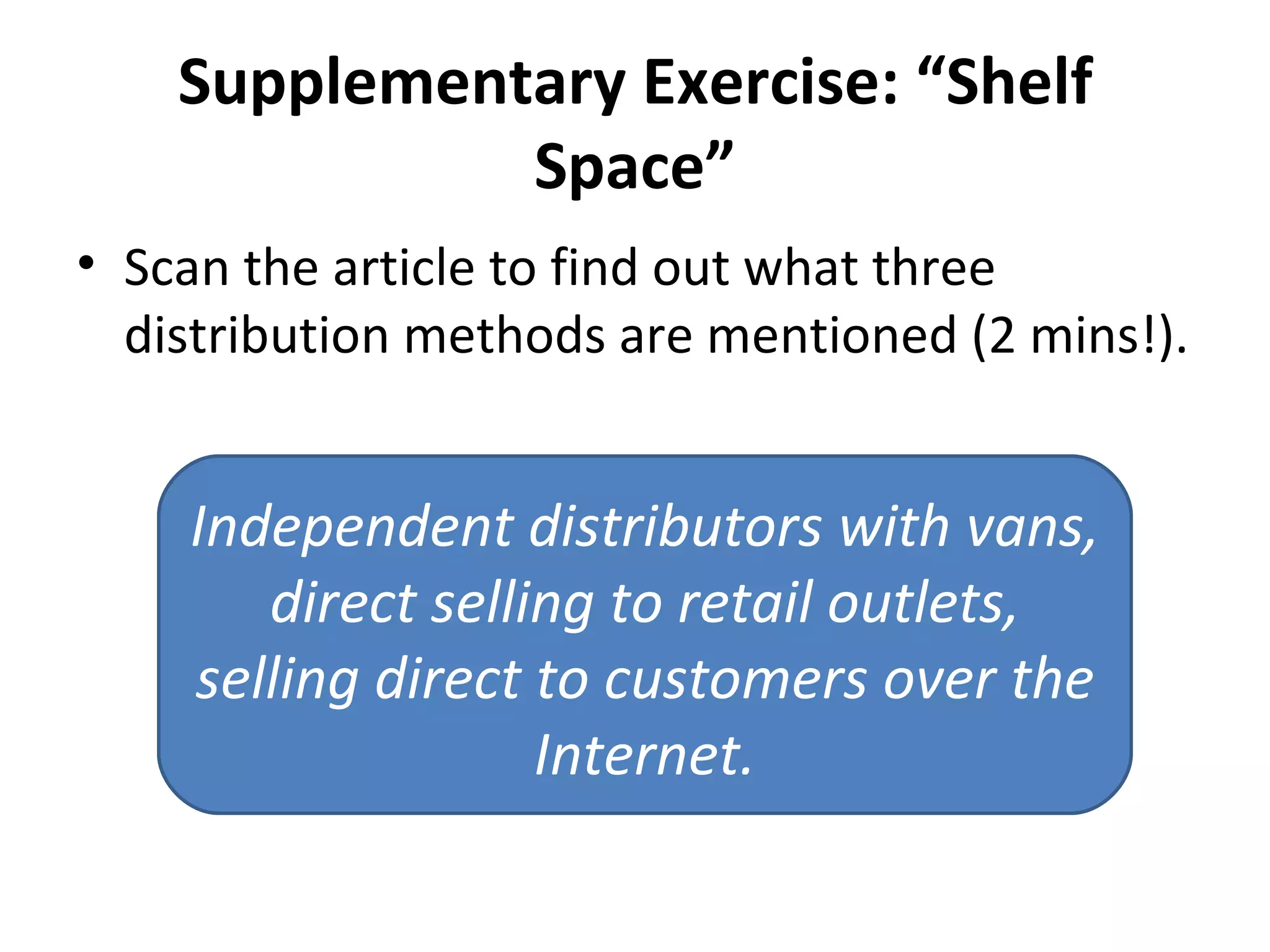
Supplementary Exercise: “Shelf Space” Scan the article to find out what three distribution methods are mentioned (2 mins!). Independent distributors with vans, direct selling to retail outlets, selling direct to customers over the Internet.
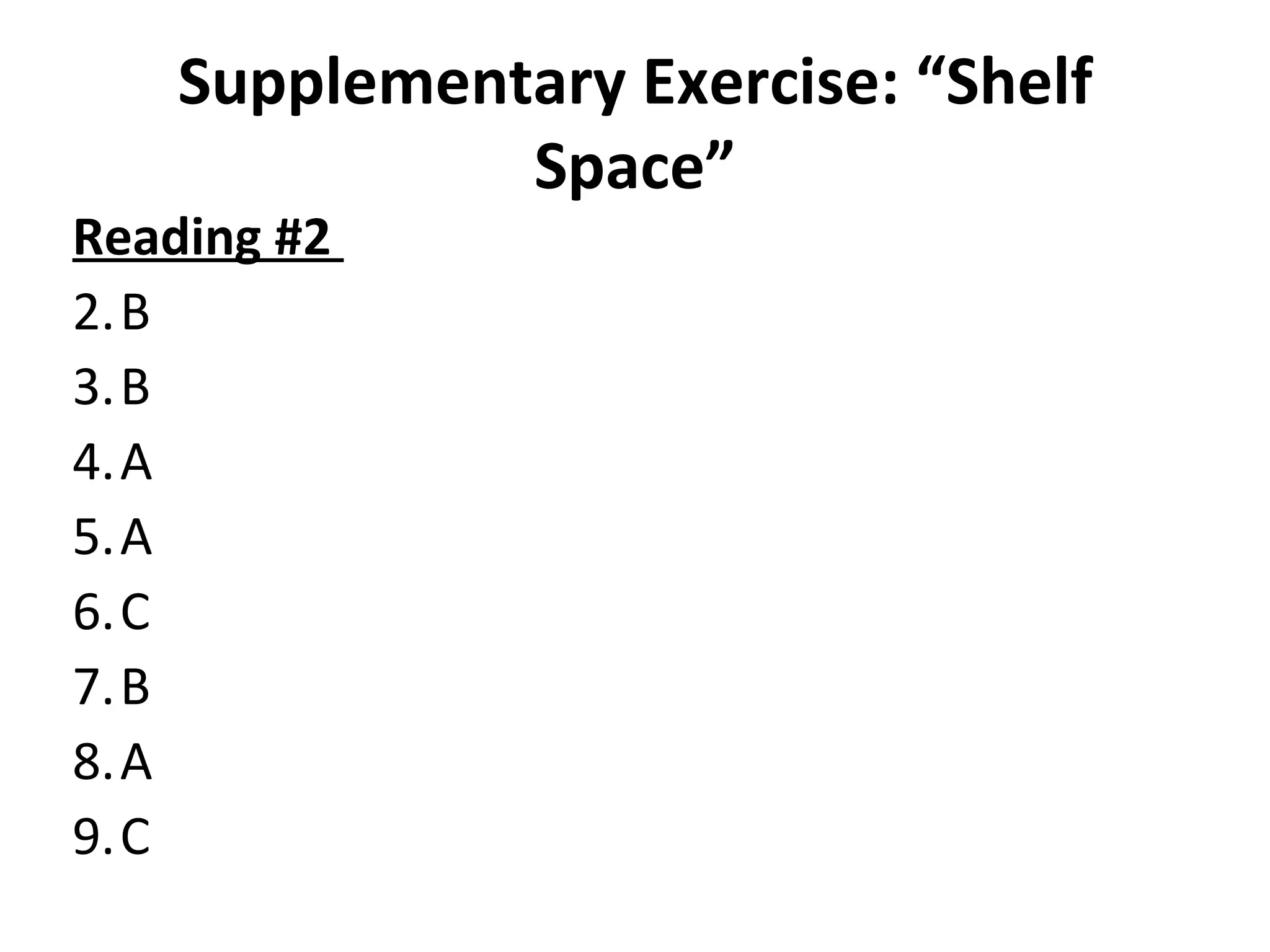
Supplementary Exercise: “Shelf Space” Reading #2  B B A A C B A C
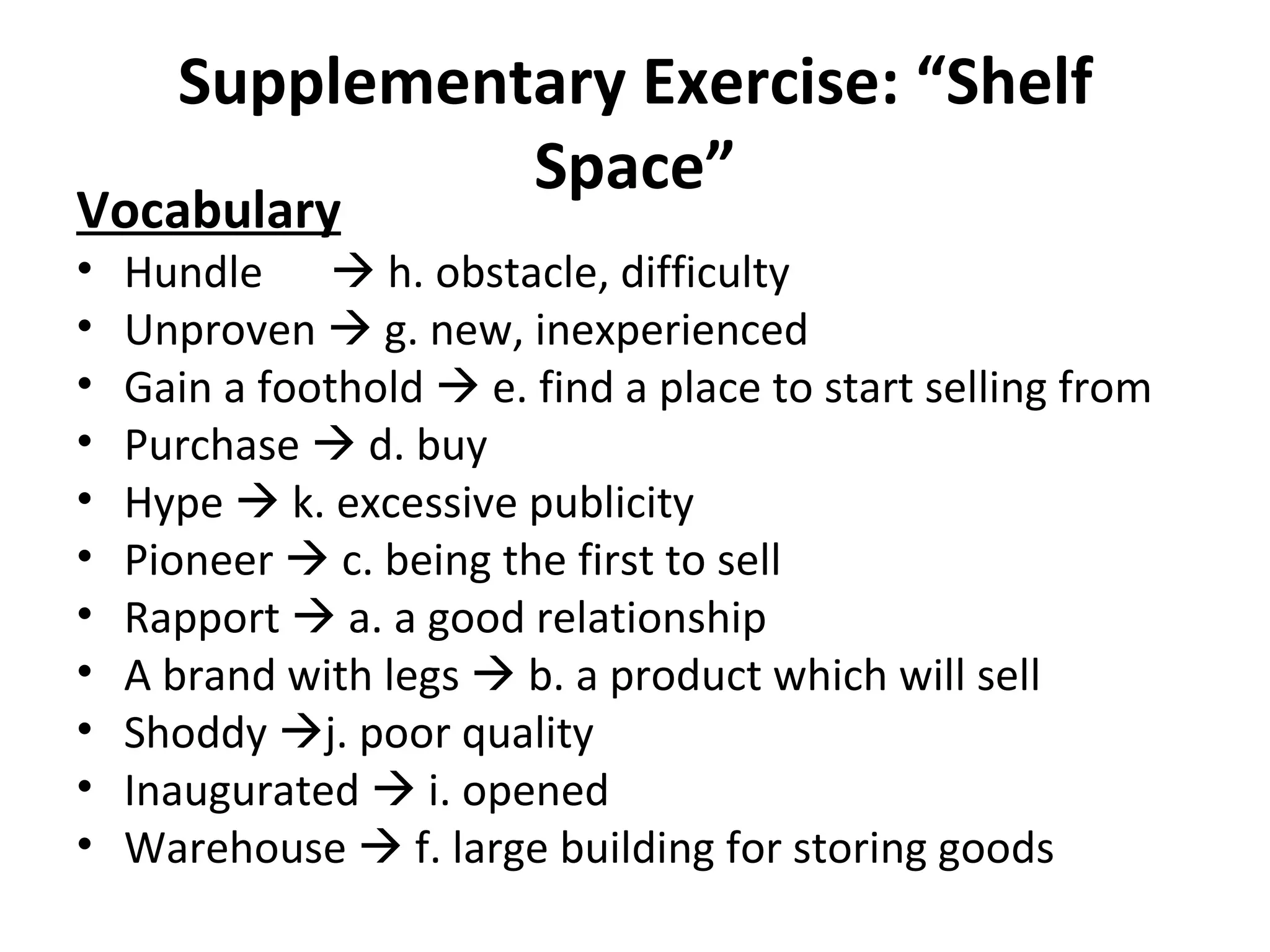
Supplementary Exercise: “Shelf Space” Vocabulary Hundle   h. obstacle, difficulty Unproven    g. new, inexperienced Gain a foothold    e. find a place to start selling from Purchase    d. buy Hype    k. excessive publicity Pioneer    c. being the first to sell Rapport    a. a good relationship A brand with legs    b. a product which will sell Shoddy   j. poor quality Inaugurated    i. opened Warehouse    f. large building for storing goods
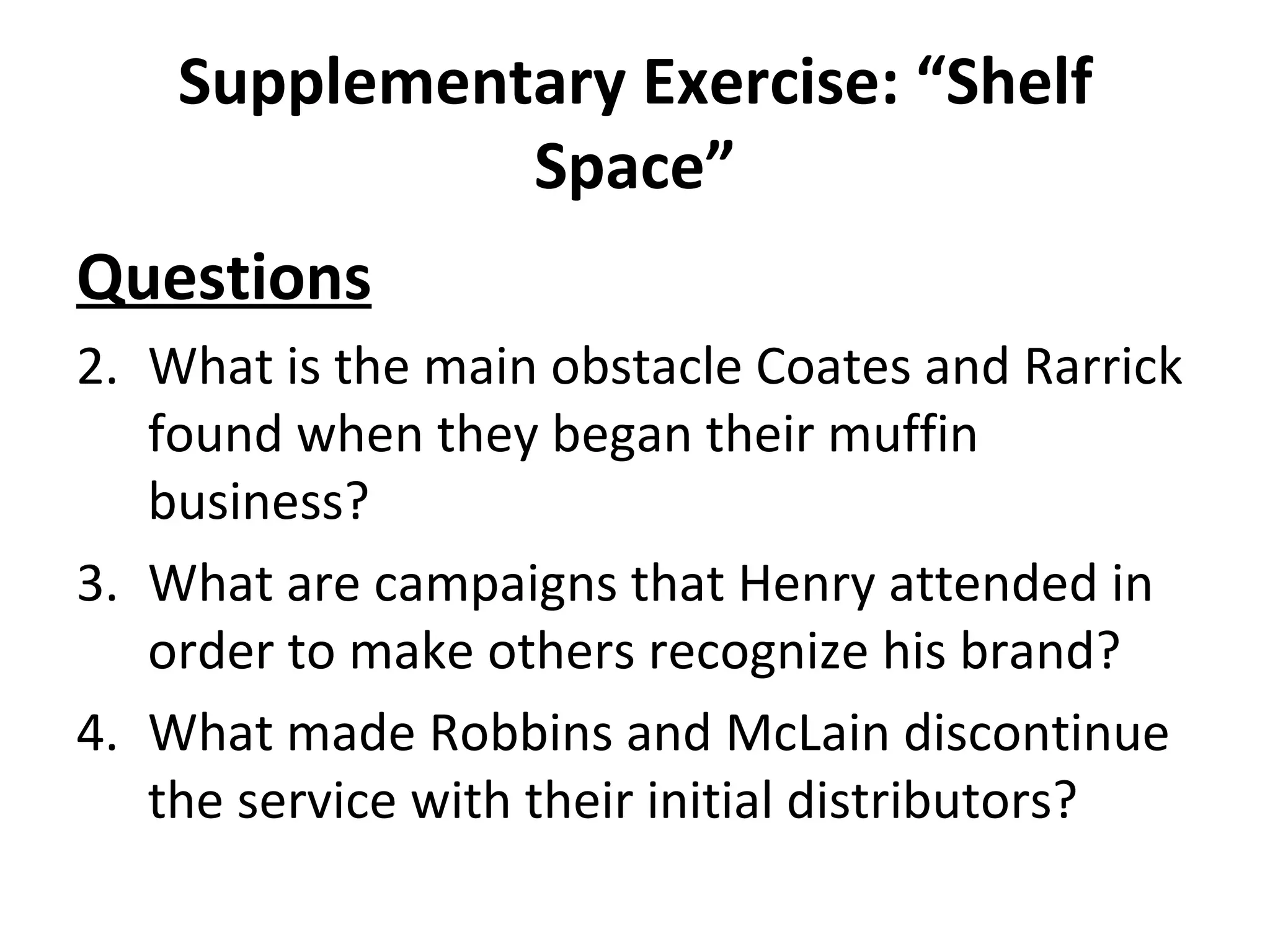
Supplementary Exercise: “Shelf Space” Questions What is the main obstacle Coates and Rarrick found when they began their muffin business? What are campaigns that Henry attended in order to make others recognize his brand? What made Robbins and McLain discontinue the service with their initial distributors?
Supplementary Exercise: “Shelf Space” Translate the following sentences from the article. The more they sold, they more they and Monkey Muffins profited. Distributors are not interested in pioneering a new brand. They want a sure thing. Every  retail outlet is looking for a brand with legs. You just have to prove that your product will have longetivity.
What is an abstract? It is a brief summary of a project, research, or  paper. It is written to describe the content or scope of your work not explain what the topic is about. The length really depends – normally an abstract should contain around 200-400 words.
An abstract should…. be concise – short and informative. don’t cite sources, tables, or figures don’t put long quotations use direct messages use ‘past tense’ to describe what you already did e.g., methods use ‘present tense’ to show the general information such as objective and results
What should an abstract include? Information in an abstract, in  fact, varies from discipline to discipline. However, it should include these four types of information The objective/purpose of the research or paper Methodology Results you obtain Conclusion or indication of the results
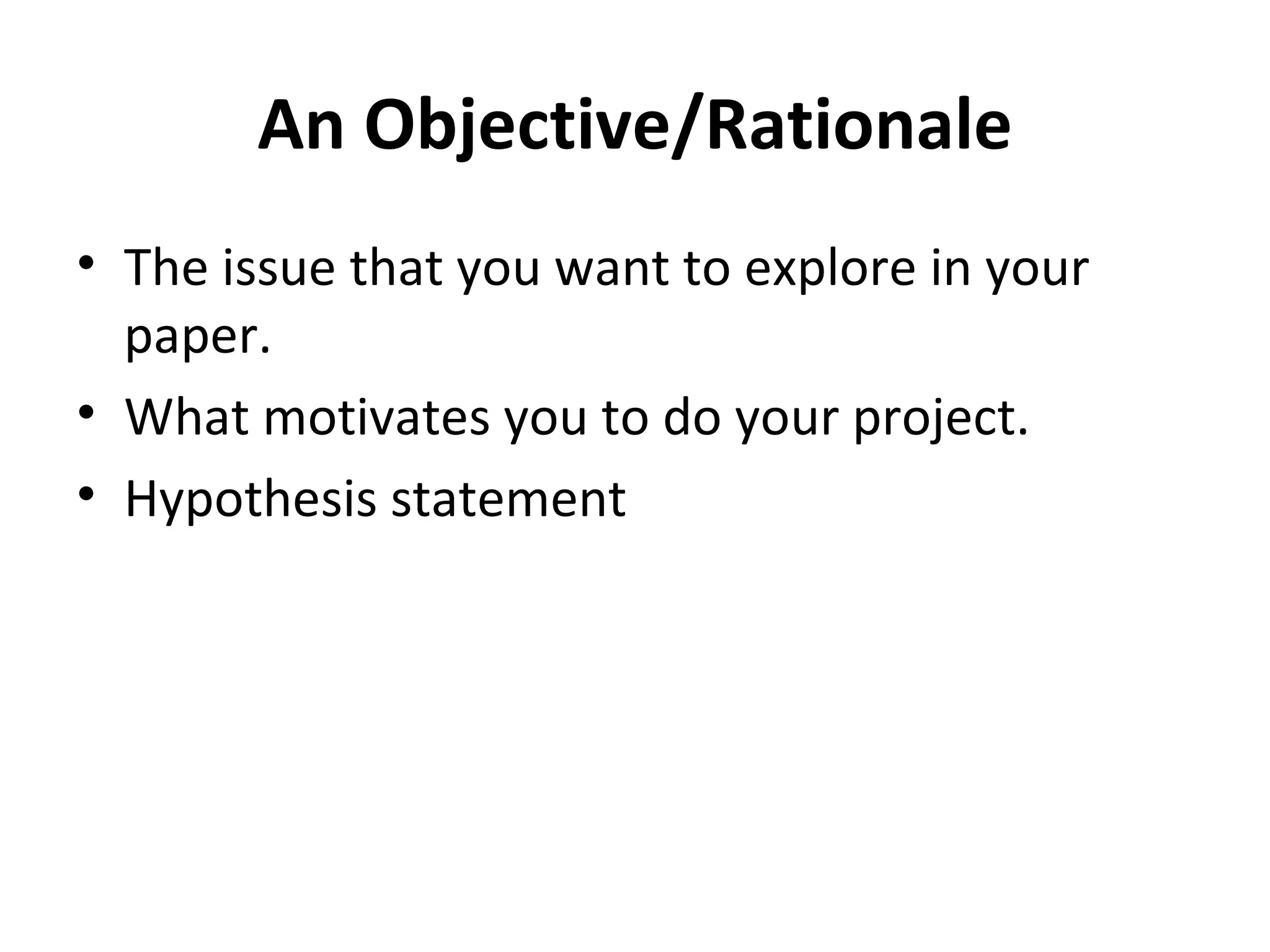
An Objective/Rationale The issue that you want to explore in your paper. What motivates you to do your project. Hypothesis statement
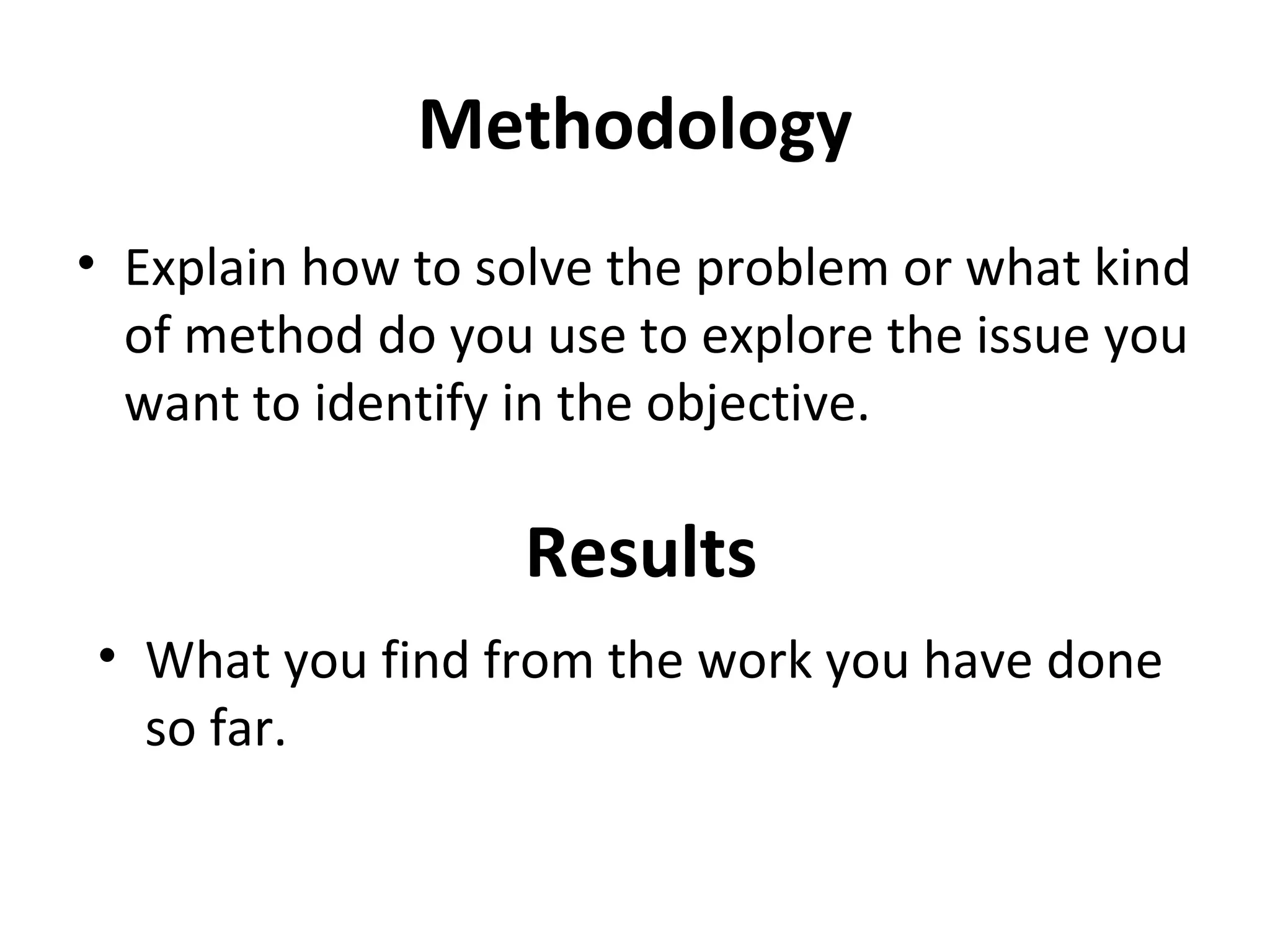
Methodology Explain how to solve the problem or what kind of method do you use to explore the issue you want to identify in the objective. Results What you find from the work you have done so far.
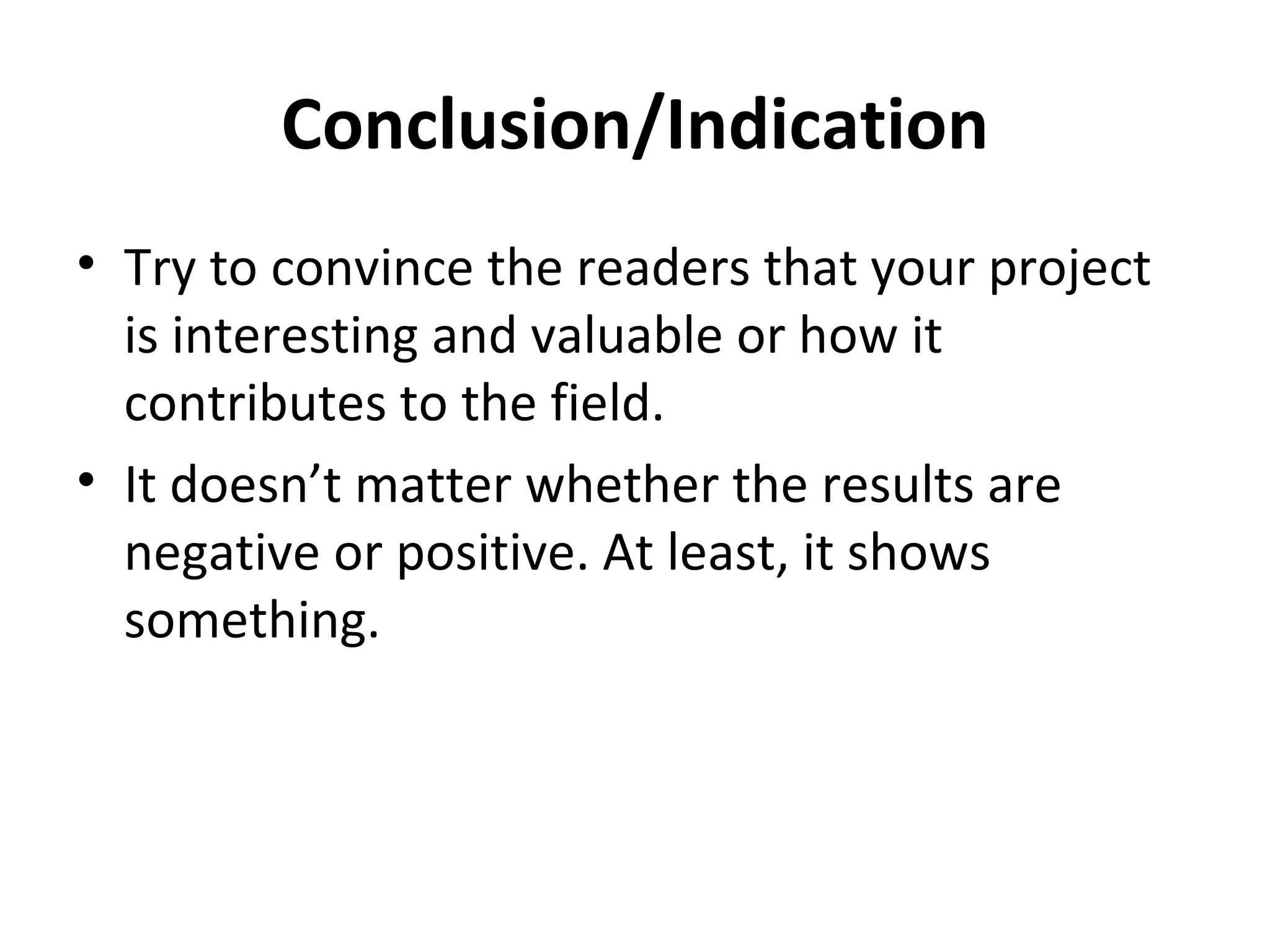
Conclusion/Indication Try to convince the readers that your project is interesting and valuable or how it contributes to the field. It doesn’t matter whether the results are negative or positive. At least, it shows something.
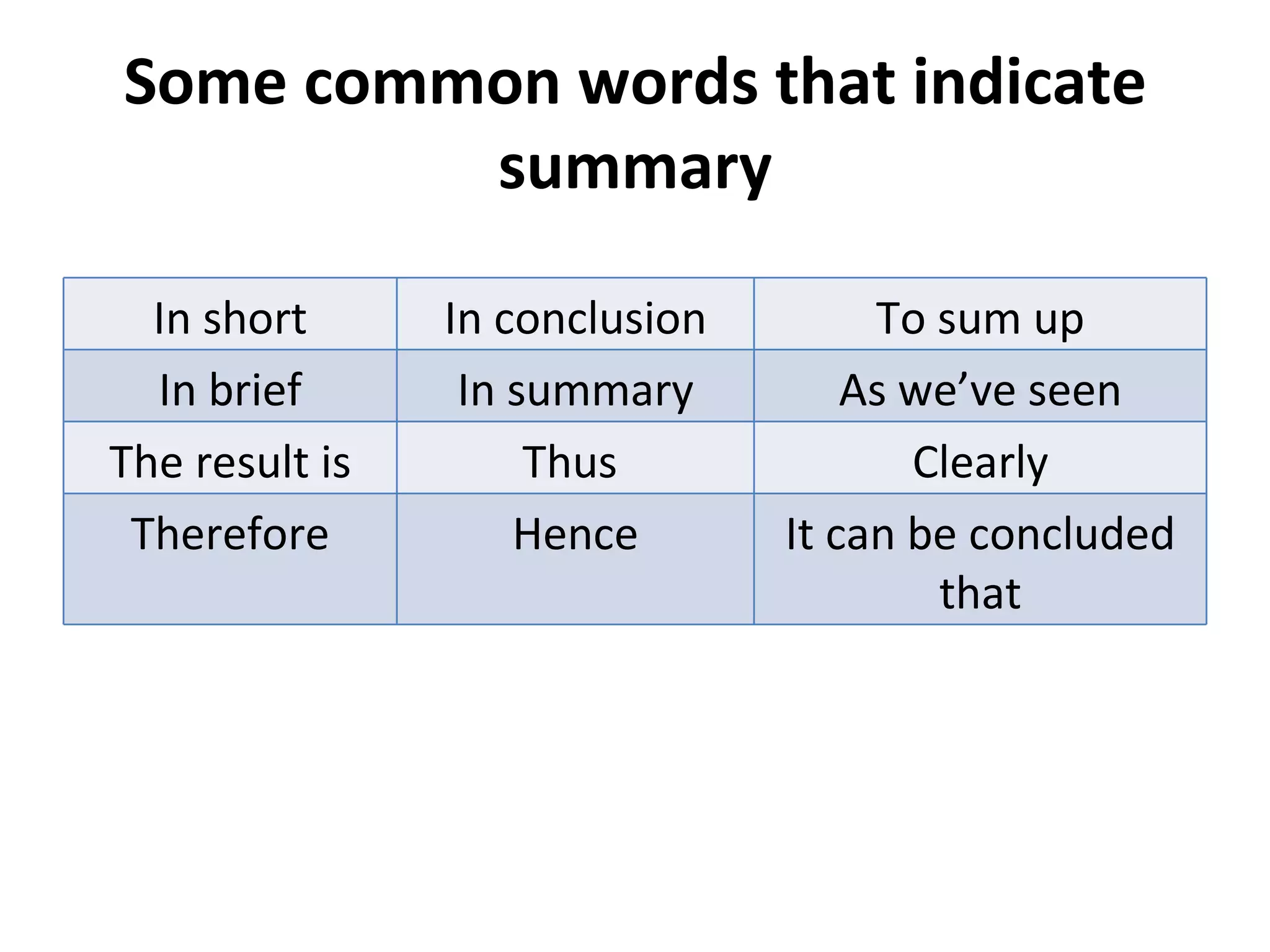
Some common words that indicate summary In short In conclusion To sum up In brief In summary As we’ve seen The result is Thus  Clearly Therefore Hence It can be concluded that
Describing chart Analyze the chart before you start writing. What are the topics and the time frame? What do the numbers and labels represent? Be clear about what you are describing. A number? A percentage? A price?
Describing chart Start by describing the overall situation. DO NOT describe every single detail. Find only important trends. Try NOT to keep repeating the same language and sentence structures. Stick to the facts! DO NOT add your own opinions.
 
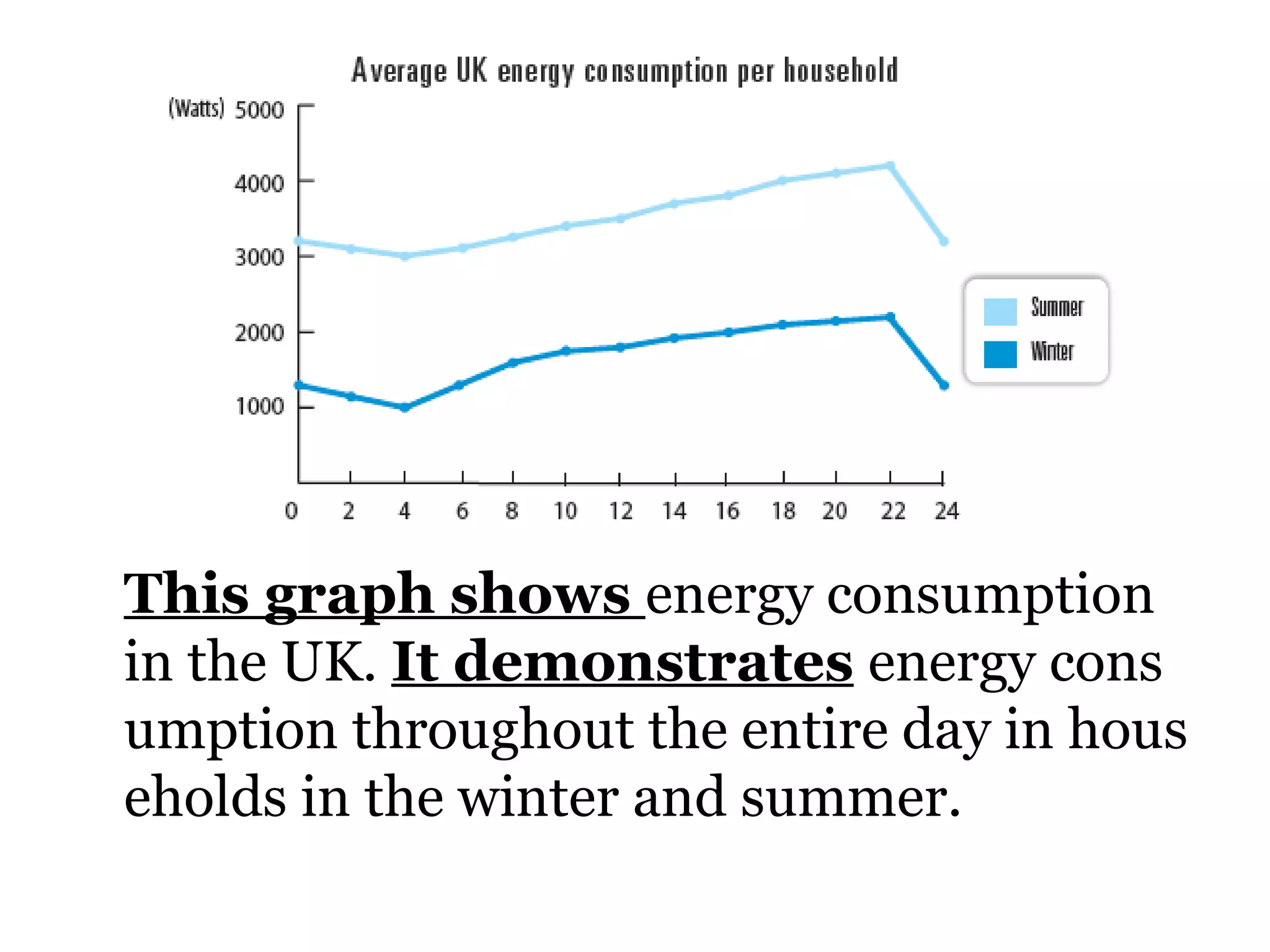
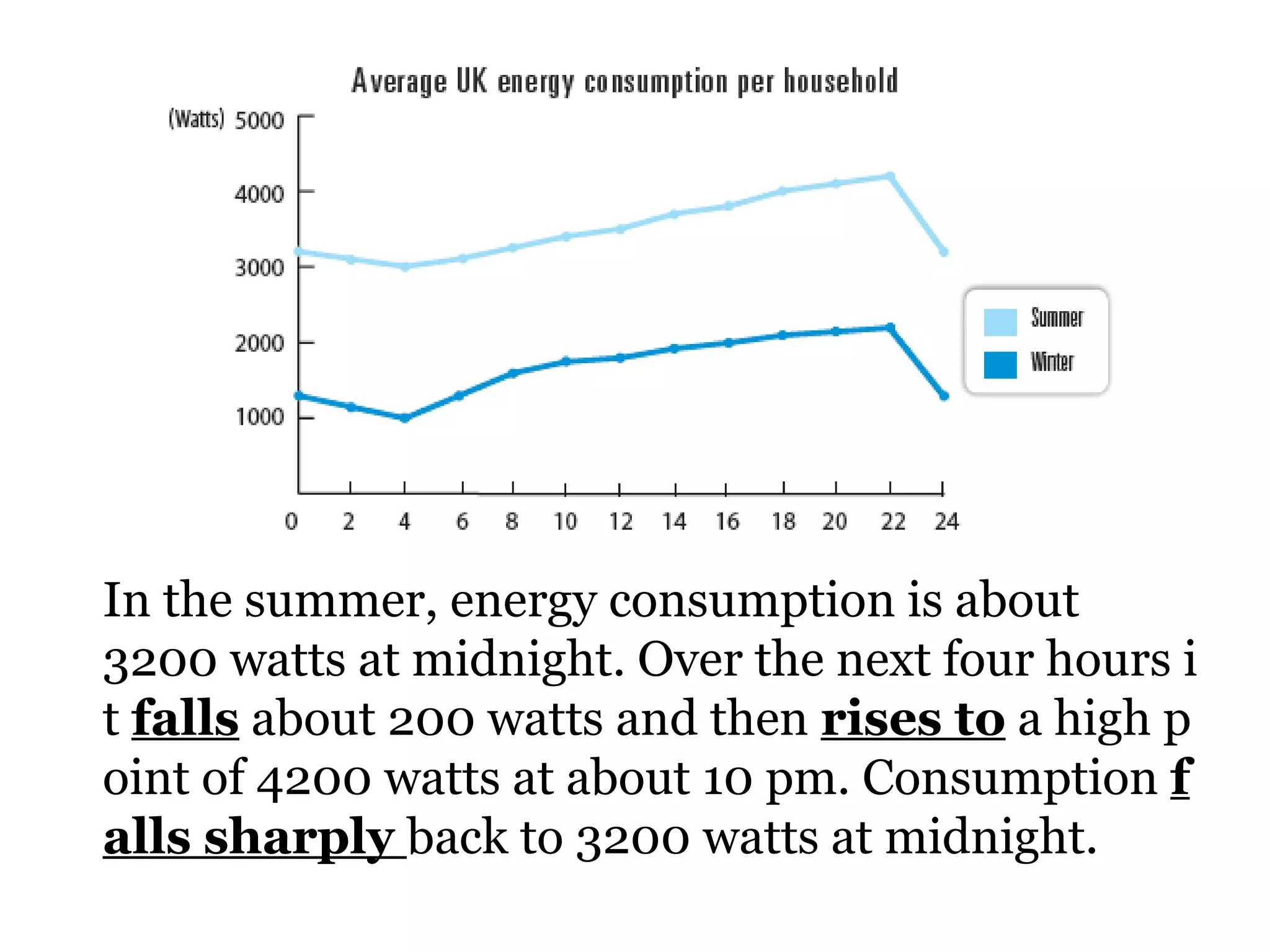
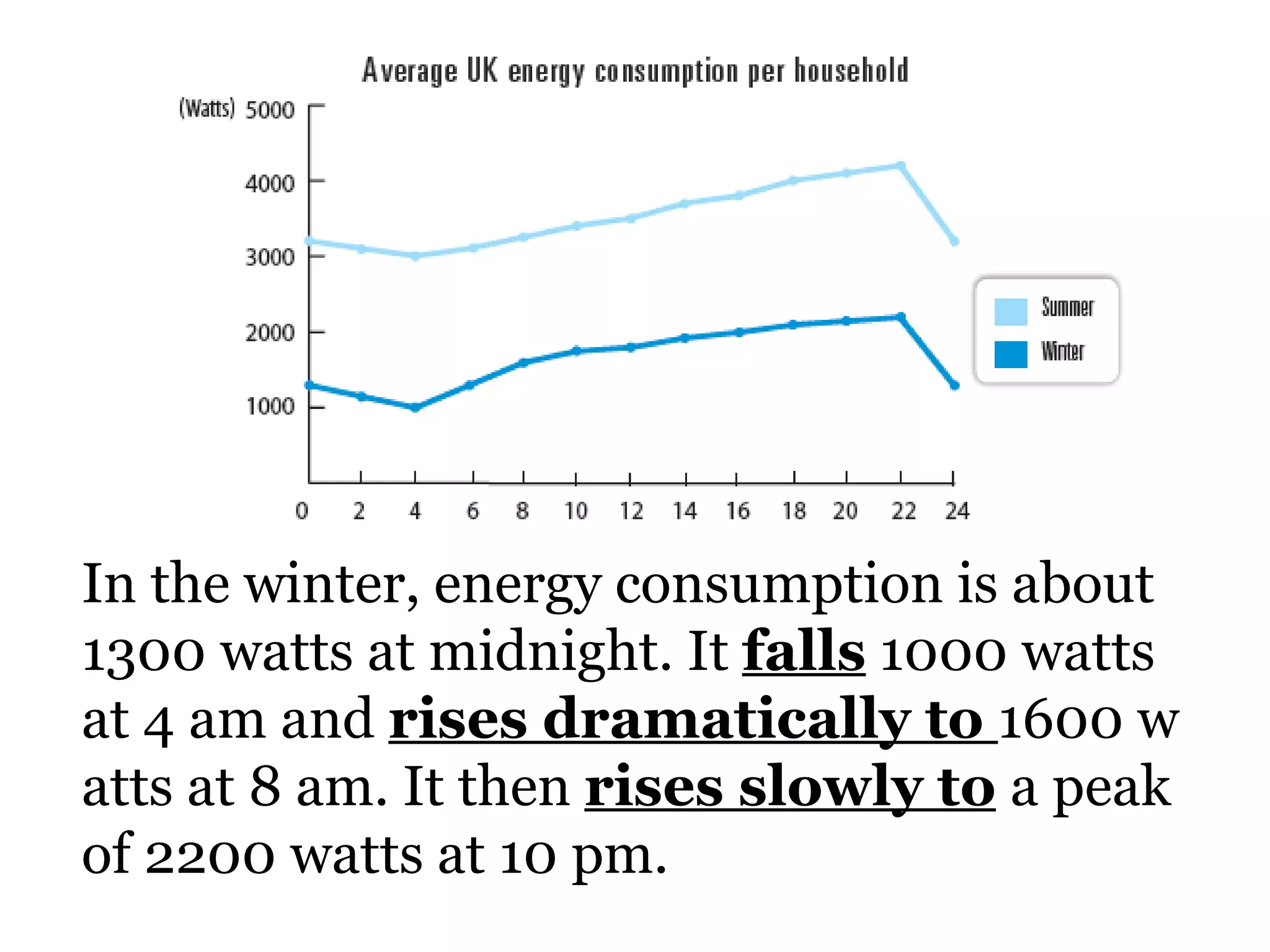
This graph shows  energy consumption in the UK.  It demonstrates   energy consumption throughout the entire day in households in the winter and summer.
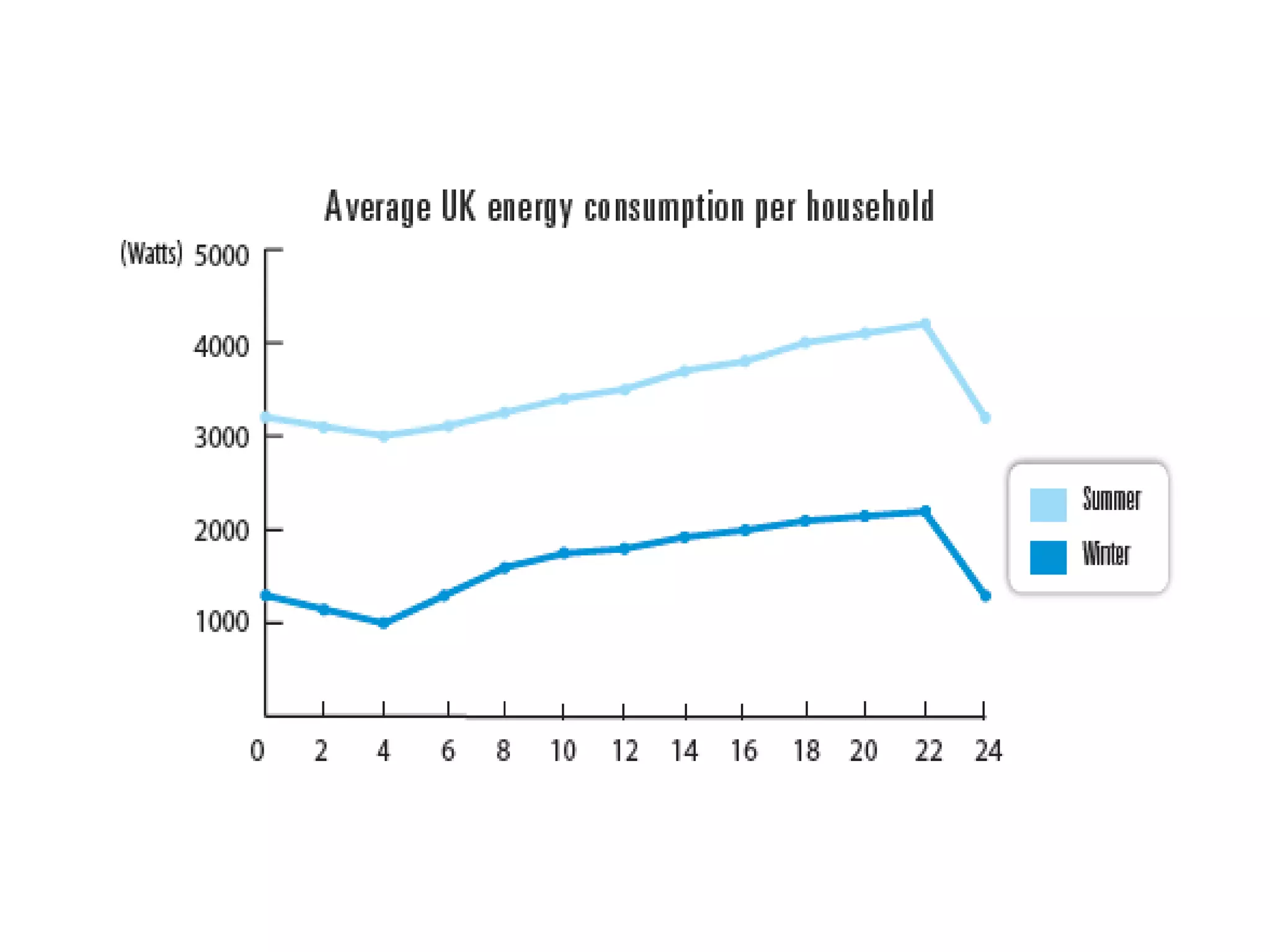
In the  summer , energy consumption is about 3200 watts at midnight. Over the next four hours it  falls  about 200 watts and then  rises to  a high point of 4200 watts at about 10 pm. Consumption  falls sharply  back to 3200 watts at midnight.
In the  winter , energy consumption is about 1300 watts at midnight. It  falls  1000 watts at 4 am and  rises dramatically to  1600 watts at 8 am. It then  rises slowly to   a peak of 2200 watts at 10 pm.
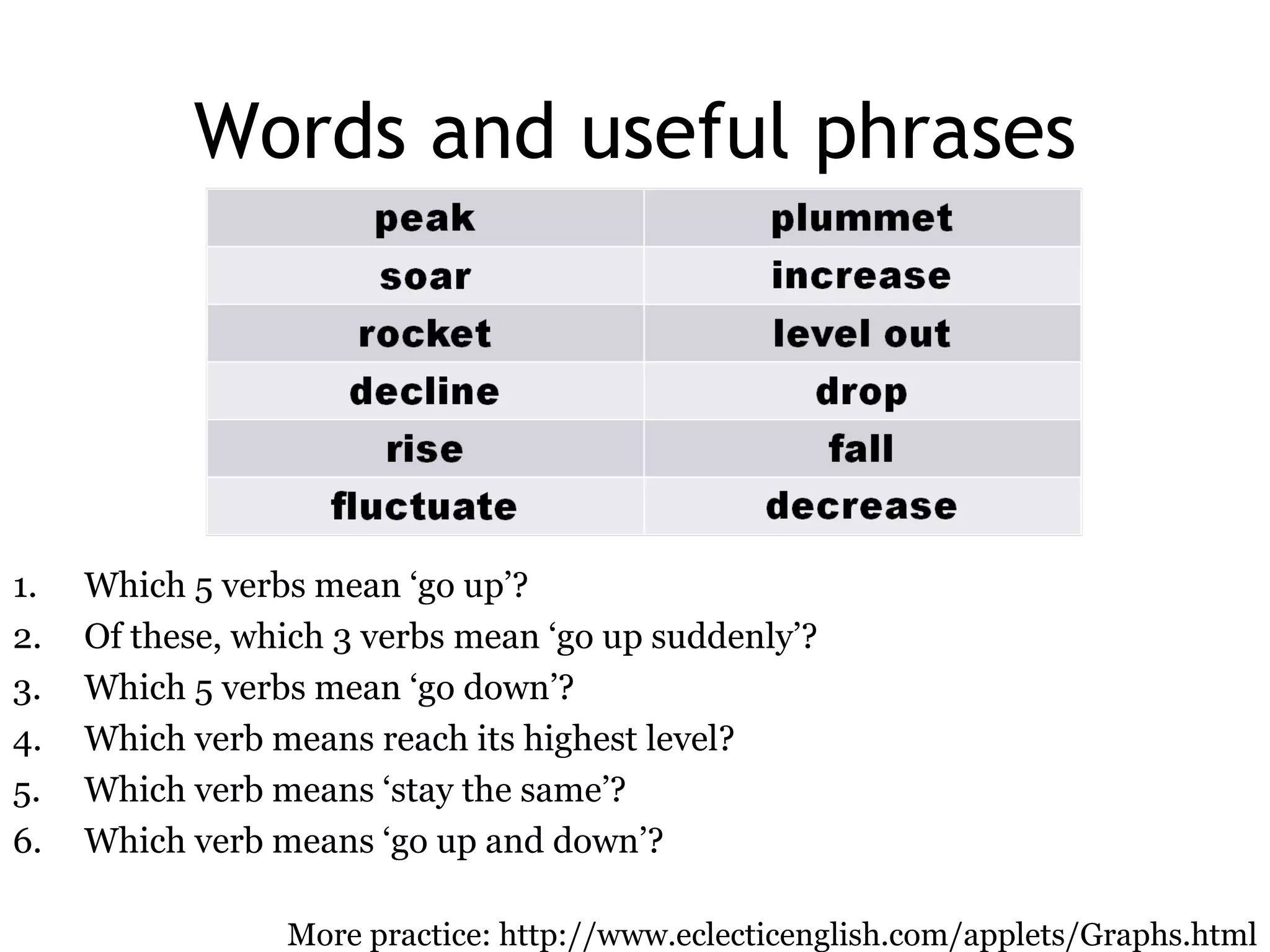
Words and useful phrases Which 5 verbs mean ‘go up’? Of these, which 3 verbs mean ‘go up suddenly’? Which 5 verbs mean ‘go down’? Which verb means reach its highest level? Which verb means ‘stay the same’? Which verb means ‘go up and down’? More practice:   http://www.eclecticenglish.com/applets/Graphs.html
 
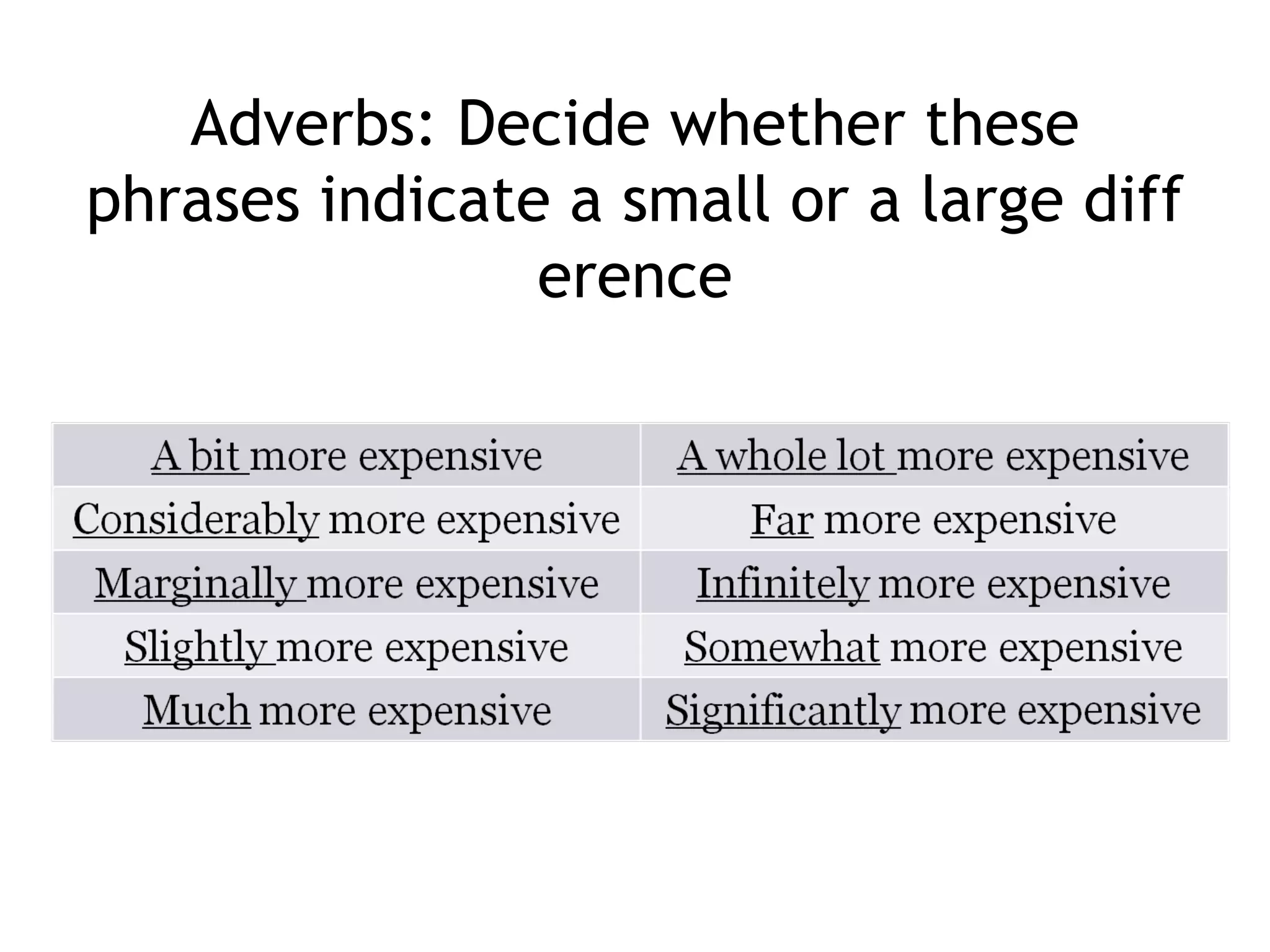
Adverbs: Decide whether these phrases indicate a small or a large difference
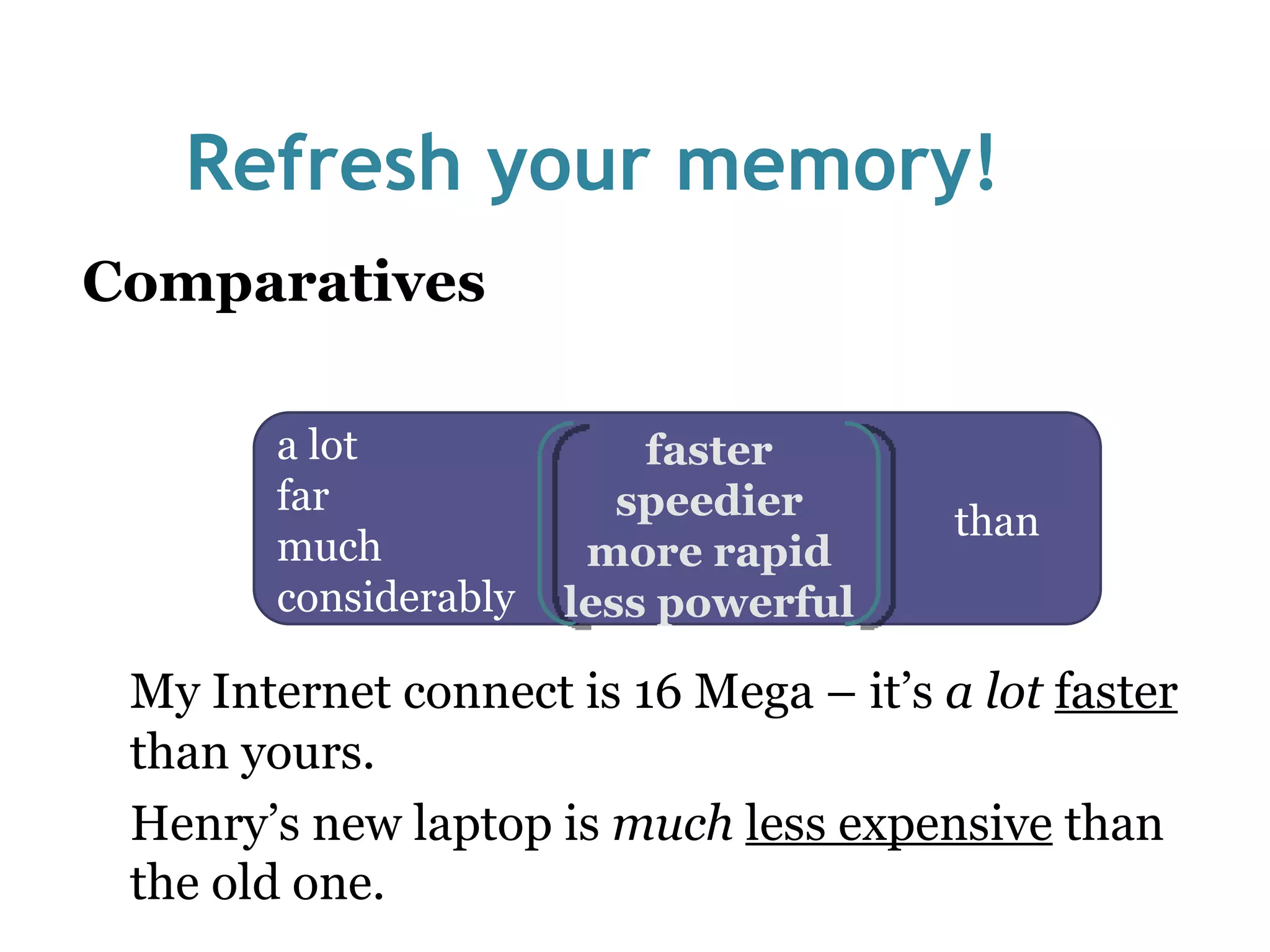
Refresh your memory! Comparatives My Internet connect is 16 Mega – it’s  a lot  faster  than yours. Henry’s new laptop is  much  less expensive  than the old one.  a lot  far much considerably faster speedier more rapid less powerful than
 
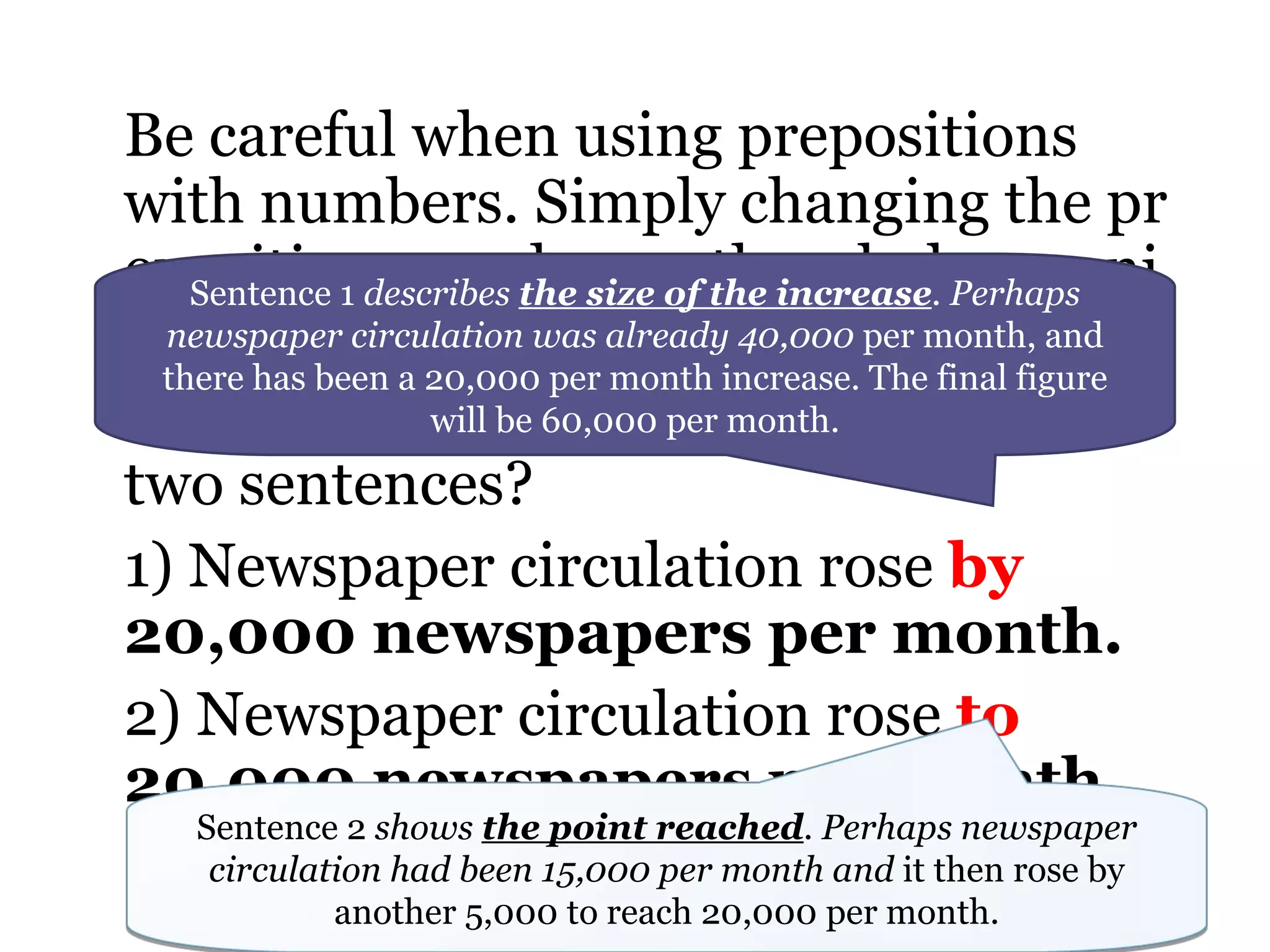
Be careful when using prepositions with numbers. Simply changing the preposition can change the whole meaning of a sentence. What’s the difference between these two sentences? 1) Newspaper circulation rose  by  20,000 newspapers per month. 2) Newspaper circulation rose  to  20,000 newspapers per month. Sentence 1  describes  the size of the increase . Perhaps newspaper circulation was already 40,000  per month, and there has been a 20,000 per month increase. The final figure will be 60,000 per month. Sentence 2  shows  the point reached . Perhaps newspaper circulation had been 15,000 per month and  it then rose by another 5,000 to reach 20,000 per month.
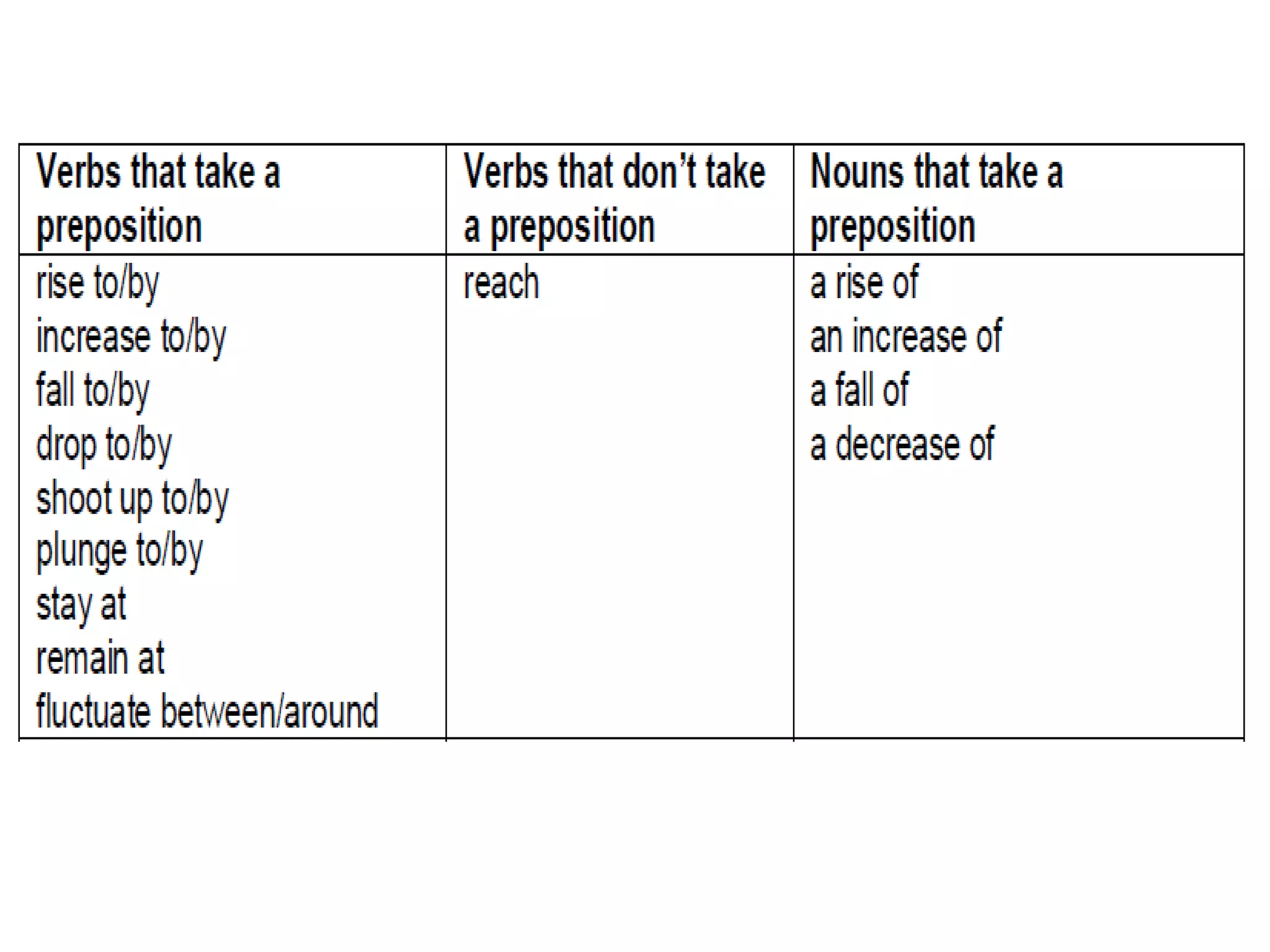
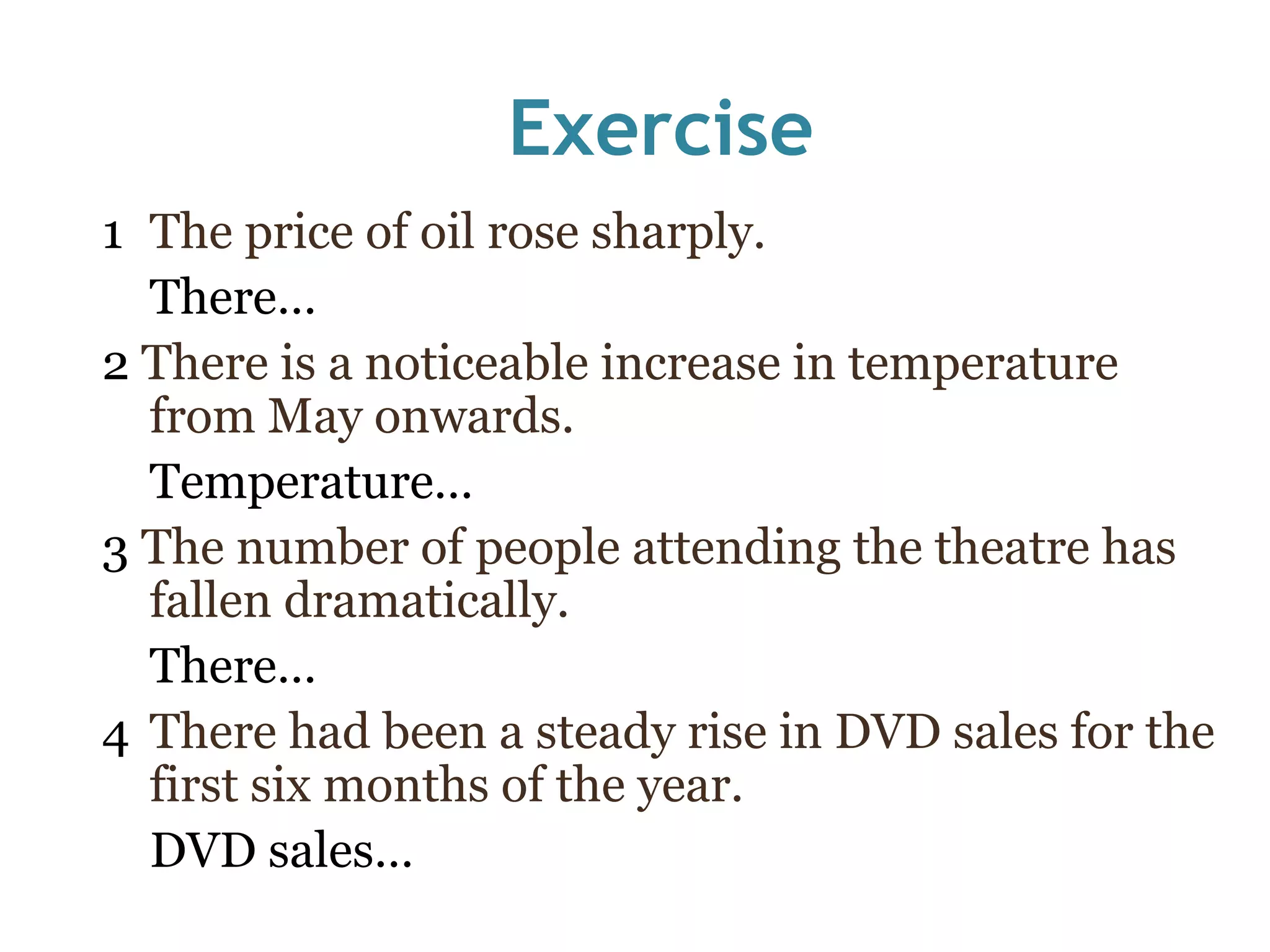
In the last task you learned some useful phrases for describing increases and decreases. There are also two useful sentence structures for doing this:
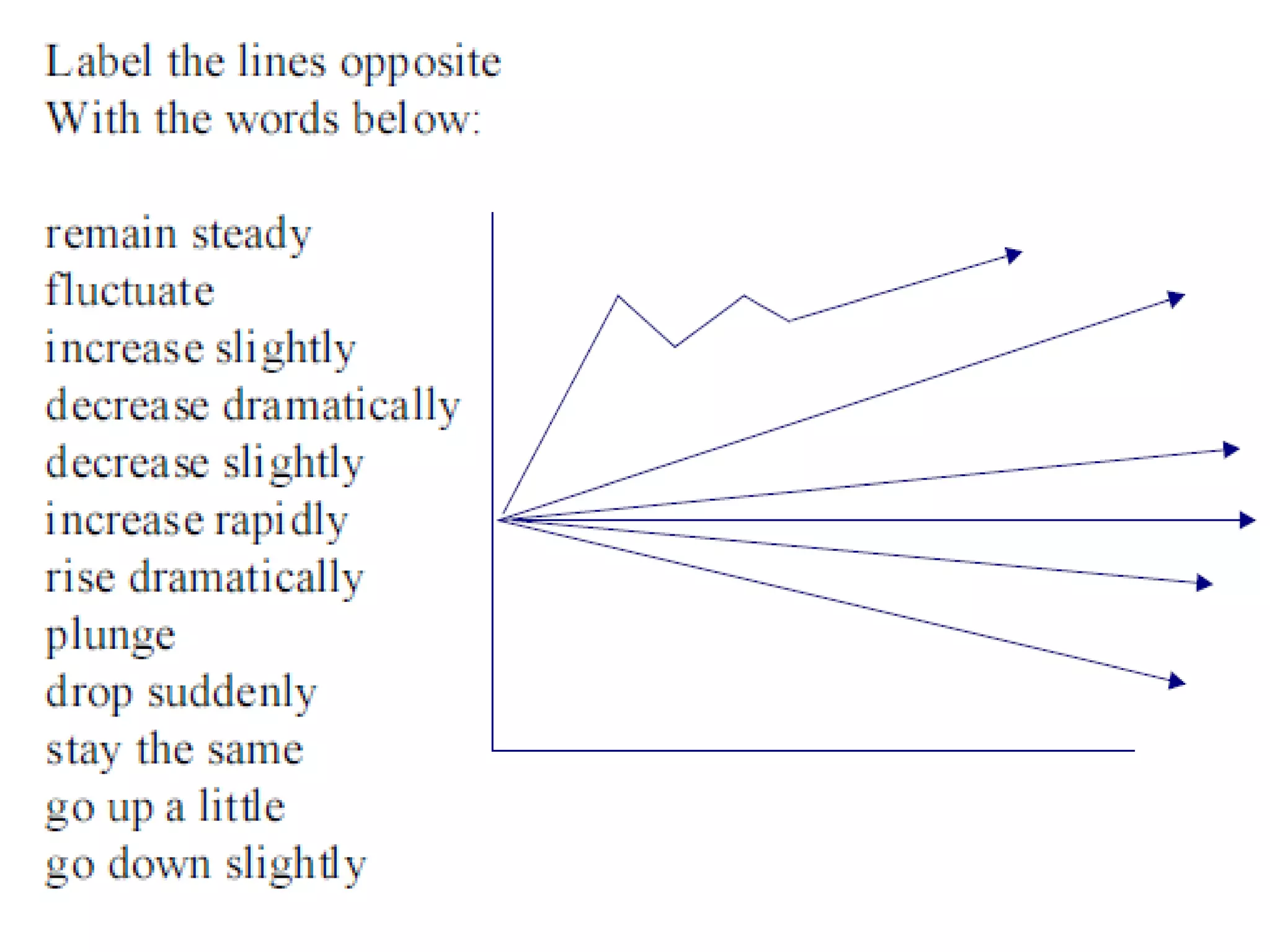
2 ways of expressing the same idea 1 SUB + verb + [adverb] For example:  The unemployment rate  rose rapidly . The cost of living  fell dramatically . 2 There is/are + [adj] + noun + in + something For example:  There was  a rise in   unemployment. There has been  an increase in  the cost of living.
Exercise 1  The price of oil rose sharply. There… 2  There is a noticeable increase in temperature from May onwards. Temperature… 3  The number of people attending the theatre has fallen dramatically. There… 4 There had been a steady rise in DVD sales for the first six months of the year. DVD sales…
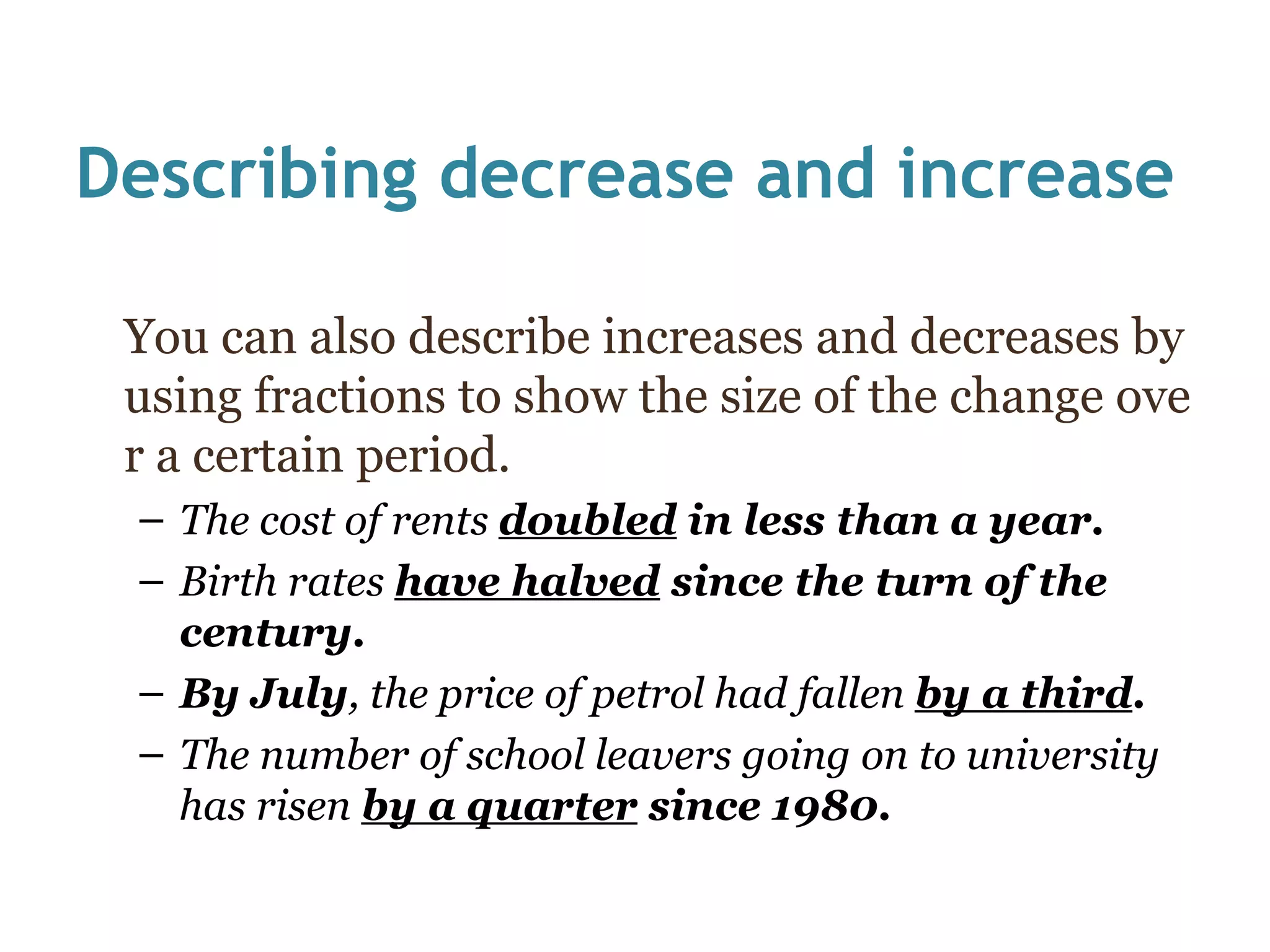
Describing decrease and increase You can also describe increases and decreases by using fractions to show the size of the change over a certain period. The cost of rents  doubled  in less than a year. Birth rates  have halved  since the turn of the century. By July , the price of petrol had fallen  by a third . The number of school leavers going on to university has risen  by a quarter  since 1980.
Activity!!
 
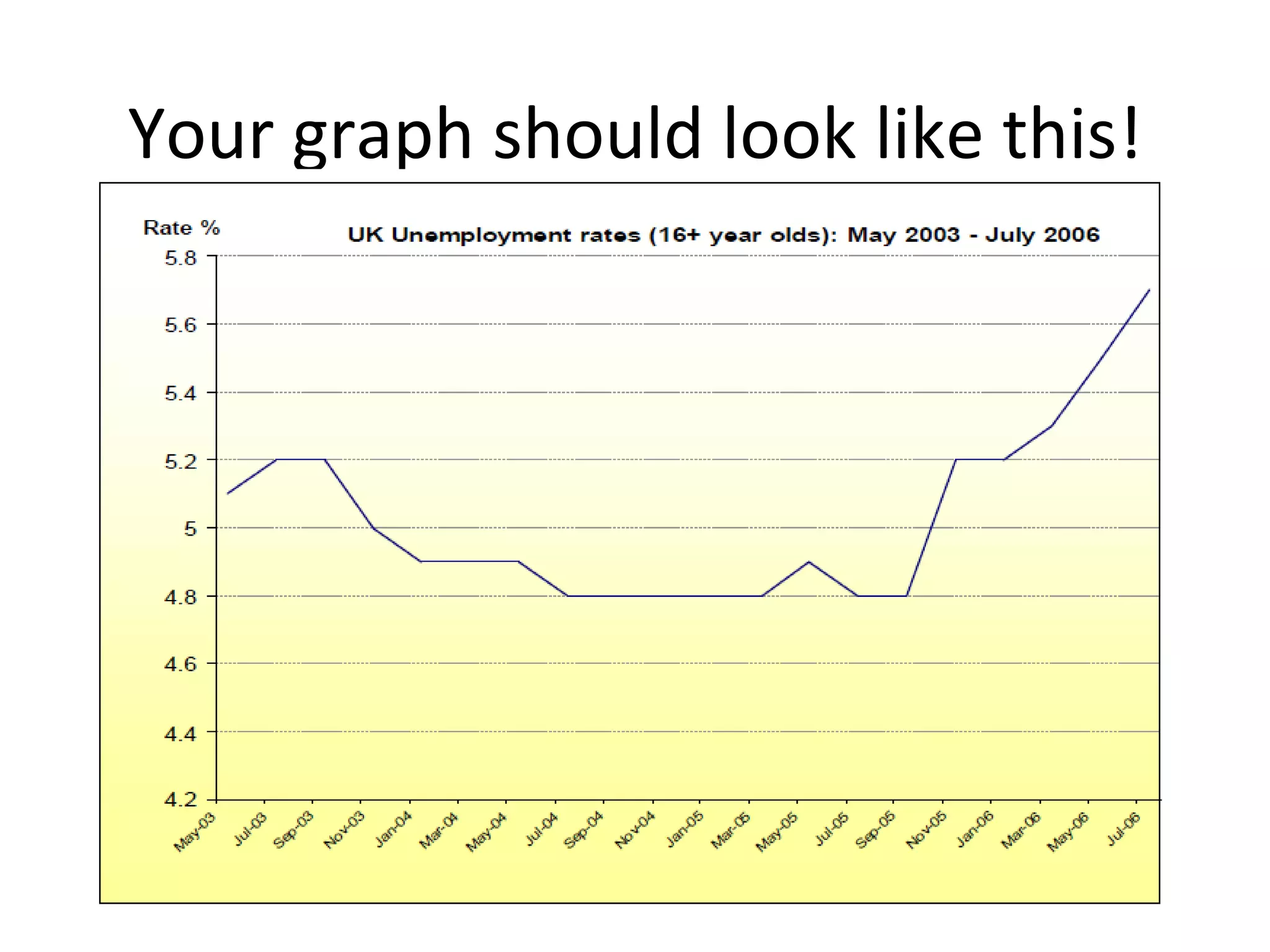
Your graph should look like this!
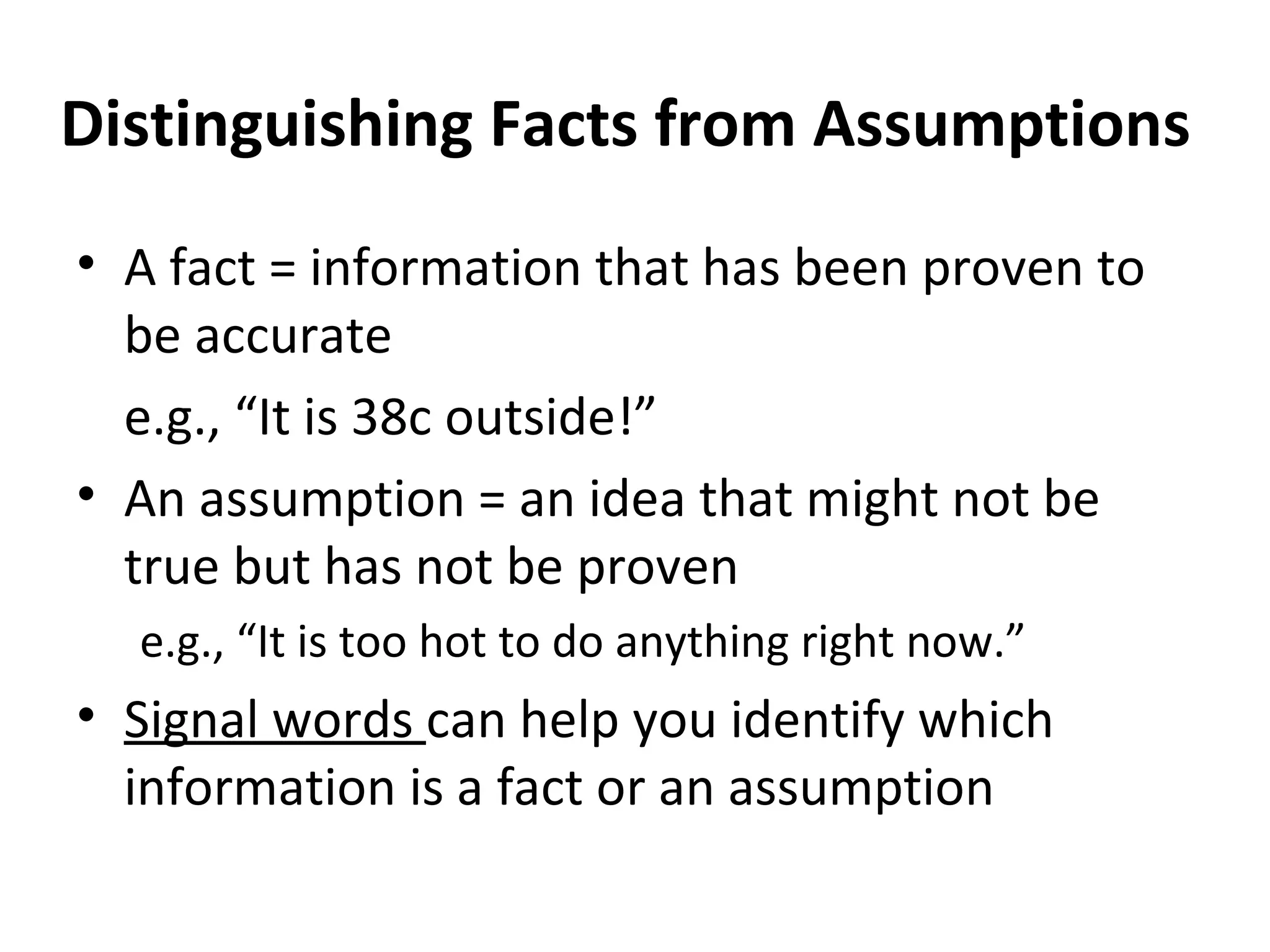
Distinguishing Facts from Assumptions A fact = information that has been proven to be accurate e.g., “It is 38c outside!” An assumption = an idea that might not be true but has not be proven e.g., “It is too hot to do anything right now.”  Signal words  can help you identify which information is a fact or an assumption
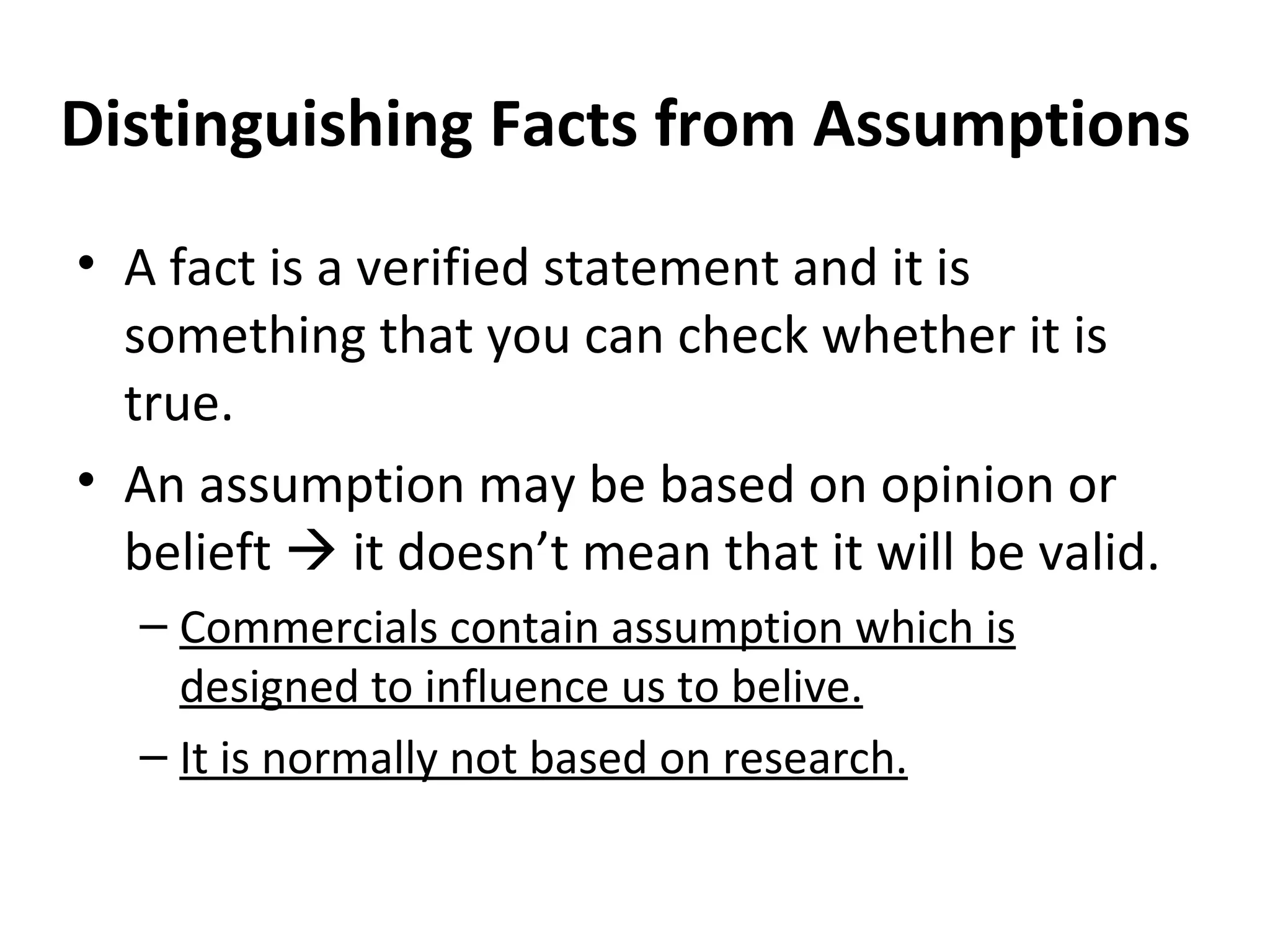
Distinguishing Facts from Assumptions A fact is a verified statement and it is something that you can check whether it is true. An assumption may be based on opinion or belieft    it doesn’t mean that it will be valid. Commercials contain assumption which is designed to influence us to belive. It is normally not based on research.
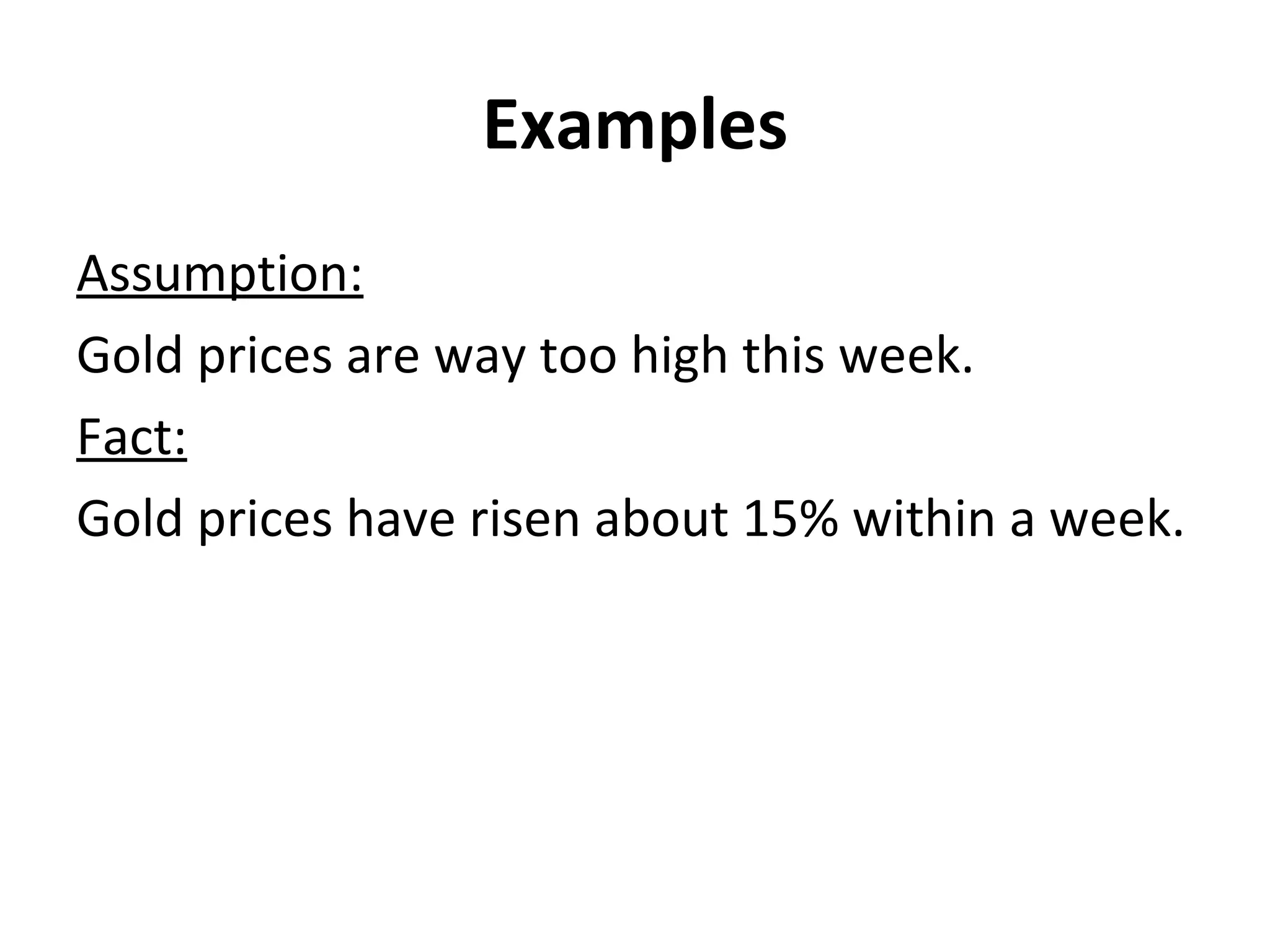
Examples Assumption: Gold prices are way too high this week. Fact: Gold prices have risen about 15% within a week.
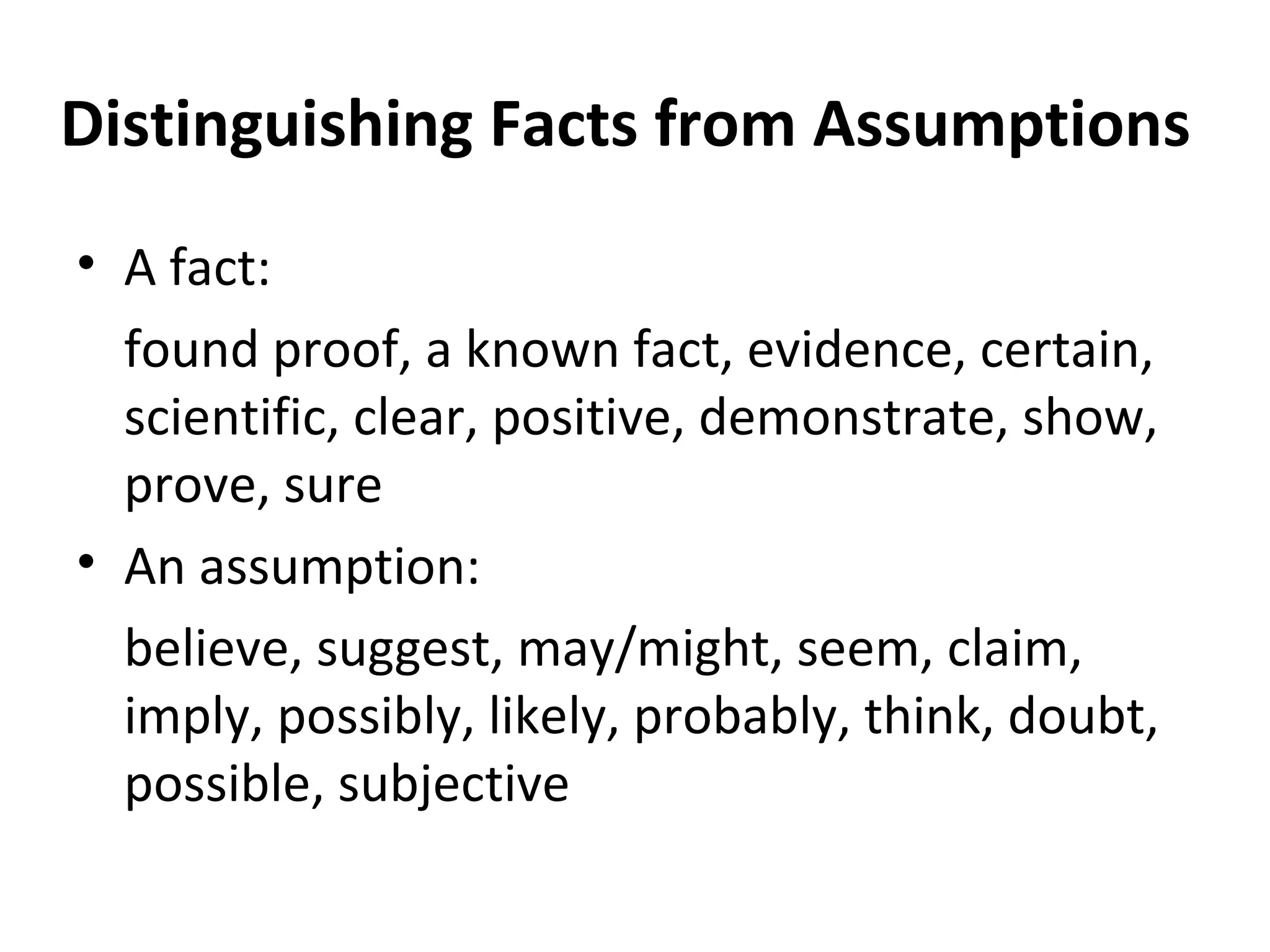
Distinguishing Facts from Assumptions A fact: found proof, a known fact, evidence, certain, scientific, clear, positive, demonstrate, show, prove, sure An assumption: believe, suggest, may/might, seem, claim, imply, possibly, likely, probably, think, doubt, possible, subjective
Let’s look at pages 200-203 together

Shelf space + abstract + graph + fact assumption

  • 1.
    Supplementary Exercise: “ShelfSpace” Scan the article to find out what three distribution methods are mentioned (2 mins!). Independent distributors with vans, direct selling to retail outlets, selling direct to customers over the Internet.
  • 2.
    Supplementary Exercise: “ShelfSpace” Reading #2 B B A A C B A C
  • 3.
    Supplementary Exercise: “ShelfSpace” Vocabulary Hundle  h. obstacle, difficulty Unproven  g. new, inexperienced Gain a foothold  e. find a place to start selling from Purchase  d. buy Hype  k. excessive publicity Pioneer  c. being the first to sell Rapport  a. a good relationship A brand with legs  b. a product which will sell Shoddy  j. poor quality Inaugurated  i. opened Warehouse  f. large building for storing goods
  • 4.
    Supplementary Exercise: “ShelfSpace” Questions What is the main obstacle Coates and Rarrick found when they began their muffin business? What are campaigns that Henry attended in order to make others recognize his brand? What made Robbins and McLain discontinue the service with their initial distributors?
  • 5.
    Supplementary Exercise: “ShelfSpace” Translate the following sentences from the article. The more they sold, they more they and Monkey Muffins profited. Distributors are not interested in pioneering a new brand. They want a sure thing. Every retail outlet is looking for a brand with legs. You just have to prove that your product will have longetivity.
  • 6.
    What is anabstract? It is a brief summary of a project, research, or paper. It is written to describe the content or scope of your work not explain what the topic is about. The length really depends – normally an abstract should contain around 200-400 words.
  • 7.
    An abstract should….be concise – short and informative. don’t cite sources, tables, or figures don’t put long quotations use direct messages use ‘past tense’ to describe what you already did e.g., methods use ‘present tense’ to show the general information such as objective and results
  • 8.
    What should anabstract include? Information in an abstract, in fact, varies from discipline to discipline. However, it should include these four types of information The objective/purpose of the research or paper Methodology Results you obtain Conclusion or indication of the results
  • 9.
    An Objective/Rationale Theissue that you want to explore in your paper. What motivates you to do your project. Hypothesis statement
  • 10.
    Methodology Explain howto solve the problem or what kind of method do you use to explore the issue you want to identify in the objective. Results What you find from the work you have done so far.
  • 11.
    Conclusion/Indication Try toconvince the readers that your project is interesting and valuable or how it contributes to the field. It doesn’t matter whether the results are negative or positive. At least, it shows something.
  • 12.
    Some common wordsthat indicate summary In short In conclusion To sum up In brief In summary As we’ve seen The result is Thus Clearly Therefore Hence It can be concluded that
  • 13.
    Describing chart Analyzethe chart before you start writing. What are the topics and the time frame? What do the numbers and labels represent? Be clear about what you are describing. A number? A percentage? A price?
  • 14.
    Describing chart Startby describing the overall situation. DO NOT describe every single detail. Find only important trends. Try NOT to keep repeating the same language and sentence structures. Stick to the facts! DO NOT add your own opinions.
  • 15.
  • 16.
    This graph shows energy consumption in the UK. It demonstrates energy consumption throughout the entire day in households in the winter and summer.
  • 17.
    In the summer , energy consumption is about 3200 watts at midnight. Over the next four hours it falls about 200 watts and then rises to a high point of 4200 watts at about 10 pm. Consumption falls sharply back to 3200 watts at midnight.
  • 18.
    In the winter , energy consumption is about 1300 watts at midnight. It falls 1000 watts at 4 am and rises dramatically to 1600 watts at 8 am. It then rises slowly to a peak of 2200 watts at 10 pm.
  • 19.
    Words and usefulphrases Which 5 verbs mean ‘go up’? Of these, which 3 verbs mean ‘go up suddenly’? Which 5 verbs mean ‘go down’? Which verb means reach its highest level? Which verb means ‘stay the same’? Which verb means ‘go up and down’? More practice: http://www.eclecticenglish.com/applets/Graphs.html
  • 20.
  • 21.
    Adverbs: Decide whetherthese phrases indicate a small or a large difference
  • 22.
    Refresh your memory!Comparatives My Internet connect is 16 Mega – it’s a lot faster than yours. Henry’s new laptop is much less expensive than the old one. a lot far much considerably faster speedier more rapid less powerful than
  • 23.
  • 24.
    Be careful whenusing prepositions with numbers. Simply changing the preposition can change the whole meaning of a sentence. What’s the difference between these two sentences? 1) Newspaper circulation rose by 20,000 newspapers per month. 2) Newspaper circulation rose to 20,000 newspapers per month. Sentence 1 describes the size of the increase . Perhaps newspaper circulation was already 40,000 per month, and there has been a 20,000 per month increase. The final figure will be 60,000 per month. Sentence 2 shows the point reached . Perhaps newspaper circulation had been 15,000 per month and it then rose by another 5,000 to reach 20,000 per month.
  • 25.
    In the lasttask you learned some useful phrases for describing increases and decreases. There are also two useful sentence structures for doing this:
  • 26.
    2 ways ofexpressing the same idea 1 SUB + verb + [adverb] For example: The unemployment rate rose rapidly . The cost of living fell dramatically . 2 There is/are + [adj] + noun + in + something For example: There was a rise in unemployment. There has been an increase in the cost of living.
  • 27.
    Exercise 1 The price of oil rose sharply. There… 2 There is a noticeable increase in temperature from May onwards. Temperature… 3 The number of people attending the theatre has fallen dramatically. There… 4 There had been a steady rise in DVD sales for the first six months of the year. DVD sales…
  • 28.
    Describing decrease andincrease You can also describe increases and decreases by using fractions to show the size of the change over a certain period. The cost of rents doubled in less than a year. Birth rates have halved since the turn of the century. By July , the price of petrol had fallen by a third . The number of school leavers going on to university has risen by a quarter since 1980.
  • 29.
  • 30.
  • 31.
    Your graph shouldlook like this!
  • 32.
    Distinguishing Facts fromAssumptions A fact = information that has been proven to be accurate e.g., “It is 38c outside!” An assumption = an idea that might not be true but has not be proven e.g., “It is too hot to do anything right now.” Signal words can help you identify which information is a fact or an assumption
  • 33.
    Distinguishing Facts fromAssumptions A fact is a verified statement and it is something that you can check whether it is true. An assumption may be based on opinion or belieft  it doesn’t mean that it will be valid. Commercials contain assumption which is designed to influence us to belive. It is normally not based on research.
  • 34.
    Examples Assumption: Goldprices are way too high this week. Fact: Gold prices have risen about 15% within a week.
  • 35.
    Distinguishing Facts fromAssumptions A fact: found proof, a known fact, evidence, certain, scientific, clear, positive, demonstrate, show, prove, sure An assumption: believe, suggest, may/might, seem, claim, imply, possibly, likely, probably, think, doubt, possible, subjective
  • 36.
    Let’s look atpages 200-203 together