SHEET METAL WORKS
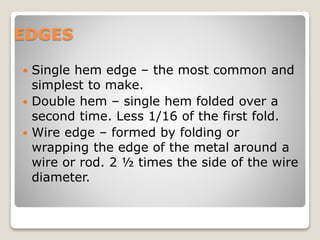
EDGES
 Single hem edge – the most common and
simplest to make.
 Double hem – single hem folded over a
second time. Less 1/16 of the first fold.
 Wire edge – formed by folding or
wrapping the edge of the metal around a
wire or rod. 2 ½ times the side of the wire
diameter.
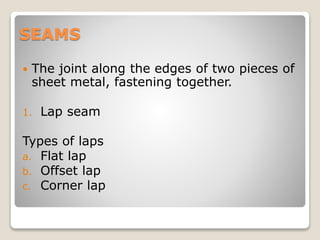
SEAMS
 The joint along the edges of two pieces of
sheet metal, fastening together.
1. Lap seam
Types of laps
a. Flat lap
b. Offset lap
c. Corner lap
2. Grooved seam
Types of grooved seam
a. Outside grooved seam
b. Inside groove seam
3. Dovetail seam
4. Burred bottom seam
5. Single and bottom seam
6. Pittsburg lock seam
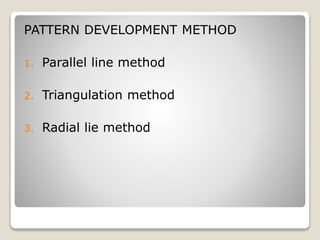
PATTERN DEVELOPMENT METHOD
1. Parallel line method
2. Triangulation method
3. Radial lie method
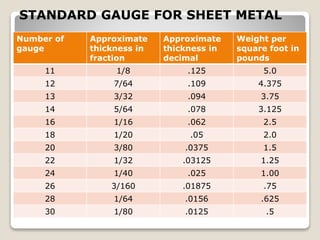
Number of
gauge
Approximate
thickness in
fraction
Approximate
thickness in
decimal
Weight per
square foot in
pounds
11 1/8 .125 5.0
12 7/64 .109 4.375
13 3/32 .094 3.75
14 5/64 .078 3.125
16 1/16 .062 2.5
18 1/20 .05 2.0
20 3/80 .0375 1.5
22 1/32 .03125 1.25
24 1/40 .025 1.00
26 3/160 .01875 .75
28 1/64 .0156 .625
30 1/80 .0125 .5
STANDARD GAUGE FOR SHEET METAL
Note ;
To find the weight of sheet metal,
multiply the thickness in decimals 40.8.
The result will be the weight in pounds
per square foot.
Ex.
if a piece of sheet metal is .005 thick,
its weight is .005 times 40.8, which is
equal to .204 pound per square foot.
Problem 1. Pattern for right angle branch
N,I,J,M shows the development of the run
pipe. The length I,J is the circumference of
the pipe, half of which is show in the plan.
The equally measured divisions on this
circumference re put together to make up the
line I,J. At right angle to this line, the
lengthwise edges of the run pipe are shown
by the lines I,N and J,M. Only a part of the
length of this pipe is develop- the part
around the required opening P,Q,R,S.
The longitudinally drawn projecting lines
from the points of division in the plan
furnish the points a’,b’,c’,d’ on the joint
line a’,d’. From this, another series of
projecting lines are drawn to the
development intersecting the longitudinal
lines on the development which start from
points d",c",b",a",b",c",d" thus giving
points defining the outline of the opening
P,Q,R,S are clearly shown.
In like manner the other pattern Z,T,U,Z’
is obtained from A,B,a,b,c,d. The
circumference of the branch pipe G H is
divide at points 0,1,2,3 etc. into equal
parts. All of this division are laid down
together, on the line Z,T so that the line
Z,T is equal to the entire circumference of
the branch pipe. The procedure of tracing
the outline of Z’,Y,W,V,U is the same as for
the opening of P,Q,R,S, which clearly
shown by the lines. Patterns do not shown
any laps for joints.
SHEET METAL WORKS.pptx

SHEET METAL WORKS.pptx

  • 1.
  • 2.
    EDGES  Single hemedge – the most common and simplest to make.  Double hem – single hem folded over a second time. Less 1/16 of the first fold.  Wire edge – formed by folding or wrapping the edge of the metal around a wire or rod. 2 ½ times the side of the wire diameter.
  • 3.
    SEAMS  The jointalong the edges of two pieces of sheet metal, fastening together. 1. Lap seam Types of laps a. Flat lap b. Offset lap c. Corner lap
  • 4.
    2. Grooved seam Typesof grooved seam a. Outside grooved seam b. Inside groove seam 3. Dovetail seam 4. Burred bottom seam 5. Single and bottom seam 6. Pittsburg lock seam
  • 5.
    PATTERN DEVELOPMENT METHOD 1.Parallel line method 2. Triangulation method 3. Radial lie method
  • 6.
    Number of gauge Approximate thickness in fraction Approximate thicknessin decimal Weight per square foot in pounds 11 1/8 .125 5.0 12 7/64 .109 4.375 13 3/32 .094 3.75 14 5/64 .078 3.125 16 1/16 .062 2.5 18 1/20 .05 2.0 20 3/80 .0375 1.5 22 1/32 .03125 1.25 24 1/40 .025 1.00 26 3/160 .01875 .75 28 1/64 .0156 .625 30 1/80 .0125 .5 STANDARD GAUGE FOR SHEET METAL
  • 7.
    Note ; To findthe weight of sheet metal, multiply the thickness in decimals 40.8. The result will be the weight in pounds per square foot. Ex. if a piece of sheet metal is .005 thick, its weight is .005 times 40.8, which is equal to .204 pound per square foot.
  • 8.
    Problem 1. Patternfor right angle branch N,I,J,M shows the development of the run pipe. The length I,J is the circumference of the pipe, half of which is show in the plan. The equally measured divisions on this circumference re put together to make up the line I,J. At right angle to this line, the lengthwise edges of the run pipe are shown by the lines I,N and J,M. Only a part of the length of this pipe is develop- the part around the required opening P,Q,R,S.
  • 9.
    The longitudinally drawnprojecting lines from the points of division in the plan furnish the points a’,b’,c’,d’ on the joint line a’,d’. From this, another series of projecting lines are drawn to the development intersecting the longitudinal lines on the development which start from points d",c",b",a",b",c",d" thus giving points defining the outline of the opening P,Q,R,S are clearly shown.
  • 10.
    In like mannerthe other pattern Z,T,U,Z’ is obtained from A,B,a,b,c,d. The circumference of the branch pipe G H is divide at points 0,1,2,3 etc. into equal parts. All of this division are laid down together, on the line Z,T so that the line Z,T is equal to the entire circumference of the branch pipe. The procedure of tracing the outline of Z’,Y,W,V,U is the same as for the opening of P,Q,R,S, which clearly shown by the lines. Patterns do not shown any laps for joints.