Aid Efficiency Services
                            Benchmarking of Non-Govermental Organizations (NGOs)
Over the years, private foundations and philanthropic brokers have seen a dramatic rise in charitable
contributions. Together with public institutions involved in “Doing Good”, they are using Nonprofit
organizations (referred below as NGOs) to design and implement assistance projects for the benefit
of civil societies, at home and abroad.

At the same time, questions are raised about the transparency, integrity and performance of these
NGOs. How do the stakeholders (donors, beneficiaries, contractors, local authorities, etc.) ensure that
an NGO complies with established exigencies of good governance and accountability? Second-party
audits, where the auditors themselves have stakes in the institutions they examine, do not guarantee
objectivity. This is where a certification process conducted by an independent third-party, can bring
strictly neutral due diligence information which creates confidence in an NGOs’ management.

In this context, SGS, the world’s leading inspection, testing and certification company, has established
the “NGO Benchmarking” Standard. Its purpose is to provide an independent assessment of NGOs’
conformity level with internationally-recognized Best Practices, and thus their mastery of the risks
attached to their mission.

108 objectively verifiable indicators have been selected from major codes and international standards.
These are presented in the form of questions in the NGO Benchmarking Standard. They are
distributed along four perspectives thus allowing any stakeholder, including the NGO itself, to identify
and measure how far specific concerns are addressed:

            P.1            Dimensions of Best Practices
                           Board of Trustees, Strategic Framework, Integrity Management, Communication,
                           Advocacy and Public Image, Human Resources, Finances: Resources, Allocations
                           and Controls, Operations, Outcomes and Continuous Improvement.
            P.2            Contributors’ Expectations
                           Transparency, Efficiency, Effectiveness.
            P.3            Management Components
                           System, Activities (Program/Project), Human Resources, Finances.
            P.4            Continuous Improvement
                           Plan, Do, Check, Act.
Ratings are provided for each indicator and then consolidated by perspective. Results are validated
with the audited organization before submission of a final report. This clear reference framework will
enable any further audit to precisely measure how far the NGO itself has improved.

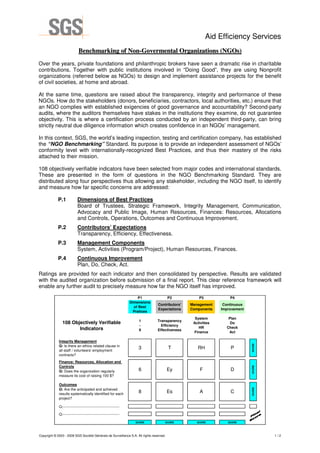
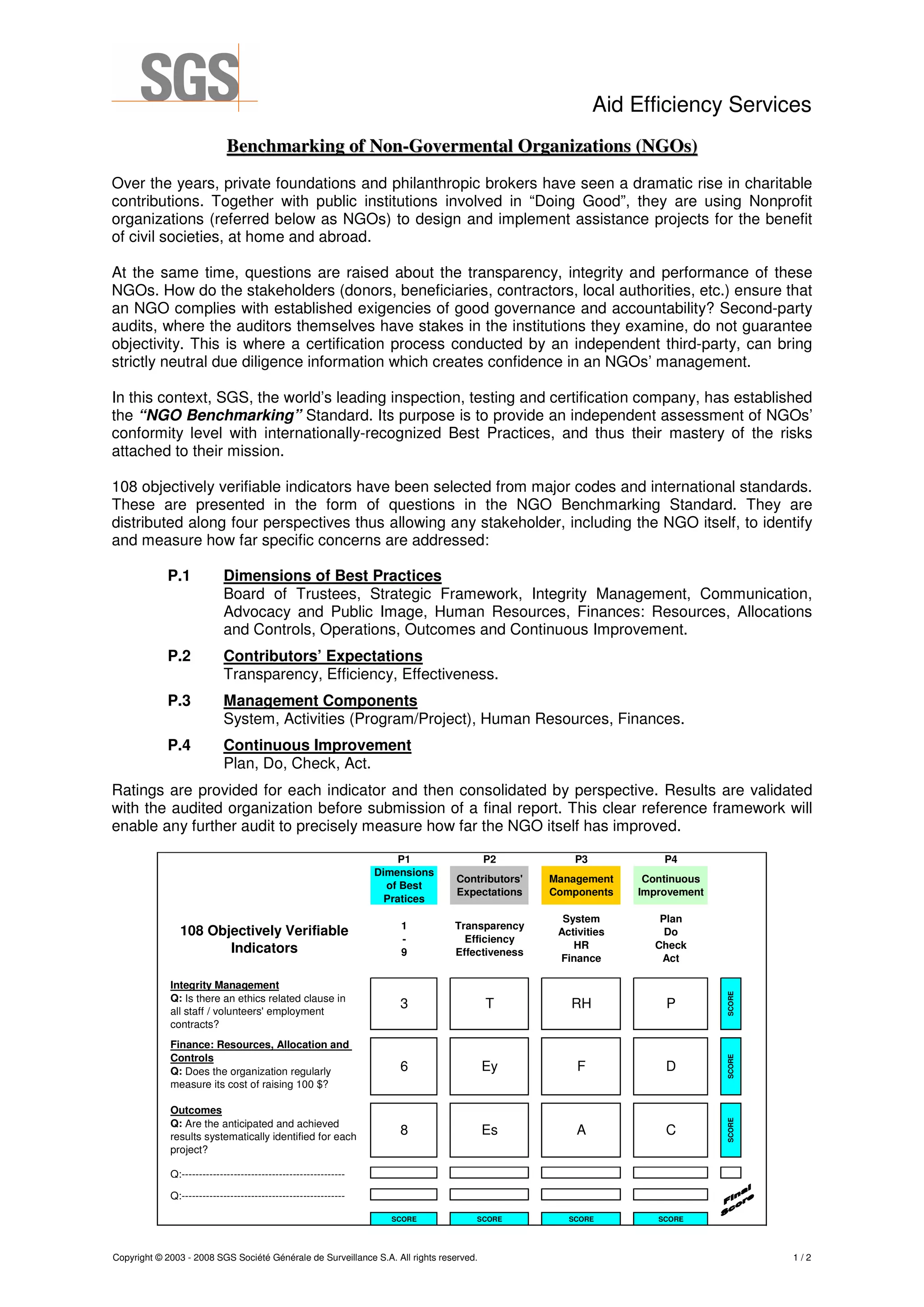
                                                                     P1                  P2          P3            P4
                                                                 Dimensions
                                                                                 Contributors'   Management     Continuous
                                                                   of Best
                                                                                 Expectations    Components    Improvement
                                                                   Pratices
                                                                                                   System         Plan
                                                                     1          Transparency
               108 Objectively Verifiable                                                         Activities       Do
                                                                     -            Efficiency
                      Indicators                                                                     HR          Check
                                                                     9          Effectiveness
                                                                                                  Finance         Act

             Integrity Management
                                                                                                                             SCORE


             Q: Is there an ethics related clause in
             all staff / volunteers' employment
                                                                     3                   T          RH             P
             contracts?
             Finance: Resources, Allocation and
             Controls
                                                                                                                             SCORE


             Q: Does the organization regularly                      6                   Ey           F            D
             measure its cost of raising 100 $?

             Outcomes
                                                                                                                             SCORE


             Q: Are the anticipated and achieved
             results systematically identified for each
                                                                     8                   Es           A            C
             project?

             Q:-----------------------------------------------

             Q:-----------------------------------------------

                                                                   SCORE             SCORE          SCORE         SCORE


Copyright © 2003 - 2008 SGS Société Générale de Surveillance S.A. All rights reserved.                                               1/2
Aid Efficiency Services

                                                         Certification Audit Results
The Audit Report:
The perimeter of the audit (headquarter, branches, projects) is defined by the client. On-site
interviews and documentary checks are conducted to generate the following results:

            Detailed scores for each perspective;
            Identification of strengths and improvement opportunities;
            Recommendations, corrective and preventive actions.

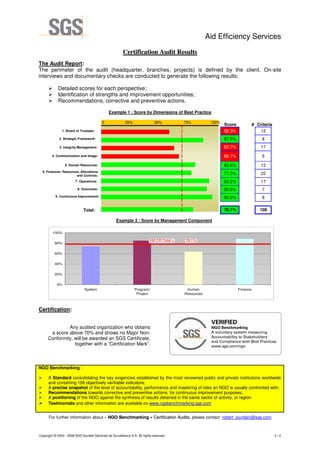
                                               Example 1 : Score by Dimensions of Best Practice

                                          0               25%                 50%          75%          100%
                                                                                                               Score             # Criteria
               1. Board of Trustees:                                                                           58.3%                 12
             2. Strategic Framework:                                                                           87.5%                  8
             3. Integrity Management:                                                                          62.7%                 17

        4. Communication and Image:                                                                            66.7%                  5

                 5. Human Resources:                                                                           80.6%                 12
  6. Finances: Resources, Allocations
                       and Controls:
                                                                                                               77.3%                 22
                        7. Operations:                                                                         92.2%                 17
                          8. Outcomes:                                                                         90.5%                  7
           9. Continuous Improvement:                                                                          95.8%                  8

                              Total:                                                                           78.1%                108

                                                    Example 2 : Score by Management Component

         100%

                                                                           VM CR Total =   78.1%
          80%


          60%


          40%


          20%


            0%
                              System                            Program/                    Human                      Finance
                                                                 Project                   Resources


Certification:


               Any audited organization who obtains
       a score above 70% and shows no Major Non-
      Conformity, will be awarded an SGS Certificate,
                  together with a “Certification Mark”.


NGO Benchmarking :

      A Standard consolidating the key exigencies established by the most renowned public and private institutions worldwide
      and containing 108 objectively verifiable indicators;
      A precise snapshot of the level of accountability, performance and mastering of risks an NGO is usually confronted with;
      Recommendations towards corrective and preventive actions, for continuous improvement purposes;
      A positioning of the NGO against the synthesis of results obtained in the same sector of activity, or region.
      Testimonials and other information are available on www.ngobenchmarking.sgs.com


      For further information about « NGO Benchmarking » Certification Audits, please contact: robert_jourdain@sgs.com


Copyright © 2003 - 2008 SGS Société Générale de Surveillance S.A. All rights reserved.                                                        2/2

SGS NGO Benchmark Audit

  • 1.
    Aid Efficiency Services Benchmarking of Non-Govermental Organizations (NGOs) Over the years, private foundations and philanthropic brokers have seen a dramatic rise in charitable contributions. Together with public institutions involved in “Doing Good”, they are using Nonprofit organizations (referred below as NGOs) to design and implement assistance projects for the benefit of civil societies, at home and abroad. At the same time, questions are raised about the transparency, integrity and performance of these NGOs. How do the stakeholders (donors, beneficiaries, contractors, local authorities, etc.) ensure that an NGO complies with established exigencies of good governance and accountability? Second-party audits, where the auditors themselves have stakes in the institutions they examine, do not guarantee objectivity. This is where a certification process conducted by an independent third-party, can bring strictly neutral due diligence information which creates confidence in an NGOs’ management. In this context, SGS, the world’s leading inspection, testing and certification company, has established the “NGO Benchmarking” Standard. Its purpose is to provide an independent assessment of NGOs’ conformity level with internationally-recognized Best Practices, and thus their mastery of the risks attached to their mission. 108 objectively verifiable indicators have been selected from major codes and international standards. These are presented in the form of questions in the NGO Benchmarking Standard. They are distributed along four perspectives thus allowing any stakeholder, including the NGO itself, to identify and measure how far specific concerns are addressed: P.1 Dimensions of Best Practices Board of Trustees, Strategic Framework, Integrity Management, Communication, Advocacy and Public Image, Human Resources, Finances: Resources, Allocations and Controls, Operations, Outcomes and Continuous Improvement. P.2 Contributors’ Expectations Transparency, Efficiency, Effectiveness. P.3 Management Components System, Activities (Program/Project), Human Resources, Finances. P.4 Continuous Improvement Plan, Do, Check, Act. Ratings are provided for each indicator and then consolidated by perspective. Results are validated with the audited organization before submission of a final report. This clear reference framework will enable any further audit to precisely measure how far the NGO itself has improved. P1 P2 P3 P4 Dimensions Contributors' Management Continuous of Best Expectations Components Improvement Pratices System Plan 1 Transparency 108 Objectively Verifiable Activities Do - Efficiency Indicators HR Check 9 Effectiveness Finance Act Integrity Management SCORE Q: Is there an ethics related clause in all staff / volunteers' employment 3 T RH P contracts? Finance: Resources, Allocation and Controls SCORE Q: Does the organization regularly 6 Ey F D measure its cost of raising 100 $? Outcomes SCORE Q: Are the anticipated and achieved results systematically identified for each 8 Es A C project? Q:----------------------------------------------- Q:----------------------------------------------- SCORE SCORE SCORE SCORE Copyright © 2003 - 2008 SGS Société Générale de Surveillance S.A. All rights reserved. 1/2
  • 2.
    Aid Efficiency Services Certification Audit Results The Audit Report: The perimeter of the audit (headquarter, branches, projects) is defined by the client. On-site interviews and documentary checks are conducted to generate the following results: Detailed scores for each perspective; Identification of strengths and improvement opportunities; Recommendations, corrective and preventive actions. Example 1 : Score by Dimensions of Best Practice 0 25% 50% 75% 100% Score # Criteria 1. Board of Trustees: 58.3% 12 2. Strategic Framework: 87.5% 8 3. Integrity Management: 62.7% 17 4. Communication and Image: 66.7% 5 5. Human Resources: 80.6% 12 6. Finances: Resources, Allocations and Controls: 77.3% 22 7. Operations: 92.2% 17 8. Outcomes: 90.5% 7 9. Continuous Improvement: 95.8% 8 Total: 78.1% 108 Example 2 : Score by Management Component 100% VM CR Total = 78.1% 80% 60% 40% 20% 0% System Program/ Human Finance Project Resources Certification: Any audited organization who obtains a score above 70% and shows no Major Non- Conformity, will be awarded an SGS Certificate, together with a “Certification Mark”. NGO Benchmarking : A Standard consolidating the key exigencies established by the most renowned public and private institutions worldwide and containing 108 objectively verifiable indicators; A precise snapshot of the level of accountability, performance and mastering of risks an NGO is usually confronted with; Recommendations towards corrective and preventive actions, for continuous improvement purposes; A positioning of the NGO against the synthesis of results obtained in the same sector of activity, or region. Testimonials and other information are available on www.ngobenchmarking.sgs.com For further information about « NGO Benchmarking » Certification Audits, please contact: robert_jourdain@sgs.com Copyright © 2003 - 2008 SGS Société Générale de Surveillance S.A. All rights reserved. 2/2