Moving from prediction
to decision:
Automating decision-making in the financial
services risk and compliance arena
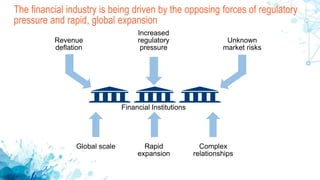
The financial industry is being driven by the opposing forces of regulatory
pressure and rapid, global expansion
Financial Institutions
Revenue
deflation
Increased
regulatory
pressure
Unknown
market risks
Trade
Finance
Industry Complex
relationships
Rapid
expansion
Global scale
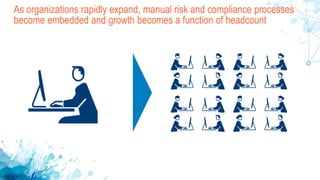
As organizations rapidly expand, manual risk and compliance processes
become embedded and growth becomes a function of headcount
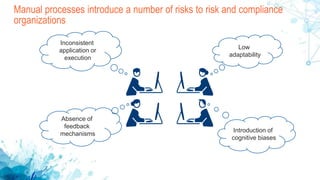
Manual processes introduce a number of risks to risk and compliance
organizations
Low
adaptability
Inconsistent
application or
execution
Introduction of
cognitive biases
Absence of
feedback
mechanisms
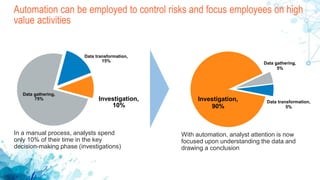
Automation can be employed to control risks and focus employees on high
value activities
Data gathering,
75%
Data transformation,
15%
Investigation,
10%
Data gathering,
5%
Data transformation,
5%
Investigation,
90%
In a manual process, analysts spend
only 10% of their time in the key
decision-making phase (investigations)
With automation, analyst attention is now
focused upon understanding the data and
drawing a conclusion
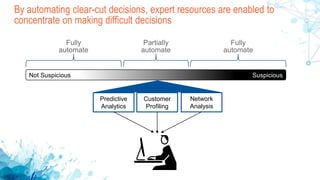
By automating clear-cut decisions, expert resources are enabled to
concentrate on making difficult decisions
Fully
automate
Fully
automate
Partially
automate
Predictive
Analytics
Customer
Profiling
Network
Analysis
SuspiciousNot Suspicious
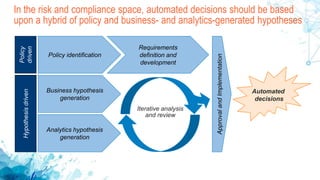
In the risk and compliance space, automated decisions should be based
upon a hybrid of policy and business- and analytics-generated hypothesesPolicy
driven
Hypothesisdriven
Policy identification
Business hypothesis
generation
Analytics hypothesis
generation
Iterative analysis
and review
Requirements
definition and
development
ApprovalandImplementation
Automated
decisions
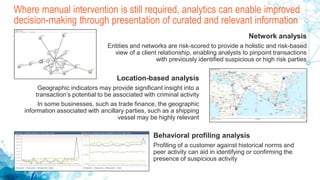
Where manual intervention is still required, analytics can enable improved
decision-making through presentation of curated and relevant information
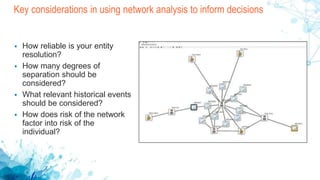
Network analysis
Entities and networks are risk-scored to provide a holistic and risk-based
view of a client relationship, enabling analysts to pinpoint transactions
with previously identified suspicious or high risk parties
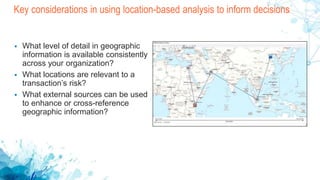
Location-based analysis
Geographic indicators may provide significant insight into a
transaction’s potential to be associated with criminal activity
In some businesses, such as trade finance, the geographic
information associated with ancillary parties, such as a shipping
vessel may be highly relevant
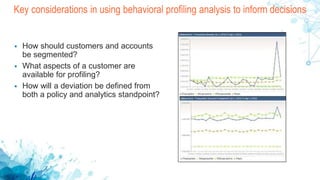
Behavioral profiling analysis
Profiling of a customer against historical norms and
peer activity can aid in identifying or confirming the
presence of suspicious activity
Key considerations in using network analysis to inform decisions
 How reliable is your entity
resolution?
 How many degrees of
separation should be
considered?
 What relevant historical events
should be considered?
 How does risk of the network
factor into risk of the
individual?
Key considerations in using location-based analysis to inform decisions
 What level of detail in geographic
information is available consistently
across your organization?
 What locations are relevant to a
transaction’s risk?
 What external sources can be used
to enhance or cross-reference
geographic information?
Key considerations in using behavioral profiling analysis to inform decisions
 How should customers and accounts
be segmented?
 What aspects of a customer are
available for profiling?
 How will a deviation be defined from
both a policy and analytics standpoint?
About the presenter
Carl Case is a Senior Manager in the Financial Services Organization of Ernst &
Young LLP (EY). Carl is a Certified Anti-Money Laundering Specialist and
specializes in data analytics, predictive modeling, model validation, and risk
management in the regulatory compliance and financial crimes space.
Carl's recent experience involves supporting global financial services institutions
in enhancing and transforming their financial crimes monitoring programs through
the use of advanced analytics and robotic process automation, specifically within
the areas of AML monitoring and investigation. He has facilitated numerous
examinations and instructional sessions with federal regulatory agencies on the
topic of AML monitoring and tuning.
Carl also serves on the steering committee of the EY Veterans Network, a national network of more
than 800 EY professionals dedicated to strong leadership principles and devoted to professional
development through networking with companies that share a commitment to veterans and
community service.
Carl completed his undergraduate studies at the United States Naval Academy and MBA at Columbia
Business School. Prior to joining EY, Carl served in the Global War on Terrorism as an officer in the
U.S. Navy.
EY | Assurance | Tax | Transactions | Advisory
About EY
EY is a global leader in assurance, tax, transaction
and advisory services. The insights and quality
services we deliver help build trust and confidence in
the capital markets and in economies the world over.
We develop outstanding leaders who team to deliver
on our promises to all of our stakeholders. In so
doing, we play a critical role in building a better
working world for our people, for our clients and for
our communities.
EY refers to the global organization, and may refer to
one or more, of the member firms of Ernst & Young
Global Limited, each of which is a separate legal
entity. Ernst & Young Global Limited, a UK company
limited by guarantee, does not provide services to
clients. For more information about our organization,
please visit ey.com.
Ernst & Young LLP is a client-serving member firm of
Ernst & Young Global Limited operating in the US.
© 2016 Ernst & Young LLP.
All Rights Reserved.
1603-1882824
ey.com

SGF2016 12641 - Moving from Prediction to Decision

  • 1.
    Moving from prediction todecision: Automating decision-making in the financial services risk and compliance arena
  • 2.
    The financial industryis being driven by the opposing forces of regulatory pressure and rapid, global expansion Financial Institutions Revenue deflation Increased regulatory pressure Unknown market risks Trade Finance Industry Complex relationships Rapid expansion Global scale
  • 3.
    As organizations rapidlyexpand, manual risk and compliance processes become embedded and growth becomes a function of headcount
  • 4.
    Manual processes introducea number of risks to risk and compliance organizations Low adaptability Inconsistent application or execution Introduction of cognitive biases Absence of feedback mechanisms
  • 5.
    Automation can beemployed to control risks and focus employees on high value activities Data gathering, 75% Data transformation, 15% Investigation, 10% Data gathering, 5% Data transformation, 5% Investigation, 90% In a manual process, analysts spend only 10% of their time in the key decision-making phase (investigations) With automation, analyst attention is now focused upon understanding the data and drawing a conclusion
  • 6.
    By automating clear-cutdecisions, expert resources are enabled to concentrate on making difficult decisions Fully automate Fully automate Partially automate Predictive Analytics Customer Profiling Network Analysis SuspiciousNot Suspicious
  • 7.
    In the riskand compliance space, automated decisions should be based upon a hybrid of policy and business- and analytics-generated hypothesesPolicy driven Hypothesisdriven Policy identification Business hypothesis generation Analytics hypothesis generation Iterative analysis and review Requirements definition and development ApprovalandImplementation Automated decisions
  • 8.
    Where manual interventionis still required, analytics can enable improved decision-making through presentation of curated and relevant information Network analysis Entities and networks are risk-scored to provide a holistic and risk-based view of a client relationship, enabling analysts to pinpoint transactions with previously identified suspicious or high risk parties Location-based analysis Geographic indicators may provide significant insight into a transaction’s potential to be associated with criminal activity In some businesses, such as trade finance, the geographic information associated with ancillary parties, such as a shipping vessel may be highly relevant Behavioral profiling analysis Profiling of a customer against historical norms and peer activity can aid in identifying or confirming the presence of suspicious activity
  • 9.
    Key considerations inusing network analysis to inform decisions  How reliable is your entity resolution?  How many degrees of separation should be considered?  What relevant historical events should be considered?  How does risk of the network factor into risk of the individual?
  • 10.
    Key considerations inusing location-based analysis to inform decisions  What level of detail in geographic information is available consistently across your organization?  What locations are relevant to a transaction’s risk?  What external sources can be used to enhance or cross-reference geographic information?
  • 11.
    Key considerations inusing behavioral profiling analysis to inform decisions  How should customers and accounts be segmented?  What aspects of a customer are available for profiling?  How will a deviation be defined from both a policy and analytics standpoint?
  • 12.
    About the presenter CarlCase is a Senior Manager in the Financial Services Organization of Ernst & Young LLP (EY). Carl is a Certified Anti-Money Laundering Specialist and specializes in data analytics, predictive modeling, model validation, and risk management in the regulatory compliance and financial crimes space. Carl's recent experience involves supporting global financial services institutions in enhancing and transforming their financial crimes monitoring programs through the use of advanced analytics and robotic process automation, specifically within the areas of AML monitoring and investigation. He has facilitated numerous examinations and instructional sessions with federal regulatory agencies on the topic of AML monitoring and tuning. Carl also serves on the steering committee of the EY Veterans Network, a national network of more than 800 EY professionals dedicated to strong leadership principles and devoted to professional development through networking with companies that share a commitment to veterans and community service. Carl completed his undergraduate studies at the United States Naval Academy and MBA at Columbia Business School. Prior to joining EY, Carl served in the Global War on Terrorism as an officer in the U.S. Navy.
  • 13.
    EY | Assurance| Tax | Transactions | Advisory About EY EY is a global leader in assurance, tax, transaction and advisory services. The insights and quality services we deliver help build trust and confidence in the capital markets and in economies the world over. We develop outstanding leaders who team to deliver on our promises to all of our stakeholders. In so doing, we play a critical role in building a better working world for our people, for our clients and for our communities. EY refers to the global organization, and may refer to one or more, of the member firms of Ernst & Young Global Limited, each of which is a separate legal entity. Ernst & Young Global Limited, a UK company limited by guarantee, does not provide services to clients. For more information about our organization, please visit ey.com. Ernst & Young LLP is a client-serving member firm of Ernst & Young Global Limited operating in the US. © 2016 Ernst & Young LLP. All Rights Reserved. 1603-1882824 ey.com

Editor's Notes

  • #3 Make this into a generic financial institutions slide.