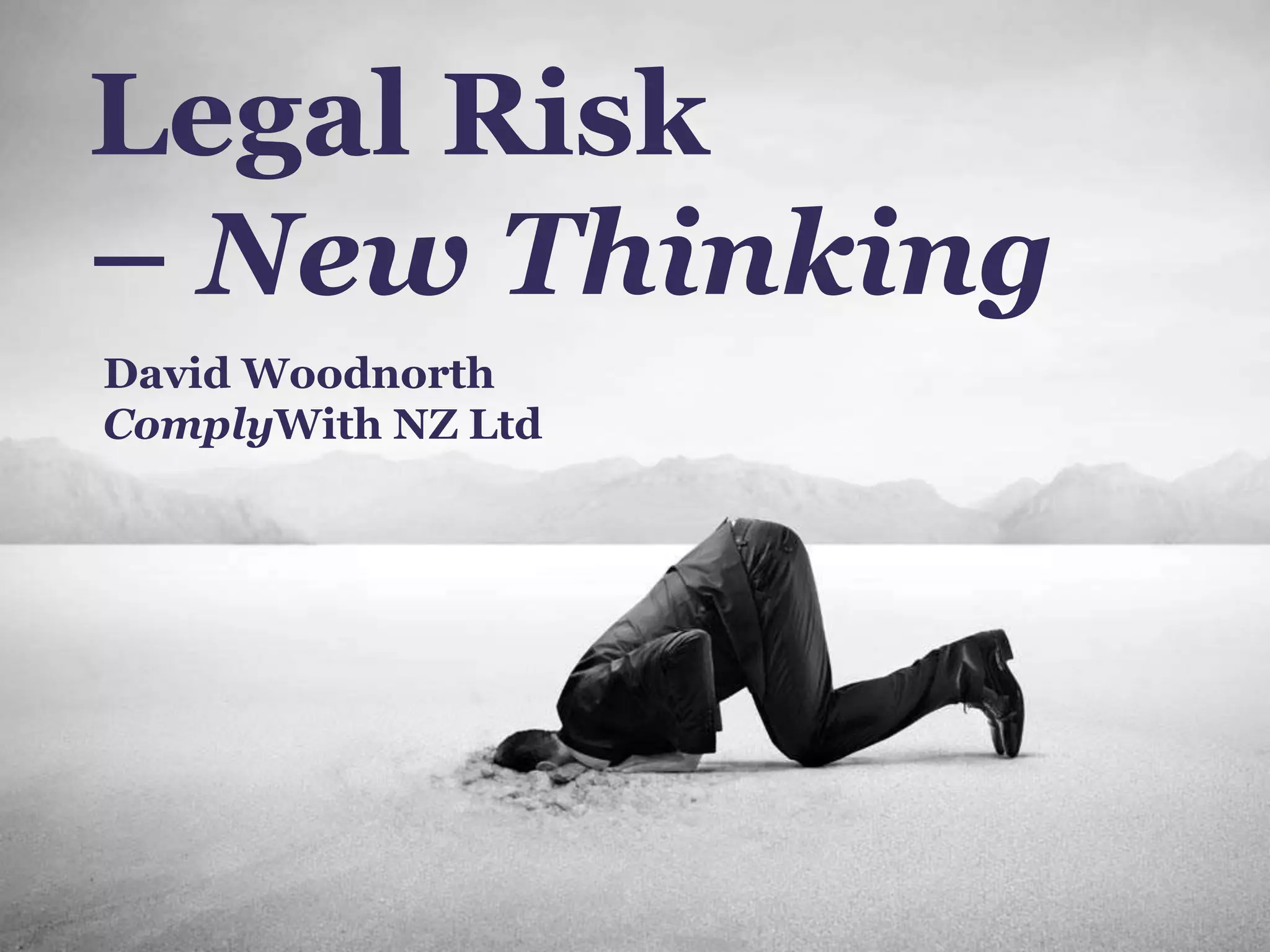




Legal Risk
– New Thinking
David Woodnorth
ComplyWith NZ Ltd
It’s mostly people doing the right thing…
› Culture
› Knowledge
› Resources
“Being smart about taking chances”
D Hubbard, The Failure of Risk Management
Legal Risk Management
What is ‘legal risk’?
› the probability & magnitude of harm
› to our people, assets, brand &/or
objectives
› involving a breach of Statutory,
Contractual or other legal obligations
› Assumed rather than led
› The Legal Team does legal risk
› No deep clarity or visibility
“We’ve got good people”
“It’s just a burden for me”
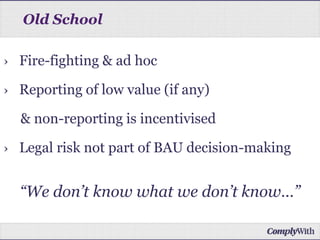
Old School
› Fire-fighting & ad hoc
› Reporting of low value (if any)
& non-reporting is incentivised
› Legal risk not part of BAU decision-making
“We don’t know what we don’t know…”
Old School
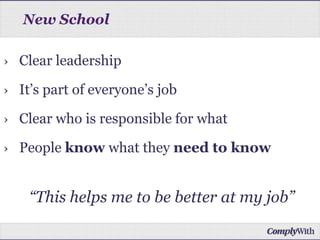
› Clear leadership
› It’s part of everyone’s job
› Clear who is responsible for what
› People know what they need to know
“This helps me to be better at my job”
New School
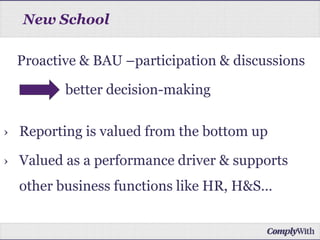
Proactive & BAU –participation & discussions
better decision-making
› Reporting is valued from the bottom up
› Valued as a performance driver & supports
other business functions like HR, H&S…
New School
It’s a different type of conversation.
Here’s what a leading brand strategist
discovered for us…
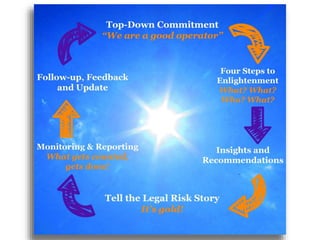
Getting Buy-in
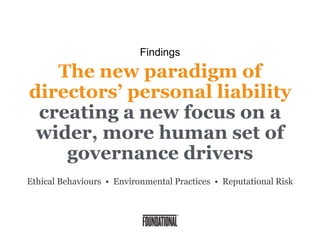
The new paradigm of
directors’ personal liability
creating a new focus on a
wider, more human set of
governance drivers
Ethical Behaviours • Environmental Practices • Reputational Risk
Findings
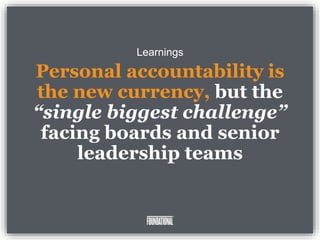
Personal accountability is
the new currency, but the
“single biggest challenge”
facing boards and senior
leadership teams
Learnings
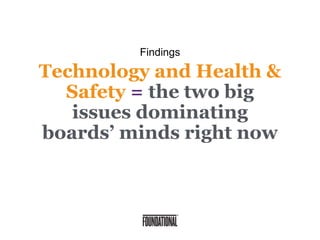
Technology and Health &
Safety = the two big
issues dominating
boards’ minds right now
Findings
And people are simply
ignorant of their
responsibilities even
those at the very top
(Who now have a whole lot more to lose)
Findings
Can we redefine the
conversation & language
around the true benefits
of getting legal risk
right?
The Challenge
“The value add is all about
legal risk, it’s a trigger to
have richer discussions
around better decision
making”
Professional Director
Getting on top of
legal risk ‘keeps business
managers current, fresh,
and builds expertise
‘where it should lay’
Findings
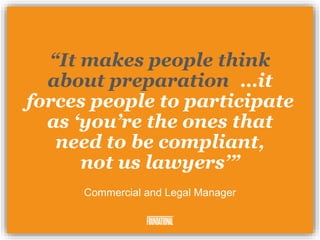
“It makes people think
about preparation, …it
forces people to participate
as ‘you’re the ones that
need to be compliant,
not us lawyers’”
Commercial and Legal Manager
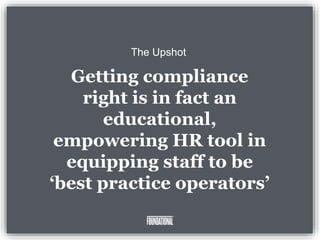
The Upshot
Getting compliance
right is in fact an
educational,
empowering HR tool in
equipping staff to be
‘best practice operators’
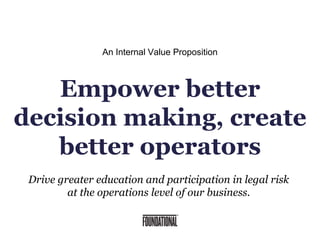
Drive greater education and participation in legal risk
at the operations level of our business.
An Internal Value Proposition
Empower better
decision making, create
better operators
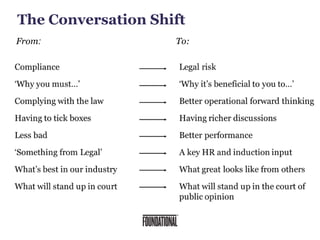
The Conversation Shift
From: To:
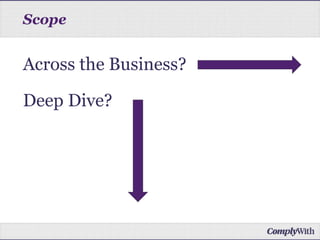
Across the Business?
Deep Dive?
Scope
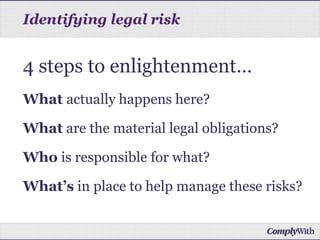
4 steps to enlightenment…
What actually happens here?
What are the material legal obligations?
Who is responsible for what?
What’s in place to help manage these risks?
Identifying legal risk
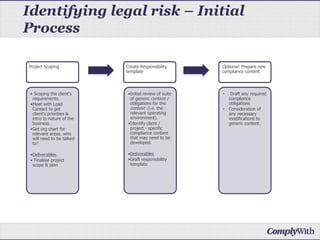
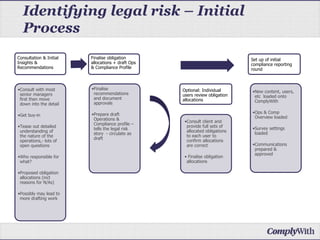
Identifying legal risk – Initial
Process
Project Scoping
• Scoping the client's
requirements.
•Meet with Lead
Contact to get
client's priorities &
intro to nature of the
business.
•Get org chart for
relevant areas, who
will need to be talked
to?
•Deliverables.
• Finalisie project
scope & plan
Create Responsibility
template
•Initial review of suite
of generic content /
obligations for the
context (i.e. the
relevant operating
environment).
•Identify client /
project - specific
compliance content
that may need to be
developed.
•Deliverables
•Draft responsibility
template
Optional: Prepare new
compliance content
• Draft any required
compliance
obligations
• Consideration of
any necessary
modifications to
generic content.
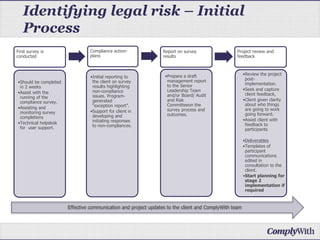
Identifying legal risk – Initial
Process
Consultation & Initial
Insights &
Recommendations
•Consult with most
senior managers
first then move
down into the detail
•Get buy-in
•Tease out detailed
understanding of
the nature of the
operations,- lots of
open questions
•Who responsible for
what?
•Proposed obligation
allocations (incl
reasons for N/As)
•Possibly may lead to
more drafting work
Finalise obligation
allocations + draft Ops
& Compliance Profile
•Finalise
recommendations
and document
approvals
•Prepare draft
Operations &
Compliance profile –
tells the legal risk
story - circulate as
draft
•Consult client and
provide full sets of
allocated obligations
to each user to
confirm allocations
are correct
• Finalise obligation
allocations
Set up of initial
compliance reporting
round
•New content, users,
etc loaded onto
ComplyWith
•Ops & Comp
Overview loaded
•Survey settings
loaded
•Communications
prepared &
approved
Optional: Individual
users review obligation
allocations
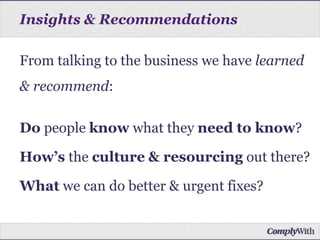
Identifying legal risk – Initial
Process
First survey is
conducted
•Should be completed
in 2 weeks
•Assist with the
running of the
compliance survey.
•Assisting and
monitoring survey
completions
•Technical helpdesk
for user support.
Compliance action-
plans
•Initial reporting to
the client on survey
results highlighting
non-compliance
issues. Program-
generated
“exception report”.
•Support for client in
developing and
initiating responses
to non-compliances.
Report on survey
results
•Prepare a draft
management report
to the Senior
Leadership Team
and/or Board/ Audit
and Risk
Committeeon the
survey process and
outcomes.
Project review and
feedback
•Review the project
post-
implementation.
•Seek and capture
client feedback,
•Client given clarity
about who things
are going to work
going forward.
•Assist client with
feedback to
participants
•Deliverables
•Templates of
participant
communications
edited in
consultation to the
client.
•Start planning for
stage 2
implementation if
required
Effective communication and project updates to the client and ComplyWith team
From talking to the business we have learned
& recommend:
Do people know what they need to know?
How’s the culture & resourcing out there?
What we can do better & urgent fixes?
Insights & Recommendations
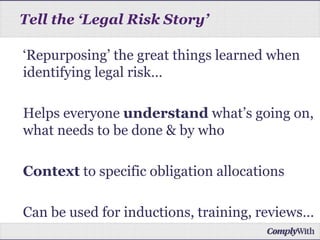
‘Repurposing’ the great things learned when
identifying legal risk…
Helps everyone understand what’s going on,
what needs to be done & by who
Context to specific obligation allocations
Can be used for inductions, training, reviews…
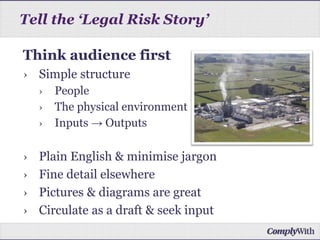
Tell the ‘Legal Risk Story’
Think audience first
› Simple structure
› People
› The physical environment
› Inputs → Outputs
› Plain English & minimise jargon
› Fine detail elsewhere
› Pictures & diagrams are great
› Circulate as a draft & seek input
Tell the ‘Legal Risk Story’
“What gets counted gets done!”
Culture is key for valuable reporting
Monitoring & Reporting
The process provides value to all:
› Knowledge
› A ‘voice’ to people in the business
› Reinforces healthy corporate accountability
Monitoring & Reporting
Don’t waste people’s time
› Targeted & tailored
› Efficient – utilise technology if possible
› Great communication, follow-up &
feedback
Monitoring & Reporting
Reports
› Who is the audience?
› Important stuff in the first 2 pages (max!)
› Do not ‘filter’ bad news – clarity is key
› What else adds value?
Questions & Discussion
ComplyWith.co.nz
twitter.com/ComplyWithNZ

Legal Risk - New Thinking

  • 1.
    Legal Risk – NewThinking David Woodnorth ComplyWith NZ Ltd
  • 2.
    It’s mostly peopledoing the right thing… › Culture › Knowledge › Resources “Being smart about taking chances” D Hubbard, The Failure of Risk Management Legal Risk Management
  • 3.
    What is ‘legalrisk’? › the probability & magnitude of harm › to our people, assets, brand &/or objectives › involving a breach of Statutory, Contractual or other legal obligations
  • 6.
    › Assumed ratherthan led › The Legal Team does legal risk › No deep clarity or visibility “We’ve got good people” “It’s just a burden for me” Old School
  • 7.
    › Fire-fighting &ad hoc › Reporting of low value (if any) & non-reporting is incentivised › Legal risk not part of BAU decision-making “We don’t know what we don’t know…” Old School
  • 8.
    › Clear leadership ›It’s part of everyone’s job › Clear who is responsible for what › People know what they need to know “This helps me to be better at my job” New School
  • 9.
    Proactive & BAU–participation & discussions better decision-making › Reporting is valued from the bottom up › Valued as a performance driver & supports other business functions like HR, H&S… New School
  • 10.
    It’s a differenttype of conversation. Here’s what a leading brand strategist discovered for us… Getting Buy-in
  • 13.
    The new paradigmof directors’ personal liability creating a new focus on a wider, more human set of governance drivers Ethical Behaviours • Environmental Practices • Reputational Risk Findings
  • 14.
    Personal accountability is thenew currency, but the “single biggest challenge” facing boards and senior leadership teams Learnings
  • 15.
    Technology and Health& Safety = the two big issues dominating boards’ minds right now Findings
  • 16.
    And people aresimply ignorant of their responsibilities even those at the very top (Who now have a whole lot more to lose) Findings
  • 17.
    Can we redefinethe conversation & language around the true benefits of getting legal risk right? The Challenge
  • 18.
    “The value addis all about legal risk, it’s a trigger to have richer discussions around better decision making” Professional Director
  • 19.
    Getting on topof legal risk ‘keeps business managers current, fresh, and builds expertise ‘where it should lay’ Findings
  • 20.
    “It makes peoplethink about preparation, …it forces people to participate as ‘you’re the ones that need to be compliant, not us lawyers’” Commercial and Legal Manager
  • 21.
    The Upshot Getting compliance rightis in fact an educational, empowering HR tool in equipping staff to be ‘best practice operators’
  • 22.
    Drive greater educationand participation in legal risk at the operations level of our business. An Internal Value Proposition Empower better decision making, create better operators
  • 23.
  • 25.
  • 26.
    4 steps toenlightenment… What actually happens here? What are the material legal obligations? Who is responsible for what? What’s in place to help manage these risks? Identifying legal risk
  • 27.
    Identifying legal risk– Initial Process Project Scoping • Scoping the client's requirements. •Meet with Lead Contact to get client's priorities & intro to nature of the business. •Get org chart for relevant areas, who will need to be talked to? •Deliverables. • Finalisie project scope & plan Create Responsibility template •Initial review of suite of generic content / obligations for the context (i.e. the relevant operating environment). •Identify client / project - specific compliance content that may need to be developed. •Deliverables •Draft responsibility template Optional: Prepare new compliance content • Draft any required compliance obligations • Consideration of any necessary modifications to generic content.
  • 28.
    Identifying legal risk– Initial Process Consultation & Initial Insights & Recommendations •Consult with most senior managers first then move down into the detail •Get buy-in •Tease out detailed understanding of the nature of the operations,- lots of open questions •Who responsible for what? •Proposed obligation allocations (incl reasons for N/As) •Possibly may lead to more drafting work Finalise obligation allocations + draft Ops & Compliance Profile •Finalise recommendations and document approvals •Prepare draft Operations & Compliance profile – tells the legal risk story - circulate as draft •Consult client and provide full sets of allocated obligations to each user to confirm allocations are correct • Finalise obligation allocations Set up of initial compliance reporting round •New content, users, etc loaded onto ComplyWith •Ops & Comp Overview loaded •Survey settings loaded •Communications prepared & approved Optional: Individual users review obligation allocations
  • 29.
    Identifying legal risk– Initial Process First survey is conducted •Should be completed in 2 weeks •Assist with the running of the compliance survey. •Assisting and monitoring survey completions •Technical helpdesk for user support. Compliance action- plans •Initial reporting to the client on survey results highlighting non-compliance issues. Program- generated “exception report”. •Support for client in developing and initiating responses to non-compliances. Report on survey results •Prepare a draft management report to the Senior Leadership Team and/or Board/ Audit and Risk Committeeon the survey process and outcomes. Project review and feedback •Review the project post- implementation. •Seek and capture client feedback, •Client given clarity about who things are going to work going forward. •Assist client with feedback to participants •Deliverables •Templates of participant communications edited in consultation to the client. •Start planning for stage 2 implementation if required Effective communication and project updates to the client and ComplyWith team
  • 30.
    From talking tothe business we have learned & recommend: Do people know what they need to know? How’s the culture & resourcing out there? What we can do better & urgent fixes? Insights & Recommendations
  • 31.
    ‘Repurposing’ the greatthings learned when identifying legal risk… Helps everyone understand what’s going on, what needs to be done & by who Context to specific obligation allocations Can be used for inductions, training, reviews… Tell the ‘Legal Risk Story’
  • 32.
    Think audience first ›Simple structure › People › The physical environment › Inputs → Outputs › Plain English & minimise jargon › Fine detail elsewhere › Pictures & diagrams are great › Circulate as a draft & seek input Tell the ‘Legal Risk Story’
  • 33.
    “What gets countedgets done!” Culture is key for valuable reporting Monitoring & Reporting
  • 34.
    Monitoring & Reporting Theprocess provides value to all: › Knowledge › A ‘voice’ to people in the business › Reinforces healthy corporate accountability
  • 35.
    Monitoring & Reporting Don’twaste people’s time › Targeted & tailored › Efficient – utilise technology if possible › Great communication, follow-up & feedback
  • 36.
    Monitoring & Reporting Reports ›Who is the audience? › Important stuff in the first 2 pages (max!) › Do not ‘filter’ bad news – clarity is key › What else adds value?
  • 37.

Editor's Notes

  • #25 INSERT DIAGRAM IMAGE – when typo corrected
  • #31 Should it read: What can we do better?