Alexios Zavras
Open Source Compliance
Intel Corp.
2
About me
Alexios Zavras (zvr)
▪ First time in SFScon!
▪ Greek, living in Munich, Germany
▪ PhD Computer Science
▪ Free Software since 1983
– Long-term view
– Member of communities
▪ Senior Open Source Compliance Engineer of Intel
Disclaimer: views expressed herein are mine; they do not necessarily reflect the views of Intel Corp.
Who is Intel?
You may have heard of us…
• Leading manufacturer of computer and communications products
• Headquartered in Santa Clara, California
• Over 100.000 employees, 190 sites in 90+ countries
• Over 15.000 employees developing software
Intel and Free Software
No discussion on merits of Free Software anymore
Both consume and contribute
• Consistently a top or #1 corporate contributor to Linux
• One of top corporate contributors to AOSP/Chromium, Apache Spark,
OpenStack and many others
• Deliver enabling, tuning, and optimizations to hundreds of FOSS projects
• Every business unit is active in Free Software!
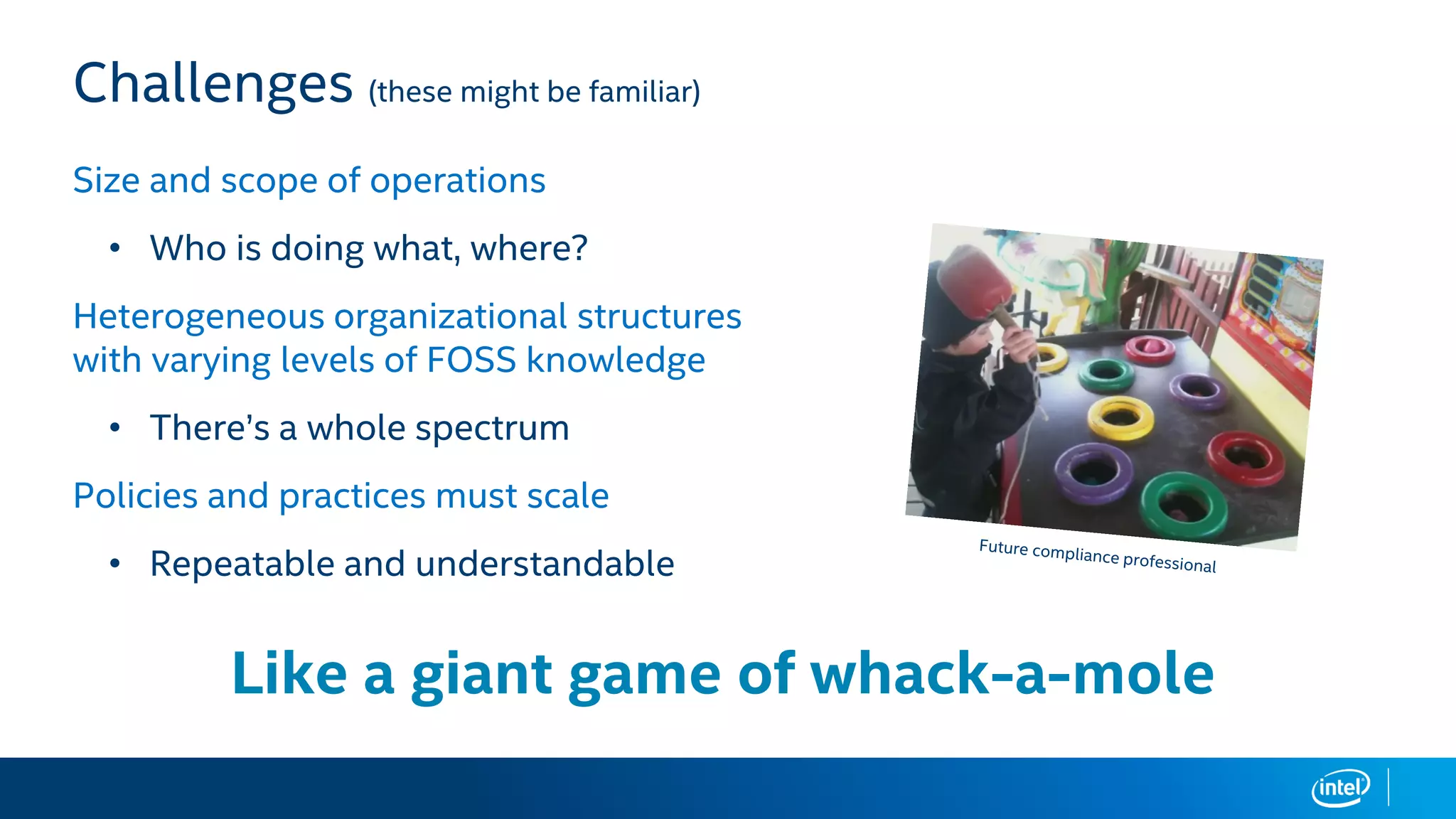
Challenges (these might be familiar)
Size and scope of operations
• Who is doing what, where?
Heterogeneous organizational structures
with varying levels of FOSS knowledge
• There’s a whole spectrum
Policies and practices must scale
• Repeatable and understandable
Like a giant game of whack-a-mole
6
Software Licenses
Software Licenses specify:
▪ Rights
– What you may do
– e.g., copy the code, modify it, re-distribute it
▪ Obligations
– What you must do
– e.g., use the same license, mention author’s name
7
Compliance
Software nowadays is a combination of components
We should comply with all obligations of all licenses
▪ Straightforward
▪ But not trivial or easy
Everyone struggles!
▪ Small group of people
▪ Industry collaborations
FOSS governance/compliance program
is necessary to mitigate risks
Compliance isn’t just a matter of law, but makes us better community citizens
Policies should address both inbound and outbound software
Ideas for attributes of an effective program:
• Mandatory training
• Use of supportive tools
• Review by panel of experts
Mandatory training
Free Software licensing basics
• What it is, how it works
• Understanding license obligations and how to fulfill them
• Identifying potential license conflicts
Other topics
• Handling 3rd party IP
• Handling own IP
• Internal processes and tools
Use of support tools
Many tools available to detect presence of FOSS and manage BOMs
▪ Choose what works best for you
But… don’t rely on scanning alone to “know” what’s in your code
• PLAN BEFORE DETECTION!
• Development teams should be trained to document the name, origin,
and license of any 3rd party code before incorporating into a project
• Use scanning to verify plan
• Avoid surprises
The ‘secret ingredient’: review by panel of experts
“Given enough eyeballs, all bugs are shallow”
Technical and legal representation
Peer review functionality (but not code review)
• Architectural review
• Feedback on likely community acceptance of a particular action or strategy
• Advice on community etiquette
Operates like an FOSS project
• Group of committers, maintainers, and BDFL
• All are welcome; members ‘rise to the top’ based on contributions
12
SPDX – Software Package Data Exchange
Standards for communicating components and licenses
▪ Specification
▪ License List
Working groups:
▪ Technical
▪ Legal
▪ Outreach
13
SPDX Licenses
Authoritative list of names and short identifiers
▪ MIT, BSD-3-Clause, GPL-2.0-or-later, …
▪ Expressions
EPL-2.0 OR MPL-2.0
▪ Use in source files:
– SPDX-License-Identifier: Apache-2.0
– Already in many projects, including the Linux kernel
14
OpenChain
Making Open Source license compliance simpler, across the supply chain
▪ Specification
▪ Curriculum
▪ Conformance
▪ Tools
Recommendations for companies of any size
You need a governance/compliance policy – if you don’t have one yet, get on it
Educate, educate, educate
• Leverage free training resources
Develop internal OSS community that role models best of OSS norms
• Forms basis for ‘expert review panel’
Join the community!
• You are not alone (nor unique)!
16
Questions?

SFScon19 - Alexios Zavras - Free Software in the industry a view from the large scale

  • 1.
    Alexios Zavras Open SourceCompliance Intel Corp.
  • 2.
    2 About me Alexios Zavras(zvr) ▪ First time in SFScon! ▪ Greek, living in Munich, Germany ▪ PhD Computer Science ▪ Free Software since 1983 – Long-term view – Member of communities ▪ Senior Open Source Compliance Engineer of Intel Disclaimer: views expressed herein are mine; they do not necessarily reflect the views of Intel Corp.
  • 3.
    Who is Intel? Youmay have heard of us… • Leading manufacturer of computer and communications products • Headquartered in Santa Clara, California • Over 100.000 employees, 190 sites in 90+ countries • Over 15.000 employees developing software
  • 4.
    Intel and FreeSoftware No discussion on merits of Free Software anymore Both consume and contribute • Consistently a top or #1 corporate contributor to Linux • One of top corporate contributors to AOSP/Chromium, Apache Spark, OpenStack and many others • Deliver enabling, tuning, and optimizations to hundreds of FOSS projects • Every business unit is active in Free Software!
  • 5.
    Challenges (these mightbe familiar) Size and scope of operations • Who is doing what, where? Heterogeneous organizational structures with varying levels of FOSS knowledge • There’s a whole spectrum Policies and practices must scale • Repeatable and understandable Like a giant game of whack-a-mole
  • 6.
    6 Software Licenses Software Licensesspecify: ▪ Rights – What you may do – e.g., copy the code, modify it, re-distribute it ▪ Obligations – What you must do – e.g., use the same license, mention author’s name
  • 7.
    7 Compliance Software nowadays isa combination of components We should comply with all obligations of all licenses ▪ Straightforward ▪ But not trivial or easy Everyone struggles! ▪ Small group of people ▪ Industry collaborations
  • 8.
    FOSS governance/compliance program isnecessary to mitigate risks Compliance isn’t just a matter of law, but makes us better community citizens Policies should address both inbound and outbound software Ideas for attributes of an effective program: • Mandatory training • Use of supportive tools • Review by panel of experts
  • 9.
    Mandatory training Free Softwarelicensing basics • What it is, how it works • Understanding license obligations and how to fulfill them • Identifying potential license conflicts Other topics • Handling 3rd party IP • Handling own IP • Internal processes and tools
  • 10.
    Use of supporttools Many tools available to detect presence of FOSS and manage BOMs ▪ Choose what works best for you But… don’t rely on scanning alone to “know” what’s in your code • PLAN BEFORE DETECTION! • Development teams should be trained to document the name, origin, and license of any 3rd party code before incorporating into a project • Use scanning to verify plan • Avoid surprises
  • 11.
    The ‘secret ingredient’:review by panel of experts “Given enough eyeballs, all bugs are shallow” Technical and legal representation Peer review functionality (but not code review) • Architectural review • Feedback on likely community acceptance of a particular action or strategy • Advice on community etiquette Operates like an FOSS project • Group of committers, maintainers, and BDFL • All are welcome; members ‘rise to the top’ based on contributions
  • 12.
    12 SPDX – SoftwarePackage Data Exchange Standards for communicating components and licenses ▪ Specification ▪ License List Working groups: ▪ Technical ▪ Legal ▪ Outreach
  • 13.
    13 SPDX Licenses Authoritative listof names and short identifiers ▪ MIT, BSD-3-Clause, GPL-2.0-or-later, … ▪ Expressions EPL-2.0 OR MPL-2.0 ▪ Use in source files: – SPDX-License-Identifier: Apache-2.0 – Already in many projects, including the Linux kernel
  • 14.
    14 OpenChain Making Open Sourcelicense compliance simpler, across the supply chain ▪ Specification ▪ Curriculum ▪ Conformance ▪ Tools
  • 15.
    Recommendations for companiesof any size You need a governance/compliance policy – if you don’t have one yet, get on it Educate, educate, educate • Leverage free training resources Develop internal OSS community that role models best of OSS norms • Forms basis for ‘expert review panel’ Join the community! • You are not alone (nor unique)!
  • 16.