DIVERSITY
OF
HUMAN
SEXUALITY
PREPARED BY: CARLA L. BALANOBA
JENALYN GABO
JAY MORENO
DIVERSITY OF HUMAN SEXUALITY
Diversity is all the ways we're
different from each other. It includes
things like race, religion, culture,
physical ability, mental ability, family
make-up, socio-economic status, and
sexual and gender diversity.
DIVERSITY OF HUMAN SEXUALITY
Sexuality refers to the sexual feelings and
attractions we have towards other people. There
are many different types of sexuality and it can
take a while for people to figure out what is right
for them. All are perfectly normal and part of the
broad range of human relationships and
experiences. A person's sexuality is a central part
of who they are and can influence their thoughts,
feelings, and actions.
DIVERSITY OF HUMAN SEXUALITY
Sexuality refers to the sexual feelings and
attractions we have towards other people. There
are many different types of sexuality and it can
take a while for people to figure out what is right
for them. All are perfectly normal and part of the
broad range of human relationships and
experiences. A person's sexuality is a central part
of who they are and can influence their thoughts,
feelings, and actions.
DIVERSITY OF HUMAN SEXUALITY
Rigid beliefs on sex and gender put people in boxes
(or closets), but these beliefs do not reflect realities
on human sexuality, especially how gender roles
and expressions, sexual attraction, and sexual
behavior influence how a person views or lives his
or her own sexuality. These notions favor male-
female distinctions and are biased against those
who do not fit existing stereotypes of sex and
gender.
SEX
Categories (male, female) to which people
are typically assigned at birth based on
physical characteristics (e.g. genitals).
Some people may be assigned intersex
when their reproductive, sexual, or genetic
biology doesn't fit the traditional definitions
of male or female.
Sexual Orientation:
A person’s emotional and sexual
attraction to others. It can change
and may or may not be the same as
a person’s sexual behavior.
Gender/Gender
Identity:
A person's internal sense of identity
as female, male, both or neither,
regardless of their sex.
Gender Expression:
How a person expresses their
gender. This can include how they
look, the name they choose, the
pronoun they use (e.g., he, she) and
their social behavior.
S - exual
O - rientation
G - ender
I - dentity
E - xpression
The acronyms LGBTQ2S+, LGBTQ’, LGBTQ +,
GLBT, LGBTTQ, and LGBTQz2 refer to the
spectrum of sexual and gender identities that
are not cisgender and heterosexual. They
include lesbian, gay, bisexual, transgender,
two-spirit, queer, questioning, intersex and
asexual. The asterisk (*) or plus sign (+)
shows there are other identities included that
aren't in the acronym. These acronyms mean
the same as ‘sexual and gender minorities.
Terms relating to LGBTQIA
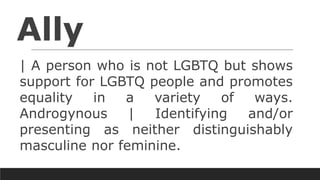
Ally
| A person who is not LGBTQ but shows
support for LGBTQ people and promotes
equality in a variety of ways.
Androgynous | Identifying and/or
presenting as neither distinguishably
masculine nor feminine.
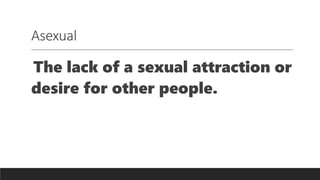
Asexual
The lack of a sexual attraction or
desire for other people.
Biphobia
Prejudice, fear or
hatred directed toward
bisexual people.
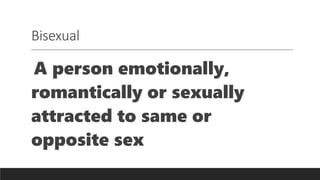
Bisexual
A person emotionally,
romantically or sexually
attracted to same or
opposite sex
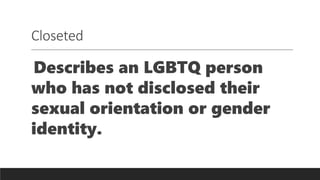
Closeted
Describes an LGBTQ person
who has not disclosed their
sexual orientation or gender
identity.
Gay
A man who is
emotionally, romantically
or sexually attracted to
men
Gender dysphoria
Clinically significant distress caused when a person's
assigned birth gender is not the same as the one with
which they identify. According to the American
Psychiatric Association's Diagnostic and Statistical
Manual of Mental Disorders (DSM), the term - which
replaces Gender Identity Disorder - "is intended to
better characterize the experiences of affected children,
adolescents, and adults."
Gender-Fluid
According to the Oxford English Dictionary, a person
who does not identify with a single fixed gender; of or
relating to a person having or expressing a fluid or
unfixed gender identity. Gender non-conforming | A
broad term referring to people who do not behave in a
way that conforms to the traditional expectations of
their gender, or whose gender expression does not fit
neatly into a category.
Intersex
An umbrella term used to describe a wide range
of natural bodily variations. In some cases,
these traits are visible at birth, and in others,
they are not apparent until puberty. Some
chromosomal variations of this type may not be
physically apparent at all.
lesbian
A woman who is
emotionally, romantically
or sexually attracted to
other women.
Living openly
A state in which LGBTQ people are
comfortably out about their sexual
orientation or gender identity -
where and when it feels appropriate
to them.
Non- binary
An adjective describing a person who does not
identify exclusively as a man or a woman. Non-
binary people may identify as being both a man
and a woman, somewhere in between, or as
falling completely outside these categories.
While many also identify as transgender, not all
non-binary people do.
Pansexual
Describes someone who has the
potential for emotional, romantic or
sexual attraction to people of any
gender though not necessarily
simultaneously, in the same way or to
the same degree.
Questioning
A term used to describe people
who are in the process of
exploring their sexual
orientation or gender identity.
Sex assigned at birth
The sex ( male or female) given to a
child at birth, most often based on
the child's external anatomy. This is
also referred to as "assigned sex at
birth."
Transphobia
The fear and hatred of,
or discomfort with,
transgender people.
Getting to Know your Sexual Identity
Everybody has a sense of their sexuality: this is
called your Gender identity. Your Gender identity is
about how you see this part of yourself and how you
express it to others. Gender identity is different
from sexual orientation. Sexual orientation is about
your sexual preferences and who you are attracted
to.
Your Gender identity may not match your sexual
orientation, for example, you may be a guy who is
attracted to other guys but still identify as ‘straight’.
Working out sexual orientation may be an ongoing
process throughout a person’s life. For instance, a
young person might identify one way at one time
then differently in a few years’ time.

sexuality in different forms and types .

  • 1.
    DIVERSITY OF HUMAN SEXUALITY PREPARED BY: CARLAL. BALANOBA JENALYN GABO JAY MORENO
  • 2.
    DIVERSITY OF HUMANSEXUALITY Diversity is all the ways we're different from each other. It includes things like race, religion, culture, physical ability, mental ability, family make-up, socio-economic status, and sexual and gender diversity.
  • 3.
    DIVERSITY OF HUMANSEXUALITY Sexuality refers to the sexual feelings and attractions we have towards other people. There are many different types of sexuality and it can take a while for people to figure out what is right for them. All are perfectly normal and part of the broad range of human relationships and experiences. A person's sexuality is a central part of who they are and can influence their thoughts, feelings, and actions.
  • 4.
    DIVERSITY OF HUMANSEXUALITY Sexuality refers to the sexual feelings and attractions we have towards other people. There are many different types of sexuality and it can take a while for people to figure out what is right for them. All are perfectly normal and part of the broad range of human relationships and experiences. A person's sexuality is a central part of who they are and can influence their thoughts, feelings, and actions.
  • 5.
    DIVERSITY OF HUMANSEXUALITY Rigid beliefs on sex and gender put people in boxes (or closets), but these beliefs do not reflect realities on human sexuality, especially how gender roles and expressions, sexual attraction, and sexual behavior influence how a person views or lives his or her own sexuality. These notions favor male- female distinctions and are biased against those who do not fit existing stereotypes of sex and gender.
  • 6.
    SEX Categories (male, female)to which people are typically assigned at birth based on physical characteristics (e.g. genitals). Some people may be assigned intersex when their reproductive, sexual, or genetic biology doesn't fit the traditional definitions of male or female.
  • 7.
    Sexual Orientation: A person’semotional and sexual attraction to others. It can change and may or may not be the same as a person’s sexual behavior.
  • 8.
    Gender/Gender Identity: A person's internalsense of identity as female, male, both or neither, regardless of their sex.
  • 9.
    Gender Expression: How aperson expresses their gender. This can include how they look, the name they choose, the pronoun they use (e.g., he, she) and their social behavior.
  • 10.
    S - exual O- rientation G - ender I - dentity E - xpression
  • 11.
    The acronyms LGBTQ2S+,LGBTQ’, LGBTQ +, GLBT, LGBTTQ, and LGBTQz2 refer to the spectrum of sexual and gender identities that are not cisgender and heterosexual. They include lesbian, gay, bisexual, transgender, two-spirit, queer, questioning, intersex and asexual. The asterisk (*) or plus sign (+) shows there are other identities included that aren't in the acronym. These acronyms mean the same as ‘sexual and gender minorities.
  • 12.
  • 13.
    Ally | A personwho is not LGBTQ but shows support for LGBTQ people and promotes equality in a variety of ways. Androgynous | Identifying and/or presenting as neither distinguishably masculine nor feminine.
  • 14.
    Asexual The lack ofa sexual attraction or desire for other people.
  • 15.
    Biphobia Prejudice, fear or hatreddirected toward bisexual people.
  • 16.
    Bisexual A person emotionally, romanticallyor sexually attracted to same or opposite sex
  • 17.
    Closeted Describes an LGBTQperson who has not disclosed their sexual orientation or gender identity.
  • 18.
    Gay A man whois emotionally, romantically or sexually attracted to men
  • 19.
    Gender dysphoria Clinically significantdistress caused when a person's assigned birth gender is not the same as the one with which they identify. According to the American Psychiatric Association's Diagnostic and Statistical Manual of Mental Disorders (DSM), the term - which replaces Gender Identity Disorder - "is intended to better characterize the experiences of affected children, adolescents, and adults."
  • 20.
    Gender-Fluid According to theOxford English Dictionary, a person who does not identify with a single fixed gender; of or relating to a person having or expressing a fluid or unfixed gender identity. Gender non-conforming | A broad term referring to people who do not behave in a way that conforms to the traditional expectations of their gender, or whose gender expression does not fit neatly into a category.
  • 21.
    Intersex An umbrella termused to describe a wide range of natural bodily variations. In some cases, these traits are visible at birth, and in others, they are not apparent until puberty. Some chromosomal variations of this type may not be physically apparent at all.
  • 22.
    lesbian A woman whois emotionally, romantically or sexually attracted to other women.
  • 23.
    Living openly A statein which LGBTQ people are comfortably out about their sexual orientation or gender identity - where and when it feels appropriate to them.
  • 24.
    Non- binary An adjectivedescribing a person who does not identify exclusively as a man or a woman. Non- binary people may identify as being both a man and a woman, somewhere in between, or as falling completely outside these categories. While many also identify as transgender, not all non-binary people do.
  • 25.
    Pansexual Describes someone whohas the potential for emotional, romantic or sexual attraction to people of any gender though not necessarily simultaneously, in the same way or to the same degree.
  • 26.
    Questioning A term usedto describe people who are in the process of exploring their sexual orientation or gender identity.
  • 27.
    Sex assigned atbirth The sex ( male or female) given to a child at birth, most often based on the child's external anatomy. This is also referred to as "assigned sex at birth."
  • 28.
    Transphobia The fear andhatred of, or discomfort with, transgender people.
  • 29.
    Getting to Knowyour Sexual Identity Everybody has a sense of their sexuality: this is called your Gender identity. Your Gender identity is about how you see this part of yourself and how you express it to others. Gender identity is different from sexual orientation. Sexual orientation is about your sexual preferences and who you are attracted to.
  • 30.
    Your Gender identitymay not match your sexual orientation, for example, you may be a guy who is attracted to other guys but still identify as ‘straight’. Working out sexual orientation may be an ongoing process throughout a person’s life. For instance, a young person might identify one way at one time then differently in a few years’ time.