Chapter 4Chapter 4
FranceFrance
FranceFrance
 Country name: French Republic, France
 Capital: Paris
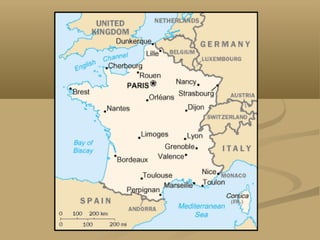
 Location: Western Europe, bordering the Bay of
Biscay and English Channel, between Belgium
and Spain, southeast of the UK; bordering the
Mediterranean Sea, between Italy and Spain
 Border countries: Andorra, Belgium, Germany,
Italy, Luxembourg, Monaco, Spain, Switzerland.
 Government type: republic
 Population: 60,180,529 (July 2003 est.)
 Languages: French 100%, rapidly declining
regional dialects and languages (Provencal,
Breton, Alsatian, Corsican, Catalan, Basque,
Flemish)
 Religions: Roman Catholic 83%-88%, Protestant
2%, Jewish 1%, Muslim 5%-10%, unaffiliated
4%
 GDP – per capita: purchasing power parity -
$26,000 (21st
in the world) (2002 est.)
 Industries: machinery, chemicals, automobiles,
metallurgy, aircraft, electronics; textiles, food
processing; tourism
 Currency: euro (EUR) (CIA, World Fact Book)
Important FactsImportant Facts
 The top destination in the world
 77,0 million international tourist arrivals
 $ 32,3 billion international tourism receipts (the third
after US and Spain) (WTO, 2003)
 Coastline: 3.427 km
 Terrain: mostly flat plains or gently rolling hills
in north and west; remainder is mountainous,
especially Pyrenees in south, Alps in east
 Climate: generally cool winters and mild
summers, but mild winters and hot summers
along the Mediterranean; occasional strong, cold,
dry, north-to-northwesterly wind known as
mistral (CIA, World Fact Book)
Selling PointsSelling Points
 Paris, museums, cathedrals, food, skiing, palaces,
specialty tours (wine, culinary, hiking etc.),
Versailles, mountain climbing, the Louvre,
beaches, the Eiffel Tower, shopping, L’Arc de
Triomphe, nightlife, the Champs Elysees,
sidewalk cafes, health spas, carnivals, casinos, the
Left Bank, Notre Dame, festivals, architecture,
walled medieval towns, the Alps, the coasts,
scenery, canal trips and art and culture
Main AttractionsMain Attractions
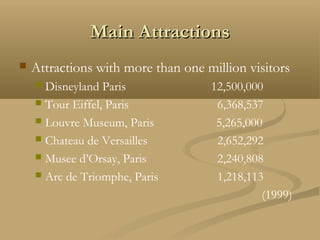
 Attractions with more than one million visitors
 Disneyland Paris 12,500,000
 Tour Eiffel, Paris 6,368,537
 Louvre Museum, Paris 5,265,000
 Chateau de Versailles 2,652,292
 Musee d’Orsay, Paris 2,240,808
 Arc de Triomphe, Paris 1,218,113
(1999)
Brief History and Its Influence onBrief History and Its Influence on
ArchitectureArchitecture
 In 120 BC, Romans occupied France.
 Beautiful arenas, villas, thermal-spring baths in towns
 Followed by the medieval religious orders
 St Jean Baptistery in Poitiers, the Trinity Chapel on
the Bay of Cannes
 1125, Gothic style began in the design of cathedrals
 Such as the ones in Reims, Chartres, Mont-Saint-
Michel
 Renaissance influence
 In the homes and chateaux of the Loire Valley
ParisParis
 The Latin Quarter (meeting place for intellectuals and
students), on the Left Bank of the Seine River
 Boulevard St. Michel, St. Germain des Pres (oldest church in
Paris), Rue Mouffetard (narrow road full of market stalls every
morning, cafes, patisseries, boulangeries), Luxemburg
Gardens, Pantheon (Voltaire, Rousseau, Victor Hugo)
 Hotel des Invalides (military museum holding
Napoleon’s tomb)
 Eiffel Tower
 Lle de la Cie (the island in the Seine, the Cathedral of
Notre Dame)
 Bateaux-Mouches (boat trips on Seine)
 Bridges on the Seine ( 36 bridges in Paris, one of the
most beautiful, Port Alexander III)
 The Georges Pompidou Center (an example of 1970’s
architecture, inside the building – the Musee National
d’Art Moderne (the world’s largest contemporary-art
museum, Picasso)
 Bastille (was site of the prison, July Column in center of
square and modern Opéra de la Bastille, Voltaire)
 Louvre Museum (Mona Lisa, more than 350.000 art
work, Rembrandt section), glass pyramid
 The Place de la Concorde (3300 year-old Egyptian
obelisk of Rameses III from the temple at Luxor)
 Place Vendome, Rue de St. Honore - place of designers
(Hermes, Gucci, etc)
 The old opera house (ceiling repainted by Marc
Chagall), the Avenue de l’Opera
 Boulevard des Champs Elysees (with shops,
showrooms, sidewalk cafes, cinemas), the Arc de
Triomphe
 Hill of Montmartre, the Sacre Coeur Basilica (nice view
over Paris), Montmartre Cemetery (graves of Degas,
Offenbach, Berlioz)
 Cabaret shows (e.g. Moulin Rouge)
 Musee d’Orsay (impressionist collection)
 La Defense, La Grande Arche (modern part of Paris,
famous with its modern architecture)
Vicinity of ParisVicinity of Paris
 Chartres
 one of Europe’s best known cathedrals
 constructed in pure Gothic style (1194-1225)
 Disneyland Paris
 France’s top tourist attraction, over the Eiffel Tower
and the Louvre
 Fontainebleau
 Palace in a huge forest, home of Marie Antoinette,
Napoleon
 Giverny
 home of the impressionist painter Claude Monet, the
beautiful garden he painted
 Loire Valley
 the valley famous with its chateaux, countryside and
villages
 Usse (home of the Sleeping Beauty legend), Clos
Luce (Leonardo da Vinci lived, died, buried), Azay-
le-rideau, Chambord, Amboise.
 barge cruises are available to see the valley (e.g.
Burgundy, Canal du Midi, etc.)
 Reims
 Principal city of the region where champagne is
produced
 Gothic cathedral (kings of France were crowned)
 Versailles
 King Louis XIV
 magnificent halls, the Hall of Mirrors
 big enough to house the king and his 3000 people in
a single building
 famous gardens, Petit Trianon (home-away-from-
home for Queen Marie Antoinette)
Southeastern FranceSoutheastern France
 Aix-en-Provence
 once a Roman spa
 famous with its romantic streets
 studio of painter Paul Cezanne
 Carcassone (famous walled city, only completed
one in Europe)
 Arles
 on the banks of the Rhone River
 Vincent Van Gogh lived and painted
 Cannes
 Cannes Film Festival
 La Croisette, the elegant seaside promenade
 The Palm Beach Casino
 Rue d’Antibes (flower gardens and shopping)
 Marseilles
 the second-most populous city in France
 also an industrial port
 examples of ancient and modern architecture (Notre-
Dame-de-la-Garde Cathedral – 19th
century basilica)
 Puget sculptures at the town hall, Museum of the
Roman Docks
 Monaco
 tiny independent principality
 Visited by gamblers, rich and famous or those who
want to say they have been there
 Casino de Monte Carlo
 beaches, the Oceanographic Museum and Aquarium
(former director Jacques Cousteau), Princess Grace
Rose Garden, the Royal Palace.
 Formula 1 and Tennis Tournament
 Nice
 most famous Riviera town
 in summer (beaches and carnival), in winter
(festivals)
 has strong cultural heritage (Opera House, the
Chagall Museum, fine-arts museum (Monet, Degas,
Renoir and Rodin collections)
 Promenade des Anglais (very old and exclusive
hotels)
 Cagnes-sur-Mer (villa of Renoir)
 Provence
 famous with restaurants and scenery
 The Riviera
 also known as the Cote d’Azur
 famous with its beaches
 beautiful drive from Nice to Monaco
 charming towns such as St. Raphael
 St. Tropez
 poor beach, nice scenery
 shopping, cafes, some museums, people-watch
Western FranceWestern France
 Biarritz
 major city of the Basque region
 top beach resort for rich, famous and retired, golf
courses, casinos, nightlife
 Bordeaux
 wine region
 18th
century architecture in city of Bordeaux
 Brittany
 region of seaside towns and villages
 Mont-Saint-Michel
 founded in the 11th
century
 at high tide, it becomes an island, at low tide, it links
to mainland
 Normandy
 full of history, William the Conqueror launched his
invasion of England, Allies landed in World War II
 beautiful scenery, old towns
Things to RememberThings to Remember
 Museums, chateaux and other historic
monuments (operated by the government) are
closed on Tuesdays
 should be avoided in August (weather and
holiday season)
 best in May-October (except August)
Hotel des InvalidesHotel des Invalides
 founded in 1671 by Louis XIV as
accommodation for disabled and impoverished
war veterans
 the Royal Chapel (church) inside has 107 meters
high dome
 remains of Emperor Napoleon Bonaparte
(Napoleon I) from St Helena brought in 1840
Jardin de LuxembourgJardin de Luxembourg
 most popular park in Paris, near the Sorbonne
University
 was design in 1612, in the 19th
century opened
for the public
 at the center, there is a pond, children can rent
small remote-controlled boats. There is also a
puppet theatre.
 popular with chess players
PantheonPantheon
 originally decided to be a basilica to serve as aoriginally decided to be a basilica to serve as a
tombtomb
 accommodate the remains of the great men ofaccommodate the remains of the great men of
France – some of the most famous buried here;France – some of the most famous buried here;
Victor Hugo, Jean Monnet, Marie/Pierre Curie,Victor Hugo, Jean Monnet, Marie/Pierre Curie,
Emile ZolaEmile Zola
Eiffel TowerEiffel Tower
 the symbol of Paris
 320 meters high, made with 7000 tones of iron,
and 7 million nails, has 1652 steps
 the highest building until the completion of the
Chrysler Building in New York in 1930
 designed by the engineer Gustave Eiffel in 1889
Notre Dame de ParisNotre Dame de Paris
 not the largest cathedral in the world, but maybe
the most famous
 construction started in 1163 and completed
around 1340
 masterpiece of Gothic art; the first cathedral
built on a monumental scale, became prototype
for future cathedrals in France
 has several large rose windows, most impressive
is 21 meters high
 located on the Ile de la Cite, a small island on
Seine (there are three islands on Seine in Paris)
 Napoleon Bonaparte was crowned Emperor in
1804
 restored between 1991 and 2001
Pont Alexander IIIPont Alexander III
 considered most beautiful bridge in Paris by
many
 decorated with lampposts and sculptures of
cherubs and nymphs
 each of the ornaments on the bridge was created
by a different artist
 in 1896, the first stone was laid by the Russian
Tsar Nicholas II. It was named after his father,
Tsar Alexander III.
Louvre MuseumLouvre Museum
 one of the largest museums in the world, maybe
the most famous
 displays about 300.000 works, among them some
world-famous like the Monalisa from Leonardo
da Vinci is present
 the latest addition to the Louvre was the glass
pyramid entrance (one of the finest examples of
a combination of modern and historic
architecture) designed by I. M. Pei
Place de la ConcordePlace de la Concorde
 largest square in Paris (8 hectares)
 sculptures stand all around the square
symbolizing eight French cities
 In 1792, during the French revolution, a
guillotine was installed at the centre of the
square. 1119 people were beheaded, including
Marie Antoinette.
 at the square, there is a 33 century old obelisk
brought back from Luxor in 1833.
Opera GarnierOpera Garnier
 most important symbol of 19th
century Baroque
style
 designed by Charles Garnier for Emperor
Napoleon III
 the largest theatre in the world by acreage (not
seating capacity, 2200 seats)
 interior is very luxuries, can be compared with
the corridors in Versailles
 construction started in 1862, not completed until
1875, partly because an underground lake was
discovered. The small lake still exists under the
building. It was the hiding place of the
“Phantom of the Opera” in Paul Leroux’s
famous play.
 after the modern Opera de Paris Bastille’s
opening in 1989, now mainly used for ballet
performances
 its large ceiling was painted by Marc Chagall in
1964
Champs-ElyseesChamps-Elysees
 world’s most beautiful avenue
 place of entertainment with cinemas, cafes, also
where prestigious companies have headquarters
Arc de TriompheArc de Triomphe
 built in the honor of Napoleonic armies
 stands 49 meters high at the center of Place
Charles de Gaulle
 adorned with many reliefs, most of them
commemorating previous battles (including
Napoleon’s victory over the Turkish – battle of
Aboukir)
 At the top of the arc, there are 30 shield,
representing one of Napoleon’s successful
battles
 12 street radiate from the circular square. The
streets are named after French military leaders
Sacre Couer BasilicaSacre Couer Basilica
 located on Montmartre, where is known for its
many artists who have been omnipresent since
1880
 Roman-Byzantype style basilica, stands in sharp
contrast with other contemporary buildings in
France (Romanesque style)
 built as moral condemnation of the signs of Paris
which believed to be the cause of the defeat of
the French army against Prussia in 1870
Musee d’OrsayMusee d’Orsay
 former railway station (Gare d’Orsay)
 has one of the most prominent site along Seine
opposite Louvre
 built in the beginning of the 20th
century, after 30
years, around 1930, platforms became too short
for the trains. In 1939, the place was out of use
as a train station. Over time, it was used as a
parking lot, theatre location, reception centre for
prisoners of war
 in 1978, decided to be used as a museum for
19th
and 20th
century art – including art forms of
sculptures, photos, films etc. After its
restoration, opened in 1986
 contains 2300 paintings, 1500 sculptures, 100
other objects
 contains works from Monet, Renoir, Cezanne,
Van Gogh
La DefenseLa Defense
 at the end of the I. World War, plans were made
to develop the axis of the Arc de Triomphe, not
realized because the Great Depression in 1930s.
 in 1951, the area was chosen as an office center
 in 1958, development of the area was started
 now, international business district of Paris
 Grande Arche de la Defense; the project was
initiated by the French president Mitterrand who
wanted a XXth century Arc de Triomphe
 106 meters high white building with middle part
left open, sides contain offices, lift can be taken
to the top (a nice view of Paris of 4km further)
Chateau de VersaillesChateau de Versailles
 at the time of Louis XIII, it was a modest
hunting lodge
 Louis XIV turned it into a royal palace,
abandoned Louvre for this
 until 1789, used as the royal palace
 In 1837, decided to be converted into a museum
 France
http://www.discoverfrance.net/
 Bridges in Paris
http://www.lcpc.fr/en/sources/paris/index.dml
 Bateaux-Mouches
http://discoverfrance.net/France/Transportation/Water/Bateaux-Mouc
 Chateau de Versailles
http://.chateauversailles.fr
For More InfoFor More Info

France

  • 1.
  • 2.
    FranceFrance  Country name:French Republic, France  Capital: Paris  Location: Western Europe, bordering the Bay of Biscay and English Channel, between Belgium and Spain, southeast of the UK; bordering the Mediterranean Sea, between Italy and Spain  Border countries: Andorra, Belgium, Germany, Italy, Luxembourg, Monaco, Spain, Switzerland.
  • 4.
     Government type:republic  Population: 60,180,529 (July 2003 est.)  Languages: French 100%, rapidly declining regional dialects and languages (Provencal, Breton, Alsatian, Corsican, Catalan, Basque, Flemish)  Religions: Roman Catholic 83%-88%, Protestant 2%, Jewish 1%, Muslim 5%-10%, unaffiliated 4%  GDP – per capita: purchasing power parity - $26,000 (21st in the world) (2002 est.)
  • 5.
     Industries: machinery,chemicals, automobiles, metallurgy, aircraft, electronics; textiles, food processing; tourism  Currency: euro (EUR) (CIA, World Fact Book)
  • 6.
    Important FactsImportant Facts The top destination in the world  77,0 million international tourist arrivals  $ 32,3 billion international tourism receipts (the third after US and Spain) (WTO, 2003)  Coastline: 3.427 km  Terrain: mostly flat plains or gently rolling hills in north and west; remainder is mountainous, especially Pyrenees in south, Alps in east
  • 7.
     Climate: generallycool winters and mild summers, but mild winters and hot summers along the Mediterranean; occasional strong, cold, dry, north-to-northwesterly wind known as mistral (CIA, World Fact Book)
  • 8.
    Selling PointsSelling Points Paris, museums, cathedrals, food, skiing, palaces, specialty tours (wine, culinary, hiking etc.), Versailles, mountain climbing, the Louvre, beaches, the Eiffel Tower, shopping, L’Arc de Triomphe, nightlife, the Champs Elysees, sidewalk cafes, health spas, carnivals, casinos, the Left Bank, Notre Dame, festivals, architecture, walled medieval towns, the Alps, the coasts, scenery, canal trips and art and culture
  • 9.
    Main AttractionsMain Attractions Attractions with more than one million visitors  Disneyland Paris 12,500,000  Tour Eiffel, Paris 6,368,537  Louvre Museum, Paris 5,265,000  Chateau de Versailles 2,652,292  Musee d’Orsay, Paris 2,240,808  Arc de Triomphe, Paris 1,218,113 (1999)
  • 10.
    Brief History andIts Influence onBrief History and Its Influence on ArchitectureArchitecture  In 120 BC, Romans occupied France.  Beautiful arenas, villas, thermal-spring baths in towns  Followed by the medieval religious orders  St Jean Baptistery in Poitiers, the Trinity Chapel on the Bay of Cannes  1125, Gothic style began in the design of cathedrals  Such as the ones in Reims, Chartres, Mont-Saint- Michel  Renaissance influence  In the homes and chateaux of the Loire Valley
  • 11.
    ParisParis  The LatinQuarter (meeting place for intellectuals and students), on the Left Bank of the Seine River  Boulevard St. Michel, St. Germain des Pres (oldest church in Paris), Rue Mouffetard (narrow road full of market stalls every morning, cafes, patisseries, boulangeries), Luxemburg Gardens, Pantheon (Voltaire, Rousseau, Victor Hugo)  Hotel des Invalides (military museum holding Napoleon’s tomb)  Eiffel Tower  Lle de la Cie (the island in the Seine, the Cathedral of Notre Dame)  Bateaux-Mouches (boat trips on Seine)
  • 12.
     Bridges onthe Seine ( 36 bridges in Paris, one of the most beautiful, Port Alexander III)  The Georges Pompidou Center (an example of 1970’s architecture, inside the building – the Musee National d’Art Moderne (the world’s largest contemporary-art museum, Picasso)  Bastille (was site of the prison, July Column in center of square and modern Opéra de la Bastille, Voltaire)  Louvre Museum (Mona Lisa, more than 350.000 art work, Rembrandt section), glass pyramid  The Place de la Concorde (3300 year-old Egyptian obelisk of Rameses III from the temple at Luxor)  Place Vendome, Rue de St. Honore - place of designers (Hermes, Gucci, etc)
  • 13.
     The oldopera house (ceiling repainted by Marc Chagall), the Avenue de l’Opera  Boulevard des Champs Elysees (with shops, showrooms, sidewalk cafes, cinemas), the Arc de Triomphe  Hill of Montmartre, the Sacre Coeur Basilica (nice view over Paris), Montmartre Cemetery (graves of Degas, Offenbach, Berlioz)  Cabaret shows (e.g. Moulin Rouge)  Musee d’Orsay (impressionist collection)  La Defense, La Grande Arche (modern part of Paris, famous with its modern architecture)
  • 14.
    Vicinity of ParisVicinityof Paris  Chartres  one of Europe’s best known cathedrals  constructed in pure Gothic style (1194-1225)  Disneyland Paris  France’s top tourist attraction, over the Eiffel Tower and the Louvre  Fontainebleau  Palace in a huge forest, home of Marie Antoinette, Napoleon
  • 15.
     Giverny  homeof the impressionist painter Claude Monet, the beautiful garden he painted  Loire Valley  the valley famous with its chateaux, countryside and villages  Usse (home of the Sleeping Beauty legend), Clos Luce (Leonardo da Vinci lived, died, buried), Azay- le-rideau, Chambord, Amboise.  barge cruises are available to see the valley (e.g. Burgundy, Canal du Midi, etc.)
  • 16.
     Reims  Principalcity of the region where champagne is produced  Gothic cathedral (kings of France were crowned)  Versailles  King Louis XIV  magnificent halls, the Hall of Mirrors  big enough to house the king and his 3000 people in a single building  famous gardens, Petit Trianon (home-away-from- home for Queen Marie Antoinette)
  • 17.
    Southeastern FranceSoutheastern France Aix-en-Provence  once a Roman spa  famous with its romantic streets  studio of painter Paul Cezanne  Carcassone (famous walled city, only completed one in Europe)  Arles  on the banks of the Rhone River  Vincent Van Gogh lived and painted
  • 18.
     Cannes  CannesFilm Festival  La Croisette, the elegant seaside promenade  The Palm Beach Casino  Rue d’Antibes (flower gardens and shopping)  Marseilles  the second-most populous city in France  also an industrial port  examples of ancient and modern architecture (Notre- Dame-de-la-Garde Cathedral – 19th century basilica)  Puget sculptures at the town hall, Museum of the Roman Docks
  • 19.
     Monaco  tinyindependent principality  Visited by gamblers, rich and famous or those who want to say they have been there  Casino de Monte Carlo  beaches, the Oceanographic Museum and Aquarium (former director Jacques Cousteau), Princess Grace Rose Garden, the Royal Palace.  Formula 1 and Tennis Tournament  Nice  most famous Riviera town  in summer (beaches and carnival), in winter (festivals)
  • 20.
     has strongcultural heritage (Opera House, the Chagall Museum, fine-arts museum (Monet, Degas, Renoir and Rodin collections)  Promenade des Anglais (very old and exclusive hotels)  Cagnes-sur-Mer (villa of Renoir)  Provence  famous with restaurants and scenery  The Riviera  also known as the Cote d’Azur  famous with its beaches  beautiful drive from Nice to Monaco  charming towns such as St. Raphael
  • 21.
     St. Tropez poor beach, nice scenery  shopping, cafes, some museums, people-watch
  • 22.
    Western FranceWestern France Biarritz  major city of the Basque region  top beach resort for rich, famous and retired, golf courses, casinos, nightlife  Bordeaux  wine region  18th century architecture in city of Bordeaux  Brittany  region of seaside towns and villages
  • 23.
     Mont-Saint-Michel  foundedin the 11th century  at high tide, it becomes an island, at low tide, it links to mainland  Normandy  full of history, William the Conqueror launched his invasion of England, Allies landed in World War II  beautiful scenery, old towns
  • 24.
    Things to RememberThingsto Remember  Museums, chateaux and other historic monuments (operated by the government) are closed on Tuesdays  should be avoided in August (weather and holiday season)  best in May-October (except August)
  • 25.
    Hotel des InvalidesHoteldes Invalides  founded in 1671 by Louis XIV as accommodation for disabled and impoverished war veterans  the Royal Chapel (church) inside has 107 meters high dome  remains of Emperor Napoleon Bonaparte (Napoleon I) from St Helena brought in 1840
  • 26.
    Jardin de LuxembourgJardinde Luxembourg  most popular park in Paris, near the Sorbonne University  was design in 1612, in the 19th century opened for the public  at the center, there is a pond, children can rent small remote-controlled boats. There is also a puppet theatre.  popular with chess players
  • 27.
    PantheonPantheon  originally decidedto be a basilica to serve as aoriginally decided to be a basilica to serve as a tombtomb  accommodate the remains of the great men ofaccommodate the remains of the great men of France – some of the most famous buried here;France – some of the most famous buried here; Victor Hugo, Jean Monnet, Marie/Pierre Curie,Victor Hugo, Jean Monnet, Marie/Pierre Curie, Emile ZolaEmile Zola
  • 28.
    Eiffel TowerEiffel Tower the symbol of Paris  320 meters high, made with 7000 tones of iron, and 7 million nails, has 1652 steps  the highest building until the completion of the Chrysler Building in New York in 1930  designed by the engineer Gustave Eiffel in 1889
  • 29.
    Notre Dame deParisNotre Dame de Paris  not the largest cathedral in the world, but maybe the most famous  construction started in 1163 and completed around 1340  masterpiece of Gothic art; the first cathedral built on a monumental scale, became prototype for future cathedrals in France  has several large rose windows, most impressive is 21 meters high
  • 30.
     located onthe Ile de la Cite, a small island on Seine (there are three islands on Seine in Paris)  Napoleon Bonaparte was crowned Emperor in 1804  restored between 1991 and 2001
  • 31.
    Pont Alexander IIIPontAlexander III  considered most beautiful bridge in Paris by many  decorated with lampposts and sculptures of cherubs and nymphs  each of the ornaments on the bridge was created by a different artist  in 1896, the first stone was laid by the Russian Tsar Nicholas II. It was named after his father, Tsar Alexander III.
  • 32.
    Louvre MuseumLouvre Museum one of the largest museums in the world, maybe the most famous  displays about 300.000 works, among them some world-famous like the Monalisa from Leonardo da Vinci is present  the latest addition to the Louvre was the glass pyramid entrance (one of the finest examples of a combination of modern and historic architecture) designed by I. M. Pei
  • 33.
    Place de laConcordePlace de la Concorde  largest square in Paris (8 hectares)  sculptures stand all around the square symbolizing eight French cities  In 1792, during the French revolution, a guillotine was installed at the centre of the square. 1119 people were beheaded, including Marie Antoinette.  at the square, there is a 33 century old obelisk brought back from Luxor in 1833.
  • 34.
    Opera GarnierOpera Garnier most important symbol of 19th century Baroque style  designed by Charles Garnier for Emperor Napoleon III  the largest theatre in the world by acreage (not seating capacity, 2200 seats)  interior is very luxuries, can be compared with the corridors in Versailles
  • 35.
     construction startedin 1862, not completed until 1875, partly because an underground lake was discovered. The small lake still exists under the building. It was the hiding place of the “Phantom of the Opera” in Paul Leroux’s famous play.  after the modern Opera de Paris Bastille’s opening in 1989, now mainly used for ballet performances  its large ceiling was painted by Marc Chagall in 1964
  • 36.
    Champs-ElyseesChamps-Elysees  world’s mostbeautiful avenue  place of entertainment with cinemas, cafes, also where prestigious companies have headquarters
  • 37.
    Arc de TriompheArcde Triomphe  built in the honor of Napoleonic armies  stands 49 meters high at the center of Place Charles de Gaulle  adorned with many reliefs, most of them commemorating previous battles (including Napoleon’s victory over the Turkish – battle of Aboukir)
  • 38.
     At thetop of the arc, there are 30 shield, representing one of Napoleon’s successful battles  12 street radiate from the circular square. The streets are named after French military leaders
  • 39.
    Sacre Couer BasilicaSacreCouer Basilica  located on Montmartre, where is known for its many artists who have been omnipresent since 1880  Roman-Byzantype style basilica, stands in sharp contrast with other contemporary buildings in France (Romanesque style)  built as moral condemnation of the signs of Paris which believed to be the cause of the defeat of the French army against Prussia in 1870
  • 40.
    Musee d’OrsayMusee d’Orsay former railway station (Gare d’Orsay)  has one of the most prominent site along Seine opposite Louvre  built in the beginning of the 20th century, after 30 years, around 1930, platforms became too short for the trains. In 1939, the place was out of use as a train station. Over time, it was used as a parking lot, theatre location, reception centre for prisoners of war
  • 41.
     in 1978,decided to be used as a museum for 19th and 20th century art – including art forms of sculptures, photos, films etc. After its restoration, opened in 1986  contains 2300 paintings, 1500 sculptures, 100 other objects  contains works from Monet, Renoir, Cezanne, Van Gogh
  • 42.
    La DefenseLa Defense at the end of the I. World War, plans were made to develop the axis of the Arc de Triomphe, not realized because the Great Depression in 1930s.  in 1951, the area was chosen as an office center  in 1958, development of the area was started  now, international business district of Paris  Grande Arche de la Defense; the project was initiated by the French president Mitterrand who wanted a XXth century Arc de Triomphe
  • 43.
     106 metershigh white building with middle part left open, sides contain offices, lift can be taken to the top (a nice view of Paris of 4km further)
  • 44.
    Chateau de VersaillesChateaude Versailles  at the time of Louis XIII, it was a modest hunting lodge  Louis XIV turned it into a royal palace, abandoned Louvre for this  until 1789, used as the royal palace  In 1837, decided to be converted into a museum
  • 45.
     France http://www.discoverfrance.net/  Bridgesin Paris http://www.lcpc.fr/en/sources/paris/index.dml  Bateaux-Mouches http://discoverfrance.net/France/Transportation/Water/Bateaux-Mouc  Chateau de Versailles http://.chateauversailles.fr For More InfoFor More Info