Seven Steps to Making a Difference for the World
Dr. Leo P. Corriveau, Plymouth State University
Step 1: Preparation for Leadership
In some fundamental sense, we can not learn how to have
relationships, how to raise kids, how to lead others – how to be
human, if you will. Why? Because to a great extent it is the very
condition of not knowing, of being vulnerable to and surprised
by life, of being unable to manage or control our lovers, our
children, or our colleagues that makes us human. (Farson, 40)
We can not begin to accept the responsibility of leadership
without first acknowledging our humanity, both in its limits and
its marvels. The first task in knowing that humanity is to come
to terms with the limitations that being human places upon us
and, paradoxically, by accepting these limitations we free
ourselves to receive the boundless riches that human existence
holds for each of us. We who lead cannot afford the self
congratulation which comes from seeing ourselves above the
fray of human striving, nor can we allow ourselves to be fooled
by the skewed vision that such egotism affords. Instead, if we
are to be worthy of guiding others, we must first have the
strength to accept our own human failings for we cannot see the
truth in others until we see the truth in ourselves.
Bennis writes, “To become a leader, then, you must become
yourself, become the maker of your own life”. He observes that
knowing thyself is “the most difficult task any of us faces. But
until you truly know yourself, strengths and weaknesses, know
what you want to do and why you want to do it, you cannot
succeed in any but the most superficial sense of the word.”
(Kouzes, 59)
Bennis is doing more than simply encouraging us to become the
“captain of our own ship”. The making of a life in the truest
sense happens from the inside out and not from the outside in.
We are, many times, so busy becoming who we think we need to
be (or should be) that we often ignore that faint voice of the
true self within our soul. The choice to reconcile that faint inner
voice with the cacophony of the outer world and to balance the
two within our human being takes courage to begin,
determination to continue, and humility to accept the truths that
unfold. Such a life journey will in the end afford you a sense of
who you are, your place in the world, and that you belong where
you have chosen to be.
Our best qualities are integrity, dedication, magnanimity,
humility, openness, and creativity. These, of course, are the
basic ingredients of leadership, and our unwillingness to tap
these qualities in ourselves explains, to a large extent, the
leadership shortage. (Bennis, 117)
“The spirit is willing but the flesh is weak” Each human being
is filled with the great qualities of the human race. The choice
to use those qualities or more precisely to answer to their
demands is not easy and, many times, is contradictory to our
own sense of self preservation. There will always be a shortage
of leaders because the way of the honorable leader is strewn
with the choice between “doing what is right for me” and
“doing what is right for all”. To lead with honor is to accept
one’s responsibility to do what is right for all, to uphold one’s
faith in the goodness of humankind, and to do so with full
knowledge of the probable cost to one’s self.
Step 2: The Notion of Trust
Being seen as someone who can be trusted, who has high
integrity, and who is honest and truthful is essential. But if you
have a sense that the person is not being honest, you will not
accept the message, and you will not willingly follow. So the
credibility check can reliably be simplified to just one question:
“Do I trust this person?” (Kouzes, 24)
People who choose to follow do so as much for emotional
reasons as for rational ones. Trust is one of those “gut
feelings”. Trusting someone does not mean that we assume they
will make no mistakes. On the contrary, trust implies that when
that person does make mistakes that those errors were made
from a position of honor and integrity. We choose to follow
because we trust at a “gut level” not that they are always going
to be right but instead, that they are always seeking to do what
is right.
Leaders must reach out and attend to all their constituents if
they wish to be credible. Credibility, like quality and service,
is determined by the constituents, so leaders must be able to
view themselves as their constituents do. It requires effort and
new skills; one benefit is that a natural by-product of attending
to other people is that they in turn come to trust us and we trust
them. (Kouzes, 90)
Trust in leadership is not created by those who lead it is given
by those who follow.
Step 3: Focus & Clarity
As perspective is vital to the painter or writer, it is vital to
leaders and their associates. (Bennis, 158)
Perspective, it should be remembered, is from a single point or
position and therefore there are as many perspectives of what is
seen as there are positions to see it from. Artists must be able to
visualize how others see differently from different positions and
more importantly, how others see differently from the exact
same position as the artist. So too, must leaders. It should also
be remembered that what the artist “sees” not only comes from
what they empirically observe but from what they feel in their
heart and what resonates in their soul. So too, must leaders.
Gandhi said, “We must be the change we wish to see in the
world.” (Bennis, 154)
Leadership is about living the vision. To create the pathway
between the present and the future for others to follow we must
be the bridge which connects the two. This can only be done by
consciously living our vision of the future in the present
moment.
All leaders see in a special way … Leaders never confuse that
which is real with that which is reality … Furthermore, leaders
know that what we see is completely a matter of choice. But
beyond all that, leaders know that how we see and what we see
are exactly the same. (Cook, 41)
What “is” is. How we see it (interpret it), however, is a matter
of our own choosing. We all have elected at one time or another
to look the other way when faced with harsh facts of what “is”.
Intellectually or emotionally it is many times an understandable
necessity for survival. But it therefore also follows that we can
choose to change the depth of our intellectual and emotional
vision and see beyond the constraints of what we perceive to be
our present reality. Leaders need to have the courage to say as
Martin Luther King said, “I have a dream.”
Step 4: Commitment
A Chinese proverb is useful in this regard: “Tell me, I may
listen. Teach me, I may remember. Involve me, I will do it.”
(Kouzes, 146)
Commitment is not possible to attain without caring. Caring is
never about the outside it always about the inside. Until a leader
creates a way for people to feel involved they will not be able to
generate the emotional linkage between involvement, caring,
and committing.
One of the most common mistakes made in attempting to create
shared values is announcing which are most important and
should guide the department (or company). Instead leaders
must cast the net widely to capture the broadest possible
understanding of constituents’ values. Participation is vital, for
people’s perspectives change once they are involved. If the key
question asked is “what principles should we have?” merely
rhetorical statements will result, (Kouzes, 125)
The whole is always greater than the sum of its parts. As more
parts are added, the identity of the whole will change. All parts
of the whole share in this identity and each newly added part
changes how all of the parts share that common identity. This
identity therefore needs to remain dynamic in order to remain
authentic. Stasis (balance) of the whole is maintained by the
constant change in the relationship between the parts to
maintain identity. Interference from outside the system will
result in an imbalance that the parts cannot efficiently respond
to since they respond best to changes within the authentic
identity that they all share.
The creation of the shared vision of an organization must
respond to these system principles.
Creating a shared vision honoring these principles will
strengthen and increase commitment. If a leader wants to be a
part of this system he/she must join as a “part of the whole” in
order to keep the process authentic.
… for a strong community and for strong and vibrant
organizations, we must be willing to make other people’s
problems our own and to live them together. (Kouzes, 129)
Empathy receives a lot of lip service. It is easy to “talk the talk”
but much tougher to “walk the walk”. If a leader says, “I
believe in you, how can I help?” they had better be willing to
put their heart and soul where their mouth is. People commit to
leader who has made a commitment to them.
Step 5: Marshalling Resources
We have all seen leaders who successfully move from one
organization to another even though they may not be expert in
the second organization’s business. They are able to do this
because they define their task as evoking the knowledge skills
and creativity of those who are already within the organization.
They are secure enough in their own identities to be able to be
influenced by new information and to accept the ideas of others
in the group. They are especially able to elicit the intelligence
and participation of group members who otherwise might not
join in. (Farson, 145)
Most people know how to solve their own problems they just
can’t seem to get around to it. Many times what they appreciate
and need is a little encouragement in getting started. Leadership
then becomes a matter of pointing out (hopefully with kindness)
that the reason they have trouble moving forward is because
they are stepping on their own feet.
How do we identify and develop such innovators? How do we
spot new information in institutions, organizations, and
professions? Innovators, like all creative people, see things
differently; think in fresh and original ways. They have useful
contacts in other areas, other institutions; they are seldom seen
as good organization men or women and often viewed as
mischievous troublemakers. The true leader not only is him- or
herself an innovator but makes every effort to locate and use
other innovators in the organization. He or she creates a
climate in which conventional wisdom can be questioned and
challenged and one in which errors are embraced rather than
shunned in favor of safe, low-risk goals. (Bennis, 29 - 30)
If doing things the same old way was the best adaptation to
change dinosaurs would still alive. Limiting resources to what
has always been in the past limits the possibility of what can be
in the future. Life demands fresh and original ideas. Leaders
welcome that which is fresh and original because to do so is to
welcome life into their cause.
If people of authority are to succeed, they must know
themselves and listen to themselves, integrating their ideals and
actions but being able, at the same time, to tolerate the gap
between the desirable and the necessary as they work to close it.
They must know how to not merely listen but hear, not merely
look but see, to play as hard as they work, and to live with
ambiguity and inconsistency. The ultimate test of anyone in
authority is whether he or she can successfully ride and direct
the tides of change and, in doing so, grow stronger. As
Sophocles said, “It is hard to learn the mind of any mortal, or
the heart, till he be tried in chief authority. Power shows the
man” (Antigone). And the thoughtful, imaginative, and
effective use of power is what separates leaders from people in
authority. (Bennis, 156)
There is no greater resource for leaders than to know they can
trust the internal compass that guides their being. That although
there will be times of doubt and indecision, if granted the
needed time it will find a way to point true. In the course of
events there will be much need to hear outside council, to see
what cannot be turned away from, to laugh with what life
presents, and to accept the doubt and regret that is part of being
human. But when all of this is done it is to one’s inner self that
leaders must return and know in their heart that their internal
compass pointed true and that from it they chose an honorable
course.
Step 6: Achievement & Celebration
Leadership can be felt throughout an organization. It gives pace
and energy to the work and empowers the work force.
Empowerment is the collective effect of leadership. In
organizations with effective leaders, empowerment is most
evident in four themes:
1. People feel significant.
2. Learning and competence matter.
3. People are part of a community.
4. Work is exciting. (Bennis, 23)
People need to believe that what they do matters. They need to
feel a sense of gratification for a job well done. There very few,
if any external motivations, that will create the will to achieve
as well as the internal knowledge that what they are trying to do
is recognized as something that makes a difference.
“[Your goal is] not to achieve wholeness by suppressing
diversity, not to make wholeness impossible by enthroning
diversity, but to preserve both. Each element in the diversity
must be respected, but each must ask itself sincerely what it can
contribute to the whole. I don’t think it is venturing beyond the
truth to say that “wholeness incorporating diversity” defines the
transcendent task for your generation.” (Kouzes, 124,125)
We are all striving to find our individual selves as well as find
our place among others. We as leaders must encourage this
process to be open and honest both to each individual and
between all who are together. We must find ways each day to
enable people to quietly celebrate each others’ unique
contribution to what we have achieved together.
Leaders do not avoid, repress, or deny conflict, but rather see it
as an opportunity. Once everyone has come to see it that way,
they can exchange their combative posture for a creative stance,
because they don’t feel threatened, they feel challenged.
(Bennis, 158)
If we are to achieve, we need to celebrate the arrival of the
opportunity to try. This does not mean that we are blind to the
effort, hardship and disappointment that may lie along the
journeys that such opportunities provide for us. But along with
these harsh realities, we use our faith in our abilities and that of
our peers to acknowledge the strengths that we have together.
As long as we are willing to be a part of that mutual creative
strength we know that we are not alone and can rely on the
agreements and disagreements of our peers to move forward
towards what we need to achieve.
Step 7: Renewal
We must learn how to harness the commitment of our people –
then our commitment to building a better world will have some
meaning … This requires a new paradigm, a new model of how
organizations work – organizations that operate in a continual
learning mode, creating change. (Senge, 348 – 349)
Organizations are given life through the people within them.
Therefore in order to create change in an organization there
must a way to create change in the individual. It is not enough
to do what has always been successful, individually or
organizationally, because the possibilities of learning then
stagnate and become barriers to rather than liberators of human
thought. As leaders we must be willing to enable others to seek
out their own liberators of human thought and use those
moments to refresh and renew themselves, each other, and the
vision they all share.
Choice is different from desire. Try an experiment. Say, “I
want.” Now, say, “I choose.” What is the difference? For most
people, “I want is passive; “I choose” is active. For most
wanting is a state if deficiency – we want what we do not have.
Choosing is a state of sufficiency – electing to have what we
truly want. For most of us, as we look back over our life, we
can see that certain choices we made are played a pivotal role in
how our life developed. So too, will the choices we make in the
future be pivotal. (Senge, 360)
Choice is part of renewal. We cannot renew without making an
active choice to do so. We can (and do) want many things but it
is when we make the choice to pursue one option and put aside
others that the chance of renewal becomes available to us. We
must then accept that we need to leave behind what is past, no
matter how comfortable, and choose to move on.
To search for understanding, knowing there is no ultimate
answer, becomes a creative process – one which involves
rationality but also something more … Einstein said, that “the
most beautiful thing we can experience is the mysterious. It is
the source of all true art and science.” (Senge, 282 – 283)
Our work is never done. That is both good and bad news. The
possibilities are so vast though that one need never tire of
looking to the stars and searching for ways to touch them.
______________________________________
References:
Farson, Management of the Absurd
Kouzes and Posner, Credibility
Warren Bennis, Why Leaders Can’t Lead
Peter Senge, The Fifth Discipline
William Cook, Strategics
Arthur M. Young, The Theory of Process
1 of 7
Journal of Surgical Research 138, 1–9 (2007)
The Leadership Dilemma
Wiley W. Souba, MD, ScD, MBA
Office of the Dean and the Department of Surgery, Ohio State
University College of Medicine and the Ohio State University
Medical
Center, Columbus, Ohio
Submitted for publication December 30, 2006
doi:10.1016/j.jss.2007.01.003
How do we make leadership happen?
To answer this somewhat odd question, we must
address both the what and the how. And herein lies the
problem, at least the root of it. To be candid, we are not
sure what leadership is (i.e., what the work of leader-
ship entails) and we are even less sure how to make it
work. It is uncomfortable and awkward for people who
think of themselves as leaders to admit that they some-
times feel incompetent exercising leadership.
Most of us come to the table with a fixed and prede-
termined set of assumptions on how leadership works
and how to exercise it (our implicit leadership theory).
These assumptions are bolted firmly to our DNA. It is
exceedingly difficult to pry us loose from these deeply
entrenched beliefs. But we must be willing to let go.
Why? Because many of the challenges that confront us
today are enormously complex and varied and our in-
grained implicit leadership theory doesn’t always work
in solving them. Different contexts call for different
leadership strategies. We need to learn new ways of
making leadership happen.
This is our leadership dilemma. Despite agreement
that effective leadership is one of the most important
(if not the single most important) determinants of or-
ganizational performance and success, we are still not
sure how to make leadership happen. Many of the
approaches that worked in the past are not as relevant
today. Yet we continue to flail, using leadership ap-
proaches that are out of date, limited under the best of
circumstances, destructive under the worst.
Leadership doesn’t happen on its own. It’s up to us to
make it happen. Indeed, we make it happen everyday
through the choices we make and actions we take,
sometimes for better, sometimes for worse. We want to
make the right choices so we make responsible leader-
ship happen but at times we encounter barriers. Some-
times the barriers are evident—a disruptive person(s),
vague goals, lack of support from the top, insufficient
resources, or incorrect information. But not infre-
1
quently the obstacles are not clear or we are not aware
of them and we are left not knowing how to tackle a
leadership challenge.
OBSTACLES TO CREATING AND EXERCISING
EFFECTIVE LEADERSHIP
The purpose of this article is to examine some of the
not so obvious obstacles to making leadership happen.
We will not be able to remove (or at the very least
reduce) these leadership barriers unless and until we
understand them and recognize them. There are at
least nine and they are cleverly at play everyday in our
organizations.
Lack of a Language Taxonomy
One of the very first obstacles we must confront in
understanding leadership is that we don’t have a consis-
tent and agreed upon language of leadership. It’s difficult
to talk and think about “leadership,” let alone exercise it
effectively, without a baseline, shared meaning. A func-
tional taxonomy should give us a common, coherent and
meaningful structure to the way we talk about and make
sense of the word leadership. A shared meaning system
will help us better understand leadership and think more
intently about how we make it happen.
Language is the most formal of human meaning
systems [1]. A system of meaning is a set of relation-
ships between one group of variables (like words) and
the meanings which are attached to them. Relation-
ships in meaning systems are arbitrary; there is no
particular reason why the word “kidney” should refer
to a bean-shaped organ in the retroperitoneum that
makes urine, for example. However, when we (as a
society or profession) agree upon certain relationships
between certain words and their meanings, a system of
meaning is established.
We have a consistent and agreed upon language
meaning system in medicine. When we use words like
0022-4804/07 $32.00
© 2007 Elsevier Inc. All rights reserved.
2 JOURNAL OF SURGICAL RESEARCH: VOL. 138, NO. 1,
MARCH 2007
ischemia, anuria, jaundice, cirrhosis or abscess there is
a widely shared understanding among clinicians as to
what they mean. On the other hand, words like leader,
leadership, management, change, power and
authority—which make up the language of
leadership—are used in ways that are often synony-
mous, occasionally contradictory, and not infrequently
confusing. When the basic building blocks are not
agreed on, it’s difficult to build a language taxonomy.
Consider the two most common ways we use the
word “leadership” in everyday conversation. Usually,
we use it to describe an individual—we say, for exam-
ple, that John is providing good leadership in the can-
cer center. Implicit in this assertion is that John,
through his choices, actions and behaviors, is moving
the cancer center in the right direction. Other times,
we use the word leadership to refer to a group of
individuals at the “top” of the organization who make
important decisions, allocate resources and set direc-
tion. Whether these people are actually exercising ef-
fective leadership as described in the first example is
often debatable. Ken Lay was regularly referred to as
Enron’s leader but was he exercising good leadership?
Developing a more robust meaning system for the
word leadership is essential. For example, we must be
clear that there is a difference between a leader and
leadership. One refers to a person, the other to an
activity or a capacity. Some leaders exercise good lead-
ership, some exercise bad leadership and others don’t
lead at all. Some people who have never been viewed by
themselves or by others as leaders have exercised ex-
traordinary leadership (e.g., Rosa Parks). Much of the
leadership they exercise goes unnoticed. Leadership
from individuals who have little formal authority is
frequently subtle and unheralded. Thousands of these
small acts of leadership happen every day and collec-
tively they help to move the organization forward and
shape its destiny.
If we can create a more functional language meaning
system, perhaps we will become more competent in tackling
the many leadership challenges that confront us.
Today’s Popular Notions of Leadership Are Inadequate
We tend to think of leadership as being about a
person who dominates, wields power, stands apart and
stands above. This view distinguishes leadership as a
skill or proficiency held by a handful of people we call
“leaders” because they are “in charge” or have posi-
tional authority. The model constructs leadership as
the possession of a person who gives orders and com-
mands power. The leader “acts” on followers to create
leadership. We expect leaders to exercise good leader-
ship that has a positive impact on people and the
organization. History, however, is riddled with exam-
ples of bad leadership.
The word “leader” often brings to mind vivid images:
the technically gifted surgeon; the brilliant scientist;
the superb clinician and gifted teacher; the faculty
member who starts a program from scratch and builds
an empire. By and large, our view of leadership tends
to center around visible individuals and their talents,
their achievements and often their clout.
This implicit leadership theory—leadership equated
with a person in charge who sets goals and gets people
to follow–is pervasive. It is the way most CXOs, deans,
department chairs and faculty think about leadership.
We learned to think this way from our superiors and
role models. This way of thinking about and exercising
leadership happens without much conscious intent and
thus is difficult to challenge or even discuss. It has
become woven seamlessly into the fabric of academic
medicine’s culture.
This view of leadership is not wrong, but it is no
longer adequate. It is an appropriate model when the
leader possesses the required abilities/skills to solve
the problem alone or by directing others. But in many
circumstances it is limited. Many of the challenges that
confront our academic health centers (AHCs) today are
so complex and unpredictable that it is practically im-
possible for one person to accomplish the work of lead-
ership alone.
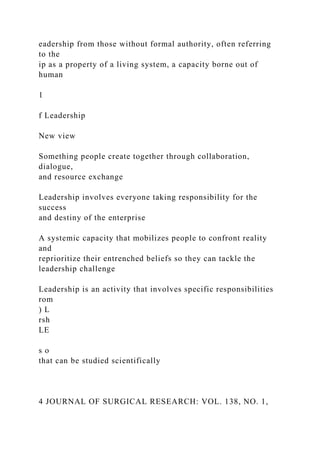
In addition to the “leadership from a leader” model,
there are at least three other ways of understanding
leadership (Fig. 1). As mentioned earlier, we some-
times use the word leadership when we refer to those
individuals at the top of the organization who set di-
rection, allocate resources, and make decisions. We
talk about the “senior leadership” or the “leadership of
the medical center” or the “leadership of the nation.”
We presume that this group exercises good leadership
in the sense that they and the decisions they make add
value to the various constituencies the organization
was designed to serve. This is often debatable.
A third way of understanding leadership recognizes
it as something exercised by people who are not in a
leadership position but nonetheless provide leader-
ship. Sometimes these individuals step up to the plate
and “take charge,” either proactively or by default.
Other times, in a meeting for example, they help the
group make collective sense out of a complex problem
they are grappling with. They may frame the issue so
there is a deeper understanding of the leadership chal-
lenge the organization must face. For example, a group
of medical students on the surgical service start a
program where they call their patients at home the day
after discharge to see how they are doing. The hospital
CEO hears about it and gets serious about customer
service. A post-doc makes sense out of data that has
perplexed the research team for months—this paves
the way for a major breakthrough. We don’t call these
individuals leaders per se because they do not have
formal authority. However, they are clearly exercising
3WILEY W. SOUBA: THE LEADERSHIP DILEMMA
leadership and could be called leaders. More than ever,
this kind of leadership will need to permeate all levels
of the organization to include those people who have, in
the past, viewed their jobs as having nothing to do with
leadership.
The forth and most intriguing way of thinking about
leadership distinguishes it as an activity created by peo-
ple working together. The model constructs leadership as
an organizational capacity (energy, force, activity) that is
created from human relationships. Leadership develop-
ment occurs through building connections and networked
relationships that foster creativity, promote collaboration
and enhance resource exchange. Leadership is propor-
tional to connectivity. Building leadership as a property
of the system generates the collective capacity that gets
people to define reality (the brutal facts) and confront
their ingrained values, habits and beliefs so they can take
on the leadership challenge(s).
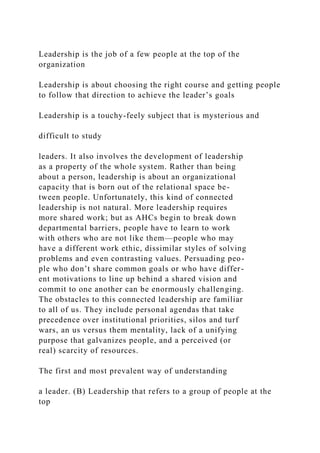
Our views of leadership are shifting (Table 1). Effec-
tive leadership in organizations today extends beyond
selecting and developing a critical mass of individual
FIG. 1. Four ways of understanding leadership. (A) Leadership f
who “run” the organization and allegedly exercise good
leadership. (C
numerous small acts of leadership that occur every day. (D)
Leade
connections and teamwork.
TAB
Shifting View
Old view
A person in charge, born with leadership skills, who possesses
power, solutions, and resources
Leadership is the job of a few people at the top of the
organization
Leadership is about choosing the right course and getting people
to follow that direction to achieve the leader’s goals
Leadership is a touchy-feely subject that is mysterious and
difficult to study
leaders. It also involves the development of leadership
as a property of the whole system. Rather than being
about a person, leadership is about an organizational
capacity that is born out of the relational space be-
tween people. Unfortunately, this kind of connected
leadership is not natural. More leadership requires
more shared work; but as AHCs begin to break down
departmental barriers, people have to learn to work
with others who are not like them—people who may
have a different work ethic, dissimilar styles of solving
problems and even contrasting values. Persuading peo-
ple who don’t share common goals or who have differ-
ent motivations to line up behind a shared vision and
commit to one another can be enormously challenging.
The obstacles to this connected leadership are familiar
to all of us. They include personal agendas that take
precedence over institutional priorities, silos and turf
wars, an us versus them mentality, lack of a unifying
purpose that galvanizes people, and a perceived (or
real) scarcity of resources.
The first and most prevalent way of understanding
a leader. (B) Leadership that refers to a group of people at the
top
eadership from those without formal authority, often referring
to the
ip as a property of a living system, a capacity borne out of
human
1
f Leadership
New view
Something people create together through collaboration,
dialogue,
and resource exchange
Leadership involves everyone taking responsibility for the
success
and destiny of the enterprise
A systemic capacity that mobilizes people to confront reality
and
reprioritize their entrenched beliefs so they can tackle the
leadership challenge
Leadership is an activity that involves specific responsibilities
rom
) L
rsh
LE
s o
that can be studied scientifically
4 JOURNAL OF SURGICAL RESEARCH: VOL. 138, NO. 1,
MARCH 2007
leadership—as a person in charge who acts on
followers—sees the solution to increasing leadership in
the organization as hiring or appointing more leaders.
Leader development occurs largely through teaching
and training a set of individual skills and abilities.
Developing the potential of promising leaders and ex-
panding managerial talent in the organization will
grow leadership capacity— but only so much. Under-
standing leadership as a property of a living system
sees increasing leadership capacity as having the right
people on the bus and in the right seats but also as the
result of connected teams that foster creativity, pro-
mote collaboration and enhance resource exchange.
Not everyone can be a leader but everyone can exercise
leadership.
High quality human connections act as channels for
sharing ideas, feedback, and building trust [2]. They
may play a key role in constructing our work identity,
giving each of us an experience of the contribution we
make. They can promote learning and growth through
knowledge acquisition and self-discovery. The positive
feelings that emerge from such constructive relation-
ships promote trust, staying power, and commitment.
These high quality connections make good leader-
ship happen. There is plenty of room to develop more of
them.
AHCs Are Loosely Coupled Systems
A third barrier to making coordinated leadership
happen across the enterprise is the structure, organi-
zation, and governance of AHCs. They have been de-
scribed as “loosely coupled systems [3].” In loosely cou-
pled systems, the forces working toward integrating
the entire enterprise are often weak compared to the
forces that encourage separation, even fragmentation.
Physicians, for example, favor autonomy and indepen-
dence, and resist being told how to practice medicine—
they are not naturally team players. Within loosely
coupled systems, local networks may be highly con-
nected but feedback times are often slow and align-
ment is difficult.
Loosely coupled systems, though messy, have valid
functions within organizations [4]. They allow for lo-
calized adaptation without changing the entire system.
The opposite, standardization, may be too restrictive.
Loosely coupled systems can allow for more variety and
diversity in adapting to a changing environment.
There is more room for self-determination by actors
(e.g., faculty, departments, research teams).
In general, loosely coupled systems are very difficult
to systematically change. The loose coupling makes it
difficult to make leadership happen, especially from
the standpoint of getting everyone playing off the same
sheet of music. Connected leadership can be observed
locally (e.g., in the operating room, in the research lab,
in the multidisciplinary clinic) but it is difficult to
exercise systemically.
Getting the various microsystems (e.g., divisions, OR
teams, research teams) of an AHC to work together
beyond their own boundaries is a major leadership
challenge. Invariably, resource constraints aggravate
the challenge and accentuate the differences in the
ways people understand the problems and their solu-
tions. The diversity arising from groups with different
goals, norms and perspectives often manifests itself as
conflict. In the debate, the leader must keep the heat
on and pressure turned up enough that people remain
alert and face the challenges, but not so high that the
pressure cooker explodes [5]. By holding people ac-
countable, insisting that they deal with tough issues
and helping them manage dissent, leaders can help
make leadership happen. Organizations and teams
that learn to harness conflict and use it constructively
come up with more creative ideas and innovative solu-
tions. Healthy conflict and debate are essential precur-
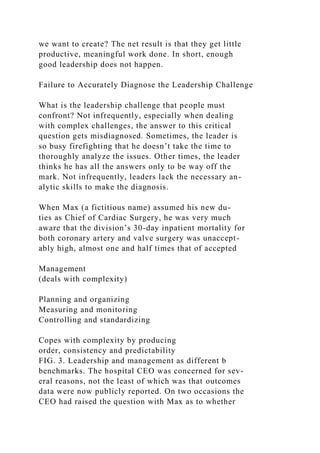
sors for organizational learning and growth (Fig. 2).
Sadly, in most organizations this adaptive work is usu-
ally avoided, more dirt is swept under the carpet, and
the organization suffers.
The Management/Leadership Paradox
Another obstacle to making leadership happen is the
misunderstanding that exists between leadership and
management. Management is often equated with busi-
ness performance while leadership (as pointed out ear-
lier) is usually associated with a person in charge. This
perspective is narrow and misleading.
Management has its roots in the early 1900s when
Frederick Taylor developed the scientific management
theory, which introduced the careful measurement of
tasks, standardization of processes, and the institution
of rewards (and punishments). Management deals
with the complexity that is inherent in large organiza-
tions (like AHCs) and it is designed to create order,
consistency and standardization [6]. It is about being
on time and on budget. In a very real sense, manage-
ment is about doing the same things the same way
every time to minimize error. Algorithms such as clin-
ical pathways and extubation protocols are intended to
standardize patient care in order to improve outcomes
and reduce costs.
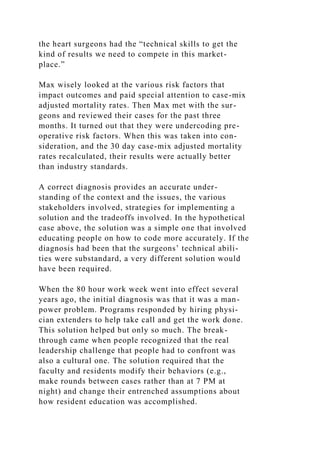
Kotter [6] points out that leadership and manage-
FIG. 2. How organizations learn.
ment are different, but complementary activities (Fig.
ut
5WILEY W. SOUBA: THE LEADERSHIP DILEMMA
3) Leadership deals with change (rather than complex-
ity) by creating more change, often by embarking on a
new strategic vision or transforming the culture. No
change (management) versus change (leadership) de-
scribes the paradoxical tension that AHCs have expe-
rienced over the past decade. How does an AHC, whose
objective it is to endure and preserve itself, change and
evolve so as to have a sustainable life?
Many new deans, department chairs and division
chiefs find themselves relentlessly surrendering to the
tyranny of the urgent, trying to create order (minimize
chaos) by constantly putting out fires [7]. Why does this
happen? Because they believe that in order to do a good
job they have to be on top of everything. Because they
want it to appear that they are unflappable. Because
they want to say yes to everything and be all things to
all people (all well-intentioned), they delegate poorly
and end up dealing with one calamity after another.
They haven’t learned to push responsibility down so
they micromanage. There is no time left to ask: Where
do we want to be in 3–5 years? What kind of culture do
we want to create? The net result is that they get little
productive, meaningful work done. In short, enough
good leadership does not happen.
Failure to Accurately Diagnose the Leadership Challenge
What is the leadership challenge that people must
confront? Not infrequently, especially when dealing
with complex challenges, the answer to this critical
question gets misdiagnosed. Sometimes, the leader is
so busy firefighting that he doesn’t take the time to
thoroughly analyze the issues. Other times, the leader
thinks he has all the answers only to be way off the
mark. Not infrequently, leaders lack the necessary an-
alytic skills to make the diagnosis.
When Max (a fictitious name) assumed his new du-
ties as Chief of Cardiac Surgery, he was very much
aware that the division’s 30-day inpatient mortality for
both coronary artery and valve surgery was unaccept-
ably high, almost one and half times that of accepted
Management
(deals with complexity)
Planning and organizing
Measuring and monitoring
Controlling and standardizing
Copes with complexity by producing
order, consistency and predictability
FIG. 3. Leadership and management as different b
benchmarks. The hospital CEO was concerned for sev-
eral reasons, not the least of which was that outcomes
data were now publicly reported. On two occasions the
CEO had raised the question with Max as to whether
the heart surgeons had the “technical skills to get the
kind of results we need to compete in this market-
place.”
Max wisely looked at the various risk factors that
impact outcomes and paid special attention to case-mix
adjusted mortality rates. Then Max met with the sur-
geons and reviewed their cases for the past three
months. It turned out that they were undercoding pre-
operative risk factors. When this was taken into con-
sideration, and the 30 day case-mix adjusted mortality
rates recalculated, their results were actually better
than industry standards.
A correct diagnosis provides an accurate under-
standing of the context and the issues, the various
stakeholders involved, strategies for implementing a
solution and the tradeoffs involved. In the hypothetical
case above, the solution was a simple one that involved
educating people on how to code more accurately. If the
diagnosis had been that the surgeons’ technical abili-
ties were substandard, a very different solution would
have been required.
When the 80 hour work week went into effect several
years ago, the initial diagnosis was that it was a man-
power problem. Programs responded by hiring physi-
cian extenders to help take call and get the work done.
This solution helped but only so much. The break-
through came when people recognized that the real
leadership challenge that people had to confront was
also a cultural one. The solution required that the
faculty and residents modify their behaviors (e.g.,
make rounds between cases rather than at 7 PM at
night) and change their entrenched assumptions about
how resident education was accomplished.
Failure to differentiate adaptive challenges from
more easily solved technical problems may be the sin-
gle most important reason for leadership failure today
[5]. Adaptive challenges are complex learning prob-
Setting direction
Selecting the right leaders
Creating the right culture
Leadership
(deals with change)
Copes with change by producing new
change that is adaptive and productive
complementary activities. Modified from Kotter [6].
lems for which the organization has no pre-existing
6 JOURNAL OF SURGICAL RESEARCH: VOL. 138, NO. 1,
MARCH 2007
resources or solutions. They are complex because they
are difficult to get our arms around. Different groups
understand both the problem and its solution differ-
ently. They are problems because they represent a gap
between the present and an aspired future. They re-
quire learning if we are going to tackle them success-
fully. Money alone will not solve them. They can only
be solved by people learning new ways of working them
out. Learning is a prerequisite for change. Because
adaptive challenges force people to make agonizing
trade-offs, it is common for them to try to avoid the
problem by treating the symptoms rather than the
problem itself. However, dealing head on with the is-
sue, while painful, offers a superb opportunity for in-
creasing leadership capacity.
The Unwillingness to Confront Reality and Take on the Really
Tough Problems
The correct diagnosis of a leadership challenge only
gets you so far; the people involved must be willing to
follow through with the right treatment. Technical
problems are relatively easy to solve because they are
usually familiar problems with proven solutions. Adap-
tive challenges cannot be solved with technical solu-
tions, but not infrequently that is what gets prescribed.
Why? Because adaptive work is painfully difficult
work. The solution requires that people make changes
in themselves, often in their ingrained mental models,
values and beliefs. It is easier to throw money at the
problem or pretend that it will go away. But we are just
fooling ourselves.
In 2005, the Penn State Hershey Medical Center
formed the Penn State Heart and Vascular Institute.
The institute combines all heart and vascular clinical
services as well as research and teaching components
into a single entity. All technical and professional rev-
enues and research dollars flow into the institute. The
new structure required the chairs of surgery, medicine
and radiology to change their underlying long-standing
views of how funds flowed in the enterprise. In partic-
ular, surgery and medicine “lost” big revenue generat-
ing divisions. The upside was that patient care could be
delivered with greater continuity, basic research could
be translated more readily, and educational programs
could integrate residents and fellows from multiple
departments.
Dean Williams, a faculty member at Harvard’s
Kennedy School of Government, argues convincingly
that real leadership gets people to face reality [8]. Real
leadership demands that the people make adjustments
in their entrenched values, thinking, and beliefs to deal
with threats, accommodate new realities, and take ad-
vantage of emerging opportunities. The reality in aca-
demic medicine is that collaboration, teamwork, inter-
disciplinary programs, and dissolution of silos are
hallmarks of the best organizations. Departmental
lines are becoming more blurred and the ability to
work and lead in a matrix structure is a critical lead-
ership skill. This “new order” creates a huge intellec-
tual hernia for many chairs, as their sense of personal
worth and security is often tied up in how sizable their
departmental reserves are and how much turf they
control. They are afraid that if they share resources
and build interdisciplinary research programs and
clinical service lines they might lose power. They might
be less important. These fears often erect barriers that
pre-empt the adaptive work that needs to be done.
The Wrong People on the Bus
Woody Hayes once said, “You win with people.” I
agree with one caveat: You win with the right people.
They are your most precious asset. The wrong people
are your biggest liability. The wrong people are not bad
people—they just don’t belong in your organization,
usually for one of two reasons. Either they don’t live
the values of the organization or they don’t get results.
Jack Welch once reflected, “Numbers and values. We
don’t have the answer here—at least I don’t. People
who make the numbers and share our values go on-
ward and upward. People who miss the numbers and
share our values get a second chance. People with no
values and no numbers— easy call. The problem is with
those who make the numbers, but don’t share the val-
ues. We try to persuade them; we wrestle with them;
we agonize over these people [9].”
Every AHC has individuals who are obstacles to
making leadership happen. If they are refractory to
counseling, they need to move on. These people create
the 90/10 rule: you spend 90% of your time dealing with
the 10% of the people who are problems. Often, these
people are chronically discontented—they may feel
passed over or unappreciated. They can sap energy
from others with their tendency to lob grenades and
speak negatively about the organization. It is essential
that key leaders undercut any shenanigans by these
disenfranchised individuals who will consistently try
to disrupt the ship’s course.
Often the most difficult (and interesting) people to
deal with are the “rockstars.” These people add enor-
mous value to the organization either because they
lead an internationally known research program with
multiple grants or because they have built a huge
clinical program that adds both reputational equity
and millions of dollars to the bottom line every year.
The challenge with these individuals is that they often
have a pre-Copernican ego. They believe that the world
revolves around them. They have an insatiable appe-
tite for resources, often exhibit behaviors which others
experience as arrogant, and act as if they report to no
one. For all the good they bring, they can be a real
thorn in your hypothalamus.
7WILEY W. SOUBA: THE LEADERSHIP DILEMMA
Mistrust
Mistrust is one of the most common barriers to mak-
ing good leadership happen. Everybody knows this and
everyone has experienced it. It bears mentioning be-
cause even when all the other enablers of leadership
are in place, without trust, leadership will not happen,
at least not in any meaningful way.
Mistrust is epidemic in the language we use. We tell
our residents, “You can’t trust medicine to call you
before the patient bleeds six units,” or “You can’t trust
anesthesia to keep up with the fluids.” We say to our
faculty, “You can’t trust the dean; he’s out to take our
money.” I heard these same comments in the 1970s
when I was a medical student. No wonder trust is not
part of the culture. O’Toole [10] notes, “In essence, the
leadership challenge is to provide the glue to cohere
independent units in a world characterized by forces of
entropy and fragmentation. Only one element has been
identified as powerful enough to overcome those cen-
tripetal forces, and that is trust.”
When senior leaders of AHCs were asked, “Which
core values are most important to the way you think
about leadership?”, trust was one of the top three val-
ues ranked (out of 38 values) [11]. It was noteworthy
that trust was significantly inversely correlated with
authority [12]. This negative relationship suggests
that the “leadership from a leader” model, which
equates leadership with a person in charge in a posi-
tion of authority, can create suspicion and a tension
that may breed mistrust. The ability to manage that
tension—when to use authority at the risk of compro-
mising trust as opposed to building trust by exercising
connected leadership—is a constant challenge for all
leaders.
Leadership Education/Development Is not an
Organizational Priority
How much time, resources and energy do AHCs
spend on leadership education and development? Not
nearly enough. How often do we see leadership devel-
opment initiatives being driven from the very top? Not
very often. Is the leadership development plan in your
organization just as important as the master space
plan or the strategic plan? Unlikely.
Why do we underinvest in leadership development?
Why are leadership development programs amongst
the first to get dumped when there’s a budget shortfall?
For one thing, we make the false assumption that
competent researchers or physicians will automatically
make good leaders; no formal education or develop-
ment is necessary. Often, they are adequate leaders
and we accept that as good enough. Sometimes, they
are a disaster and we chalk that up to bad luck or the
law of probabilities. Just because a faculty member can
surgically repair a thoracoabdominal aneurysm or is a
member of the National Academy of Science doesn’t
mean he will be a responsible department chair or an
effective leader.
Second, the link between the teaching of leadership
and the exercise of leadership has been difficult to
establish. We believe in our gut that effective leader-
ship is a critical determinant of organizational perfor-
mance and success. Intuitively, investing in developing
leaders and leadership makes sense. But the payback,
if there is one, is long-term and most people can’t see
beyond the next fiscal quarter.
Recent research suggests that there is a relationship
between good leadership and organizational perfor-
mance. A study of AHCs demonstrated that tighter
alignment between surgical chairs and medical school
deans on core values and on leadership climate percep-
tions correlated with higher school and department
NIH standing and higher U.S. News and World Report
medical school and hospital ranking [11]. Further-
more, major disparities between deans and chairs in-
dicating a misalignment of perceptions and values
were associated with poorer institutional effectiveness
in the clinical and academic missions. The study did
not establish a cause and effect but it did demonstrate
that agreement on leadership values and climate per-
ceptions predicted superior performance. The authors
suggest that developing effective leaders and leader-
ship in an AHC requires a proper context—i.e., a
healthy climate and a set of “real” (not just espoused)
core values.
The third reason we don’t teach leadership develop-
ment is that we are not sure how. We know how to
teach and train doctors, radiology technicians and di-
eticians, but we don’t really know how to prepare peo-
ple for the practice of leadership. Many AHCs point out
that they offer leadership training. Indeed, these pro-
grams focus largely on training (as opposed to building
systemic leadership capacity) and the education
mainly covers managerial topics like budgeting, reim-
bursement, negotiation, and metrics. It is important to
have an understanding of these subjects but they are
not at the heart of leadership. They do not teach people
how to think systemically and multidimensionally,
how to develop a stomach for ambiguity, or how to
tackle challenges that threaten their deep-seated val-
ues and beliefs.
As the challenges we must face become more and more
complex, those organizations that make leadership devel-
opment an essential priority (as important as research
and patient care) will be best positioned to adapt, learn,
make progress and add value to those they serve. For
more than a century, we have been teaching medical
students, residents, nurses, graduate students and post-
docs, preparing them for practice in their discipline.
Where we have fallen short is in preparing people for the
practice of leadership. This must change.
8 JOURNAL OF SURGICAL RESEARCH: VOL. 138, NO. 1,
MARCH 2007
MAKING EFFECTIVE LEADERSHIP HAPPEN
What is responsible leadership—the type of leader-
ship that makes a legitimate difference in the world,
the kind that adds real value to people’s lives? When I
asked this question to the CEO of a major university
hospital, he explained that responsible leadership was
about developing a competitive strategy that allowed
the hospital to provide higher quality patient care and
achieve better outcomes. The dean of the medical
school at the same institution told me leadership was
about improving patient care through innovations in
teaching and research. A university president from
another institution said that effective leadership was
about getting the deans in the various colleges to build
top-notch teaching and research programs. The chair-
man of a surgery department told me that leadership
was about measuring performance and holding faculty
accountable. Another department chair said that lead-
ership was about making sure the faculty had pro-
tected time.
Regardless of how we choose to define “effective” or
“responsible” leadership, it should move the organiza-
tion forward such that it more effectively achieves its
goals and serves those constituencies (i.e., adds value
to their lives) it was designed to serve. It is vitally
important that we appreciate that different contexts
call for different leadership strategies if people are
going to successfully tackle the leadership challenge at
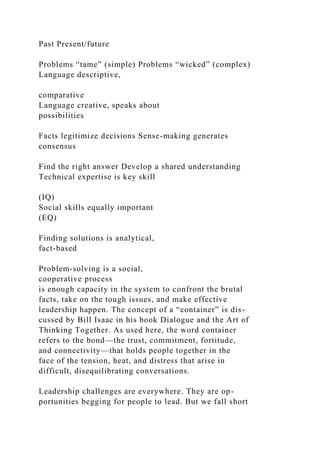
hand and make effective leadership happen. Problems
come in all sorts and sizes and we cannot solve them
using the same approach (Table 2). We must learn how
to diagnose the leadership challenge accurately so we
can formulate and implement a solution that fits the
problem.
It is no longer sufficient for leaders to focus solely on
vision and strategy as the path to leading change. They
must also recognize the importance of building a strong
working container [13] that holds people together dur-
ing the disequilibrium and developing others so there
TABLE 2
The Evolution of Organizational Problem-Solving
Past Present/future
Problems “tame” (simple) Problems “wicked” (complex)
Language descriptive,
comparative
Language creative, speaks about
possibilities
Facts legitimize decisions Sense-making generates
consensus
Find the right answer Develop a shared understanding
Technical expertise is key skill
(IQ)
Social skills equally important
(EQ)
Finding solutions is analytical,
fact-based
Problem-solving is a social,
cooperative process
is enough capacity in the system to confront the brutal
facts, take on the tough issues, and make effective
leadership happen. The concept of a “container” is dis-
cussed by Bill Isaac in his book Dialogue and the Art of
Thinking Together. As used here, the word container
refers to the bond—the trust, commitment, fortitude,
and connectivity—that holds people together in the
face of the tension, heat, and distress that arise in
difficult, disequilibrating conversations.
Leadership challenges are everywhere. They are op-
portunities begging for people to lead. But we fall short
for all the reason discussed above. We do not have a
good track record of making leadership happen (wit-
ness the silos ands turfs wars at every AHC, not to
mention the market share wars, and the literal wars
between nations).
Conflict is an inherent part of all barriers to leader-
ship. Some might argue that the problem is not conflict
but money. No organization has unlimited resources;
conflict is what results when they have to make
choices. It is this conflict we don’t want to deal with. It
brings to mind memories of stressful arguments, power
struggles and bruised egos. Consequently, most people
avoid it. We hide from it or squelch it when we see it
heading in our direction. Conflict, however, is natural,
intrinsic to all living systems—individuals, organiza-
tions, communities and nations [14]. It exists because
our worldviews differ. Conflict is not negative. It is not
a contest. It is not a game of winners and losers. It is an
opportunity for learning, growth and leadership.
Leadership Is Risky Business
Jim Collins talks about Level 5 leaders, those indi-
viduals who build enduring greatness through a para-
doxical combination of humility and professional will.
Collins notes [15], “Level 5 leadership is not about
being soft or nice or purely inclusive or consensus-
building. The whole point of Level 5 is to make sure the
right decisions happen—no matter how difficult or
painful—for the long-term greatness of the institution
and the achievement of its mission, independent of
consensus or popularity.”
Many of these decisions will not be easy and they
certainly won’t please everyone. Responsible leader-
ship asks people to define reality and reprioritize their
long-standing assumptions so they can tackle the chal-
lenges at hand. Accordingly, people push back. They
push back because change represents loss and letting
go—letting go of ways of doing things that they are
comfortable with, letting go of deep-seated beliefs. Loss
is painful and threatening.
People resist change in predictable ways. They usu-
ally start by arguing that the data are flawed. This
often stalls the initiative while more data are collected.
People shift into academic mode, which consumes more
time, energy, and other resources. The data may be
irrefutable but “the dead horse is flogged yet again.”
9WILEY W. SOUBA: THE LEADERSHIP DILEMMA
Next, people push back against the process. They argue
that department X or person Y didn’t have enough
input. Once again, the necessary adaptive work is put
on the back burner. More time passes; people are now
getting frustrated or apathetic. Finally, people attack
the individuals they perceive to be leading the change.
They argue that they are hurting the institution; they
may try to damage their credibility. Three years later
the same challenge surfaces again. By now you’ve be-
come cynical and you disengage a bit more. The burn
rate of people’s time has been huge.
It takes effort to make leadership happen. That’s
why we call it exercising leadership. It requires gener-
osity. That’s why we call it providing leadership. And it
takes innovation. That’s why we talk about creating
leadership. We make leadership happen through our
choices and actions. If we choose to erect silos and
squander resources, one kind of leadership will hap-
pen. If we choose to build a culture that is willing to
step up to the plate and build greatness, a different
kind of leadership will emerge. It is up to us.
REFERENCES
1.
http://www.wsu.edu:8001/vcwsu/commons/topics/culture/glossa
ry/
system-of-meaning.html
2. Dutton J, Heaphy E. The power of high quality connections.
In:
Cameron KS, Dutton JE, Quinn RE, eds. Positive Organiza-
tional Scholarship. San Francisco: Berrett-Koehler, 2003.
3. Gilmore T, Hirschhorn L, Kelly M. Challenges of leading and
planning in academic medical centers. Philadelphia, PA: Center
for Applied Research, Inc., 1999.
4. Weick Karl. Educational organizations as loosely coupled
sys-
tems. Administrative Science Quarterly. 1976;21:1–19.
5. Heifetz R, Linsky M. Leadership on the line. Boston: Harvard
Business School Press, 2002.
6. Kotter J. The leadership factor. New York: Free Press, 1988.
7. Souba W. The Achilles’ heals of an academic surgeon: a
leader-
ship tale. J Surg Res 2005;123:320-327.
8. Williams Dean. Real leadership. San Francisco: Berrett-
Koehler, 2005.
9. Memo from John F. Welch to corporate officers October 4,
1991.
Cited in ref 5, p. 72.
10. O’Toole J. Leading Change: The argument for values-based
leadership. New York, Jossey-Bass, 1996.
11. Souba W, Mauger D, Day D. Does agreement between
medical
school deans and surgical chairs on leadership impact organi-
zational performance? Acad Med (in press).
12. Souba W, Day D. Leadership values in academic medicine.
Academic Medicine 2006;81:20 –26.
13. The concept of a “container” is discussed by Bill Isaac in
his
book Dialogue and the Art of Thinking Together. New York:
Doubleday, 1999. As used here, the word container refers to the
bond—the trust, commitment, fortitude and connectivity—that
holds people together in the face of the tension, heat and dis-
tress that arise in difficult, disequilibrating conversations.
14. Crum T. The Magic of Conflict. New York. Simon and
Schuster.
1987.
15. Collins, Jim. Good to Great and the Social Sectors. Boulder,
CO:
Jim Collins, 2005.
http://www.wsu.edu:8001/vcwsu/commons/topics/culture/glossa
ry/system-of-meaning.html
http://www.wsu.edu:8001/vcwsu/commons/topics/culture/glossa
ry/system-of-meaning.htmlThe Leadership
DilemmaOBSTACLES TO CREATING AND EXERCISING
EFFECTIVE LEADERSHIPLack of a Language
TaxonomyToday’s Popular Notions of Leadership Are
InadequateAHCs Are Loosely Coupled SystemsThe
Management/Leadership ParadoxFailure to Accurately Diagnose
the Leadership ChallengeThe Unwillingness to Confront Reality
and Take on the Really Tough ProblemsThe Wrong People on
the BusMistrustLeadership Education/Development Is not an
Organizational PriorityMAKING EFFECTIVE LEADERSHIP
HAPPENLeadership Is Risky BusinessREFERENCES

Seven Steps to Making a Difference for the WorldDr. Leo P. C.docx

  • 1.
    Seven Steps toMaking a Difference for the World Dr. Leo P. Corriveau, Plymouth State University Step 1: Preparation for Leadership In some fundamental sense, we can not learn how to have relationships, how to raise kids, how to lead others – how to be human, if you will. Why? Because to a great extent it is the very condition of not knowing, of being vulnerable to and surprised by life, of being unable to manage or control our lovers, our children, or our colleagues that makes us human. (Farson, 40) We can not begin to accept the responsibility of leadership without first acknowledging our humanity, both in its limits and its marvels. The first task in knowing that humanity is to come to terms with the limitations that being human places upon us and, paradoxically, by accepting these limitations we free ourselves to receive the boundless riches that human existence holds for each of us. We who lead cannot afford the self congratulation which comes from seeing ourselves above the fray of human striving, nor can we allow ourselves to be fooled by the skewed vision that such egotism affords. Instead, if we are to be worthy of guiding others, we must first have the strength to accept our own human failings for we cannot see the truth in others until we see the truth in ourselves. Bennis writes, “To become a leader, then, you must become yourself, become the maker of your own life”. He observes that knowing thyself is “the most difficult task any of us faces. But until you truly know yourself, strengths and weaknesses, know what you want to do and why you want to do it, you cannot succeed in any but the most superficial sense of the word.”
  • 2.
    (Kouzes, 59) Bennis isdoing more than simply encouraging us to become the “captain of our own ship”. The making of a life in the truest sense happens from the inside out and not from the outside in. We are, many times, so busy becoming who we think we need to be (or should be) that we often ignore that faint voice of the true self within our soul. The choice to reconcile that faint inner voice with the cacophony of the outer world and to balance the two within our human being takes courage to begin, determination to continue, and humility to accept the truths that unfold. Such a life journey will in the end afford you a sense of who you are, your place in the world, and that you belong where you have chosen to be. Our best qualities are integrity, dedication, magnanimity, humility, openness, and creativity. These, of course, are the basic ingredients of leadership, and our unwillingness to tap these qualities in ourselves explains, to a large extent, the leadership shortage. (Bennis, 117) “The spirit is willing but the flesh is weak” Each human being is filled with the great qualities of the human race. The choice to use those qualities or more precisely to answer to their demands is not easy and, many times, is contradictory to our own sense of self preservation. There will always be a shortage of leaders because the way of the honorable leader is strewn with the choice between “doing what is right for me” and “doing what is right for all”. To lead with honor is to accept one’s responsibility to do what is right for all, to uphold one’s faith in the goodness of humankind, and to do so with full knowledge of the probable cost to one’s self. Step 2: The Notion of Trust Being seen as someone who can be trusted, who has high
  • 3.
    integrity, and whois honest and truthful is essential. But if you have a sense that the person is not being honest, you will not accept the message, and you will not willingly follow. So the credibility check can reliably be simplified to just one question: “Do I trust this person?” (Kouzes, 24) People who choose to follow do so as much for emotional reasons as for rational ones. Trust is one of those “gut feelings”. Trusting someone does not mean that we assume they will make no mistakes. On the contrary, trust implies that when that person does make mistakes that those errors were made from a position of honor and integrity. We choose to follow because we trust at a “gut level” not that they are always going to be right but instead, that they are always seeking to do what is right. Leaders must reach out and attend to all their constituents if they wish to be credible. Credibility, like quality and service, is determined by the constituents, so leaders must be able to view themselves as their constituents do. It requires effort and new skills; one benefit is that a natural by-product of attending to other people is that they in turn come to trust us and we trust them. (Kouzes, 90) Trust in leadership is not created by those who lead it is given by those who follow. Step 3: Focus & Clarity As perspective is vital to the painter or writer, it is vital to leaders and their associates. (Bennis, 158) Perspective, it should be remembered, is from a single point or position and therefore there are as many perspectives of what is seen as there are positions to see it from. Artists must be able to visualize how others see differently from different positions and
  • 4.
    more importantly, howothers see differently from the exact same position as the artist. So too, must leaders. It should also be remembered that what the artist “sees” not only comes from what they empirically observe but from what they feel in their heart and what resonates in their soul. So too, must leaders. Gandhi said, “We must be the change we wish to see in the world.” (Bennis, 154) Leadership is about living the vision. To create the pathway between the present and the future for others to follow we must be the bridge which connects the two. This can only be done by consciously living our vision of the future in the present moment. All leaders see in a special way … Leaders never confuse that which is real with that which is reality … Furthermore, leaders know that what we see is completely a matter of choice. But beyond all that, leaders know that how we see and what we see are exactly the same. (Cook, 41) What “is” is. How we see it (interpret it), however, is a matter of our own choosing. We all have elected at one time or another to look the other way when faced with harsh facts of what “is”. Intellectually or emotionally it is many times an understandable necessity for survival. But it therefore also follows that we can choose to change the depth of our intellectual and emotional vision and see beyond the constraints of what we perceive to be our present reality. Leaders need to have the courage to say as Martin Luther King said, “I have a dream.” Step 4: Commitment A Chinese proverb is useful in this regard: “Tell me, I may listen. Teach me, I may remember. Involve me, I will do it.” (Kouzes, 146)
  • 5.
    Commitment is notpossible to attain without caring. Caring is never about the outside it always about the inside. Until a leader creates a way for people to feel involved they will not be able to generate the emotional linkage between involvement, caring, and committing. One of the most common mistakes made in attempting to create shared values is announcing which are most important and should guide the department (or company). Instead leaders must cast the net widely to capture the broadest possible understanding of constituents’ values. Participation is vital, for people’s perspectives change once they are involved. If the key question asked is “what principles should we have?” merely rhetorical statements will result, (Kouzes, 125) The whole is always greater than the sum of its parts. As more parts are added, the identity of the whole will change. All parts of the whole share in this identity and each newly added part changes how all of the parts share that common identity. This identity therefore needs to remain dynamic in order to remain authentic. Stasis (balance) of the whole is maintained by the constant change in the relationship between the parts to maintain identity. Interference from outside the system will result in an imbalance that the parts cannot efficiently respond to since they respond best to changes within the authentic identity that they all share. The creation of the shared vision of an organization must respond to these system principles. Creating a shared vision honoring these principles will strengthen and increase commitment. If a leader wants to be a part of this system he/she must join as a “part of the whole” in order to keep the process authentic.
  • 6.
    … for astrong community and for strong and vibrant organizations, we must be willing to make other people’s problems our own and to live them together. (Kouzes, 129) Empathy receives a lot of lip service. It is easy to “talk the talk” but much tougher to “walk the walk”. If a leader says, “I believe in you, how can I help?” they had better be willing to put their heart and soul where their mouth is. People commit to leader who has made a commitment to them. Step 5: Marshalling Resources We have all seen leaders who successfully move from one organization to another even though they may not be expert in the second organization’s business. They are able to do this because they define their task as evoking the knowledge skills and creativity of those who are already within the organization. They are secure enough in their own identities to be able to be influenced by new information and to accept the ideas of others in the group. They are especially able to elicit the intelligence and participation of group members who otherwise might not join in. (Farson, 145) Most people know how to solve their own problems they just can’t seem to get around to it. Many times what they appreciate and need is a little encouragement in getting started. Leadership then becomes a matter of pointing out (hopefully with kindness) that the reason they have trouble moving forward is because they are stepping on their own feet. How do we identify and develop such innovators? How do we spot new information in institutions, organizations, and professions? Innovators, like all creative people, see things differently; think in fresh and original ways. They have useful contacts in other areas, other institutions; they are seldom seen as good organization men or women and often viewed as
  • 7.
    mischievous troublemakers. Thetrue leader not only is him- or herself an innovator but makes every effort to locate and use other innovators in the organization. He or she creates a climate in which conventional wisdom can be questioned and challenged and one in which errors are embraced rather than shunned in favor of safe, low-risk goals. (Bennis, 29 - 30) If doing things the same old way was the best adaptation to change dinosaurs would still alive. Limiting resources to what has always been in the past limits the possibility of what can be in the future. Life demands fresh and original ideas. Leaders welcome that which is fresh and original because to do so is to welcome life into their cause. If people of authority are to succeed, they must know themselves and listen to themselves, integrating their ideals and actions but being able, at the same time, to tolerate the gap between the desirable and the necessary as they work to close it. They must know how to not merely listen but hear, not merely look but see, to play as hard as they work, and to live with ambiguity and inconsistency. The ultimate test of anyone in authority is whether he or she can successfully ride and direct the tides of change and, in doing so, grow stronger. As Sophocles said, “It is hard to learn the mind of any mortal, or the heart, till he be tried in chief authority. Power shows the man” (Antigone). And the thoughtful, imaginative, and effective use of power is what separates leaders from people in authority. (Bennis, 156) There is no greater resource for leaders than to know they can trust the internal compass that guides their being. That although there will be times of doubt and indecision, if granted the needed time it will find a way to point true. In the course of events there will be much need to hear outside council, to see what cannot be turned away from, to laugh with what life presents, and to accept the doubt and regret that is part of being
  • 8.
    human. But whenall of this is done it is to one’s inner self that leaders must return and know in their heart that their internal compass pointed true and that from it they chose an honorable course. Step 6: Achievement & Celebration Leadership can be felt throughout an organization. It gives pace and energy to the work and empowers the work force. Empowerment is the collective effect of leadership. In organizations with effective leaders, empowerment is most evident in four themes: 1. People feel significant. 2. Learning and competence matter. 3. People are part of a community. 4. Work is exciting. (Bennis, 23) People need to believe that what they do matters. They need to feel a sense of gratification for a job well done. There very few, if any external motivations, that will create the will to achieve as well as the internal knowledge that what they are trying to do is recognized as something that makes a difference. “[Your goal is] not to achieve wholeness by suppressing diversity, not to make wholeness impossible by enthroning diversity, but to preserve both. Each element in the diversity must be respected, but each must ask itself sincerely what it can contribute to the whole. I don’t think it is venturing beyond the truth to say that “wholeness incorporating diversity” defines the transcendent task for your generation.” (Kouzes, 124,125) We are all striving to find our individual selves as well as find
  • 9.
    our place amongothers. We as leaders must encourage this process to be open and honest both to each individual and between all who are together. We must find ways each day to enable people to quietly celebrate each others’ unique contribution to what we have achieved together. Leaders do not avoid, repress, or deny conflict, but rather see it as an opportunity. Once everyone has come to see it that way, they can exchange their combative posture for a creative stance, because they don’t feel threatened, they feel challenged. (Bennis, 158) If we are to achieve, we need to celebrate the arrival of the opportunity to try. This does not mean that we are blind to the effort, hardship and disappointment that may lie along the journeys that such opportunities provide for us. But along with these harsh realities, we use our faith in our abilities and that of our peers to acknowledge the strengths that we have together. As long as we are willing to be a part of that mutual creative strength we know that we are not alone and can rely on the agreements and disagreements of our peers to move forward towards what we need to achieve. Step 7: Renewal We must learn how to harness the commitment of our people – then our commitment to building a better world will have some meaning … This requires a new paradigm, a new model of how organizations work – organizations that operate in a continual learning mode, creating change. (Senge, 348 – 349) Organizations are given life through the people within them. Therefore in order to create change in an organization there must a way to create change in the individual. It is not enough to do what has always been successful, individually or organizationally, because the possibilities of learning then
  • 10.
    stagnate and becomebarriers to rather than liberators of human thought. As leaders we must be willing to enable others to seek out their own liberators of human thought and use those moments to refresh and renew themselves, each other, and the vision they all share. Choice is different from desire. Try an experiment. Say, “I want.” Now, say, “I choose.” What is the difference? For most people, “I want is passive; “I choose” is active. For most wanting is a state if deficiency – we want what we do not have. Choosing is a state of sufficiency – electing to have what we truly want. For most of us, as we look back over our life, we can see that certain choices we made are played a pivotal role in how our life developed. So too, will the choices we make in the future be pivotal. (Senge, 360) Choice is part of renewal. We cannot renew without making an active choice to do so. We can (and do) want many things but it is when we make the choice to pursue one option and put aside others that the chance of renewal becomes available to us. We must then accept that we need to leave behind what is past, no matter how comfortable, and choose to move on. To search for understanding, knowing there is no ultimate answer, becomes a creative process – one which involves rationality but also something more … Einstein said, that “the most beautiful thing we can experience is the mysterious. It is the source of all true art and science.” (Senge, 282 – 283) Our work is never done. That is both good and bad news. The possibilities are so vast though that one need never tire of looking to the stars and searching for ways to touch them. ______________________________________ References:
  • 11.
    Farson, Management ofthe Absurd Kouzes and Posner, Credibility Warren Bennis, Why Leaders Can’t Lead Peter Senge, The Fifth Discipline William Cook, Strategics Arthur M. Young, The Theory of Process 1 of 7 Journal of Surgical Research 138, 1–9 (2007) The Leadership Dilemma Wiley W. Souba, MD, ScD, MBA Office of the Dean and the Department of Surgery, Ohio State University College of Medicine and the Ohio State University Medical Center, Columbus, Ohio Submitted for publication December 30, 2006 doi:10.1016/j.jss.2007.01.003 How do we make leadership happen? To answer this somewhat odd question, we must address both the what and the how. And herein lies the problem, at least the root of it. To be candid, we are not sure what leadership is (i.e., what the work of leader- ship entails) and we are even less sure how to make it work. It is uncomfortable and awkward for people who think of themselves as leaders to admit that they some- times feel incompetent exercising leadership. Most of us come to the table with a fixed and prede-
  • 12.
    termined set ofassumptions on how leadership works and how to exercise it (our implicit leadership theory). These assumptions are bolted firmly to our DNA. It is exceedingly difficult to pry us loose from these deeply entrenched beliefs. But we must be willing to let go. Why? Because many of the challenges that confront us today are enormously complex and varied and our in- grained implicit leadership theory doesn’t always work in solving them. Different contexts call for different leadership strategies. We need to learn new ways of making leadership happen. This is our leadership dilemma. Despite agreement that effective leadership is one of the most important (if not the single most important) determinants of or- ganizational performance and success, we are still not sure how to make leadership happen. Many of the approaches that worked in the past are not as relevant today. Yet we continue to flail, using leadership ap- proaches that are out of date, limited under the best of circumstances, destructive under the worst. Leadership doesn’t happen on its own. It’s up to us to make it happen. Indeed, we make it happen everyday through the choices we make and actions we take, sometimes for better, sometimes for worse. We want to make the right choices so we make responsible leader- ship happen but at times we encounter barriers. Some- times the barriers are evident—a disruptive person(s), vague goals, lack of support from the top, insufficient resources, or incorrect information. But not infre- 1 quently the obstacles are not clear or we are not aware
  • 13.
    of them andwe are left not knowing how to tackle a leadership challenge. OBSTACLES TO CREATING AND EXERCISING EFFECTIVE LEADERSHIP The purpose of this article is to examine some of the not so obvious obstacles to making leadership happen. We will not be able to remove (or at the very least reduce) these leadership barriers unless and until we understand them and recognize them. There are at least nine and they are cleverly at play everyday in our organizations. Lack of a Language Taxonomy One of the very first obstacles we must confront in understanding leadership is that we don’t have a consis- tent and agreed upon language of leadership. It’s difficult to talk and think about “leadership,” let alone exercise it effectively, without a baseline, shared meaning. A func- tional taxonomy should give us a common, coherent and meaningful structure to the way we talk about and make sense of the word leadership. A shared meaning system will help us better understand leadership and think more intently about how we make it happen. Language is the most formal of human meaning systems [1]. A system of meaning is a set of relation- ships between one group of variables (like words) and the meanings which are attached to them. Relation- ships in meaning systems are arbitrary; there is no particular reason why the word “kidney” should refer to a bean-shaped organ in the retroperitoneum that makes urine, for example. However, when we (as a society or profession) agree upon certain relationships
  • 14.
    between certain wordsand their meanings, a system of meaning is established. We have a consistent and agreed upon language meaning system in medicine. When we use words like 0022-4804/07 $32.00 © 2007 Elsevier Inc. All rights reserved. 2 JOURNAL OF SURGICAL RESEARCH: VOL. 138, NO. 1, MARCH 2007 ischemia, anuria, jaundice, cirrhosis or abscess there is a widely shared understanding among clinicians as to what they mean. On the other hand, words like leader, leadership, management, change, power and authority—which make up the language of leadership—are used in ways that are often synony- mous, occasionally contradictory, and not infrequently confusing. When the basic building blocks are not agreed on, it’s difficult to build a language taxonomy. Consider the two most common ways we use the word “leadership” in everyday conversation. Usually, we use it to describe an individual—we say, for exam- ple, that John is providing good leadership in the can- cer center. Implicit in this assertion is that John, through his choices, actions and behaviors, is moving the cancer center in the right direction. Other times, we use the word leadership to refer to a group of individuals at the “top” of the organization who make important decisions, allocate resources and set direc- tion. Whether these people are actually exercising ef-
  • 15.
    fective leadership asdescribed in the first example is often debatable. Ken Lay was regularly referred to as Enron’s leader but was he exercising good leadership? Developing a more robust meaning system for the word leadership is essential. For example, we must be clear that there is a difference between a leader and leadership. One refers to a person, the other to an activity or a capacity. Some leaders exercise good lead- ership, some exercise bad leadership and others don’t lead at all. Some people who have never been viewed by themselves or by others as leaders have exercised ex- traordinary leadership (e.g., Rosa Parks). Much of the leadership they exercise goes unnoticed. Leadership from individuals who have little formal authority is frequently subtle and unheralded. Thousands of these small acts of leadership happen every day and collec- tively they help to move the organization forward and shape its destiny. If we can create a more functional language meaning system, perhaps we will become more competent in tackling the many leadership challenges that confront us. Today’s Popular Notions of Leadership Are Inadequate We tend to think of leadership as being about a person who dominates, wields power, stands apart and stands above. This view distinguishes leadership as a skill or proficiency held by a handful of people we call “leaders” because they are “in charge” or have posi- tional authority. The model constructs leadership as the possession of a person who gives orders and com- mands power. The leader “acts” on followers to create leadership. We expect leaders to exercise good leader- ship that has a positive impact on people and the
  • 16.
    organization. History, however,is riddled with exam- ples of bad leadership. The word “leader” often brings to mind vivid images: the technically gifted surgeon; the brilliant scientist; the superb clinician and gifted teacher; the faculty member who starts a program from scratch and builds an empire. By and large, our view of leadership tends to center around visible individuals and their talents, their achievements and often their clout. This implicit leadership theory—leadership equated with a person in charge who sets goals and gets people to follow–is pervasive. It is the way most CXOs, deans, department chairs and faculty think about leadership. We learned to think this way from our superiors and role models. This way of thinking about and exercising leadership happens without much conscious intent and thus is difficult to challenge or even discuss. It has become woven seamlessly into the fabric of academic medicine’s culture. This view of leadership is not wrong, but it is no longer adequate. It is an appropriate model when the leader possesses the required abilities/skills to solve the problem alone or by directing others. But in many circumstances it is limited. Many of the challenges that confront our academic health centers (AHCs) today are so complex and unpredictable that it is practically im- possible for one person to accomplish the work of lead- ership alone. In addition to the “leadership from a leader” model, there are at least three other ways of understanding leadership (Fig. 1). As mentioned earlier, we some- times use the word leadership when we refer to those individuals at the top of the organization who set di-
  • 17.
    rection, allocate resources,and make decisions. We talk about the “senior leadership” or the “leadership of the medical center” or the “leadership of the nation.” We presume that this group exercises good leadership in the sense that they and the decisions they make add value to the various constituencies the organization was designed to serve. This is often debatable. A third way of understanding leadership recognizes it as something exercised by people who are not in a leadership position but nonetheless provide leader- ship. Sometimes these individuals step up to the plate and “take charge,” either proactively or by default. Other times, in a meeting for example, they help the group make collective sense out of a complex problem they are grappling with. They may frame the issue so there is a deeper understanding of the leadership chal- lenge the organization must face. For example, a group of medical students on the surgical service start a program where they call their patients at home the day after discharge to see how they are doing. The hospital CEO hears about it and gets serious about customer service. A post-doc makes sense out of data that has perplexed the research team for months—this paves the way for a major breakthrough. We don’t call these individuals leaders per se because they do not have formal authority. However, they are clearly exercising 3WILEY W. SOUBA: THE LEADERSHIP DILEMMA leadership and could be called leaders. More than ever, this kind of leadership will need to permeate all levels of the organization to include those people who have, in
  • 18.
    the past, viewedtheir jobs as having nothing to do with leadership. The forth and most intriguing way of thinking about leadership distinguishes it as an activity created by peo- ple working together. The model constructs leadership as an organizational capacity (energy, force, activity) that is created from human relationships. Leadership develop- ment occurs through building connections and networked relationships that foster creativity, promote collaboration and enhance resource exchange. Leadership is propor- tional to connectivity. Building leadership as a property of the system generates the collective capacity that gets people to define reality (the brutal facts) and confront their ingrained values, habits and beliefs so they can take on the leadership challenge(s). Our views of leadership are shifting (Table 1). Effec- tive leadership in organizations today extends beyond selecting and developing a critical mass of individual FIG. 1. Four ways of understanding leadership. (A) Leadership f who “run” the organization and allegedly exercise good leadership. (C numerous small acts of leadership that occur every day. (D) Leade connections and teamwork. TAB Shifting View Old view A person in charge, born with leadership skills, who possesses power, solutions, and resources
  • 19.
    Leadership is thejob of a few people at the top of the organization Leadership is about choosing the right course and getting people to follow that direction to achieve the leader’s goals Leadership is a touchy-feely subject that is mysterious and difficult to study leaders. It also involves the development of leadership as a property of the whole system. Rather than being about a person, leadership is about an organizational capacity that is born out of the relational space be- tween people. Unfortunately, this kind of connected leadership is not natural. More leadership requires more shared work; but as AHCs begin to break down departmental barriers, people have to learn to work with others who are not like them—people who may have a different work ethic, dissimilar styles of solving problems and even contrasting values. Persuading peo- ple who don’t share common goals or who have differ- ent motivations to line up behind a shared vision and commit to one another can be enormously challenging. The obstacles to this connected leadership are familiar to all of us. They include personal agendas that take precedence over institutional priorities, silos and turf wars, an us versus them mentality, lack of a unifying purpose that galvanizes people, and a perceived (or real) scarcity of resources. The first and most prevalent way of understanding a leader. (B) Leadership that refers to a group of people at the top
  • 20.
    eadership from thosewithout formal authority, often referring to the ip as a property of a living system, a capacity borne out of human 1 f Leadership New view Something people create together through collaboration, dialogue, and resource exchange Leadership involves everyone taking responsibility for the success and destiny of the enterprise A systemic capacity that mobilizes people to confront reality and reprioritize their entrenched beliefs so they can tackle the leadership challenge Leadership is an activity that involves specific responsibilities rom ) L rsh LE s o that can be studied scientifically 4 JOURNAL OF SURGICAL RESEARCH: VOL. 138, NO. 1,
  • 21.
    MARCH 2007 leadership—as aperson in charge who acts on followers—sees the solution to increasing leadership in the organization as hiring or appointing more leaders. Leader development occurs largely through teaching and training a set of individual skills and abilities. Developing the potential of promising leaders and ex- panding managerial talent in the organization will grow leadership capacity— but only so much. Under- standing leadership as a property of a living system sees increasing leadership capacity as having the right people on the bus and in the right seats but also as the result of connected teams that foster creativity, pro- mote collaboration and enhance resource exchange. Not everyone can be a leader but everyone can exercise leadership. High quality human connections act as channels for sharing ideas, feedback, and building trust [2]. They may play a key role in constructing our work identity, giving each of us an experience of the contribution we make. They can promote learning and growth through knowledge acquisition and self-discovery. The positive feelings that emerge from such constructive relation- ships promote trust, staying power, and commitment. These high quality connections make good leader- ship happen. There is plenty of room to develop more of them. AHCs Are Loosely Coupled Systems A third barrier to making coordinated leadership happen across the enterprise is the structure, organi- zation, and governance of AHCs. They have been de- scribed as “loosely coupled systems [3].” In loosely cou-
  • 22.
    pled systems, theforces working toward integrating the entire enterprise are often weak compared to the forces that encourage separation, even fragmentation. Physicians, for example, favor autonomy and indepen- dence, and resist being told how to practice medicine— they are not naturally team players. Within loosely coupled systems, local networks may be highly con- nected but feedback times are often slow and align- ment is difficult. Loosely coupled systems, though messy, have valid functions within organizations [4]. They allow for lo- calized adaptation without changing the entire system. The opposite, standardization, may be too restrictive. Loosely coupled systems can allow for more variety and diversity in adapting to a changing environment. There is more room for self-determination by actors (e.g., faculty, departments, research teams). In general, loosely coupled systems are very difficult to systematically change. The loose coupling makes it difficult to make leadership happen, especially from the standpoint of getting everyone playing off the same sheet of music. Connected leadership can be observed locally (e.g., in the operating room, in the research lab, in the multidisciplinary clinic) but it is difficult to exercise systemically. Getting the various microsystems (e.g., divisions, OR teams, research teams) of an AHC to work together beyond their own boundaries is a major leadership challenge. Invariably, resource constraints aggravate the challenge and accentuate the differences in the ways people understand the problems and their solu- tions. The diversity arising from groups with different
  • 23.
    goals, norms andperspectives often manifests itself as conflict. In the debate, the leader must keep the heat on and pressure turned up enough that people remain alert and face the challenges, but not so high that the pressure cooker explodes [5]. By holding people ac- countable, insisting that they deal with tough issues and helping them manage dissent, leaders can help make leadership happen. Organizations and teams that learn to harness conflict and use it constructively come up with more creative ideas and innovative solu- tions. Healthy conflict and debate are essential precur- sors for organizational learning and growth (Fig. 2). Sadly, in most organizations this adaptive work is usu- ally avoided, more dirt is swept under the carpet, and the organization suffers. The Management/Leadership Paradox Another obstacle to making leadership happen is the misunderstanding that exists between leadership and management. Management is often equated with busi- ness performance while leadership (as pointed out ear- lier) is usually associated with a person in charge. This perspective is narrow and misleading. Management has its roots in the early 1900s when Frederick Taylor developed the scientific management theory, which introduced the careful measurement of tasks, standardization of processes, and the institution of rewards (and punishments). Management deals with the complexity that is inherent in large organiza- tions (like AHCs) and it is designed to create order, consistency and standardization [6]. It is about being on time and on budget. In a very real sense, manage- ment is about doing the same things the same way every time to minimize error. Algorithms such as clin-
  • 24.
    ical pathways andextubation protocols are intended to standardize patient care in order to improve outcomes and reduce costs. Kotter [6] points out that leadership and manage- FIG. 2. How organizations learn. ment are different, but complementary activities (Fig. ut 5WILEY W. SOUBA: THE LEADERSHIP DILEMMA 3) Leadership deals with change (rather than complex- ity) by creating more change, often by embarking on a new strategic vision or transforming the culture. No change (management) versus change (leadership) de- scribes the paradoxical tension that AHCs have expe- rienced over the past decade. How does an AHC, whose objective it is to endure and preserve itself, change and evolve so as to have a sustainable life? Many new deans, department chairs and division chiefs find themselves relentlessly surrendering to the tyranny of the urgent, trying to create order (minimize chaos) by constantly putting out fires [7]. Why does this happen? Because they believe that in order to do a good job they have to be on top of everything. Because they want it to appear that they are unflappable. Because they want to say yes to everything and be all things to all people (all well-intentioned), they delegate poorly and end up dealing with one calamity after another. They haven’t learned to push responsibility down so they micromanage. There is no time left to ask: Where do we want to be in 3–5 years? What kind of culture do
  • 25.
    we want tocreate? The net result is that they get little productive, meaningful work done. In short, enough good leadership does not happen. Failure to Accurately Diagnose the Leadership Challenge What is the leadership challenge that people must confront? Not infrequently, especially when dealing with complex challenges, the answer to this critical question gets misdiagnosed. Sometimes, the leader is so busy firefighting that he doesn’t take the time to thoroughly analyze the issues. Other times, the leader thinks he has all the answers only to be way off the mark. Not infrequently, leaders lack the necessary an- alytic skills to make the diagnosis. When Max (a fictitious name) assumed his new du- ties as Chief of Cardiac Surgery, he was very much aware that the division’s 30-day inpatient mortality for both coronary artery and valve surgery was unaccept- ably high, almost one and half times that of accepted Management (deals with complexity) Planning and organizing Measuring and monitoring Controlling and standardizing Copes with complexity by producing order, consistency and predictability FIG. 3. Leadership and management as different b benchmarks. The hospital CEO was concerned for sev- eral reasons, not the least of which was that outcomes data were now publicly reported. On two occasions the CEO had raised the question with Max as to whether
  • 26.
    the heart surgeonshad the “technical skills to get the kind of results we need to compete in this market- place.” Max wisely looked at the various risk factors that impact outcomes and paid special attention to case-mix adjusted mortality rates. Then Max met with the sur- geons and reviewed their cases for the past three months. It turned out that they were undercoding pre- operative risk factors. When this was taken into con- sideration, and the 30 day case-mix adjusted mortality rates recalculated, their results were actually better than industry standards. A correct diagnosis provides an accurate under- standing of the context and the issues, the various stakeholders involved, strategies for implementing a solution and the tradeoffs involved. In the hypothetical case above, the solution was a simple one that involved educating people on how to code more accurately. If the diagnosis had been that the surgeons’ technical abili- ties were substandard, a very different solution would have been required. When the 80 hour work week went into effect several years ago, the initial diagnosis was that it was a man- power problem. Programs responded by hiring physi- cian extenders to help take call and get the work done. This solution helped but only so much. The break- through came when people recognized that the real leadership challenge that people had to confront was also a cultural one. The solution required that the faculty and residents modify their behaviors (e.g., make rounds between cases rather than at 7 PM at night) and change their entrenched assumptions about how resident education was accomplished.
  • 27.
    Failure to differentiateadaptive challenges from more easily solved technical problems may be the sin- gle most important reason for leadership failure today [5]. Adaptive challenges are complex learning prob- Setting direction Selecting the right leaders Creating the right culture Leadership (deals with change) Copes with change by producing new change that is adaptive and productive complementary activities. Modified from Kotter [6]. lems for which the organization has no pre-existing 6 JOURNAL OF SURGICAL RESEARCH: VOL. 138, NO. 1, MARCH 2007 resources or solutions. They are complex because they are difficult to get our arms around. Different groups understand both the problem and its solution differ- ently. They are problems because they represent a gap between the present and an aspired future. They re- quire learning if we are going to tackle them success- fully. Money alone will not solve them. They can only be solved by people learning new ways of working them out. Learning is a prerequisite for change. Because adaptive challenges force people to make agonizing trade-offs, it is common for them to try to avoid the problem by treating the symptoms rather than the problem itself. However, dealing head on with the is-
  • 28.
    sue, while painful,offers a superb opportunity for in- creasing leadership capacity. The Unwillingness to Confront Reality and Take on the Really Tough Problems The correct diagnosis of a leadership challenge only gets you so far; the people involved must be willing to follow through with the right treatment. Technical problems are relatively easy to solve because they are usually familiar problems with proven solutions. Adap- tive challenges cannot be solved with technical solu- tions, but not infrequently that is what gets prescribed. Why? Because adaptive work is painfully difficult work. The solution requires that people make changes in themselves, often in their ingrained mental models, values and beliefs. It is easier to throw money at the problem or pretend that it will go away. But we are just fooling ourselves. In 2005, the Penn State Hershey Medical Center formed the Penn State Heart and Vascular Institute. The institute combines all heart and vascular clinical services as well as research and teaching components into a single entity. All technical and professional rev- enues and research dollars flow into the institute. The new structure required the chairs of surgery, medicine and radiology to change their underlying long-standing views of how funds flowed in the enterprise. In partic- ular, surgery and medicine “lost” big revenue generat- ing divisions. The upside was that patient care could be delivered with greater continuity, basic research could be translated more readily, and educational programs could integrate residents and fellows from multiple departments.
  • 29.
    Dean Williams, afaculty member at Harvard’s Kennedy School of Government, argues convincingly that real leadership gets people to face reality [8]. Real leadership demands that the people make adjustments in their entrenched values, thinking, and beliefs to deal with threats, accommodate new realities, and take ad- vantage of emerging opportunities. The reality in aca- demic medicine is that collaboration, teamwork, inter- disciplinary programs, and dissolution of silos are hallmarks of the best organizations. Departmental lines are becoming more blurred and the ability to work and lead in a matrix structure is a critical lead- ership skill. This “new order” creates a huge intellec- tual hernia for many chairs, as their sense of personal worth and security is often tied up in how sizable their departmental reserves are and how much turf they control. They are afraid that if they share resources and build interdisciplinary research programs and clinical service lines they might lose power. They might be less important. These fears often erect barriers that pre-empt the adaptive work that needs to be done. The Wrong People on the Bus Woody Hayes once said, “You win with people.” I agree with one caveat: You win with the right people. They are your most precious asset. The wrong people are your biggest liability. The wrong people are not bad people—they just don’t belong in your organization, usually for one of two reasons. Either they don’t live the values of the organization or they don’t get results. Jack Welch once reflected, “Numbers and values. We don’t have the answer here—at least I don’t. People who make the numbers and share our values go on-
  • 30.
    ward and upward.People who miss the numbers and share our values get a second chance. People with no values and no numbers— easy call. The problem is with those who make the numbers, but don’t share the val- ues. We try to persuade them; we wrestle with them; we agonize over these people [9].” Every AHC has individuals who are obstacles to making leadership happen. If they are refractory to counseling, they need to move on. These people create the 90/10 rule: you spend 90% of your time dealing with the 10% of the people who are problems. Often, these people are chronically discontented—they may feel passed over or unappreciated. They can sap energy from others with their tendency to lob grenades and speak negatively about the organization. It is essential that key leaders undercut any shenanigans by these disenfranchised individuals who will consistently try to disrupt the ship’s course. Often the most difficult (and interesting) people to deal with are the “rockstars.” These people add enor- mous value to the organization either because they lead an internationally known research program with multiple grants or because they have built a huge clinical program that adds both reputational equity and millions of dollars to the bottom line every year. The challenge with these individuals is that they often have a pre-Copernican ego. They believe that the world revolves around them. They have an insatiable appe- tite for resources, often exhibit behaviors which others experience as arrogant, and act as if they report to no one. For all the good they bring, they can be a real thorn in your hypothalamus.
  • 31.
    7WILEY W. SOUBA:THE LEADERSHIP DILEMMA Mistrust Mistrust is one of the most common barriers to mak- ing good leadership happen. Everybody knows this and everyone has experienced it. It bears mentioning be- cause even when all the other enablers of leadership are in place, without trust, leadership will not happen, at least not in any meaningful way. Mistrust is epidemic in the language we use. We tell our residents, “You can’t trust medicine to call you before the patient bleeds six units,” or “You can’t trust anesthesia to keep up with the fluids.” We say to our faculty, “You can’t trust the dean; he’s out to take our money.” I heard these same comments in the 1970s when I was a medical student. No wonder trust is not part of the culture. O’Toole [10] notes, “In essence, the leadership challenge is to provide the glue to cohere independent units in a world characterized by forces of entropy and fragmentation. Only one element has been identified as powerful enough to overcome those cen- tripetal forces, and that is trust.” When senior leaders of AHCs were asked, “Which core values are most important to the way you think about leadership?”, trust was one of the top three val- ues ranked (out of 38 values) [11]. It was noteworthy that trust was significantly inversely correlated with authority [12]. This negative relationship suggests that the “leadership from a leader” model, which equates leadership with a person in charge in a posi- tion of authority, can create suspicion and a tension
  • 32.
    that may breedmistrust. The ability to manage that tension—when to use authority at the risk of compro- mising trust as opposed to building trust by exercising connected leadership—is a constant challenge for all leaders. Leadership Education/Development Is not an Organizational Priority How much time, resources and energy do AHCs spend on leadership education and development? Not nearly enough. How often do we see leadership devel- opment initiatives being driven from the very top? Not very often. Is the leadership development plan in your organization just as important as the master space plan or the strategic plan? Unlikely. Why do we underinvest in leadership development? Why are leadership development programs amongst the first to get dumped when there’s a budget shortfall? For one thing, we make the false assumption that competent researchers or physicians will automatically make good leaders; no formal education or develop- ment is necessary. Often, they are adequate leaders and we accept that as good enough. Sometimes, they are a disaster and we chalk that up to bad luck or the law of probabilities. Just because a faculty member can surgically repair a thoracoabdominal aneurysm or is a member of the National Academy of Science doesn’t mean he will be a responsible department chair or an effective leader. Second, the link between the teaching of leadership and the exercise of leadership has been difficult to
  • 33.
    establish. We believein our gut that effective leader- ship is a critical determinant of organizational perfor- mance and success. Intuitively, investing in developing leaders and leadership makes sense. But the payback, if there is one, is long-term and most people can’t see beyond the next fiscal quarter. Recent research suggests that there is a relationship between good leadership and organizational perfor- mance. A study of AHCs demonstrated that tighter alignment between surgical chairs and medical school deans on core values and on leadership climate percep- tions correlated with higher school and department NIH standing and higher U.S. News and World Report medical school and hospital ranking [11]. Further- more, major disparities between deans and chairs in- dicating a misalignment of perceptions and values were associated with poorer institutional effectiveness in the clinical and academic missions. The study did not establish a cause and effect but it did demonstrate that agreement on leadership values and climate per- ceptions predicted superior performance. The authors suggest that developing effective leaders and leader- ship in an AHC requires a proper context—i.e., a healthy climate and a set of “real” (not just espoused) core values. The third reason we don’t teach leadership develop- ment is that we are not sure how. We know how to teach and train doctors, radiology technicians and di- eticians, but we don’t really know how to prepare peo- ple for the practice of leadership. Many AHCs point out that they offer leadership training. Indeed, these pro- grams focus largely on training (as opposed to building systemic leadership capacity) and the education mainly covers managerial topics like budgeting, reim-
  • 34.
    bursement, negotiation, andmetrics. It is important to have an understanding of these subjects but they are not at the heart of leadership. They do not teach people how to think systemically and multidimensionally, how to develop a stomach for ambiguity, or how to tackle challenges that threaten their deep-seated val- ues and beliefs. As the challenges we must face become more and more complex, those organizations that make leadership devel- opment an essential priority (as important as research and patient care) will be best positioned to adapt, learn, make progress and add value to those they serve. For more than a century, we have been teaching medical students, residents, nurses, graduate students and post- docs, preparing them for practice in their discipline. Where we have fallen short is in preparing people for the practice of leadership. This must change. 8 JOURNAL OF SURGICAL RESEARCH: VOL. 138, NO. 1, MARCH 2007 MAKING EFFECTIVE LEADERSHIP HAPPEN What is responsible leadership—the type of leader- ship that makes a legitimate difference in the world, the kind that adds real value to people’s lives? When I asked this question to the CEO of a major university hospital, he explained that responsible leadership was about developing a competitive strategy that allowed the hospital to provide higher quality patient care and achieve better outcomes. The dean of the medical school at the same institution told me leadership was
  • 35.
    about improving patientcare through innovations in teaching and research. A university president from another institution said that effective leadership was about getting the deans in the various colleges to build top-notch teaching and research programs. The chair- man of a surgery department told me that leadership was about measuring performance and holding faculty accountable. Another department chair said that lead- ership was about making sure the faculty had pro- tected time. Regardless of how we choose to define “effective” or “responsible” leadership, it should move the organiza- tion forward such that it more effectively achieves its goals and serves those constituencies (i.e., adds value to their lives) it was designed to serve. It is vitally important that we appreciate that different contexts call for different leadership strategies if people are going to successfully tackle the leadership challenge at hand and make effective leadership happen. Problems come in all sorts and sizes and we cannot solve them using the same approach (Table 2). We must learn how to diagnose the leadership challenge accurately so we can formulate and implement a solution that fits the problem. It is no longer sufficient for leaders to focus solely on vision and strategy as the path to leading change. They must also recognize the importance of building a strong working container [13] that holds people together dur- ing the disequilibrium and developing others so there TABLE 2 The Evolution of Organizational Problem-Solving
  • 36.
    Past Present/future Problems “tame”(simple) Problems “wicked” (complex) Language descriptive, comparative Language creative, speaks about possibilities Facts legitimize decisions Sense-making generates consensus Find the right answer Develop a shared understanding Technical expertise is key skill (IQ) Social skills equally important (EQ) Finding solutions is analytical, fact-based Problem-solving is a social, cooperative process is enough capacity in the system to confront the brutal facts, take on the tough issues, and make effective leadership happen. The concept of a “container” is dis- cussed by Bill Isaac in his book Dialogue and the Art of Thinking Together. As used here, the word container refers to the bond—the trust, commitment, fortitude, and connectivity—that holds people together in the face of the tension, heat, and distress that arise in difficult, disequilibrating conversations. Leadership challenges are everywhere. They are op- portunities begging for people to lead. But we fall short
  • 37.
    for all thereason discussed above. We do not have a good track record of making leadership happen (wit- ness the silos ands turfs wars at every AHC, not to mention the market share wars, and the literal wars between nations). Conflict is an inherent part of all barriers to leader- ship. Some might argue that the problem is not conflict but money. No organization has unlimited resources; conflict is what results when they have to make choices. It is this conflict we don’t want to deal with. It brings to mind memories of stressful arguments, power struggles and bruised egos. Consequently, most people avoid it. We hide from it or squelch it when we see it heading in our direction. Conflict, however, is natural, intrinsic to all living systems—individuals, organiza- tions, communities and nations [14]. It exists because our worldviews differ. Conflict is not negative. It is not a contest. It is not a game of winners and losers. It is an opportunity for learning, growth and leadership. Leadership Is Risky Business Jim Collins talks about Level 5 leaders, those indi- viduals who build enduring greatness through a para- doxical combination of humility and professional will. Collins notes [15], “Level 5 leadership is not about being soft or nice or purely inclusive or consensus- building. The whole point of Level 5 is to make sure the right decisions happen—no matter how difficult or painful—for the long-term greatness of the institution and the achievement of its mission, independent of consensus or popularity.” Many of these decisions will not be easy and they certainly won’t please everyone. Responsible leader-
  • 38.
    ship asks peopleto define reality and reprioritize their long-standing assumptions so they can tackle the chal- lenges at hand. Accordingly, people push back. They push back because change represents loss and letting go—letting go of ways of doing things that they are comfortable with, letting go of deep-seated beliefs. Loss is painful and threatening. People resist change in predictable ways. They usu- ally start by arguing that the data are flawed. This often stalls the initiative while more data are collected. People shift into academic mode, which consumes more time, energy, and other resources. The data may be irrefutable but “the dead horse is flogged yet again.” 9WILEY W. SOUBA: THE LEADERSHIP DILEMMA Next, people push back against the process. They argue that department X or person Y didn’t have enough input. Once again, the necessary adaptive work is put on the back burner. More time passes; people are now getting frustrated or apathetic. Finally, people attack the individuals they perceive to be leading the change. They argue that they are hurting the institution; they may try to damage their credibility. Three years later the same challenge surfaces again. By now you’ve be- come cynical and you disengage a bit more. The burn rate of people’s time has been huge. It takes effort to make leadership happen. That’s why we call it exercising leadership. It requires gener- osity. That’s why we call it providing leadership. And it takes innovation. That’s why we talk about creating
  • 39.
    leadership. We makeleadership happen through our choices and actions. If we choose to erect silos and squander resources, one kind of leadership will hap- pen. If we choose to build a culture that is willing to step up to the plate and build greatness, a different kind of leadership will emerge. It is up to us. REFERENCES 1. http://www.wsu.edu:8001/vcwsu/commons/topics/culture/glossa ry/ system-of-meaning.html 2. Dutton J, Heaphy E. The power of high quality connections. In: Cameron KS, Dutton JE, Quinn RE, eds. Positive Organiza- tional Scholarship. San Francisco: Berrett-Koehler, 2003. 3. Gilmore T, Hirschhorn L, Kelly M. Challenges of leading and planning in academic medical centers. Philadelphia, PA: Center for Applied Research, Inc., 1999. 4. Weick Karl. Educational organizations as loosely coupled sys- tems. Administrative Science Quarterly. 1976;21:1–19. 5. Heifetz R, Linsky M. Leadership on the line. Boston: Harvard Business School Press, 2002. 6. Kotter J. The leadership factor. New York: Free Press, 1988. 7. Souba W. The Achilles’ heals of an academic surgeon: a leader- ship tale. J Surg Res 2005;123:320-327.
  • 40.
    8. Williams Dean.Real leadership. San Francisco: Berrett- Koehler, 2005. 9. Memo from John F. Welch to corporate officers October 4, 1991. Cited in ref 5, p. 72. 10. O’Toole J. Leading Change: The argument for values-based leadership. New York, Jossey-Bass, 1996. 11. Souba W, Mauger D, Day D. Does agreement between medical school deans and surgical chairs on leadership impact organi- zational performance? Acad Med (in press). 12. Souba W, Day D. Leadership values in academic medicine. Academic Medicine 2006;81:20 –26. 13. The concept of a “container” is discussed by Bill Isaac in his book Dialogue and the Art of Thinking Together. New York: Doubleday, 1999. As used here, the word container refers to the bond—the trust, commitment, fortitude and connectivity—that holds people together in the face of the tension, heat and dis- tress that arise in difficult, disequilibrating conversations. 14. Crum T. The Magic of Conflict. New York. Simon and Schuster. 1987. 15. Collins, Jim. Good to Great and the Social Sectors. Boulder, CO: Jim Collins, 2005.
  • 41.
    http://www.wsu.edu:8001/vcwsu/commons/topics/culture/glossa ry/system-of-meaning.html http://www.wsu.edu:8001/vcwsu/commons/topics/culture/glossa ry/system-of-meaning.htmlThe Leadership DilemmaOBSTACLES TOCREATING AND EXERCISING EFFECTIVE LEADERSHIPLack of a Language TaxonomyToday’s Popular Notions of Leadership Are InadequateAHCs Are Loosely Coupled SystemsThe Management/Leadership ParadoxFailure to Accurately Diagnose the Leadership ChallengeThe Unwillingness to Confront Reality and Take on the Really Tough ProblemsThe Wrong People on the BusMistrustLeadership Education/Development Is not an Organizational PriorityMAKING EFFECTIVE LEADERSHIP HAPPENLeadership Is Risky BusinessREFERENCES