Identifying a Research
Problem
Engr. Sylvia Emboy- Pama, REA,REB,EnP
LGU-Bayugan City
What is problem
identification?
• Problem identification is the process
of finding or determining which area
is to be studied.
• This could deal on relationship
between variables
• This could deal with differences and
comparisons among variables
• It could make an inquiry into the
extent of influence among the
variables
• It could look into the effects on an
experiment between control and
experimental groups
Where could one get ideas
of problems to be
researched on?
• Experiences
• Literature and
studiesBibliographypublished and
unpublished reference materials
• National and societal concerns
• Technological change
What are some problem
areas ?
• Research related to the development
of an individual
• Curricular research
• Social and economic condition
research
• Research on teaching and learning
• Research on educational
administration
• Research on individual differences
• Research and development of
technology on health
• Historical research in health
• Experimental research on teaching
and learning effectiveness
Sources of literature for
problem identification
• The Education Index/Psychological
abstracts/Sociological abstracts
• The Encyclopedia of Educational Research
• The Handbook of research in Teaching
• The Review of Educational Research
• Review of journals, handbooks, yearbooks,
published by professional associations
3-dimensional model for
problem consideration
• Available inputs
• Instructional activities
• Anticipated outcomes
Factors to be considered in
selecting a research problem
• The researcher’s area of interest
• Availability of funds
• The investigator’s ability and training
Characteristics of a good
problem statement
• The problem should express a
relation between 2 or more variables
• The problem should be stated clearly
and unambiguously in question form
• The problem should imply possibilities
of empirical testing
Criteria for assessing
appropriateness of a research
problem
• Is it a problem that can be effectively
solved through a process of research?
• Is the problem significant?
• Is it a new problem?
• Will it be designed such that the
influence of extraneous variables are
limited?
• To what extent are the findings
generalizable?
• Is the research feasible
• Is the researcher competent to plan and
carry out the type of study planned?
• Does he know enough about the field to
understand its significant aspects?
• Is he skillful to develop, administer, and
interpret necessary data gathering
devices and procedures?
• Are relevant data accessible?
• Will the necessary financial
resources be available to carry on
the study?
• Will there be enough time to
complete the project?
WORKSHOP ACTIVITY
• Think of a researchable problem
• Identify the possible questions that you
could research on
• Discuss your problems with a partner
• Decide which final problems should you
consider in relation to the topic,
instrument, statistical treatment
• Present the problems you have made
More samples of titles
• Demographic Attributes of Women
Belong To The Indigenous Tribal
Group: Basis For Assistance
• Perceptions Of Abortion Among
College Students: Its implications To
Morale Values
• Internet Communication: Its
Implications To Morality In Media
More sample of titles
• Feedback of children of OFW
parents: Implications to the
psychological development of children
• TV viewing of students and their
academic performance: Basis for
parental guidance
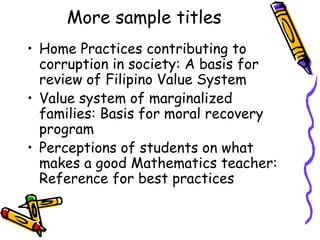
More sample titles
• Home Practices contributing to
corruption in society: A basis for
review of Filipino Value System
• Value system of marginalized
families: Basis for moral recovery
program
• Perceptions of students on what
makes a good Mathematics teacher:
Reference for best practices
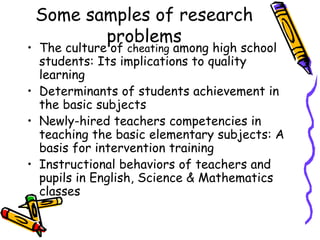
Some samples of research
problems
• The culture of cheating among high school
students: Its implications to quality
learning
• Determinants of students achievement in
the basic subjects
• Newly-hired teachers competencies in
teaching the basic elementary subjects: A
basis for intervention training
• Instructional behaviors of teachers and
pupils in English, Science & Mathematics
classes

2 Identifying a Research Problem PowerPoint

  • 1.
    Identifying a Research Problem Engr.Sylvia Emboy- Pama, REA,REB,EnP LGU-Bayugan City
  • 2.
    What is problem identification? •Problem identification is the process of finding or determining which area is to be studied. • This could deal on relationship between variables • This could deal with differences and comparisons among variables
  • 3.
    • It couldmake an inquiry into the extent of influence among the variables • It could look into the effects on an experiment between control and experimental groups
  • 4.
    Where could oneget ideas of problems to be researched on? • Experiences • Literature and studiesBibliographypublished and unpublished reference materials • National and societal concerns • Technological change
  • 5.
    What are someproblem areas ? • Research related to the development of an individual • Curricular research • Social and economic condition research • Research on teaching and learning
  • 6.
    • Research oneducational administration • Research on individual differences • Research and development of technology on health • Historical research in health • Experimental research on teaching and learning effectiveness
  • 7.
    Sources of literaturefor problem identification • The Education Index/Psychological abstracts/Sociological abstracts • The Encyclopedia of Educational Research • The Handbook of research in Teaching • The Review of Educational Research • Review of journals, handbooks, yearbooks, published by professional associations
  • 8.
    3-dimensional model for problemconsideration • Available inputs • Instructional activities • Anticipated outcomes
  • 9.
    Factors to beconsidered in selecting a research problem • The researcher’s area of interest • Availability of funds • The investigator’s ability and training
  • 10.
    Characteristics of agood problem statement • The problem should express a relation between 2 or more variables • The problem should be stated clearly and unambiguously in question form • The problem should imply possibilities of empirical testing
  • 11.
    Criteria for assessing appropriatenessof a research problem • Is it a problem that can be effectively solved through a process of research? • Is the problem significant? • Is it a new problem? • Will it be designed such that the influence of extraneous variables are limited?
  • 12.
    • To whatextent are the findings generalizable? • Is the research feasible • Is the researcher competent to plan and carry out the type of study planned? • Does he know enough about the field to understand its significant aspects? • Is he skillful to develop, administer, and interpret necessary data gathering devices and procedures?
  • 13.
    • Are relevantdata accessible? • Will the necessary financial resources be available to carry on the study? • Will there be enough time to complete the project?
  • 14.
    WORKSHOP ACTIVITY • Thinkof a researchable problem • Identify the possible questions that you could research on • Discuss your problems with a partner • Decide which final problems should you consider in relation to the topic, instrument, statistical treatment • Present the problems you have made
  • 15.
    More samples oftitles • Demographic Attributes of Women Belong To The Indigenous Tribal Group: Basis For Assistance • Perceptions Of Abortion Among College Students: Its implications To Morale Values • Internet Communication: Its Implications To Morality In Media
  • 16.
    More sample oftitles • Feedback of children of OFW parents: Implications to the psychological development of children • TV viewing of students and their academic performance: Basis for parental guidance
  • 17.
    More sample titles •Home Practices contributing to corruption in society: A basis for review of Filipino Value System • Value system of marginalized families: Basis for moral recovery program • Perceptions of students on what makes a good Mathematics teacher: Reference for best practices
  • 18.
    Some samples ofresearch problems • The culture of cheating among high school students: Its implications to quality learning • Determinants of students achievement in the basic subjects • Newly-hired teachers competencies in teaching the basic elementary subjects: A basis for intervention training • Instructional behaviors of teachers and pupils in English, Science & Mathematics classes