Welcome to Year 2
Design and
technology
Learning objectives for the four
sessions
To develop knowledge and understanding of
Design and Technology in the Primary school
through the development of skills in:
 Mechanisms
 Resistant materials
 Food as a material
 Textiles as a material
Learning objectives for the four
sessions
To help you to:
 Understand the National Curriculum for Design
and Technology
 Develop knowledge of health and safety in
D&T
 Understand the cross curricular nature of D&T
 Develop planning skills
 Develop assessment skills
Sessions this Year
Session 1 – Teddy Bears’ Name Tags
 What is Design and Technology in the NC?
 D&T across the curriculum
 Designing and making card mechanisms
Sessions this Year
 Session 2 – Teddy Bears’ Trollies
 Making with resistant materials
 The three types of D&T activity
 Planning D&T activities safely
Sessions this Year
Session 3 – Teddy Bears’ Tabards
 Making with textiles
 Assessing D&T
 How do children learn in D&T?
Sessions this Year
Session 4 – Teddy Bears’ Picnic Treats
 Making with food
 Health and Safety in food activities
You should increase your ability to:
 Reflect on yourself as a teacher and learner of
D & T;
 Work safely in D & T;
 Use a variety of equipment;
 Understand how D & T can be taught
alongside with other curriculum subjects.
Design and
technology
Welcome to Year 2
Session 1
Session 1
Teddy Bears’ Name Tags
 What is Design and Technology in the NC?
 D&T across the curriculum
 Designing and making card mechanisms
Learning objectives for the session
To develop knowledge and understanding of:
 The Programme of Study for Design and
Technology as a framework for designing and
making
 The cross curricular opportunities offered by
D&T
Develop the ability to :
 Make a simple mechanism
D&T Activities?
 Follow the instructions on your card to design
and make a product.
 Have we been doing D&T?
 What evidence do we have for this?
 Write a definition of D&T
The National Curriculum
The National Curriculum for D & T has 1 attainment target
The programmes of study are divided into 5 sections;
• Developing, planning and communicating ideas;
• Working with tools, equipment, materials and
components to make quality products;
• Evaluating processes and products;
• Knowledge and understanding of materials and
components;
• Breadth of Study.
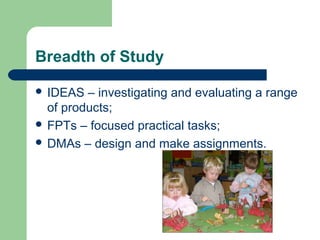
Breadth of Study
 IDEAS – investigating and evaluating a range
of products;
 FPTs – focused practical tasks;
 DMAs – design and make assignments.
Design and Make Task
 Design and make a Name Badge/ Tag for your
Teddy Bear to stop him from getting lost during
the Teddy Bears’ Picnic.
 You need to include a moving part/mechanism
that he can play with on the journey.
 Make sure that it is well made and attractive as
well as clearly displaying his or her name.

Session Powerpoint

  • 1.
    Welcome to Year2 Design and technology
  • 2.
    Learning objectives forthe four sessions To develop knowledge and understanding of Design and Technology in the Primary school through the development of skills in:  Mechanisms  Resistant materials  Food as a material  Textiles as a material
  • 3.
    Learning objectives forthe four sessions To help you to:  Understand the National Curriculum for Design and Technology  Develop knowledge of health and safety in D&T  Understand the cross curricular nature of D&T  Develop planning skills  Develop assessment skills
  • 4.
    Sessions this Year Session1 – Teddy Bears’ Name Tags  What is Design and Technology in the NC?  D&T across the curriculum  Designing and making card mechanisms
  • 5.
    Sessions this Year Session 2 – Teddy Bears’ Trollies  Making with resistant materials  The three types of D&T activity  Planning D&T activities safely
  • 6.
    Sessions this Year Session3 – Teddy Bears’ Tabards  Making with textiles  Assessing D&T  How do children learn in D&T?
  • 7.
    Sessions this Year Session4 – Teddy Bears’ Picnic Treats  Making with food  Health and Safety in food activities
  • 8.
    You should increaseyour ability to:  Reflect on yourself as a teacher and learner of D & T;  Work safely in D & T;  Use a variety of equipment;  Understand how D & T can be taught alongside with other curriculum subjects.
  • 9.
  • 10.
    Session 1 Teddy Bears’Name Tags  What is Design and Technology in the NC?  D&T across the curriculum  Designing and making card mechanisms
  • 11.
    Learning objectives forthe session To develop knowledge and understanding of:  The Programme of Study for Design and Technology as a framework for designing and making  The cross curricular opportunities offered by D&T Develop the ability to :  Make a simple mechanism
  • 12.
    D&T Activities?  Followthe instructions on your card to design and make a product.  Have we been doing D&T?  What evidence do we have for this?  Write a definition of D&T
  • 13.
    The National Curriculum TheNational Curriculum for D & T has 1 attainment target The programmes of study are divided into 5 sections; • Developing, planning and communicating ideas; • Working with tools, equipment, materials and components to make quality products; • Evaluating processes and products; • Knowledge and understanding of materials and components; • Breadth of Study.
  • 14.
    Breadth of Study IDEAS – investigating and evaluating a range of products;  FPTs – focused practical tasks;  DMAs – design and make assignments.
  • 15.
    Design and MakeTask  Design and make a Name Badge/ Tag for your Teddy Bear to stop him from getting lost during the Teddy Bears’ Picnic.  You need to include a moving part/mechanism that he can play with on the journey.  Make sure that it is well made and attractive as well as clearly displaying his or her name.