Data visualization tools for Nutrition Monitoring and
Advocacy
12 February 2020
SESSION 3
Presentation Outline:
 What is data visualization and why should we use
it strategically?
 How do data visualization tools contribute to the
nutrition landscape??
 What do we know about user needs and practice?
12 February 2020
What is data
visualization and why
should we use it
strategically?
12 February 2020
Why visualize data?
 Data are more persuasive as graphs compared
to tables.
 Human brains more rapidly process visuals
compared to text.
 Data visualization tools (DVTs) are useful for
decision-making, advocacy, and
communication.
12 February 2020
Evergreen, Stephanie DH. Effective Data Visualization: The Right Chart for the Right Data. SAGE Publications, 2016.
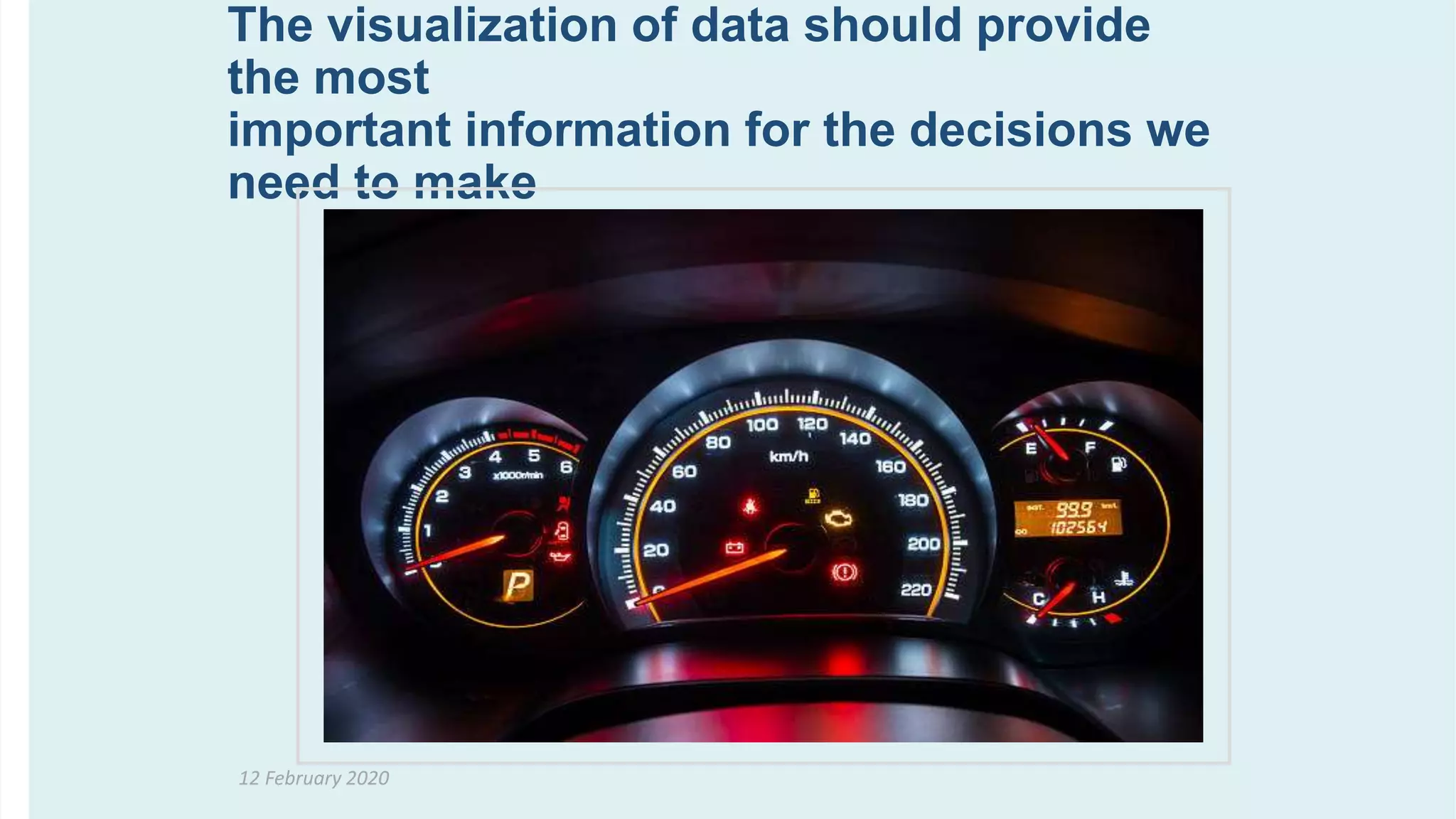
The visualization of data should provide
the most
important information for the decisions we
need to make
12 February 2020
12 February 2020
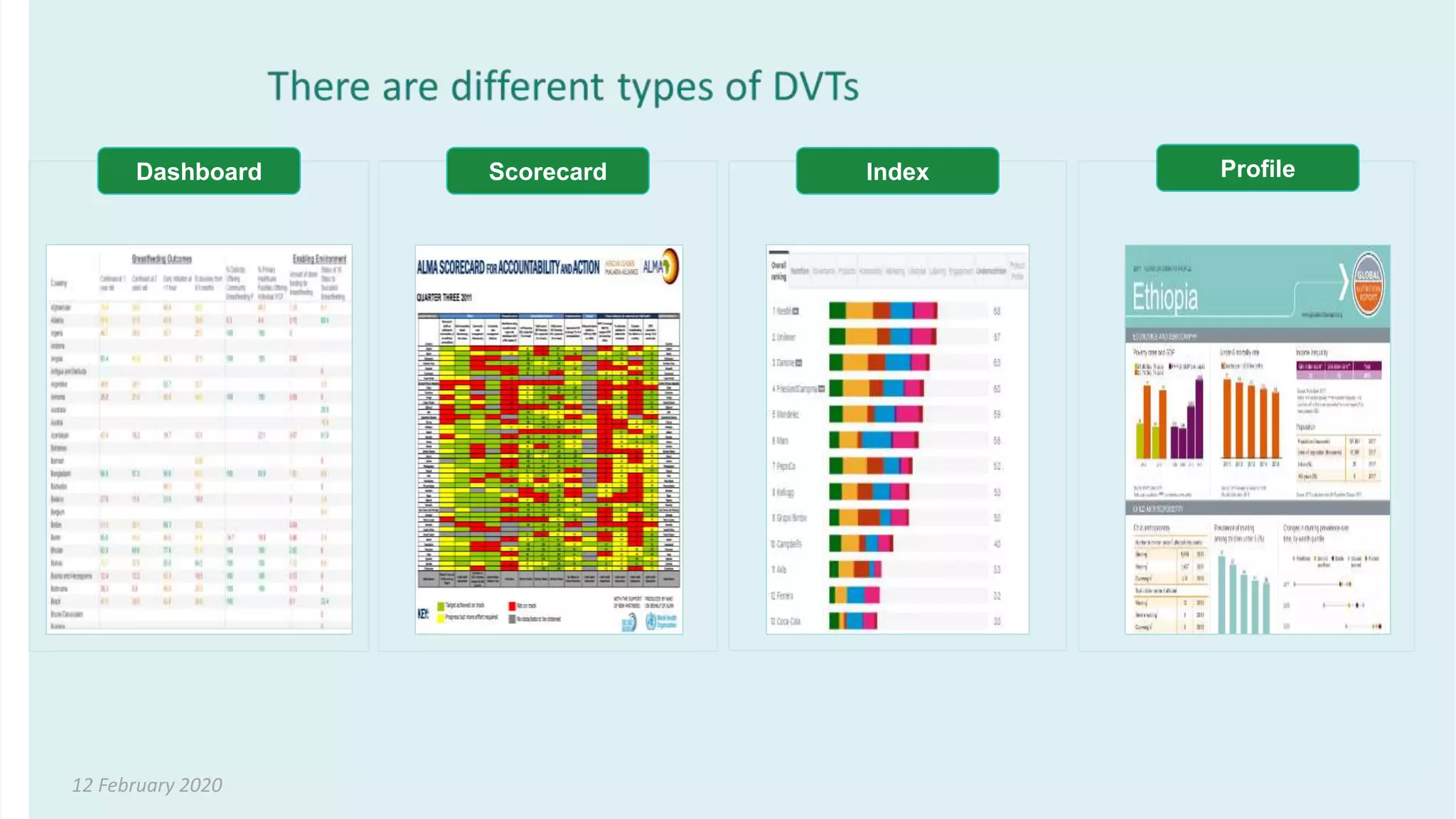
Dashboard Scorecard Index Profile
12 February 2020
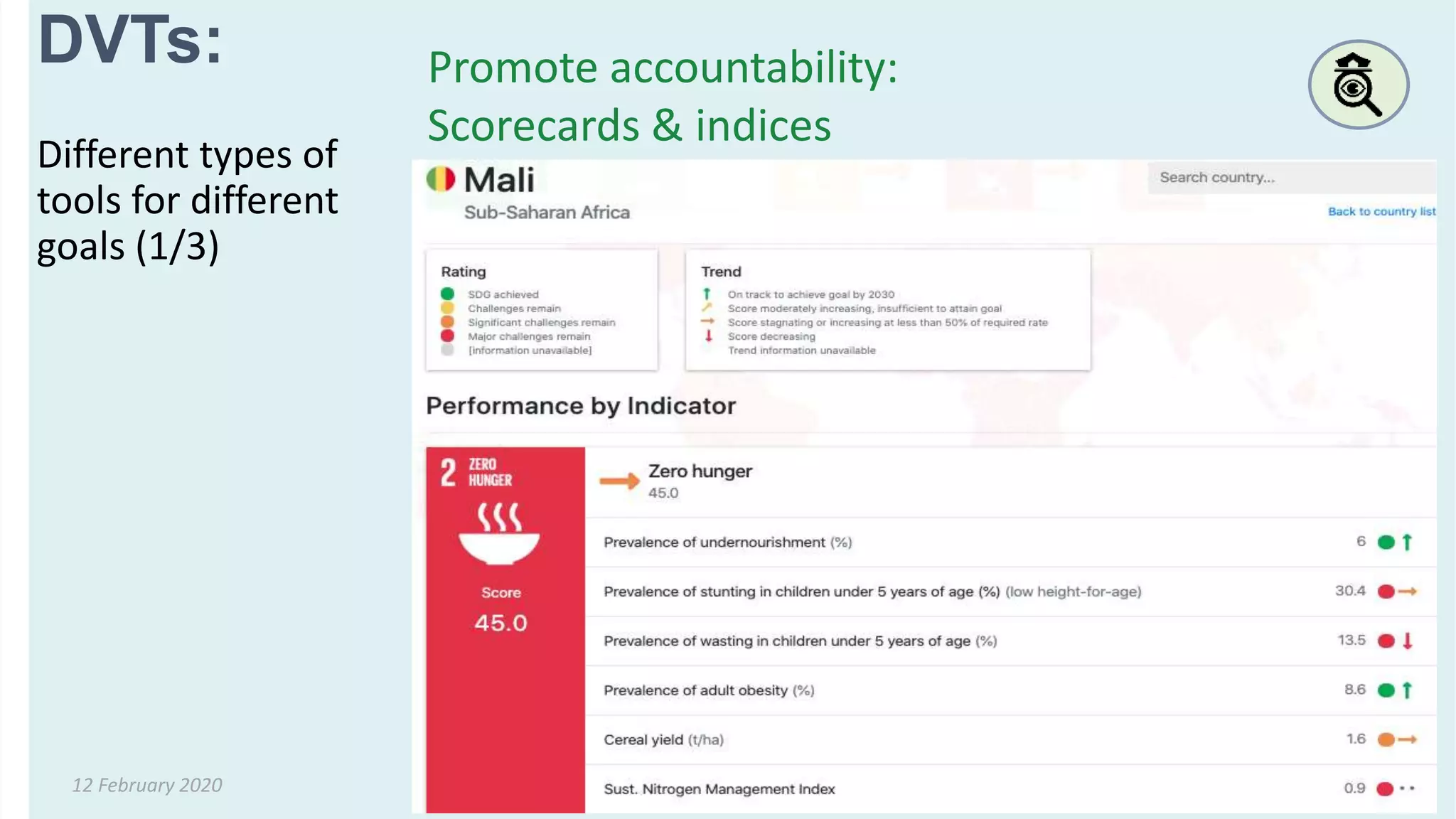
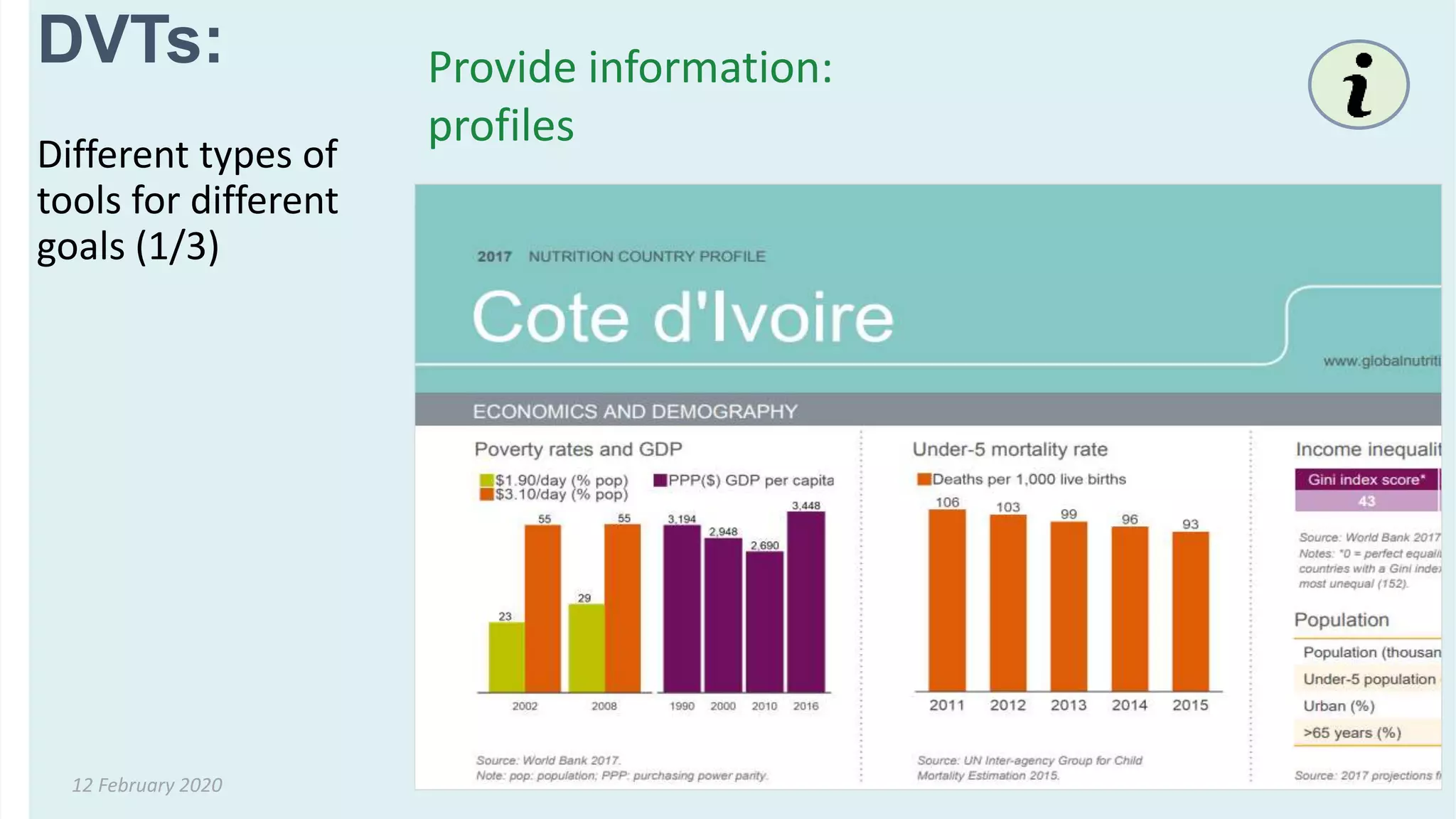
DVTs:
Different types of
tools for different
goals (1/3)
Promote accountability:
Scorecards & indices
12 February 2020
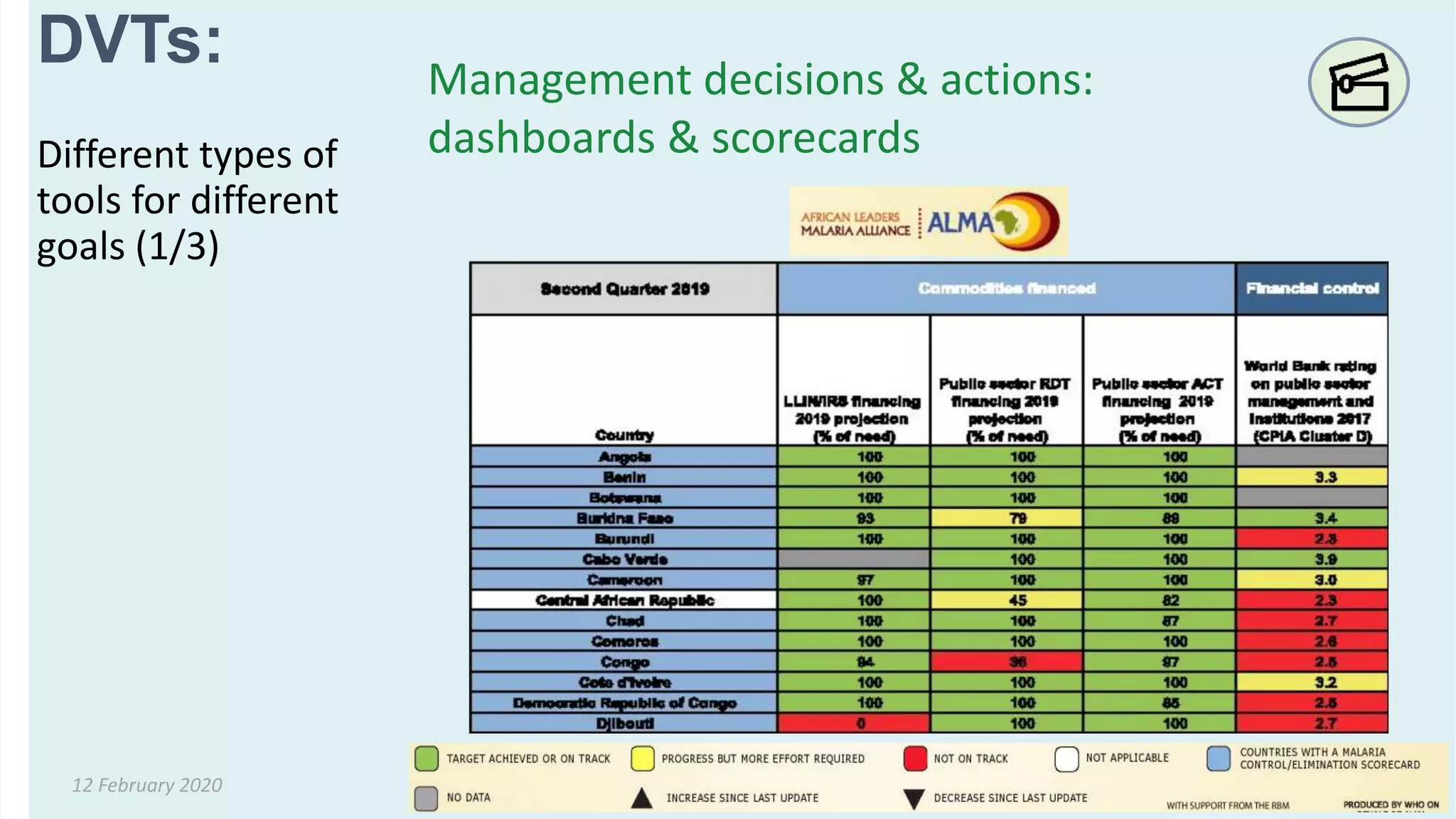
Management decisions & actions:
dashboards & scorecardsDifferent types of
tools for different
goals (1/3)
DVTs:
12 February 2020
Provide information:
profiles
Different types of
tools for different
goals (1/3)
DVTs:
How do data visualization tools
contribute to the nutrition
landscape?
12 February 2020
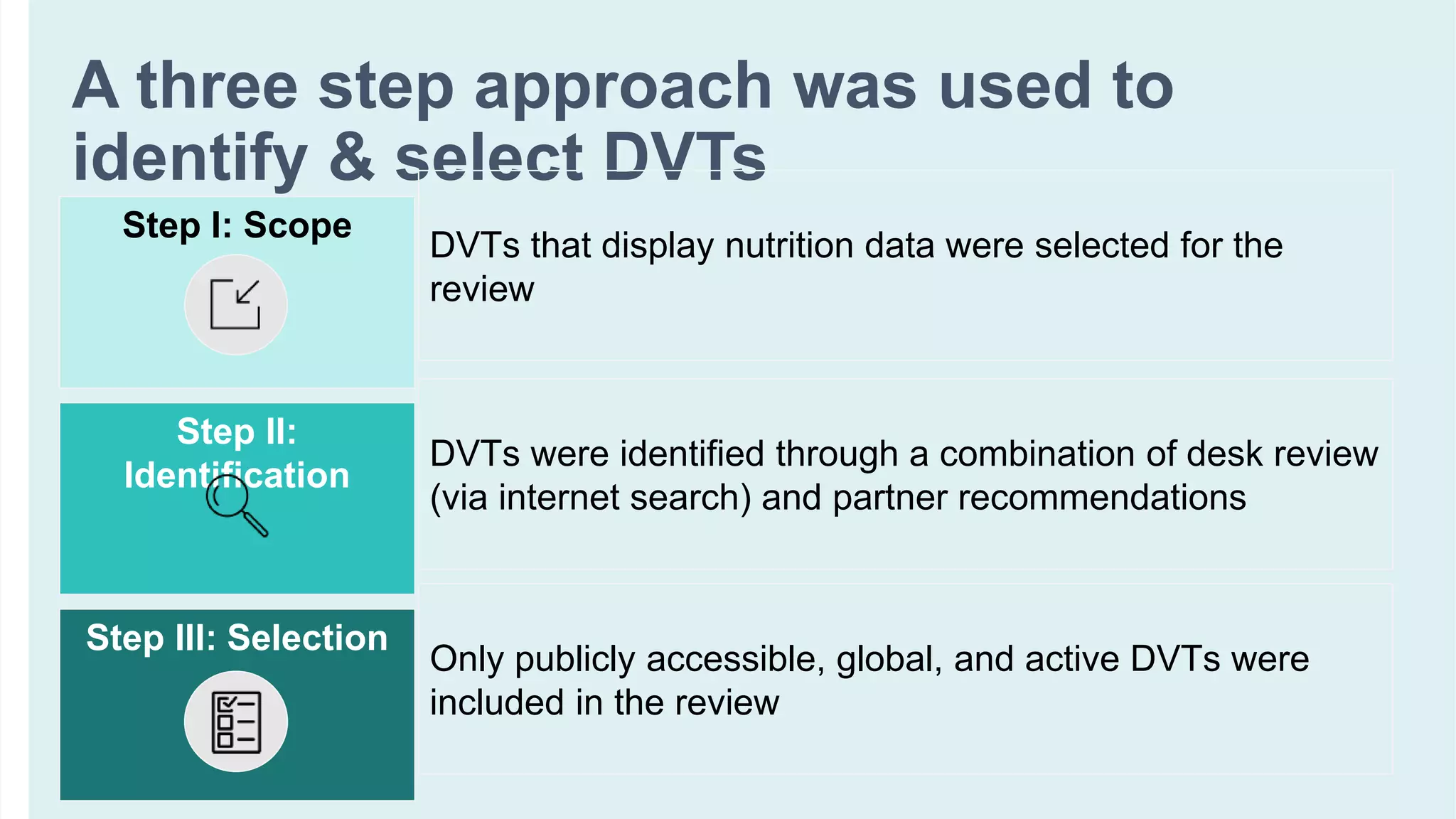
A three step approach was used to
identify & select DVTs
12 February 2020
Step I: Scope
Step II:
Identification
Step III: Selection
DVTs that display nutrition data were selected for the
review
DVTs were identified through a combination of desk review
(via internet search) and partner recommendations
Only publicly accessible, global, and active DVTs were
included in the review
12 February 2020
Key finding #1
There’s a growing
number of DVTs in
nutrition – we found 23
12 February 2020
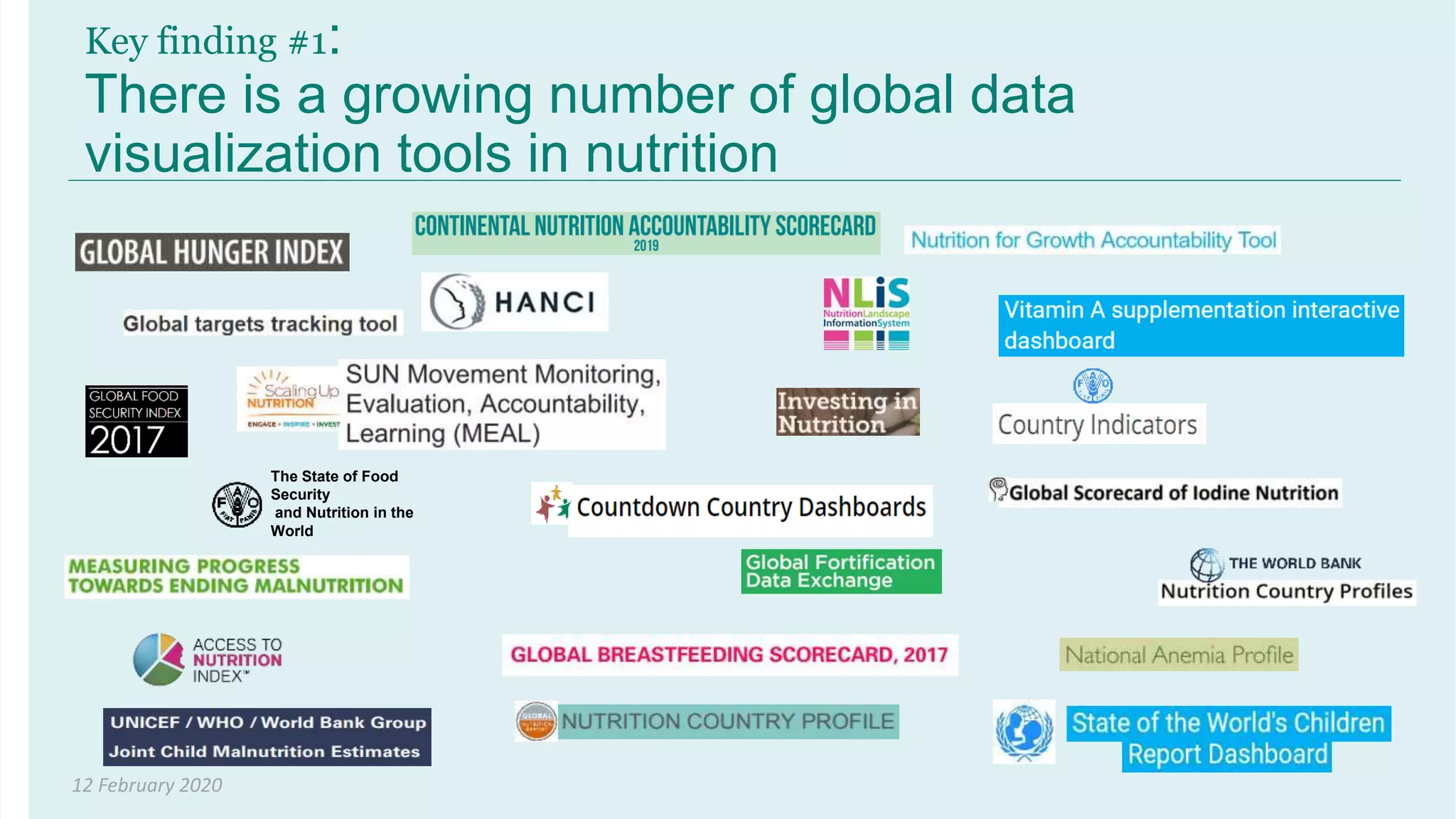
Key finding #1:
There is a growing number of global data
visualization tools in nutrition
The State of Food
Security
and Nutrition in the
World
26 February 2020
Key finding #1:
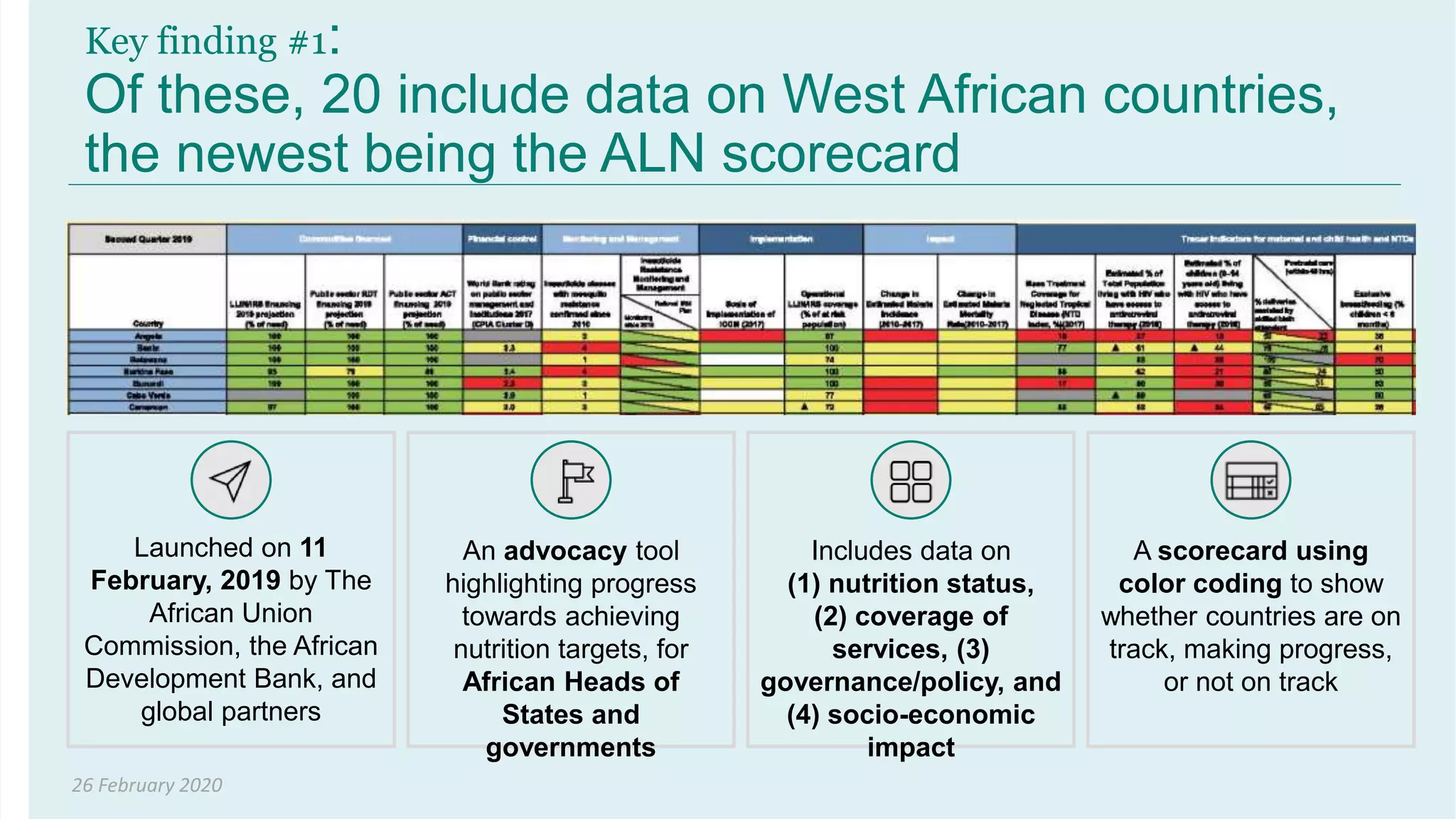
Of these, 20 include data on West African countries,
the newest being the ALN scorecard
An advocacy tool
highlighting progress
towards achieving
nutrition targets, for
African Heads of
States and
governments
Launched on 11
February, 2019 by The
African Union
Commission, the African
Development Bank, and
global partners
Includes data on
(1) nutrition status,
(2) coverage of
services, (3)
governance/policy, and
(4) socio-economic
impact
A scorecard using
color coding to show
whether countries are on
track, making progress,
or not on track
12 February 2020
Key finding #1:
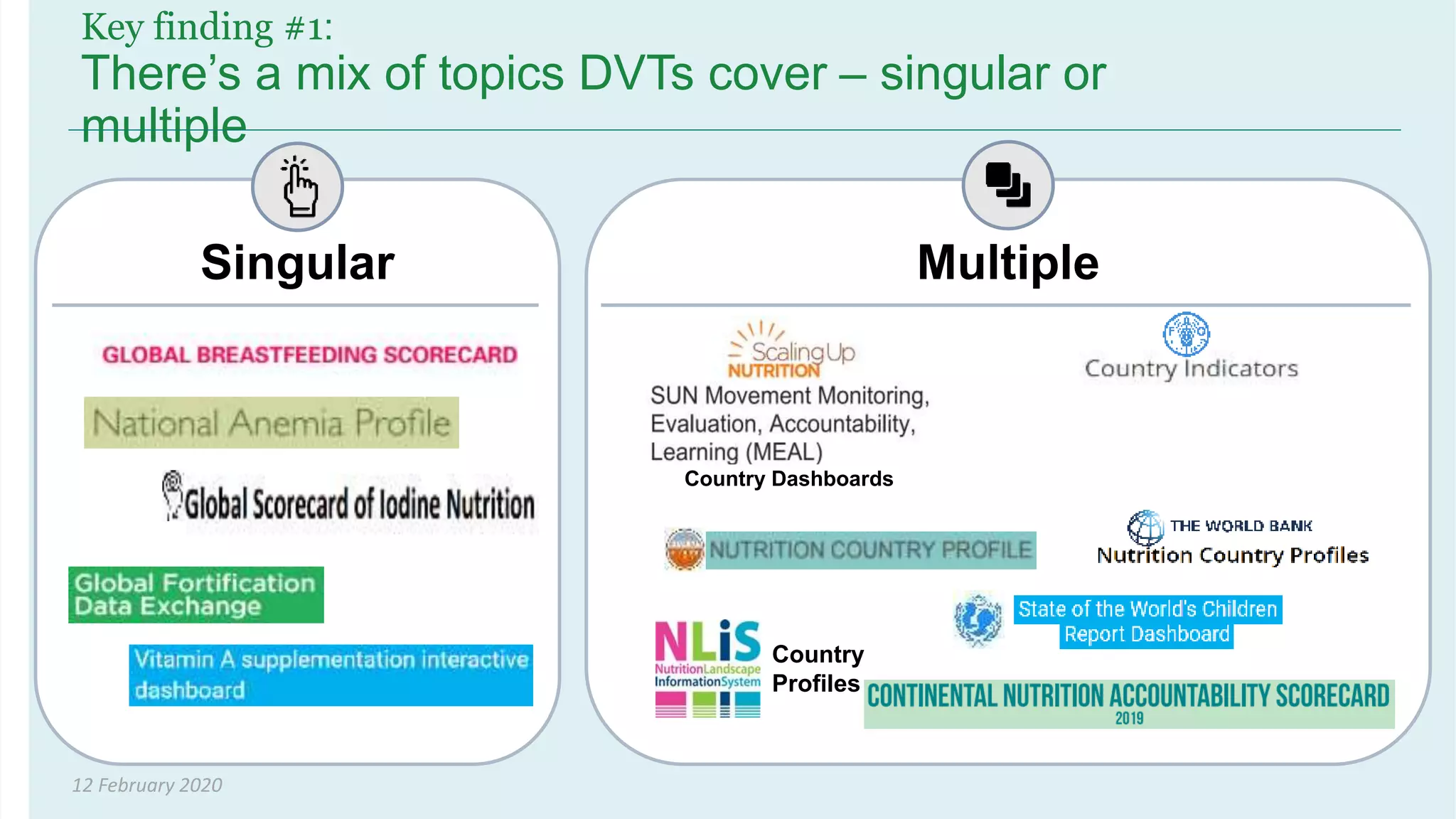
There’s a mix of topics DVTs cover – singular or
multiple
Singular Multiple
Country
Profiles
Country Dashboards
12 February 2020
Key finding #1:
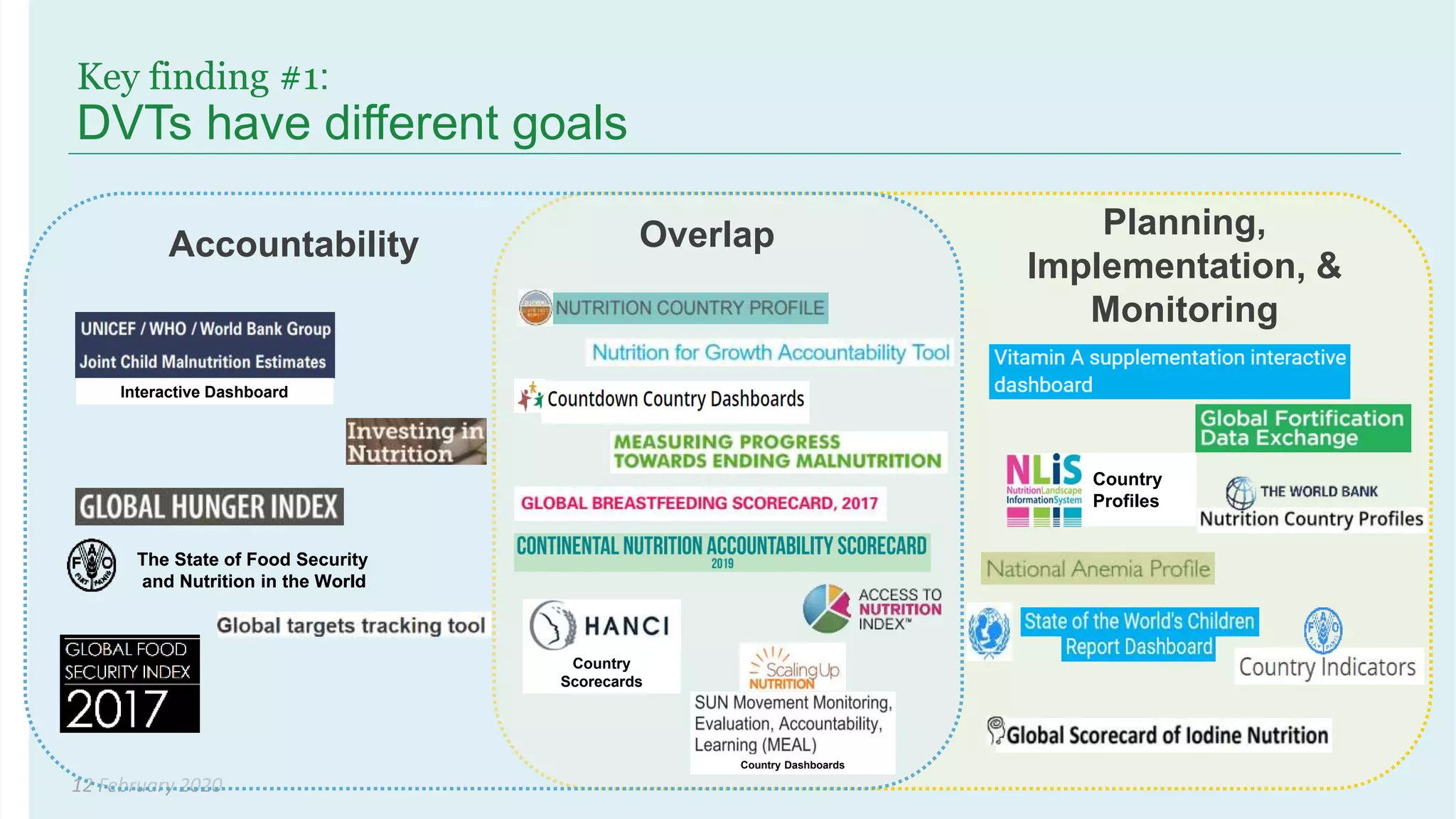
DVTs have different goals
The State of Food Security
and Nutrition in the World
Interactive Dashboard
Accountability Overlap
The State of Food Security
and Nutrition in the World
Interactive Dashboard
Country
Profiles
Country Dashboards
Country
Scorecards
Accountability
Planning,
Implementation, &
Monitoring
Overlap
26 February 2020
Key finding #1:
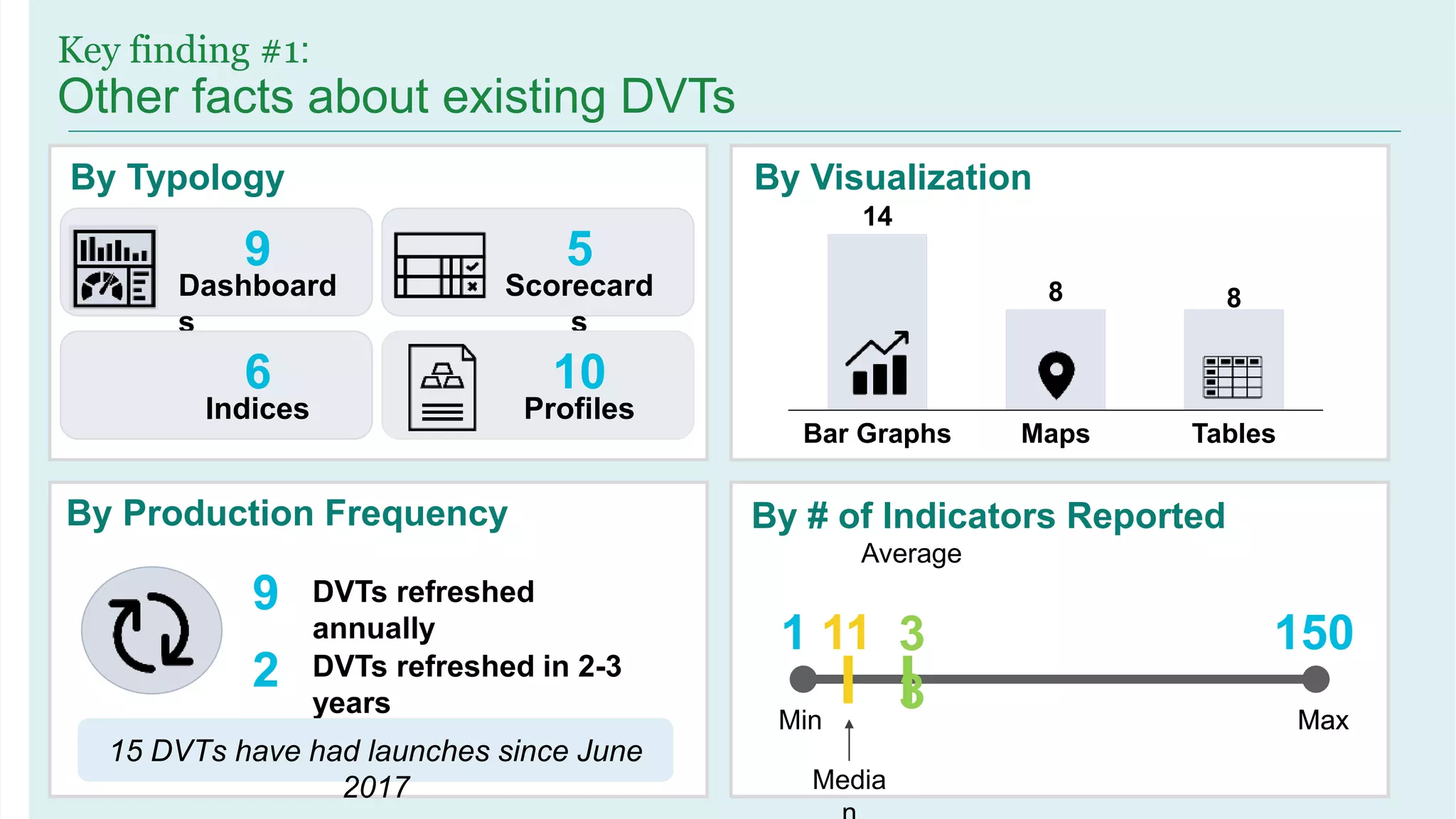
Other facts about existing DVTs
Dashboard
s
9
By Typology
Scorecard
s
5
Indices
6
Profiles
10
By Visualization
14
8 8
Bar Graphs Maps Tables
By Production Frequency
9
2
DVTs refreshed
annually
DVTs refreshed in 2-3
years
15 DVTs have had launches since June
2017
By # of Indicators Reported
Min Max
150
Media
Average
Max
1 11 3
3
12 February 2020
Key finding #2:
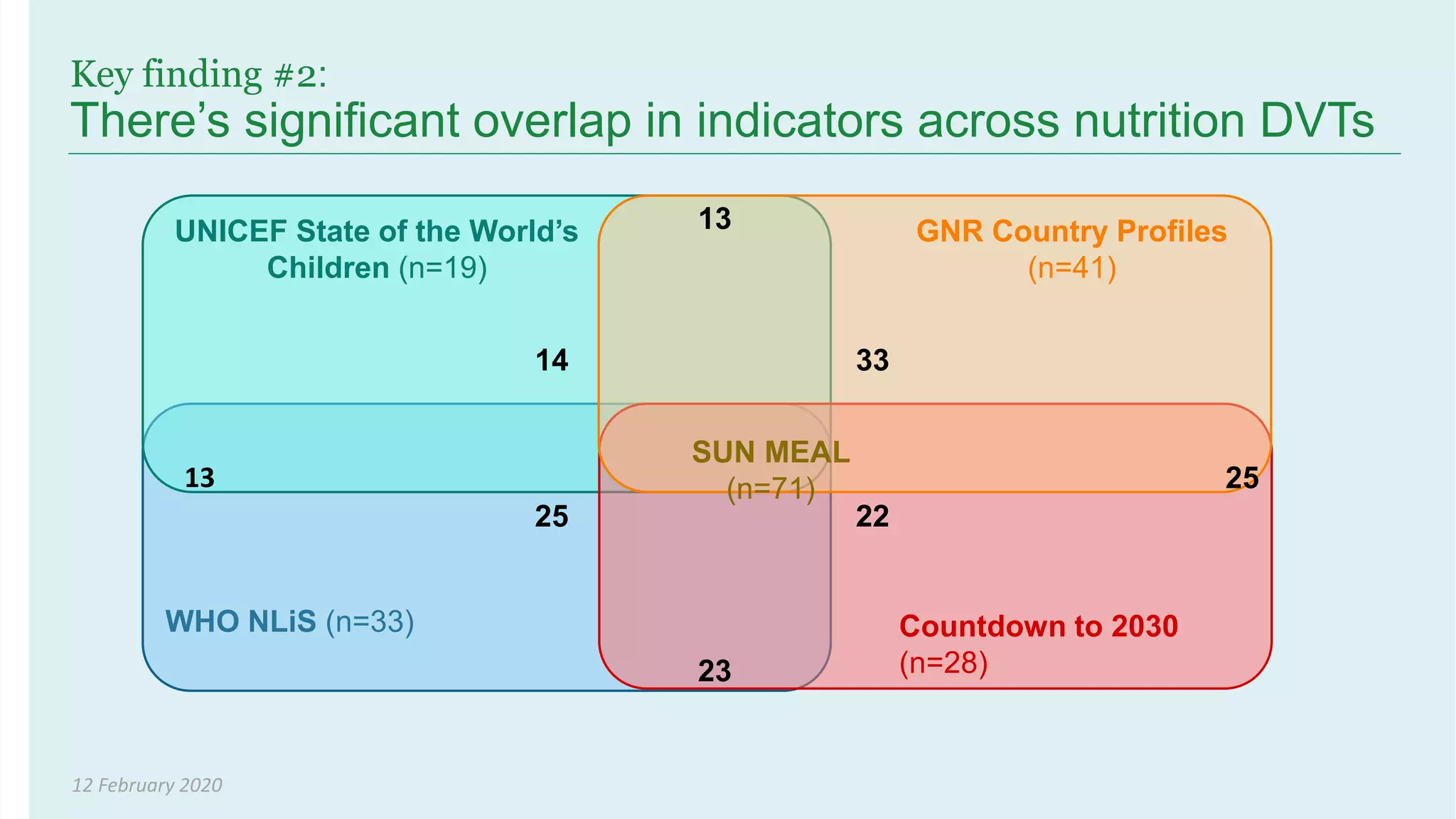
There’s significant overlap in indicators across nutrition DVTs
GNR Country Profiles
(n=41)
WHO NLiS (n=33)
23
33
25
UNICEF State of the World’s
Children (n=19)
22
14
13
13
Countdown to 2030
(n=28)
25
SUN MEAL
(n=71)
26 February 2020
Key finding #2
Differences across some
DVTs may lead to mixed
messages
12 February 2020
Key finding #2
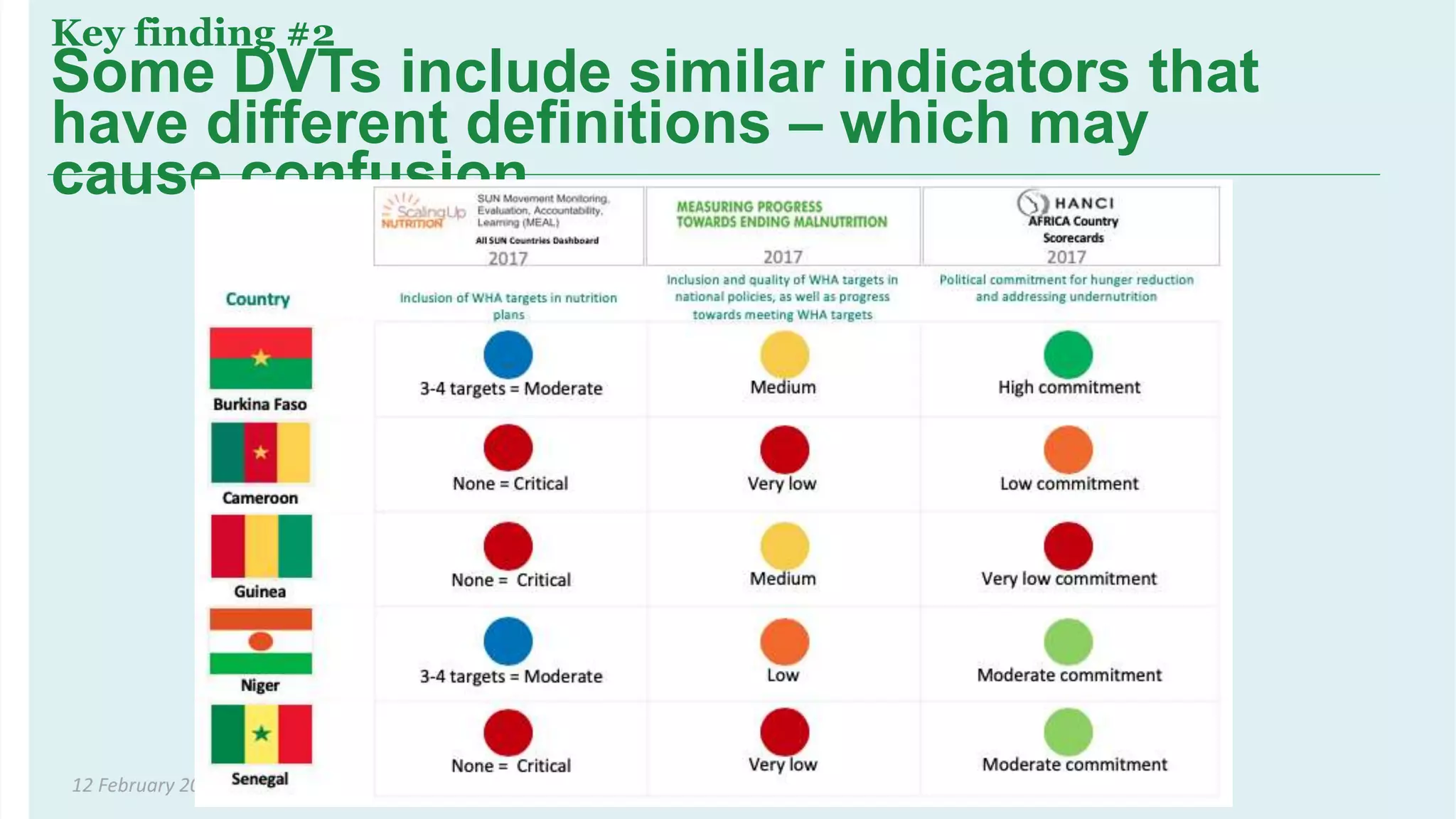
Some DVTs include similar indicators that
have different definitions – which may
cause confusion
Key finding #3
26 February 2020
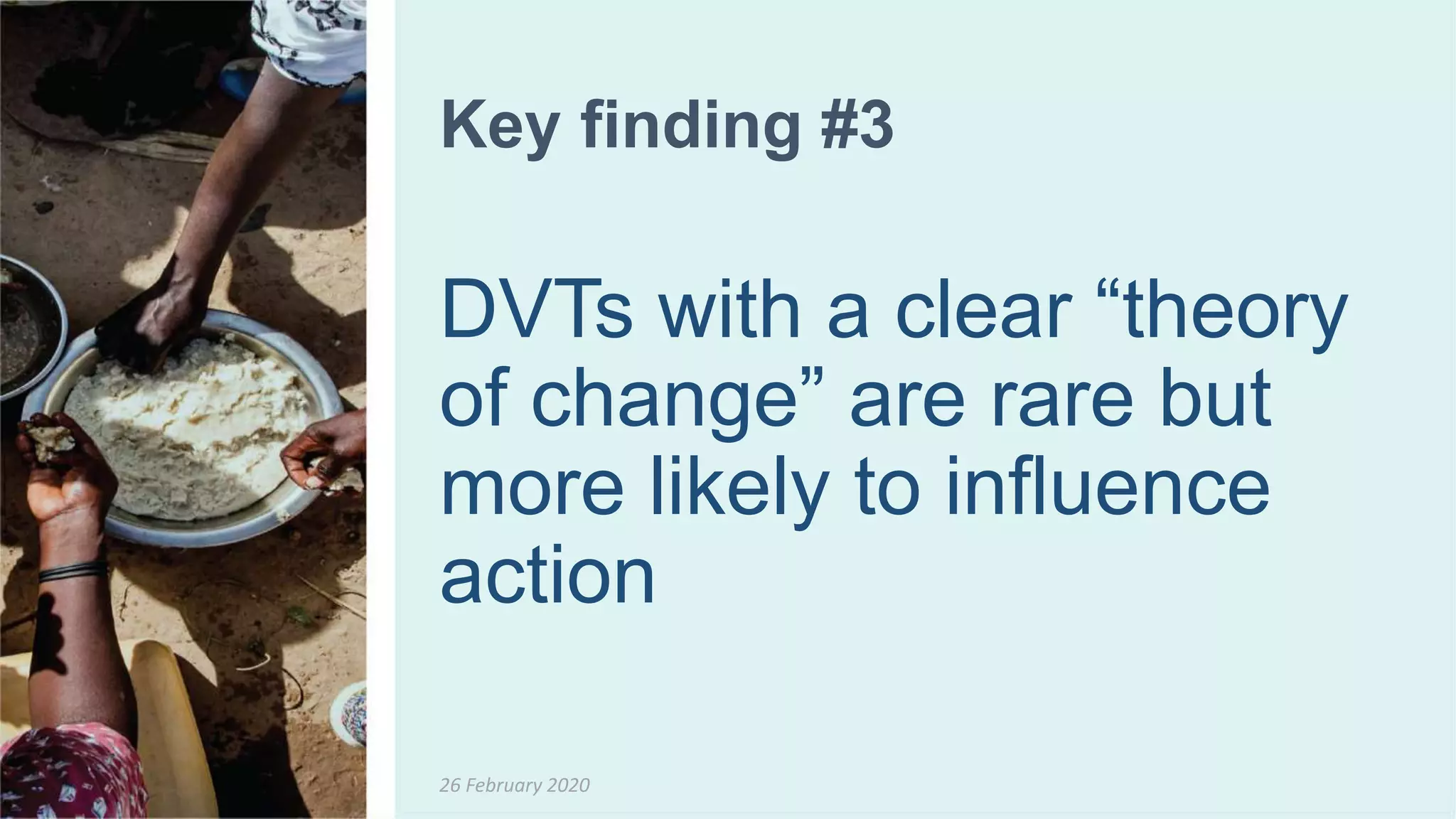
DVTs with a clear “theory
of change” are rare but
more likely to influence
action
12 February 2020
Key finding #3
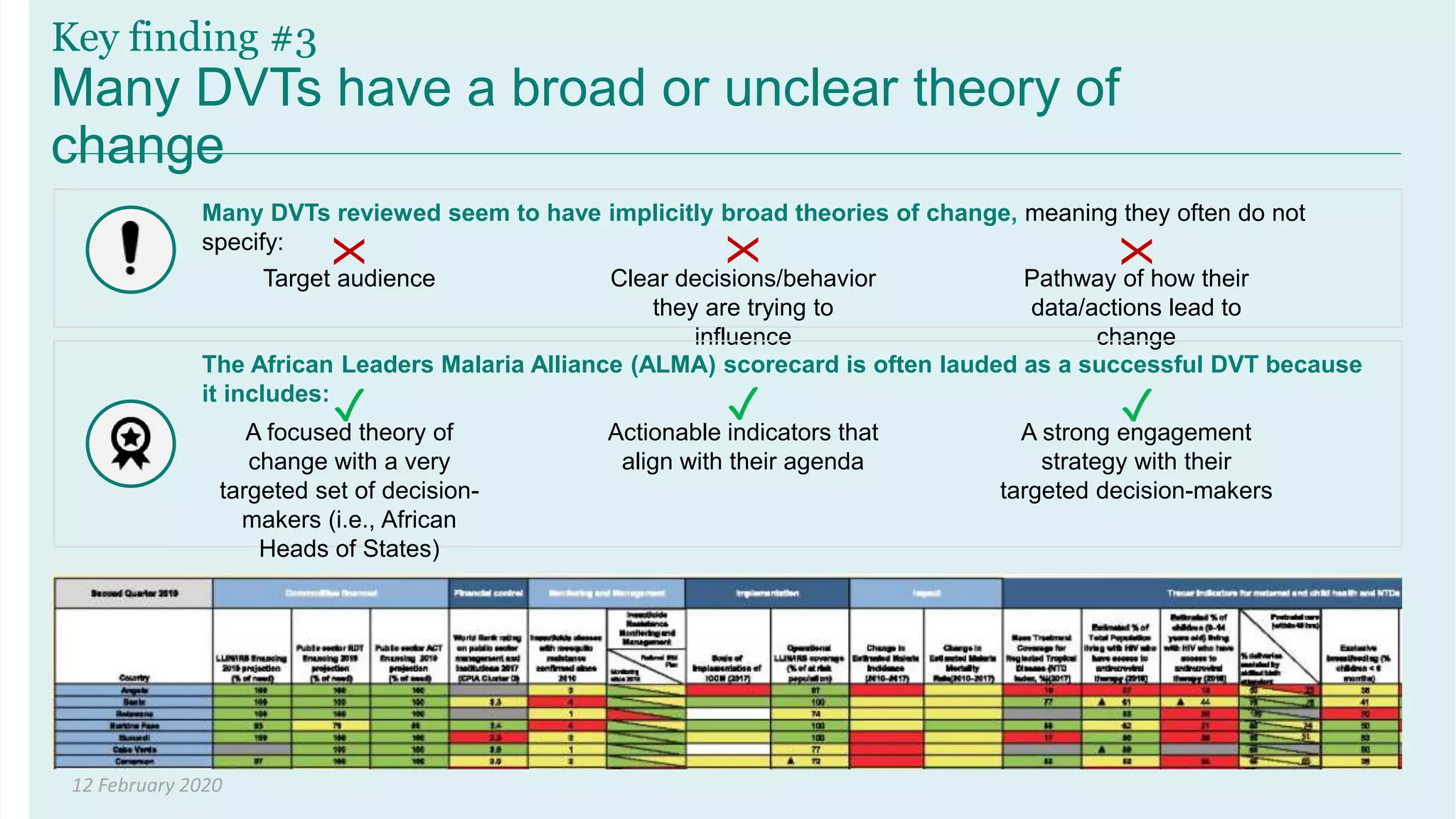
Many DVTs have a broad or unclear theory of
change
Many DVTs reviewed seem to have implicitly broad theories of change, meaning they often do not
specify:
Target audience Clear decisions/behavior
they are trying to
influence
Pathway of how their
data/actions lead to
changeX
X
X
The African Leaders Malaria Alliance (ALMA) scorecard is often lauded as a successful DVT because
it includes:
A focused theory of
change with a very
targeted set of decision-
makers (i.e., African
Heads of States)
Actionable indicators that
align with their agenda
A strong engagement
strategy with their
targeted decision-makers
✓ ✓ ✓
26 February 2020
Key finding #4
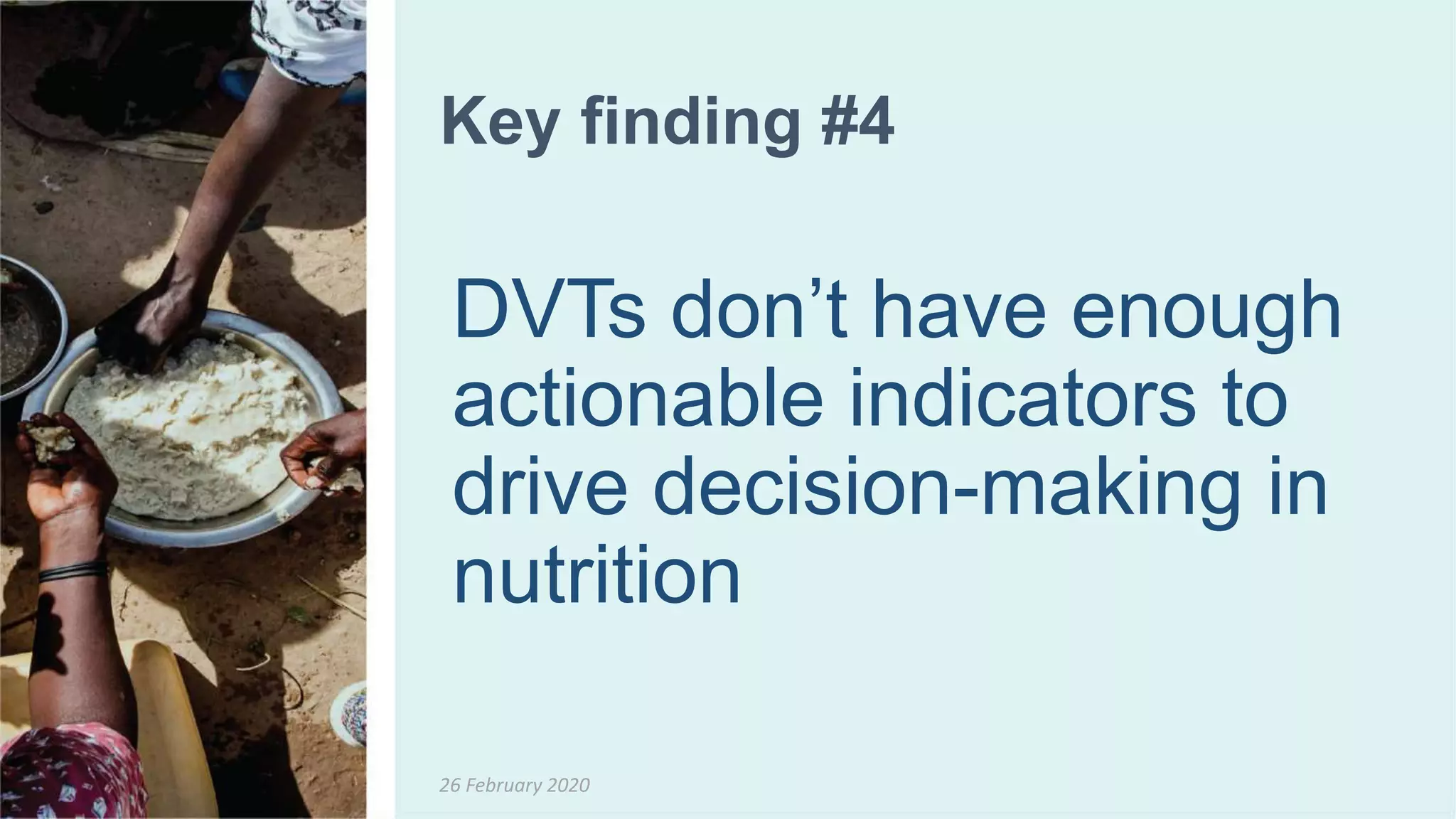
DVTs don’t have enough
actionable indicators to
drive decision-making in
nutrition
26 February 2020
How are global data
visualization tools used?
12 February 2020
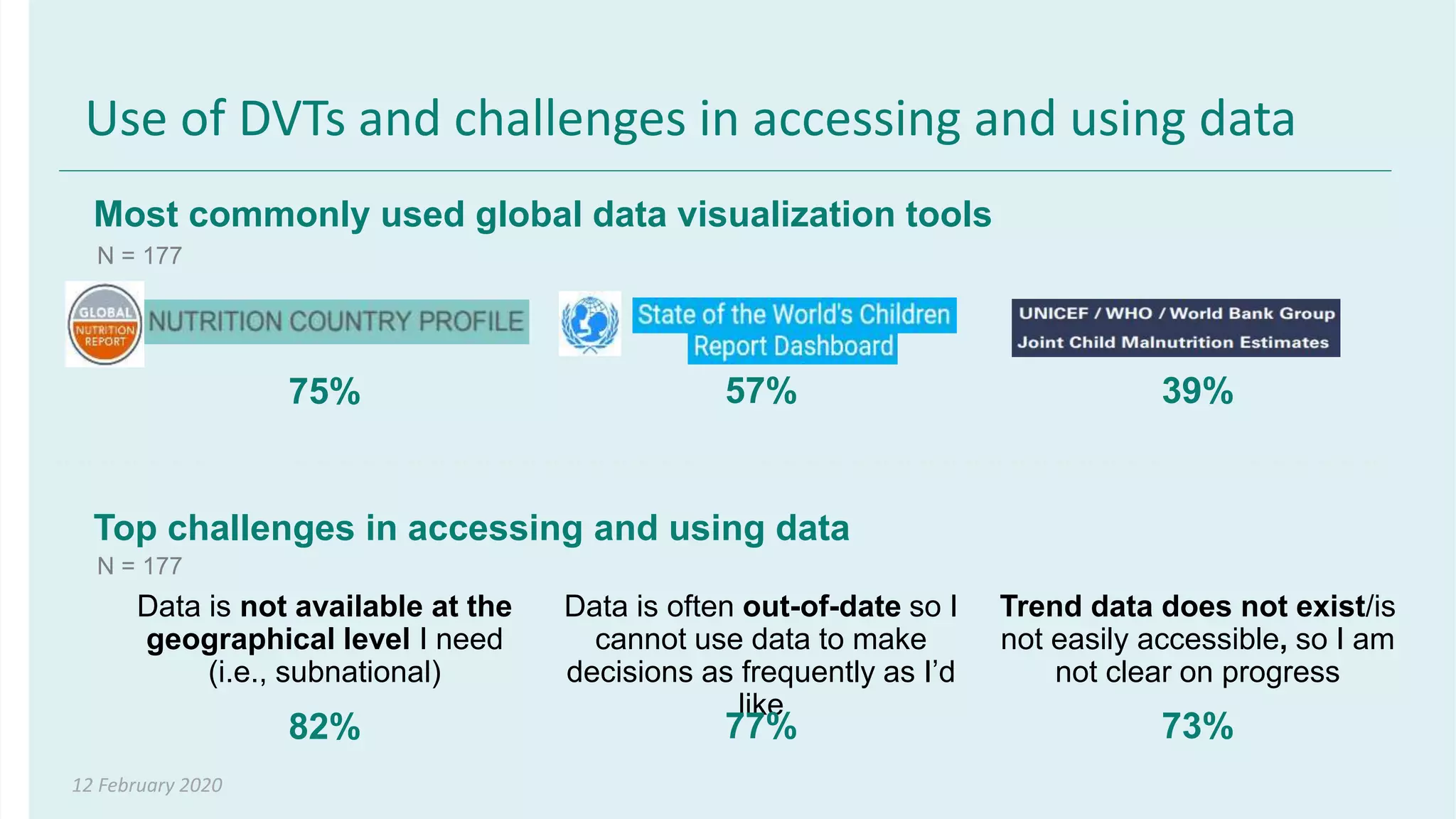
Use of DVTs and challenges in accessing and using data
N = 177
Most commonly used global data visualization tools
75% 57% 39%
Top challenges in accessing and using data
Data is not available at the
geographical level I need
(i.e., subnational)
Data is often out-of-date so I
cannot use data to make
decisions as frequently as I’d
like
Trend data does not exist/is
not easily accessible, so I am
not clear on progress
82% 77% 73%
N = 177
12 February 2020
Conclusion
12 February 2020
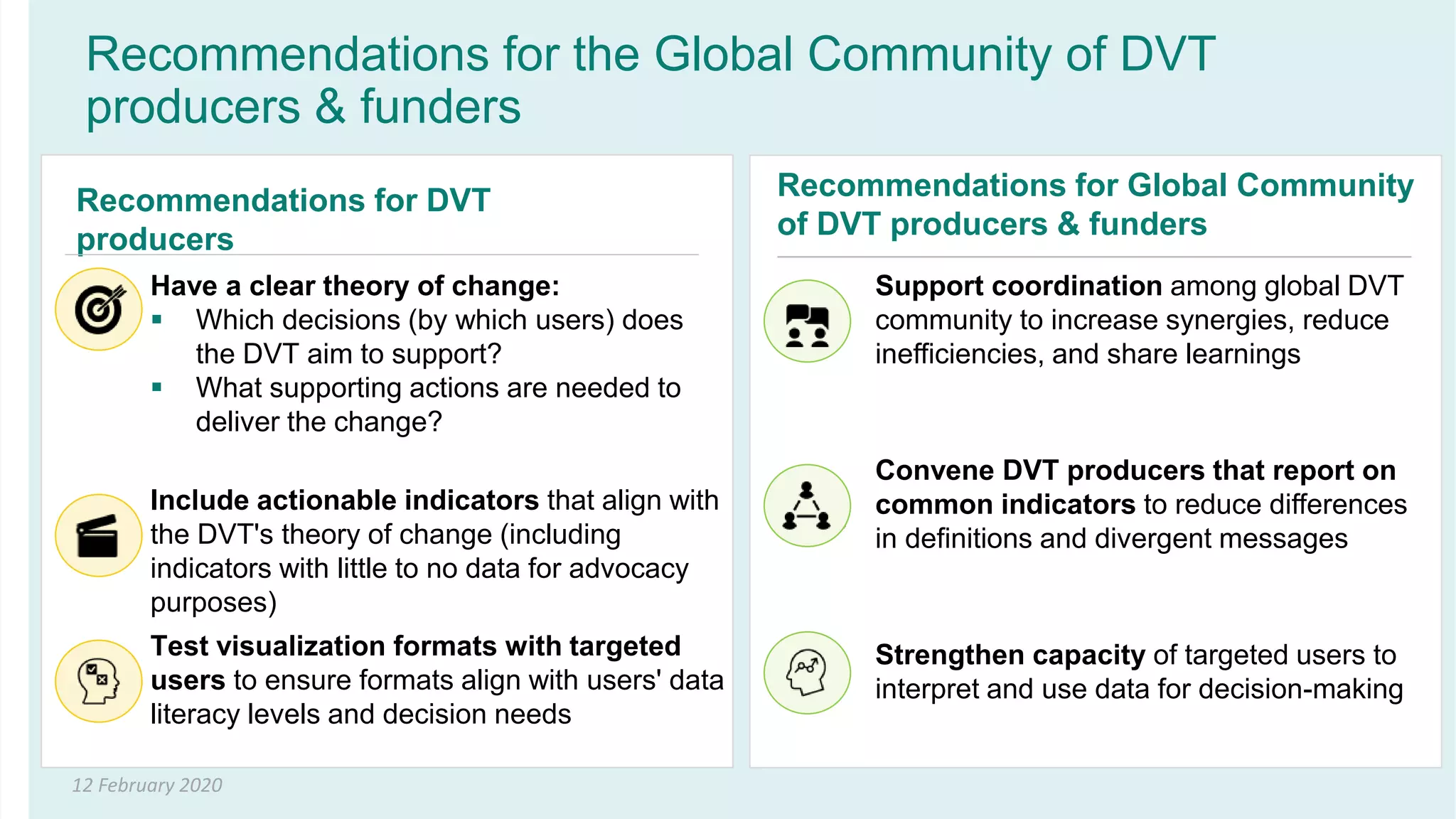
Recommendations for the Global Community of DVT
producers & funders
Have a clear theory of change:
 Which decisions (by which users) does
the DVT aim to support?
 What supporting actions are needed to
deliver the change?
Recommendations for DVT
producers
Include actionable indicators that align with
the DVT's theory of change (including
indicators with little to no data for advocacy
purposes)
Test visualization formats with targeted
users to ensure formats align with users' data
literacy levels and decision needs
Recommendations for Global Community
of DVT producers & funders
Support coordination among global DVT
community to increase synergies, reduce
inefficiencies, and share learnings
Strengthen capacity of targeted users to
interpret and use data for decision-making
Convene DVT producers that report on
common indicators to reduce differences
in definitions and divergent messages
Thank you!

T4N - Session 3: Data visualization tools for Nutrition Monitoring and Advocacy

  • 1.
    Data visualization toolsfor Nutrition Monitoring and Advocacy 12 February 2020 SESSION 3
  • 2.
    Presentation Outline:  Whatis data visualization and why should we use it strategically?  How do data visualization tools contribute to the nutrition landscape??  What do we know about user needs and practice? 12 February 2020
  • 3.
    What is data visualizationand why should we use it strategically? 12 February 2020
  • 4.
    Why visualize data? Data are more persuasive as graphs compared to tables.  Human brains more rapidly process visuals compared to text.  Data visualization tools (DVTs) are useful for decision-making, advocacy, and communication. 12 February 2020 Evergreen, Stephanie DH. Effective Data Visualization: The Right Chart for the Right Data. SAGE Publications, 2016.
  • 5.
    The visualization ofdata should provide the most important information for the decisions we need to make 12 February 2020
  • 6.
    12 February 2020 DashboardScorecard Index Profile
  • 7.
    12 February 2020 DVTs: Differenttypes of tools for different goals (1/3) Promote accountability: Scorecards & indices
  • 8.
    12 February 2020 Managementdecisions & actions: dashboards & scorecardsDifferent types of tools for different goals (1/3) DVTs:
  • 9.
    12 February 2020 Provideinformation: profiles Different types of tools for different goals (1/3) DVTs:
  • 10.
    How do datavisualization tools contribute to the nutrition landscape? 12 February 2020
  • 11.
    A three stepapproach was used to identify & select DVTs 12 February 2020 Step I: Scope Step II: Identification Step III: Selection DVTs that display nutrition data were selected for the review DVTs were identified through a combination of desk review (via internet search) and partner recommendations Only publicly accessible, global, and active DVTs were included in the review
  • 12.
    12 February 2020 Keyfinding #1 There’s a growing number of DVTs in nutrition – we found 23
  • 13.
    12 February 2020 Keyfinding #1: There is a growing number of global data visualization tools in nutrition The State of Food Security and Nutrition in the World
  • 14.
    26 February 2020 Keyfinding #1: Of these, 20 include data on West African countries, the newest being the ALN scorecard An advocacy tool highlighting progress towards achieving nutrition targets, for African Heads of States and governments Launched on 11 February, 2019 by The African Union Commission, the African Development Bank, and global partners Includes data on (1) nutrition status, (2) coverage of services, (3) governance/policy, and (4) socio-economic impact A scorecard using color coding to show whether countries are on track, making progress, or not on track
  • 15.
    12 February 2020 Keyfinding #1: There’s a mix of topics DVTs cover – singular or multiple Singular Multiple Country Profiles Country Dashboards
  • 16.
    12 February 2020 Keyfinding #1: DVTs have different goals The State of Food Security and Nutrition in the World Interactive Dashboard Accountability Overlap The State of Food Security and Nutrition in the World Interactive Dashboard Country Profiles Country Dashboards Country Scorecards Accountability Planning, Implementation, & Monitoring Overlap
  • 17.
    26 February 2020 Keyfinding #1: Other facts about existing DVTs Dashboard s 9 By Typology Scorecard s 5 Indices 6 Profiles 10 By Visualization 14 8 8 Bar Graphs Maps Tables By Production Frequency 9 2 DVTs refreshed annually DVTs refreshed in 2-3 years 15 DVTs have had launches since June 2017 By # of Indicators Reported Min Max 150 Media Average Max 1 11 3 3
  • 18.
    12 February 2020 Keyfinding #2: There’s significant overlap in indicators across nutrition DVTs GNR Country Profiles (n=41) WHO NLiS (n=33) 23 33 25 UNICEF State of the World’s Children (n=19) 22 14 13 13 Countdown to 2030 (n=28) 25 SUN MEAL (n=71)
  • 19.
    26 February 2020 Keyfinding #2 Differences across some DVTs may lead to mixed messages
  • 20.
    12 February 2020 Keyfinding #2 Some DVTs include similar indicators that have different definitions – which may cause confusion
  • 21.
    Key finding #3 26February 2020 DVTs with a clear “theory of change” are rare but more likely to influence action
  • 22.
    12 February 2020 Keyfinding #3 Many DVTs have a broad or unclear theory of change Many DVTs reviewed seem to have implicitly broad theories of change, meaning they often do not specify: Target audience Clear decisions/behavior they are trying to influence Pathway of how their data/actions lead to changeX X X The African Leaders Malaria Alliance (ALMA) scorecard is often lauded as a successful DVT because it includes: A focused theory of change with a very targeted set of decision- makers (i.e., African Heads of States) Actionable indicators that align with their agenda A strong engagement strategy with their targeted decision-makers ✓ ✓ ✓
  • 23.
    26 February 2020 Keyfinding #4 DVTs don’t have enough actionable indicators to drive decision-making in nutrition
  • 24.
    26 February 2020 Howare global data visualization tools used?
  • 25.
    12 February 2020 Useof DVTs and challenges in accessing and using data N = 177 Most commonly used global data visualization tools 75% 57% 39% Top challenges in accessing and using data Data is not available at the geographical level I need (i.e., subnational) Data is often out-of-date so I cannot use data to make decisions as frequently as I’d like Trend data does not exist/is not easily accessible, so I am not clear on progress 82% 77% 73% N = 177
  • 26.
  • 27.
    12 February 2020 Recommendationsfor the Global Community of DVT producers & funders Have a clear theory of change:  Which decisions (by which users) does the DVT aim to support?  What supporting actions are needed to deliver the change? Recommendations for DVT producers Include actionable indicators that align with the DVT's theory of change (including indicators with little to no data for advocacy purposes) Test visualization formats with targeted users to ensure formats align with users' data literacy levels and decision needs Recommendations for Global Community of DVT producers & funders Support coordination among global DVT community to increase synergies, reduce inefficiencies, and share learnings Strengthen capacity of targeted users to interpret and use data for decision-making Convene DVT producers that report on common indicators to reduce differences in definitions and divergent messages
  • 28.