New Product Development  project management Developing Project Management Capabilities
Burning platform Vast majority of programs fail to meet their objectives According to a 1995 Standish Group study, only 16% of software projects in the US are completed on time and on budget and meet their deliverables $81 Billion will be spent on cancelled projects, $59 Billion on completed projects Denver airport baggage handling system alone cost City of Denver more than $1M per day
Update from 2005 Statistics have improved from Standish, 22% of projects were completed and considered successes In parallel, during these 10 years, the number of PMP (professionalized project managers) grew by 100,000+ Projects also were re-packaged into smaller, more manageable chunks while the systems technology grew more complex
A simple definition for PM Project management is an integral part of a high performance culture. Part of the early warning system that is used by management to address problems early...while there is still opportunity to recover
What is Project Management? Fully understanding customer requirements Addressing all requirements systematically Organizing project work Planning project work Maintaining project plans Addressing issues rapidly and escalating as appropriate Anticipating risks and mitigating them systematically Projecting future costs and schedules based on performance to plan Learning from previous mistakes and improving your project based on learning Using metrics as a management tool Managing a project like small business Leading courageously
What is PM NOT? Management by hysteria or rumor Mere reporting of the news Bureaucracy for the sake of bureaucracy A policing function Just another part time job Something that anyone can do without training or experience A dead end career A note taker or a meeting facilitator A clerical position  A whistle blower  A liaison between groups or with the customer Scheduling and only scheduling Perpetuator of the “party line” An extension of senior management
Is PM a Science? PM is a body of knowledge, a field of practice within the social sciences: Other social sciences include organizational psychology, sociology, organizational behavior and organizational development PM is subject to the contingency theory as are other organizational sciences: Organizations have significant differences in multiple dimensions, environmental, cultural etc.  Mechanistic versus organic organizations Applicability of theories is dependent upon circumstances. No two organizations or projects are exactly alike.
Kerzner’s sixteen points to PM maturity Adopt a PM methodology and use it consistently Implement a philosophy that drives the company toward PM maturity and communicate it to everyone Commit to developing effective plans at the beginning of each project Minimize scope changes by committing to realistic objectives Recognize that cost and schedule management are inseparable Select the right person as the project manager Provide executives with project sponsor information, not project management information Strengthen involvement and support of line management Focus on deliverables rather than resources Cultivate effective communication, cooperation, and trust to achieve rapid project management maturity Share recognition for project success with the entire project team and line management Eliminate non-productive meetings Focus on identifying and solving problems early, quickly and cost effectively Measure progress periodically Use PM software as a tool, not as a substitute for effective planning or interpersonal skills Institute an all employee training program with periodic updates based upon documented lessons learned
PMBOK definitions Projects versus operations: Both are performed by people, are constrained by resources and are planned, executed and controlled Projects are TEMPORARY endeavors undertaken to create a unique product or service (Projects are usually undertaken to implement a STRATEGY) What is Project management? The application of of knowledge, skills, tools and techniques to project activities in order to meet or exceed stakeholder expectations
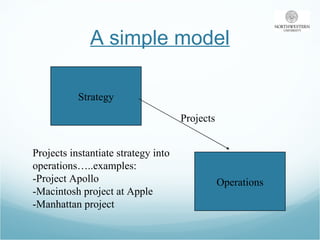
A simple model Strategy Operations Projects Projects instantiate strategy into  operations…..examples: -Project Apollo -Macintosh project at Apple -Manhattan project
Two different models Product orientation Market focused “ Genericized” to meet majority of needs of a market Maximize reuse Supportable Maintainable Consistency of deliverables Contract orientation Customer focused Highly customized to meet customer needs Little reuse Limited supportability and maintainability
Paradigms Strategy is a result of paradigms Paradigms have been studied at length by Thomas Kuhn Paradigms reflect the driving force behind how one views the world and how issues, requirements and solutions are  framed The paradigm is the driving force behind the development of a new product Example: Network computer versus personal computer Example: Federal express versus USPS Ref: The Structure of Scientific Revolutions-Thomas Kuhn
Two main schools of thought Rational The world is ordered It can be predicted It can be rationally planned Events flow in a logical sequence Past experience allows you to predict the future Chaordic The world is chaotic It is unpredictable and unstable Events are not logical and systems are not ordered The past is not necessarily a good predictor of the future Reference: Letting go for Control, Fitzgerald and Eijnatten, International Journal of Business Transformation, Apr 98
Implications Rational  Schedules are king Change is to be limited or eliminated Plans are cast in stone Resources are fixed and dedicated Goals are fixed Chaordic Change is expected Plans are to be revised constantly Resources are fluid and multi-tasking Goals evolve  Scope, schedule and resources are all in flux at the same time Reference: Letting go for Control, Fitzgerald and Eijnatten, International Journal of Business Transformation, Apr 98
Keys to new product development Process needs to embrace both rational and chaordic schools Design and implement a formal process but include some degree of flexibility to manage change and manage risks Requires use of cross-functional teams and project management techniques
Portfolio Management The multi-project environment
Definition Portfolio management for new products is a  dynamic decision process  wherein the list of active new products and R/D projects is constantly revised. Existing projects may be accelerated, de-prioritized or killed while resources are allocated and re-allocated to the active projects  Reference: Cooper: Portfolio management for new products
Two different models Product orientation Market focused “ Genericized” to meet majority of needs of a market Maximize reuse Supportable Maintainable Consistency of deliverables Contract orientation Customer focused Highly customized to meet customer needs Little reuse Limited supportability and maintainability
Strategy It all starts with strategy. All organizations have a strategy, even  if they haven’t articulated one. Let me observe their actions  and I will be able to infer an organization’s  strategy in short  order, even if it isn’t a consistent strategy .  This is sometimes known as the emergent strategy school Ideally, all projects are a reflection of the strategy. Each project  should be rationalized in the context of the portfolio strategy This is typical of the deliberate strategy school of thought  Strategy starts first with values and beliefs about the future  and beliefs about the organization’s assets and core competencies
Strategy safari- Mintzberg-2002 1. The design school, which sees strategic management as a process of attaining a fit between the internal capabilities and external possibilities of an organisation. 2. The planning school, which extols the virtues of formal strategic planning and arms itself with SWOT analyses and checklists. 3. The positioning school, heavily influenced by the ideas of Michael Porter, which stresses that strategy depends on the positioning of the firm in the market and within its industry. 4. The entrepreneurial school, which emphasises the central role played by the leader. 5. The cognitive school, which looks inwards into the minds of strategists. 6. The learning school, which sees strategy as an emergent process -- strategies emerge as people come to learn about a situation as well as their organisation's capability of dealing with it. 7. The power school, which views strategy emerging out of power games within the organisation and outside it. 8. The cultural school, which views strategy formation as a process rooted in the social force of culture. 9. The environmental school, which believes that a firm's strategy depends on events in the environment and the company's reaction to them 10. The configuration school, which views strategy as a process of transforming the organisation -- it describes the relative stability of strategy, interrupted by occasional and dramatic leaps to new ones.
Core competencies Organizations need to get down to basics. What is your organization good at? What is unique about your product or service What alternatives are there that might jeopardize your operation Examples: University of Michigan electronic documents What are your organization’s core competencies…..are they good enough to compete on a GLOBAL basis?
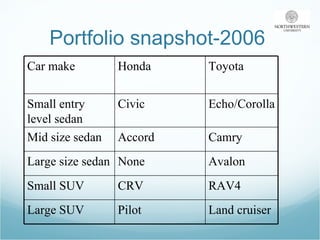
Portfolio snapshot-2006 Car make Honda Toyota Small entry level sedan Civic Echo/Corolla Mid size sedan Accord Camry Large size sedan None Avalon Small SUV CRV RAV4 Large SUV Pilot Land cruiser
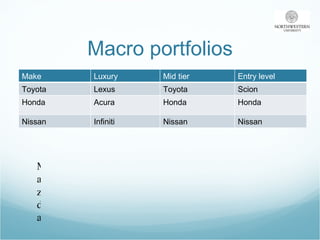
Macro portfolios Mazda attempted to start a luxury brand  under the name Millenia but it failed Toyota is rumored to be contemplating a hi tech  brand under the name Prius GM is eliminating and selling brands at high speed Make Luxury Mid tier Entry level Toyota Lexus Toyota Scion Honda Acura Honda Honda Nissan Infiniti Nissan Nissan
A simple portfolio analogy Napsack analogy Limits how many things you can carry on a long trip Forces you to make strategic choices, ie utility versus weight or displacement Most portfolios are resource constrained Research shows that most organizations have more active projects than they can sustain Results: like an overburdened napsack, something breaks Projects tend to be late, people overworked, typically poor quality
Metaphor-Financial portfolio Reflect on a financial portfolio. Goal oriented. What is the purpose of the financial portfolio? Retirement? Child’s education? Balance of risk/reward based on position in the lifecycle Looks at performance of each element against the expectations Offsetting investments to reduce overall risk and maximize possible gain
Example-Financial portfolio Cash Bonds Corporate vs municipal Growth stocks Income stocks Annuity Real estate/REITs
Investment analogy Based on strategic resource allocation theory-hedging your bets Balances (mixes) investments among various polar opposites: Stocks vs bonds vs real estate vs cash Domestic versus international (mature versus emerging market) Growth versus income Hi cap versus mid cap versus small cap Ultimate polar opposite: Risk versus reward
Product portfolio equivalents Cash cows-making good money for now Typically are at or nearing end of lifecycle Makes good money for now, but not for long Requires minimal investment to keep going Breakthrough products Requires significant investment Risk of failure If successful, may cannibalize your cash cow Portfolio expansion Minimizes risk but also tends to minimize reward
Types of projects in portfolio Breakthrough- Create new market Platform- Reach new customers within existing markets Derivatives- Sell more products to existing customers Product/brand support- Replaces current products Reference: Christensen HBSP Case 9-301-041, Using Aggregate Project Planning
Questions about portfolio  Proper mix of different types of projects Proper sequencing to reduce risk Platform followed by a few derivatives Alternating teams and sites to reduce the risks Maximize re-use of platforms, ie minimize the number of platforms Balance with maximize life from a platform
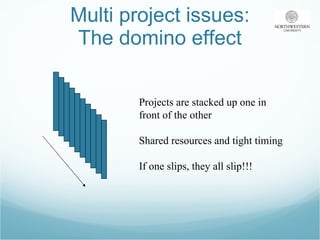
Multi project issues: The domino effect Projects are stacked up one in  front of the other Shared resources and tight timing If one slips, they all slip!!!
How to combat domino effect Alternate teams at strategic points Buffer resources/alternate teams of people Alternate sites Time spacing between projects  Alternate types of projects that will exercise different parts of the organization Alternate sizes of projects Don’t put two similar major projects in a row!!!
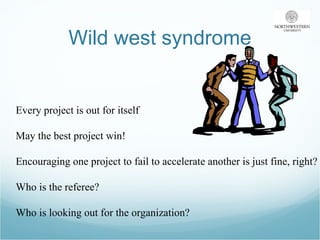
Wild west syndrome Every project is out for itself May the best project win! Encouraging one project to fail to accelerate another is just fine, right? Who is the referee? Who is looking out for the organization?
Examples of wild west effect Nudging one product out of test lab prematurely to get another product into test lab Borrowing some resources from one project and assign them to yours Reserving capacity for your project when you don’t really need it
Combating Wild west Where a single sponsor is responsible for all projects, and all resources report to that sponsor…priorities can be established and enforced What about where priorities are set from multiple sponsors????
A forum for multiple sponsors/stakeholders   Has been called many things in industry Executive review board Portfolio planning committee Marketing review board Sponsor committee Project authorization board Sector or group staff Sponsors establish and implement the process for making, monitoring and enforcing project decisions: Priorities, start, stop, staff, destaff
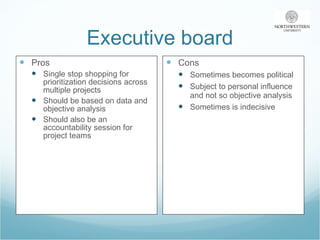
Executive board Pros Single stop shopping for prioritization decisions across multiple projects Should be based on data and objective analysis Should also be an accountability session for project teams Cons Sometimes becomes political Subject to personal influence and not so objective analysis Sometimes is indecisive
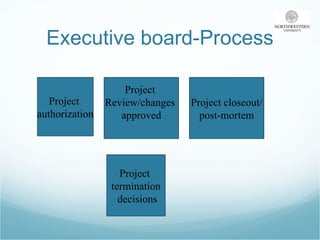
Executive board-Process Project  authorization Project  Review/changes  approved Project closeout/ post-mortem Project  termination decisions
The PM Office concept Provides an organization for PM to reside Provides support for Project controls, planning, finance, contract support, tools, process etc Provides for PM career management Should be headed by a very senior PM Should be given respect and authority from senior management
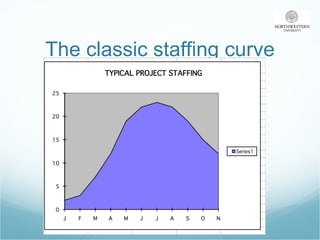
The classic staffing curve
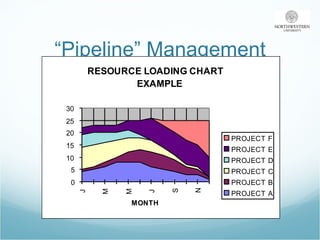
“ Pipeline” Management
Checkbook process A name for a resource management tool or technique This is a form of a multi project project plan Maps resource names to projects and to dates for the entire enterprise Highlights resource shortages
Aggregate project planning Define project types as either breakthrough, platform, derivative Identify existing projects and classify by project type Estimate average time and resources needed for each project type based on past experience Identify existing resource capacity Determine the desired mix of projects Estimate the number of projects that existing resources can support Decide which specific projects to pursue Prioritize via a valuation process Work to improve development capabilities Reference: Clark and Wheelwright, Harvard Business Review, March-April 1992
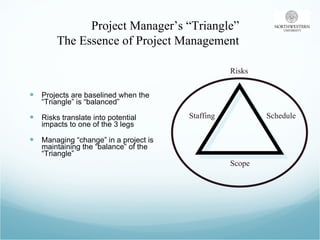
Projects are baselined when the “Triangle” is “balanced” Risks translate into potential impacts to one of the 3 legs Managing “change” in a project is maintaining the “balance” of the “Triangle” Project Manager’s “Triangle” The Essence of Project Management Scope Staffing Schedule Risks
Basic project management concepts
Where do you see projects?? Answer: EVERYWHERE! Product development Construction Customer proposals New manufacturing line ramp up Mortgage application Thanksgiving dinner Field system install Preparation for an audit Merger or acquisition Major senior management review Moving a household Building a house or major home improvement
Corollary topics/fields to Project Management Knowledge management Leadership/management theory Organizational development/behavior/theory Teambuilding/conflict management/culture/anthropology Process management/Re-engineering Total quality management Optimization theory/Operations research Operations management Communications skills and management Personal time management Negotiations skills Contract law Decision theory/Game theory Complexity theory Group dynamics Effective meetings, presentations and facilitation skills
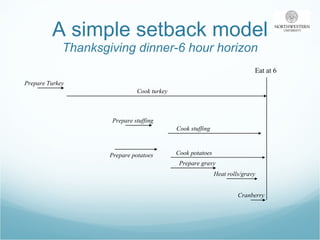
A simple setback model Thanksgiving dinner-6 hour horizon Eat at 6 Cook turkey Prepare Turkey Prepare stuffing Prepare potatoes Cook stuffing Cook potatoes Heat rolls/gravy Prepare gravy Cranberry
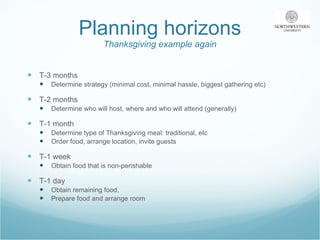
Planning horizons Thanksgiving example again T-3 months Determine strategy (minimal cost, minimal hassle, biggest gathering etc) T-2 months Determine who will host, where and who will attend (generally) T-1 month Determine type of Thanksgiving meal: traditional, etc Order food, arrange location, invite guests T-1 week Obtain food that is non-perishable T-1 day Obtain remaining food,  Prepare food and arrange room
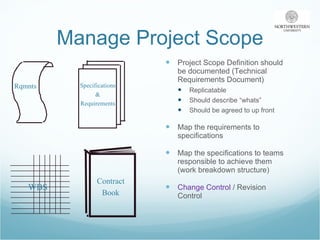
Manage Project Scope Project Scope Definition should be documented (Technical Requirements Document) Replicatable Should describe “whats” Should be agreed to up front  Map the requirements to specifications Map the specifications to teams responsible to achieve them (work breakdown structure) Change Control  / Revision Control Contract Book Rqmnts Specifications & Requirements WBS
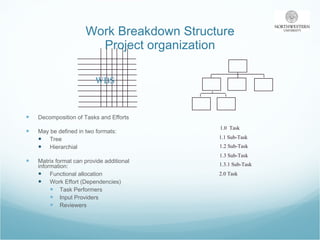
Work Breakdown Structure Project organization Decomposition of Tasks and Efforts May be defined in two formats: Tree Hierarchial Matrix format can provide additional information: Functional allocation Work Effort (Dependencies) Task Performers Input Providers Reviewers 1.0  Task 1.1 Sub-Task 1.2 Sub-Task 2.0 Task 1.3.1 Sub-Task 1.3 Sub-Task WBS
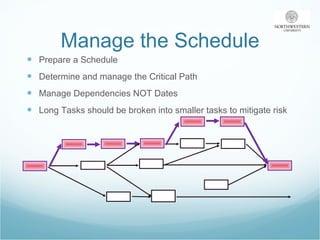
Manage the Schedule Prepare a Schedule Determine and manage the Critical Path Manage Dependencies NOT Dates Long Tasks should be broken into smaller tasks to mitigate risk
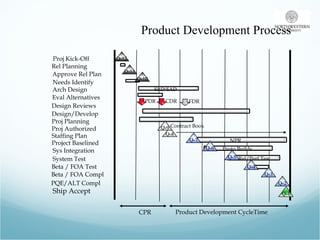
Product Development Process Product Development CycleTime Ship Accept Beta / FOA Test System Test Sys Integration Needs Identify Rel Planning Proj Kick-Off PDR CDR FDR Q-12 Approve Rel Plan Q-11 Q-10 Eval Alternatives Proj Authorized Design Reviews Arch Design Design/Develop Contract Book Staffing Plan Q-8 Proj Planning Q-9 Project Baselined NPR Q-4 Beta / FOA Compl Q-3 PQE/ALT Compl Q-2 Q-1 Q-7 Q-6 Proto Builds Q-5 Rel/Perf Test CPR SRD/SAD
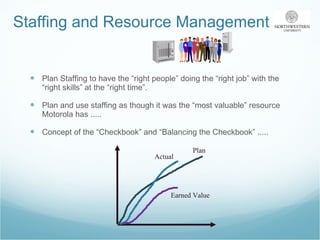
Staffing and Resource Management Plan Staffing to have the “right people” doing the “right job” with the “right skills” at the “right time”. Plan and use staffing as though it was the “most valuable” resource Motorola has ..... Concept of the “Checkbook” and “Balancing the Checkbook” ..... Plan Actual Earned Value
Risk Management Managing risk requires recognition of risk Assessing risk based on impact and likelihood Focuses management energy Implementing (simple) countermeasures against risk such as: Risk mitigation-reducing the likelihood Risk reduction Risk elimination Risk transfer Risk assumption
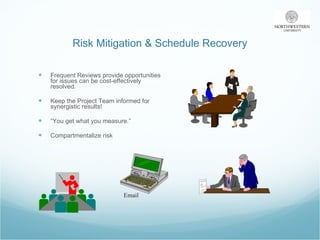
Risk Mitigation & Schedule Recovery Frequent Reviews provide opportunities for issues can be cost-effectively resolved. Keep the Project Team informed for synergistic results! “ You get what you measure.” Compartmentalize risk Email
Lessons Learned Project management is NOT a complex formula, its applying the basics Determine the project objectives and requirements Develop a plan and manage to the plan Lead the team by maintaining a balanced triangle Manage all changes to your plan Celebrate finding issues early  Define the project and the roadmap which the project fits within-define the context of the project Review project progress and status often...work all issues as early as possible Weekly schedule updates Weekly team meetings Weekly updates to Division management  Hold management accountable for their deliverables
A Low Performance Culture Quotes from early pre-PM cultures: “ Software development is an art and not a science and is therefore unpredictable” “ Planning is a waste of time, if you know what you are doing you dont need a plan” “ Oh...so you will hold me to this date....so you want a REALISTIC date!” Early mindsets observed in pre-PM cultures: One advantage of fuzzy project objectives is that they let you avoid the embarassment of estimating the corresponding costs-they also let you re-define completion as you near the end of the project Project planning and defining requirements is a stall tactic...useless overhead
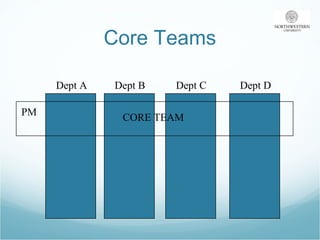
Core Teams Dept A Dept B Dept C Dept D PM CORE TEAM
Benefits of core teams Insures representation on a cross functional basis Ideally works project start to finish Typically leads to faster cycle times Usually allows the depth of the resource pools to be tapped as needed Keeps the team small and more nimble
PM versus Resource Mgt Project Mgt Focuses on deliverables Focuses on start and stop of a project Focuses on external stakeholders Looks to limit size of enterpriseand scope of project Resource manager Focuses on internal resources Development training, retention and staffing issues Ongoing concern-NO foreseeable end Looks to grow enterprise
Types of PM cultures Heavyweight Usually has resources working on a solid line basis Controls budget and all aspects of a project  Very senior and respected PM Lightweight Dotted line authority-No direct reports Relies on influence-No budget authority Usually a coordinator role
PM: as a reporter-the weak form The extreme lightweight approach PM is unempowered-spectator Reports news to decision makers-waits for decisions from “on high” Makes few or no decisions Does not influence process Does not influence staffing Does not influence technology
An org approach that works Lightweight but empowered PMs: Senior but dotted line project managers Empowered by senior management Doesn’t disrupt the resource management paradigm too badly Allows for resource development and technical expertise to be developed
Operating style that works Open communications Groups must trust the PM to be responsible and work issues diligently but appropriately PM is often used to resolve intergroup issues. Viewed as an impartial entity PM is expected to understand the “big picture” Must be able to dig into details where impact is on critical path
Project Management  Main Points PM is only a piece of the solution PM is not a panacea and must be coupled with other elements for organizational success PM is scaleable...one size doesnt fit all Coupled with TIME is a powerful weapon PM can be a vehicle for process
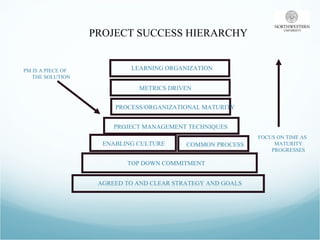
PROJECT SUCCESS HIERARCHY ENABLING CULTURE COMMON PROCESS TOP DOWN COMMITMENT AGREED TO AND CLEAR STRATEGY AND GOALS PROJECT MANAGEMENT TECHNIQUES PROCESS/ORGANIZATIONAL MATURITY LEARNING ORGANIZATION METRICS DRIVEN PM IS A PIECE OF THE SOLUTION FOCUS ON TIME AS MATURITY PROGRESSES
Creating the environment Change to project based organizations Emphasize the link between strategy and projects Understand top management influence Develop a core team system Organize for project management Develop a PM information system Develop a plan for PM selection and development Develop a learning organization Develop a PM initiative Apply PM concepts to any organization that needs them
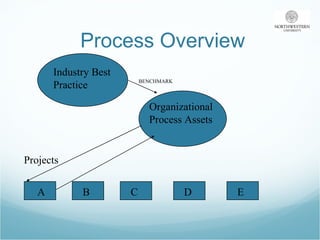
Process Overview Industry Best  Practice Organizational  Process Assets Projects A B C D E BENCHMARK
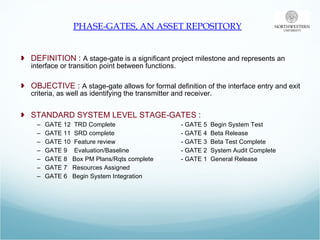
DEFINITION  :  A stage-gate is a significant project milestone and represents an interface or transition point between functions. OBJECTIVE  :  A stage-gate allows for formal definition of the interface entry and exit criteria, as well as identifying the transmitter and receiver.  STANDARD SYSTEM LEVEL STAGE-GATES  : GATE 12  TRD Complete - GATE 5  Begin System Test GATE 11  SRD complete - GATE 4  Beta Release GATE 10  Feature review - GATE 3  Beta Test Complete GATE 9  Evaluation/Baseline - GATE 2  System Audit Complete  GATE 8  Box PM Plans/Rqts complete - GATE 1  General Release GATE 7  Resources Assigned GATE 6  Begin System Integration PHASE-GATES, AN ASSET REPOSITORY
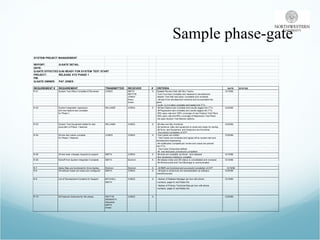
Sample phase-gate
PM INFORMATION SYSTEM Must allow easy access for all project members to all project information Should allow for capturing historical data for a project Should allow for a configuration management scheme-enable traceability Should be kept current and PM should very knowledgeable of information
Threats to a PMIS Silo thinking-lack of horizontal views in the organization Knowledge is power paradigm Lack of technology in organization Cultural bias towards distrust Hallway based processes-lack of formality A Good PM can eliminate the threats!
Project estimation data Correlates historical data : Planned staff effort versus actual Task by task, group by group Should be “normalizeable” based on a measure of complexity Crown Jewel of an organization-most important data of all! Foundational Should be kept well guarded and should be well maintained
Complexity measures used in past Written lines of software  Function points in software Weight of an aircraft Number of solder joints or connections in an electrical assembly RF system-# sites by number of channels Square feet of a building or cubic yards of a concrete job
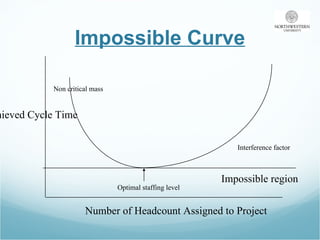
Impossible Curve Achieved Cycle Time Number of Headcount Assigned to Project Optimal staffing level Interference factor Non critical mass Impossible region
Common sense laws of staffing Nine women can’t have a baby in one month-crashing has its limits Last minute staffing can’t solve months of neglect If applied to the tail end of a development project-only helps you “test the quality in” Increases the spectator count Constantly changing staff assures constant re-learning curve effects and slow progress
Basics of planning Team must own the plan each member or team lead supplies their own piece of the plan PM integrates these plans into a cohesive integrated plan Forward pass/Backward pass Critical path Remember the PM triangle
Project Schedule basics Forward pass : The view of where you realistically are today and where you will be in the future based on set durations  Backward pass : Starting from your target date, working backwards to where you need to be or where you should have been to achieve your target based on set durations Float : the difference between the forward and backward pass YOU NEED BOTH FOR A FULL PICTURE!
Characteristics of critical path A day slip on the critical path effects the end date by one day Resources applied on non-critical path items are resources wasted If you don’t know the critical path, then you are forced to treat all tasks as critical Plans, over time, tend to converge such that nearly all paths are critical
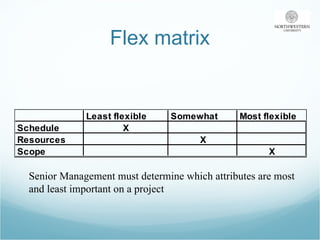
Flex matrix Senior Management must determine which attributes are most  and least important on a project
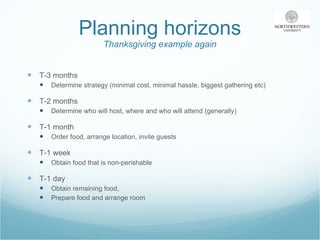
Planning horizons Thanksgiving example again T-3 months Determine strategy (minimal cost, minimal hassle, biggest gathering etc) T-2 months Determine who will host, where and who will attend (generally) T-1 month Order food, arrange location, invite guests T-1 week Obtain food that is non-perishable T-1 day Obtain remaining food,  Prepare food and arrange room
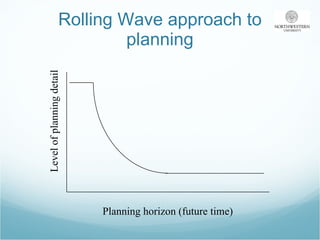
Rolling Wave approach to planning Level of planning detail Planning horizon (future time)
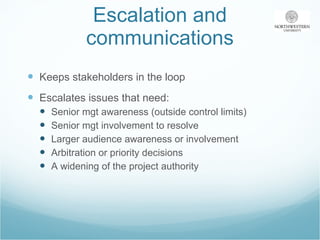
Escalation and communications Keeps stakeholders in the loop  Escalates issues that need: Senior mgt awareness (outside control limits) Senior mgt involvement to resolve Larger audience awareness or involvement Arbitration or priority decisions A widening of the project authority
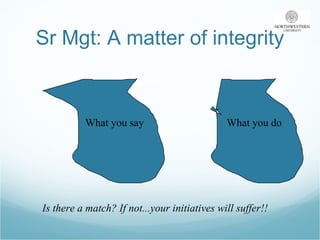
Sr Mgt: A matter of integrity What you say What you do Is there a match? If not...your initiatives will suffer!!
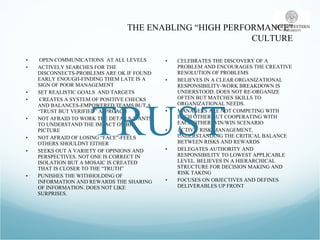
THE ENABLING “HIGH PERFORMANCE” CULTURE OPEN COMMUNICATIONS  AT ALL LEVELS ACTIVELY SEARCHES FOR THE DISCONNECTS-PROBLEMS ARE OK IF FOUND EARLY ENOUGH-FINDING THEM LATE IS A SIGN OF POOR MANAGEMENT SET REALISTIC GOALS  AND TARGETS CREATES A SYSTEM OF POSITIVE CHECKS AND BALANCES-EMPOWERED TEAMS BUT A “TRUST BUT VERIFIED” APPROACH NOT AFRAID TO WORK THE DETAILS-WANTS TO UNDERSTAND THE IMPACT ON BIG PICTURE NOT AFRAID OF LOSING “FACE”-FEELS OTHERS SHOULDNT EITHER SEEKS OUT A VARIETY OF OPINIONS AND PERSPECTIVES. NOT ONE IS CORRECT IN ISOLATION BUT A MOSAIC IS CREATED THAT IS CLOSER TO THE “TRUTH” PUNISHES THE WITHHOLDING OF INFORMATION AND REWARDS THE SHARING OF INFORMATION. DOES NOT LIKE SURPRISES.  CELEBRATES THE DISCOVERY OF A PROBLEM AND ENCOURAGES THE CREATIVE RESOLUTION OF PROBLEMS BELIEVES IN A CLEAR ORGANIZATIONAL RESPONSIBILITY-WORK BREAKDOWN IS UNDERSTOOD. DOES NOT RE-ORGANIZE OFTEN BUT MATCHES SKILLS TO ORGANIZATIONAL NEEDS.  MANAGERS ARE NOT COMPETING WITH EACH OTHER BUT COOPERATING WITH EACH OTHER-WIN/WIN SCENARIO ACTIVE  RISK MANAGEMENT, UNDERSTANDING THE CRITICAL BALANCE BETWEEN RISKS AND REWARDS DELEGATES AUTHORITY AND RESPONSIBILITY TO LOWEST APPLICABLE LEVEL. BELIEVES IN A HIERARCHICAL STRUCTURE FOR DECISION MAKING AND RISK TAKING FOCUSES ON OBJECTIVES AND DEFINES DELIVERABLES UP FRONT TRUST

Exec ed pm3

  • 1.
    New Product Development project management Developing Project Management Capabilities
  • 2.
    Burning platform Vastmajority of programs fail to meet their objectives According to a 1995 Standish Group study, only 16% of software projects in the US are completed on time and on budget and meet their deliverables $81 Billion will be spent on cancelled projects, $59 Billion on completed projects Denver airport baggage handling system alone cost City of Denver more than $1M per day
  • 3.
    Update from 2005Statistics have improved from Standish, 22% of projects were completed and considered successes In parallel, during these 10 years, the number of PMP (professionalized project managers) grew by 100,000+ Projects also were re-packaged into smaller, more manageable chunks while the systems technology grew more complex
  • 4.
    A simple definitionfor PM Project management is an integral part of a high performance culture. Part of the early warning system that is used by management to address problems early...while there is still opportunity to recover
  • 5.
    What is ProjectManagement? Fully understanding customer requirements Addressing all requirements systematically Organizing project work Planning project work Maintaining project plans Addressing issues rapidly and escalating as appropriate Anticipating risks and mitigating them systematically Projecting future costs and schedules based on performance to plan Learning from previous mistakes and improving your project based on learning Using metrics as a management tool Managing a project like small business Leading courageously
  • 6.
    What is PMNOT? Management by hysteria or rumor Mere reporting of the news Bureaucracy for the sake of bureaucracy A policing function Just another part time job Something that anyone can do without training or experience A dead end career A note taker or a meeting facilitator A clerical position A whistle blower A liaison between groups or with the customer Scheduling and only scheduling Perpetuator of the “party line” An extension of senior management
  • 7.
    Is PM aScience? PM is a body of knowledge, a field of practice within the social sciences: Other social sciences include organizational psychology, sociology, organizational behavior and organizational development PM is subject to the contingency theory as are other organizational sciences: Organizations have significant differences in multiple dimensions, environmental, cultural etc. Mechanistic versus organic organizations Applicability of theories is dependent upon circumstances. No two organizations or projects are exactly alike.
  • 8.
    Kerzner’s sixteen pointsto PM maturity Adopt a PM methodology and use it consistently Implement a philosophy that drives the company toward PM maturity and communicate it to everyone Commit to developing effective plans at the beginning of each project Minimize scope changes by committing to realistic objectives Recognize that cost and schedule management are inseparable Select the right person as the project manager Provide executives with project sponsor information, not project management information Strengthen involvement and support of line management Focus on deliverables rather than resources Cultivate effective communication, cooperation, and trust to achieve rapid project management maturity Share recognition for project success with the entire project team and line management Eliminate non-productive meetings Focus on identifying and solving problems early, quickly and cost effectively Measure progress periodically Use PM software as a tool, not as a substitute for effective planning or interpersonal skills Institute an all employee training program with periodic updates based upon documented lessons learned
  • 9.
    PMBOK definitions Projectsversus operations: Both are performed by people, are constrained by resources and are planned, executed and controlled Projects are TEMPORARY endeavors undertaken to create a unique product or service (Projects are usually undertaken to implement a STRATEGY) What is Project management? The application of of knowledge, skills, tools and techniques to project activities in order to meet or exceed stakeholder expectations
  • 10.
    A simple modelStrategy Operations Projects Projects instantiate strategy into operations…..examples: -Project Apollo -Macintosh project at Apple -Manhattan project
  • 11.
    Two different modelsProduct orientation Market focused “ Genericized” to meet majority of needs of a market Maximize reuse Supportable Maintainable Consistency of deliverables Contract orientation Customer focused Highly customized to meet customer needs Little reuse Limited supportability and maintainability
  • 12.
    Paradigms Strategy isa result of paradigms Paradigms have been studied at length by Thomas Kuhn Paradigms reflect the driving force behind how one views the world and how issues, requirements and solutions are framed The paradigm is the driving force behind the development of a new product Example: Network computer versus personal computer Example: Federal express versus USPS Ref: The Structure of Scientific Revolutions-Thomas Kuhn
  • 13.
    Two main schoolsof thought Rational The world is ordered It can be predicted It can be rationally planned Events flow in a logical sequence Past experience allows you to predict the future Chaordic The world is chaotic It is unpredictable and unstable Events are not logical and systems are not ordered The past is not necessarily a good predictor of the future Reference: Letting go for Control, Fitzgerald and Eijnatten, International Journal of Business Transformation, Apr 98
  • 14.
    Implications Rational Schedules are king Change is to be limited or eliminated Plans are cast in stone Resources are fixed and dedicated Goals are fixed Chaordic Change is expected Plans are to be revised constantly Resources are fluid and multi-tasking Goals evolve Scope, schedule and resources are all in flux at the same time Reference: Letting go for Control, Fitzgerald and Eijnatten, International Journal of Business Transformation, Apr 98
  • 15.
    Keys to newproduct development Process needs to embrace both rational and chaordic schools Design and implement a formal process but include some degree of flexibility to manage change and manage risks Requires use of cross-functional teams and project management techniques
  • 16.
    Portfolio Management Themulti-project environment
  • 17.
    Definition Portfolio managementfor new products is a dynamic decision process wherein the list of active new products and R/D projects is constantly revised. Existing projects may be accelerated, de-prioritized or killed while resources are allocated and re-allocated to the active projects Reference: Cooper: Portfolio management for new products
  • 18.
    Two different modelsProduct orientation Market focused “ Genericized” to meet majority of needs of a market Maximize reuse Supportable Maintainable Consistency of deliverables Contract orientation Customer focused Highly customized to meet customer needs Little reuse Limited supportability and maintainability
  • 19.
    Strategy It allstarts with strategy. All organizations have a strategy, even if they haven’t articulated one. Let me observe their actions and I will be able to infer an organization’s strategy in short order, even if it isn’t a consistent strategy . This is sometimes known as the emergent strategy school Ideally, all projects are a reflection of the strategy. Each project should be rationalized in the context of the portfolio strategy This is typical of the deliberate strategy school of thought Strategy starts first with values and beliefs about the future and beliefs about the organization’s assets and core competencies
  • 20.
    Strategy safari- Mintzberg-20021. The design school, which sees strategic management as a process of attaining a fit between the internal capabilities and external possibilities of an organisation. 2. The planning school, which extols the virtues of formal strategic planning and arms itself with SWOT analyses and checklists. 3. The positioning school, heavily influenced by the ideas of Michael Porter, which stresses that strategy depends on the positioning of the firm in the market and within its industry. 4. The entrepreneurial school, which emphasises the central role played by the leader. 5. The cognitive school, which looks inwards into the minds of strategists. 6. The learning school, which sees strategy as an emergent process -- strategies emerge as people come to learn about a situation as well as their organisation's capability of dealing with it. 7. The power school, which views strategy emerging out of power games within the organisation and outside it. 8. The cultural school, which views strategy formation as a process rooted in the social force of culture. 9. The environmental school, which believes that a firm's strategy depends on events in the environment and the company's reaction to them 10. The configuration school, which views strategy as a process of transforming the organisation -- it describes the relative stability of strategy, interrupted by occasional and dramatic leaps to new ones.
  • 21.
    Core competencies Organizationsneed to get down to basics. What is your organization good at? What is unique about your product or service What alternatives are there that might jeopardize your operation Examples: University of Michigan electronic documents What are your organization’s core competencies…..are they good enough to compete on a GLOBAL basis?
  • 22.
    Portfolio snapshot-2006 Carmake Honda Toyota Small entry level sedan Civic Echo/Corolla Mid size sedan Accord Camry Large size sedan None Avalon Small SUV CRV RAV4 Large SUV Pilot Land cruiser
  • 23.
    Macro portfolios Mazdaattempted to start a luxury brand under the name Millenia but it failed Toyota is rumored to be contemplating a hi tech brand under the name Prius GM is eliminating and selling brands at high speed Make Luxury Mid tier Entry level Toyota Lexus Toyota Scion Honda Acura Honda Honda Nissan Infiniti Nissan Nissan
  • 24.
    A simple portfolioanalogy Napsack analogy Limits how many things you can carry on a long trip Forces you to make strategic choices, ie utility versus weight or displacement Most portfolios are resource constrained Research shows that most organizations have more active projects than they can sustain Results: like an overburdened napsack, something breaks Projects tend to be late, people overworked, typically poor quality
  • 25.
    Metaphor-Financial portfolio Reflecton a financial portfolio. Goal oriented. What is the purpose of the financial portfolio? Retirement? Child’s education? Balance of risk/reward based on position in the lifecycle Looks at performance of each element against the expectations Offsetting investments to reduce overall risk and maximize possible gain
  • 26.
    Example-Financial portfolio CashBonds Corporate vs municipal Growth stocks Income stocks Annuity Real estate/REITs
  • 27.
    Investment analogy Basedon strategic resource allocation theory-hedging your bets Balances (mixes) investments among various polar opposites: Stocks vs bonds vs real estate vs cash Domestic versus international (mature versus emerging market) Growth versus income Hi cap versus mid cap versus small cap Ultimate polar opposite: Risk versus reward
  • 28.
    Product portfolio equivalentsCash cows-making good money for now Typically are at or nearing end of lifecycle Makes good money for now, but not for long Requires minimal investment to keep going Breakthrough products Requires significant investment Risk of failure If successful, may cannibalize your cash cow Portfolio expansion Minimizes risk but also tends to minimize reward
  • 29.
    Types of projectsin portfolio Breakthrough- Create new market Platform- Reach new customers within existing markets Derivatives- Sell more products to existing customers Product/brand support- Replaces current products Reference: Christensen HBSP Case 9-301-041, Using Aggregate Project Planning
  • 30.
    Questions about portfolio Proper mix of different types of projects Proper sequencing to reduce risk Platform followed by a few derivatives Alternating teams and sites to reduce the risks Maximize re-use of platforms, ie minimize the number of platforms Balance with maximize life from a platform
  • 31.
    Multi project issues:The domino effect Projects are stacked up one in front of the other Shared resources and tight timing If one slips, they all slip!!!
  • 32.
    How to combatdomino effect Alternate teams at strategic points Buffer resources/alternate teams of people Alternate sites Time spacing between projects Alternate types of projects that will exercise different parts of the organization Alternate sizes of projects Don’t put two similar major projects in a row!!!
  • 33.
    Wild west syndromeEvery project is out for itself May the best project win! Encouraging one project to fail to accelerate another is just fine, right? Who is the referee? Who is looking out for the organization?
  • 34.
    Examples of wildwest effect Nudging one product out of test lab prematurely to get another product into test lab Borrowing some resources from one project and assign them to yours Reserving capacity for your project when you don’t really need it
  • 35.
    Combating Wild westWhere a single sponsor is responsible for all projects, and all resources report to that sponsor…priorities can be established and enforced What about where priorities are set from multiple sponsors????
  • 36.
    A forum formultiple sponsors/stakeholders Has been called many things in industry Executive review board Portfolio planning committee Marketing review board Sponsor committee Project authorization board Sector or group staff Sponsors establish and implement the process for making, monitoring and enforcing project decisions: Priorities, start, stop, staff, destaff
  • 37.
    Executive board ProsSingle stop shopping for prioritization decisions across multiple projects Should be based on data and objective analysis Should also be an accountability session for project teams Cons Sometimes becomes political Subject to personal influence and not so objective analysis Sometimes is indecisive
  • 38.
    Executive board-Process Project authorization Project Review/changes approved Project closeout/ post-mortem Project termination decisions
  • 39.
    The PM Officeconcept Provides an organization for PM to reside Provides support for Project controls, planning, finance, contract support, tools, process etc Provides for PM career management Should be headed by a very senior PM Should be given respect and authority from senior management
  • 40.
  • 41.
  • 42.
    Checkbook process Aname for a resource management tool or technique This is a form of a multi project project plan Maps resource names to projects and to dates for the entire enterprise Highlights resource shortages
  • 43.
    Aggregate project planningDefine project types as either breakthrough, platform, derivative Identify existing projects and classify by project type Estimate average time and resources needed for each project type based on past experience Identify existing resource capacity Determine the desired mix of projects Estimate the number of projects that existing resources can support Decide which specific projects to pursue Prioritize via a valuation process Work to improve development capabilities Reference: Clark and Wheelwright, Harvard Business Review, March-April 1992
  • 44.
    Projects are baselinedwhen the “Triangle” is “balanced” Risks translate into potential impacts to one of the 3 legs Managing “change” in a project is maintaining the “balance” of the “Triangle” Project Manager’s “Triangle” The Essence of Project Management Scope Staffing Schedule Risks
  • 45.
  • 46.
    Where do yousee projects?? Answer: EVERYWHERE! Product development Construction Customer proposals New manufacturing line ramp up Mortgage application Thanksgiving dinner Field system install Preparation for an audit Merger or acquisition Major senior management review Moving a household Building a house or major home improvement
  • 47.
    Corollary topics/fields toProject Management Knowledge management Leadership/management theory Organizational development/behavior/theory Teambuilding/conflict management/culture/anthropology Process management/Re-engineering Total quality management Optimization theory/Operations research Operations management Communications skills and management Personal time management Negotiations skills Contract law Decision theory/Game theory Complexity theory Group dynamics Effective meetings, presentations and facilitation skills
  • 48.
    A simple setbackmodel Thanksgiving dinner-6 hour horizon Eat at 6 Cook turkey Prepare Turkey Prepare stuffing Prepare potatoes Cook stuffing Cook potatoes Heat rolls/gravy Prepare gravy Cranberry
  • 49.
    Planning horizons Thanksgivingexample again T-3 months Determine strategy (minimal cost, minimal hassle, biggest gathering etc) T-2 months Determine who will host, where and who will attend (generally) T-1 month Determine type of Thanksgiving meal: traditional, etc Order food, arrange location, invite guests T-1 week Obtain food that is non-perishable T-1 day Obtain remaining food, Prepare food and arrange room
  • 50.
    Manage Project ScopeProject Scope Definition should be documented (Technical Requirements Document) Replicatable Should describe “whats” Should be agreed to up front Map the requirements to specifications Map the specifications to teams responsible to achieve them (work breakdown structure) Change Control / Revision Control Contract Book Rqmnts Specifications & Requirements WBS
  • 51.
    Work Breakdown StructureProject organization Decomposition of Tasks and Efforts May be defined in two formats: Tree Hierarchial Matrix format can provide additional information: Functional allocation Work Effort (Dependencies) Task Performers Input Providers Reviewers 1.0 Task 1.1 Sub-Task 1.2 Sub-Task 2.0 Task 1.3.1 Sub-Task 1.3 Sub-Task WBS
  • 52.
    Manage the SchedulePrepare a Schedule Determine and manage the Critical Path Manage Dependencies NOT Dates Long Tasks should be broken into smaller tasks to mitigate risk
  • 53.
    Product Development ProcessProduct Development CycleTime Ship Accept Beta / FOA Test System Test Sys Integration Needs Identify Rel Planning Proj Kick-Off PDR CDR FDR Q-12 Approve Rel Plan Q-11 Q-10 Eval Alternatives Proj Authorized Design Reviews Arch Design Design/Develop Contract Book Staffing Plan Q-8 Proj Planning Q-9 Project Baselined NPR Q-4 Beta / FOA Compl Q-3 PQE/ALT Compl Q-2 Q-1 Q-7 Q-6 Proto Builds Q-5 Rel/Perf Test CPR SRD/SAD
  • 54.
    Staffing and ResourceManagement Plan Staffing to have the “right people” doing the “right job” with the “right skills” at the “right time”. Plan and use staffing as though it was the “most valuable” resource Motorola has ..... Concept of the “Checkbook” and “Balancing the Checkbook” ..... Plan Actual Earned Value
  • 55.
    Risk Management Managingrisk requires recognition of risk Assessing risk based on impact and likelihood Focuses management energy Implementing (simple) countermeasures against risk such as: Risk mitigation-reducing the likelihood Risk reduction Risk elimination Risk transfer Risk assumption
  • 56.
    Risk Mitigation &Schedule Recovery Frequent Reviews provide opportunities for issues can be cost-effectively resolved. Keep the Project Team informed for synergistic results! “ You get what you measure.” Compartmentalize risk Email
  • 57.
    Lessons Learned Projectmanagement is NOT a complex formula, its applying the basics Determine the project objectives and requirements Develop a plan and manage to the plan Lead the team by maintaining a balanced triangle Manage all changes to your plan Celebrate finding issues early Define the project and the roadmap which the project fits within-define the context of the project Review project progress and status often...work all issues as early as possible Weekly schedule updates Weekly team meetings Weekly updates to Division management Hold management accountable for their deliverables
  • 58.
    A Low PerformanceCulture Quotes from early pre-PM cultures: “ Software development is an art and not a science and is therefore unpredictable” “ Planning is a waste of time, if you know what you are doing you dont need a plan” “ Oh...so you will hold me to this date....so you want a REALISTIC date!” Early mindsets observed in pre-PM cultures: One advantage of fuzzy project objectives is that they let you avoid the embarassment of estimating the corresponding costs-they also let you re-define completion as you near the end of the project Project planning and defining requirements is a stall tactic...useless overhead
  • 59.
    Core Teams DeptA Dept B Dept C Dept D PM CORE TEAM
  • 60.
    Benefits of coreteams Insures representation on a cross functional basis Ideally works project start to finish Typically leads to faster cycle times Usually allows the depth of the resource pools to be tapped as needed Keeps the team small and more nimble
  • 61.
    PM versus ResourceMgt Project Mgt Focuses on deliverables Focuses on start and stop of a project Focuses on external stakeholders Looks to limit size of enterpriseand scope of project Resource manager Focuses on internal resources Development training, retention and staffing issues Ongoing concern-NO foreseeable end Looks to grow enterprise
  • 62.
    Types of PMcultures Heavyweight Usually has resources working on a solid line basis Controls budget and all aspects of a project Very senior and respected PM Lightweight Dotted line authority-No direct reports Relies on influence-No budget authority Usually a coordinator role
  • 63.
    PM: as areporter-the weak form The extreme lightweight approach PM is unempowered-spectator Reports news to decision makers-waits for decisions from “on high” Makes few or no decisions Does not influence process Does not influence staffing Does not influence technology
  • 64.
    An org approachthat works Lightweight but empowered PMs: Senior but dotted line project managers Empowered by senior management Doesn’t disrupt the resource management paradigm too badly Allows for resource development and technical expertise to be developed
  • 65.
    Operating style thatworks Open communications Groups must trust the PM to be responsible and work issues diligently but appropriately PM is often used to resolve intergroup issues. Viewed as an impartial entity PM is expected to understand the “big picture” Must be able to dig into details where impact is on critical path
  • 66.
    Project Management Main Points PM is only a piece of the solution PM is not a panacea and must be coupled with other elements for organizational success PM is scaleable...one size doesnt fit all Coupled with TIME is a powerful weapon PM can be a vehicle for process
  • 67.
    PROJECT SUCCESS HIERARCHYENABLING CULTURE COMMON PROCESS TOP DOWN COMMITMENT AGREED TO AND CLEAR STRATEGY AND GOALS PROJECT MANAGEMENT TECHNIQUES PROCESS/ORGANIZATIONAL MATURITY LEARNING ORGANIZATION METRICS DRIVEN PM IS A PIECE OF THE SOLUTION FOCUS ON TIME AS MATURITY PROGRESSES
  • 68.
    Creating the environmentChange to project based organizations Emphasize the link between strategy and projects Understand top management influence Develop a core team system Organize for project management Develop a PM information system Develop a plan for PM selection and development Develop a learning organization Develop a PM initiative Apply PM concepts to any organization that needs them
  • 69.
    Process Overview IndustryBest Practice Organizational Process Assets Projects A B C D E BENCHMARK
  • 70.
    DEFINITION : A stage-gate is a significant project milestone and represents an interface or transition point between functions. OBJECTIVE : A stage-gate allows for formal definition of the interface entry and exit criteria, as well as identifying the transmitter and receiver. STANDARD SYSTEM LEVEL STAGE-GATES : GATE 12 TRD Complete - GATE 5 Begin System Test GATE 11 SRD complete - GATE 4 Beta Release GATE 10 Feature review - GATE 3 Beta Test Complete GATE 9 Evaluation/Baseline - GATE 2 System Audit Complete GATE 8 Box PM Plans/Rqts complete - GATE 1 General Release GATE 7 Resources Assigned GATE 6 Begin System Integration PHASE-GATES, AN ASSET REPOSITORY
  • 71.
  • 72.
    PM INFORMATION SYSTEMMust allow easy access for all project members to all project information Should allow for capturing historical data for a project Should allow for a configuration management scheme-enable traceability Should be kept current and PM should very knowledgeable of information
  • 73.
    Threats to aPMIS Silo thinking-lack of horizontal views in the organization Knowledge is power paradigm Lack of technology in organization Cultural bias towards distrust Hallway based processes-lack of formality A Good PM can eliminate the threats!
  • 74.
    Project estimation dataCorrelates historical data : Planned staff effort versus actual Task by task, group by group Should be “normalizeable” based on a measure of complexity Crown Jewel of an organization-most important data of all! Foundational Should be kept well guarded and should be well maintained
  • 75.
    Complexity measures usedin past Written lines of software Function points in software Weight of an aircraft Number of solder joints or connections in an electrical assembly RF system-# sites by number of channels Square feet of a building or cubic yards of a concrete job
  • 76.
    Impossible Curve AchievedCycle Time Number of Headcount Assigned to Project Optimal staffing level Interference factor Non critical mass Impossible region
  • 77.
    Common sense lawsof staffing Nine women can’t have a baby in one month-crashing has its limits Last minute staffing can’t solve months of neglect If applied to the tail end of a development project-only helps you “test the quality in” Increases the spectator count Constantly changing staff assures constant re-learning curve effects and slow progress
  • 78.
    Basics of planningTeam must own the plan each member or team lead supplies their own piece of the plan PM integrates these plans into a cohesive integrated plan Forward pass/Backward pass Critical path Remember the PM triangle
  • 79.
    Project Schedule basicsForward pass : The view of where you realistically are today and where you will be in the future based on set durations Backward pass : Starting from your target date, working backwards to where you need to be or where you should have been to achieve your target based on set durations Float : the difference between the forward and backward pass YOU NEED BOTH FOR A FULL PICTURE!
  • 80.
    Characteristics of criticalpath A day slip on the critical path effects the end date by one day Resources applied on non-critical path items are resources wasted If you don’t know the critical path, then you are forced to treat all tasks as critical Plans, over time, tend to converge such that nearly all paths are critical
  • 81.
    Flex matrix SeniorManagement must determine which attributes are most and least important on a project
  • 82.
    Planning horizons Thanksgivingexample again T-3 months Determine strategy (minimal cost, minimal hassle, biggest gathering etc) T-2 months Determine who will host, where and who will attend (generally) T-1 month Order food, arrange location, invite guests T-1 week Obtain food that is non-perishable T-1 day Obtain remaining food, Prepare food and arrange room
  • 83.
    Rolling Wave approachto planning Level of planning detail Planning horizon (future time)
  • 84.
    Escalation and communicationsKeeps stakeholders in the loop Escalates issues that need: Senior mgt awareness (outside control limits) Senior mgt involvement to resolve Larger audience awareness or involvement Arbitration or priority decisions A widening of the project authority
  • 85.
    Sr Mgt: Amatter of integrity What you say What you do Is there a match? If not...your initiatives will suffer!!
  • 86.
    THE ENABLING “HIGHPERFORMANCE” CULTURE OPEN COMMUNICATIONS AT ALL LEVELS ACTIVELY SEARCHES FOR THE DISCONNECTS-PROBLEMS ARE OK IF FOUND EARLY ENOUGH-FINDING THEM LATE IS A SIGN OF POOR MANAGEMENT SET REALISTIC GOALS AND TARGETS CREATES A SYSTEM OF POSITIVE CHECKS AND BALANCES-EMPOWERED TEAMS BUT A “TRUST BUT VERIFIED” APPROACH NOT AFRAID TO WORK THE DETAILS-WANTS TO UNDERSTAND THE IMPACT ON BIG PICTURE NOT AFRAID OF LOSING “FACE”-FEELS OTHERS SHOULDNT EITHER SEEKS OUT A VARIETY OF OPINIONS AND PERSPECTIVES. NOT ONE IS CORRECT IN ISOLATION BUT A MOSAIC IS CREATED THAT IS CLOSER TO THE “TRUTH” PUNISHES THE WITHHOLDING OF INFORMATION AND REWARDS THE SHARING OF INFORMATION. DOES NOT LIKE SURPRISES. CELEBRATES THE DISCOVERY OF A PROBLEM AND ENCOURAGES THE CREATIVE RESOLUTION OF PROBLEMS BELIEVES IN A CLEAR ORGANIZATIONAL RESPONSIBILITY-WORK BREAKDOWN IS UNDERSTOOD. DOES NOT RE-ORGANIZE OFTEN BUT MATCHES SKILLS TO ORGANIZATIONAL NEEDS. MANAGERS ARE NOT COMPETING WITH EACH OTHER BUT COOPERATING WITH EACH OTHER-WIN/WIN SCENARIO ACTIVE RISK MANAGEMENT, UNDERSTANDING THE CRITICAL BALANCE BETWEEN RISKS AND REWARDS DELEGATES AUTHORITY AND RESPONSIBILITY TO LOWEST APPLICABLE LEVEL. BELIEVES IN A HIERARCHICAL STRUCTURE FOR DECISION MAKING AND RISK TAKING FOCUSES ON OBJECTIVES AND DEFINES DELIVERABLES UP FRONT TRUST