Session 1-4
Descriptive Statistics
• Introduction
o Statistics
o Data
o Scales of Measurement
o Data Classification
o Descriptive & Inferential Statistics
• Data Summarization
o Tabular Summarization of Qualitative Data
o Graphical Summarization of Qualitative Data
Session 1-4
Descriptive Statistics
o Tabular Summarization of Quantitative Data
o Graphical Summarization of Quantitative Data
• Summary Statistics
o Introduction
o Measures of Central Tendency
o Measures of Dispersion
o Measures of Skewness
Session 1-4
Descriptive Statistics
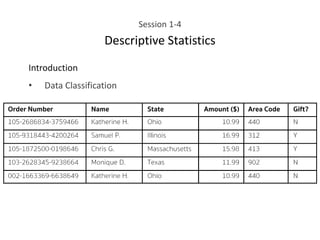
Introduction
•Statistics
o ‘status’ (Latin), ‘statista’ (Italian), ‘statistik’ (German) – political
state
o Art & science of collecting, analyzing, presenting, and
interpreting data
o Used in all almost fields of human activity - Planning, Economy,
Business, Industry, Mathematics, Biology, Astronomy, Medical
Science, Psychology, Education, War, Politics, Environment
Session 1-4
Descriptive Statistics
Introduction
• Data
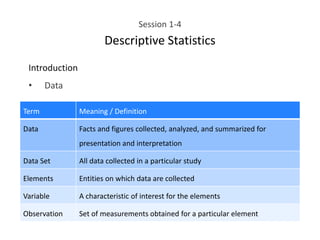
Term Meaning / Definition
Data Facts and figures collected, analyzed, and summarized for
presentation and interpretation
Data Set All data collected in a particular study
Elements Entities on which data are collected
Variable A characteristic of interest for the elements
Observation Set of measurements obtained for a particular element
Session 1-4
Descriptive Statistics
Introduction
• Data
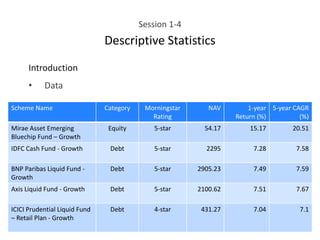
Scheme Name Category Morningstar
Rating
NAV 1-year
Return (%)
5-year CAGR
(%)
Mirae Asset Emerging
Bluechip Fund – Growth
Equity 5-star 54.17 15.17 20.51
IDFC Cash Fund - Growth Debt 5-star 2295 7.28 7.58
BNP Paribas Liquid Fund -
Growth
Debt 5-star 2905.23 7.49 7.59
Axis Liquid Fund - Growth Debt 5-star 2100.62 7.51 7.67
ICICI Prudential Liquid Fund
– Retail Plan - Growth
Debt 4-star 431.27 7.04 7.1
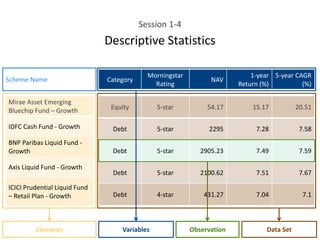
Category
Morningstar
Rating
NAV
1-year
Return (%)
5-year CAGR
(%)
Equity 5-star 54.17 15.17 20.51
Debt 5-star 2295 7.28 7.58
Debt 5-star 2905.23 7.49 7.59
Debt 5-star 2100.62 7.51 7.67
Debt 4-star 431.27 7.04 7.1
Mirae Asset Emerging
Bluechip Fund – Growth
IDFC Cash Fund - Growth
BNP Paribas Liquid Fund -
Growth
Axis Liquid Fund - Growth
ICICI Prudential Liquid Fund
– Retail Plan - Growth
Scheme Name
Elements Variables Data Set
Observation
Session 1-4
Descriptive Statistics
Session 1-4
Descriptive Statistics
Introduction
• Scales of Measurement
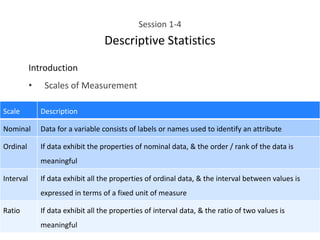
Scale Description
Nominal Data for a variable consists of labels or names used to identify an attribute
Ordinal If data exhibit the properties of nominal data, & the order / rank of the data is
meaningful
Interval If data exhibit all the properties of ordinal data, & the interval between values is
expressed in terms of a fixed unit of measure
Ratio If data exhibit all the properties of interval data, & the ratio of two values is
meaningful
Session 1-4
Descriptive Statistics
Introduction
• Scales of Measurement
o No. of observations always equals the no. of elements
o No. of measurements obtained for each element equals the no.
of variables
o Total no. of data items equals the product of no. of
observations (or elements) and no. of variables
Session 1-4
Descriptive Statistics
Introduction
•Data Classification
o Qualitative Data (Categorical Data)
• Data that can be group by specific categories
• Are measures of ‘types’ and may be represented by a name,
symbol or a numeric code
• Signify category to which an item belongs to
• Use either nominal or ordinal scale of measurement
• Qualitative variable – one with qualitative or cateogrical data
• E.g. – responses to questions like “What color is your car?”
• Specical case with only two repsonse options (usually “yes” and
“no”)
Session 1-4
Descriptive Statistics
Introduction
•Data Classification
o Quantitative Data
• Data that use numeric values to indicate how much or how many
• Are measures of values or counts
• Expressed as numbers
• Use either interval or ratio scale of measurement
• Quantitative variable – variable with quantitative data
• E.g. – responses to questions like “How many runs will India score
in the next match?”
Session 1-4
Descriptive Statistics
Introduction
•Data Classification
o Variables with non-numeric values – Qualitative
o Variables with numeric values – Qualitative or Quantitative
o Qualitative data can be summarized by counting the number of
observations in each category or by computing the proportion
of observations in each category
o Arithmetic operations can be performed on quantitative data
Session 1-4
Descriptive Statistics
Introduction
• Data Classification
Session 1-4
Descriptive Statistics
Introduction
• Data Classification
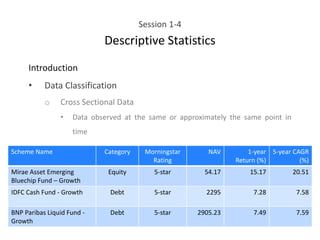
o Cross Sectional Data
• Data observed at the same or approximately the same point in
time
Scheme Name Category Morningstar
Rating
NAV 1-year
Return (%)
5-year CAGR
(%)
Mirae Asset Emerging
Bluechip Fund – Growth
Equity 5-star 54.17 15.17 20.51
IDFC Cash Fund - Growth Debt 5-star 2295 7.28 7.58
BNP Paribas Liquid Fund -
Growth
Debt 5-star 2905.23 7.49 7.59
Session 1-4
Descriptive Statistics
Introduction
• Data Classification
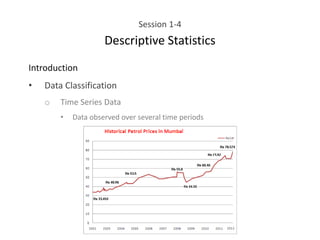
o Time Series Data
• Data observed over several time periods
Session 1-4
Descriptive Statistics
Introduction
•Data Classification
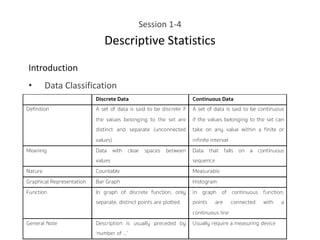
o Quantitative data may be discrete or continuous
o Discrete Data
• Data that measure how many
• Contains distinct or separate, finite values that have nothing in-
between i.e. sub-division is not possible
• Relies of count, includes only those values that can only be
counted in whole numbers or integers i.e. data cannot be broken
down into fractions or decimals
• E.g. – number of students in this class
Session 1-4
Descriptive Statistics
Introduction
•Data Classification
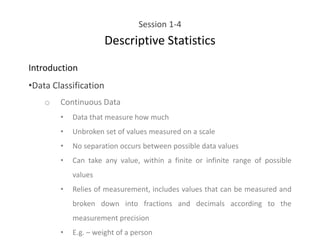
o Continuous Data
• Data that measure how much
• Unbroken set of values measured on a scale
• No separation occurs between possible data values
• Can take any value, within a finite or infinite range of possible
values
• Relies of measurement, includes values that can be measured and
broken down into fractions and decimals according to the
measurement precision
• E.g. – weight of a person
Session 1-4
Descriptive Statistics
Introduction
• Data Classification
Session 1-4
Descriptive Statistics
Introduction
• Descriptive & Inferential Statistics
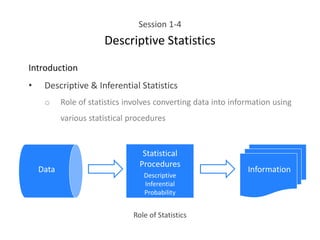
o Role of statistics involves converting data into information using
various statistical procedures
Role of Statistics
Data Information
Statistical
Procedures
Descriptive
Inferential
Probability
Session 1-4
Descriptive Statistics
Introduction
• Descriptive & Inferential Statistics
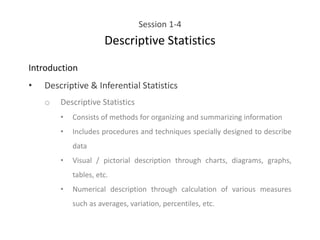
o Descriptive Statistics
• Consists of methods for organizing and summarizing information
• Includes procedures and techniques specially designed to describe
data
• Visual / pictorial description through charts, diagrams, graphs,
tables, etc.
• Numerical description through calculation of various measures
such as averages, variation, percentiles, etc.
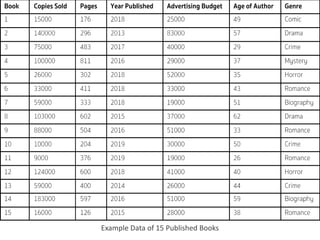
Example Data of 15 Published Books
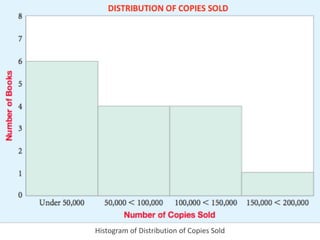
Histogram of Distribution of Copies Sold
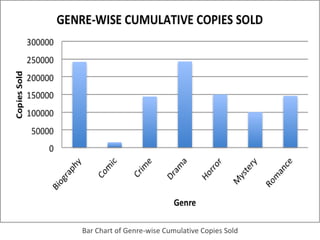
Bar Chart of Genre-wise Cumulative Copies Sold
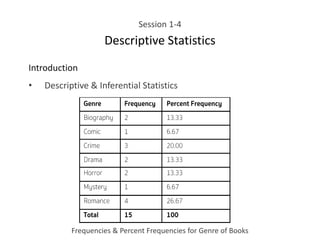
Frequencies & Percent Frequencies for Genre of Books
Session 1-4
Descriptive Statistics
Introduction
• Descriptive & Inferential Statistics
Session 1-4
Descriptive Statistics
Introduction
• Descriptive & Inferential Statistics
o Statistical Inference
• Difficult, costly, time-consuming to collect data for each & every
element belonging to a large group of elements (individuals,
companies, voters, households, products, consumers, etc.)
• In such cases, data is collected from only a small portion of the
large group
• The larger group of elements ➔ Population
• The smaller group of elements ➔ Sample
Session 1-4
Descriptive Statistics
Introduction
• Descriptive & Inferential Statistics
o Statistical Inference
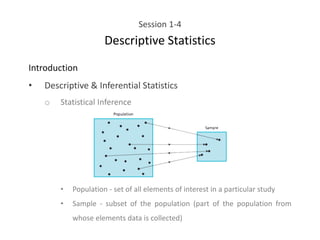
• Population - set of all elements of interest in a particular study
• Sample - subset of the population (part of the population from
whose elements data is collected)
Session 1-4
Descriptive Statistics
Introduction
•Descriptive & Inferential Statistics
o Statistical Inference
• Census - process of conducting a survey collect data for the entire
population
• Sample survey - process of conducting a survey to collect data for a
sample
• Statistical Inference – process through which statistics uses data
from a sample to make estimates & test hypotheses about the
characteristics of a population
Session 1-4
Descriptive Statistics
Introduction
• Descriptive & Inferential Statistics
o Inferential Statistics
• Consists of methods for drawing and measuring the reliability of
conclusions about a population based on information obtained
from a sample of the population
• Includes inferential procedures that help decision makers draw
inferences from a set of data
• Inferential procedures include estimation & hypothesis testing
Session 1-4
Descriptive Statistics
Introduction
•Descriptive & Inferential Statistics
o Inferential Statistics
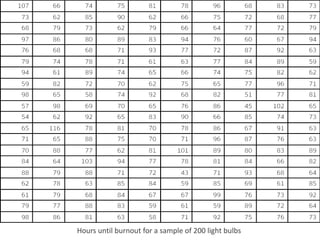
• E.g. - To increase the useful life of its high intensity light bulbs, the
product design group at Norris Electronics developed a new light
bulb filament. In this case, the population is defined as all light
bulbs that could be produced with the new filament. To evaluate
the advantages of the new filament, 200 bulbs with the new
filament were manufactured & tested. Data collected from this
sample shows the number of hours each light bulb operated
before filament burnout.
Hours until burnout for a sample of 200 light bulbs
Session 1-4
Descriptive Statistics
Introduction
• Descriptive & Inferential Statistics
o Inferential Statistics
• To make an inference about the average hours of useful life for the
population of all light bulbs that could be produced with the new
filament, Norris can use the sample average lifetime for the light
bulbs
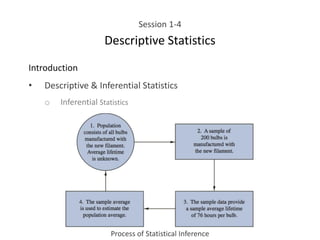
• The sample result can be used to estimate that the average lifetime
for the light bulbs in the population is 76 hours
Session 1-4
Descriptive Statistics
Introduction
• Descriptive & Inferential Statistics
o Inferential Statistics
Process of Statistical Inference
Session 1-4
Descriptive Statistics
Introduction
•Descriptive & Inferential Statistics
o Inferential Statistics
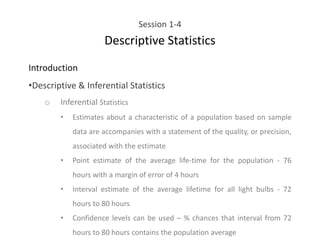
• Estimates about a characteristic of a population based on sample
data are accompanies with a statement of the quality, or precision,
associated with the estimate
• Point estimate of the average life-time for the population - 76
hours with a margin of error of 4 hours
• Interval estimate of the average lifetime for all light bulbs - 72
hours to 80 hours
• Confidence levels can be used – % chances that interval from 72
hours to 80 hours contains the population average
Session 1-4
Descriptive Statistics
Data Summarization
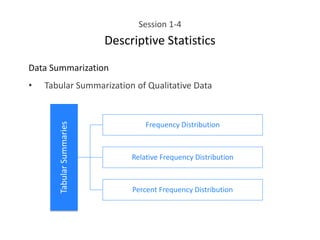
• Tabular Summarization of Qualitative Data
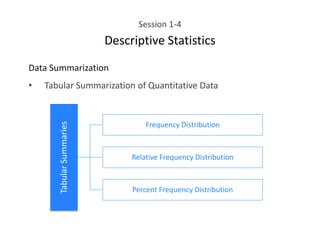
Tabular
Summaries
Frequency Distribution
Relative Frequency Distribution
Percent Frequency Distribution
Session 1-4
Descriptive Statistics
Data Summarization
• Tabular Summarization of Qualitative Data
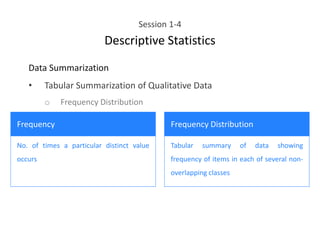
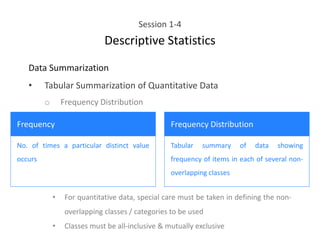
o Frequency Distribution
Frequency Frequency Distribution
No. of times a particular distinct value
occurs
Tabular summary of data showing
frequency of items in each of several non-
overlapping classes
Session 1-4
Descriptive Statistics
Data Summarization
• Tabular Summarization of Qualitative Data
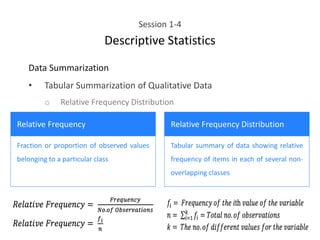
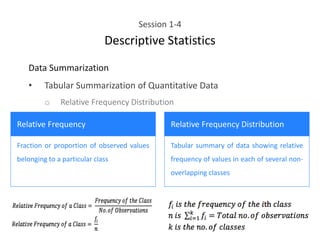
o Relative Frequency Distribution
Relative Frequency Relative Frequency Distribution
Fraction or proportion of observed values
belonging to a particular class
Tabular summary of data showing relative
frequency of items in each of several non-
overlapping classes
Session 1-4
Descriptive Statistics
Data Summarization
• Tabular Summarization of Qualitative Data
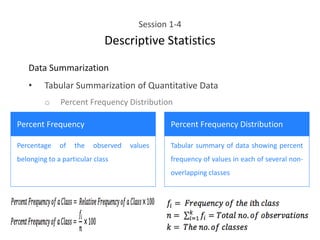
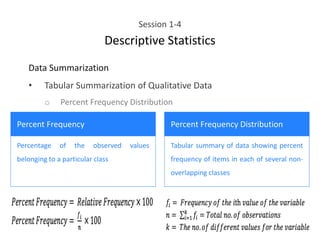
o Percent Frequency Distribution
Percent Frequency Percent Frequency Distribution
Percentage of the observed values
belonging to a particular class
Tabular summary of data showing percent
frequency of items in each of several non-
overlapping classes
Session 1-4
Descriptive Statistics
Data Summarization
• Tabular Summarization of Qualitative Data
Session 1-4
Descriptive Statistics
Data Summarization
• Tabular Summarization of Qualitative Data
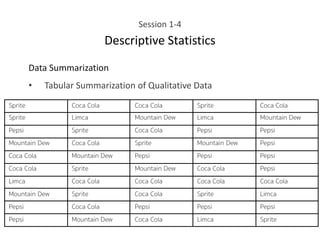
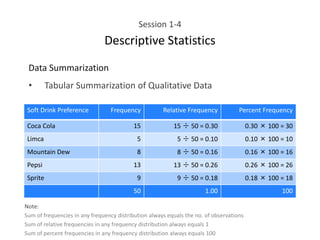
Soft Drink Preference Frequency Relative Frequency Percent Frequency
Coca Cola 15 15 ÷ 50 = 0.30 0.30 × 100 = 30
Limca 5 5 ÷ 50 = 0.10 0.10 × 100 = 10
Mountain Dew 8 8 ÷ 50 = 0.16 0.16 × 100 = 16
Pepsi 13 13 ÷ 50 = 0.26 0.26 × 100 = 26
Sprite 9 9 ÷ 50 = 0.18 0.18 × 100 = 18
50 1.00 100
Note:
Sum of frequencies in any frequency distribution always equals the no. of observations
Sum of relative frequencies in any frequency distribution always equals 1
Sum of percent frequencies in any frequency distribution always equals 100
Session 1-4
Descriptive Statistics
Data Summarization
• Graphical Summarization of Qualitative Data
Graphical
Summaries
Bar Chart
Pie Chart
Session 1-4
Descriptive Statistics
Data Summarization
• Graphical Summarization of Qualitative Data
o Bar Chart
• A graphical representation of a qualitative / categorical data set in
which a rectangle or bar is drawn over each category or class
• Bars may be vertical or horizontal
• Bars have the same width
• Length or height of each bar represents the frequency or
percentage of observations or some other measure associated with
the category
Session 1-4
Descriptive Statistics
Data Summarization
• Graphical Summarization of Qualitative Data
o Bar Chart
• Bars of different categories do not touch each other (since the each
class or category is separate)
• Bars may all be of the same color or different colors depicting
different categories
• Multiple variables can be graphed on the same bar chart
• Frequencies, relative frequencies, or percent frequencies can be
used to label / scale the bar chart (often relative frequencies are
used)
Session 1-4
Descriptive Statistics
Data Summarization
• Graphical Summarization of Qualitative Data
o Bar Chart
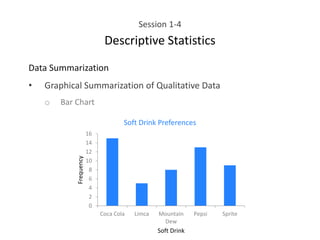
0
2
4
6
8
10
12
14
16
Coca Cola Limca Mountain
Dew
Pepsi Sprite
Frequency
Soft Drink
Soft Drink Preferences
Session 1-4
Descriptive Statistics
Data Summarization
• Graphical Summarization of Qualitative Data
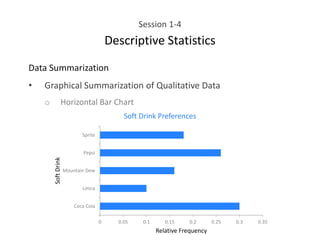
o Horizontal Bar Chart
• Uses horizontal bars instead of vertical bars
• Bars are placed on the vertical axis
• Frequencies, relative frequencies or percent frequencies are
displayed on the horizontal axis
• Lengths (instead of the heights) of the bars correspond to the
values (frequencies, relative frequencies or percent frequencies) to
be represented
Session 1-4
Descriptive Statistics
Data Summarization
• Graphical Summarization of Qualitative Data
o Horizontal Bar Chart
0 0.05 0.1 0.15 0.2 0.25 0.3 0.35
Coca Cola
Limca
Mountain Dew
Pepsi
Sprite
Relative Frequency
Soft
Drink
Soft Drink Preferences
Session 1-4
Descriptive Statistics
Data Summarization
•Graphical Summarization of Qualitative Data
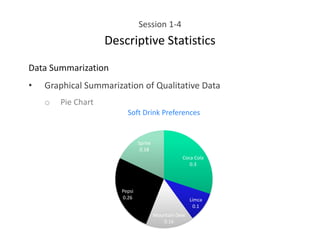
o Pie Chart
• A graphical representation of a qualitative / categorical data set in
the form of a circle divided into slices corresponding to the
categories or classes to be displayed
• Sizes of the slices are proportional to the frequency or percentage
of observations or some other measure associated with the
categories or classes
• Sizes of slices (in °) for classes or categories are computed by
multiplying their respective relative frequencies by 360°
Session 1-4
Descriptive Statistics
Data Summarization
• Graphical Summarization of Qualitative Data
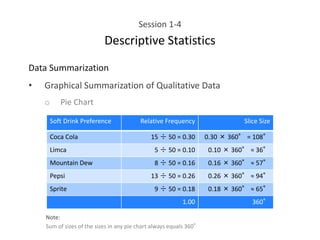
o Pie Chart
Soft Drink Preference Relative Frequency Slice Size
Coca Cola 15 ÷ 50 = 0.30 0.30 × 360° = 108°
Limca 5 ÷ 50 = 0.10 0.10 × 360° = 36°
Mountain Dew 8 ÷ 50 = 0.16 0.16 × 360° ≈ 57°
Pepsi 13 ÷ 50 = 0.26 0.26 × 360° ≈ 94°
Sprite 9 ÷ 50 = 0.18 0.18 × 360° ≈ 65°
1.00 360°
Note:
Sum of sizes of the sizes in any pie chart always equals 360°
Session 1-4
Descriptive Statistics
Data Summarization
• Graphical Summarization of Qualitative Data
o Pie Chart
Coca Cola
0.3
Limca
0.1
Mountain Dew
0.16
Pepsi
0.26
Sprite
0.18
Soft Drink Preferences
Session 1-4
Descriptive Statistics
Data Summarization
• Tabular Summarization of Quantitative Data
Tabular
Summaries
Frequency Distribution
Relative Frequency Distribution
Percent Frequency Distribution
Session 1-4
Descriptive Statistics
Data Summarization
• Tabular Summarization of Quantitative Data
o Frequency Distribution
• For quantitative data, special care must be taken in defining the non-
overlapping classes / categories to be used
• Classes must be all-inclusive & mutually exclusive
Frequency Frequency Distribution
No. of times a particular distinct value
occurs
Tabular summary of data showing
frequency of items in each of several non-
overlapping classes
Session 1-4
Descriptive Statistics
Data Summarization
• Tabular Summarization of Quantitative Data
o Frequency Distribution
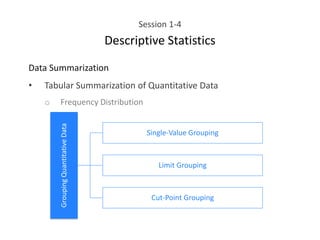
Grouping
Quantitative
Data
Single-Value Grouping
Limit Grouping
Cut-Point Grouping
Session 1-4
Descriptive Statistics
Data Summarization
• Tabular Summarization of Quantitative Data
o Frequency Distribution
• Single-Value Grouping
o Grouping quantitative data such that each class represents a
single possible value
o Such classes that represent single values each are called single-
value classes
o Distinct values of the observations are used as classes, just like
that for qualitative data
o Particularly suitable for discrete data when there are only a few
distinct values
Session 1-4
Descriptive Statistics
Data Summarization
• Tabular Summarization of Quantitative Data
o Frequency Distribution
• Single-Value Grouping
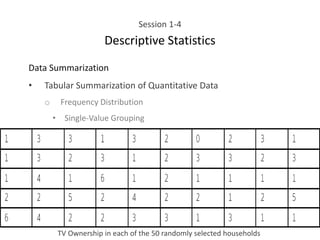
TV Ownership in each of the 50 randomly selected households
Session 1-4
Descriptive Statistics
Data Summarization
• Tabular Summarization of Quantitative Data
o Frequency Distribution
• Single-Value Grouping
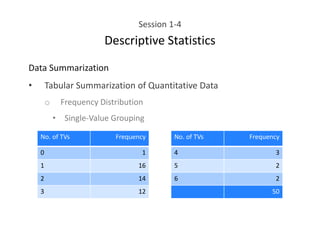
No. of TVs Frequency
0 1
1 16
2 14
3 12
No. of TVs Frequency
4 3
5 2
6 2
50
Session 1-4
Descriptive Statistics
Data Summarization
• Tabular Summarization of Quantitative Data
o Frequency Distribution
• Limit Grouping
o Grouping quantitative data such that each class contains a range
of values
o Each class has its own class limits that define the range of values
it can take
o The smallest value that could go in a class is called the lower
limit of the class, and the largest value that could go in the class
is called the upper limit of the class
Session 1-4
Descriptive Statistics
Data Summarization
•Tabular Summarization of Quantitative Data
o Frequency Distribution
• Limit Grouping
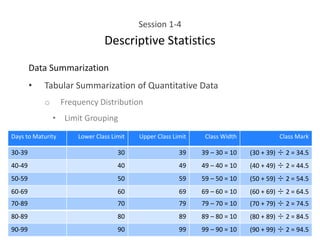
o Lower class limit – smallest value that could go in a class
o Upper class limit – largest value that could go in a class
o Class width – difference between the lower class limit of a class
& the lower class limit of the next-higher class
o Class mark or class midpoint – average of the lower class limit &
upper class limit of a class
o Useful when data with too many distinct values are expressed as
whole numbers
Session 1-4
Descriptive Statistics
Data Summarization
• Tabular Summarization of Quantitative Data
o Frequency Distribution
• Limit Grouping
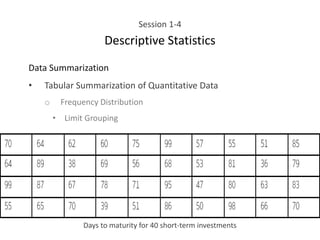
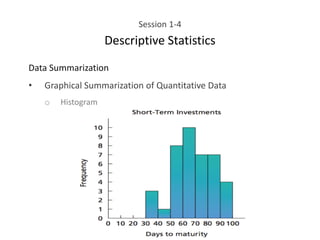
Days to maturity for 40 short-term investments
Session 1-4
Descriptive Statistics
Data Summarization
• Tabular Summarization of Quantitative Data
o Frequency Distribution
• Limit Grouping
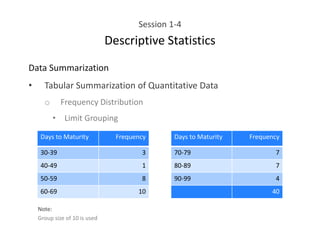
Days to Maturity Frequency
30-39 3
40-49 1
50-59 8
60-69 10
Days to Maturity Frequency
70-79 7
80-89 7
90-99 4
40
Note:
Group size of 10 is used
Session 1-4
Descriptive Statistics
Data Summarization
• Tabular Summarization of Quantitative Data
o Frequency Distribution
• Limit Grouping
Days to Maturity Lower Class Limit Upper Class Limit Class Width Class Mark
30-39 30 39 39 – 30 = 10 (30 + 39) ÷ 2 = 34.5
40-49 40 49 49 – 40 = 10 (40 + 49) ÷ 2 = 44.5
50-59 50 59 59 – 50 = 10 (50 + 59) ÷ 2 = 54.5
60-69 60 69 69 – 60 = 10 (60 + 69) ÷ 2 = 64.5
70-89 70 79 79 – 70 = 10 (70 + 79) ÷ 2 = 74.5
80-89 80 89 89 – 80 = 10 (80 + 89) ÷ 2 = 84.5
90-99 90 99 99 – 90 = 10 (90 + 99) ÷ 2 = 94.5
Session 1-4
Descriptive Statistics
Data Summarization
• Tabular Summarization of Quantitative Data
o Frequency Distribution
• Limit Grouping
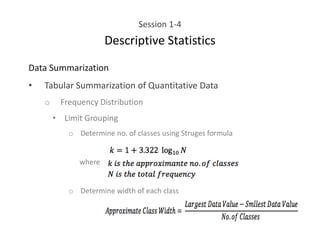
o Determine no. of classes using Struges formula
where
o Determine width of each class
Session 1-4
Descriptive Statistics
Data Summarization
• Tabular Summarization of Quantitative Data
o Frequency Distribution
• Limit Grouping
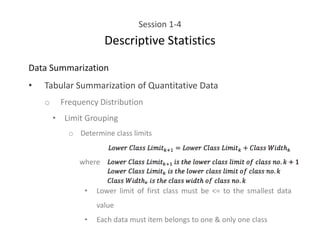
o Determine class limits
where
• Lower limit of first class must be <= to the smallest data
value
• Each data must item belongs to one & only one class
Session 1-4
Descriptive Statistics
Data Summarization
•Tabular Summarization of Quantitative Data
o Frequency Distribution
• Cut-Point Grouping
o Method of grouping quantitative data by using cut-points
o Useful for continuous data (expressed in decimals) with too
many distinct values
o Each class contains a range of values and has a lower cut-point &
an upper cut-point
o Lower class cut-point – smallest value that could go in a class
(same as the lower limit of the class in limit grouping)
Session 1-4
Descriptive Statistics
Data Summarization
•Tabular Summarization of Quantitative Data
o Frequency Distribution
• Cut-Point Grouping
o Upper class cut-point – smallest value that could go in the next-
higher class i.e. lower class cut-point of the next-higher class
(same as lower limit of the next higher class in limit grouping)
o Class width - difference between lower class cut-point & upper
class cut-point of a class
o Class mark or class midpoint - average of the lower class cut-
point & upper class cut-point of a class
Session 1-4
Descriptive Statistics
Data Summarization
• Tabular Summarization of Quantitative Data
o Frequency Distribution
• Cut-Point Grouping
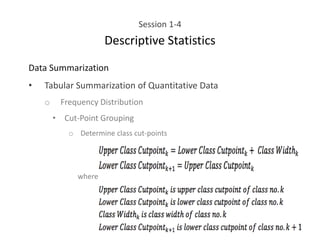
o Determine class cut-points
where
Session 1-4
Descriptive Statistics
Data Summarization
• Tabular Summarization of Quantitative Data
o Frequency Distribution
• Cut-Point Grouping
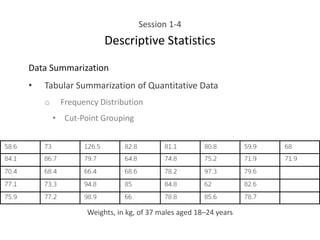
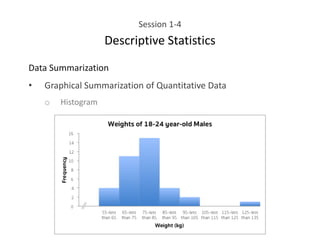
Weights, in kg, of 37 males aged 18–24 years
Session 1-4
Descriptive Statistics
Data Summarization
• Tabular Summarization of Quantitative Data
o Frequency Distribution
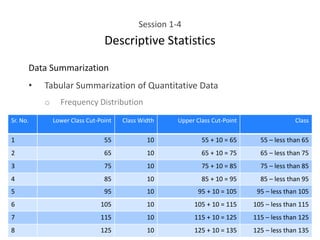
Sr. No. Lower Class Cut-Point Class Width Upper Class Cut-Point Class
1 55 10 55 + 10 = 65 55 – less than 65
2 65 10 65 + 10 = 75 65 – less than 75
3 75 10 75 + 10 = 85 75 – less than 85
4 85 10 85 + 10 = 95 85 – less than 95
5 95 10 95 + 10 = 105 95 – less than 105
6 105 10 105 + 10 = 115 105 – less than 115
7 115 10 115 + 10 = 125 115 – less than 125
8 125 10 125 + 10 = 135 125 – less than 135
Session 1-4
Descriptive Statistics
Data Summarization
• Tabular Summarization of Quantitative Data
o Frequency Distribution
• Limit Grouping
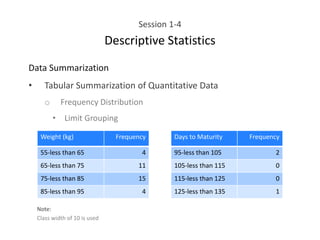
Weight (kg) Frequency
55-less than 65 4
65-less than 75 11
75-less than 85 15
85-less than 95 4
Days to Maturity Frequency
95-less than 105 2
105-less than 115 0
115-less than 125 0
125-less than 135 1
Note:
Class width of 10 is used
Session 1-4
Descriptive Statistics
Data Summarization
• Tabular Summarization of Quantitative Data
o Relative Frequency Distribution
Relative Frequency Relative Frequency Distribution
Fraction or proportion of observed values
belonging to a particular class
Tabular summary of data showing relative
frequency of values in each of several non-
overlapping classes
Session 1-4
Descriptive Statistics
Data Summarization
• Tabular Summarization of Quantitative Data
o Percent Frequency Distribution
Percent Frequency Percent Frequency Distribution
Percentage of the observed values
belonging to a particular class
Tabular summary of data showing percent
frequency of values in each of several non-
overlapping classes
Session 1-4
Descriptive Statistics
Data Summarization
• Tabular Summarization of Quantitative Data
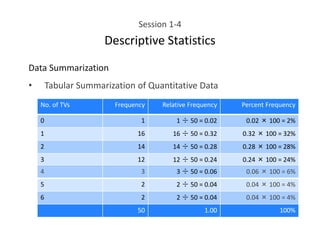
No. of TVs Frequency Relative Frequency Percent Frequency
0 1 1 ÷ 50 = 0.02 0.02 × 100 = 2%
1 16 16 ÷ 50 = 0.32 0.32 × 100 = 32%
2 14 14 ÷ 50 = 0.28 0.28 × 100 = 28%
3 12 12 ÷ 50 = 0.24 0.24 × 100 = 24%
4 3 3 ÷ 50 = 0.06 0.06 × 100 = 6%
5 2 2 ÷ 50 = 0.04 0.04 × 100 = 4%
6 2 2 ÷ 50 = 0.04 0.04 × 100 = 4%
50 1.00 100%
Session 1-4
Descriptive Statistics
Data Summarization
• Tabular Summarization of Quantitative Data
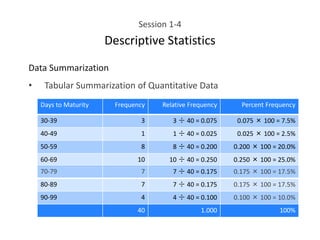
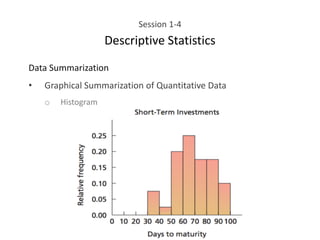
Days to Maturity Frequency Relative Frequency Percent Frequency
30-39 3 3 ÷ 40 = 0.075 0.075 × 100 = 7.5%
40-49 1 1 ÷ 40 = 0.025 0.025 × 100 = 2.5%
50-59 8 8 ÷ 40 = 0.200 0.200 × 100 = 20.0%
60-69 10 10 ÷ 40 = 0.250 0.250 × 100 = 25.0%
70-79 7 7 ÷ 40 = 0.175 0.175 × 100 = 17.5%
80-89 7 7 ÷ 40 = 0.175 0.175 × 100 = 17.5%
90-99 4 4 ÷ 40 = 0.100 0.100 × 100 = 10.0%
40 1.000 100%
Session 1-4
Descriptive Statistics
Data Summarization
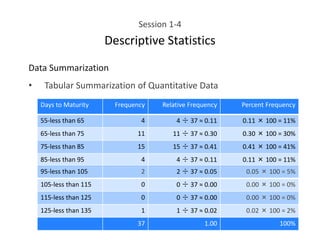
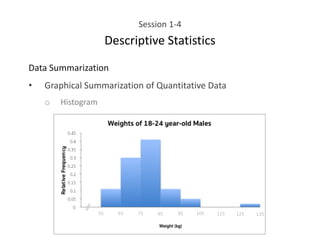
• Tabular Summarization of Quantitative Data
Days to Maturity Frequency Relative Frequency Percent Frequency
55-less than 65 4 4 ÷ 37 ≈ 0.11 0.11 × 100 = 11%
65-less than 75 11 11 ÷ 37 ≈ 0.30 0.30 × 100 = 30%
75-less than 85 15 15 ÷ 37 ≈ 0.41 0.41 × 100 = 41%
85-less than 95 4 4 ÷ 37 ≈ 0.11 0.11 × 100 = 11%
95-less than 105 2 2 ÷ 37 ≈ 0.05 0.05 × 100 = 5%
105-less than 115 0 0 ÷ 37 ≈ 0.00 0.00 × 100 = 0%
115-less than 125 0 0 ÷ 37 ≈ 0.00 0.00 × 100 = 0%
125-less than 135 1 1 ÷ 37 ≈ 0.02 0.02 × 100 = 2%
37 1.00 100%
Session 1-4
Descriptive Statistics
Data Summarization
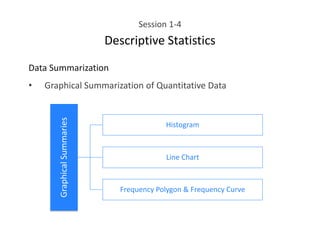
• Graphical Summarization of Quantitative Data
Graphical
Summaries
Histogram
Line Chart
Frequency Polygon & Frequency Curve
Session 1-4
Descriptive Statistics
Data Summarization
• Graphical Summarization of Quantitative Data
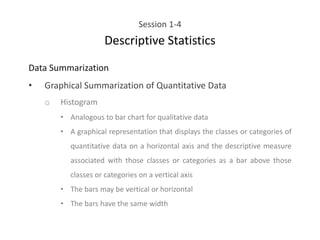
o Histogram
• Analogous to bar chart for qualitative data
• A graphical representation that displays the classes or categories of
quantitative data on a horizontal axis and the descriptive measure
associated with those classes or categories as a bar above those
classes or categories on a vertical axis
• The bars may be vertical or horizontal
• The bars have the same width
Session 1-4
Descriptive Statistics
Data Summarization
• Graphical Summarization of Quantitative Data
o Histogram
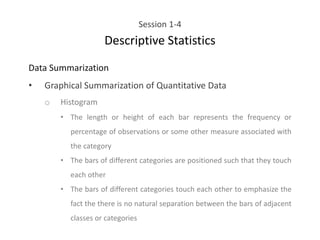
• The length or height of each bar represents the frequency or
percentage of observations or some other measure associated with
the category
• The bars of different categories are positioned such that they touch
each other
• The bars of different categories touch each other to emphasize the
fact the there is no natural separation between the bars of adjacent
classes or categories
Session 1-4
Descriptive Statistics
Data Summarization
• Graphical Summarization of Quantitative Data
o Histogram
• Frequencies, relative frequencies, or percent frequencies can be
used to label / scale the horizontal chart
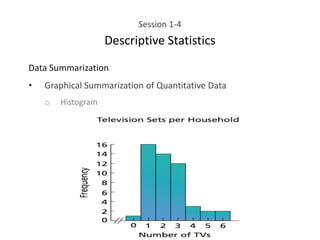
• Frequency histogram - a histogram that uses frequencies on the
vertical axis
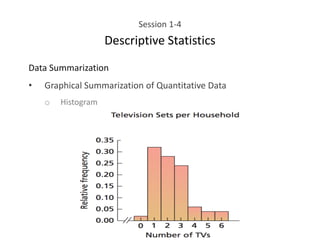
• Relative frequency histogram - a histogram that uses relative
frequencies on the vertical axis
• Percent frequency histogram - a histogram that uses percent
frequencies on the vertical axis
Session 1-4
Descriptive Statistics
Data Summarization
• Graphical Summarization of Quantitative Data
o Histogram
• For single-value grouping, the distinct values of the observations
are used to label the bars, with each such value centered under
its bar
• For limit grouping or cut point grouping, the lower class limits or,
equivalently, the lower class cut points are used to label the bars,
or alternately class marks or class midpoints centered under the
bars can also be used to label the bars
Session 1-4
Descriptive Statistics
Data Summarization
• Graphical Summarization of Quantitative Data
o Histogram
Session 1-4
Descriptive Statistics
Data Summarization
• Graphical Summarization of Quantitative Data
o Histogram
Session 1-4
Descriptive Statistics
Data Summarization
• Graphical Summarization of Quantitative Data
o Histogram
Session 1-4
Descriptive Statistics
Data Summarization
• Graphical Summarization of Quantitative Data
o Histogram
Session 1-4
Descriptive Statistics
Data Summarization
• Graphical Summarization of Quantitative Data
o Histogram
Session 1-4
Descriptive Statistics
Data Summarization
• Graphical Summarization of Quantitative Data
o Histogram
Session 1-4
Descriptive Statistics
Data Summarization
• Graphical Summarization of Quantitative Data
o Line Chart
• A graphical representation where data are plotted on a Cartesian
coordinate grid with straight lines connecting each pair of
successive points
• Used to display quantitative values over a continuous interval or
time period
• Most frequently used to show trends and analyze how the data
has changed over time
• Typically, the vertical axis has a quantitative value, while the
horizontal axis is a timescale or a sequence of intervals
Session 1-4
Descriptive Statistics
Data Summarization
• Graphical Summarization of Quantitative Data
o Line Chart
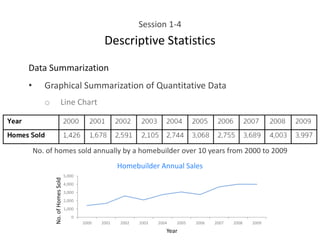
No. of homes sold annually by a homebuilder over 10 years from 2000 to 2009
0
1,000
2,000
3,000
4,000
5,000
2000 2001 2002 2003 2004 2005 2006 2007 2008 2009
No.
of
Homes
Sold
Year
Homebuilder Annual Sales
Session 1-4
Descriptive Statistics
Data Summarization
• Graphical Summarization of Quantitative Data
o Frequency Polygon & Frequency Curve
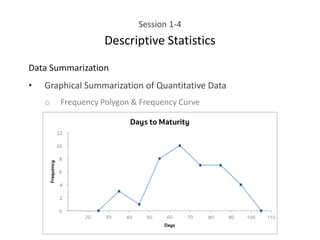
• A frequency polygon is a line chart created by joining all of the
top points of a histogram with end points lying on the horizontal
axis i.e. the rightmost & leftmost points are zero
• A frequency polygon looks like a line chart, and makes continuous
data visually easy to interpret
• Frequency polygons - for understanding shape of distribution of
data
• Line charts - to show trends & analyze how the data has changed
over time
Session 1-4
Descriptive Statistics
Data Summarization
• Graphical Summarization of Quantitative Data
o Frequency Polygon & Frequency Curve
• A frequency polygon is similar to a histogram except that there
are no rectangles, only a point at the midpoint of each class at a
height proportional to the frequency of the class
• Frequency polygons serve the same purpose as histograms
• Are especially helpful for comparing sets of data
Session 1-4
Descriptive Statistics
Data Summarization
• Graphical Summarization of Quantitative Data
o Frequency Polygon & Frequency Curve
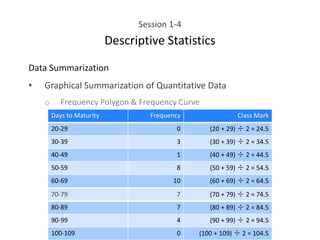
Days to Maturity Frequency Class Mark
20-29 0 (20 + 29) ÷ 2 = 24.5
30-39 3 (30 + 39) ÷ 2 = 34.5
40-49 1 (40 + 49) ÷ 2 = 44.5
50-59 8 (50 + 59) ÷ 2 = 54.5
60-69 10 (60 + 69) ÷ 2 = 64.5
70-79 7 (70 + 79) ÷ 2 = 74.5
80-89 7 (80 + 89) ÷ 2 = 84.5
90-99 4 (90 + 99) ÷ 2 = 94.5
100-109 0 (100 + 109) ÷ 2 = 104.5
Session 1-4
Descriptive Statistics
Data Summarization
• Graphical Summarization of Quantitative Data
o Frequency Polygon & Frequency Curve
Session 1-4
Descriptive Statistics
Data Summarization
• Graphical Summarization of Quantitative Data
o Frequency Polygon & Frequency Curve
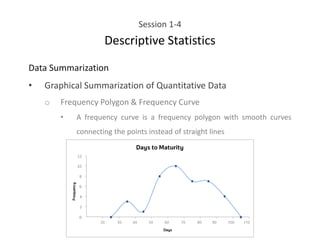
• A frequency curve is a frequency polygon with smooth curves
connecting the points instead of straight lines
Session 1-4
Descriptive Statistics
Summary Statistics
• Introduction
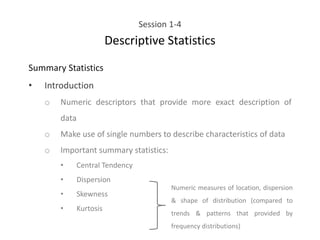
o Numeric descriptors that provide more exact description of
data
o Make use of single numbers to describe characteristics of data
o Important summary statistics:
• Central Tendency
• Dispersion
• Skewness
• Kurtosis
Numeric measures of location, dispersion
& shape of distribution (compared to
trends & patterns that provided by
frequency distributions)
Session 1-4
Descriptive Statistics
Summary Statistics
• Introduction
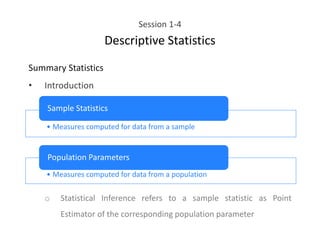
o Statistical Inference refers to a sample statistic as Point
Estimator of the corresponding population parameter
• Measures computed for data from a sample
Sample Statistics
• Measures computed for data from a population
Population Parameters
Session 1-4
Descriptive Statistics
Summary Statistics
• Measures of Central Tendency
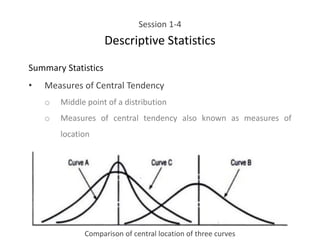
o Middle point of a distribution
o Measures of central tendency also known as measures of
location
Comparison of central location of three curves
Session 1-4
Descriptive Statistics
Summary Statistics
• Measures of Central Tendency
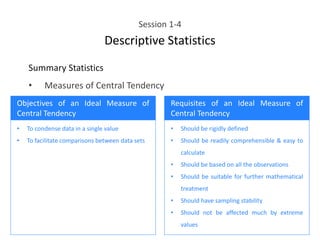
Objectives of an Ideal Measure of
Central Tendency
Requisites of an Ideal Measure of
Central Tendency
• To condense data in a single value
• To facilitate comparisons between data sets
• Should be rigidly defined
• Should be readily comprehensible & easy to
calculate
• Should be based on all the observations
• Should be suitable for further mathematical
treatment
• Should have sampling stability
• Should not be affected much by extreme
values
Session 1-4
Descriptive Statistics
Summary Statistics
• Measures of Central Tendency
o Arithmetic Mean
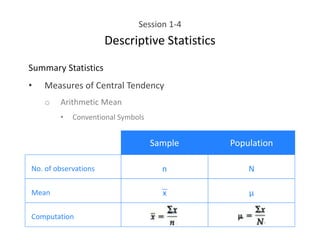
• Conventional Symbols
Sample Population
No. of observations N
n
Mean μ
x
Computation
Session 1-4
Descriptive Statistics
Summary Statistics
• Measures of Central Tendency
o Arithmetic Mean
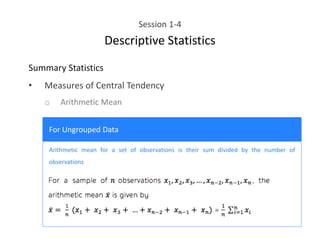
For Ungrouped Data
Arithmetic mean for a set of observations is their sum divided by the number of
observations
Session 1-4
Descriptive Statistics
Summary Statistics
• Measures of Central Tendency
o Arithmetic Mean
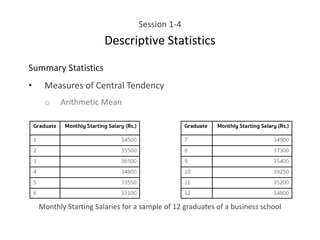
Monthly Starting Salaries for a sample of 12 graduates of a business school
Session 1-4
Descriptive Statistics
Summary Statistics
• Measures of Central Tendency
o Arithmetic Mean
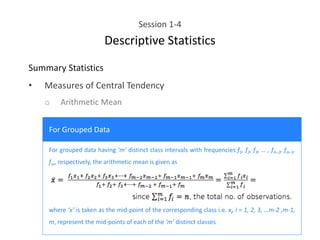
For Grouped Data
For grouped data having ‘m’ distinct class intervals with frequencies f1, f2, f3, … , fm-2, fm-1,
fm, respectively, the arithmetic mean is given as
where ‘x’ is taken as the mid-point of the corresponding class i.e. xi, i = 1, 2, 3, …m-2 ,m-1,
m, represent the mid-points of each of the ‘m’ distinct classes
Session 1-4
Descriptive Statistics
Summary Statistics
• Measures of Central Tendency
o Arithmetic Mean
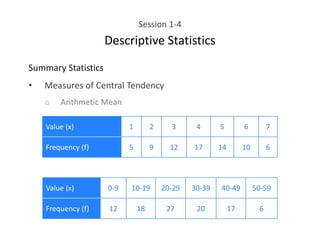
Value (x) 1 2 3 4 5 6 7
Frequency (f) 5 9 12 17 14 10 6
Value (x) 0-9 10-19 20-29 30-39 40-49 50-59
Frequency (f) 12 18 27 20 17 6
Session 1-4
Descriptive Statistics
Summary Statistics
• Measures of Dispersion
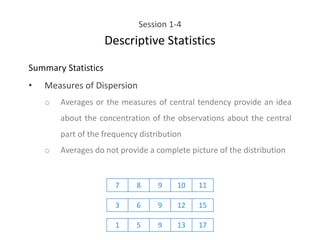
o Averages or the measures of central tendency provide an idea
about the concentration of the observations about the central
part of the frequency distribution
o Averages do not provide a complete picture of the distribution
7 8 9 10 11
3 6 9 12 15
1 5 9 13 17
Session 1-4
Descriptive Statistics
Summary Statistics
• Measures of Dispersion
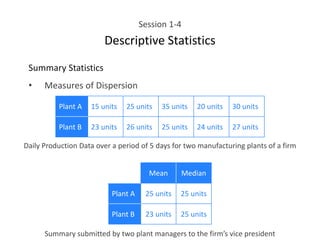
Plant A 15 units 25 units 35 units 20 units 30 units
Plant B 23 units 26 units 25 units 24 units 27 units
Mean Median
Plant A 25 units 25 units
Plant B 23 units 25 units
Daily Production Data over a period of 5 days for two manufacturing plants of a firm
Summary submitted by two plant managers to the firm’s vice president
Session 1-4
Descriptive Statistics
Summary Statistics
• Measures of Dispersion
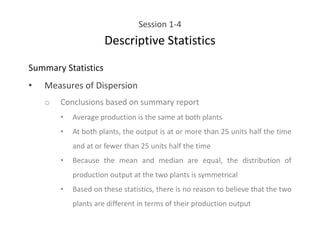
o Conclusions based on summary report
• Average production is the same at both plants
• At both plants, the output is at or more than 25 units half the time
and at or fewer than 25 units half the time
• Because the mean and median are equal, the distribution of
production output at the two plants is symmetrical
• Based on these statistics, there is no reason to believe that the two
plants are different in terms of their production output
Session 1-4
Descriptive Statistics
Summary Statistics
•Measures of Dispersion
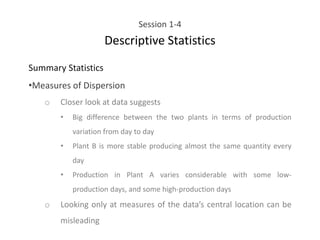
o Closer look at data suggests
• Big difference between the two plants in terms of production
variation from day to day
• Plant B is more stable producing almost the same quantity every
day
• Production in Plant A varies considerable with some low-
production days, and some high-production days
o Looking only at measures of the data’s central location can be
misleading
Session 1-4
Descriptive Statistics
Summary Statistics
• Measures of Dispersion
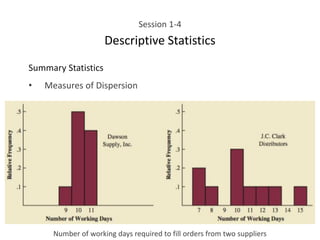
Number of working days required to fill orders from two suppliers
Session 1-4
Descriptive Statistics
Summary Statistics
• Measures of Dispersion
o To better describe a set of data, a measure of variation / spread
/ dispersion required in addition to the measure of central
tendency
o Dispersion => scatter
o Dispersion provides an idea about the heterogeneity or
homogeneity of the distribution.
o A more homogeneous series is less dispersed / scattered
o A more heterogeneous series is more dispersed / scattered
Session 1-4
Descriptive Statistics
Summary Statistics
• Measures of Dispersion
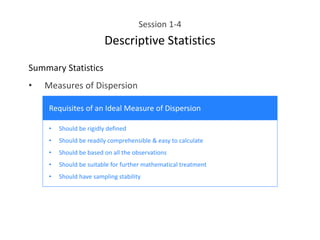
• Should be rigidly defined
• Should be readily comprehensible & easy to calculate
• Should be based on all the observations
• Should be suitable for further mathematical treatment
• Should have sampling stability
Requisites of an Ideal Measure of Dispersion
Session 1-4
Descriptive Statistics
Summary Statistics
• Measures of Dispersion
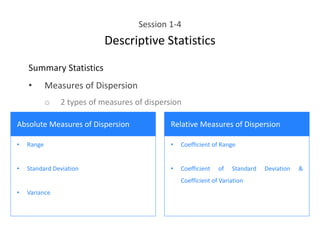
o 2 types of measures of dispersion
Absolute Measures of Dispersion Relative Measures of Dispersion
• Range
• Standard Deviation
• Variance
• Coefficient of Range
• Coefficient of Standard Deviation &
Coefficient of Variation
Session 1-4
Descriptive Statistics
Summary Statistics
• Measures of Dispersion
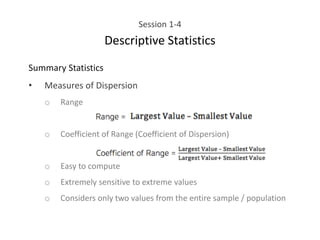
o Range
o Coefficient of Range (Coefficient of Dispersion)
o Easy to compute
o Extremely sensitive to extreme values
o Considers only two values from the entire sample / population
Session 1-4
Descriptive Statistics
Summary Statistics
• Measures of Dispersion
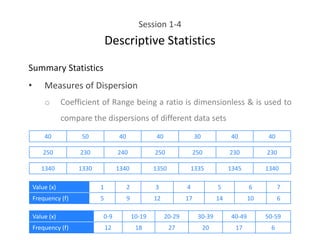
o Coefficient of Range being a ratio is dimensionless & is used to
compare the dispersions of different data sets
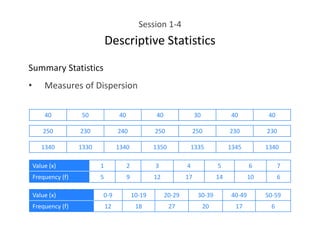
40 50 40 40 30 40 40
250 230 240 250 250 230 230
1340 1330 1340 1350 1335 1345 1340
Value (x) 1 2 3 4 5 6 7
Frequency (f) 5 9 12 17 14 10 6
Value (x) 0-9 10-19 20-29 30-39 40-49 50-59
Frequency (f) 12 18 27 20 17 6
Session 1-4
Descriptive Statistics
Summary Statistics
• Measures of Dispersion
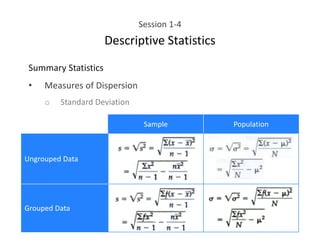
o Standard Deviation
Sample Population
Ungrouped Data
Grouped Data
Session 1-4
Descriptive Statistics
Summary Statistics
• Measures of Dispersion
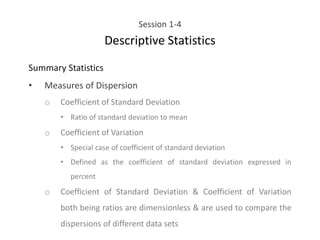
o Coefficient of Standard Deviation
• Ratio of standard deviation to mean
o Coefficient of Variation
• Special case of coefficient of standard deviation
• Defined as the coefficient of standard deviation expressed in
percent
o Coefficient of Standard Deviation & Coefficient of Variation
both being ratios are dimensionless & are used to compare the
dispersions of different data sets
Session 1-4
Descriptive Statistics
Summary Statistics
• Measures of Dispersion
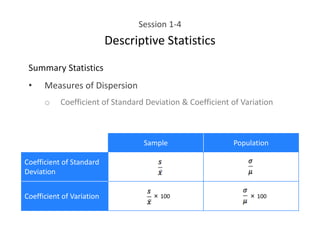
o Coefficient of Standard Deviation & Coefficient of Variation
Sample Population
Coefficient of Standard
Deviation
Coefficient of Variation × 100 × 100
Session 1-4
Descriptive Statistics
Summary Statistics
• Measures of Dispersion
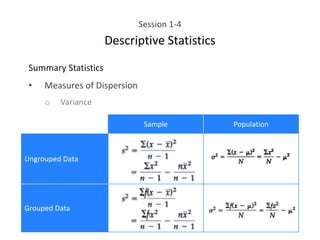
o Variance
Sample Population
Ungrouped Data
Grouped Data
Session 1-4
Descriptive Statistics
Summary Statistics
• Measures of Dispersion
40 50 40 40 30 40 40
250 230 240 250 250 230 230
1340 1330 1340 1350 1335 1345 1340
Value (x) 1 2 3 4 5 6 7
Frequency (f) 5 9 12 17 14 10 6
Value (x) 0-9 10-19 20-29 30-39 40-49 50-59
Frequency (f) 12 18 27 20 17 6
Session 1-4
Descriptive Statistics
Summary Statistics
•Measures of Skewness
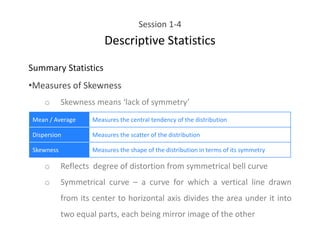
o Skewness means ‘lack of symmetry’
o Reflects degree of distortion from symmetrical bell curve
o Symmetrical curve – a curve for which a vertical line drawn
from its center to horizontal axis divides the area under it into
two equal parts, each being mirror image of the other
Mean / Average Measures the central tendency of the distribution
Dispersion Measures the scatter of the distribution
Skewness Measures the shape of the distribution in terms of its symmetry
Session 1-4
Descriptive Statistics
Summary Statistics
•Measures of Skewness
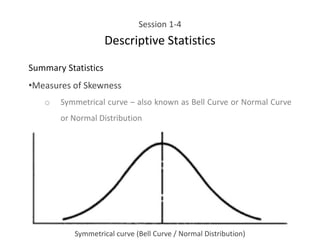
o Symmetrical curve – also known as Bell Curve or Normal Curve
or Normal Distribution
Symmetrical curve (Bell Curve / Normal Distribution)
Session 1-4
Descriptive Statistics
Summary Statistics
•Measures of Skewness
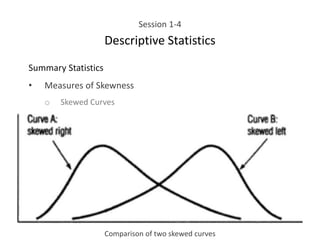
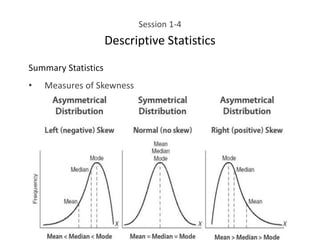
o Skewed curves – curves where values in their frequency
distributions are not equally distributed and are concentrated
at either the lower end or the higher end
• Right skewed (positively skewed) curves – curves which tail off
(extend) toward the higher end of the measuring scale
• Left skewed (negatively skewed) curves – curves which tail off
(extend) toward the lower end of the measuring scale
Session 1-4
Descriptive Statistics
Summary Statistics
• Measures of Skewness
o Skewed Curves
Comparison of two skewed curves
Session 1-4
Descriptive Statistics
Summary Statistics
• Measures of Skewness
Session 1-4
Descriptive Statistics
Summary Statistics
•Measures of Skewness
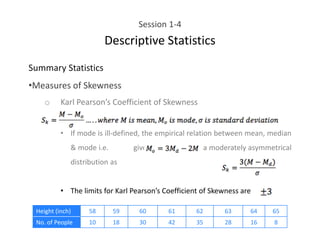
o Karl Pearson’s Coefficient of Skewness
• If mode is ill-defined, the empirical relation between mean, median
& mode i.e. gives the formula for a moderately asymmetrical
distribution as
• The limits for Karl Pearson’s Coefficient of Skewness are
Height (inch) 58 59 60 61 62 63 64 65
No. of People 10 18 30 42 35 28 16 8

Session 1-4 - Descriptive Statistics.pdf

  • 1.
    Session 1-4 Descriptive Statistics •Introduction o Statistics o Data o Scales of Measurement o Data Classification o Descriptive & Inferential Statistics • Data Summarization o Tabular Summarization of Qualitative Data o Graphical Summarization of Qualitative Data
  • 2.
    Session 1-4 Descriptive Statistics oTabular Summarization of Quantitative Data o Graphical Summarization of Quantitative Data • Summary Statistics o Introduction o Measures of Central Tendency o Measures of Dispersion o Measures of Skewness
  • 3.
    Session 1-4 Descriptive Statistics Introduction •Statistics o‘status’ (Latin), ‘statista’ (Italian), ‘statistik’ (German) – political state o Art & science of collecting, analyzing, presenting, and interpreting data o Used in all almost fields of human activity - Planning, Economy, Business, Industry, Mathematics, Biology, Astronomy, Medical Science, Psychology, Education, War, Politics, Environment
  • 4.
    Session 1-4 Descriptive Statistics Introduction •Data Term Meaning / Definition Data Facts and figures collected, analyzed, and summarized for presentation and interpretation Data Set All data collected in a particular study Elements Entities on which data are collected Variable A characteristic of interest for the elements Observation Set of measurements obtained for a particular element
  • 5.
    Session 1-4 Descriptive Statistics Introduction •Data Scheme Name Category Morningstar Rating NAV 1-year Return (%) 5-year CAGR (%) Mirae Asset Emerging Bluechip Fund – Growth Equity 5-star 54.17 15.17 20.51 IDFC Cash Fund - Growth Debt 5-star 2295 7.28 7.58 BNP Paribas Liquid Fund - Growth Debt 5-star 2905.23 7.49 7.59 Axis Liquid Fund - Growth Debt 5-star 2100.62 7.51 7.67 ICICI Prudential Liquid Fund – Retail Plan - Growth Debt 4-star 431.27 7.04 7.1
  • 6.
    Category Morningstar Rating NAV 1-year Return (%) 5-year CAGR (%) Equity5-star 54.17 15.17 20.51 Debt 5-star 2295 7.28 7.58 Debt 5-star 2905.23 7.49 7.59 Debt 5-star 2100.62 7.51 7.67 Debt 4-star 431.27 7.04 7.1 Mirae Asset Emerging Bluechip Fund – Growth IDFC Cash Fund - Growth BNP Paribas Liquid Fund - Growth Axis Liquid Fund - Growth ICICI Prudential Liquid Fund – Retail Plan - Growth Scheme Name Elements Variables Data Set Observation Session 1-4 Descriptive Statistics
  • 7.
    Session 1-4 Descriptive Statistics Introduction •Scales of Measurement Scale Description Nominal Data for a variable consists of labels or names used to identify an attribute Ordinal If data exhibit the properties of nominal data, & the order / rank of the data is meaningful Interval If data exhibit all the properties of ordinal data, & the interval between values is expressed in terms of a fixed unit of measure Ratio If data exhibit all the properties of interval data, & the ratio of two values is meaningful
  • 8.
    Session 1-4 Descriptive Statistics Introduction •Scales of Measurement o No. of observations always equals the no. of elements o No. of measurements obtained for each element equals the no. of variables o Total no. of data items equals the product of no. of observations (or elements) and no. of variables
  • 9.
    Session 1-4 Descriptive Statistics Introduction •DataClassification o Qualitative Data (Categorical Data) • Data that can be group by specific categories • Are measures of ‘types’ and may be represented by a name, symbol or a numeric code • Signify category to which an item belongs to • Use either nominal or ordinal scale of measurement • Qualitative variable – one with qualitative or cateogrical data • E.g. – responses to questions like “What color is your car?” • Specical case with only two repsonse options (usually “yes” and “no”)
  • 10.
    Session 1-4 Descriptive Statistics Introduction •DataClassification o Quantitative Data • Data that use numeric values to indicate how much or how many • Are measures of values or counts • Expressed as numbers • Use either interval or ratio scale of measurement • Quantitative variable – variable with quantitative data • E.g. – responses to questions like “How many runs will India score in the next match?”
  • 11.
    Session 1-4 Descriptive Statistics Introduction •DataClassification o Variables with non-numeric values – Qualitative o Variables with numeric values – Qualitative or Quantitative o Qualitative data can be summarized by counting the number of observations in each category or by computing the proportion of observations in each category o Arithmetic operations can be performed on quantitative data
  • 12.
  • 13.
    Session 1-4 Descriptive Statistics Introduction •Data Classification o Cross Sectional Data • Data observed at the same or approximately the same point in time Scheme Name Category Morningstar Rating NAV 1-year Return (%) 5-year CAGR (%) Mirae Asset Emerging Bluechip Fund – Growth Equity 5-star 54.17 15.17 20.51 IDFC Cash Fund - Growth Debt 5-star 2295 7.28 7.58 BNP Paribas Liquid Fund - Growth Debt 5-star 2905.23 7.49 7.59
  • 14.
    Session 1-4 Descriptive Statistics Introduction •Data Classification o Time Series Data • Data observed over several time periods
  • 15.
    Session 1-4 Descriptive Statistics Introduction •DataClassification o Quantitative data may be discrete or continuous o Discrete Data • Data that measure how many • Contains distinct or separate, finite values that have nothing in- between i.e. sub-division is not possible • Relies of count, includes only those values that can only be counted in whole numbers or integers i.e. data cannot be broken down into fractions or decimals • E.g. – number of students in this class
  • 16.
    Session 1-4 Descriptive Statistics Introduction •DataClassification o Continuous Data • Data that measure how much • Unbroken set of values measured on a scale • No separation occurs between possible data values • Can take any value, within a finite or infinite range of possible values • Relies of measurement, includes values that can be measured and broken down into fractions and decimals according to the measurement precision • E.g. – weight of a person
  • 17.
  • 18.
    Session 1-4 Descriptive Statistics Introduction •Descriptive & Inferential Statistics o Role of statistics involves converting data into information using various statistical procedures Role of Statistics Data Information Statistical Procedures Descriptive Inferential Probability
  • 19.
    Session 1-4 Descriptive Statistics Introduction •Descriptive & Inferential Statistics o Descriptive Statistics • Consists of methods for organizing and summarizing information • Includes procedures and techniques specially designed to describe data • Visual / pictorial description through charts, diagrams, graphs, tables, etc. • Numerical description through calculation of various measures such as averages, variation, percentiles, etc.
  • 20.
    Example Data of15 Published Books
  • 21.
  • 22.
    Bar Chart ofGenre-wise Cumulative Copies Sold
  • 23.
    Frequencies & PercentFrequencies for Genre of Books Session 1-4 Descriptive Statistics Introduction • Descriptive & Inferential Statistics
  • 24.
    Session 1-4 Descriptive Statistics Introduction •Descriptive & Inferential Statistics o Statistical Inference • Difficult, costly, time-consuming to collect data for each & every element belonging to a large group of elements (individuals, companies, voters, households, products, consumers, etc.) • In such cases, data is collected from only a small portion of the large group • The larger group of elements ➔ Population • The smaller group of elements ➔ Sample
  • 25.
    Session 1-4 Descriptive Statistics Introduction •Descriptive & Inferential Statistics o Statistical Inference • Population - set of all elements of interest in a particular study • Sample - subset of the population (part of the population from whose elements data is collected)
  • 26.
    Session 1-4 Descriptive Statistics Introduction •Descriptive& Inferential Statistics o Statistical Inference • Census - process of conducting a survey collect data for the entire population • Sample survey - process of conducting a survey to collect data for a sample • Statistical Inference – process through which statistics uses data from a sample to make estimates & test hypotheses about the characteristics of a population
  • 27.
    Session 1-4 Descriptive Statistics Introduction •Descriptive & Inferential Statistics o Inferential Statistics • Consists of methods for drawing and measuring the reliability of conclusions about a population based on information obtained from a sample of the population • Includes inferential procedures that help decision makers draw inferences from a set of data • Inferential procedures include estimation & hypothesis testing
  • 28.
    Session 1-4 Descriptive Statistics Introduction •Descriptive& Inferential Statistics o Inferential Statistics • E.g. - To increase the useful life of its high intensity light bulbs, the product design group at Norris Electronics developed a new light bulb filament. In this case, the population is defined as all light bulbs that could be produced with the new filament. To evaluate the advantages of the new filament, 200 bulbs with the new filament were manufactured & tested. Data collected from this sample shows the number of hours each light bulb operated before filament burnout.
  • 29.
    Hours until burnoutfor a sample of 200 light bulbs
  • 30.
    Session 1-4 Descriptive Statistics Introduction •Descriptive & Inferential Statistics o Inferential Statistics • To make an inference about the average hours of useful life for the population of all light bulbs that could be produced with the new filament, Norris can use the sample average lifetime for the light bulbs • The sample result can be used to estimate that the average lifetime for the light bulbs in the population is 76 hours
  • 31.
    Session 1-4 Descriptive Statistics Introduction •Descriptive & Inferential Statistics o Inferential Statistics Process of Statistical Inference
  • 32.
    Session 1-4 Descriptive Statistics Introduction •Descriptive& Inferential Statistics o Inferential Statistics • Estimates about a characteristic of a population based on sample data are accompanies with a statement of the quality, or precision, associated with the estimate • Point estimate of the average life-time for the population - 76 hours with a margin of error of 4 hours • Interval estimate of the average lifetime for all light bulbs - 72 hours to 80 hours • Confidence levels can be used – % chances that interval from 72 hours to 80 hours contains the population average
  • 33.
    Session 1-4 Descriptive Statistics DataSummarization • Tabular Summarization of Qualitative Data Tabular Summaries Frequency Distribution Relative Frequency Distribution Percent Frequency Distribution
  • 34.
    Session 1-4 Descriptive Statistics DataSummarization • Tabular Summarization of Qualitative Data o Frequency Distribution Frequency Frequency Distribution No. of times a particular distinct value occurs Tabular summary of data showing frequency of items in each of several non- overlapping classes
  • 35.
    Session 1-4 Descriptive Statistics DataSummarization • Tabular Summarization of Qualitative Data o Relative Frequency Distribution Relative Frequency Relative Frequency Distribution Fraction or proportion of observed values belonging to a particular class Tabular summary of data showing relative frequency of items in each of several non- overlapping classes
  • 36.
    Session 1-4 Descriptive Statistics DataSummarization • Tabular Summarization of Qualitative Data o Percent Frequency Distribution Percent Frequency Percent Frequency Distribution Percentage of the observed values belonging to a particular class Tabular summary of data showing percent frequency of items in each of several non- overlapping classes
  • 37.
    Session 1-4 Descriptive Statistics DataSummarization • Tabular Summarization of Qualitative Data
  • 38.
    Session 1-4 Descriptive Statistics DataSummarization • Tabular Summarization of Qualitative Data Soft Drink Preference Frequency Relative Frequency Percent Frequency Coca Cola 15 15 ÷ 50 = 0.30 0.30 × 100 = 30 Limca 5 5 ÷ 50 = 0.10 0.10 × 100 = 10 Mountain Dew 8 8 ÷ 50 = 0.16 0.16 × 100 = 16 Pepsi 13 13 ÷ 50 = 0.26 0.26 × 100 = 26 Sprite 9 9 ÷ 50 = 0.18 0.18 × 100 = 18 50 1.00 100 Note: Sum of frequencies in any frequency distribution always equals the no. of observations Sum of relative frequencies in any frequency distribution always equals 1 Sum of percent frequencies in any frequency distribution always equals 100
  • 39.
    Session 1-4 Descriptive Statistics DataSummarization • Graphical Summarization of Qualitative Data Graphical Summaries Bar Chart Pie Chart
  • 40.
    Session 1-4 Descriptive Statistics DataSummarization • Graphical Summarization of Qualitative Data o Bar Chart • A graphical representation of a qualitative / categorical data set in which a rectangle or bar is drawn over each category or class • Bars may be vertical or horizontal • Bars have the same width • Length or height of each bar represents the frequency or percentage of observations or some other measure associated with the category
  • 41.
    Session 1-4 Descriptive Statistics DataSummarization • Graphical Summarization of Qualitative Data o Bar Chart • Bars of different categories do not touch each other (since the each class or category is separate) • Bars may all be of the same color or different colors depicting different categories • Multiple variables can be graphed on the same bar chart • Frequencies, relative frequencies, or percent frequencies can be used to label / scale the bar chart (often relative frequencies are used)
  • 42.
    Session 1-4 Descriptive Statistics DataSummarization • Graphical Summarization of Qualitative Data o Bar Chart 0 2 4 6 8 10 12 14 16 Coca Cola Limca Mountain Dew Pepsi Sprite Frequency Soft Drink Soft Drink Preferences
  • 43.
    Session 1-4 Descriptive Statistics DataSummarization • Graphical Summarization of Qualitative Data o Horizontal Bar Chart • Uses horizontal bars instead of vertical bars • Bars are placed on the vertical axis • Frequencies, relative frequencies or percent frequencies are displayed on the horizontal axis • Lengths (instead of the heights) of the bars correspond to the values (frequencies, relative frequencies or percent frequencies) to be represented
  • 44.
    Session 1-4 Descriptive Statistics DataSummarization • Graphical Summarization of Qualitative Data o Horizontal Bar Chart 0 0.05 0.1 0.15 0.2 0.25 0.3 0.35 Coca Cola Limca Mountain Dew Pepsi Sprite Relative Frequency Soft Drink Soft Drink Preferences
  • 45.
    Session 1-4 Descriptive Statistics DataSummarization •Graphical Summarization of Qualitative Data o Pie Chart • A graphical representation of a qualitative / categorical data set in the form of a circle divided into slices corresponding to the categories or classes to be displayed • Sizes of the slices are proportional to the frequency or percentage of observations or some other measure associated with the categories or classes • Sizes of slices (in °) for classes or categories are computed by multiplying their respective relative frequencies by 360°
  • 46.
    Session 1-4 Descriptive Statistics DataSummarization • Graphical Summarization of Qualitative Data o Pie Chart Soft Drink Preference Relative Frequency Slice Size Coca Cola 15 ÷ 50 = 0.30 0.30 × 360° = 108° Limca 5 ÷ 50 = 0.10 0.10 × 360° = 36° Mountain Dew 8 ÷ 50 = 0.16 0.16 × 360° ≈ 57° Pepsi 13 ÷ 50 = 0.26 0.26 × 360° ≈ 94° Sprite 9 ÷ 50 = 0.18 0.18 × 360° ≈ 65° 1.00 360° Note: Sum of sizes of the sizes in any pie chart always equals 360°
  • 47.
    Session 1-4 Descriptive Statistics DataSummarization • Graphical Summarization of Qualitative Data o Pie Chart Coca Cola 0.3 Limca 0.1 Mountain Dew 0.16 Pepsi 0.26 Sprite 0.18 Soft Drink Preferences
  • 48.
    Session 1-4 Descriptive Statistics DataSummarization • Tabular Summarization of Quantitative Data Tabular Summaries Frequency Distribution Relative Frequency Distribution Percent Frequency Distribution
  • 49.
    Session 1-4 Descriptive Statistics DataSummarization • Tabular Summarization of Quantitative Data o Frequency Distribution • For quantitative data, special care must be taken in defining the non- overlapping classes / categories to be used • Classes must be all-inclusive & mutually exclusive Frequency Frequency Distribution No. of times a particular distinct value occurs Tabular summary of data showing frequency of items in each of several non- overlapping classes
  • 50.
    Session 1-4 Descriptive Statistics DataSummarization • Tabular Summarization of Quantitative Data o Frequency Distribution Grouping Quantitative Data Single-Value Grouping Limit Grouping Cut-Point Grouping
  • 51.
    Session 1-4 Descriptive Statistics DataSummarization • Tabular Summarization of Quantitative Data o Frequency Distribution • Single-Value Grouping o Grouping quantitative data such that each class represents a single possible value o Such classes that represent single values each are called single- value classes o Distinct values of the observations are used as classes, just like that for qualitative data o Particularly suitable for discrete data when there are only a few distinct values
  • 52.
    Session 1-4 Descriptive Statistics DataSummarization • Tabular Summarization of Quantitative Data o Frequency Distribution • Single-Value Grouping TV Ownership in each of the 50 randomly selected households
  • 53.
    Session 1-4 Descriptive Statistics DataSummarization • Tabular Summarization of Quantitative Data o Frequency Distribution • Single-Value Grouping No. of TVs Frequency 0 1 1 16 2 14 3 12 No. of TVs Frequency 4 3 5 2 6 2 50
  • 54.
    Session 1-4 Descriptive Statistics DataSummarization • Tabular Summarization of Quantitative Data o Frequency Distribution • Limit Grouping o Grouping quantitative data such that each class contains a range of values o Each class has its own class limits that define the range of values it can take o The smallest value that could go in a class is called the lower limit of the class, and the largest value that could go in the class is called the upper limit of the class
  • 55.
    Session 1-4 Descriptive Statistics DataSummarization •Tabular Summarization of Quantitative Data o Frequency Distribution • Limit Grouping o Lower class limit – smallest value that could go in a class o Upper class limit – largest value that could go in a class o Class width – difference between the lower class limit of a class & the lower class limit of the next-higher class o Class mark or class midpoint – average of the lower class limit & upper class limit of a class o Useful when data with too many distinct values are expressed as whole numbers
  • 56.
    Session 1-4 Descriptive Statistics DataSummarization • Tabular Summarization of Quantitative Data o Frequency Distribution • Limit Grouping Days to maturity for 40 short-term investments
  • 57.
    Session 1-4 Descriptive Statistics DataSummarization • Tabular Summarization of Quantitative Data o Frequency Distribution • Limit Grouping Days to Maturity Frequency 30-39 3 40-49 1 50-59 8 60-69 10 Days to Maturity Frequency 70-79 7 80-89 7 90-99 4 40 Note: Group size of 10 is used
  • 58.
    Session 1-4 Descriptive Statistics DataSummarization • Tabular Summarization of Quantitative Data o Frequency Distribution • Limit Grouping Days to Maturity Lower Class Limit Upper Class Limit Class Width Class Mark 30-39 30 39 39 – 30 = 10 (30 + 39) ÷ 2 = 34.5 40-49 40 49 49 – 40 = 10 (40 + 49) ÷ 2 = 44.5 50-59 50 59 59 – 50 = 10 (50 + 59) ÷ 2 = 54.5 60-69 60 69 69 – 60 = 10 (60 + 69) ÷ 2 = 64.5 70-89 70 79 79 – 70 = 10 (70 + 79) ÷ 2 = 74.5 80-89 80 89 89 – 80 = 10 (80 + 89) ÷ 2 = 84.5 90-99 90 99 99 – 90 = 10 (90 + 99) ÷ 2 = 94.5
  • 59.
    Session 1-4 Descriptive Statistics DataSummarization • Tabular Summarization of Quantitative Data o Frequency Distribution • Limit Grouping o Determine no. of classes using Struges formula where o Determine width of each class
  • 60.
    Session 1-4 Descriptive Statistics DataSummarization • Tabular Summarization of Quantitative Data o Frequency Distribution • Limit Grouping o Determine class limits where • Lower limit of first class must be <= to the smallest data value • Each data must item belongs to one & only one class
  • 61.
    Session 1-4 Descriptive Statistics DataSummarization •Tabular Summarization of Quantitative Data o Frequency Distribution • Cut-Point Grouping o Method of grouping quantitative data by using cut-points o Useful for continuous data (expressed in decimals) with too many distinct values o Each class contains a range of values and has a lower cut-point & an upper cut-point o Lower class cut-point – smallest value that could go in a class (same as the lower limit of the class in limit grouping)
  • 62.
    Session 1-4 Descriptive Statistics DataSummarization •Tabular Summarization of Quantitative Data o Frequency Distribution • Cut-Point Grouping o Upper class cut-point – smallest value that could go in the next- higher class i.e. lower class cut-point of the next-higher class (same as lower limit of the next higher class in limit grouping) o Class width - difference between lower class cut-point & upper class cut-point of a class o Class mark or class midpoint - average of the lower class cut- point & upper class cut-point of a class
  • 63.
    Session 1-4 Descriptive Statistics DataSummarization • Tabular Summarization of Quantitative Data o Frequency Distribution • Cut-Point Grouping o Determine class cut-points where
  • 64.
    Session 1-4 Descriptive Statistics DataSummarization • Tabular Summarization of Quantitative Data o Frequency Distribution • Cut-Point Grouping Weights, in kg, of 37 males aged 18–24 years
  • 65.
    Session 1-4 Descriptive Statistics DataSummarization • Tabular Summarization of Quantitative Data o Frequency Distribution Sr. No. Lower Class Cut-Point Class Width Upper Class Cut-Point Class 1 55 10 55 + 10 = 65 55 – less than 65 2 65 10 65 + 10 = 75 65 – less than 75 3 75 10 75 + 10 = 85 75 – less than 85 4 85 10 85 + 10 = 95 85 – less than 95 5 95 10 95 + 10 = 105 95 – less than 105 6 105 10 105 + 10 = 115 105 – less than 115 7 115 10 115 + 10 = 125 115 – less than 125 8 125 10 125 + 10 = 135 125 – less than 135
  • 66.
    Session 1-4 Descriptive Statistics DataSummarization • Tabular Summarization of Quantitative Data o Frequency Distribution • Limit Grouping Weight (kg) Frequency 55-less than 65 4 65-less than 75 11 75-less than 85 15 85-less than 95 4 Days to Maturity Frequency 95-less than 105 2 105-less than 115 0 115-less than 125 0 125-less than 135 1 Note: Class width of 10 is used
  • 67.
    Session 1-4 Descriptive Statistics DataSummarization • Tabular Summarization of Quantitative Data o Relative Frequency Distribution Relative Frequency Relative Frequency Distribution Fraction or proportion of observed values belonging to a particular class Tabular summary of data showing relative frequency of values in each of several non- overlapping classes
  • 68.
    Session 1-4 Descriptive Statistics DataSummarization • Tabular Summarization of Quantitative Data o Percent Frequency Distribution Percent Frequency Percent Frequency Distribution Percentage of the observed values belonging to a particular class Tabular summary of data showing percent frequency of values in each of several non- overlapping classes
  • 69.
    Session 1-4 Descriptive Statistics DataSummarization • Tabular Summarization of Quantitative Data No. of TVs Frequency Relative Frequency Percent Frequency 0 1 1 ÷ 50 = 0.02 0.02 × 100 = 2% 1 16 16 ÷ 50 = 0.32 0.32 × 100 = 32% 2 14 14 ÷ 50 = 0.28 0.28 × 100 = 28% 3 12 12 ÷ 50 = 0.24 0.24 × 100 = 24% 4 3 3 ÷ 50 = 0.06 0.06 × 100 = 6% 5 2 2 ÷ 50 = 0.04 0.04 × 100 = 4% 6 2 2 ÷ 50 = 0.04 0.04 × 100 = 4% 50 1.00 100%
  • 70.
    Session 1-4 Descriptive Statistics DataSummarization • Tabular Summarization of Quantitative Data Days to Maturity Frequency Relative Frequency Percent Frequency 30-39 3 3 ÷ 40 = 0.075 0.075 × 100 = 7.5% 40-49 1 1 ÷ 40 = 0.025 0.025 × 100 = 2.5% 50-59 8 8 ÷ 40 = 0.200 0.200 × 100 = 20.0% 60-69 10 10 ÷ 40 = 0.250 0.250 × 100 = 25.0% 70-79 7 7 ÷ 40 = 0.175 0.175 × 100 = 17.5% 80-89 7 7 ÷ 40 = 0.175 0.175 × 100 = 17.5% 90-99 4 4 ÷ 40 = 0.100 0.100 × 100 = 10.0% 40 1.000 100%
  • 71.
    Session 1-4 Descriptive Statistics DataSummarization • Tabular Summarization of Quantitative Data Days to Maturity Frequency Relative Frequency Percent Frequency 55-less than 65 4 4 ÷ 37 ≈ 0.11 0.11 × 100 = 11% 65-less than 75 11 11 ÷ 37 ≈ 0.30 0.30 × 100 = 30% 75-less than 85 15 15 ÷ 37 ≈ 0.41 0.41 × 100 = 41% 85-less than 95 4 4 ÷ 37 ≈ 0.11 0.11 × 100 = 11% 95-less than 105 2 2 ÷ 37 ≈ 0.05 0.05 × 100 = 5% 105-less than 115 0 0 ÷ 37 ≈ 0.00 0.00 × 100 = 0% 115-less than 125 0 0 ÷ 37 ≈ 0.00 0.00 × 100 = 0% 125-less than 135 1 1 ÷ 37 ≈ 0.02 0.02 × 100 = 2% 37 1.00 100%
  • 72.
    Session 1-4 Descriptive Statistics DataSummarization • Graphical Summarization of Quantitative Data Graphical Summaries Histogram Line Chart Frequency Polygon & Frequency Curve
  • 73.
    Session 1-4 Descriptive Statistics DataSummarization • Graphical Summarization of Quantitative Data o Histogram • Analogous to bar chart for qualitative data • A graphical representation that displays the classes or categories of quantitative data on a horizontal axis and the descriptive measure associated with those classes or categories as a bar above those classes or categories on a vertical axis • The bars may be vertical or horizontal • The bars have the same width
  • 74.
    Session 1-4 Descriptive Statistics DataSummarization • Graphical Summarization of Quantitative Data o Histogram • The length or height of each bar represents the frequency or percentage of observations or some other measure associated with the category • The bars of different categories are positioned such that they touch each other • The bars of different categories touch each other to emphasize the fact the there is no natural separation between the bars of adjacent classes or categories
  • 75.
    Session 1-4 Descriptive Statistics DataSummarization • Graphical Summarization of Quantitative Data o Histogram • Frequencies, relative frequencies, or percent frequencies can be used to label / scale the horizontal chart • Frequency histogram - a histogram that uses frequencies on the vertical axis • Relative frequency histogram - a histogram that uses relative frequencies on the vertical axis • Percent frequency histogram - a histogram that uses percent frequencies on the vertical axis
  • 76.
    Session 1-4 Descriptive Statistics DataSummarization • Graphical Summarization of Quantitative Data o Histogram • For single-value grouping, the distinct values of the observations are used to label the bars, with each such value centered under its bar • For limit grouping or cut point grouping, the lower class limits or, equivalently, the lower class cut points are used to label the bars, or alternately class marks or class midpoints centered under the bars can also be used to label the bars
  • 77.
    Session 1-4 Descriptive Statistics DataSummarization • Graphical Summarization of Quantitative Data o Histogram
  • 78.
    Session 1-4 Descriptive Statistics DataSummarization • Graphical Summarization of Quantitative Data o Histogram
  • 79.
    Session 1-4 Descriptive Statistics DataSummarization • Graphical Summarization of Quantitative Data o Histogram
  • 80.
    Session 1-4 Descriptive Statistics DataSummarization • Graphical Summarization of Quantitative Data o Histogram
  • 81.
    Session 1-4 Descriptive Statistics DataSummarization • Graphical Summarization of Quantitative Data o Histogram
  • 82.
    Session 1-4 Descriptive Statistics DataSummarization • Graphical Summarization of Quantitative Data o Histogram
  • 83.
    Session 1-4 Descriptive Statistics DataSummarization • Graphical Summarization of Quantitative Data o Line Chart • A graphical representation where data are plotted on a Cartesian coordinate grid with straight lines connecting each pair of successive points • Used to display quantitative values over a continuous interval or time period • Most frequently used to show trends and analyze how the data has changed over time • Typically, the vertical axis has a quantitative value, while the horizontal axis is a timescale or a sequence of intervals
  • 84.
    Session 1-4 Descriptive Statistics DataSummarization • Graphical Summarization of Quantitative Data o Line Chart No. of homes sold annually by a homebuilder over 10 years from 2000 to 2009 0 1,000 2,000 3,000 4,000 5,000 2000 2001 2002 2003 2004 2005 2006 2007 2008 2009 No. of Homes Sold Year Homebuilder Annual Sales
  • 85.
    Session 1-4 Descriptive Statistics DataSummarization • Graphical Summarization of Quantitative Data o Frequency Polygon & Frequency Curve • A frequency polygon is a line chart created by joining all of the top points of a histogram with end points lying on the horizontal axis i.e. the rightmost & leftmost points are zero • A frequency polygon looks like a line chart, and makes continuous data visually easy to interpret • Frequency polygons - for understanding shape of distribution of data • Line charts - to show trends & analyze how the data has changed over time
  • 86.
    Session 1-4 Descriptive Statistics DataSummarization • Graphical Summarization of Quantitative Data o Frequency Polygon & Frequency Curve • A frequency polygon is similar to a histogram except that there are no rectangles, only a point at the midpoint of each class at a height proportional to the frequency of the class • Frequency polygons serve the same purpose as histograms • Are especially helpful for comparing sets of data
  • 87.
    Session 1-4 Descriptive Statistics DataSummarization • Graphical Summarization of Quantitative Data o Frequency Polygon & Frequency Curve Days to Maturity Frequency Class Mark 20-29 0 (20 + 29) ÷ 2 = 24.5 30-39 3 (30 + 39) ÷ 2 = 34.5 40-49 1 (40 + 49) ÷ 2 = 44.5 50-59 8 (50 + 59) ÷ 2 = 54.5 60-69 10 (60 + 69) ÷ 2 = 64.5 70-79 7 (70 + 79) ÷ 2 = 74.5 80-89 7 (80 + 89) ÷ 2 = 84.5 90-99 4 (90 + 99) ÷ 2 = 94.5 100-109 0 (100 + 109) ÷ 2 = 104.5
  • 88.
    Session 1-4 Descriptive Statistics DataSummarization • Graphical Summarization of Quantitative Data o Frequency Polygon & Frequency Curve
  • 89.
    Session 1-4 Descriptive Statistics DataSummarization • Graphical Summarization of Quantitative Data o Frequency Polygon & Frequency Curve • A frequency curve is a frequency polygon with smooth curves connecting the points instead of straight lines
  • 90.
    Session 1-4 Descriptive Statistics SummaryStatistics • Introduction o Numeric descriptors that provide more exact description of data o Make use of single numbers to describe characteristics of data o Important summary statistics: • Central Tendency • Dispersion • Skewness • Kurtosis Numeric measures of location, dispersion & shape of distribution (compared to trends & patterns that provided by frequency distributions)
  • 91.
    Session 1-4 Descriptive Statistics SummaryStatistics • Introduction o Statistical Inference refers to a sample statistic as Point Estimator of the corresponding population parameter • Measures computed for data from a sample Sample Statistics • Measures computed for data from a population Population Parameters
  • 92.
    Session 1-4 Descriptive Statistics SummaryStatistics • Measures of Central Tendency o Middle point of a distribution o Measures of central tendency also known as measures of location Comparison of central location of three curves
  • 93.
    Session 1-4 Descriptive Statistics SummaryStatistics • Measures of Central Tendency Objectives of an Ideal Measure of Central Tendency Requisites of an Ideal Measure of Central Tendency • To condense data in a single value • To facilitate comparisons between data sets • Should be rigidly defined • Should be readily comprehensible & easy to calculate • Should be based on all the observations • Should be suitable for further mathematical treatment • Should have sampling stability • Should not be affected much by extreme values
  • 94.
    Session 1-4 Descriptive Statistics SummaryStatistics • Measures of Central Tendency o Arithmetic Mean • Conventional Symbols Sample Population No. of observations N n Mean μ x Computation
  • 95.
    Session 1-4 Descriptive Statistics SummaryStatistics • Measures of Central Tendency o Arithmetic Mean For Ungrouped Data Arithmetic mean for a set of observations is their sum divided by the number of observations
  • 96.
    Session 1-4 Descriptive Statistics SummaryStatistics • Measures of Central Tendency o Arithmetic Mean Monthly Starting Salaries for a sample of 12 graduates of a business school
  • 97.
    Session 1-4 Descriptive Statistics SummaryStatistics • Measures of Central Tendency o Arithmetic Mean For Grouped Data For grouped data having ‘m’ distinct class intervals with frequencies f1, f2, f3, … , fm-2, fm-1, fm, respectively, the arithmetic mean is given as where ‘x’ is taken as the mid-point of the corresponding class i.e. xi, i = 1, 2, 3, …m-2 ,m-1, m, represent the mid-points of each of the ‘m’ distinct classes
  • 98.
    Session 1-4 Descriptive Statistics SummaryStatistics • Measures of Central Tendency o Arithmetic Mean Value (x) 1 2 3 4 5 6 7 Frequency (f) 5 9 12 17 14 10 6 Value (x) 0-9 10-19 20-29 30-39 40-49 50-59 Frequency (f) 12 18 27 20 17 6
  • 99.
    Session 1-4 Descriptive Statistics SummaryStatistics • Measures of Dispersion o Averages or the measures of central tendency provide an idea about the concentration of the observations about the central part of the frequency distribution o Averages do not provide a complete picture of the distribution 7 8 9 10 11 3 6 9 12 15 1 5 9 13 17
  • 100.
    Session 1-4 Descriptive Statistics SummaryStatistics • Measures of Dispersion Plant A 15 units 25 units 35 units 20 units 30 units Plant B 23 units 26 units 25 units 24 units 27 units Mean Median Plant A 25 units 25 units Plant B 23 units 25 units Daily Production Data over a period of 5 days for two manufacturing plants of a firm Summary submitted by two plant managers to the firm’s vice president
  • 101.
    Session 1-4 Descriptive Statistics SummaryStatistics • Measures of Dispersion o Conclusions based on summary report • Average production is the same at both plants • At both plants, the output is at or more than 25 units half the time and at or fewer than 25 units half the time • Because the mean and median are equal, the distribution of production output at the two plants is symmetrical • Based on these statistics, there is no reason to believe that the two plants are different in terms of their production output
  • 102.
    Session 1-4 Descriptive Statistics SummaryStatistics •Measures of Dispersion o Closer look at data suggests • Big difference between the two plants in terms of production variation from day to day • Plant B is more stable producing almost the same quantity every day • Production in Plant A varies considerable with some low- production days, and some high-production days o Looking only at measures of the data’s central location can be misleading
  • 103.
    Session 1-4 Descriptive Statistics SummaryStatistics • Measures of Dispersion Number of working days required to fill orders from two suppliers
  • 104.
    Session 1-4 Descriptive Statistics SummaryStatistics • Measures of Dispersion o To better describe a set of data, a measure of variation / spread / dispersion required in addition to the measure of central tendency o Dispersion => scatter o Dispersion provides an idea about the heterogeneity or homogeneity of the distribution. o A more homogeneous series is less dispersed / scattered o A more heterogeneous series is more dispersed / scattered
  • 105.
    Session 1-4 Descriptive Statistics SummaryStatistics • Measures of Dispersion • Should be rigidly defined • Should be readily comprehensible & easy to calculate • Should be based on all the observations • Should be suitable for further mathematical treatment • Should have sampling stability Requisites of an Ideal Measure of Dispersion
  • 106.
    Session 1-4 Descriptive Statistics SummaryStatistics • Measures of Dispersion o 2 types of measures of dispersion Absolute Measures of Dispersion Relative Measures of Dispersion • Range • Standard Deviation • Variance • Coefficient of Range • Coefficient of Standard Deviation & Coefficient of Variation
  • 107.
    Session 1-4 Descriptive Statistics SummaryStatistics • Measures of Dispersion o Range o Coefficient of Range (Coefficient of Dispersion) o Easy to compute o Extremely sensitive to extreme values o Considers only two values from the entire sample / population
  • 108.
    Session 1-4 Descriptive Statistics SummaryStatistics • Measures of Dispersion o Coefficient of Range being a ratio is dimensionless & is used to compare the dispersions of different data sets 40 50 40 40 30 40 40 250 230 240 250 250 230 230 1340 1330 1340 1350 1335 1345 1340 Value (x) 1 2 3 4 5 6 7 Frequency (f) 5 9 12 17 14 10 6 Value (x) 0-9 10-19 20-29 30-39 40-49 50-59 Frequency (f) 12 18 27 20 17 6
  • 109.
    Session 1-4 Descriptive Statistics SummaryStatistics • Measures of Dispersion o Standard Deviation Sample Population Ungrouped Data Grouped Data
  • 110.
    Session 1-4 Descriptive Statistics SummaryStatistics • Measures of Dispersion o Coefficient of Standard Deviation • Ratio of standard deviation to mean o Coefficient of Variation • Special case of coefficient of standard deviation • Defined as the coefficient of standard deviation expressed in percent o Coefficient of Standard Deviation & Coefficient of Variation both being ratios are dimensionless & are used to compare the dispersions of different data sets
  • 111.
    Session 1-4 Descriptive Statistics SummaryStatistics • Measures of Dispersion o Coefficient of Standard Deviation & Coefficient of Variation Sample Population Coefficient of Standard Deviation Coefficient of Variation × 100 × 100
  • 112.
    Session 1-4 Descriptive Statistics SummaryStatistics • Measures of Dispersion o Variance Sample Population Ungrouped Data Grouped Data
  • 113.
    Session 1-4 Descriptive Statistics SummaryStatistics • Measures of Dispersion 40 50 40 40 30 40 40 250 230 240 250 250 230 230 1340 1330 1340 1350 1335 1345 1340 Value (x) 1 2 3 4 5 6 7 Frequency (f) 5 9 12 17 14 10 6 Value (x) 0-9 10-19 20-29 30-39 40-49 50-59 Frequency (f) 12 18 27 20 17 6
  • 114.
    Session 1-4 Descriptive Statistics SummaryStatistics •Measures of Skewness o Skewness means ‘lack of symmetry’ o Reflects degree of distortion from symmetrical bell curve o Symmetrical curve – a curve for which a vertical line drawn from its center to horizontal axis divides the area under it into two equal parts, each being mirror image of the other Mean / Average Measures the central tendency of the distribution Dispersion Measures the scatter of the distribution Skewness Measures the shape of the distribution in terms of its symmetry
  • 115.
    Session 1-4 Descriptive Statistics SummaryStatistics •Measures of Skewness o Symmetrical curve – also known as Bell Curve or Normal Curve or Normal Distribution Symmetrical curve (Bell Curve / Normal Distribution)
  • 116.
    Session 1-4 Descriptive Statistics SummaryStatistics •Measures of Skewness o Skewed curves – curves where values in their frequency distributions are not equally distributed and are concentrated at either the lower end or the higher end • Right skewed (positively skewed) curves – curves which tail off (extend) toward the higher end of the measuring scale • Left skewed (negatively skewed) curves – curves which tail off (extend) toward the lower end of the measuring scale
  • 117.
    Session 1-4 Descriptive Statistics SummaryStatistics • Measures of Skewness o Skewed Curves Comparison of two skewed curves
  • 118.
    Session 1-4 Descriptive Statistics SummaryStatistics • Measures of Skewness
  • 119.
    Session 1-4 Descriptive Statistics SummaryStatistics •Measures of Skewness o Karl Pearson’s Coefficient of Skewness • If mode is ill-defined, the empirical relation between mean, median & mode i.e. gives the formula for a moderately asymmetrical distribution as • The limits for Karl Pearson’s Coefficient of Skewness are Height (inch) 58 59 60 61 62 63 64 65 No. of People 10 18 30 42 35 28 16 8