SERVICE SECTOR
ASST. PROF. RANJANI SHUKLA
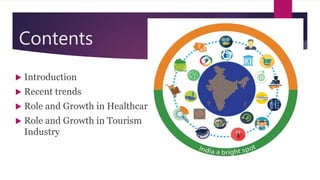
Contents
 Introduction
 Recent trends
 Role and Growth in Healthcare
 Role and Growth in Tourism
Industry
INTRODUCTION
A service is an act or performance offered by one party to another.
They are economic activities that create value and provide benefits for
customers at specific times and places as a result of bringing desired change.
The current list of Fortune 500 contains more service companies and fewer
manufacturers than in previous decades.
INTRODUCTION
 India’s services sector covers a wide variety of activities such as trade,
hotel and restaurants, transport, storage and communication,
financing, insurance, real estate, business services, community, social
and personal services, and services associated with construction.
 Products today have a higher service component than in previous
decades.
 The services sector is not only the dominant sector in India’s GDP, but
has also attracted significant foreign investment, has contributed
significantly to export and has provided large-scale employment.
Market size
 The services sector is a key driver of India’s economic growth.
 The sector contributed 55.39 per cent to India’s Gross Value
Added at current price in FY20*. Services sector’s GVA grew at
a CAGR of 1.45 per cent to US$ 1,064.8 billion in FY20 from
US$ 1,005 billion in FY16.
 Net export estimate in FY20 from services stood at US$ 214.14
billion, while import was at US$ 131.41 billion in FY20.
Investment
Some of the developments and major investments by companies in the services
sector in the recent past are as follows:
 Services sector is the largest recipient of FDI in India with inflow of US$ 82
billion between April 2000 and March 2020.
 In June 2020, Jio Platforms Ltd. sold 22.38 per cent stake worth Rs 1.04
trillion (US$ 14.75 billion) to ten global investors in a span of eight weeks
under separate deals, involving Facebook, Silver Lake, Vista, General
Atlantic, Mubadala, Abu Dhabi Investment Authority (ADIA), TPG Capital
and L. Catterton.
Investment
 This is the largest continuous fundraise by any company in
the world.
 In February 2020, Novartis launched Biome India, a digital
innovation hub, in Hyderabad, its first such center in Asia
and the fourth globally.
 Indian healthcare companies are entering into mergers and
acquisition (M&A) with domestic and foreign companies to
drive growth and gain new markets.
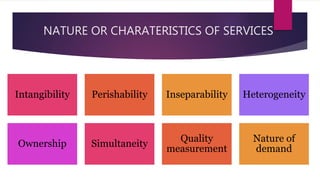
NATURE OR CHARATERISTICS OF SERVICES
Intangibility Perishability Inseparability Heterogeneity
Ownership Simultaneity
Quality
measurement
Nature of
demand
NATURE OR
CHARATERISTICS
OF SERVICES
Intangibility
We are aware of the fact that services are of intangible nature
and it is intangibility that complicates the task of decision-
makers.
The customer can’t touch the services, they can’t smell them.
In a true sense, it is not a physical object.
It is the professional excellence of decision-makers that
counts here, that influences the entire process and that helps
them substantially.
Perishability
 In the context of services, if we fail to sell the services, it is lost only not
for today but even for the future.
 If a labour stops to work, if a seat in the aircraft remains unsold, if a
bedroom in a hotel remains unbooked, a chair in a cinema hall remains
vacant; we find the business non-existent and the opportunities are lost
and lost forever. The services can’t be stored or preserved.
 Unutilised or underutilised services are found to be a waste. A building
unoccupied, a person unemployed, credit unutilised, vacant beds in a
hospital are economic waste.
Inseparability
This is also a feature that complicates the task of professionals while marketing the
services. The inseparability focuses on the fact that the services are not of
separable nature.
Generally, the services are created and supplied simultaneously. Like the dancers,
musicians, dentists and other professionals create and offer services at the same
time. In other words, the services and their providers are the same.
Goods are produced, sold and then consumed but the services are sold, produced
and then used.
Heterogeneity
Another feature is heterogeneity which makes it difficult to establish standard. The quality of services
can’t be standardized.
The prices charged may be too high or too low. In the case of entertainment and sports, we find the
same thing. The same type of services can’t be sold to all the customers even if they pay the same price.
The heterogeneity factor makes it difficult to market efficiently. The professionals by using their
excellence bear the responsibility of minimising the problem.
Ownership  It is also ownership that makes it significant to
market the services in a bit different way. The goods
sold are transferred from one place to another, the
ownership is also transferred, and this provides to the
buyers an opportunity to resell.
 In the case of services, we don’t find the same thing.
The users have just an access to the service. As for
example, a consumer can use personal care services
or Medicare services or can use a hotel room or
swimming pool, however the ownership rests with the
providers.
Simultaneity
Services can’t be delivered to customers or users. Services don’t
move through the channel of distribution.
For availing the services, it is essential that the users are
brought to the providers or the providers go to the users. It is
right to say that the services have limited geographical areas.
For e.g.: Hotel rooms can’t be brought to the users; aero plane
can’t be brought to the customers, etc.
Quality
Measurement
The quality of service requires another tool for measurement. We can’t
measure it in terms of service level. It is very difficult to rate or quantify the total
purchase.
As for example, we can quantify the food served in a hotel but the way a waiter
or a carrier serves it, or overall environment or behavior of other staff can’t be
ignored while rating the total process. Hence, we can determine the level of
satisfaction at which the users are found satisfied.
A firm sells atmosphere, conveniences, consistent quality, status, anxiety, moral,
etc.
Nature of Demand
Generally, the services are found of fluctuating nature. Particularly during the peak season, we
find an abnormal increase in the demand. As for example, the mobility of passenger is found
increased, specially during the marriage season or during an important festival.
The tourists prefer to go the tourist spots or resorts specially during summer when we find the
weather condition suitable. The cricket stadiums are used in winter. The golf courses remain
unused during the winter.
The public transport facilities are used considerably during the beginning and end of office
hours. There are a number of examples to prove the peak hour when we find an abnormal
increase in the demand position.
SCOPE OF SERVICES INDUSTRY
FINANCIAL
SERVICES
TOURISM DISTRIBUTION HEALTH EDUCATION
Financial
services
 Financial services are the economic
services provided by the finance
industry, which encompasses a broad
range of businesses that manage money,
including credit unions, banks, credit
card companies, insurance companies,
accountancy companies, consumer
finance companies, stock brokerages,
investment funds and some government
sponsored enterprises.
TOURISM
 Tourism is travel for recreation, leisure, religious, family or business
purposes usually for a limited duration.
 Tourism is commonly associated with international travel but may also
refer to travel to another place within the same country.
 The World Tourism Organization defines tourists as people "traveling to
and staying in places outside their usual environment or not more than
one consecutive years for leisure business and other purposes".
TOURISM
 Tourism brings in large amounts of income into a local economy in
the form of payment for goods and services needed by
tourists, accounting for 30% of the world's trade off services and 6%
of overall exports of goods and services.
 It also creates opportunities for employment in the service sector of
the economy associated with tourism.
 The service industries which benefit from tourism include
transportation services such as airlines, cruise, ships, and taxi cabs,
hospitality services, such as amusement parks, casinos, shopping
malls, music venues and theaters.
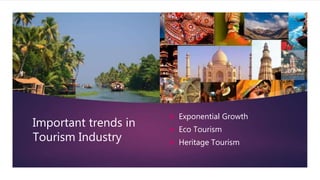
Important trends in
Tourism Industry
 Exponential Growth
 Eco Tourism
 Heritage Tourism
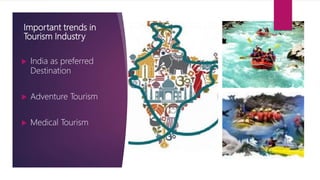
Important trends in
Tourism Industry
 India as preferred
Destination
 Adventure Tourism
 Medical Tourism
Health
 Health care is the diagnosis, treatment and prevention of disease,
illness, injury and other physical and mental impairments in human
being.
 Health care is delivered by practitioners in allied health, dentistry,
midwifery, medicine, nursing, optometry, pharmacy,
psychology, and other health professions.
 It refers to the work done in providing primary care, secondary care
and tertiary care as well as in public health.
Important trends in Health Industry
Rapid Growth Rapid expansion in Health
infrastructure
Role of Traditional medicine
Important
trends in Health
Industry
• Public and private providers of
health services
• Rising investment in Health care
facilities
• Health through insurance
• Medical Tourism
Problems faced
by Health
Industry
 Inadequate healthcare infrastru
cture
 The health care divide
 Lack of insurance
 High incidence disease
THANK YOU!!!

Service sector

  • 1.
  • 2.
    Contents  Introduction  Recenttrends  Role and Growth in Healthcare  Role and Growth in Tourism Industry
  • 3.
    INTRODUCTION A service isan act or performance offered by one party to another. They are economic activities that create value and provide benefits for customers at specific times and places as a result of bringing desired change. The current list of Fortune 500 contains more service companies and fewer manufacturers than in previous decades.
  • 4.
    INTRODUCTION  India’s servicessector covers a wide variety of activities such as trade, hotel and restaurants, transport, storage and communication, financing, insurance, real estate, business services, community, social and personal services, and services associated with construction.  Products today have a higher service component than in previous decades.  The services sector is not only the dominant sector in India’s GDP, but has also attracted significant foreign investment, has contributed significantly to export and has provided large-scale employment.
  • 5.
    Market size  Theservices sector is a key driver of India’s economic growth.  The sector contributed 55.39 per cent to India’s Gross Value Added at current price in FY20*. Services sector’s GVA grew at a CAGR of 1.45 per cent to US$ 1,064.8 billion in FY20 from US$ 1,005 billion in FY16.  Net export estimate in FY20 from services stood at US$ 214.14 billion, while import was at US$ 131.41 billion in FY20.
  • 6.
    Investment Some of thedevelopments and major investments by companies in the services sector in the recent past are as follows:  Services sector is the largest recipient of FDI in India with inflow of US$ 82 billion between April 2000 and March 2020.  In June 2020, Jio Platforms Ltd. sold 22.38 per cent stake worth Rs 1.04 trillion (US$ 14.75 billion) to ten global investors in a span of eight weeks under separate deals, involving Facebook, Silver Lake, Vista, General Atlantic, Mubadala, Abu Dhabi Investment Authority (ADIA), TPG Capital and L. Catterton.
  • 7.
    Investment  This isthe largest continuous fundraise by any company in the world.  In February 2020, Novartis launched Biome India, a digital innovation hub, in Hyderabad, its first such center in Asia and the fourth globally.  Indian healthcare companies are entering into mergers and acquisition (M&A) with domestic and foreign companies to drive growth and gain new markets.
  • 8.
    NATURE OR CHARATERISTICSOF SERVICES Intangibility Perishability Inseparability Heterogeneity Ownership Simultaneity Quality measurement Nature of demand
  • 9.
    NATURE OR CHARATERISTICS OF SERVICES Intangibility Weare aware of the fact that services are of intangible nature and it is intangibility that complicates the task of decision- makers. The customer can’t touch the services, they can’t smell them. In a true sense, it is not a physical object. It is the professional excellence of decision-makers that counts here, that influences the entire process and that helps them substantially.
  • 10.
    Perishability  In thecontext of services, if we fail to sell the services, it is lost only not for today but even for the future.  If a labour stops to work, if a seat in the aircraft remains unsold, if a bedroom in a hotel remains unbooked, a chair in a cinema hall remains vacant; we find the business non-existent and the opportunities are lost and lost forever. The services can’t be stored or preserved.  Unutilised or underutilised services are found to be a waste. A building unoccupied, a person unemployed, credit unutilised, vacant beds in a hospital are economic waste.
  • 11.
    Inseparability This is alsoa feature that complicates the task of professionals while marketing the services. The inseparability focuses on the fact that the services are not of separable nature. Generally, the services are created and supplied simultaneously. Like the dancers, musicians, dentists and other professionals create and offer services at the same time. In other words, the services and their providers are the same. Goods are produced, sold and then consumed but the services are sold, produced and then used.
  • 12.
    Heterogeneity Another feature isheterogeneity which makes it difficult to establish standard. The quality of services can’t be standardized. The prices charged may be too high or too low. In the case of entertainment and sports, we find the same thing. The same type of services can’t be sold to all the customers even if they pay the same price. The heterogeneity factor makes it difficult to market efficiently. The professionals by using their excellence bear the responsibility of minimising the problem.
  • 13.
    Ownership  Itis also ownership that makes it significant to market the services in a bit different way. The goods sold are transferred from one place to another, the ownership is also transferred, and this provides to the buyers an opportunity to resell.  In the case of services, we don’t find the same thing. The users have just an access to the service. As for example, a consumer can use personal care services or Medicare services or can use a hotel room or swimming pool, however the ownership rests with the providers.
  • 14.
    Simultaneity Services can’t bedelivered to customers or users. Services don’t move through the channel of distribution. For availing the services, it is essential that the users are brought to the providers or the providers go to the users. It is right to say that the services have limited geographical areas. For e.g.: Hotel rooms can’t be brought to the users; aero plane can’t be brought to the customers, etc.
  • 15.
    Quality Measurement The quality ofservice requires another tool for measurement. We can’t measure it in terms of service level. It is very difficult to rate or quantify the total purchase. As for example, we can quantify the food served in a hotel but the way a waiter or a carrier serves it, or overall environment or behavior of other staff can’t be ignored while rating the total process. Hence, we can determine the level of satisfaction at which the users are found satisfied. A firm sells atmosphere, conveniences, consistent quality, status, anxiety, moral, etc.
  • 16.
    Nature of Demand Generally,the services are found of fluctuating nature. Particularly during the peak season, we find an abnormal increase in the demand. As for example, the mobility of passenger is found increased, specially during the marriage season or during an important festival. The tourists prefer to go the tourist spots or resorts specially during summer when we find the weather condition suitable. The cricket stadiums are used in winter. The golf courses remain unused during the winter. The public transport facilities are used considerably during the beginning and end of office hours. There are a number of examples to prove the peak hour when we find an abnormal increase in the demand position.
  • 17.
    SCOPE OF SERVICESINDUSTRY FINANCIAL SERVICES TOURISM DISTRIBUTION HEALTH EDUCATION
  • 18.
    Financial services  Financial servicesare the economic services provided by the finance industry, which encompasses a broad range of businesses that manage money, including credit unions, banks, credit card companies, insurance companies, accountancy companies, consumer finance companies, stock brokerages, investment funds and some government sponsored enterprises.
  • 19.
    TOURISM  Tourism istravel for recreation, leisure, religious, family or business purposes usually for a limited duration.  Tourism is commonly associated with international travel but may also refer to travel to another place within the same country.  The World Tourism Organization defines tourists as people "traveling to and staying in places outside their usual environment or not more than one consecutive years for leisure business and other purposes".
  • 20.
    TOURISM  Tourism bringsin large amounts of income into a local economy in the form of payment for goods and services needed by tourists, accounting for 30% of the world's trade off services and 6% of overall exports of goods and services.  It also creates opportunities for employment in the service sector of the economy associated with tourism.  The service industries which benefit from tourism include transportation services such as airlines, cruise, ships, and taxi cabs, hospitality services, such as amusement parks, casinos, shopping malls, music venues and theaters.
  • 21.
    Important trends in TourismIndustry  Exponential Growth  Eco Tourism  Heritage Tourism
  • 22.
    Important trends in TourismIndustry  India as preferred Destination  Adventure Tourism  Medical Tourism
  • 23.
    Health  Health careis the diagnosis, treatment and prevention of disease, illness, injury and other physical and mental impairments in human being.  Health care is delivered by practitioners in allied health, dentistry, midwifery, medicine, nursing, optometry, pharmacy, psychology, and other health professions.  It refers to the work done in providing primary care, secondary care and tertiary care as well as in public health.
  • 24.
    Important trends inHealth Industry Rapid Growth Rapid expansion in Health infrastructure Role of Traditional medicine
  • 25.
    Important trends in Health Industry •Public and private providers of health services • Rising investment in Health care facilities • Health through insurance • Medical Tourism
  • 26.
    Problems faced by Health Industry Inadequate healthcare infrastru cture  The health care divide  Lack of insurance  High incidence disease
  • 27.