Serverless	Computing
for	the	Inquiring	Mind
Eoin	Woods Andy	Longshaw
Endava Coop	Digital
licensed under a Creative Commons Attribution-ShareAlike 4.0 International License
Agenda
• Introduction	to	Serverless Computing
• Exercise	1:	Creating	Some	Functions
• Architectural	Implications
• [Break]
• Exercise	2:	Applying	the	Serverless Style
• Summary	and	Learning	Points
Introduction
Serverless computing
Serverless computing is	a	cloud computing	execution	model	in	
which	the	cloud	provider	dynamically	manages	the	allocation	of	
machine	resources,	and	bills	based	on	the	actual	amount	of	
resources	consumed	by	an	application,	rather	than	billing	based	on	
pre-purchased	units	of	capacity.	It	is	a	form	of	utility computing.
Wikipedia	- https://en.wikipedia.org/wiki/Serverless_computing
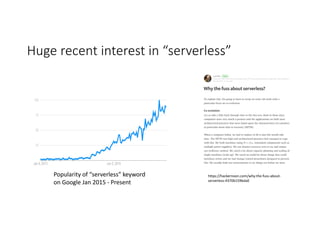
Huge	recent	interest	in	“serverless”
https://hackernoon.com/why-the-fuss-about-
serverless-4370b1596da0
Popularity	of	“serverless”	keyword	
on	Google	Jan	2015	- Present
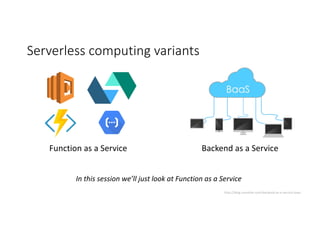
Serverless computing	variants
Function	as	a	Service Backend	as	a	Service
In	this	session	we’ll	just	look	at	Function	as	a	Service
http://blog.raremile.com/backend-as-a-service-baas
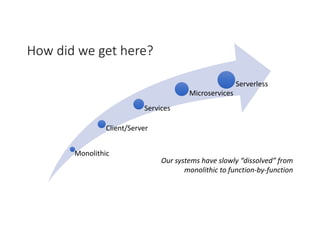
Monolithic
Client/Server
Services
Microservices
Serverless
How	did	we	get	here?
Our	systems	have	slowly	“dissolved”	from	
monolithic	to	function-by-function
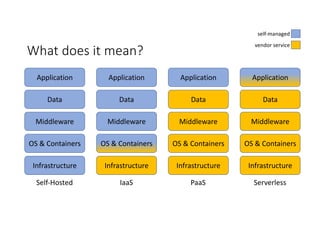
What	does	it	mean?
Infrastructure
OS	&	Containers
Middleware
Application
Data
Infrastructure
OS	&	Containers
Middleware
Application
Data
Infrastructure
OS	&	Containers
Middleware
Application
Data
Infrastructure
OS	&	Containers
Middleware
Application
Data
Self-Hosted IaaS PaaS Serverless
self-managed
vendor	service
What	does	it	mean?
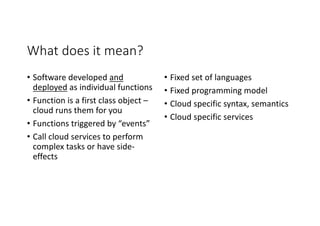
• Software	developed	and	
deployed as	individual	functions
• Function	is	a	first	class	object	–
cloud	runs	them	for	you
• Functions	triggered	by	“events”
• Call	cloud	services	to	perform	
complex	tasks	or	have	side-
effects
• Fixed	set	of	languages
• Fixed	programming	model
• Cloud	specific	syntax,	semantics
• Cloud	specific	services
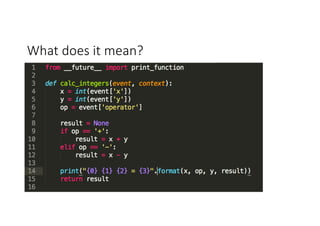
What	does	it	mean?
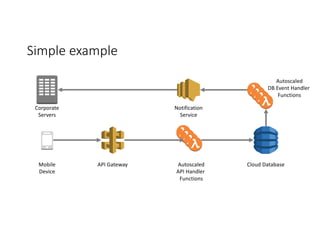
Simple	example
API	Gateway Cloud	DatabaseAutoscaled
API	Handler	
Functions
Notification
Service
Mobile
Device
Corporate
Servers
Autoscaled
DB	Event	Handler	
Functions
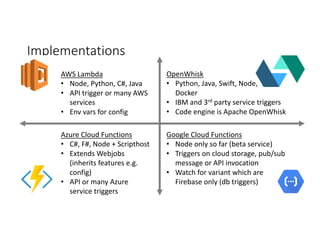
Implementations
AWS	Lambda
• Node,	Python,	C#,	Java
• API	trigger	or	many	AWS	
services
• Env vars for	config
OpenWhisk
• Python,	Java,	Swift,	Node,	
Docker
• IBM	and	3rd party	service	triggers
• Code	engine	is	Apache	OpenWhisk
Azure	Cloud	Functions
• C#,	F#,	Node	+	Scripthost
• Extends	Webjobs
(inherits	features	e.g.	
config)
• API	or	many	Azure	
service	triggers
Google	Cloud	Functions
• Node	only	so	far	(beta	service)
• Triggers	on	cloud	storage,	pub/sub	
message	or	API	invocation
• Watch	for	variant	which	are
Firebase	only	(db triggers)
Exercise	1	– 45	Minutes
Objective:	develop	a	simple	set	of	serverless functions	on	AWS
We	have	a	set	of	instructions	and	a	Github repository	to	assist
https://github.com/andylongshaw/serverless
Break	– 15	Minutes
Architectural	Implications
At	the	micro-level	serverless seems	pretty	simple.		
Just	develop	a	procedure	and	deploy	to	the	cloud…
… of	course	there’s	always	a	tradeoff somewhere	…
… what	impact	does	this	have	on	the	overall	design	of	
the	system?	(“the	architecture”)
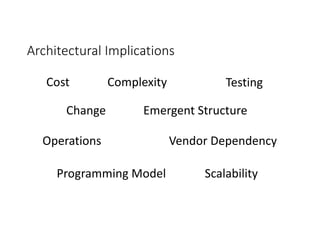
Architectural	Implications
Cost
Change
Complexity
Emergent	Structure
ScalabilityProgramming	Model
Vendor	DependencyOperations
Testing
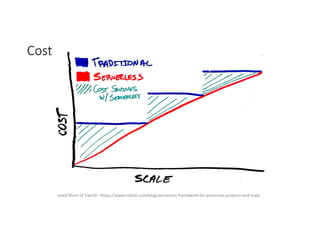
Cost
Jared	Short	of	Trek10	- https://www.trek10.com/blog/serverless-framework-for-processes-projects-and-scale
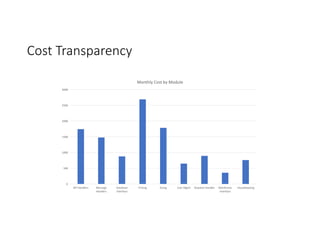
Cost	Transparency
0
500
1000
1500
2000
2500
3000
API	Handlers Message	
Handlers
Database	
Interface
Pricing Sizing User	Mgmt Dispatch	Handler Mainframe	
Interface
Housekeeping
Monthly	Cost	by	Module
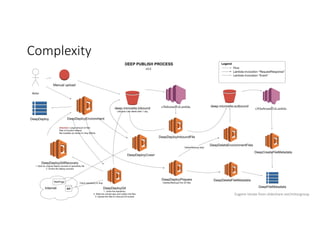
Complexity
Eugene	Istrate from	slideshare.net/mitocgroup
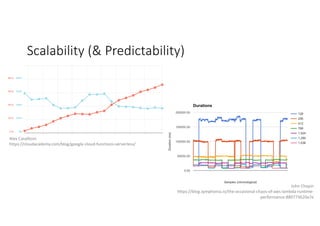
Scalability	(&	Predictability)
Alex	Casalboni
https://cloudacademy.com/blog/google-cloud-functions-serverless/
John	Chapin
https://blog.symphonia.io/the-occasional-chaos-of-aws-lambda-runtime-
performance-880773620a7e
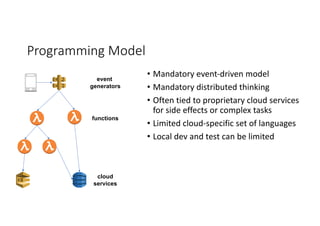
Programming	Model
event
generators
functions
cloud
services
• Mandatory	event-driven	model
• Mandatory	distributed	thinking
• Often	tied	to	proprietary	cloud	services	
for	side	effects	or	complex	tasks
• Limited	cloud-specific	set	of	languages
• Local	dev	and	test	can	be	limited
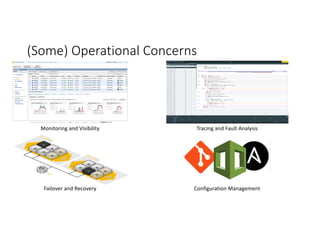
(Some)	Operational	Concerns
Monitoring	and	Visibility Tracing	and	Fault	Analysis
Configuration	ManagementFailover	and	Recovery
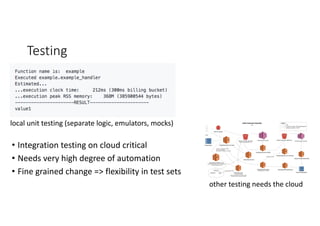
Testing
local	unit	testing	(separate	logic,	emulators,	mocks)
other	testing	needs	the	cloud
• Integration	testing	on	cloud	critical
• Needs	very	high	degree	of	automation
• Fine	grained	change	=>	flexibility	in	test	sets
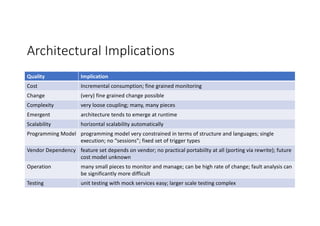
Architectural	Implications
Quality Implication
Cost Incremental consumption;	fine	grained	monitoring
Change (very) fine	grained	change	possible
Complexity very	loose	coupling;	many, many	pieces
Emergent architecture	tends	to	emerge	at	runtime
Scalability horizontal scalability	automatically
Programming	Model programming	model	very	constrained in	terms	of	structure	and	languages;	single	
execution;	no	“sessions”;	fixed	set	of	trigger	types
Vendor	Dependency feature	set	depends	on	vendor;	no	practical portabiilty at	all	(porting	via	rewrite);	future	
cost	model	unknown
Operation many	small	pieces	to	monitor and	manage;	can	be	high	rate	of	change;	fault	analysis	can	
be	significantly	more	difficult
Testing unit testing	with	mock	services	easy;	larger	scale	testing	complex
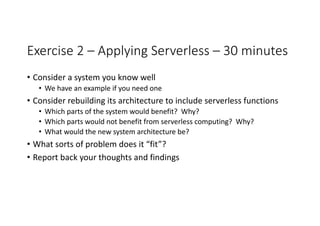
Exercise	2	– Applying	Serverless – 30	minutes
• Consider	a	system	you	know	well
• We	have	an	example	if	you	need	one
• Consider	rebuilding	its	architecture	to	include	serverless functions
• Which	parts	of	the	system	would	benefit?		Why?
• Which	parts	would	not	benefit	from	serverless computing?		Why?
• What	would	the	new	system	architecture	be?
• What	sorts	of	problem	does	it	“fit”?
• Report	back	your	thoughts	and	findings
Summary
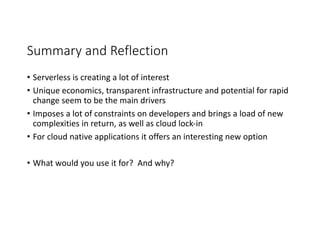
Summary	and	Reflection
• Serverless is	creating	a	lot	of	interest
• Unique	economics,	transparent	infrastructure	and	potential	for	rapid	
change	seem	to	be	the	main	drivers
• Imposes	a	lot	of	constraints	on	developers	and	brings	a	load	of	new	
complexities	in	return,	as	well	as	cloud	lock-in
• For	cloud	native	applications	it	offers	an	interesting	new	option
• What	would	you	use	it	for?		And	why?
Eoin	Woods
Endava
eoin.woods@endava.com
Thank	You
Andy	Longshaw
Coop	Digital
andy@blueskyline.com

Serverless Computing for the Inquiring Mind