Serverless Computing: The
Future of Cloud Computing
Serverless computing is a revolutionary approach to cloud computing
that simplifies application development and deployment. It offers
significant advantages in terms of scalability, cost optimization, and
developer productivity.
Abdul Sameer
21361A0501
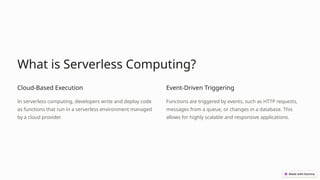
What is Serverless Computing?
Cloud-Based Execution
In serverless computing, developers write and deploy code
as functions that run in a serverless environment managed
by a cloud provider.
Event-Driven Triggering
Functions are triggered by events, such as HTTP requests,
messages from a queue, or changes in a database. This
allows for highly scalable and responsive applications.
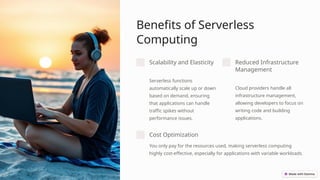
Benefits of Serverless
Computing
Scalability and Elasticity
Serverless functions
automatically scale up or down
based on demand, ensuring
that applications can handle
traffic spikes without
performance issues.
Reduced Infrastructure
Management
Cloud providers handle all
infrastructure management,
allowing developers to focus on
writing code and building
applications.
Cost Optimization
You only pay for the resources used, making serverless computing
highly cost-effective, especially for applications with variable workloads.
Scalability and Elasticity
1 Automatic Scaling
Serverless functions scale automatically based on real-time
demand, ensuring optimal performance during peak traffic
periods.
2 Instant Provisioning
New instances of serverless functions are provisioned
instantly, allowing applications to handle sudden increases in
demand without delay.
3 No Idle Resources
Serverless functions are only active when they are needed,
eliminating the need for idle resources and reducing costs.
Reduced Infrastructure Management
Serverless Platform
Cloud providers manage all server-related tasks, such as
provisioning, scaling, security, and monitoring, allowing
developers to focus on application logic.
Simplified Deployment
Deploying serverless applications is as simple as uploading
code, eliminating the need for complex infrastructure
configuration and management.
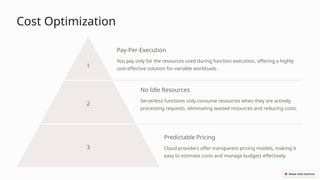
Cost Optimization
1
Pay-Per-Execution
You pay only for the resources used during function execution, offering a highly
cost-effective solution for variable workloads.
2
No Idle Resources
Serverless functions only consume resources when they are actively
processing requests, eliminating wasted resources and reducing costs.
3
Predictable Pricing
Cloud providers offer transparent pricing models, making it
easy to estimate costs and manage budgets effectively.
Serverless Architectures
API Gateways
API gateways provide a secure and scalable entry point for
incoming requests, routing them to the appropriate
serverless functions.
Event Queues
Event queues enable asynchronous communication
between serverless functions, allowing for decoupled
architectures and enhanced scalability.
Databases
Serverless databases provide scalable and managed
database services for storing and retrieving data for
serverless applications.
Microservices and Event-Driven Design
Microservices
Serverless functions are well-suited for building
microservices, allowing for modular and independent
development and deployment of application components.
Event-Driven Design
Serverless applications leverage event-driven architectures,
where components communicate asynchronously through
events, enabling scalability and resilience.
Serverless Computing Platforms
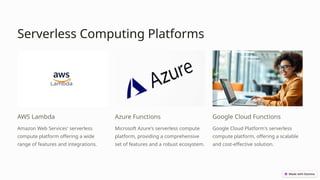
AWS Lambda
Amazon Web Services' serverless
compute platform offering a wide
range of features and integrations.
Azure Functions
Microsoft Azure's serverless compute
platform, providing a comprehensive
set of features and a robust ecosystem.
Google Cloud Functions
Google Cloud Platform's serverless
compute platform, offering a scalable
and cost-effective solution.
Challenges and
Considerations
Vendor Lock-In
Serverless platforms are often
tied to specific cloud
providers, potentially limiting
portability and flexibility.
Cold Starts
The first time a function is
invoked, it may experience a
cold start, which can result in
latency.
Debugging and Monitoring
Debugging and monitoring serverless applications can be more
challenging due to the ephemeral nature of functions.
Conclusion and Future Implications
The contributions of the work presented in this paper are threefold: (a) a methodical review of related
literature on the topic of serverless computing, to address the issue of the lack of compiling information on
the state-of-the-art of the field; (b) a comparison of the platforms and tools used in serverless computing; (c)
an extensive analysis of the differences, benefits, and issues related to serverless computing, to provide a
more complete understanding of the topic. Given the fast evolution and growing interest in the field, this
survey focused on gathering the most outstanding trends and outcomes of serverless computing, as
described by recent researchers. This survey could significantly reduce ambiguity and the entry barrier for
novice developers to adapt to the serverless environment.
THANK YOU

Serverless-Computing-The-Future-of-Cloud-Computing (1).pptx

  • 1.
    Serverless Computing: The Futureof Cloud Computing Serverless computing is a revolutionary approach to cloud computing that simplifies application development and deployment. It offers significant advantages in terms of scalability, cost optimization, and developer productivity. Abdul Sameer 21361A0501
  • 2.
    What is ServerlessComputing? Cloud-Based Execution In serverless computing, developers write and deploy code as functions that run in a serverless environment managed by a cloud provider. Event-Driven Triggering Functions are triggered by events, such as HTTP requests, messages from a queue, or changes in a database. This allows for highly scalable and responsive applications.
  • 3.
    Benefits of Serverless Computing Scalabilityand Elasticity Serverless functions automatically scale up or down based on demand, ensuring that applications can handle traffic spikes without performance issues. Reduced Infrastructure Management Cloud providers handle all infrastructure management, allowing developers to focus on writing code and building applications. Cost Optimization You only pay for the resources used, making serverless computing highly cost-effective, especially for applications with variable workloads.
  • 4.
    Scalability and Elasticity 1Automatic Scaling Serverless functions scale automatically based on real-time demand, ensuring optimal performance during peak traffic periods. 2 Instant Provisioning New instances of serverless functions are provisioned instantly, allowing applications to handle sudden increases in demand without delay. 3 No Idle Resources Serverless functions are only active when they are needed, eliminating the need for idle resources and reducing costs.
  • 5.
    Reduced Infrastructure Management ServerlessPlatform Cloud providers manage all server-related tasks, such as provisioning, scaling, security, and monitoring, allowing developers to focus on application logic. Simplified Deployment Deploying serverless applications is as simple as uploading code, eliminating the need for complex infrastructure configuration and management.
  • 6.
    Cost Optimization 1 Pay-Per-Execution You payonly for the resources used during function execution, offering a highly cost-effective solution for variable workloads. 2 No Idle Resources Serverless functions only consume resources when they are actively processing requests, eliminating wasted resources and reducing costs. 3 Predictable Pricing Cloud providers offer transparent pricing models, making it easy to estimate costs and manage budgets effectively.
  • 7.
    Serverless Architectures API Gateways APIgateways provide a secure and scalable entry point for incoming requests, routing them to the appropriate serverless functions. Event Queues Event queues enable asynchronous communication between serverless functions, allowing for decoupled architectures and enhanced scalability. Databases Serverless databases provide scalable and managed database services for storing and retrieving data for serverless applications.
  • 8.
    Microservices and Event-DrivenDesign Microservices Serverless functions are well-suited for building microservices, allowing for modular and independent development and deployment of application components. Event-Driven Design Serverless applications leverage event-driven architectures, where components communicate asynchronously through events, enabling scalability and resilience.
  • 9.
    Serverless Computing Platforms AWSLambda Amazon Web Services' serverless compute platform offering a wide range of features and integrations. Azure Functions Microsoft Azure's serverless compute platform, providing a comprehensive set of features and a robust ecosystem. Google Cloud Functions Google Cloud Platform's serverless compute platform, offering a scalable and cost-effective solution.
  • 10.
    Challenges and Considerations Vendor Lock-In Serverlessplatforms are often tied to specific cloud providers, potentially limiting portability and flexibility. Cold Starts The first time a function is invoked, it may experience a cold start, which can result in latency. Debugging and Monitoring Debugging and monitoring serverless applications can be more challenging due to the ephemeral nature of functions.
  • 11.
    Conclusion and FutureImplications The contributions of the work presented in this paper are threefold: (a) a methodical review of related literature on the topic of serverless computing, to address the issue of the lack of compiling information on the state-of-the-art of the field; (b) a comparison of the platforms and tools used in serverless computing; (c) an extensive analysis of the differences, benefits, and issues related to serverless computing, to provide a more complete understanding of the topic. Given the fast evolution and growing interest in the field, this survey focused on gathering the most outstanding trends and outcomes of serverless computing, as described by recent researchers. This survey could significantly reduce ambiguity and the entry barrier for novice developers to adapt to the serverless environment.
  • 12.