Microservices and	Serverless for	MegaStartups
Boaz	Ziniman,	Technical	Evangelist
Amazon	Web	Services
@ziniman
DevOps	Israel	– December	2017
About me
• Technical Evangelist at AWS
• Events & Meetsup
• Webinars
• Blogs
• Community
• Social Media
• A long history of Web Development, IT and Operations
• AWS Customer since 2009
Agenda
• Breaking the Monolith
• An Introduction to Microservices
• Who needs servers?
• Lambda and Serverless on AWS
• 5 Principals for running Microservices at scale
Migrating from Monolith
to Microservice
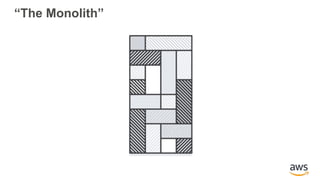
“The Monolith”
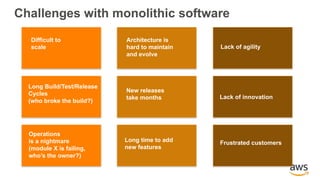
Challenges with monolithic software
Long Build/Test/Release
Cycles
(who broke the build?)
Operations
is a nightmare
(module X is failing,
who’s the owner?)
Difficult to
scale
New releases
take months
Long time to add
new features
Architecture is
hard to maintain
and evolve
Lack of innovation
Frustrated customers
Lack of agility
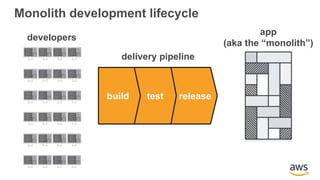
Monolith development lifecycle
releasetestbuild
delivery pipeline
app
(aka the “monolith”)
developers
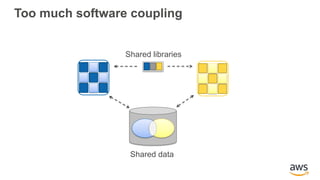
Too much software coupling
Shared libraries
Shared data
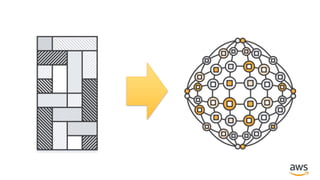
Evolving towards microservices
“IMG_1760” by Robert Couse-Baker. No alterations other than cropping. https://www.flickr.com/photos/29233640@N07/14859431605/
Image used with permissions under Creative Commons license 2.0, Attribution Generic License (https://creativecommons.org/licenses/by/2.0/)
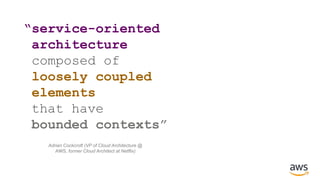
“service-oriented
architecture
composed of
loosely coupled
elements
that have
bounded contexts”
Adrian Cockcroft (VP of Cloud Architecture @
AWS, former Cloud Architect at Netflix)
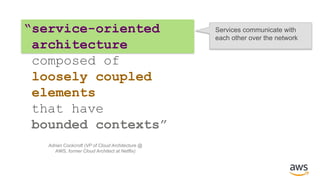
“service-oriented
architecture
composed of
loosely coupled
elements
that have
bounded contexts”
Services communicate with
each other over the network
Adrian Cockcroft (VP of Cloud Architecture @
AWS, former Cloud Architect at Netflix)
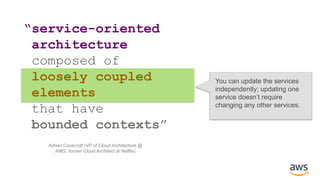
“service-oriented
architecture
composed of
loosely coupled
elements
that have
bounded contexts”
You can update the services
independently; updating one
service doesn’t require
changing any other services.
Adrian Cockcroft (VP of Cloud Architecture @
AWS, former Cloud Architect at Netflix)
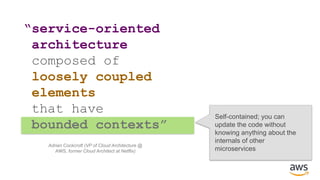
“service-oriented
architecture
composed of
loosely coupled
elements
that have
bounded contexts”
Self-contained; you can
update the code without
knowing anything about the
internals of other
microservices
Adrian Cockcroft (VP of Cloud Architecture @
AWS, former Cloud Architect at Netflix)
“Do one thing, and do it well”
“Swiss Army” by by Jim Pennucci. No alterations other than cropping. https://www.flickr.com/photos/pennuja/5363518281/
Image used with permissions under Creative Commons license 2.0, Attribution Generic License (https://creativecommons.org/licenses/by/2.0/)
“Tools” by Tony Walmsley: No alterations other than cropping. https://www.flickr.com/photos/twalmsley/6825340663/
Image used with permissions under Creative Commons license 2.0, Attribution Generic License (https://creativecommons.org/licenses/by/2.0/)
“Do one thing, and do it well”
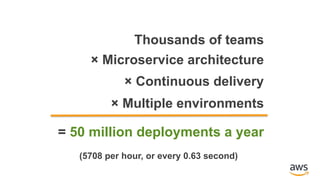
= 50 million deployments a year
Thousands of teams
× Microservice architecture
× Continuous delivery
× Multiple environments
(5708 per hour, or every 0.63 second)
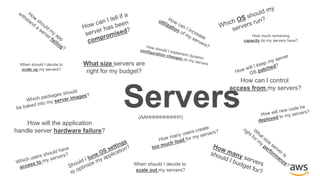
Servers
How will the application
handle server hardware failure?
How can I control
access from my servers?
When should I decide to
scale out my servers?
When should I decide to
scale up my servers?
What size servers are
right for my budget?
How much remaining
capacity do my servers have?
(AAHHHHHHHHH!!)
What is
serverless?
Build and run applications
without thinking about servers
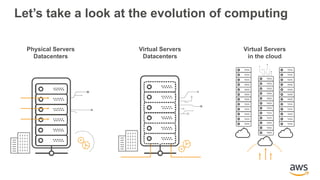
Let’s take a look at the evolution of computing
Physical Servers
Datacenters
Virtual Servers
Datacenters
Virtual Servers
in the cloud
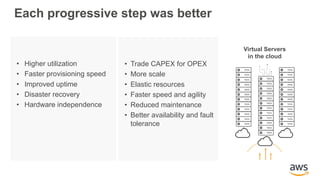
Each progressive step was better
Physical Servers
Datacenters
Virtual Servers
Datacenters
Virtual Servers
in the cloud
• Higher utilization
• Faster provisioning speed
• Improved uptime
• Disaster recovery
• Hardware independence
• Trade CAPEX for OPEX
• More scale
• Elastic resources
• Faster speed and agility
• Reduced maintenance
• Better availability and fault
tolerance
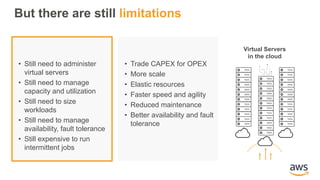
But there are still limitations
Physical Servers
Datacenters
Virtual Servers
Datacenters
• Trade CAPEX for OPEX
• More scale
• Elastic resources
• Faster speed and agility
• Reduced maintenance
• Better availability and fault
tolerance
• Still need to administer
virtual servers
• Still need to manage
capacity and utilization
• Still need to size
workloads
• Still need to manage
availability, fault tolerance
• Still expensive to run
intermittent jobs
Virtual Servers
in the cloud
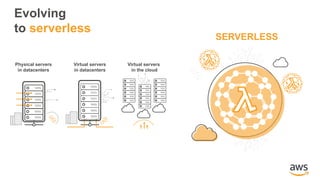
Evolving
to serverless
SERVERLESS
Virtual servers
in the cloud
Physical servers
in datacenters
Virtual servers
in datacenters
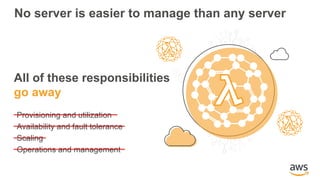
No server is easier to manage than any server
All of these responsibilities
go away
Provisioning and utilization
Availability and fault tolerance
Scaling
Operations and management
Serverless with AWS Lambda
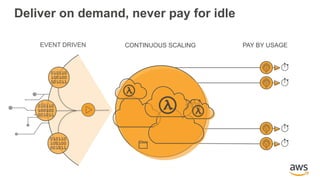
EVENT DRIVEN CONTINUOUS SCALING PAY BY USAGE
Deliver on demand, never pay for idle
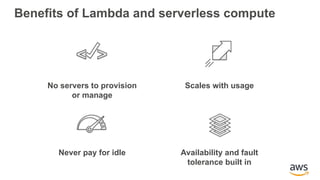
No servers to provision
or manage
Scales with usage
Never pay for idle Availability and fault
tolerance built in
Benefits of Lambda and serverless compute
How it works?
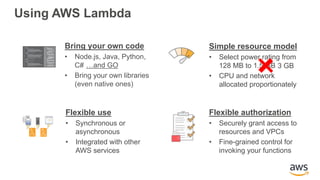
Using AWS Lambda
Bring your own code
• Node.js, Java, Python,
C#
• Bring your own libraries
(even native ones)
Simple resource model
• Select power rating from
128 MB to 1.5 GB
• CPU and network
allocated proportionately
Flexible use
• Synchronous or
asynchronous
• Integrated with other
AWS services
Flexible authorization
• Securely grant access to
resources and VPCs
• Fine-grained control for
invoking your functions
…and GO 3 GB
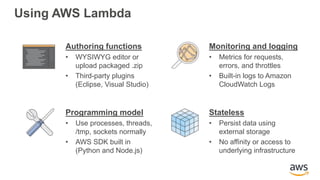
Using AWS Lambda
Authoring functions
• WYSIWYG editor or
upload packaged .zip
• Third-party plugins
(Eclipse, Visual Studio)
Monitoring and logging
• Metrics for requests,
errors, and throttles
• Built-in logs to Amazon
CloudWatch Logs
Programming model
• Use processes, threads,
/tmp, sockets normally
• AWS SDK built in
(Python and Node.js)
Stateless
• Persist data using
external storage
• No affinity or access to
underlying infrastructure
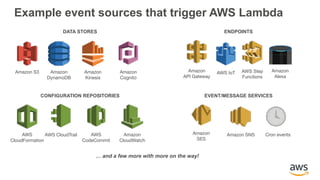
Amazon S3 Amazon
DynamoDB
Amazon
Kinesis
AWS
CloudFormation
AWS CloudTrail Amazon
CloudWatch
Amazon
Cognito
Amazon SNSAmazon
SES
Cron events
DATA STORES ENDPOINTS
CONFIGURATION REPOSITORIES EVENT/MESSAGE SERVICES
Example event sources that trigger AWS Lambda
… and a few more with more on the way!
AWS
CodeCommit
Amazon
API Gateway
Amazon
Alexa
AWS IoT AWS Step
Functions
Use cases
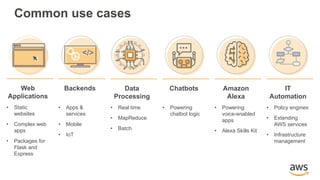
Common use cases
Web
Applications
• Static
websites
• Complex web
apps
• Packages for
Flask and
Express
Data
Processing
• Real time
• MapReduce
• Batch
Chatbots
• Powering
chatbot logic
Backends
• Apps &
services
• Mobile
• IoT
</></>
Amazon
Alexa
• Powering
voice-enabled
apps
• Alexa Skills Kit
IT
Automation
• Policy engines
• Extending
AWS services
• Infrastructure
management
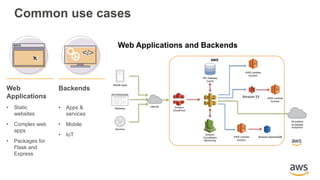
Common use cases
Web Applications and Backends
Internet
Mobile Apps
Websites
Services
AWS Lambda
function
AWS
API Gateway
Cache
All publicly
accessible
endpoints
Amazon
CloudWatch
Monitoring
Amazon
CloudFront
Amazon	S3 AWS Lambda
function
AWS Lambda
function
Amazon DynamoDB
Web
Applications
• Static
websites
• Complex web
apps
• Packages for
Flask and
Express
Backends
• Apps &
services
• Mobile
• IoT
</></>
Common use cases
Web
Applications
• Static
websites
• Complex web
apps
• Packages for
Flask and
Express
Data
Processing
• Real time
• MapReduce
• Batch
Chatbots
• Powering
chatbot logic
Backends
• Apps &
services
• Mobile
• IoT
</></>
Amazon
Alexa
• Powering
voice-enabled
apps
• Alexa Skills Kit
IT
Automation
• Policy engines
• Extending
AWS services
• Infrastructure
management
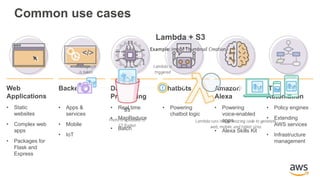
Lambda + S3
Common use cases
Web
Applications
• Static
websites
• Complex web
apps
• Packages for
Flask and
Express
Data
Processing
• Real time
• MapReduce
• Batch
Chatbots
• Powering
chatbot logic
Backends
• Apps &
services
• Mobile
• IoT
</></>
Amazon
Alexa
• Powering
voice-enabled
apps
• Alexa Skills Kit
IT
Automation
• Policy engines
• Extending
AWS services
• Infrastructure
management
Customers innovating with serverless
@parallax
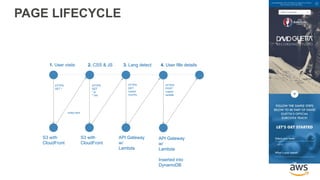
1. User visits
HTTPS
GET /
S3 with
CloudFront
2. CSS & JS
HTTPS
GET
*.js
*.css
S3 with
CloudFront
index.html
3. Lang detect
API Gateway
w/
Lambda
HTTPS
GET
/users/
country
HTTPS
POST
/users/
update
4. User fills details
API Gateway
w/
Lambda
Inserted into
DynamoDB
PAGE LIFECYCLE
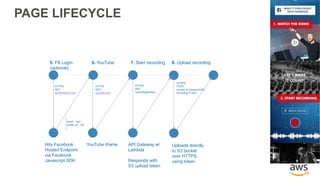
5.
6.
5. FB Login
(optional)
Hits Facebook
Hosted Endpoint
via Facebook
Javascript SDK
6. YouTube
YouTube iframe
7. Start recording
API Gateway w/
Lambda
Responds with
S3 upload token
Uploads directly
to S3 bucket
over HTTPS
using token
8. Upload recording
HTTPS
GET
api.facebook.com
HTTPS
GET
youtube.com
{
“email”: “xyz”,
“profile_id”: 123
}
HTTPS
GET
/recordings/token
HTTPS
POST
bucket.s3.amazon/UID/
recording-X.mp3
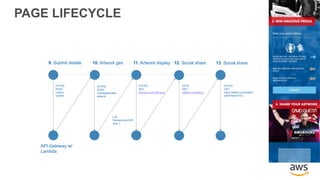
PAGE LIFECYCLE
9. Submit details
API Gateway w/
Lambda
10. Artwork gen
HTTPS
POST
/users/generate_
artwork
API Gateway w/
Lambda.
Create image,
put on S3, return
S3 image URL
11. Artwork display
CloudFront w/ S3
HTTPS
GET
/domain.com/UID.png
AddThis.js is
populated with
the share texts,
and includes the
S3 URL
HTTP
GET
addthis.com/file.js
HTTPS
POST
/users/
update
{ url:
“domain.com/UID
.png” }
12. Social share 13. Social share
HTTPS
GET
https://twitter.com/intent/
tweet?text=XYZ
Directly hits the
social media
service
PAGE LIFECYCLE
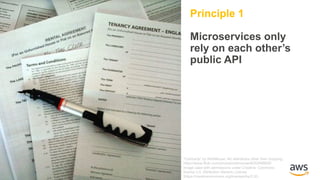
Principle 1
Microservices only
rely on each other’s
public API
“Contracts” by NobMouse. No alterations other than cropping.
https://www.flickr.com/photos/nobmouse/4052848608/
Image used with permissions under Creative Commons
license 2.0, Attribution Generic License
(https://creativecommons.org/licenses/by/2.0/)
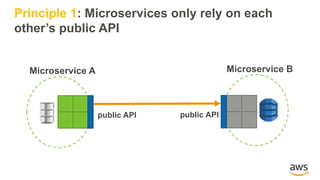
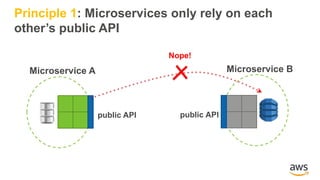
Microservice A Microservice B
public API
Principle 1: Microservices only rely on each
other’s public API
public API
public API
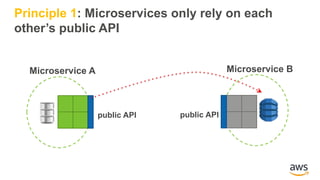
Microservice A Microservice B
Principle 1: Microservices only rely on each
other’s public API
public API
public API public API
Nope!
Microservice A Microservice B
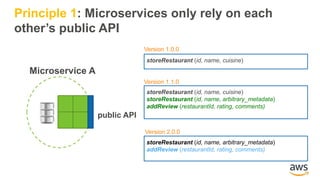
Principle 1: Microservices only rely on each
other’s public API
storeRestaurant (id, name, cuisine)
storeRestaurant (id, name, arbitrary_metadata)
addReview (restaurantId, rating, comments)
storeRestaurant (id, name, arbitrary_metadata)
addReview (restaurantId, rating, comments)
Version 1.0.0
Version 1.1.0
Version 2.0.0
public API
Microservice A
Principle 1: Microservices only rely on each
other’s public API
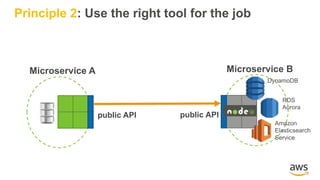
Principle 2
Use the right tool for the
job
“Tools #2” by Juan Pablo Olmo. No alterations other than cropping.
https://www.flickr.com/photos/juanpol/1562101472/
Image used with permissions under Creative Commons license
2.0, Attribution Generic License
(https://creativecommons.org/licenses/by/2.0/)
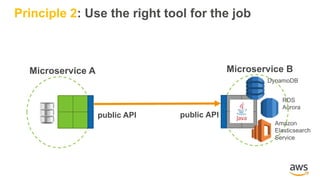
public API
Microservice A Microservice B
Amazon
Elasticsearch
Service
RDS
Aurora
DynamoDB
public API
Principle 2: Use the right tool for the job
public API
RDS
Aurora
Microservice A Microservice B
Amazon
Elasticsearch
Service
DynamoDB
public API
Principle 2: Use the right tool for the job
Principle 3
Secure Your Services
“security” by Dave Bleasdale. No alterations other than cropping.
https://www.flickr.com/photos/sidelong/3878741556/
Image used with permissions under Creative Commons license 2.0,
Attribution Generic License
(https://creativecommons.org/licenses/by/2.0/)
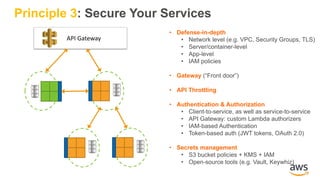
Principle 3: Secure Your Services
• Defense-in-depth
• Network level (e.g. VPC, Security Groups, TLS)
• Server/container-level
• App-level
• IAM policies
• Gateway (“Front door”)
• API Throttling
• Authentication & Authorization
• Client-to-service, as well as service-to-service
• API Gateway: custom Lambda authorizers
• IAM-based Authentication
• Token-based auth (JWT tokens, OAuth 2.0)
• Secrets management
• S3 bucket policies + KMS + IAM
• Open-source tools (e.g. Vault, Keywhiz)
API	Gateway
Principle 4
More than just
technology
transformation
“rowing on the river in Bedford” by Matthew Hunt.
No alterations other than cropping.
https://www.flickr.com/photos/mattphotos/19189529/
Image used with permissions under Creative Commons license 2.0,
Attribution Generic License (https://creativecommons.org/licenses/by/2.0/)
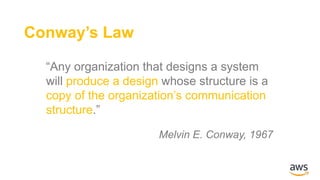
“Any organization that designs a system
will produce a design whose structure is a
copy of the organization’s communication
structure.”
Melvin E. Conway, 1967
Conway’s Law
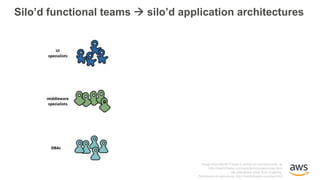
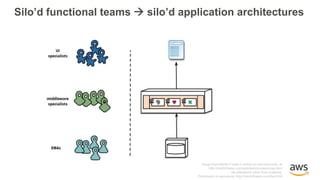
Silo’d functional teams à silo’d application architectures
Image from Martin Fowler’s article on microservices, at
http://martinfowler.com/articles/microservices.html
No alterations other than cropping.
Permission to reproduce: http://martinfowler.com/faq.html
Silo’d functional teams à silo’d application architectures
Image from Martin Fowler’s article on microservices, at
http://martinfowler.com/articles/microservices.html
No alterations other than cropping.
Permission to reproduce: http://martinfowler.com/faq.html
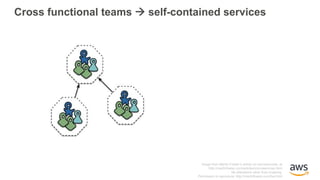
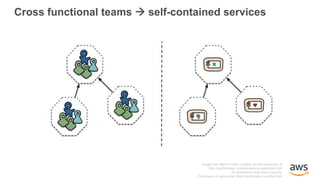
Cross functional teams à self-contained services
Image from Martin Fowler’s article on microservices, at
http://martinfowler.com/articles/microservices.html
No alterations other than cropping.
Permission to reproduce: http://martinfowler.com/faq.html
Cross functional teams à self-contained services
Image from Martin Fowler’s article on microservices, at
http://martinfowler.com/articles/microservices.html
No alterations other than cropping.
Permission to reproduce: http://martinfowler.com/faq.html
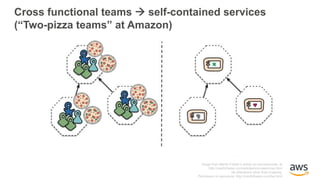
Cross functional teams à self-contained services
(“Two-pizza teams” at Amazon)
Image from Martin Fowler’s article on microservices, at
http://martinfowler.com/articles/microservices.html
No alterations other than cropping.
Permission to reproduce: http://martinfowler.com/faq.html
Image from Martin Fowler’s article on microservices, at
http://martinfowler.com/articles/microservices.html
No alterations other than cropping.
Permission to reproduce: http://martinfowler.com/faq.html
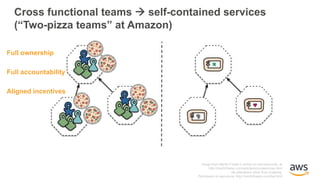
Cross functional teams à self-contained services
(“Two-pizza teams” at Amazon)
Full ownership
Full accountability
Aligned incentives
Principle 5
Automate Everything
“Robot”	by	Robin Zebrowski.	No	alterations	other	than	cropping.
https://www.flickr.com/photos/firepile/438134733/
Image used	with	permissions	under	Creative		Commons	license	2.0,
Attribution	Generic	License	
(https://creativecommons.org/licenses/by/2.0/)§
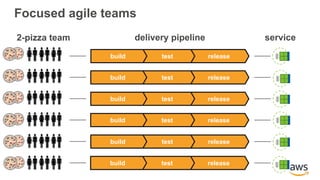
Focused agile teams
delivery pipeline service
releasetestbuild
releasetestbuild
releasetestbuild
releasetestbuild
releasetestbuild
releasetestbuild
2-pizza team
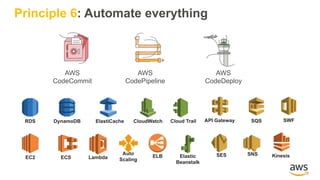
Principle 6: Automate everything
AWS
CodeCommit
AWS
CodePipeline
AWS
CodeDeploy
EC2 ELB
Auto
ScalingLambdaECS
DynamoDBRDS ElastiCache SQS SWF
SES SNS
API GatewayCloudWatch Cloud Trail
KinesisElastic
Beanstalk
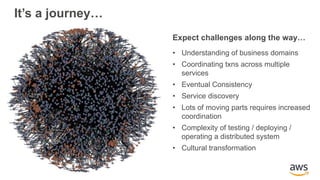
It’s a journey…
Expect challenges along the way…
• Understanding of business domains
• Coordinating txns across multiple
services
• Eventual Consistency
• Service discovery
• Lots of moving parts requires increased
coordination
• Complexity of testing / deploying /
operating a distributed system
• Cultural transformation
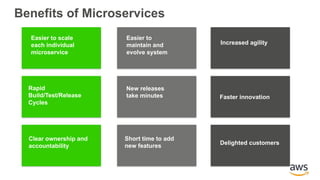
Benefits of Microservices
Rapid
Build/Test/Release
Cycles
Clear ownership and
accountability
Easier to scale
each individual
microservice
New releases
take minutes
Short time to add
new features
Easier to
maintain and
evolve system
Faster innovation
Delighted customers
Increased agility
AWS resources:
• Microservices without the Servers
https://aws.amazon.com/blogs/compute/
microservices-without-the-servers
• Microservices with ECS:
https://aws.amazon.com/blogs/compute/using-amazon-
api-gateway-with-microservices-deployed-on-amazon-
ecs/
• Serverless Service Discovery:
https://aws.amazon.com/blogs/developer/
serverless-service-discovery-part-1-get-started/
• ECS Service Discovery:
https://aws.amazon.com/blogs/compute/
service-discovery-an-amazon-ecs-reference-
architecture/
• Serverless Webapp - Reference Architecture:
https://github.com/awslabs/lambda-refarch-webapp
• Zombie Microservices Workshop:
https://github.com/awslabs/aws-lambda-zombie-
workshop
Popular open-source tools:
• Serverless – http://serverless.com
• Apex - http://apex.run/
https://aws.amazon.com/devops/
Additional Resources
Boaz Ziniman
@ziniman

Microservices and Serverless for Mega Startups - DevOps IL Meetup

  • 1.
  • 2.
    About me • TechnicalEvangelist at AWS • Events & Meetsup • Webinars • Blogs • Community • Social Media • A long history of Web Development, IT and Operations • AWS Customer since 2009
  • 3.
    Agenda • Breaking theMonolith • An Introduction to Microservices • Who needs servers? • Lambda and Serverless on AWS • 5 Principals for running Microservices at scale
  • 4.
  • 5.
  • 6.
    Challenges with monolithicsoftware Long Build/Test/Release Cycles (who broke the build?) Operations is a nightmare (module X is failing, who’s the owner?) Difficult to scale New releases take months Long time to add new features Architecture is hard to maintain and evolve Lack of innovation Frustrated customers Lack of agility
  • 7.
    Monolith development lifecycle releasetestbuild deliverypipeline app (aka the “monolith”) developers
  • 8.
    Too much softwarecoupling Shared libraries Shared data
  • 9.
    Evolving towards microservices “IMG_1760”by Robert Couse-Baker. No alterations other than cropping. https://www.flickr.com/photos/29233640@N07/14859431605/ Image used with permissions under Creative Commons license 2.0, Attribution Generic License (https://creativecommons.org/licenses/by/2.0/)
  • 13.
    “service-oriented architecture composed of loosely coupled elements thathave bounded contexts” Adrian Cockcroft (VP of Cloud Architecture @ AWS, former Cloud Architect at Netflix)
  • 14.
    “service-oriented architecture composed of loosely coupled elements thathave bounded contexts” Services communicate with each other over the network Adrian Cockcroft (VP of Cloud Architecture @ AWS, former Cloud Architect at Netflix)
  • 15.
    “service-oriented architecture composed of loosely coupled elements thathave bounded contexts” You can update the services independently; updating one service doesn’t require changing any other services. Adrian Cockcroft (VP of Cloud Architecture @ AWS, former Cloud Architect at Netflix)
  • 16.
    “service-oriented architecture composed of loosely coupled elements thathave bounded contexts” Self-contained; you can update the code without knowing anything about the internals of other microservices Adrian Cockcroft (VP of Cloud Architecture @ AWS, former Cloud Architect at Netflix)
  • 17.
    “Do one thing,and do it well” “Swiss Army” by by Jim Pennucci. No alterations other than cropping. https://www.flickr.com/photos/pennuja/5363518281/ Image used with permissions under Creative Commons license 2.0, Attribution Generic License (https://creativecommons.org/licenses/by/2.0/)
  • 18.
    “Tools” by TonyWalmsley: No alterations other than cropping. https://www.flickr.com/photos/twalmsley/6825340663/ Image used with permissions under Creative Commons license 2.0, Attribution Generic License (https://creativecommons.org/licenses/by/2.0/) “Do one thing, and do it well”
  • 21.
    = 50 milliondeployments a year Thousands of teams × Microservice architecture × Continuous delivery × Multiple environments (5708 per hour, or every 0.63 second)
  • 22.
    Servers How will theapplication handle server hardware failure? How can I control access from my servers? When should I decide to scale out my servers? When should I decide to scale up my servers? What size servers are right for my budget? How much remaining capacity do my servers have? (AAHHHHHHHHH!!)
  • 23.
    What is serverless? Build andrun applications without thinking about servers
  • 24.
    Let’s take alook at the evolution of computing Physical Servers Datacenters Virtual Servers Datacenters Virtual Servers in the cloud
  • 25.
    Each progressive stepwas better Physical Servers Datacenters Virtual Servers Datacenters Virtual Servers in the cloud • Higher utilization • Faster provisioning speed • Improved uptime • Disaster recovery • Hardware independence • Trade CAPEX for OPEX • More scale • Elastic resources • Faster speed and agility • Reduced maintenance • Better availability and fault tolerance
  • 26.
    But there arestill limitations Physical Servers Datacenters Virtual Servers Datacenters • Trade CAPEX for OPEX • More scale • Elastic resources • Faster speed and agility • Reduced maintenance • Better availability and fault tolerance • Still need to administer virtual servers • Still need to manage capacity and utilization • Still need to size workloads • Still need to manage availability, fault tolerance • Still expensive to run intermittent jobs Virtual Servers in the cloud
  • 27.
    Evolving to serverless SERVERLESS Virtual servers inthe cloud Physical servers in datacenters Virtual servers in datacenters
  • 28.
    No server iseasier to manage than any server All of these responsibilities go away Provisioning and utilization Availability and fault tolerance Scaling Operations and management
  • 29.
  • 30.
    EVENT DRIVEN CONTINUOUSSCALING PAY BY USAGE Deliver on demand, never pay for idle
  • 31.
    No servers toprovision or manage Scales with usage Never pay for idle Availability and fault tolerance built in Benefits of Lambda and serverless compute
  • 32.
  • 33.
    Using AWS Lambda Bringyour own code • Node.js, Java, Python, C# • Bring your own libraries (even native ones) Simple resource model • Select power rating from 128 MB to 1.5 GB • CPU and network allocated proportionately Flexible use • Synchronous or asynchronous • Integrated with other AWS services Flexible authorization • Securely grant access to resources and VPCs • Fine-grained control for invoking your functions …and GO 3 GB
  • 34.
    Using AWS Lambda Authoringfunctions • WYSIWYG editor or upload packaged .zip • Third-party plugins (Eclipse, Visual Studio) Monitoring and logging • Metrics for requests, errors, and throttles • Built-in logs to Amazon CloudWatch Logs Programming model • Use processes, threads, /tmp, sockets normally • AWS SDK built in (Python and Node.js) Stateless • Persist data using external storage • No affinity or access to underlying infrastructure
  • 35.
    Amazon S3 Amazon DynamoDB Amazon Kinesis AWS CloudFormation AWSCloudTrail Amazon CloudWatch Amazon Cognito Amazon SNSAmazon SES Cron events DATA STORES ENDPOINTS CONFIGURATION REPOSITORIES EVENT/MESSAGE SERVICES Example event sources that trigger AWS Lambda … and a few more with more on the way! AWS CodeCommit Amazon API Gateway Amazon Alexa AWS IoT AWS Step Functions
  • 36.
  • 37.
    Common use cases Web Applications •Static websites • Complex web apps • Packages for Flask and Express Data Processing • Real time • MapReduce • Batch Chatbots • Powering chatbot logic Backends • Apps & services • Mobile • IoT </></> Amazon Alexa • Powering voice-enabled apps • Alexa Skills Kit IT Automation • Policy engines • Extending AWS services • Infrastructure management
  • 38.
    Common use cases WebApplications and Backends Internet Mobile Apps Websites Services AWS Lambda function AWS API Gateway Cache All publicly accessible endpoints Amazon CloudWatch Monitoring Amazon CloudFront Amazon S3 AWS Lambda function AWS Lambda function Amazon DynamoDB Web Applications • Static websites • Complex web apps • Packages for Flask and Express Backends • Apps & services • Mobile • IoT </></>
  • 39.
    Common use cases Web Applications •Static websites • Complex web apps • Packages for Flask and Express Data Processing • Real time • MapReduce • Batch Chatbots • Powering chatbot logic Backends • Apps & services • Mobile • IoT </></> Amazon Alexa • Powering voice-enabled apps • Alexa Skills Kit IT Automation • Policy engines • Extending AWS services • Infrastructure management Lambda + S3
  • 40.
    Common use cases Web Applications •Static websites • Complex web apps • Packages for Flask and Express Data Processing • Real time • MapReduce • Batch Chatbots • Powering chatbot logic Backends • Apps & services • Mobile • IoT </></> Amazon Alexa • Powering voice-enabled apps • Alexa Skills Kit IT Automation • Policy engines • Extending AWS services • Infrastructure management
  • 41.
  • 42.
  • 44.
    1. User visits HTTPS GET/ S3 with CloudFront 2. CSS & JS HTTPS GET *.js *.css S3 with CloudFront index.html 3. Lang detect API Gateway w/ Lambda HTTPS GET /users/ country HTTPS POST /users/ update 4. User fills details API Gateway w/ Lambda Inserted into DynamoDB PAGE LIFECYCLE
  • 45.
    5. 6. 5. FB Login (optional) HitsFacebook Hosted Endpoint via Facebook Javascript SDK 6. YouTube YouTube iframe 7. Start recording API Gateway w/ Lambda Responds with S3 upload token Uploads directly to S3 bucket over HTTPS using token 8. Upload recording HTTPS GET api.facebook.com HTTPS GET youtube.com { “email”: “xyz”, “profile_id”: 123 } HTTPS GET /recordings/token HTTPS POST bucket.s3.amazon/UID/ recording-X.mp3 PAGE LIFECYCLE
  • 46.
    9. Submit details APIGateway w/ Lambda 10. Artwork gen HTTPS POST /users/generate_ artwork API Gateway w/ Lambda. Create image, put on S3, return S3 image URL 11. Artwork display CloudFront w/ S3 HTTPS GET /domain.com/UID.png AddThis.js is populated with the share texts, and includes the S3 URL HTTP GET addthis.com/file.js HTTPS POST /users/ update { url: “domain.com/UID .png” } 12. Social share 13. Social share HTTPS GET https://twitter.com/intent/ tweet?text=XYZ Directly hits the social media service PAGE LIFECYCLE
  • 47.
    Principle 1 Microservices only relyon each other’s public API “Contracts” by NobMouse. No alterations other than cropping. https://www.flickr.com/photos/nobmouse/4052848608/ Image used with permissions under Creative Commons license 2.0, Attribution Generic License (https://creativecommons.org/licenses/by/2.0/)
  • 48.
    Microservice A MicroserviceB public API Principle 1: Microservices only rely on each other’s public API public API
  • 49.
    public API Microservice AMicroservice B Principle 1: Microservices only rely on each other’s public API public API
  • 50.
    public API publicAPI Nope! Microservice A Microservice B Principle 1: Microservices only rely on each other’s public API
  • 51.
    storeRestaurant (id, name,cuisine) storeRestaurant (id, name, cuisine) storeRestaurant (id, name, arbitrary_metadata) addReview (restaurantId, rating, comments) storeRestaurant (id, name, arbitrary_metadata) addReview (restaurantId, rating, comments) Version 1.0.0 Version 1.1.0 Version 2.0.0 public API Microservice A Principle 1: Microservices only rely on each other’s public API
  • 52.
    Principle 2 Use theright tool for the job “Tools #2” by Juan Pablo Olmo. No alterations other than cropping. https://www.flickr.com/photos/juanpol/1562101472/ Image used with permissions under Creative Commons license 2.0, Attribution Generic License (https://creativecommons.org/licenses/by/2.0/)
  • 53.
    public API Microservice AMicroservice B Amazon Elasticsearch Service RDS Aurora DynamoDB public API Principle 2: Use the right tool for the job
  • 54.
    public API RDS Aurora Microservice AMicroservice B Amazon Elasticsearch Service DynamoDB public API Principle 2: Use the right tool for the job
  • 55.
    Principle 3 Secure YourServices “security” by Dave Bleasdale. No alterations other than cropping. https://www.flickr.com/photos/sidelong/3878741556/ Image used with permissions under Creative Commons license 2.0, Attribution Generic License (https://creativecommons.org/licenses/by/2.0/)
  • 56.
    Principle 3: SecureYour Services • Defense-in-depth • Network level (e.g. VPC, Security Groups, TLS) • Server/container-level • App-level • IAM policies • Gateway (“Front door”) • API Throttling • Authentication & Authorization • Client-to-service, as well as service-to-service • API Gateway: custom Lambda authorizers • IAM-based Authentication • Token-based auth (JWT tokens, OAuth 2.0) • Secrets management • S3 bucket policies + KMS + IAM • Open-source tools (e.g. Vault, Keywhiz) API Gateway
  • 57.
    Principle 4 More thanjust technology transformation “rowing on the river in Bedford” by Matthew Hunt. No alterations other than cropping. https://www.flickr.com/photos/mattphotos/19189529/ Image used with permissions under Creative Commons license 2.0, Attribution Generic License (https://creativecommons.org/licenses/by/2.0/)
  • 58.
    “Any organization thatdesigns a system will produce a design whose structure is a copy of the organization’s communication structure.” Melvin E. Conway, 1967 Conway’s Law
  • 59.
    Silo’d functional teamsà silo’d application architectures Image from Martin Fowler’s article on microservices, at http://martinfowler.com/articles/microservices.html No alterations other than cropping. Permission to reproduce: http://martinfowler.com/faq.html
  • 60.
    Silo’d functional teamsà silo’d application architectures Image from Martin Fowler’s article on microservices, at http://martinfowler.com/articles/microservices.html No alterations other than cropping. Permission to reproduce: http://martinfowler.com/faq.html
  • 61.
    Cross functional teamsà self-contained services Image from Martin Fowler’s article on microservices, at http://martinfowler.com/articles/microservices.html No alterations other than cropping. Permission to reproduce: http://martinfowler.com/faq.html
  • 62.
    Cross functional teamsà self-contained services Image from Martin Fowler’s article on microservices, at http://martinfowler.com/articles/microservices.html No alterations other than cropping. Permission to reproduce: http://martinfowler.com/faq.html
  • 63.
    Cross functional teamsà self-contained services (“Two-pizza teams” at Amazon) Image from Martin Fowler’s article on microservices, at http://martinfowler.com/articles/microservices.html No alterations other than cropping. Permission to reproduce: http://martinfowler.com/faq.html
  • 64.
    Image from MartinFowler’s article on microservices, at http://martinfowler.com/articles/microservices.html No alterations other than cropping. Permission to reproduce: http://martinfowler.com/faq.html Cross functional teams à self-contained services (“Two-pizza teams” at Amazon) Full ownership Full accountability Aligned incentives
  • 65.
    Principle 5 Automate Everything “Robot” by RobinZebrowski. No alterations other than cropping. https://www.flickr.com/photos/firepile/438134733/ Image used with permissions under Creative Commons license 2.0, Attribution Generic License (https://creativecommons.org/licenses/by/2.0/)§
  • 66.
    Focused agile teams deliverypipeline service releasetestbuild releasetestbuild releasetestbuild releasetestbuild releasetestbuild releasetestbuild 2-pizza team
  • 67.
    Principle 6: Automateeverything AWS CodeCommit AWS CodePipeline AWS CodeDeploy EC2 ELB Auto ScalingLambdaECS DynamoDBRDS ElastiCache SQS SWF SES SNS API GatewayCloudWatch Cloud Trail KinesisElastic Beanstalk
  • 68.
    It’s a journey… Expectchallenges along the way… • Understanding of business domains • Coordinating txns across multiple services • Eventual Consistency • Service discovery • Lots of moving parts requires increased coordination • Complexity of testing / deploying / operating a distributed system • Cultural transformation
  • 69.
    Benefits of Microservices Rapid Build/Test/Release Cycles Clearownership and accountability Easier to scale each individual microservice New releases take minutes Short time to add new features Easier to maintain and evolve system Faster innovation Delighted customers Increased agility
  • 70.
    AWS resources: • Microserviceswithout the Servers https://aws.amazon.com/blogs/compute/ microservices-without-the-servers • Microservices with ECS: https://aws.amazon.com/blogs/compute/using-amazon- api-gateway-with-microservices-deployed-on-amazon- ecs/ • Serverless Service Discovery: https://aws.amazon.com/blogs/developer/ serverless-service-discovery-part-1-get-started/ • ECS Service Discovery: https://aws.amazon.com/blogs/compute/ service-discovery-an-amazon-ecs-reference- architecture/ • Serverless Webapp - Reference Architecture: https://github.com/awslabs/lambda-refarch-webapp • Zombie Microservices Workshop: https://github.com/awslabs/aws-lambda-zombie- workshop Popular open-source tools: • Serverless – http://serverless.com • Apex - http://apex.run/ https://aws.amazon.com/devops/ Additional Resources
  • 71.