
Server-Side JavaScript
with Nashorn
Dan Woods
@danveloper
About Me
Author for InfoQ /danveloper
danielpwoods@gmail.com
Intro
My Experiences with PhotoZero!
!
• A client-side file encryption service
!
• Allowed clients to security unlock files/photos with
confidence
!
• Server never knew about the content or password
that a user was uploading, only its chunks in the
position
!
• Salted unlock keys were encrypted to double-down
on security
File
Intro
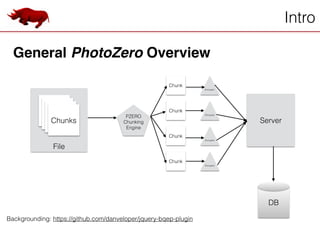
General PhotoZero Overview
Chunks
PZERO
Chunking
Engine
Chunk
Chunk
Chunk
Chunk
Server
Encryptor
Encryptor
Encryptor
Encryptor
DB
Backgrounding: https://github.com/danveloper/jquery-bqep-plugin
Intro
PhotoZero & How I came to Server-Side
JavaScript!
!
• Client entirely in HTML5 JavaScript
!
• Decorated with JQuery (some good, mostly bad)
!
• Server-side was implemented on the JVM (Grails)
!
• Non-common language between front-end and
back-end didn’t feel right
Intro
Rhino!
!
• Started by Netscape in 1997
!
• Originally designed as Netscape’s (ahem…)
Javagator
!
• Code generation, memory leaks, slow compilation
times
Intro
What is Nashorn?!
!
• The Better-than-Rhino JVM JavaScript Engine
!
• Comes out-of-the-box with Java 8 and above
!
• Replacement for Rhino
Intro
The Need for Nashorn!
!
• JVM is a polyglot platform
!
• Rhino is old
!
• Comparatively, Rhino is quite slow
!
• ECMAScript compliance
Intro
The How of Nashorn!
!
• Truly practical JavaScript on the JVM was not
possible until Java 7
!
• Java 7’s invokeDynamic gives static linking to
dynamic languages (incl. JavaScript)
!
• JVM dynamic languages have runtime support in
method dispatching, without runtime costs
Engine Features
Nashorn Features!
!
• 100% ECMAScript 5.1 compliance
!
• Support for a few extensions
• function expression closures - Mozilla 1.8,
• for-each expressions - Mozilla 1.6,
• Rhino constructor extensions
!
• Powerful CLI (jjs) for building command-line scripts!
Use Cases
Avatar.js and node.jar!
!
• Avatar is a web framework that brings Node-style
syntax and programming to the JVM
!
• Written by Oracle as a code-gen’d bridge to HTML5
apps
!
• Event-driven support for html web server, SSE
spec, websockets
Use Cases
Avatar.js and node.jar!
!
• Respects your Node modules paths, so you can
npm install in the same way
!
• Note: v8 and Nashorn have different ideas about
what the Error class does… I’ve built a “fix”
Use Cases
Java Interoperability!
!
• Java has a great modularity story, and its ability to
compose libraries is a huge value to JavaScript
!
• Java has a long history and has figured out
solutions to a lot of the problems of server-side
development
!
• Nashorn’s dynamic linking brings performance with
interoperability; JavaScript methods can be
seamlessly linked and vice-versa
Use Cases
What has Java Done Right?!
!
• For better or worse: databases and persistence
!
• Threads; we can’t just ignore these things! They’re
useful!
!
• Right Tool For The Job (tm) — JVM languages
!
• Embedded systems
!
• Build systems (Maven, Gradle, SBT, Ant, etc…)
Use Cases
Why Should I Care?!
!
• This platform of interop allows you to use best-of-
breed for the job
!
• Gives you an avenue to refactor existing code to
more sensible JavaScript
!
• Garner all the tooling and monitoring of JMX and
Java instrumentation
Use Cases
Server Side Scripting!
!
• Nashorn ships with a script runner (jjs)
!
• Allows server scripts to be written with JavaScript
!
• Special syntax for falling back to shell, and ability to
capture that output (very Perl-like)
Use Cases
Performance!
!
• Java 8 introduced practical JavaScript on the JVM
!
• Performance & Compliance is at the forefront, but
the former is still not quite there
!
• The near-term roadmap for the JVM brings
performance enhancements to Nashorn
Performance
Performance!
!
• Soon, JavaScript on the JVM will run at near-native
performance levels!
!
• This update will come as part of Java 8u40
The Future
The Future…!
!
• Nashorn will make the JVM a platform for
performant dynamic languages, targeting native-
like performance
!
• Java 8 will continue to improve upon JavaScript’s
server-side performance, and will offer other
languages the same performance

Server-Side JavaScript with Nashorn

  • 1.
  • 2.
    About Me Author forInfoQ /danveloper danielpwoods@gmail.com
  • 3.
    Intro My Experiences withPhotoZero! ! • A client-side file encryption service ! • Allowed clients to security unlock files/photos with confidence ! • Server never knew about the content or password that a user was uploading, only its chunks in the position ! • Salted unlock keys were encrypted to double-down on security
  • 4.
  • 5.
    Intro PhotoZero & HowI came to Server-Side JavaScript! ! • Client entirely in HTML5 JavaScript ! • Decorated with JQuery (some good, mostly bad) ! • Server-side was implemented on the JVM (Grails) ! • Non-common language between front-end and back-end didn’t feel right
  • 6.
    Intro Rhino! ! • Started byNetscape in 1997 ! • Originally designed as Netscape’s (ahem…) Javagator ! • Code generation, memory leaks, slow compilation times
  • 7.
    Intro What is Nashorn?! ! •The Better-than-Rhino JVM JavaScript Engine ! • Comes out-of-the-box with Java 8 and above ! • Replacement for Rhino
  • 8.
    Intro The Need forNashorn! ! • JVM is a polyglot platform ! • Rhino is old ! • Comparatively, Rhino is quite slow ! • ECMAScript compliance
  • 9.
    Intro The How ofNashorn! ! • Truly practical JavaScript on the JVM was not possible until Java 7 ! • Java 7’s invokeDynamic gives static linking to dynamic languages (incl. JavaScript) ! • JVM dynamic languages have runtime support in method dispatching, without runtime costs
  • 10.
    Engine Features Nashorn Features! ! •100% ECMAScript 5.1 compliance ! • Support for a few extensions • function expression closures - Mozilla 1.8, • for-each expressions - Mozilla 1.6, • Rhino constructor extensions ! • Powerful CLI (jjs) for building command-line scripts!
  • 11.
    Use Cases Avatar.js andnode.jar! ! • Avatar is a web framework that brings Node-style syntax and programming to the JVM ! • Written by Oracle as a code-gen’d bridge to HTML5 apps ! • Event-driven support for html web server, SSE spec, websockets
  • 12.
    Use Cases Avatar.js andnode.jar! ! • Respects your Node modules paths, so you can npm install in the same way ! • Note: v8 and Nashorn have different ideas about what the Error class does… I’ve built a “fix”
  • 13.
    Use Cases Java Interoperability! ! •Java has a great modularity story, and its ability to compose libraries is a huge value to JavaScript ! • Java has a long history and has figured out solutions to a lot of the problems of server-side development ! • Nashorn’s dynamic linking brings performance with interoperability; JavaScript methods can be seamlessly linked and vice-versa
  • 14.
    Use Cases What hasJava Done Right?! ! • For better or worse: databases and persistence ! • Threads; we can’t just ignore these things! They’re useful! ! • Right Tool For The Job (tm) — JVM languages ! • Embedded systems ! • Build systems (Maven, Gradle, SBT, Ant, etc…)
  • 15.
    Use Cases Why ShouldI Care?! ! • This platform of interop allows you to use best-of- breed for the job ! • Gives you an avenue to refactor existing code to more sensible JavaScript ! • Garner all the tooling and monitoring of JMX and Java instrumentation
  • 16.
    Use Cases Server SideScripting! ! • Nashorn ships with a script runner (jjs) ! • Allows server scripts to be written with JavaScript ! • Special syntax for falling back to shell, and ability to capture that output (very Perl-like)
  • 17.
    Use Cases Performance! ! • Java8 introduced practical JavaScript on the JVM ! • Performance & Compliance is at the forefront, but the former is still not quite there ! • The near-term roadmap for the JVM brings performance enhancements to Nashorn
  • 18.
    Performance Performance! ! • Soon, JavaScripton the JVM will run at near-native performance levels! ! • This update will come as part of Java 8u40
  • 19.
    The Future The Future…! ! •Nashorn will make the JVM a platform for performant dynamic languages, targeting native- like performance ! • Java 8 will continue to improve upon JavaScript’s server-side performance, and will offer other languages the same performance