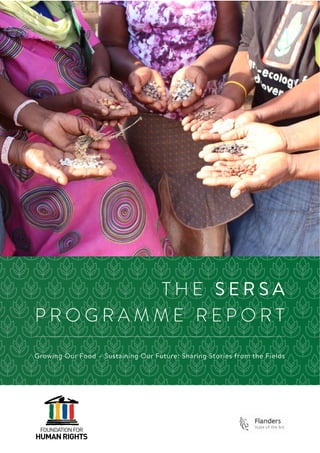
T H E S E R S A
P R O G R A M M E R E P O R T
Growing Our Food – Sustaining Our Future: Sharing Stories from the Fields
1Growing Our Food – Sustaining Our Future: Sharing Stories from the Fields
Table of Contents
Abbreviations and Glossary of Terms 2
Useful Concepts 3
Message from the Deputy Director – Foundation for Human Rights 4
Message from the Government of Flanders 6
Message from the SERSA Programme Manager 7
About the Foundation for the Human Rights 8
Background to the SERSA programme 9
Work of the Foundation for Human Rights 10
Small-Scale and Subsistence Farming 10
Socio-economic Rights and Job Creation 27
Land in South Africa 45
Food Security in South Africa – promoting dialogue on the Right to food 47
Climate Change 49
List of Grantees 50
2 THE SERSA PROJECT REPORT
ANC African National Congress
FHR Foundation for Human Rights
WHO World Health Organisation
FAO Food and Agricultural Organisation
NGO Non-Governmental Organisation
CBO Community-Based Organisation
OVC Orphaned and Vulnerable Children
HIV
DoA Department of Agriculture
EU European Union
UNFCCC United Nations Framework on Climate Change
PGS Participatory Guarantee System
DoJ&CD Department of Justice & Constitutional Development
CCS Catholic Community Services
ABBREVIATIONS AND
GLOSSARY OF TERMS
3Growing Our Food – Sustaining Our Future: Sharing Stories from the Fields
Below are some useful concepts necessary for the
easy reading of this document.
Food Security
In 1996, the World Food Summit developed the following
Permaculture
The term developed as a combination of permanent
working with, rather than against nature; of protracted
and thoughtful observation rather than protracted and
thoughtless labour; of looking at plants and animals
in all their functions, rather than treating any area as a
Organic Farming
achieve good crop yields without harming the natural
Food Sovereignty
culturally appropriate food produced through ecologically
who produce, distribute and consume food at the heart
of food systems and policies rather than the demands
USEFUL CONCEPTS
4 THE SERSA PROJECT REPORT
to assisting the most vulnerable groups in South Africa
In South Africa, not only civil and political rights, but also
FHR subscribes to a human rights-based approach to
can be described as the denial of a person’s right to
deprived of basic capabilities - such as the capability
to be free from hunger, to live in good health, and to be
poor person is one for whom a number of human rights
Through the assistance of the Flanders Government,
we have been able to move away from addressing more
than just a conceptual framework for development but
sharp focus of the Flanders Government support for
land reform, small-scale agriculture, climate change,
the environment and job creation in three designated
provinces allowed for a practical application of these
This includes supporting small-scale farmers with
agricultural and non-farm development as a basis for
Therefore, we are especially proud of the focus of
need to be supported in these endeavours through
agricultural support services, creation of new markets
and local sharing of resources such as agricultural
Employment is an instrumental right by which socio-
South Africa’s Constitution upholds people’s right to a
initiative of civil society, the project’s compatibility with
We want to express our gratitude and recognise the
We are grateful to the Flanders Government for their
support and the commitment shown to development by
Hanif Vally, Deputy Director, Foundation for Human
Rights.
Message from the Foundation
for Human Rights
5Growing Our Food – Sustaining Our Future: Sharing Stories from the Fields
6 THE SERSA PROJECT REPORT
Flanders has a tradition of addressing human rights, a
Today, the Government of Flanders abides by the
rights is not only a legal, but also an ethical obligation,
which must apply to both its own citizens and to its
Therefore, human rights and good governance are
a fundamental component of Flemish foreign and
Flanders fosters partnerships with strong civil society
and non-governmental organisations, maintaining that
these play an integral role in promoting the knowledge
of human rights, in monitoring human rights progress, in
reporting on human rights violations, and in developing
national dialogue processes which allow for civil society’s
contribution to the national human rights debate,
and also proactively provides resources and support
cooperation with them was a natural progression within
the Flemish development cooperation programme in
was the Foundation’s rights-based approach to poverty
vulnerable groups in society and works towards ensuring
their rights as enshrined in the South African Constitution
as well as by international conventions to which the
The Participation and Development of Capabilities of
Civil Society in realising Socio-Economic Rights in South
economic rights and strengthening the capacity of civil
society to engage in public policy dialogue in areas such
as the right to food and the right to a healthy and clean
support, promote and protect these rights as established
in the South African Constitution, emphasis has been
placed on actual rights-based practice, including
measurement of its implementation and practice by
stakeholders, both government and organisations on the
The Government of Flanders is concerned that respect
our sincere hope that the FHR will continue to implement
Dr. Geraldine Reymenants, General Representative,
Government of Flanders”
Message from the Government
of Flanders
7Growing Our Food – Sustaining Our Future: Sharing Stories from the Fields
happy to state that it gave the FHR an opportunity to go beyond
its traditional work of supporting activities that promote human
supporting activities that enabled communities to realise their
rights by supporting subsistence and small-scale farming as a
Either way, the success of this programme was the fact that even
in instances where the aim was to help communities realise their
that utilised the agro-ecological methods in their farming, the
overcome the impact to drought that hit the country from 2015 to
ahead of many others in thinking about adapting to the impact of
This programme was very exciting, as it presented us with so
needing to deal with various weather patterns to dealing with
to come up with strategies that were aimed at enabling them
to building the capacity of the grantees to sustain their projects
The implementation of this project saw the FHR working with
various stakeholders on initiatives that were aimed at creating jobs
and addressing food insecurity within communities where grantees
their programme was to see how Biowatch has helped the group
helping the members to keep count of how much they consumed
empowered community
members as they were able
to track the productivity of
their gardens and to track
how much money was due
to them, as they sold their
surplus to supermarkets as
I was also inspired by
the story of Lindiwe, a
small-scale farmer, who
was trained on agro-
ecological farming practices
by the Siyavuna Abalimi
Although she had always
been passionate about
I am grateful to each and every one of these colleagues, as my
I also would like to thank the Government of Flanders for providing
Mamashoabathe Noko, SERSA Programme Manager, Project
Management Unit.
Message from the Programme
Manager of SERSA
8 THE SERSA PROJECT REPORT
The FHR is a grant making institution supporting
civil society organisations in South Africa and the
region, to implement programmes which promote and
realising the human rights outlined in the Constitution
through successfully responding to calls for proposals for
the FHR on behalf of the government of South Africa
ministry overseeing the programme, with the FHR as
as the line ministry overseeing the programme, with the
Union Foundation would become an independent entity
VISION
An entrenched participatory democracy, symbolised
by a vibrant civil society having realised their rights in
the Constitution, freed from social injustice, living in a
society based on democratic values, social justice and
MISSION
The Foundation’s mission is to address the historical
legacy of apartheid, to promote and advance
transformation in our country, and to build a human
Rights-Based Approach
The FHR believes a human rights-based approach
to development provides the necessary conceptual
emphasises participation, non-discrimination,
human rights focus also brings two important values to
development work: it provides a framework for policies
and programmes, and provides the poor with the power
to demand accountability in order to overcome poverty
The FHR is committed to expanding human rights
awareness, and provides support to civil society
The FHR stresses the importance of the universality
and inalienability of human rights, the indivisibility,
interdependence and interrelatedness of these rights,
The FHR believes that rights education is essential to
Rights, states that all human beings are entitled to their
rights without discrimination on grounds of race, colour,
sex, ethnicity, age, language, religion, politics, national or
1
1 The Constitution of the Republic of South Africa, 1996.
ABOUT THE FOUNDATION
FOR HUMAN RIGHTS
9Growing Our Food – Sustaining Our Future: Sharing Stories from the Fields
South Africa has made a number of gains post the
translated into solutions to addressing unemployment,
various researchers as interacting in complex ways and
The SERSA programme is funded by the Government of
beginning 2013 - 2015 December the amount of
FHR was funded to manage these resources and
distribute to CSOs working in the agrarian sector
Three priority provinces were selected these being Free
focused on promoting organic small agriculture as a
that people must be given power to produce their own
food and to be actively involved as participants in the
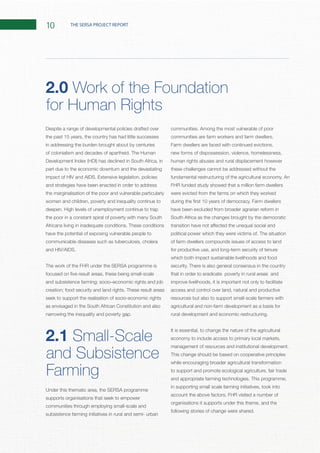
Expected Result Was Result Area themes
restorative justice mechanisms for reform 100th
through public policy, dialogue and Institutions and CSOs
policy dialogue
1.0 BACKGROUND TO THE
SERSA PROGRAMME
10 THE SERSA PROJECT REPORT
Despite a range of developmental policies drafted over
the past 15 years, the country has had little successes
in addressing the burden brought about by centuries
part due to the economic downturn and the devastating
and strategies have been enacted in order to address
the marginalisation of the poor and vulnerable particularly
the poor in a constant spiral of poverty with many South
have the potential of exposing vulnerable people to
communicable diseases such as tuberculosis, cholera
The work of the FHR under the SERSA programme is
seek to support the realisation of socio-economic rights
as envisaged in the South African Constitution and also
2.1 Small-Scale
and Subsistence
Farming
Under this thematic area, the SERSA programme
supports organisations that seek to empower
communities through employing small-scale and
subsistence farming initiatives in rural and semi- urban
Farm dwellers are faced with continued evictions,
new forms of dispossession, violence, homelessness,
human rights abuses and rural displacement however
these challenges cannot be addressed without the
FHR funded study showed that a million farm dwellers
were evicted from the farms on which they worked
have been excluded from broader agrarian reform in
South Africa as the changes brought by the democratic
of farm dwellers compounds issues of access to land
for productive use, and long-term security of tenure
which both impact sustainable livelihoods and food
that in order to eradicate poverty in rural areas and
improve livelihoods, it is important not only to facilitate
access and control over land, natural and productive
resources but also to support small-scale farmers with
agricultural and non-farm development as a basis for
It is essential, to change the nature of the agricultural
economy to include access to primary local markets,
This change should be based on cooperative principles
while encouraging broader agricultural transformation
to support and promote ecological agriculture, fair trade
in supporting small scale farming initiatives, took into
organisations it supports under this theme, and the
2.0 Work of the Foundation
for Human Rights
11Growing Our Food – Sustaining Our Future: Sharing Stories from the Fields
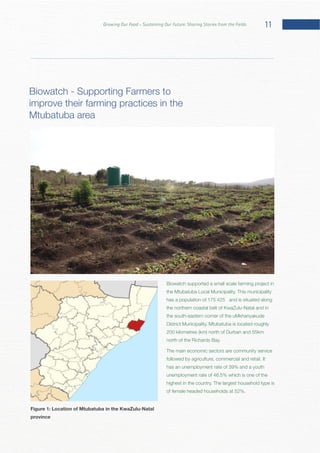
Biowatch supported a small scale farming project in
has a population of 175 425 and is situated along
The main economic sectors are community service
has an unemployment rate of 39% and a youth
Figure 1: Location of Mtubatuba in the KwaZulu-Natal
province
Biowatch - Supporting Farmers to
improve their farming practices in the
12 THE SERSA PROJECT REPORT
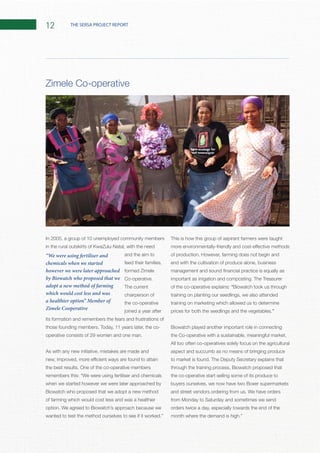
In 2005, a group of 10 unemployed community members
and the aim to
feed their families,
The current
chairperson of
the co-operative
joined a year after
its formation and remembers the fears and frustrations of
As with any new initiative, mistakes are made and
when we started however we were later approached by
Biowatch who proposed that we adopt a new method
of farming which would cost less and was a healthier
This is how this group of aspirant farmers were taught
end with the cultivation of produce alone, business
of the co-operative explains: “Biowatch took us through
training on planting our seedlings, we also attended
training on marketing which allowed us to determine
prices for both the seedlings and the vegetables.”
Biowatch played another important role in connecting
All too often co-operatives solely focus on the agricultural
aspect and succumb as no means of bringing produce
through the training process, Biowatch proposed that
the co-operative start selling some of its produce to
buyers ourselves, we now have two Boxer supermarkets
orders twice a day, especially towards the end of the
“We were using fertiliser and
chemicals when we started
however we were later approached
by Biowatch who proposed that we
adopt a new method of farming
which would cost less and was
a healthier option” Member of
Zimele Cooperative
13Growing Our Food – Sustaining Our Future: Sharing Stories from the Fields
Placing a group of people together, to work together
Each member of the co-operative owns a portion in the
market garden and depending on the order; they collect
Once the bunches are sold the member has the option
The member has her own book where he/she records
the amount they made from each sale and the deputy
sales are calculated and each member receives their
The co-operative initiative is not solely aimed at
empowering the 30 participants of the scheme,
operative applies two methodologies in empowering
positive; the co-operative gives back to the community
by sharing vegetable produce and their income with the
“Every once a year, we hold an event in August
where we call all the orphaned and vulnerable children
in the community, we give them food packages which
him for a lifetime”; the approach is meant to minimise
dependency and empower the community start their
higher price to community members and the rationale
is to encourage the community to follow their steps and
charge double to the community, if the vegetables are
expensive then they [the community] will think of starting
14 THE SERSA PROJECT REPORT
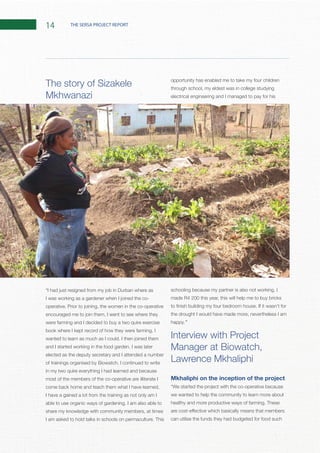
The story of Sizakele
I was working as a gardener when I joined the co-
encouraged me to join them, I went to see where they
book where I kept record of how they were farming, I
elected as the deputy secretary and I attended a number
most of the members of the co-operative are illiterate I
I have a gained a lot from the training as not only am I
share my knowledge with community members, at times
opportunity has enabled me to take my four children
through school, my eldest was in college studying
electrical engineering and I managed to pay for his
made R4 200 this year, this will help me to buy bricks
the drought I would have made more, nevertheless I am
happy.”
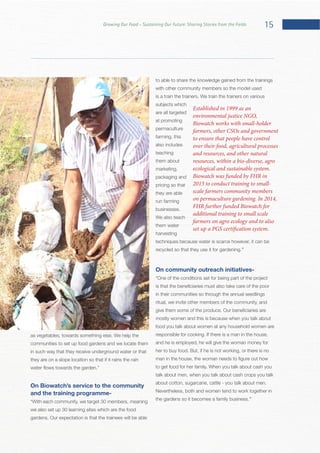
Interview with Project
Mkhaliphi on the inception of the project
we wanted to help the community to learn more about
can utilise the funds they had budgeted for food such
15Growing Our Food – Sustaining Our Future: Sharing Stories from the Fields
communities to set up food gardens and we locate them
in such way that they receive underground water or that
they are on a slope location so that if it rains the rain
On Biowatch’s service to the community
and the training programme-
we also set up 30 learning sites which are the food
to able to share the knowledge gained from the trainings
with other community members so the model used
subjects which
are all targeted
at promoting
permaculture
farming, this
also includes
teaching
them about
marketing,
packaging and
pricing so that
they are able
run farming
We also teach
them water
harvesting
recycled so that they use it for gardening.”
On community outreach initiatives-
in their communities so through the annual seedlings
ritual, we invite other members of the community, and
mostly women and this is because when you talk about
food you talk about women at any household women are
and he is employed, he will give the woman money for
talk about men, when you talk about cash crops you talk
Nevertheless, both and women tend to work together in
”
Established in 1999 as an
environmental justice NGO,
Biowatch works with small-holder
farmers, other CSOs and government
to ensure that people have control
over their food, agricultural processes
and resources, and other natural
resources, within a bio-diverse, agro
ecological and sustainable system.
Biowatch was funded by FHR in
2013 to conduct training to small-
scale farmers community members
on permaculture gardening. In 2014,
FHR further funded Biowatch for
additional training to small scale
farmers on agro ecology and to also
set up a PGS certification system.
16 THE SERSA PROJECT REPORT
On project success -
One of the major successes of the project was that
initially families had established food gardens to provide
food for themselves, but with the surplus, they have
now been able to sell and bring income into their
explains that the permaculture training supported by the
FHR provided an opportunity to enhance the farmers
understanding of agro ecology and allowed them to
strategise on advocacy initiatives around agro ecology,
now they are able to engage government departments
to garner support for agro ecology and to negotiate for
a PGS system which is an alternative to an expensive
their own produce making it easier for them to negotiate
This project has created jobs for people, many of them
They are now also able to hire people in the community
to help them through the farming season or to set
that there is also need for a multi-sectoral approach,
they are not giving us a sense of what they want they
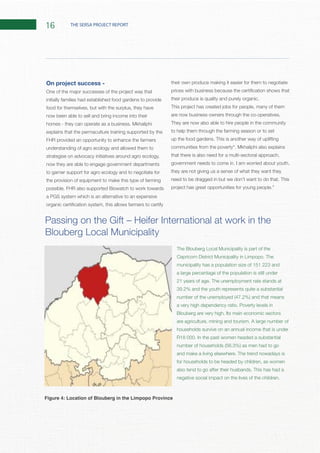
municipality has a population size of 151 223 and
a large percentage of the population is still under
households survive on an annual income that is under
for households to be headed by children, as women
Figure 4: Location of Blouberg in the Limpopo Province
17Growing Our Food – Sustaining Our Future: Sharing Stories from the Fields
Interview with Project
Mbeki on project inception-
from 30 members who had initially approached the
members to Heifer to assist them given the nature of
municipality has a long standing
relationship with the DoA so it
agreed to help empower the
community by training them on
community skills through training
so that they able to approach life
in way that allows them to stay
On Heifer’s ways of working-
“
category A is focused on supporting impoverished
Category B is focused on families who have something,
is of community members who have more goats and
chickens, these are given seedlings to set up vegetable
the community on vegetable and animal management
which serves as the foundation for setting up food
awareness training component to the project in order
to encourage the participation of all family members
in the number of women who have taken part in this
project, but it has
also allowed the
community to fully
participate and
to work together
to increase
productivity in
Passing on the
gift is a principle
that underpins this
project, we believe
that in order to help communities out of poverty, each
member has to give another impoverished family the
people have begun to realise that you can reap rewards
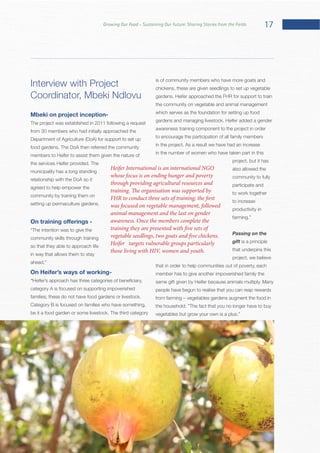
Heifer International is an international NGO
whose focus is on ending hunger and poverty
through providing agricultural resources and
training. The organisation was supported by
FHR to conduct three sets of training; the first
was focused on vegetable management, followed
animal management and the last on gender
awareness. Once the members complete the
training they are presented with five sets of
vegetable seedlings, two goats and five chickens.
Heifer targets vulnerable groups particularly
those living with HIV, women and youth.
18 THE SERSA PROJECT REPORT
Mosisi’s story (member of the
Cooperative)

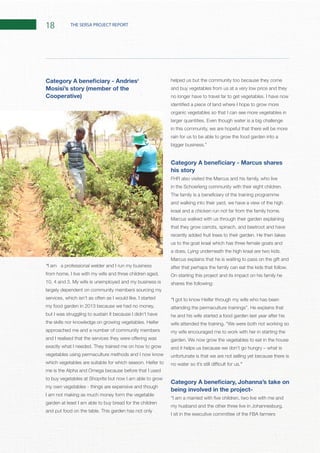
“I am a professional welder and I run my business
largely dependent on community members sourcing my
my food garden in 2013 because we had no money,
but I was struggling to sustain it because I didn’t have
approached me and a number of community members
vegetables using permaculture methods and I now know
me is the Alpha and Omega because before that I used
to buy vegetables at Shoprite but now I am able to grow
my own vegetables - things are expensive and though
I am not making as much money form the vegetable
garden at least I am able to buy bread for the children
helped us but the community too because they come
and buy vegetables from us at a very low price and they
organic vegetables so that I can see more vegetables in
in this community, we are hopeful that there will be more
rain for us to be able to grow the food garden into a
his story
and walking into their yard, we have a view of the high
that they grow carrots, spinach, and beetroot and have
us to the goat kraal which has three female goats and
On starting this project and its impact on his family he
shares the following:
“I got to know Heifer through my wife who has been
he and his wife started a food garden last year after his
my wife encouraged me to work with her in starting the
unfortunate is that we are not selling yet because there is
.”
being involved in the project-
I sit in the executive committee of the FBA farmers
19Growing Our Food – Sustaining Our Future: Sharing Stories from the Fields
association which is largely responsible for determining
the market price of livestock and vegetables grown by
to access the market by negotiating with commercial
chickens in November 2014 from the Heifer programme,
the chickens have now multiplied and I have managed
to pass on the gift and have also sold three chickens at
February this year and they are now pregnant, so I am
just waiting for the goats give birth so that I can pass on
had nothing, but now am able to pass the gift to another
are also able to eat at home and this project is helping
me to buy bricks so that I can have a brick house instead
Women in Agri-processing: Empowering rural
Solidaridad Southern Africa
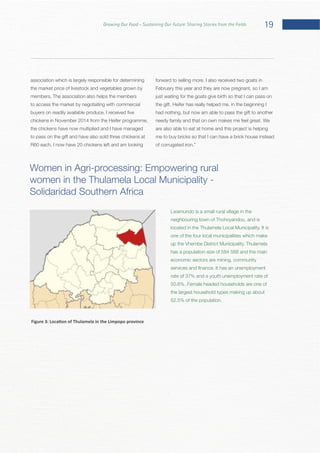
Lwamundo is a small rural village in the
neighbouring town of Thohoyandou, and is
one of the four local municipalities which make
has a population size of 584 568 and the main
economic sectors are mining, community
rate of 37% and a youth unemployment rate of
the largest household types making up about
20 THE SERSA PROJECT REPORT
21Growing Our Food – Sustaining Our Future: Sharing Stories from the Fields
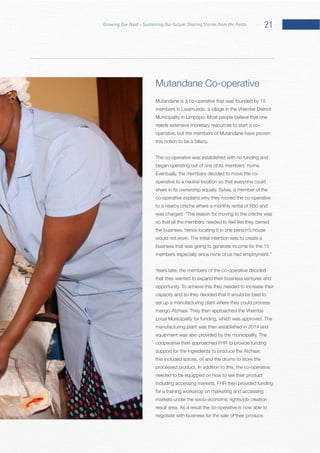
members in Lwamundo, a village in the Vhembe District
needs extensive monetary resources to start a co-
The co-operative was established with no funding and
Eventually, the members decided to move the co-
operative to a neutral location so that everyone could
co-operative explains why they moved the co-operative
to a nearby crèche where a monthly rental of R50 and
so that all the members needed to feel like they owned
the business, hence locating it in one person’s house
business that was going to generate income for the 15
Years later, the members of the co-operative decided
that they wanted to expand their business ventures and
capacity and so they decided that it would be best to
set up a manufacturing plant where they could process
manufacturing plant was then established in 2014 and
cooperative then approached FHR to provide funding
support for the ingredients to produce the Atchaar,
this included spices, oil and the drums to store the
for a training workshop on marketing and accessing
markets under the socio-economic rights/job creation
22 THE SERSA PROJECT REPORT
The co-operative had the ambition and the drive to
condiment and relish; however, they did not have the
skills or knowledge on how to process mangoes into
Sylvia says the following about the co-operative’s
relationship with Solidarid: “Solidaridad provided the
be needed and the drums we needed to store it in for
A business needs time to grow and revenue, in particular,
tenacity and patience and a willingness to weather the
members of the co-operative grew tired of the project
lost some of our members along the way because we
For those that opted to stick it out to the end, despite
the many obstacles and rigour of hard work; they
are able to reap the rewards today. In the past
year the cooperative was able to produce half-
processed mango Atchaar, which they sold to the
company that provided training for them and that
was the beginning of the cooperative accessing
It has since expanded its reach and is
members attribute their success to the training
We only managed to do
all of this because of the training that Solidaridad
provided us,”
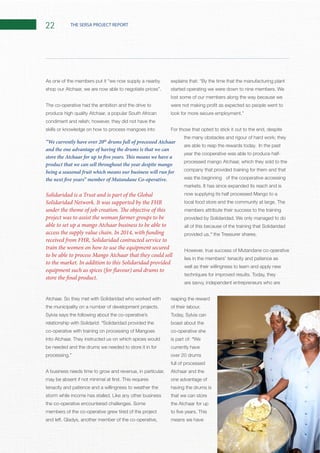
lies in the members’ tenacity and patience as
well as their willingness to learn and apply new
are savvy, independent entrepreneurs who are
reaping the reward
Today, Sylvia can
boast about the
co-operative she
is part of: “We
currently have
over 20 drums
full of processed
Atchaar and the
one advantage of
having the drums is
that we can store
the Atchaar for up
means we have
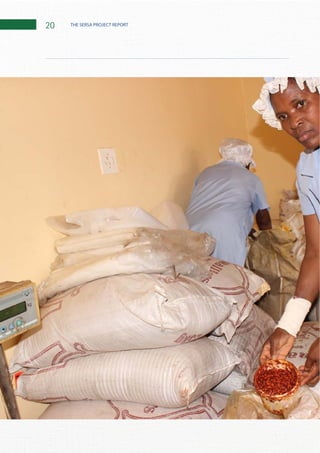
Solidaridad is a Trust and is part of the Global
Solidaridad Network. It was supported by the FHR
under the theme of job creation. The objective of this
project was to assist the woman farmer groups to be
able to set up a mango Atchaar business to be able to
access the supply value chain. In 2014, with funding
received from FHR, Solidaridad contracted service to
train the women on how to use the equipment secured
to be able to process Mango Atchaar that they could sell
to the market. In addition to this Solidaridad provided
equipment such as spices (for flavour) and drums to
store the final product.
“We currently have over 20th
drums full of processed Atchaar
and the one advantage of having the drums is that we can
store the Atchaar for up to five years. This means we have a
product that we can sell throughout the year despite mango
being a seasonal fruit which means our business will run for
the next five years” member of Mutandane Co-operative.
23Growing Our Food – Sustaining Our Future: Sharing Stories from the Fields
a product that we can sell throughout the year despite
mango being a seasonal fruit which means we are in
Beyond the impact felt by the co-operative as a
collective, the greatest impact has been felt by the
individuals and their families, an impact with individual
was an ordinary woman staying at home doing nothing,
this business I am able to also contribute to household
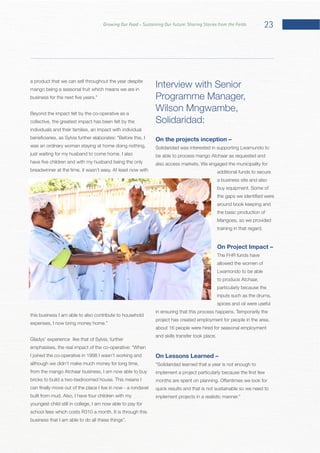
Gladys’ experience like that of Sylvia, further
I joined the co-operative in 1998 I wasn’t working and
although we didn’t make much money for long time,
from the mango Atchaar business, I am now able to buy
youngest child still in college, I am now able to pay for
business that I am able to do all these things”.
Interview with Senior
Solidaridad:
On the projects inception –
Solidaridad was interested in supporting Lwamundo to
additional funds to secure
a business site and also
around book keeping and
the basic production of
On Project Impact –
The FHR funds have
allowed the women of
Lwamondo to be able
to produce Atchaar,
particularly because the
inputs such as the drums,
spices and oil were useful
project has created employment for people in the area,
about 16 people were hired for seasonal employment
On Lessons Learned –
24 THE SERSA PROJECT REPORT
Interview with Izandla
Organics Deputy Director,
Rebecca Sondezi and
Project team
Established in 2013, the co-operative sought to help
their community by setting up food gardens deliberately
targeting the poor, child-headed households and the
and HIV, in many families the elderly are left to care for
the children once the parents have passed as a result
food gardens will not only help improve nutrition but in
a community with high unemployment levels, it would
Izandla was able to establish 54 food gardens for poor
families and because of high drought levels in the
community - through this funding - Izandla was able to
set up 38 water harvesters in 38 households so that the
Rebecca shares with us that the following:
Rebecca on setting up the project
asked them if they have a garden and if not we asked
gardening scheme called Siceluthando to ask if they
needed any
help and they
would point
us to families
in need of
is how we
selected our
for this
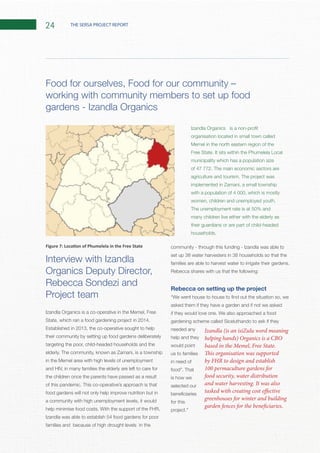
working with community members to set up food
gardens - Izandla Organics
organisation located in small town called
municipality which has a population size
with a population of 4 000, which is mostly
The unemployment rate is at 50% and
many children live either with the elderly as
their guardians or are part of child-headed
Izandla (is an isiZulu word meaning
helping hands) Organics is a CBO
based in the Memel, Free State.
This organisation was supported
by FHR to design and establish
100 permaculture gardens for
food security, water distribution
and water harvesting. It was also
tasked with creating cost effective
greenhouses for winter and building
garden fences for the beneficiaries.
25Growing Our Food – Sustaining Our Future: Sharing Stories from the Fields
Shakes from Memel food gardens’ take
on some challenges faced in the running
of the project-
the project because most of the people in the
community depended on the trainers to set up the
hundred food gardens, some of the gardens could
With the project having come to an end the trainers
though we have closed the organisation the work
still continues, families are still growing produce in
the food gardens and we continue to mentor them.”
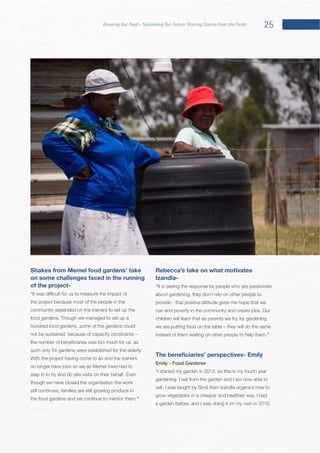
Rebecca’s take on what motivates
Izandla-
“It is seeing the response by people who are passionate
about gardening, they don’t rely on other people to
provide - that positive attitude gives me hope that we
children will learn that as parents we try, by gardening
”
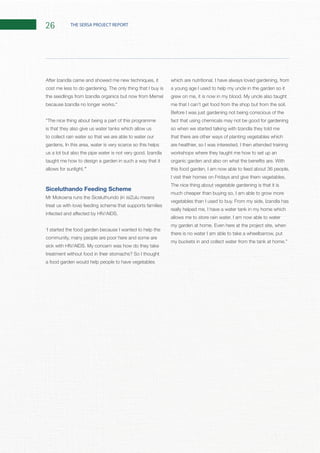
Emily - Food Gardener
26 THE SERSA PROJECT REPORT
is that they also give us water tanks which allow us
to collect rain water so that we are able to water our
taught me how to design a garden in such a way that it
allows for sunlight.”
Siceluthando Feeding Scheme
‘I started the food garden because I wanted to help the
community, many people are poor here and some are
treatment without food in their stomachs? So I thought
a food garden would help people to have vegetables
a young age I used to help my uncle in the garden so it
Before I was just gardening not being conscious of the
fact that using chemicals may not be good for gardening
so when we started talking with Izandla they told me
that there are other ways of planting vegetables which
workshops where they taught me how to set up an
this food garden, I am now able to feed about 36 people,
The nice thing about vegetable gardening is that it is
much cheaper than buying so, I am able to grow more
really helped me, I have a water tank in my home which
there is no water I am able to take a wheelbarrow, put
27Growing Our Food – Sustaining Our Future: Sharing Stories from the Fields
For the majority of the last 15 years, South Africa has
world with approximately 40% of the national income
than half of all working age South Africans had income
earning employment, compared to the international
the fact that among the employed, many are poorly
There is general consensus that job creation is key in
communities, impacting positively on the most vulnerable
employment especially if supported through agricultural
support services, creation of new markets and local
women empowerment and food security which remain
economic sector in the food growth path which targets
about 300 000 households in agricultural smallholder
The FHR plays an important role in alleviating poverty by
supporting initiatives that aimed at creating jobs, in turn
promoting the realisation of socio-economic rights such
as the right to food, water and education which are all
2.2 Socio-economic
Rights and Job Creation
28 THE SERSA PROJECT REPORT
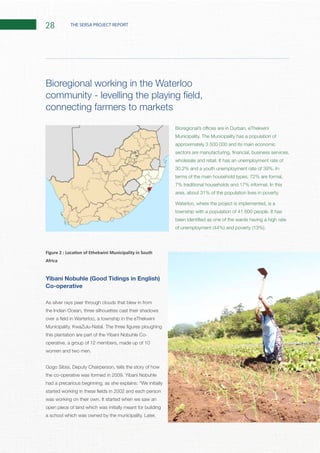
Yibani Nobuhle (Good Tidings in English)
Co-operative
As silver rays peer through clouds that blew in from
the Indian Ocean, three silhouettes cast their shadows
this plantation are part of the Yibani Nobuhle Co-
operative, a group of 12 members, made up of 10
Gogo Sibisi, Deputy Chairperson, tells the story of how
open piece of land which was initially meant for building
Bioregional working in the Waterloo
connecting farmers to markets
approximately 3 500 000 and its main economic
terms of the main household types, 72% are formal,
Waterloo, where the project is implemented, is a
29Growing Our Food – Sustaining Our Future: Sharing Stories from the Fields
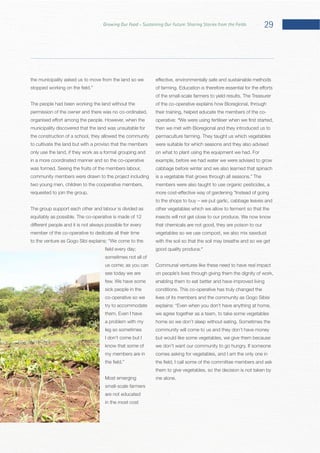
the municipality asked us to move from the land so we
The people had been working the land without the
permission of the owner and there was no co-ordinated,
municipality discovered that the land was unsuitable for
the construction of a school, they allowed the community
to cultivate the land but with a proviso that the members
only use the land, if they work as a formal grouping and
in a more coordinated manner and so the co-operative
community members were drawn to the project including
two young men, children to the cooperative members,
The group support each other and labour is divided as
member of the co-operative to dedicate all their time
to the venture as Gogo Sibi explains:
sometimes not all of
us come; as you can
see today we are
sick people in the
co-operative so we
try to accommodate
a problem with my
leg so sometimes
I don’t come but I
know that some of
my members are in
small-scale farmers
are not educated
in the most cost
of the co-operative explains how Bioregional, through
their training, helped educate the members of the co-
operative: “
then we met with Bioregional and they introduced us to
were suitable for which seasons and they also advised
example, before we had water we were advised to grow
cabbage before winter and we also learned that spinach
The
members were also taught to use organic pesticides, a
other vegetables which we allow to ferment so that the
that chemicals are not good, they are poison to our
vegetables so we use compost, we also mix sawdust
with the soil so that the soil may breathe and so we get
.”
Communal ventures like these need to have real impact
on people’s lives through giving them the dignity of work,
enabling them to eat better and have improved living
lives of its members and the community as Gogo Sibisi
we agree together as a team, to take some vegetables
community will come to us and they don’t have money
but would like some vegetables, we give them because
comes asking for vegetables, and I am the only one in
them to give vegetables, so the decision is not taken by
30 THE SERSA PROJECT REPORT
The Treasurer
then elaborates:
started the
farming, some of
us were working
elsewhere and
as the business
grew, we
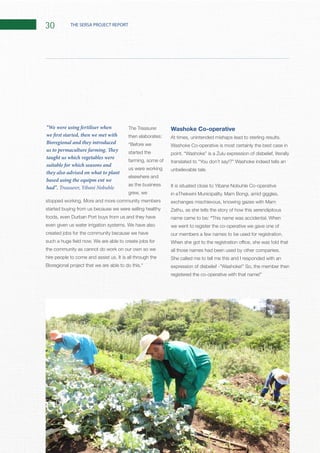
started buying from us because we were selling healthy
foods, even Durban Port buys from us and they have
created jobs for the community because we have
the community as cannot do work on our own so we
Washoke Co-operative
Washoke Co-operative is most certainly the best case in
It is situated close to Yibane Nobuhle Co-operative
name came to be: “
we went to register the co-operative we gave one of
She called me to tell me this and I responded with an
“We were using fertiliser when
we first started, then we met with
Bioregional and they introduced
us to permaculture farming. They
taught us which vegetables were
suitable for which seasons and
they also advised on what to plant
based using the equipm ent we
had”. Treasurer, Yibani Nobuhle
31Growing Our Food – Sustaining Our Future: Sharing Stories from the Fields
of Bioregional who also suggested that we motivate to
condition though, that we should not use the land to put
up a structure so we use it for farming and we store our
.”
Washoke, with four women and one male member,
like the majority of co-operatives, is largely made up of
these co-operatives have such low male participation?
gardening and gardening is viewed as women’s job,
drought, some of our members are working because we
Despite these challenges the group presses on with
as they earn an income which feeds their families
understands why this project is still viable despite the
farming the organic way, but also on how to set up
vegetables to the communities, we have an idea of
market and they pick up our vegetables for free, so we
about organic farming, as we were taught by Bioregional,
us is a bargain - so we thank the funders that support
The Story of Bekeka Jumba – Turkey Cooperative
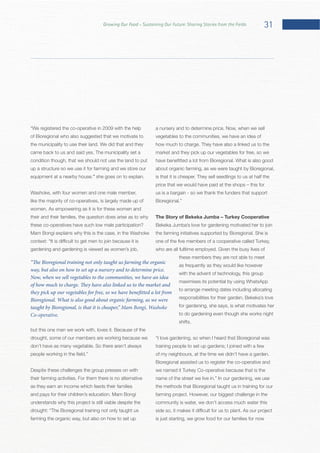
Bekeka Jumba’s love for gardening motivated her to join
these members they are not able to meet
with the advent of technology, this group
maximises its potential by using WhatsApp
to arrange meeting dates including allocating
for gardening, she says, is what motivates her
to do gardening even though she works night
training people to set up gardens; I joined with a few
Bioregional assisted us to register the co-operative and
we named it Turkey Co-operative because that is the
the methods that Bioregional taught us in training for our
community is water, we don’t access much water this
is just starting, we grow food for our families for now
“The Bioregional training not only taught us farming the organic
way, but also on how to set up a nursery and to determine price.
Now, when we sell vegetables to the communities, we have an idea
of how much to charge. They have also linked us to the market and
they pick up our vegetables for free, so we have benefitted a lot from
Bioregional. What is also good about organic farming, as we were
taught by Bioregional, is that it is cheaper,” Mam Bongi, Washoke
Co-operative.
32 THE SERSA PROJECT REPORT
and have not as yet started selling to the market but
Manager at Bioregional
Sarah on the inception of the project-
“This farming project was born out of another project
focused on entrepreneurial development in the Waterloo
decided to approach FHR for funding support to train
have six co-operatives which we are supporting through
training and
the provision of
seedlings for the
However, we
only have four
fully functional
co-operatives
because
some lack
Given the
number of co-
operatives we
were supporting,
we proposed
to the food
growers that in
order to make
work easier for themselves, they should set up an
association which will have various committees that will
help determine the price, markets and schedule training
On Bioregional’s service to the community –
“We conducted a number of training workshops geared
trainings last year that the farmers even said they
organic farming approaches and once the training is
price of a seedling is 50 cents, we contribute 25 cents
as Bioregional and the farmers pay the other 25 cents
Bioregional is an entrepreneurial
NGO which establishes
sustainable business and
works with partners around
the world to demonstrate
that a sustainable future can
be attractive and affordable.
FHR supported Bioregional
to support local food growers
(mainly women) in the Waterloo
area, north of Durban to
establish a Waterloo Agrihub.
The organisation does this by
conducting a number of training
workshops on organic and
sustainable farming methods
using appropriate technologies
for agro-ecological development.
33Growing Our Food – Sustaining Our Future: Sharing Stories from the Fields
which basically means the farmers buy the seedlings at
On accessing markets and cutting out the middle
man-“This project was initially set up to address food
security in the home however, the farmers had surplus
the farmers to markets, so we go and negotiate with
commercial buyers on their behalf and every second
week vegetables are collected from the four agri-hubs,
packaged and branded fair food and delivered to the
town and the municipality’s economic development
On determining price-
“In determining price, the farmers have been in the
business for a long time, some go to Spar to look
such suppliers because you can sell beans to them
farmers because they are the ones who put in the hard
the farmer scheme, we are able to link them to a higher
organic, we like the Waterloo farmers and low output
there is a casino that has recently been established and
the system to make sure that we are able to match the
we send potential clients a list of what crops are available
and those we intend on growing throughout the year and
order and when.“
On project successes-
“The funding from FHR has allowed us to leverage our
resources, we are now able to negotiate with the bigger
buyers, one company has gone as far as donating water
.”
34 THE SERSA PROJECT REPORT
Bakotudi Co-operative
The award-winning Bakotudi Co-operative has its
project site located in Thabazimbi, an iron mining town
surrounded by the Witfonteinrand and Boshofberg with
The Chairperson, Abraham, tells of the co-operative’s
inception in 2013, with the assistance of Food and
some grow impatient as their need is immediate and
members leave the co-operative, as Abraham explains:
was not yielding results as rapidly as they had expected
so they journeyed on but I stayed because I love
To close this knowledge gap to ensure that the co-
operative’s farmers are independent agriculturalists and
entrepreneurs, FHR provided funding that enabled Food
and Trees to take the members through a series of
training workshops focused on sustainability approaches
“The training introduced us to intercropping
were growing; now we know which vegetables to plant
plant cucumber and various herbs and this expands our
market,”
The next step to a successful small-scale farming
venture, is linking produce to a sustainable and
Food and Trees in the Thabazimbi
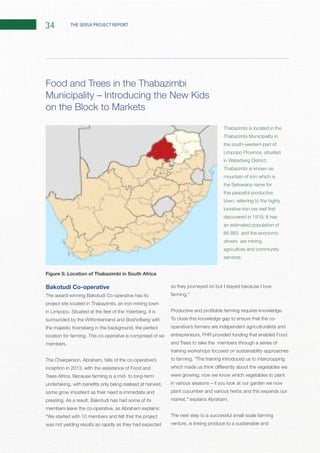
Thabazimbi is located in the
the south-western part of
Limpopo Province, situated
Thabazimbi is known as
mountain of iron which is
the Setswana name for
this peaceful productive
town, referring to the highly
an estimated population of
66 883 and the economic
drivers are mining,
agriculture and community
Figure 5: Location of Thabazimbi in South Africa
35Growing Our Food – Sustaining Our Future: Sharing Stories from the Fields
negotiating supply of their produce with big commercial
negotiations are concluded with major commercial retail
merchants, the co-operative already have developed
produce to community members and also small
business owners who ordinarily would travel about for
distance and the cost of transporting goods made
are also gaining access to the market and they
hope that soon they will be supplying to much
The skills Abraham attained through agricultural
training has turned him into a highly sought after
expert who also gives invaluable insight to commercial
“Since I became a member of the co-operative,
I have been able to share knowledge gained from the
Established in 1990, Food and Trees for Africa is
a non- profit organisation whose area of focus is
addressing climate change through raising awareness
of the importance of moving towards a green and just
environment and society. It was supported by the FHR
under the job creation theme. The organisation provides
training to community members on organic farming.
The objective is to equip community members with skills
to enable them to set up organic food gardens for food
security and to generate an income.
36 THE SERSA PROJECT REPORT
a group of farmers in Cullinan as a result of the skills I
for advice on farming and I give them, then they go and
degree but the training here has made me an expert in
farming,”
Apart from the training and the support the co-operative
has received, what sets this group apart is the passion
he talks about his love for farming: “Some of my peers
because they believe that farming is for old people but
co-operative provincially and nationally and now people
at Food and Trees.
Lawrence explained that Food and Trees started the
project in Thabazimbi to address some of the challenges
faced by the community such as unemployment and
young people were selected from the community based
Lawrence’s take on the inception of the project-
because most of them had no knowledge or skill on
are able to run the farm with very little assistance
from Food and Trees - they are business owners
and also employ casual workers on the farm to
Lovejoy, added that the project has also created
opportunities for new business because people in the
community they now see opportunity in being vegetable
Lovejoy’s take on the project’s next steps-
“The journey is not over though, we need to conduct
more training for the members so that we get
be able to expand our market and increase production
community and neighbouring towns but we cannot go
”
Lovejoy’s take on accessing markets-
doubtful of us because we are new kids on the block
“The training introduced us to intercropping which made us
think differently about the vegetables we were growing; now we
know which vegetables to plant in various seasons – if you look
at our garden we now plant cucumber and various herbs and
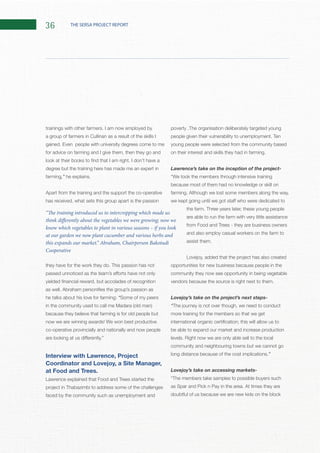
this expands our market.” Abraham, Chairperson Bakotudi
Cooperative
37Growing Our Food – Sustaining Our Future: Sharing Stories from the Fields
and ordinarily they would expect to see a white man in
shorts selling the produce to big business so we have to
Lawrence’s take on some of the challenges faced –
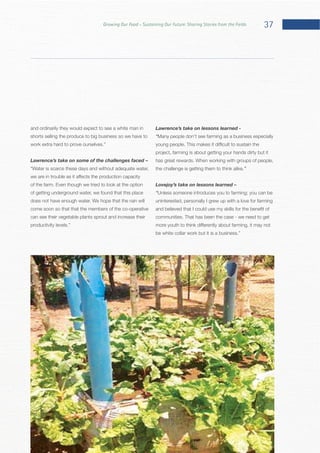
of getting underground water, we found that this place
come soon so that that the members of the co-operative
can see their vegetable plants sprout and increase their
Lawrence’s take on lessons learned -
“
project, farming is about getting your hands dirty but it
the challenge is getting them to think alike.”
Lovejoy’s take on lessons learned –
“Unless someone introduces you to farming; you can be
uninterested, personally I grew up with a love for farming
38 THE SERSA PROJECT REPORT
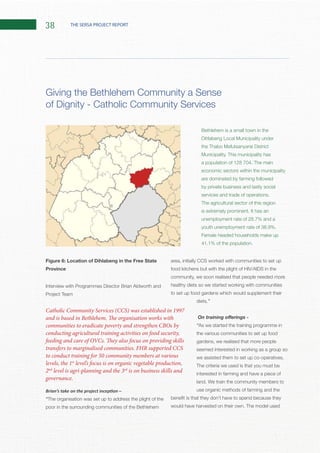
Figure 6: Location of Dihlabeng in the Free State
Province
Interview with Programmes Director Brian Aldworth and
Project Team
“The organisation was set up to address the plight of the
poor in the surrounding communities of the Bethlehem
area, initially CCS worked with communities to set up
food kitchens but with the plight of HIV/AIDS in the
community, we soon realised that people needed more
healthy diets so we started working with communities
to set up food gardens which would supplement their
diets.”
“As we started the training programme in
the various communities to set up food
gardens, we realised that more people
seemed interested in working as a group so
The criteria we used is that you must be
interested in farming and have a piece of
use organic methods of farming and the
Giving the Bethlehem Community a Sense
of Dignity - Catholic Community Services
Catholic Community Services (CCS) was established in 1997
and is based in Bethlehem. The organisation works with
communities to eradicate poverty and strengthen CBOs by
conducting agricultural training activities on food security,
feeding and care of OVCs. They also focus on providing skills
transfers to marginalised communities. FHR supported CCS
to conduct training for 50 community members at various
levels, the 1st
level’s focus is on organic vegetable production,
2nd
level is agri-planning and the 3rd
is on business skills and
governance.
Bethlehem is a small town in the
economic sectors within the municipality
are dominated by farming followed
by private business and lastly social
The agricultural sector of this region
Female headed households make up
39Growing Our Food – Sustaining Our Future: Sharing Stories from the Fields
for this project is a train the trainers model which aims
to encourage trained community members to use the
knowledge gained from this training to set up gardens so
On lessons learned …..
“One of the key lessons learned is that you have to be
it improves their sense of dignity, it empowers them
to bring extra money home and also to harvest good
community members have no book knowledge, they
learned what they know from their grandparents and
On the future of the project and its impact -
looking at the impact that the food gardening project has
had on the various communities similar projects need to
co-operatives is valuable because the members are able
members we talked to acknowledge that formalising the
groups through setting up co-operatives is a limitation
This means that without multi-year funding, it becomes
”
impact however the funding from the FHR has allowed
us to reach more poor communities, train them on
organic vegetable farming and support them to farm in
able to make an income for themselves, this will improve
Trusting each other -
Tsepanong Co-operative in
the Bahlokong Community
A group of seven women run the Tsepanong Co-
in the Bahlokong community, one of the surrounding
The chairperson of the co-operative shares how the
co-operative was formed by a group of unemployed
we started the project we were not working so, we
decided to come together to set up a food garden with
the community hall and we approached the municipality
because the community hall is a gathering place and it
I was working in the garden and then a woman
working is there an opportunity for me?’’ so I
“CCS took us through a number of training sessions
also had no idea how to work so they gave us good
we were able to plant accordingly to make sure that the
“With the knowledge gained from the training, we were able to
plant better to make sure that the vegetables we sell are fresh
and of good quality,” member of the Tsepanong Co-operative.
40 THE SERSA PROJECT REPORT
The co-operative’s initial plan to set up their venture near
from where they operate from is easily accessible and
the cooperative have a viable market without having
to do much marketing and lobbying work:
go out to sell, people come to us from the community,
they know about us because we are located in the
community hall so when they come to meetings they see
and those who are having funerals come to us for
produce because they hear about us from people who
come to the community hall.”
Since the project was initiated by a group of unemployed
women, the group now cannot imagine that they once
sought employment as the only means of earning an
food they put on the table and money they earn is as a
not been working when the project started, we were
are able to not only put food on the table but also, we
allowed me to grow a food garden in my backyard which
helps me to feed my family.”
Working with OVCs: Ikemeleng
Home-Based Care
Ikemeleng is a home based care
centre that provides services to
kitchen, it serves the community
children came to the centre, Ikemeleng expanded its
Unfortunately, funding for the food scheme came to an
end, CCS then approached the centre and advised them
to set a food garden so that they can continue to feed
know how we were going to continue to provide food
gardens enabled us to then train parents to set up food
programme is that it provides us with seedlings which
mean that the families don’t have to spend a lot on
gardens, the training has also opened opportunities for
us we are often invited by schools to train children on
Sunduza Co-operative
The best testimony of what is needed for a co-operative
to run successfully comes from the members of the
with Sunduza, a co-operative of six strong, which was
assisted us in registering the co-operative and when
we started we were located on an open piece of land
not far from
where we are
started stealing
from us, they
targeted our
didn’t earn a living, we couldn’t feed our children and so
“Because I love farming, I love this project, the money is
in the soil - we can’t depend on government to give us jobs.
We want to be the first women to succeed in farming in our
community so, no matter how hard it gets we will soldier on
until we see our dream come true,” member of the Sunduza
Co-operative.
41Growing Our Food – Sustaining Our Future: Sharing Stories from the Fields
the priest at CSS again and he advised that we speak to
place is big, we decided to invite a few more people so
The member of the co-operative goes on to explain
what came by the group’s way of assistance and how
they mobilised to develop the farm into a viable business
for the members of the co-operative: “CCS helped us
Now we are able to sell vegetables and chickens to the
community.”
The co-operative is run responsibly, with the team taking
their experience into account and not overextending
farmers and businesses promise too much, yet deliver
service and in turn leads to many emerging farmers and
businesses losing credibility with communities and in so
as a co-operative has guarded against it:
started selling to businesses yet because they want us
to sign a contract for continuous delivery and that is
usually a challenge for us because this farm is still young
The commitment of the members of the co-operative is
“There
is also no free day, we come in the morning and leave at
don’t have jobs in this community and we want to create
love farming, I love this project, the money is in the soil
community so, no matter how hard it gets we will soldier
As one of the members put it, the project is a work in
progress, gains have been made, but the potential for
project get to a level that I want to see it at but there is
a light because now I am able to buy impumpu (maize
42 THE SERSA PROJECT REPORT
Interview with Mthetho Mkhungo -
KwaZulu-Natal
In project inception -
“
poverty, this is a very rural community and our approach
as Siyavuna is to help the communities to embark on
agriculture which will help them to access the markets
found in this community that there were many elderly
people who were farming but they didn’t know about the
them to organic farming”.
On the training-
from door to door to ask farmers whether they would
be interested in joining the programme. We train the
farmers based on a programme which allows them
to graduate to various levels, M1 – M3. M3 being the
most advanced level, this is where we then introduce
the farmers
to the
market. The
farmers do
their farming
in their
backyards
at home,
then once a
week, they
bring their
produce to
a collection
point.
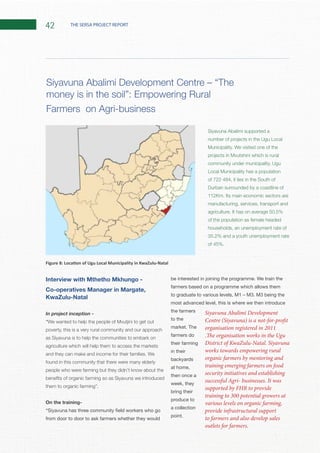
Siyavuna Abalimi supported a
number of projects in the Ugu Local
of 722 484, it lies in the South of
Durban surrounded by a coastline of
manufacturing, services, transport and
of the population as female headed
households, an unemployment rate of
money is in the soil”: Empowering Rural
Farmers on Agri-business
Siyavuna Abalimi Development
Centre (Siyavuna) is a not-for-profit
organisation registered in 2011
.The organisation works in the Ugu
District of KwaZulu-Natal. Siyavuna
works towards empowering rural
organic farmers by mentoring and
training emerging farmers on food
security initiatives and establishing
successful Agri- businesses. It was
supported by FHR to provide
training to 300 potential growers at
various levels on organic farming,
provide infrastructural support
to farmers and also develop sales
outlets for farmers.
43Growing Our Food – Sustaining Our Future: Sharing Stories from the Fields
the farmer the value of their produce based on what the
the co-operatives’ manager is to help the farmers access
the markets so I negotiate with potential buyers.
On accessing the market -
there are relatively wealthy so, we target them as
also market our produce using Facebook and we run
helped create jobs for farmers and people who were just
out even thinking of selling their produce because they
that their vegetables will be sold-they will not wither in
the training and graduate at all levels, the money from
On lessons learned -
As Siyavuna we have also learned a lot from the farmers
- big time - I am a teacher in the project and the best
way to teach is sometimes to listen to them on how
indigenous
knowledge
and can be
carried from
generation to
We are now
even thinking of developing a publication documenting
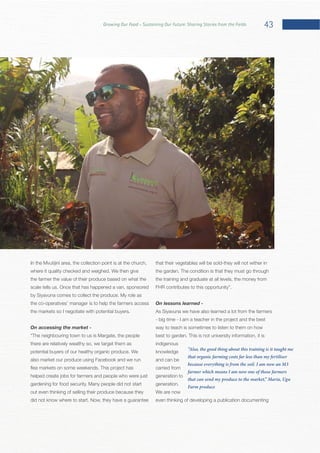
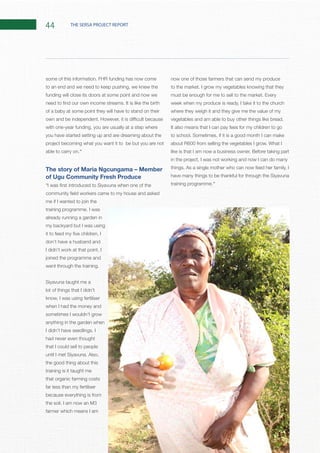
“Also, the good thing about this training is it taught me
that organic farming costs far less than my fertiliser
because everything is from the soil. I am now an M3
farmer which means I am now one of those farmers
that can send my produce to the market,” Maria, Ugu
Farm produce
44 THE SERSA PROJECT REPORT
to an end and we need to keep pushing, we knew the
funding will close its doors at some point and now we
of a baby at some point they will have to stand on their
with one-year funding, you are usually at a step where
you have started setting up and are dreaming about the
project becoming what you want it to be but you are not
“
The story of Maria Ngcungama – Member
of Ugu Community Fresh Produce
me if I wanted to join the
already running a garden in
my backyard but I was using
don’t have a husband and
joined the programme and
Siyavuna taught me a
lot of things that I didn’t
know, I was using fertiliser
when I had the money and
sometimes I wouldn’t grow
anything in the garden when
had never even thought
that I could sell to people
the good thing about this
training is it taught me
that organic farming costs
far less than my fertiliser
because everything is from
farmer which means I am
now one of those farmers that can send my produce
week when my produce is ready, I take it to the church
where they weigh it and they give me the value of my
It also means that I can pay fees for my children to go
in the project, I was not working and now I can do many
have many things to be thankful for through the Siyavuna
”
45Growing Our Food – Sustaining Our Future: Sharing Stories from the Fields
2013 marked the centenary of South Africa’s notorious
th
century segregation
of the most arable land for white people who make up
approximately 9% of the population, is still evident in
the country’s divided countryside and deeply racialised
of redistributing 30% of agricultural land into black
the New Growth Path, National Development
Plan: Vision for 2030 and in political rhetoric across the
opportunity for researchers in academia, civil society and
to agricultural policy nor can the social meaning of land
intersection of issues shaping relationships to land at
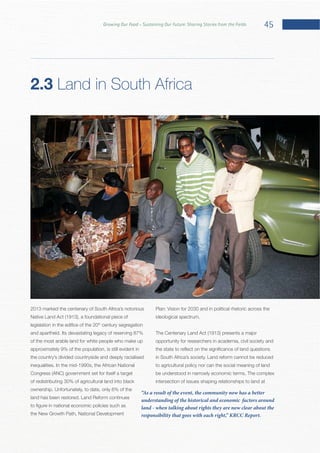
2.3 Land in South Africa
“As a result of the event, the community now has a better
understanding of the historical and economic factors around
land - when talking about rights they are now clear about the
responsibility that goes with each right,” KRCC Report.
46 THE SERSA PROJECT REPORT
the start of the 21st
century therefore demand fresh
awareness raising and capacity building initiatives
focused on promoting dialogue in communities on
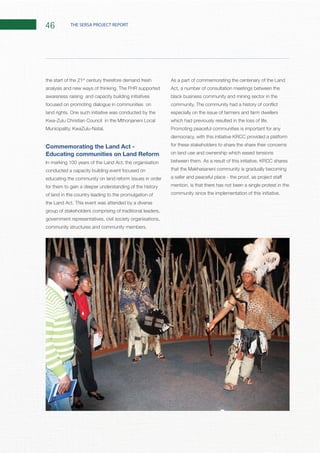
Commemorating the Land Act -
Educating communities on Land Reform
In marking 100 years of the Land Act, the organisation
conducted a capacity building event focused on
educating the community on land reform issues in order
for them to gain a deeper understanding of the history
of land in the country leading to the promulgation of
group of stakeholders comprising of traditional leaders,
government representatives, civil society organisations,
As a part of commemorating the centenary of the Land
Act, a number of consultation meetings between the
black business community and mining sector in the
especially on the issue of farmers and farm dwellers
Promoting peaceful communities is important for any
for these stakeholders to share the share their concerns
on land use and ownership which eased tensions
mention, is that there has not been a single protest in the
47Growing Our Food – Sustaining Our Future: Sharing Stories from the Fields
There is little certainty about household food security
status in the country though it is generally accepted
that there is a dramatic fall in the experience of hunger
Policies that focus on poverty nodes, will not necessarily
reach the larger population of hungry people in
households spend more on food but still less than
the people who are often hungry do not receive grants
with contextual factors such as gender and HIV impact
knowledge around the precise gendered dimensions of
food security which in turn, limits our household level
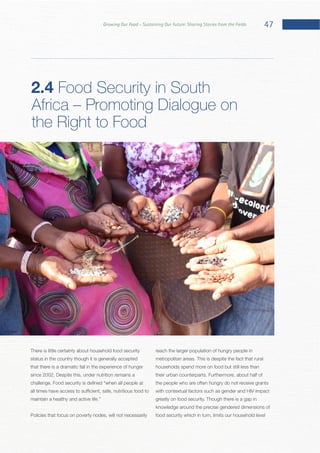
2.4 Food Security in South
Africa – Promoting Dialogue on
the Right to Food
48 THE SERSA PROJECT REPORT
understanding of gender relations and food security,
there is general consensus that women play a key role
51% of the population is women, this subject needs to
be further explored if the feminisation of poverty is to be
understanding the systemic nature of the problem
needs to prioritised and current initiatives need to be
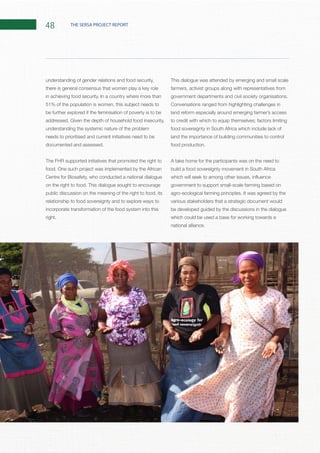
The FHR supported initiatives that promoted the right to
Centre for Biosafety, who conducted a national dialogue
public discussion on the meaning of the right to food, its
relationship to food sovereignty and to explore ways to
incorporate transformation of the food system into this
This dialogue was attended by emerging and small scale
farmers, activist groups along with representatives from
Conversations ranged from highlighting challenges in
land reform especially around emerging farmer’s access
food sovereignty in South Africa which include lack of
land the importance of building communities to control
A take home for the participants was on the need to
build a food sovereignty movement in South Africa
government to support small-scale farming based on
various stakeholders that a strategic document would
be developed guided by the discussions in the dialogue
which could be used a base for working towards a
49Growing Our Food – Sustaining Our Future: Sharing Stories from the Fields
South Africa’s constitution upholds people’s rights to
developed under the Constitution has been given legal
promote sustainable development, environmental justice
South Africa is also a signatory to the United Nations
published a climate change response Green Paper which
reiterates the Copenhagen Accord Pledge to trim down
the growth in carbon emissions by 34% in 2020 and
emissions intensity makes it the largest carbon emitter
in Africa and the 12th
Parallel with its emissions intensity, the production
system in South Africa has resulted in the wholesale
destruction of environments as well as the
climate impacts while undermining the resilience of
that climate change already has a substantial impact
on the human ability to sustain itself, and that the
It has also has the potential of worsening existing
vulnerabilities, adds to pressures on the environment
and natural resources on which many South Africans
FHR supported an organisation in the Northern Cape
in educating them on increasing their resilience to the
one of the recipients of the FHR grant, conducted a
series educational workshops with small-scale farmers
opportunity for these famers to share information on
weather patterns observed by farmers and mitigating
participatory Climate Change Adaptation Handbook
aimed at improving adaptation practices of practitioners
stemming from the workshops at the UNFCCC COP 20
2.6 Climate Change
50 THE SERSA PROJECT REPORT
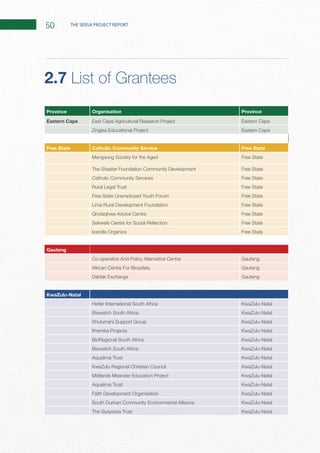
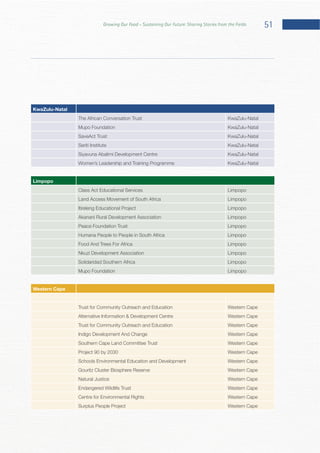
2.7 List of Grantees
Province Organisation Province
Eastern Cape East Cape Agricultural Research Project Eastern Cape
Eastern Cape
Free State Catholic Community Service Free State
Free State
The Shaster Foundation Community Development Free State
Catholic Community Services Free State
Rural Legal Trust Free State
Free State Unemployed Youth Forum Free State
Lima Rural Development Foundation Free State
Free State
Free State
Izandla Organics Free State
Gauteng
Co-operative And Policy Alternative Centre Gauteng
African Centre For Biosafety Gauteng
Dahlak Exchange Gauteng
KwaZulu-Natal
Heifer International South Africa
Biowatch South Africa
Ithemba Projects
BioRegional South Africa
Biowatch South Africa
Faith Development Organisation
South Durban Community Environmental Alliance
The Siyazisiza Trust
51Growing Our Food – Sustaining Our Future: Sharing Stories from the Fields
KwaZulu-Natal
The African Conversation Trust
SaveAct Trust
Seriti Institute
Siyavuna Abalimi Development Centre
Women’s Leadership and Training Programme
Limpopo
Class Act Educational Services Limpopo
Limpopo
Itireleng Educational Project Limpopo
Akanani Rural Development Association Limpopo
Peace Foundation Trust Limpopo
Humana People to People in South Africa Limpopo
Food And Trees For Africa Limpopo
Nkuzi Development Association Limpopo
Solidaridad Southern Africa Limpopo
Limpopo
Western Cape
Trust for Community Outreach and Education Western Cape
Alternative Information & Development Centre Western Cape
Trust for Community Outreach and Education Western Cape
Indigo Development And Change Western Cape
Southern Cape Land Committee Trust Western Cape
Project 90 by 2030 Western Cape
Schools Environmental Education and Development Western Cape
Gouritz Cluster Biosphere Reserve Western Cape
Natural Justice Western Cape
Endangered Wildlife Trust Western Cape
Centre for Environmental Rights Western Cape
Surplus People Project Western Cape
52 THE SERSA PROJECT REPORT
CONTACT DETAILS
Tel: +27 11 484 0390
Fax: +27 86 614 9533
Email: info@fhr.org.za
Website: www.fhr.org.za
Twitter: @FHRRights
Facebook: www.facebook.com/FHRights
PHYSICAL ADDRESS
POSTAL ADDRESS

Sersa programme report

  • 1.
    T H ES E R S A P R O G R A M M E R E P O R T Growing Our Food – Sustaining Our Future: Sharing Stories from the Fields
  • 3.
    1Growing Our Food– Sustaining Our Future: Sharing Stories from the Fields Table of Contents Abbreviations and Glossary of Terms 2 Useful Concepts 3 Message from the Deputy Director – Foundation for Human Rights 4 Message from the Government of Flanders 6 Message from the SERSA Programme Manager 7 About the Foundation for the Human Rights 8 Background to the SERSA programme 9 Work of the Foundation for Human Rights 10 Small-Scale and Subsistence Farming 10 Socio-economic Rights and Job Creation 27 Land in South Africa 45 Food Security in South Africa – promoting dialogue on the Right to food 47 Climate Change 49 List of Grantees 50
  • 4.
    2 THE SERSAPROJECT REPORT ANC African National Congress FHR Foundation for Human Rights WHO World Health Organisation FAO Food and Agricultural Organisation NGO Non-Governmental Organisation CBO Community-Based Organisation OVC Orphaned and Vulnerable Children HIV DoA Department of Agriculture EU European Union UNFCCC United Nations Framework on Climate Change PGS Participatory Guarantee System DoJ&CD Department of Justice & Constitutional Development CCS Catholic Community Services ABBREVIATIONS AND GLOSSARY OF TERMS
  • 5.
    3Growing Our Food– Sustaining Our Future: Sharing Stories from the Fields Below are some useful concepts necessary for the easy reading of this document. Food Security In 1996, the World Food Summit developed the following Permaculture The term developed as a combination of permanent working with, rather than against nature; of protracted and thoughtful observation rather than protracted and thoughtless labour; of looking at plants and animals in all their functions, rather than treating any area as a Organic Farming achieve good crop yields without harming the natural Food Sovereignty culturally appropriate food produced through ecologically who produce, distribute and consume food at the heart of food systems and policies rather than the demands USEFUL CONCEPTS
  • 6.
    4 THE SERSAPROJECT REPORT to assisting the most vulnerable groups in South Africa In South Africa, not only civil and political rights, but also FHR subscribes to a human rights-based approach to can be described as the denial of a person’s right to deprived of basic capabilities - such as the capability to be free from hunger, to live in good health, and to be poor person is one for whom a number of human rights Through the assistance of the Flanders Government, we have been able to move away from addressing more than just a conceptual framework for development but sharp focus of the Flanders Government support for land reform, small-scale agriculture, climate change, the environment and job creation in three designated provinces allowed for a practical application of these This includes supporting small-scale farmers with agricultural and non-farm development as a basis for Therefore, we are especially proud of the focus of need to be supported in these endeavours through agricultural support services, creation of new markets and local sharing of resources such as agricultural Employment is an instrumental right by which socio- South Africa’s Constitution upholds people’s right to a initiative of civil society, the project’s compatibility with We want to express our gratitude and recognise the We are grateful to the Flanders Government for their support and the commitment shown to development by Hanif Vally, Deputy Director, Foundation for Human Rights. Message from the Foundation for Human Rights
  • 7.
    5Growing Our Food– Sustaining Our Future: Sharing Stories from the Fields
  • 8.
    6 THE SERSAPROJECT REPORT Flanders has a tradition of addressing human rights, a Today, the Government of Flanders abides by the rights is not only a legal, but also an ethical obligation, which must apply to both its own citizens and to its Therefore, human rights and good governance are a fundamental component of Flemish foreign and Flanders fosters partnerships with strong civil society and non-governmental organisations, maintaining that these play an integral role in promoting the knowledge of human rights, in monitoring human rights progress, in reporting on human rights violations, and in developing national dialogue processes which allow for civil society’s contribution to the national human rights debate, and also proactively provides resources and support cooperation with them was a natural progression within the Flemish development cooperation programme in was the Foundation’s rights-based approach to poverty vulnerable groups in society and works towards ensuring their rights as enshrined in the South African Constitution as well as by international conventions to which the The Participation and Development of Capabilities of Civil Society in realising Socio-Economic Rights in South economic rights and strengthening the capacity of civil society to engage in public policy dialogue in areas such as the right to food and the right to a healthy and clean support, promote and protect these rights as established in the South African Constitution, emphasis has been placed on actual rights-based practice, including measurement of its implementation and practice by stakeholders, both government and organisations on the The Government of Flanders is concerned that respect our sincere hope that the FHR will continue to implement Dr. Geraldine Reymenants, General Representative, Government of Flanders” Message from the Government of Flanders
  • 9.
    7Growing Our Food– Sustaining Our Future: Sharing Stories from the Fields happy to state that it gave the FHR an opportunity to go beyond its traditional work of supporting activities that promote human supporting activities that enabled communities to realise their rights by supporting subsistence and small-scale farming as a Either way, the success of this programme was the fact that even in instances where the aim was to help communities realise their that utilised the agro-ecological methods in their farming, the overcome the impact to drought that hit the country from 2015 to ahead of many others in thinking about adapting to the impact of This programme was very exciting, as it presented us with so needing to deal with various weather patterns to dealing with to come up with strategies that were aimed at enabling them to building the capacity of the grantees to sustain their projects The implementation of this project saw the FHR working with various stakeholders on initiatives that were aimed at creating jobs and addressing food insecurity within communities where grantees their programme was to see how Biowatch has helped the group helping the members to keep count of how much they consumed empowered community members as they were able to track the productivity of their gardens and to track how much money was due to them, as they sold their surplus to supermarkets as I was also inspired by the story of Lindiwe, a small-scale farmer, who was trained on agro- ecological farming practices by the Siyavuna Abalimi Although she had always been passionate about I am grateful to each and every one of these colleagues, as my I also would like to thank the Government of Flanders for providing Mamashoabathe Noko, SERSA Programme Manager, Project Management Unit. Message from the Programme Manager of SERSA
  • 10.
    8 THE SERSAPROJECT REPORT The FHR is a grant making institution supporting civil society organisations in South Africa and the region, to implement programmes which promote and realising the human rights outlined in the Constitution through successfully responding to calls for proposals for the FHR on behalf of the government of South Africa ministry overseeing the programme, with the FHR as as the line ministry overseeing the programme, with the Union Foundation would become an independent entity VISION An entrenched participatory democracy, symbolised by a vibrant civil society having realised their rights in the Constitution, freed from social injustice, living in a society based on democratic values, social justice and MISSION The Foundation’s mission is to address the historical legacy of apartheid, to promote and advance transformation in our country, and to build a human Rights-Based Approach The FHR believes a human rights-based approach to development provides the necessary conceptual emphasises participation, non-discrimination, human rights focus also brings two important values to development work: it provides a framework for policies and programmes, and provides the poor with the power to demand accountability in order to overcome poverty The FHR is committed to expanding human rights awareness, and provides support to civil society The FHR stresses the importance of the universality and inalienability of human rights, the indivisibility, interdependence and interrelatedness of these rights, The FHR believes that rights education is essential to Rights, states that all human beings are entitled to their rights without discrimination on grounds of race, colour, sex, ethnicity, age, language, religion, politics, national or 1 1 The Constitution of the Republic of South Africa, 1996. ABOUT THE FOUNDATION FOR HUMAN RIGHTS
  • 11.
    9Growing Our Food– Sustaining Our Future: Sharing Stories from the Fields South Africa has made a number of gains post the translated into solutions to addressing unemployment, various researchers as interacting in complex ways and The SERSA programme is funded by the Government of beginning 2013 - 2015 December the amount of FHR was funded to manage these resources and distribute to CSOs working in the agrarian sector Three priority provinces were selected these being Free focused on promoting organic small agriculture as a that people must be given power to produce their own food and to be actively involved as participants in the Expected Result Was Result Area themes restorative justice mechanisms for reform 100th through public policy, dialogue and Institutions and CSOs policy dialogue 1.0 BACKGROUND TO THE SERSA PROGRAMME
  • 12.
    10 THE SERSAPROJECT REPORT Despite a range of developmental policies drafted over the past 15 years, the country has had little successes in addressing the burden brought about by centuries part due to the economic downturn and the devastating and strategies have been enacted in order to address the marginalisation of the poor and vulnerable particularly the poor in a constant spiral of poverty with many South have the potential of exposing vulnerable people to communicable diseases such as tuberculosis, cholera The work of the FHR under the SERSA programme is seek to support the realisation of socio-economic rights as envisaged in the South African Constitution and also 2.1 Small-Scale and Subsistence Farming Under this thematic area, the SERSA programme supports organisations that seek to empower communities through employing small-scale and subsistence farming initiatives in rural and semi- urban Farm dwellers are faced with continued evictions, new forms of dispossession, violence, homelessness, human rights abuses and rural displacement however these challenges cannot be addressed without the FHR funded study showed that a million farm dwellers were evicted from the farms on which they worked have been excluded from broader agrarian reform in South Africa as the changes brought by the democratic of farm dwellers compounds issues of access to land for productive use, and long-term security of tenure which both impact sustainable livelihoods and food that in order to eradicate poverty in rural areas and improve livelihoods, it is important not only to facilitate access and control over land, natural and productive resources but also to support small-scale farmers with agricultural and non-farm development as a basis for It is essential, to change the nature of the agricultural economy to include access to primary local markets, This change should be based on cooperative principles while encouraging broader agricultural transformation to support and promote ecological agriculture, fair trade in supporting small scale farming initiatives, took into organisations it supports under this theme, and the 2.0 Work of the Foundation for Human Rights
  • 13.
    11Growing Our Food– Sustaining Our Future: Sharing Stories from the Fields Biowatch supported a small scale farming project in has a population of 175 425 and is situated along The main economic sectors are community service has an unemployment rate of 39% and a youth Figure 1: Location of Mtubatuba in the KwaZulu-Natal province Biowatch - Supporting Farmers to improve their farming practices in the
  • 14.
    12 THE SERSAPROJECT REPORT In 2005, a group of 10 unemployed community members and the aim to feed their families, The current chairperson of the co-operative joined a year after its formation and remembers the fears and frustrations of As with any new initiative, mistakes are made and when we started however we were later approached by Biowatch who proposed that we adopt a new method of farming which would cost less and was a healthier This is how this group of aspirant farmers were taught end with the cultivation of produce alone, business of the co-operative explains: “Biowatch took us through training on planting our seedlings, we also attended training on marketing which allowed us to determine prices for both the seedlings and the vegetables.” Biowatch played another important role in connecting All too often co-operatives solely focus on the agricultural aspect and succumb as no means of bringing produce through the training process, Biowatch proposed that the co-operative start selling some of its produce to buyers ourselves, we now have two Boxer supermarkets orders twice a day, especially towards the end of the “We were using fertiliser and chemicals when we started however we were later approached by Biowatch who proposed that we adopt a new method of farming which would cost less and was a healthier option” Member of Zimele Cooperative
  • 15.
    13Growing Our Food– Sustaining Our Future: Sharing Stories from the Fields Placing a group of people together, to work together Each member of the co-operative owns a portion in the market garden and depending on the order; they collect Once the bunches are sold the member has the option The member has her own book where he/she records the amount they made from each sale and the deputy sales are calculated and each member receives their The co-operative initiative is not solely aimed at empowering the 30 participants of the scheme, operative applies two methodologies in empowering positive; the co-operative gives back to the community by sharing vegetable produce and their income with the “Every once a year, we hold an event in August where we call all the orphaned and vulnerable children in the community, we give them food packages which him for a lifetime”; the approach is meant to minimise dependency and empower the community start their higher price to community members and the rationale is to encourage the community to follow their steps and charge double to the community, if the vegetables are expensive then they [the community] will think of starting
  • 16.
    14 THE SERSAPROJECT REPORT The story of Sizakele I was working as a gardener when I joined the co- encouraged me to join them, I went to see where they book where I kept record of how they were farming, I elected as the deputy secretary and I attended a number most of the members of the co-operative are illiterate I I have a gained a lot from the training as not only am I share my knowledge with community members, at times opportunity has enabled me to take my four children through school, my eldest was in college studying electrical engineering and I managed to pay for his made R4 200 this year, this will help me to buy bricks the drought I would have made more, nevertheless I am happy.” Interview with Project Mkhaliphi on the inception of the project we wanted to help the community to learn more about can utilise the funds they had budgeted for food such
  • 17.
    15Growing Our Food– Sustaining Our Future: Sharing Stories from the Fields communities to set up food gardens and we locate them in such way that they receive underground water or that they are on a slope location so that if it rains the rain On Biowatch’s service to the community and the training programme- we also set up 30 learning sites which are the food to able to share the knowledge gained from the trainings with other community members so the model used subjects which are all targeted at promoting permaculture farming, this also includes teaching them about marketing, packaging and pricing so that they are able run farming We also teach them water harvesting recycled so that they use it for gardening.” On community outreach initiatives- in their communities so through the annual seedlings ritual, we invite other members of the community, and mostly women and this is because when you talk about food you talk about women at any household women are and he is employed, he will give the woman money for talk about men, when you talk about cash crops you talk Nevertheless, both and women tend to work together in ” Established in 1999 as an environmental justice NGO, Biowatch works with small-holder farmers, other CSOs and government to ensure that people have control over their food, agricultural processes and resources, and other natural resources, within a bio-diverse, agro ecological and sustainable system. Biowatch was funded by FHR in 2013 to conduct training to small- scale farmers community members on permaculture gardening. In 2014, FHR further funded Biowatch for additional training to small scale farmers on agro ecology and to also set up a PGS certification system.
  • 18.
    16 THE SERSAPROJECT REPORT On project success - One of the major successes of the project was that initially families had established food gardens to provide food for themselves, but with the surplus, they have now been able to sell and bring income into their explains that the permaculture training supported by the FHR provided an opportunity to enhance the farmers understanding of agro ecology and allowed them to strategise on advocacy initiatives around agro ecology, now they are able to engage government departments to garner support for agro ecology and to negotiate for a PGS system which is an alternative to an expensive their own produce making it easier for them to negotiate This project has created jobs for people, many of them They are now also able to hire people in the community to help them through the farming season or to set that there is also need for a multi-sectoral approach, they are not giving us a sense of what they want they municipality has a population size of 151 223 and a large percentage of the population is still under households survive on an annual income that is under for households to be headed by children, as women Figure 4: Location of Blouberg in the Limpopo Province
  • 19.
    17Growing Our Food– Sustaining Our Future: Sharing Stories from the Fields Interview with Project Mbeki on project inception- from 30 members who had initially approached the members to Heifer to assist them given the nature of municipality has a long standing relationship with the DoA so it agreed to help empower the community by training them on community skills through training so that they able to approach life in way that allows them to stay On Heifer’s ways of working- “ category A is focused on supporting impoverished Category B is focused on families who have something, is of community members who have more goats and chickens, these are given seedlings to set up vegetable the community on vegetable and animal management which serves as the foundation for setting up food awareness training component to the project in order to encourage the participation of all family members in the number of women who have taken part in this project, but it has also allowed the community to fully participate and to work together to increase productivity in Passing on the gift is a principle that underpins this project, we believe that in order to help communities out of poverty, each member has to give another impoverished family the people have begun to realise that you can reap rewards Heifer International is an international NGO whose focus is on ending hunger and poverty through providing agricultural resources and training. The organisation was supported by FHR to conduct three sets of training; the first was focused on vegetable management, followed animal management and the last on gender awareness. Once the members complete the training they are presented with five sets of vegetable seedlings, two goats and five chickens. Heifer targets vulnerable groups particularly those living with HIV, women and youth.
  • 20.
    18 THE SERSAPROJECT REPORT Mosisi’s story (member of the Cooperative) “I am a professional welder and I run my business largely dependent on community members sourcing my my food garden in 2013 because we had no money, but I was struggling to sustain it because I didn’t have approached me and a number of community members vegetables using permaculture methods and I now know me is the Alpha and Omega because before that I used to buy vegetables at Shoprite but now I am able to grow my own vegetables - things are expensive and though I am not making as much money form the vegetable garden at least I am able to buy bread for the children helped us but the community too because they come and buy vegetables from us at a very low price and they organic vegetables so that I can see more vegetables in in this community, we are hopeful that there will be more rain for us to be able to grow the food garden into a his story and walking into their yard, we have a view of the high that they grow carrots, spinach, and beetroot and have us to the goat kraal which has three female goats and On starting this project and its impact on his family he shares the following: “I got to know Heifer through my wife who has been he and his wife started a food garden last year after his my wife encouraged me to work with her in starting the unfortunate is that we are not selling yet because there is .” being involved in the project- I sit in the executive committee of the FBA farmers
  • 21.
    19Growing Our Food– Sustaining Our Future: Sharing Stories from the Fields association which is largely responsible for determining the market price of livestock and vegetables grown by to access the market by negotiating with commercial chickens in November 2014 from the Heifer programme, the chickens have now multiplied and I have managed to pass on the gift and have also sold three chickens at February this year and they are now pregnant, so I am just waiting for the goats give birth so that I can pass on had nothing, but now am able to pass the gift to another are also able to eat at home and this project is helping me to buy bricks so that I can have a brick house instead Women in Agri-processing: Empowering rural Solidaridad Southern Africa Lwamundo is a small rural village in the neighbouring town of Thohoyandou, and is one of the four local municipalities which make has a population size of 584 568 and the main economic sectors are mining, community rate of 37% and a youth unemployment rate of the largest household types making up about
  • 22.
    20 THE SERSAPROJECT REPORT
  • 23.
    21Growing Our Food– Sustaining Our Future: Sharing Stories from the Fields members in Lwamundo, a village in the Vhembe District needs extensive monetary resources to start a co- The co-operative was established with no funding and Eventually, the members decided to move the co- operative to a neutral location so that everyone could co-operative explains why they moved the co-operative to a nearby crèche where a monthly rental of R50 and so that all the members needed to feel like they owned the business, hence locating it in one person’s house business that was going to generate income for the 15 Years later, the members of the co-operative decided that they wanted to expand their business ventures and capacity and so they decided that it would be best to set up a manufacturing plant where they could process manufacturing plant was then established in 2014 and cooperative then approached FHR to provide funding support for the ingredients to produce the Atchaar, this included spices, oil and the drums to store the for a training workshop on marketing and accessing markets under the socio-economic rights/job creation
  • 24.
    22 THE SERSAPROJECT REPORT The co-operative had the ambition and the drive to condiment and relish; however, they did not have the skills or knowledge on how to process mangoes into Sylvia says the following about the co-operative’s relationship with Solidarid: “Solidaridad provided the be needed and the drums we needed to store it in for A business needs time to grow and revenue, in particular, tenacity and patience and a willingness to weather the members of the co-operative grew tired of the project lost some of our members along the way because we For those that opted to stick it out to the end, despite the many obstacles and rigour of hard work; they are able to reap the rewards today. In the past year the cooperative was able to produce half- processed mango Atchaar, which they sold to the company that provided training for them and that was the beginning of the cooperative accessing It has since expanded its reach and is members attribute their success to the training We only managed to do all of this because of the training that Solidaridad provided us,” lies in the members’ tenacity and patience as well as their willingness to learn and apply new are savvy, independent entrepreneurs who are reaping the reward Today, Sylvia can boast about the co-operative she is part of: “We currently have over 20 drums full of processed Atchaar and the one advantage of having the drums is that we can store the Atchaar for up means we have Solidaridad is a Trust and is part of the Global Solidaridad Network. It was supported by the FHR under the theme of job creation. The objective of this project was to assist the woman farmer groups to be able to set up a mango Atchaar business to be able to access the supply value chain. In 2014, with funding received from FHR, Solidaridad contracted service to train the women on how to use the equipment secured to be able to process Mango Atchaar that they could sell to the market. In addition to this Solidaridad provided equipment such as spices (for flavour) and drums to store the final product. “We currently have over 20th drums full of processed Atchaar and the one advantage of having the drums is that we can store the Atchaar for up to five years. This means we have a product that we can sell throughout the year despite mango being a seasonal fruit which means our business will run for the next five years” member of Mutandane Co-operative.
  • 25.
    23Growing Our Food– Sustaining Our Future: Sharing Stories from the Fields a product that we can sell throughout the year despite mango being a seasonal fruit which means we are in Beyond the impact felt by the co-operative as a collective, the greatest impact has been felt by the individuals and their families, an impact with individual was an ordinary woman staying at home doing nothing, this business I am able to also contribute to household Gladys’ experience like that of Sylvia, further I joined the co-operative in 1998 I wasn’t working and although we didn’t make much money for long time, from the mango Atchaar business, I am now able to buy youngest child still in college, I am now able to pay for business that I am able to do all these things”. Interview with Senior Solidaridad: On the projects inception – Solidaridad was interested in supporting Lwamundo to additional funds to secure a business site and also around book keeping and the basic production of On Project Impact – The FHR funds have allowed the women of Lwamondo to be able to produce Atchaar, particularly because the inputs such as the drums, spices and oil were useful project has created employment for people in the area, about 16 people were hired for seasonal employment On Lessons Learned –
  • 26.
    24 THE SERSAPROJECT REPORT Interview with Izandla Organics Deputy Director, Rebecca Sondezi and Project team Established in 2013, the co-operative sought to help their community by setting up food gardens deliberately targeting the poor, child-headed households and the and HIV, in many families the elderly are left to care for the children once the parents have passed as a result food gardens will not only help improve nutrition but in a community with high unemployment levels, it would Izandla was able to establish 54 food gardens for poor families and because of high drought levels in the community - through this funding - Izandla was able to set up 38 water harvesters in 38 households so that the Rebecca shares with us that the following: Rebecca on setting up the project asked them if they have a garden and if not we asked gardening scheme called Siceluthando to ask if they needed any help and they would point us to families in need of is how we selected our for this working with community members to set up food gardens - Izandla Organics organisation located in small town called municipality which has a population size with a population of 4 000, which is mostly The unemployment rate is at 50% and many children live either with the elderly as their guardians or are part of child-headed Izandla (is an isiZulu word meaning helping hands) Organics is a CBO based in the Memel, Free State. This organisation was supported by FHR to design and establish 100 permaculture gardens for food security, water distribution and water harvesting. It was also tasked with creating cost effective greenhouses for winter and building garden fences for the beneficiaries.
  • 27.
    25Growing Our Food– Sustaining Our Future: Sharing Stories from the Fields Shakes from Memel food gardens’ take on some challenges faced in the running of the project- the project because most of the people in the community depended on the trainers to set up the hundred food gardens, some of the gardens could With the project having come to an end the trainers though we have closed the organisation the work still continues, families are still growing produce in the food gardens and we continue to mentor them.” Rebecca’s take on what motivates Izandla- “It is seeing the response by people who are passionate about gardening, they don’t rely on other people to provide - that positive attitude gives me hope that we children will learn that as parents we try, by gardening ” Emily - Food Gardener
  • 28.
    26 THE SERSAPROJECT REPORT is that they also give us water tanks which allow us to collect rain water so that we are able to water our taught me how to design a garden in such a way that it allows for sunlight.” Siceluthando Feeding Scheme ‘I started the food garden because I wanted to help the community, many people are poor here and some are treatment without food in their stomachs? So I thought a food garden would help people to have vegetables a young age I used to help my uncle in the garden so it Before I was just gardening not being conscious of the fact that using chemicals may not be good for gardening so when we started talking with Izandla they told me that there are other ways of planting vegetables which workshops where they taught me how to set up an this food garden, I am now able to feed about 36 people, The nice thing about vegetable gardening is that it is much cheaper than buying so, I am able to grow more really helped me, I have a water tank in my home which there is no water I am able to take a wheelbarrow, put
  • 29.
    27Growing Our Food– Sustaining Our Future: Sharing Stories from the Fields For the majority of the last 15 years, South Africa has world with approximately 40% of the national income than half of all working age South Africans had income earning employment, compared to the international the fact that among the employed, many are poorly There is general consensus that job creation is key in communities, impacting positively on the most vulnerable employment especially if supported through agricultural support services, creation of new markets and local women empowerment and food security which remain economic sector in the food growth path which targets about 300 000 households in agricultural smallholder The FHR plays an important role in alleviating poverty by supporting initiatives that aimed at creating jobs, in turn promoting the realisation of socio-economic rights such as the right to food, water and education which are all 2.2 Socio-economic Rights and Job Creation
  • 30.
    28 THE SERSAPROJECT REPORT Yibani Nobuhle (Good Tidings in English) Co-operative As silver rays peer through clouds that blew in from the Indian Ocean, three silhouettes cast their shadows this plantation are part of the Yibani Nobuhle Co- operative, a group of 12 members, made up of 10 Gogo Sibisi, Deputy Chairperson, tells the story of how open piece of land which was initially meant for building Bioregional working in the Waterloo connecting farmers to markets approximately 3 500 000 and its main economic terms of the main household types, 72% are formal, Waterloo, where the project is implemented, is a
  • 31.
    29Growing Our Food– Sustaining Our Future: Sharing Stories from the Fields the municipality asked us to move from the land so we The people had been working the land without the permission of the owner and there was no co-ordinated, municipality discovered that the land was unsuitable for the construction of a school, they allowed the community to cultivate the land but with a proviso that the members only use the land, if they work as a formal grouping and in a more coordinated manner and so the co-operative community members were drawn to the project including two young men, children to the cooperative members, The group support each other and labour is divided as member of the co-operative to dedicate all their time to the venture as Gogo Sibi explains: sometimes not all of us come; as you can see today we are sick people in the co-operative so we try to accommodate a problem with my leg so sometimes I don’t come but I know that some of my members are in small-scale farmers are not educated in the most cost of the co-operative explains how Bioregional, through their training, helped educate the members of the co- operative: “ then we met with Bioregional and they introduced us to were suitable for which seasons and they also advised example, before we had water we were advised to grow cabbage before winter and we also learned that spinach The members were also taught to use organic pesticides, a other vegetables which we allow to ferment so that the that chemicals are not good, they are poison to our vegetables so we use compost, we also mix sawdust with the soil so that the soil may breathe and so we get .” Communal ventures like these need to have real impact on people’s lives through giving them the dignity of work, enabling them to eat better and have improved living lives of its members and the community as Gogo Sibisi we agree together as a team, to take some vegetables community will come to us and they don’t have money but would like some vegetables, we give them because comes asking for vegetables, and I am the only one in them to give vegetables, so the decision is not taken by
  • 32.
    30 THE SERSAPROJECT REPORT The Treasurer then elaborates: started the farming, some of us were working elsewhere and as the business grew, we started buying from us because we were selling healthy foods, even Durban Port buys from us and they have created jobs for the community because we have the community as cannot do work on our own so we Washoke Co-operative Washoke Co-operative is most certainly the best case in It is situated close to Yibane Nobuhle Co-operative name came to be: “ we went to register the co-operative we gave one of She called me to tell me this and I responded with an “We were using fertiliser when we first started, then we met with Bioregional and they introduced us to permaculture farming. They taught us which vegetables were suitable for which seasons and they also advised on what to plant based using the equipm ent we had”. Treasurer, Yibani Nobuhle
  • 33.
    31Growing Our Food– Sustaining Our Future: Sharing Stories from the Fields of Bioregional who also suggested that we motivate to condition though, that we should not use the land to put up a structure so we use it for farming and we store our .” Washoke, with four women and one male member, like the majority of co-operatives, is largely made up of these co-operatives have such low male participation? gardening and gardening is viewed as women’s job, drought, some of our members are working because we Despite these challenges the group presses on with as they earn an income which feeds their families understands why this project is still viable despite the farming the organic way, but also on how to set up vegetables to the communities, we have an idea of market and they pick up our vegetables for free, so we about organic farming, as we were taught by Bioregional, us is a bargain - so we thank the funders that support The Story of Bekeka Jumba – Turkey Cooperative Bekeka Jumba’s love for gardening motivated her to join these members they are not able to meet with the advent of technology, this group maximises its potential by using WhatsApp to arrange meeting dates including allocating for gardening, she says, is what motivates her to do gardening even though she works night training people to set up gardens; I joined with a few Bioregional assisted us to register the co-operative and we named it Turkey Co-operative because that is the the methods that Bioregional taught us in training for our community is water, we don’t access much water this is just starting, we grow food for our families for now “The Bioregional training not only taught us farming the organic way, but also on how to set up a nursery and to determine price. Now, when we sell vegetables to the communities, we have an idea of how much to charge. They have also linked us to the market and they pick up our vegetables for free, so we have benefitted a lot from Bioregional. What is also good about organic farming, as we were taught by Bioregional, is that it is cheaper,” Mam Bongi, Washoke Co-operative.
  • 34.
    32 THE SERSAPROJECT REPORT and have not as yet started selling to the market but Manager at Bioregional Sarah on the inception of the project- “This farming project was born out of another project focused on entrepreneurial development in the Waterloo decided to approach FHR for funding support to train have six co-operatives which we are supporting through training and the provision of seedlings for the However, we only have four fully functional co-operatives because some lack Given the number of co- operatives we were supporting, we proposed to the food growers that in order to make work easier for themselves, they should set up an association which will have various committees that will help determine the price, markets and schedule training On Bioregional’s service to the community – “We conducted a number of training workshops geared trainings last year that the farmers even said they organic farming approaches and once the training is price of a seedling is 50 cents, we contribute 25 cents as Bioregional and the farmers pay the other 25 cents Bioregional is an entrepreneurial NGO which establishes sustainable business and works with partners around the world to demonstrate that a sustainable future can be attractive and affordable. FHR supported Bioregional to support local food growers (mainly women) in the Waterloo area, north of Durban to establish a Waterloo Agrihub. The organisation does this by conducting a number of training workshops on organic and sustainable farming methods using appropriate technologies for agro-ecological development.
  • 35.
    33Growing Our Food– Sustaining Our Future: Sharing Stories from the Fields which basically means the farmers buy the seedlings at On accessing markets and cutting out the middle man-“This project was initially set up to address food security in the home however, the farmers had surplus the farmers to markets, so we go and negotiate with commercial buyers on their behalf and every second week vegetables are collected from the four agri-hubs, packaged and branded fair food and delivered to the town and the municipality’s economic development On determining price- “In determining price, the farmers have been in the business for a long time, some go to Spar to look such suppliers because you can sell beans to them farmers because they are the ones who put in the hard the farmer scheme, we are able to link them to a higher organic, we like the Waterloo farmers and low output there is a casino that has recently been established and the system to make sure that we are able to match the we send potential clients a list of what crops are available and those we intend on growing throughout the year and order and when.“ On project successes- “The funding from FHR has allowed us to leverage our resources, we are now able to negotiate with the bigger buyers, one company has gone as far as donating water .”
  • 36.
    34 THE SERSAPROJECT REPORT Bakotudi Co-operative The award-winning Bakotudi Co-operative has its project site located in Thabazimbi, an iron mining town surrounded by the Witfonteinrand and Boshofberg with The Chairperson, Abraham, tells of the co-operative’s inception in 2013, with the assistance of Food and some grow impatient as their need is immediate and members leave the co-operative, as Abraham explains: was not yielding results as rapidly as they had expected so they journeyed on but I stayed because I love To close this knowledge gap to ensure that the co- operative’s farmers are independent agriculturalists and entrepreneurs, FHR provided funding that enabled Food and Trees to take the members through a series of training workshops focused on sustainability approaches “The training introduced us to intercropping were growing; now we know which vegetables to plant plant cucumber and various herbs and this expands our market,” The next step to a successful small-scale farming venture, is linking produce to a sustainable and Food and Trees in the Thabazimbi Thabazimbi is located in the the south-western part of Limpopo Province, situated Thabazimbi is known as mountain of iron which is the Setswana name for this peaceful productive town, referring to the highly an estimated population of 66 883 and the economic drivers are mining, agriculture and community Figure 5: Location of Thabazimbi in South Africa
  • 37.
    35Growing Our Food– Sustaining Our Future: Sharing Stories from the Fields negotiating supply of their produce with big commercial negotiations are concluded with major commercial retail merchants, the co-operative already have developed produce to community members and also small business owners who ordinarily would travel about for distance and the cost of transporting goods made are also gaining access to the market and they hope that soon they will be supplying to much The skills Abraham attained through agricultural training has turned him into a highly sought after expert who also gives invaluable insight to commercial “Since I became a member of the co-operative, I have been able to share knowledge gained from the Established in 1990, Food and Trees for Africa is a non- profit organisation whose area of focus is addressing climate change through raising awareness of the importance of moving towards a green and just environment and society. It was supported by the FHR under the job creation theme. The organisation provides training to community members on organic farming. The objective is to equip community members with skills to enable them to set up organic food gardens for food security and to generate an income.
  • 38.
    36 THE SERSAPROJECT REPORT a group of farmers in Cullinan as a result of the skills I for advice on farming and I give them, then they go and degree but the training here has made me an expert in farming,” Apart from the training and the support the co-operative has received, what sets this group apart is the passion he talks about his love for farming: “Some of my peers because they believe that farming is for old people but co-operative provincially and nationally and now people at Food and Trees. Lawrence explained that Food and Trees started the project in Thabazimbi to address some of the challenges faced by the community such as unemployment and young people were selected from the community based Lawrence’s take on the inception of the project- because most of them had no knowledge or skill on are able to run the farm with very little assistance from Food and Trees - they are business owners and also employ casual workers on the farm to Lovejoy, added that the project has also created opportunities for new business because people in the community they now see opportunity in being vegetable Lovejoy’s take on the project’s next steps- “The journey is not over though, we need to conduct more training for the members so that we get be able to expand our market and increase production community and neighbouring towns but we cannot go ” Lovejoy’s take on accessing markets- doubtful of us because we are new kids on the block “The training introduced us to intercropping which made us think differently about the vegetables we were growing; now we know which vegetables to plant in various seasons – if you look at our garden we now plant cucumber and various herbs and this expands our market.” Abraham, Chairperson Bakotudi Cooperative
  • 39.
    37Growing Our Food– Sustaining Our Future: Sharing Stories from the Fields and ordinarily they would expect to see a white man in shorts selling the produce to big business so we have to Lawrence’s take on some of the challenges faced – of getting underground water, we found that this place come soon so that that the members of the co-operative can see their vegetable plants sprout and increase their Lawrence’s take on lessons learned - “ project, farming is about getting your hands dirty but it the challenge is getting them to think alike.” Lovejoy’s take on lessons learned – “Unless someone introduces you to farming; you can be uninterested, personally I grew up with a love for farming
  • 40.
    38 THE SERSAPROJECT REPORT Figure 6: Location of Dihlabeng in the Free State Province Interview with Programmes Director Brian Aldworth and Project Team “The organisation was set up to address the plight of the poor in the surrounding communities of the Bethlehem area, initially CCS worked with communities to set up food kitchens but with the plight of HIV/AIDS in the community, we soon realised that people needed more healthy diets so we started working with communities to set up food gardens which would supplement their diets.” “As we started the training programme in the various communities to set up food gardens, we realised that more people seemed interested in working as a group so The criteria we used is that you must be interested in farming and have a piece of use organic methods of farming and the Giving the Bethlehem Community a Sense of Dignity - Catholic Community Services Catholic Community Services (CCS) was established in 1997 and is based in Bethlehem. The organisation works with communities to eradicate poverty and strengthen CBOs by conducting agricultural training activities on food security, feeding and care of OVCs. They also focus on providing skills transfers to marginalised communities. FHR supported CCS to conduct training for 50 community members at various levels, the 1st level’s focus is on organic vegetable production, 2nd level is agri-planning and the 3rd is on business skills and governance. Bethlehem is a small town in the economic sectors within the municipality are dominated by farming followed by private business and lastly social The agricultural sector of this region Female headed households make up
  • 41.
    39Growing Our Food– Sustaining Our Future: Sharing Stories from the Fields for this project is a train the trainers model which aims to encourage trained community members to use the knowledge gained from this training to set up gardens so On lessons learned ….. “One of the key lessons learned is that you have to be it improves their sense of dignity, it empowers them to bring extra money home and also to harvest good community members have no book knowledge, they learned what they know from their grandparents and On the future of the project and its impact - looking at the impact that the food gardening project has had on the various communities similar projects need to co-operatives is valuable because the members are able members we talked to acknowledge that formalising the groups through setting up co-operatives is a limitation This means that without multi-year funding, it becomes ” impact however the funding from the FHR has allowed us to reach more poor communities, train them on organic vegetable farming and support them to farm in able to make an income for themselves, this will improve Trusting each other - Tsepanong Co-operative in the Bahlokong Community A group of seven women run the Tsepanong Co- in the Bahlokong community, one of the surrounding The chairperson of the co-operative shares how the co-operative was formed by a group of unemployed we started the project we were not working so, we decided to come together to set up a food garden with the community hall and we approached the municipality because the community hall is a gathering place and it I was working in the garden and then a woman working is there an opportunity for me?’’ so I “CCS took us through a number of training sessions also had no idea how to work so they gave us good we were able to plant accordingly to make sure that the “With the knowledge gained from the training, we were able to plant better to make sure that the vegetables we sell are fresh and of good quality,” member of the Tsepanong Co-operative.
  • 42.
    40 THE SERSAPROJECT REPORT The co-operative’s initial plan to set up their venture near from where they operate from is easily accessible and the cooperative have a viable market without having to do much marketing and lobbying work: go out to sell, people come to us from the community, they know about us because we are located in the community hall so when they come to meetings they see and those who are having funerals come to us for produce because they hear about us from people who come to the community hall.” Since the project was initiated by a group of unemployed women, the group now cannot imagine that they once sought employment as the only means of earning an food they put on the table and money they earn is as a not been working when the project started, we were are able to not only put food on the table but also, we allowed me to grow a food garden in my backyard which helps me to feed my family.” Working with OVCs: Ikemeleng Home-Based Care Ikemeleng is a home based care centre that provides services to kitchen, it serves the community children came to the centre, Ikemeleng expanded its Unfortunately, funding for the food scheme came to an end, CCS then approached the centre and advised them to set a food garden so that they can continue to feed know how we were going to continue to provide food gardens enabled us to then train parents to set up food programme is that it provides us with seedlings which mean that the families don’t have to spend a lot on gardens, the training has also opened opportunities for us we are often invited by schools to train children on Sunduza Co-operative The best testimony of what is needed for a co-operative to run successfully comes from the members of the with Sunduza, a co-operative of six strong, which was assisted us in registering the co-operative and when we started we were located on an open piece of land not far from where we are started stealing from us, they targeted our didn’t earn a living, we couldn’t feed our children and so “Because I love farming, I love this project, the money is in the soil - we can’t depend on government to give us jobs. We want to be the first women to succeed in farming in our community so, no matter how hard it gets we will soldier on until we see our dream come true,” member of the Sunduza Co-operative.
  • 43.
    41Growing Our Food– Sustaining Our Future: Sharing Stories from the Fields the priest at CSS again and he advised that we speak to place is big, we decided to invite a few more people so The member of the co-operative goes on to explain what came by the group’s way of assistance and how they mobilised to develop the farm into a viable business for the members of the co-operative: “CCS helped us Now we are able to sell vegetables and chickens to the community.” The co-operative is run responsibly, with the team taking their experience into account and not overextending farmers and businesses promise too much, yet deliver service and in turn leads to many emerging farmers and businesses losing credibility with communities and in so as a co-operative has guarded against it: started selling to businesses yet because they want us to sign a contract for continuous delivery and that is usually a challenge for us because this farm is still young The commitment of the members of the co-operative is “There is also no free day, we come in the morning and leave at don’t have jobs in this community and we want to create love farming, I love this project, the money is in the soil community so, no matter how hard it gets we will soldier As one of the members put it, the project is a work in progress, gains have been made, but the potential for project get to a level that I want to see it at but there is a light because now I am able to buy impumpu (maize
  • 44.
    42 THE SERSAPROJECT REPORT Interview with Mthetho Mkhungo - KwaZulu-Natal In project inception - “ poverty, this is a very rural community and our approach as Siyavuna is to help the communities to embark on agriculture which will help them to access the markets found in this community that there were many elderly people who were farming but they didn’t know about the them to organic farming”. On the training- from door to door to ask farmers whether they would be interested in joining the programme. We train the farmers based on a programme which allows them to graduate to various levels, M1 – M3. M3 being the most advanced level, this is where we then introduce the farmers to the market. The farmers do their farming in their backyards at home, then once a week, they bring their produce to a collection point. Siyavuna Abalimi supported a number of projects in the Ugu Local of 722 484, it lies in the South of Durban surrounded by a coastline of manufacturing, services, transport and of the population as female headed households, an unemployment rate of money is in the soil”: Empowering Rural Farmers on Agri-business Siyavuna Abalimi Development Centre (Siyavuna) is a not-for-profit organisation registered in 2011 .The organisation works in the Ugu District of KwaZulu-Natal. Siyavuna works towards empowering rural organic farmers by mentoring and training emerging farmers on food security initiatives and establishing successful Agri- businesses. It was supported by FHR to provide training to 300 potential growers at various levels on organic farming, provide infrastructural support to farmers and also develop sales outlets for farmers.
  • 45.
    43Growing Our Food– Sustaining Our Future: Sharing Stories from the Fields the farmer the value of their produce based on what the the co-operatives’ manager is to help the farmers access the markets so I negotiate with potential buyers. On accessing the market - there are relatively wealthy so, we target them as also market our produce using Facebook and we run helped create jobs for farmers and people who were just out even thinking of selling their produce because they that their vegetables will be sold-they will not wither in the training and graduate at all levels, the money from On lessons learned - As Siyavuna we have also learned a lot from the farmers - big time - I am a teacher in the project and the best way to teach is sometimes to listen to them on how indigenous knowledge and can be carried from generation to We are now even thinking of developing a publication documenting “Also, the good thing about this training is it taught me that organic farming costs far less than my fertiliser because everything is from the soil. I am now an M3 farmer which means I am now one of those farmers that can send my produce to the market,” Maria, Ugu Farm produce
  • 46.
    44 THE SERSAPROJECT REPORT to an end and we need to keep pushing, we knew the funding will close its doors at some point and now we of a baby at some point they will have to stand on their with one-year funding, you are usually at a step where you have started setting up and are dreaming about the project becoming what you want it to be but you are not “ The story of Maria Ngcungama – Member of Ugu Community Fresh Produce me if I wanted to join the already running a garden in my backyard but I was using don’t have a husband and joined the programme and Siyavuna taught me a lot of things that I didn’t know, I was using fertiliser when I had the money and sometimes I wouldn’t grow anything in the garden when had never even thought that I could sell to people the good thing about this training is it taught me that organic farming costs far less than my fertiliser because everything is from farmer which means I am now one of those farmers that can send my produce week when my produce is ready, I take it to the church where they weigh it and they give me the value of my It also means that I can pay fees for my children to go in the project, I was not working and now I can do many have many things to be thankful for through the Siyavuna ”
  • 47.
    45Growing Our Food– Sustaining Our Future: Sharing Stories from the Fields 2013 marked the centenary of South Africa’s notorious th century segregation of the most arable land for white people who make up approximately 9% of the population, is still evident in the country’s divided countryside and deeply racialised of redistributing 30% of agricultural land into black the New Growth Path, National Development Plan: Vision for 2030 and in political rhetoric across the opportunity for researchers in academia, civil society and to agricultural policy nor can the social meaning of land intersection of issues shaping relationships to land at 2.3 Land in South Africa “As a result of the event, the community now has a better understanding of the historical and economic factors around land - when talking about rights they are now clear about the responsibility that goes with each right,” KRCC Report.
  • 48.
    46 THE SERSAPROJECT REPORT the start of the 21st century therefore demand fresh awareness raising and capacity building initiatives focused on promoting dialogue in communities on Commemorating the Land Act - Educating communities on Land Reform In marking 100 years of the Land Act, the organisation conducted a capacity building event focused on educating the community on land reform issues in order for them to gain a deeper understanding of the history of land in the country leading to the promulgation of group of stakeholders comprising of traditional leaders, government representatives, civil society organisations, As a part of commemorating the centenary of the Land Act, a number of consultation meetings between the black business community and mining sector in the especially on the issue of farmers and farm dwellers Promoting peaceful communities is important for any for these stakeholders to share the share their concerns on land use and ownership which eased tensions mention, is that there has not been a single protest in the
  • 49.
    47Growing Our Food– Sustaining Our Future: Sharing Stories from the Fields There is little certainty about household food security status in the country though it is generally accepted that there is a dramatic fall in the experience of hunger Policies that focus on poverty nodes, will not necessarily reach the larger population of hungry people in households spend more on food but still less than the people who are often hungry do not receive grants with contextual factors such as gender and HIV impact knowledge around the precise gendered dimensions of food security which in turn, limits our household level 2.4 Food Security in South Africa – Promoting Dialogue on the Right to Food
  • 50.
    48 THE SERSAPROJECT REPORT understanding of gender relations and food security, there is general consensus that women play a key role 51% of the population is women, this subject needs to be further explored if the feminisation of poverty is to be understanding the systemic nature of the problem needs to prioritised and current initiatives need to be The FHR supported initiatives that promoted the right to Centre for Biosafety, who conducted a national dialogue public discussion on the meaning of the right to food, its relationship to food sovereignty and to explore ways to incorporate transformation of the food system into this This dialogue was attended by emerging and small scale farmers, activist groups along with representatives from Conversations ranged from highlighting challenges in land reform especially around emerging farmer’s access food sovereignty in South Africa which include lack of land the importance of building communities to control A take home for the participants was on the need to build a food sovereignty movement in South Africa government to support small-scale farming based on various stakeholders that a strategic document would be developed guided by the discussions in the dialogue which could be used a base for working towards a
  • 51.
    49Growing Our Food– Sustaining Our Future: Sharing Stories from the Fields South Africa’s constitution upholds people’s rights to developed under the Constitution has been given legal promote sustainable development, environmental justice South Africa is also a signatory to the United Nations published a climate change response Green Paper which reiterates the Copenhagen Accord Pledge to trim down the growth in carbon emissions by 34% in 2020 and emissions intensity makes it the largest carbon emitter in Africa and the 12th Parallel with its emissions intensity, the production system in South Africa has resulted in the wholesale destruction of environments as well as the climate impacts while undermining the resilience of that climate change already has a substantial impact on the human ability to sustain itself, and that the It has also has the potential of worsening existing vulnerabilities, adds to pressures on the environment and natural resources on which many South Africans FHR supported an organisation in the Northern Cape in educating them on increasing their resilience to the one of the recipients of the FHR grant, conducted a series educational workshops with small-scale farmers opportunity for these famers to share information on weather patterns observed by farmers and mitigating participatory Climate Change Adaptation Handbook aimed at improving adaptation practices of practitioners stemming from the workshops at the UNFCCC COP 20 2.6 Climate Change
  • 52.
    50 THE SERSAPROJECT REPORT 2.7 List of Grantees Province Organisation Province Eastern Cape East Cape Agricultural Research Project Eastern Cape Eastern Cape Free State Catholic Community Service Free State Free State The Shaster Foundation Community Development Free State Catholic Community Services Free State Rural Legal Trust Free State Free State Unemployed Youth Forum Free State Lima Rural Development Foundation Free State Free State Free State Izandla Organics Free State Gauteng Co-operative And Policy Alternative Centre Gauteng African Centre For Biosafety Gauteng Dahlak Exchange Gauteng KwaZulu-Natal Heifer International South Africa Biowatch South Africa Ithemba Projects BioRegional South Africa Biowatch South Africa Faith Development Organisation South Durban Community Environmental Alliance The Siyazisiza Trust
  • 53.
    51Growing Our Food– Sustaining Our Future: Sharing Stories from the Fields KwaZulu-Natal The African Conversation Trust SaveAct Trust Seriti Institute Siyavuna Abalimi Development Centre Women’s Leadership and Training Programme Limpopo Class Act Educational Services Limpopo Limpopo Itireleng Educational Project Limpopo Akanani Rural Development Association Limpopo Peace Foundation Trust Limpopo Humana People to People in South Africa Limpopo Food And Trees For Africa Limpopo Nkuzi Development Association Limpopo Solidaridad Southern Africa Limpopo Limpopo Western Cape Trust for Community Outreach and Education Western Cape Alternative Information & Development Centre Western Cape Trust for Community Outreach and Education Western Cape Indigo Development And Change Western Cape Southern Cape Land Committee Trust Western Cape Project 90 by 2030 Western Cape Schools Environmental Education and Development Western Cape Gouritz Cluster Biosphere Reserve Western Cape Natural Justice Western Cape Endangered Wildlife Trust Western Cape Centre for Environmental Rights Western Cape Surplus People Project Western Cape
  • 54.
    52 THE SERSAPROJECT REPORT
  • 56.
    CONTACT DETAILS Tel: +2711 484 0390 Fax: +27 86 614 9533 Email: info@fhr.org.za Website: www.fhr.org.za Twitter: @FHRRights Facebook: www.facebook.com/FHRights PHYSICAL ADDRESS POSTAL ADDRESS