Sequence
1. What’s sequence?
1.1 Example:
1.1.1 Group discussion 1
Questions:
The diagram shows the first three patterns in a sequence of growing tile patterns.
a) Draw the nexttwo diagramsinthe sequence.
b) Complete this table.
c) Describe the patternlinkingthe numberof whitetilesandthe numberof redtiles.
d) Use yourrule in part (c) to predictthe numberof redtilesina patternwith 100 white
tiles.
e) Describe the patterninthe numberof redtiles.
f) Use yourrule in part (e) to predictthe numberof redtilesinthe 15th
diagram.
Solutions:
a)
b)
No. of white
tiles
1 2 3 4 5
No. of red
tiles
2 4 6 8 10
c) Times2
d) 100 x 2 = 200 red tiles
e) Plus2 or add 2 or +2
f) Redtilesat 15th
position(diagram)
=2+ 2(14)
=30
1.1.2 Task 1 (A)
Questions:
The diagram shows the first three patterns in a sequence of growing tile patterns.
a) Draw the nexttwodiagramsin the sequence.
b) Complete thistable.
c) Describe the patternlinkingthe numberof white tilesandthe numberof greentiles.
d) Use yourrule in part (c) to predictthe numberof greentilesinapatternwith100 white tiles.
e) Describe the patterninthe numberof greentiles.
f) Use yourrule in part (e) topredictthe numberof greentiles inthe 15th
diagram.
Solutions:
a)
b)
No. of white
tiles
1 2 3 4 5
No. of green
tiles
c)
d)
e)
f)
1.1.3 Task 1(B)
Questions:
The diagram shows the first three patterns in a sequence of growing tile patterns.
a) Draw the nexttwodiagramsin the sequence.
b) Complete thistable.
c) Describe the patternlinkingthe numberof white tilesandthe numberof orange tiles.
d) Use yourrule in part (c) to predictthe numberof orange tilesina patternwith100 white
tiles.
e) Describe the patterninthe numberof orange tiles.
f) Use yourrule in part (e) topredictthe numberof orange tilesinthe 15th
diagram.
Solutions:
a)
b)
No. of white
tiles
1 2 3 4 5
No. of green
tiles
c)
d)
e)
f)
1.1.4 Quiz 1
Questions:
The diagram shows the first three patterns in a sequence of growing tile patterns.
a) Draw the nexttwodiagramsin the sequence.
b) Complete thistable.
c) Describe the patternlinkingthe numberof white tilesandthe numberof yellow tiles.
d) Use yourrule in part (c) to predictthe numberof yellow tilesinapatternwith100 white tiles.
e) Describe the patterninthe numberof yellow tiles.
f) Use yourrule in part (e) topredictthe numberof yellow tilesinthe 15th
diagram.
Solutions:
a)
**The change is byincreasing1 columnand1 row.
b)
No. of white
tiles
1 2 3 4 5
No. of
yellow tiles
1 4 9 16 25
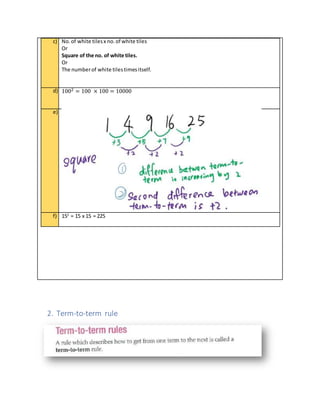
c) No.of white tilesx no.of white tiles
Or
Square of the no. of white tiles.
Or
The numberof white tilestimesitself.
d) 1002 = 100 × 100 = 10000
e)
f) 152
= 15 x 15 = 225
2. Term-to-term rule
2.1 Example:
2.2 Examples:
Questions:
For the sequence below:
2 4 6 8 10
a. Describe the term-to-termrule.
b. Write downthe nexttwotermsof the sequence.
c. Calculate the 10th
term.
Solutions:
a.
b.
c.
2.2.1 Group discussion 2
Questions:
For the sequence below:
1 3 5 7 9
a. Describe the term-to-termrule.
b. Write downthe nexttwotermsof the sequence.
c. Calculate the 10th
term.
Solutions:
a.
b.
c.
2.2.2 Task 2
Questions:
Part A
For the sequence below:
4 7 10 13 16
a. Describe the term-to-termrule.
b. Write downthe nexttwotermsof the sequence.
c. Calculate the 10th
term.
Solutions:
a.
b.
c.
Part B
For the sequence below:
7 14 21 28 35
a. Describe the term-to-termrule.
b. Write downthe nexttwotermsof the sequence.
c. Calculate the 10th
term.
Solutions:
a.
b.
c.
2.2.3 Group discussion 3
Questions:
Part A
For the sequence below:
9 7 5 3 1
a. Describe the term-to-termrule.
b. Write downthe nexttwotermsof the sequence.
c. Calculate the 10th
term.
Solutions:
a.
b.
c.
Part B
For the sequence below:
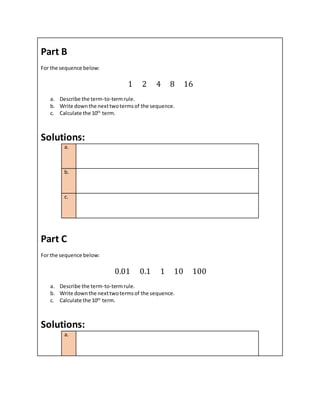
1 2 4 8 16
a. Describe the term-to-termrule.
b. Write downthe nexttwotermsof the sequence.
c. Calculate the 10th
term.
Solutions:
a.
b.
c.
Part C
For the sequence below:
0.01 0.1 1 10 100
a. Describe the term-to-termrule.
b. Write downthe nexttwotermsof the sequence.
c. Calculate the 10th
term.
Solutions:
a.
b.
c.
2.2.4 Task 3
Questions:
Part A
For the sequence below:
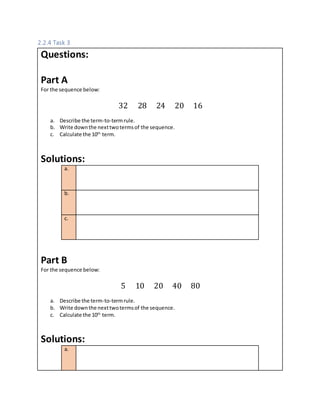
32 28 24 20 16
a. Describe the term-to-termrule.
b. Write downthe nexttwotermsof the sequence.
c. Calculate the 10th
term.
Solutions:
a.
b.
c.
Part B
For the sequence below:
5 10 20 40 80
a. Describe the term-to-termrule.
b. Write downthe nexttwotermsof the sequence.
c. Calculate the 10th
term.
Solutions:
a.
b.
c.
Part C
For the sequence below:
32 16 8 4 2
a. Describe the term-to-termrule.
b. Write downthe nexttwotermsof the sequence.
c. Calculate the 10th
term.
Solutions:
a.
b.
c.
3. Past year questions
Year 2017 P2 Q9
Here are the firstfive termsof a numbersequence.
23 20 17 14 11
a. Write downthe 8th
termof thissequence. [1%]
b. Findthe term-to-termrule. [1%]
Solution:
a.
b.
Year 2018 P1 Q18
The term-to-termrule of asequence ismultiplyby3.
The fourthterm of the sequence is54.
Work out the firsttermof the sequence. [1%]
Solution:
Year 2018 P2 Q11
Findthe term-to-termrule of eachsequence. [2%]
Solution:
Sequence Term-to-termrule 10th
term
11, 17, 23, 30, …
5, 8, 11, 14, …
6, 12, 18, 24, …
12, 9, 6, 3, …

Sequence

  • 1.
  • 3.
    1.1.1 Group discussion1 Questions: The diagram shows the first three patterns in a sequence of growing tile patterns. a) Draw the nexttwo diagramsinthe sequence. b) Complete this table. c) Describe the patternlinkingthe numberof whitetilesandthe numberof redtiles. d) Use yourrule in part (c) to predictthe numberof redtilesina patternwith 100 white tiles. e) Describe the patterninthe numberof redtiles. f) Use yourrule in part (e) to predictthe numberof redtilesinthe 15th diagram. Solutions: a)
  • 4.
    b) No. of white tiles 12 3 4 5 No. of red tiles 2 4 6 8 10 c) Times2 d) 100 x 2 = 200 red tiles e) Plus2 or add 2 or +2 f) Redtilesat 15th position(diagram) =2+ 2(14) =30
  • 5.
    1.1.2 Task 1(A) Questions: The diagram shows the first three patterns in a sequence of growing tile patterns. a) Draw the nexttwodiagramsin the sequence. b) Complete thistable. c) Describe the patternlinkingthe numberof white tilesandthe numberof greentiles. d) Use yourrule in part (c) to predictthe numberof greentilesinapatternwith100 white tiles. e) Describe the patterninthe numberof greentiles. f) Use yourrule in part (e) topredictthe numberof greentiles inthe 15th diagram. Solutions: a) b) No. of white tiles 1 2 3 4 5 No. of green tiles c) d) e)
  • 6.
  • 7.
    1.1.3 Task 1(B) Questions: Thediagram shows the first three patterns in a sequence of growing tile patterns. a) Draw the nexttwodiagramsin the sequence. b) Complete thistable. c) Describe the patternlinkingthe numberof white tilesandthe numberof orange tiles. d) Use yourrule in part (c) to predictthe numberof orange tilesina patternwith100 white tiles. e) Describe the patterninthe numberof orange tiles. f) Use yourrule in part (e) topredictthe numberof orange tilesinthe 15th diagram. Solutions: a) b) No. of white tiles 1 2 3 4 5 No. of green tiles c) d) e) f)
  • 8.
    1.1.4 Quiz 1 Questions: Thediagram shows the first three patterns in a sequence of growing tile patterns. a) Draw the nexttwodiagramsin the sequence. b) Complete thistable. c) Describe the patternlinkingthe numberof white tilesandthe numberof yellow tiles. d) Use yourrule in part (c) to predictthe numberof yellow tilesinapatternwith100 white tiles. e) Describe the patterninthe numberof yellow tiles. f) Use yourrule in part (e) topredictthe numberof yellow tilesinthe 15th diagram. Solutions: a) **The change is byincreasing1 columnand1 row. b) No. of white tiles 1 2 3 4 5 No. of yellow tiles 1 4 9 16 25
  • 9.
    c) No.of whitetilesx no.of white tiles Or Square of the no. of white tiles. Or The numberof white tilestimesitself. d) 1002 = 100 × 100 = 10000 e) f) 152 = 15 x 15 = 225 2. Term-to-term rule
  • 10.
  • 11.
    2.2 Examples: Questions: For thesequence below: 2 4 6 8 10 a. Describe the term-to-termrule. b. Write downthe nexttwotermsof the sequence. c. Calculate the 10th term. Solutions: a. b. c. 2.2.1 Group discussion 2 Questions: For the sequence below: 1 3 5 7 9 a. Describe the term-to-termrule. b. Write downthe nexttwotermsof the sequence. c. Calculate the 10th term. Solutions:
  • 12.
  • 13.
    2.2.2 Task 2 Questions: PartA For the sequence below: 4 7 10 13 16 a. Describe the term-to-termrule. b. Write downthe nexttwotermsof the sequence. c. Calculate the 10th term. Solutions: a. b. c. Part B For the sequence below: 7 14 21 28 35 a. Describe the term-to-termrule. b. Write downthe nexttwotermsof the sequence. c. Calculate the 10th term. Solutions:
  • 14.
    a. b. c. 2.2.3 Group discussion3 Questions: Part A For the sequence below: 9 7 5 3 1 a. Describe the term-to-termrule. b. Write downthe nexttwotermsof the sequence. c. Calculate the 10th term. Solutions: a. b. c.
  • 15.
    Part B For thesequence below: 1 2 4 8 16 a. Describe the term-to-termrule. b. Write downthe nexttwotermsof the sequence. c. Calculate the 10th term. Solutions: a. b. c. Part C For the sequence below: 0.01 0.1 1 10 100 a. Describe the term-to-termrule. b. Write downthe nexttwotermsof the sequence. c. Calculate the 10th term. Solutions: a.
  • 16.
  • 17.
    2.2.4 Task 3 Questions: PartA For the sequence below: 32 28 24 20 16 a. Describe the term-to-termrule. b. Write downthe nexttwotermsof the sequence. c. Calculate the 10th term. Solutions: a. b. c. Part B For the sequence below: 5 10 20 40 80 a. Describe the term-to-termrule. b. Write downthe nexttwotermsof the sequence. c. Calculate the 10th term. Solutions: a.
  • 18.
    b. c. Part C For thesequence below: 32 16 8 4 2 a. Describe the term-to-termrule. b. Write downthe nexttwotermsof the sequence. c. Calculate the 10th term. Solutions: a. b. c.
  • 19.
    3. Past yearquestions Year 2017 P2 Q9 Here are the firstfive termsof a numbersequence. 23 20 17 14 11 a. Write downthe 8th termof thissequence. [1%] b. Findthe term-to-termrule. [1%] Solution: a. b. Year 2018 P1 Q18 The term-to-termrule of asequence ismultiplyby3. The fourthterm of the sequence is54. Work out the firsttermof the sequence. [1%] Solution:
  • 20.
    Year 2018 P2Q11 Findthe term-to-termrule of eachsequence. [2%] Solution: Sequence Term-to-termrule 10th term 11, 17, 23, 30, … 5, 8, 11, 14, … 6, 12, 18, 24, … 12, 9, 6, 3, …