Tenofovir DF/emtricitabine and efavirenz combination therapy for HIV
infection in patients treated for tuberculosis: the ANRS 129 BKVIR trial
Olivier Lortholary1*, Caroline Roussillon2,3, Ce´line Boucherie2,3, Christophe Padoin4, Marie-Laure Chaix5,
Guillaume Breton6, Agathe Rami7, Nicolas Veziris8,9, Olivier Patey10, Eric Caumes11, Thierry May12,
Jean-Michel Molina13, Je´rome Robert8,9, Michel Tod14, Catherine Fagard2,3 and Genevie`ve Cheˆne2,3,15
on behalf of The ANRS 129 BKVIR Trial Group†
1
Universite´ Paris Descartes, APHP, Hoˆpital Necker Enfants Malades, Centre d’Infectiologie Necker-Pasteur, IHU Imagine, Paris, France;
2
Universite´ Bordeaux, ISPED, Centre INSERM U897-Epidemiologie-Biostatistique, F-33000 Bordeaux, France; 3
INSERM, ISPED, Centre
INSERM U897-Epidemiologie-Biostatistique, F-33000 Bordeaux, France; 4
Hoˆpital Avicenne, Laboratoire de Toxicologie et de Suivi
The´rapeutique, Bobigny, France; 5
Universite´ Paris Descartes EA 3620, Sorbonne Paris Cite´, AP-HP, Laboratoire de Virologie, CHU Necker-
Enfants Malades, Paris, France; 6
AP-HP, Hoˆpital Pitie´-Salpeˆtrie`re, Service de Me´decine Interne, Paris, France; 7
AP-HP, Hoˆpital Lariboisie`re,
Service de Me´decine Interne, Paris, France; 8
Sorbonne Universite´s, UPMC Univ Paris 06, CR7, INSERM, U1135, Centre d’Immunologie et des
Maladies Infectieuses, CIMI, team E13 (Bacteriology), F-75013, Paris, France; 9
AP-HP, Hoˆpital Pitie´-Salpeˆtrie`re, Centre National de
Re´fe´rence des Mycobacte´ries et de la Re´sistance des Mycobacte´ries aux Antituberculeux, Bacte´riologie-Hygie`ne, F-75013, Paris, France;
10
Hoˆpital Villeneuve St-Georges, Service des Maladies Infectieuses et Tropicales, Villeneuve S-Georges, France; 11
AP-HP, Hoˆpital Pitie´-
Salpeˆtrie`re, Service des Maladies Infectieuses et Tropicales, Paris, France; 12
Hoˆpital Brabois, Service des Maladies Infectieuses, Nancy,
France; 13
Universite´ Paris Diderot Paris 7, Hoˆpital St-Louis and INSERM U941, Paris, France; 14
Hoˆpital de la Croix-Rousse, Hospices Civils de
Lyon, Lyon, France; 15
CHU de Bordeaux, Poˆle de sante´ publique, Service d’information me´dicale, F-33000 Bordeaux, France
*Corresponding author. Tel: +33 1 42 19 26 63; Fax: +33 1 44 49 54 40; E-mail: olivier.lortholary@aphp.fr
†Members are listed in the Acknowledgements.
Received 6 August 2015; returned 10 September 2015; revised 3 October 2015; accepted 15 October 2015
Background: HIV-infected patients with TB need simplified, effective and well-tolerated antiretroviral regimens.
Methods: The French ANRS 129 BKVIR open trial evaluated the once-daily tenofovir DF/emtricitabine and efavir-
enz combination, started within 12 weeks after TB treatment initiation, in antiretroviral-naive HIV-1-infected
patients. Success was defined as an HIV-1 RNA ,50 copies/mL and TB cure at 48 weeks.
Results: TB was confirmed microbiologically (90%) or histologically (10%) in 69 patients (71% male; median age
43 years; 54% born in Africa). The median time between TB treatment initiation and antiretroviral therapy was
8 weeks (range 1–22 weeks). At baseline, median HIV-1 RNA was 5.4 log10 copies/mL and median CD4 cell count
74 cells/mm3
. In the ITT analysis, combined success at week 48 was achieved in 57/69 patients (83%, 95% CI
74–92). Twelve patients did not achieve virological success, and TB was not cured in one of them. Among the 47
patients who fully adhered to the strategy, the success rate was 96% (95% CI 90–100) and was not affected by
low rifampicin and isoniazid serum concentrations. Forty-nine serious adverse events were reported in 31
patients (45%), and 11 led to antiretroviral drug interruption. All adverse events resolved. The immune reconsti-
tution inflammatory syndrome occurred in 23 patients (33%, 95% CI 22–44), and was associated with a low
baseline BMI (P¼0.03) and a low haemoglobin level (P¼0.02).
Conclusion: These results support the use of tenofovir DF/emtricitabine and efavirenz combination therapy for
HIV infection in patients with TB.
Introduction
Co-infection with Mycobacterium tuberculosis and HIV is a major
public health problem worldwide,1
and TB is the most common
AIDS-defining illness in many countries. An estimated 1.37 million
new cases of TB occur each year in HIV-infected patients, mostly
in Africa, and 25% of TB-related deaths involve HIV-infected
patients. In addition, there is very limited decrease in TB incidence
among patients having CD4 ,50 cells/mm3
on a combination ART
(cART) regimen.2
Numerous pharmacokinetic interactions and
# The Author 2015. Published by Oxford University Press on behalf of the British Society for Antimicrobial Chemotherapy. All rights reserved.
For Permissions, please e-mail: journals.permissions@oup.com
J Antimicrob Chemother 2016; 71: 783–793
doi:10.1093/jac/dkv384 Advance Access publication 17 December 2015
783
byguestonMarch24,2016http://jac.oxfordjournals.org/Downloadedfrom
additive toxicities have been reported between TB drugs and
cART3 – 6
and the risk of an immune reconstitution inflammatory
syndrome (IRIS) has been well documented.7,8
Finally, the need
for close long-term adherence to both cART and TB therapy calls
for simplified cART regimens.9,10
The ANRS 129 BKVIR non-comparative pilot trial was designed
to evaluate the efficacy and safety of once-daily tenofovir DF/
emtricitabine and efavirenz, prescribed as a first-line combination
,12 weeks after starting antituberculous drugs in patients
co-infected with HIV and TB. This trial also assessed rifampicin
and isoniazid pharmacokinetics and the potential impact on TB
outcome.
Patients and methods
Study design and population
The ANRS 129 BKVIR study was a multicentre, non-comparative, nation-
wide trial. HIV-1-infected, antiretroviral-naive adults were eligible if they
had confirmed TB and had been treated with antituberculous drugs for
,12 weeks before inclusion. Patients had to be affiliated to the healthcare
system and were not eligible if they had HIV-2 or group O infection or
active cancer, were pregnant or breastfeeding, or had creatinine clearance
,60 mL/min, haemoglobin ,8 g/dL, neutrophils ,750/mm3
, platelets
,50000/mm3
, or any liver enzyme value .3-fold higher than the upper
normal limit.
All the patients gave their written informed consent and the protocol
was approved by an ethics committee (Comite´ Consultatif de Protection
des Personnes dans la Recherche Biome´dicale Paris Necker, France, num-
ber 05-06-09) and by the Agence Franc¸aise de Se´curite´ Sanitaire des
Produits de Sante´. The trial conformed to the Declaration of Helsinki.
This trial is registered with ClinicalTrials.gov (identifier: NCT00115609).
Study treatments
At week 0, all the patients started a once-daily cART regimen combining
tenofovir DF (300 mg/day)/emtricitabine (200 mg/day) and efavirenz
(800 mg/day if also treated with rifampicin, otherwise 600 mg/day).
Antitubercular treatment was managed by the study investigators accord-
ing to the standard of care (intensive phase followed by a continuation
phase with duration depending on TB localization).
Primary and secondary outcome measures
The primary endpoint was a combination of HIV-1 RNA ,50 copies/mL
and TB cure at week 48 (‘combined success’). The choice of a combined
outcome was based on a real-life approach, taking into account difficulties
of compliance to multiple drugs. TB was considered ‘probably cured’ if all
TB-attributed signs resolved and ‘certainly cured’ when, in addition, at
least two sputum smears were negative (if TB had been diagnosed micro-
scopically) or if culture was negative (in patients with positive culture at
baseline). Secondary endpoints included changes in the plasma HIV-1
RNA level and CD4+ T cell count, changes in the HIV-1 DNA level, TB
cure at week 48, adherence to treatment, pharmacokinetics of TB drugs,
safety and IRIS.
Local laboratories measured HIV-1 RNA and CD4+ Tcells at the screen-
ing visit, baseline (week 0) and weeks 4, 8, 12, 24, 36 and 48. HIV-1 DNA
was measured in peripheral blood mononuclear cells at weeks 0, 24 and
48.11
Drug susceptibility testing (DST) was performed in each centre by
using the proportion method, on either solid (Lo¨wenstein–Jensen) or liquid
(MGIT) medium. DST quality was assessed by an external quality assess-
ment programme using proficiency testing organized by the National
Reference Laboratory. The average agreement rates for isoniazid and
rifampicin DST were .90%.
Efavirenz plasma concentrations were measured at week 2 in patients
treated with rifampicin. Concentrations were considered sub-therapeutic if
,1 mg/L and supra-therapeutic if .4 mg/L. Rifampicin and isoniazid
trough and 2 h concentrations were measured at weeks 2, 8, 12 and 24
by liquid chromatography.12
Low 2 h concentrations were defined as
,8 mg/L for rifampicin and ,3 mg/L for isoniazid, and very low 2 h con-
centrations as ,4 mg/L for rifampicin and ,2 mg/L for isoniazid.13,14
TB was evaluated by the investigators according to national guidelines.
The severity of clinical and laboratory abnormalities was graded with the
Agence Nationale de Recherches sur le SIDA et les He´patites Virales
(ANRS) scale.
Events Review Committee
An Events Review Committee (ERC) reviewed TB diagnoses and cures, as
well as adverse events related or not related to the study drugs. IRIS
cases were reviewed and classified.15,16
IRIS was also classified as definite,
probable or ruled out.
Statistical analysis
Based on the literature available at the set-up of the trial, the success rate
at week 48 was expected to be at least 55%. One hundred patients were
required to ensure that the precision of the estimated success rate (two-
sided 95% CI) would be at least 10%. The primary analysis was conducted
on an ITT basis and included all enrolled patients, regardless of whether or
not the study treatment was prematurely discontinued. Missing HIV-1 RNA
values were classified as treatment failures in the primary efficacy ana-
lysis. The primary endpoint was also analysed separately among patients
who fully adhered to the trial strategy and among patients who did not
comply with the therapeutic strategy.
Differences in continuous variables were assessed using the Wilcoxon
rank-sum test. The cumulative incidence of events was estimated using
the Kaplan–Meier method, from week 0 onwards.
Risk factors for IRIS were identified by logistic regression. Baseline char-
acteristics with P values of ≤0.25 in univariable analysis were included in
the multivariable model. Variables retained in the multivariable model
were those associated with IRIS at a P value of ≤0.05.
All statistical analyses were performed with SAS software version 9.1.3
service pack 2 (SAS institute Inc., Cary, NC, USA). Drug concentrations were
analysed with JMP version 5.0.1.2 (SAS institute Inc., Cary, NC, USA).
Results
From December 2005 to December 2008, 85 patients were
screened, 70 were enrolled and 69 were analysed (one patient
had no French healthcare coverage). Despite extension of the
inclusion period, recruitment of the 100 participants needed
was not achieved because of the lack of healthcare coverage in
migrants with TB in France.
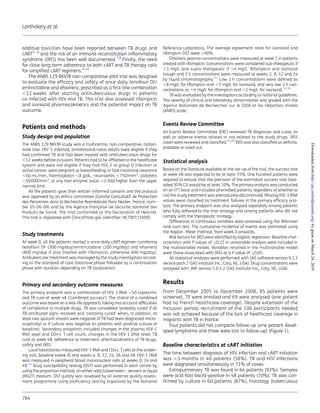
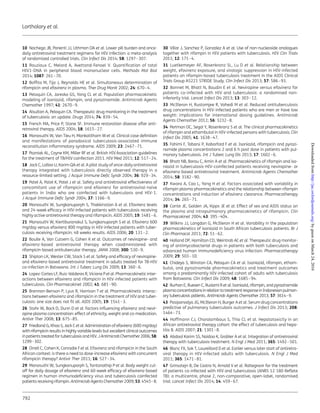
Four patients did not complete follow-up (one patient devel-
oped lymphoma and three were lost to follow-up) (Figure 1).
Baseline characteristics at cART initiation
The time between diagnosis of HIV infection and cART initiation
was ,3 months in 40 patients (58%). TB and HIV infections
were diagnosed simultaneously in 71% of cases.
Extrapulmonary TB was found in 64 patients (93%). Samples
were acid-fast bacilli-positive in 48 patients (70%). TB was con-
firmed by culture in 60 patients (87%), histology (tuberculous
Lortholary et al.
784
byguestonMarch24,2016http://jac.oxfordjournals.org/Downloadedfrom
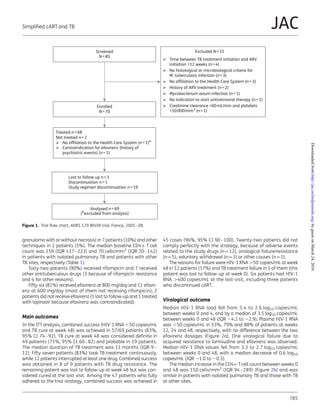
granuloma with or without necrosis) in 7 patients (10%) and other
techniques in 2 patients (3%). The median baseline CD4+ T cell
count was 159 (IQR 137–223) and 70 cells/mm3
(IQR 20–142)
in patients with isolated pulmonary TB and patients with other
TB sites, respectively (Table 1).
Sixty-two patients (90%) received rifampicin and 7 received
other antituberculous drugs (3 because of rifampicin resistance
and 4 for other reasons).
Fifty-six (81%) received efavirenz at 800 mg/day and 11 efavir-
enz at 600 mg/day (most of them not receiving rifampicin); 2
patients did not receive efavirenz (1 lost to follow-up and 1 treated
with lopinavir because efavirenz was contraindicated).
Main outcomes
In the ITT analysis, combined success (HIV-1 RNA ,50 copies/mL
and TB cure at week 48) was achieved in 57/69 patients (83%,
95% CI 74–92). TB cure at week 48 was considered definite in
49 patients (71%, 95% CI 60–82) and probable in 19 patients.
The median duration of TB treatment was 11 months (IQR 9–
12). Fifty-seven patients (83%) took TB treatment continuously,
while 12 patients interrupted at least one drug. Combined success
was obtained in 8 of 9 patients with TB drug resistance. The
remaining patient was lost to follow-up at week 48 but was con-
sidered cured at the last visit. Among the 47 patients who fully
adhered to the trial strategy, combined success was achieved in
45 cases (96%, 95% CI 90–100). Twenty-two patients did not
comply perfectly with the strategy, because of adverse events
related to the study drugs (n¼12), virological failure/resistance
(n¼5), voluntary withdrawal (n¼3) or other causes (n¼2).
The reasons for failure were HIV-1 RNA .50 copies/mL at week
48 in 12 patients (17%) and TB treatment failure in 1 of them (this
patient was lost to follow-up at week 0). Six patients had HIV-1
RNA .400 copies/mL at the last visit, including three patients
who discontinued cART.
Virological outcome
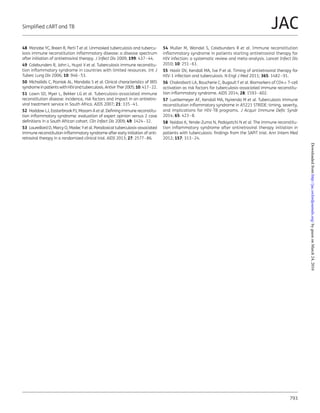
Median HIV-1 RNA load fell from 5.4 to 2.6 log10 copies/mL
between weeks 0 and 4, and by a median of 3.5 log10 copies/mL
between weeks 0 and 48 (IQR 24.2 to 22.9). Plasma HIV-1 RNA
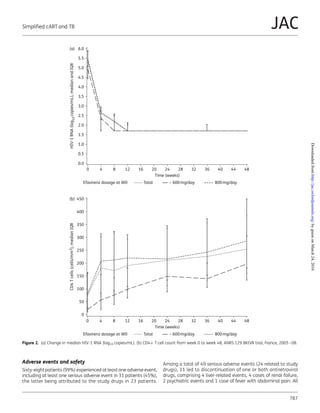
was ,50 copies/mL in 53%, 79% and 88% of patients at weeks
12, 24 and 48, respectively, with no difference between the two
efavirenz dosages (Figure 2a). One virological failure due to
acquired resistance to lamivudine and efavirenz was observed.
Median HIV-1 DNA values fell from 3.3 to 2.7 log10 copies/mL
between weeks 0 and 48, with a median decrease of 0.6 log10
copies/mL (IQR 21.0 to 20.3).
The median increase in the CD4+ Tcell count between weeks 0
and 48 was 150 cells/mm3
(IQR 94–289) (Figure 2b) and was
similar in patients with isolated pulmonary TB and those with TB
at other sites.
Screened
N=85
Enrolled
N=70
Excluded N=15
Time between TB treatment initiation and ARV
initiation >12 weeks (n=4)
No histological or microbiological criteria for
M. tuberculosis infection (n=3)
No affiliation to the Health Care System (n=3)
History of ARV treatment (n=2)
Mycobacterium avium infection (n=1)
No indication to start antiretroviral therapy (n=1)
Creatinine clearance <60mL/min and platelets
<50000/mm3 (n=1)
Treated n=68
Not treated n=2
No affiliation to the Health Care System (n=1)*
Contraindication for efavirenz (history of
psychiatric events) (n=1)
Lost to follow up n=3
Discontinuation n=1
Study regimen discontinuation n=19
Analysed n=69
(*excluded from analysis)
Figure 1. Trial flow chart, ANRS 129 BKVIR trial, France, 2005–08.
Simplified cART and TB
785
JAC
byguestonMarch24,2016http://jac.oxfordjournals.org/Downloadedfrom
Table 1. Baseline demographic and clinical characteristics of the 69 patients enrolled in the ANRS 129 BKVIR trial, France, 2005–2008
Baseline demographic and clinical data Values
Median age, years (IQR) 43 (34–52)
Males, n (%) 49 (71)
Birthplace, n (%)
sub-Saharan Africa 37 (54)
France 16 (23)
other countries 16 (23)
Time between arrival in France and TB diagnosis in years (N¼53), median (IQR) 8 (4–19)
Mode of HIV infection, n (%)
heterosexual 52 (75)
homo/bisexual male 11 (16)
other 6 (9)
HBV serology, n (%) (N¼66)
HBsAg positive 7 (11)
anti-HBc-positive and/or anti-HBs positive 37 (56)
negative 22 (33)
HCV serology, n (%) (N¼68)
positive 5 (7)
negative 63 (93)
Body weight, kg, median (IQR) 63 (56–73)
BMI, kg/m2
, median (IQR) 21.5 (19.6–24.3)
CD4 T cells/mm3
, median (IQR) 74 (23–159)
CD4 T cells (%), median (IQR) 8 (3–14)
CD8 T cells/mm3
, median (IQR) 555 (399–910)
CD8 T cells (%), median (IQR) 65 (57–76)
Ratio CD4 T cells/CD8 T cells, median (IQR) 0.11 (0.05–0.22)
HIV-1 RNA, log10 copies/mL, median (IQR) 5.4 (4.9–5.9)
TB localization, n (%)
isolated pulmonary 5 (7)
pulmonary and extrapulmonary 52 (76)
isolated extrapulmonary 12 (17)
Result of AFB detection for pulmonary TB (N¼57), n (%)
positive 34 (60)
positive culture 33 (97)
negative 23 (40)
positive culture 17 (74)
Elements of diagnosis, n (%)
positive culture 60 (87)
histology 7 (10)
other 2 (3)a
TB drug resistance, n¼60 (%)
no resistance 51 (85)
streptomycin resistance 4 (7)
isoniazid+rifampicin resistance 2 (3)
isoniazid resistance 2 (3)
rifampicin resistance 1 (2)
AFB, acid-fast bacilli; HBV, hepatitis B virus; HCV, hepatitis C virus; HBsAg, hepatitis B surface antigen; HBc, hepatitis B core.
a
Both patients had a microscopically positive sputum smear plus positive M. tuberculosis PCR in one case and a positive Quantiferon test in the other case.
Lortholary et al.
786
byguestonMarch24,2016http://jac.oxfordjournals.org/Downloadedfrom
Adverse events and safety
Sixty-eight patients (99%) experienced at least one adverse event,
including at least one serious adverse event in 31 patients (45%),
the latter being attributed to the study drugs in 23 patients.
Among a total of 49 serious adverse events (24 related to study
drugs), 11 led to discontinuation of one or both antiretroviral
drugs, comprising 4 liver-related events, 4 cases of renal failure,
2 psychiatric events and 1 case of fever with abdominal pain. All
0.0
0 4 8 12 16 20 24
Time (weeks)
28 32 36 40 44 48
0.5
1.0
HIV-1RNA(log10copies/mL),medianandIQR
1.5
2.0
2.5
3.0
3.5
4.0
4.5
5.0
5.5
6.0(a)
(b)
0
0
50
100
150
200
250
300
350
400
4 8 12 16 20 24
Time (weeks)
Efavirenz dosage at W0 Total 600mg/day 800mg/day
28 32 36 40 44 48
CD4Tcells(cells/mm3),medianIQR
450
Efavirenz dosage at W0 Total 600mg/day 800mg/day
Figure 2. (a) Change in median HIV-1 RNA (log10 copies/mL). (b) CD4+ T cell count from week 0 to week 48, ANRS 129 BKIVR trial, France, 2005–08.
Simplified cART and TB
787
JAC
byguestonMarch24,2016http://jac.oxfordjournals.org/Downloadedfrom
were considered related to the study drugs by the investigator and
the sponsor and all resolved during the trial. No patient died.
The adverse events were neurological (n¼43, 16%), cutaneous
(n¼19, 7%) or hepatic (n¼12, 4%). Seventy-seven adverse events
were considered by the investigator as related to efavirenz (71 clin-
ical, 6 biological). Clinical adverse events related to efavirenz
occurred after a median of 26 days (first quartile 6 days). Eighty-
one percent of neurological and 58% of hepatic adverse events
were considered related to efavirenz (Table 2). Among the 19
patients who discontinued the study regimen, 9 (47%) did so
because of efavirenz intolerance (initial dosage 800 mg/day in
eight cases, 600 mg/day in one case). These latter adverse effects
occurred after a median of 26 days (IQR 16–116) and comprised
four neuropsychiatric events, three hepatic events, one case of
gynaecomastia and one of IRIS. At the time of efavirenz withdrawal,
three of the patients concerned were receiving 600 mg/day.
All seven renal adverse events (four serious) were attributed to
tenofovir.
Among the 277 recorded adverse events, 33 (12%) were
attributed to TB agents, including 9 hepatic events and 1 cutane-
ous event.
Impact of the initial efavirenz dosage and therapeutic
monitoring
Among the 37 patients receiving efavirenz at 800 mg/day plus
rifampicin at week 0 and for whom efavirenz serum concentra-
tions were available at week 2, values were within, above and
below the therapeutic range in 26 (71%), 9 (24%) and 2 (5%)
patients, respectively. The two patients receiving efavirenz
at 600 mg/day plus rifampicin both had efavirenz serum
concentrations within the therapeutic range at week 2. Week 2
efavirenz serum concentrations did not differ between patients
of African origin and other patients. The increase in the CD4+ T
cell count between baseline and week 48 was 209 (IQR 10–
357) and 150 cells/mm3
(IQR 96 to 230), respectively, in patients
with efavirenz plasma concentration .4 mg/L at week 2 (n¼11)
and patients with lower concentrations (n¼34).
Among the 26 patients who experienced neurological adverse
effects related to efavirenz, 14, 7 and 2 patients had week 2 serum
efavirenz concentrations within, above and below the therapeutic
range, respectively, while 3 patients had no available values.
Among the nine patients with high efavirenz concentrations at
week 2, eight (89%) experienced a related adverse event (neuro-
logical, hepatic and cutaneous events in seven, two and one,
respectively).
Serial serum concentrations of rifampicin
and isoniazid
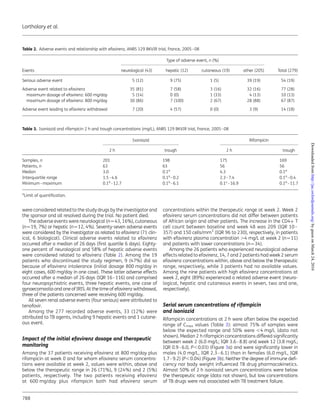
Rifampicin concentrations at 2 h were often below the expected
range of Cmax values (Table 3): almost 75% of samples were
below the expected range and 50% were ,4 mg/L (data not
shown). Median 2 h rifampicin concentrations differed significantly
between week 2 (6.0 mg/L; IQR 3.6–8.8) and week 12 (3.8 mg/L;
IQR 0.9–6.0, P,0.03) (Figure 3a) and were significantly lower in
males (4.0 mg/L, IQR 2.3–6.1) than in females (6.0 mg/L, IQR
1.7–9.2) (P,0.04) (Figure 3b). Neither the degree of immune defi-
ciency nor body weight influenced TB drug pharmacokinetics.
Almost 50% of 2 h isoniazid serum concentrations were below
the therapeutic range (data not shown), but low concentrations
of TB drugs were not associated with TB treatment failure.
Table 2. Adverse events and relationship with efavirenz, ANRS 129 BKVIR trial, France, 2005–08
Type of adverse event, n (%)
Events neurological (43) hepatic (12) cutaneous (19) other (205) Total (279)
Serious adverse event 5 (12) 9 (75) 1 (5) 39 (19) 54 (19)
Adverse event related to efavirenz 35 (81) 7 (58) 3 (16) 32 (16) 77 (28)
maximum dosage of efavirenz: 600 mg/day 5 (14) 0 (0) 1 (33) 4 (13) 10 (13)
maximum dosage of efavirenz: 800 mg/day 30 (86) 7 (100) 2 (67) 28 (88) 67 (87)
Adverse event leading to efavirenz withdrawal 7 (20) 4 (57) 0 (0) 3 (9) 14 (18)
Table 3. Isoniazid and rifampicin 2 h and trough concentrations (mg/L), ANRS 129 BKVIR trial, France, 2005–08
Isoniazid Rifampicin
2 h trough 2 h trough
Samples, n 201 198 175 169
Patients, n 63 63 56 56
Median 3.0 0.1a
4.3 0.1a
Interquartile range 1.5–4.6 0.1a
–0.2 2.3–7.4 0.1a
–0.4
Minimum–maximum 0.1a
–12.7 0.1a
–6.1 0.1*–16.9 0.1a
–11.7
a
Limit of quantification.
Lortholary et al.
788
byguestonMarch24,2016http://jac.oxfordjournals.org/Downloadedfrom
IRIS
Twenty-three patients (33%) had IRIS (95% CI 22–44), 19 cases
being considered ‘definite’ according to the French, INSHI
(International Network for the Study of HIV IRIS) and ERC classi-
fications. Discrepancies among the three classifications were
noted in the remaining four cases.
Five episodes (22%) were considered serious (two cases of
acute renal failure, two cerebral tuberculomas with seizures or
intracranial hypertension, and one case of segmental bronchus
compression), and 12 patients (52%) required steroid therapy.
The median time between cART initiation and the onset of IRIS
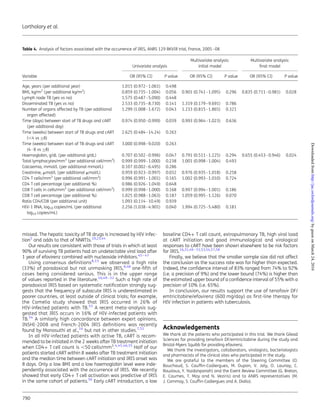
was 8 days (IQR 5–14). In multivariate analysis, a higher BMI
(OR¼0.84 per additional unit, 95% CI 0.71–0.98, P¼0.03) and
a higher haemoglobin level (OR¼0.66 per additional unit, 95%
CI 0.45–0.95, P¼0.02) were protective against IRIS (Table 4).
Discussion
In the ANRS 129 BKVIR trial, 83% of HIV-infected patients with TB
were successfully treated, with tuberculosis cure and HIV viral
control at week 48. Our findings thus support UK, EACS (European
AIDS Clinical Society) and WHO recommendations advocating
first-line tenofovir DF/emtricitabine and efavirenz combination
therapy for antiretroviral-naive HIV-infected patients receiving TB
drugs.3,17
Previous studies of efavirenz combined with other nucleoside
analogues have also given encouraging results.18–23
Subsequent
studies favoured efavirenz rather than nevirapine co-administration
with rifampicin.6
Given the deleterious pharmacokinetic interaction
between rifampicin and efavirenz,24
we initially prescribed efavirenz
at 800 mg/day. However, 50% of patients who discontinued the
study regimen did so because of efavirenz intolerance, mostly at
800 mg/day, in keeping with British data.25
The optimal efavirenz
dosage for use in combination with rifampicin remains a matter
of heated debate. One study showed that ethnicity and low body
weight influenced efavirenz concentrations.26
Earlier studies of
slim Thai patients failed to show differences in efavirenz concentra-
tions or efficacy when used with rifampicin.20,21
In South Africa, efa-
virenz at 600 mg/day plus rifampicin was associated with wide
variations in efavirenz concentrations and with neurological adverse
effects in up to 50% of patients but resulted in good virological out-
comes.27
A more recent study showed that efavirenz concentra-
tions did not decrease after adding rifampicin when 600 mg/day
dosage was used, while they increased when 800 mg/day dosage
was used.28
Our data support recommendations advocating efavir-
enz at 600 mg/day for co-administration with rifampicin, but efavir-
enz at 800 mg/day remains an option for patients weighing
.60 kg,3,4
who tend to have lower efavirenz concentrations.29
A
higher risk of treatment failure was found when the efavirenz
dose was not adjusted to body weight,30
but the recent STRIDE
study showed no benefit of weight-based dosing.31
The tenofovir
DF/emtricitabine and efavirenz combination tested here, although
associated with a high rate of well-known adverse effects (partially
due to close observation in the hospital setting), appears to be an
acceptable option. Other options, such as nevirapine-containing
regimens, could also be acceptable.32
We found low concentrations of both rifampicin (75% of
patients) and isoniazid (50% of patients) in these HIV-infected
patients with TB. In four earlier studies, around three-quarters of
patients had rifampicin concentrations ,8 mg/L (,4 mg/L in
around one-third of cases).33–36
In three studies, around 50% of
patients had isoniazid concentrations ,3 mg/L.33,35,36
Of note, we
found no influence of body weight on rifampicin concentrations,
contrary to a recent study of South African patients.33
Two former
studies and the present study showed lower rifampicin concentra-
tions in male patients.33,37
Surprisingly, isoniazid plasma levels were
also low, whereas HIV serostatus is supposed to have little or no
effect on isoniazid concentrations.38–40
We found that low rifampi-
cin and isoniazid serum concentrations did not affect TB treatment
efficacy. Likewise, Chideya et al.41
and Burhan et al.42
only found a
relationship between low pyrazinamide concentrations and poorer
outcome in Botswana and Indonesia, respectively. Together, these
data suggest that routine monitoring of isoniazid and rifampicin
concentrations is not mandatory for HIV-infected patients with
TB, even though low drug exposure is predictive of poor clinical out-
come in all-comer patients with tuberculosis.43
Twelve percent of adverse events were attributed to TB drugs,
including 9/12 hepatic and 1/19 cutaneous events, although it
should be noted that recording only started at the time of inclu-
sion and that early TB drug-related adverse effects were therefore
0
2 8
Visit week
12 24
10
(a)
(b)
Rifampicin2hconc(mg/L)
0
F
Sex
M
10
Rifampicin2hconc(mg/L)
Figure 3. (a) Median rifampicin 2 h concentrations at each protocol visit
and (b) according to gender [male (M); female (F)]. Error bars indicate
the range of concentrations and boxes represent the IQRs. ANRS 129
BKIVR trial, France, 2005–08.
Simplified cART and TB
789
JAC
byguestonMarch24,2016http://jac.oxfordjournals.org/Downloadedfrom
missed. The hepatic toxicity of TB drugs is increased by HIV infec-
tion5
and adds to that of NNRTIs.19,23,44
Our results are consistent with those of trials in which at least
90% of surviving TB patients had an undetectable viral load after
1 year of efavirenz combined with nucleoside inhibitors.45– 47
Using consensus definitions8,15
we observed a high rate
(33%) of paradoxical but not unmasking IRIS,8,48
one-fifth of
cases being considered serious. This is in the upper range
of values reported in the literature.16,49 – 52
Such a high rate of
paradoxical IRIS based on systematic notification strongly sug-
gests that the frequency of subacute IRIS is underestimated in
poorer countries, at least outside of clinical trials; for example,
the Camelia study showed that IRIS occurred in 26% of
HIV-infected patients with TB.53
A recent meta-analysis sug-
gested that IRIS occurs in 16% of HIV-infected patients with
TB.54
A similarly high concordance between expert opinions,
INSHI-2008 and French-2004 IRIS definitions was recently
found by Manosuthi et al.,16
but not in other studies.7,52
In all HIV-infected patients with active TB, cART is recom-
mended to be initiated in the 2 weeks after TB treatment initiation
when CD4+ T cell count is ,50 cells/mm3
.4,45,46,55
Half of our
patients started cART within 8 weeks after TB treatment initiation
and the median time between cART initiation and IRIS onset was
8 days. Only a low BMI and a low haemoglobin level were inde-
pendently associated with the occurrence of IRIS. We recently
showed that early CD4+ T cell activation was predictive of IRIS
in the same cohort of patients.56
Early cART introduction, a low
baseline CD4+ T cell count, extrapulmonary TB, high viral load
at cART initiation and good immunological and virological
responses to cART have been shown elsewhere to be risk factors
for IRIS.16,31,49 –51,53,54,57,58
Finally, we believe that the smaller sample size did not affect
the conclusion as the success rate was far higher than expected.
Indeed, the confidence interval of 83% ranged from 74% to 92%
(i.e. a precision of 9%) and the lower bound (74%) is higher than
the estimated upper bound of a confidence interval of 55% with a
precision of 10% (i.e. 65%).
In conclusion, our results support the use of tenofovir DF/
emtricitabine/efavirenz (600 mg/day) as first-line therapy for
HIV infection in patients with tuberculosis.
Acknowledgements
We thank all the patients who participated in this trial. We thank Gilead
Sciences for providing tenofovir DF/emtricitabine during the study and
Bristol-Myers Squibb for providing efavirenz.
We thank the investigators, collaborators, virologists, bacteriologists
and pharmacists of the clinical sites who participated in the study.
We are grateful to the members of the Steering Committee (O.
Bouchaud, S. Couffin-Cadiergues, M. Dupon, V. Joly, O. Launay, C.
Rouzioux, Y. Yazdanpanah) and the Event Review Committee (G. Breton,
E. Caumes, T. May and N. Veziris) and to ANRS representatives (M.
J. Commoy, S. Couffin-Cadiergues and A. Diallo).
Table 4. Analysis of factors associated with the occurrence of IRIS, ANRS 129 BKVIR trial, France, 2005–08
Variable
Univariate analysis
Multivariate analysis:
initial model
Multivariate analysis:
final model
OR (95% CI) P value OR (95% CI) P value OR (95% CI) P value
Age, years (per additional year) 1.015 (0.972–1.061) 0.498
BMI, kg/m2
(per additional kg/m2
) 0.859 (0.735–1.004) 0.056 0.901 (0.741–1.095) 0.296 0.835 (0.711–0.981) 0.028
Lymph node TB (yes vs no) 1.575 (0.487–5.090) 0.448
Disseminated TB (yes vs no) 2.533 (0.735–8.730) 0.141 1.319 (0.179–9.691) 0.786
Number of organs affected by TB (per additional
organ affected)
1.299 (1.008–1.672) 0.043 1.233 (0.815–1.865) 0.321
Time (days) between start of TB drugs and cART
(per additional day)
0.974 (0.950–0.999) 0.039 0.993 (0.964–1.023) 0.636
Time (weeks) between start of TB drugs and cART
(,4 vs ≥8)
2.625 (0.484–14.24) 0.263
Time (weeks) between start of TB drugs and cART
(4–8 vs ≥8)
3.000 (0.998–9.020) 0.263
Haemoglobin, g/dL (per additional g/dL) 0.707 (0.502–0.996) 0.047 0.791 (0.511–1.225) 0.294 0.655 (0.453–0.946) 0.024
Total lymphocytes/mm3
(per additional cell/mm3
) 0.999 (0.999–1.000) 0.238 1.001 (0.998–1.004) 0.493
Calcaemia, mmol/L (per additional mmol/L) 0.107 (0.002–6.495) 0.286
Creatinine, mmol/L (per additional mmol/L) 0.959 (0.923–0.997) 0.032 0.976 (0.935–1.018) 0.258
CD4 T cells/mm3
(per additional cell/mm3
) 0.996 (0.991–1.001) 0.165 1.002 (0.993–1.010) 0.724
CD4 T cell percentage (per additional %) 0.986 (0.926–1.049) 0.648
CD8 T cells in cells/mm3
(per additional cell/mm3
) 0.999 (0.998–1.000) 0.168 0.997 (0.994–1.001) 0.186
CD8 T cell percentage (per additional %) 1.025 (0.988–1.063) 0.187 1.059 (0.995–1.126) 0.070
Ratio CD4/CD8 (per additional unit) 1.093 (0.114–10.49) 0.939
HIV-1 RNA, log10 copies/mL (per additional
log10 copies/mL)
2.256 (1.038–4.901) 0.040 1.994 (0.725–5.480) 0.181
Lortholary et al.
790
byguestonMarch24,2016http://jac.oxfordjournals.org/Downloadedfrom
ANRS 129 BKVIR Trial Group
Investigators and sites
Saint-Jean hospital, Perpignan: H. Aumaıˆtre, F. Borsato, M. Malet, M. Me´dus,
L. Moreau, S. Neuville, M. Saada. Avicenne Hospital, Bobigny: S. Abgrall,
D. Ahoudji, L. Balmard, M. Bentata, O. Bouchaud, A. Boudribila, J. Cailhol,
R. Dhote, R. Djebbar, H. Gros, P. Honore´, T. Huynh, A. Krivitzky, R. Mansouri,
C. Pizzocolo, F. Rouges, E. Viot. Villeneuve Saint-Georges Hospital: B. Amar,
J. Bantsimba, S. Dellion, O. Patey, L. Richier. Pellegrin Hospital, Bordeaux:
M. Dupon, H. Dutronc, D. Neau, J. M. Ragnaud, I. Raymond. Necker Hospital,
Paris: S. Boucly, L. Gailhoustet, O. Lortholary, A. Maignan, F. Touam, J. P. Viard.
Lariboisie`re Hospital, Paris: J. F. Bergmann, E. Boulanger, V. Delcey, M. Diemer,
A. Durel, F. Jouade, M. Parrinello, A. Rami, P. Sellier. Saint-Germain en Laye
Hospital: P. Brazille, C. Leclerc, Y. Welker. Raymond Poincare´ Hospital,
Garches: L. Bernard, H. Berthe´, C. Perronne, J. Salomon, P. de Truchis. Paul
Brousse Hospital, Villejuif: C. Bolliot, C. Couzigou, O. Derradji, L. Escaut,
E. Teicher, D. Vittecoq. Tenon Hospital, Paris: C. Chakvetadze, C. Fontaine,
T. L’Yavanc, A. Maresca, G. Pialoux, L. Slama, L. Tuna. Antoine Be´cle`re
Hospital, Clamart: D. Bornarel, F. Boue´, A. Chassaing, L. Chaiba-Berroukeche,
V. Chambrin, A. M. Delavalle, P. Galanaud, A. Levy, C. Pignon. Bichat
Claude-Bernard Hospital, Paris: D. Bonnet, J. L. Ecobichon, I. Fournier,
G. Fraquiero, J. Gerbe, A. Gervais, V. Guiyedi, L. Iordache, V. Joly, P. Klutse, J.
J. Laurichesse, C. Leport, M. Onanga, G. Pahlaval, B. C. Phung,
P. Ralaimazava, P. Yeni. Cochin Hospital, Paris: F. Almasi, M. Basler,
N. Benammar, A. Brunes, C. Gue´rin, L. Guillevin, R. Meddour, D. Salmon,
G. Spiridon, T. Tahi. Louis Mourier Hospital, Colombes: M. Bloch, C. Ferreira,
I. Mahe, V. Manceron, C. Minozzi, E. Mortier, A. M. Simonpoli, P. Vinceneux,
F. Zeng Ai. Henri Mondor Hospital, Cre´teil: C. Chesnel, S. Dominguez,
P. Jouve, A. S. Lascaux-Cametz, J. D. Lelie`vre, Y. Levy, G. Melica, A. Sobel.
Pitie´ Salpeˆtrie`re Hospital, Paris: N. Bentaleb, A. Blondin-Diop,
M. Bonmarchand, P. Bossi, C. Brancon, G. Breton, F. Bricaire, F. Caby,
A. Canestri, C. Clavel, N. Edeb, S. Herson, M. Iguertsira, C. Katlama,
H. Kouadio, P. Lagarde, J. L. Lopez, F. Marguet, V. Martinez, H. Remidi,
A. Simon, J. F. Souchon, M. A. Valantin. Saint-Antoine Hospital, Paris:
D. Bollens, P. M. Girard, J. L. Lagneau, B. Lefebvre, R. Mouchotte, Z. Ouazene,
M. Sebire, A. Theveny-Christiany, N. Valin. Saint Louis Hospital, Paris:
A. Bourgarit, N. de Castro, J. Delgado, S. Ferret, C. Lascoux-Combe, J.
M. Molina, S. Parlier, J. Pavie, C. Pintado, D. Ponscarme, A. Rachline,
D. Sereni, O. Taulera, C. de Verdiere, F. Vincent. Saint Andre´ Hospital,
Bordeaux: N. Bernard, M. Bonarek, F. Bonnet, J. Delaune, D. Lacoste, I. Louis,
D. Malvy, P. Mercier, P. Morlat, M. C. Pertusa, M. Schottey. Gui de Chauliac
Hospital, Montpellier: N. Chanteloube, A. Eden, V. Le Moing, A. Makilson,
C. Merle de Boever, J. Reynes, C. Turrie`re, C. Tramoni, M. Vidal. Hoˆtel Dieu
Hospital, Nantes: C. Anavena, E. Billaud, C. Biron, B. Bonnet, J. Bouchez,
D. Boutoille, D. Brosseau, C. Brunct, M. Colas, N. Feuillebois, H. Hu¨e,
E. Launay, P. Morineau le Houssine, F. Raffi, V. Reliquet. L’Archet I Hospital,
Nice: E. Cua, P. Dellamonica, J. Durant, V. Rahelinirina. Pontchaillou Hospital,
Rennes: C. Arvieux, J. M. Chapplain, F. Fily, E. Labbay, C. Michelet, F. Morin,
C. Peaucelle, M. Revest, M. Ratajczak, F. Souala, P. Tattevin, R. Thomas.
Purpan Hospital, Toulouse: M. Alvarez, F. Balsarin, E. Bonnet, F. Busato,
L. Cuzin, D. Marche, B. Marchou, P. Massip, M. Obadia, L. Porte. Gustave Dron
Hospital, Tourcoing: E. Aissi, F. Ajana, I. Alcaraz, V. Baclet, S. Dubus, Y. Ge´rard,
H. Guerroumi, T. Huleux, A. Lahouste, M. C. Marien, H. Melliez, Y. Mouton, M.
P. Pennel, M. Valette, N. Viget, Y. Yazdanpanah. De Brabois Hospital, Nancy:
S. Bevilacqua, L. Boyer, T. Lecompte, L. Letranchant, T. May, C. Rabaud,
L. Thomas, R. Vancon, S. Wassoumbou. Charles Nicolle Hospital, Rouen:
P. Abboud, F. Borsa-Lebas, F. Caron, Y. Debab, M. Etienne, M. Faucon,
I. Gueit. Nord Hospital, Marseille: P. Brouqui, S. Mokhtari, J. Moreau,
M. Schlojsers, E. Vandergheynst. Cre´teil Hospital: M. Chousterman,
I. Delacroix-Szmania, B. El Harrar, V. Garrait, S. Joannes, I. Luquet-Besson,
M. Mouchet, L. Richier. Ambroise Pare´ Hospital, Boulogne: A. Blase Stevens,
C. Dupont, A. Freire Maresca, S. Greffe, T. Hanslik, B. Landi, J. Leporrier,
E. Rouveix, K. Toth. Delafontaine Hospital, Saint-Denis: L. El Mansouf, M.
A. Khuong-Josses, D. Me´chali, J. Phalip Le Besnerais, B. Taverne. Jean
Verdier Hospital, Bondy: F. Barclay, O. Fain, G. Flexor, J. Stirnemann, S. Tassi.
Chambe´ry Hospital: M. Levast, O. Rogeaux, D. Raffenot, J. Tous.
Steering Committee
O. Lortholary, O. Bouchaud, M. L. Chaix, G. Cheˆne, S. Couffin-Cadiergues,
M. Dupon, C. Fagard, V. Joly, O. Launay, J. M. Molina, J. Robert, C. Roussillon,
C. Rouzioux, M. Tod, Y. Yazdanpanah.
Events Review Committee
O. Lortholary, G. Breton, E. Caumes, T. May, C. Roussillon, N. Veziris.
Clinical Trials Unit/INSERM U897, Bordeaux School of Public
Health (ISPED), University Bordeaux Segalen
M. Badets, C. Boucherie, C. Fagard, G. Cheˆne, C. Roussillon, N. Terras. The
study team also included C. Gue´rin, protocol pharmacist, F. Altare,
A. Bourgarit and G. Carcelain in charge of the BKVIRIS substudy, Lisa
Chakrabarti in charge of the BKVIR Cytok substudy, and pharmaceutical
representatives: A. Trylesinski and. C. Aubron-Olivier (Gilead Sciences)
and T. Nguyen and Y. Bennai (Bristol-Myers Squibb).
Funding
The ANRS 129 BKVIR trial was sponsored and funded by ANRS (Agence
Nationale de Recherches sur le SIDA et les He´patites Virales).
Transparency declarations
None to declare.
References
1 Aaron L, Saadoun D, Calatroni I et al. Tuberculosis in HIV-infected
patients: a comprehensive review. Clin Microbiol Infect 2004; 10: 388–98.
2 del Amo J, Moreno S, Bucher HC et al. Impact of antiretroviral therapy on
tuberculosis incidence among HIV-positive patients in high-income coun-
tries. Clin Infect Dis 2012; 54: 1364–72.
3 European AIDS Clinical Society. Guidelines Version 6.0. Octobre 2011.
Brussels: EACS, 2011. http://apps.who.int/medicinedocs/en/d/Js19813en/.
4 Panel on Antiretroviral Guidelines for Adults and Adolescents. Guidelines
for the Use of Antiretroviral Agents in HIV-1-Infected Adults and
Adolescents. Washington: Department of Health and Human Services,
2013. https://aidsinfo.nih.gov/guidelines.
5 Lanternier F, Dalban C, Perez L et al. Tolerability of anti-tuberculosis
treatment and HIV serostatus. Int J Tuberc Lung Dis 2007; 11: 1203–9.
6 Manosuthi W, Sungkanuparph S, Tantanathip P et al. A randomized trial
comparing plasma drug concentrations and efficacies between 2 nonnu-
cleoside reverse-transcriptase inhibitor-based regimens in HIV-infected
patients receiving rifampicin: the N2R Study. Clin Infect Dis 2009; 48:
1752–9.
7 Haddow LJ, Moosa MY, Easterbrook PJ. Validation of a published case
definition for tuberculosis-associated immune reconstitution inflamma-
tory syndrome. AIDS 2010; 24: 103–8.
8 Meintjes G, Lawn SD, Scano F et al. Tuberculosis-associated immune
reconstitution inflammatory syndrome: case definitions for use in
resource-limited settings. Lancet Infect Dis 2008; 8: 516–23.
9 Onyebujoh PC, Ribeiro I, Whalen CC. Treatment options for HIV-associated
tuberculosis. J Infect Dis 2007; 196 Suppl 1: S35–45.
Simplified cART and TB
791
JAC
byguestonMarch24,2016http://jac.oxfordjournals.org/Downloadedfrom
10 Nachega JB, Parienti JJ, Uthman OA et al. Lower pill burden and once-
daily antiretroviral treatment regimens for HIV infection: a meta-analysis
of randomized controlled trials. Clin Infect Dis 2014; 58: 1297–307.
11 Rouzioux C, Melard A, Avettand-Fenoel V. Quantification of total
HIV1-DNA in peripheral blood mononuclear cells. Methods Mol Biol
2014; 1087: 261–70.
12 Boffito M, Tija J, Reynolds HE et al. Simultaneous determination of
rifampicin and efavirenz in plasma. Ther Drug Monit 2002; 24: 670–4.
13 Peloquin CA, Jaresko GS, Yong CL et al. Population pharmacokinetic
modeling of isoniazid, rifampin, and pyrazinamide. Antimicrob Agents
Chemother 1997; 41: 2670–9.
14 Alsultan A, Peloquin CA. Therapeutic drug monitoring in the treatment
of tuberculosis: an update. Drugs 2014; 74: 839–54.
15 French MA, Price P, Stone SF. Immune restoration disease after anti-
retroviral therapy. AIDS 2004; 18: 1615–27.
16 Manosuthi W, Van Tieu H, Mankatitham W et al. Clinical case definition
and manifestations of paradoxical tuberculosis-associated immune
reconstitution inflammatory syndrome. AIDS 2009; 23: 2467–71.
17 Pozniak AL, Coyne KM, Miller RF et al. British HIVAssociation guidelines
for the treatment of TB/HIV coinfection 2011. HIV Med 2011; 12: 517–24.
18 Jack C, Lalloo U, Karim QA et al. A pilot study of once-daily antiretroviral
therapy integrated with tuberculosis directly observed therapy in a
resource-limited setting. J Acquir Immune Defic Syndr 2004; 36: 929–34.
19 Patel A, Patel K, Patel J et al. Safety and antiretroviral effectiveness of
concomitant use of rifampicin and efavirenz for antiretroviral-naive
patients in India who are coinfected with tuberculosis and HIV-1.
J Acquir Immune Defic Syndr 2004; 37: 1166–9.
20 Manosuthi W, Sungkanuparph S, Thakkinstian A et al. Efavirenz levels
and 24-week efficacy in HIV-infected patients with tuberculosis receiving
highly active antiretroviral therapy and rifampicin. AIDS 2005; 19: 1481–6.
21 Manosuthi W, Kiertiburanakul S, Sungkanuparph S et al. Efavirenz 600
mg/day versus efavirenz 800 mg/day in HIV-infected patients with tuber-
culosis receiving rifampicin: 48 weeks results. AIDS 2006; 20: 131–2.
22 Boulle A, Van Cutsem G, Cohen K et al. Outcomes of nevirapine- and
efavirenz-based antiretroviral therapy when coadministered with
rifampicin-based antitubercular therapy. JAMA 2008; 300: 530–9.
23 Shipton LK, Wester CW, Stock S et al. Safety and efficacy of nevirapine-
and efavirenz-based antiretroviral treatment in adults treated for TB-HIV
co-infection in Botswana. Int J Tuberc Lung Dis 2009; 13: 360–6.
24 Lopez-Cortes LF, Ruiz-Valderas R, Viciana P et al. Pharmacokinetic inter-
actions between efavirenz and rifampicin in HIV-infected patients with
tuberculosis. Clin Pharmacokinet 2002; 41: 681–90.
25 Brennan-Benson P, Lyus R, Harrison T et al. Pharmacokinetic interac-
tions between efavirenz and rifampicin in the treatment of HIV and tuber-
culosis: one size does not fit all. AIDS 2005; 19: 1541–3.
26 Stohr W, Back D, Dunn D et al. Factors influencing efavirenz and nevir-
apine plasma concentration: effect of ethnicity, weight and co-medication.
Antivir Ther 2008; 13: 675–85.
27 Friedland G, Khoo S, Jack C et al. Administration of efavirenz (600 mg/day)
with rifampicin results in highly variable levels but excellent clinical outcomes
in patients treated for tuberculosis and HIV. J Antimicrob Chemother 2006; 58:
1299–302.
28 Orrell C, Cohen K, Conradie F et al. Efavirenz and rifampicin in the South
African context: is there a need to dose-increase efavirenz with concurrent
rifampicin therapy? Antivir Ther 2011; 16: 527–34.
29 Manosuthi W, Sungkanuparph S, Tantanathip P et al. Body weight cut-
off for daily dosage of efavirenz and 60-week efficacy of efavirenz-based
regimen in human immunodeficiency virus and tuberculosis coinfected
patients receiving rifampin. Antimicrob Agents Chemother 2009; 53: 4545–8.
30 Villar J, Sanchez P, Gonzalez A et al. Use of non-nucleoside analogues
together with rifampin in HIV patients with tuberculosis. HIV Clin Trials
2011; 12: 171–4.
31 Luetkemeyer AF, Rosenkranz SL, Lu D et al. Relationship between
weight, efavirenz exposure, and virologic suppression in HIV-infected
patients on rifampin-based tuberculosis treatment in the AIDS Clinical
Trials Group A5221 STRIDE Study. Clin Infect Dis 2013; 57: 586–93.
32 Bonnet M, Bhatt N, Baudin E et al. Nevirapine versus efavirenz for
patients co-infected with HIV and tuberculosis: a randomised non-
inferiority trial. Lancet Infect Dis 2013; 13: 303–12.
33 McIlleron H, Rustomjee R, Vahedi M et al. Reduced antituberculosis
drug concentrations in HIV-infected patients who are men or have low
weight: implications for international dosing guidelines. Antimicrob
Agents Chemother 2012; 56: 3232–8.
34 Perlman DC, Segal Y, Rosenkranz S et al. The clinical pharmacokinetics
of rifampin and ethambutol in HIV-infected persons with tuberculosis. Clin
Infect Dis 2005; 41: 1638–47.
35 Fahimi F, Tabarsi P, Kobarfard F et al. Isoniazid, rifampicin and pyrazi-
namide plasma concentrations 2 and 6 h post dose in patients with pul-
monary tuberculosis. Int J Tuberc Lung Dis 2013; 17: 1602–6.
36 Bhatt NB, Barau C, Amin A et al. Pharmacokinetics of rifampin and iso-
niazid in tuberculosis-HIV-coinfected patients receiving nevirapine- or
efavirenz-based antiretroviral treatment. Antimicrob Agents Chemother
2014; 58: 3182–90.
37 Kwara A, Cao L, Yang H et al. Factors associated with variability in
rifampin plasma pharmacokinetics and the relationship between rifampin
concentrations and induction of efavirenz clearance. Pharmacotherapy
2014; 34: 265–71.
38 Conte JE, Golden JA, Kipps JE et al. Effect of sex and AIDS status on
the plasma and intrapulmonary pharmacokinetics of rifampicin. Clin
Pharmacokinet 2004; 43: 395–404.
39 Wilkins JJ, Langdon G, McIlleron H et al. Variability in the population
pharmacokinetics of isoniazid in South African tuberculosis patients. Br J
Clin Pharmacol 2011; 72: 51–62.
40 Holland DP, Hamilton CD, Weintrob AC et al. Therapeutic drug monitor-
ing of antimycobacterial drugs in patients with both tuberculosis and
advanced human immunodeficiency virus infection. Pharmacotherapy
2009; 29: 503–10.
41 Chideya S, Winston CA, Peloquin CA et al. Isoniazid, rifampin, etham-
butol, and pyrazinamide pharmacokinetics and treatment outcomes
among a predominantly HIV-infected cohort of adults with tuberculosis
from Botswana. Clin Infect Dis 2009; 48: 1685–94.
42 Burhan E, Ruesen C, Ruslami R et al. Isoniazid, rifampin, and pyrazinamide
plasmaconcentrationsin relation to treatment responsein Indonesian pulmon-
ary tuberculosis patients. Antimicrob Agents Chemother 2013; 57: 3614–9.
43 Pasipanodya JG, McIlleron H, Burger A et al. Serum drug concentrations
predictive of pulmonary tuberculosis outcomes. J Infect Dis 2013; 208:
1464–73.
44 Hoffmann CJ, Charalambous S, Thio CL et al. Hepatotoxicity in an
African antiretroviral therapy cohort: the effect of tuberculosis and hepa-
titis B. AIDS 2007; 21: 1301–8.
45 Abdool Karim SS, Naidoo K, Grobler A et al. Integration of antiretroviral
therapy with tuberculosis treatment. N Engl J Med 2011; 365: 1492–501.
46 Blanc FX, Sok T, Laureillard D et al. Earlier versus later start of antiretro-
viral therapy in HIV-infected adults with tuberculosis. N Engl J Med
2011; 365: 1471–81.
47 Grinsztejn B, De Castro N, Arnold V et al. Raltegravir for the treatment
of patients co-infected with HIV and tuberculosis (ANRS 12 180 Reflate
TB): a multicentre, phase 2, non-comparative, open-label, randomised
trial. Lancet Infect Dis 2014; 14: 459–67.
Lortholary et al.
792
byguestonMarch24,2016http://jac.oxfordjournals.org/Downloadedfrom
48 Manabe YC, Breen R, Perti T et al. Unmasked tuberculosis and tubercu-
losis immune reconstitution inflammatory disease: a disease spectrum
after initiation of antiretroviral therapy. J Infect Dis 2009; 199: 437–44.
49 Colebunders R, John L, Huyst V et al. Tuberculosis immune reconstitu-
tion inflammatory syndrome in countries with limited resources. Int J
Tuberc Lung Dis 2006; 10: 946–53.
50 Michailidis C, Pozniak AL, Mandalia S et al. Clinical characteristics of IRIS
syndrome in patients with HIVand tuberculosis. Antivir Ther 2005; 10: 417–22.
51 Lawn SD, Myer L, Bekker LG et al. Tuberculosis-associated immune
reconstitution disease: incidence, risk factors and impact in an antiretro-
viral treatment service in South Africa. AIDS 2007; 21: 335–41.
52 Haddow LJ, Easterbrook PJ, Mosam A et al. Defining immune reconstitu-
tion inflammatory syndrome: evaluation of expert opinion versus 2 case
definitions in a South African cohort. Clin Infect Dis 2009; 49: 1424–32.
53 Laureillard D, Marcy O, Madec Yet al. Paradoxical tuberculosis-associated
immune reconstitution inflammatory syndrome after early initiation of anti-
retroviral therapy in a randomized clinical trial. AIDS 2013; 27: 2577–86.
54 Muller M, Wandel S, Colebunders R et al. Immune reconstitution
inflammatory syndrome in patients starting antiretroviral therapy for
HIV infection: a systematic review and meta-analysis. Lancet Infect Dis
2010; 10: 251–61.
55 Havlir DV, Kendall MA, Ive P et al. Timing of antiretroviral therapy for
HIV-1 infection and tuberculosis. N Engl J Med 2011; 365: 1482–91.
56 Chakrabarti LA, Boucherie C, Bugault F et al. Biomarkers of CD4+ T-cell
activation as risk factors for tuberculosis-associated immune reconstitu-
tion inflammatory syndrome. AIDS 2014; 28: 1593–602.
57 Luetkemeyer AF, Kendall MA, Nyirenda M et al. Tuberculosis immune
reconstitution inflammatory syndrome in A5221 STRIDE: timing, severity,
and implications for HIV-TB programs. J Acquir Immune Defic Syndr
2014; 65: 423–8.
58 Naidoo K, Yende-Zuma N, Padayatchi N et al. The immune reconstitu-
tion inflammatory syndrome after antiretroviral therapy initiation in
patients with tuberculosis: findings from the SAPiT trial. Ann Intern Med
2012; 157: 313–24.
Simplified cART and TB
793
JAC
byguestonMarch24,2016http://jac.oxfordjournals.org/Downloadedfrom

Truvada EFV en VIH TB

  • 1.
    Tenofovir DF/emtricitabine andefavirenz combination therapy for HIV infection in patients treated for tuberculosis: the ANRS 129 BKVIR trial Olivier Lortholary1*, Caroline Roussillon2,3, Ce´line Boucherie2,3, Christophe Padoin4, Marie-Laure Chaix5, Guillaume Breton6, Agathe Rami7, Nicolas Veziris8,9, Olivier Patey10, Eric Caumes11, Thierry May12, Jean-Michel Molina13, Je´rome Robert8,9, Michel Tod14, Catherine Fagard2,3 and Genevie`ve Cheˆne2,3,15 on behalf of The ANRS 129 BKVIR Trial Group† 1 Universite´ Paris Descartes, APHP, Hoˆpital Necker Enfants Malades, Centre d’Infectiologie Necker-Pasteur, IHU Imagine, Paris, France; 2 Universite´ Bordeaux, ISPED, Centre INSERM U897-Epidemiologie-Biostatistique, F-33000 Bordeaux, France; 3 INSERM, ISPED, Centre INSERM U897-Epidemiologie-Biostatistique, F-33000 Bordeaux, France; 4 Hoˆpital Avicenne, Laboratoire de Toxicologie et de Suivi The´rapeutique, Bobigny, France; 5 Universite´ Paris Descartes EA 3620, Sorbonne Paris Cite´, AP-HP, Laboratoire de Virologie, CHU Necker- Enfants Malades, Paris, France; 6 AP-HP, Hoˆpital Pitie´-Salpeˆtrie`re, Service de Me´decine Interne, Paris, France; 7 AP-HP, Hoˆpital Lariboisie`re, Service de Me´decine Interne, Paris, France; 8 Sorbonne Universite´s, UPMC Univ Paris 06, CR7, INSERM, U1135, Centre d’Immunologie et des Maladies Infectieuses, CIMI, team E13 (Bacteriology), F-75013, Paris, France; 9 AP-HP, Hoˆpital Pitie´-Salpeˆtrie`re, Centre National de Re´fe´rence des Mycobacte´ries et de la Re´sistance des Mycobacte´ries aux Antituberculeux, Bacte´riologie-Hygie`ne, F-75013, Paris, France; 10 Hoˆpital Villeneuve St-Georges, Service des Maladies Infectieuses et Tropicales, Villeneuve S-Georges, France; 11 AP-HP, Hoˆpital Pitie´- Salpeˆtrie`re, Service des Maladies Infectieuses et Tropicales, Paris, France; 12 Hoˆpital Brabois, Service des Maladies Infectieuses, Nancy, France; 13 Universite´ Paris Diderot Paris 7, Hoˆpital St-Louis and INSERM U941, Paris, France; 14 Hoˆpital de la Croix-Rousse, Hospices Civils de Lyon, Lyon, France; 15 CHU de Bordeaux, Poˆle de sante´ publique, Service d’information me´dicale, F-33000 Bordeaux, France *Corresponding author. Tel: +33 1 42 19 26 63; Fax: +33 1 44 49 54 40; E-mail: olivier.lortholary@aphp.fr †Members are listed in the Acknowledgements. Received 6 August 2015; returned 10 September 2015; revised 3 October 2015; accepted 15 October 2015 Background: HIV-infected patients with TB need simplified, effective and well-tolerated antiretroviral regimens. Methods: The French ANRS 129 BKVIR open trial evaluated the once-daily tenofovir DF/emtricitabine and efavir- enz combination, started within 12 weeks after TB treatment initiation, in antiretroviral-naive HIV-1-infected patients. Success was defined as an HIV-1 RNA ,50 copies/mL and TB cure at 48 weeks. Results: TB was confirmed microbiologically (90%) or histologically (10%) in 69 patients (71% male; median age 43 years; 54% born in Africa). The median time between TB treatment initiation and antiretroviral therapy was 8 weeks (range 1–22 weeks). At baseline, median HIV-1 RNA was 5.4 log10 copies/mL and median CD4 cell count 74 cells/mm3 . In the ITT analysis, combined success at week 48 was achieved in 57/69 patients (83%, 95% CI 74–92). Twelve patients did not achieve virological success, and TB was not cured in one of them. Among the 47 patients who fully adhered to the strategy, the success rate was 96% (95% CI 90–100) and was not affected by low rifampicin and isoniazid serum concentrations. Forty-nine serious adverse events were reported in 31 patients (45%), and 11 led to antiretroviral drug interruption. All adverse events resolved. The immune reconsti- tution inflammatory syndrome occurred in 23 patients (33%, 95% CI 22–44), and was associated with a low baseline BMI (P¼0.03) and a low haemoglobin level (P¼0.02). Conclusion: These results support the use of tenofovir DF/emtricitabine and efavirenz combination therapy for HIV infection in patients with TB. Introduction Co-infection with Mycobacterium tuberculosis and HIV is a major public health problem worldwide,1 and TB is the most common AIDS-defining illness in many countries. An estimated 1.37 million new cases of TB occur each year in HIV-infected patients, mostly in Africa, and 25% of TB-related deaths involve HIV-infected patients. In addition, there is very limited decrease in TB incidence among patients having CD4 ,50 cells/mm3 on a combination ART (cART) regimen.2 Numerous pharmacokinetic interactions and # The Author 2015. Published by Oxford University Press on behalf of the British Society for Antimicrobial Chemotherapy. All rights reserved. For Permissions, please e-mail: journals.permissions@oup.com J Antimicrob Chemother 2016; 71: 783–793 doi:10.1093/jac/dkv384 Advance Access publication 17 December 2015 783 byguestonMarch24,2016http://jac.oxfordjournals.org/Downloadedfrom
  • 2.
    additive toxicities havebeen reported between TB drugs and cART3 – 6 and the risk of an immune reconstitution inflammatory syndrome (IRIS) has been well documented.7,8 Finally, the need for close long-term adherence to both cART and TB therapy calls for simplified cART regimens.9,10 The ANRS 129 BKVIR non-comparative pilot trial was designed to evaluate the efficacy and safety of once-daily tenofovir DF/ emtricitabine and efavirenz, prescribed as a first-line combination ,12 weeks after starting antituberculous drugs in patients co-infected with HIV and TB. This trial also assessed rifampicin and isoniazid pharmacokinetics and the potential impact on TB outcome. Patients and methods Study design and population The ANRS 129 BKVIR study was a multicentre, non-comparative, nation- wide trial. HIV-1-infected, antiretroviral-naive adults were eligible if they had confirmed TB and had been treated with antituberculous drugs for ,12 weeks before inclusion. Patients had to be affiliated to the healthcare system and were not eligible if they had HIV-2 or group O infection or active cancer, were pregnant or breastfeeding, or had creatinine clearance ,60 mL/min, haemoglobin ,8 g/dL, neutrophils ,750/mm3 , platelets ,50000/mm3 , or any liver enzyme value .3-fold higher than the upper normal limit. All the patients gave their written informed consent and the protocol was approved by an ethics committee (Comite´ Consultatif de Protection des Personnes dans la Recherche Biome´dicale Paris Necker, France, num- ber 05-06-09) and by the Agence Franc¸aise de Se´curite´ Sanitaire des Produits de Sante´. The trial conformed to the Declaration of Helsinki. This trial is registered with ClinicalTrials.gov (identifier: NCT00115609). Study treatments At week 0, all the patients started a once-daily cART regimen combining tenofovir DF (300 mg/day)/emtricitabine (200 mg/day) and efavirenz (800 mg/day if also treated with rifampicin, otherwise 600 mg/day). Antitubercular treatment was managed by the study investigators accord- ing to the standard of care (intensive phase followed by a continuation phase with duration depending on TB localization). Primary and secondary outcome measures The primary endpoint was a combination of HIV-1 RNA ,50 copies/mL and TB cure at week 48 (‘combined success’). The choice of a combined outcome was based on a real-life approach, taking into account difficulties of compliance to multiple drugs. TB was considered ‘probably cured’ if all TB-attributed signs resolved and ‘certainly cured’ when, in addition, at least two sputum smears were negative (if TB had been diagnosed micro- scopically) or if culture was negative (in patients with positive culture at baseline). Secondary endpoints included changes in the plasma HIV-1 RNA level and CD4+ T cell count, changes in the HIV-1 DNA level, TB cure at week 48, adherence to treatment, pharmacokinetics of TB drugs, safety and IRIS. Local laboratories measured HIV-1 RNA and CD4+ Tcells at the screen- ing visit, baseline (week 0) and weeks 4, 8, 12, 24, 36 and 48. HIV-1 DNA was measured in peripheral blood mononuclear cells at weeks 0, 24 and 48.11 Drug susceptibility testing (DST) was performed in each centre by using the proportion method, on either solid (Lo¨wenstein–Jensen) or liquid (MGIT) medium. DST quality was assessed by an external quality assess- ment programme using proficiency testing organized by the National Reference Laboratory. The average agreement rates for isoniazid and rifampicin DST were .90%. Efavirenz plasma concentrations were measured at week 2 in patients treated with rifampicin. Concentrations were considered sub-therapeutic if ,1 mg/L and supra-therapeutic if .4 mg/L. Rifampicin and isoniazid trough and 2 h concentrations were measured at weeks 2, 8, 12 and 24 by liquid chromatography.12 Low 2 h concentrations were defined as ,8 mg/L for rifampicin and ,3 mg/L for isoniazid, and very low 2 h con- centrations as ,4 mg/L for rifampicin and ,2 mg/L for isoniazid.13,14 TB was evaluated by the investigators according to national guidelines. The severity of clinical and laboratory abnormalities was graded with the Agence Nationale de Recherches sur le SIDA et les He´patites Virales (ANRS) scale. Events Review Committee An Events Review Committee (ERC) reviewed TB diagnoses and cures, as well as adverse events related or not related to the study drugs. IRIS cases were reviewed and classified.15,16 IRIS was also classified as definite, probable or ruled out. Statistical analysis Based on the literature available at the set-up of the trial, the success rate at week 48 was expected to be at least 55%. One hundred patients were required to ensure that the precision of the estimated success rate (two- sided 95% CI) would be at least 10%. The primary analysis was conducted on an ITT basis and included all enrolled patients, regardless of whether or not the study treatment was prematurely discontinued. Missing HIV-1 RNA values were classified as treatment failures in the primary efficacy ana- lysis. The primary endpoint was also analysed separately among patients who fully adhered to the trial strategy and among patients who did not comply with the therapeutic strategy. Differences in continuous variables were assessed using the Wilcoxon rank-sum test. The cumulative incidence of events was estimated using the Kaplan–Meier method, from week 0 onwards. Risk factors for IRIS were identified by logistic regression. Baseline char- acteristics with P values of ≤0.25 in univariable analysis were included in the multivariable model. Variables retained in the multivariable model were those associated with IRIS at a P value of ≤0.05. All statistical analyses were performed with SAS software version 9.1.3 service pack 2 (SAS institute Inc., Cary, NC, USA). Drug concentrations were analysed with JMP version 5.0.1.2 (SAS institute Inc., Cary, NC, USA). Results From December 2005 to December 2008, 85 patients were screened, 70 were enrolled and 69 were analysed (one patient had no French healthcare coverage). Despite extension of the inclusion period, recruitment of the 100 participants needed was not achieved because of the lack of healthcare coverage in migrants with TB in France. Four patients did not complete follow-up (one patient devel- oped lymphoma and three were lost to follow-up) (Figure 1). Baseline characteristics at cART initiation The time between diagnosis of HIV infection and cART initiation was ,3 months in 40 patients (58%). TB and HIV infections were diagnosed simultaneously in 71% of cases. Extrapulmonary TB was found in 64 patients (93%). Samples were acid-fast bacilli-positive in 48 patients (70%). TB was con- firmed by culture in 60 patients (87%), histology (tuberculous Lortholary et al. 784 byguestonMarch24,2016http://jac.oxfordjournals.org/Downloadedfrom
  • 3.
    granuloma with orwithout necrosis) in 7 patients (10%) and other techniques in 2 patients (3%). The median baseline CD4+ T cell count was 159 (IQR 137–223) and 70 cells/mm3 (IQR 20–142) in patients with isolated pulmonary TB and patients with other TB sites, respectively (Table 1). Sixty-two patients (90%) received rifampicin and 7 received other antituberculous drugs (3 because of rifampicin resistance and 4 for other reasons). Fifty-six (81%) received efavirenz at 800 mg/day and 11 efavir- enz at 600 mg/day (most of them not receiving rifampicin); 2 patients did not receive efavirenz (1 lost to follow-up and 1 treated with lopinavir because efavirenz was contraindicated). Main outcomes In the ITT analysis, combined success (HIV-1 RNA ,50 copies/mL and TB cure at week 48) was achieved in 57/69 patients (83%, 95% CI 74–92). TB cure at week 48 was considered definite in 49 patients (71%, 95% CI 60–82) and probable in 19 patients. The median duration of TB treatment was 11 months (IQR 9– 12). Fifty-seven patients (83%) took TB treatment continuously, while 12 patients interrupted at least one drug. Combined success was obtained in 8 of 9 patients with TB drug resistance. The remaining patient was lost to follow-up at week 48 but was con- sidered cured at the last visit. Among the 47 patients who fully adhered to the trial strategy, combined success was achieved in 45 cases (96%, 95% CI 90–100). Twenty-two patients did not comply perfectly with the strategy, because of adverse events related to the study drugs (n¼12), virological failure/resistance (n¼5), voluntary withdrawal (n¼3) or other causes (n¼2). The reasons for failure were HIV-1 RNA .50 copies/mL at week 48 in 12 patients (17%) and TB treatment failure in 1 of them (this patient was lost to follow-up at week 0). Six patients had HIV-1 RNA .400 copies/mL at the last visit, including three patients who discontinued cART. Virological outcome Median HIV-1 RNA load fell from 5.4 to 2.6 log10 copies/mL between weeks 0 and 4, and by a median of 3.5 log10 copies/mL between weeks 0 and 48 (IQR 24.2 to 22.9). Plasma HIV-1 RNA was ,50 copies/mL in 53%, 79% and 88% of patients at weeks 12, 24 and 48, respectively, with no difference between the two efavirenz dosages (Figure 2a). One virological failure due to acquired resistance to lamivudine and efavirenz was observed. Median HIV-1 DNA values fell from 3.3 to 2.7 log10 copies/mL between weeks 0 and 48, with a median decrease of 0.6 log10 copies/mL (IQR 21.0 to 20.3). The median increase in the CD4+ Tcell count between weeks 0 and 48 was 150 cells/mm3 (IQR 94–289) (Figure 2b) and was similar in patients with isolated pulmonary TB and those with TB at other sites. Screened N=85 Enrolled N=70 Excluded N=15 Time between TB treatment initiation and ARV initiation >12 weeks (n=4) No histological or microbiological criteria for M. tuberculosis infection (n=3) No affiliation to the Health Care System (n=3) History of ARV treatment (n=2) Mycobacterium avium infection (n=1) No indication to start antiretroviral therapy (n=1) Creatinine clearance <60mL/min and platelets <50000/mm3 (n=1) Treated n=68 Not treated n=2 No affiliation to the Health Care System (n=1)* Contraindication for efavirenz (history of psychiatric events) (n=1) Lost to follow up n=3 Discontinuation n=1 Study regimen discontinuation n=19 Analysed n=69 (*excluded from analysis) Figure 1. Trial flow chart, ANRS 129 BKVIR trial, France, 2005–08. Simplified cART and TB 785 JAC byguestonMarch24,2016http://jac.oxfordjournals.org/Downloadedfrom
  • 4.
    Table 1. Baselinedemographic and clinical characteristics of the 69 patients enrolled in the ANRS 129 BKVIR trial, France, 2005–2008 Baseline demographic and clinical data Values Median age, years (IQR) 43 (34–52) Males, n (%) 49 (71) Birthplace, n (%) sub-Saharan Africa 37 (54) France 16 (23) other countries 16 (23) Time between arrival in France and TB diagnosis in years (N¼53), median (IQR) 8 (4–19) Mode of HIV infection, n (%) heterosexual 52 (75) homo/bisexual male 11 (16) other 6 (9) HBV serology, n (%) (N¼66) HBsAg positive 7 (11) anti-HBc-positive and/or anti-HBs positive 37 (56) negative 22 (33) HCV serology, n (%) (N¼68) positive 5 (7) negative 63 (93) Body weight, kg, median (IQR) 63 (56–73) BMI, kg/m2 , median (IQR) 21.5 (19.6–24.3) CD4 T cells/mm3 , median (IQR) 74 (23–159) CD4 T cells (%), median (IQR) 8 (3–14) CD8 T cells/mm3 , median (IQR) 555 (399–910) CD8 T cells (%), median (IQR) 65 (57–76) Ratio CD4 T cells/CD8 T cells, median (IQR) 0.11 (0.05–0.22) HIV-1 RNA, log10 copies/mL, median (IQR) 5.4 (4.9–5.9) TB localization, n (%) isolated pulmonary 5 (7) pulmonary and extrapulmonary 52 (76) isolated extrapulmonary 12 (17) Result of AFB detection for pulmonary TB (N¼57), n (%) positive 34 (60) positive culture 33 (97) negative 23 (40) positive culture 17 (74) Elements of diagnosis, n (%) positive culture 60 (87) histology 7 (10) other 2 (3)a TB drug resistance, n¼60 (%) no resistance 51 (85) streptomycin resistance 4 (7) isoniazid+rifampicin resistance 2 (3) isoniazid resistance 2 (3) rifampicin resistance 1 (2) AFB, acid-fast bacilli; HBV, hepatitis B virus; HCV, hepatitis C virus; HBsAg, hepatitis B surface antigen; HBc, hepatitis B core. a Both patients had a microscopically positive sputum smear plus positive M. tuberculosis PCR in one case and a positive Quantiferon test in the other case. Lortholary et al. 786 byguestonMarch24,2016http://jac.oxfordjournals.org/Downloadedfrom
  • 5.
    Adverse events andsafety Sixty-eight patients (99%) experienced at least one adverse event, including at least one serious adverse event in 31 patients (45%), the latter being attributed to the study drugs in 23 patients. Among a total of 49 serious adverse events (24 related to study drugs), 11 led to discontinuation of one or both antiretroviral drugs, comprising 4 liver-related events, 4 cases of renal failure, 2 psychiatric events and 1 case of fever with abdominal pain. All 0.0 0 4 8 12 16 20 24 Time (weeks) 28 32 36 40 44 48 0.5 1.0 HIV-1RNA(log10copies/mL),medianandIQR 1.5 2.0 2.5 3.0 3.5 4.0 4.5 5.0 5.5 6.0(a) (b) 0 0 50 100 150 200 250 300 350 400 4 8 12 16 20 24 Time (weeks) Efavirenz dosage at W0 Total 600mg/day 800mg/day 28 32 36 40 44 48 CD4Tcells(cells/mm3),medianIQR 450 Efavirenz dosage at W0 Total 600mg/day 800mg/day Figure 2. (a) Change in median HIV-1 RNA (log10 copies/mL). (b) CD4+ T cell count from week 0 to week 48, ANRS 129 BKIVR trial, France, 2005–08. Simplified cART and TB 787 JAC byguestonMarch24,2016http://jac.oxfordjournals.org/Downloadedfrom
  • 6.
    were considered relatedto the study drugs by the investigator and the sponsor and all resolved during the trial. No patient died. The adverse events were neurological (n¼43, 16%), cutaneous (n¼19, 7%) or hepatic (n¼12, 4%). Seventy-seven adverse events were considered by the investigator as related to efavirenz (71 clin- ical, 6 biological). Clinical adverse events related to efavirenz occurred after a median of 26 days (first quartile 6 days). Eighty- one percent of neurological and 58% of hepatic adverse events were considered related to efavirenz (Table 2). Among the 19 patients who discontinued the study regimen, 9 (47%) did so because of efavirenz intolerance (initial dosage 800 mg/day in eight cases, 600 mg/day in one case). These latter adverse effects occurred after a median of 26 days (IQR 16–116) and comprised four neuropsychiatric events, three hepatic events, one case of gynaecomastia and one of IRIS. At the time of efavirenz withdrawal, three of the patients concerned were receiving 600 mg/day. All seven renal adverse events (four serious) were attributed to tenofovir. Among the 277 recorded adverse events, 33 (12%) were attributed to TB agents, including 9 hepatic events and 1 cutane- ous event. Impact of the initial efavirenz dosage and therapeutic monitoring Among the 37 patients receiving efavirenz at 800 mg/day plus rifampicin at week 0 and for whom efavirenz serum concentra- tions were available at week 2, values were within, above and below the therapeutic range in 26 (71%), 9 (24%) and 2 (5%) patients, respectively. The two patients receiving efavirenz at 600 mg/day plus rifampicin both had efavirenz serum concentrations within the therapeutic range at week 2. Week 2 efavirenz serum concentrations did not differ between patients of African origin and other patients. The increase in the CD4+ T cell count between baseline and week 48 was 209 (IQR 10– 357) and 150 cells/mm3 (IQR 96 to 230), respectively, in patients with efavirenz plasma concentration .4 mg/L at week 2 (n¼11) and patients with lower concentrations (n¼34). Among the 26 patients who experienced neurological adverse effects related to efavirenz, 14, 7 and 2 patients had week 2 serum efavirenz concentrations within, above and below the therapeutic range, respectively, while 3 patients had no available values. Among the nine patients with high efavirenz concentrations at week 2, eight (89%) experienced a related adverse event (neuro- logical, hepatic and cutaneous events in seven, two and one, respectively). Serial serum concentrations of rifampicin and isoniazid Rifampicin concentrations at 2 h were often below the expected range of Cmax values (Table 3): almost 75% of samples were below the expected range and 50% were ,4 mg/L (data not shown). Median 2 h rifampicin concentrations differed significantly between week 2 (6.0 mg/L; IQR 3.6–8.8) and week 12 (3.8 mg/L; IQR 0.9–6.0, P,0.03) (Figure 3a) and were significantly lower in males (4.0 mg/L, IQR 2.3–6.1) than in females (6.0 mg/L, IQR 1.7–9.2) (P,0.04) (Figure 3b). Neither the degree of immune defi- ciency nor body weight influenced TB drug pharmacokinetics. Almost 50% of 2 h isoniazid serum concentrations were below the therapeutic range (data not shown), but low concentrations of TB drugs were not associated with TB treatment failure. Table 2. Adverse events and relationship with efavirenz, ANRS 129 BKVIR trial, France, 2005–08 Type of adverse event, n (%) Events neurological (43) hepatic (12) cutaneous (19) other (205) Total (279) Serious adverse event 5 (12) 9 (75) 1 (5) 39 (19) 54 (19) Adverse event related to efavirenz 35 (81) 7 (58) 3 (16) 32 (16) 77 (28) maximum dosage of efavirenz: 600 mg/day 5 (14) 0 (0) 1 (33) 4 (13) 10 (13) maximum dosage of efavirenz: 800 mg/day 30 (86) 7 (100) 2 (67) 28 (88) 67 (87) Adverse event leading to efavirenz withdrawal 7 (20) 4 (57) 0 (0) 3 (9) 14 (18) Table 3. Isoniazid and rifampicin 2 h and trough concentrations (mg/L), ANRS 129 BKVIR trial, France, 2005–08 Isoniazid Rifampicin 2 h trough 2 h trough Samples, n 201 198 175 169 Patients, n 63 63 56 56 Median 3.0 0.1a 4.3 0.1a Interquartile range 1.5–4.6 0.1a –0.2 2.3–7.4 0.1a –0.4 Minimum–maximum 0.1a –12.7 0.1a –6.1 0.1*–16.9 0.1a –11.7 a Limit of quantification. Lortholary et al. 788 byguestonMarch24,2016http://jac.oxfordjournals.org/Downloadedfrom
  • 7.
    IRIS Twenty-three patients (33%)had IRIS (95% CI 22–44), 19 cases being considered ‘definite’ according to the French, INSHI (International Network for the Study of HIV IRIS) and ERC classi- fications. Discrepancies among the three classifications were noted in the remaining four cases. Five episodes (22%) were considered serious (two cases of acute renal failure, two cerebral tuberculomas with seizures or intracranial hypertension, and one case of segmental bronchus compression), and 12 patients (52%) required steroid therapy. The median time between cART initiation and the onset of IRIS was 8 days (IQR 5–14). In multivariate analysis, a higher BMI (OR¼0.84 per additional unit, 95% CI 0.71–0.98, P¼0.03) and a higher haemoglobin level (OR¼0.66 per additional unit, 95% CI 0.45–0.95, P¼0.02) were protective against IRIS (Table 4). Discussion In the ANRS 129 BKVIR trial, 83% of HIV-infected patients with TB were successfully treated, with tuberculosis cure and HIV viral control at week 48. Our findings thus support UK, EACS (European AIDS Clinical Society) and WHO recommendations advocating first-line tenofovir DF/emtricitabine and efavirenz combination therapy for antiretroviral-naive HIV-infected patients receiving TB drugs.3,17 Previous studies of efavirenz combined with other nucleoside analogues have also given encouraging results.18–23 Subsequent studies favoured efavirenz rather than nevirapine co-administration with rifampicin.6 Given the deleterious pharmacokinetic interaction between rifampicin and efavirenz,24 we initially prescribed efavirenz at 800 mg/day. However, 50% of patients who discontinued the study regimen did so because of efavirenz intolerance, mostly at 800 mg/day, in keeping with British data.25 The optimal efavirenz dosage for use in combination with rifampicin remains a matter of heated debate. One study showed that ethnicity and low body weight influenced efavirenz concentrations.26 Earlier studies of slim Thai patients failed to show differences in efavirenz concentra- tions or efficacy when used with rifampicin.20,21 In South Africa, efa- virenz at 600 mg/day plus rifampicin was associated with wide variations in efavirenz concentrations and with neurological adverse effects in up to 50% of patients but resulted in good virological out- comes.27 A more recent study showed that efavirenz concentra- tions did not decrease after adding rifampicin when 600 mg/day dosage was used, while they increased when 800 mg/day dosage was used.28 Our data support recommendations advocating efavir- enz at 600 mg/day for co-administration with rifampicin, but efavir- enz at 800 mg/day remains an option for patients weighing .60 kg,3,4 who tend to have lower efavirenz concentrations.29 A higher risk of treatment failure was found when the efavirenz dose was not adjusted to body weight,30 but the recent STRIDE study showed no benefit of weight-based dosing.31 The tenofovir DF/emtricitabine and efavirenz combination tested here, although associated with a high rate of well-known adverse effects (partially due to close observation in the hospital setting), appears to be an acceptable option. Other options, such as nevirapine-containing regimens, could also be acceptable.32 We found low concentrations of both rifampicin (75% of patients) and isoniazid (50% of patients) in these HIV-infected patients with TB. In four earlier studies, around three-quarters of patients had rifampicin concentrations ,8 mg/L (,4 mg/L in around one-third of cases).33–36 In three studies, around 50% of patients had isoniazid concentrations ,3 mg/L.33,35,36 Of note, we found no influence of body weight on rifampicin concentrations, contrary to a recent study of South African patients.33 Two former studies and the present study showed lower rifampicin concentra- tions in male patients.33,37 Surprisingly, isoniazid plasma levels were also low, whereas HIV serostatus is supposed to have little or no effect on isoniazid concentrations.38–40 We found that low rifampi- cin and isoniazid serum concentrations did not affect TB treatment efficacy. Likewise, Chideya et al.41 and Burhan et al.42 only found a relationship between low pyrazinamide concentrations and poorer outcome in Botswana and Indonesia, respectively. Together, these data suggest that routine monitoring of isoniazid and rifampicin concentrations is not mandatory for HIV-infected patients with TB, even though low drug exposure is predictive of poor clinical out- come in all-comer patients with tuberculosis.43 Twelve percent of adverse events were attributed to TB drugs, including 9/12 hepatic and 1/19 cutaneous events, although it should be noted that recording only started at the time of inclu- sion and that early TB drug-related adverse effects were therefore 0 2 8 Visit week 12 24 10 (a) (b) Rifampicin2hconc(mg/L) 0 F Sex M 10 Rifampicin2hconc(mg/L) Figure 3. (a) Median rifampicin 2 h concentrations at each protocol visit and (b) according to gender [male (M); female (F)]. Error bars indicate the range of concentrations and boxes represent the IQRs. ANRS 129 BKIVR trial, France, 2005–08. Simplified cART and TB 789 JAC byguestonMarch24,2016http://jac.oxfordjournals.org/Downloadedfrom
  • 8.
    missed. The hepatictoxicity of TB drugs is increased by HIV infec- tion5 and adds to that of NNRTIs.19,23,44 Our results are consistent with those of trials in which at least 90% of surviving TB patients had an undetectable viral load after 1 year of efavirenz combined with nucleoside inhibitors.45– 47 Using consensus definitions8,15 we observed a high rate (33%) of paradoxical but not unmasking IRIS,8,48 one-fifth of cases being considered serious. This is in the upper range of values reported in the literature.16,49 – 52 Such a high rate of paradoxical IRIS based on systematic notification strongly sug- gests that the frequency of subacute IRIS is underestimated in poorer countries, at least outside of clinical trials; for example, the Camelia study showed that IRIS occurred in 26% of HIV-infected patients with TB.53 A recent meta-analysis sug- gested that IRIS occurs in 16% of HIV-infected patients with TB.54 A similarly high concordance between expert opinions, INSHI-2008 and French-2004 IRIS definitions was recently found by Manosuthi et al.,16 but not in other studies.7,52 In all HIV-infected patients with active TB, cART is recom- mended to be initiated in the 2 weeks after TB treatment initiation when CD4+ T cell count is ,50 cells/mm3 .4,45,46,55 Half of our patients started cART within 8 weeks after TB treatment initiation and the median time between cART initiation and IRIS onset was 8 days. Only a low BMI and a low haemoglobin level were inde- pendently associated with the occurrence of IRIS. We recently showed that early CD4+ T cell activation was predictive of IRIS in the same cohort of patients.56 Early cART introduction, a low baseline CD4+ T cell count, extrapulmonary TB, high viral load at cART initiation and good immunological and virological responses to cART have been shown elsewhere to be risk factors for IRIS.16,31,49 –51,53,54,57,58 Finally, we believe that the smaller sample size did not affect the conclusion as the success rate was far higher than expected. Indeed, the confidence interval of 83% ranged from 74% to 92% (i.e. a precision of 9%) and the lower bound (74%) is higher than the estimated upper bound of a confidence interval of 55% with a precision of 10% (i.e. 65%). In conclusion, our results support the use of tenofovir DF/ emtricitabine/efavirenz (600 mg/day) as first-line therapy for HIV infection in patients with tuberculosis. Acknowledgements We thank all the patients who participated in this trial. We thank Gilead Sciences for providing tenofovir DF/emtricitabine during the study and Bristol-Myers Squibb for providing efavirenz. We thank the investigators, collaborators, virologists, bacteriologists and pharmacists of the clinical sites who participated in the study. We are grateful to the members of the Steering Committee (O. Bouchaud, S. Couffin-Cadiergues, M. Dupon, V. Joly, O. Launay, C. Rouzioux, Y. Yazdanpanah) and the Event Review Committee (G. Breton, E. Caumes, T. May and N. Veziris) and to ANRS representatives (M. J. Commoy, S. Couffin-Cadiergues and A. Diallo). Table 4. Analysis of factors associated with the occurrence of IRIS, ANRS 129 BKVIR trial, France, 2005–08 Variable Univariate analysis Multivariate analysis: initial model Multivariate analysis: final model OR (95% CI) P value OR (95% CI) P value OR (95% CI) P value Age, years (per additional year) 1.015 (0.972–1.061) 0.498 BMI, kg/m2 (per additional kg/m2 ) 0.859 (0.735–1.004) 0.056 0.901 (0.741–1.095) 0.296 0.835 (0.711–0.981) 0.028 Lymph node TB (yes vs no) 1.575 (0.487–5.090) 0.448 Disseminated TB (yes vs no) 2.533 (0.735–8.730) 0.141 1.319 (0.179–9.691) 0.786 Number of organs affected by TB (per additional organ affected) 1.299 (1.008–1.672) 0.043 1.233 (0.815–1.865) 0.321 Time (days) between start of TB drugs and cART (per additional day) 0.974 (0.950–0.999) 0.039 0.993 (0.964–1.023) 0.636 Time (weeks) between start of TB drugs and cART (,4 vs ≥8) 2.625 (0.484–14.24) 0.263 Time (weeks) between start of TB drugs and cART (4–8 vs ≥8) 3.000 (0.998–9.020) 0.263 Haemoglobin, g/dL (per additional g/dL) 0.707 (0.502–0.996) 0.047 0.791 (0.511–1.225) 0.294 0.655 (0.453–0.946) 0.024 Total lymphocytes/mm3 (per additional cell/mm3 ) 0.999 (0.999–1.000) 0.238 1.001 (0.998–1.004) 0.493 Calcaemia, mmol/L (per additional mmol/L) 0.107 (0.002–6.495) 0.286 Creatinine, mmol/L (per additional mmol/L) 0.959 (0.923–0.997) 0.032 0.976 (0.935–1.018) 0.258 CD4 T cells/mm3 (per additional cell/mm3 ) 0.996 (0.991–1.001) 0.165 1.002 (0.993–1.010) 0.724 CD4 T cell percentage (per additional %) 0.986 (0.926–1.049) 0.648 CD8 T cells in cells/mm3 (per additional cell/mm3 ) 0.999 (0.998–1.000) 0.168 0.997 (0.994–1.001) 0.186 CD8 T cell percentage (per additional %) 1.025 (0.988–1.063) 0.187 1.059 (0.995–1.126) 0.070 Ratio CD4/CD8 (per additional unit) 1.093 (0.114–10.49) 0.939 HIV-1 RNA, log10 copies/mL (per additional log10 copies/mL) 2.256 (1.038–4.901) 0.040 1.994 (0.725–5.480) 0.181 Lortholary et al. 790 byguestonMarch24,2016http://jac.oxfordjournals.org/Downloadedfrom
  • 9.
    ANRS 129 BKVIRTrial Group Investigators and sites Saint-Jean hospital, Perpignan: H. Aumaıˆtre, F. Borsato, M. Malet, M. Me´dus, L. Moreau, S. Neuville, M. Saada. Avicenne Hospital, Bobigny: S. Abgrall, D. Ahoudji, L. Balmard, M. Bentata, O. Bouchaud, A. Boudribila, J. Cailhol, R. Dhote, R. Djebbar, H. Gros, P. Honore´, T. Huynh, A. Krivitzky, R. Mansouri, C. Pizzocolo, F. Rouges, E. Viot. Villeneuve Saint-Georges Hospital: B. Amar, J. Bantsimba, S. Dellion, O. Patey, L. Richier. Pellegrin Hospital, Bordeaux: M. Dupon, H. Dutronc, D. Neau, J. M. Ragnaud, I. Raymond. Necker Hospital, Paris: S. Boucly, L. Gailhoustet, O. Lortholary, A. Maignan, F. Touam, J. P. Viard. Lariboisie`re Hospital, Paris: J. F. Bergmann, E. Boulanger, V. Delcey, M. Diemer, A. Durel, F. Jouade, M. Parrinello, A. Rami, P. Sellier. Saint-Germain en Laye Hospital: P. Brazille, C. Leclerc, Y. Welker. Raymond Poincare´ Hospital, Garches: L. Bernard, H. Berthe´, C. Perronne, J. Salomon, P. de Truchis. Paul Brousse Hospital, Villejuif: C. Bolliot, C. Couzigou, O. Derradji, L. Escaut, E. Teicher, D. Vittecoq. Tenon Hospital, Paris: C. Chakvetadze, C. Fontaine, T. L’Yavanc, A. Maresca, G. Pialoux, L. Slama, L. Tuna. Antoine Be´cle`re Hospital, Clamart: D. Bornarel, F. Boue´, A. Chassaing, L. Chaiba-Berroukeche, V. Chambrin, A. M. Delavalle, P. Galanaud, A. Levy, C. Pignon. Bichat Claude-Bernard Hospital, Paris: D. Bonnet, J. L. Ecobichon, I. Fournier, G. Fraquiero, J. Gerbe, A. Gervais, V. Guiyedi, L. Iordache, V. Joly, P. Klutse, J. J. Laurichesse, C. Leport, M. Onanga, G. Pahlaval, B. C. Phung, P. Ralaimazava, P. Yeni. Cochin Hospital, Paris: F. Almasi, M. Basler, N. Benammar, A. Brunes, C. Gue´rin, L. Guillevin, R. Meddour, D. Salmon, G. Spiridon, T. Tahi. Louis Mourier Hospital, Colombes: M. Bloch, C. Ferreira, I. Mahe, V. Manceron, C. Minozzi, E. Mortier, A. M. Simonpoli, P. Vinceneux, F. Zeng Ai. Henri Mondor Hospital, Cre´teil: C. Chesnel, S. Dominguez, P. Jouve, A. S. Lascaux-Cametz, J. D. Lelie`vre, Y. Levy, G. Melica, A. Sobel. Pitie´ Salpeˆtrie`re Hospital, Paris: N. Bentaleb, A. Blondin-Diop, M. Bonmarchand, P. Bossi, C. Brancon, G. Breton, F. Bricaire, F. Caby, A. Canestri, C. Clavel, N. Edeb, S. Herson, M. Iguertsira, C. Katlama, H. Kouadio, P. Lagarde, J. L. Lopez, F. Marguet, V. Martinez, H. Remidi, A. Simon, J. F. Souchon, M. A. Valantin. Saint-Antoine Hospital, Paris: D. Bollens, P. M. Girard, J. L. Lagneau, B. Lefebvre, R. Mouchotte, Z. Ouazene, M. Sebire, A. Theveny-Christiany, N. Valin. Saint Louis Hospital, Paris: A. Bourgarit, N. de Castro, J. Delgado, S. Ferret, C. Lascoux-Combe, J. M. Molina, S. Parlier, J. Pavie, C. Pintado, D. Ponscarme, A. Rachline, D. Sereni, O. Taulera, C. de Verdiere, F. Vincent. Saint Andre´ Hospital, Bordeaux: N. Bernard, M. Bonarek, F. Bonnet, J. Delaune, D. Lacoste, I. Louis, D. Malvy, P. Mercier, P. Morlat, M. C. Pertusa, M. Schottey. Gui de Chauliac Hospital, Montpellier: N. Chanteloube, A. Eden, V. Le Moing, A. Makilson, C. Merle de Boever, J. Reynes, C. Turrie`re, C. Tramoni, M. Vidal. Hoˆtel Dieu Hospital, Nantes: C. Anavena, E. Billaud, C. Biron, B. Bonnet, J. Bouchez, D. Boutoille, D. Brosseau, C. Brunct, M. Colas, N. Feuillebois, H. Hu¨e, E. Launay, P. Morineau le Houssine, F. Raffi, V. Reliquet. L’Archet I Hospital, Nice: E. Cua, P. Dellamonica, J. Durant, V. Rahelinirina. Pontchaillou Hospital, Rennes: C. Arvieux, J. M. Chapplain, F. Fily, E. Labbay, C. Michelet, F. Morin, C. Peaucelle, M. Revest, M. Ratajczak, F. Souala, P. Tattevin, R. Thomas. Purpan Hospital, Toulouse: M. Alvarez, F. Balsarin, E. Bonnet, F. Busato, L. Cuzin, D. Marche, B. Marchou, P. Massip, M. Obadia, L. Porte. Gustave Dron Hospital, Tourcoing: E. Aissi, F. Ajana, I. Alcaraz, V. Baclet, S. Dubus, Y. Ge´rard, H. Guerroumi, T. Huleux, A. Lahouste, M. C. Marien, H. Melliez, Y. Mouton, M. P. Pennel, M. Valette, N. Viget, Y. Yazdanpanah. De Brabois Hospital, Nancy: S. Bevilacqua, L. Boyer, T. Lecompte, L. Letranchant, T. May, C. Rabaud, L. Thomas, R. Vancon, S. Wassoumbou. Charles Nicolle Hospital, Rouen: P. Abboud, F. Borsa-Lebas, F. Caron, Y. Debab, M. Etienne, M. Faucon, I. Gueit. Nord Hospital, Marseille: P. Brouqui, S. Mokhtari, J. Moreau, M. Schlojsers, E. Vandergheynst. Cre´teil Hospital: M. Chousterman, I. Delacroix-Szmania, B. El Harrar, V. Garrait, S. Joannes, I. Luquet-Besson, M. Mouchet, L. Richier. Ambroise Pare´ Hospital, Boulogne: A. Blase Stevens, C. Dupont, A. Freire Maresca, S. Greffe, T. Hanslik, B. Landi, J. Leporrier, E. Rouveix, K. Toth. Delafontaine Hospital, Saint-Denis: L. El Mansouf, M. A. Khuong-Josses, D. Me´chali, J. Phalip Le Besnerais, B. Taverne. Jean Verdier Hospital, Bondy: F. Barclay, O. Fain, G. Flexor, J. Stirnemann, S. Tassi. Chambe´ry Hospital: M. Levast, O. Rogeaux, D. Raffenot, J. Tous. Steering Committee O. Lortholary, O. Bouchaud, M. L. Chaix, G. Cheˆne, S. Couffin-Cadiergues, M. Dupon, C. Fagard, V. Joly, O. Launay, J. M. Molina, J. Robert, C. Roussillon, C. Rouzioux, M. Tod, Y. Yazdanpanah. Events Review Committee O. Lortholary, G. Breton, E. Caumes, T. May, C. Roussillon, N. Veziris. Clinical Trials Unit/INSERM U897, Bordeaux School of Public Health (ISPED), University Bordeaux Segalen M. Badets, C. Boucherie, C. Fagard, G. Cheˆne, C. Roussillon, N. Terras. The study team also included C. Gue´rin, protocol pharmacist, F. Altare, A. Bourgarit and G. Carcelain in charge of the BKVIRIS substudy, Lisa Chakrabarti in charge of the BKVIR Cytok substudy, and pharmaceutical representatives: A. Trylesinski and. C. Aubron-Olivier (Gilead Sciences) and T. Nguyen and Y. Bennai (Bristol-Myers Squibb). Funding The ANRS 129 BKVIR trial was sponsored and funded by ANRS (Agence Nationale de Recherches sur le SIDA et les He´patites Virales). Transparency declarations None to declare. References 1 Aaron L, Saadoun D, Calatroni I et al. Tuberculosis in HIV-infected patients: a comprehensive review. Clin Microbiol Infect 2004; 10: 388–98. 2 del Amo J, Moreno S, Bucher HC et al. Impact of antiretroviral therapy on tuberculosis incidence among HIV-positive patients in high-income coun- tries. Clin Infect Dis 2012; 54: 1364–72. 3 European AIDS Clinical Society. Guidelines Version 6.0. Octobre 2011. Brussels: EACS, 2011. http://apps.who.int/medicinedocs/en/d/Js19813en/. 4 Panel on Antiretroviral Guidelines for Adults and Adolescents. Guidelines for the Use of Antiretroviral Agents in HIV-1-Infected Adults and Adolescents. Washington: Department of Health and Human Services, 2013. https://aidsinfo.nih.gov/guidelines. 5 Lanternier F, Dalban C, Perez L et al. Tolerability of anti-tuberculosis treatment and HIV serostatus. Int J Tuberc Lung Dis 2007; 11: 1203–9. 6 Manosuthi W, Sungkanuparph S, Tantanathip P et al. A randomized trial comparing plasma drug concentrations and efficacies between 2 nonnu- cleoside reverse-transcriptase inhibitor-based regimens in HIV-infected patients receiving rifampicin: the N2R Study. Clin Infect Dis 2009; 48: 1752–9. 7 Haddow LJ, Moosa MY, Easterbrook PJ. Validation of a published case definition for tuberculosis-associated immune reconstitution inflamma- tory syndrome. AIDS 2010; 24: 103–8. 8 Meintjes G, Lawn SD, Scano F et al. Tuberculosis-associated immune reconstitution inflammatory syndrome: case definitions for use in resource-limited settings. Lancet Infect Dis 2008; 8: 516–23. 9 Onyebujoh PC, Ribeiro I, Whalen CC. Treatment options for HIV-associated tuberculosis. J Infect Dis 2007; 196 Suppl 1: S35–45. Simplified cART and TB 791 JAC byguestonMarch24,2016http://jac.oxfordjournals.org/Downloadedfrom
  • 10.
    10 Nachega JB,Parienti JJ, Uthman OA et al. Lower pill burden and once- daily antiretroviral treatment regimens for HIV infection: a meta-analysis of randomized controlled trials. Clin Infect Dis 2014; 58: 1297–307. 11 Rouzioux C, Melard A, Avettand-Fenoel V. Quantification of total HIV1-DNA in peripheral blood mononuclear cells. Methods Mol Biol 2014; 1087: 261–70. 12 Boffito M, Tija J, Reynolds HE et al. Simultaneous determination of rifampicin and efavirenz in plasma. Ther Drug Monit 2002; 24: 670–4. 13 Peloquin CA, Jaresko GS, Yong CL et al. Population pharmacokinetic modeling of isoniazid, rifampin, and pyrazinamide. Antimicrob Agents Chemother 1997; 41: 2670–9. 14 Alsultan A, Peloquin CA. Therapeutic drug monitoring in the treatment of tuberculosis: an update. Drugs 2014; 74: 839–54. 15 French MA, Price P, Stone SF. Immune restoration disease after anti- retroviral therapy. AIDS 2004; 18: 1615–27. 16 Manosuthi W, Van Tieu H, Mankatitham W et al. Clinical case definition and manifestations of paradoxical tuberculosis-associated immune reconstitution inflammatory syndrome. AIDS 2009; 23: 2467–71. 17 Pozniak AL, Coyne KM, Miller RF et al. British HIVAssociation guidelines for the treatment of TB/HIV coinfection 2011. HIV Med 2011; 12: 517–24. 18 Jack C, Lalloo U, Karim QA et al. A pilot study of once-daily antiretroviral therapy integrated with tuberculosis directly observed therapy in a resource-limited setting. J Acquir Immune Defic Syndr 2004; 36: 929–34. 19 Patel A, Patel K, Patel J et al. Safety and antiretroviral effectiveness of concomitant use of rifampicin and efavirenz for antiretroviral-naive patients in India who are coinfected with tuberculosis and HIV-1. J Acquir Immune Defic Syndr 2004; 37: 1166–9. 20 Manosuthi W, Sungkanuparph S, Thakkinstian A et al. Efavirenz levels and 24-week efficacy in HIV-infected patients with tuberculosis receiving highly active antiretroviral therapy and rifampicin. AIDS 2005; 19: 1481–6. 21 Manosuthi W, Kiertiburanakul S, Sungkanuparph S et al. Efavirenz 600 mg/day versus efavirenz 800 mg/day in HIV-infected patients with tuber- culosis receiving rifampicin: 48 weeks results. AIDS 2006; 20: 131–2. 22 Boulle A, Van Cutsem G, Cohen K et al. Outcomes of nevirapine- and efavirenz-based antiretroviral therapy when coadministered with rifampicin-based antitubercular therapy. JAMA 2008; 300: 530–9. 23 Shipton LK, Wester CW, Stock S et al. Safety and efficacy of nevirapine- and efavirenz-based antiretroviral treatment in adults treated for TB-HIV co-infection in Botswana. Int J Tuberc Lung Dis 2009; 13: 360–6. 24 Lopez-Cortes LF, Ruiz-Valderas R, Viciana P et al. Pharmacokinetic inter- actions between efavirenz and rifampicin in HIV-infected patients with tuberculosis. Clin Pharmacokinet 2002; 41: 681–90. 25 Brennan-Benson P, Lyus R, Harrison T et al. Pharmacokinetic interac- tions between efavirenz and rifampicin in the treatment of HIV and tuber- culosis: one size does not fit all. AIDS 2005; 19: 1541–3. 26 Stohr W, Back D, Dunn D et al. Factors influencing efavirenz and nevir- apine plasma concentration: effect of ethnicity, weight and co-medication. Antivir Ther 2008; 13: 675–85. 27 Friedland G, Khoo S, Jack C et al. Administration of efavirenz (600 mg/day) with rifampicin results in highly variable levels but excellent clinical outcomes in patients treated for tuberculosis and HIV. J Antimicrob Chemother 2006; 58: 1299–302. 28 Orrell C, Cohen K, Conradie F et al. Efavirenz and rifampicin in the South African context: is there a need to dose-increase efavirenz with concurrent rifampicin therapy? Antivir Ther 2011; 16: 527–34. 29 Manosuthi W, Sungkanuparph S, Tantanathip P et al. Body weight cut- off for daily dosage of efavirenz and 60-week efficacy of efavirenz-based regimen in human immunodeficiency virus and tuberculosis coinfected patients receiving rifampin. Antimicrob Agents Chemother 2009; 53: 4545–8. 30 Villar J, Sanchez P, Gonzalez A et al. Use of non-nucleoside analogues together with rifampin in HIV patients with tuberculosis. HIV Clin Trials 2011; 12: 171–4. 31 Luetkemeyer AF, Rosenkranz SL, Lu D et al. Relationship between weight, efavirenz exposure, and virologic suppression in HIV-infected patients on rifampin-based tuberculosis treatment in the AIDS Clinical Trials Group A5221 STRIDE Study. Clin Infect Dis 2013; 57: 586–93. 32 Bonnet M, Bhatt N, Baudin E et al. Nevirapine versus efavirenz for patients co-infected with HIV and tuberculosis: a randomised non- inferiority trial. Lancet Infect Dis 2013; 13: 303–12. 33 McIlleron H, Rustomjee R, Vahedi M et al. Reduced antituberculosis drug concentrations in HIV-infected patients who are men or have low weight: implications for international dosing guidelines. Antimicrob Agents Chemother 2012; 56: 3232–8. 34 Perlman DC, Segal Y, Rosenkranz S et al. The clinical pharmacokinetics of rifampin and ethambutol in HIV-infected persons with tuberculosis. Clin Infect Dis 2005; 41: 1638–47. 35 Fahimi F, Tabarsi P, Kobarfard F et al. Isoniazid, rifampicin and pyrazi- namide plasma concentrations 2 and 6 h post dose in patients with pul- monary tuberculosis. Int J Tuberc Lung Dis 2013; 17: 1602–6. 36 Bhatt NB, Barau C, Amin A et al. Pharmacokinetics of rifampin and iso- niazid in tuberculosis-HIV-coinfected patients receiving nevirapine- or efavirenz-based antiretroviral treatment. Antimicrob Agents Chemother 2014; 58: 3182–90. 37 Kwara A, Cao L, Yang H et al. Factors associated with variability in rifampin plasma pharmacokinetics and the relationship between rifampin concentrations and induction of efavirenz clearance. Pharmacotherapy 2014; 34: 265–71. 38 Conte JE, Golden JA, Kipps JE et al. Effect of sex and AIDS status on the plasma and intrapulmonary pharmacokinetics of rifampicin. Clin Pharmacokinet 2004; 43: 395–404. 39 Wilkins JJ, Langdon G, McIlleron H et al. Variability in the population pharmacokinetics of isoniazid in South African tuberculosis patients. Br J Clin Pharmacol 2011; 72: 51–62. 40 Holland DP, Hamilton CD, Weintrob AC et al. Therapeutic drug monitor- ing of antimycobacterial drugs in patients with both tuberculosis and advanced human immunodeficiency virus infection. Pharmacotherapy 2009; 29: 503–10. 41 Chideya S, Winston CA, Peloquin CA et al. Isoniazid, rifampin, etham- butol, and pyrazinamide pharmacokinetics and treatment outcomes among a predominantly HIV-infected cohort of adults with tuberculosis from Botswana. Clin Infect Dis 2009; 48: 1685–94. 42 Burhan E, Ruesen C, Ruslami R et al. Isoniazid, rifampin, and pyrazinamide plasmaconcentrationsin relation to treatment responsein Indonesian pulmon- ary tuberculosis patients. Antimicrob Agents Chemother 2013; 57: 3614–9. 43 Pasipanodya JG, McIlleron H, Burger A et al. Serum drug concentrations predictive of pulmonary tuberculosis outcomes. J Infect Dis 2013; 208: 1464–73. 44 Hoffmann CJ, Charalambous S, Thio CL et al. Hepatotoxicity in an African antiretroviral therapy cohort: the effect of tuberculosis and hepa- titis B. AIDS 2007; 21: 1301–8. 45 Abdool Karim SS, Naidoo K, Grobler A et al. Integration of antiretroviral therapy with tuberculosis treatment. N Engl J Med 2011; 365: 1492–501. 46 Blanc FX, Sok T, Laureillard D et al. Earlier versus later start of antiretro- viral therapy in HIV-infected adults with tuberculosis. N Engl J Med 2011; 365: 1471–81. 47 Grinsztejn B, De Castro N, Arnold V et al. Raltegravir for the treatment of patients co-infected with HIV and tuberculosis (ANRS 12 180 Reflate TB): a multicentre, phase 2, non-comparative, open-label, randomised trial. Lancet Infect Dis 2014; 14: 459–67. Lortholary et al. 792 byguestonMarch24,2016http://jac.oxfordjournals.org/Downloadedfrom
  • 11.
    48 Manabe YC,Breen R, Perti T et al. Unmasked tuberculosis and tubercu- losis immune reconstitution inflammatory disease: a disease spectrum after initiation of antiretroviral therapy. J Infect Dis 2009; 199: 437–44. 49 Colebunders R, John L, Huyst V et al. Tuberculosis immune reconstitu- tion inflammatory syndrome in countries with limited resources. Int J Tuberc Lung Dis 2006; 10: 946–53. 50 Michailidis C, Pozniak AL, Mandalia S et al. Clinical characteristics of IRIS syndrome in patients with HIVand tuberculosis. Antivir Ther 2005; 10: 417–22. 51 Lawn SD, Myer L, Bekker LG et al. Tuberculosis-associated immune reconstitution disease: incidence, risk factors and impact in an antiretro- viral treatment service in South Africa. AIDS 2007; 21: 335–41. 52 Haddow LJ, Easterbrook PJ, Mosam A et al. Defining immune reconstitu- tion inflammatory syndrome: evaluation of expert opinion versus 2 case definitions in a South African cohort. Clin Infect Dis 2009; 49: 1424–32. 53 Laureillard D, Marcy O, Madec Yet al. Paradoxical tuberculosis-associated immune reconstitution inflammatory syndrome after early initiation of anti- retroviral therapy in a randomized clinical trial. AIDS 2013; 27: 2577–86. 54 Muller M, Wandel S, Colebunders R et al. Immune reconstitution inflammatory syndrome in patients starting antiretroviral therapy for HIV infection: a systematic review and meta-analysis. Lancet Infect Dis 2010; 10: 251–61. 55 Havlir DV, Kendall MA, Ive P et al. Timing of antiretroviral therapy for HIV-1 infection and tuberculosis. N Engl J Med 2011; 365: 1482–91. 56 Chakrabarti LA, Boucherie C, Bugault F et al. Biomarkers of CD4+ T-cell activation as risk factors for tuberculosis-associated immune reconstitu- tion inflammatory syndrome. AIDS 2014; 28: 1593–602. 57 Luetkemeyer AF, Kendall MA, Nyirenda M et al. Tuberculosis immune reconstitution inflammatory syndrome in A5221 STRIDE: timing, severity, and implications for HIV-TB programs. J Acquir Immune Defic Syndr 2014; 65: 423–8. 58 Naidoo K, Yende-Zuma N, Padayatchi N et al. The immune reconstitu- tion inflammatory syndrome after antiretroviral therapy initiation in patients with tuberculosis: findings from the SAPiT trial. Ann Intern Med 2012; 157: 313–24. Simplified cART and TB 793 JAC byguestonMarch24,2016http://jac.oxfordjournals.org/Downloadedfrom