Download to read offline
![Separable and non-separable discrete wavelet transform based texture
features and image classification of breast thermograms
Mahnaz Etehadtavakol a,1
, E.Y.K. Ng b,⇑
, Vinod Chandran c,2
, Hossien Rabbani a,d
a
Medical Image and Signal Processing Research Centre, Isfahan University of Medical Sciences, Isfahan 81745-319, Iran
b
School of Mechanical and Aerospace Engineering, Nanyang Technological University, 50 Nanyang Avenue, Singapore 639798, Singapore
c
School of Electrical Engineering and Computer Science, Science and Engineering Faculty, Queensland University of Technology, Brisbane, Queensland 4001, Australia
d
Department of Physics and Biomedical Engineering, Isfahan University of Medical Sciences, 81465-1148 Isfahan, Iran
h i g h l i g h t s
Pectoral regions of two breasts are decomposed using discrete separable wavelet.
Pectoral regions of two breasts are decomposed using dual-tree complex wavelet.
Got the 1st and 2nd order statistical parameters with sub-band images of 2 breasts.
Principle Component Analysis and an Adaboost classifier are applied.
Complex wavelet performs better than separable ones for malignant vs. non-malignant.
a r t i c l e i n f o
Article history:
Received 25 January 2013
Available online 12 September 2013
Keywords:
Discrete Wavelet Transform
Texture Features
Image Classification
Principle Component Analysis
Breast Thermograms
a b s t r a c t
Highly sensitive infrared cameras can produce high-resolution diagnostic images of the temperature and
vascular changes of breasts. Wavelet transform based features are suitable in extracting the texture dif-
ference information of these images due to their scale-space decomposition. The objective of this study is
to investigate the potential of extracted features in differentiating between breast lesions by comparing
the two corresponding pectoral regions of two breast thermograms. The pectoral regions of breastsare
important because near 50% of all breast cancer is located in this region. In this study, the pectoral region
of the left breast is selected. Then the corresponding pectoral region of the right breast is identified.
Texture features based on the first and the second sets of statistics are extracted from wavelet decom-
posed images of the pectoral regions of two breast thermograms. Principal component analysis is used
to reduce dimension and an Adaboost classifier to evaluate classification performance. A number of dif-
ferent wavelet features are compared and it is shown that complex non-separable 2D discrete wavelet
transform features perform better than their real separable counterparts.
Ó 2013 Published by Elsevier B.V.
1. Introduction
The hypothesis of breast thermography has been proposed more
than 50 years. It has had a controversial history. In the beginning, the
infrared cameras were primitive that captured breast images with
poor resolution. Recently, renewed interest in thermography has
been created because of the availability of highly sensitive infrared
cameras and a greater understanding of advanced image processing
techniques and computer modeling. The normal breast tissue has a
predictable emanation of heat patterns on the skin surface. Presence
of physiological processes such as vascular disturbances or inflam-
mation prompt disruption of the normal heat pattern. Later genera-
tion of thermography measurements are able to capture very small
variations in infrared emanation. They can detect skin temperature
differences of as small as 0.025 °C [1]. In addition, computer model-
ing and many advanced image processing algorithms such as neural
network, fractal, higher order spectral, mutual information analysis
can further help to interpret various thermographic patterns more
accurately [2].
All objects in the universe emit infrared (IR) radiation as a
function of their temperatures. The higher an object’s tempera-
ture, the more intense IR radiation it emits [3,4]. The surface
temperature of a human body has been an indicator of health
since 400 B.C. Hippocrates, the Greek physician, wrote that ‘‘In
whatever part of the body excess of heat or cold is felt, the dis-
ease is there to be discovered’’ [5]. Breast thermography [3] is a
potential early detection method for breast cancer which is
1350-4495/$ - see front matter Ó 2013 Published by Elsevier B.V.
http://dx.doi.org/10.1016/j.infrared.2013.08.009
⇑ Corresponding author. Tel.: +65 6790 4455.
E-mail addresses: mahtavakol@yahoo.com (M. Etehadtavakol), MYKNG@ntu.
sg.edu (E.Y.K. Ng), v.chandran@qut.edu.au (V. Chandran), h_rabbani@med.mui.ac.ir
(H. Rabbani).
1
Tel.: +98 311 6691224.
2
Tel.: +61 73138 2124.
Infrared Physics Technology 61 (2013) 274–286
Contents lists available at ScienceDirect
Infrared Physics Technology
journal homepage: www.elsevier.com/locate/infrared](https://image.slidesharecdn.com/separableandnon-separablediscretewavelettransformbasedtexture-160228180842/85/Separable-and-non-separable-discrete-wavelet-transform-based-texture-1-320.jpg)
![Separable and non-separable discrete wavelet transform based texture
features and image classification of breast thermograms
Mahnaz Etehadtavakol a,1
, E.Y.K. Ng b,⇑
, Vinod Chandran c,2
, Hossien Rabbani a,d
a
Medical Image and Signal Processing Research Centre, Isfahan University of Medical Sciences, Isfahan 81745-319, Iran
b
School of Mechanical and Aerospace Engineering, Nanyang Technological University, 50 Nanyang Avenue, Singapore 639798, Singapore
c
School of Electrical Engineering and Computer Science, Science and Engineering Faculty, Queensland University of Technology, Brisbane, Queensland 4001, Australia
d
Department of Physics and Biomedical Engineering, Isfahan University of Medical Sciences, 81465-1148 Isfahan, Iran
h i g h l i g h t s
Pectoral regions of two breasts are decomposed using discrete separable wavelet.
Pectoral regions of two breasts are decomposed using dual-tree complex wavelet.
Got the 1st and 2nd order statistical parameters with sub-band images of 2 breasts.
Principle Component Analysis and an Adaboost classifier are applied.
Complex wavelet performs better than separable ones for malignant vs. non-malignant.
a r t i c l e i n f o
Article history:
Received 25 January 2013
Available online 12 September 2013
Keywords:
Discrete Wavelet Transform
Texture Features
Image Classification
Principle Component Analysis
Breast Thermograms
a b s t r a c t
Highly sensitive infrared cameras can produce high-resolution diagnostic images of the temperature and
vascular changes of breasts. Wavelet transform based features are suitable in extracting the texture dif-
ference information of these images due to their scale-space decomposition. The objective of this study is
to investigate the potential of extracted features in differentiating between breast lesions by comparing
the two corresponding pectoral regions of two breast thermograms. The pectoral regions of breastsare
important because near 50% of all breast cancer is located in this region. In this study, the pectoral region
of the left breast is selected. Then the corresponding pectoral region of the right breast is identified.
Texture features based on the first and the second sets of statistics are extracted from wavelet decom-
posed images of the pectoral regions of two breast thermograms. Principal component analysis is used
to reduce dimension and an Adaboost classifier to evaluate classification performance. A number of dif-
ferent wavelet features are compared and it is shown that complex non-separable 2D discrete wavelet
transform features perform better than their real separable counterparts.
Ó 2013 Published by Elsevier B.V.
1. Introduction
The hypothesis of breast thermography has been proposed more
than 50 years. It has had a controversial history. In the beginning, the
infrared cameras were primitive that captured breast images with
poor resolution. Recently, renewed interest in thermography has
been created because of the availability of highly sensitive infrared
cameras and a greater understanding of advanced image processing
techniques and computer modeling. The normal breast tissue has a
predictable emanation of heat patterns on the skin surface. Presence
of physiological processes such as vascular disturbances or inflam-
mation prompt disruption of the normal heat pattern. Later genera-
tion of thermography measurements are able to capture very small
variations in infrared emanation. They can detect skin temperature
differences of as small as 0.025 °C [1]. In addition, computer model-
ing and many advanced image processing algorithms such as neural
network, fractal, higher order spectral, mutual information analysis
can further help to interpret various thermographic patterns more
accurately [2].
All objects in the universe emit infrared (IR) radiation as a
function of their temperatures. The higher an object’s tempera-
ture, the more intense IR radiation it emits [3,4]. The surface
temperature of a human body has been an indicator of health
since 400 B.C. Hippocrates, the Greek physician, wrote that ‘‘In
whatever part of the body excess of heat or cold is felt, the dis-
ease is there to be discovered’’ [5]. Breast thermography [3] is a
potential early detection method for breast cancer which is
1350-4495/$ - see front matter Ó 2013 Published by Elsevier B.V.
http://dx.doi.org/10.1016/j.infrared.2013.08.009
⇑ Corresponding author. Tel.: +65 6790 4455.
E-mail addresses: mahtavakol@yahoo.com (M. Etehadtavakol), MYKNG@ntu.
sg.edu (E.Y.K. Ng), v.chandran@qut.edu.au (V. Chandran), h_rabbani@med.mui.ac.ir
(H. Rabbani).
1
Tel.: +98 311 6691224.
2
Tel.: +61 73138 2124.
Infrared Physics Technology 61 (2013) 274–286
Contents lists available at ScienceDirect
Infrared Physics Technology
journal homepage: www.elsevier.com/locate/infrared](https://image.slidesharecdn.com/separableandnon-separablediscretewavelettransformbasedtexture-160228180842/75/Separable-and-non-separable-discrete-wavelet-transform-based-texture-1-2048.jpg)
![non-invasive, non-radiating, passive, fast, painless, low cost, risk
free and no contact with the body [4–7]. It is effective for wo-
men with all ages as well as with all sizes of breasts, fibrocystic
breasts, breast with dense tissue, pregnant or nursing women
[7,8]. It has high portability and real time imaging capability
[9]. It is also useful for monitoring the breast after surgery.
Blood vessel activity and heat suggest the presence of precan-
cerous cells or cancer cells in their early stages of development.
It may detect the first signs of the emergence of cancer 8–
10 years before mammography can detect [10,11]. The following
factors cause cancerous cells to generate heat: (1) higher meta-
bolic activity of cancerous cells compared to normal cells, (2)
Angiogenesis; a cancer tumor starving for nutrients produces a
chemical that promotes the development of blood vessels that
supply the tumor and also causes normal blood vessels to dilate
to provide more blood in tumor growth [7], [11–18].
The Marseille system of classification is used to categorize the
results of a thermogram currently [19].
TH-1 No unusual features; normal breast tissue
TH-2 Area(s) of increases in heat that are responsive to the cold
challenge
TH-3 Area(s) of atypical increases in heat that are not respon-
sive to the cold challenge
TH-4 Area(s) of abnormal increases in heat that are not respon-
sive to the cold challenge
TH-5 Area(s) of severely abnormal increases in heat that are not
responsive to cold challenge
Early stage tumors that have not grown large enough or dense
(thick) enough can not to be seen by current mammography. When
the thermogram grasps the heat from the tumor, a mammogram is
performed and often the mass is not detected. The result of the
thermogram is then considered a false positive. The more patients
of younger age screened with the so-called false positive, the more
suspicion was placed on thermography [20].
Symmetry in temperature distribution between breasts usually
indicates healthy subjects, and asymmetrical temperature distri-
butions can be a strong indicator or behavior of abnormality [6].
Comparison between contra lateral breast images is one of the
effective methods in breast cancer detection [12,16].
In a study Etehadtavakol et al. [16] have used mutual informa-
tion indicator to capture thermal dependencies between two
breasts. They showed that the more similar the thermal image of
right breast to the thermal image of left breast, the closer the nor-
malized mutual information value to one.
Cancer is often characterized as a chaotic poorly regulated
growth. Etehadtavakol et al. [17] have been demonstrated that non-
linear analysis of breast thermograms using Lyapunov exponents is
potentially capable of differentiating between different classes of
breast lesions. In another study Etehadtavakol et al. [18] have ana-
lyzed thermal images of breast using fractal dimension to determine
the possible difference between malignant and benign patterns. The
numerical experimental results showed a significant difference in
fractal dimension between the malignant and benign cases.
The pectoral major muscles are thick, fan-shaped muscles, situ-
ated at the chest anterior of the body as shown in Fig. 1 as the red
portion [21]. The pectoral region (especially the upper outer quad-
rant) has to be scanned by an oblique optical axis for a better view-
ing angle.
Female breasts overlay the pectoral major muscles and usually
extend from the level of the second rib to the level of the sixth rib
in the front of the human rib cage; thus, the breasts cover much of
the chest area and the chest walls. The base of each breast is at-
tached to the chest by the deep fascia over the pectoral major mus-
cles. The pectoral region is important since near 50% of breast
cancer is located in this region [22].
A wavelet transform (WT) is a decomposition of an image onto a
family of functions called a wavelet family. The wavelet approach
has been used for irregularities detection [23].
The paper is organized as follows: methods are introduced in
Section 2, followed by the dataset and processing steps in Section 3,
then the experimental results are discussed in Section 4. Section 5
concludes the findings.
2. Theory and methods
2.1. Wavelet transform (WT)
Multi resolution enhancement methods, based on the WT, to
simultaneously enhance features of all sizes have been developed.
Fig. 1. Location of the pectoral major muscles in a female breast [21].
M. Etehadtavakol et al. / Infrared Physics Technology 61 (2013) 274–286 275](https://image.slidesharecdn.com/separableandnon-separablediscretewavelettransformbasedtexture-160228180842/85/Separable-and-non-separable-discrete-wavelet-transform-based-texture-2-320.jpg)
![The variation of the resolution of a WT enables the WT to zoom
into the irregularities of an image and characterize them locally.
The main derivation of image wavelet analysis is that features of
interest reside at certain scales. In particular, features with sharp
borders, are mostly contained in high resolution levels or small
scales of multi scale description. Larger objects with smooth edges
are mostly contained in low resolution levels within coarse scales.
The wavelet transform comes in several forms. The critically-sam-
pled form of the wavelet transform provides the most compact
representation; however, it has several limitations. For example,
it lacks the shift-invariance property, and in multiple dimensions
it does a poor job of distinguishing orientations, which is important
in image processing. In fact ordinary WT is optimal for point singu-
larities and in image processing. It would be better to have a trans-
form that deals with two-dimensional (2D) singularities (e.g.,
edges, lines, etc) directly instead of accumulating point singulari-
ties (to detect 2D singularities). For these reasons, it turns out that
for some applications, improvements can be obtained by using an
expansive wavelet transform in place of a critically-sampled one.
There are several kinds of expansive discrete WTs (DWTs); here
we describe and provide an implementation of the dual-tree com-
plex discrete wavelet transform (DTCWT). The DTCWT overcomes
these limitations - it is a nearly shift-invariant and is oriented in
2D. The 2D dual-tree wavelet transform produces six sub-bands
at each scale, each of which is strongly oriented at distinct angles
[24]. Separable 2D discrete wavelet transform (DWT) and Non sep-
arable 2D discrete wavelet transforms are discussed in Appendix.
2.2. 2D dual-tree complex WTand Gabor analysis
Gabor analysis is usually used in image processing. A 2D Gabor
function is a 2D Gaussian window multiplied by a complex sinu-
soid which is expressed in the following equation:
Gðx; yÞ ¼ eÀððx=rxÞ2
þðy=ryÞ2
Þ
eÀjðxxxþwyyÞ
ð1Þ
Gabor functions are greatly concentrated in the space-
frequency plane. They are applied in certain image analysis
algorithms as the impulse response of a set of 2D filters [25]. The
orientation of the Gabor function can be adjusted by varying the
parameters xx and xy, and the spatial extent and aspect ratio of
the function can be adjusted by varying rx and ry. Some Gabor-
based image processing algorithms use both magnitude and phase
information of Gabor filtered images. In contrast to analysis by Ga-
bor functions, the 2D dual-tree complex WT (2D-DTCWT) is based
Fig. 2. Flowchart of algorithm for automatic separation of two breasts.
276 M. Etehadtavakol et al. / Infrared Physics Technology 61 (2013) 274–286](https://image.slidesharecdn.com/separableandnon-separablediscretewavelettransformbasedtexture-160228180842/85/Separable-and-non-separable-discrete-wavelet-transform-based-texture-3-320.jpg)
![on finite impulse response filter banks with a fast invertible imple-
mentation. A typical Gabor image analysis is either expensive to
compute, or noninvertible, or both. Many ideas and techniques
from Gabor analysis can be accessed by wavelet-based image pro-
cessing with the 2D dual-tree complex WT.
2.3. Feature extraction
(a) First set of statistical features is calculated from the original
image intensity values. They do not consider any relation-
ship with neighborhood pixels. Histogram based approach
is considered. It is based on the intensity concentration on
all or part of an image represented as a histogram. Features
determined by this approach in this study are mean, stan-
dard deviation, entropy, skewness, and kurtosis.
(b) Second set of statistical features is calculated from the
co-occurrence matrix. Haralick et al. suggested them as the
textural features [26] which can be extracted from co-
occurrence matrix. These features measure smoothness,
coarseness, and regularity of pixels in an image. Measures
include Energy, Correlation, Inertia, Entropy, Inverse Differ-
ence Moment, Sum Average, Sum Variance, Sum Entropy,
Difference Average, Difference Variance, Difference Entropy,
and Information measure of correlation.
The gray level co-occurrence matrix of a given M Â N image is
defined by:
Cdði; jÞ ¼
Xn
p¼1
Xm
q¼1
1; if Iðp; qÞ ¼ i and Iðp þ Dx; q þ DyÞ ¼ j
0; otherwise
ð2Þ
where (p, q) and (p + Dx, q + Dy) e M Â N, d = (Dx, Dy) Given a grey
level in an image, the probability that a pixel at a (Dx, Dy) distance
away is j and can be defined as:
Pdði; jÞ ¼
cdði; jÞ
P
cdði; jÞ
ð3Þ
2.4. Feature reduction
We have a dataset represented as a matrix, such that each row
represents a set of features or dimensions that describe a particular
instance of something. When the number of features is large, then
the memory space of unique possible rows is exponentially large.
Hence, the larger the dimensionality, the more difficult it becomes
to sample the space. This causes many problems. Algorithms that
operate on high-dimensional data tend to have a very high time
complexity. Many machine learning algorithms, for example,
struggle with high-dimensional data. Reducing data into fewer
dimensions often makes analysis algorithms more efficient, and
can help machine learning algorithms make more accurate
predictions.
In the mean square error, linear dimension reduction technique,
principle component analysis (PCA) is the best option [27–30]. PCA
seeks to reduce the dimension of the features with the largest
as if we started in HI res
0
0
0
0
0
0
0
0
0
0
0
0
0
0
0
0
0
0
0
0
0
0
0
0
0
0
0
0
(a) (b) (c)
(d) (e) (f)
(g) (h) (i) (j)
Fig. 3. Implementation of automatic separation of two breasts algorithm (a) original image, (b) edge detection by Canny edge detector, (c) extracting outer boundaries (d)
localizing nine landmark points with ‘ + ’, (e) two points with maximum curvature, (f) two lower boundaries, (g) extracting Upper boundary, (h) all boundaries, (i) separated
right breast and (j) separated left breast.
M. Etehadtavakol et al. / Infrared Physics Technology 61 (2013) 274–286 277](https://image.slidesharecdn.com/separableandnon-separablediscretewavelettransformbasedtexture-160228180842/85/Separable-and-non-separable-discrete-wavelet-transform-based-texture-4-320.jpg)
![variance by finding a few orthogonal linear combinations of the
original features [31]. The first several PCs explain most of the var-
iance so that the rest can be disregarded with minimal loss of
information.
The PCA involves the following steps:
Fig. 4. The proposed algorithm to differentiate malignant cases from benign cases.
Left Pectoral Right Pectoral
Fig. 5a. Pectoral regions of left and right breasts of a malignant case.
Separable DWT of Left Breast
Fig. 5b. Four sub band images obtained by 2D separable DWT of left pectoral region
in Fig. 5a. (a) Images consist of a decomposed coarse image, (b) a decomposed
horizontal detail image, (c) a decomposed vertical detail image and (d) a
decomposed diagonal detail image.
278 M. Etehadtavakol et al. / Infrared Physics Technology 61 (2013) 274–286](https://image.slidesharecdn.com/separableandnon-separablediscretewavelettransformbasedtexture-160228180842/85/Separable-and-non-separable-discrete-wavelet-transform-based-texture-5-320.jpg)
![(1) Getting the extracted features as the data set in row vectors
(X).
(2) Subtracting the mean from each of the data dimensions and
forming the mean adjusted data matrix (DataAdjust).
(3) Obtaining the covariance matrix.
(4) Obtaining the Eigen vectors and corresponding Eigen values
of the covariance matrix.
(5) Choosing components and forming EigenVectors matrix
where EigenVectors =(eig1, eig2, . . ., eign).
(6) Deriving the NewData set which is defined by
NewData = transpose of EigenVectors  transpose ofDataAdjust
In this study, reduced features set is the NewData matrix.
3. Dataset and processing steps
In this work, forty breast thermal images were chosen. Twelve
benign and eight malignant cases were used for training and twenty
images for data testing in Adaboost classifier [32,33]. By applying
non-contact thermography, field data were collected from the
Department of Diagnostic Radiology, Singapore General Hospital
[34–36]. For the examination, MkIIST System 3.0–5.4 lm short
wavelength (30 frames/sec), Stirling cooler, InSb detector with
(256 Â 200) elements (Japan) was used for acquiring Infrared
thermograms (URL: www.nec-avio.co.jp/en/contact/index.html). It
Separable DWT of Right Breast
Fig. 5c. Four sub band images obtained by 2D separable DWT of right pectoral
region in Fig. 5a. (a) Images consist of a decomposed coarse image, (b) a
decomposed horizontal detail image, (c) a decomposed vertical detail image and
(d) a decomposed diagonal detail image.
Real 2D Dual Tree WT of Left Breast
Fig. 5d. Six sub band images obtained by real 2D dual-tree wavelet transform of left
pectoral region in Fig. 5a (malignant case).
Complex 2D Dual Tree WT of Left Breast
Fig. 5e. Six sub band images obtained by complex 2D dual-tree wavelet transform
of left pectoral region in Fig. 5a.
Magnitude 2D Dual Tree WT of Left Breast
Fig. 5f. Six sub band images related to the magnitude of 2D dual-tree wavelet
transform of left pectoral region in Fig. 5a.
Phase 2D Dual Tree WT of Left Breast
Fig. 5g. Six sub band images related to the phase of 2D dual-tree wavelet transform
of left pectoral region in Fig. 5a. Ranges for sub band images of (1–6) are [0° 311°],
[0° 145°], [0° 306°], [0° 250°] [0° 274°], [0° 165°] respectively.
Real 2D Dual Tree WT of Right Breast
Fig. 5h. Six sub band images obtained by real 2D dual-tree wavelet transform of
right pectoral region in Fig. 5a.
M. Etehadtavakol et al. / Infrared Physics Technology 61 (2013) 274–286 279](https://image.slidesharecdn.com/separableandnon-separablediscretewavelettransformbasedtexture-160228180842/85/Separable-and-non-separable-discrete-wavelet-transform-based-texture-6-320.jpg)
![has a measuring accuracy of ±0.4% (full scale) and temperature res-
olution of 0.1 °C at 30 °C black body. The instrument where placed
1 m away from the chest with attached lens (FOV 15° Â 10°, IFOV
2.2mrad). A temperaturecontrolled room with the temperature
range of 20–22 °C (within ±0.1 °C) was observed for the examina-
tion. Moreover, the examination room allowed humidity at
60% ± 5% [37–40]. In order to collect satisfactory thermograms,
the patients were required to rest for at least 15 min to stabilize
and acquire the basal metabolic rate, to achieve minimum surface
temperature changes [41,42]. Also, the patients were asked to wear
a loose gown which helps the air flows easily. In addition, it was rec-
ommended that the patients were within the period of the 5–
12th
and 21st day after the onset of menstrual cycle [43]. Since the vas-
cularization is at basal level with least engorgement of blood ves-
sels during these periods [44].
Two breasts were separated from background in each image.
The separation of two breasts was accomplished automatically
by using the following algorithm as shown in Fig. 2. For a data
set, a training procedure localized nine landmark points for the
two breasts. The first and the last points were corresponding to
the points with maximum curvature. For a typical new case, the
two points with maximum curvature on the breasts were obtained
and geometrically transformed accordingly to the first and the last
points of the averaged set points of the training results. Then, a lin-
ear interpolation was used to fit two curves between the points
with maximum curvature of each breast and the fifth point of it.
Consequently, two arm pits are connected to extract the upper
boundary (Fig. 3g). Finally, by finding the intersection of the per-
pendicular line crossing the fifth point with upper boundary
(Fig. 3h), the left breast was separated from the right breast. The
procedure worked correctly for 90% of all the cases available. The
implementation of the algorithm for one case is illustrated in
Fig. 3a–j.
(1) Pectoral region of left breast is chosen. Then the correspond-
ing region is identified in right breast.
(2) By using separable 2D discrete wavelet transform (DWT),
the pectoral regions of two breasts are decomposed into
the resolution hierarchy of sub-band images, consisting of
a coarse approximation image and a set of wavelet images.
Wavelet decomposed images consist of a coarse image, a
horizontal detail image, a vertical detail image and a diago-
nal detail image of pectoral region of left breast as well as
the corresponding images of right breast.
(3) First set of statistical parameters based on histogram are cal-
culated from the DWT decomposed images of the pectoral
region of left breast as well as the wavelet decomposed
images of corresponding region of the right breast. Then,
the first set features are obtained by computing the magni-
tude of difference of corresponding obtained values of two
breasts.
Complex 2D Dual Tree WT of Right Breast
Fig. 5i. Six sub band images obtained by complex 2D dual-tree wavelet transform
of right pectoral region in Fig. 5a.
Magnitude 2D Dual Tree WT of Right Breast
Fig. 5j. Six sub band images related to the magnitude of 2D dual-tree wavelet
transform of right pectoral region in Fig. 5a.
Phase 2D Dual Tree WT of Right Breast
Fig. 5k. Six sub band images related to the phase of 2D dual-tree wavelet transform
of right pectoral region in Fig. 5a. Ranges for sub band images of (1–6) are [0° 360°],
[0° 360°], [0° 139°], [0° 360°] [0° 221°], [0° 76°] respectively
Table 1
The coefficientsused for experimental complex DWT.
Order set af{1} af{2}
1 0.03516384000000 0 0 À0.03516384000000
2 0 0 0 0
3 À0.08832942000000 À0.11430184000000 À0.11430184000000 0.08832942000000
4 0.23389032000000 0 0 0.23389032000000
5 0.76027237000000 0.58751830000000 0.58751830000000 À0.76027237000000
6 0.58751830000000 À0.76027237000000 0.76027237000000 0.58751830000000
7 0 0.23389032000000 0.23389032000000 0
8 À0.11430184000000 0.08832942000000 À0.08832942000000 À0.11430184000000
9 0 0 0 0
10 0 À0.03516384000000 0.03516384000000 0
280 M. Etehadtavakol et al. / Infrared Physics Technology 61 (2013) 274–286](https://image.slidesharecdn.com/separableandnon-separablediscretewavelettransformbasedtexture-160228180842/85/Separable-and-non-separable-discrete-wavelet-transform-based-texture-7-320.jpg)
![second set statistical parameters obtained from separable DWT
decomposed images of pectoral regions of two contra lateral
breasts while in the second set same parameters are obtained
but from DTCWT decomposed images for the same regions of the
first set.
Four sub band images (a coarse image, a horizontal detail im-
age, a vertical detail image and a diagonal detail image) are ob-
tained by 2D separable DWT. On the other hand, twelve sub
band images are obtained by non separable 2D dual-tree wavelet
transform. Moreover, in the second set, two series of features are
computed by applying DTCWT. First series composed of features
extracted from the six sub band images associated to the real
and six sub band images associated to the complex 2D dual-tree
wavelet. In the second series, six sub band images are associated
to the magnitude and the other six sub band images are related
to the phase. Obtained accuracy for the second series (magni-
tude-phase features) with DWT and DTCWT are 58% and 61%
respectively, while for the first series (real-complex features) are
84% and 86% respectively. Hence, it shows that the first series gives
more accurate results than the second one. Sub band images ob-
tained by applying separable DWT and DTCWT for pectoral regions
of one malignant case are demonstrated in Fig. 5.
Finally, we used wavelet software at Polytechnic University,
Brooklyn, NY, Kingsbury Q-filters for the DTCWT (http://taco.poly.
edu/WaveletSoftware/) with Gabor filter the coefficients used for
the DTCWT are included in Table 1. As one expected, the experi-
mental complex DWT coefficients here appeared as a special case
of Gabor function.
5. Discussion
Thermography is a physiological test while mammography is an
anatomical test. Physiological changes eventually lead to anatom-
ical changes. Hence, precancerous tissues or even early stage
tumors cannot be detected by mammography. The heat from the
precancerous tissues or tumors can be grasped by thermography
not by mammography, the result is then considered as false posi-
tive. A thoughtful and careful look at diet, exposure to toxins,
and lifestyle could help to defense against breast cancer. Moreover,
in order to collect satisfactory and standard thermograms, there
are some roles must be considered during imaging. They have been
explained in Section 3. Not obeying the roles leads false positive. In
addition, there are some claims that thermography has false nega-
tive for women who have tumors that are located deep in breast
tissue may not be detected. It can be noted that mammography
has also limitations for detecting tumors in auxiliary and armpits
regions. The false positive and false negative rates for modern ther-
mography are similar to that of mammography. Using highly sen-
sitive state of the art infrared cameras, sophisticated computers,
and advanced image processing technique and modeling provide
high resolution thermograms that reduce false positive and false
negative rates.
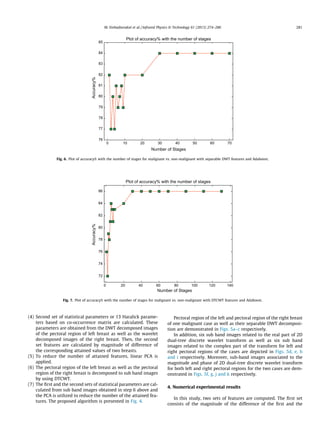
In this study, as we expected theoretically, more information
are seen in sub band images obtained by DTCWT than those of sep-
arable DWT. However, 4th order redundancy is observed by apply-
ing the DTCWT. Extracted features can be fed into a trained
classifier to detect anomalies in breast thermograms. In this study,
an Adaboost classifier is used [32,33]. Plot of accuracy (%) with the
number of stages for malignant vs. non-malignant using separable
DWT features and Adaboost is shown in Fig. 6. In addition, same
plot with DTCWT features is presented in Fig. 7. By comparing in
the Figs. 6 and 7, we see that 86% accuracy is attained for the num-
ber of stages greater than 30 with DTCWT while 84% accuracy with
separable DWT. With increasing the number of stages as are pre-
sented in Figs. 8 and 9, DTCWT also gives more accurate results fas-
ter than separable DWT.
However, in another study, we performed third order statistical
features extracted using bispectrum with very good accuracy is at-
tained for these problems with the same data using the hottest re-
gion in each case [45]. Higher order spectra (HOS) are spectral
representations of higher order moments or cumulants of a ran-
dom process [46,47]. HOS can be very useful in the extraction of
shape and the identification of nonlinearity in deterministic signals
as well as random processes [48,49]. Invariance to translation and
scale may be one reason why better classification accuracy is
achieved.
6. Conclusion
Breast thermograms are processed to extract corresponding
pectoral regions from both breasts and texture features are
extracted to classify them as malignant, benign and normal classes.
The performance of discrete wavelet transform based features of
the first and second sets is evaluated. Features are selected and
0 100 200 300 400 500 600 700 800 900 1000
60
65
70
75
80
85
Number of Thresholds
Accuracy%
Plot of accuracy% with the number of thresholds
10 stages
20 stages
30 stages
Fig. 8. Plot of accuracy% with the number of thresholds for three stages for malignant vs. non-malignant with separable DWT features and Adaboost.
282 M. Etehadtavakol et al. / Infrared Physics Technology 61 (2013) 274–286](https://image.slidesharecdn.com/separableandnon-separablediscretewavelettransformbasedtexture-160228180842/85/Separable-and-non-separable-discrete-wavelet-transform-based-texture-9-320.jpg)
![fused for decision making using the Adaboost algorithm. It is dem-
onstrated that non-separable and complex wavelet features per-
form marginally better than separable and real ones for the
malignant versus non-malignant classification while it is the other
way around for benign versus normal classification. Classification
accuracy of about 58% and 61% are reached for the two
magnitude-phase classification problems. Although, for the two
real-complex classification problems 84% and 86% accuracies are
obtained. Future work may include the third order statistical
features extracted using the bispectrum with the hottest regions
in each case. It is believed that the invariance to translation and
scale may be one reason why better classification accuracy can
be achieved further. Though the co-occurrence is second order
but theskewness and kurtosis extracted from gray level co-occur-
rence matrixare higher-order feature.
Appendix A. 2D Discrete wavelet transforms
A.1. Separable 2D discrete wavelet transform (DWT)
Basically, the original image is decomposed into a resolution
hierarchy of sub-band images, consisting of a coarse approxima-
tion image and a set of wavelet images, which provide some
important details. All sub-band images have the same number of
pixels as the original. Fig. A.1 indicates two steps of DWT decom-
position of an image.
The following three wavelets characterize the separable (row-
column) implementation of the DWT [49].
w1ðx; yÞ ¼ /ðxÞwðyÞ ðA:1Þ
w2ðx; yÞ ¼ wðxÞ/ðyÞ ðA:2Þ
w3ðx; yÞ ¼ wðxÞwðyÞ ðA:3Þ
LH wavelet, HL wavelet and HH wavelet are shown by Eqs.
(A.1)–(A.3) respectively. The LH wavelet is the product of the
low-pass function /(.) along the first dimension and the high-pass
function w(.) along the second dimension. The LH and HL wavelets
are oriented vertically and horizontally, however, the HH wavelet
mixes +45° and À45° orientations and has a checkerboard appear-
ance (Fig. A.2). Consequently, the separable DWT fails to isolate
these orientations.
A.2. Non separable 2D discrete wavelet transforms
The complex wavelet transform (CWT) is a complex-valued
extension to the standard DWT. It is a 2D wavelet transform which
provides multi resolution, sparse representation, and useful char-
acterization of the structure of an image.
In order to implement CWT for digital images, the dual-tree
CWT (DTCWT) that is a non-separable 2D discrete wavelet trans-
form has been introduced [50]. It calculates the complex transform
of a signal using two separate DWT decompositions (tree a and tree
b). Fig. A.3 shows block diagram for a 3-level DTCWT. As we see it
employs two real DWTs; the first DWT (tree a) gives the real part of
the transform while the second DWT (tree b) gives the imaginary
part.
0 100 200 300 400 500 600 700 800 900 1000
72
74
76
78
80
82
84
86
Number of Thresholds
Accuracy%
Plot of accuracy% with the number of thresholds
10 stages
20 stages
30 stages
Fig. 9. Plot of accuracy% with the number of thresholds for three stages for malignant vs. non-malignant with DTCWT features and Adaboost.
Fig. A.1. Two steps of DWT decomposition of an image.
M. Etehadtavakol et al. / Infrared Physics Technology 61 (2013) 274–286 283](https://image.slidesharecdn.com/separableandnon-separablediscretewavelettransformbasedtexture-160228180842/85/Separable-and-non-separable-discrete-wavelet-transform-based-texture-10-320.jpg)
![The DTCWT can be used to implement 2D wavelet transforms
that are more selective with respect to orientation than in the pre-
vious separable 2D DWT which is one of its advantages. There are
two versions of the 2D dual-tree DWT: the real 2D dual-tree DWT
and the complex 2D dual-tree DWT. The real 2D dual-tree DWT is
2-times expansive, while the complex 2D dual-tree DWT is 4-times
expansive. Both types have wavelets oriented in six distinct direc-
tions. The real version is illustrated first.
A.2.1. Real 2D Dual-tree DWT
In explaining how the DTCWT produces oriented wavelets, let
consider the 2D wavelet
w3ðx; yÞ ¼ wðxÞwðyÞ ðA:4Þ
where w(x) is a complex wavelet given by w(x) = wh(x) + jwg(x). Sub-
sequently,w(x,y) is obtained by
w3ðx; yÞ ¼ ½whðxÞ þ jwgðxÞŠ½whðyÞ þ jwgðyÞŠ
¼ whðxÞwhðyÞ À wgðxÞwgðyÞ þ j½wgðxÞwhðyÞ
þ whðxÞwgðyÞŠ: ðA:5Þ
The spectrum of the analytic 1-D wavelet is supported on only
one side of the frequency axis, while the spectrum of the complex
2D wavelet w(x, y) is supported in only one quadrant of the 2D fre-
quency plane. For this reason, the complex 2D wavelet is oriented.
If the real part of this complex wavelet is taken, then the sum of
two separable wavelets is obtained as:
Real Partfw3ðx; yÞg ¼ whðxÞwhðyÞ À wgðxÞwgðyÞ ðA:6Þ
Unlike the real separable wavelet, the support of the spectrum
of this real wavelet does not exhibit the checkerboard artifact,
and therefore, this real wavelet, illustrated in the second panel of
Fig. A.4, is oriented at À45°. Note that this construction depends
on the complex wavelet high pass filter w(x) = wh(x) + jwg(x).
The first term, wh(x)wh(y), as well as the second term, wg(x)wg
(y)in Eq. (A.6) are the HH wavelets of a separable 2D real wavelet
transform. The first term is implemented using the filters {h0 (n),
h1 (n)} while the second term is implemented using the filters
{g0 (n), g1 (n)}.
For obtaining a real 2D wavelet oriented at +45°, consider the
complex 2D wavelet
w2ðx; yÞ ¼ wðxÞwðyÞ ðA:7Þ
where wðyÞ represents the complex conjugate of w(y) and, w(x) is
the approximately analytic wavelet wh(x) + jwg(x). Eq. (A.8)
expresses w2(x, y)
w2ðx; yÞ ¼ ½whðxÞ þ jwgðxÞŠ½whðyÞ þ jwgðyÞŠ
¼ whðxÞwhðyÞ þ wgðxÞwgðyÞ þ j½wgðxÞwhðyÞ
À whðxÞwgðyÞŠ ðA:8Þ
The spectrum of the complex 2D wavelet w2(x, y) is supported in
only one quadrant of the 2D frequency plane. By taking the real part
of this complex wavelet, the real wavelet is obtained as follows:
Real Partfw2ðx; yÞg ¼ whðxÞwhðyÞ þ wgðxÞwgðyÞ ðA:9Þ
This real 2D wavelet is oriented at +45° as illustrated in the fifth
panel of Fig. A.5. It does not possess any checkerboard artifact.
With repeating this procedure on the following complex 2D
wavelets: /ðxÞwðyÞ; wðxÞ/ðyÞ; /ðxÞwðyÞ and wðxÞ/ðyÞ where w(x) =
wh(x) + jwg(x) and /(x) = /h(x) + j/g(x), four more oriented real 2D
wavelets can be obtained. By taking the real part of each of these
four complex wavelets respectively. These four real oriented 2D
wavelets in addition to the two already obtained ones in Eqs.
(A.6) and (A.9) are the total six real oriented 2D wavelets. Specifi-
cally, these six wavelets can be expressed as follows:
wiðx; yÞ ¼
1
ffiffiffi
2
p ðw1;iðx; yÞ À w2;iðx; yÞÞ; ðA:10Þ
wiþ3ðx; yÞ ¼
1
ffiffiffi
2
p ðw1;iðx; yÞ þ w2;iðx; yÞÞ; ðA:11Þ
for i = 1, 2, 3, where the two separable 2D wavelet bases can be de-
fined in the following way.
w1;1ðx; yÞ ¼ /hðxÞwhðyÞ
Fig. A.2. Three wavelets of separable DWT as gray scale images in the vertical (LH),
horizontal (HL) and diagonal (HH) directions [25].
Fig. A.3. Block diagram for a 3-level DTCWT.
1 2 3 4 5 6
Fig. A.4. Six wavelets associated with the real 2D dual-tree DWT [25].
284 M. Etehadtavakol et al. / Infrared Physics Technology 61 (2013) 274–286](https://image.slidesharecdn.com/separableandnon-separablediscretewavelettransformbasedtexture-160228180842/85/Separable-and-non-separable-discrete-wavelet-transform-based-texture-11-320.jpg)
![w2;1ðx; yÞ ¼ /gðxÞwgðyÞ ðA:12Þ
w1;2ðx; yÞ ¼ whðxÞ/hðyÞ
w2;2ðx; yÞ ¼ wgðxÞ/gðyÞ ðA:13Þ
w1;3ðx; yÞ ¼ whðxÞwhðyÞ
w2;3ðx; yÞ ¼ wgðxÞwgðyÞ ðA:14Þ
The normalization 1=
ffiffiffi
2
p
can be used so that the sum/difference
operation constitutes an orthonormal operation. Fig. A.4 illustrates
the six real oriented wavelets derived from a pair of typical wave-
lets. Compared to separable wavelets shown in Fig. A.2, these six
strictly non-separable wavelets isolate different orientations. Each
of the six wavelets is aligned along a specific direction and no
checkerboard effect appears. Furthermore, they cover more dis-
tinct orientations than the separable DWT wavelets.
Since wavelets shown in Eqs. (A.12)–(A.14) are all separable, a
2D wavelet transform based on these six oriented wavelets can
be implemented using two real separable 2D wavelet transforms
in parallel. As mentioned before, one separable 2D wavelet trans-
form can be implemented by using {h0 (n), h1 (n)} and the other
one by using {g0 (n), g1 (n)}.
Applying both separable transforms to the same 2D data give a
total of six sub bands: two LH, two HL, and two HH sub bands. Tak-
ing the sum and the difference of each pair of sub bands implement
the oriented wavelet transform. The transform is then two-times
expansive and free of the checkerboard artifact.
A.2.2. Complex 2D dual-tree DWT
To develop this transform, consider taking the imaginary part of
Eq. (A.5) as shown in the following equation:
Imag Partfw3ðx; yÞg ¼ wgðxÞwhðyÞ þ whðxÞwgðyÞ ðA:15Þ
The support of the spectrum of ImagPart {w3(x, y)} in the 2D fre-
quency plane is the same as the spectrum of the real part in Eq.
(A.6), and similar to the real 2D wavelet, it is oriented at À45°.
The first term of Eq. (A.15), wg(x)wh(y), is the HH wavelet of a sep-
arable real 2D wavelet transform implemented using the filters
{g0(n), g1(n)} on the rows, and the filters {h0(n), h1(n)} on the col-
umns of the image. Similarly, the second term, wh(x)wg(y) , is also
the HH wavelet of a real separable wavelet transform, but one
implemented using the filters {h0(n), h1(n)} on the rows and
{g0(n), g1(n)} on the columns. Besides, in similar manner, by con-
sidering the imaginary parts of wðxÞwðyÞ; /ðxÞwðyÞ; wðxÞ/ðyÞ;
/ðxÞwðyÞ and wðxÞ/ðyÞ where w(x) = wh(x) + jwg(x) and /(x) =
/h(x) + j/g(x)
The six oriented wavelets are obtained in Eqs. (A.16) and (A.17)
wiðx; yÞ ¼
1
ffiffiffi
2
p ðw3;iðx; yÞ À w4;iðx; yÞÞ; ðA:16Þ
wiþ3ðx; yÞ ¼
1
ffiffiffi
2
p ðw3;iðx; yÞ þ w4;iðx; yÞÞ; ðA:17Þ
for i = 1, 2, 3, where the two separable 2D wavelet bases are defined
as:
w3;1ðx; yÞ ¼ /gðxÞwhðyÞ
w41ðx; yÞ ¼ /hðxÞwgðyÞ ðA:18Þ
w3;2ðx; yÞ ¼ wgðxÞ/hðyÞ
w4;2ðx; yÞ ¼ whðxÞ/gðyÞ ðA:19Þ
w3;3ðx; yÞ ¼ wgðxÞwhðyÞ
w4;3ðx; yÞ ¼ whðxÞwgðyÞ ðA:20Þ
The six real-valued wavelets in Eqs. (A.16) and (A.17) are ori-
ented for the same reason as the real-valued wavelets of Eqs.
(A.10) and (A.11) are oriented. However, a set of six complex wave-
lets can be formed by using wavelets Eqs. (A.10) and (A.11) as the
real parts and wavelets Eqs. (A.16) and (A.17) as the imaginary
parts. Fig. A.5 illustrates a set of six oriented complex wavelets ob-
tained in this way. The real and imaginary parts of each complex
wavelet are oriented at the same angle, and the magnitude of each
complex wavelet is an approximately circular bell-shaped
function.
The first row displays the real part and the second row indicates
the imaginary part of a set of six complex wavelets. In addition, the
magnitudes of the six complex wavelets are shown on the third
row. As shown in Fig. A.5, the magnitude of the complex wavelets
does not have an oscillatory behavior instead they are bell-shaped
envelopes.
References
[1] Debi Walker, Tina Kaczor, Breast thermography history: theoryand use,
Natural Medicine Journal (2012).
[2] International Academy of Clinical Thermology: http://www.iact-org.org/
articles/articles-second-look.html, (last accessed August 2013.)
[3] B.F. Jones, A reappraisal of the use of infrared thermal image analysis in
medicine, IEEE Transactions on Medical Imaging. 17 (1998) 61019–61027,
http://dx.doi.org/10.1109/42.746635.
[4] E.Y.K. Ng, A review of thermography as promising non-invasive detection
modality for breast tumour, International Journal of Thermal Sciences 48 (5)
(2009) 849–855, http://dx.doi.org/10.1016/j.ijthermalsci.2008.06.015.
[5] Thermology (Teletherm Infrared), http://www.thermology.com/
history.htm, (last accessed August 2013.)
[6] N. Diakides, J.D. Bronzino, Medical Infrared Imaging, CRC, Taylor Francis,
New York, 2008.
[7] E.Y.K. Ng, E.C. Kee, Integrative Computer-aided Diagnostic with Breast
Thermogram, in: Selected paper from 7th NTU-SGH Biomedical Engineering
Symposium (special Issue), Journal of Mechanics in Medicine and Biology 7 (1)
(2007) 1–10.
[8] E.Y.K. Ng, U.R. Acharya, A review of remote-sensing infrared thermography for
indoor mass blind fever screening in containing an epidemic, IEEE Engineering
in Medicine and Biology 28 (1) (2009) 76–83.
[9] G. Schaefer, M. Zavisek, T. Nakashima, Thermography based breast cancer
analysis using statistical features and fuzzy classification, Pattern Recognition
42 (6) (2009) 1133–1137.
[10] M. EtehadTavakol, E.Y.K. Ng, Breast thermography as a potential non-contact
method in the early detection of cancer: a review, Journal of Mechanics in
Medicine and Biology 13 (2) (2013) 1330001–1330020, http://dx.doi.org/
10.1142/S0219519413300019.
[11] J.R. Keyserlingk, P.D. Ahlgren, E. Yu, N. Belliveau, Infrared imaging of breast:
Initial reappraisal using high-resolution digital technology in 100 successive
cases of stage I and II breast cancer, Breast Journal 4 (1998) 4245–4251, http://
dx.doi.org/10.1046/ j.1524-4741.1998.440245.x.
Fig. A.5. Twelve wavelets associated with the real 2D dual-tree DWT [24] Typical
wavelets associated with the oriented 2D dual-tree CWT. First row illustrates the
real part of each complex wavelet; second row indicates the imaginary part; and
third row illustrates the magnitude.
M. Etehadtavakol et al. / Infrared Physics Technology 61 (2013) 274–286 285](https://image.slidesharecdn.com/separableandnon-separablediscretewavelettransformbasedtexture-160228180842/85/Separable-and-non-separable-discrete-wavelet-transform-based-texture-12-320.jpg)
![[12] H. Qi, P.T. Kuruganti, W.E. Snyder, Detecting breast cancer from thermal
infrared images by asymmetry analysis, biomedical engineering handbook,
CRC, Boca Raton, 2006 (Chapter 27–1 to 27–14).
[13] L.G. Keith, J.J. Oleszczuk, M. Laguens, Circadian rhythm chaos: a new breast
cancer marker, International Journal of Fertility and Women’ s Medicine 46
(2001) 238–247.
[14] T.Z. Tan, C. Quek, G.S. Ng, E.Y.K. Ng, A novel cognitive interpretation of breast
cancer thermography with complementary learning fuzzy neural memory
structure. Expert Systems with Applications: An, International Journal 33 (3)
(2007) 652–666.
[15] E.Y.K. Ng, N.M. Sudharsan, Effect of blood flow, tumour and cold stress in a
female breast: a novel time-accurate computer simulation, International
Journal of Engineering in Medicine 215 (H4) (2001) 393–404.
[16] M. EtehadTavakol, E.Y.K. Ng, C. Lucas, S. Sadri, N. Gheissari, Estimating the
mutual information between bilateral breast in thermograms using
nonparametric windows, Journal of Medical Systems 5 (5) (2011) 959–967.
[17] M. EtehadTavakol, E.Y.K. Ng, C. Lucas, S. Sadri, M Ataei, Nonlinear analysis
using lyapunov exponents in breast thermal images to identify abnormal
lesions, Infrared Physics and Technology 55 (4) (2012) 345–352. http://
dx.doi.org/10.1016/j.infrared.2012.02.007.
[18] M. EtehadTavakol, C. Lucas, S. Sadri, E.Y.K. Ng, Analysis of breast thermography
using fractal dimension to establish possible difference between malignant
and benign patterns, Journal of Healthcare Engineering 1 (1) (2010) 27–43.
[19] D.A. Kennedy, T. Lee T, D. Seely, A comparative review of thermography as a
breast cancer screening technique, Integrative Cancer Therapeutics 8 (1)
(2009) 9–16.
[20] Multimodality Breast Imaging: Diagnosis and Treatment, E.Y.K. Ng, R.U.
Acharya, R.M. Rangayyan, J.S. Suri, vol. 2, 2013. Chapter 9:255–274, SPIE,
USA, ISBN: 978-0-8194-9294-4.
[21] http://rakdojke.kbsplit.hr/images/fig6.jpg, (last accessed August 2013.)
[22] University of Michigan, Medical School, http://www.med.umich.edu/lrc/
coursepages/m1/anatomy2010/html/musculoskeletal_system/
pectoral_tables.html, (last accessed August 2013.)
[23] O. Boiman, Detecting irregularities in images and in video, ICCV, Tenth IEEE
International Conference on Computer Vision 1 (2005) 462–469.
[24] Charles K. Chui, An Introduction to Wavelets, Academic Press, San Diego, 1992.
ISBN 0-12-174584-8.
[25] Hans G. Feichtinger, Thomas strohmer: Advances in Gabor Analysis,
Birkhäuser, 2003.
[26] Robert M Haralick, K Shanmugam, I. Dinstein, Textural features for image
classification, IEEE Transactions on Systems Man and Cybernetics SMC-3 (6)
(1973) 610–621.
[27] J.E. Jackson, A User’s Guide to Principal Components, John Wiley and Sons,
New York, 1991.
[28] I.T. Jolliffe, Discarding variables in principal component analysis I: artificial
data, Applied Statistical 21 (1972) 160–173.
[29] I.T. Jolliffe, Discarding variables in principal component analysis 11: real data,
Applied Statistical 22 (1973) 21–31.
[30] I.T. Jolliffe, Principal Component Analysis, Springer-Verlag, New York, 1986.
[31] A survey of dimension reduction techniques, US DOE Office of Scientific and
Technical Information, 2002. doi: 10.2172/15002155.
[32] Y. Freund, R.E. Shapire, Experiments with a new boosting algorithm, in: Proc.
of the 13th Intl. Conf. on Artificial Intelligence, Morgan Kaufmann, 1996, pp.
146–148.
[33] R.E. Shapire, A brief introduction to boosting, in: Proc. of the 16th Intl. Conf. on
Artificial Intelligence, vol. 2, Morgan Kaufmann Publishers Inc. San Francisco,
1999, pp. 1401–1406.
[34] M. EtehadTavakol, S. Sadri, E.Y.K. Ng, Application of K- and fuzzy C-means for
color segmentation of thermal infrared breast images, Journal of Medical
Systems 34 (1) (2010) 35–42, http://dx.doi.org/10.1007/s10916-008-9213-1.
[35] E.Y.K. Ng, Y. Chen, L.N. Ung, S.K. Fok, I.S.Y. Wan, Thermography as an Indicator
of Breast Blood Perfusion. in: Proc. 10th Int. Conf. on Biomed. Eng., Singapore
Ed: JCH Goh, Humanities Press, 2000, pp. 275–276.
[36] E.Y.K. Ng, L.N. Ung, F.C. Ng, L.S.J. Sim, Statistical analysis of healthy and
malignant breast thermography, Journal of Medical Engineering and
Technology 25 (2001) 253–263.
[37] Thermography Guidelines (TG), Standards and Protocols in Clinical
Thermographic Imaging, http://www.iact-org.org/professionals/thermog-
guidelines.html, (last accessed Aug 2013.)
[38] W.C. Amalu, W.B. Hobbins, J.F. Head, R.L. Elliott, Infrared imaging of the breast
– an overview, in Biomedical Engineering Handbook, CRC Press, 2006, chapter
25–1 to 25–21.
[39] K. Ammer, E.F.L. Ring, Standard procedures for infrared imaging in medicine, in
Biomedical Engineering Handbook, CRC Press, 2006, chapter 36–1 to 36–14.
[40] E.F.J. Ring, K. Ammer, The technique of infrared imaging in medicine,
Thermology Intl 10 (2000) 7–14.
[41] A. Jung, J. Zuber, Thermographic Methods in Medical Diagnostics, MedPress,
Warsaw, 1998.
[42] J.F. Head, C.A. Lipari, F. Wang, R.L. Elliot, Image analysis of digitized infrared
images of the breasts from a first generation infrared imaging system. In: Proc
19th Intl. Conf. IEEE/EMBS Chicago, IL. USA, 1997.
[43] E.Y.K. Ng, Y. Chen, L.N. Ung, Computerized breast thermography: study of
image segmentation and temperature cyclic variations, International Journal
of Medical Engineering and Technology 25 (2001) 12–16.
[44] M. EtehadTavakol, E.Y.K. Ng, C. Lucas, S. Sadri, Color segmentation and fractal
analysis of breast thermograms. in: J.S. Suri, S.V. Sree, K.H. Ng, R.M. Rangayyan
(Eds.), Book Chapters in Diagnostic and Therapeutic Applications of Breast
Imaging, SPIE’s book series, USA, vol. 1, 2012, pp. 373–398, (Chpter 11). ISBN:
9780819487896.
[45] M. Etehadtavakol, V. Chandran, E.Y.K. Ng, R. Kafieh, Breast cancer detection
from thermal images using bispectral invariant features, International Journal
of Thermal Sciences 69 (2013) 21–36.
[46] A.P. Petropulu, Higher-Order Spectral Analysis, The Biomedical Engineering
Handbook: second edition, in: Joseph D. Bronzino (Ed.), Boca Raton: CRC Press
LLC, 2000.
[47] K.C. Chua, V. Chandran, U.R. Acharya, C.M. Lim, Cardiac state diagnosis using
higher order spectra of heart rate variability, Journal of Medical Engineering
and Technology 32 (2) (2008) 145–155.
[48] T. Ning, J.D. Bronzino, Bispectral Analysis of the EEG During Various
Vigilance States, IEEE Transactions on Biomedical Engineering 36 (4) (1989)
497–499.
[49] K.C. Chua, V. Chandran, U.R. Acharya, C.M. Lim, Analysis of epileptic EEG
signals using higher order spectra, Journal of Medical Engineering and
Technology 33 (1) (2009) 42–50.
[50] I.W. Selesnick, R.G. Baraniuk, N.G. Kingsbury, The dual tree complex wavelet
transform, IEEE Signal Processing Magazine 22 (6) (2005) 123–151.
286 M. Etehadtavakol et al. / Infrared Physics Technology 61 (2013) 274–286](https://image.slidesharecdn.com/separableandnon-separablediscretewavelettransformbasedtexture-160228180842/85/Separable-and-non-separable-discrete-wavelet-transform-based-texture-13-320.jpg)

This document summarizes a study that uses wavelet transform based texture features and image classification to analyze breast thermograms. The study compares separable and non-separable discrete wavelet transforms. Texture features are extracted from wavelet decomposed images of the pectoral regions of two breasts. Principal component analysis and an Adaboost classifier are then applied to evaluate classification performance. The results show that complex non-separable 2D discrete wavelet transform features perform better than real separable counterparts for classifying malignant versus non-malignant breast lesions.


