Make a sensitivity training module to sensitize top
leaders and your workforce of an MNC with the LGBTQI+
community.
The LGBT community is extremely diverse; it includes women, men, people of color, and people of
different generations and cultures. As such, many LGBT employees hold double (or even triple)
minority status. LGBT women, for example, face various barriers that are attributable to both their
LGBT identity and their gender.
In an LGBT-inclusive workplace, all employees are treated fairly and have equal access to career
opportunities, regardless of sexual orientation, gender identity, and/or gender expression. Diverse
employee representation has a positive effect on business results because it allows an organization
to effectively leverage all talent.
Therefore, an LGBT-inclusive workplace recognizes, understands, and tackles the unique
challenges that both LGBT women and men face during recruitment, in daily workplace interactions,
and in advancing to senior leadership positions. It also recognizes cultural differences within an
organization, both by function and by office, and challenges workplace norms in each of these
cultures.
It is imperative for organizations to identify the diversity and variety of differences in their
organization.
Through a plethora of progressive steps and initiatives over the years across the globe, the
LGBTQI+ community has been able to secure a place of pride in society and in their
workplace. However, there still remain certain barriers that may exist as challenges to their
escalating growth in holding a place based on their potential, capabilities and qualifications
through sheer hard work and determination, which often gets blurred due to preconceived
notions and biases in people’s minds.
Hence, it is essential for organizations to be sensitized towards the community, as a
business imperative and to achieve sustainable growth.
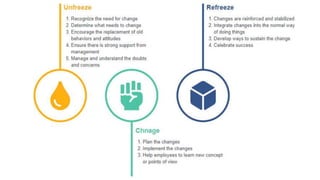
This sensitizing module will be suggesting the use of Lewin’s 3 stage model : Unfreezing old
values, Developing new values and finally, Refreezing the new values.
Step 1: Unfreezing the old values
It is important to be inclusive of everyone in an organization, irrespective of
whether one agrees to their values, beliefs, morals, lifestyle, etc or not.
The workplace needs to be a tolerant and accepting environment, wherein
people feel safe and welcome- ranging from top-level managers, employees to
even clients and customers.
The first step is to ‘unfreeze’ or do away with old values that may reflect
certain preconceived notions, biases and judgements that may not be well
based on factual matter. Understanding these through open discussion and
conversation can facilitate broadening people’s views and mindsets towards
the community.
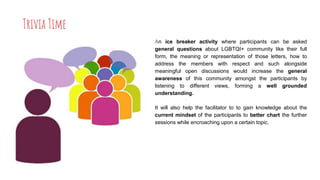
Trivia Time
An ice breaker activity where participants can be asked
general questions about LGBTQI+ community like their full
form, the meaning or representation of those letters, how to
address the members with respect and such alongside
meaningful open discussions would increase the general
awareness of this community amongst the participants by
listening to different views, forming a well grounded
understanding.
It will also help the facilitator to to gain knowledge about the
current mindset of the participants to better chart the further
sessions while encroaching upon a certain topic.
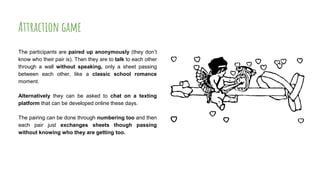
Attraction game
The participants are paired up anonymously (they don’t
know who their pair is). Then they are to talk to each other
through a wall without speaking, only a sheet passing
between each other, like a classic school romance
moment.
Alternatively they can be asked to chat on a texting
platform that can be developed online these days.
The pairing can be done through numbering too and then
each pair just exchanges sheets though passing
without knowing who they are getting too.
They are not to talk about their genders, names or
family, but about themselves. After about 30 minutes or
so, the facilitator can ask everyone to answer if they enjoyed
talking to someone new and whether if given an opportunity
would they go for a date with the same.
This would help the participants gain an understanding of
how attraction works and how gender is a personal
preference. The participants will question within themselves
about how the lives for this community have been
different based on nothing but a choice like that of clothes
and hence slowly help them do away with their old biased
attitudes.
Step 2- developing new values.
Once the old values have been dealt with and new values have been
encouraged and learned, the next step is to inculcate the new values as part
of a deeper understanding of oneself and others.
The essence is to develop and frame these values and morals in one’s life so
that it becomes part of one’s way of thinking. Further, it is important to apply
this understanding in different facets and situations of daily life.
The new values learned are important in determining the progression in
attitude towards this community and respecting the members.
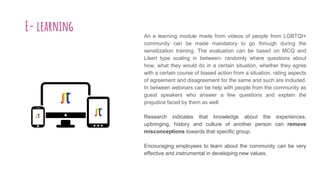
E- learning An e learning module made from videos of people from LGBTQI+
community can be made mandatory to go through during the
sensitization training. The evaluation can be based on MCQ and
Likert type scaling in between- randomly where questions about
how, what they would do in a certain situation, whether they agree
with a certain course of biased action from a situation, rating aspects
of agreement and disagreement for the same and such are included.
In between webinars can be help with people from the community as
guest speakers who answer a few questions and explain the
prejudice faced by them as well.
Research indicates that knowledge about the experiences,
upbringing, history and culture of another person can remove
misconceptions towards that specific group.
Encouraging employees to learn about the community can be very
effective and instrumental in developing new values.
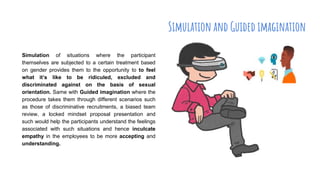
Simulation and Guided imagination
Simulation of situations where the participant
themselves are subjected to a certain treatment based
on gender provides them to the opportunity to to feel
what it’s like to be ridiculed, excluded and
discriminated against on the basis of sexual
orientation. Same with Guided imagination where the
procedure takes them through different scenarios such
as those of discriminative recruitments, a biased team
review, a locked mindset proposal presentation and
such would help the participants understand the feelings
associated with such situations and hence inculcate
empathy in the employees to be more accepting and
understanding.
Step 3 Refreezing new values
Once the old values have been dealt with and new values have been
encouraged and learned, the next step is to inculcate the new values as part
of a deeper understanding of oneself and others.
The essence is to develop and frame these values and morals in one’s life so
that it becomes part of one’s way of thinking. Further, it is important to apply
this understanding in different facets and situations of daily life.
The new values learned are important in determining the progression in
attitude towards this community and respecting the members.
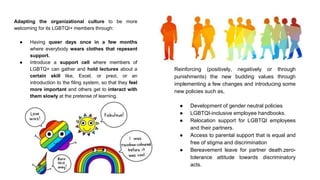
Adapting the organizational culture to be more
welcoming for its LGBTQI+ members through:
● Having queer days once in a few months
where everybody wears clothes that repesent
support.
● Introduce a support cell where members of
LGBTQ+ can gather and hold lectures about a
certain skill like, Excel, or prezi, or an
introduction to the filing system, so that they feel
more important and others get to interact with
them slowly at the pretense of learning.
Reinforcing (positively, negatively or through
punishments) the new budding values through
implementing a few changes and introducing some
new policies such as,
● Development of gender neutral policies
● LGBTQI-inclusive employee handbooks.
● Relocation support for LGBTQI employees
and their partners.
● Access to parental support that is equal and
free of stigma and discrimination
● Bereavement leave for partner death.zero-
tolerance attitude towards discriminatory
acts.
References
Megathlin D. (2007), Making Change: LGBT Inclusion—Implementing Policies, Programs, and Practices,
Raytheon Company, Catalyst.

Sensitization module (LGBTQ+ community).pptx

  • 2.
    Make a sensitivitytraining module to sensitize top leaders and your workforce of an MNC with the LGBTQI+ community.
  • 3.
    The LGBT communityis extremely diverse; it includes women, men, people of color, and people of different generations and cultures. As such, many LGBT employees hold double (or even triple) minority status. LGBT women, for example, face various barriers that are attributable to both their LGBT identity and their gender. In an LGBT-inclusive workplace, all employees are treated fairly and have equal access to career opportunities, regardless of sexual orientation, gender identity, and/or gender expression. Diverse employee representation has a positive effect on business results because it allows an organization to effectively leverage all talent. Therefore, an LGBT-inclusive workplace recognizes, understands, and tackles the unique challenges that both LGBT women and men face during recruitment, in daily workplace interactions, and in advancing to senior leadership positions. It also recognizes cultural differences within an organization, both by function and by office, and challenges workplace norms in each of these cultures.
  • 4.
    It is imperativefor organizations to identify the diversity and variety of differences in their organization. Through a plethora of progressive steps and initiatives over the years across the globe, the LGBTQI+ community has been able to secure a place of pride in society and in their workplace. However, there still remain certain barriers that may exist as challenges to their escalating growth in holding a place based on their potential, capabilities and qualifications through sheer hard work and determination, which often gets blurred due to preconceived notions and biases in people’s minds. Hence, it is essential for organizations to be sensitized towards the community, as a business imperative and to achieve sustainable growth. This sensitizing module will be suggesting the use of Lewin’s 3 stage model : Unfreezing old values, Developing new values and finally, Refreezing the new values.
  • 6.
    Step 1: Unfreezingthe old values It is important to be inclusive of everyone in an organization, irrespective of whether one agrees to their values, beliefs, morals, lifestyle, etc or not. The workplace needs to be a tolerant and accepting environment, wherein people feel safe and welcome- ranging from top-level managers, employees to even clients and customers. The first step is to ‘unfreeze’ or do away with old values that may reflect certain preconceived notions, biases and judgements that may not be well based on factual matter. Understanding these through open discussion and conversation can facilitate broadening people’s views and mindsets towards the community.
  • 7.
    Trivia Time An icebreaker activity where participants can be asked general questions about LGBTQI+ community like their full form, the meaning or representation of those letters, how to address the members with respect and such alongside meaningful open discussions would increase the general awareness of this community amongst the participants by listening to different views, forming a well grounded understanding. It will also help the facilitator to to gain knowledge about the current mindset of the participants to better chart the further sessions while encroaching upon a certain topic.
  • 8.
    Attraction game The participantsare paired up anonymously (they don’t know who their pair is). Then they are to talk to each other through a wall without speaking, only a sheet passing between each other, like a classic school romance moment. Alternatively they can be asked to chat on a texting platform that can be developed online these days. The pairing can be done through numbering too and then each pair just exchanges sheets though passing without knowing who they are getting too.
  • 9.
    They are notto talk about their genders, names or family, but about themselves. After about 30 minutes or so, the facilitator can ask everyone to answer if they enjoyed talking to someone new and whether if given an opportunity would they go for a date with the same. This would help the participants gain an understanding of how attraction works and how gender is a personal preference. The participants will question within themselves about how the lives for this community have been different based on nothing but a choice like that of clothes and hence slowly help them do away with their old biased attitudes.
  • 10.
    Step 2- developingnew values. Once the old values have been dealt with and new values have been encouraged and learned, the next step is to inculcate the new values as part of a deeper understanding of oneself and others. The essence is to develop and frame these values and morals in one’s life so that it becomes part of one’s way of thinking. Further, it is important to apply this understanding in different facets and situations of daily life. The new values learned are important in determining the progression in attitude towards this community and respecting the members.
  • 11.
    E- learning Ane learning module made from videos of people from LGBTQI+ community can be made mandatory to go through during the sensitization training. The evaluation can be based on MCQ and Likert type scaling in between- randomly where questions about how, what they would do in a certain situation, whether they agree with a certain course of biased action from a situation, rating aspects of agreement and disagreement for the same and such are included. In between webinars can be help with people from the community as guest speakers who answer a few questions and explain the prejudice faced by them as well. Research indicates that knowledge about the experiences, upbringing, history and culture of another person can remove misconceptions towards that specific group. Encouraging employees to learn about the community can be very effective and instrumental in developing new values.
  • 12.
    Simulation and Guidedimagination Simulation of situations where the participant themselves are subjected to a certain treatment based on gender provides them to the opportunity to to feel what it’s like to be ridiculed, excluded and discriminated against on the basis of sexual orientation. Same with Guided imagination where the procedure takes them through different scenarios such as those of discriminative recruitments, a biased team review, a locked mindset proposal presentation and such would help the participants understand the feelings associated with such situations and hence inculcate empathy in the employees to be more accepting and understanding.
  • 13.
    Step 3 Refreezingnew values Once the old values have been dealt with and new values have been encouraged and learned, the next step is to inculcate the new values as part of a deeper understanding of oneself and others. The essence is to develop and frame these values and morals in one’s life so that it becomes part of one’s way of thinking. Further, it is important to apply this understanding in different facets and situations of daily life. The new values learned are important in determining the progression in attitude towards this community and respecting the members.
  • 14.
    Adapting the organizationalculture to be more welcoming for its LGBTQI+ members through: ● Having queer days once in a few months where everybody wears clothes that repesent support. ● Introduce a support cell where members of LGBTQ+ can gather and hold lectures about a certain skill like, Excel, or prezi, or an introduction to the filing system, so that they feel more important and others get to interact with them slowly at the pretense of learning. Reinforcing (positively, negatively or through punishments) the new budding values through implementing a few changes and introducing some new policies such as, ● Development of gender neutral policies ● LGBTQI-inclusive employee handbooks. ● Relocation support for LGBTQI employees and their partners. ● Access to parental support that is equal and free of stigma and discrimination ● Bereavement leave for partner death.zero- tolerance attitude towards discriminatory acts.
  • 15.
    References Megathlin D. (2007),Making Change: LGBT Inclusion—Implementing Policies, Programs, and Practices, Raytheon Company, Catalyst.