LGBTQIA* Inclusive
Workplace Practices
Center for Diversity and Inclusion
LGBTQIA* Common Terms
• LESBIAN: A woman identified woman who experiences the human need for warmth,
affection, and/or love from another woman identified woman
• GAY: A man identified man who experiences the human need for warmth, affection,
and/or love from another man identified man
• BISEXUAL: A person whose need for warmth, affection, and love can be satisfied by
people who identify as a man or a woman
• TRANSGENDER: An umbrella term for people who have a gender identity/expression
not commonly associated with their assigned sex at birth
Terms continued
• QUEER: Once used primarily as a pejorative term, queer is being reclaimed by many
LGBTQIA* people. Many who choose to use the term feel that it is more inclusive
• QUESTIONING: Someone who does not identify as LGBTQIA* —because they haven’t
determined how best to identify themselves or they do not wish to associate themselves with
• INTERSEX: A term used to describe a person whose chromosomes, genitalia, and/or
secondary sex characteristics are determined to be neither exclusively male nor female
• ASEXUAL: A person who is not sexually/physically attracted to other people; however, this
does not exclude romantic feelings/attachment
How Many Tech Students Are LGBTQIA*?
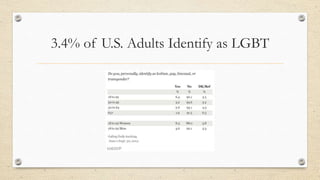
3.4% of U.S. Adults Identify as LGBT
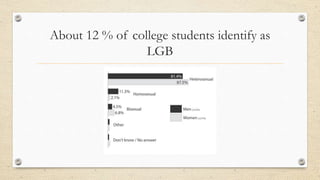
About 12 % of college students identify as
LGB
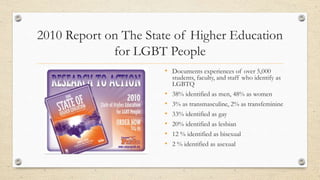
2010 Report on The State of Higher Education
for LGBT People
• Documents experiences of over 5,000
students, faculty, and staff who identify as
LGBTQ
• 38% identified as men, 48% as women
• 3% as transmasculine, 2% as transfeminine
• 33% identified as gay
• 20% identified as lesbian
• 12 % identified as bisexual
• 2 % identified as asexual
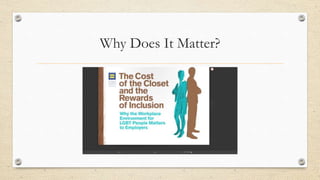
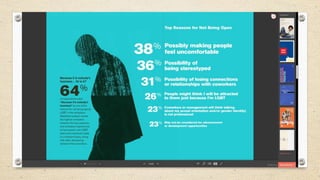
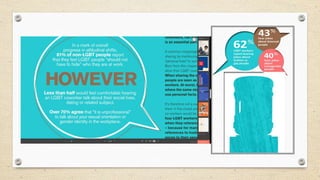
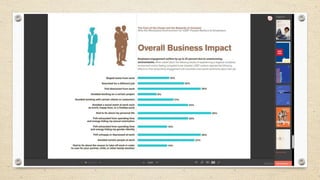
Why Does It Matter?
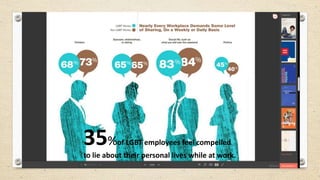
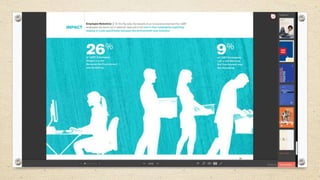
35%of LGBT employees feel compelled
to lie about their personal lives while at work.
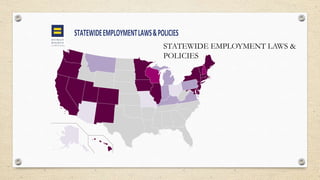
STATEWIDE EMPLOYMENT LAWS &
POLICIES
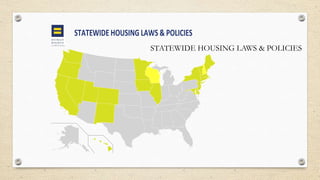
STATEWIDE HOUSING LAWS & POLICIES
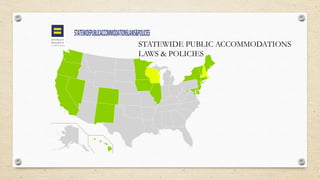
STATEWIDE PUBLIC ACCOMMODATIONS
LAWS & POLICIES
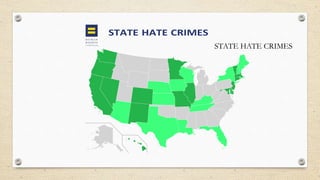
STATE HATE CRIMES
How Can You Be LGBTQIA* Inclusive?
Language And Terminology
• The language we use can show
respect for how people describe
their own bodies, genders, and
relationships
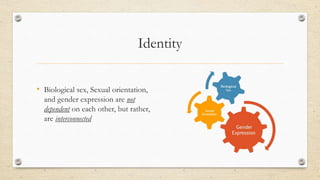
Identity
• Biological sex, Sexual orientation,
and gender expression are not
dependent on each other, but rather,
are interconnected
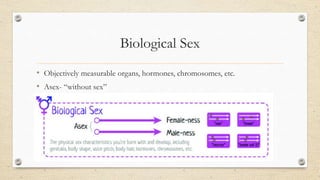
Biological Sex
• Objectively measurable organs, hormones, chromosomes, etc.
• Asex- “without sex”
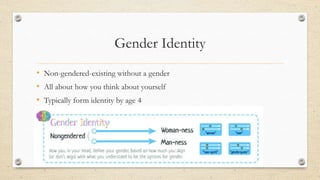
Gender Identity
• Non-gendered-existing without a gender
• All about how you think about yourself
• Typically form identity by age 4
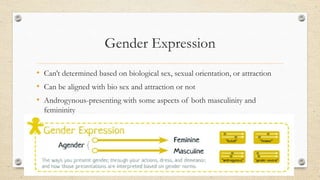
Gender Expression
• Can’t determined based on biological sex, sexual orientation, or attraction
• Can be aligned with bio sex and attraction or not
• Androgynous-presenting with some aspects of both masculinity and
femininity
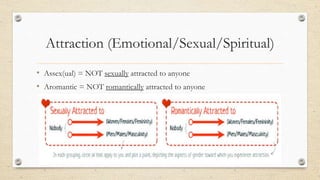
Attraction (Emotional/Sexual/Spiritual)
• Assex(ual) = NOT sexually attracted to anyone
• Aromantic = NOT romantically attracted to anyone
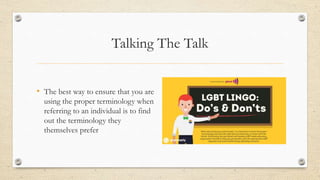
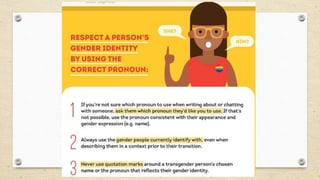
Talking The Talk
• The best way to ensure that you are
using the proper terminology when
referring to an individual is to find
out the terminology they
themselves prefer
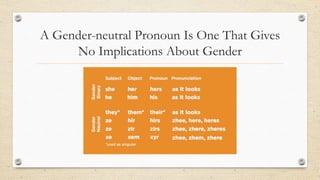
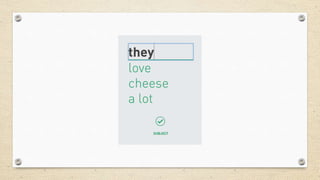
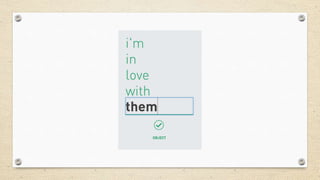
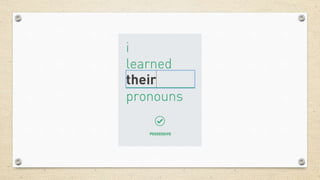
A Gender-neutral Pronoun Is One That Gives
No Implications About Gender
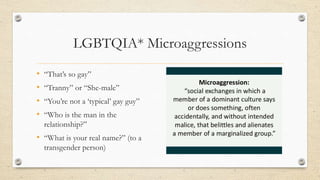
LGBTQIA* Microaggressions
• “That’s so gay”
• “Tranny” or “She-male”
• “You’re not a ‘typical’ gay guy”
• “Who is the man in the
relationship?”
• “What is your real name?” (to a
transgender person)
Avoid Offensive & Inaccurate Language
• Homosexual lifestyle
• Gay Marriage
• Sexual preference
• “A transgender”
• Sex change
• Lesbian, Gay
• Marriage equality
• Sexual orientation
• Transgender person
• Transition
Consider The Following Questions:
• Should I be out on my resume?
• Should I be out at the interview?
• Will the clothes I wear to an interview be gendered and judged even if they
are professional clothes?
• When is it okay to come out at work? How do I do so?
• When should I keep my sexual orientation/gender identity private?
Questions Continued
• How do I know if a work/internship/Co-op environment is safe?
• How do I handle discrimination in the workplace? Am I protected?
• Are there going to be other people who identify as LGBTQIA* in the
company? How do I find them?
• Does the company have gender-neutral restrooms?
• Does the company participate in or sponsor LGBT-related events?
Diversity Initiatives
• Need to be aligned with organizational objectives, mission, and strategic plan
• Need full company buy-in and employee participation
• Need to be more than just numerical diversity…systemic diversity is key
• Need to be the responsibility of top-level and senior executives, not just
diversity officers or the human resource department
• A visible, top priority
Assessment and Evaluation
Check effectiveness & outcomes
• Some diversity measures include:
1) Employee attrition rates
2) Workforce satisfaction
3) Market share within new customer bases
4) External awards and recognition for
diversity efforts
5) Workplace climate satisfaction
Actively seek employee input
• Cultural diversity audits
• Employee satisfaction surveys
• Employee feedback hotline
• Focus groups
• Training evaluations
Diversity Affinity Groups
• Input is sought from these groups
to determine their perception of
progress achieved with regard to
diversity
• They focus on retention of
LGBTQIA* and allied employees
and support business opportunities
with LGBTQIA* consumers
Rating U.S. Workplaces on LGBTQIA*
Equality
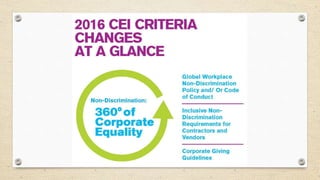
• Human Rights Campaign Foundation’s 2016 CEI is the national
benchmarking tool on corporate policies and practices pertinent to LGBT
employees
• CEI does not rate public sector (government) employers or businesses with
fewer than 500 full-time U.S. employees
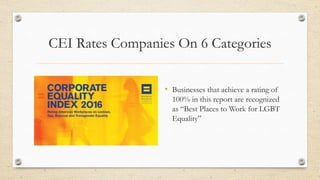
CEI Rates Companies On 6 Categories
• Businesses that achieve a rating of
100% in this report are recognized
as “Best Places to Work for LGBT
Equality”
1. Non-discrimination Policies
• There is no federal law that protect workers from discrimination in the
workplace based on sexual orientation and gender identity.
• Your Equal Employment Opportunity policy includes:
• Sexual orientation – 15 pts.
• Gender identity – 15 pts.
2. EEO Policy Extended
• If an employee is traveling or being relocated internationally, the non-
discrimination guidelines of your company must be portable
• Where supplier mandates exists to protect named categories, sexual
orientation and gender identity are included in this list
• HRC holds companies accountable for any giving to a non-religious
organization that explicitly discriminated against members of the LGBT
community
• Pts. On theses are TBD
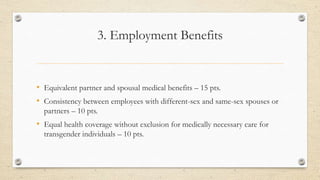
3. Employment Benefits
• Equivalent partner and spousal medical benefits – 15 pts.
• Consistency between employees with different-sex and same-sex spouses or
partners – 10 pts.
• Equal health coverage without exclusion for medically necessary care for
transgender individuals – 10 pts.
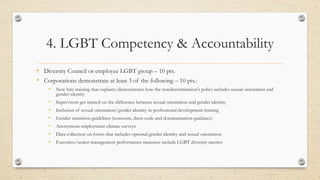
4. LGBT Competency & Accountability
• Diversity Council or employee LGBT group – 10 pts.
• Corporations demonstrate at least 3 of the following – 10 pts.:
• New hire training that explains/demonstrates how the nondiscrimination's policy includes sexual orientation and
gender identity
• Supervisors get trained on the difference between sexual orientation and gender identity
• Inclusion of sexual orientation/gender identity in professional development training
• Gender transition guidelines (restroom, dress code and documentation guidance)
• Anonymous employment climate surveys
• Data collection on forms that includes optional gender identity and sexual orientation
• Executive/senior management performance measures include LGBT diversity metrics
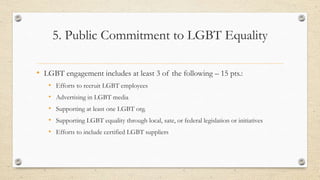
5. Public Commitment to LGBT Equality
• LGBT engagement includes at least 3 of the following – 15 pts.:
• Efforts to recruit LGBT employees
• Advertising in LGBT media
• Supporting at least one LGBT org.
• Supporting LGBT equality through local, sate, or federal legislation or initiatives
• Efforts to include certified LGBT suppliers
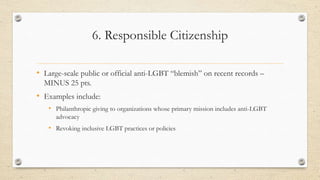
6. Responsible Citizenship
• Large-scale public or official anti-LGBT “blemish” on recent records –
MINUS 25 pts.
• Examples include:
• Philanthropic giving to organizations whose primary mission includes anti-LGBT
advocacy
• Revoking inclusive LGBT practices or policies
There’s a difference
Being Politically Correct
• Externally driven
• Can be equated to censorship and
conflicts with personal values
Being Inclusive
• Internally driven
• Is a mindset and does not conflict
with personal values
Questions to Ask Yourself
• What are your organization’s top three 3 diversity goals and objectives?
• Does your organization measure its diversity strategy’s effectiveness? If so,
how and how often?
• Who has responsibility for managing diversity in your organization?
• What identifies how employees are held accountable for diversity?
Questions Continued
• What does senior leadership currently do to demonstrate its commitment to
diversity?
• Is it obvious on your website that you support LGBT employees and
diversity?
• What type of language, images, and assumptions do you use in your
publications and materials?
References
• Campus Pride. (2016). Campus Pride | Building LGBTQ-Friendly College
Awareness. Retrieved from https://www.campuspride.org/
• HRC's 2016 Corporate Equality Index | Human Rights Campaign -
http://www.hrc.org/campaigns/corporate-equality-index
• The Cost of the Closet and the Rewards of Inclusion | Human Rights
Campaign - http://www.hrc.org/resources/the-cost-of-the-closet-and-the-
rewards-of-inclusion

long version LGBTQIA Inclusive Practices

  • 1.
  • 2.
    LGBTQIA* Common Terms •LESBIAN: A woman identified woman who experiences the human need for warmth, affection, and/or love from another woman identified woman • GAY: A man identified man who experiences the human need for warmth, affection, and/or love from another man identified man • BISEXUAL: A person whose need for warmth, affection, and love can be satisfied by people who identify as a man or a woman • TRANSGENDER: An umbrella term for people who have a gender identity/expression not commonly associated with their assigned sex at birth
  • 3.
    Terms continued • QUEER:Once used primarily as a pejorative term, queer is being reclaimed by many LGBTQIA* people. Many who choose to use the term feel that it is more inclusive • QUESTIONING: Someone who does not identify as LGBTQIA* —because they haven’t determined how best to identify themselves or they do not wish to associate themselves with • INTERSEX: A term used to describe a person whose chromosomes, genitalia, and/or secondary sex characteristics are determined to be neither exclusively male nor female • ASEXUAL: A person who is not sexually/physically attracted to other people; however, this does not exclude romantic feelings/attachment
  • 4.
    How Many TechStudents Are LGBTQIA*?
  • 5.
    3.4% of U.S.Adults Identify as LGBT
  • 6.
    About 12 %of college students identify as LGB
  • 7.
    2010 Report onThe State of Higher Education for LGBT People • Documents experiences of over 5,000 students, faculty, and staff who identify as LGBTQ • 38% identified as men, 48% as women • 3% as transmasculine, 2% as transfeminine • 33% identified as gay • 20% identified as lesbian • 12 % identified as bisexual • 2 % identified as asexual
  • 8.
    Why Does ItMatter?
  • 9.
    35%of LGBT employeesfeel compelled to lie about their personal lives while at work.
  • 14.
  • 15.
  • 16.
  • 17.
  • 18.
    How Can YouBe LGBTQIA* Inclusive?
  • 19.
    Language And Terminology •The language we use can show respect for how people describe their own bodies, genders, and relationships
  • 20.
    Identity • Biological sex,Sexual orientation, and gender expression are not dependent on each other, but rather, are interconnected
  • 21.
    Biological Sex • Objectivelymeasurable organs, hormones, chromosomes, etc. • Asex- “without sex”
  • 22.
    Gender Identity • Non-gendered-existingwithout a gender • All about how you think about yourself • Typically form identity by age 4
  • 23.
    Gender Expression • Can’tdetermined based on biological sex, sexual orientation, or attraction • Can be aligned with bio sex and attraction or not • Androgynous-presenting with some aspects of both masculinity and femininity
  • 24.
    Attraction (Emotional/Sexual/Spiritual) • Assex(ual)= NOT sexually attracted to anyone • Aromantic = NOT romantically attracted to anyone
  • 25.
    Talking The Talk •The best way to ensure that you are using the proper terminology when referring to an individual is to find out the terminology they themselves prefer
  • 26.
    A Gender-neutral PronounIs One That Gives No Implications About Gender
  • 31.
    LGBTQIA* Microaggressions • “That’sso gay” • “Tranny” or “She-male” • “You’re not a ‘typical’ gay guy” • “Who is the man in the relationship?” • “What is your real name?” (to a transgender person)
  • 32.
    Avoid Offensive &Inaccurate Language • Homosexual lifestyle • Gay Marriage • Sexual preference • “A transgender” • Sex change • Lesbian, Gay • Marriage equality • Sexual orientation • Transgender person • Transition
  • 33.
    Consider The FollowingQuestions: • Should I be out on my resume? • Should I be out at the interview? • Will the clothes I wear to an interview be gendered and judged even if they are professional clothes? • When is it okay to come out at work? How do I do so? • When should I keep my sexual orientation/gender identity private?
  • 34.
    Questions Continued • Howdo I know if a work/internship/Co-op environment is safe? • How do I handle discrimination in the workplace? Am I protected? • Are there going to be other people who identify as LGBTQIA* in the company? How do I find them? • Does the company have gender-neutral restrooms? • Does the company participate in or sponsor LGBT-related events?
  • 35.
    Diversity Initiatives • Needto be aligned with organizational objectives, mission, and strategic plan • Need full company buy-in and employee participation • Need to be more than just numerical diversity…systemic diversity is key • Need to be the responsibility of top-level and senior executives, not just diversity officers or the human resource department • A visible, top priority
  • 36.
    Assessment and Evaluation Checkeffectiveness & outcomes • Some diversity measures include: 1) Employee attrition rates 2) Workforce satisfaction 3) Market share within new customer bases 4) External awards and recognition for diversity efforts 5) Workplace climate satisfaction Actively seek employee input • Cultural diversity audits • Employee satisfaction surveys • Employee feedback hotline • Focus groups • Training evaluations
  • 37.
    Diversity Affinity Groups •Input is sought from these groups to determine their perception of progress achieved with regard to diversity • They focus on retention of LGBTQIA* and allied employees and support business opportunities with LGBTQIA* consumers
  • 38.
    Rating U.S. Workplaceson LGBTQIA* Equality • Human Rights Campaign Foundation’s 2016 CEI is the national benchmarking tool on corporate policies and practices pertinent to LGBT employees • CEI does not rate public sector (government) employers or businesses with fewer than 500 full-time U.S. employees
  • 39.
    CEI Rates CompaniesOn 6 Categories • Businesses that achieve a rating of 100% in this report are recognized as “Best Places to Work for LGBT Equality”
  • 40.
    1. Non-discrimination Policies •There is no federal law that protect workers from discrimination in the workplace based on sexual orientation and gender identity. • Your Equal Employment Opportunity policy includes: • Sexual orientation – 15 pts. • Gender identity – 15 pts.
  • 41.
    2. EEO PolicyExtended • If an employee is traveling or being relocated internationally, the non- discrimination guidelines of your company must be portable • Where supplier mandates exists to protect named categories, sexual orientation and gender identity are included in this list • HRC holds companies accountable for any giving to a non-religious organization that explicitly discriminated against members of the LGBT community • Pts. On theses are TBD
  • 42.
    3. Employment Benefits •Equivalent partner and spousal medical benefits – 15 pts. • Consistency between employees with different-sex and same-sex spouses or partners – 10 pts. • Equal health coverage without exclusion for medically necessary care for transgender individuals – 10 pts.
  • 43.
    4. LGBT Competency& Accountability • Diversity Council or employee LGBT group – 10 pts. • Corporations demonstrate at least 3 of the following – 10 pts.: • New hire training that explains/demonstrates how the nondiscrimination's policy includes sexual orientation and gender identity • Supervisors get trained on the difference between sexual orientation and gender identity • Inclusion of sexual orientation/gender identity in professional development training • Gender transition guidelines (restroom, dress code and documentation guidance) • Anonymous employment climate surveys • Data collection on forms that includes optional gender identity and sexual orientation • Executive/senior management performance measures include LGBT diversity metrics
  • 44.
    5. Public Commitmentto LGBT Equality • LGBT engagement includes at least 3 of the following – 15 pts.: • Efforts to recruit LGBT employees • Advertising in LGBT media • Supporting at least one LGBT org. • Supporting LGBT equality through local, sate, or federal legislation or initiatives • Efforts to include certified LGBT suppliers
  • 45.
    6. Responsible Citizenship •Large-scale public or official anti-LGBT “blemish” on recent records – MINUS 25 pts. • Examples include: • Philanthropic giving to organizations whose primary mission includes anti-LGBT advocacy • Revoking inclusive LGBT practices or policies
  • 47.
    There’s a difference BeingPolitically Correct • Externally driven • Can be equated to censorship and conflicts with personal values Being Inclusive • Internally driven • Is a mindset and does not conflict with personal values
  • 48.
    Questions to AskYourself • What are your organization’s top three 3 diversity goals and objectives? • Does your organization measure its diversity strategy’s effectiveness? If so, how and how often? • Who has responsibility for managing diversity in your organization? • What identifies how employees are held accountable for diversity?
  • 49.
    Questions Continued • Whatdoes senior leadership currently do to demonstrate its commitment to diversity? • Is it obvious on your website that you support LGBT employees and diversity? • What type of language, images, and assumptions do you use in your publications and materials?
  • 51.
    References • Campus Pride.(2016). Campus Pride | Building LGBTQ-Friendly College Awareness. Retrieved from https://www.campuspride.org/ • HRC's 2016 Corporate Equality Index | Human Rights Campaign - http://www.hrc.org/campaigns/corporate-equality-index • The Cost of the Closet and the Rewards of Inclusion | Human Rights Campaign - http://www.hrc.org/resources/the-cost-of-the-closet-and-the- rewards-of-inclusion

Editor's Notes

  • #15 Dark Purple = States that prohibit discrimination based on sexual orientation and gender identity (20 states & D.C.): California, Colorado, Connecticut, Delaware, District of Columbia, Hawaii, Illinois, Iowa, Maine, Maryland, Massachusetts, Minnesota, Nevada, New Jersey, New Mexico, New York, Oregon, Rhode Island, Utah, Vermont, Washington Fuchsia = States that prohibit discrimination based on sexual orientation only (2 states): New Hampshire, Wisconsin Lavender = States that prohibit discrimination against public employees based on sexual orientation and gender identity (6 states): Indiana, Kentucky, Michigan, Montana, Pennsylvania, Virginia Lightest color = States that prohibit discrimination against public employees based on sexual orientation only (4 states): Alaska, Arizona, Missouri, Ohio Gray = States that don’t prohibit discrimination
  • #16 Darker yellow = States that prohibit housing discrimination based on sexual orientation and gender identity (20 states & D.C.): California, Colorado, Connecticut, Delaware, District of Columbia, Hawaii, Illinois, Iowa, Maine, Maryland, Massachusetts, Minnesota, Nevada, New Jersey, New Mexico, New York, Oregon, Rhode Island, Utah, Vermont, Washington Brighter yellow = States that prohibit housing discrimination based on sexual orientation only (2 states): New Hampshire, Wisconsin Gay = no laws prohibiting discrimination
  • #17 Green = States that prohibit discrimination based on sexual orientation and gender identity (18 states & D.C.): California, Colorado, Connecticut, Delaware, District of Columbia, Hawaii, Illinois, Iowa, Maine, Maryland, Minnesota, Nevada, New Jersey, New Mexico, New York, Oregon, Rhode Island, Vermont, Washington Yellow/green = States that prohibit discrimination based on sexual orientation only (3 states): Massachusetts, New Hampshire, Wisconsin Gray = no laws prohibiting dirscrimination
  • #18 Dark green = States that have a law that addresses hate or bias crimes based on sexual orientation and gender identity (16 states & D.C.): California, Colorado, Connecticut, Delaware, District of Columbia, Hawaii, Illinois, Maryland, Massachusetts, Minnesota, Missouri, Nevada, New Jersey, New Mexico, Oregon, Vermont, Washington Light green = States that have a law that addresses hate or bias crimes based on sexual orientation only (14 states): Arizona, Florida, Iowa, Kansas, Kentucky, Louisiana, Maine, Nebraska, New Hampshire, New York, Rhode Island, Tennessee, Texas, Wisconsin Gray =